as good as he got (almost)
pp. 63-65 · Read in the full issue
When ‘man-Tanna’ would give as good as he got (almost)
Yesterday
RON ADAMS, noting the recent intervention by British forces on the troubled island of Tanna in the newly independent republic of Vanuatu, recalls much bloodier feats of British arms on Tanna more than 100 years ago.
The recent deployment of British forces on Tanna, in the southern New Hebrides, recalls events in pre-condominium days when British forces were often called in to bring the ‘recalcitrant Tannese’ to heel.
True, circumstances have changed. Whereas the call for intervention then came from British traders and missionaries concerned to secure their re spective spheres of influence, the recent intervention came from the government-elect of a soon-to-be independent Vanu uatu concerned to secure its sphere of influence. But from the point of view of many Tannese though not the majority the change was more apparent than real. For them the issue remained the attempt by foreigners to impose outside control on ‘man-Tanna’.
Now that Vanuatu is inde pendent, the picture may change although perhaps not!
From their first contact with Europeans, the Tannese experi enced the deadly effect of their firepower. More- than 200 years ago Captain Cook found it necessary to use muskets and cannon to control the crowds which had assembled at Port
Resolution to view the strange white visitors. His purpose was ‘to show the Multitude on shore the effect of our firearms with out materially hurting any of them’.
However, some of his subor dinates were less tolerant of Tannese manners. One lieuten ant of marines shot at an individual who had shown his backside to the landing party and defiantly beaten it. Another ‘contemptuous challenge’ the next day was dealt with in the same way. A few days later a group of petty officers fired at some small boys who threw stones at a shore party. These minor confrontations were eclipsed by the fatal shooting of a Tannese warrior by a marine on guard duty.
Nearly 70 years later a missionary recorded the myth that that warrior had been killed by the marine for practis ing sorcery against an ill chief whom Cook had visited which rather succinctly sums up the misunderstanding in herent in culture contact situ ations.
The next half-dozen Royal Navy visits to Tanna passed without incident. Then, in 1857, New South Wales Governor
Denison despatched a gunboat to Tanna to ‘discover and pun ish’ the murderers of two British seamen from the New Forest, a small inter-island trader. Denison was responding to the threat of Sydney entre preneur and parliamentarian Robert Towns, that if a ship-of war were not immediately sent to the island, traders would take the matter into their own hands.
As Captain Loring of HMS Iris discovered in his inquiries, the New Forest had the year before shipped seven Tannese from Black Beach, on Tanna’s north-west coast. After voyaging for four months, the men had jumped ship at Aneityum, where they remained for some more months working occasionally for the New Forest’s master.
They eventually left Aneityum on a whaler under the im pression that they would be returned to their own island.
But they never reached Tanna, and when the New Forest called at Black Beach in October 1857 her boat’s crew was attacked to avenge the presumed death of the seven Tannese.
So the New Forest sailed back to Aneityum, where its
upper section was repainted.
Thus camouflaged, it returned to Black Beach, where it fired on unsuspecting Tannese who came off to trade, killing five.
Understandably, after his in quiry Loring let the inhabitants of Black Beach off with a warning.
Loring arrived back in Syd ney to the news that the master and two seamen of the trader Anne and Jane had been killed within days of the Iris’s depar ture from Tanna, and at the very spot Loring had issued his warning. His peaceable ap proach discredited, Loring did not bother to get the Tannese version the second time. ‘Very much assisted’ (in his words) by the crews of three trading vessels including the New Forest he went back and bombarded Black Beach, land ing 100 men to destroy villages and gardens.
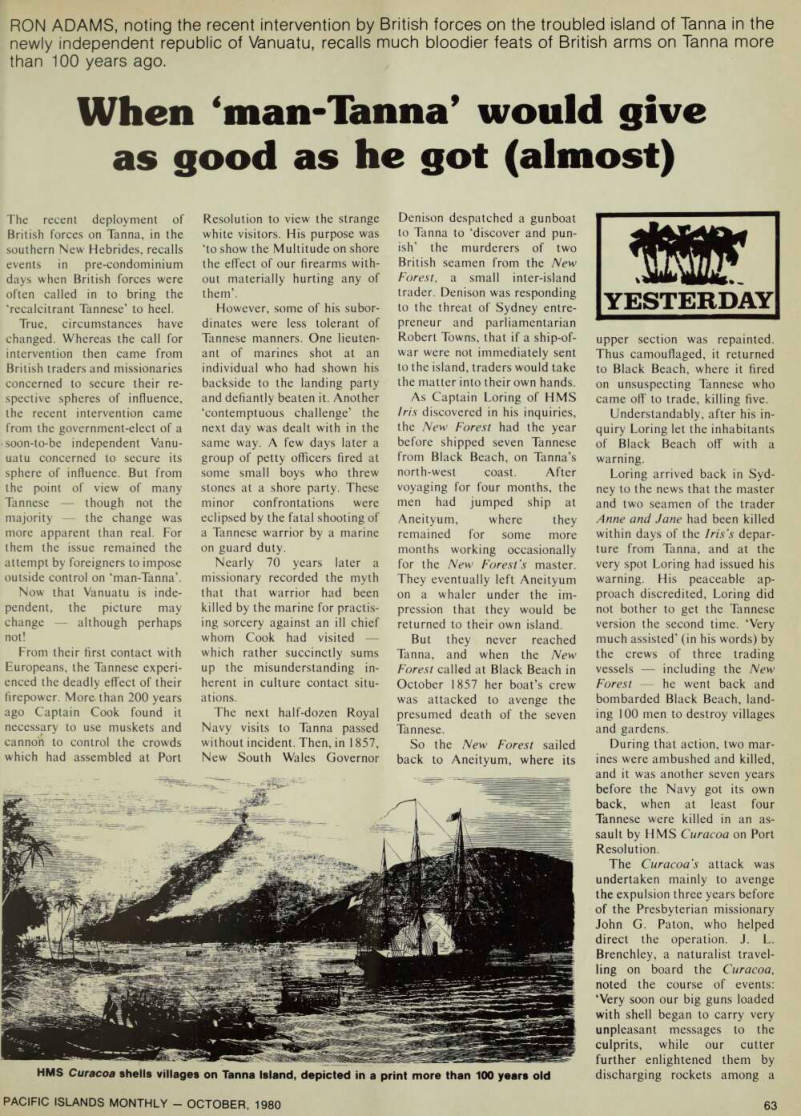
During that action, two mar ines were ambushed and killed, and it was another seven years before the Navy got its own back, when at least four Tannese were killed in an as sault by HMS Curacoa on Port Resolution.
The Curacoa’s attack was undertaken mainly to avenge the expulsion three years before of the Presbyterian missionary John G. Paton, who helped direct the operation. J. L.
Brenchley, a naturalist travel ling on board the Curacoa, noted the course of events: ‘Very soon our big guns loaded with shell began to carry very unpleasant messages to the culprits, while our cutter further enlightened them by discharging rockets among a
HMS Curacoa shells villages on Tanna Island, depicted in a print more than 100 years old
great crowd of natives that clustered about the harbour.
This overture continued for some hours, when the more serious business of the day began by the landing of some 170 men, who were to penetrate into the island, and commit such devastation as was in their power.’
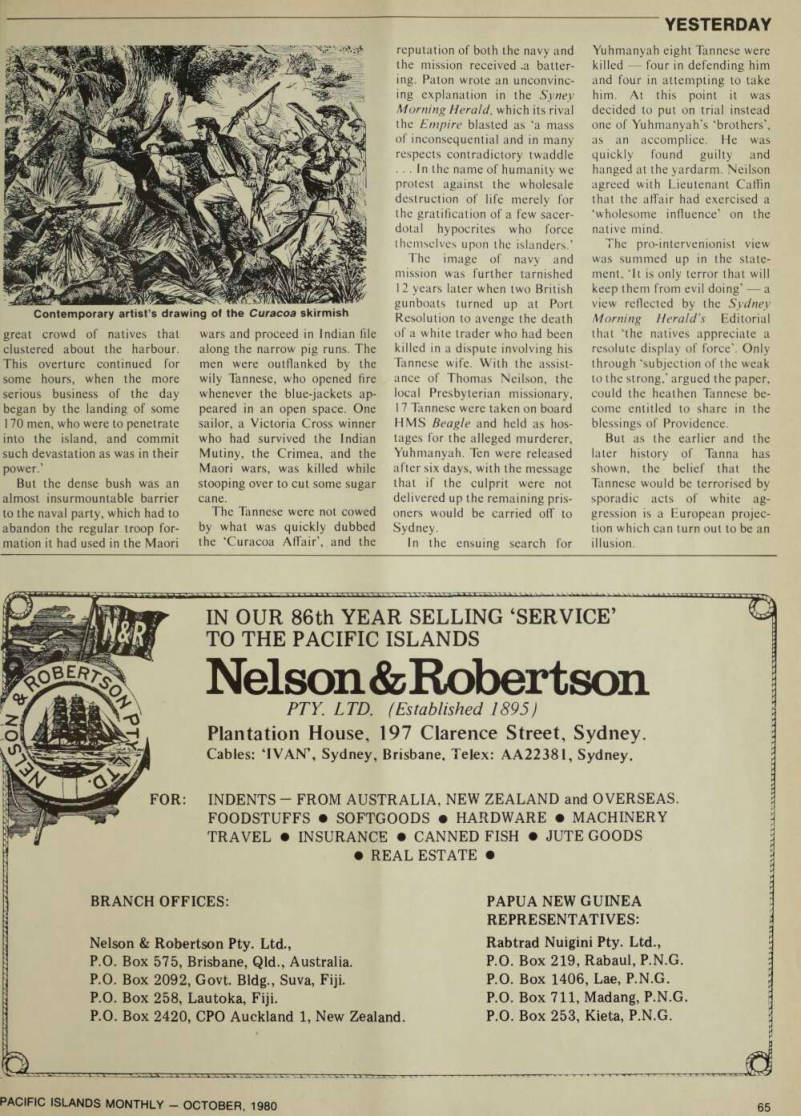
But the dense bush was an almost insurmountable barrier to the naval party, which had to abandon the regular troop for mation it had used in the Maori
wars and proceed in Indian file along the narrow pig runs. The men were outflanked by the wily Tannese, who opened fire whenever the blue-jackets ap peared in an open space. One sailor, a Victoria Cross winner who had survived the Indian Mutiny, the Crimea, and the Maori wars, was killed while stooping over to cut some sugar cane.
The Tannese were not cowed by what was quickly dubbed the ‘Curacoa Affair’, and the
reputation of both the navy and the mission received .a batter ing. Paton wrote an unconvinc ing explanation in the Syney Morning Herald, which its rival the Empire blasted as ‘a mass of inconsequential and in many respects contradictory twaddle ... In the name of humanity we protest against the wholesale destruction of life merely for the gratification of a few sacer dotal hypocrites who force themselves upon the islanders.’
The image of navy and mission was further tarnished 12 years later when two British gunboats turned up at Port Resolution to avenge the death of a white trader who had been killed in a dispute involving his Tannese wife. With the assist ance of Thomas Neilson, the local Presbyterian missionary, 17 Tannese were taken on board HMS Beagle and held as hos tages for the alleged murderer, Yuhmanyah. Ten were released after six days, with the message that if the culprit were not delivered up the remaining pris oners would be carried off to
Sydney.
In the ensuing search for
Yuhmanyah eight Tannese were killed four in defending him and four in attempting to take him. At this point it was decided to put on trial instead one of Yuhmanyah’s ‘brothers’, as an accomplice. He was quickly found guilty and hanged at the yardarm. Neilson agreed with Lieutenant Caffin that the affair had exercised a ‘wholesome influence’ on the native mind.
The pro-intervenionist view was summed up in the state ment, ‘lt is only terror that will keep them from evil doing’ a view reflected by the Sydney Morning Herald’s Editorial that ‘the natives appreciate a resolute display of force’. Only through ‘subjection of the weak to the strong,’ argued the paper, could the heathen Tannese be come entitled to share in the blessings of Providence.
But as the earlier and the later history of Tanna has shown, the belief that the Tannese would be terrorised by sporadic acts of white ag gression is a European projec tion which can turn out to be an illusion.
Contemporary artist’s drawing of the Curacoa skirmish