Relaxed atmosphere, friendly
pp. 59-61 · Read in the full issue
New Caledonia
Relaxed atmosphere, friendly people, incomparable food
lAN DOWNS turns in a highly positive report on New Caledonia as a destination for budget-conscious holiday-makers interested in making a short visit. He writes not only of Noumea, but of attractive country trips as well. lan Downs is a former district commissioner in Papua New Guinea who became an MR and planter there. He is now a writer living in Australia. His history of the Australian trusteeship in PNG is to be published later this year.
For holiday-makers looking for something different on a short tour, but frightened by the high costs of travel, New Caledonia is still a bargain. The big island has been French since 1853 and among the small capitals of Oceania, Noumea is that rarity: an established cosmopolitan city with a distinctive character of its own. In contrast, the almost deserted countryside has good roads leading to quiet bays, high mountains, verdant valleys and grassy plains. New Caledonia is 1455 km from Brisbane and regular flights by Air Pacific make the journey in not much more than 100 min utes. A package tour of seven to eight days can include air fare, accommodation and a rented car for less than SASSO per person. If you wish, you have the option of delivering yourself to Club Mediterranee to enjoy organised activities and glamor ous surroundings centred on the Chateau Royal.
Intending travellers should allow two clear days to get more than just a glimpse of Noumea, the first at the beginning of the holiday to explore and get
oriented, and the second on the day before leaving New Cale donia. The best way to see the city is to walk. You can get downtown from the hotels that ring the waterfront of the Baie des Citrons and Anse Vata by boarding a small public bus.
Taxis are expensive and, until you know your way, self-driving exposes you to hazards of one way traffic and difficult park ing.
There is an abundance of information on what to see in brochures and guide books.
Noumea is indelibly French and everyone speaks that language, but English is under stood in shops, banks and ho tels. Courteous visitors, whether lost or looking for a particular place, will receive friendly courtesy and help in return. Most shops, businesses and banks are open by 7.45 am, but close again from 11.45 to 2 pm. A visit to the central market near the main bus terminal is well worth an early morning bus ride at 6.30 am. By 9 o’clock there will be nothing left to see.
The old colonial buildings of
a bygone convict heritage, and the more modern multi-cultural atmosphere of the Quartier Latin, should not be over looked. For determined walkers who want to get out of town, the restaurant and surrounding for est on Mount Koghi, overlook ing the city and with excep tional views to the reef beyond, is a worthwhile goal. For those less determined, or without time to spare, the restaurant can be reached in about 10 minutes by car.
Even if your stay is limited, get out of Noumea as soon as you can. Tour operators tend to keep you too long in Noumea and then send you round the island (which is roughly 400 km long and 50km wide) too fast to get more than a hasty look.
New Caledonian beaches don’t compare with those in Australia and for this reason the ‘off season’ months of June and July (when the climate is cooler) are the best for touring the country side.
Those in search of Melane sian villages will find them tucked away in the mountain valleys, or on the far north-east coast. Elsewhere, the hamlets are small and more European than indigenous. In New Caledonia all the people are citizens of France and most of them seem happy and relaxed in an island where industry, agriculture, health, education and welfare are all subsidised by metropolitan France.
To get the ‘feel’ of the island a drive of 170 km to the El Kantara motel near the beach Jskm from Bourail, via La Foa and Moindou, is an easy first day. Short drives in this area could include a morning on the beach (Plage de Poe) a climb down the cliffs to Turtle Bay, or an inland drive from Bourail to
Bouirou and Pothe, returning by way of Camp de Nandai.
Bourail itself has an old-world colonial atmosphere of its own.
Depending on time available, you can either cross the island from Bourail to the east coast and go north to Hienghene, or drive back to Sarramea a few kilometres inland from La Foa.
Spend the night in the motel Evasion 130, situated in the middle of an old coffee plan tation in a green valley. From Sarramea you can cross the mountains to Canala, and re-
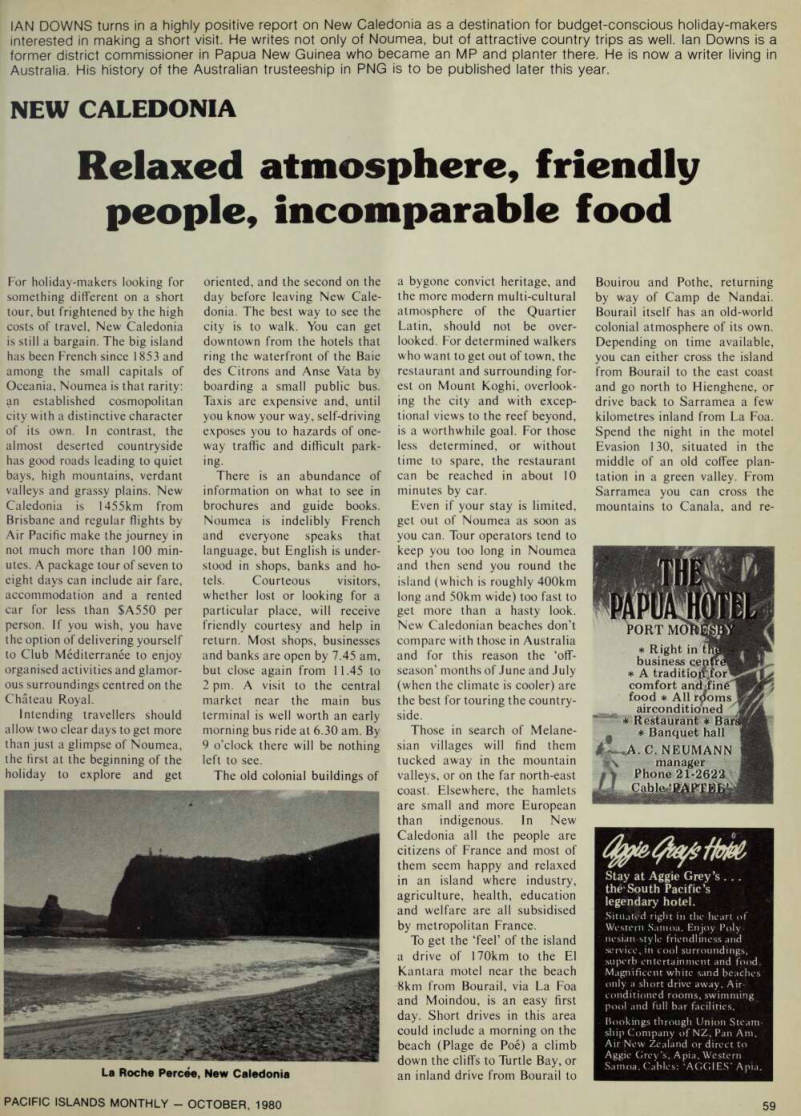
La Roche Percée, New Caledonia
turn by way of Thio and Bouloupari to Noumea.
Both El Kantara and Evasion 130 are quiet places in the off season. They are managed by charming families who provide wonderful meals. At El Kan tara, you can play tennis or
charter a boat for a reef excursion or deep-sea fishing.
At Evasion you can go for forest walks or horse-riding. Both mo tels are clean, restful, scenic places. They both have swim ming pools, and are ideal for travellers with young children.
The exchange rate in July 1980 for Australian dollars in travellers cheques was 80 CFP to the Australian dollar more or less. Cost of living, and in flation, are a little higher than in Australia. Noumea is gener ally more expensive than the countryside. New Caledonians spend their money mostly on food, wine and clothes, and they pay more than Australians for all of them. Wages range from $4OO per month for an un skilled, poorly educated casual rural worker, to $7OOO per month for professional people.
Salaries and wages are varied by a consumer price index.
Import duties on goods from France are generally lower than those from elsewhere. Some foreign goods can’t be imported at all, for example Australian wine.
In a population of fewer than 150 000, roughly 38 per cent are French or other European, 42 per cent indigenous Melane sian, 12 per cent migrants from French Polynesia and 5 per cent from Asia. More than half the population live in or near
Noumea. There are over 40 000 motor vehicles, and new regis trations average 3800 a year.
Food is universally excellent whether you dine in an expens ive hotel or in a cafe favoured by workers during the long lunch-break. No one seems to take lunch to office or work place and all appear to enjoy three courses and a bottle of wine. A relatively inexpensive lunch of soup, scallops, sole and coffee would cost $9. French wine can be bought for less than $4 a bottle, but anything under $lO is well below Australian standards. However a continen tal breakfast will not cost more than $3 and a careful tourist can find a delicatessen and prepare lunch less expensively.
If you must have alcohol buy a bottle of Scotch at the duty-free shop before leaving, and add Vichy water (at $2 a large bottle) when you get to Noumea.
When you get home from New Caledonia you will re member friendly people, a relaxed atmosphere and incom parable food.
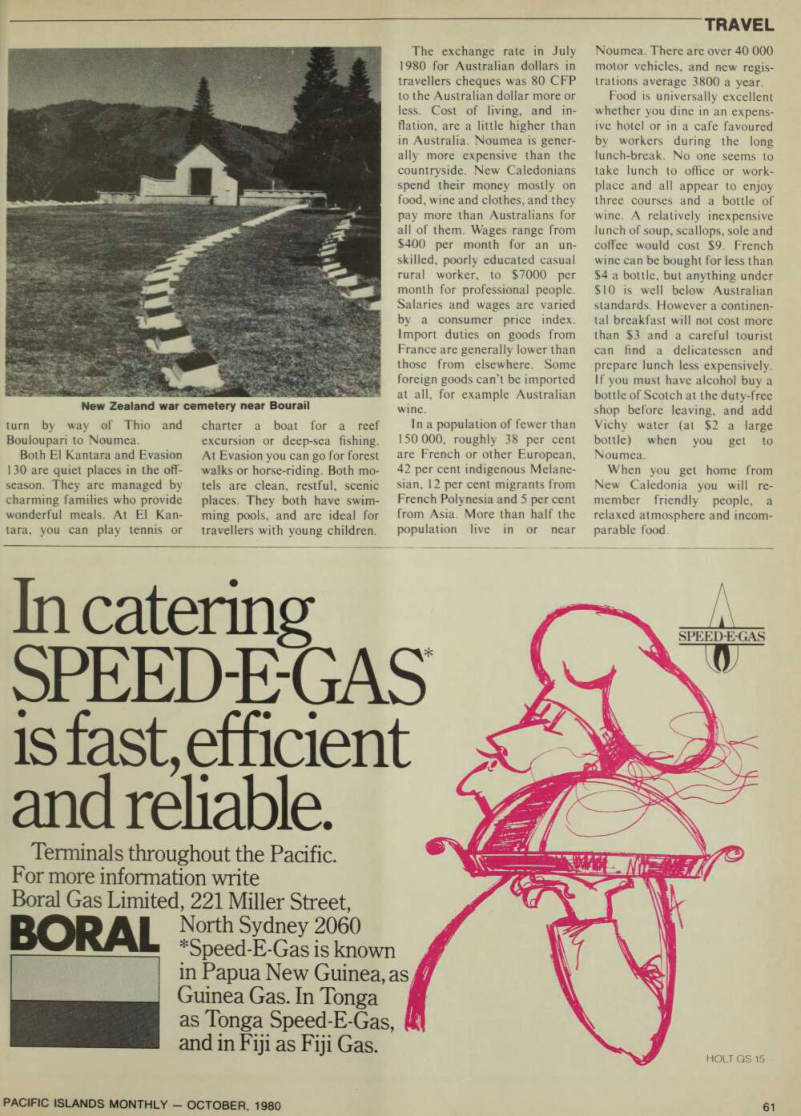
New Zealand war cemetery near Bourail