Easter Island: Two
pp. 55-57 · Read in the full issue

kinds of wine
The Eighth Land. By Thomas S. Barthel. Translated from German by Anneliese Martin.
Published by the University Press of Hawaii, Honolulu.
Isbn 0 8248 0553 4. $U517.50.
Rapa Nui. By Michel Rougie.
Published by Editions Delroisse,
Boulogne, France, for the
Chilean National Tourism Ser vice, Santiago. ISBN 2 85518 046 5. Price unstated.
Easter Island is a place that most people have heard of and (still) few people have visited.
Michel Rougie’s Rapanui Thomas Barthel’s The Eighth Land provide, in their different ways, information and specu lation about that most remote of the Pacific islands.
Both ‘Eighth Land’ and ‘Rapanui’ are local terms used by the Islanders to describe their homeland.
Rougie’s book seems to have been published in 1979, though no such details are provided either by the author or the
printer.
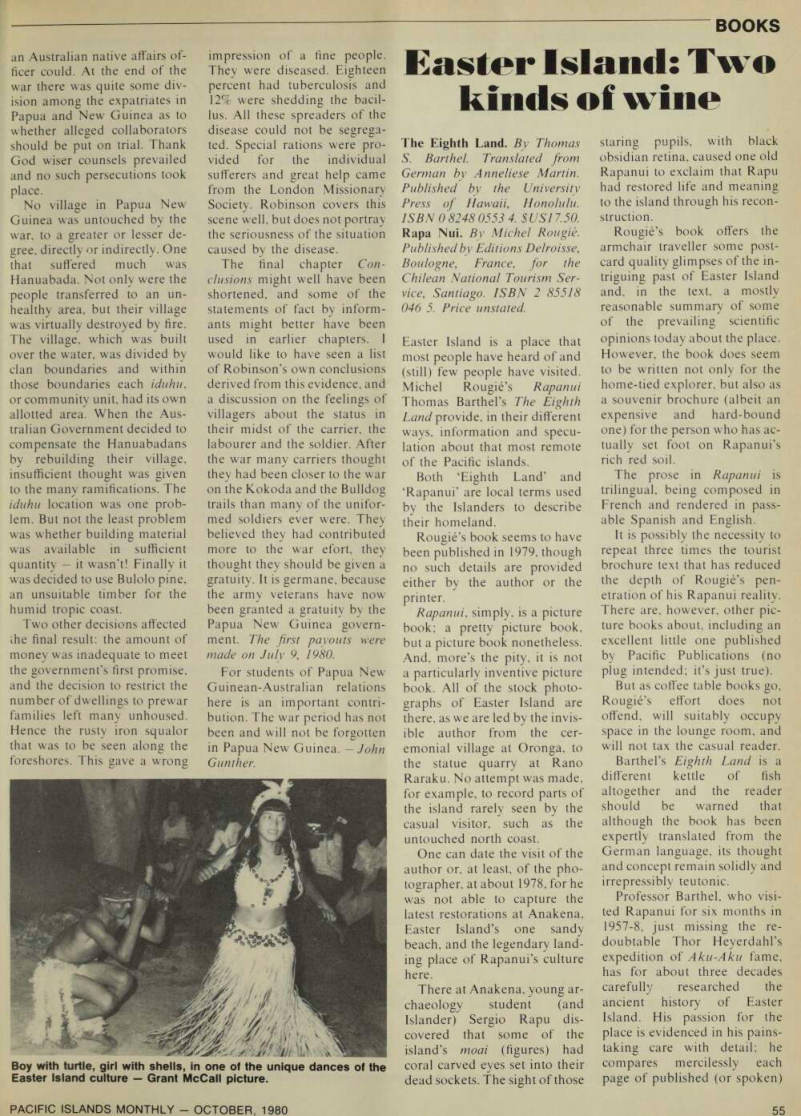
Rapanui, simply, is a picture
book; a pretty picture book, but a picture book nonetheless.
And, more’s the pity, it is not
a particularly inventive picture
book. All of the stock photo graphs of Easter Island are there, as we are led by the invis ible author from the cer emonial village at Oronga, to the statue quarry at Rano Raraku. No attempt was made, for example, to record parts of the island rarely seen by the casual visitor, such as the untouched north coast.
One can date the visit of the author or, at least, of the pho tographer, at about 1978, for he was not able to capture the latest restorations at Anakena, Easter Island’s one sandy beach, and the legendary land
ing place of Rapanui’s culture
here.
There at Anakena, young ar chaeology student (and
Islander) Sergio Rapu dis
covered that some of the island’s moai (figures) had coral carved eyes set into their dead sockets. The sight of those
staring pupils, with black
obsidian retina, caused one old Rapanui to exclaim that Rapu had restored life and meaning to the island through his recon struction.
Rougie’s book offers the armchair traveller some post card quality glimpses of the in triguing past of Easter Island and, in the text, a mostly reasonable summary of some of the prevailing scientific
opinions today about the place.
However, the book does seem to be written not only for the home-tied explorer, but also as a souvenir brochure (albeit an expensive and hard-bound one) for the person who has ac tually set foot on Rapanui’s rich red soil.
The prose in Rapanui is
trilingual, being composed in
French and rendered in pass
able Spanish and English.
It is possibly the necessity to repeat three times the tourist brochure text that has reduced the depth of Rougie’s pen etration of his Rapanui reality.
There are, however, other pic ture books about, including an excellent little one published by Pacific Publications (no plug intended; it’s just true).
But as coffee table books go, Rougie’s effort does not offend, will suitably occupy space in the lounge room, and will not tax the casual reader.
Barthel’s Eighth Land is a different kettle of fish altogether and the reader should be warned that although the book has been expertly translated from the German language, its thought and concept remain solidly and
irrepressibly teutonic.
Professor Barthel, who visi ted Rapanui for six months in 1957-8, just missing the re doubtable Thor Heyerdahl’s expedition of Aku-Aku fame, has for about three decades carefully researched the ancient history of Easter Island. His passion for the place is evidenced in his pains taking care with detail; he compares mercilessly each page of published (or spoken)
information. He examines with minute care the different ver sions of the story he seeks to tell, rolling each fact on his mind’s tongue, like some zealous wine/data taster.
The vintage Barthel pro duces is not Rougie’s cheap plonk, pretty white, but a robust, complex, dark red wine. Like those full bodied reds, however. Barthel’s book can give one a headache if it is consumed too rapidly or in too great a quantity at one time.
Whereas Rougie’s photo
book is mainly pictures and little significant text, Barthel has produced his study without a single photograph or draw ing, unless one counts the plate opposite the title page, which is a copy of a page of the mys terious Manuscript E.
Now, all travellers to Rapanui since the last century have hoped to come away from the place with some souvenir, some treasure. For whalers, they sought food and water; for others, the missionaries, they sought souls. And, later on, scientists came to solve the mystery of the small isolated land with the huge stone monuments.
Barthel, too, went to Rapanui on a quest and it was nothing less than to find evi dence to enable him to de
cipher the precious rongo
rongo tablets. Rongo-rongo seem to be mnemonic records of ancient stories, beliefs, and customs, but their translation has eluded experts (including Barthel, it should be said) since the missionaries first stumbled across them as (to them) scrap timber.
In order to achieve his goal, Barthel enlisted the aid of a number of Islander informants and, he believes, gained access to a secret manuscript written,
conveniently, in plainly legible
Rapanui in a school copy book.
One particular family pro
vided Barthel with his notes; in fact, his main informants were a group of brothers, sons of Easter Island’s first catechist. It is clear that the opinions and ideas of this family have largely formed his understand ing of what ancient Rapanui was about.
The 372 pages of closely
packed text begins with an ex ploration of the origin of the Rapanui, carrying on with the ancient discovery of the island by its early inhabitants. There are certain details of the found ing days of the island’s popu lation, including violent clan conflicts, the section conclud ing with the death of the cul ture hero, the ‘Great Parent’.
A tenth chapter begins
Barthel’s speculations about the origin and function of the
huge stone figures, with just a
hint that a further book treat ing that subject may be on its way to us.
Many readers will not share Professor Barthel’s taste for the details of ancient Rapanui life,
especially when these points
are compared with and cross referenced to the work of pre vious authors. Throughout his
exposition, the final authority
for his reconstructions remains his precious Manuscript E and the last 50 pages of his book contain it in full, in the original
Rapanui.
The Eighth Land is a schol arly book intended, for the most part, for the specialist.
But there is a quiet, conver sational tone about the prose that, while not economical of pages, makes the book seem rather like an assured, if some times dull, chat with a learned
gentleman.
The chat with the learned gentleman Barthel is much to be preferred to the slide show served up by the amateur Rougie. Grant McCall.
Tonga's King:
A big man who
thinks big
His Majesty King Taufa’ahau Tupou IV of the Kingdom of Tonga. By ’Amanaki Taulahi.
Published by the Institute of Pa
cific Studies, University of the
South Pacific. No price given.
King Taufa’ahau Tupou IV, of Tonga, is a big man who thinks big. He is an international fig
ure, making frequent visits
overseas, meeting people in
high places in government and
industry, always looking for
something to better the life of his people.
His attempts to attract huge
foreign investment in Tonga
have met with little success, but that does not at all alter the fact that he has the welfare of his country at heart.
His efforts to secure overseas investment are well documented, mostly in the columns of overseas news papers, and in the local news paper, The Tonga Chronicle , which faithfully reports his speeches from the throne at the opening and closing of the
legislative assembly. But there
is no reference to any of his flir tations with overseas capital in
this biography.
It is a slim volume, with a mere 23 pages of text, more like an extended item in Who's Who than anything else. It in cludes his own and his wife’s (Queen Mata’aho) genealogi cal lines and a bibliography.
However, there are good
general descriptions of import
ant events in Tonga during the
king’s lifetime, especially his
coronation. The biography tells that he was educated at
Newington College, Sydney,
and Sydney University, but
says little of his life at those in stitutions. He must surely have been associated with the odd college prank or two, but we learn nothing of such things.
King Taufa’ahau Tupou IV,
as Prince Tungi, was premier of Tonga from 1949 to 1966, when he succeeded hs mother.
Queen Salote, as monarch. As premier he used his influence to further the kingdom’s edu cation system, and to develop the marketing of produce at home and overseas. He also initiated several development
projects, including the setting
up of a shipping line, the build ing of wharves, and the Dateline Hotel.
The expression ‘profusely
illustrated’ is a well-worn cliche, but it does apply to this book. There are 20 pages of
pictures depicting life in Tonga
and events in the life of the king. The many pictures of the king include one taken with another monarch, Queen Elizabeth 11, when she visited Tonga in 1970.
Overall, it is a useful refer ence booklet, but it leaves one with the feeling that a lot more could have been said in it. - Norman Baxter.
Getting to
know
Hawaii’s
Molokai
Molokai The Friendly Isle.
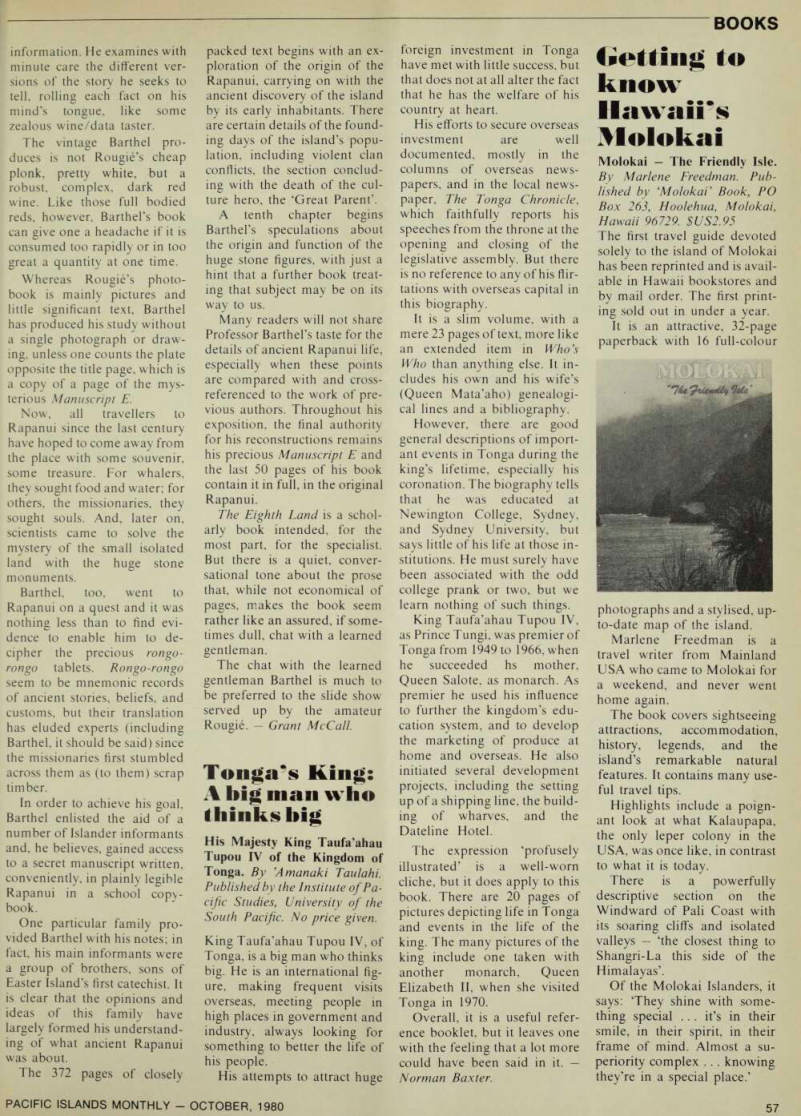
By Marlene Freedman. Pub lished by ‘ Molokai ’ Book, PO Box 263, Hoolehua, Molokai, Hawaii 96729. 5U52.95 The first travel guide devoted solely to the island of Molokai has been reprinted and is avail able in Hawaii bookstores and by mail order. The first print ing sold out in under a year.
It is an attractive, 32-page paperback with 16 full-colour
photographs and a stylised, up to-date map of the island.
Marlene Freedman is a travel writer from Mainland USA who came to Molokai for a weekend, and never went
home again.
The book covers sightseeing attractions, accommodation,
history, legends, and the
island’s remarkable natural features. It contains many use ful travel tips.
Highlights include a poign
ant look at what Kalaupapa,
the only leper colony in the
USA, was once like, in contrast to what it is today.
There is a powerfully descriptive section on the Windward of Pali Coast with its soaring cliffs and isolated valleys ‘the closest thing to Shangri-La this side of the
Himalayas’.
Of the Molokai Islanders, it says; ‘They shine with some
thing special ... it’s in their
smile, in their spirit, in their frame of mind. Almost a su
periority complex .. . knowing
they’re in a special place.’