World War II and the
pp. 53-55 · Read in the full issue

Books
World War II and the villagers of PNG
Villagers at War: Some Papua New Guinean Experiences in World War 11. By Neville K.
Robinson. Pacific Research Monograph No. 2 (E. K. Fisk, ed). Published by the A ustralian National University Press, Can berra, 1979. ISBN 0 908160 29
1. Sab.
This is a very worthwhile pub lication, written by a Guyanan, but now a resident of Papua New Guinea, and written suf ficiently long after the war for most of the bitterness to have gone out of personal experi ences some of that bitterness is, however, kept alive in Vin cent Eri’s The Crocodile. Those who actually had presents and money earned from selling artefacts confiscated by ANGAU officers will never forget the humiliation.
The book has six chapters and a large number of appen dices, some of which might well have been fitted into the text. The first chapter is prob ably the best short, short account of the Australian mili tary campaigns in Papua and in New Guinea I have read. One sentence in it interests me per sonally. Robinson says: The wounded Australians were evacuated by air once more from Myola.’ The army with out prior reference to the air force decided that Myola (an old crater lake) about 200 m above sea level could be used as an air evacuation centre.
After an inspection by the RAAF senior air staff officer and by the legendary Jerry Pentland. who would go wher ever man and plane could go. and to some places where they shouldn’t try, had said it was not on, the army persisted, calling the air force cowards.
They chartered a prewar New
Guinea flyer. Tommy O’Dea
and his tri-motored Ford. He made one successful trip. On the second he crashed, com
pletely writing-off his aero
plane and greatly and
permanently incapacitating
himself. That was the end of Myola as an evacuation centre.
Only 43 patients were ever taken out of Myola.
The second chapter deals with ANGAU, and much of it is given over to the need to re cruit labour. One must have a certain sympathy with the ANGAU officials who were trying to meet the demands of war, and at the same time be benevolent native adminis trators. In December 1942 by unconventional means Lt-Col E. Ford, who was senior malariologist, Australian army in New Guinea, in all but name, obtained an interview with Commander-in-Chief General Blarney. Ford saw the malaria situation as desperate.
It is said his opening gambit was: T don’t want you to think General you are losing your army in Milne Bay, you have already bloody well lost it.’
Blarney’s response was to tell Ford he would have his head if he were wrong. But Ford was well armed with facts and Blarney asked him what he wanted. He asked for ‘a bat
talion of pioneers’ to start mos quito control. Blarney said there was no such unit in the AIF. but ‘would native labour do?’ Ford asked for ‘a thou sand’. Blarney got on the tele phone and demanded 1000 labourers be delivered 500 to Col Ford at NG Force Head quarters, Port Moresby, and 500 to Col Maitland. Assistant Director Medical Services, Milne Force, the following day: whoever was on the other end of the telephone obviously demurred on the ground of short notice or shortage of labourers in the holding camps.
The C-in-C exploded and said it would be done. It was! Thus ANGAU was suddenly 1000 short in its workforce, which could only mean more intense
recruiting.
The chapter on The Toaripi Villages in the War is mostly taken up with the labour needed for the Bulldog trail. It was impressed labour. Not only was the trail harsh but some areas were infested with
mosquitoes; the carriers on the trail had to pass through Kukukuku country, a people they greatly feared: and their ration scale, when they got it, was quite inadequate for the energy required. Robinson’s report does not say whether a request for mosquito nets, even butter muslin was accepted; or whether Major Mack’s de mand that coastal labourers should not be asked to work in the very bitter cold and the wet at Heinan’s camp at 3000 m was acted on. Mack, ANGAU’S ADMS, who before he did medicine had been a plan tation overseer in New Guinea warned of ‘desertions and a risk of them going over to the enemy’. In general the native affairs field staff seem to have been sympathetic to the villagers, but once they were obliged to act to meet the de mands for labour at the expense of the village society they resorted to such jingoism as ‘Those who were recruited “went to work with a smile’’.’ - Some deserters were caned ‘on the spot’. One officer seems to have strongly advocated public floggings as an effective deterrent against desertion.
That same officer was the sheriff, if not the hangman, at the public execution of Tuya who as a Japanese collaborator from Butibum murdered an Australian officer. The ANGAU officer was furious when the villagers failed to get to the public hanging on time.
The fifth chapter covers Butibum village near Lae. The author spells it Butibam. The last edition of the Village Directory I have is 1960. It uses -um and not -am. The Butibum villages had every reason to be lieve they had new masters the Japanese that they did not co-operate totally with the
Japanese is of psychological
interest, especially as their Japanese contact appears to have cared for them as well as
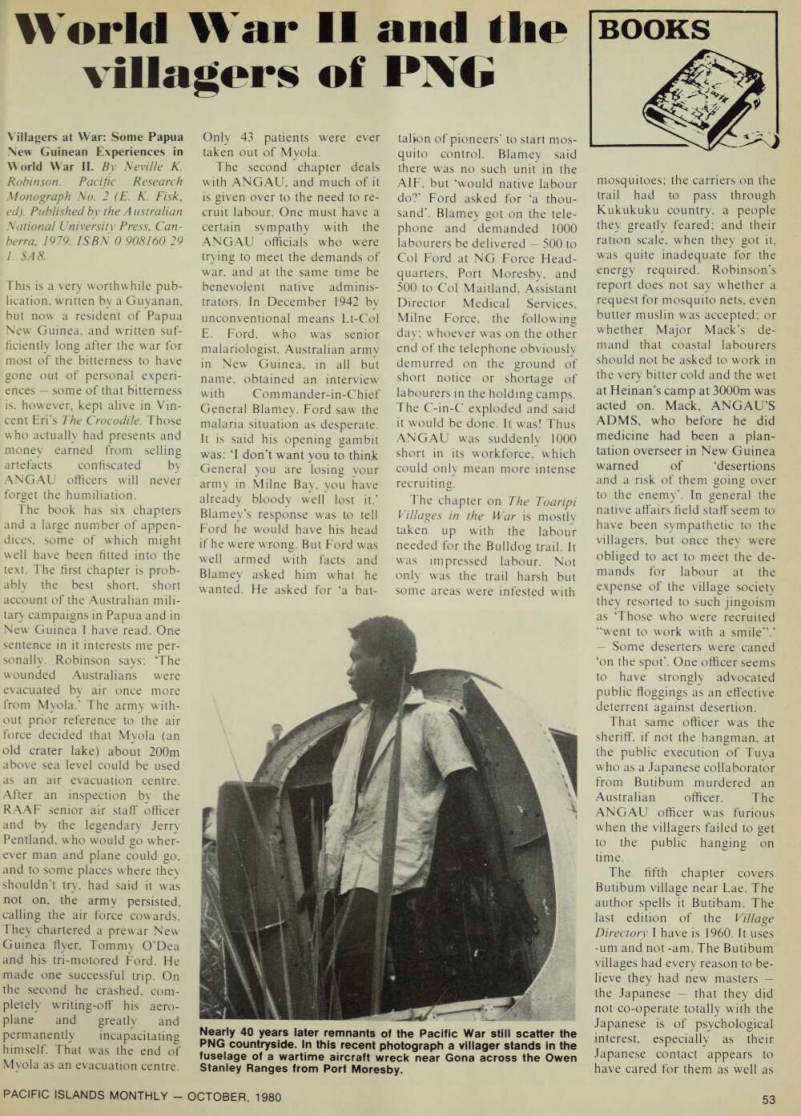
Nearly 40 years later remnants of the Pacific War still scatter the PNG countryside. In this recent photograph a villager stands in the fuselage of a wartime aircraft wreck near Gona across the Owen Stanley Ranges from Port Moresby.
an Australian native affairs of ficer could. At the end of the war there was quite some div ision among the expatriates in Papua and New Guinea as to whether alleged collaborators should be put on trial. Thank God wiser counsels prevailed and no such persecutions took
place.
No village in Papua New Guinea was untouched by the war, to a greater or lesser de gree, directly or indirectly. One that suffered much was Hanuabada. Not only were the people transferred to an un healthy area, but their village
was virtually destroyed by fire.
The village, which was built over the water, was divided by clan boundaries and within those boundaries each iduhu , or community unit, had its own allotted area. When the Aus tralian Government decided to compensate the Hanuabadans
by rebuilding their village,
insufficient thought was given
to the many ramifications. The iduhu location was one prob lem. But not the least problem was whether building material was available in sufficient quantity it wasn’t! Finally it was decided to use Bulolo pine, an unsuitable timber for the humid tropic coast.
Two other decisions affected the final result: the amount of money was inadequate to meet
the government’s first promise,
and the decision to restrict the number of dwellings to prewar families left many unhoused.
Hence the rusty iron squalor that was to be seen along the foreshores. This gave a wrong
impression of a fine people.
They were diseased. Eighteen percent had tuberculosis and 12% were shedding the bacil lus. All these spreaders of the disease could not be segrega ted. Special rations were pro vided for the individual sufferers and great help came from the London Missionary Society. Robinson covers this scene well, but does not portray the seriousness of the situation caused by the disease.
The final chapter Con clusions might well have been shortened, and some of the statements of fact by inform ants might better have been used in earlier chapters. I would like to have seen a list of Robinson’s own conclusions derived from this evidence, and a discussion on the feelings of villagers about the status in their midst of the carrier, the labourer and the soldier. After the war many carriers thought they had been closer to the war on the Kokoda and the Bulldog trails than many of the unifor med soldiers ever were. They believed they had contributed more to the war efort, they
thought they should be given a
gratuity. It is germane, because the army veterans have now
been granted a gratuity by the
Papua New Guinea govern ment. The first payouts were made on July 9, 1980.
For students of Papua New Guinean-Australian relations here is an important contri bution. The war period has not been and will not be forgotten in Papua New Guinea. - John Gunther.
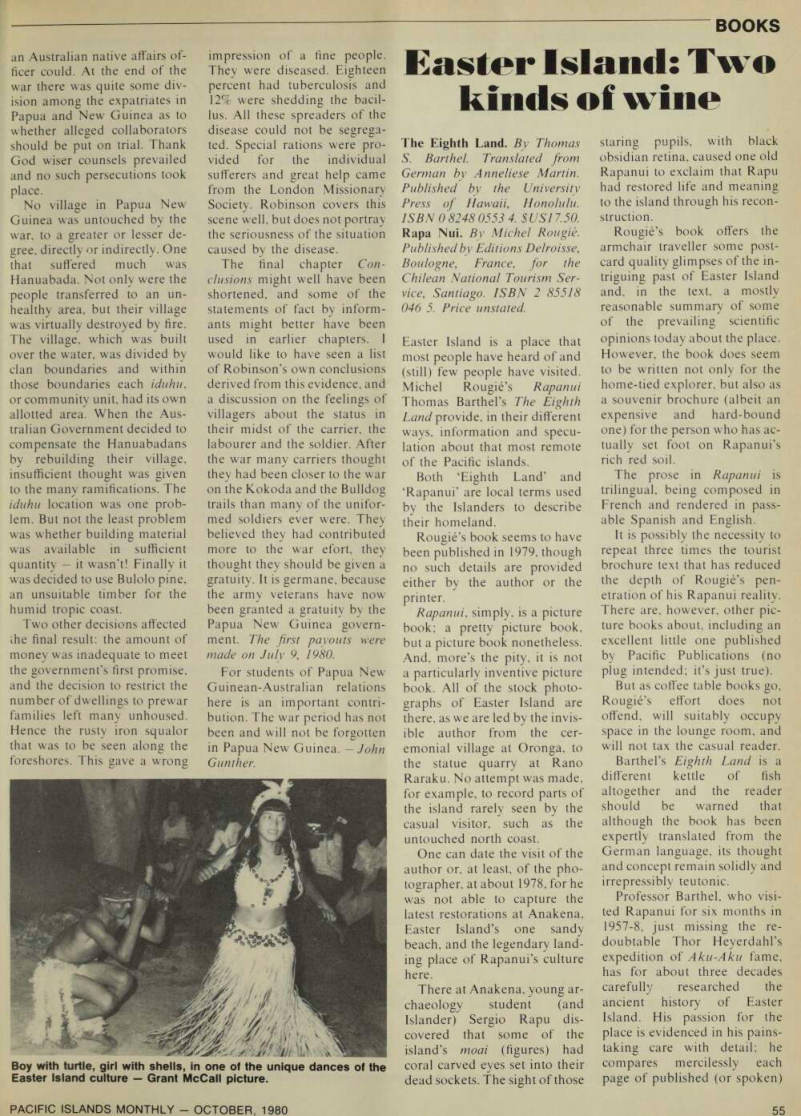
Boy with turtle, girl with shells, in one of the unique dances of the Easter Island culture - Grant McCall picture.