Luring Fiji youth
pp. 45-52 · Read in the full issue

back to the land
It has always been a difficult task to convince modern Fiji youth that agriculture holds a bright future for them. But if examples could help them get more agriculture-minded, a classical example would be that of two Kadavu youths still in their early teens.
The boys, Marika and Timoci, of Lawaki Village in
Kadavu, start their day on their farms at first light just when others are getting ready for school.
During a recent tour of Kadavu, Minister for Agricul ture and Fisheries Jonati Mavoa just could not go past the boys working in their dalo plantations before seven in the morning. He chatted with them and said a bright future awaited Fiji youths who go on the land.
Unemployment was hinder ing development, and if young people only realised the poten tial of making agriculture one’s profession, this world-wide problem would be closer to sol ution. he said.
The amount of work done by the boys is indeed impressive.
They have already planted
about two square chains of dalo and yams, inter-cropped
with vegetables.
Fourteen year-old Timoci said they allocate the morning to his farm and the afternoon to Marika’s, about a kilometre away.
For both, the fact that their primary education came to an end due to financial problems, was the turning point. Their first cabbage crop, grown after Cyclone Meli, found a market at the nearby Kavala Junior Secondary School, and the boys have already tasted the re wards of their labours: they’re earning money at an early age. ‘We’re planning to take our dalo to the Suva market when it’s ready for harvesting,’ said Timoci.
Mr Mavoa said; ‘Convincing
modern youth that agriculture
does not only mean dirtying one’s hands should be
emphasised in Fiji’s schools.’
Recently the Fiji Institute of
Agricultural Science
emphasised farming as a pro fession to students.
The institute’s secretary, Bal Chand Karan, said they organised a series of exhi bitions starting in May where students were told that agricul ture needed people with skills and dedication. He acknowled ged that most students prefer ‘white collar’ jobs, and do not realise the potential of agricul ture as a career.
In another initiative, a Ministry of Youth and Sporl-
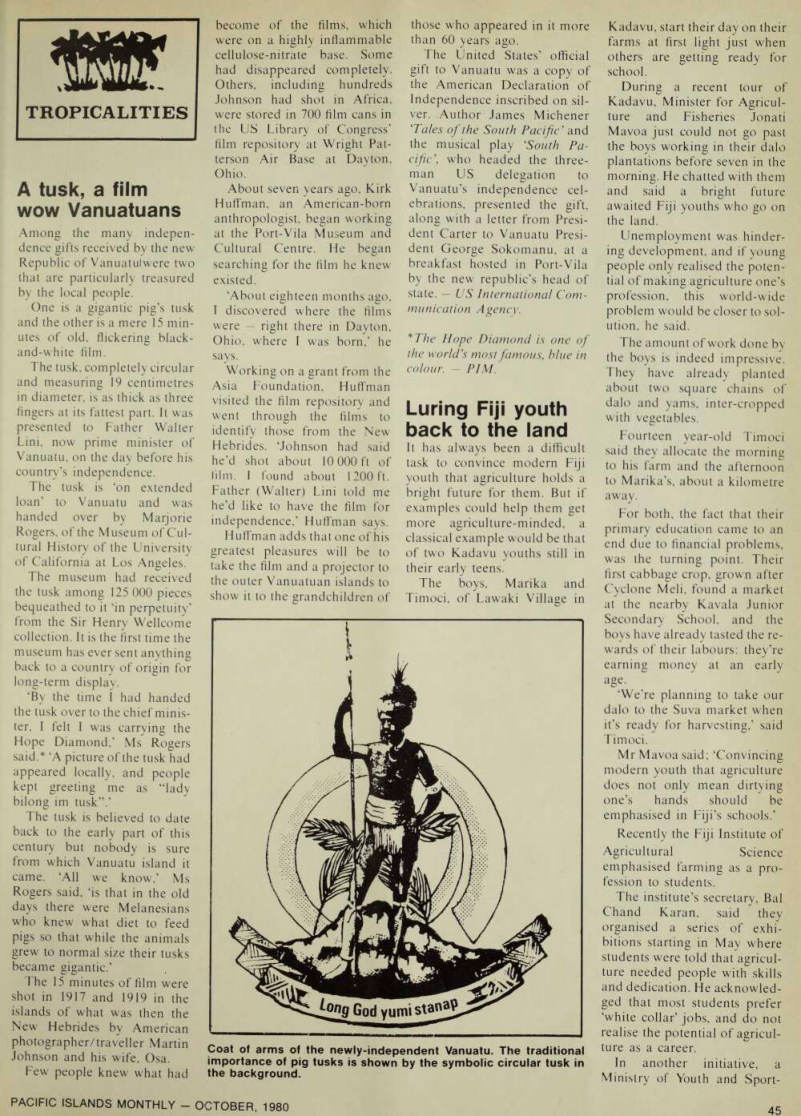
Coat of arms of the newly-independent Vanuatu. The traditional importance of pig tusks is shown by the symbolic circular tusk in the background.
registered youth body has to date planted about four hec tares of crops at Namada, in
the Sigatoka Valley. The
youths are members of the Gonedau Youth Movement, a body mainly made up of ex prisoners and the unem
ployed.
Its president, Alipate
Baledrokadroka said; ‘Camps are now under construction to provide accommodation for 48 boys from Suva and surround
ing areas.’
The members have a pro gramme to utilize 150 hectares of native land on lease to the
movement. They anticipate
planting vegetables and
rootcrops, before proceeding to livestock farming. Seremaia Tuiteci.
After a binge, a
massage. But ...
Pleas by students forced a woman teacher at Safata Jun ior High School. Western Samoa to act and prevented a sexual attack on a female student by a senior male mem ber of the school staff.
The woman’s act also pre vented a certain attack on the attacker by the school’s male students.
The incident, according to The Times' correspondent, oc curred at the rounding up of a
three-day drinking spree by
four male staff members.
The attack on the student
followed shortly after she was summoned with two other girls to massage the teacher invol ved.
The teacher was completely naked when the girls entered the house, the report said.
Students of the teacher’s class told The Times' cor respondent that the man came in during the morning and set work for them before going back to the party which appar
ently started on Wednesday.
The summons to the girls came later and it was during the massage that the attack
took place.
‘He could have raped the student had we not pleaded with one of the woman teachers to go and see for her self,’ one student said.
Before the rescue was made one student grabbed hold of a bottle and headed towards the house when the woman teacher stopped him. He was followed by other students.
The teacher managed to talk the students out of attacking the male teacher and went to the house herself.
When the student was re leased she was crying.
The headteacher was appar ently busy in his office and was not aware of what was going on. (From The Samoa Times ,
Apia.)
Malaria rate
jumps in PNG
There has been an alarming jump in the incidence of ma laria in Papua New Guinea,
particularly in highland re
gions, according to figures re
cently available from the PNG Department of Health. The Department disclosed that the incidence of malaria in the highlands at the end of 1976 was less than 1% of the popu lation a figure described as ‘acceptable’ - but the incidence had jumped to nearly 20% by the end of last year.
The situation supports fears which have been expressed for several years by senior Aus tralian doctors and health ad ministrators who were associated with the department of health in PNG during the Australian administration there. The Australian adminis tration made malaria control a
top priority expenditure item,
and this policy was instrumen tal in bringing the incidence of malaria down to acceptable levels. After self-government
and independence heavy
expenditure on malaria control ceased to be politically attract ive because the malaria situ ation was fairly stable and there were no ‘visible’ benefits
to be gained by continuing to
spend money on extensive con trols.
The demands of the national electorate for immediate and visible expenditure on roads,
airstrips, bridges, wharves and
communications created press ures which the new govern ment was reluctant to ignore in
allocating its funds. Revisiting
PNG shortly after indepen
dence the former Director of Health, Dr R F Scragg, said he was concerned that malaria control was not being main tained at previous levels. The malaria situation would re main stable for a while, he said, because of earlier work but there was a real danger that it
would then flare up with wide
spread damage to community
health and the national econ omy.
The present rate of expendi ture on malaria control is slightly more than $5 million a year, and senior officials of the Department of Health said last month a much higher allo cation was needed if significant controls were to be applied.
Present-day officials in the
department don’t necessarily
blame political policies for the rising incidence of malaria.
One reason given is that rural development has created new
breeding grounds for malaria
carrying mosquitoes, and that
the development of road links has created greater population
contacts, allowing mosquitoes
to increase the transmission rate of malaria.
PNG used DDT spraying until 1976, using a residual preparation which killed mos quitoes resting on vertical sur faces the position taken by
mosquitoes which have just
finished biting and feeding and are therefore potential links in the malaria transmission cycle.
When the malaria incidence rate began to rise sharply late in 1978 spraying was resumed in some of the worst-affected areas, but there has still been
no general resumption.
One of the biggest problems in malaria control in PNG has been the attitude of villagers who have been reluctant to open their houses and other buildings to allow access by
‘strangers’ carrying spray
pumps. While Australia was administering PNG a firm line
(rightly or wrongly) was
usually sufficient to get the job done, but PNG’s own officials
and presumably their political
leaders have been hesitant to take a firm line under similar circumstances.
Modern malaria control methods accept that it is im possible to eradicate the mos quito which carries the disease, and the methods concentrate instead on breaking the ma laria transmission cycle. At the same time, however, a degree of control is applied to reduc
ing breeding potential to keep
the overall numbers of mos quitoes as low as possible. One of the main problems is the
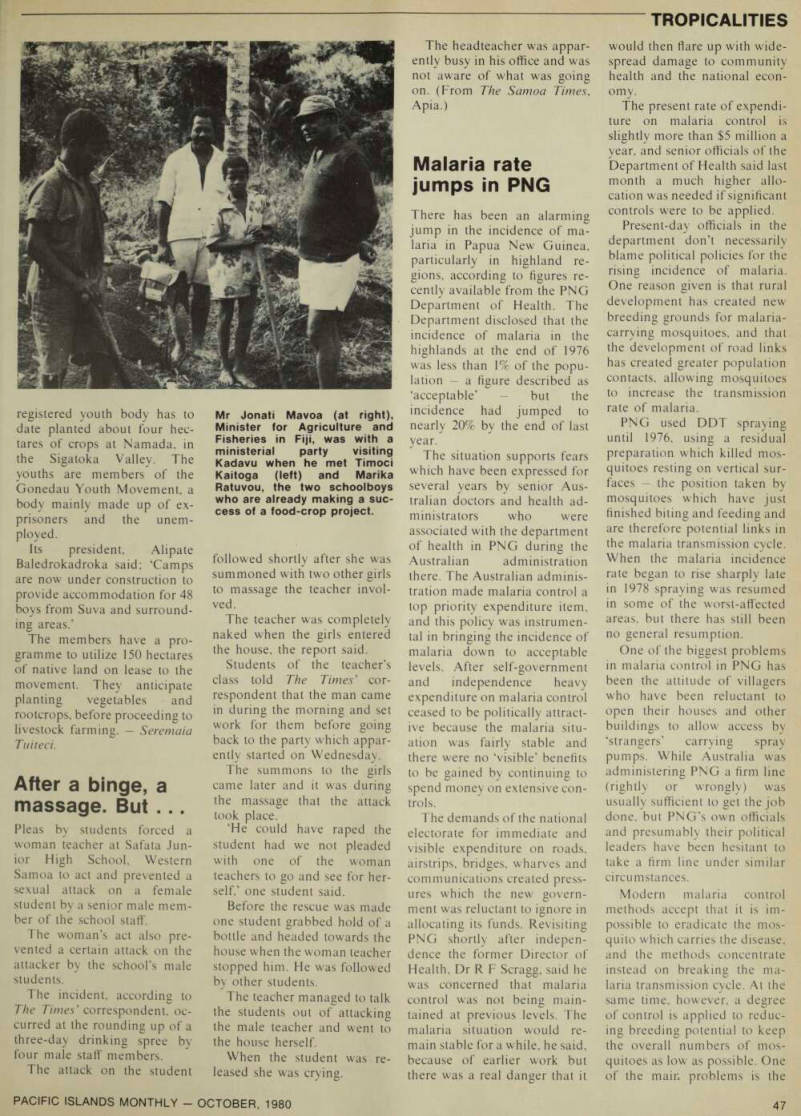
Mr Jonati Mavoa (at right), Minister for Agriculture and Fisheries in Fiji, was with a ministerial party visiting Kadavu when he met Timoci Kaitoga (left) and Marika Ratuvou, the two schoolboys who are already making a suc cess of a food-crop project.
time lag which exists between cause and effect the appli cation of controls takes time to produce results and the relax ation of controls takes time to
develop deterioration.
Critics of what has happened in PNG today believe that the time lag has caught the govern ment napping, and a concen trated and costly campaign will be needed to avoid the damag
ing effects which rising
endemic malaria can bring to community and economy.
Seduction of a
soccer star
Three beautiful girls and a $ll3 ‘bribe’ from an opposing team kept a soccer star out of a big tournament in Fiji, result ing in his team losing the tro phy, the team claims.
The soccer player, Jone Nakosia, admitted he took the money and went on a drinking spree with the girls.
He has been suspended indefinitely from his team, by the Ba Football Association.
Nakosia is one of the top
players for Ba, a team which has consistently won national championships. But it missed out on the Battle of the Giants trophy when Jone Nakosia disappeared and another top player went out with injuries.
Nakosia said three beautiful girls visited him in the Ba soc cer team camp about 9.30 on a Saturday night while he was
getting ready for bed.
They invited him to a night club. He went and when he got up to go after a few drinks, one of the girls offered him money claiming it was a personal gift from a Rewa Soccer Associ ation official.
Nakosia said he accepted the money and went on a drinking spree which left him in no con dition to play the rest of the tournament.
He said he completely forgot about the game.
AmSam choir in
Tonga, Fiji
A travelling feast of Samoan culture moved into Suva in
August after a highly successful visit to Tonga.
Eighty members of the 90strong American Samoa Arts Choir gave a series of perform ances in the Fiji capital in the week beginning August 9.
The Tonga-Fiji tour is being funded by a SUSSO 000 grant from the US National Arts Foundation.
The group is more than a choir. Its members sing, dance, mime, act, and make handi crafts. Many of their props are authentic works of art from the
Pago Pago museum.
During their week in Suva, the Samoans performed at the Civic Centre, the University of the South Pacific, at the Lon
don Missionary Society’s
Samoan Church, and at Cen tenary Cathedral from which they were broadcast over
Radio Fiji.
At the personal request of American Samoa Governor Peter Tali Coleman, the choir performed at a reception to welcome new American Am bassador to Fiji William P.
Bodde.
108 schools in
maths contest
The results of the Australian
Mathematics Competition
held on June 18 have now reached most of the 108 part icipating schools in the South west Pacific.
Prize money to the value of A 51330 and 3300 merit certificates were distributed among students from Papua New Guinea, Fiji, Western Samoa, Tonga, Kiribati, Vanuatu, Tuvalu, Solomon Islands and New Caledonia.
To mark the inaugural year of the AMC in the South-west Pacific, the Bank of New South Wales (one of the sponsors of the AMC) has additionally made a special book award to the best non-prizewinning student in each of the 108 par ticipating schools in the re
gion.
Papua New Guinea headed the list of prize winners, carry ing off 17. Next came Fiji with 15, Tonga 7, Western Samoa four, and Vanuatu, Kiribati and Tuvalu one each.
Fiji-born Don Dunstan. former premier of the state of South Australia, was back in the land of his birth in August shooting parts of a documentary to be shown on Australian television next year.
His six-man TV team filmed the beach and tropical rainforest around Pacific Har bour and up the Navua River, Navua village, Nausori and Taveuni.
Before going to Fiji, the film crew had travelled to Italy, Greece, Singapore and England filming scenes for the documen tary which is based on a book written by Mr Dunstan, Don Du ns tan’s Australia.
Mr Dunstan told The Fiji Times that the Australian
Broadcasting Commission bought the rights to the book, including the right to republish it. It was his job to turn it into a 10-parl documentary script and do the commentary.
Theme of the book is Mr Dunslan’s belief that over the past 10 or 15 years Australians had for the first time come to feel at home in their own country. Before that, they had not really considered the country as their home, but rather England, which they had constantly referred to as ‘home’. Part of the book empha sised contrasts in people’s atti tudes as between various countries, and such scenes re quired filming outside Aust ralia.
John Maynard Hedstrom. a member of the board of W. R.
Carpenter Holdings Ltd, was made a KBE in the 1980 Queen’s Birthday Honours List.
Sir Maynard comes from a well-known Fiji family. His father. Sir John Maynard Hedstrom, was knighted in
1922, and was the first Fiji-born knight.
Born at Levuka, Sir Maynard was educated in Australia at Geelong Grammar, Trinity Col lege, Melbourne, and Mel bourne University, where he graduated with a law degree in 1933.
The following year he joined the firm of Morris Hedstrom Ltd and worked his way up to become general manager, a position he held until his retire ment in 1958.
Since his retirement from active direction of the family business, now part of the Carpenter group. Sir Maynard has been extremely active in public service. He laid the foundation of the work of the National Trust for Fiji, and under his chairmanship the Fiji Broadcasting Commission con solidated its position as an organ of public information, education and entertainment.
He has been chairman of the Fiji Electrical Commission since 1970, and has served on a number of committees, includ ing the Coconut Pests and Diseases Board, the Advisory Council on Agriculture, and the board of the Fiji Museum. He has also been a generous anony mous donor to charity.
Sir Maynard was made a CBE in 1965.
Joseph Theroux, of American Samoa, originally from the USA, was awarded first prize in the 1980 South Pacific Festival of Arts Literary Competition for his short story A Samoan Headdress. The SPFA will pub lish it, along with other selected stories, in an anthology entitled South Pacific Writing.
International Labour Organis ation specialist James Burling McCartney has been in Tonga helping the government to pre pare a legislative framework for dealing with labour matters.
The legislative coverage will deal with conditions of employ ment, working conditions, workers’ compensation, indus trial safety, social security measures, and industrial re lations.
Satendra Singh, secretary of the Fiji Association in Auckland, has been made a Justice of the
People
Peace. Mr Singh served with Fiji’s Foreign Ministry before going to New Zealand, and is a former pupil of Marist Brothers’ High School in Suva.
He is a graduate of Auckland University with an MA (Hons) degree and a Diploma of Edu cation. Mr Singh is also chair man of the Multi-Cultural So ciety Commission of Auckland.
The new US State Department liaison officer for the US Trust Territory is Donald J. Vellman.
He replaces Keith Guthrie who has returned to Washington to take charge of the Pacific Desk in the State Department (PIM Sep p 33). Mr Yellman will join Rheno Harnish who has been Guthrie’s assistant for almost two years.
A former member of the US Navy, Yellman has also seen extensive diplomatic service in Mexico, Portugal and Brazil. In 1972, he received the Slate Department’s Merit Honour Award. He is fluent in Spanish and Portuguese.
Dr Hiroshi Nakajima, regional director for the Western Pacific of the World Health Organis ation, was in Western Samoa in August. He was accompanied by Dr Charles Ross-Smith, WHO programme co-ordinator for the South Pacific.
WHO’s programme in West ern Samoa will cost almost SUSSOO 000 in 1980. There are at present four fulltime WHO professional personnel in the country, working on health ser vices development, maternal and child health, family plan ning. tuberculosis, leprosy, fil ariasis research, dental health and the training of health personnel.
Barry Horsnell, director and chief manager of the Bank of New South Wales (PNG) Ltd, has finished his term after nearly four years in PNG. His replacement is Dick Frost, who
A casual day out to meet the people for Sir Tore Lokoloko.
Governor-General of Papua New Guinea, and Lady Lokoloko.
They were photographed in Port Moresby during one of the many public appearances they made for the South Pacific Festival of Arts during which PNG was host country recently Picture by
Jimmy Cornell.
has previously held appoint ments with the bank in the United Kingdom, New Zealand and Japan.
Ross Milner has arrived in Suva to take up work as assistant trade commissioner at the New Zealand High Commission. He replaced Warwick Hawker, who was returned to New Zealand.
Though based in Suva, Mr Milner’s responsibilities extend
to neighbouring countries, in cluding Tonga, Western Samoa, American Samoa, French Poly nesia, Cook Islands, Nauru, Kiribati, Tuvalu and Vanuatu.
In addition to promoting New Zealand exports, he has responsibility to give assistance to Fiji and other exporters wishing to sell to New Zealand.
Dr Mario Felszer has been appointed World Health Organ isation programme co-ordinator for Papua New Guinea. Dr Felszer, from Argentina, was previously a WHO representa tive in Tonga. His predecessor in PNG, Dr Y. H. Paik, has been reassigned to the WHO Regional Office in Manila.
Dr Jean Porter has been ap pointed director of the US Peace Corps in Tonga, replacing Preston McCrossen, who has held the position for the past two and a half years.
Dr Porter was an assistant professor of international health at Howard University, Washington, before assuming her duties in Tonga.
Eeulu Felise Va’a, editor of The Samoa Times. Apia (and a frequent contributor to PIM)
has been awarded an East-West Center fellowship running from September to December.
Lculu is the first Western Samoan to win a journalistic fellowship to the Center. Ten such fellowships have been awarded this year.
Major theme of their studies is development in the context of the Pacific region. They are due to visit Fiji, Western and American Samoa and to write about social problems in these places.
Western Samoan novelist Albert Wendt completed a world tour of two and a half months in August.
Travelling with his wife Jenny. Mr Wendt lectured on various subjects at Notre Dame, Penn State, lowa State, and other universities in the USA; at the Musee de I'Homme in Paris, the Univer sity of Kassel in Western Germany; and in Singapore.
In addition to these countries, the Wendts visited
England, Greece, Israel, India and Hong Kong. They were in England in time for the release of the English edition of Albert Wendt’s latest novel Leaves of the Banyan Tree.
But, the novelist told The Samoa Time, the best time the Wendts had was in Israel, where they were private guests of the Israeli Government. ‘We saw half of the country, the West Bank and all the Christian holy places,’ Mr Wendt said. It was the highlight of their whole trip.
The former town clerk of Lautoka, Fiji, Vishnu Chand, has been appointed town clerk of the capital city, Suva. He
succeeds Reg Ollard, who has completed his term. As Mr Chand must give Lautoka City Council three months notice, Mr Ollard has agreed to stay on with the Suva City Council on special duties until Decem ber 1.
Miss Mary Chamberlin has been appointed New Zealand’s
high commissioner to Solomon Islands. Since 1978 she has worked as assistant head of the South Pacific Division in New Zealand’s foreign ministry.
Her predecessor, Graeme Ammundsen, has been trans ferred to Tehran, Iran, as charge d’affaires.
James Irwin Cromie, 74, retired in August after 29 years as chairman of directors of the Papua New Guinea brewing company. South Pacific Hold ings Ltd.
The resignation ended an association with PNG which began in 1935 in Wau where as a young man he set up as a lawyer. The association also included World War II service with the New Guinea Volunteer Rifles and the Australian New Guinea Administrative Unit
(Angau).
Mr Cromie, who returned to live in Australia in 1966, was also the first chairman of South Pacific Post Pty Ltd, publishers of the daily Papua New Guinea Post-Courier, and held a num ber of other directorships in PNG companies.
Papua New Guinea has a new minister, Lennie Aparima, ap pointed in August as minister of state assisting the prime minis ter on public service matters.
His appointment brought to 27 the number of ministers in the PNG Cabinet.
Ross Milner - NZ trade man
Handshakes all round were the order of the day for Peter Kenilorea, re-elected last month for his second term as Prime Minister of Solomon Islands.
Here he accepts congratulations from Sir Baddeley Devesi, Governor-General, soon after the parliamentary poll was held in Honiara. Mr Kenilorea made a brief visit to Australia soon after his re-appointment and dis cussed aid projects and diplo matic links in Canberra. Picture by Chris Taboua, News Drum, Honiara.
Albert Wendt - novelist
Mary Chamberlin - com missioner
Believed to be the first woman ever to hold such a post, New Zealand-born Elaine Wall was appointed a Special Constable of the Norfolk Island Police Force in August. Administrator Peter Coleman wished her well in her new duties, and said he was sure she would be a great help to the force. Elaine is employed at the Norfolk Island hire car rental firm of Borry’s.
Also doing what is generally regarded as ‘men’s work’ is Monica Jeda, 21, from Papua New Guinea’s East Sepik Prov ince. Monica is a livestock officer in charge of all poultry and piggery projects in the Central Province. She gradu ated from Vudal Agricultural College in 1978.
When Monica started work, she found that the farmers only wanted the more senior live stock officer to help them. They weren’t sure if she knew enough about pigs and chickens. Be sides, she was a woman, so they thought that perhaps she couldn’t work with animals.
Monica could have stayed in the background. But she knew she was well trained and could do all the work required of her.
So she battled on to prove it.
Her persistence has certainly paid off she now has the full confidence of the farmers and her fellow staff members.
Bernard Coleman has been named British high com missioner to Tonga, succeeding
H. A. Arthington-Davy, who is retiring from the diplomatic service.
A Tongan youth, Siono Pita Pasikala, 20, was the hero of a dangerous voyage in the Vanuatu Government’s canoe to the South Pacific Festival of Arts in Port Moresby in July.
He was recruited to be navi gator in a seven-strong crew.
Extremely bad weather dam aged the canoe, and most crew members were either sick or discouraged from continuing.
After the captain had been taken ashore very ill by an accompanying Papua New Guinea patrol boat, Pita was appointed captain. With cour age and determination he steered the Vanuatu , with the help of the remaining crew and a vdlunteer from the patrol boat, and finally made it to PNG but only to arrive late at the festival.
The Vanuatu Government newspaper, Tam Tam, has run a special report on Pita’s achievement.
Friends across the Coral Sea: Sir Julius Chan (left), Prime Minister of Papua New Guinea, and Father Walter Uni, Prime Minister of Vanuatu, have cemented a special relationship following the intervention of PNG troops to end the Vanuatu rebellion on Espiritu Santo.
Denis Fisk, travelling with Sir Julius, took this picture when the two leaders met recently for the South Pacific Forum meet ing in Kiribati.