invisible in this
p. 67 · Read in the full issue
The enemy is often invisible in this New Zealand war
Trade
Winds
New Zealand’s constant battle in an otherwise peaceful country is keeping at bay insects, diseases and fungi from Asia and the Pacific. In a country that earns 76% of its exports from farm products any invasion of unwanted insect or fungi migrants could devastate the economy.
Foot-and-mouth disease, which plagues Latin America’s beef-producing countries, is un known in New Zealand. While stockmen fear this disease there are other dangers like the tiny spotted lucerne aphid that has plagued Australia. It has caused $5O million worth of damage to Australia’s lucerne crop in a year, and New Zealand officials fear travellers might bring it to this country.
Because of this constant danger of alien invaders port agriculture officers patrol ports and airports to check incoming travellers, visiting ships and the constant stream of foreign fishing boats.
One of the latest unwanted migrants intercepted was a canker-causing bacteria found on citrus leaves taken from private baggage coming from Singapore.
New Zealand has just spent tens of thousands of dollars erad icating this citrus canker which disfigures fruit.
Other illegal entrants were brown dog ticks that carry dis eases. These were found in baggage from Malaysia and in a crate of personal effects from Hong Kong.
While insects are a constant problem, New Zealand tourists returning from Fiji appear to have brought back with them a mosquito-borne disease, epi demic polyarthritis and rash, which was previously unknown here.
Doctors fear that New Zea land mosquitoes might have bit ten the infected tourists since they returned and might now transmit the disease.
A day with senior port agri culture officer Wallie Robertson on Wellington wharves and at the airport brings home the constant stream of infected and poten
tially dangerous goods brought into New Zealand.
Like the telegraph posts from the Pacific Islands riddled with insects: the Taiwanese cane bas kets that showered dust when tapped from the hundreds of borer holes in them: the probably contaminated wheat imbedded in hessian-wrapped cargo.
At the post office the officers constantly check parcels of goods from Asia and the Pacific Islands. Christmas is a busy time for the officers handling four gallon kerosene tins from Malaysia and India packed with foodstuff's such as dried fish, dried prawn paste, dried chillies, dried pepper seeds and spices all suspect items and all liable to be destroyed.
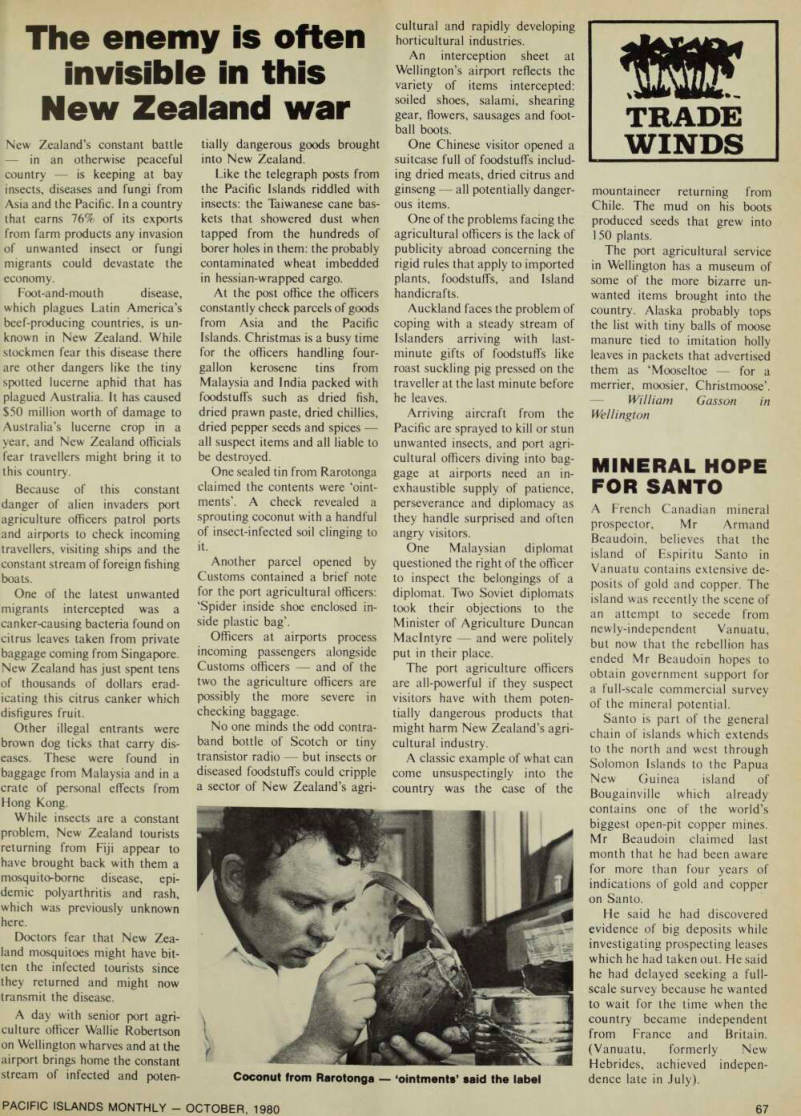
One sealed tin from Rarotonga claimed the contents were ‘oint ments’. A check revealed a sprouting coconut with a handful of insect-infected soil clinging to it.
Another parcel opened by Customs contained a brief note for the port agricultural officers: ‘Spider inside shoe enclosed in side plastic bag’.
Officers at airports process incoming passengers alongside Customs officers and of the two the agriculture officers are possibly the more severe in checking baggage.
No one minds the odd contra band bottle of Scotch or tiny transistor radio but insects or diseased foodstuff's could cripple a sector of New Zealand’s agri
cultural and rapidly developing horticultural industries.
An interception sheet at Wellington’s airport reflects the variety of items intercepted; soiled shoes, salami, shearing gear, flowers, sausages and foot ball boots.
One Chinese visitor opened a suitcase full of foodstuff's includ ing dried meats, dried citrus and ginseng all potentially danger ous items.
One of the problems facing the agricultural officers is the lack of publicity abroad concerning the rigid rules that apply to imported plants, foodstuff's, and Island handicrafts.
Auckland faces the problem of coping with a steady stream of Islanders arriving with last minute gifts of foodstuff's like roast suckling pig pressed on the traveller at the last minute before he leaves.
Arriving aircraft from the Pacific are sprayed to kill or stun unwanted insects, and port agri cultural officers diving into bag gage at airports need an in exhaustible supply of patience, perseverance and diplomacy as they handle surprised and often angry visitors.
One Malaysian diplomat questioned the right of the officer to inspect the belongings of a diplomat. Two Soviet diplomats took their objections to the Minister of Agriculture Duncan Maclntyre and were politely put in their place.
The port agriculture officers are all-powerful if they suspect visitors have with them poten tially dangerous products that might harm New Zealand’s agri cultural industry.
A classic example of what can come unsuspectingly into the country was the case of the
mountaineer returning from Chile. The mud on his boots produced seeds that grew into 150 plants.
The port agricultural service in Wellington has a museum of some of the more bizarre un wanted items brought into the country. Alaska probably tops the list with tiny balls of moose manure tied to imitation holly leaves in packets that advertised them as ‘Mooseltoe for a merrier, moosier, Christmoose’.
William G assort in
Wellington
Coconut from Rarotonga - ‘ointments’ said the label