PNG soldiers restore government
p. 19 · Read in the full issue
control on Vanuatu rebel island
The rebellion which threatened newly-independent Vanuatu (formerly the New Hebrides) ended last month when Papua New Guinea infantry forces backed by Vanuatu police established government control in the secession island of Espiritu Santo. Over a period of two weeks two rebels lost their lives and there were some injuries on both sides but the bloodbath and civil war forecast by critics of the PNG presence failed to eventuate. The operation showed up as a firm, patient and skilful one in which PNG emerged with honour upholding the legitimate government of a Pacific Island neighbour.
When Vanuatu gained its inde pendence late in July British and French troops remained on Santo by arrangement with Father Walter Lini’s legitimate central government, but the troops failed to end the re bellion (PIM Sept p 11). If anything, the rebel leadership under secessionist Jimmy Stevens, backed by some French and mixed-race set tlers of long residence, seemed to be strengthening its pos ition. In the first week after independence the rebels em barked on a new campaign of looting, burning buildings and destroying two bridges. They were also using about 50 stolen vehicles belonging to either the government or to refugees who had been forced to leave the island. On August 6 intelligence reports indicated that a yacht which had earlier visited West Coast USA and the French territory of New Caledonia had landed arms on Santo. The arms were reported to include US World War II carbines.
Meanwhile the governments of Vanuatu and Papua New Guinea were working feverishly to complete arrangements for the use of infantrymen from the PNG Defence Force in an attempt to end the rebellion.
The situation was complicated by the objections of the Parlia mentary Opposition in PNG towards sending troops to another country, by the PNG constitutional requirements which required parliamentary approval and by the fact that some Australians were serving with the PNG force on a secondment basis. Eventually the PNG parliament gave ap proval by 55 votes to 40 and Australia cleared the way for the involvement of technical support personnel serving with the PNG force. Prime Minister Lini flew to Port Moresby on
August 9 to sign the necessary agreements, and the PNG Prime Minister, Sir Julius Chan, commented ‘The time has come for the people of the South Pacific to demonstrate that they won’t be manipu lated by outsiders’.
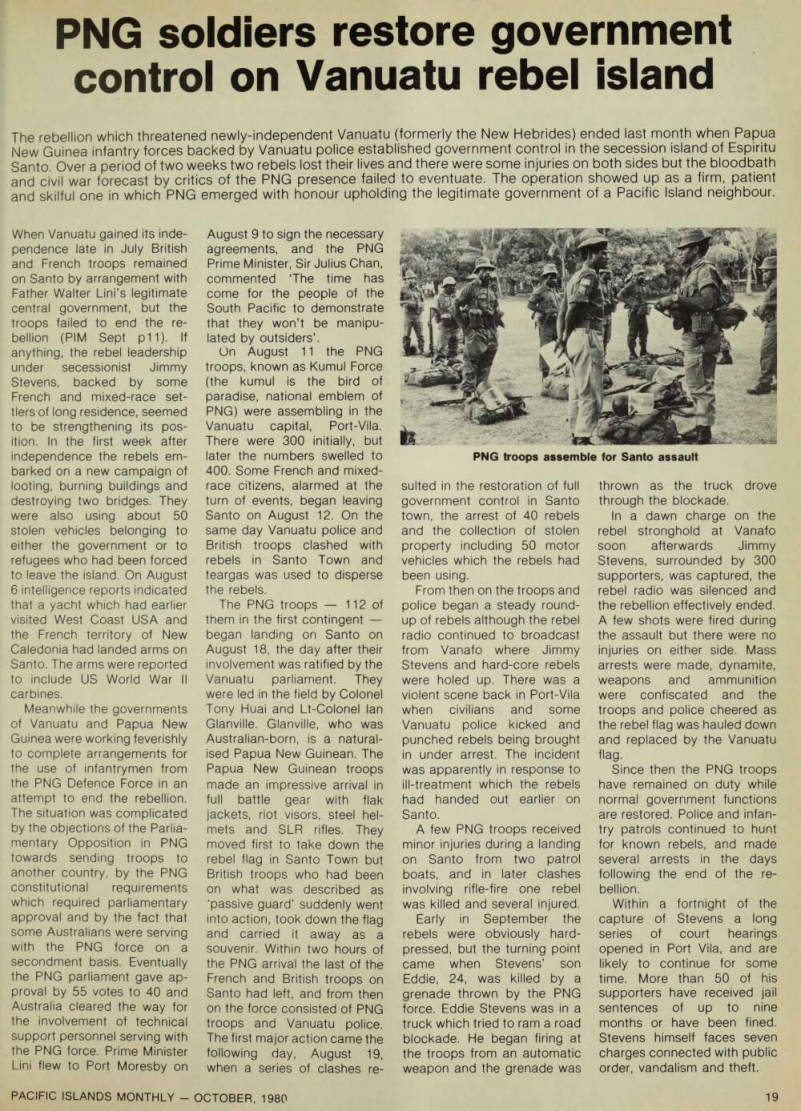
On August 11 the PNG troops, known as Kumul Force (the kumul is the bird of paradise, national emblem of PNG) were assembling in the Vanuatu capital, Port-Vila.
There were 300 initially, but later the numbers swelled to 400. Some French and mixed race citizens, alarmed at the turn of events, began leaving Santo on August 12. On the same day Vanuatu police and British troops clashed with rebels in Santo Town and teargas was used to disperse the rebels.
The PNG troops 112 of them in the first contingent began landing on Santo on August 18, the day after their involvement was ratified by the Vanuatu parliament. They were led in the field by Colonel Tony Huai and Lt-Colonel lan Glanville. Glanville, who was Australian-born, is a natural ised Papua New Guinean. The Papua New Guinean troops made an impressive arrival in full battle gear with flak jackets, riot visors, steel hel mets and SLR rifles. They moved first to take down the rebel flag in Santo Town but British troops who had been on what was described as ‘passive guard’ suddenly went into action, took down the flag and carried it away as a souvenir. Within two hours of the PNG arrival the last of the French and British troops on Santo had left, and from then on the force consisted of PNG troops and Vanuatu police.
The first major action came the following day, August 19, when a series of clashes re-
suited in the restoration of full government control in Santo town, the arrest of 40 rebels and the collection of stolen property including 50 motor vehicles which the rebels had been using.
From then on the troops and police began a steady round up of rebels although the rebel radio continued to broadcast from Vanafo where Jimmy Stevens and hard-core rebels were holed up. There was a violent scene back in Port-Vila when civilians and some Vanuatu police kicked and punched rebels being brought in under arrest. The incident was apparently in response to ill-treatment which the rebels had handed out earlier on Santo.
A few PNG troops received minor injuries during a landing on Santo from two patrol boats, and in later clashes involving rifle-fire one rebel was killed and several injured.
Early in September the rebels were obviously hard pressed, but the turning point came when Stevens’ son Eddie, 24, was killed by a grenade thrown by the PNG force. Eddie Stevens was in a truck which tried to ram a road blockade. He began firing at the troops from an automatic weapon and the grenade was
thrown as the truck drove through the blockade.
In a dawn charge on the rebel stronghold at Vanafo soon afterwards Jimmy Stevens, surrounded by 300 supporters, was captured, the rebel radio was silenced and the rebellion effectively ended.
A few shots were fired during the assault but there were no injuries on either side. Mass arrests were made, dynamite, weapons and ammunition were confiscated and the troops and police cheered as the rebel flag was hauled down and replaced by the Vanuatu flag.
Since then the PNG troops have remained on duty while normal government functions are restored. Police and infan try patrols continued to hunt for known rebels, and made several arrests in the days following the end of the re bellion.
Within a fortnight of the capture of Stevens a long series of court hearings opened in Port Vila, and are likely to continue for some time. More than 50 of his supporters have received jail sentences of up to nine months or have been fined.
Stevens himself faces seven charges connected with public order, vandalism and theft.
PNG troops assemble for Santo assault