Actors, musicians, carvers and canoe-builders show their arts
pp. 15-18 · Read in the full issue
canoe-builders show their arts
Concluding their account of the Third South Pacific Festival of Arts (PIM Sep p 17), JIMMY and GWENDA CORNELL review the contributions to the big event of (among others) actors, musicians, carvers and canoe-builders. Summing up, they make the point that with the growing participation of people from north of the equator, especially the Micronesians, the next festival (in Noumea in 1984) should be called simply ‘Pacific Festival of Arts’.
The only two theatrical pro ductions at the festival were staged by Papua New Guinean companies at the university amphitheatre. The National Theatre of Papua New Guinea chose as its contribution to the festival Eberia, a production based on a legend from the North Solomons. Eberia is the spirit of the nether world, and the story relates a man’s journey to that world in search of his dead wife. It is a theme found in many cultures, and has great similarity to the ancient Greek legend of Orpheus and Eurydice.
The dramatisation of the Eberia legend by William Takaku has brought the old story firmly into the 20th cen tury. Acted and sung in English, with the musical back ing provided by the Sanguma group from the National Arts School, the play takes the form of a modern rock opera. The struggle of Marakue to regain his wife Baru from the spirits with the help of their son Duiva was closely followed by the public, who could identify with many of the village scenes.
A central theme of Eberia was the clash between old traditions and Christianity, the church being personified by the village catechist, excellently acted by Michael Tavil. The catechist, dressed in black and wearing horns, was portrayed as the Devil himself, while the spirits of Eberia were clad in pure white. This caricature of the church, which clearly met with the great approval of the audience, is symptomatic of the present trend among young Papua New Guineans, who oppose all that is bad in Christianity, especially hypoc risy, and are generally in favour of a return to traditional ways.
The Raun Raun Theatre from Goroka was joined by the Raun Isi Theatre from Wewak
to stage Sail the Midnight Sun , a folk opera based on an epic poem by John Kasaipwalova.
The poem outlines man’s journey through life from birth and childhood to marriage and maturity. The Raun Raun pro duction has taken the meaning of the story to another level by changing the name of the main character to Niugini, thus evok ing the journey to maturity of the new nation. The music and choreography played an inte gral part in the production, and balanced the action of the play.
Generally the acting was of a high standard and probably helped by the fact that the play was in Pidgin and not English.
Yalambing Namu, who played the part of Niugini, deserves special mention in leading the cast.
The popular Sanguma group, made up of members of the music department of the National Arts School, gave several concerts as part of the festival. The group is noted for its use of traditional themes and instruments, along with the electronic gear of a modern pop group and a variety of wind instruments.
Another modern group bas ing its work on traditional musical elements was the New Zealand group from Scratch.
Taking some of their ideas from the bamboo bands so wide spread in Papua New Guinea, they performed several items on a battery of plastic pipes of varying lengths which produced a similar sound to the bamboos.
Many of the delegations also brought with them craftsmen and craftswomen, who demon strated their skills at various places in the Port Moresby area during the festival. With the craftspeople moving around, the public had a chance to see a great variety of demonstrations.
Owing to financial difficult ies, American Samoa sent only
four people to the festival, the curator of the Pago Pago Mu seum, and three craftspeople.
The weaving of fine mats was their forte, although they also demonstrated wood carving and tapamaking.
The craft most widely rep resented was wood carving, with carvers from Solomon Islands, New Zealand, American Samoa, Tahiti, Tonga, and various provinces of Papua New Guinea. Wallis and Futuna sent two mat weavers, while Kosrae, in the Federated States of Micronesia (FSM), and Tahiti, both demonstrated traditional cooking skills. One of the few Fijians at the festival was the potter Kelisita Tasere, who had spent the previous few months with the Driving Creek pottery near Auckland, and had come to Port Moresby with the New Zealand delegation. Aust ralia sent a number of demon strators of Aboriginal crafts, from etching to boomerang throwing.
The forecourt of the National Museum on some mornings resembled a busy workshop, with several carvers chipping away at their work. In the short time available, the carvers from Solomon Islands turned out a considerable number of carv ings. It was interesting to note that some of their work differed very little from the exhibits displayed in the museum next door, which had been collected from the Solomons many years ago. Equally traditional in ap pearance was a large tekoteko being carved by two carvers from New Zealand. One of these, the Maori master carver Tuti Tukaokao, from the Rotorua Arts and Crafts Centre, told us how invaluable this opportunity had been to meet and exchange ideas with carvers from other parts of the Pacific. He expressed his ad miration for the skills of the
Solomon Islanders, who with only five chisels at their dis posal could turn out remarkable works of art. The large Maori carving, worked on throughout the festival as a demonstration piece, was presented to the people of Papua New Guinea at the closing ceremony.
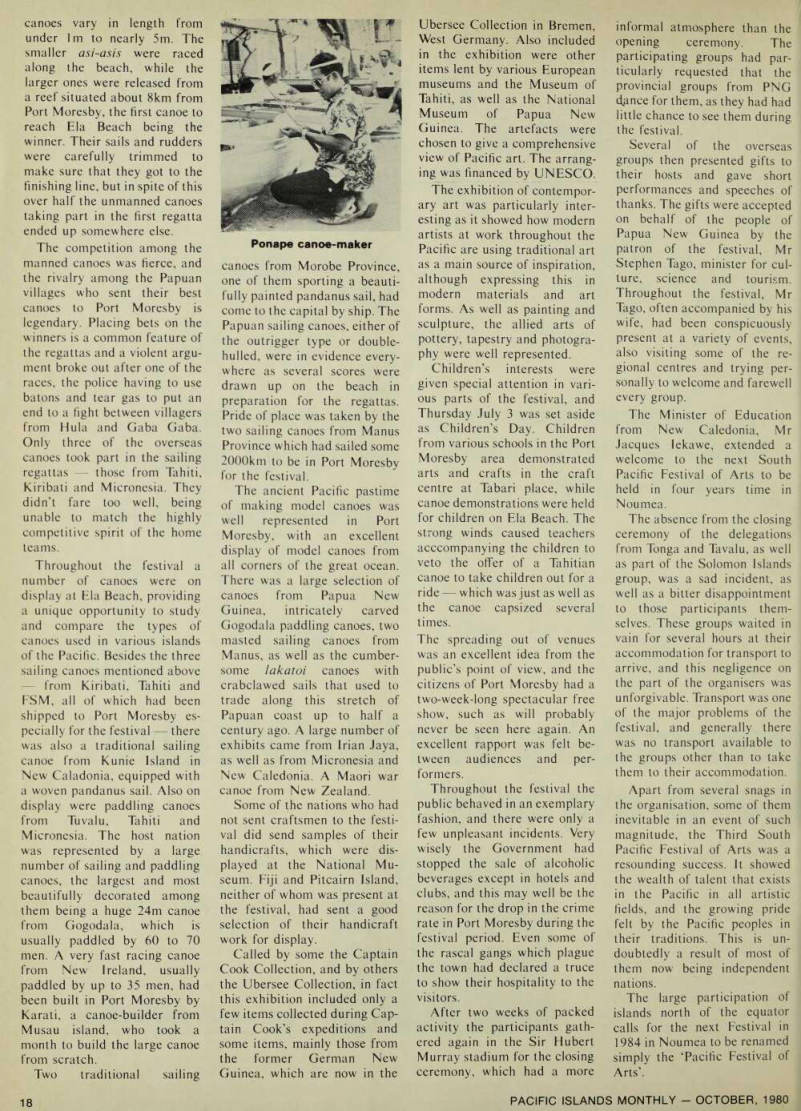
The FSM had made a great effort to be fully represented in all festival activities, another example of a small nation of limited resources giving the lead to some of those with more means at their disposal. As well as shipping a large sailing canoe to Port Moresby, Micronesian craftsmen demonstrated canoe building on Ela Beach. Morris Wakuk from Ulwe village and Nena William from Taunsak, both on Kosrae, built a 5m long paddling dugout canoe in two and a half days from a log supplied by the festival organ isers. They then quickly turned around and built a second one in the same time. Thomas Santos and Andolin Andreas from Mogot village on Ponape had come to Port Moresby before the festival to start building a traditional sailing canoe, which will be displayed with other canoes from the Pacific acquired by Papua New Guinea as a result of the festival.
In true Pacific fashion, the arrival of over 200 sailing canoes in Port Moresby sig nalled the start of the festival.
After the arrival of the Canoe Armada, sailing canoes played an important part in the festival programme. Regattas were staged on the two consecutive Saturdays, with over 400 participating canoes each time.
After paddling races for both men and women, the sailing canoes were sub-divided into three classes according to their size, a further two classes being set aside for the model canoes called asi-asi. These unmanned
canoes vary in length from under 1m to nearly sm. The smaller asi-asis were raced along the beach, while the larger ones were released from a reef situated about Bkm from Port Moresby, the first canoe to reach Ela Beach being the winner. Their sails and rudders were carefully trimmed to make sure that they got to the finishing line, but in spite of this over half the unmanned canoes taking part in the first regatta ended up somewhere else.
The competition among the manned canoes was fierce, and the rivalry among the Papuan villages who sent their best canoes to Port Moresby is legendary. Placing bets on the winners is a common feature of the regattas and a violent argu ment broke out after one of the races, the police having to use batons and tear gas to put an end to a fight between villagers from Hula and Gaba Gaba.
Only three of the overseas canoes look part in the sailing regattas those from Tahiti, Kiribati and Micronesia. They didn’t fare too well, being unable to match the highly competitive spirit of the home teams.
Throughout the festival a number of canoes were on display at Ela Beach, providing a unique opportunity to study and compare the types of canoes used in various islands of the Pacific. Besides the three sailing canoes mentioned above - from Kiribati, Tahiti and FSM, all of which had been shipped to Port Moresby es pecially for the festival there was also a traditional sailing canoe from Kunie Island in New Caladonia, equipped with a woven pandanus sail. Also on display were paddling canoes from Tuvalu, Tahiti and Micronesia. The host nation was represented by a large number of sailing and paddling canoes, the largest and most beautifully decorated among them being a huge 24m canoe from Gogodala, which is usually paddled by 60 to 70 men. A very fast racing canoe from New Ireland, usually paddled by up to 35 men, had been built in Port Moresby by Karati, a canoe-builder from Musau island, who took a month to build the large canoe from scratch.
Two traditional sailing
canoes from Morobe Province, one of them sporting a beauti fully painted pandanus sail, had come to the capital by ship. The Papuan sailing canoes, either of the outrigger type or double hulled, were in evidence every where as several scores were drawn up on the beach in preparation for the regattas.
Pride of place was taken by the two sailing canoes from Manus Province which had sailed some 2000 km to be in Port Moresby for the festival.
The ancient Pacific pastime of making model canoes was well represented in Port Moresby, with an excellent display of model canoes from all corners of the great ocean.
There was a large selection of canoes from Papua New Guinea, intricately carved Gogodala paddling canoes, two masted sailing canoes from Manus, as well as the cumber some lakatoi canoes with crabclawed sails that used to trade along this stretch of Papuan coast up to half a century ago. A large number of exhibits came from Irian Jaya, as well as from Micronesia and New Caledonia. A Maori war canoe from New Zealand.
Some of the nations who had not sent craftsmen to the festi val did send samples of their handicrafts, which were dis played at the National Mu seum. Fiji and Pitcairn Island, neither of whom was present at the festival, had sent a good selection of their handicraft work for display.
Called by some the Captain Cook Collection, and by others the Übersee Collection, in fact this exhibition included only a few items collected during Cap tain Cook’s expeditions and some items, mainly those from the former German New Guinea, which are now in the
Übersee Collection in Bremen, West Germany. Also included in the exhibition were other items lent by various European museums and the Museum of Tahiti, as well as the National Museum of Papua New Guinea. The artefacts were chosen to give a comprehensive view of Pacific art. The arrang ing was financed by UNESCO.
The exhibition of contempor ary art was particularly inter esting as it showed how modern artists at work throughout the Pacific are using traditional art as a main source of inspiration, although expressing this in modern materials and art forms. As well as painting and sculpture, the allied arts of pottery, tapestry and photogra phy were well represented.
Children’s interests were given special attention in vari ous parts of the festival, and Thursday July 3 was set aside as Children’s Day. Children from various schools in the Port Moresby area demonstrated arts and crafts in the craft centre at Tabari place, while canoe demonstrations were held for children on Ela Beach. The strong winds caused teachers acccompanying the children to veto the offer of a Tahitian canoe to take children out for a ride which was just as well as the canoe capsized several times.
The spreading out of venues was an excellent idea from the public’s point of view, and the citizens of Port Moresby had a two-week-long spectacular free show, such as will probably never be seen here again. An excellent rapport was felt be tween audiences and per formers.
Throughout the festival the public behaved in an exemplary fashion, and there were only a few unpleasant incidents. Very wisely the Government had stopped the sale of alcoholic beverages except in hotels and clubs, and this may well be the reason for the drop in the crime rate in Port Moresby during the festival period. Even some of the rascal gangs which plague the town had declared a truce to show their hospitality to the visitors.
After two weeks of packed activity the participants gath ered again in the Sir Hubert Murray stadium for the closing ceremony, which had a more
informal atmosphere than the opening ceremony. The participating groups had par ticularly requested that the provincial groups from PNG cfance for them, as they had had little chance to see them during the festival.
Several of the overseas groups then presented gifts to their hosts and gave short performances and speeches of thanks. The gifts were accepted on behalf of the people of Papua New Guinea by the patron of the festival, Mr Stephen Tago, minister for cul ture, science and tourism.
Throughout the festival, Mr Tago, often accompanied by his wife, had been conspicuously present at a variety of events, also visiting some of the re gional centres and trying per sonally to welcome and farewell every group.
The Minister of Education from New Caledonia, Mr Jacques lekawe, extended a welcome to the next South Pacific Festival of Arts to be held in four years time in Noumea.
The absence from the closing ceremony of the delegations from Tonga and Tavalu, as well as part of the Solomon Islands group, was a sad incident, as well as a bitter disappointment to those participants them selves. These groups waited in vain for several hours at their accommodation for transport to arrive, and this negligence on the part of the organisers was unforgivable. Transport was one of the major problems of the festival, and generally there was no transport available to the groups other than to take them to their accommodation.
Apart from several snags in the organisation, some of them inevitable in an event of such magnitude, the Third South Pacific Festival of Arts was a resounding success. It showed the wealth of talent that exists in the Pacific in all artistic fields, and the growing pride fell by the Pacific peoples in their traditions. This is un doubtedly a result of most of them now being independent nations.
The large participation of islands north of the equator calls for the next Festival in 1984 in Noumea to be renamed simply the ‘Pacific Festival of Arts’.
Ponape canoe-maker