US dropped claims to 25
pp. 13-14 · Read in the full issue
A shedding of islands: How the US dropped claims to 25
In the article below HARLAN LEE* for the first time definitively unravels the oft-told (but generally little understood) tale of the now relinquished claims of the United States to 25 islands in the South Pacific. The article was released by the US International Communication Agency on August 19.
Since 1962 the South Pacific region has undergone tremen dous political change. Nine island states have gained their independence in that time, and several others have become self-governing. The United Slates responded to the changes taking place in the region by seeking to establish friendly, co operative relations with the new island slates.
One way in which the US acted to improve its relations in the region was in resolving disputed claims to 25 islands in the South Pacific.
The disputed islands consist of 14 claimed by both the US and the United Kingdom in the Line and Phoenix island groups, now part of the Republic of Kiribati; four islands claimed by the two Western nations in the former Ellice Islands, now part of Tuvalu; four islands claimed by the US in the north ern Cook Islands; and the three islands of Tokelau claimed by the US and New Zealand.
For the most part the US and UK claims derived from claims made by explorers, whalers and guano miners in the period 1775-1860. Cook, Wilkes and other explorers made claims on behalf of their respective governments for the islands they discovered. The majority of the 25 islands were simply sighted and visited by whalers who made no attempt to make territorial claims. It is imposs ible to determine with any certainty who were the original
discoverers of several of the islands.
A further factor regarding claims to the islands was pass age by the US Congress in 1856 of the Guano Mining Act. The Act provided that US nationals could obtain exclusive guano mining rights if they could demonstrate that they had dis covered, occupied and taken possession of the islands in question, and that those islands were not already in the pos session or occupation of any other government. The Depart ment of Stale was charged with responsibility for issuing the certificates. Few were issued, and, of those, many were never actually used for mining. The extension of US sovereignty to the guano islands as certified under the act was only tempor ary.
Until the guano mining ceased, there was no intent on the part of the US to claim permanent sovereignty over the guano islands.
In the 1870 s and 1880 s the British Government also issued guano mining certificates to its nationals for mining operations in many of the islands in question. Like the US guano certificates, the British certifi cates were intended to extend only temporary jurisdiction to the islands for mining purposes.
Guano mining slowed, then virtually ceased in the islands by the late 1880 s. It was principally at that time that Britain began asserting sover eignty over the islands by declaring protectorate status over them, providing adminis trative functions, and repeating assertions of dominion. The northern Cook Islands and the Tokelau Islands were placed under New Zealand adminis tration in 1901. The British continued to administer the Ellice Islands and asserted pro tectorate status over the Line and Phoenix Islands. During
this period the US did not pro test any of the British or NZ acts of sovereignty over these islands.
In 1939, when it became apparent that the islands would be useful to support civil avi ation activities in the South Pacific, the US decided to an nounce its claims to the 25 islands. Following that act, the US and the UK signed an agreement in 1939 to establish joint administration of two of the islands, Canton and Enderbury. The agreement was without prejudice to the separ ate claims of the respective governments. From 1971 the US exercised sole adminis tration over Canton and Enderbury under a special ar rangement with the UK.
The US position on the island claims did not change from its formal assertion of the claims in 1939 until the mid-19705.
Realising that the continued assertion of its rather weak claims to the islands would adversely affect the friendly relations the US wished to establish with the newly inde pendent and self-governing states, the US government re viewed its policy toward the disputed claims. Since the as sertion of protectorate status, the British had administered the Phoenix and Line Islands, except for Canton and Ender bury, as part of the Gilbert and Ellice Islands Colony. It was the British intention to include
the disputed islands in its plans to grant independence to the Gilbert Islands to form the far flung Republic of Kiribati.
Similarly, the four disputed islands in the Ellice group were to become an integral part of the new independent state of Tuvalu. The Cooks, already self-governing since 1965, fully administered the four disputed northern islands. The three disputed Tokelau Islands posed an unnecessary irritant to US NZ relations. Consequently, with these factors in mind, a high-level decision was made in 1978 for the US to enter into negotiations to relinquish its claims to the disputed islands in return for assurances that would protect US economic and security interests in the region.
The first set of negotiations was held with British and Tuvaluan representatives in September 1978, prior to Tuvalu’s independence in October of that year. William Bodde, then Director of Pacific Island Affairs in the Depart ment of State (and presently US Ambassador to Fiji, Tonga and Tuvalu) led the US del egation. Following extensive negotiations a treaty of friend ship was signed at Funafuti, the capital of Tuvalu, on February 7, 1979. The treaty provided for relinquishment of US claims to the four disputed Tuvalu islands, and contained pro visions for consultation between
* Harlan Lee was Pacific Islands desk officer at the US Department of State from 1978 to 1980. From 1975 to 1977 he had served in the US Embassy in Suva. He has also studied Pacific Islands affairs at the University of Hawaii, and is now an international relations officer in the State Depart ment’s Office of UN Political Affairs.
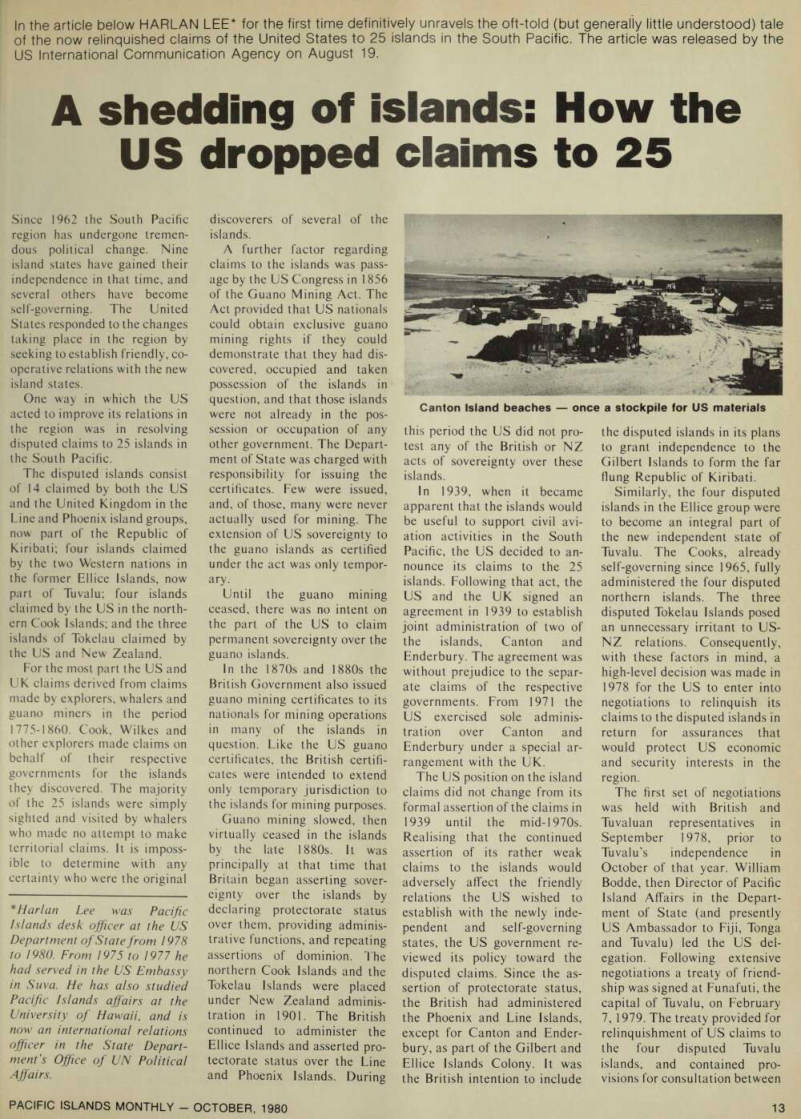
Canton Island beaches - once a stockpile for US materials
the parties on matters of mutual concern and interest.
Tuvalu and the US agreed to consult in times of international crisis regarding any request by the US for use of Tuvaluan territory for military purposes, and any requests by Tuvalu for assistance and support. The two governments also agreed to consult regarding any request by third parties to use Tuvalu’s territory for military purposes.
The treaty further provided for close co-operation between the two countries in fisheries development, in particular with respect to the economic inter ests of American Samoa. The two tuna canneries in American Samoa depend heavily on third country fishermen who catch tuna in waters surrounding Tuvalu and neighbouring South Pacific states.
The treaty with Tuvalu was transmitted by the president to the US Senate on May 9, 1979, and is awaiting Senate consent to US ratification.
Following the successful con clusion of the Tuvalu nego tiations, the US began nego tiations with Gilbert Islands and UK representatives in early 1979, prior to Gilberts’ inde pendence in July 1979. The US determined that it had no further requirements for the use of Canton and Enderbury at that lime, paving the way for successful conclusion of the negotiations.
A treaty of friendship be tween the US and the Gilberts, now known as Kiribati, was signed at Tarawa on September 20, 1979, by US representative Bodde and Kiribati president, leremia Tabai. The treaty called for the US to relinquish its claims to the 14 disputed Line and Phoenix Islands. The terms of the treaty with Kiribati are roughly similar to the terms of the US-Tuvalu treaty, with the exception that the US maintains a veto over the use by any third party for military purposes of any of the facilities on Canton, Enderbury and Hull. In an agreed minute accompanying the treaty Kiribati agreed to non discriminatory treatment of US or third country vessels supply ing the American Samoa canneries for licences to fish in Kiribati waters.
The Kiribati treaty was transmitted to the US Senate
on January 24, 1980 and it too awaits Senate consent to US ratification.
Negotiations over the dis puted claims in the northern Cooks began in October 1979 between the US, NZ and Cook Islands authorities. The govern ment of NZ recognised the competency of the Cook Islands government to sign a bilateral treaty on its own behalf, and following completion of nego tiations the US and Cook Islands signed a treaty in June 1980 to establish a maritime boundary which essentially amounted to relinquishment of US claims to the northern Cooks. US security concerns were not an issue in the nego tiations since the Cooks fall within the scope of the ANZUS Treaty. The maritime boundary agreement is expected to be transmitted to the Senate for consent to ratification at an early date.
Finally, negotiations to re solve the dispute over the three Tokelau islands commenced in May 1980 but have not been concluded. It is expected that the Tokelau agreement will be similar in form to the Cook Islands model.
Once the Tokelau agreement is reached, and the four agree ments are ratified by the Sen ate, the US will have demon strated its clear intention to cement good relations with the island states of the South Pa cific. More than any other visible form of assistance, US willingness to relinquish its disputed island claims indicates the positive nature of its ap proach to the region and its sensitivity to island concerns.
List of disputed islands: Line Islands: Caroline Atoll, Christmas Island, Flint Island, Malden Island, Starbuck Island, and Vostok Island.
Ellice Islands: (Now part of Tuvalu) Funafuti Atoll, Nukufetau Atoll, Nukulaelae Atoll, and Nurakita.
Tokelau: Atafu Atoll, Fakaofu Atoll, and Nukunono Atoll.
Northern Cook Islands: Danger Atoll, Manahiki Atoll, Penrhyn Atoll, and Rakahanga Atoll.
Phoenix Islands: Birnie Atoll, Gardner Atoll, Hull Atoll, McKean Atoll, Phoenix Atoll, Sydney Atoll, Canton Island, and Enderbury Island.