A regional
pp. 7-11 · Read in the full issue
Letters
A regional shortwave service?
The recent South Pacific Fo rum meeting in Kiribati has helped to write a new page in the modern history of the South Pacific nations. One of the achievements of this meeting was undoubtedly the setting up of fresh initiatives to establish a regional news bureau, and consequently guarantee a com mon and independent source of information for use by the regional media.
The peoples of the South Pacific region deserve the right of access to a more overall appreciation of their cultures and ideals. This was magnificently demonstrated in Port Moresby in June-July, during the Third South Pacific Festival of Arts. It very soon became obvious that the festi val would allow every participating nation and every observer present to witness the strength of the cultural bonds that unite this immense region of the world.
The eagerness and skill of the youngest nations to display their newly rediscovered wealth of traditions and ideals was heart-warming. Papua New Guinea, as the third host country in the history of this festival, handled this far reaching event with the most commendable enthusiasm; and for those who could be present in Port Moresby celebrating that spirit, the time now is for reflection.
It must be of some interest to keep the message circulating: The South Pacific nations are alive and striving. Melanesia, Micronesia and Polynesia are able to bridge historical bar riers and plunge toward the common cradle of their origins, to revive the ancestral bonds. . . .
For none of these nations is it easy today. All of them have
experienced the same evils, from slave merchants to col onial rule. Some are still today fighting desperately to salvage their identity against imported and destructive ways. Others have succeeded in rejecting open foreign domination, and now long for closer links with brother nations in their search for the original communality.
In this perspective, and in a humble and personal way, I would like to submit to all interested parties in the South Pacific a concept which would provide a major live link be tween all countries of this region, irrespective of their political, economic or cultural differences.
This concept is of an inter national shortwave radio , broadcasting in the two most widely spoken languages in the region, English and French, and placed under the authority of the South Pacific Forum. Based in a central position, it would maintain a close association with the proposed South Pacific News Bureau and would fur thermore constitute the Voice of the South Pacific for the rest of the world.
It would also act as an important formative body in many media areas, catering for trainees sent by the countries involved.
As a first step towards overcoming the split between French- and English-speaking countries, Pacific Radio-Radio Pacifique would serve a dual purpose; stress the unifying cultural bonds between brother nations, and offer an alternative to foreign-owned media.
Funding of such an inter national service could be depen dent both on the South Pacific Forum, specialised organis ations of the United Nations, such as the ITU (International Telecommunications Union), and/or special contributions from regional countries and organisations.
This concept, developed through my experience both in shortwave broadcasting and in the South Pacific region, is open for discussion. My main pur pose in submitting it is to get as much feedback as possible, in the hope that it might eventu ally attract enough interest to justify a more detailed and shared study.
Such a study would involve
expert advice from the national broadcasting services already existing in various countries of the region, as well as a compre hensive estimate of costs re garding the creation and run ning of the proposed service.
My concept cannot pretend to be exhaustive, or even orig inal, as many of the Pacific nations already have their own radio facilities, some operating on a 24-hours-a-day basis.
Listeners in the South Pacific region are also able today to tune in to overseas shortwave services, such as Radio Aust ralia, Radio France Inter national, the Voice of America, etc, which provide 24-hour prQgrammes in English or French.
What makes the concept of Pacific Radio-Radio Pacifique genuinely different, however, is that it would belong to the region, crossing the language barrier, and promoting a united approach to the problems specific to the South Pacific region.
It would act as an ambassa dor to the world, and focus its attention on the issues of today as seen by one of the world’s youngest regions and would promote unity, exchange and understanding between the brother nations themselves, at a time when these are increasing their efforts to develop econ omical, political and cultural ties between themselves.
Christian Seruzier
Melbourne, Vic Australia.
‘Hierarchy of
needs’ in Cooks
Right now the Cook Islands Government is introducing a new taxation package which is designed to balance its budget ary deficit. This it may well do, for a short time. It may also well succeed in muzzling the ox that treads out the seed corn.
The Cook Islands Govern ment, like many Pacific govern ments, faces major economic problems. The economic aspir ations of its population (and the promises that it has made to them) cannot be supported on the national resources it pos sesses. The difference has to be made up by aid. Unfortunately the aiding countries do not take a ‘soup kitchen’ attitude to aid and are asking questions about
the period needed to attain economic self-sufficiency. This is the crux of the problem.
What is economic self sufficiency? Is it a microcosm of Australia or New Zealand? Is it a return to the Pacific of 200 years ago? Or is it a rethinking of the whole problem?
I suggest the answer lies in the last approach.
There are three basic categories of people who are responsible for current plan ning: Local politicians who have little education but a certain amount of instinct and whose instinct can probably be trusted; local politicians and administrators who have some education, usually first degrees, and have come to despise their instincts in general, they have abandoned the best of their old world in favour of a superficial coating of the new; overseas experts who have cither come for a two-year holiday or who and these are far worse earnestly endeav our to fashion their host country into a poor copy of their home country.
With a few exceptions most Pacific nations are poor in natural exploitable resources and to some extent that may be their salvation. The problem with a wealth of resources is that while they may bring temporary prosperity, they are resources that, once consumed, cannot be replaced. The energy crises that Western countries face are no passing phase, and one trembles at times to think of their vast cities that depend absolutely on abundant cheap energy and excellent transport and distribution systems. When such systems fail then the whole complicated apparatus of city administration collapses with them. The Puka Pukan then, with his fish and his coconuts, may be far better off than the inhabitant of a highrise Sydney apartment building. To a great extent today the Pacific, and the Cooks in particular, stand at an economic crossroads and we do not have too long to decide which direction to take.
One influential group will pressure us to increase exports so that we can pay for more imports and have a ‘higher’ standard of living. But, then, what is a higher standard of living?
Is it living like battery hens in an Auckland suburb, watching TV at night, commuting to a boring job during the day, having a night out every week end at the club and worrying about the mortgage and the hire purchase on the new wall to-wall carpel?
Or is it simply having enough to eat and enough leisure to enjoy living? Again a funda mental question, but one that we do not face.
Right now we import almost all our energy requirements and a considerable proportion of our food in a country that could well feed itself and even look after its own energy needs as well if it was prepared to accept less conspicuous consumption.
We in the Cook Islands now face a new round of taxation and a new round of inflation so that government can support a higher rate of expenditure and model itself on a New Zealand Government that has already planned itself into a virtual state of international bank ruptcy. Arnold Nordmeyer was one of the most far-sighted and most unpopular of New Zea land ministers when in 1958 he sought to put the brakes on and prevent New Zealand from spending itself into insolvency.
The last Premier of the Cook Islands, Albert Henry, took similar measures, for his in stinct made him aware of the same problems that Mr Nord meyer foresaw. Now we have a case of the bland leading the blind.
A great writer on manage ment, Fayol, created a concept that he referred to as a ‘hierarchy of needs'. Applying this to the situation that we face today, we must acknowledge that the first need is to see that the people, and that means all the people, are adequately fed.
With the outflow of productive population that the Cook Islands has faced over the last two years, this will be in creasingly difficult.
The next need is clothing.
The next is housing, followed by education and health. After them, we can worry about the rest.
The famous economist E. F.
Schumacher once wrote: ‘The amount of real leisure that a society enjoys tends to be in inverse proportion to the
amount of labour-saving ma chinery it employs.’
For us in the Pacific that is a very relevant statement. We buy tractors, we buy rotary hoes, we buy washing ma chines, we buy electric ranges, and the most foolish buy car pets and then buy vacuum cleaners to clean them with.
Now, what does this gain us? A horse with a plough on a one-to four acre block will do the work faster than a rotary hoe and, though slower than a tractor, it will do it better. It consumes local grass and not imported diesel. It will also take you shopping or over to the neigh bours’. Yet to buy that tractor or rotary hoe we work longer hours to produce export pro duce so that we can have ‘labour-saving machinery’.
We may do better to go back and construct a Pacific edition of Fayol’s ‘hierarchy of needs’, and gear our economies to long term goals that we can live with and enjoy rather than attempt to set up bad and heavily subsidised copies of a Western consumer society.
My hope in writing is to provoke discussion for this sub ject needs long and earnest debate. The quick and 100-easy measures now being taken in the Cook Islands are no sort of answer at all. It is the people who live in the countries of the Pacific who must decide the sort of society they want and can afford, and not expatriate advisers who were sent by foreign governments.
Richard Mcdonald
Rarotonga Cook Islands (This letter cut for length)
Biased reporting
misrepresents PNG
Would you kindly allow me space in your columns to air my views on what I have read about the savageness and the primiliveness of my country, Papua New Guinea. A lot of foreign reporters and writers arc biased, favouring sen sational and distorted facts which are far from the truth.
Although our cultural and national unity can be ques tioned by the presence of 700 cultures, at least I am proud to say that all of us are aware of the independent status of our country.
Foreign reporters report on cannibalism, tribal fighting and ‘stone-age primitives’ without any understanding. Last year an Operation Drake photo grapher photographed Southern Highlands people, some wearing shorts and meri blouses and some holding steel bush knives, just outside the town of Mendi, and reported ‘stone-age tribe discovered’.
Cannibalism, which hardly exists today, was once a ritual practice but never let it be said we killed our fellow man for meat. As for tribal fighting in the highlands, even coastal Papua New Guineans do not know the real causes. The cause is often described as a worhan or a pig, but this is not the usual cause. Some tribes are tra ditional enemies and often rude words may spark off a fight.
Some tribal fights have very old causes over land boundaries.
The fact is that foreigners have no idea of our traditional social organisations, our
wantok system and our tra ditional means of dispute settle ment like paying back and compensation. But this does not mean we live in a state of anarchy. There are simply a lot of distortions. From reliable sources 1 believe that crimes such as rape, murder, armed robbery and kidnapping are more and worse in a Western civilised society than they are in my primitive PNG society.
Who, then, is a savage?
Regarding national indepen dence it must be understood that every nation depends on other nations, but in spite of interdependence, independent countries such as PNG are trying to make their own de cisions. They want to run their own affairs in their own inter ests rather than be completely colonised and exploited by foreigners. Of course the run ning of our affairs may be influenced by international issues. All the same Papua New Guineans want to retain their culture and identity. They want to be their own masters rather than second or third class citizens in their home country like the original inhabitants of South Africa or the Aborigines of Australia.
PNG is combatting econ omic exploitation and colonis ation. Although we are only five years old as an independent nation we are aware of multi national corporations and Aust ralian capitalistic enterprises.
That is why we have our organisations like NIDA (National Investment and De velopment Authority) and our Investment Corporation. This means foreign companies must satisfy our conditions before they operate here. What’s more the people of PNG have a major share in them which means they are partly nationally owned.
On the question of royalties from the Bougainville copper mine one must remember that the money is less in value than the people’s traditional values relating to gardening land, burial areas and hunting grounds. Land is our life and money cannot buy life.
Biased foreign reports on events and situations give the world the wrong impression, and I trust that you will print
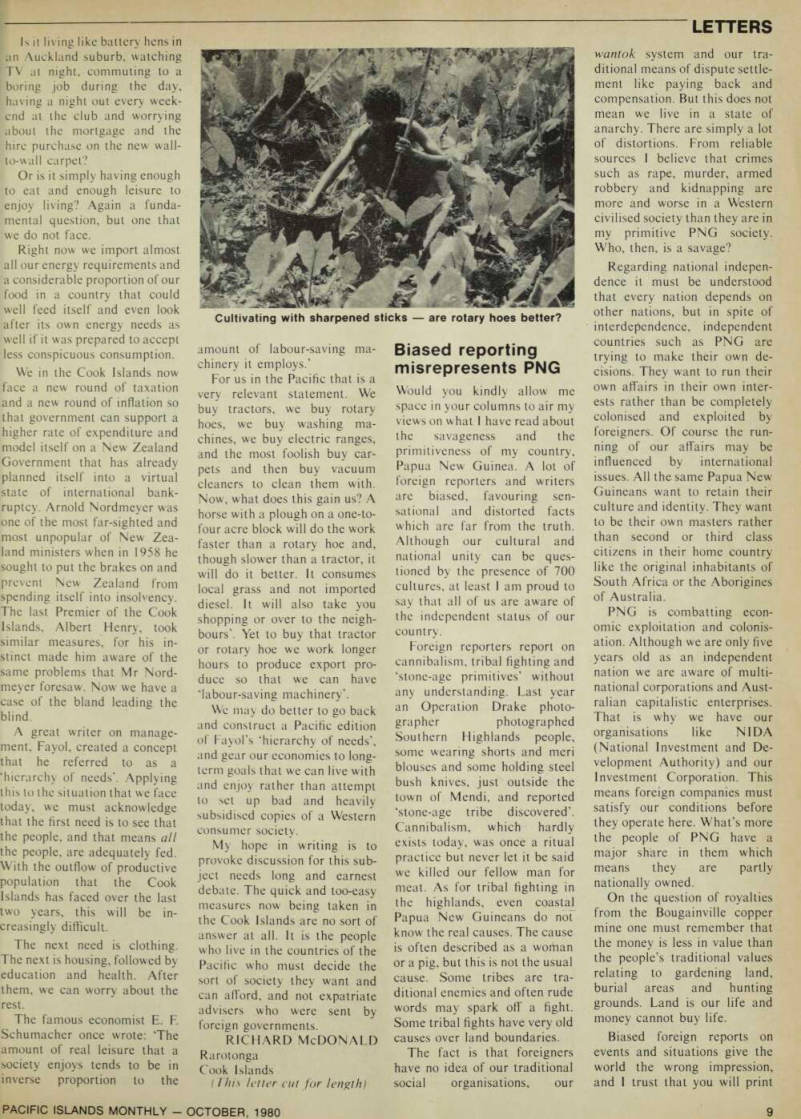
Cultivating with sharpened sticks - are rotary hoes better?
my letter with sincerity thus getting some facts and general isations about my country straight. I remain, another ‘primitive’ Papua New Guinean.
N. Pioli
Boroko Papua New Guinea (This letter was cut for ngth.) A call to ‘Pacific awareness’
I am concerned to read about the treatment of some of our Pacific Islands people, notably the Melanesian people in West Papua New Guinea and New Caledonia, and the Polynesian people in Tahiti. I am especially concerned at the attitude of the French colonisers, these so called ‘civilised’ European people, and read with concern about the activities of French settlers (belter to be called criminal vagrants) and bureau crats in Tahiti (PIM June pl 9).
It is about time the indigen ous Tahitians realised that either they fight for indepen dence or let their culture, dig nity and identity be under mined by the French people through exploitation and colon isation. Why show off your culture in the South Pacific Festival of Arts when your culture is merely decorative to suit French tourists? Don’t you realise that sooner or later your beautiful island will be infested with nuclear waste to such an extent that your survival there will have to be questioned? This will be due, obviously, to the French Government’s criminal nuclear activities.
We Pacific Islanders have to fight to retain our identities so as not to become second-class citizens in a European society.
Tahiti is your country. Do not trust any Western or European government or any world body such as the United Nations because they make decisions in the best interests of the ‘civi lised’ and Western nations. Hu man rights to them is nuclear testing and retention of status in the world at the expense of the so-called Third World, while continually suppressing the people of the Third World.
By saying that Tahiti and New Caledonia are integral parts of France and by calling
them French Polynesia or the French Pacific, France is cre ating a false image and a false sense of identity in the Pacific.
No indigenous Frenchman is a Pacific Islander. Every Pacific Island heart must go with Oscar Temaru and his party in Tahiti, the pro-independence parties in New Caledonia and the free dom fighters in West PNG for fighting to retain their Polynesian and Melanesian identities. Also every Pacific Islander should take a bow to the tiny Pacific nations like Tuvalu which are concerned neither with a modern way of life nor with owning a TV set, yet they gained their indepen dence because they wanted to retain their identities and make their own decisions.
Finally I would draw the attention of every Pacific Islander (especially the Tahitians) to the theme of the Third South Pacific Festival of Arts held in Port Moresby recently, and that was ‘Pacific awareness’. I would say we want our Pacific cultures to be alive and living, and not to be decorative or artificial to suit foreign interests such as tour ism.
E. Tobua
Port Moresby Papua New Guinea
Another 50-year
stayer
Your Jubilee August number to hand and most interesting. Con gratulations!
Like Professor Harry and Mrs Honor Maude (PIM Aug pi 13) I too have been a sub scriber to PIM for the whole 50 years, having gone to Fiji in early 1931. I did have all the early newspaper-type ones, but they have disappeared in my many travellings now fin ished in this retirement village. (The Yen) C.W.
Whonsbon
Aston, Qbe
(Archdeacon Emeritus of Polynesia) Castle Hill NSW Australia Case of a missing friend I am writing on behalf of a Japanese lady. Miss Yasuko Ito,
who is looking for her missing female friend, Mrs May MoiMoi.
When Yasuko Ito was in Tonga, from August 1976 to the beginning of February 1977, May MoiMoi lived either in the town of Nukualofa with Mr Peseti Latu and his wife, Pepe, or on the island of Oneata owned by Mr Pesiti Latu. May was married to a brother of Pepe, Salesi, and had a child.
She is thought to be in her mid 30s now, to have divorced, and to be back in her native place, American Samoa.
Could you kindly help us in the search? Any information could be sent to Miss Ito at the following address: Miss Yasuko Ito, 7-6-8, Yanaka, Taito-ku, Tokyo, Japan 110.
Thank you in advance for your kind co-opertion.
Mas Otsuji
Tokyo Japan PIM sways choice
of posting
Re Too little cover on the cover’ (PIM Aug p3B) I have compen sated PIM for reader Hitch cock’s prudery by having sent 12 friends overseas gift copies of the November issue of PIM.
Such delightful photos influ ence diplomatic postings. A friend in the Australian diplo matic service last year had difficulty deciding whether to accept an Asian or a Pacific Islands posting. He proudly informed me that the issue was resolved when he chanced upon a copy of last November’s PIM in a Canberra bookshop. I am happy to report that the South Pacific has lived up to his expectations and he believes PIM helped him make a wise decision.
Fellow Diplomat
(Name and address supplied) • A correspondent who is obviously happy in his con victions he signs himself Felix Wanker has also written to PIM criticising Lou Hitchcock for being ‘too sensitive’. Writing on an Australian postcard which shows bare-breasted girls at a Sydney beach he criticises ‘bottle-fed Yanks with a
boobs fixation who want to childishly redesign God’s handiwork’. Praising the people of the Pacific Islands he adds ‘they’re great, but quit patronising them and let them join the 20th cen tury’. Editor.
Lou’s gotta
be joking
Lou Hitchcock (PIM Aug p3B), objecting to a beautiful Island girl, topless, adorning the cover of last November’s PIM, must be joking. If the letter isn’t a joke, God help the writer.
Margaret Caspers
Ramsgate NSW Australia
A rose by any
other name...
I would like to reply to the letter of Mr S. Polume (PIM Jun p 6).
Firstly, it seems that Mr Polume has completely misun derstood the main point of my earlier letter, viz, that the future of French Polynesia is to be decided by French Polynesians, who have the right to self-determination. This earlier letter was written in response to the interference by the former Foreign Minister for Papua New Guinea, Mr Olewale, in French Polynesian affairs, when he stated that immediate independence was what French Polynesians wanted.
It seemed incongruous at the time that whilst he was espous ing complete economic and political independence for French Polynesia, his own country was not considering such a step, as witnessed by the ‘cool’ $A23Om they received annually from Australia in di rect cash grants. Mr Olewale was arrogant enough to suggest complete independence, despite the policy of the democratically elected government of French Polynesia, which has chosen internal autonomy over im mediate independence until such time as French Polynesia is economically self-sufficient, as often explained by the Vice- President of the Government Council Francis Sanford.
Not all French Polynesians agree with him, and it is typical
of most democracies to have freedom and diversity of opinion. But the majority do, as evidenced by the lack of sup port for the pro-independence parties in the Territorial As sembly elections.
At the same time, most of our people do not condone nuclear testing, and I am also com pletely against it; but that is a completely different issue from the independence one.
It is interesting to see that the new Chan government in Papua New Guinea has resolved to review its opinion in this regard, and takes a more cautious attitude as regards the per ceived aspirations of citizens of other states.
Touching on Mr Polume’s reference to my surname, I would like to point out that I have both matrilineal and patri lineal ancestors ( tupuna ) who were Tahitian, as well as a French grandfather. Logically, therefore, I can claim to be ethnically Tahitian, and, as anthropologists classify Tahitians as Polynesians, I am Polynesian as well.
Although Mr Polume is deliberately vague in defining what a ‘true’ Polynesian is, I surmise he means a ‘full blooded’ or ‘pure’ Polynesian.
This odious method of applying a ‘blood fraction’ test, as the nazi race ideologists did, is patently racist and dangerous.
By Mr Polume’s own reasoning Polynesian leaders such as Dr Tom Davis of the Cook Islands, Governor Peter Coleman of American Samoa, Mr Robert Rex of Niue, or Mr Francis Sanford of French Polynesia, are totally unrepresentative of their respective countries merely because of their European names. This absurd ity can even be extended to Papua New Guinea, where the prime minister is Sir Julius Chan. In fact, I notice that Mr Polume’s given name is Samson, which is not exactly Melanesian!
Finally, 1 think Mr Polume has a right to express his views; but he should remember that I am also entitled to express mine as an individual. As a generalis ation, it would be true to say that every person acts for ‘per sonal interest’ in his case Mr Polume’s probable interest is
that of not being poisoned by nuclear fallout. My personal interest is not to have my government’s policies dictated by outsiders; I can only imagine what other personal interests he ascribes to my surname and I can only assume that Mr Polume must suffer from blind prejudice that blind preju dice which typecasts individ uals because of their language or colour. I only hope that other readers of the PIM do not fall into this same trap.
T. De Montluc
Auckland New Zealand On the future
of TUvalu
May I congratulate Dr Stephen R. Weinstein on his splendid, factual and informative article about Tuvalu (PIM Jul p 29).
It was not Nukulaelae but Nukufetau which was one of the islands (apart from Funafuti and Nanumea) that were occupied by the American forces during World War 11.
The idea of encouraging and introducing tourism to Tuvalu is not a wise one. Tourism may bring in money or economic wealth to a country, but it will also spoil and commercialise her people and culture. One can look at Hawaii, Tahiti or even to Tuvalu’s nearest Pacific neigh bour, Fiji, as examples. In Solomon Islands tourism is not encouraged. Which one do the Tuvaluans prefer sophisti cation and commercialisation of their culture or living in harmony with nature and their environment? Tourism is not the only answer to economic sur vival, but cultural preservation, ethical and customary values should be taken into account as well.
Tuvalu’s resources lie in the sea, the land and her people.
Therefore she must exploit and encourage the fishing industry, agriculture and horticulture.
Fishing and gardening should be taught in schools. Scholar ships in marine biology, fisheries, agriculture and the soil sciences should be offered to potential students. People who can find work overseas, such as seamen, and pro fessional or technical workers, may do so. Because the popu lation is slowly increasing, and
the land area limited, family planning should be practised.
Tuvalu can certainly seek advice and get assistance from Britain, Australia and New Zealand who have the money, the expertise, and the technical know-how. Australia, with all her surplus wealth and abun dant natural resources, can surely help Tuvalu which num bers only 8000 people. It won’t be surprising if Tuvalu asks China or Russia for monetary or technical aid if the West, and especially Australia and New Zealand, refuse to help.
Although Tuvalu is a new and young nation, she must be careful indeed. So far, Tuvalu is not all that primitive and backward; it is still keeping up with the rest of the world despite her remoteness.
Neemia K. O’Brien
Gela Solomon Islands
A Tuvalu
secession?
It is intended that the Tefolaha (Nanumea) community will form a federal arrangement, or, if necessary, break away politi cally from Tuvalu in early 1981. I am unable to disclose the details in full, but I can in dicate that it is for our own benefit and welfare, especially those of our young gener ations.
Today there are in our com munity numbers of school leavers from Fiji and government secondary schools, etc, stranded without jobs, and this number can only grow with time. Furthermore, there are tradesmen and experienced labourers from Ocean Island, Nauru and Tarawa, and a number of qualified seamen,
without jobs. Accordingly,
aware that Tuvalu will not be able to engage them for a long time to come, instead of wait ing and grumbling, we have de cided to take our problems into our own hands.
Living in the capital means
facing grave problems. The
place is too narrow and crowded, with a high cost of living and lack of local foods.
Unfortunately, the flow of local supplies to help our
people is hampered by long
distances and high freight
charges. Strong winds often de stroy our limited crops, destroy many houses, and threaten people’s lives because the place is narrow and lies close to the hurricane belt.
Federation, or separation from Tuvalu would result in our community growing to up to 2000 souls or even more in two to five years’ time. This would eventually give Tuvalu an opportunity to ease its prob lems. It could fill vacancies left by our departure, and at the same time reduce the popu lation in the capital.
Tuvalu will surely not be able to develop the eight islands in the group, and the three nearest islands to the
capital have already received
favourable treatment from Tuvalu whereas we, the most populated island, the furthest and the second biggest in the group, have received unfavour able treatment. It is hard to blame anybody for this. The only answer is for us to do our utmost for the good of our island home, expecting some one to assist us financially for a start.
We wish to keep close con tact with Tuvalu, and the ques tion of our relationship will be discussed at an appropriate time by representatives of both
parties.
On behalf of the Tefolaha community, I appeal to Com monwealth countries, es pecially Australia and New Zealand, and to the United States of America, for a loan of $6-$lO million in the first five years to run and develop the government and country. Fail ing this, we will have to apply to Asian countries, etc. We will not bring the United Kingdom into this as we realise she has enough problems of her own.
But her sovereignty will be re spected, unless we are no longer bound by any family ties.
If any party or government wishes to accept our appeal please write to me or call me to your nearest agency at an ap
propriate time.
Telavifati
c/o Tefolaha Community Centre Private Sector Funafuti Tuvalu