Pacific women speak
pp. 21-25 · Read in the full issue

Political
Currents
Pacific women speak out in Copenhagen
Twenty women from South Pacific countries were in the Danish capital, Copenhagen, in July for the United Nations’ Mid-Decade Conference and Forum for Women.
PIM correspondent BENGT DANIELSSON, whose wife Marie-Therese was a member of the delegation from French Polynesia, was there too. He reports on the con ference and the forum, and on the lively contribution to proceedings made by the Pacific representatives.
What happens when 7000 women from 200 different countries, speaking at least as many separate languages, meet for two weeks for a general de bate about their problems? Just back from the United Nations Mid-Decade Conference and Forum for Women held in Copenhagen from July 14 to 30,1 can happily report that the outcome was exactly the same as if an equal number of men had convened for a similar pur pose. In other words, there were many stately ceremonies, futile speeches and chaotic de bates, but also much hard work, a valuable exchange of information (including many startling revelations), unex pected alliances and a tremen dous enthusiasm and sense of solidarity that eventually may be translated into concrete action.
Broadly speaking, it was
mostly at the official con ference in the futuristic Bella Convention Centre, attended by 130 government delegations (more than a dozen led by male cabinet ministers), that order and boredom prevailed.
The fault lay with the plan ning committee which in the hallowed bureaucratic tra dition of the UN had decided to let all delegations report in turn about the progress made in their respective countries in the fields of Equality- Development-Peace, since the first conference of this kind was held in Mexico City five years ago.
This resulted inevitably in an endless stream of self congratulatory speeches which could and should have been replaced by written reports, forming a convenient basis for a more meaningful debate. In the end, the conference agreed on a vaguely worded action programme for the next five
years, although a third of the delegations refused to sign the final resolution, because it con tained an Arab-inspired clause equating Zionism with racism.
The Australian delegate was one of the very few who had the guts to vote against it.
Fortunately, just as in Mex ico City in 1975, an alternative conference or Forum for Non-
Governmental Organisations
was held simultaneously in the nearby Science Hall of the
University of Copenhagen
which by and large supplied the enthusiasm and the refresh ing new ideas that were so sadly lacking over at the Bella Centre.
The only difficulty here was that there were so many women from throughout the world who had felt the call and the urge to speak up on vital issues at this global and truly democratic parliament that the buildings could hardly contain them all, even when they were
sitting on the floors or standing in the corridors. From European countries came 1500 participants, from North America 800, from Asia 400, from Latin America 300, from Africa 250, form the Middle East 150, from the Caribbean 50 and last but not least from the Pacific 20. In addition, more than 2000 Danish par ticipants and observers con tributed daily to making the university the most crowded and noisiest place in town for these two weeks.
Surprisingly enough, the lar
gest Pacific delegation came from French Polynesia and it included representatives of
political parties and pro
fessional organisations. Next came Papua New Guinea with three delegates. Other coun
tries represented were Fiji,
Tonga, Western Samoa, Vanuatu, Australia and New Zealand, the latter also by Aborigines and Maoris. Most in the limelight were the senior Tahitian delegate Ida Bordes- Teariki who for many years has been president of the number one nationalist party Pupu Here Aia, and Hilda Lini
whose passionate speeches and
pungent press releases put Vanuatu on the map, literally speaking, for the first lime at an international forum.
Just as the many-coloured bits of glass in a kaleidoscope constantly rearrange them selves in new patterns as you
turn it, the black, white, yellow and red women at the Forum formed an endless number of rapidly changing constel lations. Sometimes they were drawn together by a common concern with specific female problems like abortion, male dictated genital mutilations, inferior wages, legally sanc tioned discriminatory prac tices, religious prejudices against women, and so on. But more often than not they did not wage a war against the opposite sex but considered themselves as the allies of their husbands, fathers and sons in a common struggle for justice and liberty. This was par ticularly noteworthy in the case of the Latin American women who often boldly spoke out against oppression, tyranny and torture in their home coun tries. As if a new example of what this meant really was needed, a military coup oc curred in Bolivia during the conference which rallied thou sands of women from all con tinents behind the now
proscribed Bolivian delegates
whose families and friends
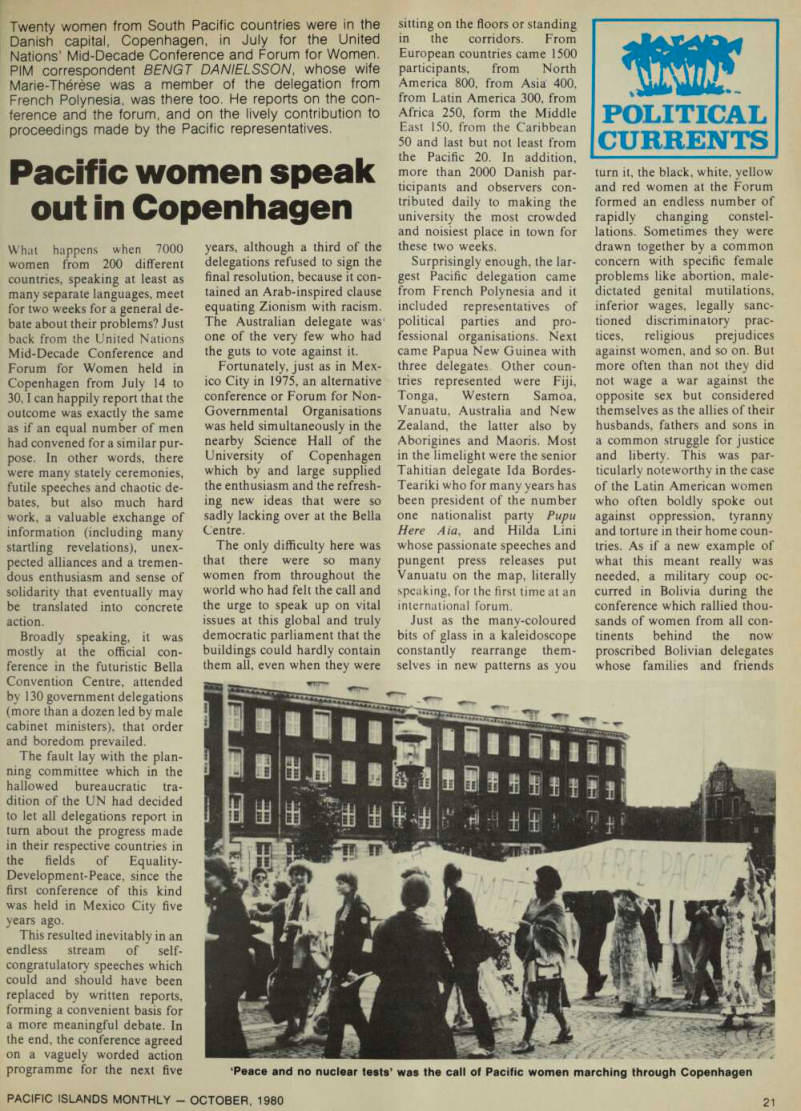
‘Peace and no nuclear tests’ was the call of Pacific women marching through Copenhagen
back home in La Paz were being arrested and shot.
The distress signals which had the most universal appeal, however, were those generated by women of all nationalities fighting against the evils of nu clear weapons and power plants. Their ranks were so rap idly swelled by sympathisers that they boldly decided to organise a peace march not simply to Bella Convention Centre (as the Latin Americans and Arabs did), but right through the city of Copen
hagen. Hundreds of journalists
and TV reporters from all over the world covered the event which culminated in a tremen
dous rally in the largest city
park. Over at the Bella Centre, Scandinavian anti-war and anti-nuclear organisations had
already during the opening cer
emony demonstrated their soli darity by presenting to the UN
Secretary-General Kurt
Waldheim a petition bearing
the signatures of 527 129 women.
Finally, there also emerged
at the forum another pattern by
which the participants grouped
themselves on a geographical basis. This was especially the case of the Pacific women who at an early stage unanimously
agreed that the following
action programme must be
given top priority by all
governments and peoples: 1) The immediate creation of a nuclear-free zone comprising the whole Pacific and the con clusion of an international
treaty expressly forbidding nu
clear tests, the use of nuclear submarines and the dumping of nuclear waste. Regular health control of the popu lation in exposed areas by in ternational teams of impartial
radiobiologists. Compensation
for victims of radio-active radi ation. 2) Acceleration of the decolonisation process in Micronesia, New Caledonia, French Polynesia, Wallis and Futuna, American Samoa, Easter Island, Western New Guinea and East Timor. Econ omic and if necessary military aid for the legally elected government of Vanuatu. 3) A halt to the economic ex ploitation of land and sea re sources such as oil, mineral nodules and fish by foreign and multi-national companies. All economic development should be planned and carried out by the Pacific governments and islanders themselves. 4) Protection of all
indigenous cultures against
commercial exploitation and foreign dominance in the field of education. 5) No more large-scale labour migrations or settle
ments in the islands by out siders. Stronger efforts to combat racial discrimination.
When it came to presenting their views to the official rep resentatives of the big powers with possessions and economic stakes in the Pacific, the Ton
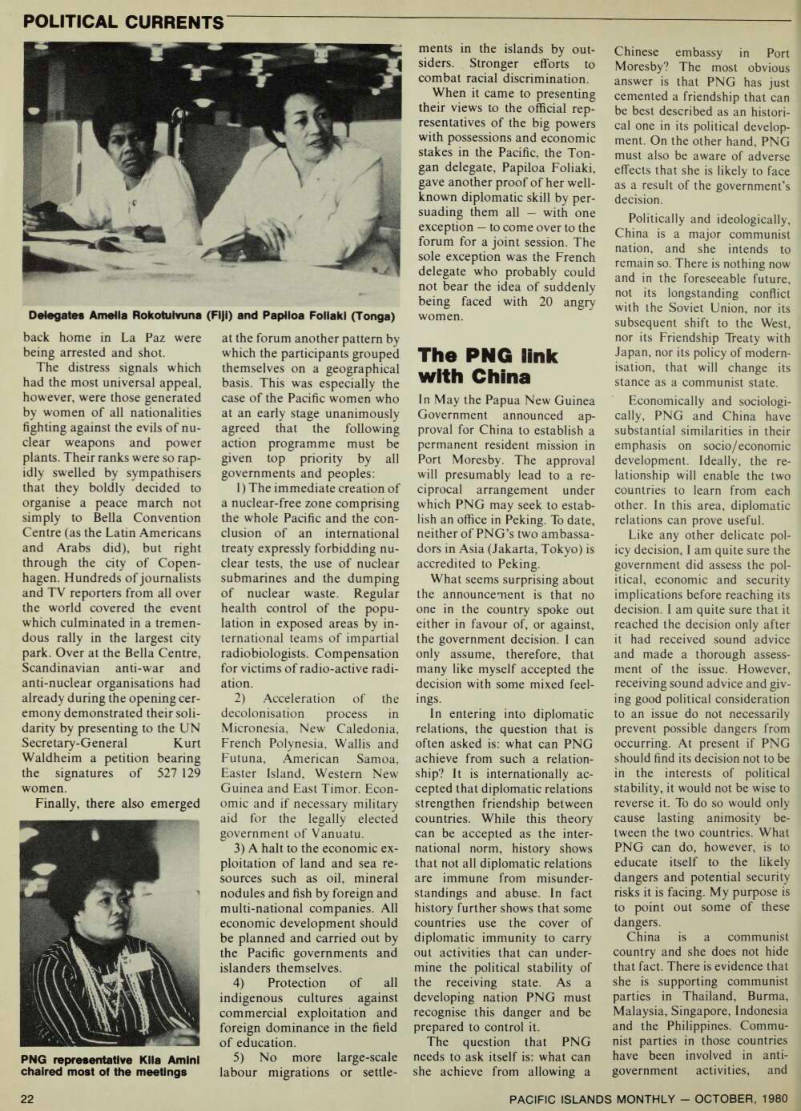
gan delegate, Papiloa Foliaki,
gave another proof of her well known diplomatic skill by per suading them all with one exception to come over to the forum for a joint session. The sole exception was the French
delegate who probably could
not bear the idea of suddenly being faced with 20 angry women.
The PNG link
with China
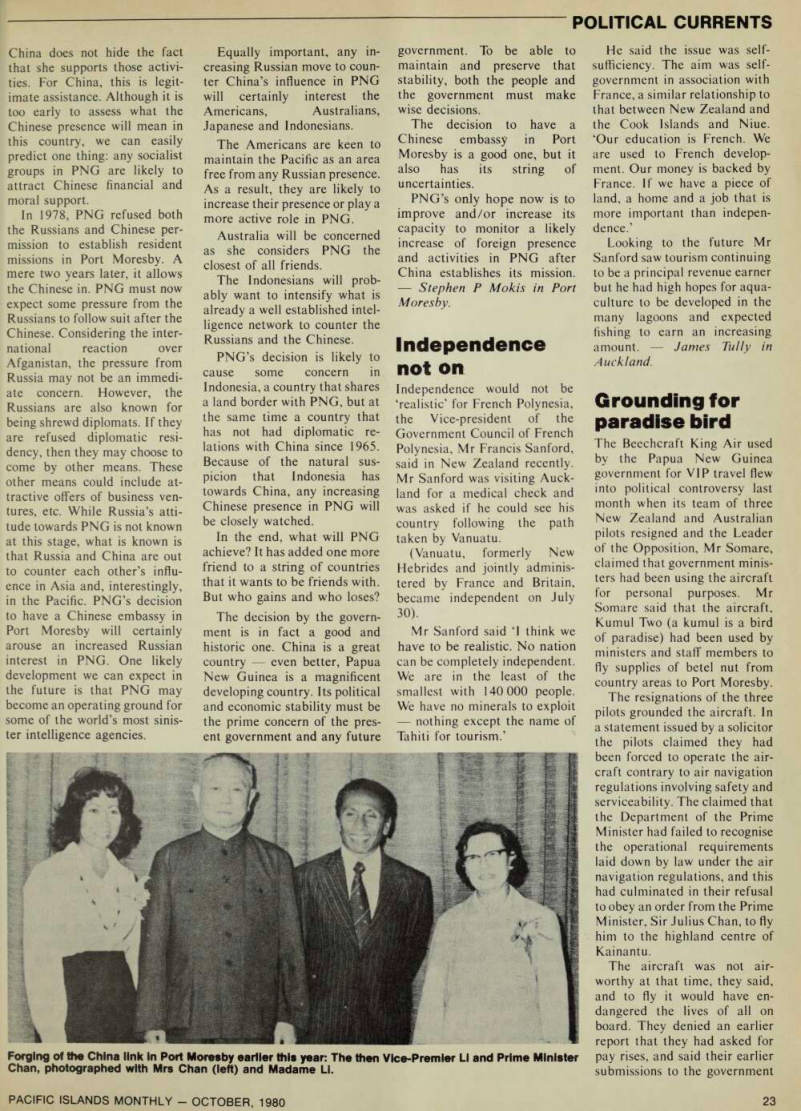
In May the Papua New Guinea Government announced ap proval for China to establish a permanent resident mission in Port Moresby. The approval will presumably lead to a re ciprocal arrangement under which PNG may seek to estab lish an office in Peking. To date, neither of PNG’s two ambassa dors in Asia (Jakarta, Tokyo) is accredited to Peking.
What seems surprising about the announcement is that no one in the country spoke out either in favour of, or against, the government decision. I can only assume, therefore, that many like myself accepted the decision with some mixed feel ings.
In entering into diplomatic relations, the question that is often asked is: what can PNG achieve from such a relation ship? It is internationally ac cepted that diplomatic relations strengthen friendship between countries. While this theory can be accepted as the inter national norm, history shows that not all diplomatic relations are immune from misunder standings and abuse. In fact history further shows that some countries use the cover of diplomatic immunity to carry out activities that can under mine the political stability of the receiving state. As a developing nation PNG must recognise this danger and be prepared to control it.
The question that PNG needs to ask itself is: what can she achieve from allowing a
Chinese embassy in Port Moresby? The most obvious answer is that PNG has just cemented a friendship that can be best described as an histori cal one in its political develop ment. On the other hand, PNG must also be aware of adverse effects that she is likely to face as a result of the government’s decision.
Politically and ideologically, China is a major communist nation, and she intends to remain so. There is nothing now and in the foreseeable future, not its longstanding conflict with the Soviet Union, nor its subsequent shift to the West, nor its Friendship Treaty with Japan, nor its policy of modern isation, that will change its stance as a communist state.
Economically and sociologi cally, PNG and China have substantial similarities in their emphasis on socio/economic development. Ideally, the re lationship will enable the two countries to learn from each other. In this area, diplomatic relations can prove useful.
Like any other delicate pol icy decision, I am quite sure the government did assess the pol itical, economic and security implications before reaching its decision. I am quite sure that it reached the decision only after it had received sound advice and made a thorough assess ment of the issue. However, receiving sound advice and giv ing good political consideration to an issue do not necessarily prevent possible dangers from occurring. At present if PNG should find its decision not to be in the interests of political stability, it would not be wise to reverse it. To do so would only cause lasting animosity be tween the two countries. What PNG can do, however, is to educate itself to the likely
dangers and potential security
risks it is facing. My purpose is to point out some of these
dangers.
China is a communist country and she does not hide that fact. There is evidence that she is supporting communist parties in Thailand, Burma, Malaysia, Singapore, Indonesia and the Philippines. Commu nist parties in those countries have been involved in anti government activities, and
Delegates Amella Rokotulvuna (Fiji) and Papiloa Foliaki (Tonga)
PNG representative Klla Amini chaired most of the meetings
China does not hide the fact that she supports those activities. For China, this is legitimate assistance. Although it is too early to assess what the Chinese presence will mean in this country, we can easily predict one thing: any socialist groups in PNG are likely to attract Chinese financial and moral support.
In 1978, PNG refused both the Russians and Chinese permiss,on to establish resident missions in Port Moresby. A mere two years later, tt allows the Chinese in. PNG must now expect some pressure from the Russians to follow suit after the Chinese. Considering the international reaction over Afganistan, the pressure from Russia may not be an immediate concern. However, the Russians are also known for being shrewd diplomats. If they are refused diplomatic residency, then they may choose to come by other means. These other means could include attractive offers of business ventures, etc. While Russia’s attitude towards PNG is not known at this stage, what is known is that Russia and China are out to counter each other’s influence in Asia and, interestingly, in the Pacific. PNG’s decision to have a Chinese embassy in Port Moresby will certainly arouse an increased Russian interest in PNG. One likely development we can expect in the future is that PNG may become an operating ground for some of the world’s most sinister intelligence agencies.
Equally important, any in creasing Russian move to coun ter China’s influence in PNG will certainly interest the Americans, Australians, Japanese and Indonesians, The Americans are keen to maintain the Pacific as an area free from any Russian presence, As a resu they are likely to increase their presence or play a more active role in PNG.
Australia will be concern ed as she consjders p NG the c|oses , of all frie nds.
The Indonesians wil| b . ab , want tQ iMengif what js a|read a we| , established intel . u network t 0 counter the Russ|ans and the chinese , . . . . ... .
PNG s decision 18 llkel y t 0 f ase . some concern in Indonesia a country that shares a land border Wlth PNG ’ but at tbe same a c , ountr y that bas not had diplomatic re latlons Wltb Ghina smce , l96s ‘ Because L of the J natural sm- P IC,OI \ tbat Indonesia has
wards China ’ an .y greasing
Chmese Presence in PNG will be close, y watched .
I n tbe end ’ wbat w dl PNG achieve? It has added one more friend to a string of countries tbat d wants to be friends with, But wbo g a i ns an d who loses?
The decision by the govern ment is in fact a good and historic one. China is a great country even better, Papua New Guinea is a magnificent developing country. Its political and economic stability must be the prime concern of the pres ent government and any future
government. To be able to maintain and preserve that stability, both the people and the government must make wise decisions.
The decision to have a Chinese embassy in Port Moresby is a good one, but it also has its string of uncertainties.
PNG’s only hope now is to improve and/or increase its capacity to monitor a likely increase of foreign presence and activities in PNG after China establishes its mission.
Stephen P Mokis in Port Moresby.
Independence
not on
Independence would not be ‘realistic’ for French Polynesia, the Vice-president of the Government Council of French Polynesia, Mr Francis Sanford, said in New Zealand recently.
Mr Sanford was visiting Auck land for a medical check and was asked if he could see his country following the path taken by Vanuatu. (Vanuatu, formerly New Hebrides and jointly adminis tered by France and Britain, became independent on July 30).
Mr Sanford said ‘1 think we have to be realistic. No nation can be completely independent.
We are in the least of the smallest with 140 000 people.
We have no minerals to exploit nothing except the name of Tahiti for tourism.’
He said the issue was self sufficiency. The aim was self government in association with France, a similar relationship to that between New Zealand and the Cook Islands and Niue. ‘Our education is French. We are used to French develop ment. Our money is backed by France. If we have a piece of land, a home and a job that is more important than indepen dence.’
Looking to the future Mr Sanford saw tourism continuing to be a principal revenue earner but he had high hopes for aqua culture to be developed in the many lagoons and expected fishing to earn an increasing amount. Janies Tally in Auckland.
Grounding for
paradise bird
The Beechcraft King Air used by the Papua New Guinea government for VIP travel flew into political controversy last month when its team of three New Zealand and Australian pilots resigned and the Leader of the Opposition, Mr Somare, claimed that government minis ters had been using the aircraft for personal purposes. Mr Somare said that the aircraft, Kumul Two (a kumul is a bird of paradise) had been used by ministers and staff members to fly supplies of betel nut from country areas to Port Moresby.
The resignations of the three pilots grounded the aircraft. In a statement issued by a solicitor the pilots claimed they had been forced to operate the air craft contrary to air navigation regulations involving safety and serviceability. The claimed that the Department of the Prime Minister had failed to recognise the operational requirements laid down by law under the air navigation regulations, and this had culminated in their refusal to obey an order from the Prime Minister, Sir Julius Chan, to fly him to the highland centre of Kainantu.
The aircraft was not air worthy at that time, they said, and to fly it would have en dangered the lives of all on board. They denied an earlier report that they had asked for pay rises, and said their earlier submissions to the government
Forging of the China link In Port Moresby earlier this year: The then Vice-Premier Li and Prime Minister Chan, photographed with Mrs Chan (left) and Madame Li.
had been in the form of rec ommendations for the efficient and safe operation of the Government Aircraft Unit.
The Acting Secretary of the Prime Minister’s Department said that by refusing to fly Sir Julius to Kainantu the pilots had ‘demeaned the office of the Prime Minister’. The resig nations had been accepted with immediate effect, he said.
Mr Amini denied there had been any compromise on safety, and said the pilots had used safety arguments as an excuse ‘for pushing other demands’.
In the political controversy which followed the resignations the Opposition Leader, Mr Somare, claimed that Sir Julius and some of his ministers had made ‘excessive and outrageous demands’ in using the aircraft.
They had flown in the aircraft for blatant political purposes and had made flights available to unauthorised passengers, he said. The aircraft had been used as a public motor vehicle and had carried supplies of betel nut which ministers and staff members had sold in Port Moresby, Mr Somare said.
Youth problems
worry to Fiji
Members of the Fiji Senate, concerned at mounting youth problems, have called on busi ness interests and the churches to get together to help youth organisations and to promote the useful assimilation of young people into the community.
Senator Inoke Tabua told a recent sitting of the upper house that ‘Big business is making so much money out of young people and their parents’ that business interests had a responsibility to bolster church aid for community youth prob lems. He claimed, too, that national leaders in Fiji were doing little to overcome the problems which were facing younger members of the com munity. Other senators spoke of growing community lawlessness if the requirements of making young people useful citizens were not met. The problem was political as much as social, they said.
A similar warning was given by the Chief Justice of Fiji, Mr Justice Tuivaga, at the cer
emonial opening last month of criminal sittings in the Su preme Court at Lautoka.
The Chief Justice said that harsh and unreasonable punish ment for young people who broke the law was not the answer. Society had to look at the causes of what was happen ing and take preventive rather than penal measures. The one thing that was obvious, he said, was that young people were showing increasing contempt for the law. Community and political leaders needed to think hard, he said, on measures to combat crimes of violence and disrespect for the law. He told civic leaders, lawyers and magistrates at the opening cer emony ‘lt is a matter of very grave concern to all of us that law and order is undergoing a severe test of strength.’
Company fights
land takeover
There were signs last month of a breakdown in Papua New Guinea’s carefully-established reputation for faultless foot work when attempting to ac quire properties owned by non nationals. What once would have been a negotiation of some care came very close last month to being an impetuous seizure, and ended in the courts with a temporary setback for the government.
The incident involved Gumanch estate, the biggest coffee plantation in PNG and a major plantation by world standards and has raised a question mark against the atti tudes of the five-month-old Chan government towards land acquisition matters. There are suggestions that Sir Julius Chan, who is generally sym pathetic towards stable pro ductive investment, may be under some pressure from members of his cabinet who take a more emotive view of foreign investment in rural pro duction.
Under the previous Somare government PNG introduced an acquisition policy which accepted in principle that all primary production should ultimately be in the hands of Papua New Guineans. But the policy also accepted that some established foreign-owned
properties were of real value to the economy at large as em ployers, taxpayers, developers and rural training grounds. Ac quisitions were confined to areas where land was short for local villagers and the actual process of acquisition was car ried out with full and early negotiations and with some latitude in agreeing to compen sation.
From a purely acquisition point of view the scheme worked smoothly with only a few disputes of any signifi cance. As a means of phasing Papua New Guineans into rural industry however the scheme fell far short of expectations.
Some communities found they lacked the expertise to run their newly-acquired properties, some were short of buffer funds, and some alleged that the pre vious foreign owners had deliberately allowed the proper ties to run down during the acquisition period. The Somare government was already re assessing the situation when the Chan government took office, and the Chan government an nounced soon afterwards that it would phase out further acqui sitions for the time being.
It was against this back ground that the government suddenly served acquisition papers last month on Gollin and Company (PNG) Pty Ltd and prepared to take over the com pany’s Gumanch coffee plan tation near Mount Hagen.
Gollin traces back to Aust
ralian financial interests and claims a turnover of well over $2 million a year through the Gumanch operation. The prop erty employs about 2000 Papua New Guineans and is the country’s biggest coffee pro ducer. The company said there had been no discussion on compensation before the ser vice of what it called ‘seizure documents’ and it took legal action on grounds that the processes used had been invalid.
The company obtained the injunction which it sought, re straining the processes which the government had initiated.
The matter is far from ended, however, and the government’s ultimate reaction will be signifi cant in terms of overall foreign investment in the rural econ omy.
Inquiries suggest that the sudden takeover bid was very much a political matter involv ing the National Party and its supporters. Mr Thomas Kavali of the National Party is Minis ter for Lands in the Chan coali tion, and the chairman of the party Mr Michael Mel has apparently been exerting strong pressures on the parliamentary wing of the party for a takeover of the Gumanch property. Mr Mel in turn is under pressure from community leaders and electors who say that 6000 people are descended from the former traditional owners of the Gumanch land and they want their use of the land restored.
Mr Kavali apparently re sisted the pressures for some time because of likely political repercussions within the government, but the sudden steps taken to resume the land appeared impetuous rather than considered. In a statement issued after the immediate re sumption moves were re strained, Mr Kavali conceded that the move ‘might appear out of line with current govern ment policy’ but he claimed that valid reasons existed. He claimed that the earlier Somare government had led some com munity leaders to believe that they could buy the Gumanch land. In attempting to acquire Gumanch for this purpose the present government was simply honouring the commitments of its predecessor, Mr Kavali said.
Lands Minister Kavali