A happy augury for literature
pp. 41-43 · Read in the full issue

literature In PNC
Voices of Independence. Edited by Ulli Beier. Published by
University of Queensland Press,
PO Box 42, St Lucia, A ustralia 4067. $17.95 Cloth. $7.95 Paperback. Cloth ISBN 0 7022 1445 0. Paperback ISBN 0 7022 1455 8.
‘Writings about Papua New
Guinea have always been edited by overseas writers and as a result the contents ... have shown bad images of the
country.’
Clement Poye, PNG’s media minister, who voiced his mis
givings about the presentation
of local writing earlier this year, may feel somewhat comforted after reading this re cent collection of writing from Papua New Guinea. The selec tions of poetry, prose and drama in Voices of Indepen dence give rise to a variety of impressions about the country and its people. But one is left with feelings of compassion and understanding for the problems of a newly independent nation.
The editor, Ulli Beier, has been closely associated with the rise of black writing in PNG and presents his writers with sympathy. In his introduction, he is critical of the role of the University of PNG, which he sees as having degenerated into a ‘manpower training insti tution’, at the expense of its arts courses. Only one student took creative writing during 1978
and there is talk of abolishing the Arts Faculty altogether.
During this critical time, the encouragement of writers was taken up by other organisations, such as the National Broadcast ing Commission and the Insti tute of PNG Studies, who now provide the major outlet for struggling local writers.
There is evidence in this collection of some change of subject matter since indepen dence. A major concern is still the search for a cultural ident ity. But there are also indi cations of disillusionment with the national government, a power-hungry bureaucracy and the growth of a Westernised elite.
The book opens with two extracts from autobiographies, the first a chapter from Michael Somare’s Sana about tra ditional male initiation cer emonies. Despite his
time-consuming political
activities, he underwent the rites and received his grand father’s wisdom and title in order to maintain close links with his people. The writing is fluent and self-conscious, the writer appearing very much aware of his responsibilities as chief minister, as he then was.
The second autobiogra
phical extract, The Story of My
Life , was spoken in Pidgin by Somu Sigob and recorded by students at UPNG, The author was a security officer in the
university library when he died in 1975 and had never written anything. The colourful and colloquial account of his life gives a vivid picture of war time activities in Papua New Guinea.
A grimmer note is struck in
John Kasaipwalova’s fragment
of a novel called Bomana Kalabus O Sori O! written while he was in gaol. During
his imprisonment, he gathered
from a fellow prisoner the material for this typical but engrossing story of a village youth caught up in the tram mels of life in the city, with its wantoks, drink, fights and
flight from justice.
John Kasaipwalova is also represented in this collection by an essay on the need to reaf firm traditional cultural identi ties, and a play called The Naked Jazz which the author says is about the marriage be tween the female Trobriand traditional culture and the male Western culture. First performed in 1976, it is a scathing attack on the central
government and its inability to communicate at the village level.
Russell Soaba has been one of Papua New Guinea’s most consistent writers since the late sixties, and his novel Wanpis was published in 1978. The theme of the extract included in Voices of Independence re flects the title of the collection, for it deals with the deep seated antagonism and anger felt by a black colonised people against its white ‘mas ters’. The narrative begins
gently but gathers force as viol ence erupts after a party. A Buka student and an Aus tralian exchange angry words and the fat, defenceless white man becomes the focus of an outpouring of black hatred. He is accused of‘White Fatherism’ and told; ‘The only blacks you want to be with are those that you think of as mere fools who must regard you as some Big Masta beyond their
comprehension!’
The selection of poetry is varied, including a long tra ditional poem on the capture and tragic death of a village chief, and seven poems from
Naked Thoughts by Russell
Soaba. Soaba’s poems reflect a marked European influence
sometimes insufficiently
assimilated, and more effective is the moving simplicity of The
Death of My Grandfather by
Hengenike Riyong:
‘From a thousand feet I hang my heart Not for all but the beats of his drum
Nothing precious to sac
rifice But my swaying heart.’
This collection represents writers, both established and new, whose talent and ver satility augur well for the future of Papua New Guinean written culture. It is a pity that such varied and interesting writing has been marred in the
printing by frequent typo
graphical errors. -
Jo Rudd.
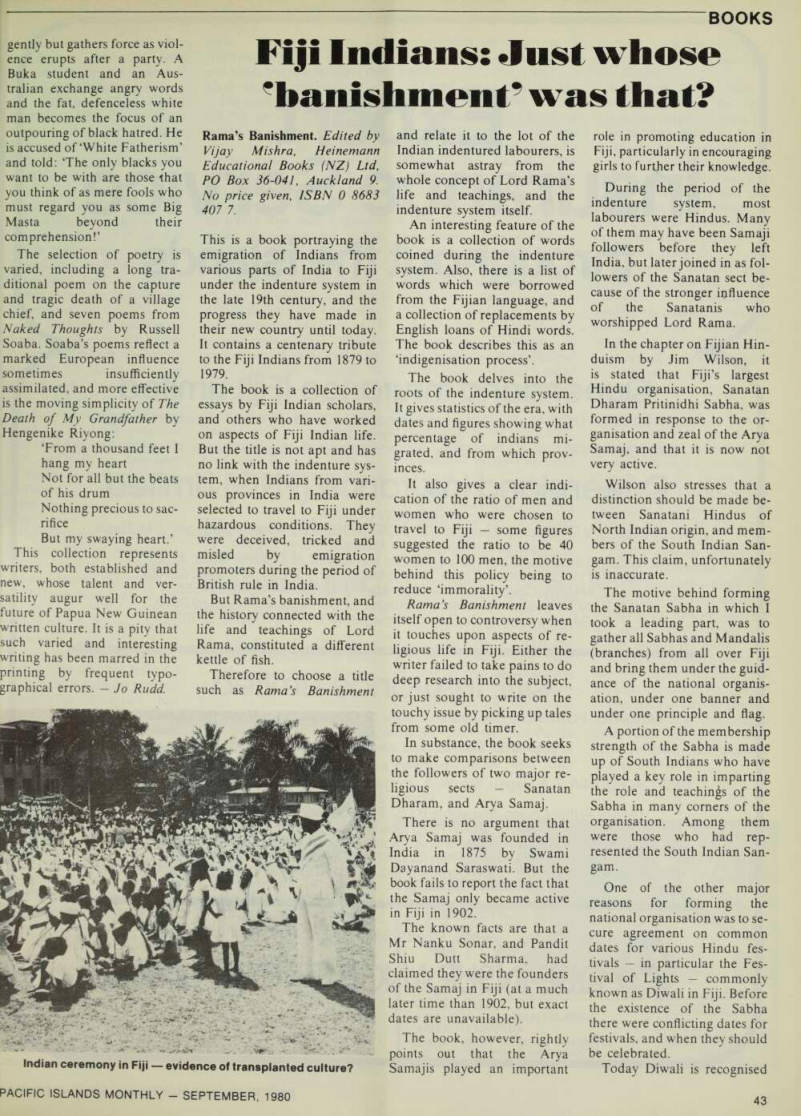
Indian ceremony in Fiji - evidence of transplanted culture?