Fiji Indians: Just whose
pp. 43-45 · Read in the full issue

'banishment ' was that?
Rama's Banishment. Edited by Vi jay Mishra, Heinemann Educational Books (NZ) Ltd, PO Box 36-041, Auckland 9.
No price given, ISBN 0 8683 407 7.
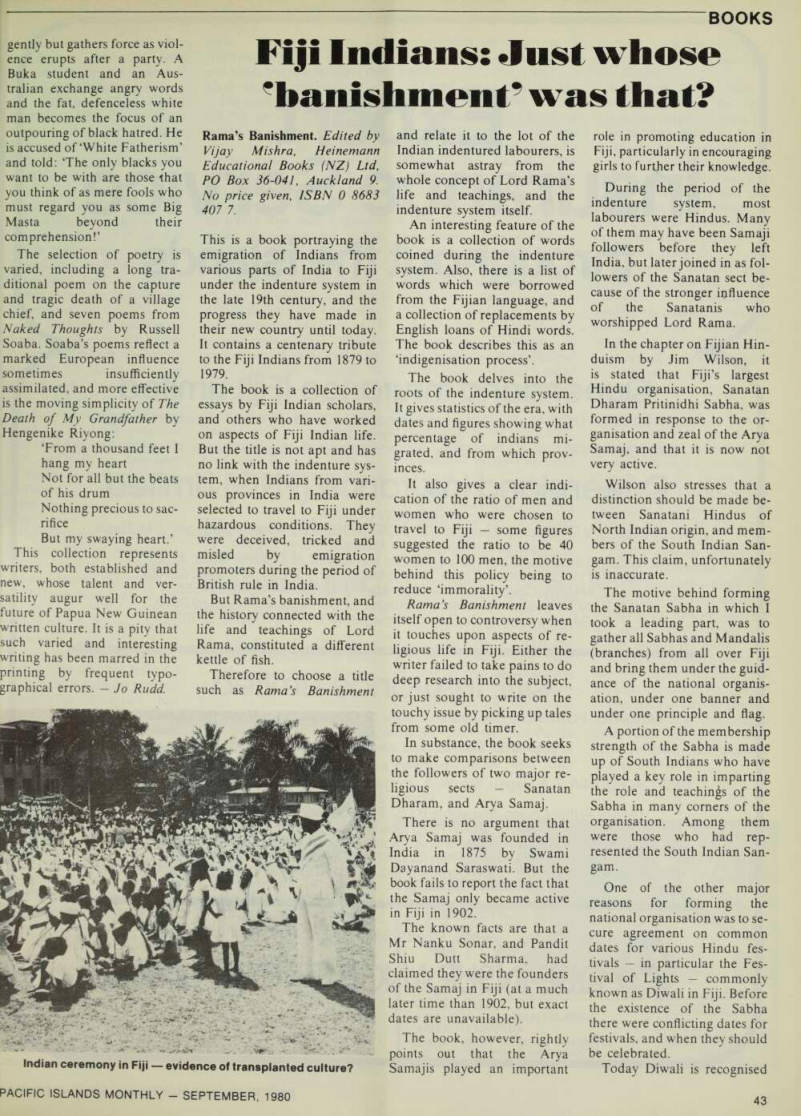
This is a book portraying the emigration of Indians from various parts of India to Fiji under the indenture system in the late 19th century, and the progress they have made in their new country until today.
It contains a centenary tribute to the Fiji Indians from 1879 to 1979.
The book is a collection of essays by Fiji Indian scholars, and others who have worked on aspects of Fiji Indian life.
But the title is not apt and has no link with the indenture sys tem, when Indians from vari ous provinces in India were selected to travel to Fiji under hazardous conditions. They were deceived, tricked and
misled by emigration
promoters during the period of British rule in India.
But Rama’s banishment, and the history connected with the life and teachings of Lord Rama, constituted a different kettle of fish.
Therefore to choose a title such as Rama’s Banishment
and relate it to the lot of the Indian indentured labourers, is somewhat astray from the whole concept of Lord Rama’s life and teachings, and the indenture system itself.
An interesting feature of the book is a collection of words coined during the indenture system. Also, there is a list of words which were borrowed from the Fijian language, and a collection of replacements by English loans of Hindi words.
The book describes this as an
‘indigenisation process’.
The book delves into the roots of the indenture system.
It gives statistics of the era, with dates and figures showing what percentage of indians mi grated, and from which prov inces.
It also gives a clear indi cation of the ratio of men and women who were chosen to travel to Fiji some figures suggested the ratio to be 40 women to 100 men, the motive behind this policy being to
reduce ‘immorality’.
Rama’s Banishment leaves itself open to controversy when it touches upon aspects of re ligious life in Fiji. Either the writer failed to take pains to do deep research into the subject, or just sought to write on the
touchy issue by picking up tales
from some old timer.
In substance, the book seeks to make comparisons between the followers of two major re ligious sects Sanatan Dharam, and Arya Samaj.
There is no argument that Arya Samaj was founded in India in 1875 by Swami Dayanand Saraswati. But the book fails to report the fact that the Samaj only became active in Fiji in 1902.
The known facts are that a Mr Nanku Sonar, and Pandit Shiu Dutt Sharma, had claimed they were the founders of the Samaj in Fiji (at a much later time than 1902, but exact dates are unavailable).
The book, however, rightly points out that the Arya Samajis played an important
role in promoting education in Fiji, particularly in encouraging girls to further their knowledge.
During the period of the indenture system, most labourers were Hindus. Many of them may have been Samaji followers before they left India, but later joined in as fol lowers of the Sanatan sect be cause of the stronger influence of the Sanatanis who worshipped Lord Rama.
In the chapter on Fijian Hin duism by Jim Wilson, it is stated that Fiji’s largest Hindu organisation, Sanatan Dharam Pritinidhi Sabha, was formed in response to the or ganisation and zeal of the Arya Samaj, and that it is now not very active.
Wilson also stresses that a distinction should be made be tween Sanatani Hindus of North Indian origin, and mem bers of the South Indian San gam. This claim, unfortunately is inaccurate.
The motive behind forming the Sanatan Sabha in which I took a leading part, was to gather all Sabhas and Mandalis (branches) from all over Fiji and bring them under the guid ance of the national organis ation, under one banner and under one principle and flag.
A portion of the membership strength of the Sabha is made up of South Indians who have
played a key role in imparting
the role and teachings of the Sabha in many corners of the
organisation. Among them
were those who had rep resented the South Indian San gam.
One of the other major reasons for forming the national organisation was to se cure agreement on common dates for various Hindu fes tivals in particular the Fes
tival of Lights commonly
known as Diwali in Fiji. Before the existence of the Sabha there were conflicting dates for festivals, and when they should be celebrated.
Today Diwali is recognised
in Fiji as a public holiday, after the issue of conflicting dates was resolved by the Sabha. It was on their insistence, and on the insistence of a Hindu
journalist, that Fiji’s Prime
Minister, Ratu Sir Kamisese Mara, after consultation with his cabinet, agreed to grant this public holiday. The other hol iday is for Mohammed the
Prophet’s birthday.
Basically, the religious issue
is very sensitive for the Fiji Indian community as a whole.
Therefore, to highlight the sub ject could lead to conflict among those who read Rama's Banishment.
The book briefly touches on the formation of the Fiji Indian Congress. Although it is not my intention to damn outright what it says about the Con gress, it has still to be pointed out that the congress, as illus trated in the book, was not formed at Lautoka on May 12, 1929, and that two days later Dr Beattie formed another or
ganisation, coincidentally,
under a similar name in Suva.
The facts are that the con gress was formed following a
golden jubilee celebration
commemorating the arrival of Fiji Indians from India to Fiji on May 14, 1929. It was a brainchild of the committee
celebrating the jubilee. They
thought the time was oppor tune to form a united front for the Indians to fight for political
rights. The Congress was
backed by the monthly news paper Virddhie which assisted
in publicising its objectives.
The newspaper was edited and
published by Dr Beattie.
There is a mention that dur
ing the jubilee celebration
there was friction among the Indians some opposed the idea behind the celebration.
They were of the opinion that the jubilee was not an occasion to celebrate, rather it was a black day for the Indians as they were hoodwinked into the indenture contract and treated as slaves.
But the book correctly re minds us that the 1979 cen tenary celebration went off harmoniously, without any ill feelings among the Indians, and was treated as a national event. Tears of joy in fact rolled
from former indentured labourers who are now frail and weak, but also recollect the black days of indenture.
The book has correctly stres sed that on completion of the indenture system, the Indians were ready to encounter another battle this time for
equal rights.
It traces the matter of politi cal rights of Indians from the time they won their franchise under the communal voting system, to today’s electoral sys tem.
Mishra obviously spent a lot of time compiling the book.
Although there are a few mis interpretations of facts, it is recommended that today’s
generation should grab the
book and go through it
thoroughly.
Perhaps when its second edition goes to press, it would be advisable to tone down its vocabulary. As it stands the book appears to be more for the intellectual than the man in
the street.
G. D. Sharma.