'dream of islands'
pp. 40-41 · Read in the full issue
They all had their 'dream of islands'
A Dream of Islands: Voyages of Self-Discovery in the South Seas. By Gavin Daws, Re search Professor of Pacific History at the Australian National University. Published by The Jacaranda Press, Queensland, and simul taneously by W. W. Norton, New York. ISBN 0 7016 1360 2. 5A12.95.
The 18th-century discoveries by Wallis, Bougainville, Cook, and others in the South Seas and in Tahiti in particular excited the imagination of Europe. Stories of the New Eden, of Bougainville’s Nouvelle Cythere told of a world where the constraints of European life and work were replaced by an existence of ease, freedom and voluptuous delights. The initial impact of this promise of sexual freedom combined with a life of ease in a fecund tropical environment proved irresistable to many of the European newcomers, and led to extensive desertions and to the most famous mutiny in naval history.
In the light of the new knowledge, European philos ophers revived Rousseau’s The ory of The Noble Savage’, and thinking men began to question the nature of man and his civilisation in the wider con cept of this newly discovered Elysium. Which was the better or more natural way of life?
Was it possible that the Golden Age of Greece, the Utopia of More, or the Paradise of Columbus could really exist in the South Seas? How was it possible to reconcile the fact that whilst Mass was being celebrated by the Spaniards in the Marquesas they were shooting the natives, or that Wallis, Bougainville and Cook had all destroyed life and prop erty during their island so journs? What were the relative merits of island life compared with European civilisation?
As the author succinctly puts it: ‘For a brief moment in the eighteenth century, the savage, and especially the
Polynesian, had seemed to of fer the white man a vision of what it might be like to go naked in the world once more.
The idea of some sort of earthly paradise in the South Seas lived on into the nine teenth century . . . but as those Europeans who thought about such things concluded, there was very little to be said for savagery of any kind, and a great deal for civilisation.’
Nevertheless, men went there for all reasons that men go anywhere: to seek the ex perience of new discovery, to escape the conventions of Europeans mores, to trade, to seek self-expression, to exercise authority, to escape creditors, or to save the South Sea Islander from himself by redeeming his immortal soul
through Christian missionary effort. All had their own dreams of islands.
The author takes five very diverse European characters whom he calls ‘Eminent Victorians of the South Seas’ to illustrate his thesis that however hard these men strove to mobilise their powers of self expression, self-justification and self-realisation in Polynesia, they could not es cape the ‘running battle of civilisation and its discontents’, and that whatever their orig inal motivation, they wanted, desperately, the world to know about them.
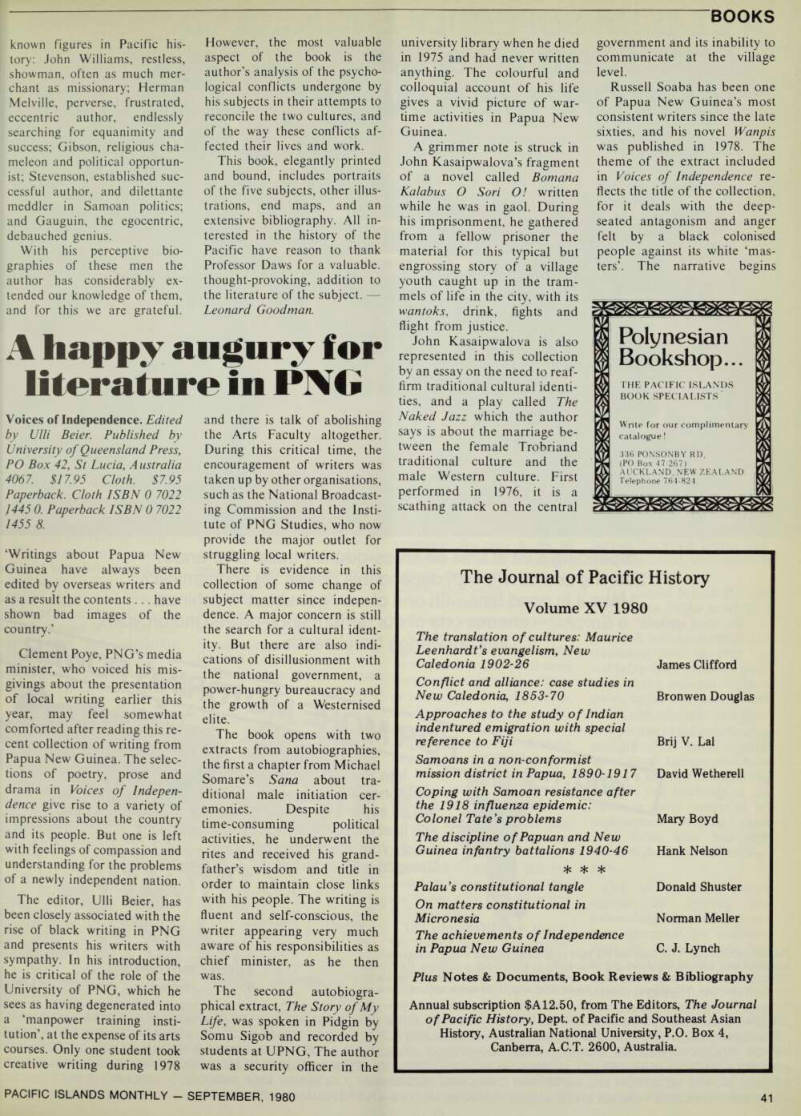
The five men chosen are well
Melville - ‘perverse, frus trated, eccentric’.
known figures in Pacific his tory: John Williams, restless, showman, often as much mer chant as missionary; Herman Melville, perverse, frustrated, eccentric author, endlessly searching for equanimity and success; Gibson, religious cha meleon and political opportun ist; Stevenson, established suc cessful author, and dilettante meddler in Samoan politics; and Gauguin, the egocentric, debauched genius.
With his perceptive bio graphies of these men the author has considerably ex tended our knowledge of them, and for this we are grateful.
However, the most valuable aspect of the book is the author’s analysis of the psycho logical conflicts undergone by his subjects in their attempts to reconcile the two cultures, and of the way these conflicts af fected their lives and work.
This book, elegantly printed and bound, includes portraits of the five subjects, other illus trations, end maps, and an extensive bibliography. All in terested in the history of the Pacific have reason to thank Professor Daws for a valuable, thought-provoking, addition to the literature of the subject.
Leonard Goodman.