Are migrants
pp. 19-24 · Read in the full issue

Tropicalities
Sports medicine
body in PNG
An interim sports medicine committee has been formed in Papua New Guinea.
Co-ordinators of the com mittee, Roger Hau’ofa and Pamela Easterbrook, said the objectives are to promote fit ness, prevention of injuries, diagnosis of injuries, treatment of injuries, rehabilitation back to sport, training of personnel in sports medicine and teaching sportsmen and women about nutrition.
Health Minister John Jaminan has expressed support and has appointed one of his research officers to assist the committee. Experts in medi cine, and the medical students, have also given their support to the committee, which will work closely with the health ministry and the National Sports Train ing Institute based in Goroka.
The interim committee has called on Education Minister Sam Tulo to have physical education reintroduced in schools.
Are migrants
ripped-off?
Migrants from the Pacific islands heading for New Zea land should beware of some lawyers who tend to Tip them off for handling immigration work.
Parliamentary Under
secretary for Immigration Aussie Malcolm has high lighted the problem and gath ered on his desk a formidable file of instances reported to him.
He plans to forward it to the New Zealand Law Society in Auckland, but only on the assurance that the names of the people who forwarded instances of being ripped off remain confidential.
Mr Malcolm’s prime objec tive is to encourage the Law Society to set a scale of charges
for handling immigration work, especially where court work is not involved. Since lawyers produce a scale of fees for other work, he argues they should have a scale of fees for immi gration work, particularly since some of the jobs they are asked to do are simple, straightfor ward clerical duties. ‘There have been occasions when people with immigration difficulties have approached a lawyer and the service was no different from that received if they had gone to an immi gration desk and asked an official for a form and for that some migrants have been charged slooo,' Mr Malcolm claimed. ‘That is presuming what I have told is correct,’ he hastened to add.
While Polynesians appear to be the main victims Mr Malcolm’s warning applies to all groups. ‘lmmigrants are one of the most vulnerable groups in our society and they should be deserving of the protection of our system,’ he said.
Unfortunately some of the migrants hammered hardest by lawyers are those who desper ately need legal help to avoid deportation. They enter a ‘no win’ situation. They face heavy legal fees, and Mr Malcolm ends up deporting them any way. ‘All that of course is nice and tidy. I deport the evidence and then the Law Society claims that they haven’t had many complaints about high legal fees.’
In his mind the reports coming across his desk smack of exploitation ‘and that’s not on’. While not wanting to
attack lawyers as a group, Mr Malcolm points strongly to the need for a standard scale of fees that would help to dispel sus picions among the migrant
community.
William
Gas son in Wellington.
Tonga: Uproar
on cathedral
Construction has begun on a $4OO 000 modern Catholic ca thedral on the Nukualofa sea front site formerly occupied by the recently razed, 96-year old St Mary’s Cathedral.
An astonishingly wide cross section of the local and expatri ate community is up in arms about the destruction of the beatiful old stone building, which was one of Tonga’s few remaining architectural treasures and historic land marks.
They are incensed that the rebuilding plan was not publicised in advance, and that demolition was undertaken so suddenly that a fait accompli was achieved before concerted protest action could be mar shalled.
According to church auth orities, the decision to demolish and rebuild was based on expert advice that the old cathedral
was no longer safe, combined with an urgent need for a building to house larger congre gations. But Catholic and non- Catholic protesters alike reject these explanations as specious, and continue to mourn the vanished St Mary’s.
They claim that the ‘expert advice’ was supplied by a Nukualofa construction engin eer whose contracting firm had a vested interest in the pro posal; and that public opinion should have been canvassed and further and impartial opinions sought on ways and means of saving such a priceless link with the past.
Many also speculate that the desire to acquire a large new cathedral, even more modern and grandiose than the recently completed Basilica of St Anthony, contributed to the failure to research and cost restoration possibilities. And those who had been most affec ted by the overcrowding prob lem say that the problem could easily have been solved, for well into the future, by increasing the number of Sunday services, with the old edifice dedicated to some useful cultural purpose if and when the need for more space became imperative.
At least one well known Tongan indentity has since switched to a rival denomi nation ‘as my personal protest against such cultural vandal ism’. Penny Hodgkinson in Nukualofa.
Fiji artefacts
come home
Englishman James kooper (1897-1971) devoted 60 years of his life to the buying and exchanging of Pacific Island artefacts, and built his collec tion without ever visiting the Pacific region.
The Fijian section of the Hooper collection was very impressive and contained about 180 high-quality items, some very rare. Following Mr Hooper’s death many of the by now very valuable items were sold, the remainder being retained by the estate.
The Fiji Museum had long been interested in the possi bility of bringing back to Fiji at least some of the artefacts, particularly those not already represented in the national col lection in Suva. However, at the time of the sale the museum
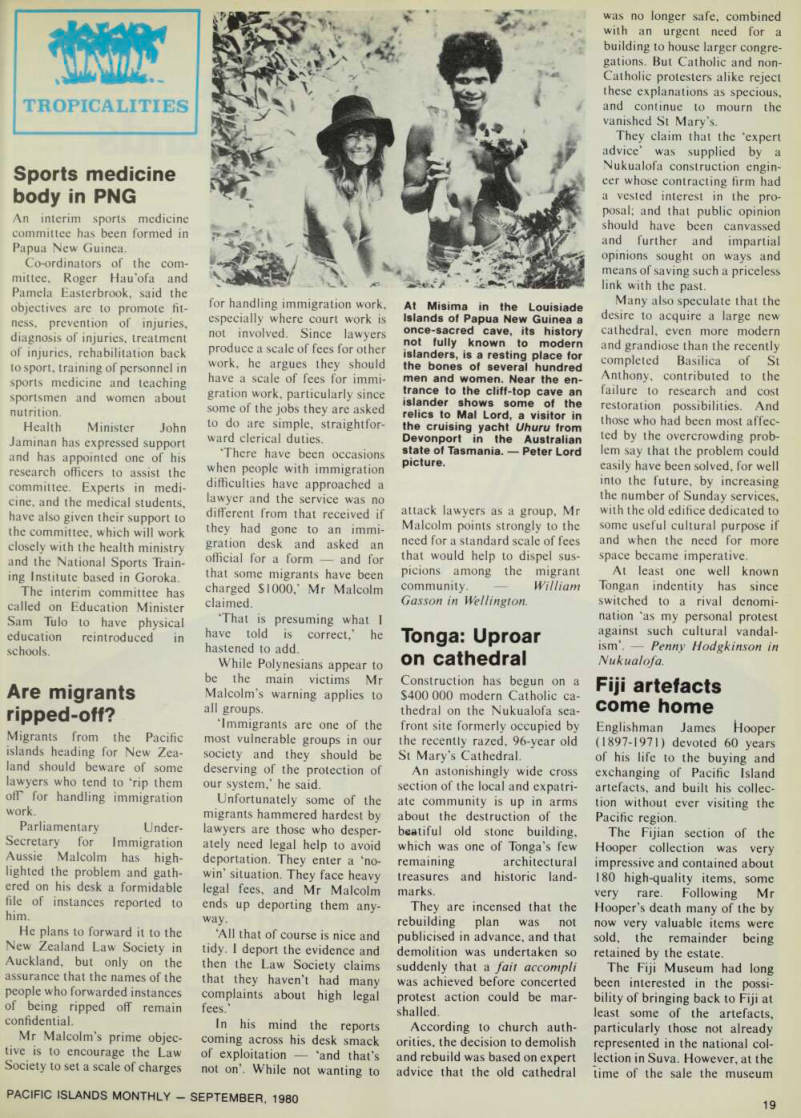
At Misima in the Louisiade Islands of Papua New Guinea a once-sacred cave, its history not fully known to modern islanders, is a resting place for the bones of several hundred men and women. Near the en trance to the cliff-top cave an islander shows some of the relics to Mai Lord, a visitor in the cruising yacht Uhuru from Devonport in the Australian state of Tasmania. - Peter Lord picture.
was unable to raise the necess ary funds.
Hearing of the museum’s lost opportunity, Mobil Oil Aust ralia Ltd offered to buy the remaining Fijian material from the Hooper estate and present it to the Fiji Museum and the people of Fiji.
A high proportion of the retrieved material comprises artefacts not previously represented in the museum’s collection, which means that for the first time this century the people of Fiji can see and appreciate rare and significant artefacts that form an essential part of Fiji’s cultural heritage.
Bottles: Lees
get the lees
Fiji’s Court of Appeal has upheld the claim of Carlton Brewery (Fiji) Ltd to the owner ship of all beer bottles marked with the company’s emblem.
It has ordered one of the country’s biggest soft drinks manufacturers, Lees Ltd, to return all the beer bottles it has to the brewery at rates normally paid for empties.
The decision against an ap peal by Lees means a problem not only for the Lautoka soft drinks bottler but for several other soft drink companies who sell drinks in the brewery’s 26 oz bottles.
In their judgment the three appeal judges say evidence showed that Lees was fully aware of Carlton’s claims to own the bottles. There was nothing to show that the bottles had ever belonged to anyone else.
In delivering judgment the judges awarded costs to Carlton.
Carlton started its bottle case against Lees in 1978. It asked the Supreme Court to instruct the soft drink company to stop using its bottles and to return all those it had. In distributing its beer through wholesalers, the company had made it clear it was selling only the beer, not the containers.
Mr Siddiq Koya, for Lees, had submitted that there was a public market in Fiji for the bottles, since people who bought them from collectors did so in good faith.
However, said the appeal
judges, there was no evidence that such a market existed or that Fiji law allowed for it.
The appeal was heard by Mr Justice Sir Trevor Gould, Mr Justice Speight and Mr Justice Spring. Mr Barrie Sweetman appeared for Carlton Brewery (Fiji) Ltd.
More Mormon
temples
Plans for five new Mormon temples in the Pacific have been announced. The temples not to be confused with the large numbers of Latter-day Saint chapels already in the area are the most sacred buildings in the Mormon faith.
Construction work on two of them at Nukualofa, Tonga, and Apia, Western Samoa is to begin early next year. Work on others will follow, in Sydney, Australia, Papeete, Tahiti, and Santiago, Chile.
The temples are not places of worship. They are regarded as sacred buildings for the pur pose of solemnising marriages, ‘sealing’ children to parents, and parents to grandparents, reflecting the firm family orien tation of the church.
Church architect Emil Fetzer said the church would like to proceed ‘more or less simultaneously’ on all five temples, plus two others plan ned for the United States and South America. However, dif ferences in local building codes and other restrictions would cause slight delays to some of them, he said.
Three basic designs are being used for the temples. The move marks a new era for the church in temple building. To date, the
church’s temples have gener ally been massive, imposing buildings which have been costly to erect. Seventeen such temples exist, including one near Hamilton, New Zealand, and one in Hawaii.
The new generation of much smaller temples will enable many more to be built, making church ordinances available to many more members. Empha sis will still be placed on tastefulness, dignity and beauty, however. Cost of the Australian temple is expected to be about $4.5 million.
More than 100 000 Mormons live in Australia and New Zealand, with many thousands more throughout the Pacific, especially in the Hawaii .n and Samoan Islands, and Tonga.
Death in the
South Pacific
‘Death in the South Pacific .. .’
It’s not the title of some new London-written novel, but that of a paper in the May issue of The New Zealand Medical Journal.
Co-authored by two doctors, a PhD student and a biostati stician, the paper looks at the effect of Westernisation on Polynesians. It concludes that it is having a rather adverse effect.
Back in 1963 researchers examined the people of Pukapuka, Rarotonga, a group of New Zealand Maoris, and the European population of a small New Zealand township.
Follow-up examinations were conducted 10 years later and the results were subjected to detailed study. The end result is the paper in the Journal.
‘ln the Polynesian popu lations there is a gradient of increasing mortality rate with increasing Westernisation, most apparent in the men; death rates are lowest in Pukapuka, where there is no difference between the figures for the sexes, and highest in Maoris where sex difference is now apparent,’ the study says.
This demonstrates, say the writers, that with increasing Westernisation, ‘the mortality experience of Polynesians de teriorates’.
Polynesians living under similar conditions as Caucasians in New Zealand have age-adjusted death rates which are twice as high as for the Caucasians.
The study looked closely at blood pressure and serum chol esterol, which in Western industrialised populations are linked to cardiovascular dis eases. ‘The higher death rates in the more Westernised Polynesians cannot be explained by the variables studied. The Maoris have the highest death rates despite their high cholesterol, and the inverse relationship between cholesterol and mor tality, and the pattern is re versed in the Pukapukans. The low level of blood pressure in Pukapuka does not explain their favourable mortality ex perience since blood pressure is not predictive of death in Pukapuka.’
The study said that is was not surprising that the high death rates amount Polynesians were difficult to explain in terms of the data gathered in their study. ‘Westernisation involves a
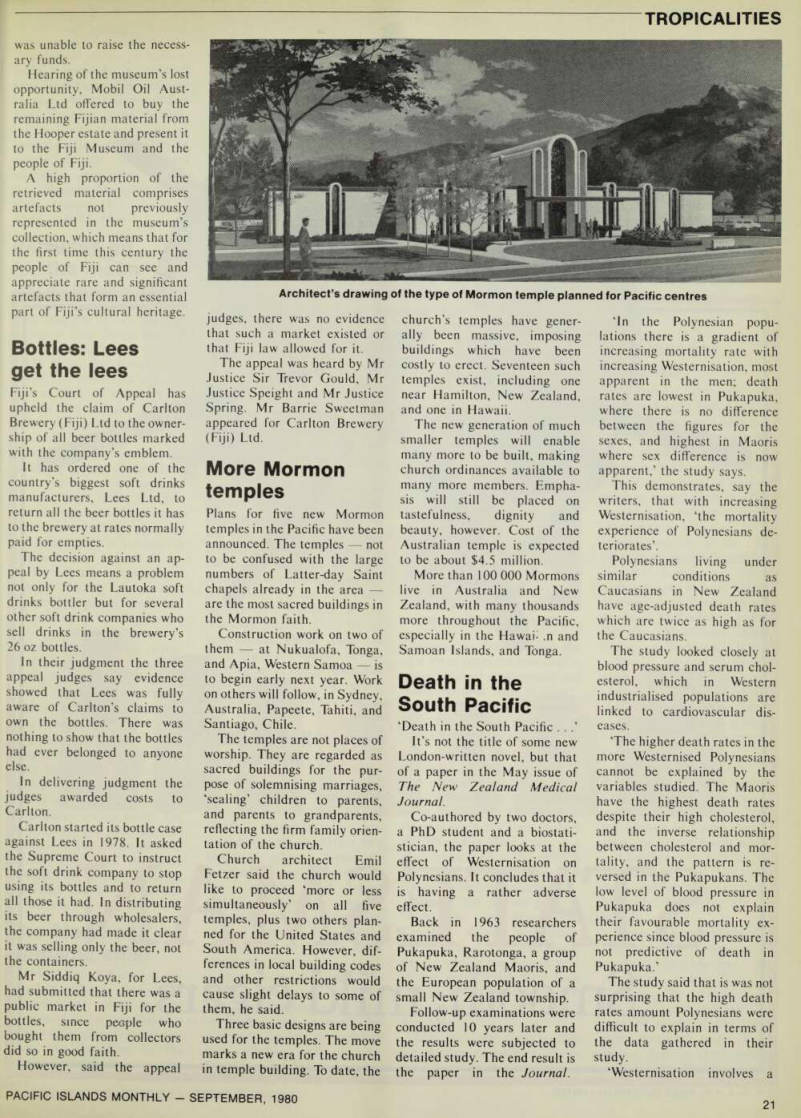
Architect’s drawing of the type of Mormon temple planned for Pacific centres
wide range of social and en vironmental changes which ex press themselves in mechan isms other than those mediated through the standard risk fac tors. However, given the gen etic similarity of the Polynesian groups studied, it can safely be concluded that the adverse mortality experience of the New Zealand Maoris is poten
tially preventable.’
Mike
Field in Wellington
Palauans go
for the moon
The Palau legislature has selec ted a Palau flag from among more than 200 entries proposed during a flag design contest held in that district.
The Palau flag design a golden full moon centred in a field of blue reflected tra ditional and modern Palauan ‘affinity for the moon’, accord ing to the legislature.
The legislature said: ‘The full moon represents the peak of cyclic activity of the earth, of low and high tides; the best time for fishing, felling timber trees, canoe-carving, planting, harvesting, and for celebrating notable events.’ ‘The full moon over Palau gives a feeling of warmth, tranquillity, peace, love and domestic unity,’ the legislature said.
A three-by-five-foot version of the flag was prepared for display by the Palau delegation to this year’s South Pacific Festival of Arts held in Papua New Guinea.
Palauans claim that centuries before the US astro nauts landed on the moon in 1969, a Palauan settler (Tkud) and his wife had already taken up residence on the moon. The dark spots you see on the surface of the moon are, of course, Tkud and his wife tending their orange tree, the Palauans claim. Micro nesian News Service
The Marshalls’
Nomadic chief
President Amata Kabua of the Marshall Islands has been achieving in recent months what used to be considered a next-to-impossible feat by pre vious administrations in the Marshall Islands.
Thanks to Marshall Islands Airlines, Kabua has been able to bring his government to the widely dispersed Marshallese population instead of issuing governmental directives from the seat of government in Majuro as his predecessors were wont to do.
The two Australian-built No mad aircraft, which constitute the government-owned airline, have been used by President Kabua as flying executive offices. In one week in July alone, Kabua was able to fly about half of his Cabinet to Kwajalein Atoll for an urgent meeting with Kwajalein land owners on what to do with more than SUS 2 million in land rental for that atoll. Following that meeting, Kabua and his government flew to Likiep Atoll, 265 miles in the opposite direction, where they joined more than 2000 other Marsh allese in ceremonies marking the official opening of the Likiep airport.
The Marshall Islands is blessed with several functioning airports and runways built by the US during the nuclear testings in the 1950 s and 60s.
Additional runways on other atolls have been planned for completion by the Marshalls Government. Officials in the Marshall Islands Government Information Office said the government is expected to visit outlying areas in the Marshalls more frequently in the future.
Micronesian News Service.
HER Excellency
wows ’em
Australia’s first resident high commissioner in Tonga, Miss Maris King, arrived at the end of May, preceded by a wide spread buzz of speculation. In a kingdom where diplomatic excellencies are constantly in the limelight, and where women’s undoubtedly consider able influence is traditionally exerted discreetly from behind the scenes, how would a HER Excellency fare?
Miss King provided the answer in no time flat. Her particular combination of natu ral charm, down-to-earth job approach, easy accessibility and obvious affinity for Polynesia and Polynesians has
already won all hearts and added a valuable new burnish to the local Australian image.
Male chauvinism reigned su preme in the upper echelons of the Australian public service when Miss King began her career as a foreign affairs sten ographer. After serving in a number of overseas secretarial posts, she transferred to the executive stream when it was first opened to women in 1949 and studied for an economics degree at Canberra University College. After graduation she spent several years in the Econ omic Analysis Branch, where her duties included attendance at many conferences around the world.
In 1973, transferred to the diplomatic stream, she was appointed deputy high com-
missioner in Fiji. During the next three years she took part in many regional conferences and made frequent visits to Tonga.
In April 1977, she became high commissioner in Nauru. A fascinating experience, she says, because her country’s smallest diplomatic outpost also embraced its largest ‘par ish’ five million square miles of it, including visiting rep resentation in the then Gilbert Islands and in Micronesia, at a time when both areas were in the thick of independence and self-determination planning.
During her second year in Nauru she was also elected President of the Soroptimist Federation of the South-west Pacific and in the second year of her presidential term took long leave and spent much of it visiting member clubs around Australia.
She says the opportunities for Australian women diplo mats have vastly increased in
recent years. There is already a counterpart head-of-mission in Ireland, ‘and several more women are getting close to that level’.
Miss King freely admits that being single has eliminated some potential career obstacles. ‘Even though there are no longer any official barriers to the appointment of a married woman as head-of-mission, not all husbands are psychologi cally equipped to shape their own lives around their partner’s postings or to accept a support ive role'somewhat akin to that
of a diplomatic wife.'
Penny
Hodgkinson in Nukualofa.
Services for
Vanuatu
Many people who have been associated with New Hebrides over the years would have given anything to be able to share in the Independence Day cel ebrations held in Port-Vila on July 30. However, at least two services were held in Australia to give folk the opportunity to share in spirit with their Pacific friends their joy at the estab lishment of the new Republic of Vanuatu. Ecumenical services were arranged in Scots Church, Melbourne on Sunday August 3, and in St Stephen’s Uniting Church, Macquarie Street, Sydney on Wednesday July 30.
The services brought together people who had actu ally worked in New Hebrides, those who had some special interest in the islands, as well as New Hebrideans at present in the cities.
On the British side the Presbyterian and Anglican Churches have been involved in mission work since the 1840 s, the Church of Christ came in 1905, the SDA Church in 1912, and the Apostolic Church later on. The churches thus have a deep and abiding interest in what is happening in the Islands.
Since the first stirrings of the independence movement the overseas churches have been supportive, and within New Hebrides the Anglican and Presbyterian Churches have supplied much of the leader ship. Anglican priest Father Walter Lini is chief minister and five Presbyterian pastors
Her Excellency Maris King
have been released by the church to serve in the Rep resentative Assembly. The Rev Fred Timakata will be minister for home affairs, while George Kalkoa, a well-known Presbyterian layman, is presi dent under the name of Ati George Sokomanu.
So it was appropriate that friends of the new republic should gather together in a service of worship to give thanks for independence and to pray for the people of Vanuatu.
Former missionaries, the Rev Alan Blake and the Rev Keith Allen, who both served at Tangoa Training Institute took part, along with the Rev David Eagling who was at the Bible School on Pentecost. John- Henry Wotlemaro, who is train ing for the Anglican priesthood and is at present at Vision Bible College, spoke of what indepen dence meant to him, and Obed Moses, who is studying at Croydon Bible College, explained what Vanuatu meant and led in prayer. The sermon was preached by the Rev Dr John Brown of the Commission for World Mission of the Uniting Church.
In his sermon John Brown said: ‘Today is a day of rejoicing for all the people of Vanuatu and their friends. It is a day of rejoicing in the mercy and justice of God; a day for congratulations to the leaders of Vanuatu who have persevered with great patience in the face of the unending provocation of those who refuse to relinquish power, and today see the fruits of their patience.
We give thanks to God; we rejoice with our brothers and sisters in Vanuatu; and we pray for them as they assume oner ous responsibilities for the fu ture.
We can hardly rejoice with them in their achievement of independence and self government without at the same time committing our selves in fellowship with others who continue their struggles for justice, freedom, self government and dignity. We remember the peoples of New Caledonia and French Polynesia who remain dominated by colonial powers.
Let us commit ourselves to support them till they have
achieved the same self government and independence. ‘But we remember particu larly the struggle which black people are carrying on in this country for a more just and human Australia the struggle against the combined interests of company, other sectional interests and govern ment to gain recognition of their right to their own land. It would be grossly inconsistent of us to support the people 2000 miles away in their struggle while we hold down those involved in a similar struggle here in Australia.’
To add to the evening a choir from the Fijian community (near neighbours in the Pacific) sang a hymn appropriate to the occasion. Later the Fijians with their singing turned what could have been an Australian cup of tea into a true Pacific Islands
gathering.
Alan Blake.
Upshot of Tonga
church battle
Siupeli Taliai, whose dramatic clash with the president of Tonga’s Free Wesleyan Church was reported earlier (P1M May pi5), has been reinstated as an ordained minister and as con ference secretary, but not as principal of Tupou College.
The reinstatement took the form of a presidential motion, seconded and carried without discussion during the minis terial session of the church’s pre-conference quarterly meet ing. This neat manoeuvre bypassed the constitutional pro cedure whereby accuser and accused are required to put forward their respective cases for a vote to be taken, with the result to be ratified by the annual conference in the event of a ‘guilty’ verdict.
Frustrated by what he de scribes as ‘a disappointingly inconclusive outcome’, Siupeli has accepted an invitation from the Uniting Church in Aust ralia to take up an administrat ive post in its Melbourne office.
His decision was approved at the FWC’s May -Conference, during which Dr Mo’ungaloa was again elected president, but with a considerably reduced percentage of the total vote. —
Penny Hodgkins on in Nukualofa.