Port Moresby as ‘the cultural and artistic capital
pp. 17-18 · Read in the full issue
artistic capital of the Pacific’
The Third South Pacific Festival of Arts held in Port Moresby in July was 'a great success’, according to JIMMY and GWENDA CORNELL. The article below is the first of two in which the writers provide a comprehensive and sometimes critical review of the big event.
During the first two weeks of July the Third South Pacific Festival of Arts turned Port Moresby into the cultural and artistic capital of the Pacific as 2000 participants from most Pacific nations displayed their talents in song and dance per formances, demonstrations of
carving, pottery and weaving,
art exhibitions, literary dis cussions, theatre productions and film performances.
Compared with the previous
two festivals in Suva and Rotorua, the organisers had
planned a highly ambitious
programme, and in light of the enthusiastic response of most participating nations the fes tival must be regarded as a great success.
The programme covered many facets of Pacific Islands culture, but its dominant fea tures were the traditional song and dance performances presented both by the 20 par ticipating nations and by the various provinces of the host country.
In a deliberate attempt to bring the festival to the people,
the performances were staged
at a variety of venues, most of them open air arenas close to the local market places in and around Port Moresby. Exceed ing all the organisers’ expec tations, the response of the crowds was tremendous as
thousands of people thronged
to each performance.
The theme of the festival was Pacific Awareness although only a few countries attempted to interpret this theme in their programmes. But most groups made an effort to present truly traditional songs and dances, often very different from the shows put on for tourists in the various hotels throughout the Pacific.
Outstanding in their attempt to portray Pacific Awareness were the Cook Islanders, who based a whole evening’s pro gramme on the theme of ‘The
Sea and Its Resources’. The leader of the group, Turepu Turepu, explained that they had chosen this particular sub ject as the sea is of such sig nificance for the whole Pacific region. As well as portraying the sea and activities related to it in song and dance, the Cook Islanders also demonstrated the weaving of fish traps and work done by children with shells. The poet Makuiti Ton gia read some of his poems,
striking in their outspoken
ness.
The theme of the festival was approached in a different way by the Western Samoans, who
presented a performance based
on the traditional Samoan eti quette of receiving guests.
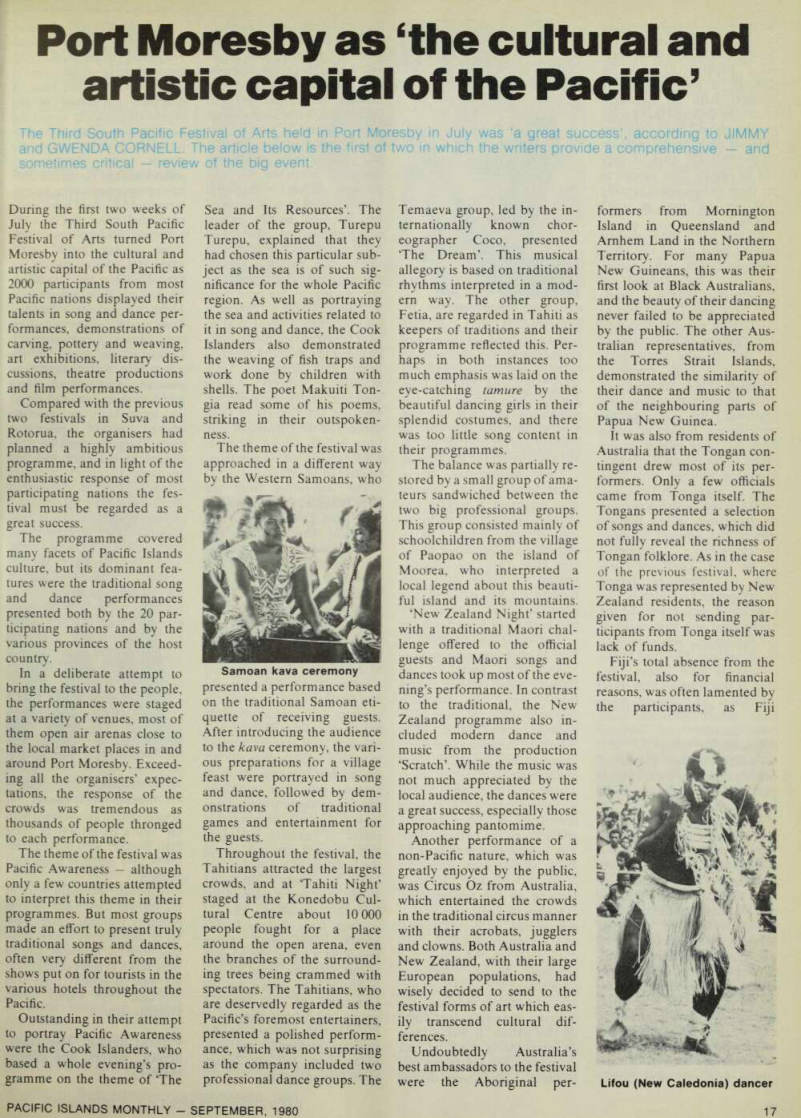
After introducing the audience to the kaxa ceremony, the vari ous preparations for a village feast were portrayed in song and dance, followed by dem onstrations of traditional games and entertainment for the guests.
Throughout the festival, the Tahitians attracted the largest crowds, and at ‘Tahiti Night’ staged at the Konedobu Cul tural Centre about 10 000
people fought for a place
around the open arena, even the branches of the surround ing trees being crammed with spectators. The Tahitians, who are deservedly regarded as the Pacific’s foremost entertainers,
presented a polished perform
ance, which was not surprising as the company included two professional dance groups. The
Temaeva group, led by the in ternationally known chor
eographer Coco, presented
‘The Dream’. This musical allegory is based on traditional rhythms interpreted in a mod ern way. The other group, Fetia, are regarded in Tahiti as keepers of traditions and their programme reflected this. Per haps in both instances too much emphasis was laid on the
eye-catching tamure by the
beautiful dancing girls in their splendid costumes, and there was too little song content in their programmes.
The balance was partially re stored by a small group of ama teurs sandwiched between the
two big professional groups.
This group consisted mainly of schoolchildren from the village of Paopao on the island of Moorea, who interpreted a local legend about this beauti ful island and its mountains. ‘New Zealand Night’ started with a traditional Maori chal lenge offered to the official guests and Maori songs and dances took up most of the eve
ning’s performance. In contrast
to the traditional, the New Zealand programme also in cluded modern dance and music from the production ‘Scratch’. While the music was not much appreciated by the local audience, the dances were a great success, especially those
approaching pantomime.
Another performance of a non-Pacific nature, which was
greatly enjoyed by the public,
was Circus Oz from Australia, which entertained the crowds in the traditional circus manner with their acrobats, jugglers and clowns. Both Australia and New Zealand, with their large
European populations, had
wisely decided to send to the festival forms of art which eas ily transcend cultural dif ferences.
Undoubtedly Australia’s
best ambassadors to the festival were the Aboriginal per
formers from Momington Island in Queensland and Arnhem Land in the Northern
Territory. For many Papua
New Guineans, this was their first look at Black Australians, and the beauty of their dancing never failed to be appreciated by the public. The other Aus tralian representatives, from the Torres Strait Islands, demonstrated the similarity of their dance and music to that of the neighbouring parts of Papua New Guinea.
It was also from residents of Australia that the Tongan con tingent drew most of its per formers. Only a few officials came from Tonga itself. The Tongans presented a selection of songs and dances, which did not fully reveal the richness of Tongan folklore. As in the case of the previous festival, where
Tonga was represented by New
Zealand residents, the reason given for not sending par ticipants from Tonga itself was lack of funds.
Fiji’s total absence from the festival, also for financial reasons, was often lamented by
the participants, as Fiji
Samoan kava ceremony
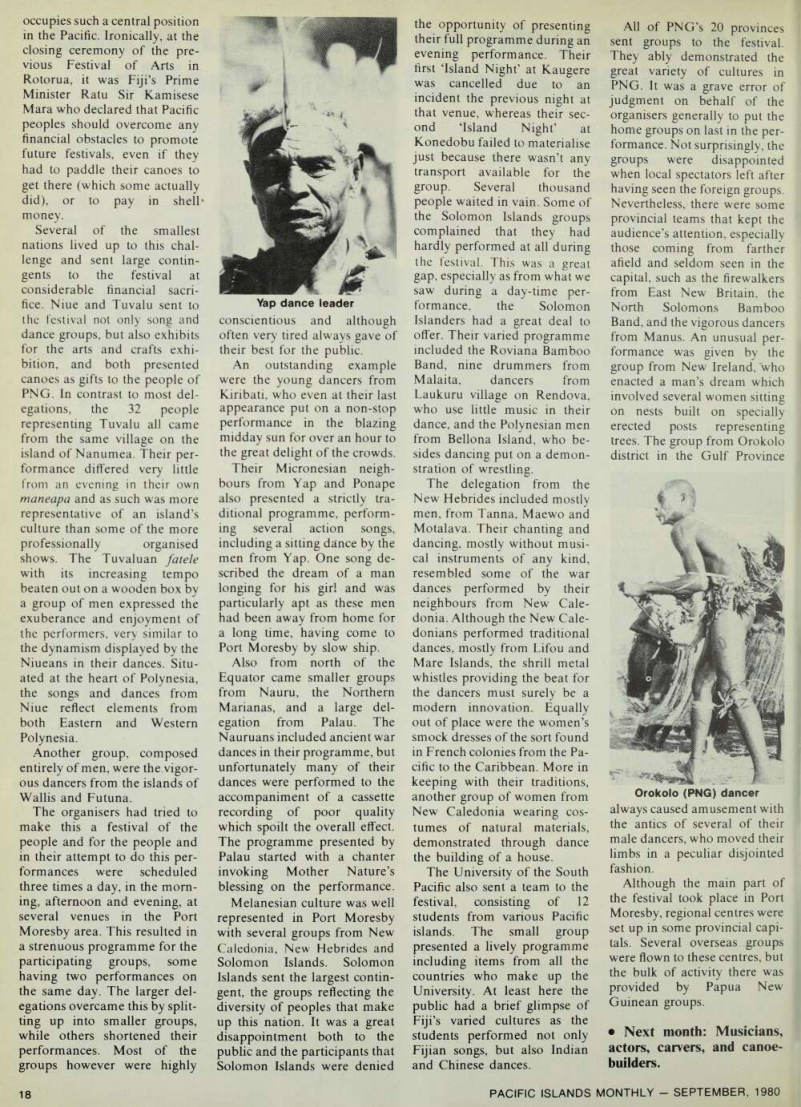
Lifou (New Caledonia) dancer
occupies such a central position in the Pacific. Ironically, at the closing ceremony of the pre vious Festival of Arts in Rotorua, it was Fiji’s Prime Minister Ratu Sir Kamisese Mara who declared that Pacific peoples should overcome any financial obstacles to promote future festivals, even if they had to paddle their canoes to get there (which some actually did), or to pay in shell money.
Several of the smallest nations lived up to this chal lenge and sent large contin gents to the festival at considerable financial sacri fice. Niue and Tuvalu sent to the festival not only song and dance groups, but also exhibits for the arts and crafts exhi bition, and both presented canoes as gifts to the people of PNG. In contrast to most del
egations, the 32 people
representing Tuvalu all came from the same village on the island of Nanumea. Their per formance differed very little from an evening in their own maneapa and as such was more representative of an island’s culture than some of the more
professionally organised
shows. The Tuvaluan fatele with its increasing tempo beaten out on a wooden box by a group of men expressed the exuberance and enjoyment of the performers, very similar to
the dynamism displayed by the
Niueans in their dances. Situ ated at the heart of Polynesia, the songs and dances from Niue reflect elements from both Eastern and Western
Polynesia.
Another group, composed entirely of men, were the vigor ous dancers from the islands of Wallis and Futuna.
The organisers had tried to make this a festival of the people and for the people and in their attempt to do this per formances were scheduled three times a day, in the morn ing, afternoon and evening, at several venues in the Port Moresby area. This resulted in a strenuous programme for the participating groups, some having two performances on the same day. The larger del
egations overcame this by split
ting up into smaller groups, while others shortened their performances. Most of the groups however were highly
conscientious and although often very tired always gave of their best for the public.
An outstanding example
were the young dancers from Kiribati, who even at their last appearance put on a non-stop
performance in the blazing
midday sun for over an hour to the great delight of the crowds.
Their Micronesian neigh bours from Yap and Ponape also presented a strictly tra ditional programme, perform ing several action songs,
including a sitting dance by the
men from Yap. One song de scribed the dream of a man longing for his girl and was particularly apt as these men had been away from home for a long time, having come to
Port Moresby by slow ship.
Also from north of the Equator came smaller groups from Nauru, the Northern Marianas, and a large del egation from Palau. The Nauruans included ancient war dances in their programme, but unfortunately many of their dances were performed to the accompaniment of a cassette
recording of poor quality
which spoilt the overall effect.
The programme presented by Palau started with a chanter invoking Mother Nature’s
blessing on the performance.
Melanesian culture was well
represented in Port Moresby
with several groups from New Caledonia, New Hebrides and Solomon Islands. Solomon Islands sent the largest contin gent, the groups reflecting the diversity of peoples that make up this nation. It was a great disappointment both to the public and the participants that Solomon Islands were denied
the opportunity of presenting
their full programme during an
evening performance. Their
first ‘lsland Night’ at Kaugere was cancelled due to an incident the previous night at that venue, whereas their sec ond ‘lsland Night’ at Konedobu failed to materialise just because there wasn’t any transport available for the group. Several thousand people waited in vain. Some of the Solomon Islands groups complained that they had hardly performed at all during the festival. This was a great gap, especially as from what we saw during a day-time per formance, the Solomon Islanders had a great deal to offer. Their varied programme included the Roviana Bamboo Band, nine drummers from Malaita. dancers from Laukuru village on Rendova, who use little music in their dance, and the Polynesian men from Bellona Island, who be sides dancing put on a demon stration of wrestling.
The delegation from the New Hebrides included mostly men, from Tanna, Maewo and Motalava. Their chanting and
dancing, mostly without musi
cal instruments of any kind, resembled some of the war
dances performed by their
neighbours from New Cale donia. Although the New Cale donians performed traditional dances, mostly from Lifou and Mare Islands, the shrill metal whistles providing the beat for the dancers must surely be a modern innovation. Equally out of place were the women’s smock dresses of the sort found in French colonies from the Pa cific to the Caribbean. More in keeping with their traditions, another group of women from New Caledonia wearing cos tumes of natural materials, demonstrated through dance the building of a house.
The University of the South Pacific also sent a team to the festival, consisting of 12 students from various Pacific islands. The small group
presented a lively programme
including items from all the countries who make up the University. At least here the public had a brief glimpse of Fiji’s varied cultures as the students performed not only Fijian songs, but also Indian and Chinese dances.
All of PNG’s 20 provinces sent groups to the festival.
They ably demonstrated the
great variety of cultures in PNG. It was a grave error of judgment on behalf of the organisers generally to put the home groups on last in the per formance. Not surprisingly, the groups were disappointed when local spectators left after having seen the foreign groups.
Nevertheless, there were some provincial teams that kept the audience’s attention, especially those coming from farther afield and seldom seen in the capital, such as the firewalkers from East New Britain, the North Solomons Bamboo Band, and the vigorous dancers from Manus. An unusual per formance was given by the group from New Ireland, who enacted a man’s dream which involved several women sitting on nests built on specially erected posts representing trees. The group from Orokoio district in the Gulf Province
always caused amusement with the antics of several of their male dancers, who moved their limbs in a peculiar disjointed fashion.
Although the main part of the festival took place in Port
Moresby, regional centres were
set up in some provincial capi tals. Several overseas groups were flown to these centres, but the bulk of activity there was
provided by Papua New
Guinean groups. • Next month: Musicians, actors, carvers, and canoe builders.
Yap dance leader
Orokolo (PNG) dancer