France in the South Pacific -
pp. 25-37 · Read in the full issue

Political
Currents
the view from Paris
The South Pacific consists of two groupings of peoples of widely differing origins, lifestyles and levels of develop ment. To the West lie two nations of the ‘white Common wealth,’ Australia and New Zealand; facing this bloc of nations of European origin is a whole nebula of archipelagoes and islands occupied in the main by people of Melanesian and Polynesian stock.
Australia is inhabited by immigrants hailing chiefly from the United Kingdom and Ire land, and, later on, from non- English-speaking European nations, Greeks, Italians, Yugoslavs, and refugees from central Europe who found themselves stateless at the end of World War 11. The Aborigi nal population, either elimi nated or debased in the past by diseases and customs associated with the irruption of white colonists (tuberculosis and al coholism, for example), has now achieved some stability in the Northern Territory and Queensland, and a proportion of Aboriginal youth today con
tributes to the birth of a sub proletariat in Sydney. The Ab original community veers be tween two lines of action: securing entry into the new Australian society, or, on the contrary, seeking to prevent the development of the mineral resources in northern Australia from interfering with the cus tomary laws which regulate its existence. Under the tutelage of Canberra, the Aboriginal com munity still plays only a negli gible role in national political life.
New Zealand, due to the exclusively Anglo-Saxon character of its population, and the vagaries of an economy which remains heavily depen dent on its traditional agricul tural trade outlets, appears to be much less well adapted than Australia to breaking free of the Victorian heritage. But two factors contribute to forming its policy in the South Pacific: on the one hand, the preservation of its influence and economic interests in the new states in Oceania, despite the increasing weight exercised in them by
Australia; and, on the other hand, the awakening of the Maori population which, unlike the Australian Aborigines, has emerged as an active minority (10% of the population) which is pressing its political demands and claims to land. Up to now, the Maoris have not established contacts with the other Poly nesian peoples of Oceania. But if their demands were to receive support from outside, New Zea land would have grounds to fear a change in its relations with the new Oceanic states.
These new states include: Papua New Guinea, to the north of Australia, and separated from it by the Torres Strait. Long ignored by ex plorers because its terrain and vegetation were unfavourable to white penetration in 1936, more than 50% of its population were still beyond the reach of any colonial census operation its substantial natural and mineral resources remain unexploited. So the new state is hesitating between two orien tations: having a common bor der with Indonesia, it is think ing of some formula for an association with the Associ ation of South-east Asian Nations (ASEAN) which would give it entry into a regional framework deemed favourable to its economic de velopment. But because of its size its territory is half as big as France and its population (3 million inhabitants ), Papua New Guinea looms as some thing of a giant alongside the small South Pacific states, and for these reasons it aspires to play a major role in the regional bodies of Oceania. This dual calling helps explain the rather paradoxical policy of the Papua New Guinea Govenment: con cerned to maintain good re lations with Jakarta, it avoids making any territorial claims on it and discourages the separatism of the Papuan tribes living in the Indonesian prov ince of Irian Jaya. On the other hand, it displays pan- Melanesian solidarity with the Kanak population of New
Caledonia, and extends its patronage to the pro independence minority in this Territory.
Further East, Fiji was the first oceanic state to play an appreciable role in inter national organisations after it became independent. Much smaller and less populous (600 000 inhabitants) than Papua New Guinea, Fiji never theless has a population (50% Melanesians and 50% Indians introduced by the British colon ists to grow sugar cane) which is at a .higher level of develop ment. It also has a better administrative structure.
Attaching great importance to the Lome agreements, in whose development its representatives waged a competent defence of the interests of sugar-producing countries, Fiji has recently modified the rather uncompro mising positions it had pre viously upheld in the regional bodies and the specialist insti tutions of the United Nations.
Despite the increasing weight of Papua New Guinea, the quality of its elites and its international experience will no doubt mean that Fiji will retain its influence in the zone.
Solomon Islands, indepen dent since 1978, is an archipel ago of 190 000 inhabitants, which is bound to become influ ential in the South Pacific Commission and the Forum.
But a characteristically Mela nesian circumspection makes it disinclined to adopt vanguard positions notably on matters of decolonisation and more interested in concentrating on its development policies, which face difficulties due to a lack of natural resources and trained personnel. Western Samoa, on the other hand, is more prone to back campaigns against our tests or our presence in Oceania. Tonga, the only state in the zone to have preserved its
traditional institutions and its dynasty in the course of the colonial period, is taking advan tage of its long-standing links wjth European nations France and Germany in par ticular and of the transport staging facilities it can provide, to offset the slight appeal of its natural resources. Kiribati (for merly the Gilbert Islands), the last comer among the Oceanic states, possesses a very large maritime area, which could in future arouse certain appetites.
Finally, among the micro-states of the zone, a special place must be accorded the tiny republic of Nauru which, by virtue of its phosphate resources, has the highest per capita income of any country in the world. Re markably well run, and playing an important role in the inter island air links of Oceania, Nauru maintains very friendly relations with our country.
The following entities have a special status: The three French Pacific Territories; New Caledonia, French Polynesia, Wallis and Futuna; The Cook Islands, Niue and Tokelau, associated with New Zealand under an arrange ment which gives them New Zealand citizenship without representation in the parlia ment in Wellington and a specific participation in the regional institutions; American Samoa; The Territories of Micronesia (Carolines, Marshalls, Palau), on whose behalf Washington is seeking, in exchange for a status as associated Territories which would leave in the hands of the American Government wide responsibilities in matters of defence and external relations, an end to the United Nations
Trusteeship arrangements.
Factors In The Evol
Ution Of The South
Pacific
Three factors are in operation today which explain the present evolution of the South Pacific: the demographic recovery of the Melanesian and Polynesian populations; the development of inter-island relationships and the awakening of an Oceanic particularism; and the influence of the churches and religious
organisations on the institutions and policies of the Oceanic states.
In the course of the colonial period, the decline in the birth rate of the Oceanic populations foreshadowed a development akin to that of the Aboriginal communities in Australia. If this trend had continued in the course of the 20th century, it seems likely that the population of the Oceanic archipelagoes and islands today would be made up for the most part of immigrant Europeans, Indians, Chinese, Vietnamese and Indonesians. But the Mela nesian and Polynesian peoples, from the beginning of the 19205, began once again to record high birthrates, and have thus been able to remain the majority populations of Oceania. This phenomenon has played an important role in moulding the collective men tality of the Oceanians.
Notably, it is an aid to understanding the emergence of a ‘pan-Melanesian’ national ist sentiment, which sometimes leads to hostile reflexes in relation to the South Pacific’s other ethnic communities. The marked hostility of the Oceanic states to any plans to receive refugees especially Vietnam ese in their islands, even sparsely populated islands, also springs from fears that the Melanesian or Polynesian pre ponderance could once more be threatened.
The often considerable dis tances separating the islands and archipelagoes of the South Pacific had not in the past prevented the Oceanic popu lations from multiplying their contacts and maritime ex changes. The Polynesians, in particular, were remarkable navigators who were able to master the expanses of ocean for purposes of fishing, trade or conquest. But the decline of these societies and the advent of the colonisers favoured re lations between the metropoli tan countries and the territories under their influence, to the detriment of inter-island exchanges.
The accession to indepen dence of the former British and Australian colonies; the slow but steady development of a network of air links; the disrup
tion caused by World War II in the traditional exchanges be tween the South Pacific and Europe changed the assump tions inherited from the col onial age and favoured the development of a regional con sciousness. In 1947, the Canberra conference created a South Pacific Commission which at the time embraced Great Britain, France, the Netherlands, the United States, Australia and New Zealand.
This regional organisation, which had a purely economic brief, was later broadened to include Oceanic states as they became independent, whilst alongside it there was created a Forum of the South Pacific states, open to Australia and New Zealand, but excluding the United States, France and Great Britain. Thus a regional solidarity was asserted, some times to our detriment, since it tended to exclude ‘metropoli tan’ representatives, or at least to reduce them to the position of ‘observer-contributors’, since they were judged to be outside the zone. The ‘white’ nations of Australia and New Zealand on the other hand were included in the grouping without, up to the present, any restrictions.
The distinction so estab lished is thus not based on criteria of standard of living or race, despite the occasional re flexes of Melanesian or Poly nesian ethnocentrism men tioned above. On the face of it, the ‘anti-colonialist’ reflex of the New Melanesian or Poly nesian stales should have been directed equally at Australia and New Zealand which, in the past, had shown no great ten derness in the treatment of their indigenous populations, and whose citizens who have emigrated to the Islands enjoy clearly privileged incomes. The marked interest of Canberra and Wellington in maintaining good relations with the Island countries, and the growing vol ume of aid given them by these two capitals, do not suffice to explain the political homogen eity of the South Pacific.
To understand it, one must take into special consideration the major role of the churches the Presbyterian Church in particular in the Oceanic mentality. The Biblical culture
propagated from Sydney, which has taken root from New South Wales to French Poly nesia, preserves a remarkable spiritual, intellectual and moral cohesion between peoples who are separated from each other by vast distances. This explains to a great extent why democ racy and respect for human rights are a much more lively reality in Oceania than in other parts of the globe. It also aids an understanding of the small inroads made by marxisl ideol ogy into Melanesian and Polynesian societies, and the natural aversion felt by their leaders for countries with com munist regimes, the USSR es pecially. The Oceanic states thus occupy a special place among the various groupings of states in the contemporary world: they are not to be found in the ranks of the movement of non-aligned countries, despite some similarities of interests and certain rhetorical borrowings. No South Pacific state took part in the recent Havana conference.
The influential religious or ganisations of the South Pacific have therefore contributed to the preservation of the demo cratic institutions of the states of this region. But there is another side to the coin; if the ‘Presbyterian lobby’ helps to preserve the stability of the South Pacific, and the pro- Western orientation of its peoples, it also fosters strong and tenacious anti-French prejudices. The pastors who provide moral inspiration to, and sometimes rule, the Oceanic peoples are seldom receptive to our reasoning.
Honourable men, somewhat simplistic, they have trouble conceiving of models of decolonisation other than the British one, and see in our nuclear tests an offence against Creation.
The Presence Of
France In The South
Pacific
France, which means to retain its presence in the South Pa cific, is called upon to adapt both its way of speaking and its actions to the specific mentality of the Oceanians. It should be particularly borne in mind that the fenced-off situations of the
colonial age have led to a total failure to appreciate the culture and institutions of France, even in states neighbouring French Territories. So France must wage campaigns of explanation of its presence and activities in the South Pacific in a consistent and followed-up manner.
It should be particularly explained to people who know nothing of the French Consti tution that the overseas Terri tories of the Republic are not ‘colonies’ made up of ‘natives’ administered from Paris, but communities endowed with a specific status, managing their own resources and inhabited by citizens who take part, in the same way as other Frenchmen, in all popular voting processes.
Their belonging to the Republic therefore does not result from any survival of a colonial regime, but from the legally expressed will of a majority of citizens in each Territory. There is nothing to prevent the elected representatives and the acti vists of the pro-independence minority groupings from pub licly presenting their policies whenever and wherever they choose: and they don’t fail to take advantage of this fact. But the very affirmation of the principle of self-determination, the latitude given to French citizens of the overseas Territories in expressing their desires in periodic public votes,
justify a firm rejection of any foreign interference. Third countries cannot dictate from outside to French Territories the choice of their destiny.
For minds trained in or accustomed to French consti tutional law, reasoning such as this is self-evident. But for Oceanians naturally inclined to identify democracy with Anglo- Saxon tradition, steady and repeated explanatory cam paigns are necessary. M Destremau, then state secretary for foreign affairs, went to Australia in 1976, and made initial contacts with the Papua New Guinea authorities. M Olivier Stirn, in June and December 1979, twice visited South Pacific states. He went to Australia, New Zealand, Fiji and Tonga, to Solomon Islands and Papua New Guinea. He was able to present, not only to members of government but also to church representatives and radio and press people, the principles of French policy.
Dialogue with the South Pa cific states is naturally not limited to these clarifications of basic principles. It is also directed at developing a policy of exchanges, co-operation, and good neighbourliness with the countries close to the overseas Territories, a policy adapted to the structure, needs and par ticular resources of each state concerned. The New Hebrides, a Franco-British condominium due to become independent in 1980, clearly represents a special case. The co-operation envisaged is not only concerned with the responsibilities shared by Paris with London over half a century. It must also take account of the needs of a bi cultural state, in which the French-speaking minority wishes to retain the advantages flowing from the efforts of France over the last decade.
Co-operation is much more recent in the other, exclusively English-speaking, states in the area. They have modest finan cial and other means, and the almost total ignorance of the French language prevailing in them constitutes a serious ob stacle to its development.
Still, initiatives taken over the last three years have led to the despatch of French doctors to Tonga and Western Samoa, to
the establishment at the Uni versity of the South Pacific in Fiji of a French-language de partment, and to the training at the Paris Institute of Public Administration of young public servants from Papua New Guinea. The Office for Over seas Scientific and Technical Research (ORSTOM) and the National Centre for Exploi tation of the Oceans (CNEXO), which both have a very good name in Oceania, are extending their work in coun tries close to New Caledonia and French Polynesia. The C* tablishment of new economic zones also represents a field in which France and its Pacific neighbours can in future collab orate to their mutual advan tage.
Along with all these develop ments, France’s relations with Australia and New Zealand have clearly improved since the suspension of nuclear tests in the atmosphere. Cultural con tacts are developing satisfac torily; the more liberal policy pursued by the Fraser govern ment in matters of foreign investments is encouraging French companies to take a more active interest in devel oping the considerable mineral
reserves of Australia than in the past. So it can reasonably be hoped that Franco-Australian economic exchanges will in future be much more developed and more balanced than they are at present. These perspec tives for economic co-operation naturally go beyond the frame work of regional co-operation.
A sound foothold in Australia and especially in Sydney, the metropolis of the South Pacific nevertheless fortifies the presence of France in Oceania.
She has long looked something of an intruder in a continent which, without her, would be long exclusively to the English speaking world. It is true that the Australians and New Zealanders are only half convinced of the permanence of the status of the Overseas Territories; but, apprehensive about the penetration of Oceania by less friendly powers, they attach importance to the presence, particularly the naval presence, of France, and hope that she will continue her contribution to regional devel opment.
For its part, France feels the need to act in concert with Australia and New Zealand in
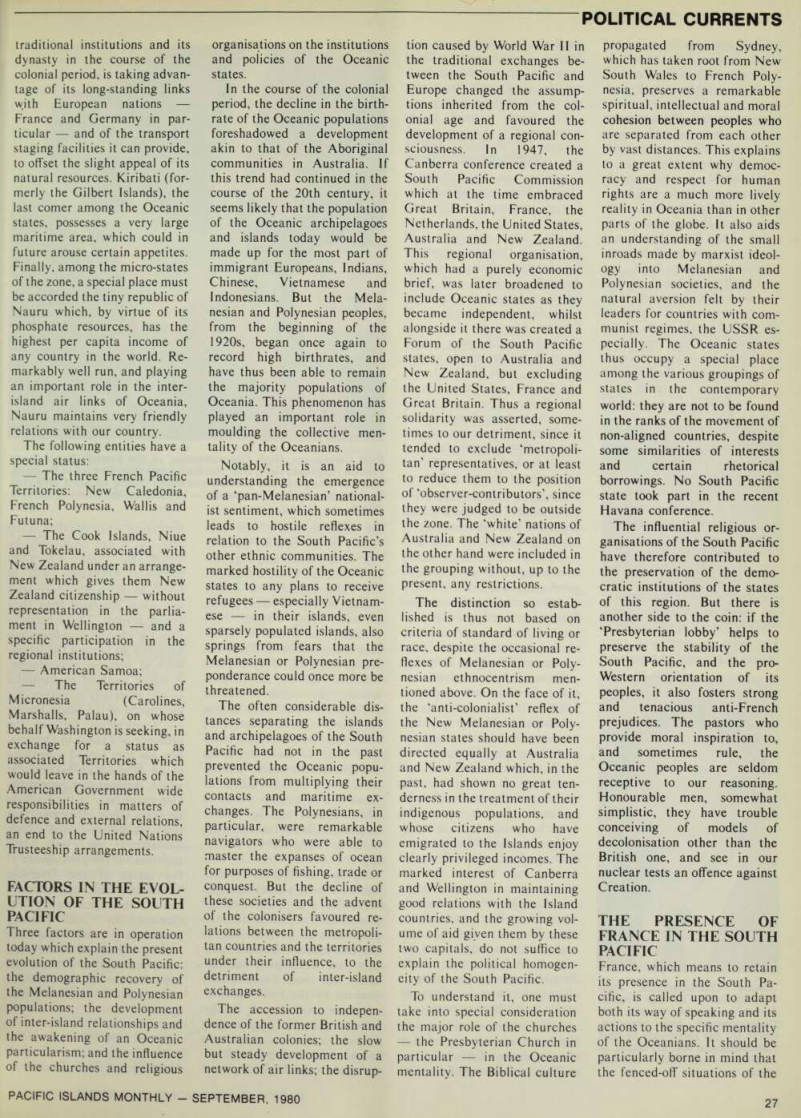
Claude Charbonniaud, High Commissioner of the French Republic in the Pacific. Mr Charbonniaud has respons ibility for the territories of New Caledonia and Wallis/Futuna.
Australian Information Service photo.
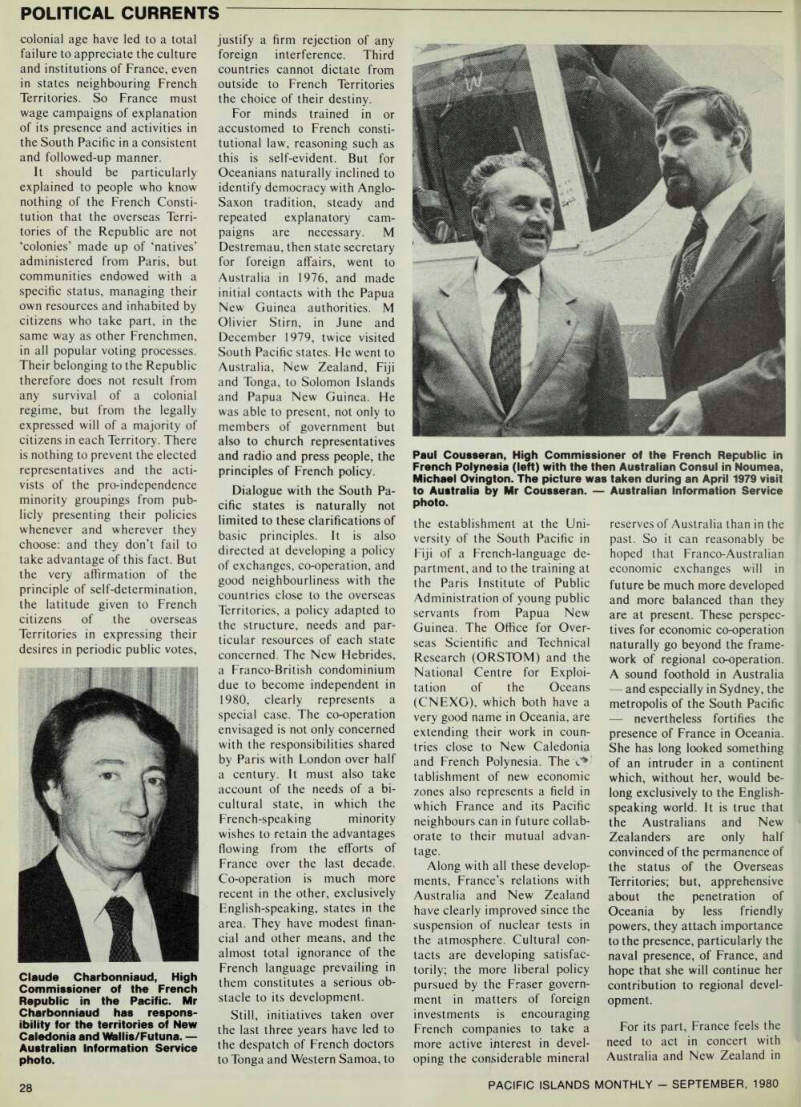
Paul Cousseran, High Commissioner of the French Republic in French Polynesia (left) with the then Australian Consul in Noumea, Michael Ovington. The picture was taken during an April 1979 visit to Australia by Mr Cousseran. - Australian Information Service photo.
the implementation of its policy in the South Pacific. But it also means to ensure that its inter ests will be represented directly with the new Oceanic states themselves. Two charges d’affaires have been appointed to Fiji and Papua New Guinea, and ambassadors will be appointed later. An embassy will be set up in Port-Vila when the New Hebrides becomes independent. France will then be in a position, despite the distances and the delays imposed by the existing net work of air services, to have regular contacts with all states in the zone.
So France intends to adapt its policies to the new realities in Oceania, to make itself better understood by the South Pacific states which recently became independent, and to develop its exchanges with each one of them. But its policy in the region must be seen in the wider context of the co operation or confrontation which is at present taking shape between countries bordering the Pacific China, USSR, Korea, Japan, the ASEAN nations, and the Andean countries. France’s presence in Oceania represents an appreciable asset in the sense that it allows her to play a no doubt modest but still effec tive role in the consideration now being given to periodic consultations even in institutionalised form, as the Japanese propose of the Pacific states.
Knocking on
Lome doors
The idea that every time the Cook Islands did something for itself it was off and running from its partnership with New Zealand is stupid, according to the country’s Premier Dr Tom Davis.
Dr Davis was commenting on moves by the Cooks to accede to the Lome conven tion, opening the way for it to receive aid and development funds from the European Eco
nomic Community.
In May Dr Davis addressed a meeting in Nairobi, Kenya, of the ACP the organisation of Asian, Caribbean and Pacific
nations signatory to the conven tion. This has been interpreted as a move by his Democratic Party Government away from its close links with New Zea land. ‘Why lose one part of the world to gain another. Why not have both,’ he said.
But the Cooks’ ties with New Zealand have proved a stum bling block to its membership of the ACP and the convention. ‘One of the precepts of joining the convention, not clearly stated but understood, is that a nation shall be completely independent,’ Dr Davis said.
In his Nairobi speech he emphasised that the Cooks could act on its own behalf and enter into international agree ments.
In an interview in Rarotonga he said New Zealand had tried to help the Cooks in its moves.
It had written to the Lome Council Secretariat emphasis ing the Cook Islands’ sover eignty. But there was unnecessary suspicion of both the Cook Islands and of New Zealand’s role. The ACP was apprehensive that if the Cooks got EEC aid, New Zealand may back out of its responsi bilities to the Cooks. Also, the Cooks could be used by New Zealand as an offshore facility for obtaining EEC funds.
The ACP nations agreed to support the Cooks’ mem bership in principle. But two countries (Francophone coun tries, said Dr Davis, who would not name them) thought it should get a closer look. It has been referred to the ACP’s committee of ambassadors for final decision.
After the conference Dr Davis visited several EEC countries, all of which must ap prove the Cooks being admit ted to the convention. The
United Kingdom, Belgium,
Holland and West Germany gave full support. But France had some reservations because of the Cooks’ constitutional re lationship with New Zealand.
It was concerned at creating a precedent. Thus, the Cook Islands’ next move must be to show the EEC nations that admitting it would open no
floodgates.
‘We will say that we are really no different from any
other Pacific nation, and that it would rather be a precedent if we were not admitted as a member,’ Dr Davis said. Sue Green in Wellington.
Martyrs and
mercenaries
Ever since the independence issue in the New Hebrides be came an issue there has been a race to find a martyr a genu inely dedicated person who had lost his life in such a self effacing way that many would be inspired to continue the con flict where he left off. No mat ter whether he was struggling for a genuinely New Hebridean autonomy, or for a neo-colonialist reshuffle of the old order both sides were anxious for a hero. Alas, so far no one has measured up.
The first attempt was by the
Francophone political leader
ship, who tried to turn the elec tion day incident of November 29, 1977, into a ‘Holy War’.
When the British police chief failed to get any help from his French colleague in seeking to avoid a possible bloody con frontation between the ‘Mod erates’, who had taken over Port-Vila early that morning, and the Vanuaaku relief force
who were advancing through
the outskirts, he sent his force of 12 men alone to dispel the group of toughs lolling around outside the Vanuaaku Party
headquarters and obviously
spoiling for a fight. The police
did their job with only a few teargas cartridges. But in the
succeeding ranting and rioting
one belligerent hothead got a bit too close to the obviously apprehensive thin blue line and stopped a gas cartridge point blank in the ribs.
A martyr? Maybe, but unfor tunately for the image, he did not die. There was also the story from British doctors who were refused permission to examine the patient, and ex pressed their belief that the man had fallen on his own axe.
Nevertheless such was the hue and cry that the two British of ficers involved, Messrs Dumper and Osborne, were shipped back to the UK the following day and never heard of again. This was despite the near mutiny of their fellows
who saw such a capitulation as really letting the side down, no matter how sensitive the Com mon Market negotiations were at the time. So much was made
of ‘police brutality’ that people
began to wonder who was this Melanesian who was prepared to take his life in his hands to protect the interests of French citizens against his own kind.
Obviously he must have had a
split personality because when
the so-called ‘Moderate’ lead ership tried to capitalise once
again on the issue by putting
out a poster, he turned out to be two people.
Then there were what seemed to be attempts from the Vanuaaku side. One night on Tanna a line of trees planted 16 years before to delineate a land
dispute was chopped down
and troubles started again. Not
for long, however, as the word soon went around as to who swung the first axe. ‘lt was Kasso the local French police man!’ So that one backfired.
A barbed wire fence at Enima was cut into two-foot lengths and cattle were disper
sed to spoil people’s gardens.
Guess who is suddenly on hand to try to adjudicate a new de cision that effectively reverses the old one? Why, the French District Agent of course.
And guess who fronts up to remind him that it was one of his predecessors who had settled the row 10 years before by making a native court de cision that is like the law of the Medes and Persians and desig ned to smother all native feel ings of injustice under wads of whiteman paper? Who else but
the Presbyterian Missionary.
So the old animosities are
The Rev K. C. Calvert of Tanna. ‘No one has measured up as a hero’ he writes.
rehoned and manoeuvre is countered by manoeuvre. ‘Why Monsieur Pouillet, you would not want to create any
precedent that might under
mine the authority of Joint Court documentation on land, would you? Just to win the al legiance of such a small group of dissidents is not worth it!
Why, every European plan
tation owner in the group would want to slice you up with blunt razor blades!’
But in the meantime the innocents who have been
manipulated into creating the
incident, for reasons far be
yond their comprehension, re
main incensed. A fight! Two broken arms, a multitude of bruises and old Kalwasi with a crack on the head. Six weeks of suffering and a lingering death.
An official inquiry? No, it
would be too difficult to prove any connection.
Then there was the story of Tamalea on Aneityum who, along with a friend in affaire No 2978, was gaoled for six months by a French judge after being severely beaten up by a group of ‘Moderates’ who said that the two of them were mak ing public political statements that disturbed the peace. Most other people just thought they were drunk. When he came back home to find his family life in disarray, he committed suicide to avoid the shame.
That was a bit messy, so no martyr’s crown for him either.
Stories of this sort are legion throughout the group.
But then, there was Alexis lolu! At last! ‘A responsible public figure.’ ‘A Member of
the Representative Assembly.’ ‘Slain in the course of public duty.’ ‘Killed by the guns of political anarchists.’ ‘Died for Custom.’ Would he make it to the Cloistered Halls? All right, maybe he did have a record of violence and bashing and tying up people. Maybe he was attacking the government police station that night of June 11 to liberate some of his men who had been arrested for helping him to try to blow up a police convoy. Maybe he did have a knapsack beside him with five sticks of dynamite, some teargas canisters, home made bombs, knives and a pis tol, but Che Guevara would have had the same! Ah yes, but Che wouldn’t have had his dynamite given to him by the French District Agent. And be sides, there was a letter in the bag. A letter from Vila. Was that what the private plane, chartered by a well-known French political leader, had dropped off as it flew over Sul phur Bay a couple of days be fore? Instructions to attack the airfield and the Government • Station on June 11.
Anyway, why did Alexis kid nap the local government agent and his assistant in the first place? The Vanuaaku Party government had been very careful to choose a French educated national for the senior position to avoid any such unpleasantness or charges of favouritism. Reuben Tamata, and Josephu his sec retary, could speak much better French than Alexis. In fact Charlie Nako and Isaac Wan, the other two ‘Francophone’ leaders on Tanna, could not speak French at all.
Maybe the real split on Tanna is the age-old one be
tween the majority favouring
education and development and the ‘Custom’ Mifala no wantem faction which has been sharpened up into a political pressure group by judicious Santa Claus tactics by no less a figure than French Resident
Commissioner Jean-Jacques
Robert himself. Alexis had been employed as an assistant by Charlie Biddle, a boxing promoter, and had only a very basic primary school education before he rocketed to stardom as a political front man.
Indeed, it would seem that the basic common factor of all the present ‘Moderate’ Party leadership is a lack of edu cation, plus a willingness to be manipulated, as long as it builds up their own personal prestige. All the educated poli ticians (with any brains at all) left the French-dominated par ties and stood as Indepen dents.
So what was the driving urge that led Alexis lolu to his
death? Martyrdom or money?
Maybe there was a bit of the mystic there too. Certainly the talk had gone round Tanna about the source of his power.
It was Karaperimun, the old ancestral spirit of Tukusmera, the highest peak on the island.
Charlie Nako and Isaac Wan also had their spiritual sources of power or negau. And as Alexis had so fearlessly stood out in front of his men in the glare of vehicle headlights, urg ing them to move up against the line of police and Vanu aaku vigilantes it would seem that he was utterly convinced of his own immunity. There was also the subsequent news paper story about the death flute that had been broken, the custom charm or spell that had backfired and so allowed his death. But then again as some one else said, ‘maybe he had just been reading too many Phantom comics’.
Whatever the verdict of his tory on Alexis lolu, whether he died for belief in his ances tors, the glories of France or his
own grandiose imagination, it
would seem that with indepen dence now having been achieved, the story of Vanua
tu’s struggle for independence
will contain no heroics, only a sour memory of expatriate interference, and the cold blooded manipulation of essentially innocent and naive people for motives far beyond their own understanding.
K. C. Calvert, Tanna, Vanuatu.
Comeback by
proxy?
The former Cook Islands premier, Albert Henry, plans to use a nominee to make a politi
cal comeback. He says the nominee is ‘sure to succeed’ in the country’s next general elec tion.
Mr Henry is prevented from standing for election himself because of his conviction for conspiracy to defraud, under a clause added to the Cook Islands’ Electoral Act after the 1978 fly-in-voter scandal. So he plans to nominate someone to stand for parliament for him. If his party wins, parliament would then be called and the act appended to clear the way for him to stand in the by election which would then be come necessary when his nominee resigned. After vic tory in the by-election, he would again take over as Prem ier. ‘I am the leader now. It is
already decided. The people
are not wanting me to go in there and become a minor member, they are wanting me to go back in there and lead them,’ he said when explaining his plans in a recent interview
in Rarotonga.
Although the next election is not due until 1982, Mr Henry said the country was in such an economic mess there may have to be an early election. His Cook Islands Party would win it. He predicted the party would win all four Rarotonga seats, at present held by the
governing Democratic Party,
and that Dr Davis would lose his seat.
Still bitter about his convic tion and ousting, Mr Henry said the recent withdrawal of his knighthood was a last-ditch effort to undermine him. But it
had not. ‘My being dislodged
from the government did not change the minds of the people in fact it made them stronger.
My conviction did not change the atmosphere at all so per haps the removal of the knight hood could be the last knock-out possible. But it has not made a mite of dif ference.’
Recently Albert Henry has
said he would appeal against his conviction, but he is now dropping that course because he can’t afford it. The earlier court cases had cost him $6O 000 and he was still paying off his lawyer, he said. Sue Green in Wellington.
Alexis lolu (Nabanga picture)
came expendable.