How the pioneers established air routes
pp. 151-155 · Read in the full issue
across the Pacific
In a fitting commentary linking with PlM’s 50 years of publication, aviation writer JACK PERCIVAL tells here about the plans and the people behind 50 years of civil aviation in the Pacific region.
It is now 50 years since the first flight from America to Aust ralia, but trans-Pacific air routes are still being parti tioned on a government-to government basis, trying to make sure that the flag lines get the best cut of the bird.
The only private company on the USA Australia route which seems to successfully compete with the flag lines is Continental. It is a newcomer :ompared with Pan American, Qantas, Air New Zealand and \ir France, all of whom have done an excellent job of establishing communications with islands once weeks away oy often irregular shipping ichedules.
Drop-outs in the trans pacific route caused by inancial and equipment diffi
eulties and/or aviation political
irrangements have been \merican Airlines and what
Kbout The Author: Jack
’ercival is Australia’s senior iviation correspondent. He has een the Pacific aviation trans port industry grow from a ledgling in 1933 when he first lew with Charles Kingsford Smith in the Southern Cross icross the Tasman to New !ealand. Later he was a crew nember on the first Indian )cean survey flight from Port ledland to Mombasa via tacos, Diego Garcia and the Seychelles, and a crew mem >er in the first survey flight rom Sydney to Valparaiso, a lew route which is now being leveloped as a result of the xtension of the airstrip on iaster Island. Jack Percival’s xperience, like PlM’s, tretches over the 50 years of viation development in the *acific, and here he recalls ome of the personalities who lave passed from the active ‘acific scene now that trans 'acific aviation has become an nternational power play. But he Island nations, particularly iji and Papua New Guinea, are iow moving into the picture nd producing their own influ nces.
was once known as BOAC (now known as British they have dropped ‘Airways’ from their aircraft livery, advertising and publicity). American Air lines is estimated to have lost about $5O million on its short term United States East Coast to Sydney operation.
Meanwhile an interesting web of inter-island services has been woven, mainly centred on Nadi, Fiji’s international air port, which has held on to its grip as the South Pacific’s main commercial air hub, at one time contested by the French who were anxious to make Tahiti the focal point of South Pacific air services.
The story of the first west bound Pacific flight by Kingsford Smith, Ulm, Warner and Lyon in 1928 has been told often; and so also has the story of the first flight by Kingsford Smith and P. G. Taylor from Brisbane to California in a single-engined Lockheed Altair, and the many pioneer ing trans-Tasman flights by Kingsford Smith and Ulm and their crews across the Tasman Sea.
But it is little known that Kingsford Smith on July 10, 1935, put before the Australian Government a plan to operate regular trans-Tasman and trans-Pacific services. At that time I was on the board of the Trans-Tasman Development Company, and I have before me now a copy of the detailed 32-page proposal which was addressed to the Hon. R. A.
Parkhill, Minister for Defence, and the head of civil aviation for the Commonwealth of Australia.
The proposal from Kingsford Smith included the following: ‘Since 1928 I have person ally completed six trans- Tasman crossings and have gained valuable experience under stress. Similarly, my col league, the late C. T. P. Ulm, made many such flights. ‘On each occasion, and in
Mr Ulm’s case as well as my own, the most careful research was made into meteorological conditions, radio facilities and equipment, safety precautions and other essential details rel evant to flights of this charac ter. As a result, valuable data and information has been col lected, studied and used as a basis for the submissions now made. ‘The foregoing facts also pro vide further support for my contention that Australian pilots and technicians are more fully equipped to plan and operate trans-Tasman and Pa cific air services than overseas authorities whose knowledge of the peculiar circumstances pre vailing over the routes is purely theoretical. ‘May I reiterate that the proposals now made are based on known facts resulting from personal experience and direct investigation.’
Kingsford Smith proposed a weekly service (inward and outward) using a four-engined Martin or Sikorsky flying-boat, carrying respectively 35 pass engers and 2000 lb of mail, or 20 passengers and 2000 lb of mail. On a weekly service (inward and outward) he suggested using a Douglas two engined land aircraft, carrying
mail only. All he asked for was a small subsidy and the right to carry mail. The proposal was flatly rejected.
This, in effect, sent him barnstorming around the world until he drowned in the Bay of Bengal, as Ulm earlier had perished off Hawaii in an Air speed Envoy while trying to carry the Australian flag across the Pacific.
Soon after, another famous Australian airman, Tasmanian born Harold Gatty, who had flown around the world in eight days with Wiley Post, bobbed up in the Pacific looking for bases for a Pan-American trans-Pacific service from San Francisco to Sydney by way of New Zealand.
Years before, apparently, Eddie Rickenbacker and Gatty had filed papers in Washington making a claim for a Pacific trunk line route. Now, Pan American was all set to go using Clipper flying-boats, but there was a serious snag. All the key islands other than Hawaii and New Caledonia en route to New Zealand were coloured red on the atlases and marked British on navigation charts.
Gatty, who retained his Australian passport until his death in Suva in 1957, dis
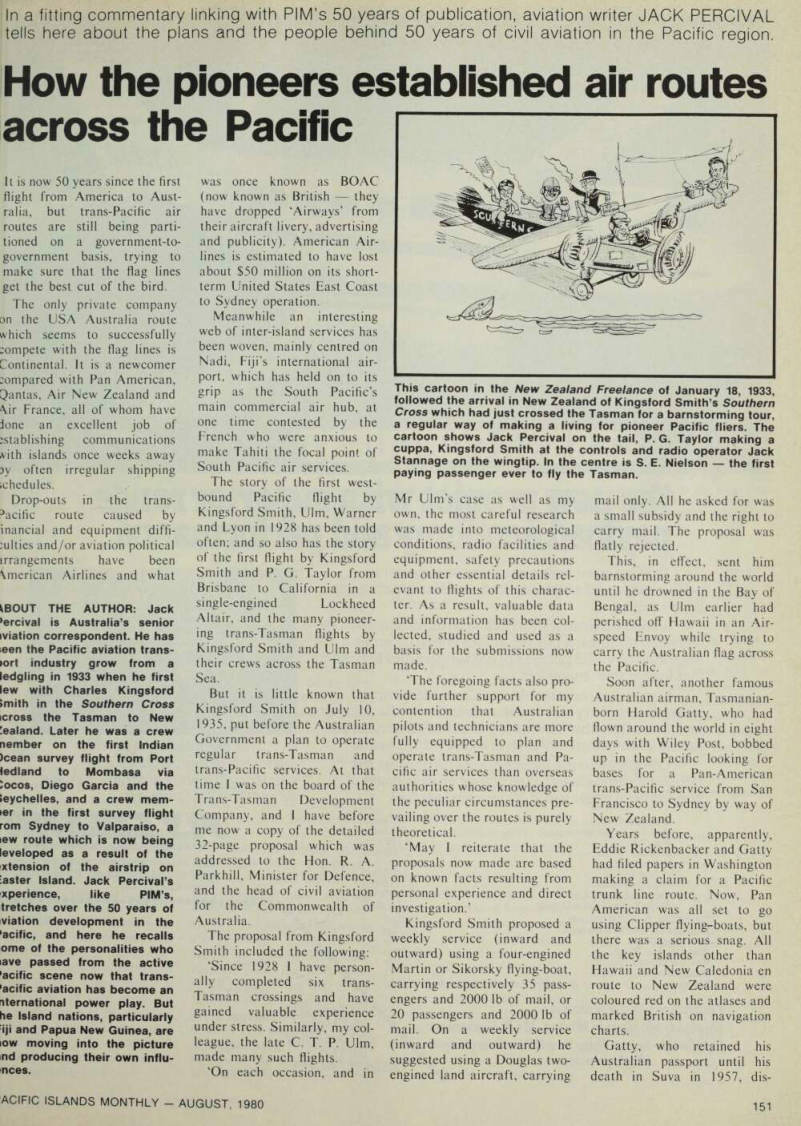
This cartoon in the New Zealand Freelance of January 18, 1933, followed the arrival in New Zealand of Kingsford Smith s Southern Cross which had just crossed the Tasman for a barnstorming tour, a regular way of making a living for pioneer Pacific fliers. The cartoon shows Jack Percival on the tail, P. G. Taylor making a cuppa, Kingsford Smith at the controls and radio operator Jack Stannage on the wingtip. In the centre is S. E. Nielson - the first paying passenger ever to fly the Tasman.
covered that some of the vital key-base islands were uninhabi ted, but had frequently been used by Nantucket whalers as stop-overs during expeditions to and from Antarctic waters.
The United States Govern ment passed legislation that islands claimed by nations (mainly Britain) had to have permanent settlers on them or they were up for grabs by the first country whose citizens settled there. That triggered an international row between the United States and Britain (stirred up by the Australian and New Zealand govern ments). A cruiser, HMS LEITH, was sent from Auckland to nail metal plaques on coconut palms on the most strategic islands. The contro versy ended with Canton Island, in the Phoenix Group, being declared a condominium, rather like what even today has happened to Diego Garcia, in the Indian Ocean, now an \nglo-American condominium with the accent on an \merican development pro gramme, and meant to keep an ;ye on the Persian Gulf.
Pan American built a pala ial hotel on Canton. A lone 'Jew Zealander was also sent here with a number of packing :ases, from which he built a mt of sorts, and from that hut le represented the British Em )ire.
After a catastrophic disaster it Samoa, when Captain tfusick and crew were blown iut of the sky when they ittempted to dump fuel from
>ipes immediately beneath the
ngines, Pan American began ts Pacific service, which was lermitted to fly only as far as /lechanics Bay, Auckland. The 'asman was closed to Pan American.
The United Kingdom, Aust alia and New Zealand formed asman Empire Airways EAL and the first flight rom Rose Bay, Sydney, to Jew Zealand was made in uly, 1940, with Captain J. lurgess, a former Imperial drways captain, in command.
The Tasman remained losed to Pan American for a >ng while, in fact until the apanese bombed Pearl Har our and Australia was under ireat, so the way was cleared 3r Pan American to make its
ntry to Sydney.
Gatty later became head of the American Air Force’s Transport Command in Aust ralia, but he was no politician, and he surrendered his com mission to go to Suva where he became a member of the Legis lative Council and virtually Director of Civil Aviation.
He was a remarkable avia tion boffin in many ways and in his native country he never received his due. He was first a mariner and the Royal Aust ralian Naval College had passed him through as a navi gator. He evolved what was then considered a better form of air navigation than any before devised, and between the wars he set up an air navigation school in Los Angeles where one of his first pupils was Anne Morrow Lindbergh, wife of Charles, herself a pilot of repute. His school became famous world wide.
He sold the United States Army and Navy a radically designed ground-speed and drift indicator and was ap pointed senior American Air Corps Navigation Officer, in charge of air navigation re search and training. He wrote a survival book, the Raft Book, which was in the kit of all United States Marine Corps pilots in case they were forced down or shot down over the sea or jungle. After the war, when he was in the RAAF and was Director of Air Transport for
the Allied air forces, Gatty went to Fiji and launched Fiji Airways, now a leader in Pacific regional airlines as Air Pacific.
As I learned as a crew member with P. G. Taylor when we were making plans for the survey flight from Sydney to Valparaiso via Easter Island, there was not an island in the whole of Oceania of which Gatty did not have a detailed knowledge. I often wonder what happened to his library including works on the whole of the Pacific, even way out to the Gambier Islands and Easter Island, which he kept in air-conditioned and insect proof bookcases at his home.
At the dedication of a mem orial to him in Campbelltown, Tasmania, it was said of him, ‘He was a dreamer, a great Australian whose whole life had been marked by a spirit of adventure allied to great deter mination, gallantry and unself ishness’.
Stewart Middlemiss, re cently retired as general man ager for Airlines of New South Wales, was another pioneer of Pacific aviation development after the war. He was one of the originals to fly package deals in flying-boats from Rose Bay to remote Pacific islands, going as far out as Tahiti. One of the Pacific’s best-known cap tains, he flew thousands of passengers to New Caledonia, Fiji and the Society Islands.
!n those days not long after the war it was a battle to procure reasonable accommo dation for passengers and proper meals, let alone to get aircraft serviced in remote places. From the beginning, Aggie Grey, in Apia, was the exception. Somehow or other Aggie Grey always found beds, meals and liquor coupons for a flying-boat load of passengers.
At that time liquor purchases in Western Samoa were con trolled by a permit system, but our passengers were graded number one and got the maxi mum issue.
Stewart Middlemiss was in direct competition with Bryan Monkton and his Trans Oceanic Airways, with P. G.
Taylor and his Pacific Cruisebird flying-boat service, and with Qantas. I remember when Middlemiss and Monkton went to Rathmines, New South Wales in June, 1946, where ex-RAAF Sunderlands and Catalinas were being offered for disposal sale. Monkton wanted to buy only one but the Disposals Commission told him that he would have to tender for a
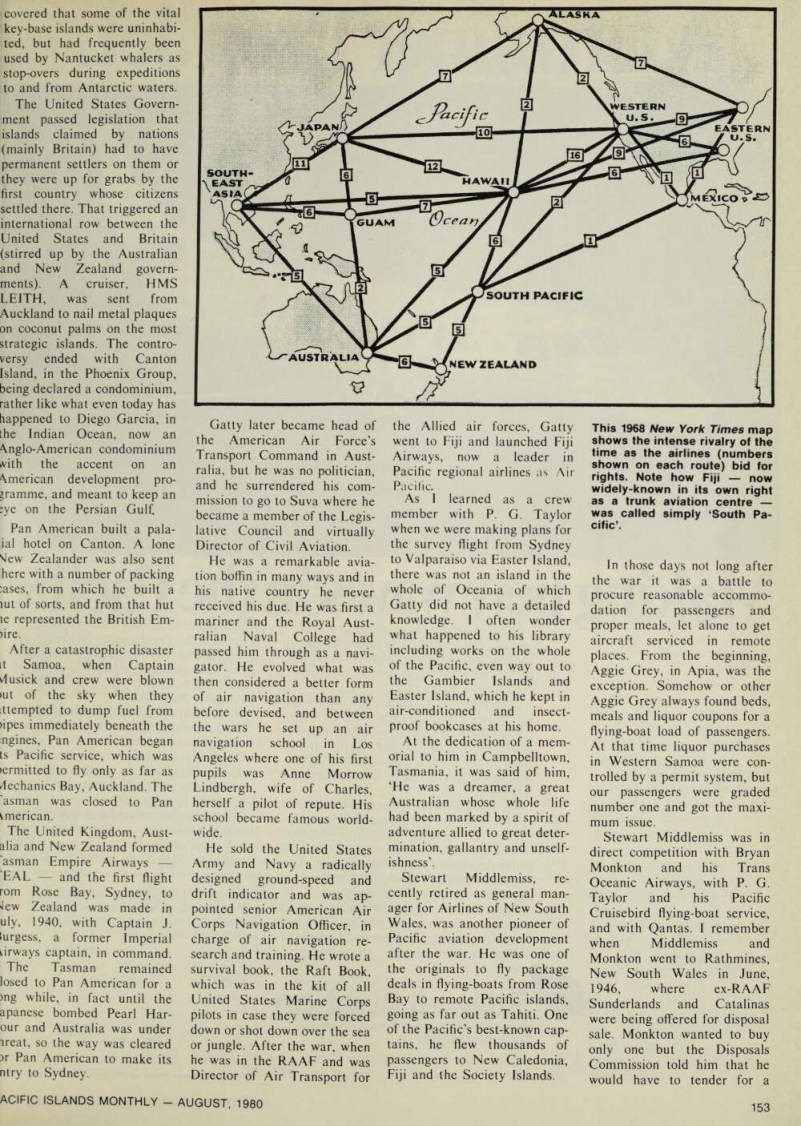
This 1968 New York Times map shows the intense rivalry of the time as the airlines (numbers shown on each route) bid for rights. Note how Fiji - now widely-known in its own right as a trunk aviation centre was called simply ‘South Pa cific’.
minimum of five Sunderlands.
He put in a tender of only £5OOO for the five and forgot about it.
Two months later he was shocked to get notification that his tender had been accepted and would he please pay up and arrange to remove the aircraft. He took delivery and converted the Sunderlands into what he described as ‘A reason able sort of passenger aircraft, by lining the interiors with three-ply and installing 32 seats.’
His first commercial oper ation, in February, 1947, was the freighting of a load of fresh vegetables to Port Moresby.
But, in March, 1947, Lever Brothers asked him to start a regular service to the Solomons. The route took in Noumea, Port Vila, Espiritu Santo and Tulagi with exten sions to the Russell Islands.
Eventually he ran into hot competition with Qantas, vhich started flying in parallel igainst him to Lord Howe sland, Noumea, Vila, Santo md Tulagi. During this period vlonkton’s company also made nany ad hoc charter flights to Europe to bring back Italian nigrants to Truk (Carolines), Cwajalein and some of the Marshalls. Today Monkton is Australian representative for Middle East Airlines and is
►ased in Sydney.
Captain Hugh (‘Smokey’) finch, DFC, joined Qantas as a lying-boat captain in 1948 in "atalinas and Sandringhams. ie made 63 flights to Noumea /hen the flying-time was be ween 7/2 and nine hours epending on the weather. He ew aerial surveys of many ‘acific island groups from Fiji j Tahiti, establishing the 3utes of scheduled services.
Ie was also responsible for all )antas operations in the acific including New Zealand, New Caledonia, Norfolk Island, New Hebrides, iji, Western and American amoa, the Cook Islands, bnga, French Polynesia and apua New Guinea.
The most famous competitor f these airmen was the late Sir lordon Taylor, with whose Dmpany, P. G. Taylor (Pty) td. 1 was manager of flying perations. P. G.’s operations egan in the early 50s. In those mes nine-day cruises, hotels,
tours and meals included, cost an unbelievable 258 pounds.
Slop points were Noumea, Suva and Nabavatu, in the Exploring Isles of Fiji. Other flights extended to Western Samoa, Tahiti and Bora Bora.
The longer 15-day packages cost 2450 pounds all inclusive, excepting passengers’ pur chases at souvenir shops. These flights were the forerunners of Pacific tourist travel. 1 was in Korea when the Australian Cabinet decided to support an Australian survey flight across the Pacific to South America via Easter Island in 1951. ‘Bill’ (P.G.) Taylor wired me to return to Sydney to sort out details and I decided to join him in the venture. No aircraft had flown in some of these areas. It was smooth going as far as Tahiti in the Catalina Frigate Bird II but from there on it was a case of out into the wild blue yonder.
There was no radio between Tahiti and Valparaiso except a small installation on Easter Island. There was no harbour to alight at in Easter Island and the whole place was sur rounded by cliffs. We were lucky to get the services of G.
H. (Harry) Purvis, AFC, for mer senior route captain for the original ANA and wartime operations head of RAAF Transport, with whom I had a previous long association. He shipped as first officer.
From Tahiti on Harry did most of the flying, because Taylor was flat out on navi gation. The east and west bound alightings and take-offs in mountainous seas at Easter Island were really frightening.
East-bound, to Chile, when Purvis and the radio operator, Angus Allison, were ashore, the anchors dragged and finally the cables snapped. Taylor de cided to ‘sail’ the Catalina around to the other side of the island. This he did by lowering the ailerons and elevator, and he made occasional use of a single engine. At one stage we were 20 miles to sea and out of eye-shot of the island.
L. (‘Blue’) L’Huillier, the engineer, and myself were kept busy bailing out what seemed an interminable amount of water which seeped through a hole in the nose. There were high winds and big seas. Before
this sailing effort we had dumped 500 gallons of clear, blue-green 100-octane fuel which spread around us and 1 couldn’t subdue disastrous thoughts about what would happen if a spark set it afire.
Much to our surprise at Easter Island we were hailed by a voice with an Australian accent. It was from Jack Lord, formerly of Narrabri NSW, who managed 35 000 merinos on the island for the Easter Island Exploitation Company.
He was of great assistance to us because the Catalina had to be refuelled from a barge in the open sea. We took off with the aid of rockets on the hull to give us a quick lift.
Incidentally, I visited the radio shack when we went ashore and found we had re ceived no signals from the operator because he was ‘high’ on local grog.
Rose Bay in those flying-boat days was a happy place in spite of the keen competition for package deal passengers to the Islands. There were under-the counter arrangements for the exchange of spare parts, and out in the Pacific when crews met ashore we had a good time together, particularly at Quinn’s Tahitian Hut at Papeete, now long gone.
The Pacific flying atmos phere had changed by 1968, when the US Civil Aeronautics Board drew up a plan for a partitioning of the Pacific among airlines. That report said ‘The Pacific routes are among the fastest growing, most undeveloped, least com petitive, highest priced and most profitable international air routes in the world’.
US Pacific carriers at that time were Pan American, Northwest and United. United flew to Hawaii and the Far East and Pan American to Hawaii, the Far East and the South Pacific. Apparently
wanting entry to the Pacific were American, Braniff, Conti nental, Delta, Eastern, National, Trans World and Western. Of the 11 major trunk airlines (those with ‘grandfather’ rights going back to the original Civil Aeronaut ics Act of 1938) only Northeast had not applied for Pacific routes. Other applicants were World Airways, a supplemen tal; Pacific Airlines, a local carrier service; Alaska Air lines, a regional carrier; and three all-cargo lines Airlift International, Flying Tiger and Seaboard World Airlines.
The report included a map boxing proposed Pacific routes into an oblong shape bounded by the US West Coast, New Zealand, the Australian East Coast, Malaya and Alaska.
The map showed Hawaii as the Pacific axis and Guam as the central base off Asia. That map, now more than 20 years old, with Nadi as the pivot for the South Pacific and headed ‘Battle for the Rich Pacific Market’, still more or less paints a picture of the battle that is going on today for the Pacific market, except that Melbourne was right out of that sketch.
Today the future operation of South Pacific routes is the province of Washington and Canberra. Control of inter national air routes to and from the Commonwealth is summed up in a report named ‘Econ omic Regulatory Arrange ments for International Air Services’.
The international view, in cluding that of America, Japan and the South East Asian countries and New Zealand, is that aviation is a game of chequers with the chequer board arranged for protection ism and the elimination of competition. So much has changed in the 50 year life of Pacific aviation.
Catalina flying-boat as an amphibian