Isa Lei: The love song that
p. 149 · Read in the full issue
became a Pacific favourite
Ratu Sir Kamisese Mara, Prime Minister of Fiji, created wide interest recently when he wrote the words to a song which pays homage to Fijian soldiers serving abroad. It was recalled in PIM at the time that he was following the footsteps of his father, the late Tui Nauay, Ratu Tevita Uluilakeba, who wrote one of the sets of words for the widely-known song of farewell, Isa Lei. Here JANE MILDER tells the story of Isa Lei which started as a love song and linked the cultures of Fiji and Tonga.
Most people who have either lived in Fiji, or travelled there briefly in a cruise ship, have loved the haunting strains of Isa Lei , which has become the well-known Fijian song of fare well. For anyone born in Fiji, to hear Isa Lei sung by a Fijian choir of mixed voices is a very moving experience and brings tears to many an eye.
When ships call at Fiji, even for a few hours, they generally find the Band of the Fiji Military Forces, with members dressed in their scarlet jackets and white sulus with points around the hemline, making a very colourful display on the wharf, playing their instru ments with perfect precision, or perhaps the Fiji Police Band is there to farewell the ship with the strains of that haunt ing farewell song of their islands, Isa Lei , the words of which are as follows; Isa isa vulagi lasa dina Nomu lako au na rarawa kina.
Cava beka ko a mai cakava, Nomu lako au na seqa ni lasa.
Chorus Isa lei, na noqu rarawa, Ni ko sana vodo e na mataka, Bau nanuma, na nodatou lasa, Mai Suva nanuma tiko ga.
Vanua rogo na nomuni vanua, Kena ca ni levu tuna ua, Lomaqu voli me’u bau butuka, Tovolea ke balavu na bula.
Domoni dina na nomu yanuyanu, Kena kau wale na salusalu, Mocelolo, bua, na kukuwalu, Lagakali, maba na rosi damu.
The English translation is: Isa, Isa, you are my only treasure.
Must you leave me, so lonely ind forsaken, Vs the roses will miss the sun it dawning.
Every moment my heart for is yearning.
Chorus Isa Lei, the purple shadows ‘all,
Sad the morrow will dawn upon my sorrow.
Oh! forget not, when you’re far away.
Precious moments, beside dear Suva Bay.
Isa, Isa, my heart was filled with pleasure.
From the moment I heard your tender greeting, 'Mid the sunshine, we spent the hours together, Now so swiftly those happy hours are fleeting.
O’er the ocean your island home is calling.
Happy country where roses bloom in splendour.
Oh! if I would but journey there beside you, Then forever my heart would sing in rapture.
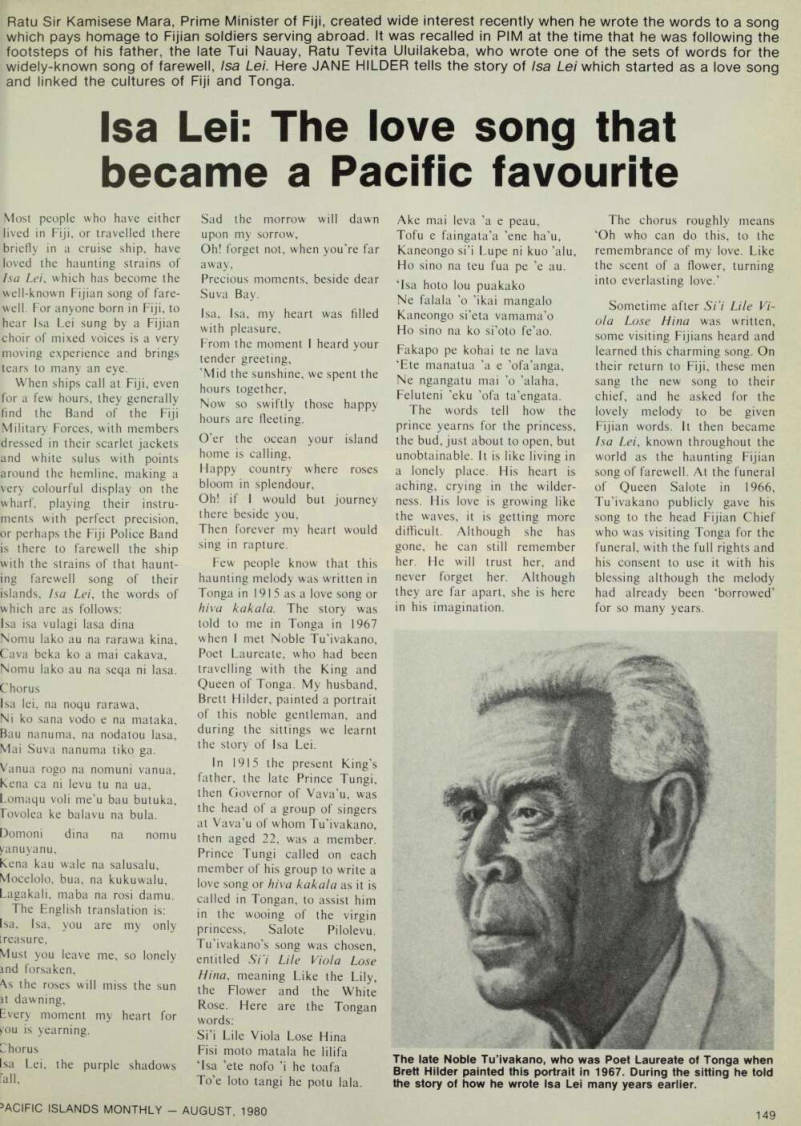
Few people know that this haunting melody was written in Tonga in 1915 as a love song or hiva kakala. The story was told to me in Tonga in 1967 when I met Noble Tu’ivakano, Poet Laureate, who had been travelling with the King and Queen of Tonga. My husband, Brett Hilder, painted a portrait of this noble gentleman, and during the sittings we learnt the story of Isa Lei.
In 1915 the present King’s father, the late Prince Tungi, then Governor of Vava’u, was the head of a group of singers at Vava’u of whom Tu’ivakano, then aged 22, was a member.
Prince Tungi called on each member of his group to write a love song or hiva kakala as it is called in Tongan, to assist him in the wooing of the virgin princess, Salote Pilolevu.
Tu’ivakano’s song was chosen, entitled Si’i Lile Viola Lose Hina , meaning Like the Lily, the Flower and the White Rose. Here are the Tongan words; Si’i Lile Viola Lose Hina Fisi moto matala he lilifa Tsa ’ete nofo ’i he toafa To’e loto tangi he potu lala.
Ake mai leva ’a e peau.
Tofu e faingata’a ’ene ha’u, Kaneongo si’i Lupe ni kuo ’alu, Ho sino na teu fua pe ’e au.
Tsa hoto lou puakako Ne falala ’o ’ikai mangalo Kaneongo si’eta vamama’o Ho sino na ko si’oto fe’ao.
Fakapo pe kohai te ne lava ‘Ete manatua ’a e ’ofa’anga, Ne ngangatu mai ’o ’alaha, Feluteni ’eku ’ofa ta’engata.
The words tell how the prince yearns for the princess, the bud, just about to open, but unobtainable. It is like living in a lonely place. His heart is aching, crying in the wilder ness. His love is growing like the waves, it is getting more difficult. Although she has gone, he can still remember her. He will trust her, and never forget her. Although they are far apart, she is here in his imagination.
The chorus roughly means ‘Oh who can do this, to the remembrance of my love. Like the scent of a flower, turning into everlasting love.’
Sometime after Si’i Lile Vi ola Lose Hina was written, some visiting Fijians heard and learned this charming song. On their return to Fiji, these men sang the new song to their chief, and he asked for the lovely melody to be given Fijian words. It then became Isa Lei , known throughout the world as the haunting Fijian song of farewell. At the funeral of Queen Salote in 1966, Tu’ivakano publicly gave his song to the head Fijian Chief who was visiting Tonga for the funeral, with the full rights and his consent to use it with his blessing although the melody had already been ‘borrowed’ for so many years.
The late Noble Tu’ivakano, who was Poet Laureate of Tonga when Brett Hilder painted this portrait in 1967. During the sitting he told the story of how he wrote Isa Lei many years earlier.