Nauru spending half
pp. 157-159 · Read in the full issue

Trade
Winds
Nauru spending half its money on airline
Nauru, the island country where per capita income is rated as the highest in the world, plans to spend about half its national budget this year on its inter national airline.
This was disclosed in the island’s parliament in June when the Minister for Finance, Mr Kenas Aroi, brought down the 1980-81 budget of just over $59 million. What the govern ment sees as the ‘expansion and development’ of Air Nauru will absorb $29.4 million of this amount. Fuel costs alone for the thirsty jets which Nauru flies on an image-making Pa cific network will amount to $ll million about one-fifth of the total budget expendi ture.
Predictably the budget fig
ures have created wide specu ation in the Pacific about the wisdom of Nauru’s airline poli
ces, strengthening the wide
;pread belief that the operation
s mainly a gigantic public re
ations exercise. Air Nauru’s leet of five aircraft uses Boe ng 727 s and 737 s to fly to Aus
ralia, Japan, Hong Kong, the
Philippines, New Zealand, Kiribati, New Hebrides and Mew Caledonia.
The government estimates his year that the airline will ;arn revenue of $ll million, ess than half of what is being >rovided in the budget for air ine purposes. Critics claim that he ‘subsidy’ nature of what the ’overnment is doing is even greater than it might appear )ecause last year’s revenue was
considerably less than expected
suggesting that the new estima ted revenue may be over optimistic. Nauru is also banking on a fare increase to take effect later this year but the increase is not yet certain because it depends on the ap proval of other countries ser ved by the airline.
The budget allocation for the airline operation includes recurrent and capital expenses and also involves extensions to the terminal building and main runway on Nauru.
A press report published in Nauru after the budget was tabled said that the money
remaining after providing for
the airline would be ‘shared scroogely’ between other
government requirements.
The total budget represents an increase of 2.5% over the previous year, but the airline allocation is up by about 20%.
Other provisions in the budget are for a 12% increase in public service salaries, tech nical improvements to the Nauru General hospital, local isation training for Nauruan employees and a $1.7 million
housing scheme.
‘Happy Isles’
Expansion
The Solomon Islands Broad
casting Corporation restruc
tured and expanded since independence came to its country in 1978, is now broad-
casting under the title Radio Happy Isles, and by late in Sep tember or early October it is expected to open its first re gional station which will be at Gizo in the Western Prov ince.
Since just before indepen dence Gizo has had a medium wave transmitter, but so far it has been restricted to relaying the single network service pro vided from Honiara, the Solomons capital. The new re gional studio is now nearing
completion in preparation for
the opening.
Australian aid is being used to fund expansion to the broad
casting service.
The Malaita Province is to have a studio linked to the Honiara complex. Plans are also being made for a commer cial cassette production section to encourage local artists and permit sales of their recordings.
The National Broadcasting Commission in Papua New Guinea has been successfully conducting a similar venture for several years.
Work will begin soon on a transmitter and studio building on Santa Cruz Island in the Temotu Nende Province, and a similar establishment is planned for Kira Kira, capital of Makira-Ulawa Province.
Meanwhile work is progress ing in Honiara on Broacasting House, the new building which will be the headquarters of the Solomon Islands Broadcasting Corporation and which will in clude studio, office, library and
technical requirements.
Among its provisions will be facilities for broadcasting a sec ond network programme.
The Solomons Corporation believes that with the extent of aid now being received from Australia it is entering a period of being able to devote much more time to developmental rather than purely entertain ment programmes. Additional staff members are being re cruited and trained, and the corporation believes it will be in a stronger position to assist the government in national and
provincial development pro
jects.
Since the installation of transmitters of greater power, reception reports have been received from as far away as the United States East Coast, Africa, Canada and Europe.
The transmissions appear to
have a big following not only
in Solomon Islands but in Papua New Guinea, the New Hebrides, Australia, Fiji and New Zealand.
Paper Mill
For Fiji?
The Auckland-based company M. K. Hunt Foundation Ltd hopes to have approval from the Fiji Government in three to four months for development of a $4OO million pulp and paper mill.
If it comes, the complex could start production in the mid-1980s drawing 260 000 cubic metres of pine logs from two of Fiji’s five major forests.
A second phase development
would use timber from the other three major forests in
Fiji.
At full production the mill could earn about $4O million a year in overseas sales and $5
million locally. A feasibility
study had been accepted and a more detailed study was in pro gress the governing director, M. K. Hunt, said.
The project would consist of a joint venture between his company and the Fiji Pine Commission and would take about 15 years to complete.
The first phase would cost about $B5 million and Hunt Foundation Ltd had been offered $5O million already by overseas concerns, including international banks, Mr Hunt
said. He hoped preliminary
development might start by the
end of the year and major work early next year, depending on when final approval came from the Fiji Government.
Mr Hunt declined to say what types of paper would be produced but said the mill would need about 750 workers.
Two major hydro schemes now
nearing completion would pro
vide the power. Fiji chose the
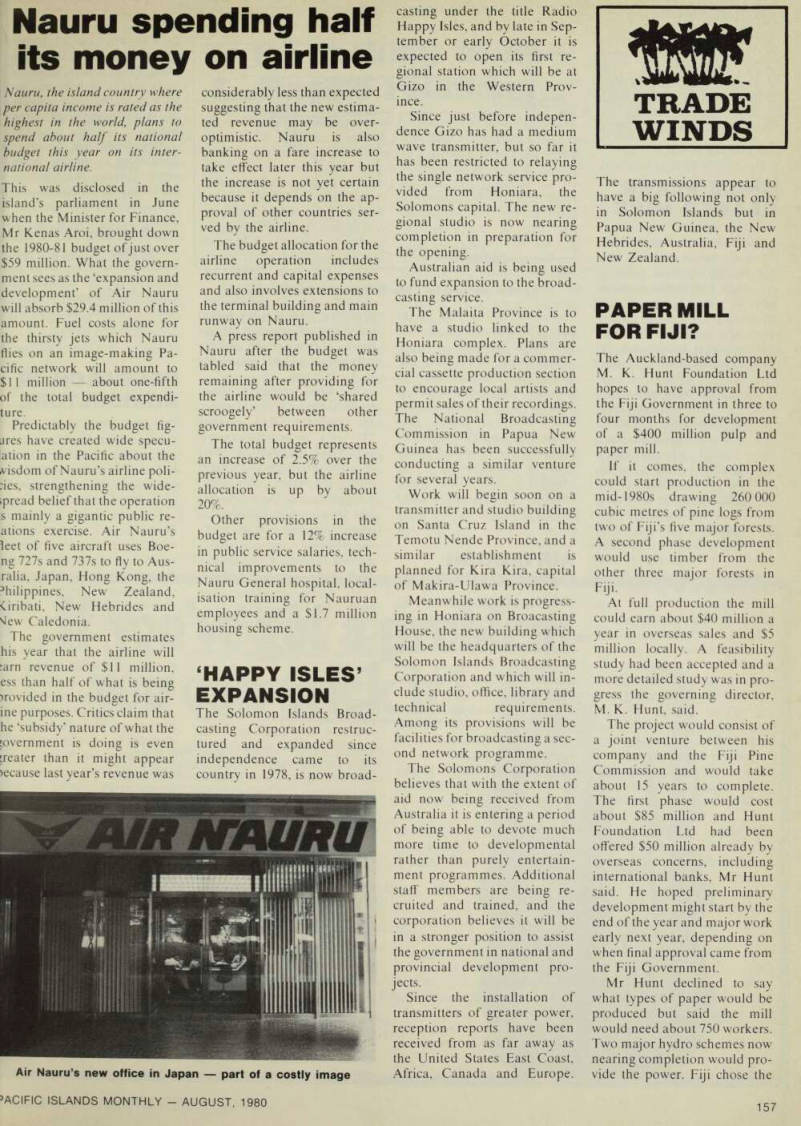
Air Nauru’s new office in Japan - part of a costly image
Hunt Foundation Ltd proposal for the scheme ahead of others from companies in New Zealand, Italy, the United States, Canada, Japan, South Korea and Australia.
William Gasson in Welling ton.
Chile Plans
Seabed Mine
Chile plans to extract minerals from the seabed in an area within 200 nautical miles of the Juan Fernandez archipel ago in its South Pacific territories. The Chilean govern ment also plans to make inter national legal submissions for extending the area of extrac tion.
The plans were announced recently by the Chilean Minis ter for Mines, Mr Quinones, who said it was not anticipated there would be any major development of the undersea field until the end of the 1980 s.
Mr Quinones said investi gations so far suggested that the proposed field was one of the largest undersea mineral reserves in the world. It con sisted of seabed nodules which appeared to have potential for the extraction of cobalt, cop per, nickel and manganese.
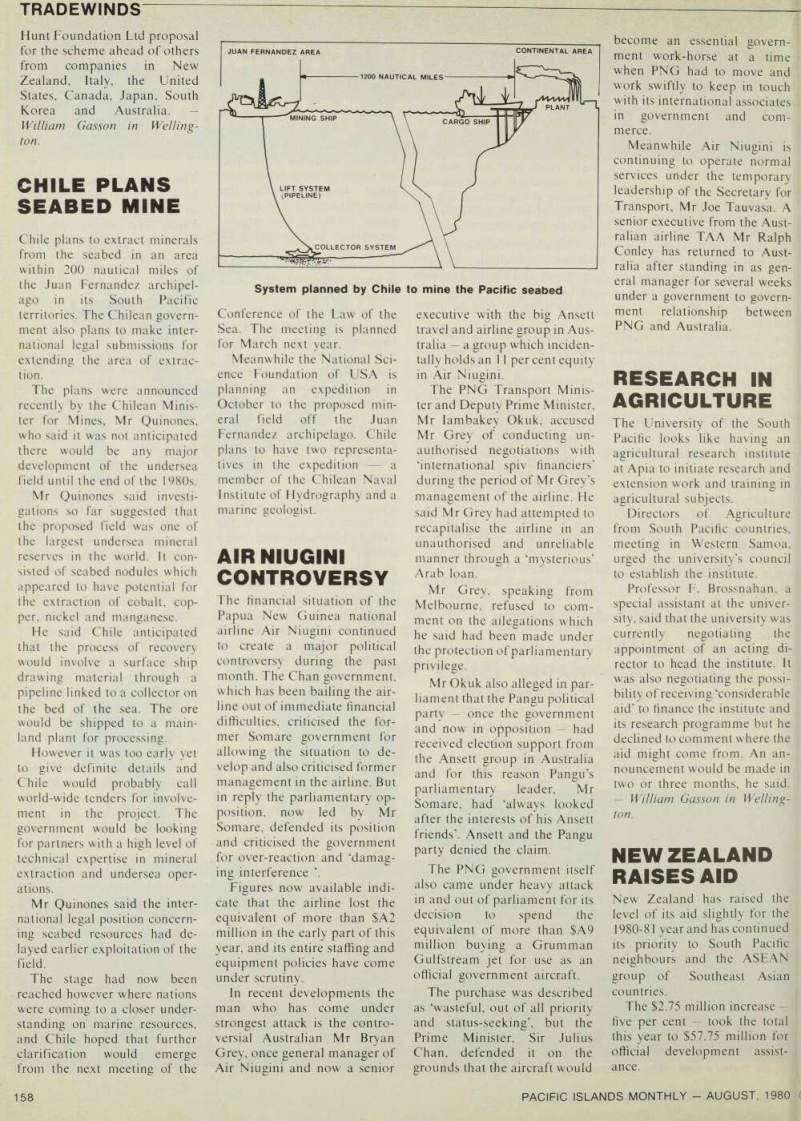
He said Chile anticipated that the process of recovery would involve a surface ship drawing material through a pipeline linked to a collector on the bed of the sea. The ore would be shipped to a main land plant for processing.
However it was too early yet to give definite details and Chile would probably call world-wide tenders for involve ment in the project. The government would be looking for partners with a high level of technical expertise in mineral extraction and undersea oper ations.
Mr Quinones said the inter national legal position concern ing seabed resources had de layed earlier exploitation of the field.
The stage had now been reached however where nations were coming to a closer under standing on marine resources, and Chile hoped that further clarification would emerge from the next meeting of the
Conference of the Law of the Sea. The meeting is planned for March next year.
Meanwhile the National Sci ence Foundation of USA is planning an expedition in October to the proposed min eral field off the Juan Fernandez archipelago. Chile plans to have two representa tives in the expedition a member of the Chilean Naval Institute of Hydrography and a marine geologist.
Air Niugini
Controversy
The financial situation of the Papua New Guinea national airline Air Niugini continued to create a major political controversy during the past month. The Chan government, which has been bailing the air line out of immediate financial difficulties, criticised the for mer Somare government for allowing the situation to de velop and also criticised former management in the airline. But in reply the parliamentary op position, now led by Mr Somare, defended its position and criticised the government for over-reaction and ‘damag ing interference ’.
Figures now available indi cate that the airline lost the equivalent of more than SA2 million in the early part of this year, and its entire staffing and
equipment policies have come
under scrutiny.
In recent developments the man who has come under strongest attack is the contro versial Australian Mr Bryan Grey, once general manager of Air Niugini and now a senior
executive with the big Ansett travel and airline group in Aus tralia a group which inciden tally holds an 11 per cent equity in Air Niugini.
The PNG Transport Minis ter and Deputy Prime Minister, Mr lambakey Okuk, accused Mr Grey of conducting un authorised negotiations with ‘international spiv financiers’
during the period of Mr Grey’s
management of the airline. He said Mr Grey had attempted to recapitalise the airline in an unauthorised and unreliable
manner through a ‘mysterious’
Arab loan.
Mr Grey, speaking from
Melbourne, refused to com ment on the allegations which he said had been made under the protection of parliamentary
privilege.
Mr Okuk also alleged in par liament that the Pangu political party once the government and now in opposition had received election support from the Ansett group in Australia and for this reason Pangu’s parliamentary leader. Mr Somare, had ‘always looked after the interests of his Ansett friends’. Ansett and the Pangu party denied the claim.
The PNG government itself also came under heavy attack in and out of parliament for its decision to spend the equivalent of more than SA9 million buying a Grumman Gulfstream jet for use as an official government aircraft.
The purchase was described as ‘wasteful, out of all priority and status-seeking’, but the Prime Minister, Sir Julius Chan, defended it on the grounds that the aircraft would
become an essential govern ment work-horse at a time when PNG had to move and work swiftly to keep in touch with its international associates in government and com merce.
Meanwhile Air Niugini is continuing to operate normal services under the temporary leadership of the Secretary for Transport, Mr Joe Tauvasa. A senior executive from the Aust ralian airline TAA Mr Ralph Conley has returned to Aust ralia after standing in as gen eral manager for several weeks under a government to govern ment relationship between PNG and Australia.
Research In
Agriculture
The University of the South Pacific looks like having an agricultural research institute at Apia to initiate research and extension work and training in
agricultural subjects.
Directors of Agriculture from South Pacific countries, meeting in Western Samoa, urged the university’s council to establish the institute.
Professor F. Brossnahan. a special assistant at the univer sity, said that the university was
currently negotiating the
appointment of an acting di rector to head the institute. It was also negotiating the possi
bility of receiving ‘considerable
aid' to finance the institute and its research programme but he declined to comment where the aid might come from. An an nouncement would be made in two or three months, he said.
William Gasson in Welling-
ton.
New Zealand
Raises Aid
New Zealand has raised the level of its aid slightly for the 1980-81 year and has continued its priority to South Pacific neighbours and the ASEAN group of Southeast Asian countries.
The $2.75 million increase five per cent took the total this year to $57.75 million for official development assist ance.
System planned by Chile to mine the Pacific seabed
This will enable us to main tain current levels of bilateral aid and to cover increased con tributions to multilateral development organisations,’ the Prime Minister, Mr Robert Muldoon, said. ‘As in 1979-80, it is expected that about two thirds of all bilteral aid, or over half the total aid vote, will be directed to the Pacific.’
Micronesia:
Nz Success
The New Zealand trade mission to Micronesia (PIM May p 63) has returned with the message that the visit was a great success for all companies concerned.
The mission visited Nauru, Kiribati. Guam, Saipan and Majuro.
A number of joint ventures are being considered in various areas by mission members, and a return buying mission to New Zealand was being organised by the government of Marshall Islands to foster trade and closer relations.