of Catholicism in Oceania
pp. 133-137 · Read in the full issue


A 'Roman view' of the origins of Catholicism in Oceania
The Founding of the Roman Catholic Church in Oceania, 1825 to 1850. By Ralph M.
Wiltgen. Published by A.N.U.
Press, Canberra, 1979. ISBN 0 7081 0835 0. $ A 24.50.
July, 1847, was a significant month for Roman Catholic missions in New Caledonia. In Rome it saw the church of ficially grant to the three-year old mission the status of a vicariate, with its own bishop.
But in New Caledonia the Marist missionaries faced near complete massacre.
Their problems had begun when their fellow Marist, Bishop Jean-Georges Collomb, on his way to the Solomons, had been forced by a missed rendezvous with another ship to unload all his goods and provisions at Balade (or BaVaoup) in New Caledonia.
The people eagerly helped carry the goods into the store house, but the local missionaries soberly told the bishop that the way they dapped their thighs was not
necessarily reassuring.
Growing indications of hos tility kept the missionaries :onfined more and more to their dwelling. They had few weapons. Today, we tend to think of Europeans armed with modern weapons hopelessly Dutclassing the clubs and >pears of primitive people. The •ealities in the 1840 s were quite opposite. Guns were :lumsy, single-shot weapons which took time to reload, [slanders soon learnt that once Europeans were ashore, they :ould wait until guns had been iischarged, and then attack in lundreds. Late in 1849 in this iame region, twelve of the crew )f the Alcmene , a French war ship, were killed and three jaten.
It was July 18, 1847, a Sunday, when a New Ealedonian called out that he wanted to return some goods which had been stolen a week earlier. Brother Blaise Marmoilon was enticed out
side. Suddenly a spear pierced his shoulder. The other missionaries dragged him back inside, but they knew that the situation was becoming desper ate. Next the church was set alight. As they sadly watched the end of so much work, they made their preparations for death. Soon flames were being applied to their own building.
One of the priests called out to the attackers, and offered the key to the storeroom on condition that the fire was extinguished. Once it was out, he threw the key outside. Dur ing the mad scramble to unlock the store, and share the booty, the missionaries escaped through the rear of their dwell ing and were able to get to Pouebo and join their fellow missionaries. But Blaise was unable to keep up. He was caught, beheaded, and his body horribly mutilated.
At Pouebo things were hardly any belter. The people from the local village soon heard about the newly ac quired wealth of the neighbour ing tribe, and began planning to attack the mission. The one reassurance which the missionaries had was the pres ence of their two large Newfoundland dogs. When dangerous looking gatherings of men were seen, the dogs were released and the men
hurriedly disappeared up the nearest trees.
Day after worrying day went by, with reports filtering through to the Marists of new plans being made in the village for the final massacre. Sud denly a sail was seen in the bay. It was a French warship.
The Melanesians did not give up easily. They ambushed the 90 armed sailors who came to the rescue, wounding five, but the 10 missionaries were safely evacuated to Sydney.
These events are detailed in a massive new volume of about a quarter of a million words by Ralph M. Wiltgen, SVD , The Founding of the Roman Cath olic Church in Oceania, 1825 to 1850 published by A.N.U.
Press, Canberra. The appear ance of a book which sets out to give the history of the founding of the Catholic church over a fifth of the earth’s surface is certainly an important event. Wiltgen has attempted a formidable task, even if he specifies only a 25year span.
Wiltgen first became inter ested in New Guinea, where his own order, the Divine Word Society, has missions. But when he found that missions had been begun by other orders many years earlier, in what his book shows to be typically thorough fashion, he decided to
go back to beginnings. This he really did, and it is not true that the book starts in 1825 as the title suggests. Some of the most interesting new material goes back a number of centuries. The present volume may be followed by others.
The scope is vast. There are stories of the efforts of the first Catholic missionaries in Hawaii, and parts of Micronesia, and also in Tahiti, the Gambiers, the Marquesas and the Tuamotus. The first missionaries of the Catholic faith in these parts were the French Picpus fathers, and 1 get the impression that Wiltgen has been the first serious researcher of the ar chives of this religious order.
But the principal source of material for these areas, and for the remaining areas which the book covers, is the archives of the Sacred Congregation for the Evangelisation of Nations, formerly called the Propa gation of the Faith, in Rome, the church’s organisation chiefly responsible for evangelisation. In relation to the Pacific, I believe that Wiltgen’s study of these ar chives is the most thorough which has yet been made. He brings to this study a precision, and an eye for detail, which is quite exceptional. Documents, dates, the questions which were examined at meetings of the sacred congregation, who was present, who signed sub missions, who presented them to the Pope, the exact date when they were promulgated - one could go on and on.
Even if there were no other merits to the book, the wealth of this detail and its methodi cal presentation would make the volume a must for any library, or for anyone inter ested in the beginnings of the Catholic church in the Pacific.
The other major source of material, and it is a most important one, is the archives of the Marist Fathers in Rome.
These archives are in excellent condition, and the author ac
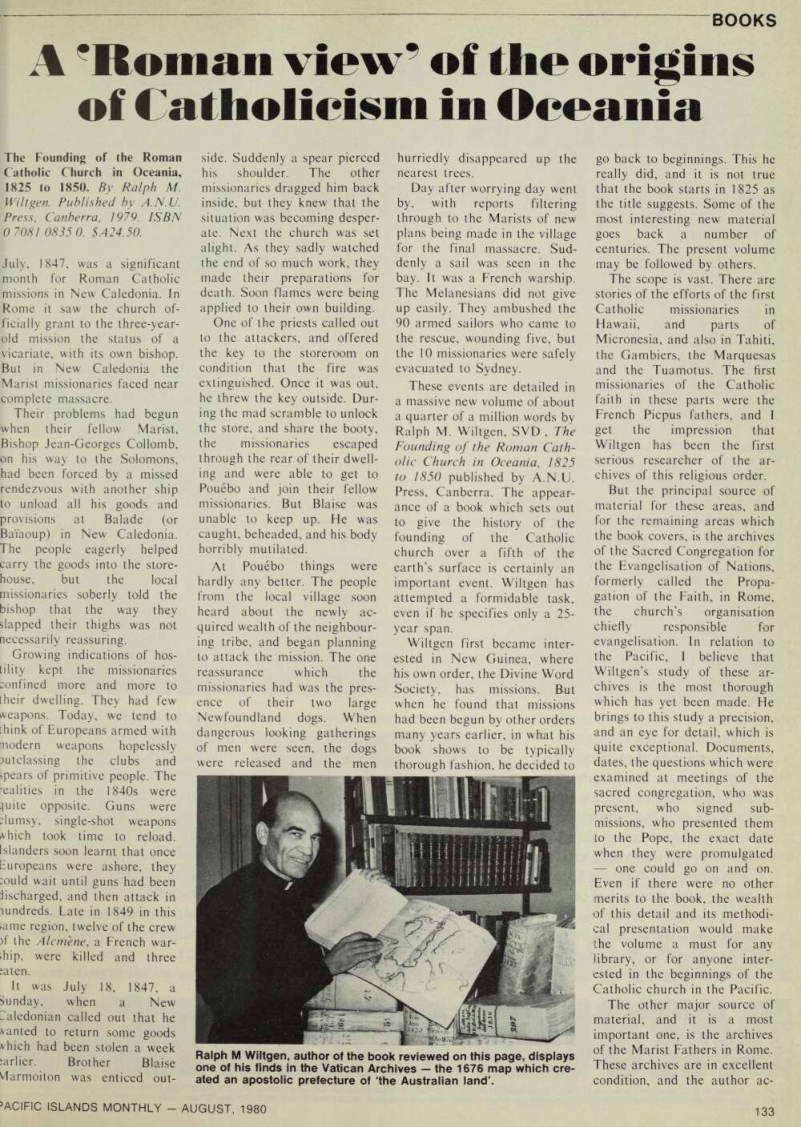
Ralph M Wiltgen, author of the book reviewed on this page, displays one of his finds in the Vatican Archives - the 1676 map which cre ated an apostolic prefecture of ‘the Australian land’.
knowledges his debt to the archivist, not only for the locat ing of documents, but also for the use of that author’s four large volumes of source docu ments, Origines Maristes, ap pearing discreetly in footnotes as O.M.
The centre of attention in Wiltgen’s book is the southwest Pacific, with its multitude of islands, including New Zealand, and, with much less justification, Australia.
The chapters on Australia are far from substantial. They offer little which is not already available in other books. Few of these books are listed in the bibliography. In this sense, the title of Wiltgen’s book claims too much, and raises expec tations which the book is un able to fulfil. What Wiltgen gives is basically a careful survey of Roman material re lating to this part of the world.
Perhaps he should have added to his title the words, ‘A Roman View’, because that is what, in fact, the book gives.
Western Oceania, in this work, embraces Samoa, Tonga, Fiji, New Zealand, New Caledonia, New Hebrides, the Solomons and New Guinea.
When these places enter the story, the narrative gathers pace and interest. This section also introduces the Marist Fathers to the book, the order to which the entire region was originally entrusted, and which is still directly involved in all of these islands except New Guinea.
Wiltgen closely analyses a series of events through which the mission was placed under Jean-Baptist Pompallier as first bishop. He was a priest who might have joined the Marists when they were officially constituted, but chose not to do so, though he had previously worked with those who did.
Pompallier led a small band of Marists into the Pacific in 1836, setting up missions first in the obscure islands of Wallis and Futuna. The reasons for this choice included the fact that missionaries of other Christian churches were already established on most of the larger islands One day, some historian is going to make a proper study of these sad, and sometimes
bitter, early rivalries, so differ ent from the atmosphere today, but it is not in the present book that such a study is begun.
None of the growing library of books on other Christian Pacific mission work is listed in the bibliography.
Pierre Bataillon, left in charge on Wallis, was later to become a bishop. His Marist counterpart on Futuna is now St Peter Chanel. Chanel was a virtual total failure, and Bataillon completely successful in obtaining conversions at the time Chanel was axed to death.
But both islands have been completely Christian ever since the Marists returned to Futuna. Pompallier went on to begin in New Zealand.
The story of all these Pacific missions is truly breathtaking, and Wiltgen tells some of it well. There are tales of spec tacular courage, at limes extra ordinary heroism, and day-to day dedication, despite the dis couragement and depression created by distance, lonely iso lation, ferocity by local inhabi tants, disease and death. And these are not the greatest tragedies. The saddest are the problems created by sheer stu pidity of people in positions of responsibility, and instances of
near criminal neglect of subor dinates.
The man at the centre of it all as regards the southwest Pacific, including New Zea land where he was located, was Pompallier. It is when Pom pallier enters the story that Wiltgen’s inability or refusal to provide the reader with any clue about personality and character becomes inexcus able. It is an omission which makes little sense in the light of his goal, staled in his open ing sentence in the words of Polybius: ‘To penetrate to the knowledge of the causes which have made one party succeed and the other fail in their respective situations’. When two parties are opposed, how can one possibly achieve this aim properly without saying what sort of person each one was?
The two people concerned were Pompallier, placed in charge of the mission, and the superior-general of the Marists, Jean-Claude Colin, the order which provided the mission aries, and, for some years, the supplies to enable the work to be carried out. The clash be tween these two men threads through more than two-thirds of this massive book.
It was some time before 1 realised what Wiltgen does, but his approach is to make no comment of his own about Pompallier or Colin. Neither does he do so, in fact, about any of the huge numbers of persons who come into the story. In regard to these key figures, he merely quotes charges and comments which each made about the other. If one searches the copious index under Pompallier’s name for ‘life and qualities’ there are more than a dozen references, but not one turns out to be a comment by the author.
I suspect that the author has deliberately chosen this ap proach in an attempt to be impartial. The problem is that while, from Rome, there were accusations, and counter accusations, in fact not all were true. But nowhere does Wiltgen indicate which were true and which were merely accusations. The result of this silence. I believe, is a serious injustice to Colin.
The bishop accused Colin of taking too much notice of criticisms of himself, Pompallier, by the young missionaries, and so he set about censoring their letters; he suggested that Colin with held moneys properly belong ing to himself, and that there were plots and intrigues against himself by his missionaries, and attempts to asurp his powers as bishop. He made these charges very widely, for instance to the president of Propagation de la foi, chief source of missionary finances, and he wrote to him about two years earlier than Wiltgen is aware, in 1843, (compare Wiltgen p 401) caus ing the cancelling of a special grant of 80 000 francs which Colin had just negotiated on Pompallier’s behalf. These matters are thoroughly ana lysed in Kevin J. Roach, ‘Jean- Claude Colin and the Foun dation of the New Zealand Catholic Mission’ (NZ Journal of History, April, 1969).
Pompallier also made his charges directly to Rome.
The charges made against their bishop by the men under him, and taken up on their behalf by Colin, included gross neglect, leaving them at times
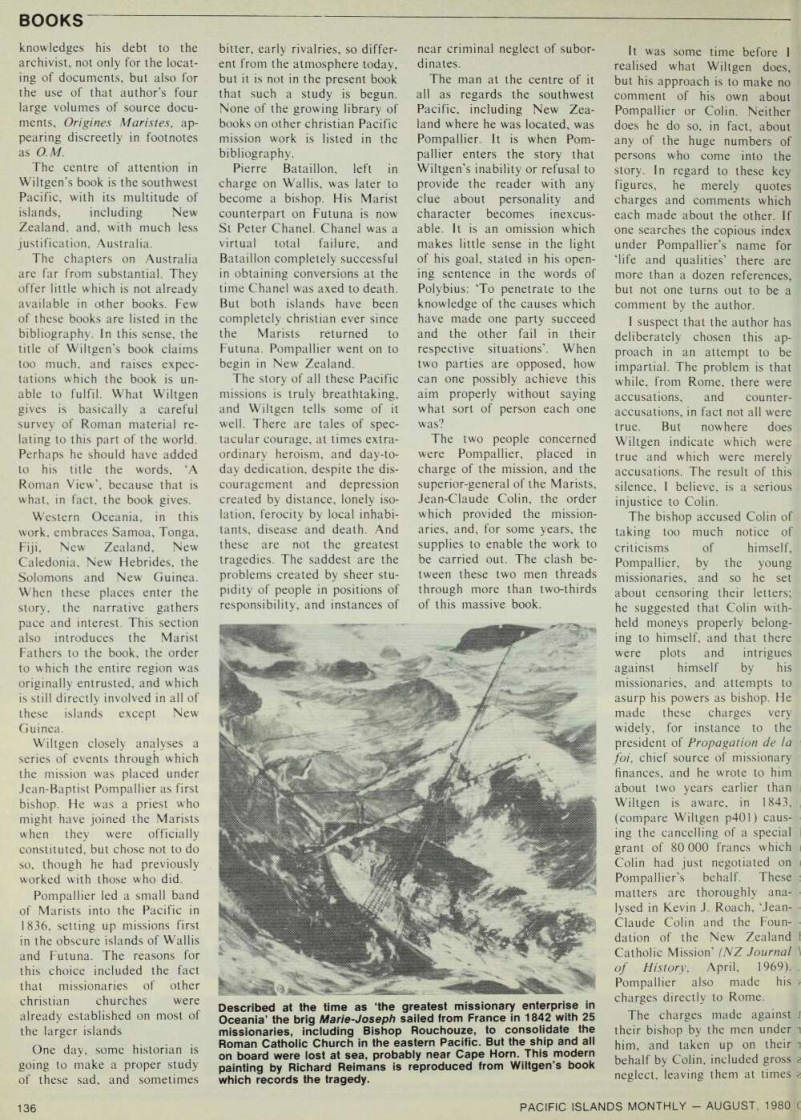
Described at the time as ‘the greatest missionary enterprise in Oceania’ the brig Marie-Joseph sailed from France in 1842 with 25 missionaries, including Bishop Rouchouze, to consolidate the Roman Catholic Church in the eastern Pacific. But the ship and all on board were lost at sea, probably near Cape Horn. This modern painting by Richard Reimans is reproduced from Wiltgen’s book which records the tragedy.
nearly starving, with no money to buy flour, and forced to subsist on kumara, a sort of yam eaten by the Maoris. Colin was horrified to read of his men, having no money, begging for flour or ships biscuits from a passing ship. At the same time, they said, Pompallier spent vast sums of money on gifts to the Maoris to bring about ‘conversions’ and on buy ing a ship which was extremely expensive to maintain.
In Wiltgen’s book, none of these points is presented as fact, they remain as ac cusations, and so one is never sure whether the efforts Colin made to protect his men were thoroughly justified, or were exaggerated reactions. The eventual outcome was arranged in 1848 in Rome; Pompallier’s jurisdiction was reduced to the diocese of Auckland, he was to recruit other priests to staff the diocese, and the Marists gradu ally withdrew to other places.
What sort of persons were ;hese two, Colin and Pom- Dallier, since Wiltgen does not ;ay? Colin’s biographies (none )f which, in French or English, s listed in the bibliography) •eveal a man who could be called stubborn, and at times :anlankerous. But his record eveals him as one who re amed the loyalty of his men, vho was highly intelligent, careful in the use of money, ind honest.
By contrast, Pompallier had Live, courage and zeal mportant qualities in a nissionary bishop. He was a ;ood linguist and learnt to peak the Maori language well.
Viltgen does make a rather laive statement on p 244, say
ing that Pompallier learnt the Wallisian language in five weeks, apparently forgetting that the Polynesian language is so similar on different islands that from Hawaii to New Zea land people have little diffi culty in understanding one another. When Pompallier was in Wallis he had been learning Maori for over five years.
Almost from arrival in New Zealand, the bishop began sending back to Europe claims of conversion which soon were in the tens of thousands. New Zealand historian, Dr H. M.
Laracy of Auckland described the claims as ‘mendaciously inflated’.
In financial matters, Pom pallier can only be described as incompetent. Financial disas ters punctuated his 30 years in Auckland, and in 1868, when he left for the last time, the diocese was in chaos, and a meeting of lay people, chaired by the priest administrator of the diocese, asked Rome for another apostolic visitation by a bishop to examine the bank rupt church’s affairs. This was 20 years after the relations with the Marists had been severed. During those same years the bishop had also had the greatest difficulty retaining priests. Large numbers whom he recruited were unable to work with him, and I would believe that the number of those who left him was as high as six out of every 10.
These disputes affected the rest of the Pacific missions greatly. A thrust of Marist missionary endeavour away from New Zealand followed, and a much earlier start was made on other islands than might otherwise have occurred.
One of the most tragic of these new missions was in the Solomons. The ferocity of the Melanesians could not have been more clearly brought home to the Marists than in 1845 when, within days of arrival at Ysabel, Bishop Jean- Baptiste Epalle (a man who had previously worked under Pompallier) was clubbed to death. Severely shaken by this loss they moved to San Cristobal (Makira), but in a few months three more mis sionaries were killed and eaten by cannibals.
Frightening as the losses were, they could be met by bravery, a bravery which was not lacking. What could not be overcome was another problem which soon began to take its toll disease. They moved to new missions on smaller islands where no inter-tribal rivalry could jeopardise their safety, at Woodlark (Murua) and Rooke (Umboi). More deaths began to result from malaria and other tropical diseases. Bishop Collomb died of amoebic dys entery on Rooke, within sight of the ultimate goal. New Guinea. He was 32.
The mission in New Cale donia was another whose estab lishment faced many problems, including the near total mass acre already described.
Wiltgen is most ungenerous to brave men who, after the res cue, returned for a second attempt, and then a third, when he titles the chapter, ‘New Caledonians put the Marists to flight’.
Although Wiltgen does not raise the point, it has always seemed to me that there are grounds for seeing elements of cargo in the 1847 events at Balade. It is many years earlier than the cult is normally recognised, but the direct re lation between the arrival of Collomb’s supplies, and the troubles for the missionaries who were going to send them away, seems interesting.
Eighteen fifty, the year in which Wiltgen terminates his history, was the one in which the second evacuation of the New Caledonian missionaries was ordered, not long after the massacre of the crew of the Alcmene. Leaving Pouebo (Wiltgen uses a different spell ing) they maintained a mission on tiny He des Pins, close to the main island, bringing with them some Christians and people preparing for baptism to continue with the missionaries.
These provided the basis for the final successful attempt.
Bataillon’s Central Oceania vicariate, in 1850, was practi cally limited to Wallis and Futuna. Efforts had begun in Samoa and Tonga, but Fiji was still awaiting successful estab lishment.
There are many large gaps in Wiltgen’s book. And, at the
same time, there are long pass ages which seem quite ex traneous to the real story: two pages (533-34) discussing whether Baja California mission would be entrusted to the Picpus Fathers; a lengthy analysis of policy decisions in Maryland, Quebec and Mon treal (pp4ll-412). These are more valuable as studies of the way the Roman congregation worked, which the book ex plains very well indeed.
The volume itself is an out standing production. It has been carefully footnoted and there is an excellent index. The large format pages have been strongly bound. The typeset ting is beautifully clear and accurate. I noted only two errors p 457 1.15 ‘nearly’ (nearby) and p 568 ‘vounteered’ (volunteered). Illustrations are somewhat limited, but the re production of a number of documents is excellent, and likewise the interesting histori cal maps are very clear. The author has also provided some useful sketch maps to clarify geographical locations for the reader. The price is good value at 5A24.50, and has been achieved through production subsidies from many of the island dioceses whose begin nings are told in the pages of the book.
While the author’s failure to give any kind of character outlines can only be described as a serious and regrettable omission in such a work, the wealth of accurate detail makes this volume an essential one for any religious or general study of these island regions during the period it covers.
John Hosie SM.
Pompallier - troubled pioneer.
Colin - Marist founder