An art book that
p. 139 · Read in the full issue
bares the feelings of Pacific artists
Art of the Pacific. Photographs by Brian Brake. Conversations by James McNeish. With com mentary by David Simmons.
Published by Oxford University Press, in association with Queen Elizabeth lIA rts Council of New Zealand. ISBN O 19 558043 5. $NZ39.95.
The Enlightenment during the
18th century opened the eyes and minds of Europeans to the world of rational explanation and what we would call intellectual reality. Every as pect of life after the 18th cen tury would be irrevocably changed by the belief that there was a physical explanation for the world, physical and meta
physical. Physics, philosophy
and natural science became predominant sciences. Tech nology provided the means whereby the physical world could be explored. Trade and Empire provided an impetus to exploration in areas of the world far away from Europe.
Exploration brought Euro
peans to the South Pacific, to an area of the world entirely different from the old world at home.
As part of the European expansion, collections of a scientific nature were stimula ted, including collections of primitive art from Oceania, Polynesia and Australia. From the end of the 18th century large and significant collec tions of primitive art were de
veloped, primarily for the
insights these objects provided
into primitive philosophy and
religious beliefs. They were also curios for the European
market, fantastic images that
amazed and delighted. Unfor
tunately, as works of art and el ements in the social and religious fabric of everyday life Df the people of the Pacific, they, were not understood.
It was not until the 20th cen tury that the products of primi tive art from the South Pacific gained any status as art. Nor, until recently, was there any
serious inquiry into their func tions. There still remains a vast area of the unknown about the arts of the South Pacific.
The progress of colonisation and change has destroyed or diminished to an unrecognis able degree the societies and social ideas that stimulated the creation of the objects collected during the last 200 years. Only recently have questions been asked about aesthetic attitudes and the role of the arts and the artist in the societies from which so many of the most magnificent artworks were de rived.
While the world has lost much of the most important in formation required to under stand the earliest arts of the South Pacific region, the
objects, fortunately, have been
preserved. More importantly,
many objects of significance
have been retained in the South Pacific. There is there fore an opportunity to appreci ate and understand, if only through a darkened glass, the creative genius contained within the cultures of this
unique region.
There is a need to come to terms with the arts of the South Pacific and the cultures that gave rise to them historically, and continue to produce works of significance. The arts are an insight into the heart of a cul ture. They contain in symbolic form the ideas distilled from
social experience, the beliefs and aspirations of individuals in our own environment.
Many published works have
explained and displayed the
arts of the South Pacific in European cultural and aes thetic terms. This is not a true advance on the position two centuries ago. Art of the Pacific is another book in that vein. It is nicely designed and pro duced. It is divided into easily read and understood parts, dealing with each cultural area in Melanesia and Polynesia
individually and briefly. There
is a useful introduction to the social life of the people of the region, so different from the
technologically sophisticated
cultures of European Australia, New Zealand and the Western cultures of the islands.
However, if the book only went that far it would be no more worth recommending to the collector of primitive art, the student, or the general reader than a half-dozen others in the same price range.
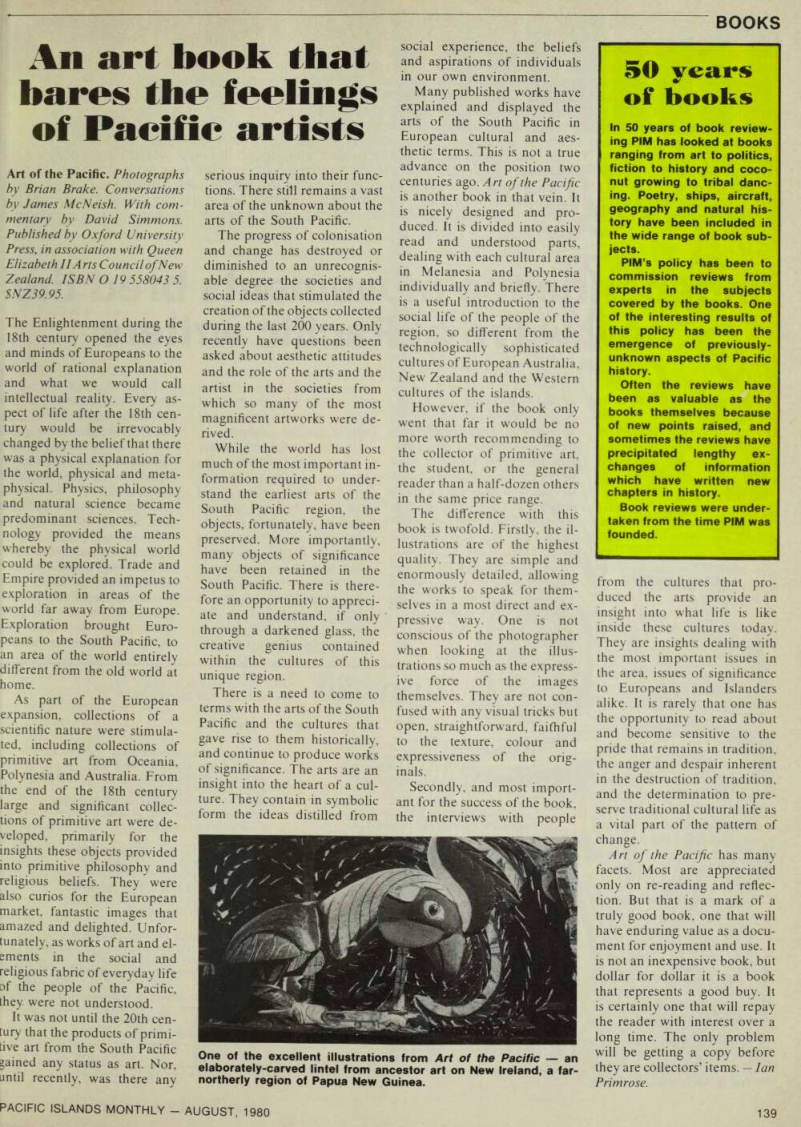
The difference with this book is twofold. Firstly, the il lustrations are of the highest
quality. They are simple and
enormously detailed, allowing
the works to speak for them selves in a most direct and ex pressive way. One is not conscious of the photographer when looking at the illus trations so much as the express ive force of the images themselves. They are not con fused with any visual tricks but open, straightforward, faifhful to the texture, colour and
expressiveness of the orig
inals.
Secondly, and most import
ant for the success of the book, the interviews with people
from the cultures that pro duced the arts provide an insight into what life is like inside these cultures today.
They are insights dealing with
the most important issues in the area, issues of significance to Europeans and Islanders alike. It is rarely that one has the opportunity to read about and become sensitive to the pride that remains in tradition, the anger and despair inherent in the destruction of tradition, and the determination to pre serve traditional cultural life as a vital part of the pattern of
change.
Art of the Pacific has many facets. Most are appreciated only on re-reading and reflec tion. But that is a mark of a truly good book, one that will have enduring value as a docu ment for enjoyment and use. It is not an inexpensive book, but dollar for dollar it is a book that represents a good buy. It is certainly one that will repay the reader with interest over a
long time. The only problem
will be getting a copy before
they are collectors’ items.
Ian
Primrose.
One of the excellent illustrations from Art of the Pacific - an elaborately-carved lintel from ancestor art on New Ireland, a far northerly region of Papua New Guinea.