The Pacific pictures
pp. 131-132 · Read in the full issue

Books
The Pacific pictures are superb, but...
The People from the Horizon.
By Philip Snow and Stefanie Waine. Published by Phaidon Press, Oxford. ISBN
0 7148 2006 7. Sai2O.
Some 40 years ago, a young Cambridge graduate, Philip Snow, a younger brother of the noted author C. P. Snow, went out to Fiji as an administrator.
He remained there for 14 years, stationed at such places as Lomaloma, Taveuni and the Rewa district of Viti Levu.
Snow had the distinction of captaining Fiji at cricket, and his daughter Stefanie was born there.
Those 14 years left an indelible impression on Snow.
Although he later became bur sar of Rugby School, his heart remained in the Pacific, and, as he now recalls, hardly a day has since passed ‘without thinking about that part of the world, or reading, hearing and talking about it’.
In short, Snow is a Pacific buff, and this is one of the reasons he advances for co authoring The People from the Horizon with his daughter Stefanie. The book is sub-titled An illustrated history of the Europeans among the South Sea Islanders’.
Other reasons given in the book for embarking on the venture are: (I) a zephyr of change has blown through the Pacific in recent years and it seemed time to ‘try and catch a little of the past as fragments inevitably slip away’, and (2) many of the illustrations of the pictorially attractive Pacific should be better knwon than they are. In addition, the authors would like to awaken interest in the Pacific among those who ‘do not know a great deal about that segment of the globe’, and to stimulate inter est among those who do.
In one respect at least, Snow and his daughter deserve to succeed. Their work is a superb collection of 273 pictures, the assemblage of which must have occupied thousands of hours of research and correspondence.
The pictures range from Pigafetta’s representation of Magellan’s encounter with the Chamorros of Guam in 1521, to recent cover pictures from PIM. In between, there are familiar and not-so-familiar paintings, drawings, etchings and photographs of Pacific scenes and personalities, many of them in colour.
The not-so-familiar pictures, in particular, are a constant
delight. The two-page frontis piece, for example, is Louis- Auguste de Sainson’s seldom reproduced picture of top hatted French officers of the Dumont d'Urville expedition going ashore at Tikopia in 1826, hand in hand with some of the locals.
Other pleasant surprises are reproductions of two delicately evocative paintings of Fiji in the 1870 s by Constance Gor don Gumming, neither of which, to my knowledge, has previously been published in colour.
There are also reproductions in colour of many of the not very well known paintings of Louis Choris, who accom panied the Russian explorer Otto von Kotzebue on his voy age round the world in the second decade of last century.
Other paintings of the same ilk are two paintings by J. Glen Wilson, an artist on the voyage of HMS Herald in 1854-56.
There are, indeed, so many visually pleasant surprises that it is difficult, in a short space, even to give an idea of what they are.
Unfortunately, The People from the Horizon is unlikely to have the success that its pic torial excellence deserves.
One reason is the book’s phenomenal price, which means that the cost of owning each of its 296 pages works out at a little over 40 cents a page!
Also, much as I regret to say it, the book’s text scarcely matches the magnificent illus trations.
Although they struggled valiantly with 700-odd biblio graphical references, the authors’ attempt to cover four and a half centuries of Pacific history will certainly not satisfy the largest class of potential buyers those who already know a good deal about the Pacific.
The principal defect in their history is the unequal treat ment of subjects. For example, explorers and discoverers rate four chapters, but the thou sands of American whalers
who scoured the Pacific for about half a century from the 1820 s to 1870 s rate less than four pages. Also, there is an excess of petty details, and the authors frequently get their facts wrong.
Here are examples of some facets of the book that earned bad marks from me: • Some of the authors’ prose reads more like the Guinness Book of Records than a $l2O history book. For example, Mendana (who is always irrita tingly called de Mendana, just as Quiros is always de Quiros) is said to have been ‘the first European to find a principal Pacific archipelago and, discounting New Guinea, the first to visit a Melanesian group (the Solomons in 1568); he was then the first to dis cover a Polynesian archipelago (the Marquesas in 1595)’. • Some statements in the text are self-contradictory. For in stance, George Robertson, master of HMS Dolphin when Tahiti was discovered in 1767, is said to have written a journal which was perhaps ‘the first true ethnography of the South Seas’. However, four pages later. Cook is described as ‘the first Pacific ethnographer’. • Some details are downright inaccurate. ‘Dignified Norfolk Island’ (p 249) is said to be ‘not on the regular tourist routes’.
Eastern (i.e. American) Samoa is said (p 246) to have remained virtually unchanged since World War II despite the revolution of Governor Lee!
Quiros (p 43) is said to have sighted Tahiti in 1606, although he never came within 500 miles of it; and the island that he called La Conversion de San Pablo is said to be in the Cook group when, in fact, it is Hao Atoll in the Tuamotu Archipelago. • Some details in the text do not match up with the illus trations. For example, Micro nesians are described as ‘small, smooth-haired, squat, dark, Mongoloid, mesocephalic’. Yet
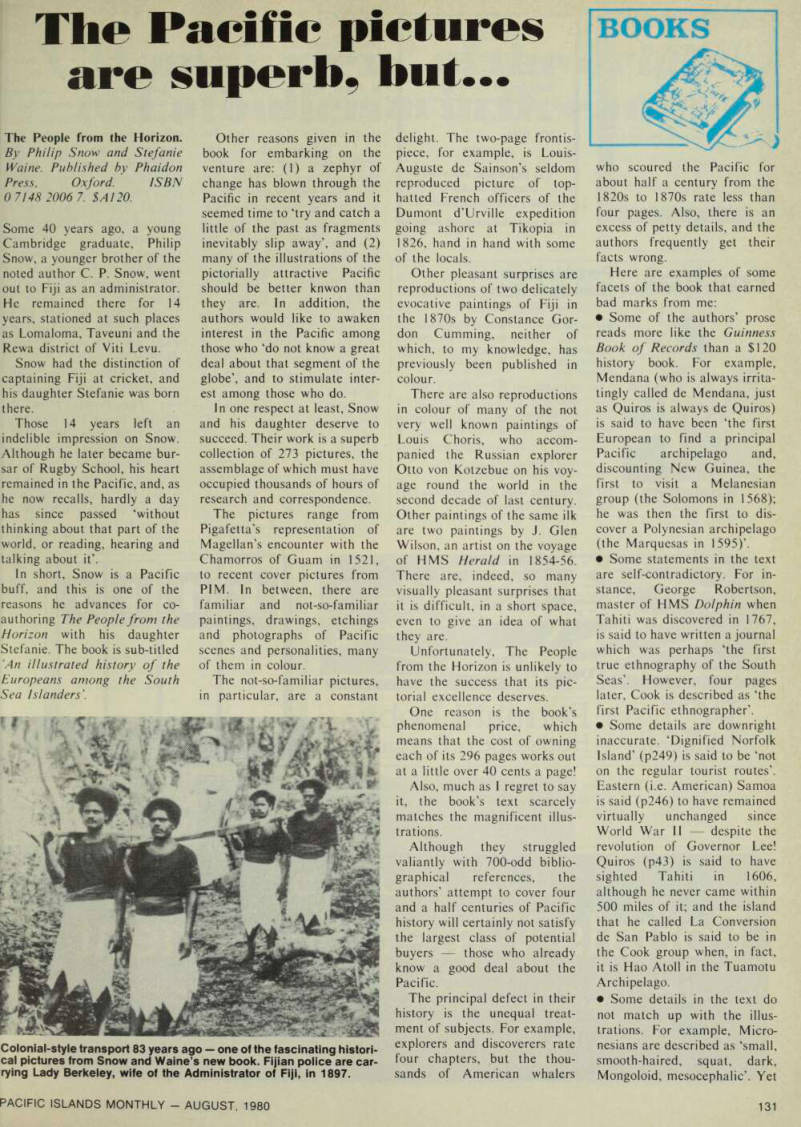
Colonial-style transport 83 years ago one of the fascinating histori cal pictures from Snow and Waine’s new book. Fijian police are car rying Lady Berkeley, wife of the Administrator of Fiji, in 1897.
the Micronesian pictured on the opposite page a Yapese who appeared on PI M’s cover in April 1973 looks much more like a bluff Yarmouth boatman than the Snows’ de scription of a Micronesian. He is bald-headed and bewhiskered, and has such a European cast of feature that even blind Freddy would never mistake him for a Mongoloid. • Some statements in the book are decidedly naive. For example, considering that mis cegenation has been rampant in the Pacific since Europeans arrived there, it is naive to suggest that you can still sit in Papeete and see ‘pure Tahitians’ strolling past, or that elsewhere you can find ‘pure Tuvaluans’, ‘pure Cook Islanders’, etc. Also, the Chamorros of Guam did not struggle to survive for 350 years after Europeans encoun tered them and then die out, as the authors say. They intermarried with the Mexi cans, Filipinos, Spaniards, Japanese and others who settled on Guam over the years
so that Chamorro blood still runs in the veins of many Guamanians of today.
Another minus for the book in my view is that Snow has a propensity for inflicting him self on his readers when his own part in the ‘history of the Europeans among the South Sea Islanders’ scarcely war rants the prominence he gives himself. Thus, on p 231, he is pictured with the late Edward Cakobau; on p 238, he is shown strolling somewhere in England with Ratu Sir Kamisese Mara; and somewhere else, there’s a photograph of his house in Taveuni. Also, he bobs up in the text from time to time when his presence is quite uncalled for.
Yet despite all its short comings, I would be pleased to own The People from the Horizon for it is a beautiful coffee-table book. But PI M’s editor has insisted that I send the review copy back, and $l2O is simply too much to pay for it, as the authors and pub lishers will surely discover Robert Langdon.