Readers of PIM from
p. 113 · Read in the full issue
the first issue
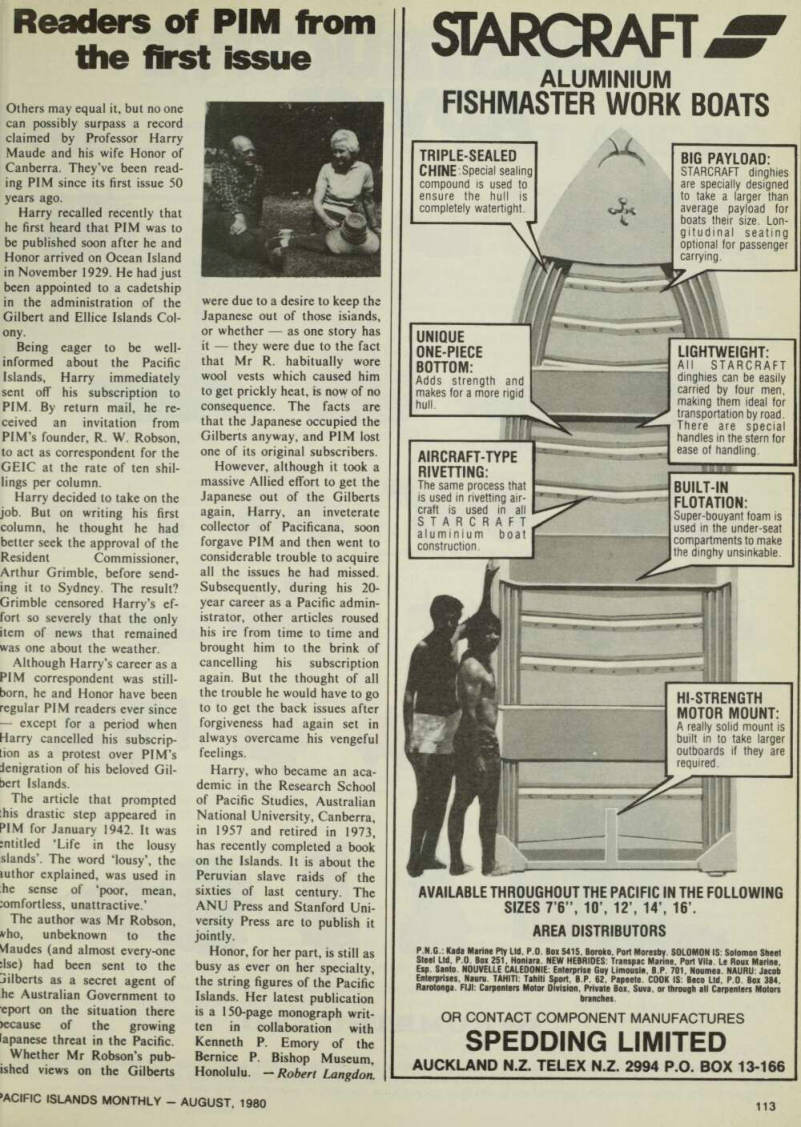
Others may equal it, but no one can possibly surpass a record claimed by Professor Harry Maude and his wife Honor of Canberra. They’ve been read ing PIM since its first issue 50 years ago.
Harry recalled recently that he first heard that PIM was to be published soon after he and Honor arrived on Ocean Island in November 1929. He had just been appointed to a cadetship in the administration of the Gilbert and Ellice Islands Col ony.
Being eager to be well informed about the Pacific Islands, Harry immediately sent off his subscription to PIM. By return mail, he re ceived an invitation from PI M’s founder, R. W. Robson, to act as correspondent for the GEIC at the rate of ten shil lings per column.
Harry decided to take on the job. But on writing his first column, he thought he had better seek the approval of the Resident Commissioner, Arthur Grimble, before send ing it to Sydney. The result?
Grimble censored Harry’s ef fort so severely that the only item of news that remained was one about the weather.
Although Harry’s career as a PIM correspondent was still born, he and Honor have been regular PIM readers ever since except for a period when Harry cancelled his subscrip tion as a protest over PI M’s Jenigration of his beloved Gil bert Islands.
The article that prompted this drastic step appeared in PIM for January 1942. It was entitled ‘Life in the lousy stands’. The word Mousy’, the tuthor explained, was used in he sense of ‘poor, mean, comfortless, unattractive.’
The author was Mr Robson, vho, unbeknown to the Maudes (and almost every-one else) had been sent to the Gilberts as a secret agent of he Australian Government to ■eport on the situation there >ecause of the growing lapanese threat in the Pacific.
Whether Mr Robson’s pub ished views on the Gilberts
were due to a desire to keep the Japanese out of those islands, or whether — as one story has it — they were due to the fact that Mr R. habitually wore wool vests which caused him to get prickly heat, is now of no consequence. The facts are that the Japanese occupied the Gilberts anyway, and PIM lost one of its original subscribers.
However, although it took a massive Allied effort to get the Japanese out of the Gilberts again, Harry, an inveterate collector of Pacificana, soon forgave PIM and then went to considerable trouble to acquire all the issues he had missed.
Subsequently, during his 20year career as a Pacific admin istrator, other articles roused his ire from time to time and brought him to the brink of cancelling his subscription again. But the thought of all the trouble he would have to go to to get the back issues after forgiveness had again set in always overcame his vengeful feelings.
Harry, who became an aca demic in the Research School of Pacific Studies, Australian National University, Canberra, in 1957 and retired in 1973, has recently completed a book on the Islands. It is about the Peruvian slave raids of the sixties of last century. The ANU Press and Stanford Uni versity Press are to publish it jointly.
Honor, for her part, is still as busy as ever on her specialty, the string figures of the Pacific Islands. Her latest publication is a 150-page monograph writ ten in collaboration with Kenneth P. Emory of the Bernice P. Bishop Museum,
Honolulu.
Robert Langdon.