Remembering the fury of Mount
pp. 111-112 · Read in the full issue
Lamington after 30 years
The Northern Province of Papua New Guinea on January 21, 1981, will commemorate the 30th anniversary of the explosion of Mt Lamington, a long dormant volcano across the Owen Stanley Ranges from Port Moresby. It was the greatest volcanic eruption in the recorded history of PNG, costing the lives of more than 4000 people. Port Moresby journalist MACLAREN HIARI tells the story.
Sunday, January 21, 1951, was a beautiful morning in the area around Mt Lamington. The sky was blue and clear. A cool breeze blew on the magnificent surroundings that Papua has to iscus, frangipani and bougain villea. It was a scene to glad den the heart, in the finest surroundigns that Papua has to offer, in a province as fertile and flourishing as any in the country.
The Orakaivan people were sitting around talking, women and children were in their gardens, or doing cleaning work.
The church bell was ringing.
Many people were preparing to go off to the service.
But there was an undercur
rent of unease and alarm in the communities and villages around Mt Lamington.
For almost a week there had been strange things happening within the mountain, which was not then even recognised as volcanic. (Later studies have revealed that the last known eruption of Lamington was well over 1000 years ago an episode which has become part of the legends of the local people.) Beginning with landslides on Mt Lamington’s summit, poss ibly triggered by the small tremors being felt at the time, and a thin column of smoke, the activity gradually in creased until by January 20 the vapour column was about 8000
metres high, heavily charged with ash and fed by explosions ever few minutes.
Rumbling noises were heard.
Fireballs and red flashes lit the ash column. Constant earth tremors made it difficult to stand.
Ten miles away, an old Orakaivan man stood gazing at the distant mountain, explain ing to his people that when he was a lad he had climbed Lamington with his grand father, and the head of hidden fire and fumes had seared their skin. He warned that one day this killer would bring trouble and death.
But most people laughed and wouldn’t believe him. After all, he was an old man, and old
4000 Died
When
Volcano
Exploded
men often tend to be over fearful.
People’s fears were some what allayed by a visit from experts from the vulcanological observatory, who explained that a volcano as old and dormant as Lamington could never become a danger. True, it was on the volcanic beltlhat stretched down to the islands beyond Milne Bay, but there was no cause for concern.
On Friday, January 19, the Port Moresby weekly paper,
the South Pacific Post, had carrried a report that Mt Lamington had erupted the previous day, but that ‘the District Commissioner, Mr Cecil Crowley, reports that there has been no loss of life, nor is there any immediate danger’.
The reassuring South Pacific Post was read out during the church services held on the morning of Sunday, January 21.
As the services were closing just before 11 am, although the tremors had ceased, emissions from the volcano increased rap idly until the mountain, wreathed in violent belchings of smoke, suddenly exploded with a mighty roar, raining destruction and death all around. The blast was heard as far away as Port Moresby and Lae.
The rumblings from the mountain soon turned into a loud and continuous outrush of gases, and a dark grey cloud of ash rose to a height of about 15 000 metres.
Then an avalanche of fire charged particles described as
‘a black cloud, whirling and billowing like an oil fire’ swept down the mountain in all direc tions, completely devastating 177 square kilometres of the surrounding country. The sky was black, with complete dark ness prevailing for more than two hours.
Higaturu Government station and the Sangara Mission Station were com pletely wiped out. Also de stroyed were forests, gardens and coffee plantations; a station jeep finished up as a lump of twisted metal in the bare branches of a lonely tree; the Wairope Bridge, a land mark of the famous wartime Kokoda Trail, disappeared; the Kumusi River, a turbulent stream which normally rushed through the rocks studding its surface, became filled with ash and debris, and changed into a wide, placid flow; up at Kokoda, daylight turned into night, with flashes of lightning and the rumbling of explosions.
The gas which rushed out with incredible force after the main explosion was the cause of most of the loss of human
life. Four thosand Papuans were estimated to have been killed, their lungs seared by the gas, and dying where they stood. The 30 Europeans who died included the holidaying Director of the Department of Native Affairs, W. R.
Humphries, the District Com missioner, Cecil Crowley, and Margaret de Bibra, head mistress of the Martyrs’ Mem orial School at Sangara.
The devastated area ex tended as far as but did not destroy Awala, where Clem Searle, who years before had been in charge of the AWA radio station in Port Moresby, opened his transmitter on the plantation and gave the world the first news of the disaster.
In Port Moresby, an em ployee of the PNG Service of the Australian Broadcasting Commission, Fred Warren, re called in later years that a dinner guest was about to leave his house when a sound like the patter of rain was heard on the roof. It was volcanic ash.
He and his friend quickly turned on the radio and heard the words ‘and Higaturu has vanished’. Mt Lamington had erupted, they learned, 2942 people were dead, and Higaturu Station and most of the Higaturu hamlets were de stroyed.
The next morning, Warren and a companion were haunt ing Port Moresby airport look ing for a plane to take them to Popondetta. When they finally
arrived there they found that the ABC’s PNG Service was already represented by Kath erine Vellacott-Jones, one of the ABC’s first journalists be fore the days of an organised newsroom, and an announcer, Fred Edwards.
Over the next few days air craft from Port Moresby and Lae airlifted to the area rescue teams of doctors, nurses, orderlies, and medical and other supplies. The teams tentatively pushed their way into the gas-poisoned, shattered area in search of survivors.
Frightened villagers, their backs, legs and arms burned badly by the blast, drifted into Popondetta in a steady flow seeking treatment Others, panic-stricken, had headed for the coast.
There were many heroes from this holocaust. Among those whose contribution was recognised were Rod Hart and Dennis Taylor of the Anglican Church, and Clem Searle, businessman.
The area around Mt Lamington today is once again heavily populated, with coffee plantations, schools, churches, and the new multi-million dol lar Higaturu Oil Palm Scheme, although Higaturu itself was never rebuilt.
The jungle now hides the scars of the country’s greatest peacetime tragedy. But a seis mological observatory at Popondetta is carefully moni toring the old killer’s activities.
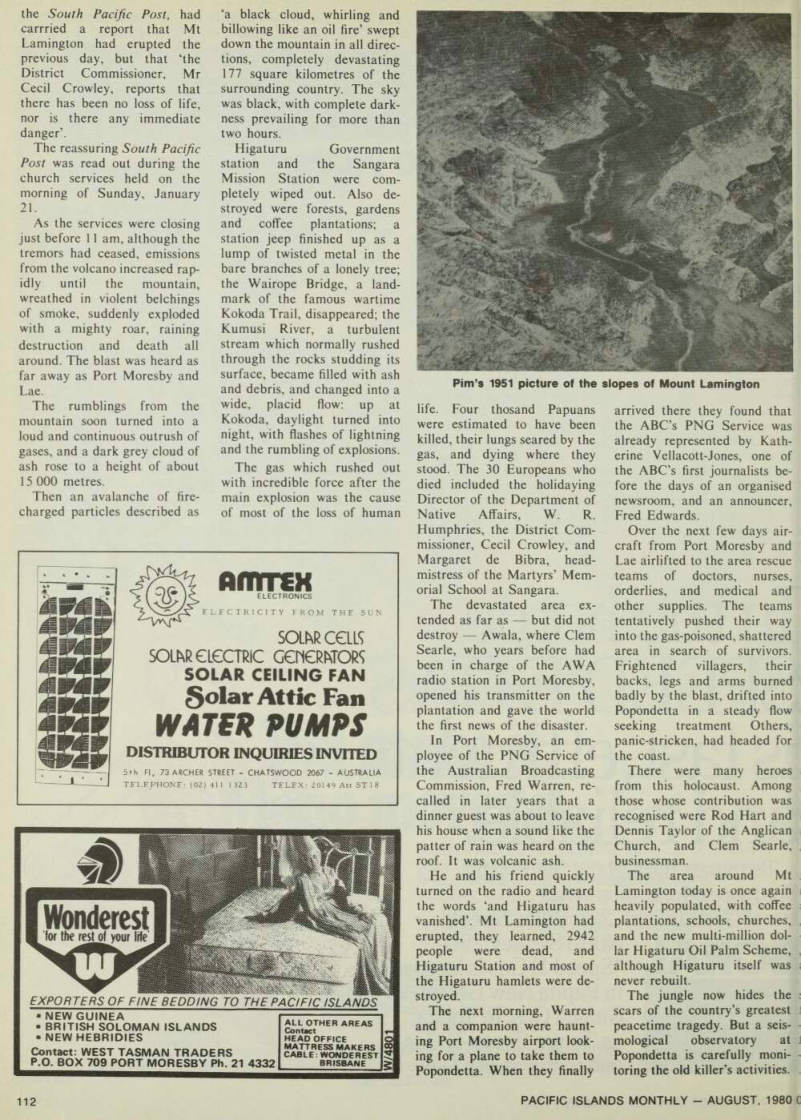
Rim’s 1951 picture of the slopes of Mount Lamington