a Kingdom
pp. 108-109 · Read in the full issue
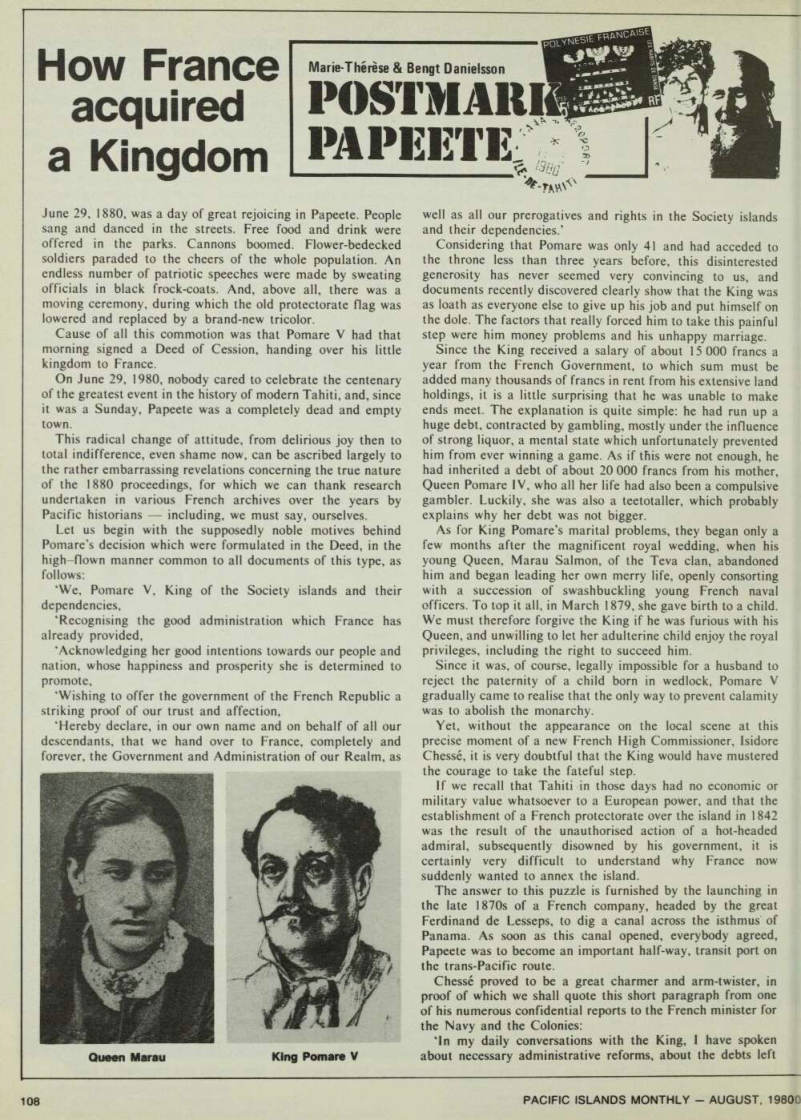
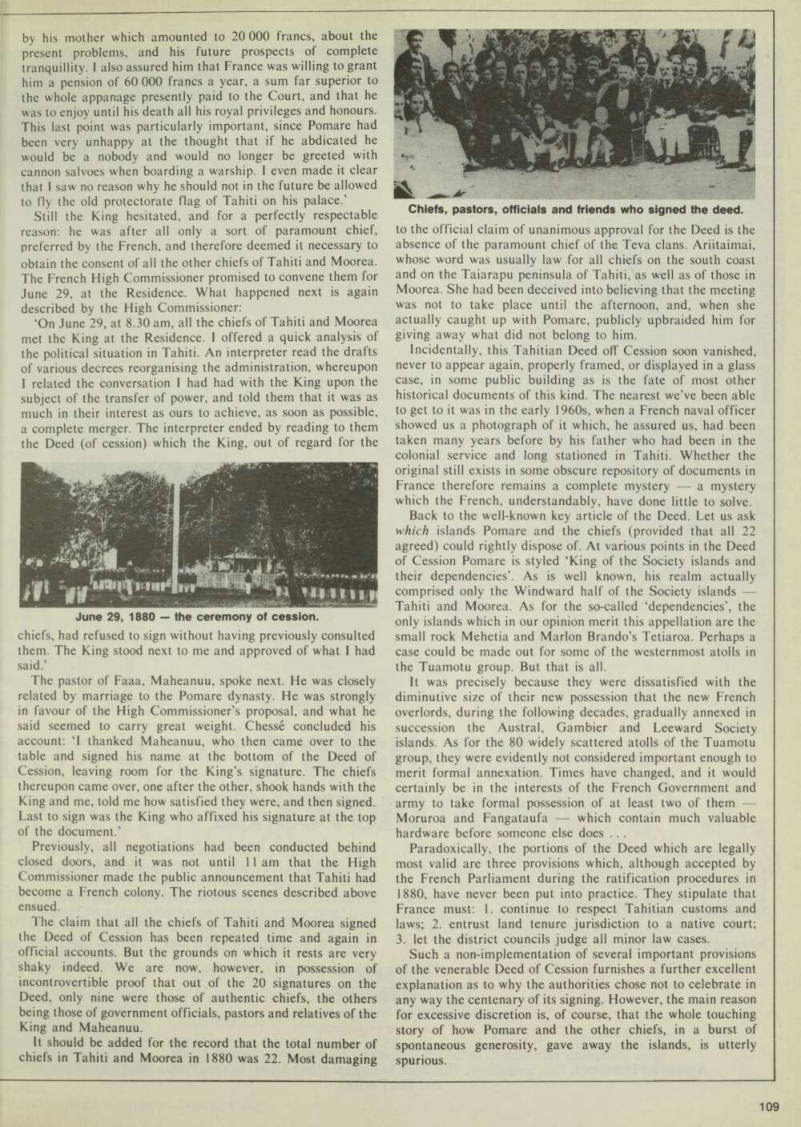
How France acquired a Kingdom
June 29, 1880, was a day of great rejoicing in Papeete. People sang and danced in the streets. Free food and drink were offered in the parks. Cannons boomed. Flower-bedecked soldiers paraded to the cheers of the whole population. An endless number of patriotic speeches were made by sweating officials in black frock-coats. And, above all, there was a moving ceremony, during which the old protectorate flag was lowered and replaced by a brand-new tricolor.
Cause of all this commotion was that Pomare V had that morning signed a Deed of Cession, handing over his little kingdom to France.
On June 29, 1980, nobody cared to celebrate the centenary of the greatest event in the history of modern Tahiti, and, since it was a Sunday, Papeete was a completely dead and empty town.
This radical change of attitude, from delirious joy then to total indifference, even shame now, can be ascribed largely to the rather embarrassing revelations concerning the true nature of the 1880 proceedings, for which we can thank research undertaken in various French archives over the years by Pacific historians including, we must say, ourselves.
Let us begin with the supposedly noble motives behind Pomare’s decision which were formulated in the Deed, in the high-flown manner common to all documents of this type, as follows: ‘We, Pomare V, King of the Society islands and their dependencies, ‘Recognising the good administration which France has already provided, ‘Acknowledging her good intentions towards our people and nation, whose happiness and prosperity she is determined to promote, ‘Wishing to offer the government of the French Republic a striking proof of our trust and affection, ‘Hereby declare, in our own name and on behalf of all our descendants, that we hand over to France, completely and forever, the Government and Administration of our Realm, as
well as all our prerogatives and rights in the Society islands and their dependencies.’
Considering that Pomare was only 41 and had acceded to the throne less than three years before, this disinterested generosity has never seemed very convincing to us, and documents recently discovered clearly show that the King was as loath as everyone else to give up his job and put himself on the dole. The factors that really forced him to take this painful step were him money problems and his unhappy marriage.
Since the King received a salary of about 15 000 francs a year from the French Government, to which sum must be added many thousands of francs in rent from his extensive land holdings, it is a little surprising that he was unable to make ends meet. The explanation is quite simple: he had run up a huge debt, contracted by gambling, mostly under the influence of strong liquor, a mental state which unfortunately prevented him from ever winning a game. As if this were not enough, he had inherited a debt of about 20 000 francs from his mother, Queen Pomare IV, who all her life had also been a compulsive gambler. Luckily, she was also a teetotaller, which probably explains why her debt was not bigger.
As for King Pomare’s marital problems, they began only a few months after the magnificent royal wedding, when his young Queen, Marau Salmon, of the Teva clan, abandoned him and began leading her own merry life, openly consorting with a succession of swashbuckling young French naval officers. To top it all, in March 1879, she gave birth to a child.
We must therefore forgive the King if he was furious with his Queen, and unwilling to let her adulterine child enjoy the royal privileges, including the right to succeed him.
Since it was, of course, legally impossible for a husband to reject the paternity of a child born in wedlock, Pomare V gradually came to realise that the only way to prevent calamity was to abolish the monarchy.
Yet, without the appearance on the local scene at this precise moment of a new French High Commissioner, Isidore Chesse, it is very doubtful that the King would have mustered the courage to take the fateful step.
If we recall that Tahiti in those days had no economic or military value whatsoever to a European power, and that the establishment of a French protectorate over the island in 1842 was the result of the unauthorised action of a hot-headed admiral, subsequently disowned by his government, it is certainly very difficult to understand why France now suddenly wanted to annex the island.
The answer to this puzzle is furnished by the launching in the late 1870 s of a French company, headed by the great Ferdinand de Lesseps, to dig a canal across the isthmus of Panama. As soon as this canal opened, everybody agreed, Papeete was to become an important half-way, transit port on the trans-Pacific route.
Chesse proved to be a great charmer and arm-twister, in proof of which we shall quote this short paragraph from one of his numerous confidential reports to the French minister for the Navy and the Colonies; ‘ln my daily conversations with the King, I have spoken about necessary administrative reforms, about the debts left
Queen Marau
King Pomare V
by his mother which amounted to 20 000 francs, about the present problems, and his future prospects of complete tranquillity. I also assured him that France was willing to grant him a pension of 60 000 francs a year, a sum far superior to the whole appanage presently paid to the Court, and that he was to enjoy until his death all his royal privileges and honours.
This last point was particularly important, since Pomare had been very unhappy at the thought that if he abdicated he would be a nobody and would no longer be greeted with cannon salvoes when boarding a warship. I even made it clear that I saw no reason why he should not in the future be allowed to fly the old protectorate flag of Tahiti on his palace.’
Still the King hesitated, and for a perfectly respectable reason: he was after all only a sort of paramount chief, preferred by the French, and therefore deemed it necessary to obtain the consent of all the other chiefs of Tahiti and Moorea.
The French High Commissioner promised to convene them for June 29, at the Residence. What happened next is again described by the High Commissioner; ‘On June 29, at 8.30 am, all the chiefs of Tahiti and Moorea met the King at the Residence. I offered a quick analysis of the political situation in Tahiti. An interpreter read the drafts of various decrees reorganising the administration, whereupon I related the conversation I had had with the King upon the subject of the transfer of power, and told them that it was as much in their interest as ours to achieve, as soon as possible, a complete merger. The interpreter ended by reading to them the Deed (of cession) which the King, out of regard for the
chiefs, had refused to sign without having previously consulted them. The King stood next to me and approved of what I had said.’
The pastor of Faaa, Maheanuu, spoke next. He was closely related by marriage to the Pomare dynasty. He was strongly in favour of the High Commissioner’s proposal, and what he said seemed to carry great weight. Chesse concluded his account; ‘1 thanked Maheanuu, who then came over to the table and signed his name at the bottom of the Deed of Cession, leaving room for the King’s signature. The chiefs thereupon came over, one after the other, shook hands with the King and me, told me how satisfied they were, and then signed.
Last to sign was the King who affixed his signature at the top of the document.’
Previously, all negotiations had been conducted behind closed doors, and it was not until 11 am that the High Commissioner made the public announcement that Tahiti had become a French colony. The riotous scenes described above ensued.
The claim that all the chiefs of Tahiti and Moorea signed the Deed of Cession has been repeated time and again in official accounts. But the grounds on which it rests are very shaky indeed. We are now, however, in possession of incontrovertible proof that out of the 20 signatures on the Deed, only nine were those of authentic chiefs, the others being those of government officials, pastors and relatives of the King and Maheanuu.
It should be added for the record that the total number of chiefs in Tahiti and Moorea in 1880 was 22. Most damaging
to the official claim of unanimous approval for the Deed is the absence of the paramount chief of the Teva clans. Ariitaimai, whose word was usually law for all chiefs on the south coast and on the Taiarapu peninsula of Tahiti, as well as of those in Moorea. She had been deceived into believing that the meeting was not to take place until the afternoon, and, when she actually caught up with Pomare, publicly upbraided him for giving away what did not belong to him.
Incidentally, this Tahitian Deed off Cession soon vanished, never to appear again, properly framed, or displayed in a glass case, in some public building as is the fate of most other historical documents of this kind. The nearest we’ve been able to get to it was in the early 19605, when a French naval officer showed us a photograph of it which, he assured us, had been taken many years before by his father who had been in the colonial service and long stationed in Tahiti. Whether the original still exists in some obscure repository of documents in France therefore remains a complete mystery a mystery which the French, understandably, have done little to solve.
Back to the well-known key article of the Deed. Let us ask which islands Pomare and the chiefs (provided that all 22 agreed) could rightly dispose of. At various points in the Deed of Cession Pomare is styled ‘King of the Society islands and their dependencies’. As is well known, his realm actually comprised only the Windward half of the Society islands Tahiti and Moorea. As for the so-called ‘dependencies’, the only islands which in our opinion merit this appellation are the small rock Mehetia and Marlon Brando’s Tetiaroa. Perhaps a case could be made out for some of the westernmost atolls in the Tuamotu group. But that is all.
It was precisely because they were dissatisfied with the diminutive size of their new possession that the new French overlords, during the following decades, gradually annexed in succession the Austral, Gambier and Leeward Society islands. As for the 80 widely scattered atolls of the Tuamotu group, they were evidently not considered important enough to merit formal annexation. Times have changed, and it would certainly be in the interests of the French Government and army to take formal possession of at least two of them Moruroa and Fangataufa which contain much valuable hardware before someone else does ...
Paradoxically, the portions of the Deed which are legally most valid are three provisions which, although accepted by the French Parliament during the ratification procedures in 1880, have never been put into practice. They stipulate that France must: 1. continue to respect Tahitian customs and laws; 2. entrust land tenure jurisdiction to a native court; 3. let the district councils judge all minor law cases.
Such a non-implementation of several important provisions of the venerable Deed of Cession furnishes a further excellent explanation as to why the authorities chose not to celebrate in any way the centenary of its signing. However, the main reason for excessive discretion is, of course, that the whole touching story of how Pomare and the other chiefs, in a burst of spontaneous generosity, gave away the islands, is utterly spurious.
June 29, 1880 - the ceremony of cession.
Chiefs, pastors, officials and friends who signed the deed.