The Little Items That Are Big
pp. 115-129 · Read in the full issue
Judy Tudor writes a postscript to her memorable series
Beginning from our January issue this year and ending with the July one, PIM has published more than 36 000 words in its series on PlM’s Pacific the distillation of the last 50 years of Pacific Islands events as recorded in the pages of PIM. In trying to cover what PIM said, I have gone through 600 individual issues of the magazine and filled literally dozens of notebooks, but in every instalment since January many of the small items that could have been written into the record have had to be passed over, simply for lack of space. But it seems to me that it is the ‘trivia’ that makes the difference between the Pacific Islands and the ordinary places on earth, so here we record, as a sort of postscript to the series, small items culled mostly from the events of the ‘Fifties and Seventies’.
Although it is very easy to believe to the contrary, the life of the vast majority of Islanders has not changed a great deal, nor has their typical way of looking at things. Only a tiny minority become Prime Ministers, or even poli ticians, or go galloping around the earth being treated as VIPs in Peking or making speeches at the United Nations.
Having now finished this task of recording what PIM has said on thousands of subjects over the last 50 years a task that has driven me to distraction at times and taken about 10 years off my life at a time when I can ill spare them I feel I should end by making a few prognostications. But I shall refrain!
I can’t even guess what is going to happen in the Pacific in the next 50 years. All I can hope is that somehow the Pacific Islanders will manage to retain some of the pleasant things that make them different from anyone else. Judy Tudor.
The Fifties
JAPAN was in the market for the Japanese ships sunk at Rabaul during the war and subsequently salvaged. PIM commented: ‘lf anything is needed to prove that the whole human race is mad, these scrap deals are it. Japs built them, we sink them, we salvage them, Japs buy them.’
FIJI was sending six athletes to the Empire Games (yes, it was still the Empire), to be held in Vancouver in August 1954.
ILU FARM, 17 miles out, was one reason for choosing Honiara for the postwar capital of BSIP. The Americans used the farm to great effect during the later stages of the war to provide themselves with vegetables. But after trying rice, vegetables and cattle raising with a view to showing the Solomon Islanders how to be farmers, the BSIP Department of Agriculture was about to give up the nine years struggle in September 1954. Tenders were being called for the 1000 acres property, complete with buildings, on a 99 years lease.
ANOTHER raft drifter, an elderly American named William Willis, complete with black cat, arrived in Pago Pago ex-Peru at
the end of 1954, whereupon the Sydney Daily Telegraph had a rush of enthusiasm to the head. It sent two reporters by regular airline to Suva, where they hired a Sunderland flying boat to continue on to Western Samoa, then a BP launch to get to Pago only to find that Willis refused to talk. He had tied up his story with a New York newspaper before he left and remained stubbornly dumb. However, one reporter did get an interview with Meeki the cal. Willis gave Meeki away in Samoa but there was such a howl about this in the US he hurriedly retrieved it it meant an extra $lO 000 to him, he reckoned. Both cat and Willis then left for home and glory.
WHEN the US detonated an H-bomb in the Marshalls in March 1954, fallout polluted a Japanese ship, Fukyryo Maru and there was the usual outcry. But not so much publicity was given to two small islands, Rongelap and Utirik, which also caught the fallout.
The US Navy evacuated the populations to Kwajalein. The Utirik people were soon declared medically fit and were returned to their island but Rongelap was declared dangerously radioactive and at the end of 1954 these people were settled on another islet in the Majuro group.
IN MAY 1955 it was announced that Santo, New Hebrides, would have a tuna fishing industry based there. D. J. Gubbay and Co. would be the operating company, on the British register in the NH. The shore installations would include a freezer (the fish would not be canned) and would be supplied by seven Japanese long-line fishing vessels.
IN JULY 1955 PIM reached its quarter century and to celebrate the occasion this issue burst into full colour for the first time and the last for many years. A colour-photo competition had been in progress for six months and 200 colour transparencies had been received. Half a dozen winners were chosen and these entries reproduced. Most of the rest of the silver anniversary issue was given to reviews of the previous 25 years. The issue ran to 192 pages 28 more than usual. Among the regular news stories in that issue was a special article from R. W. Robson who had just spent some lime with the Fiji Battalion, hunting terrorists among the rubber plantations of Malaya.
ALL LAND titles had been lost in New Guinea during the Japanese occupation and to assist the authorities in reconstructing them many inquiries had been made all over the world, but particularly in Germany, as many Australian titles were based on German records prior to World War I. As a result of these inquiries, the authorities were amazed to have descendants of members of what had been known as the Waria Syndicate put in a claim for 5000 sq miles of New Guinea which included the Morobe mining area. The claim was based on a lease granted by the Imperial German Government in July 1914. Although German plantations etc were expropriated after World War I the claimants insisted that the Waria Syndicate lease had been overlooked and was still valid. In spite of repeated knockbacks by NG Land Courts, the claim was persisted with for years.
IN MARCH 1953 two rhinoceros beetles, a devastating pest of coconuts, were found in the Suva wharf area and everyone went on beetle alert. Extreme measures were taken in relation to the
movements of shipping and all other transport, a Coconut Pests and Diseases Board was set up with a budget of £l4 000 but it was soon found that the pest had been established on Viti Levu for years. In spite of all, the beetle had come to stay.
OLD TERRITORIAN Joe Bourke’s dream came true on November 26, 1952, when beer brewed in his brewery in Port Moresby began to flow and even more important, was pronounced good by local connoisseurs. Lae and Suva also got breweries in the 50s the latter owned by a partnership of Carlton & United, Melbourne, and W. R. Carpenter. Not long after Suva’s brewery came on stream, Fijians and Indians were legally permitted to drink beer without taking out a permit.
IN JUNE 1953 a bulldozer driver at Bulolo, NG, turned up two gold bricks, part of a number that had been stolen from an Army guardhouse in 1942. One weighed 516 oz, the other 443 oz. They were originally the property of Koranga Gold Sluicing. An extensive search had been made for them in 1942 and after the war, without result; neither could any clue be found as to who was responsible. At the time, the value of the gold was put at £l5 000 imagine what it would be worth in 1980!
AFTER outbreaks of typhoid in widely scattered locations in Australia, Papuan desiccated coconut became suspect. Three factories, all in a small way, made desiccated in Papua and when in August 1953 Australian health authorities froze shop stocks and warned households not to use Territory coconut the whole industry was killed overnight.
QUEEN ELIZABETH II and the Duke of Edinburgh, in the course of their post-Coronation visit to the British countries south of the equator, spent December 17 and 18, 1953 in Fiji and the 19th and 20th in Nukualofa as guests of Queen Salote of Tonga.
The excitement in both places was intense. Representatives of islands off the Royal route, in Western Samoa, Cook Islands and Niue, went to New Zealand to meet the royal pair just as representatives of Papua-New Guinea, Norfolk Island, and Nauru went to Canberra during the royal visit there in February 1954.
The PIM issues covering these events were full of pictures and enthusiasm.
SIR WALTER CARPENTER, founder of W. R. Carpenter and Co. in 1914, died in Sydney on February 1, 1954 aged 77.
HEAD CHIEF Raymond Gadabu of Nauru said during an interview in Australia in April 1954 that Nauru was in the market for a new island home as it was expected that phosphate deposits would be finished in 30 years. The Nauruans, he said, wanted to emulate the Ocean Island Banabans who had resettled on Fiji’s Rabi. This was the first shot in the continuing campaign for a new homeland for the Nauruans and it ended quite differently.
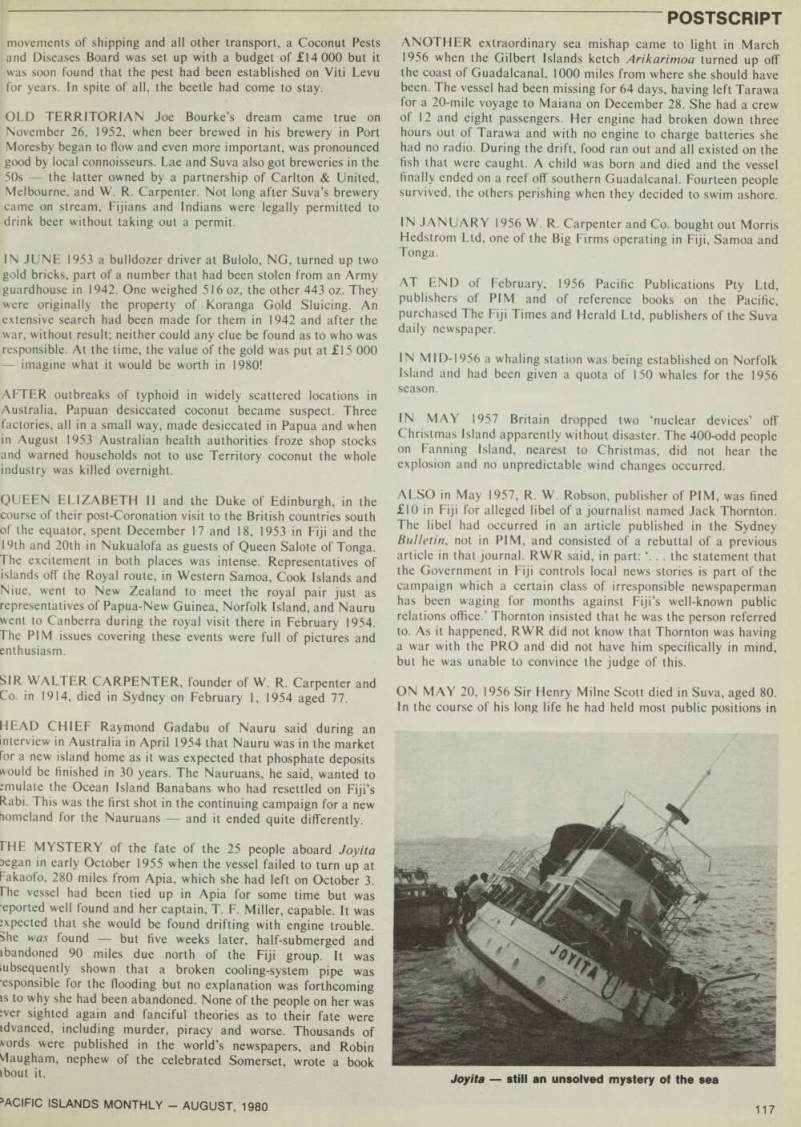
FHE MYSTERY of the fate of the 25 people aboard Joyita Degan in early October 1955 when the vessel failed to turn up at Fakaofo, 280 miles from Apia, which she had left on October 3.
Fhe vessel had been tied up in Apia for some time but was •eporled well found and her captain, T. F. Miller, capable. It was expected that she would be found drifting with engine trouble.
She was found but five weeks later, half-submerged and ibandoned 90 miles due north of the Fiji group. It was ;übsequently shown that a broken cooling-system pipe was esponsible for the flooding but no explanation was forthcoming is to why she had been abandoned. None of the people on her was ;ver sighted again and fanciful theories as to their fate were idvanced, including murder, piracy and worse. Thousands of vords were published in the world’s newspapers, and Robin Maugham, nephew of the celebrated Somerset, wrote a book ibout it.
ANOTHER extraordinary sea mishap came to light in March 1956 when the Gilbert Islands ketch Arikarimoa turned up off the coast of Guadalcanal, 1000 miles from where she should have been. The vessel had been missing for 64 days, having left Tarawa for a 20-mile voyage to Maiana on December 28. She had a crew of 12 and eight passengers. Her engine had broken down three hours out of Tarawa and with no engine to charge batteries she had no radio. During the drift, food ran out and all existed on the fish that were caught. A child was born and died and the vessel finally ended on a reef off southern Guadalcanal. Fourteen people survived, the others perishing when they decided to swim ashore.
IN JANUARY 1956 W. R. Carpenter and Co. bought out Morris Hedslrom Ltd, one of the Big Firms operating in Fiji, Samoa and Tonga.
AT END of February, 1956 Pacific Publications Pty Ltd, publishers of PIM and of reference books on the Pacific, purchased The Fiji Times and Herald Ltd, publishers of the Suva daily newspaper.
IN MID-1956 a whaling station was being established on Norfolk Island and had been given a quota of 150 whales for the 1956 season.
IN MAY 1957 Britain dropped two ‘nuclear devices’ off Christmas Island apparently without disaster. The 400-odd people on Fanning Island, nearest to Christmas, did not hear the explosion and no unpredictable wind changes occurred.
ALSO in May 1957, R. W. Robson, publisher of PIM, was fined £lO in Fiji for alleged libel of a journalist named Jack Thornton.
The libel had occurred in an article published in the Sydney Bulletin , not in PIM, and consisted of a rebuttal of a previous article in that journal. RWR said, in part: ‘. . . the statement that the Government in Fiji controls local news stories is part of the campaign which a certain class of irresponsible newspaperman has been waging for months against Fiji’s well-known public relations office.’ Thornton insisted that he was the person referred to. As it happened, RWR did not know that Thornton was having a war with the PRO and did not have him specifically in mind, but he was unable to convince the judge of this.
ON MAY 20, 1956 Sir Henry Milne Scott died in Suva, aged 80.
In the course of his long life he had held most public positions in
Joyita - still an unsolved mystery of the sea
the colony at one time or another, as well as being its most prominent lawyer. In the following month, Sir Alport Barker, formerly owner and publisher of The Fiji Times, died in retirement in Auckland, aged 82.
THE DUKE OF EDINBURGH visited Papua New Guinea and Norfolk Island in November, 1956 en route to opening the Olympic Games in Melbourne ‘against a background of war tensions and calamity that threatens to make the holding of the games a complete fiasco’. So said PIM not knowing that similar sentiments would be repeated nearly a quarter century later. On that occasion Russia had just bloodily put down uprisings in Hungary and France and England had ignominiously had to withdraw from the Suez affair after Russia threatened intervention, and the US in the middle of a presidential election, joined in denouncing her old allies.
SIR BEAUMONT PHILLIPS, Chief Justice of the Papua-New Guinea Supreme Court, died in Melbourne on June 6, 1957.
KURU disease, sometimes called laughing death, which affected the central nervous system and was confined to people in one small area of the Eastern Highlands of New Guinea first came to public notice, although it had been studied by health officers for some years.
HAROLD GATTY, aged 54, died suddenly in Suva on August 30, 1957. In 1931 he had been Wiley Post’s navigator when they :ircumnavigaled the globe by plane in eight days 15 hours a •ecord at the time. In the late 1930 s he negotiated landing rights 'or Pan American Airways in New Zealand; after the war, from Suva he set up South Seas Marine Products which, though a ailure, paved the way for more successful tuna fisheries in the South Pacific. Finally, in 1951, he gave Fiji its first successful nternal air services.
N NOVEMBER 1957, Stuart Inder joined PIM to share editorial responsibility with Judy Tudor.
PHE FIRST migrants from the overcrowded Gilbert Islands irrived in the Western District of BSIP. In spite of some troblems, they were reported to be settling in fairly well.
MR KENT SHELBY of California arrived in Fiji in March 1958 to claim an island he had won for supplying the last line of a limerick publicising a movie called The Little Hut. The island was a pint-sized islet off Lautoka with mud, mangroves, a beach, 59 coconuts and a bure equipped with furniture provided by Northern Hotels. Mr Shelby brought a friend with him, they stayed a couple of months and then left, saying rude things about Fiji and British colonials.
IN MID-1958 New Guinea Chinese became eligible for Australian citizenship. This allowed them to settle in Australia and in the Australian Territory of Papua.
AFTER the Tolais of Navuneram village repeatedly refused to pay their £2 annual headtax, a patrol headed by the District Commissioner and the P-NG Commissioner of Police, plus 80 police, went to the village on August 3, 1958, and told the villagers to line up for a census. The villagers refused and after a long parley, started to hurl stones at the patrol. The police were ordered to fire over the heads of the belligerents but, to the consternation of all concerned, when the smoke of battle cleared, two Navunerams lay dead.
IN MAY 1958 the fourth South Pacific Conference was held in Rabaul and pronounced the most promising to date. By then delegates knew what it was all about and were not backward in stating which way they wanted to go.
The Seventies
MR HARRY MOORS, or Afioga Afoafouvale Misimoa, of Western Samoa became the first Islander Secretary-General of the South Pacific Commission at the beginning of 1970. Previous Sec-Generals had been Establishment appointments by the six foundation members of the SPC UK, Australia, USA, New Zealand, France and the Netherlands. Misimoa was well known in his country where, at different times and because of his European/Samoan ancestry, he had represented Europeans and Samoans in local politics. He died suddenly in Tarawa after only 13 months in office and was succeeded by another West Samoan of part European/Samoan blood, Mr Fred Betham.
PRINCESS SIUILIKUTAPU, niece of King Taufa’ahau of Tonga, who had secretly married a Tongan university student in Auckland, was back home in Nukualofa in January 1970 without her husband and with her marriage annulled. Royalty didn’t marry commoners in Tonga whatever they might do elsewhere, and while the Australian and New Zealand media wept for the busted romance, the general opinion in Tonga was that the King was right. It wasn’t long before the princess had found another husband. In October 1970 she married a Tonga noble, Major
The Papuan oil rig - hopes were short-lived
IKalanivalu Fotofili, the king’s aide-de-camp -and her own second :cousin.
TONGA had gone overboard in another direction as well, reported PIM, this time in the matter of postage stamps. It had already produced some in the shape of bananas and other oddments, but in early 1970 they came out shaped like an oil-rig, commemorating the fact that Tonga was having its first scientific search for petroleum, which hasn’t yet been found.
AN AIR DISASTER in mid-January 1970 shocked all in the two Samoas. A DC3 belonging to Polynesian Airlines crashed in the lagoon after take-off from West Samoa’s Faleolo Airport and 29 passengers and three crew were killed.
IN the early 1970 s controversy was already raging in New Hebrides over several land development schemes and some •esidents could see the country being inundated and its life-style changed by settlements of expatriates, thousands strong. A mbdivision at Hog Harbour (renamed more romantically Lokalee 3each) owned by an American company headed by Ex-Marine Eugene Peacock had already sold 1000 lots, sight unseen, mostly n Honolulu or to ex-Korea or Vietnam veterans. A hotel had been milt there, out in the boondocks, to provide somewhere for iwners to stay while examining what they had bought. Two other levelopments were planned, one near Vila. The New Hebrides lever did get to be over-run by expatriate settlers, however. The ondominium government soon clamped restrictions on the sub livision of land, and many overseas purchasers were not mpressed with their purchases when they saw them.
JEW HEBRIDES was to have more success as a tax-haven for iternational companies and as a result was attracting new esidents lawyers, trust company officials etc, and in turn reating a demand for housing and office space. Local directors 'ere also required and these got lucrative director’s fees for little r no effort. >N MARCH 17, 1970, the Colonial Sugar Refining Co. released 48-page pamphlet in Fiji which, said PIM, cursed in the most sntlemanly board-room manner Lord Denning’s report on the •cal sugar industry which had given growers 65% of the proceeds f sugar cane for the next decade. It also announced that, as it dw considered the production of sugar in Fiji uneconomic, it ould withdraw from the country at the end of the 1972 milling :ason. or most people in Fiji this was a bombshell. Few could imagine le place without the CSR Co. which had been first established
in Fiji in 1882. Who could the Indian politicians rail against if their favourite whipping boy went home to Australia?
To a few who had carefully read the Denning report, said PIM, and measured it up against the current economic trends, including Britain’s probable entry into the Common Market, the CSR’s decision came as no surprise.
What to do about the future milling of Fiji’s sugar was one of the first conundrums independent Fiji had to solve. This it did after months of talking and negotiations. The Government decided to take over all CSR’s shares in its Fiji subsidiary, South Pacific Sugar Mills Ltd, and the company’s freehold land as well, a deal costing about $l4 million. The Fiji Sugar Corporation Ltd which resettled, is run on commercial lines.
ON APRIL 19, 1970, American Samoa got an unexpected visit from U.S. astronauts when James Lovell and his crew of three from the unlucky Apollo 13 mission literally dropped in. They had splashed down in the ocean about 625 miles away and were flown by helicopter to Tafuna airport. The Apollo 13 mission was to have landed the men on the moon but a mystery explosion forced them to abort. The whole world watched anxiously as the team struggled back to earth, to make a successful re-entry. About 7000 welcoming Samoans crowded the Tafuna area, complete with bands, choirs and dancing girls.
EIGHT YEARS after it became independent in 1962 Western Samoa joined the British Commonwealth. It had been enjoying most of the advantages of belonging except attendance at the Prime Ministers’ conferences.
AT THE END of 1970 the Pacific was getting ready to say good bye to Burns Philp Line ships, once thought by Islands residents to be as permanent a part of the Islands scene as reefs and coconuts.
Of the famous BP ships that once traded from Australia to the S.W. Pacific, the Far East and Malaysia, only three were left. One of these was a chartered vessel and the other two were soon to go.
After World War II other shipping companies came into Pacific services and seemed to trade profitably. Why then, asked PIM, could not the long established shipping companies like Burns Philp and Union Steam Ship Co. of NZ continue to compete?
Part of the answer was in that the newcomers did not operate under Australian or NZ articles, and thus pay union wages, nor suffer the same pressures from the Australian or New Zealand governments. So far as the B.P. Line was concerned, its owners were merchants who had indulged in tremendous diversification of interests, and thus did not have to continue with the unprofitable divisions of their business empire.
B.P. ships were probably of greatest benefit to their owners between the wars. In the 1930’s the famous 7-letter “M” ships Montoro, Malaita, Macdhui, Morinda. Marsina, etc were
M alekula, with paying-off pennant, leaves the Pacific in 1969
Fiji’s Lautoka sugar mill - new owners in the Seventies
cargo-passenger carriers between Sydney and the S.W. Pacific and had no competition from air services. From Islands centres smaller vessels, with names no less famous than those of their larger sisters, provided local services. Now, alas, mourned PIM, the last remnant of a once mighty merchant fleet was all but gone.
THE British Pacific had frequently been visited by Royalty but in November 1970 American and Western Samoa were briefly visited by Pope Paul VI, to general enthusiasm.
THE University of Papua New Guinea which had had its first six graduates in 1970, was beginning to worry about ‘indigenisation’ by 1971. According to the Australian firm hired to look after its manpower planning, the incumbent Vice-Chancellor, Dr John Gunther, had all the qualifications for his job except the right colour. He should have been black. When he left the job, and the consultants seemed to feel that it had better be sooner rather than later, social and political opinion in the country might preclude appointment of another European to the post, or so they seemed to think. All other University appointees would be better black, also.
Dr Gunther, who had worked several miracles in establishing the university, was reported to be unperturbed. When he did retire he was, in fact, succeeded by another wrong-skinned individual but the Vice-Chancellor after that was, at last, black.
THE perennial business of tourists in scanty dress was getting another airing in Fiji in 1971. An Indian member of parliament called for ‘dress control’, saying that people in rural areas were not used to seeing women walk around in ‘topless bras, bikinis and similar attire.’
It all fell on deaf ears, of course. Ten years later, cruise ships and planes are still issuing the same old warnings and the same people are still ignoring them. By now, anyway, even rural Fiji must be used to tourists, if not in topless bras, at least in something pretty scanty.
FIJI AIRWAYS, which had been established by the late Harold Gatty in 1951 as a purely domestic carrier, changed its name in 1971 to Air Pacific. By the end of the decade it was operating services to Samoa, Tonga, Gilbert and Ellice, New Hebrides, Solomons, Nauru, Port Moresby and Brisbane and its ownership vas divided between Qantas, British Airways, Air New Zealand, Fiji, Solomons, Western Samoa and Tonga.
FINY Pitcairn Island, which depended on stamp issues for its jverseas currency, was hopping mad in mid-1971 over a special Tamp ordered to commemorate the visit earlier that year by the 3uke of Edinburgh. It had ordered 1000 of the stamps as a ‘rare’ ssue, only to find that over 40,000 of them had been printed and
Air Pacific emerges from Fiji Airways, 1971
»old in Britain. It was enough, said PIM, to make the whole 87 nhabitants of Pitcairn stage another mutiny or even support the UN Committee of 24’s pipedream of an independent Pitcairn that ;ould issue its own stamps without interference. (Since Fiji had become independent, Pitcairn was part of the province of the UK -ligh Commissioner in New Zealand).
MAURU in 1971 bought a building site at the ‘Paris-end’ of _ol!ins Street, Melbourne for $5 million and proceeded to erect >n it Nauru House, of 51 storeys, the tallest building in that city, t was opened on April 15, 1977 providing office accommodation or more people than the total population of Nauru.
N EARLY 1972 Fiji was collectively staggered when tenders for he talked-about-for-generations rebuilding and sealing of Queen’s td were opened. The lowest tender, at $26 million, was twice as nuch as local estimates. The highest was $37 million. The World lank had promised a loan of $lO million towards the project, an mount that now began to look slightly inadequate. Fiji finally ecided to rebuild and seal the two ends of the road from Nadi a Sigatoka and from Deuba to Suva leaving for posterity the otorious section in the middle that twists through the Serua hills.
'OTLATCH FORESTS INC the big American timber company, 'as threatening in early 1972 to withdraw its whole $5 million nterprise from Western Samoa if something wasn’t done about etting shipping in to Asau wharf. The wharf had been finished iree years before, but it still remained in virgin state as the ifficulty of blasting and dredging a channel through coral had een sadly underestimated. he channel was eventually completed but the company did epart, in 1977, the W. Samoan government taking over for SUS 2 lillion, to be paid over s'/2 years. 1 52 MILLION, 84-room Beachcomber Hotel opened at Deuba, iji, at th e end of 1972, part of the $32 million Pacific Harbour Dmplex. The hotel was run by American Airlines as part of its lagship chain until the airline withdrew from Pacific service. The rst stage of the 1120 acres at Pacific Harbour was completed irly in 1973 when half the residential blocks, most of them onting artificial waterways, had been sold. The first 9-holes of ie golf-course were complete by the end of 1972 and by the end of ie decade international golf was being played on the completed 3 holes. By this time there was Middle East oil money invested i the big development, which now included the Fiji Cultural entre. -E NOU, once a notorious convict settlement in Noumea arbour, was no more by 1973. Immense port extensions had
joined it to the mainland by a causeway. The new works and the wharves, which could berth the biggest liner, cost the equivalent of $A 15 million.
AT THE END OF 1972 the South Pacific Commission celebrated its 25th birthday in a very poor state of health. Originally set up by six metropolitan governments with colonies in the Pacific for the advancement of Islanders and to tackle problems common to them all, it began to lose its original purpose once the colonies started to become independent nations. The South Pacific Conference, which was set up as an adjunct to the SPC so that Islanders could meet together, eventually became more important than the parent body and amalgamated with it, deciding what projects the SPC should spend its limited budget on. The SPC still tries to maintain its non-political stance, which was certainly not the case with the South Pacific Forum which came into being in the early 1970 s and stole a lot of the SPC’s thunder.
It was formed by Fiji, Western Samoa, Cook Islands, Nauru, Tonga and Australia and NZ, and members were added as former colonies became independent. At the end of 1972 the Forum set up the South Pacific Bureau for Economic Cooperation, with headquarters in Suva, as its operating arm. The Forum Shipping Line was one practical manifestation and the body also deliberated on such things as fisheries, laws of the sea, the declaration of offshore economic zones, etc. The Forum was alive, vigorous and forward-looking into the ’eighties.
ONE of the first acts of the Labor Government which came to power in Australia at the end of 1972 was to revalue upwards the Australian dollar and by 1973 Australian exporters and primary producers in Papua New Guinea and Solomons, which still used Australian currency, were damning them to hell. Then to add more confusion, the United States devalued its currency, which gave Australia an effective 20% revaluation, especially affecting commodities written in US dollar terms. Bougainville Copper Ltd, which had only begun to export in 1972, expected a 20% cut in earnings.
It needn’t have been too worried. In early 1974 it was announced that it had made a massive $A 143.8 million profit in 1973. This, said PIM, might be thought to make everyone in PNG happy, instead it caused much bitchiness. Chief Minister Somare went on record that unless he could get a bigger share of it, he would be failing the country. John Kaputin, then Rabaul’s professional angry young man who was also PNG Minister for Justice at the time, demanded that Bougainville Copper pay 80 per cent income tax and that PNG should take over a controlling interest.
PNG government already had a 20% share in the company (another 52.6% was owned by Conzinc Riotinto of Australia, and
A changing emphasis - SPC headquarters in Noumea, 1971
The pit on Bougainville - gold as well as copper
the rest was in private hands) and although the company got a tax holiday until 1975 it paid a withholding tax and royalties. PNG’s share of 1973 profits was $l6 million in dividends, $9.5 million in holding tax and $9.7 million in royalties.
Outraged or avaricious feelings were eventually cooled in case other potential overseas investments were frightened off although the government’s agreement with the company was renegotiated, and in the years ahead Bougainville Copper Ltd made greater profits.
Apart from copper, which had an up-and-down existence, the company produced anything up to 750 000 oz of gold p.a. At the end of the decade, when this rose to around SUS6OO per ounce, profits from gold outweighed profits from copper and PIM suggested that the company’s name should be changed to Bougainville Gold Ltd.
FIJI got a new daily newspaper in October 1974 to rival the 105years old Fiji Times. It was called Fiji Sun and started out as an afternoon tabloid but subsequently changed to morning publi cation.
MILITANT members of the Union of Caledonian Youth finally got the authorities to remove a plaque from a statue in Noumea’s central square in late 1974. The plaque was attached to the statue of Admiral Olry, an early Governor, and had been there for many years, but it was found to be humiliating to New Caledonians in the 19705. It was a relief showing island warriors handing over their spears to 19th century Frenchmen.
ALSO at this time New Caledonia was at last doing something about that casino it had promised in the 19505. It was coming to life in the former reception areas of the old Chateau Royale hotel.
A new marble-finished, multi-storied, international type of hotel was built next door to the older building but was to prove something of a white elephant. This building was eventually taken over by Club Mediterranee and opened to a different type of client in November 1979.
THE UN Development Programme Office, which after many years had been thrown out of Western Samoa in July 1979 had persuaded a reluctant Fiji to give it living space. The reason why Prime Minister Mata’afa of Western Samoa had, the previous July, given UNDP 60 days to quit the country remained a mystery.
ONE of the oddest angles of the Arab oil crisis that had affected the Pacific as well as the rest of the world occurred in late 1974 when the oil-rich Sheik of Kuwait closed down his Gulf Fisherine Pty Ltd in Papua. Reason given was rising price of fuel! The ships of the company had been operating in the Gulf of Papua for several years, mainly for prawns. Those directly affected by the withdrawal were 200 Papuans who had worked in the enterprise.
THE Australian Labor Government, which turned thumbs down on Imperial honours, especially knighthoods, was embarrassed by Papua New Guinea’s long lists which it had to submit to London.
Although Australia had handed out knighthoods in Papua New Guinea as though a pension of a $1 million a year were attached to them about two in 50 years Papua New Guinea began to give them away with enthusiasm about 10 in the 19705.
THE Fiji Mineworkers’ Union must have made some sort of industrial history in its log of claims in 1975. It sought a 30 minute sex-break at midday, to be tacked on to the usual lunch break. It would apply to married men only single men would just have to manage as best they could. The union submitted that by the time a man finished a hard days labouring he was exhausted and not in fit condition to fulfil his sexual obligations to his wife. Unfortunately PIM never reported the result of the claim, although we expect it was one union claim that was not met.
ALTHOUGH the traditional copra industry had more de pressions than booms in the 1970 s palm oil was paying dividends.
A huge new project was being planned in the Popondetta area of PNG in 1976 and when fully established was expected to be the biggest in the world. It was being developed by the Common wealth Development Corporation and the PNG Government and would cost an estimated K 35 million. It w£s to involve a nucleus plantation of 4000 ha with a crushing mill and 1400 small holdings on another 5600 ha. The CDC was involved in projects in 50 developing countries in Africa, Asia and the Pacific, including a successful oil palm venture in the Solomons.
RATU LIVAI VOLAVOLA, a Fiji senator, was reported in PIM of Feb. 1977 as attacking a local company for selling pre-packed, powdered kava (or yagona, as it is called in Fiji). He seemed a bit late however, as instant yagona or ground up kava root had been on sale in Fiji markets for years and was even bought as a gimmick by tourists. Originally the root was chewed by village maidens and spat into the kava bowl, their saliva helping to pre-
Oil palm seedlings - new earnings for PNG
digest the woody root. This practice was frowned upon as unhygienic by Europeans and the custom died out in favour of pounding the root.
There are two approaches to kava, anyway the ceremonial approach; and the kind that is toted around Suva wharves and other work places in an old galvanised bucket, and taken unceremoniously merely as a refreshing drink.
PIM got a new look again in 1978. The magazine became bigger and fancier, with sections on tinted paper. It also had a new sort of contents page which made Judy Tudor’s task of doing this 50 years review just that much harder.
THERE were 68 recorded murders in Papua and New Guinea in 1976-77 31 up on the previous year. The PNG Police Association was asking for temporary reintroduction of the death penalty.
TEN PNG politicians from the New Guinea Highlands had to change their travel plans in March 1977 when infuriated constituents sat down on the airstrip and refused to let the plane they had boarded lake off for an $lB 000 ‘study tour’ of the Philippines. Two airlines were operating direct flights from Port Moresby to Manila and the Philippines had gained a reputation as a very bright holiday spot.
NAURU opened another Nauru House in 1978, this time in Saipan, Northern Marianas. It was of eight storeys with a •evolving restaurant on top.
BY 1978 over 500 Papua New Guineans were in the business of farming, collecting and exporting butterflies and insects under the Insect Farming and Trading Project set up four years before.
Previous to that, the lucrative business was in the hands of foreign businessmen’ who were also suspected of being exploiters )f the worst kind they paid villagers about 100 for butterflies hat overseas collectors would pay up to $2OO for.
CANNIBALISM was not dead in Papua New Guinea it was dive, although not very well, in the Western Province where three nen in August 1978 were each given 15 months gaol for eating 3art of a dead man.
WHEN a Japanese floating trade fair visited PNG in October 1978 displays of cars, helicopters, machinery and electronic gear vere regarded as old stuff. What did fascinate the 7000 who /isited the fair was the ship’s escalator; few had ever heard of one, riuch less seen one.
SHORTLY after Tuvalu became independent in 1978, its Prime Minister, Toalipi Lauti, look over $5OO 000 which amounted :o close to all the country’s reserves and placed it in the hands of Californian businessman Sidney Gross and his Blue Chip Realty Investment. It was unorthodox to say the least and everyone from
London to Suva expressed disapproval. So apparently did P.M.
Laud's nearer associates. In February 1980 it was decided to withdraw the whole amount, now grown to $582 000 thanks to Blue Chip, and put it in Barclay’s Bank which was about to set up business in Funafuti. Mr Gross had visited Tuvalu in September 1979 and expressed a wish to start a bank himself but evidently it had been decided that the old British firm was best.
PNG’s Ombudsman reported late in 1979 that due to complaints laid he had investigated a considerable number of public figures and ascertained that collectively they had debts of $l7B 000 that they made no effort to settle. This did not include ‘normal loans, dishonoured cheques or monthly debts’. Twenty-four politicians including some ministers had debts of $132 308; departmental heads were responsible for $9619 and members of statutory authorities for $36 094.
ELI BONAY whom the Indonesians made their first governor of Irian Jaya (West New Guinea) in 1962 before they sacked and put him in gaol, crossed into PNG as a refugee in late 1979.
ANGUS SMALES who had been in Papua New Guinea as journalist and newspaper correspondent since 1956 became PI M’s new editor in March 1980, only the sixth to hold the post in 50 years.
OF ALL the dozens of conferences and talk fests that had kept people moving expensively around the Pacific in the ’seventies none was as inexplicable as that held in Easter Island in Oct. 1979. Stuart Inder who was there amongst 70 academics, administrators and journalists reported that no one seemed to know what anyone else was about and he concluded that the locale was more interesting than the agenda. The conference was conducted by the University of Chile’s Institute of International Studies and he concluded that the host country knew as much about the problems and aspirations of Pacific Islanders as Islanders knew about Chile.
PIM reported in February 1980 that Fiji Prime Minister Ratu Sir Kamisese Mara, was making a second attempt to get the Chief Justice to move on; and further, that he felt that Ratu Sir George Cakobau should also call it a day now that he had completed seven years as Governor-General. Needless to say, neither the C.J. nor the G.G. saw things in quite the same light.
AMONGST THOSE who died during the ’seventies were: Don Barrett, soldier, politician, planter and sportsman, of New Britain, following an appendix operation in January 1973; High Chief Fiame Mata’afa, in mid-1975, aged 53, who had been Prime Minister of Western Samoa for 13 of the 16 years of independence; Sir Maurice Scott, prominent public figure in Fiji legal and sporting circles, at Suva on June 5, 1976; Pouvaana a Oopa, French Polynesian senator to the French parliament, in March, 1977 aged 81. His colourful life has been outlined previously in these notes; Dr Charles Elliot Fox, CBE, who died in New Zealand aged 99 and in early 1978 was flown back to the Solomons for burial. He had served there as a missionary for 70 years; Michael J. Leahy ‘Mick’ explorer, gold prospector and grazier who died at his home at Zenag, New Guinea in March 1979, aged 78; Mrs Flo Stewart, pioneer hotel proprietor and resident of PNG since 1906, who died at Lae in mid-1979 aged 93; and Sir Jack Murray, 90, first post-war Administrator of Papua New Guinea, an Eddie Award appointee and therefore anathema to the Liberal Government which came into office in Australia in 1949.
A scholar and a gentleman, said PIM at his passing in December 1979 which wasn’t what it said when he was in office.
Kava drinking ceremony in Fiji