.. and a look at PIM
pp. 89-91 · Read in the full issue

from the outside
Sir John Gunther, a man whose name became synonymous with enlightened Australian attitudes towards Pacific Islands people, now lives in retirement in Queensland.
His distinguished career, first in tropical medicine among Australia's neighbours, then Director of Health and later Assistant Administrator of Papua New Guinea, led him to the position where he became best known in the Pacific as the foundation Vice-chancellor of the University of PNG.
He has been reading PIM since 1935, he hasn’t always agreed with it, and particularly in recent years he has been writing for it. And now, on the occasion of this 50th anniversary issue, he takes a look at PIM and some of its people: One night about 33 years ago Colonel J. K. Murray, then Administrator of Papua New Guinea, telephoned me to say that he wanted me to see a journalist of the Pacific Islands Monthly the next morning. He reminded me that the Minister for External Territories, E. J. Ward, had refused permission for Robson, publisher of PIM, to enter Papua New Guinea. His telephone call was also to warn me that the journalist, Mrs Tudor, was very knowledgeable about New Guinea.
He told me how he had just met Mrs Tudor himself, and he described the meeting in these words:
‘I had decided to give her only a half-hour interview, and I was determined to talk for most of that time. 1 said that you and I had recently visited Maprik. I described how 5000 native people, who were quite naked, gathered about the air strip, all armed with bows and arrows. I explained that Maprik was a relatively new post, it had been first opened in 1938 by Ken Bridges and he was there now as assistant district officer. Mrs Tudor let me talk on about a yam the people presented me with and the house the army had built and now occupied by Bridges and then she said “Yes, I know, I went there gold mining with my husband in 1928”’.
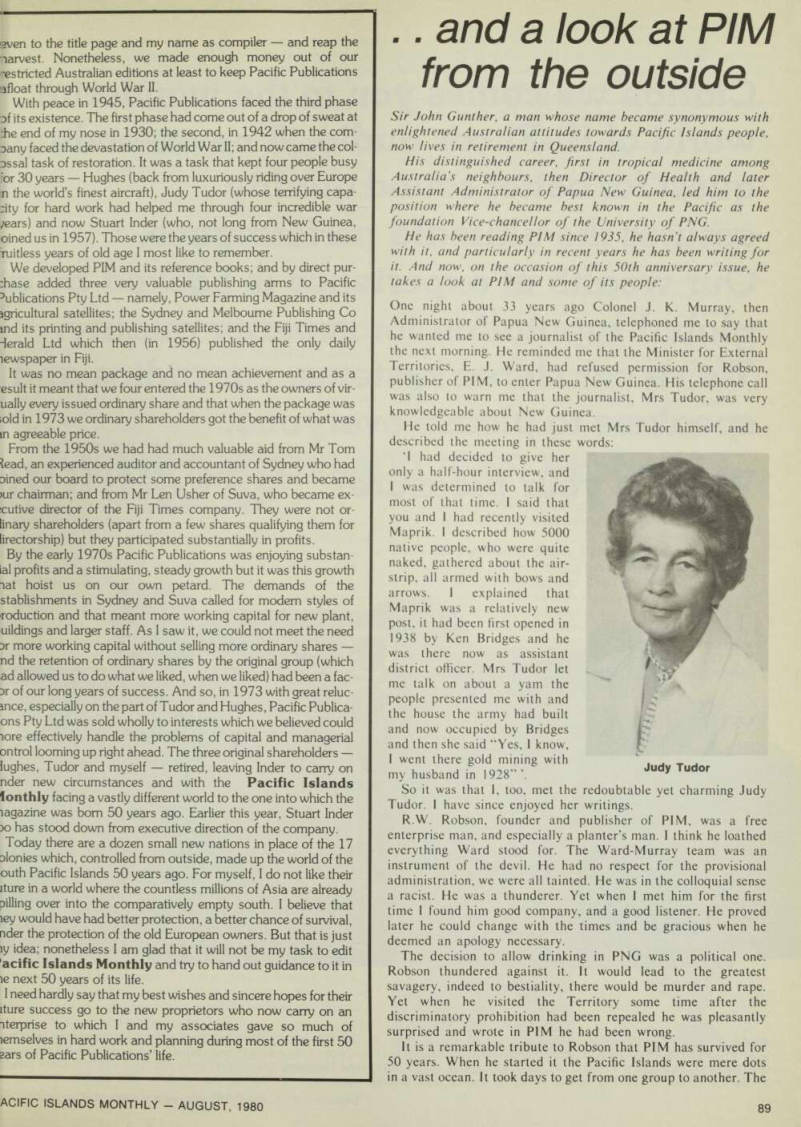
So it was that I, too, met the redoubtable yet charming Judy Tudor. I have since enjoyed her writings.
R.W. Robson, founder and publisher of RIM, was a free enterprise man, and especially a planter’s man. I think he loathed everything Ward stood for. The Ward-Murray team was an instrument of the devil. He had no respect for the provisional administration, we were all tainted. He was in the colloquial sense a racist. He was a thunderer. Yet when I met him for the first time I found him good company, and a good listener. He proved later he could change with the times and be gracious when he deemed an apology necessary.
The decision to allow drinking in PNG was a political one.
Robson thundered against it. It would lead to the greatest savagery, indeed to bestiality, there would be murder and rape.
Yet when he visited the Territory some time after the discriminatory prohibition had been repealed he was pleasantly surprised and wrote in PIM he had been wrong.
It is a remarkable tribute to Robson that PIM has survived for 50 years. When he started it the Pacific Islands were mere dots in a vast ocean. It took days to gel from one group to another. The
Judy Tudor
year PIM first left the press was the year Kingsford Smith first • completed a circumnavigation of the globe the long way round.
The first man, the first aeroplane to do so. He was the first man to cross the Pacific just two years before PIM came out and ;so the ocean started to contract, and the polyglot peoples came • closer together and PIM can say ‘I was part of that’.
I can remember first reading PIM in 1935, and there was much in it in those days which I did not understand.
Then the war came, no Pacific Island peoples were greatly unaffected. In 1947 the governments of Australia and New Zealand invited the British, the Dutch, the French and the USA governments to join them to create the South Pacific Commission.
The commission served its purpose, but the people burst out of the cocoon within which they had been confined by the ‘no politics’ rule covering the South Pacific Conference, and PIM became a medium through which conference discussions could be reported, bringing the peoples of the Pacific closer together. The always proud Polynesians found they had close neighbours equally as proud and with their own sense of dignity the Melanesians and the Micronesians.
Robson kept up with the times, though probably still the planter’s man, still the antisocialist, he came to see that maybe people he thought could not manage their affairs for generations would do so sooner rather than later. His appointment of the active news-hungry, liberal Stuart Inder to the editorial staff gave a new turn to PIM. Inder travelled widely, often going into backwaters, meeting small communities and hearing their ambitions. This was able to contract still further the vast ocean.
Inder reported with sympathy. He has been on first name terms with most leaders of nations like Papua New Guinea and Fiji, and the mini-slates, of which Nauru was the first. Most of these peoples now have their able correspondents who keep previously isolated peoples in touch with each other through PIM. Inder has seen the rise of the Pacific Forum which has already proved that Polynesians, Melanesians and Micronesians are an entity and are prepared to stand for what they see as the rights of Pacific Islanders.
There remains one cloud hanging over the Pacific in which PIM may yet come to play a major role. France is jealously guarding her right to remain the administering authority in French Polynesia and New Caledonia, on the ground that they are provinces of France.
The indigenous people may not want this. France is inclined to dismiss their desire for the dignity of indepedence as not discussable. France will not only have to deal with its own dissidents, and I make no attempt to quantify them, but increasingly France will be opposed by its newly independent neighbours. F for one, would like to be well informed on the total situation, and I am sure PIM could do this. We should be told about the New Hebrides not in terms of a k bow and arrow revolution’ or how many wives Jimmy Stevens has, but why a revolt against an apparently lawfully constituted government has been allowed to continue in the dying hours of colonialism. I have attended a South Pacific conference where the senior com missioner for France walked out when French policies were criticised. Do the French want to stay put in the New Hebrides?
PIM can tell us. PIM has served and can serve the Pacific well.