Pacific Leaders Add Their Messages
pp. 91-95 · Read in the full issue

Sir Julius Chan, Prime Minister of Papua New Guinea: 1 congratulate Pacific Islands Monthly on its 50th anniversary of publication.
PIM has been part of the Pacific for a half a century and while t may have commenced its life serving the interests of mainly expatriate residents, its role has been successfully changed for it o become a valuable source of news and contact for Pacific 'slanders themselves.
In Papua New Guinea, we have just successfully concluded the Third South Pacific Festival of Arts. This was a joyous occasion or all who participated, all who visited us, and all who watched.
We learned again that essentially we are one, we are people of he Pacific. We do not need a sophisticated system of satellite 'arthstations to get that message across. The best ommunication system is one which involves personal contact, ind the development of personal relationships. We need a lengthening of our ties, a demonstration of our common human alues, and we need above most things else, more knowledge of ach other.
The average person in the Pacific is not able to afford the mancial cost of visiting his Pacific neighbours not all of us \re lucky enough to have our trips paid for.
We can, however, actively seek knowledge by learning from shat we read, from whatever sources are available to us. I admit hose sources are limited, but the Pacific Islands Monthly is one uch source, and it is a valuable source. It combines straight eporting with a gossipy breeziness which is refreshing. There is ' decidedly human approach in its pages.
Members of the South Pacific Forum have proposed an njor mat ion and news agency to serve Pacific Islands overnments and news media. This is a constructive step, and it dll receive my country’s support. If we improve our information gencies, then we will be moving towards the realisation that we ave much in common and much to share.
We may be separated by vast distances of ocean, but it is the me ocean which separates us, and its waters touch on each of our hores.
I congratulate the Pacific Islands Monthly and I wish it at least another 50 years of successful publication.
Ratu Sir Kamisese Mara, Prime Minister of Fiji: Two score years and ten is a long time in human terms; but it is a short in the life of a newspaper. Though Pacific Islands Monthly is not old, its very wide range of coverage of Pacific affairs, handled with understanding and balance, enables it to present a truly South Pacific view. PIM has helped to promote a distinctive regional identity for the South Pacific with energy and enthusiasm, and for which it deserves credit. I offer my congratulations for reaching its 50th birthday and send my best wishes for the future.
Young Vivian, Secretary-General of the South Pacific
Commission, Noumea:
I know of no publication that has helped the South Pacific region more than PIM has in the last 50 years. Your pub ,; cation’s major contribution has been to bring awareness to the village man, to the family, to administrations and to the governments. PIM has
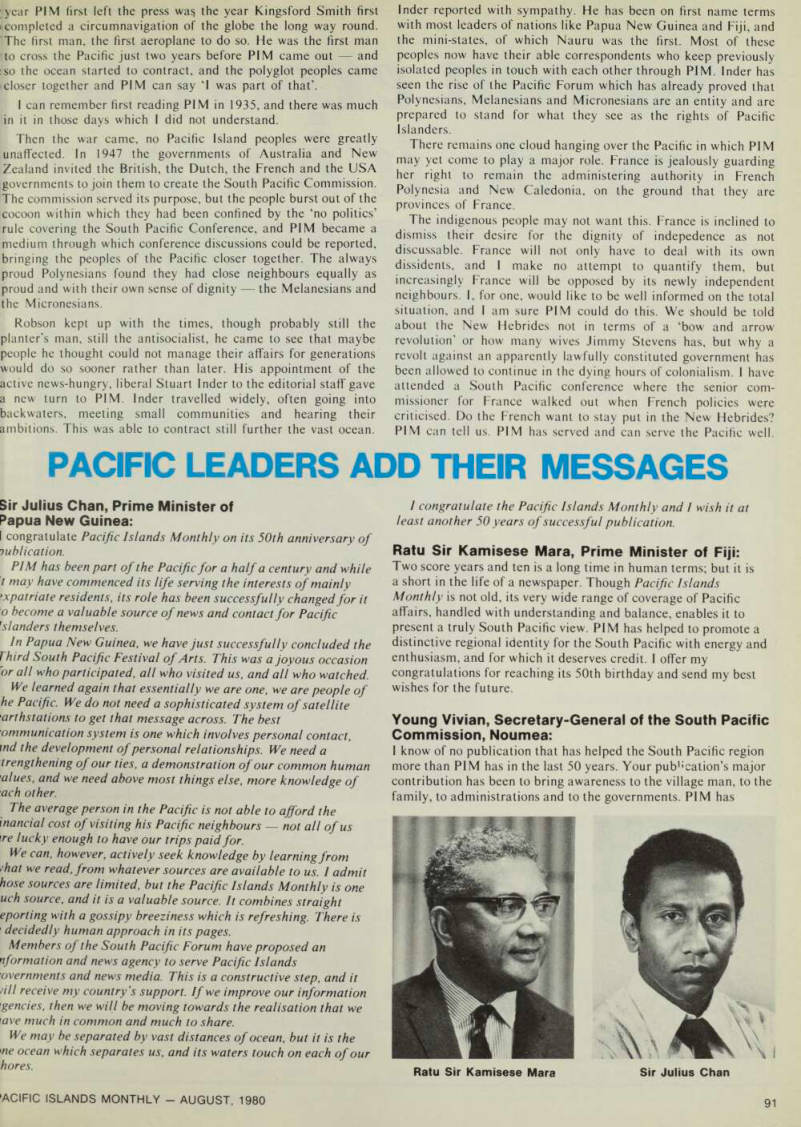
Ratu Sir Kamisese Mara
Sir Julius Chan
encouraged Pacific people to have the confidence to find their own solutions to their problems the problems of education, economic development, agriculture, the preservation of culture and the environment, to name only a few. PIM has encouraged Pacific Island writers, poets, artists, carvers and weavers. PIM has Hone much for the planter, fisherman, teacher, politician, church leader, for everybody in the Pacific Islands, and I believe it will continue doing so as it enters its next half century. -rancis Ariioehau Sanford, Vice-president Council of
Government, French Polynesia:
It is with great pleasure that I wish Pacific Islands Monthly all he best on its 50th birthday.
The sincerest compliment I can pay to your magazine is to say hat I’ve always regretted that a publication of like quality does tot exist in our French Pacific Territories.
As the same time I’ve sometimes also regretted the rather sharp one of the articles that you publish on Polynesia and New Caledonia. It seems to me that too often the political realities in >ur Territories, in particular the fact that they are French ;peaking, cause you to overlook equally if not much more mportant realities: the Polynesians and Melanesians themselves, heir lives, languages, cultures and development.
On the occasion of this 50th anniversary, this comment should n no way be interpreted as a reproach. On the contrary, I am one >f those who fully agree with the political gentleman who once aid: ‘Even if I don’t agree with what you say, I will fight to the fitter end to defend your right to say it, to write it, and to have >eople read it.’
The years ahead are going to be crucial for the South Pacific, n the face of the great economic and political powers of the vorld, the only way open to us small countries of the region is to ►ecome ever more united, ever more brotherly in our elationships.
Pacific Islands Monthly can play an important part in this line if economic and political development if it becomes a true eflection of the different cultures which represent not only our listinctiveness, but also our collective power of survival. ; ather Walter Uni, Prime Minister of the Republic of Vanuatu: t is with considerable pleasure that I send greetings to Pacific stands Monthly on its 50th anniversary.
During the 50 years the magazine has existed significant and ar-reaching changes have taken place in the South Pacific, hanges which have affected the lives of all those people who live i the region. Following the end of World War 11, which itself ntroduced into the Islands profound social change, political lovements began to slowly but surely evolve which have led over he years to the greater majority of the Island groups achieving ationhood.
Such important and significant developments have been ecorded and commented on by Pacific Islands Monthly hroughout this period of unprecedented change, and the
magazine has done so in a manner that has not only been highly professional, but has clearly demonstrated a concern for and commitment to the region it serves.
Because of the distances between the various Island states Pacific Islands Monthly has also served as a valuable means of communication and in this respect it has fulfilled, and continues to fulfil, a vital social role.
Nineteen-eighty is the year of Vanuatu’s birth. It is a happy coincidence that during the same year Pacific Islands Monthly celebrates its 50th anniversary.
As we celebrate our independence in Vanuatu we are happy to have this opportunity to salute Pacific Islands Monthly and to congratulate it on having developed over the past 50 years as very much an important part of the Pacific scene.
Bernard Dowiyogo, Member of Parliament, Nauru: PIM can be aptly described as the only truly regional magazine in the Pacific for the Pacific peoples. PIM can look back over the last 50 years with justifiable pride for its unique service and achievements. It has adequately catered to the needs of the many islands and cultures within the region which were, and still are, at differing stages of economic and political development.
PI M’s presentation has been noticeably improving over the years, and no doubt PIM can look to the future with confidence.
Paul M. Calvo, Governor of Guam: In the last 50 years, PIM has seen the Pacific Basin island governments go through many changes politically, socially and economically. Throughout these changes, PIM has faithfully endeavoured to record these events for the sake of our islands’ citizens, as well as for the purpose of keeping our neighbouring Asian countries, and the United States mainland abreast of the many recent developments in our portion of the world. The citizens of Guam pay tribute to these efforts, and congratulate PIM for their commitment to the people of the Pacific region.
The expansion of our commercial port facilities, increasing our tourism potential, and developing jobs in the private sector are only a few of the new heights our people have been, and will continue to strive for in the immediate future. With the realisation of these aspirations we will undoubtedly move on to other goals to keep the proverial ‘wheel of progress’ turning for Guam, as well as the rest of the Pacific Basin. I feel I echo the sentiments of all of the Pacific in saying that PIM is welcome to observe, and take part in, this necessary process for another 50 years, and more.
Peter Tali Coleman, Governor, American Samoa: May PIM have many more anniversaries and a long life. It started as a string but has now become a rope that pulls the Pacific Island peoples together through the island news and information for the island peoples. We take off our hat to the vision of service of the founder, Mr R. W. Robson. We also salute Stuart Inder for the many years of sensitive and incisive reporting. Truly a dedicated Pacific Island public servant serving the interests of all island peoples. Some of us who are older remember the early growing years of PIM. We look back with gratitude, and forward to new horizons.
David Buffett, Chief Minister, Norfolk Island: PIM has reached its 50th anniversary 50 years devoted to reporting, interpreting and commenting upon activities in the Pacific region. PIM has performed this role in what must be the most changing and controversial span of 50 years that has been experienced in the region for many centuries.
Prior to the commencment of PIM there were meagre and infrequent facilities to communicate within the whole Pacific region. PIM in its earliest days, despite the communication and transport difficulties, commenced a task to increase communication and thereby understanding and rapport between peoples of the region.
In doing so it has achieved great credit, to the extent that the Pacific Islanders look upon PIM as ‘their’ magazine. There are
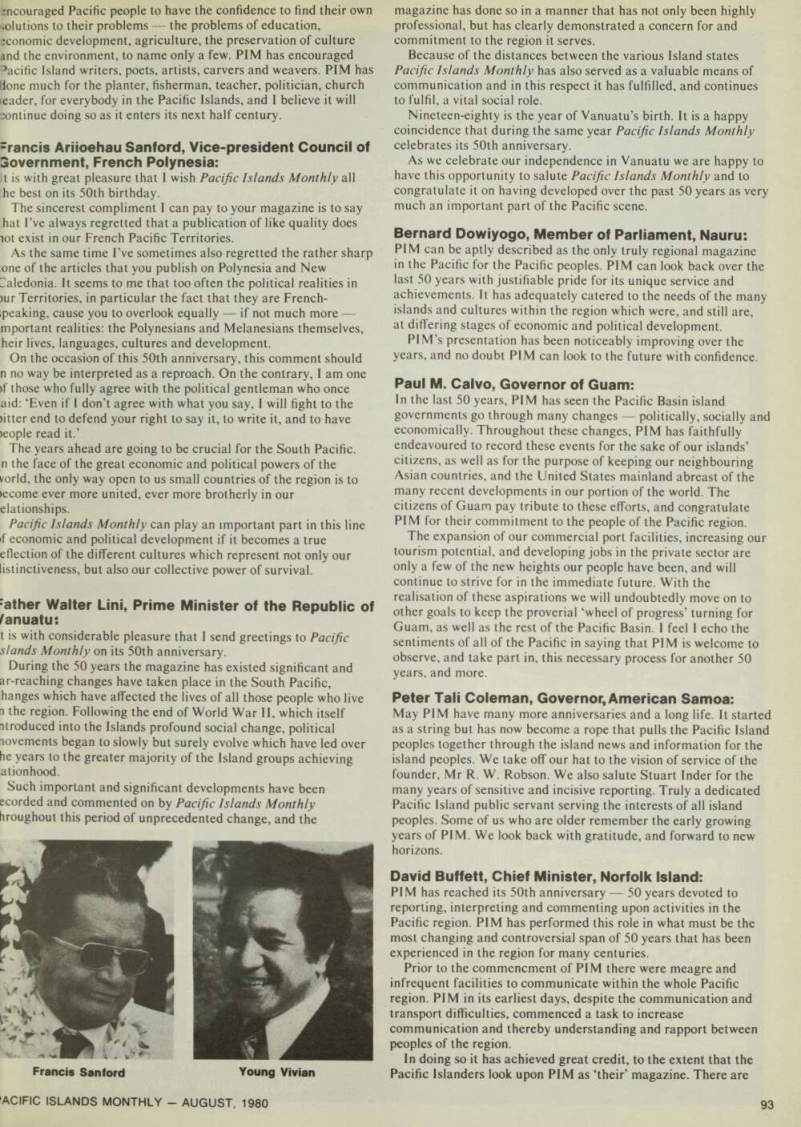
Francis Sanford
Young Vivian
not many publications especially of those which report controversial current events which can boast such a number of diverse people willing to claim ‘ownership’.
All this achievement is of course the result of human endeavour.
From my research and experience two PIM men have been outstanding R. W, Robson and Stuart Inder. They have guided the path of PIM over the major part of its 50 years, ensured reporting of integrity and covered the events important to the peoples of the Pacific.
I pay tribute to PIM acknowledging its past 50 years and its two great men. Having said that, I continue on to say PlM’s task has only just begun.
The Pacific region is at a critical stage; economically, socially and politically. There needs to be fostered the development of rapport between its peoples in these three broad areas. Thus there is a need for the broad spectrum of activities in the region to be reported objectively, accurately and regularly by a publication of recognised ability. I am sure PIM has identified this task and will pursue it diligently. I wish it well in doing so.
Andrew Peacock, Minister for Foreign Affairs, Australia: On behalf of the Australian Government I warmly congratulate PIM and all associated with it on its 50th birthday. The magazine has become a ‘regional institution’ in its own right and has contributed in no small way to fostering a sense of regional identity amongst the countries and peoples of the South Pacific.
The magazine has played a pioneering role as an independent observer and recorder of regional developments and has taken a close interest in the policies of governments in the region.
PIM has witnessed many changes in the South Pacific region n its 50 years. Perhaps one of the most important developments, vhich is still continuing, is the move to nationhood by the peoples )f the region which began in the 19605. This has been iccompanied by great economic and social change and has jrought new challenges both to the Island states themselves and o Australia.
Australia accords the South Pacific an extremely high priority n its foreign policy and therefore welcomes the role PIM has )layed in the region. I wish all at PIM well for the future.
Everett Kleinjans, President, East-West Center,
Hawaii: Jnquestionably the Pacific Islands are moving steadily toward the :entre of international attention. This is dq,e in large part to ;conomic considerations such as tourism, ocean mineral and fish esources, and ocean energy research. Beyond the economic or ven the strategic and geopolitical role, the Island nations will ontinue to play in the world scene, there are also increasing ultural contacts and conflicts ahead for all people in the area. As he nations in and bordering the Pacific come into closer touch in he years to come, there will be an urgent need for leaders in msiness, government, and education with the knowledge and ensitivities necessary to ensure smooth and fruitful relations mong the peoples and nations of the region.
In a small way, the East-West Center during its first 20 years las participated with the Pacific Islanders, Asians, and Americans in an attempt to work together in an educational nvironment to learn skills, trade experiences, and develop nderstanding of each other. We have learned in the process that ffective communication among colleagues and co-workers builds riendships and trust, and we at the Center value the many ositive relationships we have with Pacific Islands friends.
Effective communication, of course, has been a key task of the 'acific Islands Monthly and it has provided a valuable service 3 the Pacific in its continued examination, evaluation, and eportage of Pacific affairs. As President of the East-West Center, would like to extend personal and institutional congratulations nd commendation to the Pacific Islands Monthly for its 50 years f extraordinary service to the cause of informing us of each
other. We all benefit from your publication and I wish you another 50 years of success. Mahalpo’.
Dr James A. Maraj, Vice-chancellor, University of the South Pacific, Fiji: Many of us hold the view that the 80s will be a decade during which island communities will assume a new order of importance.
Such a perspective is less likely to be concerned with matters military or strategic and will be conditioned essentially by economic considerations.
Already we see signs of the Pacific being rediscovered by ‘powers’ great and not so great. This is taking place at a time when we ourselves are trying to come to grips with our newly-won independence and our consciousness of sovereignty. In the new era there will be an increasing need for the media to assist in clarifying issues, interpreting postures and in projecting a Pacific viewpoint which leaves the wider international community in no doubt of our resolve and determination to develop a humane and just society. This responsibility falls not only on the media but on all agencies and organisations which are dedicated to service of the peoples of the Pacific. Nonetheless, the media carry a particular responsibility and in that context PlM’s role is a crucial one. I have no doubt that this will be acknowledged and that we can look forward with pride to the way in which you will perform that vital role.
Congratulations on your achievements during the past 50 years.
May your efforts in the years ahead be as rewarding.
Dr S. Amanaki Havea, Principal, Pacific Theological
College, Fiji:
Greetings from the Pacific Theological College. We send our congratulations to PIM as you celebrate your 50th anniversary of publication. Each month we look forward to the arrival of PIM for many good reasons.
This college is a regional and ecumenical institution, and students come from more than 13 countries within the region and from the five major churches which serve the region. So, PIM bears news from all these areas with a variety of articles keeping the students interested as they refer to them and ponder over them. Like us, PIM is regional and is endeavouring to maintain the unity and solidarity of the Pacific peoples. PIM has no east or west, no north or south. It is a magazine that deals with and treats fairly the issues of the Pacific region.
Today we see the heels of colonisation disappearing over the horizon, and the churches and governments are rising to maintain independence and self-rule. As I see it, PIM has been instrumental in bridging the gaps in many avenues of thought.
There are times when PIM is provocative, times when it is prophetic, but the variety we have enjoyed very much.
We enjoy the editorials and the contributions from those who write regularly every month. The names have been friends. Only last year I shook the hand of Percy Chatterton, and the name became a person. This is why I think PIM needs to be congratulated. It talks to people and about people. May the second half of the century be as effective and as acceptable as the first half.
Ruth E. Lechte, South Pacific Area Director for World
YWCA, Fiji:
Congratulations to PIM for 50 years of publication.
It’s usefulness lies in different areas for different people and it is a measure of the journal’s success that it is able to manage to serve so many different needs. For myself, as a regional worker, it is vital. It tells me, in a cheerful fashion, what is going on in the places I will visit and in which I have responsibilities general things that give me the feel of the place* between visits and keep me alert to developments.
More importantly, PIM gives me depth information on trade, politics, people’s aspirations all of which make me a more effective animateur with the groups who request my help or advice.