Pacific Islands Monthly
pp. 88-89 · Read in the full issue
The Three Lives of Pacific Islands Monthly
Founder and first editor R.W. ROBSON recalls PlM’s developmental days
The editor has kindly asked me to write something for this issue of the Pacific Islands Monthly which I established in 1930 and edited for many years and which this month completes 50 years of continuous publication.
I find that 10 years ago, on the journal’s 40th birthday, I de scribed the why and the how of it, and nothing is gained by repeating the story it is there in the files. The idea came to me in May 1914, when I was in Rarotonga, and noticed the Islanders’ eagerness to have news of events and conditions in other Islands groups; and it was put into shape 16 years later, when I decided that a career in metropolitan daily newspaper journalism held no future for people after middle age. I was 45. It was a gamble, because as I learned the hard way the profitable establish ment of an independent publishing business cannot be based only on an idea. v The Pacific Islands Monthly was a success from the beginning, but its rapid growth was a constant embarrassment.
Growth demanded more working capital but my resources were extremely limited. It was touch and go on several occasions. I sur vived because I had luck in getting some outside consultative work which paid high fees, and loyalty and hard work given me by two youngsters I pinched from Yaffa Syndicate Selwyn Hughes, who stayed with me all his working life and the late Muriel Bridges (who was my secretary for some 15 years, and married an AIF man at the end of World War II).
I put the business into shape as Pacific Publications Pty Ltd in 1932, and in the next 10 years the PIM, what with its attendant reference books and the generous fees that came from Ocean Newspapers Ltd., gave me a very healthy income. Ocean Newspapers was owned by the big Australian newspapers to publish a regular news-sheet for the passengers of the chief inter national liners. I also had an income from Sydney and Melbourne Publishing Co. Pty Ltd., which owned a building, an old but effi cient printing plant and half a dozen trade magazines dealing with things like bread and cordial manufacturing I had bought a few shares in S & M and exercised managerial control over the com pany. In ten years I had risen from near penury to comparative wealth.
But calamity was waiting just around the comer. World War II came in 1939. Ocean Newspapers closed up overnight and with it a big part of my income. Advertising business just shrank and shrank, and many small publishing businesses closed their doors.
We were expected to do likewise, but the war at first was far away and I decided to keep PIM going, so that the Islands communities could know what was happening to their friends and interests in the war zones. Commercial printing contracts kept the old S & M Co. and its little trade journals going.
But when Japan attacked Pearl Harbour in December 1941 and so brought World War II right into the Pacific it really looked like the end. All communications were brought under tight military supervision, and PIM had lived on mails and shipping. Further-
more, all publications in general circulation had to submit all that they published to censorship. By 1942 my business seemed to be in tatters and the outlook very uncertain. But as a result of the war, the Americans wanted every scrap of information they could get about the South Pacific islands, irrespective of cost, and their de mand for our Pacific Islands Year Book had no limits.
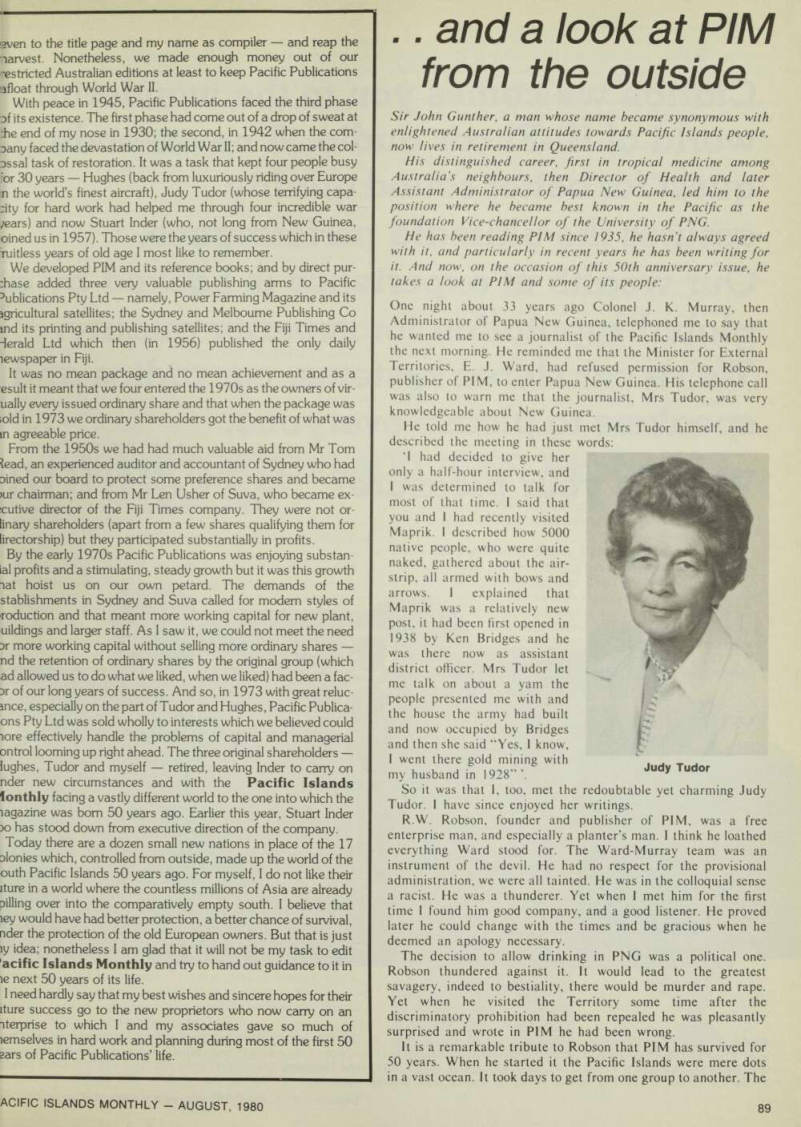
This was our big opportunity, and I decided to rush out a new special edition. But by this time Selwyn Hughes was headed for the RAAF and training in Canada, and all other literary staff had gone into the services or to war jobs. To do what I had to do I urgently needed help, so I went into the market place seeking a competent woman. My lucky star led me to Mrs Judy Tudor who had been living in New Guinea and was looking for this kind of job.
She went straight into that urgent year book task and, displaying the tireless energy which always distinguished her and still does we got out an edition in record time and sold every copy. But, alas, we still could not meet demand, as war had cut off supplies of paper which was severely rationed. I then arranged to have an edi tion published by Macmillans in the United States only to have the humiliation of seeing a pirate publisher there steal the book (there was then no reciprocal copyright agreement with the USA) and reproduce the 1942 Sydney edition by photographic process
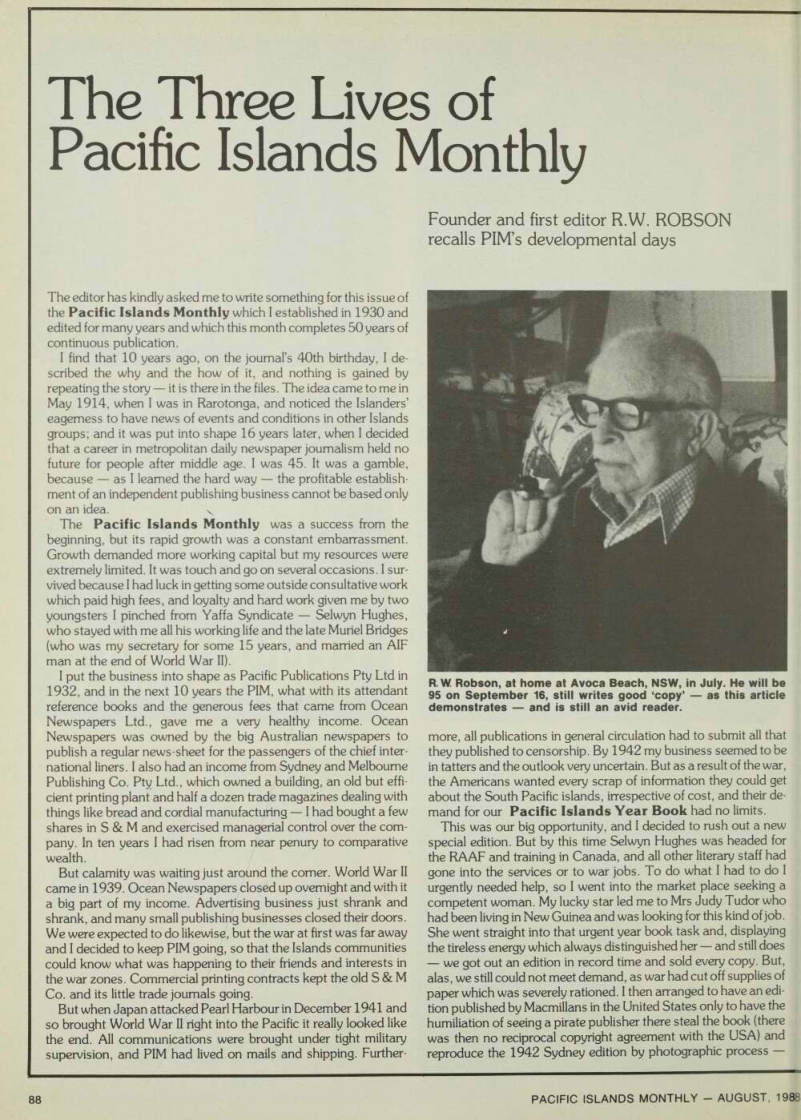
R.W. Robson, at home at Avoca Beach, NSW, in July. He will be 95 on September 16, still writes good ‘copy’ - as this article demonstrates - and is still an avid reader.
gven to the title page and my name as compiler and reap the tarvest. Nonetheless, we made enough money out of our 'es trie ted Australian editions at least to keep Pacific Publications afloat through World War 11.
With peace in 1945, Pacific Publications faced the third phase pf its existence. The first phase had come out of a drop of sweat at die end of my nose in 1930; the second, in 1942 when the com pany faced the devastation of World War II; and now came the col ossal task of restoration. It was a task that kept four people busy for 30 years Hughes (back from luxuriously riding over Europe in the world’s finest aircraft), Judy Tudor (whose terrifying capa :ity for hard work had helped me through four incredible war years) and now Stuart Inder (who, not long from New Guinea, oined us in 1957). Those were the years of success which in these ruitless years of old age I most like to remember.
We developed PIM and its reference books; and by direct pur :hase added three very valuable publishing arms to Pacific Publications Pty Ltd namely, Power Farming Magazine and its igricultural satellites; the Sydney and Melbourne Publishing Co md its printing and publishing satellites; and the Fiji Times and deraid Ltd which then (in 1956) published the only daily lewspaper in Fiji.
It was no mean package and no mean achievement and as a esult it meant that we four entered the 1970 s as the owners of vir ually every issued ordinary share and that when the package was ;old in 1973 we ordinary shareholders got the benefit of what was in agreeable price.
From the 1950 s we had had much valuable aid from Mr Tom tead, an experienced auditor and accountant of Sydney who had Dined our board to protect some preference shares and became >ur chairman; and from Mr Len Usher of Suva, who became ex cutive director of the Fiji Times company. They were not or linary shareholders (apart from a few shares qualifying them for lirectorship) but they participated substantially in profits.
By the early 1970 s Pacific Publications was enjoying substan ial profits and a stimulating, steady growth but it was this growth lat hoist us on our own petard. The demands of the stablishments in Sydney and Suva called for modem styles of reduction and that meant more working capital for new plant, uildings and larger staff. As I saw it, we could not meet the need Dr more working capital without selling more ordinary shares nd the retention of ordinary shares by the original group (which ad allowed us to do what we liked, when we liked) had been a fac- Dr of our long years of success. And so, in 1973 with great reluc mce, especially on the part of Tudor and Hughes, Pacific Publica ons Pty Ltd was sold wholly to interests which we believed could lore effectively handle the problems of capital and managerial ontrol looming up right ahead. The three original shareholders lughes, Tudor and myself retired, leaving Inder to carry on nder new circumstances and with the Pacific Islands l onthly facing a vastly different world to the one into which the lagazine was bom 50 years ago. Earlier this year, Stuart Inder do has stood down from executive direction of the company.
Today there are a dozen small new nations in place of the 17 Dlonies which, controlled from outside, made up the world of the outh Pacific Islands 50 years ago. For myself, I do not like their iture in a world where the countless millions of Asia are already pilling over into the comparatively empty south. I believe that ley would have had better protection, a better chance of survival, nder the protection of the old European owners. But that is just ly idea; nonetheless I am glad that it will not be my task to edit acific Islands Monthly and try to hand out guidance to it in te next 50 years of its life.
I need hardly say that my best wishes and sincere hopes for their iture success go to the new proprietors who now carry on an nterprise to which I and my associates gave so much of lemselves in hard work and planning during most of the first 50 2ars of Pacific Publications’ life.