The Coolidge
pp. 14-17 · Read in the full issue

Tropicalities
as marine
reserve?
The New Hebrides Govern
ment is considering declaring
the USS President Coolidge the largest accessible marine wreck in the world and scuba di ver’s paradise a National Marine Reserve.
The Vila weekly Voice of the New Hebrides reports that Willie Korisa, minister for social affairs in the incoming independent government, has the legal aspects of the matter under close study.
Originally a liner, the Presi dent Coolidge became a troop ship during World War II and met her doom when she struck a mine on her way from the US to Noumea. Her 33 000 tonne bulk lies on her side, with the bow in 24 metres of water and stern in 75 metres, about 80 metres from the shore of the island of the New Hebridean island of Santo.
Between 4000 and 6000 tonnes of fuel and a wealth of cargo jeeps, bulldozers, cranes and trucks have already been salvaged. But for the future, in view of the government announcement,
perhaps the President Coolidge
will be allowed to lie quietly in
her barnacled splendour, pro tected by official decree. It will be troubled only by the gaze of divers, who will continue to be able to wander over her decks and into her cabins.
Some notion of the attrac tion of the President Coolidge for scuba devotees can be had from the remarks of Rob Lahood, editor of a New
Zealand diving magazine, who
told Voice of the New Hebrides: ‘After the Coolidge , any other dive seems like an anti climax.’
Mr Lahood recently led a party of visiting New Zealand divers on a visit to the President Coolidge. He told of a tame turtle who comes out of his hid ing hole apparently to greet di vers, and of schools of
magnificent tropical fish who
lead a happy rent-free exist ence in the wreck. ‘She could occupy a diver for a good year, he said.
Tonga: German
illusions
The year 1980 seems likely to go down in Tongan history as ‘The year of the German invasion’.
At the International Dateline Hotel, Nukualofa, the manager, Mr A. Johanssen, re ports: ‘We’ve had more Ger man guests this year than in the rest of the hotel’s history. A glance at the register of the re
cently opened Friendly
Islander, further along the seafront, reveals a startling preponderance of German names and addresses. And in the popular French restaurant of the Good Samaritan Beach Resort 20 km out of town, Ger
man voices, by sheer weight of numbers, often drown out the
English counterpoint.
The influx is the direct result of the enormous publicity generated in West Germany during the State Visit by Ton ga’s Royals and their entourage last November, and in par ticular to an interview with the
King published in the widely
read illustrated weekly Bunte and a despatch from the Ger man Press Agency which was picked up by newspapers and magazines around the country.
The misleading message conveyed appears to be the re sult of misunderstanding plus wishful thinking a fact ack
nowledged by the management
of Bunte , which later sent a journalistic team to the king dom to apologise for false hopes raised and to collect the actual facts for publication.
The general message that reached 60 million Germans, via print, radio and television, was: • The King would like many Germans to come to his South Sea Paradise, not only as holidaymakers but also as per manent settlers. • Land would be available to them in his 200-island (sic) kingdom, for an annual rental of a mere 25 seniti per square metre. • Permanent settlers would not be required to pay taxes.
The fact is, of course, that the
king was referring only to
potential investors, arriving with pockets full of investment marks to found new industries and create new employment opportunities for Tongans. For such useful immigrants, indus trial land on which to start their
enterprises is certainly avail able, along with a five-year tax holiday and other encourage ment perks, once the green light is obtained from the Department of Labour, Com merce and Industries.
But that is not the way the message got through to ordinary German people, yearning to escape from ratrace stresses, bureaucratic regimen tation, inflation difficulties and international political tensions at the start of the 1980’s.
Carried away by vision of a
romantic Dolce vita , they began
to bombard various potential information sources with let ters of inquiry the Tongan High Commission in London and to the Palace Office, the Prime Minister’s Department, the Immigration Department, the Tongan Visitors’ Bureau and the German Consul in Nukualofa.
Imagine the confusion and the delays, in offiices confronted with hundreds of such letters, and with nobody equipped to translate and answer them. Lack of reply must have deterred many from pursuing the dream further.
But astonishing numbers of bewitched Tongaphiles refused to be discouraged and rushed off to airline offices, deter mined to go and see for them selves.
A significant proportion of them are simply well-heeled vacationers, out to enjoy the one-upmanship of visiting a place so recently and so glamorously in the news.
Others are canny business men, combining a pleasure jaunt with a reconnaissance of investment possibilitiesrOthers again have come and more are reputed to be on the way still clinging to their vision and determined to make it come true. A plot of land, pref erably on an enchanting, pri vate, fertile, palm-fringed, sapphire, sea-girt tropic isle.
Fishing, diving, swimming, laz ing, and being proudly self supporting, growing one’s own crops and grazing a few cattle.
Oh Bliss!
They arrive, and they find very quickly that there’s a large gap between dream and re ality.
It’s true that all but 36 of Tonga’s 170 (not 200) islands
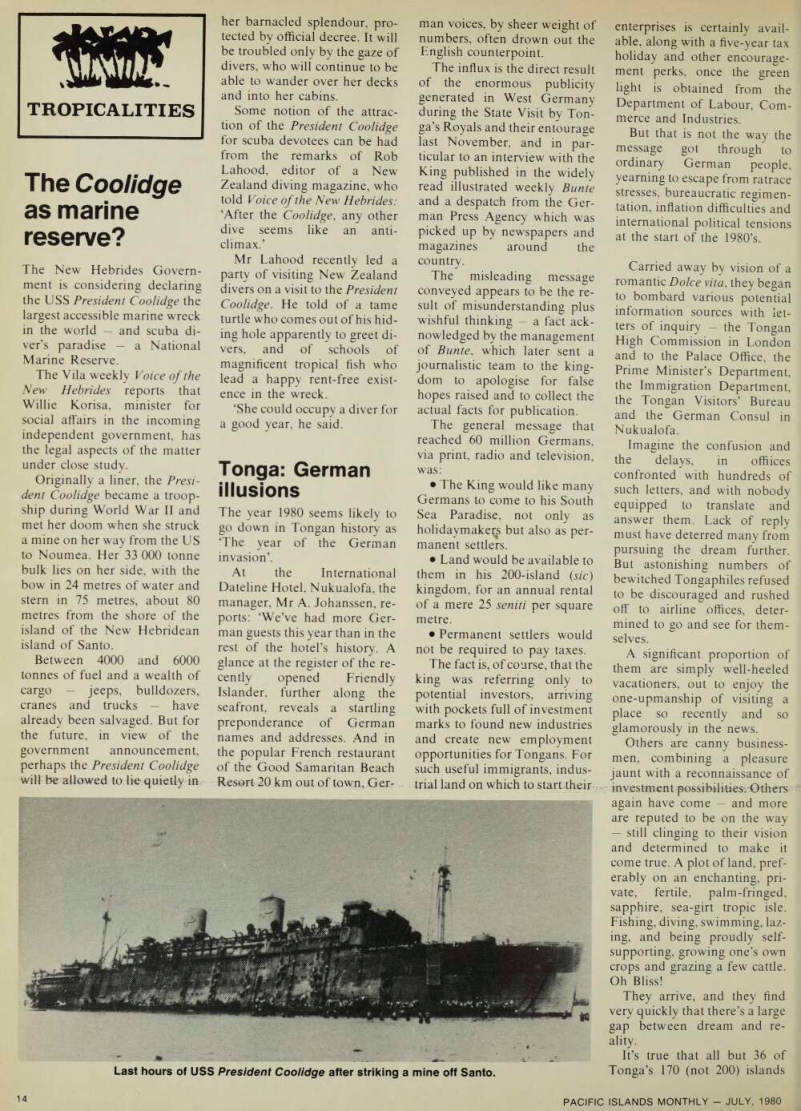
Last hours of USS President Coolidge after striking a mine off Santo.
are uninhabited. But only be cause they are uninhabitable.
No fresh water, little or no ar able land, no transport, no communications. It’s true that
accepted settlers are legally
permitted to rent land if they can find any. Tonga’s limited usable land and rapidly grow ing population spells an acute land shortage, even for Ton gans. It’s true that would-be settlers from Germany or other lands can get long-term visas.
But only on a two-year renew able basis, and only in certain well-defined categories, e.g. • Investors, planning to set up approved new industries. • Employees, if advance
covered by approved local
company sponsorships guar
anteeing wages and housing
this category is mainly for those with management qualifi cations. • Cabinet-approved ‘retirees’, if they can provide clear evi dence of regular receipt of wel come foreign exchange, in the form of pension cheques or other guaranteed remittances.
Through the corrective pub
licity in Bunte and by means of circular letters to inquirers summarising the real situation, Tonga is doing its best to re solve a problem created by over-enthusiastic reaction and
underlining that red-tape
exists, even in the South Seas.
This may not be much comfort to those Germans who have already sold up their
assets, relinquished their jobs,
and taken off in pursuit of a dream. But the Tongan view, with some reason, is a shoulder-shrugging ‘Too bad.
They really should have done their homework properly and sat tight till they had all the facts.’ Penny Hodgkinson in
Nukualofa.
Islands story
for TV filming
The Australian Broadcasting Commission and the UK net work Thames TV are to spend SABOO 000 filming a 10-part TV series on a children’s adventure in the Pacific Islands. The series, to be called Coral Island, is based on a book of the same name by the
19th century writer Robert Ballantyne.
About three-quarters of the filming will be done on lo cation in Western Samoa, par ticularly in the Salamumu village area where the matai (head man) has agreed to build a traditional village of eight fales (traditional houses) as a film set. Money paid to the vil lagers for their help will be used to improve the local school.
In May ABC-TV head of drama, Geoff Daniels, visited a number of Pacific countries to find a suitable location. He went to Papua New Guinea, Solomons Islands and the Cooks before deciding on Western Samoa. The author of Coral Island, Ballantyne, was born in Edinburgh, Scotland, in 1824 and for some years worked with the Hudson Bay Company in Canada. Re nowned as a writer of boys’ stories, his book tells of the adventures of three boys shipwrecked on an island, how they lived off the lush veg etation and their confron tations with warriors and pirates. However, says Daniels, Ballantyne goes somewhat amiss when he introduces into his story incongruous charac ters such as penguins.
Daniels doubts if Ballantyne ever got to the South Pacific. ‘I don’t think he was aware of its ecology and relied on mission ary reports of the day. Still, we can adapt the series, of course’, he says A number of villagers will feature in the series, mostly as extras and warriors, although experienced Maori actors will be imported from New Zealand.
Two boys from Britain and one from Australia will play the lead roles. To date, how ever, no casting has been done.
The film production unit will use Apia as its base for the
expected eight-week shoot.
Thames TV will foot the bill for the venture with ABC-TV
providing the production re
sources and facilities.
Thames and the ABC will have the screening rights for their respective countries and will share equally income derived from overseas sales.
Michael Hohensee.
Letters of a
Swedish baron
Western Samoa’s Nelson Memorial Public Library has received a gift of copies of cor
respondence by Baron Otto
Von Cedercrantz, who was a chief justice of Samoa from 1889 to 1893.
The gift was presented in May by Olaf Kaijser, former Swedish ambassador to new Zealand, who was visiting Apia. Mr Kaijser obtained the copies from the files of the Swedish Foreign Office.
Speaking at the hand-over ceremony, Mr Kaijser said he regretted that very little is made of the Swedish chief jus tice in official histories of Samoa. He told the Samoa Times he would continue to do research on the chief justice and his time in Samoa in the hope of vindicating him in his quarrels with the ‘three
powers’.
Baron von Cedercrantz was appointed to his position as a result of the 1889 Berlin Treaty which Britain, the United States and Germany sought to settle their differences over the administration of the Samoan islands.
Unfortunately, despite the
fact that many government officials, including the chief justice, were men of high cal ibre, bickering between the treaty powers and their Samoan factions continued, and the experiment was shortlived. Chief Justice von Cedercrantz was made a scape goat for the inherent ills of colonialism and was forced to
resign.
In a commentary on the gift of the papers, the Samoa Times quoted an editorial in The Times , London, of April 8, 1893, which lauded the resig nation of the chief justice, say ing that since his installation ‘there have been a series of petty dissensions, chiefly be tween him and the Consuls, which put peace and quiet out of the question’.
The editorial accused the baron of doing a bad job of
implementing the provisions of
the convention, and of ‘going native’.
It said: ‘Herr von Ceder crantz adopted as his motto
“Samoa for the Samoans” and, irrespective of the interests of foreign residents, formed his policy on these lines. It is true the native inhabitants out number the foreigners in the proportion of about 120 to one, and this numerical superiority may have induced the Chief Justice to overlook the little band of settlers. The natives, however, have not been slow to give proofs of their overbear ing character in times past, and Herr von Cedercrantz’s con duct has done nothing to lessen the dangers of revolution in the future.’
The editorial added: ‘Leav ing out of count the fact that the Polynesians of Samoa are not a very highly cultured race, the Germans, English and Americans certainly deserve the chief consideration. It is they who pay the taxes, which form the greater part of the income of Samoa; and it is in their hands that the whole trade of the islands is concen trated.
‘Another point, though ap
parently insignificant, deserves
mention. Herr von Cedercrantz has always made it his custom to live in the simplest style in Samoa, and has therefore failed to make much im pression on the natives who, like all uncultured peoples, are
highly susceptible to the
influence of outward show. In a word, Herr von Cedercrantz has failed to satisfy either the Powers, the foreign settlers, or the Samoans themselves,
though probably acting with
the best intentions.’
Olaf Kaijser, the man re sponsible for the gift of the von Cedercrantz papers, is no stranger to Samoa. He first visi ted Apia in 1966 when he presented a microfilm reader to the Nelson Memorial Public
Library.
The gift was provided by a
newspaper The Barometer and a bank in the Swedish city of Kalmar. They were to honour the memory of August Nillson who came to Samoa from Kal mar in 1851 at the age of 13.
Mr Nillson settled in Samoa, and his son Olaf Nelson was the chief founder of the Mau Movement. The present Prime Minister, Tupuola Efi, is a grandson of Olaf Nelson.
Yet another sect
sets up In Tonga
Tonga, having recently cel ebrated the centenary of its treaty of friendship with the Republic of Germany, seemed a likely place for the New Apostolic Church to continue its evangelistic moves into the
Pacific region, particularly
when its modern-day mis sionaries are named Schulte and Hammacher. This church is particularly strong in such places as Germany and South Africa.
April 1978 saw Queensland District Elder Berne Shulte and
Sydney Evangelist Heinz Ham
macher arrive in Nukualofa to launch their church activities in the heart of Methodist terri tory. Since that occasion their church has continued to blossom. The Christian Ton gans share common interests with the New Apostolic Church (NAC) followers, being keen students of the Bible and renowned for the excellence of their choirs.
During their first week in Tonga, Elder Schulte and Evangelist Hammacher ex plained the purpose of their visit in a short radio broadcast, and the following day, in a two hour audience with His Maj
esty King Taufa’ahau Tupou
IV the church received royal approval to enter the Wesleyan
stronghold.
Although the first visit to Tonga lasted only seven days, the seeds of interest had been sown. At one service the local Wesleyan and Seventh-day Adventist ministers attended
and participated in worship.
Since April 1978 a further six team visits have taken place and on each occasion increased interest in the church has resulted. During one of these visits two NAC missionaries were visiting the offshore island of Lofanga in the
Haapai group where they
observed Tongans constructing
a small building. They quickly
rolled up their sleeves and completed the roof of what turned out to be the island’s
only hospital. An example of
Christianity with a Bible in one hand and a work tool in the other.
The NAC is keen to put up its first church building in Tonga. However, until that time arrives, services will be conducted in local homes or community halls. Each Sunday
and Wednesday their recently
ordained priest, the Rev Sami Koho conducts services in Nukualofa.
In these first two years the church membership has grown
to 35, hardly a staggering fig
ure, yet creditable in a country where there are such well established and well attended Christian churches.
The NAC is active in many areas of the Pacific, with strong followings in Papua New Guinea, the Solomons, Fiji, the Samoas, Indonesia, Hawaii and Tahiti. The church is not only present in the Western world. It is active in the Eastern bloc countries of East Ger many, Yugoslavia and Ro mania. The Church is also well represented in at least seven countries in South America.
The NAC does not have aca demically trained ministers. Its buildings are free of debt and are mostly built and main tained by members of the vari ous congregations. Its ministers in everyday life might be farmers, lawyers, doctors, mechanics or carpenters, and together with its ultra conservative outlook will blend in well with the Tongan way of life, and surely ‘run the good race'. John Slender.
New journal for
Solomons
A new journal dealing with a wide range of Solomon Islands issues is planned by the Solomon Islands Centre of the University of the South Pa cific.
The centre’s advisory com mittee has recommended pub lication of the journal, which is expected to appear bi
annually. Cost of producing
the first issue will be provided by part of a grant to the centre from the Australian Cultural Fund.
An editorial committee has been formed. Members are Mrs Kuria Hughes, Ms Salome Samou, Mrs Hazel Lulei, Mr
Teioke Kaiete and Mr Edward lame.
The centre’s director, Tony Austin, said the advisory com mittee feels there is a need for a journal which deals in some
depth with many development
issues such as economic policy, education, history, health, agriculture, literacy, etc. Exist ing newspapers cannot provide space for the longer articles re quired for such a journal. At present writers of such articles can only publish overseas.
A number of people have been asked to prepare articles for the first issue. It is hoped that, before long, people will come forward and offer to pre pare articles, and publish the results of research in the
journal. Foreign research
workers in the Solomons are required by the terms of their permits to make their findings available to the government.
The journal should enable this information to be made gener ally known. Ultimately, it is
hoped the journal will gain an
international reputation as an outlet for research and opinion about Solomon Islands.
Press release from the Solomon Islands Centre, USP.
’Quake forecast
team in NH
A team of scientists from Aus tralia’s University of Queens land has spent several months of this year in New Hebrides
installing instruments designed
to help in the long-range prediction of earthquakes.
Led by Dr Michael Gladwin, the team has been funded by the US Geological Survey and the Australian Research Grants Committee, which has
also provided pilot study fund
ing.
The Australians’ work complemented earlier seismic studies in New Hebrides by Professor Byron Isacks of Cor nell University, USA.
The 11 instruments they established at various airports throughout the group form part of a chain of 27 in the re gion. The others are established in Papua New Guinea and Solomon Islands.
The instruments transmit their readings to an earth satellite which in turn transmits them to the USA, where they are
analysed by computer. The
resulting information is then transmitted to Australia.
Dr Gladwin says that if this system of prediction, established in a region of high seismic sensitivity, proves effective, it is likely to be introduced into earthquake prone regions of high popu lation, such as the west coast of the USA, Japan and China.
The scientists have met with a certain amount of opposition
from superstitious local people
- on the island of Tanna, for example. Said Dr Gladwin: ‘A little publicity for our work
might help the people to
understand what we are trying to do so they won’t wreck our instruments’ - which is what happens when the people are not in favour of a given project.
Kathleen Paul.
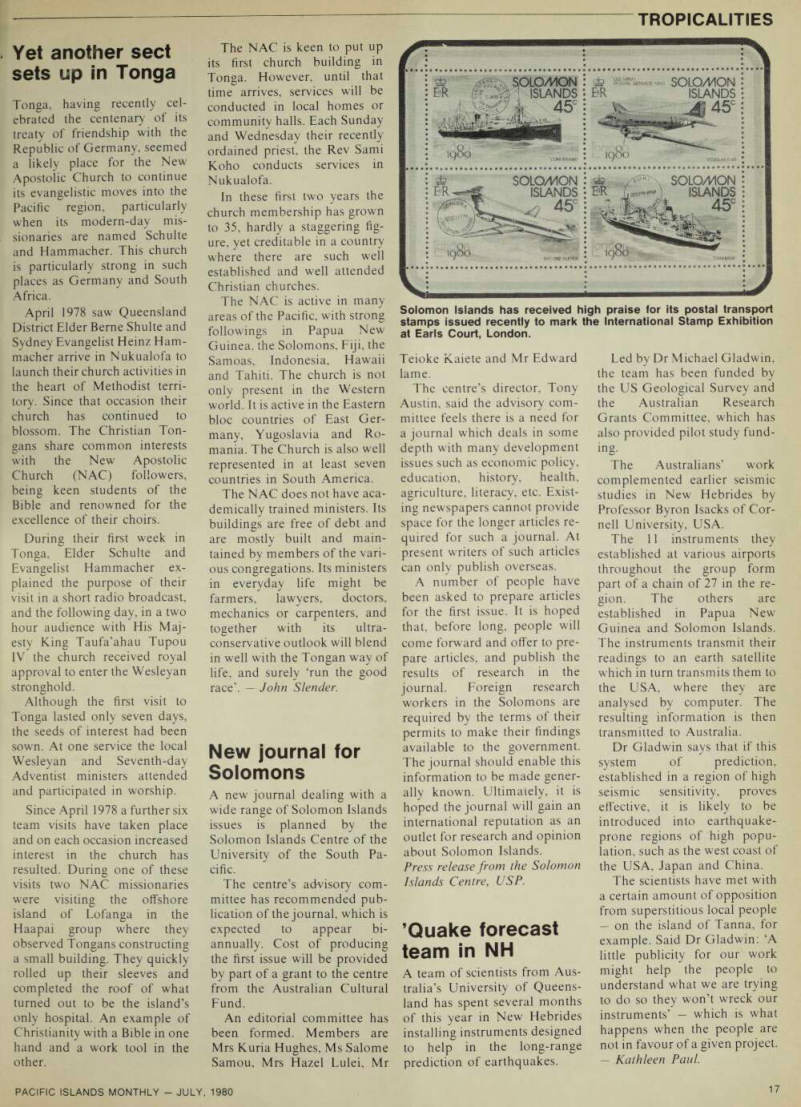
Solomon Islands has received high praise for its postal transport stamps issued recently to mark the International Stamp Exhibition at Earls Court, London.