growing mistrust
p. 13 · Read in the full issue
French face growing mistrust in New Hebrides
Following is the text of a talk given by RIM pub lisher STUART INDER on Australian Broadcast ing Commission radio on June 11. He spoke only hours after news had been received of the death on the New Hebridean island of Tanna of Alexis lolou, killed by shotgun fire during an assault by his ‘Moderate’ forces on a government post.
Government personnel had no shotguns, lolou was a member of the New Hebrides Represen tative Assembly, but had never taken part in its work because of a boycott by the ‘Moderates’ elected to the RA from Tanna and Santo. In his talk, Mr Inder highlighted the growing mistrust of French intentions on the part of the New Hebrides Government, and the expressions of support for the latter from other South Pacific nations. He told, too, of an official New Hebrides statement alleging that the French government was part of a conspiracy to overturn the democratically-elected government of the New Hebrides.
It was inevitable that there would be bloodshed in the New Hebrides as a result of the recent series of events, and today’s fatal shooting on the island of Tanna will make the divisions inside the islands even greater than they already are. Yet some good might come out of it if the death draws the attention of the outside world to the truth of what is currently happening in those islands, so that restraints can be applied.
The New Hebrides is to be
come an independent republic
on July 30, after more than 70 years of divided administration by both Britain and France.
The republic’s new govern ment was elected last November by universal suf frage, with United Nations ob servers present, and more than 90% of electors casting their votes. The Vanuaaku Party, led
by an Anglican priest, Father
Walter Lini, got 62% of the votes cast, with 11 other parties sharing the remainder, so there was no doubt that the New Hebrides has got itself a popu
larly supported government.
The ruling Vanuaaku Party
also won a majority support in two regional councils which are to be established in the islands
of Santo and Tanna.
Members of some of the smaller parties who lost out in the elections are the people who have been acting unlaw fully in recent weeks, and who are now in virtual control on Santo and who have attempted to gain control on Tanna. The New Hebrides Government says there was an organised plot by these trouble-makers to take control of other centres too, including Port-Vila. Asa result, the government asked Britain and France to make use of their mobile police who are under British and French control to move in on the trouble-makers and repossess those places. The British moved in on Tanna a fortnight ago and acted with force against the moderates, as they are called, which temporarily quietened that area. The French refused to support the British administration in doing this.
The local British view was that the same thing could have been achieved in Santo, but since the French didn’t want to go along with this, and there are many French settlers in the Santo area, Britain was not pre
pared to act unilaterally.
Now, it is not unusual for there to be differences of opinion on how to handle situ ations like this, given the dif fering British and French administrative methods. But why the New Hebrides Government is so angry with the French is that it firmly be lieves that the French officials have been acting tardily be cause they support the aims of the dissidents.
They feel France is delibera tely attempting to hold up independence so that it can win concessions for French settlers - or worse maintain their presence in the New Hebrides after independence on the pre text that they are there to safe guard the interests of their nationals.
These are very serious charges which are of sig nificance outside the New Hebrides. The government has asked the United Nations to send a neutral military unit to assist the Government in ‘pro tecting the people and land of New Hebrides’, and it has sup
ported this application with
what it says are examples of the
assistance officially given by
the French to the trouble makers.
It goes as far as saying that the moderates ‘could not have
effectively engineered and
implemented their plans for
take-over without the knowl
edge, consent and involvement of the French officials,’ and it continues: ‘lt is also clear that the French want to maintain a presence in the Pacific so that they may continue their mili tary and economic stronghold in New Caledonia and con tinue their nuclear testing in French Polynesia. To have an
independent, non-aligned and
nationalist government in the Hebrides which supports the independence movement in New Caledonia, would pose too much of a threat to their
military and economic strength
in the South Pacific.’
The official New Hebrides statement adds that the govern ment does not feel that it should rely on the French Government for protection, as in fact they are ‘a part of the conspiracy to overturn our only
legitimate democratically
elected Government’.
The New Hebrides Govern ment is now beginning to get strong support from Pacific Forum countries for its stand.
Fiji, for instance, has said that the United Kingdom and France have a clear responsi bility to restore law and order in the New Hebrides, to ‘safe
guard its territorial integrity
and to ensure its uninterrupted transition to independence on
July 30’.
This must be viewed as a clear warning to France.
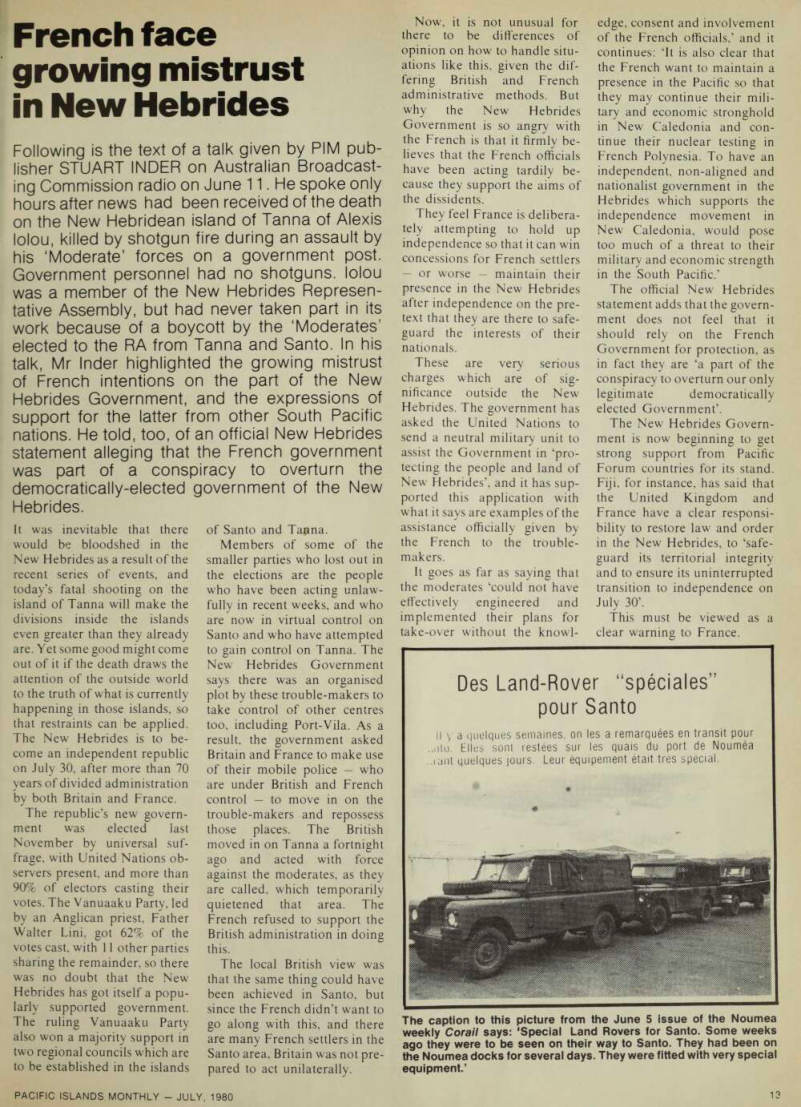
The caption to this picture from the June 5 issue of the Noumea weekly Corail says: ‘Special Land Rovers for Santo. Some weeks ago they were to be seen on their way to Santo. They had been on the Noumea docks for several days. They were fitted with very special
equipment.’