Hebrides: Troubled
Pacific
Islands
Monthly
JULY, iyou
American Samoa US$l.25 Australia ASl.OO*
Fiji Fsi.Oo
Hawaii &US mainland US$l.5O Nauru 5A1.50 New Caledonia CFPI4O New Hebrides ASI.OO NZ, Cook Is. & Niue NZ$l.OO Norfolk Island ASI.OO Papua New Guinea Kl.OO Solomons SSI.OO Tahiti CFPISO Tonga PI.OO USTT & Guam US$l.5O Western Samoa Tl.lO •Recommended retail price only.
Registered for posting as a publication Category B.
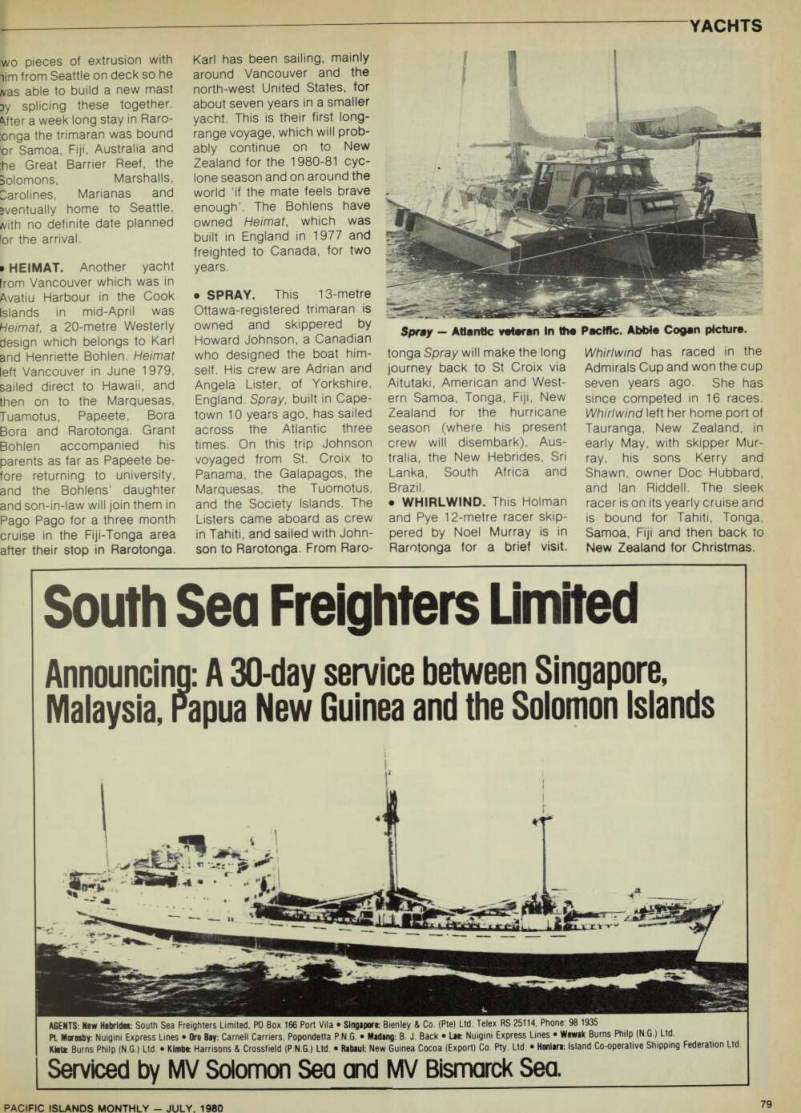
Hebrides: Troubled
Run-Up To Freedom
Advertisements & other items, p. 2 (1 item)
Akai
OFFICIAL SUPPLIER OF
VIDEO HOME SYSTEMS
MOSCOW AKAI ELECTRIC CO., LTD.
Tokyo, Japan
Richness Wherever You Go
« Whatever you're doing, wherever you're going, there's something that can make the good times even better.
Akai stereo radio cassette recorders. A great lineup superb not only in sound but also in looks. Packed with all the features, all the quality and all the stereo richness that come only from Akai. And at prices that couldn't be better.
Akai stereo radio cassette recorders.
Take them wherever you want, and make the good times even better.
AJ-490 4 Band Stereo Radio Cassette Record* •3000mW Maximum Per Channel Output •2-Way 4-Speaker System •Automatic Level Control Multi-Function 7 LED Indicators ■ ■ v.v.v.v.v.v.v.
I I I I LI I I AJ-500 4 Band Stereo Radio Cassette Recorder •Instant Program Locating System •6000mW Maximum Per Channel Output •Large 2-Way 4-Speaker System •3-Position Tape Selector •Multi-Function 7 LED Indicators AJ-420 3 Band Stereo Radio Cassette Recorder •2000mW Maximum Per Channel Output •12cm Wide Full-Range Speaker System •Multi-Function 7 LED Indicators •Recording and Playback Mixing Possible Approved by M. 0.0 Samoa Islands Burns Philp (South Sea) Co.. Ltd.
P.O. Box 129, Pago Pago, American Samoa Mariana Islands J.C.Tenorio Enterprises P.O. Box 137, Saipan Tel: 6444/8 Solomon Islands Security Electrical Co., Ltd.
P.O. Box 174, Honiara Tel: 881 Cook Islands JPS Enterprises Ltd.
P.O. Box 15, Rarotonga Tel: 2150, 2176 For more information, please send this coupon to our distributor in your country or to AKAI ELECTRIC CO.. LTDC 12-14. 2-Chome, Higashi-Kojiya, Ohta-ku. Tokyo. Japan
Pacific Islands Monthly
V 01.51 No. 7
July 1980
[Usps 952480]
Representatives
AUSTRALIA: Distribution: NSW & ACT: Allan Rodney Wright (Circulation) Pty Ltd, PO Box 907, Darlinghurst, NSW 2010; Elsewhere: Gordon & Gotch (A/asia) Ltd, Box 40, PO, Rosebery, NSW 2018. Advertising Melbourne Ray Brown Pty Ltd, 614 Queensberry St, North Melbourne 3051, telephone 329 8522, telex 31717; Brisbane - D.
Wood, Anday Agency, Box 1918, GPO, Brisbane 4001, tele phone 44 3485, 44 1546, Adelaide - Hastwell Media, PO Box 30. Glen Osmond, SA 5064, 233 Glen Osmond Rd, Frewville, 5A5063, telephone 79 1869 Perth Adrep, 62 Wickham St., East Perth, WA 6000, telephone 325 6395.
FIJI: Distribution and subscriptions - Desai Bookshops, PO Box 160, Suva. Fiji, telephone Suva 23036 Advertising Fiji Times & Herald Ltd, 20 Gordon St. Suva, telephone 312 111, telex FJ2124.
FRENCH POLYNESIA: Distribution - Hachette Pacifique, 10 Ave Bruat, Papeete, telephone 25610.
HAWAII, UNITED STATES: Distribution PIM, Hawaii, PO Box 22250, Honolulu, Hawaii 96822.
JAPAN: Advertising and subscriptions Universal Media Corporation, CPO Box 46, Tokyo, telephone 666 3036.
NEW CALEDONIA: Distribution Depot Centre de Presse Michel Pentecost, CBP2, Noumea, telephone 27 2434, 27 4729.
NEW ZEALAND: Distribution - Gordon & Gotch, PO Box 584, 2 Carr Road, Mt. Roskill, Auckland 4 Advertising - International Media Representatives Ltd, PO Box 2313, Auckland, telephone 795 487; 493 389, cables Intereps, Auckland. Subscriptions Ross Haines & Son Ltd, PO Box 1289, Auckland, telephone 769 042.
PAPUA NEW GUINEA: Distribution - Gordon & Gotch, PO Box 3395, Port Moresby, telephone 254551. 254855, Advertising PNG Post-Courier, PO Box 85, Port Moresby, telephone 21 2577, UNITED KINGDOM: The Herald & Weekly Times Ltd, 8-10 Clifford’s Inn, Fetter Lane, London EC4A IBU, telephone 01 831 6041, telex London 21989.
UNITED STATES MAINLAND: Advertising - Joshua B Powers Jr. Powers International Inc., 551 Fifth Ave, New York, New York 100 017, telephone 867 9580, telex 236514 Subscriptions PIM, Hawaii, 2812 Kahawai St, Honolulu, Hawaii 96822.
Subscriptions
PIM is airfreighted to most subscribers and agents in the Pacific Islands and the United States, but not the UK or the
Payment by personal cheque is accepted in Australian, US, New Zealand. UK and Fiji currency. For other remittances please obtain a bank draft in Australian dollars made payable to the ANZ Banking Group, 88 Wentworth Avenue, Sydney, Australia.
Published monthly by Pacific Publications (Aust.) Pty Ltd and printed in Australia by Paramac, Alexandria, NSW. Aus tralian cover price is recommended retail only. Registered at the GPO Sydney for transmission by post as a publication category B. Sk:ond class postage paid at Honolulu Hawaii. Copyright © 1978 Pacific Publications (Aust.) Pty
Ltd.
Postmaster Honolulu: Send address changes to PIM Hawaii, PO Box 22250, Honolulu Hawaii 96822.
Continent.
Aust.
Other American Samoa $13 $US16 Australia $12 Canada $14 $US18 Cook Islands $13 Fiji $12 $F12 French Polynesia $14
Cfp 1700
Guam $13 $US16 Hawaii $13 $US16 Japan $16 Y4500 Kiribati $13 Micronesia $13 $US16 Nauru $18 New Caledonia $14
Cfp 1700
New Hebrides $13 New Zealand $12 $NZ13.50 Niue $13 Norfolk Island $12 Northern Marianas $13 $US16 Papua New Guinea $13 K12 Solomon Islands $13 Tonga $13 Tuvalu $13 United Kingdom $15 10 US Mainland $14 $US18 Western Samoa $13 Elsewhere: $A16
This Month’s Features
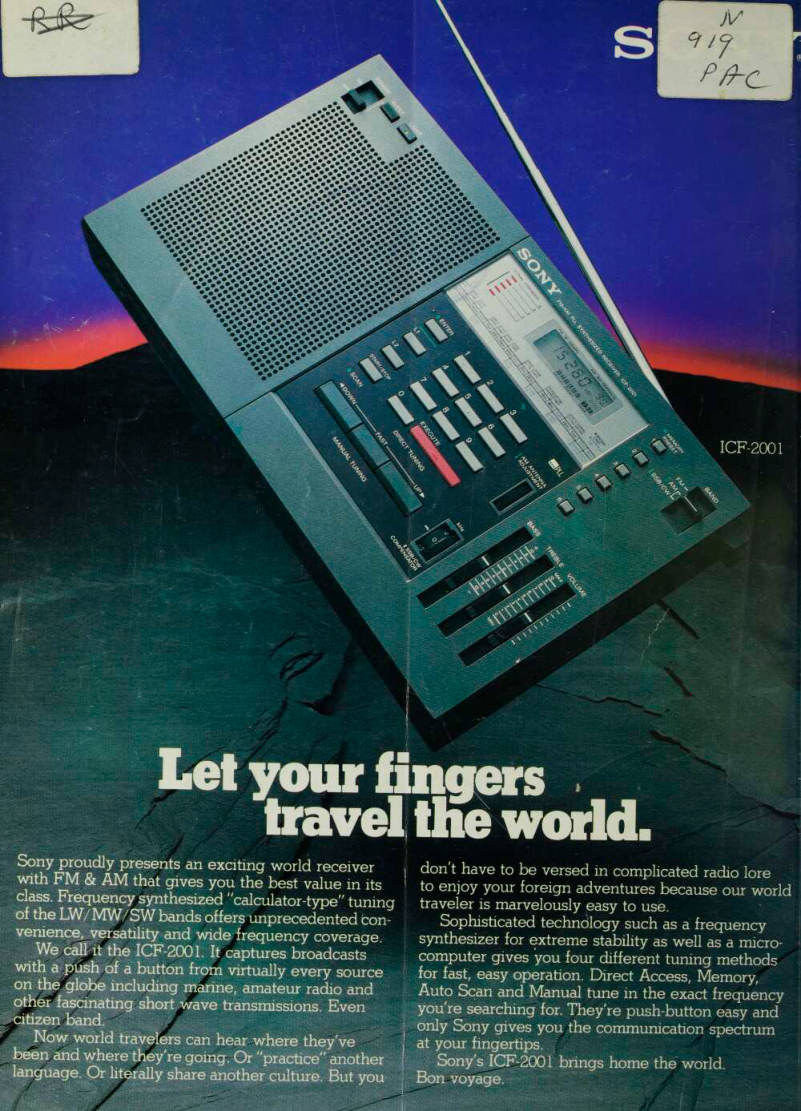
• REBELLION IN THE NEW HEBRIDES PIM Associate Editor Malcolm Salmon looks at the events which have split the New Hebrides on the eve of independence as separatist groups make a bid for power 10 • IRIAN JAYA AND PAPUA NEW GUINEA A correspondent who has heard from the West Papua Freedom Organisation says the rebels believe the new Chan government in Papua New Guinea may show more sympathy towards refugees crossing its border 18 • WHO IS RUNNING FIJI? Complaints from a section of the significant Indian community in Fiji claim that Indians are not getting a fair share of the top positions in the civil service 19 • TRAVEL The new Pacific country of Tuvalu, almost completely overlooked as a tourist destination, is well worth a visit says Stephen Weinstein 29 • PIM’S PACIFIC Judy Tudor, continuing her series of 50 years of history presented in PIM, describes ‘comic opera, mayhem and backing and filling’ in the past decade 57 Cover: On the eve of independence the New Hebrides is beset by political problems, but this girl from Port- Vita and the carved slit gong behind her typify the people and the culture of the new country. Picture by Peter Lord.
Aviation 35 Books 49 Deaths 82 Fifty Years of PIM 57 Fiji 19, 67, 69, 73 Irian Jaya 18 Islands Press 53 Letters 5 New Hebrides 10, 17 Pacific Report 9 Palau 51 Papua New Guinea 18, 52, 67
People 23 Political Currents 18 Ships 72 Shipping Services 80 Solomon Islands 17, 72 Tonga 17, 67 Tradewlnds 67 Tradewlnds Intelligence 71 Travel 29 Tropicalitles 14 Tuvalu 5, 29 Western Samoa 49, 73
Yachts 74
Advertisements & other items, pp. 3-4 (2 items)
3
PACIFIC ISLANDS MONTHLY - JULY. 1980
Founded 1930 by R. W. Robson Publisher Stuart Inder Editor Angus Smales Associate Editor Malcolm Salmon Editorial Adviser John Carter Manager John Berry Advertising Sales Manager Steve Gray A Pacific Publications production 76 Clarence Street, Sydney 2000 GPO Box 3408 Sydney 2001 Cables: PACPUB Sydney Telex: 21242 (answers INTARAD) Telephone: Sydney 29 6693 Melbourne 63 0211 ext. 1565 and 1858
Polynesian/Airlines
V*** m mm - ■ f ■ * iil Bill
AIM
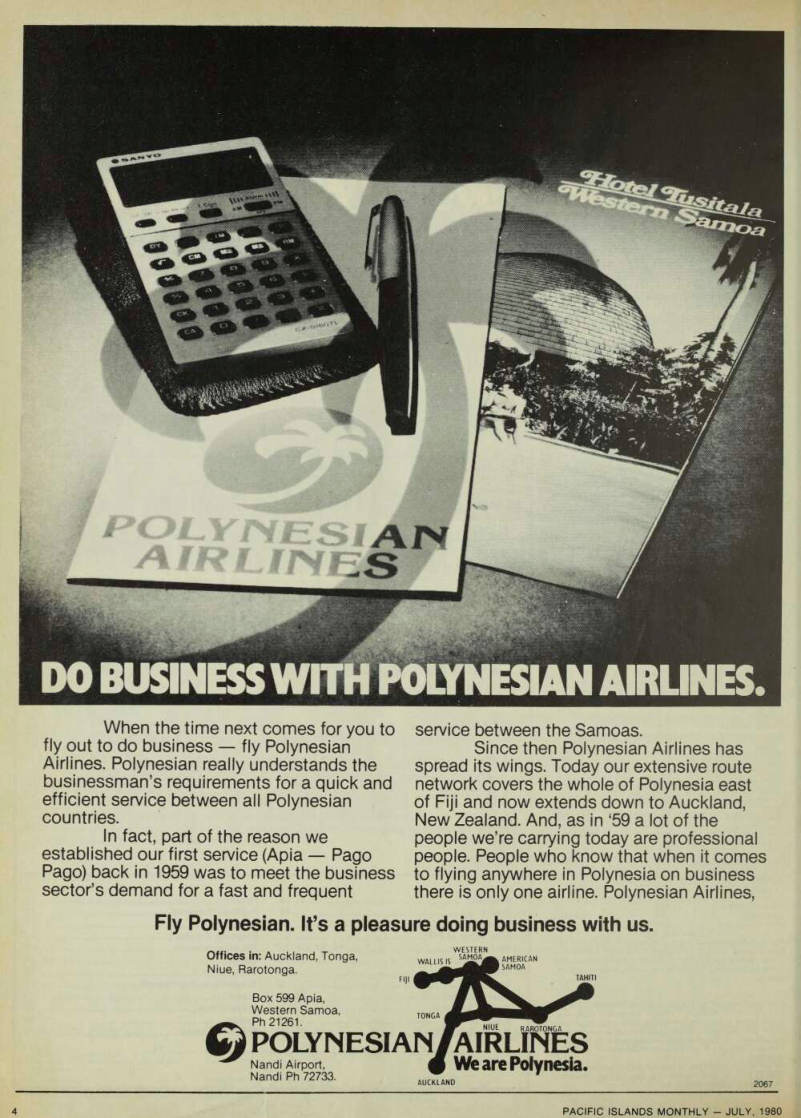
S |r:r '..i ffi When the time next comes for you to fly out to do business fly Polynesian Airlines. Polynesian really understands the businessman’s requirements for a quick and efficient service between all Polynesian countries.
In fact, part of the reason we established our first service (Apia Pago Pago) back in 1959 was to meet the business sector’s demand for a fast and frequent service between the Samoas.
Since then Polynesian Airlines has spread its wings. Today our extensive route network covers the whole of Polynesia east of Fiji and now extends down to Auckland, New Zealand. And, as in ‘59 a lot of the people we’re carrying today are professional people. People who know that when it comes to flying anywhere in Polynesia on business there is only one airline. Polynesian Airlines, Fly Polynesian. It’s a pleasure doing business with us.
Offices in: Auckland, Tonga, Niue, Rarotonga.
Box 599 Apia, Western Samoa, Ph 21261.
WESTERN
WALLIS IS AMERICAN
NIUE RAROTONGA
POLYNESIAN/AIRLINES
We are Polynesia.
Nandi Airport, Nandi Ph 72733. 2067
Tuvalu-U.S.
Letters
relations
I read with considerable dis may the letter from David Noland (PIM April 7) regard ing the US State Department’s so-called giveaway to Tuvalu and Kiribati. I am particularly disturbed that such neo colonial sentiments can be ex pressed by a person who is presumably a citizen of a nation which over 200 years
ago gained its independence
from the same colonial power and still proudly every year cel ebrates the event.
Indeed it seems to me that the rights of Tuvalu and Kiribati to the islands in ques tion are more justified than those of a largely immigrant population in the 18th cen tury.
The purpose, however, of my writing is to get some points correct.
Tuvalu is not a republic and is certainly not left-leaning. It is stated government policy that while it is prepared to co operate fully with all friendly nations, diplomatic relations will be established only with non-communist countries. It has no contact with the Soviet Union whatsoever, although such contact is not precluded if we feel it is in our interests.
The Ellice Islands have not been controlled by America since the 1800 s. Our main re source is the sea and we feel ab
solutely justified in protecting
the resource by declaring a 200-mile economic zone, in common with other South Pa cific Forum countries. There can be no justification for referring to this area as ‘American waters’. They are Tuvalu waters.
There is no question of Tuvalu having ‘clout’ with the State Department. It is a ques tion of realism and under standing on the part of the US
Administration and its
preparedness to acknowledge
the sovereignty of a nation, however small.
It is absurd to state that we are anti-America when in fact we have friendly diplomatic re lations with the US Adminis tration. We have in fact made no overtures to Red China but we do have diplomatic re lations with Taiwan. We do, nevertheless, believe in peace ful co-existence.
We are indebted to those Americans who sacrificed their lives in the interests of world peace during the Second World War but we are equally indebted to all those who paid similar sacrifices throughout the world.
In conclusion I would say that small as we are, we are Independent, intend to stay that way and look forward to the ratification of the Treaty of Friendship with the US. Per haps it is attitudes such as Mr Noland’s which force people tc seek friends elsewhere.
I. Ionatana
Secretary to Government Funafuti Tuvalu
Smallpox claim
rebutted
You recently carried an inter view with French anthropol
ogist Jean Guiart speaking
about the New Hebrides (PIM Apr plO). I must take issue with one of Mr Guiart’s state ments, when in speaking of Santo island in the 19th century he said: ‘Two-thirds of the
population died of smallpox.
This was caused by Australian labour recruiters who littered the beaches with articles of clothing which had been worn by smallpox victims in order to close off a whole labour
recruiting area from competi
tors.’
While I accept that a small pox epidemic occurred, it is ridiculous to attribute it to the deliberate actions of Australian labour recruiters. Recruiting from Santo to Queensland went on from 1863 to 1904; during this period over 2000 men and women from Santo participated in the circular mi gratory labour trade. The ma jority of them left Santo in the 1870 s and 1880 s; fewer than
300 left for Queensland after 1890.
Virtually all cases of small pox are found, on investi
gation, to have experienced
close contact with an antecedent case. Where no ani mate source is found, the dis ease has usually been spread from some inanimate object,
like clothing. Such clothing
could remain dangerous for up to about nine months, but the usual period of contagion is less than one month.
Smallpox was rare in Queensland in the 19th cen tury, so contaminated clothes would not have been readily
available. Nineteenth-century
people were rightly terrified of smallpox and did not play games with possible contagion.
Mr Guiart should ask himself
the following questions: What
captain would risk his crew by carrying the clothes aboard?
Had all members of the crew been vaccinated? Or had they
all previously had smallpox?
Where did the recruiters get the contaminated clothes? Did rival recruiters also die from
the smallpox epidemic?
I am not defending the Queensland labour trade it was often an unsavoury affair, which exploited Melanesians.
But to accuse the Queensland recrutiers of such inhumanity,
and of deliberately damaging
their own livelihoods, is incor rect. The Queensland labour recruiters have enough sins to answer for without adding
smallpox epidemics to the
list.
Clive R. Moore
History Department
James Cook University of North Queensland
Nikunau’s
worth
I am much distressed that Mr
Overy (PIM June p 5) should
have believed me capable of
making disparaging remarks
about the beautiful island of Nikunau which, by the way, I had the privilege of visiting in October last, while on the
Lindblad Explorer cruise ship.
When I used the word ‘worth less’ to describe the eight atolls discovered or seen by Commo dore Byron in 1765, I was, of course, simply referring to the opinion of the British Navi gator who, like most of the con
temporary navigators, was on perpetual lookout for new
lands containing precious min
erals and stones or at least fresh water, vegetables and meat.
As for myself, I have over the years with great pleasure lived on and visited a considerable number of atolls (see for instance my book Raroia, the
Happy Island), including
Napuka and Tepoto in the Tuamotu group which, as you know, poor Byron called the Islands of Disappointment, be cause he found them so totally devoid of useful and valuable
things.
Unfortunately, in the 1860 s and 1870 s, some British planters, established here in my adopted country, Tahiti, discovered that the Gilbert Islands, after all, did contain some wealth the islanders themselves who were therefore
kidnapped and brought here
by a succession of blackbirding vessels. Many of these Gilber tese have left descendants in French Polynesia, and I should like to suggest that Mr Overy or some other Gilbertese specialist one day write the his to'ry of this infamous trade and its consequences. If so, I would be very happy to extend my
hospitality to anyone doing
such work and would also gladly put at their disposal re search materials in various languages that I have collected over the years.
Bengt Danielsson
Papehue Tahiti
Trials of Fiji
land dealing
Your article ‘Buying a Fiji island?’ (PIM Apr p 22) was
most interesting.
The project with which I have been associated in Fiji was first commenced three or four years ago, and the sub division plans are only now
being approved, several units
at a time, by the Ministry of Lands and Resources.
All of the 800-odd blocks on the site have been sold at least once, and some have been re sold up to three or more times.
Yet only a few titles have been released, and then only this year.
Despite this situation, a
Replying to Dorothy
number of owners have been able to put up houses on their land, some having been built for several years. At least two have been resold.
All prospective owners out
side Fiji are required to gain
consent, by filing the appropri
ate form with the Ministry of Lands and Resources, to trans fer land to a person other than a Fijian national. In the above case, group approval was obtained to sell blocks outside Fiji, at the time of the project being started, with the require ment that further notification be given when blocks were re sold. This, along with the re quirement that ‘Sales and Purchase’ documents be lodged for stamping within two months of being received in Fiji, leaves the field wide open
for non-Fijian companies to
delay the stamping of docu ments for as long as they wish.
One company has at least 100 blocks on ‘Sale and Pur chase’ agreements and, to my knowledge, no titles have been issued. This particular company has not registered itself in Australia and therefore is claiming immunity from cer tain laws within Australia.
The company itself has pur chased blocks from sources other than the original owners, without revealing'the fact to new owners. Searching the title reveals none of these facts.
Obviously the Department
of Lands is not too worried at the number of times blocks change hands, as it generates much needed revenue in the form of stamp duty.
The question arises as to how one is going to gain some de gree of interest in the land until the titles are issued. Life in Fiji being what it is may mean that tranfers may take three months to complete, and a further wait of three months for the hand drawn titles to appear. Two years waiting for a title can be
most frustrating!
Of course one can get some
degree of security by placing a
caveat on the title if there is only one previous owner in volved. The situation is im possible if more than one is involved. Squabbles over the means by which titles can be transferred from the original
owners direct to the latest pur chaser also delay matters.
Meanwhile, at least one Aus tralian company is making use of large amounts of purchasers’ money due to its not appearing to have a trust account. Quite a number of Australians could be in a hopeless situation if it
liquidated overnight.
It is a pity that there will
always be unscrupulous people
who will flout the law to suit their own purpose. Beware a ‘free’ return flight to Fiji. It could prove very expensive.
David Butter
Adelaide Australia
An anniversary
suggestion
May 1 suggest that your August 50th anniversary issue should also cover each country separ ately? This would show how PIM over the last 50 years has covered important events which have taken place in each country.
Joseph Huta
Ysabel Province Solomon Islands
Law and order
in PNG
Congratulations to PIM and Kevin Egan for the Papua New Guinea law and order story (PIM Apr pll). It does not
make pleasant reading, but
there is an integrity and a genu ine affection for PNG to be dis cerned between nearly every line.
As an ex-PNG contract offi cer, in the Office of Tourism, I shared many of Kevin Egan’s frustrations over the general failure to recognise that the
slogan ‘Unity in Diversity’ is,
quite simply, a contradiction in
terms; and, equally simply,
illogical therefore.
I also shared, and continue to share, his so-well-stated con cern about the messianic visionaries who arrive in South Pacific countries for two, four or more years, and advise government leaders on policy.
Few of them are over 30 years old, and many tend to come to PNG fresh from the heady pol itical atmosphere of Monash and like institutions. They are, in the modem idiom, ‘commit
ted’. In my time in PNG I rarely saw papers presented to
ministers offering options for
solving problems: more
usually a problem was stated and a course of action consist ent with the political outlook of the writer prescribed as the only solution. That is ‘commit ment’.
One might have thought that the economic history of the 35 years since 1945 in developing countries would by now be speaking for itself so clearly as not to need semantic support.
It is surely this; that those econ omies such as Kenya, Sin
gapore. Hong Kong, Taiwan,
South Korea, Ivory Coast and the like, based on a more or less free market system tempered by a proper social realisation of the needs of the poor, the weak, the old and the infirm, have achieved economic track re
cords demonstrably superior to
their more or less socialist rivals, regardless of whether their political systems be democratic, authoritarian, col onial, paternalistic, or what ever. That the mass of people enjoy a higher standard of liv ing in the free market countries is surely obvious.
And for the future? Is it poss ible that, after 30 years of Mao
China has perceived something
still apparently hidden from the view of South Pacific bu reaucrats? Must we wait until the year 2000, target date for the achievement of the four Modernisations, to find out?
Rory Scott
Hong Kong
Replying to Dorothy
Wakau
May I respond to Dorothy Wakau’s letter (PIM May p 6).
I wish to refer particularly to what she raised regarding Papua New Guinea’s indepen dence or dependence, if she likes and cannibalism.
If Dorothy had done some historical research, she would have realised that it was Aus tralia, and her allied super power USA, both countries that claim to uphold the fun damental rights of any free born person, who directly, or indirectly, sold West Irian to what she called an ‘imperialis tic’ (but I would like to call
lndonesia, during the United Nations guided ‘Act of Free Choice’ in 1969.
Do not overlook the fact that PNG then was still under Aus tralia’s colonial rule, and hence we as a people did not have much to say as we were left in the dark regarding the impli cations of such a handover.
Now that we are independent, and the struggle in ‘West Papua New Guinea’ has reached its present magnitude, Dorothy blames the PNG Government and its citizens for handing over our brothers to Indonesia.
Let me remind Dorothy that not all citizens of independent PNG think the same way as the government of the day, and that many would be glad if Australia would chip in to help PNG feed and create job opportunities for many of the political refugees who are now
assimilating into the indepen
dent State of PNG. We hope and pray that one day all nations of the world, including Indonesia and Australia (re Aboriginal rights) may come to respect the often-quoted human rights.
May I ask Dorothy to expli
cate the phrase ‘your indepen
dence is just about as much as Australia and Indonesia allow you’. PNG is undeniably an
independent State politically,
and to a large extent economi cally. There are certainly col onial remnants who still roam around up here, basically be cause PNG is a land of milk and honey for them. But, Dorothy, do not display that arrogant maternalistic pessi mism about PNG’s indpen dence. We’ve had enough of that kind of denigration.
Regarding aid, Dorothy should not overlook the fact that Australia ripped off so much from this country, and continues to do so in the form
of the capitalistic enterprises
mentioned by Dorothy. The
aid Australia gives is to me a compensation for what Aus tralia failed to do during its col onial rule up here.
Finally, regarding cannibal
ism in PNG, may I reiterate what I once told an American female student who asked me whether a certain tribe was still
practising cannibalism. My re sponse was simply this: canni balism was, admittedly, a historical experience in certain PNG societies, and was perfor med for various religious or ritualist reasons. However, today we only eat women.
Otto M. Nikatel
Womsis Village
Atiape, West Sepik Province
Papua New Guinea
The Indo-Fijian
experience
Sarita Singh’s review of The Indo-Fijian Experience (ed Subramani, UQP) (PIM May p 47) calls for some comment.
Her review contains some fac tual errors. (1) The Indo-Fijian Experi ence was not a brainchild of the Council for the Centenary cel ebrations in 1979. The book was ready for press before the council was formed. However, the council did offer to support the book financially, in return for distribution rights in Fiji. (2) Ray Pillai’s story Laxmi was not published in PIM. It was published in Mana Vol 1, No 2, 1976. (3) ‘Sulochna Nand’: an unfortunate mispelling. Her name is Sulochana Chand.
Matters of literary judgment
are naturally to some degree subjective. I find it easy to be in agreement with Sarita Singh on her evaluation of Ray Pillai’s work. At the same time, it seems to me that Subramani is a more complex and poten tially more influential author.
And Vijay C Mishra’s essay Indo-Fijian Fiction and the Gir mit Ideology could better have been recognised for what it is not ‘boring’, but a major and illuminating comment on the aesthetic awareness presently achieved after more than a dec ade of literary endeavour in the South Pacific.
One essay Sarita Singh does not mention at all: Pio Manoa’s Across the Fence. In Fiji, where inter-racial tensions have for so long been a matter of debate, and sometimes of re ality, that essay is one of enor
mous impact and implication,
advancing as it does another re
ality from a Fijian point of
view, the reality of the har mony that does exist between
peoples, whatever their racial problems might look like from the outside.
And it seems strangely dis missive to describe Brij Lai as ‘a relatively unknown local writer’. It is true that his account of the wreck of the Syria has narrative elements; but it apparently didn’t occur to Sarita Singh that years of re search went into the eluci dation of detail concerning that tragic event, and that the resulting ‘simple narrative’ is a measure of Brij Lai’s judgment and restraint.
Subramani is to be much complimented, I feel, in his selection of material for The
Indo-Fijian Experience.
K O Arvidson
East-West Center Honolulu
Hebrides: A Yank’s
lament Congratulations on your ever
improving magazine.
In the early 1970 s I made several trips to the New Hebrides. On my first and sec ond trips, I purchased approx imately 506 beautiful acres about 12 miles out of Santo toward the Lokalee Beach Hotel; also some 217 lovely acres on a plateau overlooking the Tacuma River about five miles out of Port Vila.
My idea was to create
reasonably priced homes on
what was to have been two beautiful subdivisions with paved roads, a shopping centre and a school in each. The shop ping centre was to have fea
tured fresh garden vegetables
grown and sold by the natives, in addition to any items pro duced by the natives, with the hope of helping them to better
their life-style.
Special low rental of shop ping centre space was to be offered to the natives.
During my trips I was friendly to the natives, and at times, when there was room in my car, I would give them a ride when they were hiking into town. I picked up a native who
was carrying his injured daugh
ter some eight to 12 miles into town. I waited with him at the
hospital until her injured leg
was repaired, and then drove them back to their village.
I was subsequently told to re port to the the British authori ties. They were outraged that I was befriending the natives. I was told never again to pick them up as such treatment would ‘spoil’ them and soon
they would no longer be willing
to work for wages that were very ‘fair’ for them.
On planning our fourth trip in the mid 19705, I was told I would not receive a visa, as my wife and I were no longer wel come in the New Hebrides.
Have such conditions changed? If not, could you please put me in touch with a reputable real estate agent who could give me the current value of my properties, and sell them for me? I had planned to move to the New Hebrides about 1976. I was going to bring my airplane with me so that chiefs could visit other islands and improve communications and goodwill with their ‘brothers’.
With independence of New Hebrides, will titles to lands paid for in full be in any way jeopardised? If this letter will not make my position worse than it already is with the authorities, you may print it!
My address is: 1782 Akolea Place, Hilo, Hawaii 96720.
Dave Ford
Hilo Hawaii
A word from the
Peace Corps
I would like to commmend your magazine for the fine treatment of the ‘America in the Pacific’ articles (PIM Mar).
I would especially like to thank you for the articles concerning Peace Corps’ efforts in the re gion, and only wish you could have rounded out your scope of coverage by mentioning our efforts in Micronesia.
I find it ironic that US foreign policy in this area is finally coming around to the small-scale development ap proach practised by PC and other volunteer organisations in the Pacific for the past 14 years.
Recognising the aspirations
of the peoples of the Pacific is vital and basic for any brand of assistance to be accepted, or even the dialogue for such as sistance to begin. The nations
of the Pacific are fiercely proud of their traditions, customs, integrity and their ability to rationally discuss any aspect of their social, economic and/or
political well-being. They are
not impressed with pressure tactics nor displays of force, yet the great powers continue to display this antiquated form of
‘gunboat diplomacy’. A recent
example comes to mind of a Western Samoa Independence Day celebration a few years ago when the US sent a war ship with a fireworks display that failed to explode; while the Red Chinese sent an in credible acrobatic team who put on shows throughout the country that people still re member. It is sad to think this attitude still remains as Senator Glenn has recommended an increase in naval visits to the area to promote, ‘a larger and more effective US presence’.
Until the US, New Zealand and Australia learn that politi cal pressure, gross displays of power and the dumping of troublesome civil service per sonnel will only earn them a few temporary successes and long-term hatred, the Pacific region will be mired in stag nation for years to come.
But as long as the US and other great nations are per ceived by Pacific Island coun tries as holding respect for their
personal integrity and
sovereignity there is much hope for mutual understand
ing, long-lasting economic and
political ties, friendships, and a fantastic chance for growth and progress in an area eager for such change.
The peoples of the Pacific have been ‘discovered’ by ex plorers from many nations;
‘conquered’ by soldiers from
many sides; ‘exploited’ by
whalers of questionable de scent; ‘saved’ by missionaries of many faiths; etc., etc., yet through it all, with all the comings and goings of such di verse groups through the years, they have maintained their cul tures, languages and customs.
An incredible historical accomplishment! I am glad to have contributed to this area over the past 10 years.
Brad Dude
Deputy Country Director Peace Corps/Micronesia
Advertisements & other items, p. 8 (1 item)
to nusißHim
TRnuEmnc
soon?
(lie ran supply
business contacts
Businessmen travelling to Australia can call on the services of the Australian Trade Commissioner.
He can provide introductions to the Regional Offices of the Department of Trade and Resources located in all Australian capitals.
These offices have been established to directly introduce overseas businessmen to Australian manufacturers and trading companies.
He maintains a comprehensive register system of goods and services available from Australia. If it is available from Australia he can tell you who supplies it.
Easy communications and rapid shipping services make Australia a logical trading partner, and the Australian Trade Commissioner is here to assist development of two way trade.
C^l Ifc.
Ask the expert who knows Australia The Australian Trade Commissioner can give you details of suppliers and also advise you on ways to research or develop markets in Australia. You can contact an Australian Trade Commissioner at these addresses:
FIJI
P.O. Box 1252, Suva.
Phone; 31 2844
PAPUA NEW GUINEA
P.O. Box 9129, Hohola.
Phone: 25 9333
NEW CALEDONIA
P.O. Box 22, Noumea.
Phone: 27 2414
Ask the Australian Trade Commissioner
Pacific Report
Aid Guarantee For Air Niugini
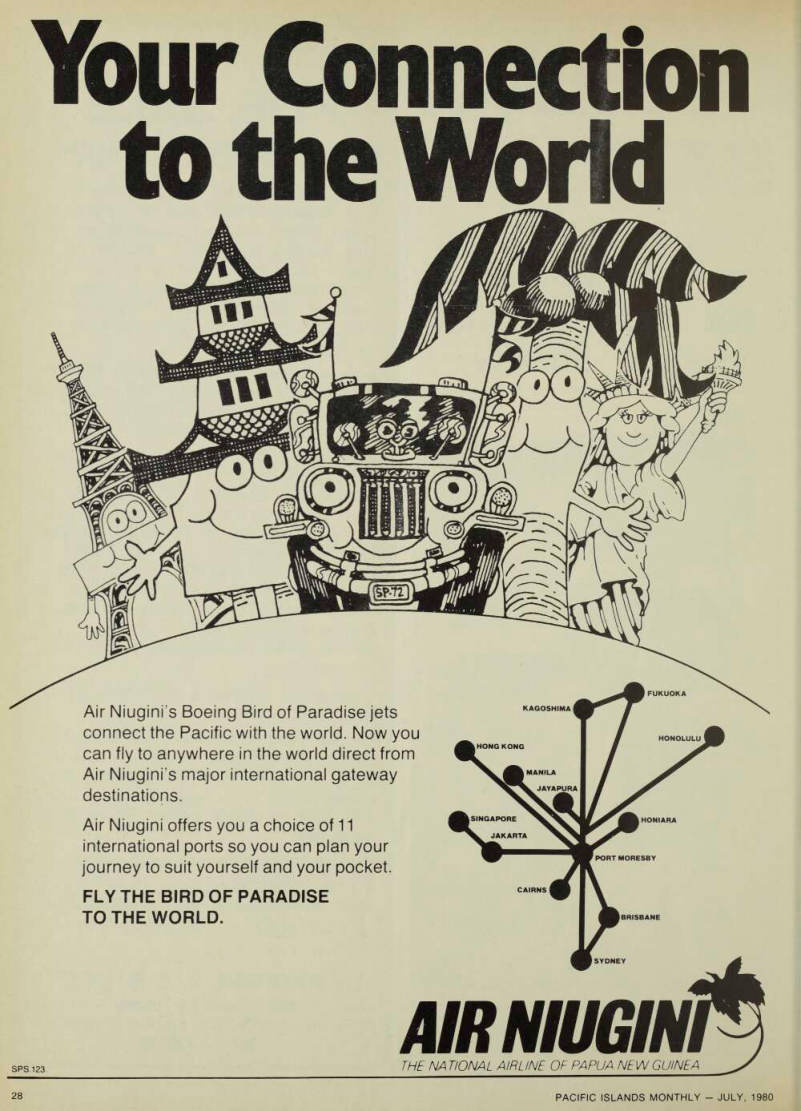
The Papua New Guinea government has decided to provide guarantees of up to K 5 million (about SUS 7 million) to help its national airline Air Niugini resolve its financial problems, but while the guarantee remains in force the airline will lose its autonomy. Instead it will be fully accountable to the government in its day-to-day finances. The provision of the guarantee, which will be effective for six months, was approved at a meeting of the PNG Cabinet and announced by the Prime Minister, Sir Julius Chan. Sir Julius disclosed that the airline had lost K 2.1 million since January this year. (See other references to Air Niugini in Tradewinds section). Meanwhile the Australian airline TAA seconded one of its top executives, Mr Ralph Conley, to act as general manager of Air Niugini as an interim measure at the request of the PNG government. Mr Conley was the air line’s first manager until his departure four years ago.
New Cable Across Pacific
A cartel of nine countries, including Australia, New Zealand, Fiji and Papua New Guinea, has been formed to build the new Anz can submarine cable system which will link Australia and Canada across the Pacific. Other countries in the group are Canada, UK, West Germany, France and the Philippines. Aus tralia is the major shareholder with a majority interest of 57% in the $350 million project. Anzcan, with a capacity for 1000 circuits, will link Australia to Canada through Norfolk Island, Fiji and Hawaii and is expected to be in operation by 1983. It will replace the 80-circuit Compac cable which will end its 21-year design life in 1983.
Fiji Affirms Economic Zone
Fiji has affirmed its right to maintain a 200-mile economic zone over its seas in the face of US refusal to recognise the validity of such zones where migratory species of fish are concerned.
The Fiji attitude, which supports that taken by most Pacific Island countries, was reaffirmed in parliament recently following ques tions from the floor. Ratu Sir Penaia Ganilau, acting for the Prime Minister, told members that formal declaration of a 200-mile zone had yet to be made but the government intended to go ahead with its plans. The declaration would be fully consistent with modern international law, he said.
Assistance For Png Census
The Australian government is helping Papua New Guinea con duct a national census which has already begun and will con tinue until October. The present phase of the operation includes a widespread training course for government officers and others who will conduct the census. Part of the Australian aid is the provision of a Hercules transport aircraft to carry huge quantities of census materials to major centres and to some of the more remote parts of the country. The census is expected to reveal that PNG’s population has well passed 3 000 000.
Cyclone Destroyed 700 Houses
Latest estimates of the damage caused by Cyclone Tia which hit parts of Fiji in April indicate that more than 700 houses were destroyed. The figure was reported by the secretary of the Prime Minister’s Relief and Rehabilitation Committee which has been carrying out assessments of damage in more than 100 village areas. Many school buildings had also been damaged or de stroyed, he said.
Australian Attitudes Criticised
The National Director of Australian Community Aid Abroad, Mr Harry Martin, claims that Australia is effectively ‘at war’ with countries in the Third World including its regional neighbours in the Pacific. In a recent statement announcing a national edu cation campaign on Third World problems he accused Australia of being in league with the developed world to produce aggress ive trade and foreign relations policies which were causing hard ship and harm in Third World countries.
Women Want Tougher Laws
About 2000 women last month marched on the government offices in Port Moresby and handed a petition to the Papua New Guinea-Prime Minister, Sir Julius Chan, demanding new laws to reduce urban crime including murder, rape and theft. The march was held following the rape and murder of a young mother and the release of statistics showing an increase in crime. The government is studying the petition which requests firearms for police, curfews, identity cards and public lashing as punishment for crimes of violence.
Missile Tests Concluded
China completed two missile tests in the South Pacific in May and then announced that its current tests were completed. (PIM June plO). Both missiles landed in the announced test area 1300 km north-wet of Fiji, and Australian and Fiji observers made reports to their governments. The tests created wide spread criticism from Island countries, particularly from Fiji, Papua New Guinea, Solomon Islands and Tuvalu. China has de nied that the tests interfered with the sovereignty of any country or that the missiles passed through any country’s air space.
Footballers Go Home
A Tongan rugby union tour of Western Samoa came to a sudden end last month on the eve of the second and final test after a series of incidents had strained relations on both sides. For two weeks the Tongan team had complained it was not being prop erly treated, and shortly before the final test was due to start the team announced it was going home. There were suggestions that the recommendation to return had come from the govern ment of Tonga. The withdrawal of the team led to a new contro versy in which Western Samoa officials claimed they would not pay the fares home for the visitors because contract arrange ments had been broken. The visitors missed the aircraft which was to have carried them because of a series of arguments over their tickets, but flew home on a later flight. Latest reports have not indicated who eventually footed the bill for the tickets. During the tour Tonga won the first test but lost the other three non-test games.
Extensive Losses From Fire
Extensive losses were caused in Port Moresby in May when fire swept through a block of shops and offices in the suburb of Boroko. The fire burnt out the electrical appliance retail shop of Brian Bell and Company, and spread to other businesses in the same complex including a furniture shop, sports goods shop and music shop. Poor water pressure resulting from current water shortages hampered the efforts of urban and civil aviation fire tenders which were called to the fire.
Tribal Fighting Causes Concern
Renewed outbreaks of tribal fighting in the Papua New Guinea highland provinces are causing concern to the government. Last year in the face of some political opposition the government tem porarily gave sweeping powers to its police by declaring a state of civil emergency in some of the worst-affected provinces. After the emergency was lifted a measure of peace returned to the troubled clans, but the situation is now deteriorating again. In the latest outbreak in the Chimbu and Enga Provinces there have been at least 12 deaths, and more than 100 houses have been burnt down and food and commercial crops have been de stroyed.
Hebrides: A sorely troubled
run-up to freedom
Probably never before in its history has the New Hebrides, the condominium jointly administered by Britain and France since 1906, been the sub ject of such worldwide attention as during the month of June 1980. PIM associate editor MAL COLM SALMON backgrounds the secessionist crisis on the island of Santo, and the similar movement on the southern island of Tanna, and describes the local and foreign forces which have brought it about so short a time before the due independence date of July 30, 1980.
1. New Hebrides
background
At the country-wide New Hebrides elections of November 14, 1979, the Vanuaaku Party won 26 of the 39 seats in the Representative Assembly. This emphatic en dorsement by the electorate of VP policies surprised few people. Obvious exceptions, however, were certain very senior people in the French Residency in Port-Vila, who had clearly expected a much closer result, if not victory for the non-VP political forces.
Held simultaneously with
the Representative Assembly
poll were elections to two Re gional Assemblies which would sit on the islands of Santo and Tanna. These bodies had been provided for in the constitution agreed upon two months before in an obvious effort to meet to some extent the particularist/separatist ten dencies which are strongest in these two New Hebridean islands.
Unlike the outcome of the national poll, the results in these two elections did cause general surprise: for the VP won them too, by 8-7 majori ties in both places. It is beyond doubt that the regional as sembly election results, much more than the national one, set the stage for the troubles to come.
The seven successful non-VP candidates elected to the Rep resentative Assembly immedi ately announced a boycott of
its proceedings, claiming that
the elections were not fairly conducted. This boycott con tinues at time of writing.
More serious was that in the week after the elections the first civil disturbances, with strong secessionist overtones, occurred on Santo and Tanna (PIM Jan pp 13-17).
There was a resurgence of similar strife in February on the two islands, but, like the November incidents, they were
eventually brought under con
trol by various means. But order was not restored before secessionists on Santo had
proclaimed the ‘independence’
of the island renamed for the purpose ‘Vemerana’ and those on Tanna that of ‘Tafea’.
In April the New Hebrides Government announced that
the country’s independence
would be formally proclaimed on July 30. After some delay the decision was ratified by the British and then, with extreme reluctance, by the French, who declined, through the medium of Overseas Territory Minister Paul Dijoud, to accept ‘moral responsibility’ for the choice of this date.
But the choice of an
independence date certainly
acted as a catalyst for the se cessionists.
The events of May-June on Santo and Tanna had all the earmarks of a determined attempt to present the New Hebrides Government with a fait accompli of secessions on
July 30.
On Santo in late May Jimmy
Stevens presented himself as prime minister of‘Vemerana’, with a small ‘cabinet’ selected from among his 700-800 Na- Gnamel followers. Central government officials and police on the island were arrested. Hundreds of tourists and other foreigners were evacuated to Port-Vila.
But the most important feature of this new ‘secession’,
clearly distinguishing it from
the previous one, was the active participation in it of a number of French and mixed-race colons, reportedly armed with shot guns. Informed estimates put the combined strength of the Na-Griamel-co/ort force at about 1000 persons. There is reported to be a population of around 4000 in the area they claim to control. The Santo ‘secession’ was still in force at time of going to press.
On Tanna the secessionist moves were quelled after the British Resident Commissioner in the New Hebrides Andrew Stuart authorised the despatch of a police mobile unit of 26 men to the island.
Once on Tanna, the police set out to find the central government’s district commissioner and his assistant, who had been kidnapped.
Heading towards the village
where they were thought to be held, a stick of dynamite exploded on the readjust in front of their Land Rover. If the blast had occurred a matter of seconds later, the police would certainly have been killed, or at least seriously wounded. Im-
mediately after the explosion five secessionists started shoot ing at the police, firing about 80 rounds. The police beat a tactical retreat under cover of tear gas and smoke grenades, From accounts of those on the spot, it was a ‘miracle’ that no one was killed. In the con fusion, the district com missioner and his assistant, who were in fact held in the vil lage towards which the police were heading, managed to escape. At last report, Tanna was calm, and talks were proceeding with the secession ists. New Hebrides Govem ment sources have expressed their gratitude to Mr Stuart and to the police for their actions, One spokesman said: ‘lt’s a pity it hasn’t happened else where.’
During the months of March-April, in parallel with many of the events described above, more or less abortive political negotiations on the future of the New Hebrides took place in Paris and London between the New Hebridean parties and the British and French authorities, and, back at home, between the New Hebrides Government and the would-be secessionists at Lamap, on the island of Malekula, and in Santo Town, The Lamap-Santo talks pro duced no meeting of minds on the issues dividing the parties, issues which centre essentially on the degree of decentralis ation of powers between the central government and the islands.
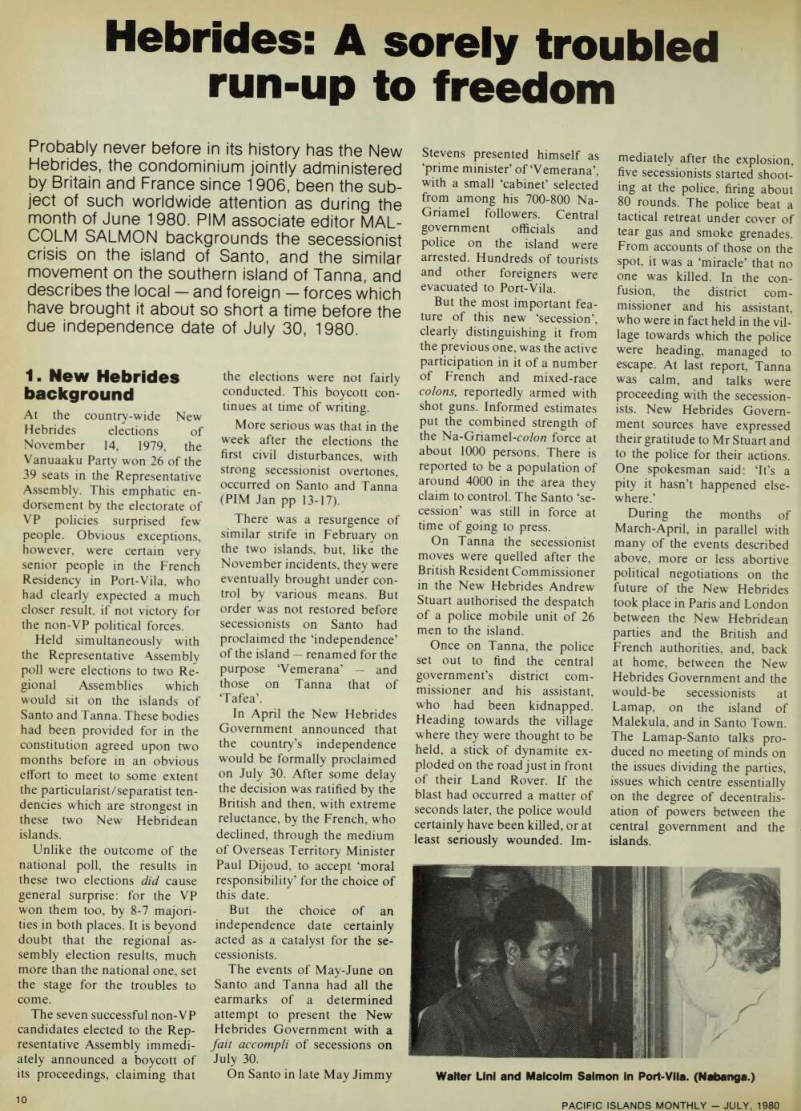
Waiter Lini and Maicoim Salmon in Port-Viia. (Nabanga.)
A secret secessionist plan al legedly discovered by the New Hebrides Government pro vided for the successive hiving off from the central govern ment of five centres Santo, Tanna, Malekula, Ambrym and finally Port-Vila itself. So the present score, at least in terms of this plan, can only be said to favour the govern ment.
2. The Phoenix
connection
Interviewed on Australian radio in June, the Carson City, Nevada, real estate developer Michael Oliver said of the Santo situation; ‘I am advis ing ... Without me, there would be blood flowing all over the place.’
Oliver is the founding father of the Phoenix Foundation (PIM June p 18), whose ideas are those of private enterprise fundamentalism no govern ment, ‘voluntary’ taxes, no social welfare, and so on.
Later in the interview, Oliver said; T would like to go to Santo and build a large sugar plantation and make some high-grade alcohol which can be used for like they do in Brazil. To alleviate
the gasoline shortage... That’s
my pet project.’
In early June, shortly after the Santo ‘secession’, the Phoenix Foundation distribu ted prospectuses to European residents of Port-Vila offering shares in a ‘Vemarana
Development Corporation’ in
a way that suggested it will vir tually run Santo if the secession should succeed.
Phoenix Foundation lawyer Thomas Eck (PIM June p 18) drafted the ‘Constitution of Vemarana’. (Tt reads more like a company prospectus,’ wrote one journalist who had studied
it closely.) Passing through
Port-Vila in April, Eck’s bag gage was searched and 1000 ‘Vemarana’ passports con tained in it were allegedly con fiscated by Customs officials.
Oliver admits financing
Jimmy Stevens’ frequent inter
national travels.
In the May 1976 Phoenix Foundation newsletter Oliver said the foundation’s financial assistance to Stevens’ move ment was ‘vital’, adding: ‘The minimum required is $250 000.’
The Phoenix Foundation is the principal source and on the evidence, an abundant source of the finance keeping the Santo secession going.
And the source of its political
support?
3. The French
connection
France can and does fre quently protest the purity of its intentions in the New Hebrides. But it has not yet suc ceeded in dispelling the sus
picion, widespread throughout
the Pacific, that it is playing a double game there.
The main reason for this sus picion can be stated in two words: New Caledonia.
The charge that the French want a weak and ‘destabilised’
New Hebrides after indepen dence for fear that a strong New Hebrides would act as a force of attraction for New Caledonia’s own Melanesian
population in their aspirations
for independence may be over simple. But it has enough plausibility to be widely be lieved, and that, politically speaking, is what counts.
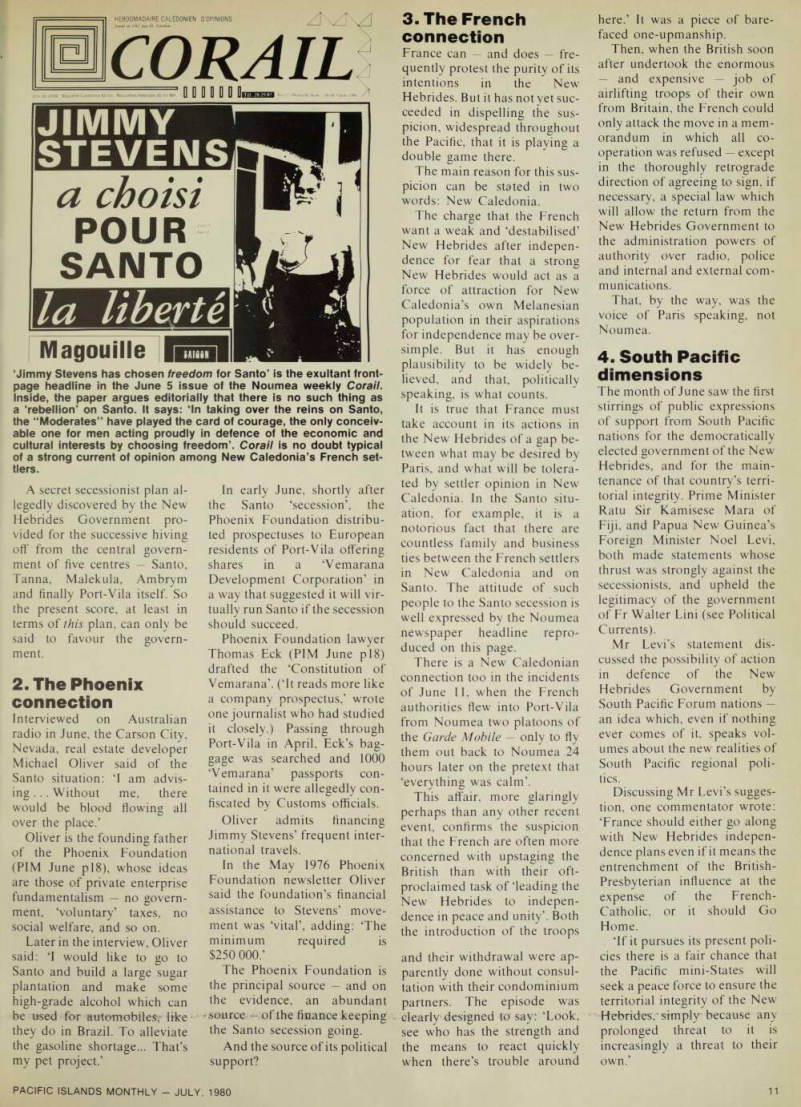
It is true that France must take account in its actions in the New Hebrides of a gap be tween what may be desired by Paris, and what will be tolera ted by settler opinion in New Caledonia. In the Santo situ ation, for example, it is a notorious fact that there are countless family and business ties between the French settlers in New Caledonia and on Santo. The attitude of such people to the Santo secession is well expressed by the Noumea newspaper headline repro duced on this page.
There is a New Caledonian connection too in the incidents of June 11, when the French authorities flew into Port-Vila from Noumea two platoons of the Garde Mobile only to fly them out back to Noumea 24 hours later on the pretext that ‘everything was calm’.
This affair, more glaringly perhaps than any other recent event, confirms the suspicion that the French are often more concerned with upstaging the British than with their oft
proclaimed task of‘leading the
New Hebrides to indepen dence in peace and unity’. Both the introduction of the troops and their withdrawal were ap parently done without consul tation with their condominium partners. The episode was clearly designed to say: ‘Look, see who has the strength and the means to react quickly when there’s trouble around
here.’ It was a piece of bare
faced one-upmanship.
Then, when the British soon after undertook the enormous - and expensive job of airlifting troops of their own from Britain, the French could only attack the move in a mem orandum in which all co operation was refused except
in the thoroughly retrograde
direction of agreeing to sign, if necessary, a special law which will allow the return from the New Hebrides Government to the administration powers of authority over radio, police and internal and external com munications.
That, by the way, was the voice of Paris speaking, not Noumea.
4. South Pacific
dimensions The month of June saw the first
stirrings of public expressions
of support from South Pacific nations for the democratically elected government of the New Hebrides, and for the main tenance of that country’s terri torial integrity. Prime Minister Ratu Sir Kamisese Mara of Fiji, and Papua New Guinea’s Foreign Minister Noel Levi, both made statements whose thrust was strongly against the secessionists, and upheld the legitimacy of the government of Fr Walter Lini (see Political Currents).
Mr Levi’s statement dis cussed the possibility of action in defence of the New Hebrides Government by South Pacific Forum nations an idea which, even if nothing ever comes of it, speaks vol umes about the new realities of
South Pacific regional poli
tics.
Discussing Mr Levi’s sugges tion, one commentator wrote: ‘France should either go along with New Hebrides indepen dence plans even if it means the entrenchment of the British- Presbyterian influence at the expense of the French- Catholic, or it should Go Home. if it pursues its present poli cies there is a fair chance that the Pacific mini-States will seek a peace force to ensure the territorial integrity of the New Hebrides,' simply because any prolonged threat to it is increasingly a threat to their own.’
‘Jimmy Stevens has chosen freedom for Santo’ is the exultant front page headline in the June 5 issue of the Noumea weekly Corail.
Inside, the paper argues editorially that there is no such thing as a rebellion’ on Santo. It says: ‘ln taking over the reins on Santo, the “Moderates” have played the card of courage, the only conceiv able one for men acting proudly in defence of the economic and cultural interests by choosing freedom’. Corail is no doubt typical of a strong current of opinion among New Caledonia’s French set tlers.
Advertisements & other items, p. 12 (1 item)
Test drive our high-performance
T b ?,^vou
p USH
P'ADIQ
n,, Q\e 6 n
AUTq.
eject
Tu n^bal
KP-2500A
PSI
ra
Test drive our high-performance
economy model.
Thinking about buying a car stereo?
Then maybe you should give our KP-2500A some thought. This DIN-size car stereo features an Auto-replay cassette deck for easy cassette handling along with locking fast forward and rewind with Auto-eject. For increased on-theroad durability and wider frequency response, the KP-2500A features a hard permalloy tape head. To keep you in touch with the best in FM stereo, the AM/FM tuner features 1.9/xV FM sensitivity. There’s also an FM stereo/mono switch for optimum reception in remote areas.
Combine all this with a low sticker price and Pioneer reliability and there you have it.
So why not roll into your local Pioneer car stereo dealer and test drive the KP-2500A and see why it’s miles ahead of the others.
M PIONEER
. 2327 For further information, please contact: Australia: Pioneer Marketing Service Pty. Ltd., P.O. Box 317, Mordialloc, Victoria, 3195 Tel: 90-9011 Fiji Islands: Brijlal & Company, G.P.O. Box No. 362, Suva, Fiji Islands Tel; 22258 New Zealand: Monaco Electronics Ltd., 30 Pollen Street, Grey Lynn, Auckland, New Zealand Tel: (09) 762 098 Norfolk island: Burns Philp (Norfolk Island) Ltd., Norfolk Island, South Pacific New Hebrides: Burns Philp (New Hebrides) Ltd., Vila, New Hebrides Nauru island: Jacob Enterprises, P.O. Box No. 4, Republic of Nauru Tahiti: Ets. PERFECT. B.P. 594, Papeete. Tahiti Tel; 20 407 New Caledonia: Menard Freres Ville, B.P. H 2 Cedex, Noumea, New Tel: 27.52.22 American Samoa: Transpac Corporation, P.O. Box 1477, Pago Pago, Samoa 96799 Tel; 633-5224 Rarotonga: South Seas International Ltd., P.O. Box 49, Papua New Guinea: Bali Merchants Pty. Ltd., P.O. Box 6103,
growing mistrust
French face growing mistrust in New Hebrides
Following is the text of a talk given by RIM pub lisher STUART INDER on Australian Broadcast ing Commission radio on June 11. He spoke only hours after news had been received of the death on the New Hebridean island of Tanna of Alexis lolou, killed by shotgun fire during an assault by his ‘Moderate’ forces on a government post.
Government personnel had no shotguns, lolou was a member of the New Hebrides Represen tative Assembly, but had never taken part in its work because of a boycott by the ‘Moderates’ elected to the RA from Tanna and Santo. In his talk, Mr Inder highlighted the growing mistrust of French intentions on the part of the New Hebrides Government, and the expressions of support for the latter from other South Pacific nations. He told, too, of an official New Hebrides statement alleging that the French government was part of a conspiracy to overturn the democratically-elected government of the New Hebrides.
It was inevitable that there would be bloodshed in the New Hebrides as a result of the recent series of events, and today’s fatal shooting on the island of Tanna will make the divisions inside the islands even greater than they already are. Yet some good might come out of it if the death draws the attention of the outside world to the truth of what is currently happening in those islands, so that restraints can be applied.
The New Hebrides is to be
come an independent republic
on July 30, after more than 70 years of divided administration by both Britain and France.
The republic’s new govern ment was elected last November by universal suf frage, with United Nations ob servers present, and more than 90% of electors casting their votes. The Vanuaaku Party, led
by an Anglican priest, Father
Walter Lini, got 62% of the votes cast, with 11 other parties sharing the remainder, so there was no doubt that the New Hebrides has got itself a popu
larly supported government.
The ruling Vanuaaku Party
also won a majority support in two regional councils which are to be established in the islands
of Santo and Tanna.
Members of some of the smaller parties who lost out in the elections are the people who have been acting unlaw fully in recent weeks, and who are now in virtual control on Santo and who have attempted to gain control on Tanna. The New Hebrides Government says there was an organised plot by these trouble-makers to take control of other centres too, including Port-Vila. Asa result, the government asked Britain and France to make use of their mobile police who are under British and French control to move in on the trouble-makers and repossess those places. The British moved in on Tanna a fortnight ago and acted with force against the moderates, as they are called, which temporarily quietened that area. The French refused to support the British administration in doing this.
The local British view was that the same thing could have been achieved in Santo, but since the French didn’t want to go along with this, and there are many French settlers in the Santo area, Britain was not pre
pared to act unilaterally.
Now, it is not unusual for there to be differences of opinion on how to handle situ ations like this, given the dif fering British and French administrative methods. But why the New Hebrides Government is so angry with the French is that it firmly be lieves that the French officials have been acting tardily be cause they support the aims of the dissidents.
They feel France is delibera tely attempting to hold up independence so that it can win concessions for French settlers - or worse maintain their presence in the New Hebrides after independence on the pre text that they are there to safe guard the interests of their nationals.
These are very serious charges which are of sig nificance outside the New Hebrides. The government has asked the United Nations to send a neutral military unit to assist the Government in ‘pro tecting the people and land of New Hebrides’, and it has sup
ported this application with
what it says are examples of the
assistance officially given by
the French to the trouble makers.
It goes as far as saying that the moderates ‘could not have
effectively engineered and
implemented their plans for
take-over without the knowl
edge, consent and involvement of the French officials,’ and it continues: ‘lt is also clear that the French want to maintain a presence in the Pacific so that they may continue their mili tary and economic stronghold in New Caledonia and con tinue their nuclear testing in French Polynesia. To have an
independent, non-aligned and
nationalist government in the Hebrides which supports the independence movement in New Caledonia, would pose too much of a threat to their
military and economic strength
in the South Pacific.’
The official New Hebrides statement adds that the govern ment does not feel that it should rely on the French Government for protection, as in fact they are ‘a part of the conspiracy to overturn our only
legitimate democratically
elected Government’.
The New Hebrides Govern ment is now beginning to get strong support from Pacific Forum countries for its stand.
Fiji, for instance, has said that the United Kingdom and France have a clear responsi bility to restore law and order in the New Hebrides, to ‘safe
guard its territorial integrity
and to ensure its uninterrupted transition to independence on
July 30’.
This must be viewed as a clear warning to France.
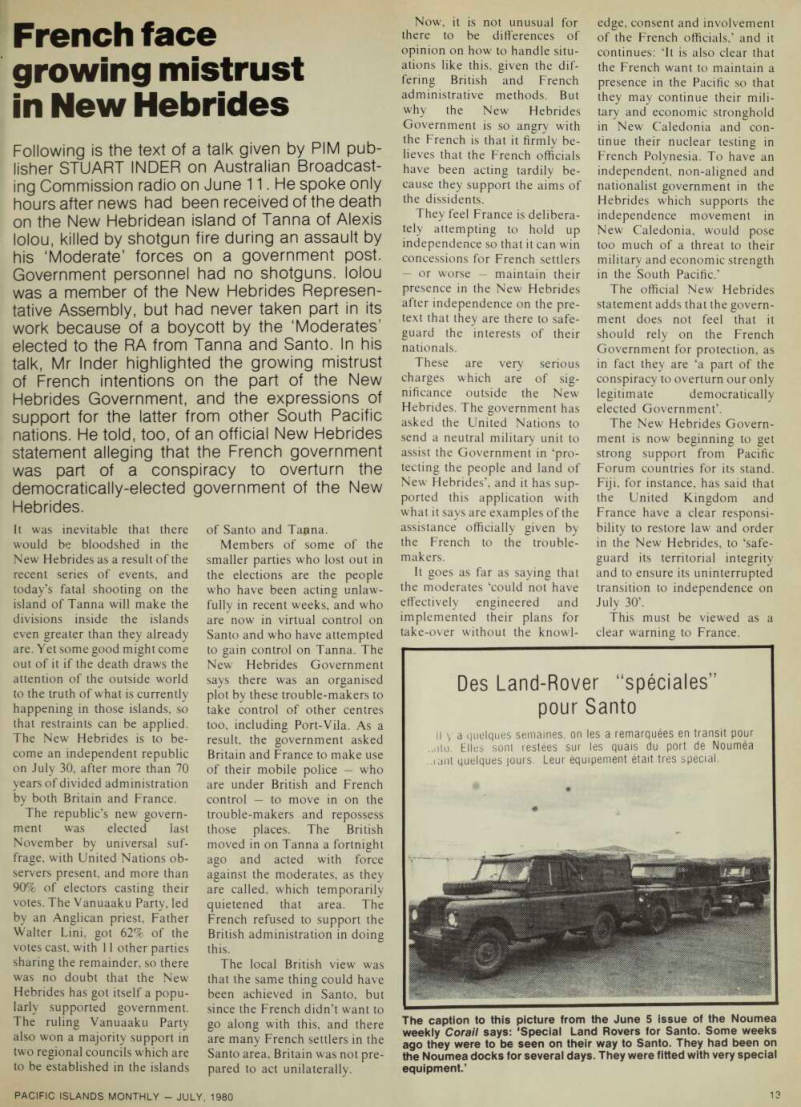
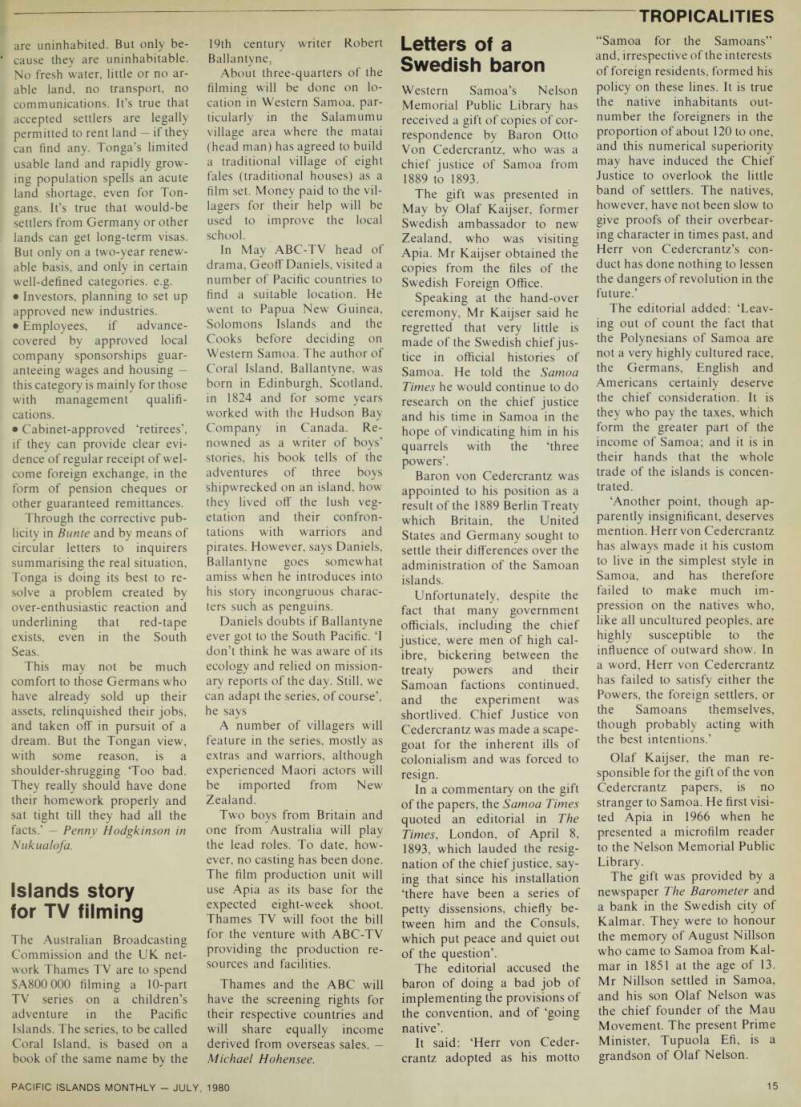
The caption to this picture from the June 5 issue of the Noumea weekly Corail says: ‘Special Land Rovers for Santo. Some weeks ago they were to be seen on their way to Santo. They had been on the Noumea docks for several days. They were fitted with very special
equipment.’
The Coolidge

Tropicalities
as marine
reserve?
The New Hebrides Govern
ment is considering declaring
the USS President Coolidge the largest accessible marine wreck in the world and scuba di ver’s paradise a National Marine Reserve.
The Vila weekly Voice of the New Hebrides reports that Willie Korisa, minister for social affairs in the incoming independent government, has the legal aspects of the matter under close study.
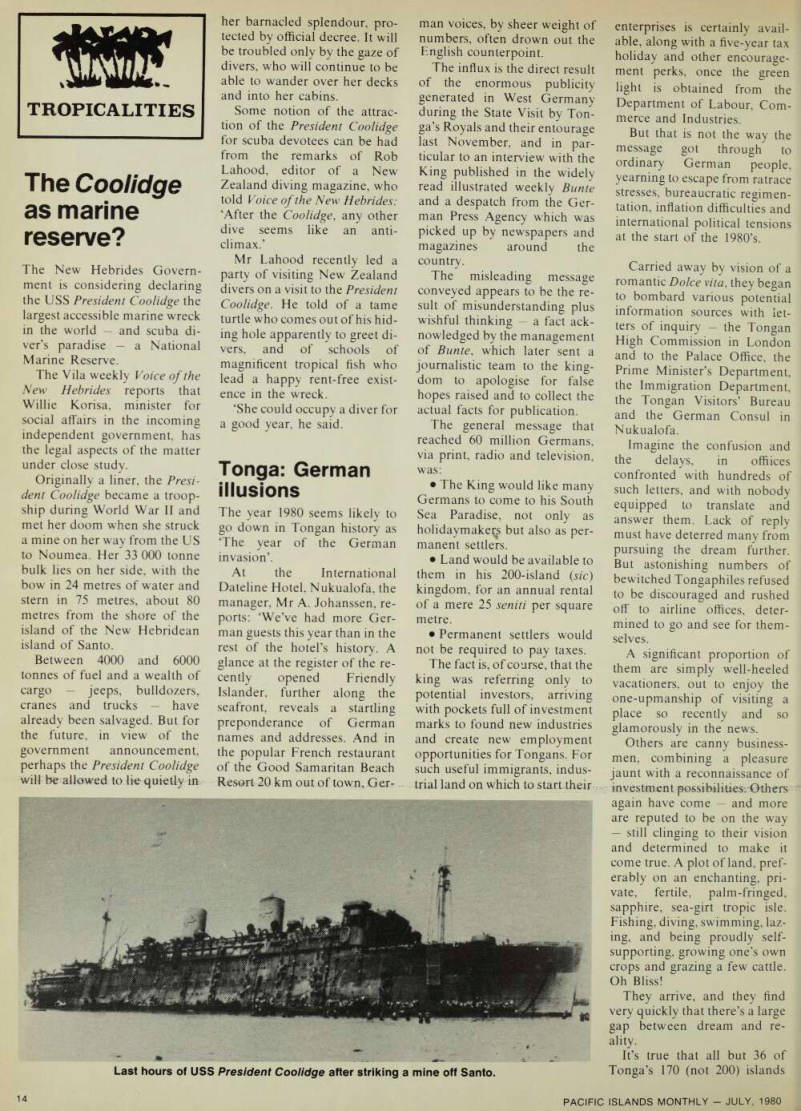
Originally a liner, the Presi dent Coolidge became a troop ship during World War II and met her doom when she struck a mine on her way from the US to Noumea. Her 33 000 tonne bulk lies on her side, with the bow in 24 metres of water and stern in 75 metres, about 80 metres from the shore of the island of the New Hebridean island of Santo.
Between 4000 and 6000 tonnes of fuel and a wealth of cargo jeeps, bulldozers, cranes and trucks have already been salvaged. But for the future, in view of the government announcement,
perhaps the President Coolidge
will be allowed to lie quietly in
her barnacled splendour, pro tected by official decree. It will be troubled only by the gaze of divers, who will continue to be able to wander over her decks and into her cabins.
Some notion of the attrac tion of the President Coolidge for scuba devotees can be had from the remarks of Rob Lahood, editor of a New
Zealand diving magazine, who
told Voice of the New Hebrides: ‘After the Coolidge , any other dive seems like an anti climax.’
Mr Lahood recently led a party of visiting New Zealand divers on a visit to the President Coolidge. He told of a tame turtle who comes out of his hid ing hole apparently to greet di vers, and of schools of
magnificent tropical fish who
lead a happy rent-free exist ence in the wreck. ‘She could occupy a diver for a good year, he said.
Tonga: German
illusions
The year 1980 seems likely to go down in Tongan history as ‘The year of the German invasion’.
At the International Dateline Hotel, Nukualofa, the manager, Mr A. Johanssen, re ports: ‘We’ve had more Ger man guests this year than in the rest of the hotel’s history. A glance at the register of the re
cently opened Friendly
Islander, further along the seafront, reveals a startling preponderance of German names and addresses. And in the popular French restaurant of the Good Samaritan Beach Resort 20 km out of town, Ger
man voices, by sheer weight of numbers, often drown out the
English counterpoint.
The influx is the direct result of the enormous publicity generated in West Germany during the State Visit by Ton ga’s Royals and their entourage last November, and in par ticular to an interview with the
King published in the widely
read illustrated weekly Bunte and a despatch from the Ger man Press Agency which was picked up by newspapers and magazines around the country.
The misleading message conveyed appears to be the re sult of misunderstanding plus wishful thinking a fact ack
nowledged by the management
of Bunte , which later sent a journalistic team to the king dom to apologise for false hopes raised and to collect the actual facts for publication.
The general message that reached 60 million Germans, via print, radio and television, was: • The King would like many Germans to come to his South Sea Paradise, not only as holidaymakers but also as per manent settlers. • Land would be available to them in his 200-island (sic) kingdom, for an annual rental of a mere 25 seniti per square metre. • Permanent settlers would not be required to pay taxes.
The fact is, of course, that the
king was referring only to
potential investors, arriving with pockets full of investment marks to found new industries and create new employment opportunities for Tongans. For such useful immigrants, indus trial land on which to start their
enterprises is certainly avail able, along with a five-year tax holiday and other encourage ment perks, once the green light is obtained from the Department of Labour, Com merce and Industries.
But that is not the way the message got through to ordinary German people, yearning to escape from ratrace stresses, bureaucratic regimen tation, inflation difficulties and international political tensions at the start of the 1980’s.
Carried away by vision of a
romantic Dolce vita , they began
to bombard various potential information sources with let ters of inquiry the Tongan High Commission in London and to the Palace Office, the Prime Minister’s Department, the Immigration Department, the Tongan Visitors’ Bureau and the German Consul in Nukualofa.
Imagine the confusion and the delays, in offiices confronted with hundreds of such letters, and with nobody equipped to translate and answer them. Lack of reply must have deterred many from pursuing the dream further.
But astonishing numbers of bewitched Tongaphiles refused to be discouraged and rushed off to airline offices, deter mined to go and see for them selves.
A significant proportion of them are simply well-heeled vacationers, out to enjoy the one-upmanship of visiting a place so recently and so glamorously in the news.
Others are canny business men, combining a pleasure jaunt with a reconnaissance of investment possibilitiesrOthers again have come and more are reputed to be on the way still clinging to their vision and determined to make it come true. A plot of land, pref erably on an enchanting, pri vate, fertile, palm-fringed, sapphire, sea-girt tropic isle.
Fishing, diving, swimming, laz ing, and being proudly self supporting, growing one’s own crops and grazing a few cattle.
Oh Bliss!
They arrive, and they find very quickly that there’s a large gap between dream and re ality.
It’s true that all but 36 of Tonga’s 170 (not 200) islands
Last hours of USS President Coolidge after striking a mine off Santo.
are uninhabited. But only be cause they are uninhabitable.
No fresh water, little or no ar able land, no transport, no communications. It’s true that
accepted settlers are legally
permitted to rent land if they can find any. Tonga’s limited usable land and rapidly grow ing population spells an acute land shortage, even for Ton gans. It’s true that would-be settlers from Germany or other lands can get long-term visas.
But only on a two-year renew able basis, and only in certain well-defined categories, e.g. • Investors, planning to set up approved new industries. • Employees, if advance
covered by approved local
company sponsorships guar
anteeing wages and housing
this category is mainly for those with management qualifi cations. • Cabinet-approved ‘retirees’, if they can provide clear evi dence of regular receipt of wel come foreign exchange, in the form of pension cheques or other guaranteed remittances.
Through the corrective pub
licity in Bunte and by means of circular letters to inquirers summarising the real situation, Tonga is doing its best to re solve a problem created by over-enthusiastic reaction and
underlining that red-tape
exists, even in the South Seas.
This may not be much comfort to those Germans who have already sold up their
assets, relinquished their jobs,
and taken off in pursuit of a dream. But the Tongan view, with some reason, is a shoulder-shrugging ‘Too bad.
They really should have done their homework properly and sat tight till they had all the facts.’ Penny Hodgkinson in
Nukualofa.
Islands story
for TV filming
The Australian Broadcasting Commission and the UK net work Thames TV are to spend SABOO 000 filming a 10-part TV series on a children’s adventure in the Pacific Islands. The series, to be called Coral Island, is based on a book of the same name by the
19th century writer Robert Ballantyne.
About three-quarters of the filming will be done on lo cation in Western Samoa, par ticularly in the Salamumu village area where the matai (head man) has agreed to build a traditional village of eight fales (traditional houses) as a film set. Money paid to the vil lagers for their help will be used to improve the local school.
In May ABC-TV head of drama, Geoff Daniels, visited a number of Pacific countries to find a suitable location. He went to Papua New Guinea, Solomons Islands and the Cooks before deciding on Western Samoa. The author of Coral Island, Ballantyne, was born in Edinburgh, Scotland, in 1824 and for some years worked with the Hudson Bay Company in Canada. Re nowned as a writer of boys’ stories, his book tells of the adventures of three boys shipwrecked on an island, how they lived off the lush veg etation and their confron tations with warriors and pirates. However, says Daniels, Ballantyne goes somewhat amiss when he introduces into his story incongruous charac ters such as penguins.
Daniels doubts if Ballantyne ever got to the South Pacific. ‘I don’t think he was aware of its ecology and relied on mission ary reports of the day. Still, we can adapt the series, of course’, he says A number of villagers will feature in the series, mostly as extras and warriors, although experienced Maori actors will be imported from New Zealand.
Two boys from Britain and one from Australia will play the lead roles. To date, how ever, no casting has been done.
The film production unit will use Apia as its base for the
expected eight-week shoot.
Thames TV will foot the bill for the venture with ABC-TV
providing the production re
sources and facilities.
Thames and the ABC will have the screening rights for their respective countries and will share equally income derived from overseas sales.
Michael Hohensee.
Letters of a
Swedish baron
Western Samoa’s Nelson Memorial Public Library has received a gift of copies of cor
respondence by Baron Otto
Von Cedercrantz, who was a chief justice of Samoa from 1889 to 1893.
The gift was presented in May by Olaf Kaijser, former Swedish ambassador to new Zealand, who was visiting Apia. Mr Kaijser obtained the copies from the files of the Swedish Foreign Office.
Speaking at the hand-over ceremony, Mr Kaijser said he regretted that very little is made of the Swedish chief jus tice in official histories of Samoa. He told the Samoa Times he would continue to do research on the chief justice and his time in Samoa in the hope of vindicating him in his quarrels with the ‘three
powers’.
Baron von Cedercrantz was appointed to his position as a result of the 1889 Berlin Treaty which Britain, the United States and Germany sought to settle their differences over the administration of the Samoan islands.
Unfortunately, despite the
fact that many government officials, including the chief justice, were men of high cal ibre, bickering between the treaty powers and their Samoan factions continued, and the experiment was shortlived. Chief Justice von Cedercrantz was made a scape goat for the inherent ills of colonialism and was forced to
resign.
In a commentary on the gift of the papers, the Samoa Times quoted an editorial in The Times , London, of April 8, 1893, which lauded the resig nation of the chief justice, say ing that since his installation ‘there have been a series of petty dissensions, chiefly be tween him and the Consuls, which put peace and quiet out of the question’.
The editorial accused the baron of doing a bad job of
implementing the provisions of
the convention, and of ‘going native’.
It said: ‘Herr von Ceder crantz adopted as his motto
“Samoa for the Samoans” and, irrespective of the interests of foreign residents, formed his policy on these lines. It is true the native inhabitants out number the foreigners in the proportion of about 120 to one, and this numerical superiority may have induced the Chief Justice to overlook the little band of settlers. The natives, however, have not been slow to give proofs of their overbear ing character in times past, and Herr von Cedercrantz’s con duct has done nothing to lessen the dangers of revolution in the future.’
The editorial added: ‘Leav ing out of count the fact that the Polynesians of Samoa are not a very highly cultured race, the Germans, English and Americans certainly deserve the chief consideration. It is they who pay the taxes, which form the greater part of the income of Samoa; and it is in their hands that the whole trade of the islands is concen trated.
‘Another point, though ap
parently insignificant, deserves
mention. Herr von Cedercrantz has always made it his custom to live in the simplest style in Samoa, and has therefore failed to make much im pression on the natives who, like all uncultured peoples, are
highly susceptible to the
influence of outward show. In a word, Herr von Cedercrantz has failed to satisfy either the Powers, the foreign settlers, or the Samoans themselves,
though probably acting with
the best intentions.’
Olaf Kaijser, the man re sponsible for the gift of the von Cedercrantz papers, is no stranger to Samoa. He first visi ted Apia in 1966 when he presented a microfilm reader to the Nelson Memorial Public
Library.
The gift was provided by a
newspaper The Barometer and a bank in the Swedish city of Kalmar. They were to honour the memory of August Nillson who came to Samoa from Kal mar in 1851 at the age of 13.
Mr Nillson settled in Samoa, and his son Olaf Nelson was the chief founder of the Mau Movement. The present Prime Minister, Tupuola Efi, is a grandson of Olaf Nelson.
Yet another sect
sets up In Tonga
Tonga, having recently cel ebrated the centenary of its treaty of friendship with the Republic of Germany, seemed a likely place for the New Apostolic Church to continue its evangelistic moves into the
Pacific region, particularly
when its modern-day mis sionaries are named Schulte and Hammacher. This church is particularly strong in such places as Germany and South Africa.
April 1978 saw Queensland District Elder Berne Shulte and
Sydney Evangelist Heinz Ham
macher arrive in Nukualofa to launch their church activities in the heart of Methodist terri tory. Since that occasion their church has continued to blossom. The Christian Ton gans share common interests with the New Apostolic Church (NAC) followers, being keen students of the Bible and renowned for the excellence of their choirs.
During their first week in Tonga, Elder Schulte and Evangelist Hammacher ex plained the purpose of their visit in a short radio broadcast, and the following day, in a two hour audience with His Maj
esty King Taufa’ahau Tupou
IV the church received royal approval to enter the Wesleyan
stronghold.
Although the first visit to Tonga lasted only seven days, the seeds of interest had been sown. At one service the local Wesleyan and Seventh-day Adventist ministers attended
and participated in worship.
Since April 1978 a further six team visits have taken place and on each occasion increased interest in the church has resulted. During one of these visits two NAC missionaries were visiting the offshore island of Lofanga in the
Haapai group where they
observed Tongans constructing
a small building. They quickly
rolled up their sleeves and completed the roof of what turned out to be the island’s
only hospital. An example of
Christianity with a Bible in one hand and a work tool in the other.
The NAC is keen to put up its first church building in Tonga. However, until that time arrives, services will be conducted in local homes or community halls. Each Sunday
and Wednesday their recently
ordained priest, the Rev Sami Koho conducts services in Nukualofa.
In these first two years the church membership has grown
to 35, hardly a staggering fig
ure, yet creditable in a country where there are such well established and well attended Christian churches.
The NAC is active in many areas of the Pacific, with strong followings in Papua New Guinea, the Solomons, Fiji, the Samoas, Indonesia, Hawaii and Tahiti. The church is not only present in the Western world. It is active in the Eastern bloc countries of East Ger many, Yugoslavia and Ro mania. The Church is also well represented in at least seven countries in South America.
The NAC does not have aca demically trained ministers. Its buildings are free of debt and are mostly built and main tained by members of the vari ous congregations. Its ministers in everyday life might be farmers, lawyers, doctors, mechanics or carpenters, and together with its ultra conservative outlook will blend in well with the Tongan way of life, and surely ‘run the good race'. John Slender.
New journal for
Solomons
A new journal dealing with a wide range of Solomon Islands issues is planned by the Solomon Islands Centre of the University of the South Pa cific.
The centre’s advisory com mittee has recommended pub lication of the journal, which is expected to appear bi
annually. Cost of producing
the first issue will be provided by part of a grant to the centre from the Australian Cultural Fund.
An editorial committee has been formed. Members are Mrs Kuria Hughes, Ms Salome Samou, Mrs Hazel Lulei, Mr
Teioke Kaiete and Mr Edward lame.
The centre’s director, Tony Austin, said the advisory com mittee feels there is a need for a journal which deals in some
depth with many development
issues such as economic policy, education, history, health, agriculture, literacy, etc. Exist ing newspapers cannot provide space for the longer articles re quired for such a journal. At present writers of such articles can only publish overseas.
A number of people have been asked to prepare articles for the first issue. It is hoped that, before long, people will come forward and offer to pre pare articles, and publish the results of research in the
journal. Foreign research
workers in the Solomons are required by the terms of their permits to make their findings available to the government.
The journal should enable this information to be made gener ally known. Ultimately, it is
hoped the journal will gain an
international reputation as an outlet for research and opinion about Solomon Islands.
Press release from the Solomon Islands Centre, USP.
’Quake forecast
team in NH
A team of scientists from Aus tralia’s University of Queens land has spent several months of this year in New Hebrides
installing instruments designed
to help in the long-range prediction of earthquakes.
Led by Dr Michael Gladwin, the team has been funded by the US Geological Survey and the Australian Research Grants Committee, which has
also provided pilot study fund
ing.
The Australians’ work complemented earlier seismic studies in New Hebrides by Professor Byron Isacks of Cor nell University, USA.
The 11 instruments they established at various airports throughout the group form part of a chain of 27 in the re gion. The others are established in Papua New Guinea and Solomon Islands.
The instruments transmit their readings to an earth satellite which in turn transmits them to the USA, where they are
analysed by computer. The
resulting information is then transmitted to Australia.
Dr Gladwin says that if this system of prediction, established in a region of high seismic sensitivity, proves effective, it is likely to be introduced into earthquake prone regions of high popu lation, such as the west coast of the USA, Japan and China.
The scientists have met with a certain amount of opposition
from superstitious local people
- on the island of Tanna, for example. Said Dr Gladwin: ‘A little publicity for our work
might help the people to
understand what we are trying to do so they won’t wreck our instruments’ - which is what happens when the people are not in favour of a given project.
Kathleen Paul.
Solomon Islands has received high praise for its postal transport stamps issued recently to mark the International Stamp Exhibition at Earls Court, London.
Advertisements & other items, p. 16 (1 item)
pcjwep
Looking for handy, reliable transport from home to town?
For performing everyday tasks?
Go with a Suzuki!— choose one of our rugged,
high-performing 4-wheel drive vehicles,
just meeting your transport needs.
and
FOP
mqb§
WiQ
TOR®
pcjwep
r SSL'S
Look into the traditional excellence of Suzuki’s performanceproven motorcycles and fleet of outboard motors something to satisfy your every motoring need. Going by land or by sea ... go with a Suzuki.
DTBS
SUZUKI IS 125
SUZUKI MOTOR CO., LTD. reserves the right to change, without notice, equipment, specifications, colours, materials and other items to apply local conditions. Each model might be discontinued without notice. Please inquire at your local dealer for details of any such changes. Actual body colours might differ slightly from the colours in this ad.
SUZUKI MOTOR CO , LTD
Hamamatsu, Japan
SUZUKI
SOLOMON ISLANDS SOLOMON ISLAND SERVICE STATION LTD. «NEW CALEDONIA STE. SUPERCAL • PAPUA NEW GUINEA BURNS PHILP (NEW GUINEA) LTD. «NEW HEBRIDES HENRI LEROUX •NIUE ISLAND BURNS PHILP (SOUTH SEA) CO., LTD. • PON APE LEO ETSCHEIT • TAHITI NIPPON AUTOMOTO • ELLICE ISLAND TUVALU COOPERATIVE WHOLESALE SOCIETY LTD. «GUAM & SAIPAN ISLAND CYCLERY, INC. • NORFOLK MARTIN’S AGENCIES LTD. «SAMOA PACIFIC PRODUCTS. INC. •TARAWA GILBERT ISLANDS COOPERATIVE FEDERATION LIMITED •TONGA MORRIS HEDSTROM LTD. •WESTERN CAROLINES BECHESRRAK T. COMPANY •YAP AMBROSE D. MINGINFEL’S WHOLESALER • EASTERN CAROLINES KIOMASA STORE • NAURU EQUAPAC MOTORS •FIJI NIRANJANS AUTOPORT LTD.
watches PNG policy
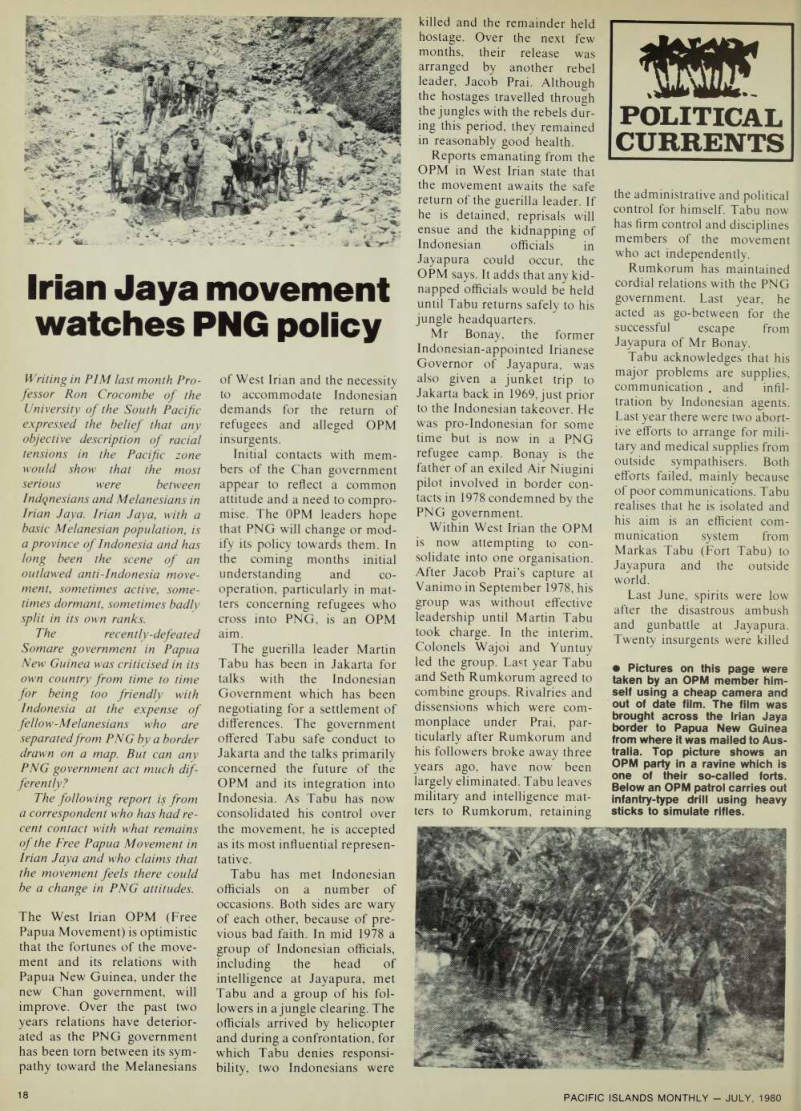
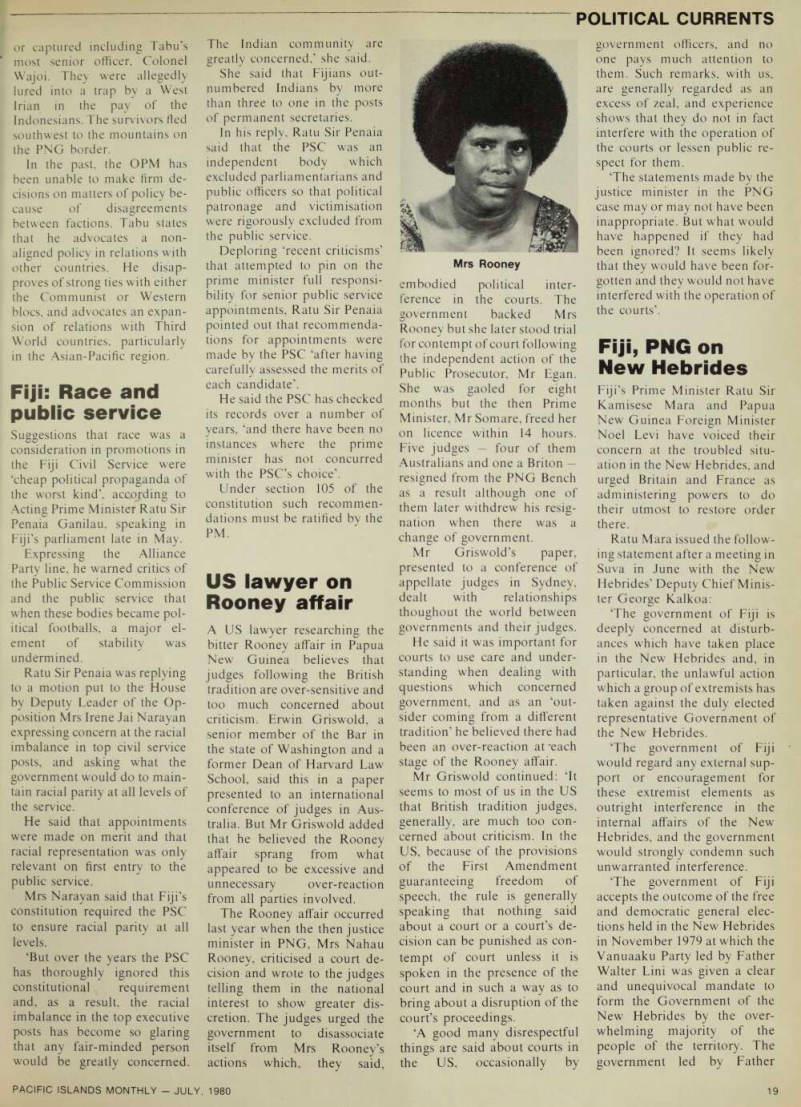
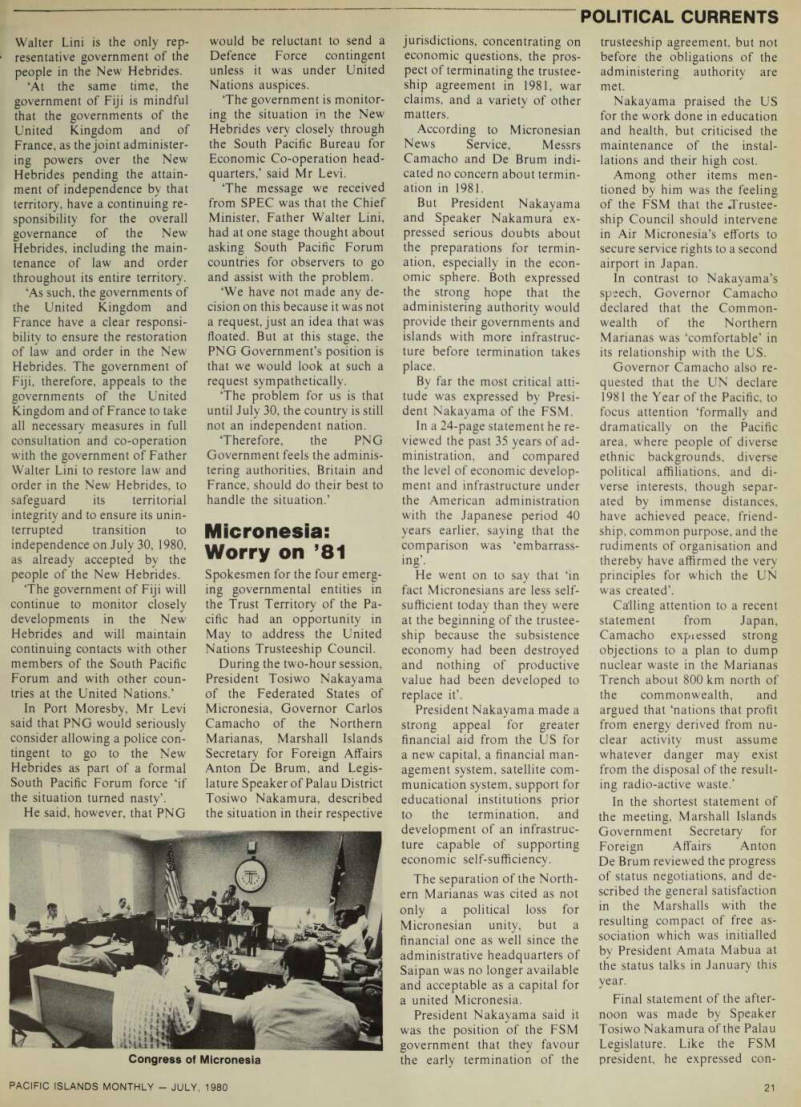
Political
Currents
Irian Jaya movement watches PNG policy
Writing in PIM last month Pro fessor Ron Crocombe of the
University of the South Pacific
expressed the belief that any
objective description of racial
tensions in the Pacific zone would show that the most serious were between Indqnesians and Melanesians in Irian Jay a. Irian Jay a, with a basic Melanesian population, is a province of Indonesia and has long been the scene of an outlawed anti-Indonesia move ment, sometimes active, some times dormant, sometimes badly split in its own ranks.
The recently-defeated
Somare government in Papua New Guinea was criticised in its own country from time to time
for being too friendly with
Indonesia at the expense of fellow-Melanesians who are separatedfrom PNG by a border drawn on a map. But can any PNG government act much dif
ferently?
The following report is from a correspondent who has had re cent contact with what remains of the Free Papua Movement in Irian Jaya and who claims that the movement feels there could be a change in PNG attitudes.
The West Irian OPM (Free
Papua Movement) is optimistic
that the fortunes of the move ment and its relations with Papua New Guinea, under the new Chan government, will improve. Over the past two years relations have deterior ated as the PNG government has been torn between its sym pathy toward the Melanesians
of West Irian and the necessity to accommodate Indonesian demands for the return of
refugees and alleged OPM
insurgents.
Initial contacts with mem bers of the Chan government appear to reflect a common attitude and a need to compro mise. The OPM leaders hope that PNG will change or mod ify its policy towards them. In the coming months initial understanding and co
operation, particularly in mat
ters concerning refugees who
cross into PNG, is an OPM aim.
The guerilla leader Martin Tabu has been in Jakarta for talks with the Indonesian Government which has been negotiating for a settlement of differences. The government offered Tabu safe conduct to Jakarta and the talks primarily concerned the future of the OPM and its integration into Indonesia. As Tabu has now consolidated his control over the movement, he is accepted as its most influential represen tative.
Tabu has met Indonesian officials on a number of occasions. Both sides are wary of each other, because of pre vious bad faith. In mid 1978 a group of Indonesian officials, including the head of intelligence at Jayapura, met Tabu and a group of his fol lowers in a jungle clearing. The
officials arrived by helicopter
and during a confrontation, for which Tabu denies responsi bility, two Indonesians were
killed and the remainder held hostage. Over the next few months, their release was arranged by another rebel leader, Jacob Prai. Although
the hostages travelled through
the jungles with the rebels dur ing this period, they remained
in reasonably good health.
Reports emanating from the
OPM in West Irian state that the movement awaits the safe return of the guerilla leader. If he is detained, reprisals will ensue and the kidnapping of Indonesian officials in Jayapura could occur, the OPM says. It adds that any kid napped officials would be held until Tabu returns safely to his
jungle headquarters.
Mr Bonay, the former
Indonesian-appointed Irianese
Governor of Jayapura, was
also given a junket trip to
Jakarta back in 1969, just prior to the Indonesian takeover. He was pro-Indonesian for some time but is now in a PNG refugee camp. Bonay is the father of an exiled Air Niugini pilot involved in border con tacts in 1978 condemned by the PNG government.
Within West Irian the OPM is now attempting to con solidate into one organisation.
After Jacob Prai’s capture at Vanimo in September 1978, his group was without effective leadership until Martin Tabu took charge. In the interim,
Colonels Wajoi and Yuntuy
led the group. Last year Tabu and Seth Rumkorum agreed to combine groups. Rivalries and dissensions which were com monplace under Prai, par ticularly after Rumkorum and his followers broke away three years ago, have now been largely eliminated. Tabu leaves
military and intelligence mat
ters to Rumkorum, retaining
the administrative and political control for himself. Tabu now has firm control and disciplines members of the movement who act independently.
Rumkorum has maintained cordial relations with the PNG government. Last year, he acted as go-between for the successful escape from
Jayapura of Mr Bonay.
Tabu acknowledges that his
major problems are supplies,
communication . and infil tration by Indonesian agents.
Last year there were two abort ive efforts to arrange for mili tary and medical supplies from outside sympathisers. Both efforts failed, mainly because of poor communications. Tabu realises that he is isolated and his aim is an efficient com munication system from Markas Tabu (Fort Tabu) to Jayapura and the outside world.
Last June, spirits were low after the disastrous ambush
and gunbattle at Jayapura.
Twenty insurgents were killed
Pictures on this page were taken by an OPM member him self using a cheap camera and out of date film. The film was brought across the Irian Jaya border to Papua New Guinea from where it was mailed to Aus tralia. Top picture shows an OPM party in a ravine which is one of their so-called forts.
Below an OPM patrol carries out
infantry-type drill using heavy
sticks to simulate rifles.
or captured including Tabu’s most senior officer. Colonel
Wajoi. They were allegedly
lured into a trap by a West Irian in the pay of the Indonesians. The survivors fled southwest to the mountains on the PNG border.
In the past, the OPM has been unable to make firm de cisions on matters of policy be cause of disagreements between factions. Tabu states that he advocates a non aligned policy in relations with other countries. He disap proves of strong ties with either the Communist or Western blocs, and advocates an expan sion of relations with Third World countries, particularly in the Asian-Pacific region.
Fiji: Race and
public service
Suggestions that race was a consideration in promotions in the Fiji Civil Service were
‘cheap political propaganda of
the worst kind’, according to Acting Prime Minister Ratu Sir Penaia Ganilau, speaking in Fiji’s parliament late in May.
Expressing the Alliance Party line, he warned critics of the Public Service Commission and the public service that when these bodies became pol itical footballs, a major el ement of stability was undermined.
Ratu Sir Penaia was replying to a motion put to the House
by Deputy Leader of the Op
position Mrs Irene Jai Narayan expressing concern at the racial imbalance in top civil service posts, and asking what the government would do to main tain racial parity at all levels of the service.
He said that appointments were made on merit and that
racial representation was only
relevant on first entry to the
public service.
Mrs Narayan said that Fiji’s constitution required the PSC to ensure racial parity at all levels. ‘But over the years the PSC
has thoroughly ignored this
constitutional requirement
and, as a result, the racial imbalance in the top executive posts has become so glaring that any fair-minded person would be greatly concerned.
The Indian community are greatly concerned,’ she said.
She said that Fijians out numbered Indians by more than three to one in the posts of permanent secretaries.
In his reply, Ratu Sir Penaia said that the PSC was an
independent body which
excluded parliamentarians and public officers so that political patronage and victimisation were rigorously excluded from the public service.
Deploring ‘recent criticisms’ that attempted to pin on the
prime minister full responsi
bility for senior public service appointments, Ratu Sir Penaia pointed out that recommenda tions for appointments were made by the PSC ‘after having carefully assessed the merits of each candidate’.
He said the PSC has checked its records over a number of years, ‘and there have been no instances where the prime minister has not concurred with the PSC’s choice’.
Under section 105 of the constitution such recommen dations must be ratified by the PM.
US lawyer on
Rooney affair
A US lawyer researching the bitter Rooney affair in Papua New Guinea believes that
judges following the British
tradition are over-sensitive and too much concerned about criticism. Erwin Griswold, a senior member of the Bar in the state of Washington and a former Dean of Harvard Law School, said this in a paper presented to an international conference of judges in Aus tralia. But Mr Griswold added that he believed the Rooney affair sprang from what appeared to be excessive and unnecessary over-reaction from all parties involved.
The Rooney affair occurred last year when the then justice minister in PNG, Mrs Nahau Rooney, criticised a court de cision and wrote to the judges telling them in the national interest to show greater dis cretion. The judges urged the government to disassociate itself from Mrs Rooney’s actions which, they said,
embodied political inter ference in the courts. The government backed Mrs Rooney but she later stood trial for contempt of court following the independent action of the Public Prosecutor, Mr Egan.
She was gaoled for eight months but the then Prime Minister, Mr Somare, freed her on licence within 14 hours.
Five judges four of them Australians and one a Briton resigned from the PNG Bench as a result although one of them later withdrew his resig nation when there was a change of government.
Mr Griswold’s paper, presented to a conference of
appellate judges in Sydney,
dealt with relationships thoughout the world between governments and their judges.
He said it was important for courts to use care and under
standing when dealing with
questions which concerned government, and as an ‘out sider coming from a different tradition’ he believed there had been an over-reaction at *each stage of the Rooney affair.
Mr Griswold continued: ‘lt seems to most of us in the US that British tradition judges, generally, are much too con cerned about criticism. In the US, because of the provisions of the First Amendment guaranteeing freedom of speech, the rule is generally
speaking that nothing said
about a court or a court’s de cision can be punished as con tempt of court unless it is spoken in the presence of the court and in such a way as to bring about a disruption of the
court’s proceedings.
‘A good many disrespectful
things are said about courts in the US, occasionally by
government officers, and no one pays much attention to them. Such remarks, with us, are generally regarded as an excess of zeal, and experience shows that they do not in fact interfere with the operation of the courts or lessen public re spect for them.
The statements made by the justice minister in the PNG case may or may not have been inappropriate. But what would have happened if they had been ignored? It seems likely that they would have been for gotten and they would not have interfered with the operation of the courts’.
Fiji, PNG on
New Hebrides
Fiji’s Prime Minister Ratu Sir Kamisese Mara and Papua New Guinea Foreign Minister Noel Levi have voiced their concern at the troubled situ ation in the New Hebrides, and urged Britain and France as administering powers to do their utmost to restore order there.
Ratu Mara issued the follow ing statement after a meeting in Suva in June with the New Hebrides’ Deputy Chief Minis ter George Kalkoa: ‘The government of Fiji is deeply concerned at disturb ances which have taken place in the New Hebrides and, in particular, the unlawful action which a group of extremists has taken against the duly elected representative Government of the New Hebrides. ‘The government of Fiji would regard any external sup port or encouragement for these extremist elements as outright interference in the internal affairs of the New Hebrides, and the government would strongly condemn such unwarranted interference. ‘The government of Fiji accepts the outcome of the free and democratic general elec tions held in the New Hebrides in November 1979 at which the Vanuaaku Party led by Father Walter Lini was given a clear and unequivocal mandate to form the Government of the New Hebrides by the over
whelming majority of the
people of the territory. The government led by Father
Mrs Rooney
Walter Lini is the only rep resentative government of the people in the New Hebrides. ‘At the same time, the government of Fiji is mindful that the governments of the United Kingdom and of France, as the joint administer ing powers over the New Hebrides pending the attain ment of independence by that territory, have a continuing re sponsibility for the overall governance of the New Hebrides, including the main tenance of law and order
throughout its entire territory.
‘As such, the governments of the United Kingdom and France have a clear responsi bility to ensure the restoration of law and order in the New Hebrides. The government of Fiji, therefore, appeals to the governments of the United Kingdom and of France to take all necessary measures in full consultation and co-operation with the government of Father Walter Lini to restore law and order in the New Hebrides, to safeguard its territorial integrity and to ensure its unin terrupted transition to independence on July 30, 1980,
as already accepted by the
people of the New Hebrides.
The government of Fiji will continue to monitor closely developments in the New Hebrides and will maintain continuing contacts with other members of the South Pacific Forum and with other coun tries at the United Nations.’
In Port Moresby, Mr Levi said that PNG would seriously consider allowing a police con tingent to go to the New Hebrides as part of a formal South Pacific Forum force ‘if the situation turned nasty’.
He said, however, that PNG
would be reluctant to send a Defence Force contingent unless it was under United Nations auspices. ‘The government is monitor ing the situation in the New Hebrides very closely through the South Pacific Bureau for Economic Co-operation head quarters,’ said Mr Levi. ‘The message we received from SPEC was that the Chief Minister, Father Walter Lini, had at one stage thought about asking South Pacific Forum countries for observers to go and assist with the problem. ‘We have not made any de cision on this because it was not a request, just an idea that was floated. But at this stage, the PNG Government’s position is that we would look at such a
request sympathetically.
‘The problem for us is that until July 30, the country is still not an independent nation. ‘Therefore, the PNG Government feels the adminis tering authorities, Britain and France, should do their best to handle the situation.’
Micronesia:
Worry on ’Bl
Spokesmen for the four emerg
ing governmental entities in
the Trust Territory of the Pa cific had an opportunity in May to address the United Nations Trusteeship Council.
During the two-hour session, President Tosiwo Nakayama of the Federated States of Micronesia, Governor Carlos Camacho of the Northern Marianas, Marshall Islands Secretary for Foreign Affairs Anton De Brum, and Legis lature Speaker of Palau District Tosiwo Nakamura, described the situation in their respective
jurisdictions, concentrating on
economic questions, the pros pect of terminating the trustee ship agreement in 1981, war claims, and a variety of other matters.
According to Micronesian News Service, Messrs Camacho and De Brum indi cated no concern about termin ation in 1981.
But President Nakayama and Speaker Nakamura ex pressed serious doubts about the preparations for termin ation, especially in the econ
omic sphere. Both expressed
the strong hope that the
administering authority would
provide their governments and islands with more infrastruc ture before termination takes
place.
By far the most critical atti tude was expressed by Presi dent Nakayama of the FSM.
In a 24-page statement he re viewed the past 35 years of ad ministration, and compared the level of economic develop ment and infrastructure under the American administration with the Japanese period 40 years earlier, saying that the comparison was ‘embarrass
ing’.
He went on to say that ‘in fact Micronesians are less self sufficient today than they were at the beginning of the trustee ship because the subsistence economy had been destroyed
and nothing of productive
value had been developed to
replace it’.
President Nakayama made a strong appeal for greater financial aid from the US for a new capital, a financial man agement system, satellite com munication system, support for educational institutions prior to the termination, and development of an infrastruc ture capable of supporting
economic self-sufficiency.
The separation of the North ern Marianas was cited as not only a political loss for Micronesian unity, but a financial one as well since the administrative headquarters of Saipan was no longer available and acceptable as a capital for a united Micronesia.
President Nakayama said it was the position of the FSM government that they favour the early termination of the
trusteeship agreement, but not before the obligations of the
administering authority are
met.
Nakayama praised the US
for the work done in education and health, but criticised the maintenance of the instal lations and their high cost.
Among other items men tioned by him was the feeling of the FSM that the .Trustee ship Council should intervene in Air Micronesia’s efforts to secure service rights to a second
airport in Japan.
In contrast to Nakayama’s speech, Governor Camacho declared that the Common wealth of the Northern Marianas was ‘comfortable’ in its relationship with the US.
Governor Camacho also re quested that the UN declare 1981 the Year of the Pacific, to focus attention ‘formally and dramatically on the Pacific area, where people of diverse ethnic backgrounds, diverse political affiliations, and di verse interests, though separ ated by immense distances, have achieved peace, friend ship, common purpose, and the rudiments of organisation and thereby have affirmed the very principles for which the UN was created’.
Calling attention to a recent statement from Japan, Camacho expiessed strong
objections to a plan to dump
nuclear waste in the Marianas Trench about 800 km north of the commonwealth, and argued that ‘nations that profit from energy derived from nu clear activity must assume whatever danger may exist from the disposal of the result ing radio-active waste.’
In the shortest statement of the meeting, Marshall Islands Government Secretary for Foreign Affairs Anton De Brum reviewed the progress of status negotiations, and de scribed the general satisfaction in the Marshalls with the resulting compact of free as sociation which was initialled by President Amata Mabua at the status talks in January this year.
Final statement of the after noon was made by Speaker Tosiwo Nakamura of the Palau Legislature. Like the FSM president, he expressed con
Congress of Micronesia
cern that the trusteeship might be terminated before an ad equate infrastructure was in place in Palau.
Speaker Nakamaru noted that ‘the trusteeship termin ation is, in the final analysis, the process of self determination to be decided by the people concerned, in this case by the Micronesians them selves, and not by the United States’.
Pay boost for
Apia MPs
Western Samoa’s parliamen tarians have received pay
boosts retrospective to January
1. 1980.
The prime minister now re ceives $lB 500 a year, including allowances (up from $l3 000, including allowances); Cabinet Ministers: $lO 000, plus $2500 allowances; and MPs from Savaii and Upolu $5500 a year,
including allowances.
Salary increases for the Head of State and the Council of
Deputies are to be approved by
act of parliament when it meets for the first time this year in July or August.
Saving Fiji
from Reds
A senior member of Fiji’s
parliamentary opposition, and
two businessmen who support the ruling Alliance Party, have teamed up to save Fiji from communism.
While the country isn’t in imminent danger of being sub merged by the Red threat, it may need saving in five years, according to National Feder ation Party MP Vijay Par-’ manandam, who is president of the Fiji Youth Anti-Com
munist League.
The league is affiliated with the Asian Youth Anti-Com munist League, which in turn is affiliated with the World Youth Anti-Communist League. The world body had about 30 countries as members, and in some the national league had other bodies affili ated with it.
Mr Parmanandam, a pros perous lawyer and business man. has taken up the cudgels with the help of Suva bus
company manager and city council member Maan Singh, and construction company
owner Vijay Ragwhan.
Mr Parmanandam said the main reason the league had been formed was that Fiji had broken off relations with Taiwan and recognised Red China.
Asked by The Fiji Times if there were dangers in having links with the Soviet Union or China. Mr Parmanandam said he thought there were dangers in having links with any com munist country. ‘We are naive in our foreign affairs understandably naive as we are a new country, not yet 10 years old.’ he said.
The Latos saga
wound up
An examination paper with spelling errors and typing mis takes was at the centre of a sharp row earlier this year be tween New Zealand and a number of Pacific States.
The Language Achievement Test for Overseas Students - Latos was administered
by New Zealand’s University
Grants Committee to Pacific and Asian students trying to get into New Zealand universi ties.
Unexpectedly, New Zealand toughened up the test this year and refused 13 of Western Samoa’s top 18 students places
in university, even though they
had passed all the tests that ordinary New Zealand students would have to pass.
At least two Tongan stu dents, winners of Auckland Star scholarships, were also bounced out on the basis of Latos. A number of Asian students were also affected.
Australia, quick to seize the
public relations advantage, im
mediately offered places in
Australian universities to the New Zealand rejects.
That was hardly the end of the matter because Western Samoa, Fiji and Tonga were stuck with education systems all geared towards New Zea land. Their students all aim to pass School Certificate (sat for in the third year of high school) and University Entrance (UE, sat for the following year).
Both papers are set in New Zealand, and are aimed mainly at the tens of thousands of New Zealanders who sit for them.
UE, as the name implies, is the
key to university education.
But in the last 10 years non- New Zealanders have been forced to sit for Latos as well.
The test is supposed to be a measure of language pro ficiency, but recently it was used as a device to cut back on the numbers of foreign students universities would have to handle. The universi ties claimed the test was an excellent way of judging language, but they declined to let anybody see it. The test is administered in secret, teachers are not allowed to see it, and students are not allowed even to take away the question sheets at the end of the examin ation.
Western Samoa’s Prime Minister Tupuola Efi him self educated at a New Zealand
university was outraged at
the way Latos was used to cut out his students. His anger was further increased by a secret New Zealand Ministry of Foreign Affairs report written by researcher Dr Patricia Kinloch.
Foreign Affairs had been telling the Samoan Govern
ment that Samoan students were failing their courses in greater numbers than other students, and that they failed their courses with lower levels of marks. Kinloch’s report showed this to be simply untrue. ‘We’re being conned,’ a spokesman for the Prime
Minister’s Department in Apia
told the official newspaper Savali.
Tupuola headed to Welling
ton with the report to back up his complaints, but found an unexpected ally in New Zealand’s Prime Minister Robert Muldoon who was annoyed at the universities as well.
Although funded by the
government, New Zealand universities are independent and cannot be directed by government. However, a re quest from the New Zealand Cabinet to take a look at the issue, as well as heavy press criticism, forced the uni versities to reconsider. In late May they suspended Latos and set up a sub-committee to examine it. It is believed Latos will remain buried for quite some time, and will re-emerge next year in a much changed form. Mike Field in Welling ton.
Victoria University - Latos reconsidered
Advertisements & other items, p. 20 (1 item)
f
♦ **
I ==s?==si W i *
\WZ*&~~Z IT**? ff
so f » ? ac
Uil
JVC
HR -90
c TECHfIiCHLiRECORD i SER
Here you see them: all of JVC’s wide-ranging products. At JVC, we think that every one of them is a star.
After all, it’s not every audio and video manufacturer that can offer the likes of the Super-A high fidelity amplifiers, the world’s first metal-tape-compatible cassette decks, the JVC-invented VHS video cassette system or the revolutionary VHD video disc system which offers immense potential for the future. And that’s just naming a few of the major technological developments in the products you see here.
These products are only the result of 53 years of hard work in all aspects of audio and video. Over half a century of rigorous quality control, extensive research and a refusal to be daunted by obstacles </EF* V Q X £■ °fo<? in the way of innovative advances. The reason, we feel, why we were chosen for the 1980 Olympic Games.
At JVC, we’ve got over 10,000 dedicated men and women working around the world to bring you audio and video performance worthy to be called “all-star.”
Because we know that’s the only kind of performance worthy of you.
JVC
VICTOR COMPANY OF JAPAN. LIMITED
Australia: Hagemeyer (Australasia) 8.V., 25-27 Paul Street, North Ryde, N.S.W. 2113.
Australia Tel. 887-1444 Fiji Islands: D. Gokal & Co., Ltd., G.P.O. Box 501, Corner of Pier Street & Renwick Road, Suva, Fiji Tel. 25259 Cook Islands: J & P. Ingram & Co., Ltd., P.O. Box 55, Rarotonga, Cook Islands Tel. 378457 New Hebrides: Wu ke Luong, P.O. Box 113, Rue Higginson, Port-Vila, New [Hebrides Tel. 2115 New Caledonia: Caldis, 2, Route du Velodrome, B.P. Ml, Noumea, Cedex, New Caledonia Tel. 262350 Tahiti: Magasin Sincere, B.P. 215, Papeete, Tahiti Tel. 20060 Papua New Guinea: Hagemeyer (P.N.G.) Pty, Ltd., P.O. Box9oLae, Papua New Guinea Tel. 42-3200 New Zealand: Atlas Majestic Industries Ltd., 11, Albion Road, Otahuhu, Auckland 6, New Zealand Tel. 27-67-099 !
People
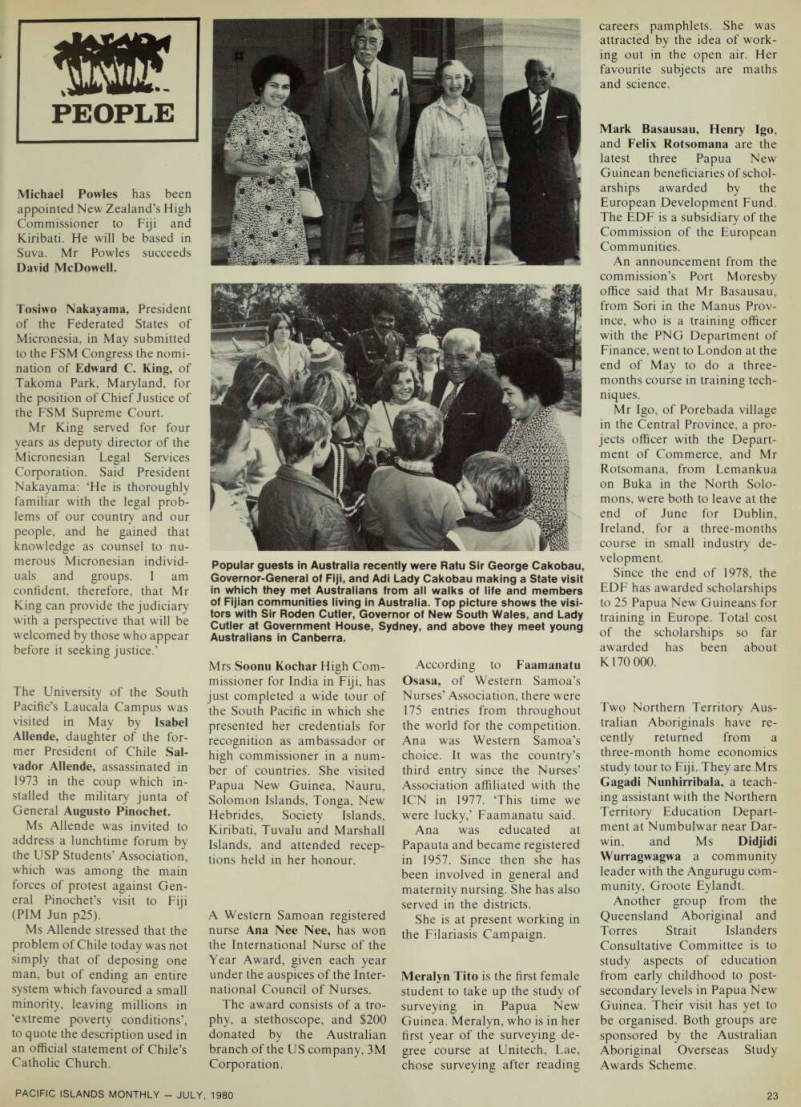

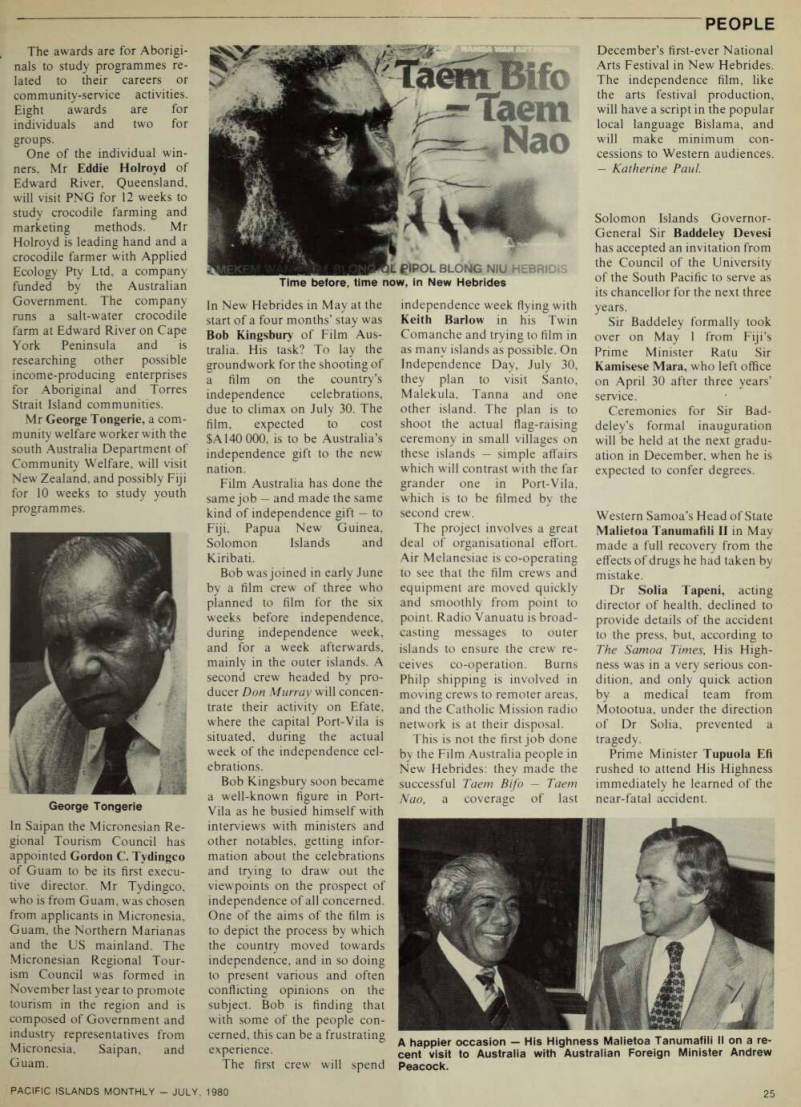
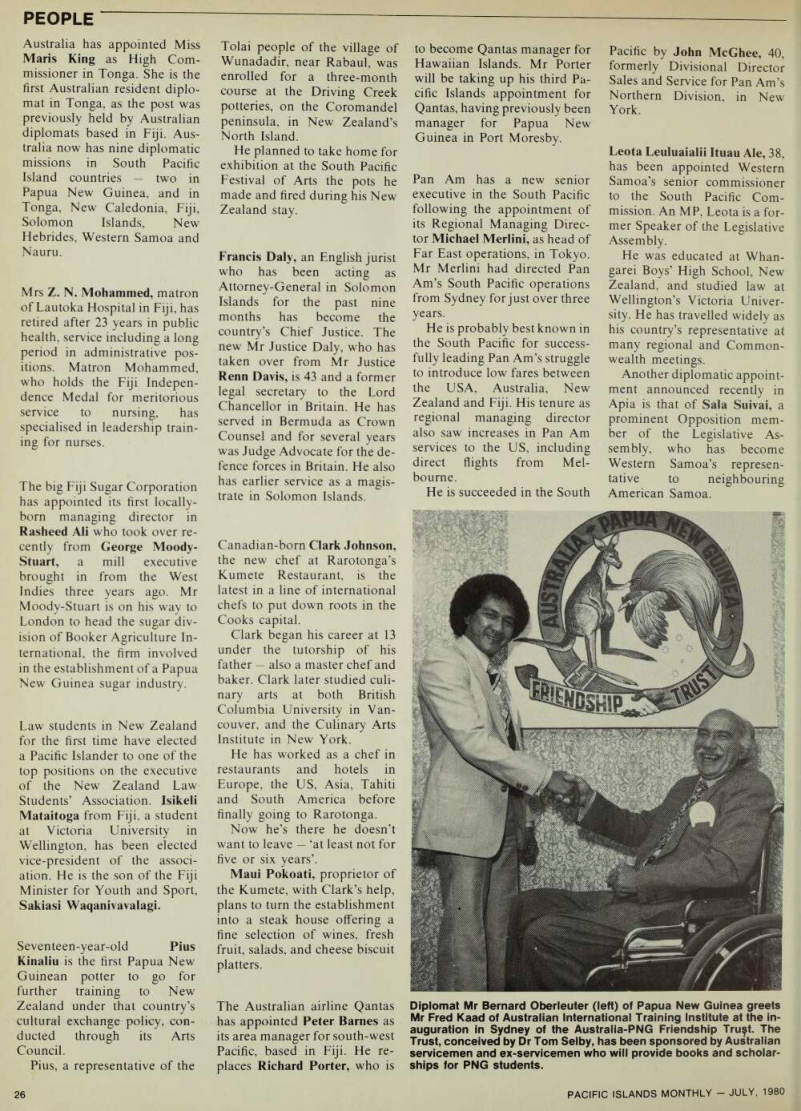
Michael Powles has been
appointed New Zealand’s High
Commissioner to Fiji and Kiribati. He will be based in Suva. Mr Powles succeeds David McDowell.
Tosiwo Nakayama, President of the Federated States of Micronesia, in May submitted to the FSM Congress the nomi nation of Edward C. King, of Takoma Park, Maryland, for the position of Chief Justice of the FSM Supreme Court.
Mr King served for four years as deputy director of the Micronesian Legal Services Corporation. Said President
Nakayama: ‘He is thoroughly
familiar with the legal prob lems of our country and our people, and he gained that knowledge as counsel to nu merous Micronesian individ uals and groups. I am confident, therefore, that Mr
King can provide the judiciary
with a perspective that will be welcomed by those who appear
before it seeking justice.’
The University of the South Pacific’s Laucala Campus was visited in May by Isabel Allende, daughter of the for mer President of Chile Sal vador Allende, assassinated in 1973 in the coup which in stalled the military junta of General Augusto Pinochet.
Ms Allende was invited to address a lunchtime forum by the USP Students’ Association, which was among the main forces of protest against Gen eral Pinochet’s visit to Fiji
(PIM Jun p 25).
Ms Allende stressed that the problem of Chile today was not simply that of deposing one man, but of ending an entire system which favoured a small
minority, leaving millions in
‘extreme poverty conditions’, to quote the description used in an official statement of Chile’s Catholic Church.
Mrs Soonu Kochar High Com missioner for India in Fiji, has just completed a wide tour of the South Pacific in which she presented her credentials for recognition as ambassador or high commissioner in a num ber of countries. She visited Papua New Guinea, Nauru, Solomon Islands, Tonga, New Hebrides, Society Islands, Kiribati, Tuvalu and Marshall Islands, and attended recep tions held in her honour.
A Western Samoan registered nurse Ana Nee Nee, has won the International Nurse of the Year Award, given each year under the auspices of the Inter national Council of Nurses.
The award consists of a tro phy, a stethoscope, and $2OO donated by the Australian branch of the US company, 3M
Corporation.
According to Faamanatu Osasa, of Western Samoa’s Nurses’ Association, there were 175 entries from throughout the world for the competition.
Ana was Western Samoa’s choice. It was the country’s third entry since the Nurses’
Association affiliated with the ICN in 1977. ‘This time we were lucky,’ Faamanatu said.
Ana was educated at Papauta and became registered in 1957. Since then she has been involved in general and maternity nursing. She has also served in the districts.
She is at present working in the Filariasis Campaign.
Meralyn Tito is the first female student to take up the study of surveying in Papua New Guinea. Meralyn, who is in her first year of the surveying de gree course at Unitech, Lae,
chose surveying after reading
careers pamphlets. She was attracted by the idea of work ing out in the open air. Her favourite subjects are maths and science.
Mark Basausau, Henry Igo, and Felix Rotsomana are the latest three Papua New Guinean beneficiaries of schol
arships awarded by the
European Development Fund.
The EDF is a subsidiary of the Commission of the European Communities.
An announcement from the commission’s Port Moresby office said that Mr Basausau, from Sori in the Manus Prov ince, who is a training officer with the PNG Department of Finance, went to London at the end of May to do a three months course in training tech
niques.
Mr Igo, of Porebada village in the Central Province, a pro jects officer with the Depart ment of Commerce, and Mr Rotsomana, from Lemankua on Buka in the North Solo mons, were both to leave at the end of June for Dublin, Ireland, for a three-months course in small industry de
velopment.
Since the end of 1978, the EDF has awarded scholarships to 25 Papua New Guineaais for training in Europe. Total cost of the scholarships so far awarded has been about Kl7O 000.
Two Northern Territory Aus tralian Aboriginals have re cently returned from a three-month home economics study tour to Fiji. They are Mrs Gagadi Nunhirribala, a teach ing assistant with the Northern
Territory Education Depart
ment at Numbulwar near Dar win, and Ms Didjidi Wurragwagwa a community leader with the Angurugu com
munity, Groote Eylandt.
Another group from the Queensland Aboriginal and Torres Strait Islanders Consultative Committee is to study aspects of education from early childhood to post secondary levels in Papua New Guinea. Their visit has yet to be organised. Both groups are
sponsored by the Australian
Aboriginal Overseas Study
Awards Scheme.
Popular guests in Australia recently were Ratu Sir George Cakobau, Governor-General of Fiji, and Adi Lady Cakobau making a State visit in which they met Australians from all walks of life and members of Fijian communities living in Australia. Top picture shows the visi tors with Sir Roden Cutler, Governor of New South Wales, and Lady Cutler at Government House, Sydney, and above they meet young Australians in Canberra.
The awards are for Aborigi nals to study programmes re lated to their careers or
community-service activities.
Eight awards are for individuals and two for groups.
One of the individual win ners, Mr Eddie Holroyd of Edward River, Queensland, will visit PNG for 12 weeks to study crocodile farming and marketing methods. Mr Holroyd is leading hand and a crocodile farmer with Applied Ecology Pty Ltd, a company funded by the Australian Government. The company runs a salt-water crocodile farm at Edward River on Cape York Peninsula and is researching other possible
income-producing enterprises
for Aboriginal and Torres Strait Island communities.
Mr George Tongerie, a com munity welfare worker with the south Australia Department of Community Welfare, will visit New Zealand, and possibly Fiji for 10 weeks to study youth programmes.
In Saipan the Micronesian Re gional Tourism Council has appointed Gordon C. Tydingco of Guam to be its first execu tive director. Mr Tydingco, who is from Guam, was chosen from applicants in Micronesia, Guam, the Northern Marianas and the US mainland. The Micronesian Regional Tour ism Council was formed in November last year to promote tourism in the region and is composed of Government and industry representatives from Micronesia, Saipan, and Guam.
In New Hebrides in May at the start of a four months’ stay was Bob Kingsbury of Film Aus tralia. His task? To lay the groundwork for the shooting of a film on the country’s
independence celebrations,
due to climax on July 30. The film, expected to cost $A 140 000, is to be Australia’s independence gift to the new nation.
Film Australia has done the same job and made the same kind of independence gift to
Fiji, Papua New Guinea,
Solomon Islands and Kiribati.
Bob was joined in early June by a film crew of three who planned to film for the six weeks before independence,
during independence week,
and for a week afterwards, mainly in the outer islands. A second crew headed by pro ducer Don Murray will concen trate their activity on Efate, where the capital Port-Vila is situated, during the actual week of the independence cel ebrations.
Bob Kingsbury soon became a well-known figure in Port- Vila as he busied himself with interviews with ministers and other notables, getting infor mation about the celebrations and trying to draw out the viewpoints on the prospect of independence of all concerned.
One of the aims of the film is to depict the process by which the country moved towards independence, and in so doing to present various and often
conflicting opinions on the
subject. Bob is finding that with some of the people con cerned, this can be a frustrating
experience.
The first crew will spend
independence week flying with
Keith Barlow in his Twin Comanche and trying to film in as many islands as possible. On
Independence Day, July 30,
they plan to visit Santo, Malekula, Tanna and one other island. The plan is to shoot the actual flag-raising ceremony in small villages on these islands simple affairs which will contrast with the far grander one in Port-Vila, which is to be filmed by the second crew.
The project involves a great deal of organisational effort.
Air Melanesiae is co-operating to see that the film crews and
equipment are moved quickly
and smoothly from point to point. Radio Vanuatu is broad casting messages to outer islands to ensure the crew re ceives co-operation. Burns Philp shipping is involved in moving crews to remoter areas, and the Catholic Mission radio network is at their disposal.
This is not the first job done by the Film Australia people in New Hebrides: they made the successful Taem Bifo Taem Nao, a coverage of last
December’s first-ever National Arts Festival in New Hebrides.
The independence film, like the arts festival production, will have a script in the popular local language Bislama, and will make minimum con cessions to Western audiences.
Katherine Paul.
Solomon Islands Governor- General Sir Baddeley Devesi has accepted an invitation from the Council of the University of the South Pacific to serve as its chancellor for the next three years.
Sir Baddeley formally took
over on May 1 from Fiji’s Prime Minister Ratu Sir Kamisese Mara, who left office on April 30 after three years’ service.
Ceremonies for Sir Bad
deley’s formal inauguration
will be held at the next gradu ation in December, when he is
expected to confer degrees.
Western Samoa’s Head of State Malietoa Tanumafili II in May made a full recovery from the effects of drugs he had taken by mistake.
Dr Solia Tapeni, acting director of health, declined to provide details of the accident to the press, but, according to The Samoa Times, His High ness was in a very serious con dition, and only quick action by a medical team from Motootua, under the direction of Dr Solia, prevented a
tragedy.
Prime Minister Tupuola Efi rushed to attend His Highness immediately he learned of the near-fatal accident.
George Tongerie
Time before, time now, in New Hebrides
A happier occasion - His Highness Malietoa Tanumafili II on a re cent visit to Australia with Australian Foreign Minister Andrew Peacock.
Australia has appointed Miss Maris King as High Com missioner in Tonga. She is the first Australian resident diplo mat in Tonga, as the post was
previously held by Australian
diplomats based in Fiji. Aus tralia now has nine diplomatic missions in South Pacific Island countries two in Papua New Guinea, and in
Tonga, New Caledonia, Fiji,
Solomon Islands, New Hebrides, Western Samoa and Nauru.
Mrs Z. N. Mohammed, matron of Lautoka Hospital in Fiji, has retired after 23 years in public health, service including a long period in administrative pos itions. Matron Mohammed, who holds the Fiji Indepen dence Medal for meritorious service to nursing, has
specialised in leadership train
ing for nurses.
The big Fiji Sugar Corporation
has appointed its first locally born managing director in Rasheed Ali who took over re cently from George Moody- Stuart, a mill executive brought in from the West Indies three years ago. Mr Moody-Stuart is on his way to London to head the sugar div ision of Booker Agriculture In ternational, the firm involved in the establishment of a Papua New Guinea sugar industry.
Law students in New Zealand for the first time have elected a Pacific Islander to one of the top positions on the executive of the New Zealand Law Students’ Association. Isikeli Mataitoga from Fiji, a student at Victoria University in Wellington, has been elected vice-president of the associ ation. He is the son of the Fiji Minister for Youth and Sport, Sakiasi Waqanivavalagi.
Seventeen-year-old Pius
Kinaliu is the first Papua New Guinean potter to go for further training to New Zealand under that country’s
cultural exchange policy, con
ducted through its Arts Council.
Pius, a representative of the
Tolai people of the village of Wunadadir, near Rabaul, was enrolled for a three-month course at the Driving Creek potteries, on the Coromandel peninsula, in New Zealand’s North Island.
He planned to take home for exhibition at the South Pacific Festival of Arts the pots he made and fired during his New Zealand stay.
Francis Daly, an English jurist who has been acting as Attorney-General in Solomon Islands for the past nine months has become the country’s Chief Justice. The new Mr Justice Daly, who has taken over from Mr Justice Renn Davis, is 43 and a former legal secretary to the Lord Chancellor in Britain. He has served in Bermuda as Crown Counsel and for several years was Judge Advocate for the de fence forces in Britain. He also has earlier service as a magis trate in Solomon Islands.
Canadian-born Clark Johnson, the new chef at Rarotonga’s Kumete Restaurant, is the latest in a line of international chefs to put down roots in the
Cooks capital.
Clark began his career at 13 under the tutorship of his father also a master chef and baker. Clark later studied culi nary arts at both British Columbia University in Van couver, and the Culinary Arts Institute in New York.
He has worked as a chef in restaurants and hotels in Europe, the US, Asia, Tahiti and South America before
finally going to Rarotonga.
Now he’s there he doesn’t want to leave ‘at least not for five or six years’.
Maui Pokoati, proprietor of the Kumete, with Clark’s help, plans to turn the establishment into a steak house offering a fine selection of wines, fresh fruit, salads, and cheese biscuit
platters.
The Australian airline Qantas has appointed Peter Barnes as its area manager for south-west Pacific, based in Fiji. He re places Richard Porter, who is
to become Qantas manager for Hawaiian Islands. Mr Porter will be taking up his third Pacific Islands appointment for
Qantas, having previously been
manager for Papua New Guinea in Port Moresby.
Pan Am has a new senior executive in the South Pacific following the appointment of
its Regional Managing Direc-
tor Michael Merlini, as head of Far East operations, in Tokyo.
Mr Merlini had directed Pan Am’s South Pacific operations from Sydney for just over three years.
He is probably best known in the South Pacific for success-
fully leading Pan Am’s struggle
to introduce low fares between the USA, Australia, New Zealand and Fiji. His tenure as
regional managing director
also saw increases in Pan Am services to the US, including direct flights from Melboume.
He is succeeded in the South
Pacific by John McGhee, 40, formerly Divisional Director Sales and Service for Pan Am’s Northern Division, in New York, Leota Leuluaialii Ituau Ale, 38, has been appointed Western Samoa’s senior commissioner to the South Pacific Corn mission. An MP, Leota is a for mer Speaker of the Legislative
Assembly.
He was educated at Whan
garei Boys’ High School, New
Zealand, and studied law at Wellington’s Victoria Univer sity. He has travelled widely as his country’s representative at many regional and Common
wealth meetings,
Another diplomatic appoint
ment announced recently in Apia is that of Sala Suivai, a
prominent Opposition mem
ber of the Legislative As sembly, who has become Western Samoa’s represen tative to neighbouring American Samoa.
Diplomat Mr Bernard Oberieuter (left) of Papua New Guinea greets Mr Fred Kaad of Australian International Training Institute at the in auguration in Sydney of the Australia-PNG Friendship The Trust, conceived by Dr Tom Selby, has been sponsored by Australian servicemen and ex-servicemen who will provide books and scholar ships for PNG students.
Advertisements & other items, pp. 24-28 (1 item)
from
J 0,
ffor a touch of musical enchantment
M-50Imini component system
AIWA (ortraflsmanstop
from
AIWA CO., LTD. 11-9, Ueno 1-chome, Taito-ku, Tokyo, Japan.
Australia & New Zealand AIWA Australia Pty., Ltd., P.O. Box 339, Rockdale, N.S.W., Australia 2216 Tel: 597-2388/2808 Cook Islands Island Merchants Ltd., P.O. Box 69, Rarotonga, Cook Islands Fiji D. Ranchhod & Company, Corner of Vidilo St. & Vitogo PDE, PC.
Box 18, Lautoka. Fiji Tel: 60227/P. Hargovind Bros., Duty Free Centre 190 Renwick Road, Suva, Fiji Tel: 24350 Guam Micropac Audio, Inc., PC. Box 3478, Agana, Guam 96910 Tel: 472-8091 P.N.G. Oceania Indent Agency (P.N.G.) Pty., Ltd. Box 5518, Boroko, Port Moresby, P.N.G. Tel: PM 256406 Solomon Islands Harvest Pacific Ltd., G.P.O. 517, Honiara, Solomon Islands Tel: 718 Tahiti Fare Hi-Fi Stereo, Rue du Marechal Foch, PC. Box 269, Papeete, Tahiti R C 6604 A
LANDING SHIP “DUAVATA”
FOR SALE
“AS IS, WHERE IS”. SUVA.
Built Sarawak 1976. Gross 396, Nett 276 tons Register. Steel hull Deck W plate (timber-sheathed). Deadweight 647 tons. Length o/all 140 ft. Breadth 33 ft.
Depth 10 ft. Bow Ramp Opening 16 ft.
Clear Deck Space 86 x 31 ft. Designed draft 8 ft. Bunkers 50 tons. Fresh water 38 tons. Double Bottom Tanks (suitable Oil cargoes) 499 tons.
Fully equipped Bridge Radar/Radios/ Autopilot/Echosounder. Manual Hydraulic Steering, Bridge Engine controls.
Two Liferafts (15 & 20 men).
Engines bridge control 1975 Twin Caterpillar 6 cyl. Turbo diesels (type D 343), total BMP 730 @ 1800 RPM, to Twin disc gearboxes. Two solid bronze propellers. Speed 9 —lo knots. Auxiliaries: 2 Generators (Ix 3 cyl. Deutz, 25 KVA 32 HP @ 1500 RPM. 1 x 2 cyl. Lister, 12 KVA 12 HP @ 1500 RPM), 3 Elec. 7.5 hp. Ballast Pumps. Some Main/Aux.
Engine and Elec, spares. Fuel: Light Marine Diesel; consumption 37.5 gals, per hour.
Crew accom: Master and 10 men, galley, saloon, 4 Lavatories.
Slipped and complete hull/accommodation painted May 1980. Annual/Load Line BUREAU VERITAS surveys completed June 1980. Next Special Survey due 1982. Improved Ballast Piping fitted June 1980. (Details believed correct, not guaranteed) PRICE: U 55650,000 CASH. Plans, photos, avail, on request. Prompt inspection/delivery SUVA, Fiji, may be arranged through Sole Brokers:
BANKS BROS. & STREET
122 Sussex St. Sydney.
Phone: (02)292125, Cables: “Torres”, Telex: AA20269
YUASA
BATTERY
Indispensable on
Cars and Vehicles
that support Modern
Industrial Society
IUASA
B AT
I f to Lag*
Yuasa
j
MANUFACTURERS OF ALL KINDS OF
ELECTRIC BATTERIES AND RELATED
ELECTRICAL APPLIANCES.
YUASA BATTERY CO., LTD.
No. 12-11, 2-Chome, Migashi-Shimbashi Minato-ku, Tokyo 105, Japan Phone: Tokyo (03) 437-2411
Cable : YUASABATRY TOKYO
Telex : 29228 YBCTOK
Your Connection
to the World
t 111 1U w//g "N y? m N > ©
FUKUOKA
KAGOSHIMA
Air Niugini’s Boeing Bird of Paradise jets connect the Pacific with the world. Now you can fly to anywhere in the world direct from
Air Niugini’s major international gateway
destinations.
Air Niugini offers you a choice of 11 international ports so you can plan your journey to suit yourself and your pocket.
FLY THE BIRD OF PARADISE
TO THE WORLD.
HONOLULU
HONG
KONG
MANILA
JAYAPURA
SINGAPORE
JAI
HONIARA
JAKARTA
PORT MORESBY
CAIRNS
BRISBANE
SPS.I23.
AIR NIUGINT
THE NA T/ONAL AIRLINE OF PAPUA NEW GUINEA
Travel
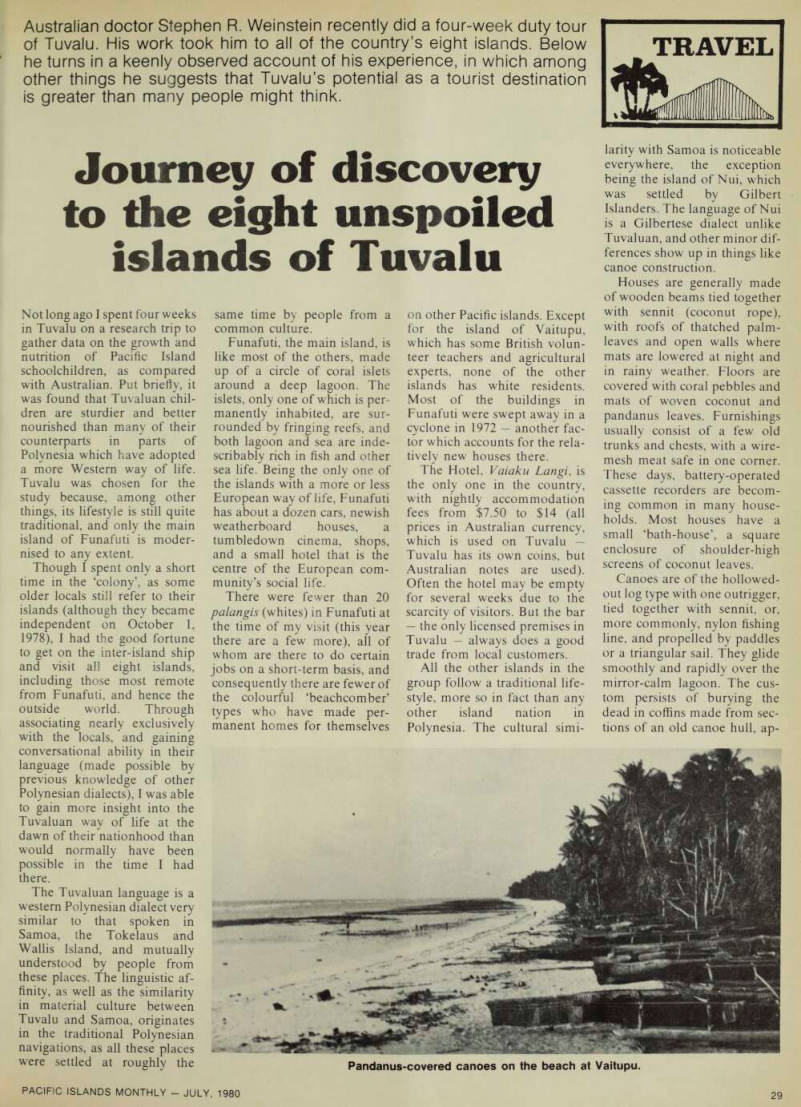
Australian doctor Stephen R. Weinstein recently did a four-week duty tour of Tuvalu. His work took him to all of the country’s eight islands. Below he turns in a keenly observed account of his experience, in which among other things he suggests that Tuvalu’s potential as a tourist destination is greater than many people might think.
to the eight unspoiled


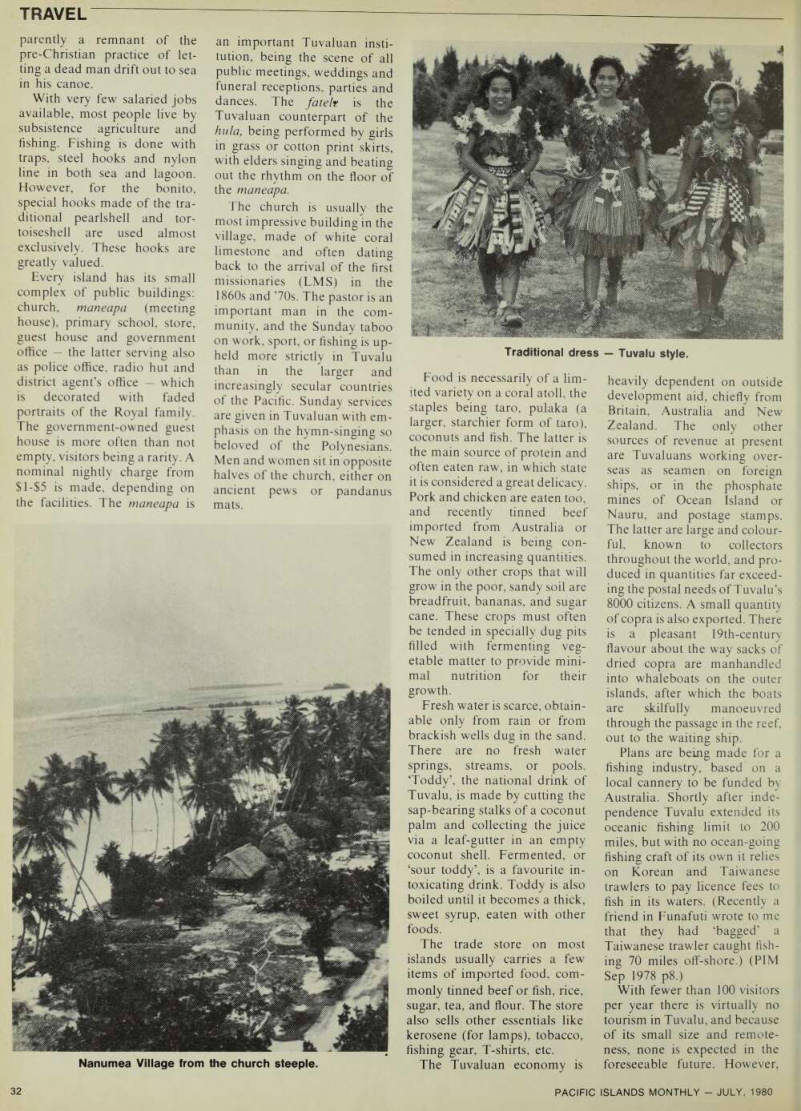
Journey of discovery to the eight unspoiled islands of Tuvalu
Not long ago I spent four weeks in Tuvalu on a research trip to gather data on the growth and nutrition of Pacific Island schoolchildren, as compared with Australian. Put briefly, it was found that Tuvaluan chil dren are sturdier and better nourished than many of their counterparts in parts of
Polynesia which have adopted
a more Western way of life.
Tuvalu was chosen for the study because, among other things, its lifestyle is still quite traditional, and only the main island of Funafuti is moder nised to any extent.
Though I spent only a short time in the ‘colony’, as some older locals still refer to their
islands (although they became
independent on October 1, 1978), I had the good fortune to get on the inter-island ship and visit all eight islands, including those most remote from Funafuti, and hence the outside world. Through
associating nearly exclusively
with the locals, and gaining conversational ability in their language (made possible by previous knowledge of other Polynesian dialects), I was able to gain more insight into the Tuvaluan way of life at the dawn of their nationhood than would normally have been possible in the time I had there.
The Tuvaluan language is a western Polynesian dialect very similar to that spoken in Samoa, the Tokelaus and Wallis Island, and mutually understood by people from these places. The linguistic af finity, as well as the similarity in material culture between Tuvalu and Samoa, originates in the traditional Polynesian navigations, as all these places were settled at roughly the
same time by people from a common culture.
Funafuti, the main island, is like most of the others, made up of a circle of coral islets around a deep lagoon. The islets, only one of which is per manently inhabited, are sur rounded by fringing reefs, and both lagoon and sea are inde scribably rich in fish and other sea life. Being the only one of the islands with a more or less European way of life, Funafuti has about a dozen cars, newish weatherboard houses, a tumbledown cinema, shops, and a small hotel that is the centre of the European com munity’s social life.
There were fewer than 20 palangis (whites) in Funafuti at the time of my visit (this year there are a few more), all of whom are there to do certain jobs on a short-term basis, and consequently there are fewer of the colourful ‘beachcomber’ types who have made per manent homes for themselves
on other Pacific islands. Except for the island of Vaitupu, which has some British volun teer teachers and agricultural experts, none of the other islands has white residents.
Most of the buildings in Funafuti were swept away in a cyclone in 1972 another fac tor which accounts for the rela tively new houses there.
The Hotel, Vaiaku Langi , is the only one in the country, with nightly accommodation fees from $7.50 to $l4 (all prices in Australian currency, which is used on Tuvalu Tuvalu has its own coins, but Australian notes are used).
Often the hotel may be empty for several weeks due to the scarcity of visitors. But the bar the only licensed premises in Tuvalu always does a good trade from local customers.
All the other islands in the group follow a traditional life style, more so in fact than any other island nation in Polynesia. The cultural simi
larity with Samoa is noticeable
everywhere, the exception
being the island of Nui, which was settled by Gilbert Islanders. The language of Nui is a Gilbertese dialect unlike Tuvaluan, and other minor dif ferences show up in things like canoe construction.
Houses are generally made of wooden beams tied together with sennit (coconut rope), with roofs of thatched palm leaves and open walls where mats are lowered at night and in rainy weather. Floors are covered with coral pebbles and mats of woven coconut and
pandanus leaves. Furnishings
usually consist of a few old trunks and chests, with a wire mesh meat safe in one corner.
These days, battery-operated
cassette recorders are becom ing common in many house holds. Most houses have a small ‘bath-house’, a square enclosure of shoulder-high screens of coconut leaves.
Canoes are of the hollowed out log type with one outrigger, tied together with sennit, or,
more commonly, nylon fishing
line, and propelled by paddles
or a triangular sail. They glide
smoothly and rapidly over the mirror-calm lagoon. The cus tom persists of burying the dead in coffins made from sec tions of an old canoe hull, ap-
Pandanus-covered canoes on the beach at Vaitupu.
parently a remnant of the pre-Christian practice of letting a dead man drift out to sea in his canoe.
With very few salaried jobs available, most people live by subsistence agriculture and fishing. Fishing is done with traps, steel hooks and nylon line in both sea and lagoon.
However, for the bonito, special hooks made of the traditional pearlshell and tortoiseshell are used almost exclusively. These hooks are
greatly valued.
Every island has its small
complex of public buildings;
church, maneapa (meeting house), primary school, store, guest house and government office - the latter serving also as police office, radio hut and district agent s office which is decorated with faded
portraits of the Royal family.
The government-owned guest house is more often than not empty, visitors being a rarity. A
nominal nightly charge from
sl-$5 is made, depending on the facilities. The maneapa is
an important Tuvaluan insti tution, being the scene of all
public meetings, weddings and
funeral receptions, parties and dances. The fateh is the Tuvaluan counterpart of the
hula, being performed by girls
in grass or cotton print skirts, with elders singing and beating out the rhythm on the floor of the maneapa.
The church is usually the most impressive building in the village, made of white coral limestone and often dating back t 0 the arrival of the first missionaries (LMS) in the 1860 s and’7os. The pastor is an important man in the corn munity, and the Sunday taboo on work, sport, or fishing is up held more strictly in Tuvalu than in the larger and increasingly secular countries 0 f the Pacific. Sunday services are given in Tuvaluan with em phasis on the hymn-singing so beloved of the Polynesians, Men and women sit in opposite halves of the church, either on ancient pews or pandanus mats.
Food is necessarily of a lim ited variety on a coral atoll, the staples being taro, pulaka (a larger, starchier form of taro), coconuts and fish. The latter is the main source of protein and often eaten raw, in which state it is considered a great delicacy.
Pork and chicken are eaten too, and recently tinned beef imported from Australia or New Zealand is being con
sumed in increasing quantities.
The only other crops that will grow in the poor, sandy soil are breadfruit, bananas, and sugar cane. These crops must often
be tended in specially dug pits
filled with fermenting veg etable matter to provide mini mal nutrition for their growth.
Fresh water is scarce, obtain able only from rain or from brackish wells dug in the sand.
There are no fresh water
springs, streams, or pools.
Toddy’, the national drink of Tuvalu, is made by cutting the sap-bearing stalks of a coconut
palm and collecting the juice
via a leaf-gutter in an empty coconut shell. Fermented, or ‘sour toddy’, is a favourite in toxicating drink. Toddy is also boiled until it becomes a thick, sweet syrup, eaten with other foods.
The trade store on most islands usually carries a few items of imported food, com monly tinned beef or fish, rice, sugar, tea, and flour. The store also sells other essentials like kerosene (for lamps), tobacco, fishing gear, T-shirts, etc.
The Tuvaluan economy is
heavily dependent on outside
development aid, chiefly from
Britain, Australia and New Zealand. The only other sources of revenue at present are Tuvaluans working over seas as seamen on foreign ships, or in the phosphate mines of Ocean Island or Nauru, and postage stamps.
The latter are large and colour ful, known to collectors throughout the world, and pro duced in quantities far exceed ing the postal needs of Tuvalu’s 8000 citizens. A small quantity of copra is also exported. There
is a pleasant 19th-century
flavour about the way sacks of dried copra are manhandled into whaleboats on the outer islands, after which the boats are skilfully manoeuvred through the passage in the reef, out to the waiting ship.
Plans are being made for a fishing industry, based on a local cannery to be funded by Australia. Shortly after inde pendence Tuvalu extended its oceanic fishing limit to 200 miles, but with no ocean-going fishing craft of its own it relies on Korean and Taiwanese trawlers to pay licence fees to fish in its waters. (Recently a friend in Funafuti wrote to me that they had ‘bagged’ a Taiwanese trawler caught fish ing 70 miles off-shore.) (PIM
Sep 1978 pB.)
With fewer than 100 visitors per year there is virtually no tourism in Tuvalu, and because of its small size and remote ness, none is expected in the foreseeable future. However,
Nanumea Village from the church steeple.
Traditional dress - Tuvalu style.
in my opinion Tuvalu has a lot to offer potential tourists. In addition to fishing and skin diving in almost untouched waters, searching for war relics in the bush, and observing the Polynesian way of life in
uncommercialised villages
where visitors are treated as honoured guests, have obvious attractions. Tuvalu is off the beaten track in the truest sense of this well-worn expression, and, to use another cliche, the visitor must be prepared to ‘rough it’ as regards both trans port and accommodation.
However, it is well worth it.
The only link with the out side world is the weekly plane from Suva, which lands on the coral runway at Funafuti, built during the war. When not in use by the aircraft, the runway is used as a sporting ground, in particular for the Tuvaluan ballgame known as te ano,
played with a pandanus-leaf
ball. I won’t attempt to de scribe the rules here.
None of the outer islands has an airstrip, and inter-island
travel is exclusively by the ship
Nivanga (meaning ‘voyage’),
which makes monthly or fort nightly round trips to most islands. ‘Plane day’ in Funafuti is a big event, when most of the
population gathers along the
airstrip to see who the new arrivals are, and say goodbye to departing friends. Most new arrivals get a mention over Radio Tuvalu on the same day.
Otherwise, the national radio
carries mainly taped music,
shipping news, politics, and
signs off with the national an them every evening at 7.30 pm.
The inter-island ship is a Tuvaluan institution, around which so much of the islands’ life revolves. The ship has first and second class cabins, each with their own saloons, toilets, etc., but in the cramped space on board these colonial-relic
distinctions are largely ignored.
Most people travel by ‘deck passage’ anyway, which is cer tainly more comfortable than trying to go to sleep in the hot, stuffy cabins. Days are spent
singing to the accompaniment
of ukuleles under tarpaulins on deck, or trailing fishing lines after the boat. Sometimes sharks can be seen following in search of scraps. For the ‘cabin’ passengers, meals consist of beef and rice served in the sa loon, but deck passengers mostly bring their own food, of the native variety.
On reaching an island, the Nivanga anchors off the reef, and is often met by people in outrigger canoes. When wind and tide are right, one of the two landing boats is lowered into the water, filled with pass engers and their belongings, and then heads for the passage in the reef. Shooting the reef passage even under the best of conditions can be a tricky job, and despite the skill of the Tuvaluan sailors, a boat some times overturns, so everyone has to swim for it, and cargo is
recovered later as best as poss ible. Back at home in Funafuti, the ship anchors in the lagoon, but despite many problems plans for a deep-water jetty are still underway, so that the land ing craft need not be used in
Funafuti. Spending long quiet
nights on deck under the stars, I managed to learn a bit about traditional Polynesian navi gation from the sailors, such as interpreting winds, currents, stars, clouds and birds.
Each one of the former Ellice islands has a separate European discoverer, and there was little contact with the out side world until the arrival of missionaries in the 1860 s. In the later years of the 19th cen tury some of the islands suf fered from raids by blackbirders, who took away a considerable part of the popu lation. (On one island I was shown an area of red sand which tradition has it became that colour from the blood of a party of blackbirders killed
there 100 years ago.) This led to the islands being taken under British protection in the 1890 s.
Since then their history has been uneventful, apart from an interlude during World War II when American forces occupied Funafuti, Nanumea and Nukulaelae, and built air strips from which to engage the Japanese in Tarawa to the north. Older people have a lot of stories to tell about wartime events, and even today there are a lot of old aircraft parts in use as water-tanks, building materials, and racks for drying copra.
Tour of
Oceania
The Australian Institute of In ternational Affairs, New South Wales branch, is mounting a tour of Oceania from August 16 to September 7.
Those taking part will visit Papua New Guinea, Solomon Islands, New Hebrides and New Caledonia.
Tour leader Colonel D. M.
Ramsay told PIM: ‘Our aim is to stimulate further the good understanding between Aus tralia and the countries to be visited. ‘We have decided on a num ber of topics for study and dis cussion, including trade between countries in the re
gion, relationships with neigh
bouring countries and with major powers, security and de fence of the region, and the two hundred nautical mile exclusive economic zones.’
Colonel Ramsay may be contacted at 121 Edgecliff Road, Woollahra, 2025.
Unloading the landing craft at Nanumea Lagoon.
Meleangi at Funafuti
Advertisements & other items, pp. 30-34 (1 item)
Datsun Creates Ha
\bu never see a lot
of our best work.
Today, people are looking at new cars in a new way.
Sure, you still want a car that will zip through traffic. But you also need one that will zip past gas pumps and repair shops.
You want a car that is comfortable. But you also need one that is comfortably priced.
You want a car that looks nice.
But you also need one that will hold its good looks for some years to come.
And that comes from the way the people who built the car think.
At Datsun, we think in terms of harmony.” i T Harmony between research and development. Between design and engineering. Throughout testing. And retesting. And up and down each of our assembly lines.
In short, harmony from concept through the completed car.
Thinking and working in harmony permits us to resolve seemingly unresolvable differences. To balance flatout contradictions.
For example, you want a strong, safe car. But you also need one that is fuel efficient. More strength would seem to mean more weight. More fuel efficiency would seem to mean less weight.
Our solution: A new, high-tension steel. It is thinner and lighter than the steel it replaced. Yet equally as strong. More pounds were saved, with no loss of strength, by drilling holes in the steel suspension system (which were later filled with rubber plugs).
Problem-solving by designresolving conflicting elements to * improve the overall quality of the product—has helped Datsun to build
DATSUN CREATES HA
kmerican Samoa: B F. KNEUBUHL INC., Pago Pago/Cook Islands; COOK ISLANDS MOTOR CENTRE LTD , Rarotonga/ Fiji: CARPENTERS MOTORS, Suva/Guam: DATSUN MOTORS SALES, Agana/ Hawaii: NISSAN MOTOR CORPORATION IN HAWAII LTD , Honolulu /Kiribati: ATOLL AUTO STORES, Tarawa/ Nauru; JACOB ENTERPRISES LTD./ Now Caledonia t
s HHMHHHI liters P v :ars that are strong and safe, yet light ind fuel efficient.
Harmony has also led to many )ther solid product improvements, tome you see. Some you don’t.
When a Datsun leaves the assem- )ly line, it leaves with nearly nine )ounds of gleaming acrylic paint.
Vnd almost four and a half pounds of ound deadener.
Part of that paint does an under- ;over job. Inside the air cleaner. )n the underside of the hood. Under the mat in the trunk. Even the drive shaft is painted. As is the inside of the rocker panels, fender wells and splash pans. (Which also receive a generous extra layer of stone guard coat to help fight off salt damage in colder climates.) Every trunk is sealed with more than a pound of weather stripping.
Every door with nearly half a pound.
And every door also comes with a hole in the bottom... a precisely-positioned drain hole to prevent build-up of water running down the windowpane.
So now you have some idea of why Datsuns are so right for the times.
They offer you what the world needs.
Without sacrificing what you want.
That’s harmony.
The model shown above is the Datsun 120 Y for South America.
Specifications and equipment may vary according to market.
DATSUN
tMONY BY DESIGN
THE NAME OF QUALITY
NISSAN
NISSAN MOTOR CO. LTD
GENCE ALMA S.A., Noumea/Now Hebrides: PENTECOST S.A., Port Vila and Santo/Norfolk Islands: SIRIUS MOTORS/Papua New Guinea: BOROKO MOTORS LTD . Port Moresby/ aipan: JOETEN MOTOR COMPANY INC / Solomon Islands: IGNITED ENTERPRISES LTD , Honiara/Tahiti: TAHITIBULL S.A.R.L.. Papeete/Western Samoa: MORRIS HEDSTROM LTD., Apia
The rally's underway.
The competition is tough.
The skills that make up a champion are many.
The winner s edge — reliability. The kind of reliability you expect from Clarion car stereo.
High guality performance all the way.
Check out the full lineup. You'll find it in the winner's circle , every time.
inner’s Edge
In Car Entertainment Company
liClarion
Clarion Co.. Ltd. Tokyo. Ja m m
fill
ifton
rioo i
' i Australia; Amalgamated Wireless Zealand Limited R.p. Box 60-248 Porirua/Fijimrndsr Brijlal & Co. Ltd. g:'PO Box 362 Suva/Tahiti: Hi-Fi Vairaatoa PC. Box 1128 Papeete/ New Caledonia: Caldis Cedex/Guam: Guam Radio & TV Shop P.O. Box 1939 Guam 96910/New Hebrides; The Sound Centre P.O. Box 434 Vila/Cook Islands; South Seas International Ltd.
P O Box 49 Rarotonga /Papua New Guinea: Hagemeyer (PN G.) Pty. Ltd. P.O. Box 1428 Boroko. Port Moresby * Dolby and the double-D, symbol are trademarks of Dolby Laboratories.
Pacific Island Aviation
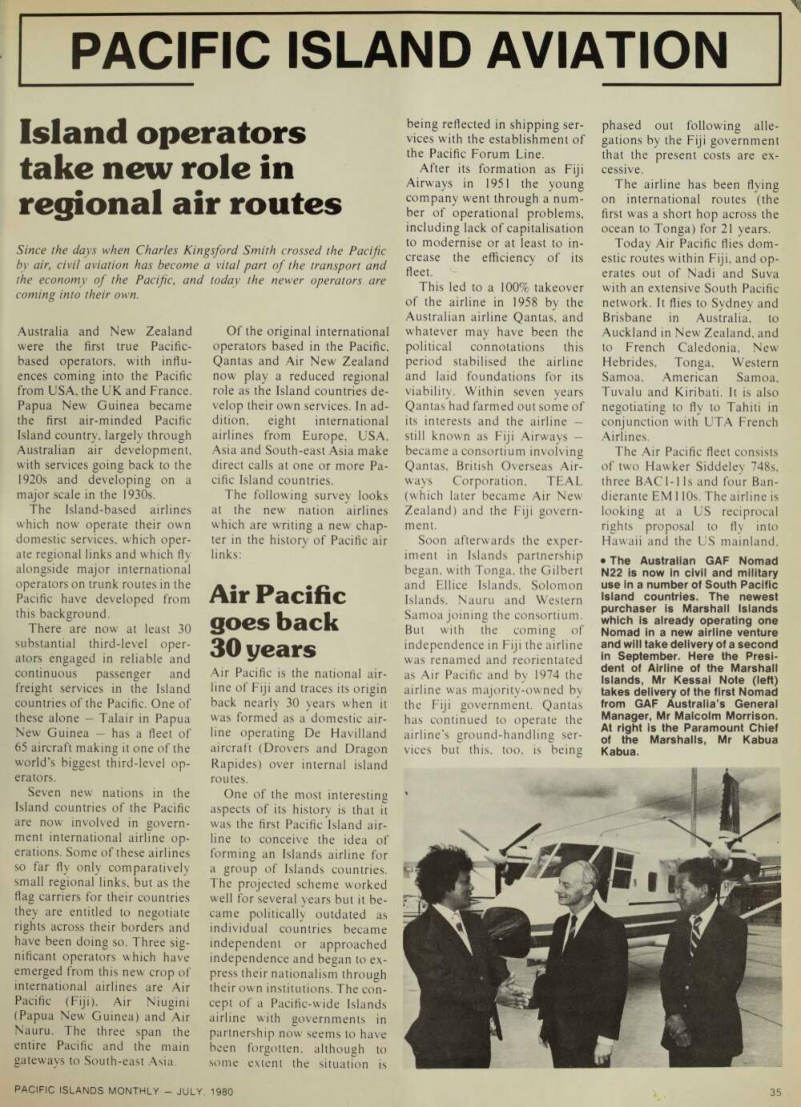
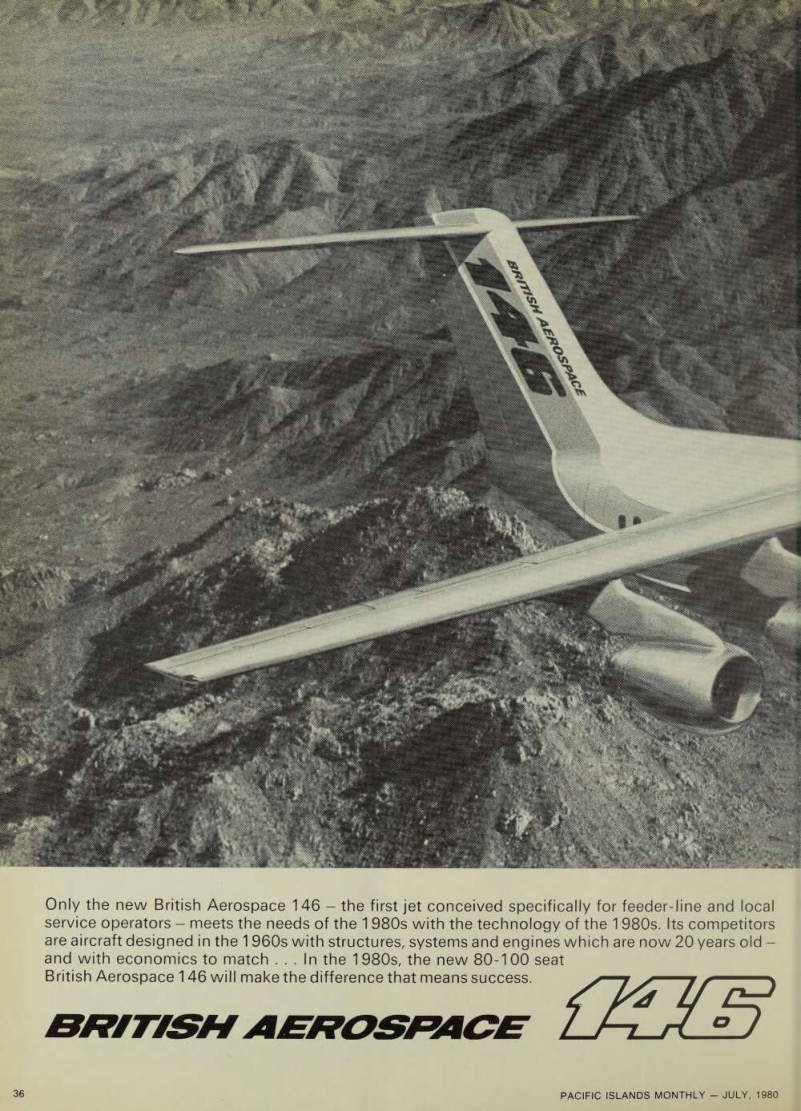


Island operators take new role in regional air routes
Since the days when Charles Kingsford Smith crossed the Pacific by air, civil aviation has become a vital part of the transport and the economy of the Pacific, and today the newer operators are coming into their own.
Australia and New Zealand were the first true Pacific based operators, with influ ences coming into the Pacific from USA, the UK and France.
Papua New Guinea became the first air-minded Pacific Island country, largely through Australian air development, with services going back to the
1920 s and developing on a
major scale in the 19305.
The Island-based airlines which now operate their own domestic services, which oper ate regional links and which fly alongside major international operators on trunk routes in the Pacific have developed from this background.
There are now at least 30 substantial third-level oper ators engaged in reliable and continuous passenger and freight services in the Island countries of the Pacific. One of these alone Talair in Papua New Guinea has a fleet of 65 aircraft making it one of the world’s biggest third-level op erators.
Seven new nations in the Island countries of the Pacific are now involved in govern ment international airline op erations. Some of these airlines
so far fly only comparatively
small regional links, but as the flag carriers for their countries they are entitled to negotiate rights across their borders and have been doing so. Three sig nificant operators which have emerged from this new crop of international airlines are Air Pacific (Fiji). Air Niugini (Papua New Guinea) and Air Nauru. The three span the entire Pacific and the main gateways to South-east Asia.
Of the original international operators based in the Pacific, Qantas and Air New Zealand now play a reduced regional role as the Island countries de velop their own services. In ad dition, eight international airlines from Europe, USA.
Asia and South-east Asia make direct calls at one or more Pa cific Island countries.
The following survey looks at the new nation airlines which are writing a new chap ter in the history of Pacific air links:
Air Pacific
goes back
30 years
Air Pacific is the national air line of Fiji and traces its origin back nearly 30 years when it was formed as a domestic air line operating De Havilland aircraft (Drovers and Dragon Rapides) over internal island routes.
One of the most interesting aspects of its history is that it was the first Pacific Island air line to conceive the idea of forming an Islands airline for a group of Islands countries.
The projected scheme worked well for several years but it be came politically outdated as individual countries became independent or approached independence and began to ex press their nationalism through their own institutions. The con cept of a Pacific-wide Islands airline with governments in partnership now seems to have been forgotten, although to some extent the situation is
being reflected in shipping ser vices with the establishment of the Pacific Forum Line.
After its formation as Fiji Airways in 1951 the young company went through a num
ber of operational problems,
including lack of capitalisation
to modernise or at least to in crease the efficiency of its fleet.
This led to a 100% takeover of the airline in 1958 by the Australian airline Qantas, and whatever may have been the political connotations this period stabilised the airline and laid foundations for its viability. Within seven years Qantas had farmed out some of its interests and the airline still known as Fiji Airways became a consortium involving Qantas, British Overseas Air ways Corporation. TEAL (which later became Air New Zealand) and the Fiji govern ment.
Soon afterwards the exper iment in Islands partnership began, with Tonga, the Gilbert and Ellice Islands, Solomon Islands, Nauru and Western Samoa joining the consortium.
But with the coming of independence in Fiji the airline was renamed and reorientated as Air Pacific and by 1974 the
airline was majority-owned by
the Fiji government. Qantas has continued to operate the airline's ground-handling ser vices but this, too, is being
phased out following alle
gations by the Fiji government
that the present costs are ex cessive.
The airline has been flying on international routes (the first was a short hop across the ocean to Tonga) for 21 years.
Today Air Pacific flies dom estic routes within Fiji, and op erates out of Nadi and Suva with an extensive South Pacific network. It flies to Sydney and Brisbane in Australia, to Auckland in New Zealand, and to French Caledonia, New Hebrides, Tonga, Western Samoa, American Samoa, Tuvalu and Kiribati. It is also negotiating to fly to Tahiti in conjunction with UTA French Airlines.
The Air Pacific fleet consists of two Hawker Siddeley 7485, three BACI-1 Is and four Ban dierante EM 110 s. The airline is looking at a US reciprocal
rights proposal to fly into
Hawaii and the US mainland.
The Australian GAF Nomad N22 is now in civil and military use in a number of South Pacific Island countries. The newest purchaser is Marshall Islands which is already operating one Nomad in a new airline venture and will take delivery of a second In September. Here the Presi dent of Airline of the Marshall Islands, Mr Kessai Note (left) takes delivery of the first Nomad from GAF Australia’s General Manager, Mr Malcolm Morrison.
At right is the Paramount Chief of the Marshalls, Mr Kabua Kabua.
but re-equipment with larger
aircraft would be necessary be fore this route could be con sidered.
The airline’s head office is in
the Fiji capital, Suva.
Smallest in
world was
Nauru boast
Nauru, the little island country only 30 km south of the equator, uses the catchy adver
tising slogan today that it once
operated the smallest inter national airline in the world.
That was back in 1970 soon after the achievement of
independence and naturally
enough with nationalism running high at the time there was no reference in those days to ‘the smallest inter national airline’.
But 10 years of successful op eration and the expansion of routes in the south-west Pacific and to Asia have made Nauru indulgent towards its small start, and what was once some thing of a secret has become a commercial boast. There’s little doubt that the claim of being the smallest in 1970 would take
some beating.
The airline started in 1970 with a Falcon Fan-Jet and its sole route was a hop across a corner of the Pacific to Bris bane on the Australian east coast and then back home
again.
On the way there was a stop at Honiara in Solomon Islands, but even this was only a tech nical stop because of the re
quirements of fuelling. “The
Pacific never looked so big as it did in those days” the air line’s Melbourne agents reported in Australia recently.
The airline now flies to 19
ports, including Hong Kong
and Japan in the west and Aus tralia and New Zealand in the south.
Air Nauru was an early re gional operator of Fokker Fel
lowship F2B jets, selling its two
units to Air Niugini when it
began its major period of
expansion just over two years ago. The airline now has an all- Boeing fleet - two 727 s and two 7375. Its head office is in Nauru.
N. Hebrides
has change
in airline
A major deal negotiated by
Australian-born Dennis Buchanan of Papua New Guinea has brought a substan tial change in the ownership of Air Melanesiae, the New Hebrides domestic airline which operates out of Port-Vila servicing 18 ports on 12 New Hebrides islands.
The deal has also put Buchanan right at the top as the operator behind a diversified South Pacific airline and third level air network which takes in Papua New Guinea. Solomon Islands and the New Hebrides and which could now be sitting on the edge of going inter national out of the region depending on what the New Hebrides decides to do after
gaining its independence
shortly. The operation could also possibly extend to New Caledonia.
Until recently Air Melanesiae has represented a partnership between UTA French Airlines and a New Hebrides company New Hebrides Airways Ltd. The four major shareholders in New Hebrides Airways have been Mr Bob Paul - an Aus tralian living in the New
Hebrides the UK airline Bri tish Airways, the Australian airline Qantas and the Australian-based Islands company Burns Philp. How ever Qantas relinquished its shares earlier this year, and under the new ownership deal a Buchanan company has bought out the shares of Bob Paul, Burns Philp and British
Airways.
The Buchanan company taking up the shares is American Pacific Tours which is based in Port-Vila and which was established to tap the North American market by bringing travellers to Melanesia after their arrival in Fiji. American Pacific Tours is now the majority shareholder in Air Melanesiae and is in partnership with UTA in run ning Air Melanesiae.
Buchanan’s founding
company is Talair, based at Goroka in Papua New Guinea.
It has a fleet of 65 aircraft mak ing it the biggest third-level op erator in Australasia and the South Pacific. Buchanan has operated it since 1957, and he also has a 51 per cent interest
in the Solomon Islands airline, Solair, which operates within Solomon Islands and has re gional services to Santo in the New Hebrides and Bougain ville Island in Papua New Guinea.
A minority ownership of up to five per cent in New Hebrides Airways is held by New Hebrides nationals and Buchanan has not touched this shareholding and does not intend to.
Coming originally from Syd
ney, Buchanan has been a resi dent of Papua New Guinea since November 1949. He served as a member of parlia ment there from 1968 to 1972.
Besides building up an elabor ate airline network, Dennis Buchanan, together with his wife Della, have established a fine line of young Buchanans - four sons and five daugh ters.
Talking recently in Sydney
of future plans in the New Hebrides, Buchanan said ‘We want a close association with Talair and Solair. These are all Melanesian people and we would like to help them.’
Asked to give the latest tally on his air fleet, Buchanan said Talair had 65 aircraft two Bandeirantes, six Twin Otters, 10 Barons, 11 Cessna 4025, 20 Britten-Norman Islanders and
various single-engine planes.
In the Solomons, Solair oper ates eight aircraft three Queenairs, two Islanders, two Barons, one amphibian and a Metro II which was scheduled
for delivery in early July.
New Hebrides Airways has a Trislander and an Islander, and the joint company Air Melanesiae has ordered a new
What we looked like in 1970 - Air Nauru draws comparisons to show its expansion.
Metro II - delivery this month
Buchanan - empire builder
300-series Twin Otter from Canada, scheduled for delivery in Port-Vila by October.
From PNG through Solomon Islands to the New Hebrides, the next hop for Buchanan could possibly be into neighbouring New Caledonia. Buchanan said that, subject to the willingness of the French, ‘We would like to be involved in New Caledonia.’
The history of New Hebrides Airways goes back to the early Sixties when it was founded by Australians Bob Paul and Paul Burton. Burton, a pilot, lost his life in a flying accident in the early days of the airline, and Paul would have been on the same flight but had given up his seat to another passenger.
The Burns Philp, British Air ways and Qantas shareholding was established in 1968, about the same time that the part nership was formed with UTA to operate Air Melanesiae.
The 57-year-old Paul orig
inally settled as a trader and planter on Tanna at the end of the Pacific war. and his name became synonymous with the island of Tanna where he has operated tourist bungalows and treks to the Yasur volcano crater for over 20 years. How ever he and his wife Katherine
have recently been considering
returning to live in Sydney.
Air Tungaru
youngest
in Pacific
The youngest Pacific airline
now operating on regional
flights outside its own borders is Air Tungaru. the airline of
the newly-independent
Kiribati. Air Tungaru gets its name from what the islanders claim was the original name of the country at the dawn of Pa cific history. The airline is wholly owned by the govern ment and was established in April 1978 although it did not begin flying until this year.
The only international link at present flown by Air Tun garu it also flies domestic services is a weekly return
flight to Hawaii through
Christmas Island.
The airline operates two Britten-Norman Trislanders on
its domestic services based out of Tarawa, and it wet-leases a
Boeing 727-100 C from Air
Nauru for its weekly flight to Hawaii.
The airline’s head office is at Bairiki, Tarawa.
Tuvalu given
stamp and
its seaplane
Sea Bee Air, a New Zealand company, is behind a recent South Pacific Island air oper ation a seaplane service link ing the islands of the
recently-independent Tuvalu.
Stamp collectors in many countries already have in their possession a cover which announces Tuvalu Internal Air Service and which shows a sea plane flying over the atolls of Nukulaelae, Vaitupu. Nui and Funafuti and which is dated May 16, 1979.
From this kind of publicity
one might reasonably suppose
that the service has now well and truly celebrated its first birthday. But that is not so. A good 12 months elapsed be tween the issue of the stamps and the day on which the ser vice at last got off the ground - or more accurately, got off the water.
A five-passenger Widgeon
amphibian is now linking six ports in the islands of Tuvalu, and if the service is a success a larger 10-seater Goose will be brought in to replace the Widgeon. The service is being conducted as a contract ar rangement between the oper ators and the Tuvalu government.
To be fair, it was not the fault of the government or the op erators themselves, for that matter that so much time elapsed between the issue of the stamps and the start of the service. When the stamps were designed it was generally be lieved that May 1979 would in fact see the service flying. But as a correspondent in Funafuti points out cynically, ‘in this part of the world you believe
things when they actually hap
pen, not when some one influential says they are going
to happen’.
Progress was hampered by
‘unexpected delays’ in shipping
building materials from over seas, mainly for the construc tion of the hangar alongside the runway at Funafuti. There were initial mistakes, too, in the laying of the foundations for the building. It was not until late in September that things took a turn for the better with the arrival of a warrant of ficer from the British Royal Engineers to supervise the con struction.
By the middle of November the framework of the building was complete, but there was no sign of an aircraft to be housed in it. Meanwhile in the outer islands to which the service would be linked there was con siderable delay in marking out
alighting areas, blasting out
coral heads and felling palms.
The lagoon at Nui required a fair amount of blasting work and the services of a New Zealand reef blasting team were employed on this during its enforced stay on the island due to the inordinate time taken to overhaul the country’s only inter-island vessel. Sites for non-directional beacons were plotted on maps.
The months passed. Then, at the end of February, came the rumour that a plane was to arrive early in March. Much to everyone’s surprise it did! On March 6 a team from Sea Bee Air arrived on the weekly Air Pacific flight, to be followed six
days later by the plane itself.
Not many people were aware that it was due to arrive, but by the time it had flown at low level the length of the runway and circled to land there was an interested crowd of onlookers
by the airport buildings to greet
pilot Norman Sanson and
engineer Peter McCarty.
Rumours abounded as to when the first flight would take place first it was to be on Friday morning, then it was ‘virtually certain’ that it would
be Saturday morning. So
strong was that rumour that the manager of the Philatelic Bu reau had his staff prepare a considerable number of covers to go on the ‘first flight’. At a
Friday afternoon meeting,
however, the acting minister for communications and trans port stepped in and refused to let the flight take place. It was
felt that certain contractual problems should be sorted out before official permission could be given for carrying passengers and freight.
A number of test flights were conducted, but by the end of March the only passenger who had flown in the Sea Bee was the pastor from Nukulaelae, brought to Funafuti for hospi tal treatment in a medical emergency flight. The first time Pilot Sanson was briefed to land at Nui on a check flight he refused to complete the landing because he claimed 20 coral heads still constituted a hazard. This also affected flights further afield because a Nui landing was necessary for
fuelling.
Although the test flights
proved very popular - they
attracted big crowds of people who had never before seen an aircraft at close quarters the wisdom of the entire operation
was being questioned by the
time it became a reality. It’s still too early yet to measure the potential of the service, but the prospects appear to be
good.
Air Niugini
is biggest
flag carrier
Air Niugini is the Papua New
Guinea flag-carrier, operating
domestic trunk routes as well as overseas. It was formed in November 1973, on the eve of self-government and two years before PNG became fully independent from Australia.
The airline grew n an amal gamation of Austrian and domestic airline interests and the four shareholders at Ts for mation were the Papua New Guinea government. Qantas, Ansett Transport Industries and Trans Australia Airlines.
The airline is now owned 89 per cent by the government through a national airlines commission under a structure which gives it commercial autonomy but an ultimate re sponsibility to the government through the commission and transport minister. The remaining 11 per cent is still owned by Ansett who provide some technical services in Aus
Nomad 22 into service, using the aircraft’s small strip capabilities for small unsealed airstrips. A Nomad and a Hawker Siddeley 748 are used
to provide four flights a day
now into the adjoining Samoa.
Other destinations served by Polynesian are Cook Islands, New Zealand, Niue, Tonga, Fiji and Wallis. The main fleet consists of a Boeing 737, two Hawker Siddeley 7485, a Nomad 22 and two Britten- Norman Islanders. A Cessna 172 is used for general aviation work.
VIP jet on
government
order in PNG
Purchasing its most sophisti
cated VIP aircraft to date, the Papua New Guinea govern ment is to spend SA7.B million on a Grumman Gulfstream II jet for use on government business by the Prime Minister,
Sir Julius Chan, other political leaders and senior officers.
The move follows intense lobbying by European and US manufacturers who knew that the government was consider
ing replacing its turbine
powered Beechcraft Kingair
which does not have the range and payload which the govern ment believes are required. For a number of recent overseas flights the PNG government has leased one of the four
Fokker Fellowship jets oper
ated by its national airline Air
Niugini.
There is some speculation in technical circles that even now the government will still have to fall back on airliner leasing for the type of trunk flights which may be required by government delegations. The Kingair itself has been in ser vice for less than two years, replacing one of the Cessna top lines. The Grumman is due for delivery in September, and is being bought from the execu tive fleet owned by the UK firm Rolls Royce.
The PNG government is
already on the defensive over the purchase of the Grumman, and has faced a number of political attacks alleging waste of funds. The attacks have been made all the more bitter by the fact that the government recently had to guarantee several million dollars to bail out Air Niugini from financial difficulties (see Pacific Report).
Announcing the purchase of
the Grumman. Sir Julius said the aircraft was a long-range medium-size unit with what he called ‘world-wide capabilities’. He said it had been selected only after considerable research the same terms which were used by the previous Prime Minister. Mr Somare, and earlier transport ministers when announcing the purchase of the earlier Cessna and Beechcraft.
Twelve types of aircraft were investigated, and the Grumman was found to be the most suitable for the government’s requirements, the Prime Minister said, it’s not the Prime Minister’s aircraft, and it’s not the ministers’ aircraft it’s a
government aircraft,’ Sir Julius said, and added ‘ln the end. officials will use it more than ministers.’ Sir Julius said that to be effective. Papua New Guinea’s government had to be both efficient and fast.
He said ‘Our country is deal
ing with large multi-national
companies and consortiums and we must be in a position to deal as an equal. At the mo ment, these companies are more mobile. Many of them have their own aircraft. In view of the multi-million dollar investment proposal for PNG over the next four years, the government cannot afford to operate at such a disadvan
tage.’
Sir Julius also justified the purchase on the grounds of se curity. He said it would save government officials from
being exposed to ‘hijackings,
bombings and things like
that.’
Sir Julius said the cost of the aircraft and spares would be about $7.8 million, but a sig nificant amount of this would be saved in travel expenses.
Advertisements & other items, pp. 36-48 (2 items)
x ipHwppßßlp
I ; m "0 : AI 6 a . ._ i ■
il Sr
' ,■ S
! msM ShL
■■■' - : i. : v ;■■ ¥ ¥¥¥* ' m ' -Hi « L— ••S : - " :4 : -' ¥■¥.. .■¥
x ipHwppßßlp
- 00 JHni. a ’ g;;; S: : :. V :..i ;> ':= & i C S j ■ ’ ' ■'■■■ ■ ■ ■ .:.- ''' ! %., , : ' \ i» I 4 ?! 11l ' * • I * WJMmWm m k •• F it * i m w F, - li ■ ' .* : Ik 1 s -M •:• :•»'? - ;'V" Fs§ix: : : ; I 4>>' >• v ■ I • • Pi m 31 ' MM I ■ I % 1 X I i i F- « I t :• ■■• ■ 11111 Only the new British Aerospace 146 - the first jet conceived specifically for feeder-line and local service operators - meets the needs of the 1 980 s with the technology of the 1 980 s. Its competitors are aircraft designed in the 1 960 s with structures, systems and engines which are now 20 years old and with economics to match ... In the 1 980 s, the new 80-100 seat British Aerospace 1 46 will make the difference that means success.
* "I* ' ' : ■■■ , :: * mm i ■ •c i m I • • «a» ■ %
In two years,
■ ' m •
its nearest compete
will be 20 years old
■ > :,v - • l ' • : ; ;w : : : Sf- % w
ilii
■;v> ' x ' I ni: « ■ a New-technology fanjets and advanced aerodynamics enable the 146 to improve profit margins on even the shortest sectors, and to operate from short, hot and high strips or noise-sensitive urban airports.
PACIFIC ISLANDS MONTHLY - JULY, 1980
Wide cabin and jet speeds enable the BAe 1 46 to bring intercontinental standards of comfort to feederline operations whilst carrying significantly more passengers than its closest competitors.
Economy of maintenance is ensured by a long-life structure, modular engines, and simple, accessible systems. onegoai/ecf in its range of aerospace programmes Kingston upon Thames • England 37
Available at last!
The luxury of Jergens
Three delicately scented soaps with the total freshness of nature.
Deep cleansing clear soap for problem skin. Contains Glycerine. fytxsrtnw c yvat«»«* i . c
. c/JatureScents
Gentle Touch Soaps, in three colours, with the soothing good ness of Baby Oil. m
Pfe. I
Tl fl M
ens
DRYAD DEODORANTS
The wonderful young shampoo and conditioner that leave your hair with a soft delicate fragrance for hours. "Gee, your hair smells terrific!"
With the lasting springtime fresh fragrance. Available in aerosol, stick and grance. Available in aerosol, stick and roll-on.
Hand and body lotions to enrich dry skin. Jergens Wnite and Jergens Yellow, the extra nourishment for extra-dry skin.
Also available: Jergens Lotion-mila soap.
The Andrew jergens Company is proud to be able to bring this superb range of products direct from America to you. Look for these products at your favorite store when next you go shopping.
TRADE ENQUIRIES WELCOME
MANUFACTURED BY: THE ANDREW (ERGENS Co. Cincinnati, U.S.A.
Distributed by: S. E. Tatham, Melbourne, Australia. • A)001
Metroliner Prop Jet
- . . - I * - !
m BSHMR
/ i m ■
■gjT 1 wtA^VWW
»»»' 9
■pHn
■r *■** ■P * > pp ■;■■ ' ■ v ;i
Making new waves in the Pacific.
Since Metroliner was introduced into commercial service it has continued to win the hearts of passengers and operators alike.
More than 100 Metroliners are presently operating in 20 countries.
The reasons are simple. First, Metroliner introduces substantial passenger comforts not normally associated with a 19 passenger aircraft. Like ground level pressurisation right up to 17,000 ft and minimal change through to less turbulent air layers around 30,000 ft.
Metroliner cruises at around 480 km/h.
Then there are the attractive benefits to operators. Extremely efficient operation from the twin Garrett Airesearch turbo props delivery 940 shaft horsepower, plus the ability to take off and land on grass, gravel or crushed coral strips.
Metroliner can operate medium or short haul legs with consistent profitability due to the low maintenance needs and proven reduced down-time.
Stillwell Aviation
133 Gotham Road Kew Victoria Australia 3101 Telephone (03)80 4485 Metroliner offers one more valuable characteristic, simultaneous passenger and cargo loading. An oversize rear cargo door allows unusual bulky payloads to be carried.
Australian Aircraft Magazine (May 1979) summed up Metroliner: “It also has the advantage of looking like an airliner, rather than a beefed-up light aeroplane, which is a quality which, though not necessarily related to performance and efficiency, could work wonders in terms of woo-ing nervous potential passengers.”
For a complete resume and specifications list on Metroliner contact Stillwell Aviation, sole Pacific distributor for the range of Swearingen Metroliner and Merlin aircraft.
To: Mr. G. Chappell, Stillwell Aviation, P.O. Box 161, Kew, Vic, Australia 3101.
Please send me farther business facts about owning the Metroliner Prop Jet.
Name Company Address Postcode
Slßi %
mmEm
* i w 1 : i. w% -■•4 H* * ■l, % ■vn f j*.fW ■ > *. I A f I ■~jr* - ■ 0 mm*** - Mi 1 - -
TEN
units that
a lot of power
P ■ % /#/ iwn -v; * % /' Model DP-644 DIN Concept AM/FM-MPX Car Radio with Auto Reverse Cassette Car Stereo and 44 Watts Output Power These car stereo units feature an extra-compact design with a mere 135 mm chassis depth, so they take up little room. But there's nothing little about their output power—an astounding 40 watts for the SP-785, 44 watts for the DP-644. And the LTM (Life Time Metal) playback head permits you to use normal or chrome/metal tapes and insures perfect
performance and long life.
So let these High Power units put new excitement into your driving hours.
Design and specifications subject to change without prior notice.
Model SP-785 Auto Reverse Cassette Car Stereo with 40 Watts Output Power i
FUJITSU TEN LIMITEU
Head Office: 2-28, Gosho-dori 1-chome. Hyogo-ku, Kobe. Japan Tokyo Office: (Export Section) Shuwa Onarimon Bldg , 2nd FI, 1-1, Shimbashi 6-chome. Minato-ku. Tokyo, Japan.
Phone: (03) 438-1611. Cable: TENFUJITSU TOKYO Telex: 2425101 TENTOK J.
Distributors: Papua New Guinea: CHIN H MEEN N SONS PTY. LTD. PO. Box 1106, Boroko, Port Moresby, Papua New Guinea. Phone: 256546.
Guam. MICROPAC AUDIO INC. PO Box 3478, Agana, Guam 96910 Phone: 472-8091 Tahiti: FARE HI-FI STEREO. PO Box 269. Rue du Marechal Foch, Papeete New Hebrides. BURNS PHILP NEW HEBRIDES LIMITED. Vila, New Hebrides Cook Islands. AVATIU GENERAL TRADERS, P.O. Box 27, Rarotonga Fiji: D. GOKAL& CO.. LTD. G PO. Box 501, Suva, Fiji Phone: 25259/22995.
FLY ML4IR
We have scheduled services to 130 ports of call throughout Papua New Guinea. We also have available a range of aircraft for charter. 29 years of fly j experience in Papua New Guinea.
MMIR,
Tourist/Mines of l| Niugini
For further information contact Talair Ry. Ltd., P.O. Box 108, Goroka. Phone 7211233.
Telex 72519. Cable TALAIR.
I 3L I BRANCHES A T: Goroka, Alotau, Daru, Hoskins, Kavieng, Kerema, Kundiawa, Lae, Madang, Mendi, Minj, Mount Hagen, Popondetta, Port Moresby, Rabaul, Vanimo, Wau, Wewak, Brisbane and Sydney.
Melanesia, Micronesia,
Polynesia, Malaysia,
b Papua New Guinea,
Australia,The Philippines
*1 <* Trans Micronesian Airways, Guam.
Australian Customs.
Marshall Islands Airlines, Marshall Islands. % Polynesian Airlines, Western Samoa Sabah Air, Sabah, Malaysia. Indonesian Navy.
Also in service with the Papua New Guinea Defence Force and the Philippines Air Force.
...it’s all home to Nomad
In service across the Pacific.
Unrivalled as the new cost-effective turbo-prop
third-level airliner and surveillance workhorse.
NOMAD
-AUSTRALIA.
Represented in South East Asia and the Pacific by: Government Aircraft Factories Hawker Pacific Pty. Ltd.
Fishermen’s Bend, 226 Lorimer St.. Port Melbourne, Vic., Australia. Hangar 135 Bankstown Airport, N.S.W., Australia. Telex: AA 20720.
Also at Singapore and Hong Kong.
Telex; AA 34397.
Toyota
DS m.
I
nHMMHMHiI
The Toyota truck range. Built to be unbeatable.
Bad weather conditions, no problem.
Bad roads and driving surfaces, eaten up.
Difficult loads, no contest. Built tough. Built to take it.
There's a Toyota truck built for you.
TOYOTA Land Cruiser Pickup
TOYOTA Dyna
J.
TOYOTA Stout TOYOTA Toyo-Ace
TOYOTA Hi-Lux
TOYOTA Truck
TOYOTA
For unbeatable after service: PAPUA NEW GUINEA: ELA MOTORS, Scratchley Rd., Badili, P.O. Box 675, Port Moresby. U.S. TRUST TERRITORY: MICROL CORPORATION, P.O. t 67 ' Saipan - FIJI ,SLANDS: AUTOMOTIVE SUPPLIES COMPANY, P.O. Box 5177, Raiwaqa, Suva. AMERICAN SAMOA: BURNS PHILP '™™ SEA| C 0 ' LTD - P - Box 129, Pago Pago. WESTERN SAMOA: BURNS PHILP (SOUTHSEA) CO., LTD., P.O. Box 188, Apia. TONGA: BURNS uc B mn S c OUTHSEA) C 0" LTD " P °' BoX 55, Nukualofa - GUAM; ATKINS, KROLL (GUAM) LTD., P.O. Box 6248, Tamunlng. NEW HEBRIDES: NEW AMTnl?nx^ M 0S ' P °' B ° X 18, Vila ' SOLOMON ISLANDS: MENDANA ENTERPRISES (5.1.) LTD., P.O. Box 174, Honiara. TAHITI: NIPPON rnno ° TO, BP ' 342< Papeete - COOK ISLANDS: COOK ISLANDS TRADING CORPORATION LTD., P.O. Box 92, Rarotonga. NAURU ISLAND: NAURU q R^ ATIVE SOCIETY - REPUBLIC OF KIRIBATI: TARAWA MOTORS, Box 36, Bairiki, Kiribati. NORFOLK ISLAND: MOUNT PITT (ENTERPRISES) LTD., P.O. Box 169. NEWCALEDONIA: SOCIETE IMPORTATION AUTOMOBILE DU PACIFIQUE, Rond-Poind du Pacific (Station Total) 8,P.438. Noumea.
i.r~: Hr , - ‘.l I ' ' ' ra* f < " ' -s J a r ■ v *■■ I i’l ' * rsf2 - J J OmM . f‘^ « , r % ill Jm mMm/' ... -r T*' - -h -M m . %ShL"Zj?, m * i * a £5 9 ■F • - . I ill I Jf if ::' »—“*** , ■ , .
K JSf. ~2^^:'sg ' . ~,.. ..
IS iISiS ■ .. ■. ■■, ...
Merlin 1118 Prop Jet
Now the Pacific 1 * a little closer
to the rest of the world.
Merlin 1118 is an aircraft ideally suited to the Pacific. Large enough to carry good payloads over the demanding distances involved.
Small enough to get in and out of those less developed strips.
And because Merlin 1118 is powered by Garrett Airesearch prop-jets, it has proven to be remarkably fuel efficient for its size and weight, yet still able to cruise at around 577 km/h.
By any standard, Merlin 1118 is a magnificently engineered aircraft.
Slower turning props result in less cabin noise. Flight avionics are the most advanced in its class. The cabin is fully pressurised right up to service ceilings of 30,000 ft.
Importantly, Merlin’s range (2000 statute miles) enables you to reach out to Australia, New Zealand, even South East Asia in effortless comfort.
Merlin 1118 can be configured for either commercial commuter operations or for private business flight.
For the latter, there is an impressive range of luxurious appointments and seating arrangements.
Stillwell Aviation
B S Stillwell Aviation (A/Asia) Pty Ltd 133 Gotham Rd Kew Victoria Australia 3101 Telephone (03)804485 Discover more about Merlin 1118 and how it can help you shrink the Pacific efficiently and economically.
Contact Stillwell Aviation, sole Pacific distributor forthe Swearingen Merlin 11 IB Thrbo Prop Jet. a m To: Mr. G. Chappell, Stillwell Aviation, P.O. Box 161 Kew, Vic, Australia 3101.
Please send me further business facts about owning the Swearingen Merlin 1118 TUrbo-Prop.
Name.
Company.
Address "I I I I I .Postcode,
regional
tralia, but government policy is to buy out the Ansett shareholding as soon as poss ible.
PNG itself is a pioneer avi ation country going back to early Australian influences, and internal trunk routes are still of huge importance and based on economic necessity because of the absence of road links. The internal routes serve one of the biggest island land masses in the world and a collection of outlying islands, and the international routes span the Pacific from Asia to Hawaii. The airline’s domestic inheritance makes its cargo carrying role of particular im portance, and one of its F 27 Fokkers is operated in a full
cargo configuration.
Historically it is interesting
to realise although well be fore the days of the present Air Niugini that more cargo weight was carried on the PNG mainland by air for three years in the 1930 s than was carried at the same period by air in all other countries of the world
taken together. This perform
ance was caused by the open ing of goldfields which could not be reached by surface transport.
Although the modern-day
Air Niugini is the biggest Pa cific Islands operator in terms
of route-loadings and although
the operation is inherently vi able the airline has been going through a period of financial stress. Problems at some senior executive levels, pressures to shake off the involvement of Australians, and re-equipment and fleet decisions have taken their toll. The airline has tem porarily lost its autonomy and has become directly respon sible to the government until September in its day to day op erations. Membership of the commission has been partly changed in a political contro versy and the government has been forced to make available a financial guarantee of several million dollars to tide the air line over until at least Sep tember. (See Pacific Report and Tradewinds.) Air Niugini’s routes serve Sydney, Brisbane and Cairns in Australia, Kagoshima and Fukuoka in Japan, Jakarta and Jayapura in Indonesia, and
Honolulu, Singapore, Manila,
Singapore, Hong Kong and
Honiara (Solomon Islands).
The weekly flight (two a week at present for a limited period) between Port Moresby and Honolulu is the only direct air service linking a US state with
Png.
The airline’s fleet consists of
two Boeing 707 s on full-time
lease, four Fokker F2Bs and six Fokker F27s.
Head office of the airline is at Boroko, the Port Moresby suburb which takes in Port
Moresby international airport.
Solomons in
regional
air routes
Solomon Islands, one of the newest independent states in the South Pacific, once boasted more aircraft per square kilo metre than any other Pacific country. This was in World War II when Japan, USA and Australia poured combat air craft into the main islands of the group and when the Coast watcher forces in hiding would often report two or three hun dred aircraft in the sky at one time. Even today the remains of military aircraft can still be found in the Western Province and the government recently
passed legislation recognising
the historical interest of these relics and forbidding their re moval without authority.
The airport which now serves Honiara, the capital, was built on Guadalcanal Island by US engineers as part of the military campaign and it has recently been upgraded as the centre of Solomons civil avi ation. Solomon Islands, despite its historical role in military air operations, had only limited internal air services until less than 20 years ago.
Two offshoots of Papua New Guinea third-level operations - Macair and Megapode established services there in the Sixties using Beechcraft Barons, a Piper Apache and a De Havilland Dove. It was not until 1968 that a full internal service was consolidated with the establishment of Solomon Islands Airways, now known as Solair, which was operated as
an associated company of Talair. Talair, based at Goroka in the Papua New Guinea Highlands, is the biggest third level operator in the Pacific.
Meanwhile the Solomons Administration (this was be fore independence) had taken shares in the Fiji-based Air Pa cific, and international links with Fiji and Papua New Guinea were flown by Air Pa cific. The Australian internal operator TAA also had a brief period of international contact between PNG and Solomon Islands, flying Fokker Friend ships on the route under inter national charter rights granted on behalf of the Australian in ternational operator Qantas.
Solair is now 49 per cent owned by the Solomons government and the remainder is still held by the Goroka based PNG interest but the government holds an option to
acquire the entire shareholding
by 1984.
In addition to domestic routes which serve a large group of outlying island air strips, Solair operates outside links to Kieta on Bougainville Island in PNG, to the New Hebrides and to Australia. The Australian port is Brisbane, using an Air Pacific BACI-11
jet in a joint operation.
For the inaugural flight to Brisbane recently a party of 20 from Solomon Islands, includ ing the Prime Minister. Mr Peter Kenilorea, flew in the aircraft and were welcomed by the Queensland Premier, Mr Bjelke-Petersen. The Premier also attended an official func tion to inaugurate the new ser vice. Solair and Air Pacific are
splitting the operating costs
and revenue from the weekly flight on an equal-share basis and the service is being adver tised and operated on a joint name basis.
Solomon Islander cabin crew are being used where possible on the flight. A Solomon Islander soccer star, Wilson Maelaua, who is play ing grade football in Brisbane, has been appointed customer services supervisor for Solair at Brisbane Airport. The General Manager of Solair, Mr Paul Brown, said recently that the new link to Brisbane was regarded by the airline as its
most important international operation to date. He said that Air Pacific’s action in extend ing an invitation for the joint service was indicative of the co operative atmosphere in which large and small carriers were operating in the Pacific.
The fleet used by Solair is three Beechcraft Queenairs, three Beechcraft Barons, two Britten-Norman Islanders, an amphibious Lake Buccaneer, and a Swearingen Metro II about to be added.
Future route expansions are expected to be to the PNG
capital. Port Moresby, under
reciprocal rights with the PNG carrier Air Niugini. This would probably be additional to the
existing regional link flight to
Kieta in PNG.
The airline’s head office is at Honiara.
Commercial
venture
in W. Samoa
The Western Samoa airline is Polynesian Airlines, a commer cial venture established by local business interests 21 years ago and now operating internal
flights and regional flights to
near neighbours.
Polynesian Airlines used a Percival Prince as its first fleet unit in 1959 establishing a link with adjoining American Samoa. Historically the air line’s fleet has been of interest because it was one of the few in the world to include the
Super DC3.
The Super DCS was a last phase development of the world-famous DCS which put so many airlines on their feet from the late Thirties to the
early Sixties. Something like
11.000 DCSs were built under several designations, but the production run for the Super DCS was only 105 units im mediately after World War 11.
Its tail-wheel as well as its main undercarriage retracted into full-covered nacelles, its tail fin and wingtips were squared off, and its control systems and
engine cowlings were redesig
ned.
Polynesian Airlines was also one of the first operators out side Australia to put a GAF
hope of growing
Books
The pain and the hope of growing up in Polynesia
Growing up in Polynesia. By Jane and James Ritchie. Pub lished by George Allen and Unwin, Sydney. $A5.95 The natives have been reading accounts of themselves for years. Jane and James Ritchie, however, intend Growing up in Polynesia to be a book not only about the peoples of those islands, but for that developing
population.
Fourteen chapters, 176 pages, but (pity) no illus trations, briefly outline what it is (and was) to grow up in the Polynesia of today and yester day. Along the way, the Ritchies pause for comment on what they have just described, recommending one course of action or one type of behaviour over others.
They are not merely making
the old plea that peoples whose circumstances and cultures have changed should return to an idealised past. Their advice is, on the contrary, thoughtful and measured, keenly aware as they are of how things, in their view, have gone so wrong for
Europeans.
The Ritchies are anthropol ogists, teachers in New Zealand as well as Pacific universities. Both bring to their work a history of personal in volvement and interest in Pa cific matters. Much of this
knowledge is displayed by the
husband and wife team in their competent quoting of numer ous sources.
I said that the book was writ ten as much for outsiders as it was for the Polynesians them selves. Emphasising this, the Ritchies begin each of their chapters with a few quotes from their Islander students.
These highlight modern Polynesian concerns and pro vide keynotes for the more
objective analyses that follow.
At one point, one of their indigenous critics remarks:
‘Perhaps only a few
Polynesians are conscious of the various themes that are
raised in this book. Most Polynesians are proud of the fact that they are Polynesians, but what they are adopting does not seem to promote the Polynesian way of life.’
The Pacifican readers of the manuscript, it seems, are harsh critics of themselves and their cultures, their shared and learnt patterns of behaviour.
Speaking about childhood, the Ritchies quote one of their students: ‘I can just about feel the pain that befalls the young
sters growing up.’
The Ritchies believe that Polynesian parents do not
praise their offspring suf
ficiently and at a number of points mention this as a fail
ing.
However, Polynesians share some of the problems faced by us in the European world, and their complaints often seem like echoes of distant shouts and muffled groans such as that against the tendency of Fiji parents to want schools with a strong academic orien tation and a heavy stress on examinations.
Jane and James Ritchie have taken their quotes from a var
iety of Polynesians, living both
in their own communities and far away. Some remember with
nostalgia their happy child
hood, while others bemoan the changing times, their forever
changing homelands.
‘New changes have brought
loose morals and a breaking
away from the disciplined upbringing of children. New influences challenge the tra ditional values of education and child rearing and place greater emphasis on a money economy.’
Ethnocentrism, the belief that one’s own way of life is the measure of all others, is central to most societies. Europeans have been practising it for years, in their colonial adven tures, in their imposition of foreign law on local popu lations, in their justifications for brutality and murder.
Ethnocentrism is rarely a
conscious act people just
assume that their own customs and conventions are the most correct, the most natural. The Ritchies believe that European psychology, like other brands of faith and belief, represents too heavily its native culture.
That is, when Swiss psychol ogist Jean Piaget writes about the early development of chil dren, he is writing about European infancy, as a cultural, not a biological fact.
In the last chapter of the book, ‘Human development in a Pacific perspective’, the
anthropologists gather together
the threads of their arguments to present us with their insights into both Polynesian and European cultures. The Ritchies believe- that human beings can learn from one another, empathise and under stand the divergent exper-
iments in living that our species has tried (or is trying).
In its concluding remarks, the book is frankly optimistic, hopeful that in spite of the dif ficulties of the last two cen turies, Polynesians can again regain their dignity, their eth
nic pride.
The most interesting things
in this book, this litany of recommendations for living (and loving) are the insights provided into how the ordinary Islander in the street is likely to react in given situations, and what he or she feels about the
future.
Grant McCall.
Church at Leulomoega, from Samoa Sketchbook.
(liseeniin^i
Samoa sketches for tlio (liseeniin^i
Samoa Sketchbook. Drawings by A J Peake, text by Nelson East is. Published by Hobby Investments Pty Ltd, Adelaide, Australia. Price unstated.
This slim, 64-page, volume of sketches all but two done in Western Samoa breaks new ground in the literature of these islands with an artistic and novel approach. The 34 line
drawings, clearly and cleanly
reproduced, of local buildings
and landmarks, are instantly recognisable to anyone fam iliar with the Samoa scene.
Four of the artist’s sketches have appeared on postage stamps of Western Samoa.
Each sketch in the book is ac companied by a short com mentary and a brief historical outline.
It is a well printed hardback.
But notwithstanding an end paper map of Apia, it is incon venient and incomplete for use as a guide, and inadequate as a history. However, as an at tractive souvenir to be taken away by the more discerning tourist, it should prove popu lar. Perhaps this was the pub lisher’s intention.
It was disconcerting to find the Rev Canon Whonsbon- Aston referred to in this book in the past tense. ‘Whons’ is still with us and remains ‘dearly loved throughout the Pacific’ and in Samoa, which he con
tinues to visit.
Leonard Good-
man.
Advertisements & other items, p. 50 (1 item)
Yamaha
WHEN THE PUBLIC
TALKS, WE LISTEN
At Yamaha, we keep an ear to the ground and an eye of the future. Because listening to what people want and asking what we’ll all need tomorrow is the only way to make progress meaningful in a world where change has become commonplace.
This has long been one of our basic corporate policies and, over the years, we’ve complied an enviable record of responding to voice of the public.
Some of these responses, like portable irrigation pumps and low Motorcycle purists wanted the 500 cc single back. We gave it to them. cost FRP fishing boats, have materially aided the progress of developing countries. Others, like our reissue of the 500 cc single, have been solely for speciality markets. But in all instances the reasoning has been the same: to provide the products people want at a price they can aford to pay.
A simple idea, certainly. But, also one that has made us one of the best known corporate names in the world. rmers needed portable gation pumps. We built e for them. j O - > African nations asked for help modernizing their fishing fleets. We helped them. -
YAMAHA
YAMAHA MOTOR CO., LTD. 2500 shingai iwata-shi shizuoka-ken japan
Job of writing
Palauans tackle Job of writing their own history
The History of Palau. Pub lished by the Palau Community Action Agency. Mark Berg, ed., Koror, Palau, 1979, 3 vols.
SUSIB, 547 pp, softbound.
With these volumes, the Palau Community Action Agency (PCAA) has produced what is merely the beginning of a much larger study of Palauan history and culture.
Actually there are two his tories of Palau. One is that recorded and written since Western contact. This is largely
a history of and by foreigners
and their influence on the islands. The second is the his tory of the Palauans and their land as they see it as told by and for themselves.
The PCAA has set out to do both these histories, and these first three volumes originally intended to be four represent the first history. They intend
subsequently to produce other
volumes which will ‘give Palauans’ own accounts of the origins and growth of their own culture: its most important in stitutions, its legends, and its
mythology’.
For this second history we must, alas, continue to wait patiently. For the past 15 years the Palauans have been collect ing materials, but the PCAA is
simply not yet ready to produce
them in organised form.
Indeed, it is a most formidable job, and I know of no other Pa cific Island group that has made such an effort at setting down its own history in written form.
These volumes are the work of many people too numerous to mention here. The promi nent Palauan folklorist and his torian Katherine Kesolai, the Director of the Palau Com munity Action Agency, cer
tainly provided and
continues to provide the leadership and support which a lengthy and deliberate effort such as this requires. Mark
Berg, formerly a Peace Corps
Volunteer in Palau, deserves
much credit as the principal editor.
Berg inherited a beginning of the text from Michael Yar borough, another Peace Corps
Volunteer, who initially helped
with the project. Working
slowly and carefully, Berg
checked the historical sources and documentation, and enhanced the narrative through Palauan commentary this is part of Kesolai’s and the PCAA’s intention for the
project.
Getting validating infor mation is often a delicate undertaking in Palau. Knowl edge is private, not public, property. And its revelation is often conditional and ritual istic. Hence an understanding of the historiographic processes of Palau is an essential precon dition for reputable intellectual performance and balance. Berg was certainly an excellent choice to undertake this. A graduate of Atlantic College in South Wales, England, and Yale University, he arrived in Palau in 1974 as a school teacher. Possessing a remark able intellect and keen sensi tivity to the Palauan culture, he settled gently in a village on Babelthuap, married, started a family, and shortly became a respected foreigner. An achievement in itself.
This History of Palau doesn’t contain any new or unknown data about Palau and there are a few errors in the text but it does bring together the existing data and offers it in smooth, coherent, and in formative style, which helps the reader to see a large picture rather well. It is noteworthy too that the Palauans have pub lished it themselves rather than asking or engaging a university or commercial press.
The volumes take the reader through the islands’ experience of some 300 years beginning with commentary on pre contact Palau, and ending with the US naval administration in 1947. A picture of Rous
seauesque peace and tranquil
lity is given of the early
Palauans, who existed in a near-perfect state of homeo stasis with their environment;
‘They completely understood
the ocean based upon gener ations of experience with it (and this) was predicated by their need for food, not sport or research.’
Although the written history
of Palau began with Keate’s book, An Account of the Pelew Islands ... in 1788, there cer tainly must have been outside contact before the subject of Keate’s book, Captain Henry Wilson, arrived in 1783 aboard the wrecked Antelope. Several allusions to earlier contact are
described authoritatively.
Wilson and the Palauans got on royally and their intercourse together was one of mutual benefit. After Wii ;on helped the people of Koror to solidify their political dominance, and they in turn helped him with the construction of a seaworthy craft, he sailed off to China. As gestures of friendship and social investment, Wilson took the young Palauan prince Lee 800 along, and left behind one of his crewmen, Madan Blanchard. While Lee 800 later died in England, and Blanchard proved to be less than culturally fit among his Palauan hosts, the exchange set an historical precedent of mutual party amelioration and social collusion which has dominated Palauan-foreign re lations ever since.
In Volume II one can read
about the prominent foreign
traders and adventurers who came to Palau during the
middle of the 1880 s including
Alfred Tetens, Edward Woodin, Andrew Cheyne, and the infamous D. D. O’Keefe.
The reactions of the Palauans to these people, together with statements and facsimiles of many documents, enrich the stories. Likewise the volumes are illustrated with a number of
excellent pictures.
Volume 111 contains an excellent account of World War II in Palau and an outline of the sequence of events which led to the securing of the islands from the Japanese by the Americans.
These volumes must find
their way to the shelves of all serious students of Micronesia, and can be used as school texts at secondary as well as college levels. A teachers’ guide has been prepared for the first two volumes and is available from the PCAA.
We can only hope that further works of this sort will appear in Micronesia. Dirk
Anthony Ballendorf
Advertisements & other items, p. 51 (1 item)
Bookshop..
Polynesian
THE PACIFIC ISLANDS
BOOK SPECIALISTS'
Write for our complimentary catalogue!
336 PONSONBY RI).
(PO Box 47 267)
AUCKLAND, NEW ZEALAND
Telephone 764-824.
»ORT MOl
♦ Right in I business cei ♦ A traditioj comfort food ♦ All r< airconditioned •« Restauraht * Eatf * Banquet hall
u C. NEUMANN
manager Phone J
Stay at Aggie Grey’s . . . the South Pacific’s
legendary hotel.
Situated right in the heart of Western Samoa. Enjoy Polynesian style friendliness and service, in cool surroundings, superb entertainment and food.
Magnificent white sand beaches only a short drive away. Airconditioned rooms, swimming pool and full bar facilities.
Bookings through Union Steamship Company of NZ, Pan Am, Air New Zealand or direct to Aggie Grey's. Apia, Western Samoa. Cables: ‘AGGIES’ Apia.
Something
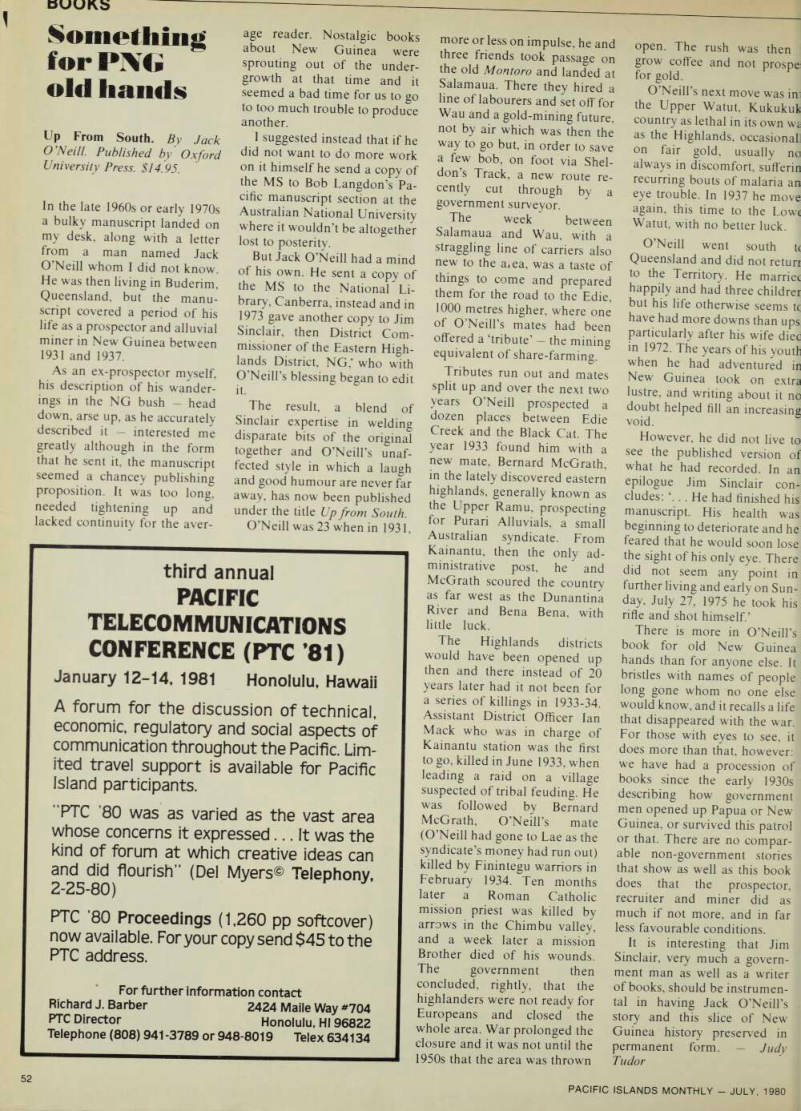
for PNG old hands
Up From South. By Jack O’Neill. Published by Oxford University Press. $14.95.
In the late 1960 s or early 1970 s a bulky manuscript landed on my desk, along with a letter from a man named Jack O’Neill whom I did not know.
He was then living in Buderim, Queensland, but the manu script covered a period of his life as a prospector and alluvial miner in New Guinea between 1931 and 1937.
As an ex-prospector myself, his description of his wander ings in the NG bush - head down, arse up, as he accurately described it interested me greatly although in the form that he sent it, the manuscript
seemed a chancey publishing
proposition. It was too long, needed tightening up and lacked continuity for the aver
age reader. Nostalgic books about New Guinea were sprouting out of the under growth at that time and it seemed a bad time for us to go to too much trouble to produce another.
I suggested instead that if he did not want to do more work on it himself he send a copy of the MS to Bob Langdon’s Pa cific manuscript section at the Australian National University where it wouldn’t be altogether lost to posterity.
But Jack O’Neill had a mind of his own. He sent a copy of the MS to the National Li brary, Canberra, instead and in 1973 gave another copy to Jim Sinclair, then District Com missioner of the Eastern High lands District, NG,‘ who with O’Neill’s blessing began to edit it.
The result, a blend of Sinclair expertise in welding disparate bits of the original together and O’Neill’s unaf fected style in which a laugh and good humour are never far away, has now been published under the title Up from South.
O’Neill was 23 when in 1931,
more or less on impulse, he and three friends took passage on the old Montoro and landed at Salamaua. There they hired a line of labourers and set off for Wau and a gold-mining future, not by air which was then the way to go but, in order to save a few bob, on foot via Shel don’s Track, anew route re
cently cut through by a
government surveyor.
The week between Salamaua and Wau, with a straggling line of carriers also new to the a*ea, was a taste of things to come and prepared them for the road to the Edie, 1000 metres higher, where one of O’Neill’s mates had been offered a ‘tribute’ the mining equivalent of share-farming.
Tributes run out and mates split up and over the next two years O’Neill prospected a dozen places between Edie Creek and the Black Cat. The year 1933 found him with a new mate, Bernard McGrath, in the lately discovered eastern
highlands, generally known as
the Upper Ramu, prospecting
for Purari Alluvials, a small Australian syndicate. From Kainantu, then the only ad ministrative post, he and McGrath scoured the country as far west as the Dunantina River and Bena Bena, with little luck.
The Highlands districts would have been opened up then and there instead of 20 years later had it not been for a series of killings in 1933-34.
Assistant District Officer lan Mack who was in charge of Kainantu station was the first to go, killed in June 1933, when leading a raid on a village suspected of tribal feuding. He was followed by Bernard McGrath, O’Neill’s mate (O’Neill had gone to Lae as the syndicate’s money had run out) killed by Finintegu warriors in February 1934. Ten months later a Roman Catholic mission priest was killed by arrows in the Chimbu valley, and a week later a mission Brother died of his wounds.
The government then concluded, rightly, that the highlanders were not ready for Europeans and closed the whole area. War prolonged the closure and it was not until the 1950 s that the area was thrown
open. The rush was then grow coffee and not prospe for gold.
O’Neill’s next move was in the Upper Watut, Kukukuk country as lethal in its own w as the Highlands, occasional on fair gold, usually no always in discomfort, sufferin recurring bouts of malaria ar eye trouble. In 1937 he move again, this time to the Lowe Watut, with no better luck.
O’Neill went south tc Queensland and did not retun to the Territory. He marriec happily and had three childrer but his life otherwise seems tc have had more downs than ups particularly after his wife diec in 1972. The years of his youth when he had adventured in New Guinea took on extra lustre, and writing about it no doubt helped fill an increasing void.
However, he did not live to see the published version of what he had recorded. In an epilogue Jim Sinclair con cludes: ‘... He had finished his manuscript. His health was beginning to deteriorate and he feared that he would soon lose the sight of his only eye. There did not seem any point in further living and early on Sun day, July 27, 1975 he took his rifle and shot himself.’
There is more in O’Neill’s book for old New Guinea hands than for anyone else. It bristles with names of people long gone whom no one else would know, and it recalls a life that disappeared with the war.
For those with eyes to see, it does more than that, however: we have had a procession of books since the early 1930s describing how government men opened up Papua or New Guinea, or survived this patrol or that. There are no compar able non-government stories that show as well as this book does that the prospector, recruiter and miner did as much if not more, and in far less favourable conditions.
It is interesting that Jim Sinclair, very much a govern ment man as well as a writer of books, should be instrumen tal in having Jack O’Neill’s story and this slice of New Guinea history preserved in
permanent form.
Judy
Tudor
Advertisements & other items, p. 52 (1 item)
Telecommunications
third annual
PACIFIC
CONFERENCE (PTC ’81)
January 12-14, 1981 Honolulu. Hawaii A forum for the discussion of technical, economic, regulatory and social aspects of communication throughout the Pacific. Limited travel support is available for Pacific Island participants.
"PTC 'BO was as varied as the vast area whose concerns it expressed... It was the kind of forum at which creative ideas can and did flourish" (Del Myers© Telephony 2-25-80) PTC ’BO Proceedings (1,260 pp softcover) now available. For your copy send $45 to the PTC address.
For further information contact Richard J. Barber 2424 Maile Way *704 PTC Director Honolulu. HI 96822 Telephone (808) 941-3789 or 948-8019 Telex 634134
Islands
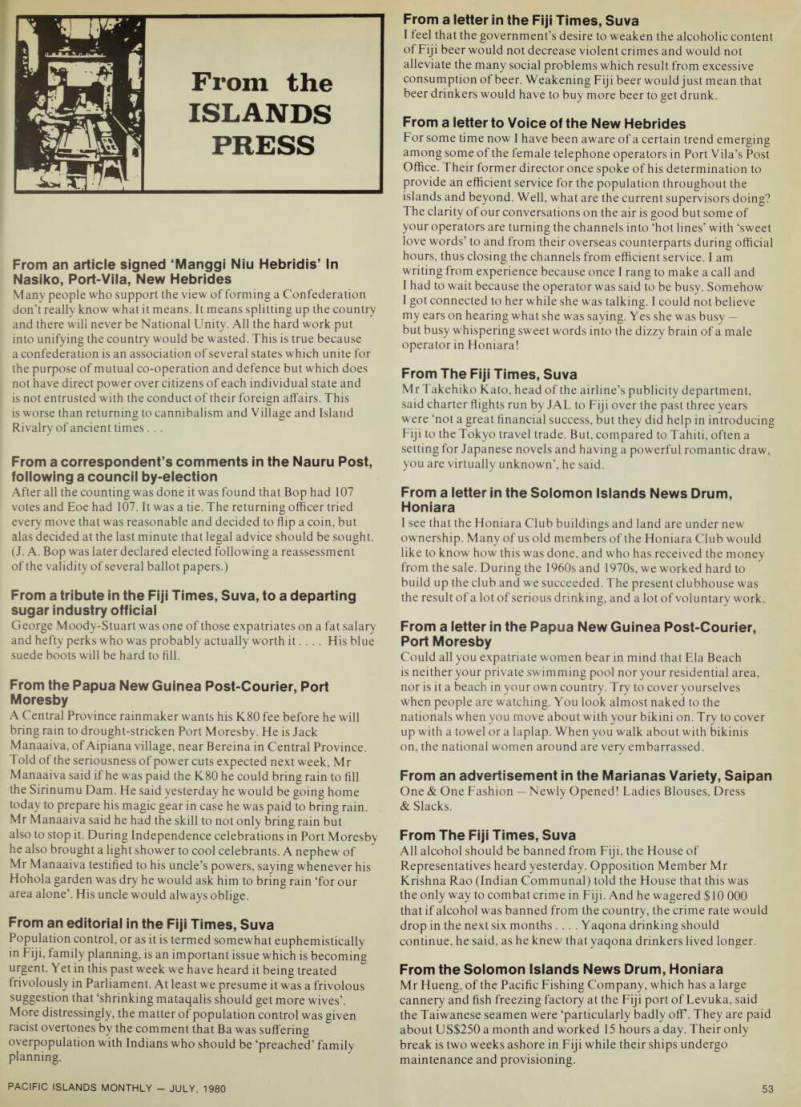
From the
Press
From an article signed ‘Manggi Niu Hebridis’ In Nasiko, Port-Vila, New Hebrides Many people who support the view of forming a Confederation don’t really know what it means. It means splitting up the country and there will never be National Unity. All the hard work put into unifying the country would be wasted. This is true because a confederation is an association of several states which unite for the purpose of mutual co-operation and defence but which does not have direct power over citizens of each individual state and is not entrusted with the conduct of their foreign affairs. This is worse than returning to cannibalism and Village and Island
Rivalry of ancient times.. .
From a correspondent’s comments in the Nauru Post,
following a council by-election
After all the counting was done it was found that Bop had 107 votes and Eoe had 107. It was a tie. The returning officer tried every move that was reasonable and decided to flip a coin, but alas decided at the last minute that legal advice should be sought. (J. A. Bop was later declared elected following a reassessment of the validity of several ballot papers.) From a tribute in the Fiji Times, Suva, to a departing sugar industry official George Moody-Stuart was one of those expatriates on a fat salary and hefty perks who was probably actually worth it... His blue suede boots will be hard to fill.
From the Papua New Guinea Post-Courier, Port
Moresby
A Central Province rainmaker wants his KBO fee before he will bring rain to drought-stricken Port Moresby. He is Jack Manaaiva, of Aipiana village, near Bereina in Central Province.
Told of the seriousness of power cuts expected next week, Mr Manaaiva said if he was paid the KBO he could bring rain to fill the Sirinumu Dam. He said yesterday he would be going home today to prepare his magic gear in case he was paid to bring rain.
Mr Manaaiva said he had the skill to not only bring rain but also to stop it. During Independence celebrations in Port Moresby he also brought a light shower to cool celebrants. A nephew of Mr Manaaiva testified to his uncle’s powers, saying whenever his Hohola garden was dry he would ask him to bring rain ‘for our area alone’. His uncle would always oblige.
From an editorial in the Fiji Times, Suva Population control, or as it is termed somewhat euphemistically in Fiji, family planning, is an important issue which is becoming urgent. Yet in this past week we have heard it being treated frivolously in Parliament. At least we presume it was a frivolous suggestion that ‘shrinking mataqalis should get more wives’.
More distressingly, the matter of population control was given racist overtones by the comment that Ba was suffering overpopulation with Indians who should be ‘preached’ family
planning.
From a letter in the Fiji Times, Suva I feel that the government’s desire to weaken the alcoholic content of Fiji beer would not decrease violent crimes and would not alleviate the many social problems which result from excessive consumption of beer. Weakening Fiji beer would just mean that beer drinkers would have to buy more beer to get drunk.
From a letter to Voice of the New Hebrides For some time now I have been aware of a certain trend emerging among some of the female telephone operators in Port Vila’s Post Office. Their former director once spoke of his determination to provide an efficient service for the population throughout the islands and beyond. Well, what are the current supervisors doing?
The clarity of our conversations on the air is good but some of your operators are turning the channels into ‘hot lines’ with ‘sweet love words’ to and from their overseas counterparts during official hours, thus closing the channels from efficient service. I am writing from experience because once I rang to make a call and I had to wait because the operator was said to be busy. Somehow I got connected to her while she was talking. I could not believe my ears on hearing what she was saying. Yes she was busy but busy whispering sweet words into the dizzy brain of a male operator in Honiara!
From The Fiji Times, Suva MrTakehiko Kato, head of the airline’s publicity department, said charter flights run by JAL to Fiji over the past three years were ‘not a great financial success, but they did help in introducing Fiji to the Tokyo travel trade. But, compared to Tahiti, often a setting for Japanese novels and having a powerful romantic draw, you are virtually unknown’, he said.
From a letter in the Solomon Islands News Drum, Honiara I see that the Honiara Club buildings and land are under new ownership. Many of us old members of the Honiara Club would like to know how this was done, and who has received the money from the sale. During the 1960 s and 19705, we worked hard to build up the club and we succeeded. The present clubhouse was the result of a lot of serious drinking, and a lot of voluntary work.
From a letter in the Papua New Guinea Post-Courier,
Port Moresby
Could all you expatriate women bear in mind that Ela Beach is neither your private swimming pool nor your residential area, nor is it a beach in your own country. Try to cover yourselves when people are watching. You look almost naked to the nationals when you move about with your bikini on. Try to cover up with a towel or a laplap. When you walk about with bikinis on, the national women around are very embarrassed.
From an advertisement in the Marianas Variety, Saipan One & One Fashion Newly Opened! Ladies Blouses, Dress & Slacks.
From The Fiji Times, Suva All alcohol should be banned from Fiji, the House of
Representatives heard yesterday. Opposition Member Mr
Krishna Rao (Indian Communal) told the House that this was the only way to combat crime in Fiji. And he wagered $ 10 000 that if alcohol was banned from the country, the crime rate would drop in the next six months ... . Yaqona drinking should continue, he said, as he knew that yaqona drinkers lived longer.
From the Solomon Islands News Drum, Honiara Mr Hueng, of the Pacific Fishing Company, which has a large cannery and fish freezing factory at the Fiji port of Levuka, said the Taiwanese seamen were ‘particularly badly off. They are paid about US$25O a month and worked 15 hours a day. Their only break is two weeks ashore in Fiji while their ships undergo maintenance and provisioning.
Advertisements & other items, pp. 54-56 (1 item)
because more
*bu get more from a
Caterpmar* B reputation is based on a firm belief in the importance of design and
development technology. Over 4,700
engineers, scientists, technicians and support staff are continually working to one end developing products to do the job better.
Our commitment to product superiority can be seen in over 120 modell of earthmoving, construction and material! handling equipment which make up a ran: that meets just about any job requirement.
And Caterpillar engines have been chosen by over 1,000 manufacturers to
Caterpillar product
goes into it.
power their equipment Caterpillar
products are backed by a full dealer service operation in over 150 countries. We stand
by our reputation.
So when we say a lift truck will lift 20 tonnes or that one of our engines will run all day at its rated output or that our CAT PLUS back-up and parts service is the best in the world, we mean it And you can rely on it That’s the Cat Promise.
Promise.
Q CATERPILLAR
Caterpillar, Cat and CB are Trademarks of Caterpillar Tractor Co.
CT3BO
V- X f * 1 u It. m * ;• j : it ■ ■ m ■r m
Expert
Insurance Service
throughout the islands
Queensland Insurance (Fiji) Limited
Head Office, 34 Usher St., SUVA . General Manager: L. G. Liddell A.A.1,1. Assistant Managers; Vijay Lai and J. T. Laidlaw. Phone; 23851.
LAUTOKA OFFICE: Burns Philp Bldg., Naviti St. District Manager: J. Dalton. Phone: 60642.
Queensland Insurance (PNG) Limited
PAPUA NEW GUINEA
Head Office, B.N.G. Building, Musgrave St.PORT MORESBY. General Manager; J. M. Dawe.
Assistant Manager: R. V. Maskell. Phone; 212144.
LAE: 4th St. & Coronation Drive. District Manager: I. R. Martin. Phone; 423873.
MOUNT HAGEN; Hagen Drive. District Manager; D. F. Carroll. Phone: 521002.
ARAWA; Chebu St. District Manager; J. Longbut. Phone: 951555.
MADANG: Kasagten St. District Manager: N. D. Ramage. Phone: 822020.
RABAUL: Wirraway St. District Manager: W. F. Tinker. Phone: 921014.
QBE Insurance Limited
NEW HEBRIDES, PORT VILA: Rue de Paris, Suite 19, Oceania Bldg. Manager: G. F. Donnelly.
Phone: 2299.
SANTO; Burns Philp (New Hebrides) Ltd. Phone: 230.
PACIFIC AGENCIES
NEW CALEDONIA; T. A.Hagen, Ste. W. A. Johnston, S.A.R.L. 5 Rue Anatole France, NOUMEA.
Phone; 272083.
TAHITI: Arthur Chung. Immeuble 8.1.5., Front de Mer, PAPEETE. Phone: 2.86.19.
NIUE; Burns Philp (South Sea) Company Ltd.
NORFOLK ISLAND; Burns Philp (South Sea) Company Ltd. Phone: 2191.
SAMOA; APIA, Burns Philp (South Sea) Company Ltd. Phone: 22611.
TONGA; Burns Philp (South Sea) Company Ltd. NUKU’ALOFA. Phone 21500 HAAPAI, VAVAU.
MEMBERS OF THE:
%£?qbe insurance group limited
filling
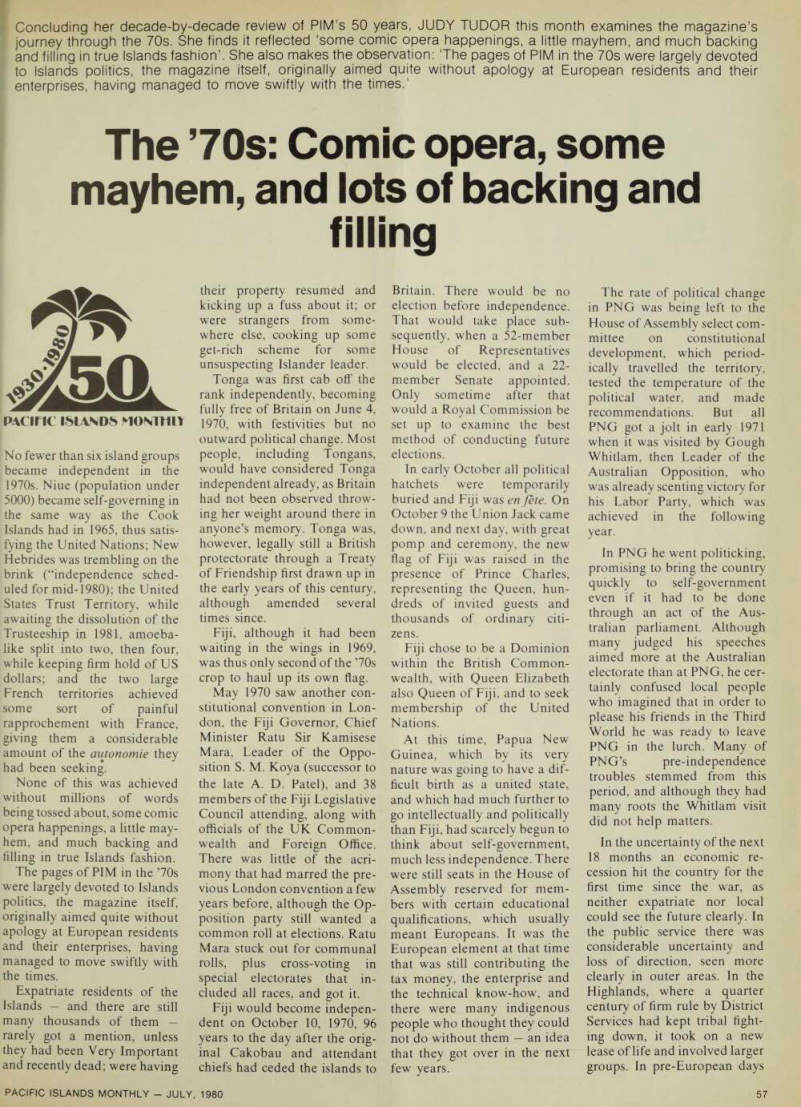
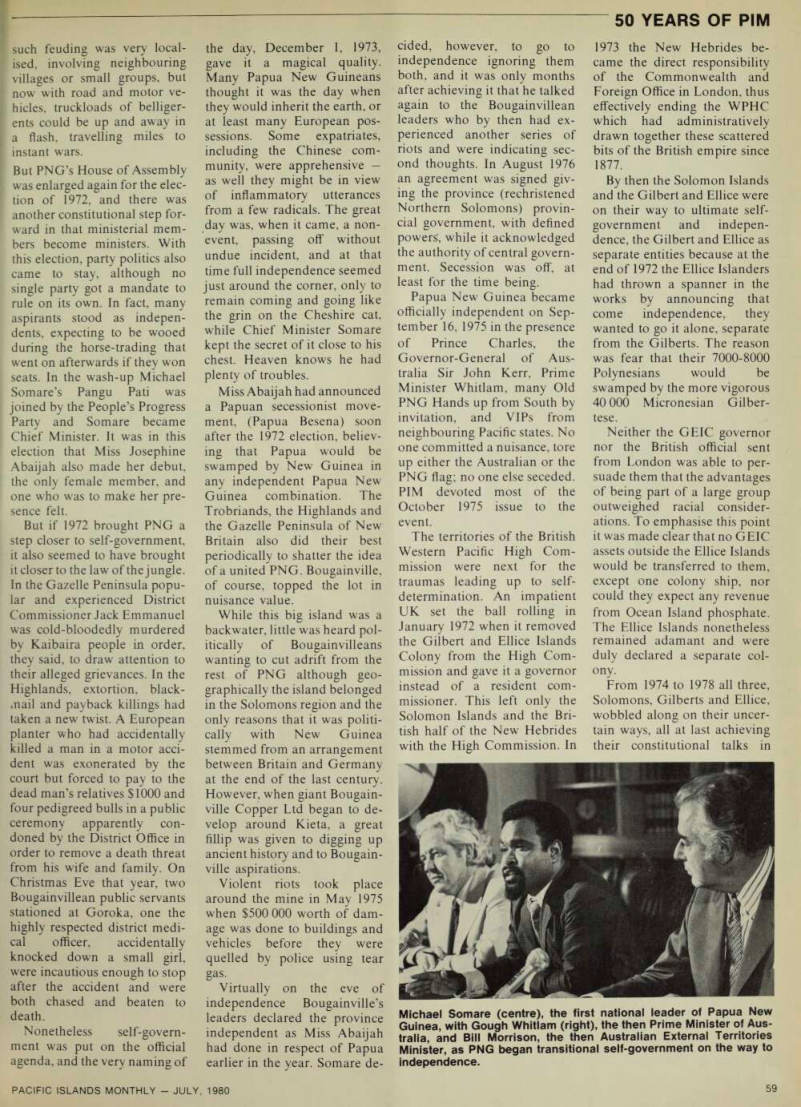

The '70s: Comic opera, some mayhem, and lots of backing and filling
Concluding her decade-by-decade review of PlM’s 50 years, JUDY TUDOR this month examines the magazine’s journey through the 70s. She finds it reflected ‘some comic opera happenings, a little mayhem, and much backing and filling in true Islands fashion’. She also makes the observation: The pages of PIM in the 70s were largely devoted to Islands politics, the magazine itself, originally aimed quite without apology at European residents and their enterprises, having managed to move swiftly with the times.’
No fewer than six island groups became independent in the 19705. Niue (population under 5000) became self-governing in the same way as the Cook Islands had in 1965, thus satis fying the United Nations; New Hebrides was trembling on the brink (“independence sched uled for mid-1980); the United States Trust Territory, while awaiting the dissolution of the Trusteeship in 1981, amoeba like split into two, then four, while keeping firm hold of US dollars; and the two large French territories achieved some sort of painful rapprochement with France, giving them a considerable amount of the autonomie they had been seeking.
None of this was achieved without millions of words being tossed about, some comic opera happenings, a little may hem, and much backing and filling in true Islands fashion.
The pages of PIM in the ’7os were largely devoted to Islands politics, the magazine itself, originally aimed quite without apology at European residents and their enterprises, having managed to move swiftly with the times.
Expatriate residents of the Islands and there are still many thousands of them rarely got a mention, unless they had been Very Important and recently dead; were having
their property resumed and kicking up a fuss about it; or were strangers from some where else, cooking up some get-rich scheme for some unsuspecting Islander leader.
Tonga was first cab off the
rank independently, becoming
fully free of Britain on June 4, 1970, with festivities but no
outward political change. Most
people, including Tongans,
would have considered Tonga
independent already, as Britain
had not been observed throw ing her weight around there in anyone’s memory. Tonga was, however, legally still a British
protectorate through a Treaty
of Friendship first drawn up in the early years of this century, although amended several times since.
Fiji, although it had been waiting in the wings in 1969, was thus only second of the ’7os crop to haul up its own flag.
May 1970 saw another con stitutional convention in Lon don, the Fiji Governor, Chief Minister Ratu Sir Kamisese Mara, Leader of the Oppo sition S. M. Koya (successor to the late A. D. Patel), and 38 members of the Fiji Legislative
Council attending, along with
officials of the UK Common wealth and Foreign Office.
There was little of the acri mony that had marred the pre vious London convention a few years before, although the Op position party still wanted a common roll at elections. Ratu Mara stuck out for communal
rolls, plus cross-voting in
special electorates that in cluded all races, and got it.
Fiji would become indepen
dent on October 10, 1970, 96 years to the day after the orig inal Cakobau and attendant chiefs had ceded the islands to
Britain. There would be no election before independence.
That would take place sub sequently, when a 52-member House of Representatives would be elected, and a 22member Senate appointed.
Only sometime after that would a Royal Commission be set up to examine the best method of conducting future elections.
In early October all political hatchets were temporarily buried and Fiji was en fete. On October 9 the Union Jack came down, and next day, with great pomp and ceremony, the new flag of Fiji was raised in the presence of Prince Charles, representing the Queen, hun dreds of invited guests and thousands of ordinary citi zens.
Fiji chose to be a Dominion within the British Common wealth, with Queen Elizabeth also Queen of Fiji, and to seek membership of the United Nations.
At this time, Papua New Guinea, which by its very nature was going to have a dif ficult birth as a united state, and which had much further to
go intellectually and politically
than Fiji, had scarcely begun to
think about self-government, much less independence. There were still seats in the House of Assembly reserved for mem bers with certain educational
qualifications, which usually
meant Europeans. It was the European element at that time that was still contributing the tax money, the enterprise and the technical know-how, and there were many indigenous
people who thought they could
not do without them an idea that they got over in the next few years.
The rate of political change in PNG was being left to the House of Assembly select com mittee on constitutional
development, which period
ically travelled the territory,
tested the temperature of the political water, and made recommendations. But all PNG got a jolt in early 1971 when it was visited by Gough Whitlam, then Leader of the Australian Opposition, who
was already scenting victory for
his Labor Party, which was achieved in the following year.
In PNG he went politicking, promising to bring the country
quickly to self-government
even if it had to be done through an act of the Aus
tralian parliament. Although
many judged his speeches
aimed more at the Australian electorate than at PNG, he cer
tainly confused local people
who imagined that in order to please his friends in the Third World he was ready to leave PNG in the lurch. Many of
PNG’s pre-independence
troubles stemmed from this
period, and although they had
many roots the Whitlam visit did not help matters.
In the uncertainty of the next 18 months an economic re cession hit the country for the first time since the war, as neither expatriate nor local could see the future clearly. In the public service there was considerable uncertainty and loss of direction, seen more clearly in outer areas. In the Highlands, where a quarter century of firm rule by District Services had kept tribal fight ing down, it took on a new lease of life and involved larger
groups. In pre-European days
such feuding was very local
ised, involving neighbouring
villages or small groups, but now with road and motor ve hicles, truckloads of belliger ents could be up and away in a flash, travelling miles to instant wars.
But PNG’s House of Assembly was enlarged again for the elec tion of 1972, and there was another constitutional step for ward in that ministerial mem bers become ministers. With this election, party politics also came to stay, although no single party got a mandate to rule on its own. In fact, many
aspirants stood as indepen
dents, expecting to be wooed
during the horse-trading that
went on afterwards if they won seats. In the wash-up Michael Somare’s Pangu Pati was
joined by the People’s Progress
Party and Somare became Chief Minister. It was in this election that Miss Josephine Abaijah also made her debut, the only female member, and one who was to make her pre sence felt.
But if 1972 brought PNG a step closer to self-government, it also seemed to have brought it closer to the law of the jungle.
In the Gazelle Peninsula popu lar and experienced District Commissioner Jack Emmanuel was cold-bloodedly murdered by Kaibaira people in order, they said, to draw attention to their alleged grievances. In the Highlands, extortion, black mail and payback killings had taken a new twist. A European
planter who had accidentally
killed a man in a motor acci dent was exonerated by the court but forced to pay to the dead man’s relatives $lOOO and four pedigreed bulls in a public ceremony apparently con doned by the District Office in order to remove a death threat from his wife and family. On Christmas Eve that year, two
Bougainvillean public servants
stationed at Goroka, one the
highly respected district medi
cal officer, accidentally knocked down a small girl, were incautious enough to stop after the accident and were both chased and beaten to death.
Nonetheless self-govern
ment was put on the official agenda, and the very naming of
the day, December 1, 1973, gave it a magical quality.
Many Papua New Guineans thought it was the day when they would inherit the earth, or at least many European pos sessions. Some expatriates, including the Chinese com
munity, were apprehensive
as well they might be in view of inflammatory utterances from a few radicals. The great day was, when it came, a non event, passing off without undue incident, and at that time full independence seemed just around the corner, only to remain coming and going like the grin on the Cheshire cat, while Chief Minister Somare kept the secret of it close to his chest. Heaven knows he had plenty of troubles.
Miss Abaijah had announced a Papuan secessionist move ment, (Papua Besena) soon after the 1972 election, believ ing that Papua would be swamped by New Guinea in
any independent Papua New
Guinea combination. The Trobriands, the Highlands and the Gazelle Peninsula of New Britain also did their best periodically to shatter the idea of a united PNG. Bougainville, of course, topped the lot in nuisance value.
While this big island was a backwater, little was heard pol
itically of Bougainvilleans
wanting to cut adrift from the rest of PNG although geo
graphically the island belonged
in the Solomons region and the only reasons that it was politi cally with New Guinea stemmed from an arrangement between Britain and Germany at the end of the last century.
However, when giant Bougain
ville Copper Ltd began to de velop around Kieta, a great
fillip was given to digging up
ancient history and to Bougain
ville aspirations.
Violent riots took place around the mine in May 1975 when $5OO 000 worth of dam age was done to buildings and vehicles before they were
quelled by police using tear
gas.
Virtually on the eve of
independence Bougainville’s
leaders declared the province
independent as Miss Abaijah
had done in respect of Papua earlier in the year. Somare de
cided, however, to go to
independence ignoring them
both, and it was only months after achieving it that he talked
again to the Bougainvillean
leaders who by then had ex perienced another series of riots and were indicating sec ond thoughts. In August 1976 an agreement was signed giv
ing the province (rechristened
Northern Solomons) provin cial government, with defined powers, while it acknowledged the authority of central govern ment, Secession was off, at least for the time being.
Papua New Guinea became
officially independent on Sep
tember 16, 1975 in the presence of Prince Charles, the Governor-General of Aus tralia Sir John Kerr, Prime Minister Whitlam, many Old PNG Hands up from South by invitation, and VIPs from neighbouring Pacific states. No one committed a nuisance, tore up either the Australian or the PNG flag; no one else seceded.
PIM devoted most of the October 1975 issue to the event.
The territories of the British Western Pacific High Com mission were next for the traumas leading up to self determination. An impatient UK set the ball rolling in January 1972 when it removed the Gilbert and Ellice Islands Colony from the High Com mission and gave it a governor instead of a resident com missioner. This left only the Solomon Islands and the Bri tish half of the New Hebrides with the High Commission. In
1973 the New Hebrides be came the direct responsibility of the Commonwealth and Foreign Office in London, thus
effectively ending the WPHC
which had administratively drawn together these scattered bits of the British empire since 1877.
By then the Solomon Islands and the Gilbert and Ellice were on their way to ultimate self government and indepen dence, the Gilbert and Ellice as separate entities because at the end of 1972 the Ellice Islanders had thrown a spanner in the
works by announcing that
come independence, they
wanted to go it alone, separate from the Gilberts. The reason was fear that their 7000-8000 Polynesians would be
swamped by the more vigorous
40 000 Micronesian Gilber tese.
Neither the GEIC governor nor the British official sent from London was able to per suade them that the advantages of being part of a large group outweighed racial consider ations. To emphasise this point it was made clear that no GEIC assets outside the Ellice Islands would be transferred to them, except one colony ship, nor could they expect any revenue from Ocean Island phosphate.
The Ellice Islands nonetheless remained adamant and were duly declared a separate col ony.
From 1974 to 1978 all three, Solomons, Gilberts and Ellice, wobbled along on their uncer tain ways, all at last achieving their constitutional talks in
Michael Somare (centre), the first national leader of Papua New Guinea, with Gough Whitlam (right), the then Prime Minister of Aus tralia, and Bill Morrison, the then Australian External Territories Minister, as PNG began transitional self-government on the way to independence.
London, all receiving promises
of continuing aid after the event and, in the fullness of time, raising their own flags.
The Solomons did so on July 7, 1978, with the Duke and Duchess of Gloucester present (the Solomon Islanders would have preferred Prince Charles and said so loudly). The Ellice, rechristened Tuvalu, followed on October 1 when Princess Margaret was sent to do the Royal honours and turned out to be a no-show she had a temperature. And lastly came the Gilberts, which chose to be called Kiribati (pronounced Kiribas except when followed by a consonant, when the ‘i’ is pronounced). Their flag went up on July 7,1979 with Princess Anne and Captain Mark Phillips healthily present.
New Zealand’s Niue had already been given self government, on the same terms as those covering the Cook Islands, on October, 19, 1974.
This had appeased the United Nations which had been beat ing its collective anti-colonial breast on the subject, and more than satisfied the Niueans who
felt that they had been hustled into political advancement fas ter than they would have chosen. So, with the settlement of the old WPHC territories in 1978-79, British interests in tue Pacific were concerned only with the New Hebrides.
Dealing with this proved as
protracted as anticipated, be
cause of the Franco-Briti.sh condominium background that even well into the decade had failed to provide the necessary
political machinery for ad
vancement. Not only was it
complicated by the three
government system French, British and Joint but by the fact that the French had always been the more vigorous and dominant partner, and that far more French nationals were permanently domiciled in the Hebrides than British.
By the time these compli cations were overcome, deep divisions had appeared among the New Hebrideans them selves. In 1975 the first Rep resentative Assembly, was
elected by universal suffrage,
but nine of the 42 seats were re
served for private enterprise
interests. The National Party gained a majority, but the as sembly did not meet for seven months while there were argu ments about the special seats.
In February 1977 the National Party changed its name to Vanuaaku Party, and refused to sit with the commercial mem bers, holding this system to be undemocratic. Another elec tion was held in November that year but was boycotted by Vanuaaku, so that seats were ‘won’ by default. This situation continued until January 1979 when there was a reconcili ation. New elections held in November resulted in a sweep ing win for the Vanuaaku Party
led by an Anglican priest, Fr
Walter Lini, who became Chief Minister, hopefully to lead New Hebrides to indepen dence in 1980.
So much for the British. For the Americans it was a decade of talks with the Micronesian inhabitants of the unwieldy Trust Territory of the Pacific Islands which was due to end in 1981 (but not necessarily).
PIM issues in the 1970 s were peppered with headlines say
ing yet another lot of US talks with the Congress of Micro nesia over future status had broken down, sometimes on the question of the money they hoped to continue to get, oc casionally on the question of military bases, often on the individual aspirations of the disparate bits and pieces that make up the TT.
In 1972, apparently despair
ing of ever getting anywhere, the Northern Marianas set up separate constitutional status talks with the US, negotiated a covenant -that will come into full effect in 1981, or whenever,
making them officially the
Commonwealth of the North ern Marianas, in political union with the US. (Mean
while they are already using
the title.) Later, the Marshalls and the Carolines also wished to con duct separate negotiations with the US, and the idea of a united Micronesia finally began to fade. It appeared, at the end of 1979, that there would be four separate states after 1981; the Marianas, a Commonwealth, as outlined above; the Federa-
ted States of Micronesia, which will cover Yap, Truk, Ponape and Kosrae; the Marshall Islands; and the Republic of Belau, formerly the Palau Dis trict. The three last expect to be ‘in free association with the US’.
The Americans found their older Samoan possession easier to deal with. Not only were the American Samoans happy to go along with what they already had, they were even reluctant to break away to the extent of electing their own governor instead of having a
Washington appointee. Three
times they turned the idea down before succumbing in 1979 and voting in Peter T.
Coleman, of Part-Samoan parentage and a former US ap pointee. American Samoa in 1980 remains an unincorpor ated Territory of the United States.
The decade in the French Pacific territories of French Polynesia and New Caledonia continued politically stormy, as battles between the so-called autonomists and the conserva tives in each country pursued their excited Gallic way, although at the ballot box the battles rarely meant more than a one-seat majority in the Ter ritorial Assemblies for either side.
In New Caledonia the nickel company and all its works was
periodically damned by the
radicals, along with metropoli
tan appointees to administra tion; while in French Polynesia the continuing nuclear exper iments and/or tourism came in for periodical abuse.
In early 1979 French High Commissioner Paul Cousseran neatly hit the nail on the head as far as French Polynesia was concerned when he said: ‘One can be intellectually for CEP (the nuclear test agency) or one can be intellectually against it. But the fact is that this country lives off it 3200
families directly not counting
Polynesian military personnel,
thousands more indirectly.
Independence is not a problem faced by this country. On the contrary its problem is depen dence ... Polynesia does not produce what it consumes.’
In mid-1977 France gave wider powers of autonomy to the new Territorial Assembly under new political status laws which provided for election of the Vice-President of the
governing body the Govern
ment Council. Francis San ford, a leading autonomist
from way back, was elected to the position. At the 1977 elec tion for the Assembly his Front Uni Party won handsomely from the conservatives while
those advocating full indepen
dence from France polled only 1.4% of the vote.
A larger measure of self determination came to New Caledonia also in 1977, mainly, by increasing from five to seven the members of the Government Council who are elected by the Territorial
Asembly.
The September 1977 elec tions for the latter resulted in an almost even split between pro- and anti-administration factions. Next election is not due until 1982 and for the nonce New Caledonia remains a territory of France, sends two deputies and one senator to Paris, is not yet sold on com
plete independence but no
doubt will go on pressing for more say in local affairs.
The Problems
of PMs
So much for tossing off the yoke of colonialism. But, as the poet said, man is born to strife
as sparks to fly upwards and
this applies to Prime Ministers and Presidents as well as the rest of us.
In March 1980 Michael Somare lost his numbers in the PNG parliament and was suc ceeded by Sir Julius Chan, leader of the People’s Progress Party which had been Somare’s
coalition partner from 1972 to 1978. In a tribute to Somare, PlM’s Angus Smales said; in eight years of leading his country, Michael Somare fashioned a stability envied by a large part of the Third World and gave PNG a reputation for political and economic stab
ility.’
Some people traced Somare’s downfall to the Rooney affair that had blown up in September 1979 when the Supreme Court sentenced Mrs Nahau Rooney, Somare’s Jus tice Minister, to eight months gaol for contempt of court. She had written to the Chief Justice stating that a university lec turer then before the court
fighting an expulsion order
should be deported, and advis ing the Judges to use greater discretion in making de cisions.
She was in gaol only one day before Somare was instrumen tal in having her released on li
cence. Four judges, including
the CJ, thereupon resigned and there was the usual media sen sation.
However, PIM believed that this was a side issue and saw more significance in the fact that much of the new leader ship consisted of men whom Somare had sacked or alien ated in the previous two years.
Several small parties, including
Miss Abaijah’s Papua Besena
joined with the PPP to defeat Somare.
Even Hammer Deßoburt, who seemed a fixture as Presi dent of Nauru, had his troubles after the elections of December 1976 when a group of younger Nauruans tried to force him to make changes in his cabinet.
Deßoburt maintained that choosing a cabinet was his pre
rogative, the majority
disagreed and he was suc ceeded by bearded Bernard Dowiyogo, 30. But not for long.
The ex-president never let up on his successor and in May 1978, over a bill dealing with
phosphate royalties, was able
to oust his younger rival,
although not before Lagumot
Harris had a feel of the top job, and the presidency is still regarded as insecure.
Although Ratu Sir Kamisese Mara has not had a break in his long Prime Ministership of
Tribal fighting continued to concern the PNG government
New Caledonia nickel works damned by the radicals.
Fiji, this was a matter of doing
things Fiji-style rather than
Westminster fashion.
The whole of Fiji was shocked numb, reported PIM after the elections in 1977, when it was found that the Federation Party had won a majority of the seats. This turn about was put down to Fijian apathy about voting, plus the influence of a breakaway group called the Fijian Nationalist Party. Whatever the cause, the numbers were against the Alliance and, a few days after the results were in, the leader of the Opposition, Mr Koya, drove up to Govern ment House confidently expecting to return as the first Indian Prime Minister of Fiji.
He was back in half an hour, a disillusioned and furious man, having been told by the Governor-General, Ratu Sir George Cakobau, that Mara had already been reappointed.
According to the G-G there was disunity in the Federation Party and it was Mara who commanded the respect of par liament and people.
Mara professed great sur prise, as clearly the Federation Party could topple him as soon as parliament met. The result was, in fact, a stalemate lasting six months. The Federation could not make up its mind to chance its arm until forced to it, and in an election of Sep tember 1977, the Alliance Party romped home with 36 seats out of 52. Mr Koya lost his seat and the Federation Party got a new leader, Mr Jai Ram Reddy.
But the biggest troubles of all were to fall on the head of Sir Albert Henry who had exer cised almost dictatorial powers in the Cook Islands since those islands became self-governing in 1965. In the elections of March 1978 Sir Albert’s Cook Islands Party again scored heavily against Dr Tom Davis’
Democratic Party by flying in
planeloads of Cook Islands voters from New Zealand. But victory was snatched away once the NZ government appointed an auditor to inquire as to whether NZ aid money had been used to charter the planes, and Dr Davis pet
itioned the Cook Islands court
alleging irregularities in the
poll.
Stuart Inder, who was in Rarotonga for PIM in July 1978, reported how Sir Albert’s CIP government ‘disappeared in a puff of smoke on July 24 and was replaced almost magi cally by the government of the Democratic Party led by Dr Tom Davis’.
The verdict that brought about the miracle was delivered by Chief Justice Gaven Donne after a hearing that lasted 18 days and, accord
ing to Inder, kept Rarotonga
agog by ‘providing a sensation as star witness Sir Albert Henry unfolded in court under exam ination an extraordinary tale of do-or-die electioneering and international finance. A key figure who to popular regret never appeared in person was Finbar Kenny, the New York boss of the Cook Islands Phila telic Bureau which for years made a mint out of its government-supported mon
opoly of Cooks Stamps’.
The reason for Henry’s dis
missal was $337 000 advanced
by Kenny and used by Henry
for six charter flights carrying supporters from New Zealand.
They had paid $2O each for food on the way but the rest was free and having arrived in Rarotonga they were shown at once into polling booths to do their duty. The Democrats also organised two flights of sup porters but these people paid their own way and there were no selection methods to help them do the decent thing, although one presumes they did it.
Henry, at the court hearing, said that the money was a loan from his good friend Finbar; but the judge found that it was an advance from the Philatelic Bureau’s stamp revenue.
Votes cast by those on Cook Islands Party charters were disallowed, and with these re moved the Democratic Party
won easily.
Sir Albert, Finbar Kenny and Mr J. Little, managing director of the Cl Develop ment Co (Kenny’s agent in the Cooks), were later charged
with fraud, and fined. Later still, Sir Albert was stripped of
his knighthood.
The downfall of Sir Albert had another result the exit of so-called cancer expert Milan Brych who had been established in Rarotonga for some time under the protection of Sir Albert, in spite of being discredited,
Brych had taken over a sec
tion of Rarotonga’s public
hospital, to the chagrin of Dr Davis who took the orthodox medical view, and was attract ing patients from Australia and New Zealand willing to pay heavily for treatment, About the time Sir Albert’s troubles blew up, Brych left for California and did not return.
Continuing Banaban Saga
The saga of the Banabans’ claim to the phosphate income of Ocean Island, past and pre sent, ran through the 1970 s and into the 80s. In 1970 they appointed an ex-Fleet Street journalist, Bertram Jones, as their Fiji-based adviser, and on the legal side, Sir Dingle Foot in Britain and K. C. Ramrakha
in Fiji.
The Rev Tebuke Rotan was back in London in mid-1971 asking the British Government for 50% of the phosphate pro ceeds from Ocean but by the early months of 1972 the Banabans had upped the ante and had decided to take their case to the UK High Court and, in a sentence, ask for the full financial benefit of phosphate mining for the past 60 years, plus the rehabilitation of the island.
The case did not come up for over two years and was still dragging on in mid-1975 when the judge, Sir Robert Megarry, decided to adjourn it in order to visit Ocean Island and Rabi much against the wishes of the British Government be cause of the time involved in such an expedition, and the added cost of an estimated SA4OO 000 to the already col ossal sums involved.
Nonetheless, in October 1975, Sir Robert and a large part of his court, including his clerk, counsel leading for the Crown, the barrister represent ing the British Phosphate Com missioners, the barrister leading for the Banabans, all with attendant solicitors, set out from London for Fiji, from there flew to Honiara where
they were picked up by Air
Nauru and deposited on Nauru. There they found that the small Banaban vessel that
they expected to travel on had already departed with a BBC TV crew which was making a documentary of the saga. The Nauru Government then put their 4400-ton Eigamoiya at the party’s disposal for the voyage to Ocean.
They arrived off the island in strong winds and big seas, the ship’s captain could not moor the vessel but went in as close as was safe while some of the lesser legal eagles were conned into a steel box dangled by the ship’s crane over the side, try
ing valiantly for long periods to
make contact with a heaving barge sent out from shore with out dashing the passengers to pieces on the side of
Eigamoiya.
At last it was proclaimed a definite no-go, the box was de posited back on the ship’s deck and the legal eagles decanted,
visibly shaken. The skipper
then put out to sea, a gangway was put down on the lee side, the High Court personnel lined up and, gingerly, one by one were taken down the gangway and, at the appropriate time, assisted to leap into a launch.
A PIM staff man witnessed it all from woe to go.
Back in London the case,
having made legal history,
finally finished in mid-1976,
after 221 sitting days. Judg
ment was not given until the end of that year when Sir
Robert Megarry found against
the Banabans in their claim for £2l million back royalties. He did, however, have plenty to say in criticism of the British Government and the BPC in their treatment of the islanders, and suggested that the BPC should make them a payment that was ‘neither nominal nor
too large’.
It was then, and only then, that the British Establishment, in which can be included the BPC, felt called upon to say anything in its own defence having allowed the excellent Banaban public relations to take all the points in a game where an uninformed public is always a sucker for David and Goliath stories.
In mid-1977, UK, Australia and New Zealand offered the Banabans a SMO million ex gratia payment which the Banabans said they would accept if they v ere given immediate self-government of Ocean Island. This they did not get as Ocean was included in the Gilberts at the time n be came independent as Kiribati in mid-1979.
The phosphate mining dam
age to Ocean Island was asses sed at SAMOOO by the British
High Court, another disap
pointment as the Banabans, who were still staking their claim to Ocean Island into the 80s, had been privately offered SAI.S million by Britain but had considered that they would get more from the High Court.
The Games
There were three South Pacific Games during the 19705, attended as usual by PIM staf fers. The first in Papeete in September 1971, was voted a howling success by all con cerned. ‘Delightful Girls + Perfect Weather + Friendly
Tahiti = Magnificent South Pacific Games’ was the PIM headline.
The second was in Guam where the headlines told the story there as well: ‘Biggest Rain-soaked, Near-disaster in Islands History’, was how PIM headed its lead story in Sep tember 1975. Guam had been in trouble from the moment it had been decided as the venue back in Tahiti in 1971. Twice the government had tried to wriggle out of it, but had been pressured into going on, with the result that hardly anything was ready when the athletes from 13 territories started
arriving.
‘The athletics venue was a shambles,’ reported John Carter in PIM, and would have remained so if New Guinea officials had not weighed in with know-how and got it into some sort of order with hours to spare ... The PR was hope less, no one on Guam except those directly involved knew anything about the Games so they stayed away in droves from the various events.’
Then it rained and rained and rained for 10 days out of the 11, and although the Guam officials could not be blamed for that, PIM asked why the middle of the local wet season had been chosen for the event.
In spite of all this, PIM de voted 10 pages to descriptions and results.
New Hebrides was chosen as the venue for the 1979 games only to back out swiftly on maturer reflection. No one else
Banabans pray before protesting over their compensation award
was willing so Fiji found itself stuck with it. These Games (the 6th in the series) duly took place in Suva in late 1979 and were pronounced a success with some qualifications. It was
suggested that they might be
the ‘last of the extravaganzas’
and many hoped so, as 2500 athletes and officials attended and general opinion was that this number was too large to cope with, As in the other two 1970 s games, New Caledonia again topped the medals count.
A Little Light Relief
In spite of the Islands being mad with politics at this period, there were more interesting events that bobbed up from time to time. In 1972, for example, an international group calling itself the Ocean Life Research Foundation set itself up to found a ‘sea city’ on crescent-shaped Minerva Reef, 450 miles south of Fiji, the only purpose of which to that time had been to provide a grave
yard for ships.
The reef had made world headlines in 1962 when a Ton gan sea captain, Tevita Fifita, and 16 of his crew, spent 100 days there when their vessel was wrecked.
Four years later Fifita had
raised the Tongan flag there although in 1972 it was not known whether Tonga had ever ratified this or not.
In January 1972 a Mr Mike Oliver, a US citizen and mem ber of the Ocean Life Foun dation, arrived in Fiji, hired a ship to take him to the reef and, after constructing two mounds of sand and coral, planted the Foundation’s flag. On his return to Suva he stated that a
dredge would be arriving
within weeks to reclaim another 400 acres.
Naturally all this infuriated Tonga but Mr Oliver swept it aside his new republic meant business, he said. It already had a constitution and a provisional
president, Maurice (or Morris) C. Davis, an electronics project engineer from California.
Next move was up to Tonga and King Taufa’ahau moved quickly. Dressed in wet weather gear he boarded the Olovaha and headed for the reef where 90 Tongan prisoners were put ashore to build an artificial island of coral rock and concrete. It was about the size of a suburban carport and fitted with a flagpole. The King, not being of athletic build, did not land on it but standing on the deck of the Olovaha he
heard a police bugler signal
that the Tongan flag had duly
been raised.
It was now Mr Davis’ turn to be infuriated. From his office
in Orange County, California,
he thundered: ‘Our Rights as individuals and citizens of a sovereign state have been violated; we intend to defend
those Rights.’
On June 15, 1972 Mr Davis arrived in Nukualofa with a feasibility study of the pro-
posed development of pier-
supported concrete platforms
which would create an artificial land surface. He wanted to talk to the King but the King refused to see him.
It would be interesting to re cord that a naval battle duly took place between the two contenders for Minerva Reef, But it didn’t happen. The King continued to treat the Ocean Life Research Foundation as though it didn’t exist. Minerva Reef now belongs to Tonga, This was not the last strange American encountered by Tonga’s King in the 70s. The other was Mr John Meier who,
against considerable criticism!
had been given a charter for a merchant bank (Bank of the South Pacific) to be set up in
Tonga. Unfortunately in late
October 1978 Meier was arrested in his Vancouver home in connection with an
obstruction of justice charge
pending in the US courts, the
central charge against him
being that he had defrauded his former employers, the
Howard Hughes empire, of
US$5B million by selling them worthless mining shares.
Advertisements & other items, pp. 58-66 (6 items)
A tiny sensation.
iw
©HITACHI
% m - Eject H|
M zSk
POWER ASSISTED CONTROL
A tiny sensation.
its incredible that a component system so small can deliver such sensational sound. But there's no denying it. Hitachi M 2 Minicomponents give you stereo sound that really fills the room - in a size that barely fills a bookshelf The powerful M 2 integrated amplifier, tape deck with Dolby,* phase-lock tuner and 2-way speakers. Put them together any way you like for performance you're sure to love.
Their rounded-edge design makes them as versatile as they are contemporary. And the dimensions are matched for a unified look, no matter how you arrange them.
Hitachi M 2 Minicomponents. Great big sound from a great little system.
I
"■MLf-'U'IH M 1
W
PHONO FM-U MW-M LW-L
0 HITACHI
tvtnco «mwbi HA-MJ
0 HITACHI
m % % m Sr.
HITACHI
The HA-M 2 integrated Amplifier is rated at 25 watts per channel continuous RMS power Dimensions (Wxhxd): ha-M2 integrated Amplifier (230 x 74x160 mm), D-M2 cassette Deck(23oxl46x 160 mm), FT-M 2 Tuner (230 x 74 xi 60 mm), and HS-M2 Speaker System (146x290x160 mm). •Dolby is a trademark of Dolby Laboratories A^!^«i^^l !l AUStra,ia Ptv '" Ltd| 155 Kevs Road| Moorabbin . Victoria 5189 Phone: (95) 8722 • NEW ZEALAND: AWA New Zealand Limited, Wi-neera Drive, p.o Box 50-248, Porirua Phone 45-75-069 • PAPUA NEW GUINEA: SO. Svensson (N.C.) Ltd, P.o. Box 705, Port Moresby Phone: 21-2944 • FIJI ISLANDS: Burns Philp (South Sea) Co,, Ltd., Box 555, C.P.O. Suva Phone 511777 • NEW CALEDONIA caldis B p mi 2 ® 23 50 * TAHITI Ets Chene Alain ' P 0 Box 272 ’ Papeete Phone: 2.88.68 • SOLOMON ISLANDS Technique Radios centre Ltd, P.O Box 465, Honiara Phone: 416 • NAURU Nauru cooperative society. Republic of Nauru • AMERICAN SAMOA: Burns Philp (South Sea) Co., Ltd., P.O. Box 129, Pago Pago • NEW HEBRIDES: Burns Philp (New Hebrides) Co., Ltd., P.o. Box 27, Port Vila
r
mrnrnimmmmßmmmm ' A
< tt vs.
O CD o o o 3 o CD (D CD C fi (Q o> C/) CD O 3 o CD o o n "*■: A
MW' I <!
WrA
m * VI mm
ISs
i-: «• !T 1 ' i
n6Eft> * o °ir * -0 z o vP ■> V. {V 6
FOR;
IN OUR 86th YEAR SELLING ‘SERVICE’
TO THE PACIFIC ISLANDS
Nelson & Robertson
PTY. LTD. (Established 1895)
Plantation House, 197 Clarence Street, Sydney.
Cables: ‘IVAN 1 , Sydney, Brisbane, Telex: AA22381, Sydney.
INDENTS - FROM AUSTRALIA, NEW ZEALAND and OVERSEAS.
FOODSTUFFS • SOFTGOODS • HARDWARE • MACHINERY TRAVEL • INSURANCE • CANNED FISH • JUTE GOODS
• REAL ESTATE •
BRANCH OFFICES:
PAPUA NEW GUINEA
REPRESENTATIVES:
Nelson & Robertson Pty. Ltd., P.O. Box 575, Brisbane, Qld., Australia.
P.O. Box 2092, Govt. Bldg., Suva, Fiji.
P.O. Box 258, Lautoka, Fiji.
P.O. Box 2420, CPO Auckland 1, New Zealand.
Rabtrad Nuigini Pty. Ltd., P.O. Box 219, Rabaul, P.N.G.
P.O. Box 1406, Lae, P.N.G.
P.O. Box 711, Madang, P.N.G.
P.O. Box 253, Kieta, P.N.G.
Y
Datsun Operating Ease
Keeps Your Materials Moving Fast!
Datsun forklifts are unsurpassed time and effort savers. Just in case you have any doubts, consider these facts. Each Datsun features virtually the smallest turning radius in its class. Together with compact body dimensions that add up to remarkable tight-space maneuverability. Simple singlelever tilt/lift control, stable lowprofile styling and higher engine power enable easy handling of a full load anywhere. Remember Datsun forklifts enjoy a proven reputation for durability, lower maintenance and greater safety.
Ask your local dealer about the many other easy-to-operate Datsun advantages. And start moving materials fast! *
DATSUN FORKLIFT
THE NAME OF QUALITY
NISSAN
NISSAN MOTOR Ca LTD
Loadlift Equipment Limited 2 Maurice Road, Penrose Auckland 6, New Zealand Tel; 663-714 Auckland Nissan Motor Co., (Australia) Pty. Ltd. Industrial Machinery Division Suite 1, 6th Floor, 100 William Street, Sydney, N.S.W. 2000, Australia Tel; 358-5444 Boroko Motors Ltd. P.O, Box 1259, Boroko, Via Port Moresby, Papua New Guinea Tel; 255255, 255-347
In catering
SPEED-E-GAS
is fast, efficient
and reliable.
Terminals throughout the Pacific.
For more information write Boral Gas Limited, 221 Miller Street,
BORAL
North Sydney 2060 *Speed-E-Gas is known in Papua New Guinea, as Guinea Gas. In Tonga J as Tonga Speed-E-Gas, f and in Fiji as Fiji Gas.
SPEED-E-GAS
nr~
HOLT GS 15
INTEGRATED TECHNICAL SERVICES
• SALES
• ON SITE INSTALLATION
• FIELD SERVICE
• HF,VHF, UHF LINK AND MOBILE SYSTEMS
• GROUND AIR COMMUNICATIONS
• MARINE NAVIGATION AND COMMUNICATIONS
• AIRCRAFT ELECTRONIC SYSTEMS
DISTRIBUTORS OF:
• CODANHFSSB SYSTEMS
• PHILIPS VHF/UHFFM MOBILE SYSTEMS
• JRC MARINE RADAR, SOUNDERS, SATTELITE
NAVIGATORS
• MAGNAVOX SATTELITE NAVIGATORS
• DECCA MARINE RADAR
• KING, MARCO, SUNAIR, COLLINS AIRCRAFT
RADIO SYSTEMS
MANUFACTURERS OF:
• PORTABLE DEPTH FINDERS
• HF RADIO SCANNERS
• VOICE SCRAMBLERS
• MICROPROCESSOR BASED CONTROL SYSTEMS
• RADIO LOCATED TRANQUILIZING DARTS
FOR WILDLIFE MANAGEMENT
FIELD ENGINEERING INTEGRATED TECHNICAL SERVICES
P. 0. Box 350, Cairns 4870, Queensland, Australia.
Phone; (070) 51 1616,51 4826,531356,51 3052. Telex; AA 48085
50 Years Of Rim
59
PACIFIC ISLANDS MONTHLY - JULY, 1980
50 Years Of Rim
61
PACIFIC ISLANDS MONTHLY - JULY, 1980
50 Years Of Pim
63
PACIFIC ISLANDS MONTHLY - JULY, 1980
50 Years Of Pim
65
PACIFIC ISLANDS MONTHLY - JULY, 1980
66
DU TcAnd Ul- KIM
PACIFIC ISLANDS MONTHLY - JULY, 1980
in Tonga
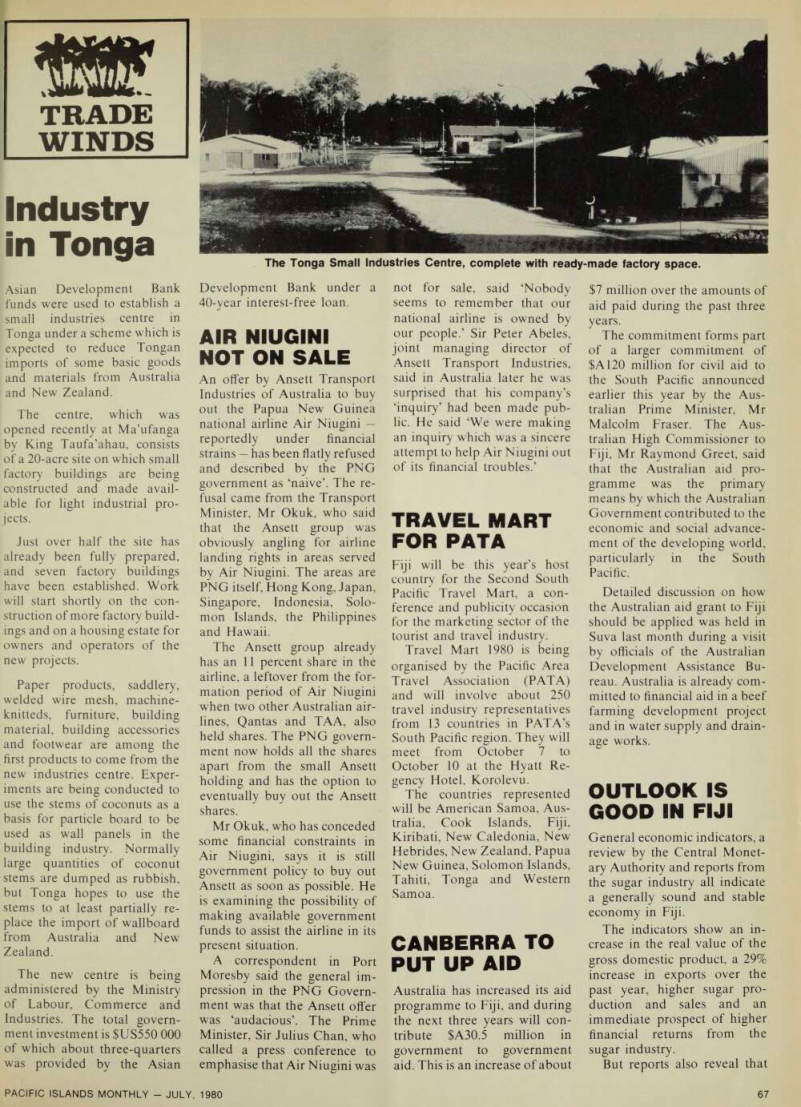

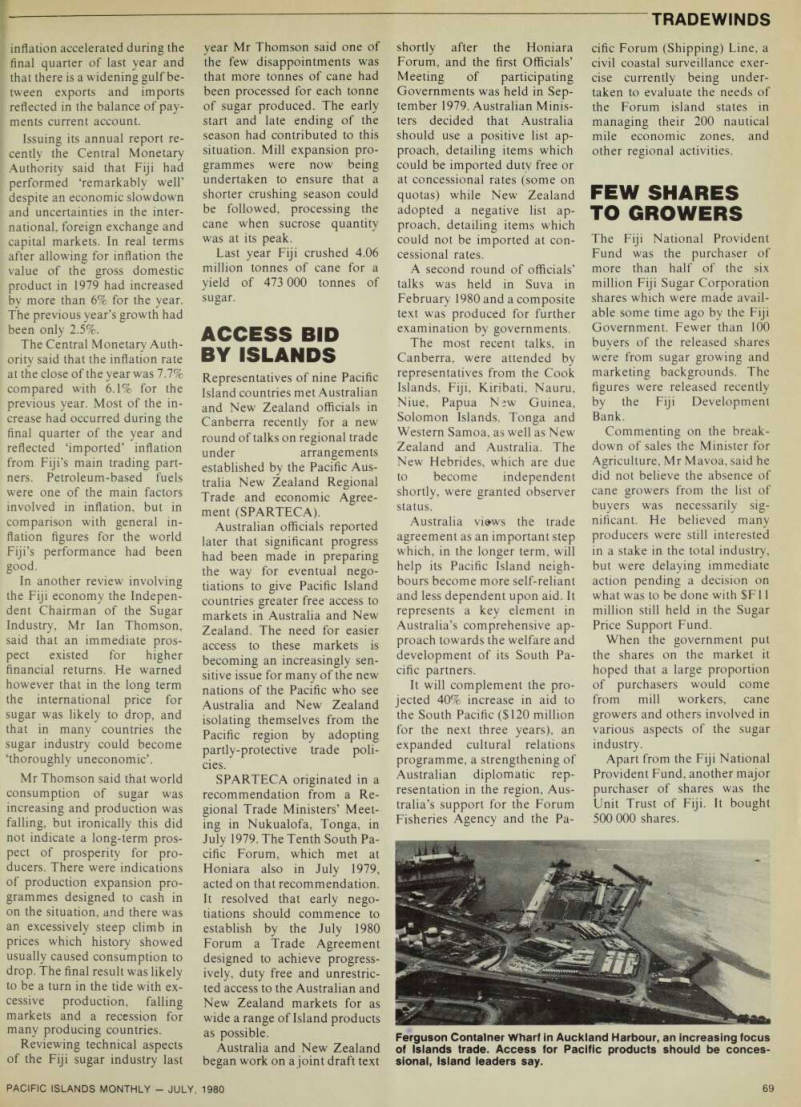
Trade
Winds
Industry
in Tonga
Asian Development Bank funds were used to establish a small industries centre in Tonga under a scheme which is expected to reduce Tongan imports of some basic goods and materials from Australia and New Zealand.
The centre, which was
opened recently at Ma’ufanga
by King Taufa’ahau, consists
of a 20-acre site on which small
factory buildings are being
constructed and made avail able for light industrial pro jects.
Just over half the site has
already been fully prepared,
and seven factory buildings
have been established. Work will start shortly on the con struction of more factory build ings and on a housing estate for owners and operators of the
new projects.
Paper products, saddlery,
welded wire mesh, machine knitteds, furniture, building material, building accessories and footwear are among the first products to come from the new industries centre. Exper iments are being conducted to use the stems of coconuts as a basis for particle board to be used as wall panels in the
building industry. Normally
large quantities of coconut
stems are dumped as rubbish, but Tonga hopes to use the stems to at least partially re place the import of wallboard from Australia and New Zealand.
The new centre is being
administered by the Ministry
of Labour, Commerce and Industries. The total govern ment investment is SUSSSO 000 of which about three-quarters was provided by the Asian
Development Bank under a 40-year interest-free loan.
Air Niugini
Not On Sale
An offer by Ansett Transport Industries of Australia to buy out the Papua New Guinea national airline Air Niugini reportedly under financial strains has been flatly refused and described by the PNG government as ‘naive’. The re fusal came from the Transport Minister, Mr Okuk, who said that the Ansett group was
obviously angling for airline
landing rights in areas served by Air Niugini. The areas are
PNG itself, Hong Kong, Japan,
Singapore, Indonesia, Solo mon Islands, the Philippines and Hawaii.
The Ansett group already has an 11 percent share in the airline, a leftover from the for mation period of Air Niugini when two other Australian air lines, Qantas and TAA, also held shares. The PNG govern ment now holds all the shares apart from the small Ansett holding and has the option to eventually buy out the Ansett shares.
Mr Okuk, who has conceded some financial constraints in Air Niugini, says it is still government policy to buy out Ansett as soon as possible. He is examining the possibility of making available government funds to assist the airline in its present situation.
A correspondent in Port Moresby said the general im pression in the PNG Govern ment was that the Ansett offer was ‘audacious’. The Prime Minister, Sir Julius Chan, who called a press conference to emphasise that Air Niugini was
not for sale, said ‘Nobody seems to remember that our national airline is owned by our people.’ Sir Peter Abeles,
joint managing director of
Ansett Transport Industries, said in Australia later he was
surprised that his company’s
‘inquiry’ had been made pub lic. He said ‘We were making an inquiry which was a sincere attempt to help Air Niugini out of its financial troubles.’
Travel Mart
For Pata
Fiji will be this year’s host country for the Second South Pacific Travel Mart, a con ference and publicity occasion for the marketing sector of the tourist and travel industry.
Travel Mart 1980 is being organised by the Pacific Area Travel Association (PATA) and will involve about 250
travel industry representatives
from 13 countries in PATA’s South Pacific region. They will meet from October 7 to October 10 at the Hyatt Re gency Hotel, Korolevu.
The countries represented will be American Samoa, Aus tralia, Cook Islands, Fiji, Kiribati, New Caledonia, New Hebrides, New Zealand, Papua New Guinea, Solomon Islands, Tahiti, Tonga and Western Samoa.
Canberra To
Put Up Aid
Australia has increased its aid programme to Fiji, and during the next three years will con tribute $A30.5 million in government to government aid. This is an increase of about
$7 million over the amounts of aid paid during the past three years.
The commitment forms part of a larger commitment of SAI2O million for civil aid to the South Pacific announced earlier this year by the Aus tralian Prime Minister, Mr Malcolm Fraser. The Aus tralian High Commissioner to Fiji, Mr Raymond Greet, said that the Australian aid pro gramme was the primary means by which the Australian Government contributed to the economic and social advance ment of the developing world, particularly in the South Pacific.
Detailed discussion on how the Australian aid grant to Fiji should be applied was held in Suva last month during a visit by officials of the Australian Development Assistance Bu reau. Australia is already com mitted to financial aid in a beef
farming development project
and in water supply and drain age works.
Outlook Is
Good In Fiji
General economic indicators, a review by the Central Monet ary Authority and reports from the sugar industry all indicate a generally sound and stable economy in Fiji.
The indicators show an in crease in the real value of the gross domestic product, a 29% increase in exports over the past year, higher sugar pro duction and sales and an immediate prospect of higher financial returns from the
sugar industry.
But reports also reveal that
The Tonga Small Industries Centre, complete with ready-made factory space.
inflation accelerated during the final quarter of last year and that there is a widening gulf be tween exports and imports reflected in the balance of pay ments current account.
Issuing its annual report re cently the Central Monetary Authority said that Fiji had performed ‘remarkably well’ despite an economic slowdown and uncertainties in the inter
national, foreign exchange and
capital markets. In real terms after allowing for inflation the value of the gross domestic product in 1979 had increased by more than 6% for the year.
The previous year’s growth had
been only 2.5%.
The Central Monetary Auth ority said that the inflation rate at the close of the year was 7.7% compared with 6.1% for the previous year. Most of the in crease had occurred during the final quarter of the year and reflected ‘imported’ inflation from Fiji’s main trading part ners. Petroleum-based fuels were one of the main factors involved in inflation, but in
comparison with general in
flation figures for the world
Fiji’s performance had been
good.
In another review involving the Fiji economy the Indepen dent Chairman of the Sugar Industry, Mr lan Thomson, said that an immediate pros pect existed for higher financial returns. He warned however that in the long term the international price for sugar was likely to drop, and that in many countries the sugar industry could become
‘thoroughly uneconomic’.
Mr Thomson said that world consumption of sugar was
increasing and production was
falling, but ironically this did not indicate a long-term pros pect of prosperity for pro ducers. There were indications
of production expansion pro
grammes designed to cash in on the situation, and there was an excessively steep climb in
prices which history showed
usually caused consumption to
drop. The final result was likely to be a turn in the tide with ex
cessive production, falling
markets and a recession for many producing countries.
Reviewing technical aspects of the Fiji sugar industry last
year Mr Thomson said one of the few disappointments was that more tonnes of cane had been processed for each tonne of sugar produced. The early start and late ending of the season had contributed to this situation. Mill expansion pro grammes were now being undertaken to ensure that a shorter crushing season could be followed, processing the cane when sucrose quantity was at its peak.
Last year Fiji crushed 4.06 million tonnes of cane for a yield of 473 000 tonnes of sugar.
Access Bid
By Islands
Representatives of nine Pacific Island countries met Australian and New Zealand officials in Canberra recently for a new round of talks on regional trade under arrangements established by the Pacific Aus tralia New Zealand Regional Trade and economic Agree ment (SPARTECA).
Australian officials reported later that significant progress had been made in preparing the way for eventual nego tiations to give Pacific Island countries greater free access to markets in Australia and New Zealand. The need for easier access to these markets is
becoming an increasingly sen
sitive issue for many of the new nations of the Pacific who see Australia and New Zealand isolating themselves from the
Pacific region by adopting
partly-protective trade poli
cies.
SPARTECA originated in a recommendation from a Re gional Trade Ministers’ Meet ing in Nukualofa, Tonga, in July 1979. The Tenth South Pa cific Forum, which met at Honiara also in July 1979, acted on that recommendation.
It resolved that early nego tiations should commence to establish by the July 1980 Forum a Trade Agreement designed to achieve progress ively, duty free and unrestric ted access to the Australian and New Zealand markets for as wide a range of Island products
as possible.
Australia and New Zealand began work on a joint draft text
shortly after the Honiara Forum, and the first Officials’
Meeting of participating
Governments was held in Sep tember 1979. Australian Minis ters decided that Australia should use a positive list ap proach, detailing items which could be imported duty free or at concessional rates (some on quotas) while New Zealand adopted a negative list ap
proach, detailing items which
could not be imported at con cessional rates.
A second round of officials’ talks was held in Suva in February 1980 and a composite text was produced for further examination by governments.
The most recent talks, in Canberra, were attended by representatives from the Cook Islands, Fiji, Kiribati, Nauru.
Niue, Papua Guinea, Solomon Islands. Tonga and Western Samoa, as well as New Zealand and Australia. The New Hebrides, which are due to become independent
shortly, were granted observer
status.
Australia vi&ws the trade agreement as an important step which, in the longer term, will help its Pacific Island neigh bours become more self-reliant and less dependent upon aid. It represents a key element in Australia’s comprehensive ap proach towards the welfare and development of its South Pa cific partners.
It will complement the pro jected 40% increase in aid to the South Pacific ($l2O million for the next three years), an expanded cultural relations programme, a strengthening of Australian diplomatic rep resentation in the region, Aus tralia’s support for the Forum Fisheries Agency and the Pa
cific Forum (Shipping) Line, a civil coastal surveillance exer
cise currently being under
taken to evaluate the needs of the Forum island states in managing their 200 nautical mile economic zones, and other regional activities.
Few Shares
To Growers
The Fiji National Provident Fund was the purchaser of more than half of the six
million Fiji Sugar Corporation
shares which were made avail able some time ago by the Fiji Government. Fewer than 100 buyers of the released shares were from sugar growing and
marketing backgrounds. The
figures were released recently
by the Fiji Development
Bank.
Commenting on the break down of sales the Minister for Agriculture, Mr Mavoa, said he did not believe the absence of cane growers from the list of
buyers was necessarily sig
nificant. He believed many producers were still interested in a stake in the total industry, but were delaying immediate action pending a decision on what was to be done with SFII million still held in the Sugar Price Support Fund.
When the government put the shares on the market it
hoped that a large proportion
of purchasers would come from mill workers, cane growers and others involved in various aspects of the sugar
industry.
Apart from the Fiji National Provident Fund, another major purchaser of shares was the Unit Trust of Fiji. It bought 500 000 shares.
Ferguson Container Wharf in Auckland Harbour, an increasing focus of Islands trade. Access for Pacific products should be conces sional, Island leaders say.
Advertisements & other items, pp. 68-71 (1 item)
Timken
o
PUTYOUR
FOOT DOWN.
DEMAND
TIMKEN
BEARINGS!
tfGtSTEftEO TRADEMARK
If you’re hard headed about the bearings you use . . . put your foot down!
Demand Timken® tapered roller bearings, and you’ll get the brand with proven quality, durability and performance.
The brand that’s given you a long j run for your money, wherever % it’s used.
On top of all this, you’ll benefit from our consistent supply, delivery, and sales and service engineering assistance available from Australian Timken and Authorized Timken® Bearing Distributors throughout the Pacific.
Another way of looking at it is that you’re not going to put your foot in it when you put your foot down and demand Timken bearings.
TIMKEN
REGISTERED TRADEMARK
TAPERED ROLLER BEARINGS
Suva^SunbMm^an^DrtLM^LaMtnka 01 ? aVklf a*® w*' 0 U n |tedEnterprises Ltd., Honiaria: Bums Philp South Sea Company, ouva, sunoeam transport Ltd. Lautoka, S.A.T.M.A., Noumea; D. L. Dent Industries Pty. Ltd., Boroko PNG’ Comotoirs Francais des Nouvelles-Hebndes, Port Vila; Bearing Service Company Ltd., Auckland: Niven Bearings Limited, Auckland.
4191 ATX
Sf We ve made the
world of difference
to Tonga's communications.
With the opening of the Cable & Wireless earth station, the people of Tonga can enjoy the benefits of the fastest, most efficient and reliable telephone, telex and telegraph links to the rest of the world. Via satellite.
At Cable & Wireless we have over a century of experience in the design, installation and maintenance of communications systems throughout the world.To date we have been involved with over 30 earth stations, each designed to meet their individual climatic and geographic conditions.
So, for more information, do a little communicating yourself. Contact us.
Hi ,
HMH
■ ■ tad oftoday’s communications. : Tongoloa, Tonga. ; Road, London |pX Tel: 01-242 4433 Telex 23181 A „
lADEWINDS INTELLIGENCE... TRADEWINDS INTELLIGENCE... TRADEWINDS INTELLIG
FEES charged by the Chilean authorities for cruise ships calling at Easter Island were dropped in March to 10% of the previous level. The discount does not apply to ships making stops at other ports in Chilean territory.
NORWAY has announced that it plans to expand trade relations with Papua New Guinea, particularly in the purchase of coffee, copra and timber. It is also prepared to assist PNG with feasibility studies into hydro-electric schemes and the shipping industry.
A CITRUS growing project, road developments and at least two port improvement projects are to be financed in the Cook Islands with an anticipated loan of $l.l million from the Asian Development Bank. The loan will be on long-term low interest rates under facilities extended by the bank to developing countries. Meanwhile the Cook Islands government is considering applying for membership of the International fund for Agricultural Development which would give it greater access to soft loans for agricul-
tural projects.
PLACER Development, the Canadian-based company operating in Papua New Guinea, is showing interest in a proposed goldmining project at Porgera in the PNG Enga Province. Under an arrangement with the PNG government Placer has the option to take up a one-third interest in any eventual mining operation.
THE AUSTRALIAN airline Qantas which normally flies its Hawaii services out of Sydney has obtained the rights to operate two flights weekly from Brisbane, Queensland, to Hawaii. One will fly direct from Brisbane and the other will call at the north Queensland coastal airport at Townsville. The new services will begin in February next year.
THE PAPUA New Guinea government plans to establish a National Logging Corporation which will operate commercially with an established international logging company as partner. The scheme plans to develop PNG’s timber logging industry, concentrating initially on areas in the Milne Bay, Morobe and Northern Provinces. Seventeen overseas-based firms have applied for the position of managing partner in the project but Cabinet will not make a final selection until August.
NEWLY-RELEASED figures show that Western Samoa last year achieved record export earnings which totalled $l5 million, but imports continued to climb and the country had a trade deficit for the year of more than $4O 000.
EARNINGS in Fiji last year from the export of shark fins, shell, turtle shells and beche-de-mer exceeded half a million dollars as part of a developing export scheme helping commercial ventures in small communities. The supplies came mainly from cooperatives in the Lau group, the Yasawas and Bua. The Government Fisheries Division is attempting to extend interest in shell-diving. The main money-earning types are trochus and mother of pearl, both of which remain in demand on the Japanese market despite the development of synthetic substitutes.
TWELVE to 15 types of sweets, popcorn, potato chips, cassava chips, hot peas, salted peas and mixed bhuja are made in a new $32 000 confectionery factory at Ba, Fiji. The owner, Mr Mohammed Gani Shah, also plans to make sweet biscuits and cordials.
A SUBSIDIARY of the big New Zealand contracting firm of Wilkins and Davis Ltd has been awarded a United Nations contract to build a cool store at Apia wharf in Western Samoa. The contract is worth about $1 million.
DESPITE a drop in the yield from Papau New Guinea coffee plantations there was an official denial last month that the situation was caused by disease. The Primary Industries Minister, Mr Roy Evara, said a technical survey showed that the trees had borne excessively heavy crops and had been unable to support the ber-
ries which had formed. The situation could be corrected by better plantation management, including the use of fertilisers and improved pruning methods. Reports of disease were incorrect, Mr Evara said and extension work was being undertaken to improve methods used by coffee growers.
THE HOTEL industry in Fiji is blaming ‘exaggerated’ overseas reports of the Easter cyclone and floods for a sudden drop in hotel occupancy rates. But Mr David Moore, of the Tourist Corporation of Fiji Group, claims that part of the problem can be attributed to lack of strong promotion by the Fiji Visitors Bureau.
Occupancies of hotels in Fiji have been the lowest since 1973, according to recent estimates.
NIUE has approved its annual budget which totals $5 million for 1980-81. The bulk of the money is being provided by aid assistance from New Zealand. A correspondent in Niue points out that with a population of only about 3000, the budget amounts to an allocation of about $ll 000 for each man, woman and child.
W R CARPENTER Holdings Ltd, the Australian-based diversified group with wide Island interests, expects to lift its group profits by at least 26% in the financial year just ended. A 26% increase would put the profit at about SAI2 million. The Papua New Guinea operations last year showed a 12% increase, but results were lower in Fiji where bad weather affected copra production.
Returns from PNG cocoa and coffee were down because of international market conditions, but the drop was more than recouped in PNG by higher returns from coconut oil expressing in Rabaul and from general tea and copra production.
THE COOK Islands government has negotiated a $lOO 000 fishing deal with South Korea, representing the first year’s licence fee for South Korean tuna ships which will be allowed to operate in the Cooks 200-mile economic zone. There will be no limit on the catch, but the tonnage caught must be notified. The agreement also provides options for annual renegotiations over a total period of five years. It is the first foreign fishing agreement ever negotiated by the Cooks.
THE AFRICAN, Caribbean and Pacific Group countries (ACP) have begun a concerted campaign to get greater benefits from the Lome Convention, the organisation which combines European and ACP countries in trade and aid arrangements. The Papuan New Guinea Minister for Foreign Affairs, Mr Noel Levi, has been appointed President of the Council of Ministers of the ACP countries and is leading the campaign. At recent talks in Kenya with the European Economic Community the responding partner in Lome Mr Levi led a delegation which called for improved arrangements on trade and aid and for better liaison between rich and poor countries. Meanwhile an EEC delegation has begun research in the South Pacific to plan new Lome Convention arrangements.
SOLOMON Islands is planning an export drive in a bid to sell more goods to Australia and New Zealand. Sawn timber and logs, canned tuna and possibly furniture will be the main exports involved in the drive. Trade agreements are now being discussed with both countries, and Solomon Islands is asking for the relaxation of import quotas on some of its products.
TUVALU’S rabbit-farming experiment (PIM Jan) has been discontinued. Although the animals survived on Tuvalu vegetation, they neither gained body weight nor bred. After the addition of trace elements to their diet was tried without any signs of improvement in health, the experiment was deemed a failure, at least for this particular breed of rabbit. Meanwhile goats are also being evaluated for farming suitability. They are continuing to thrive at the government agriculture station on Vaitupu Island.
lADEWINDS
INTELLIGENCE... TRADEWINDS INTELLIGENCE... TRADEWINDS INTELLIG
Rate-setting caused
Ships
Rate-setting caused Forum Line reaction
A heavy emphasis on market
ing and rate-setting by the
South Pacific Shipowners As sociation is believed to be the reason why the Pacific Forum Line withdrew from the associ ation. This has become appar
ent, although not officially
stated, since the announcement in April that the Forum Line was getting out of the associ ation.
The shipowners association was formed only late last year and the Forum Line was one of its founding members. Then in April this year (PIM May p 73) the Forum Line an nounced its withdrawal, saying it believed it could be employed more usefully as an independent line because of
the ‘particularly diverse trading
requirements of the Pacific Islands’.
The Forum Line did not give detailed reasons for its de cision, but claimed that con
tinuing membership of the
shipowners association could in some areas inhibit the line
from carrying out obligations
and commitments to its share holders.
The shareholders in the Forum Line are all govern ments - Cook Islands, Fiji, Kiribati, Nauru, New Zealand, Papua New Guinea, Solomon Islands, Tonga, Tuvalu and
Western Samoa. Although they
run their shipping line as a commercial operation, the establishment negotiations clearly revealed that the part ner governments see much more at stake. In addition to making a profit from the ship ping line the partners see the line as helping national
development, particularly for
the smaller island nations seek ing to build up export markets for their produce. Accordingly any rate-setting in the shipping operation tends to be inte grated with the national goals of the partner governments.
However the later-formed
shipowners association
emerged as a strictly commer cial grouping with a hard line
towards rate-setting and freight
marketing within the shipping
industry. It now appears that this attitude held a potential for conflict and the Forum Line decided to withdraw in favour
of full operating indepen
dence.
The situation has highlighted some claims that the Forum Line is politically vulnerable because of its effec tive dual aims. The line’s gen eral manager in Western Samoa, Mr Gordon Dewsnap, resigned earlier this year and left the position last month. In a public comment on his resig nation he said he was leaving as ‘a matter of principle’, but the Samoa Times newspaper claimed that political inter ference in the operation of the line had been a factor in the resignation. Mr Dewsnap, a New Zealander, had held the position for more than two years.
In Sydney recently the Chairman of the Forum Line, Mr Neroni Slade (Western Samoa) opened a new Aus
tralian regional office for the line. Other directors preseni were Mr J. Riechelmann (Tonga), Captain P. King (Papua New Guinea), Mr W.
Starr (Nauru) and Mr R. Shea (New Zealand).
Fleet Added
In Solomons
Solomon Taiyo, the Solomon Islands fishing company which links local and Japanese interests, is increasing its fleet size with the addition of two new catcher boats. The catchers, to be named Soltai Five and Soltai Six, have been acquired from Japan and are due to go into service this month. They will be able to range further afield than most of the catchers at present in ser vice because of the inclusion of
large capacity freezer equip
ment.
The total number of tuna catchers in the Solomons fleet by mid-year will be 23 six owned outright by Solomon Taiyo, 14 under charter and three from the National
Fisheries Development
Company. They are all engaged in pole and line fish
ing.
The two new catchers will be based at Tulagi and Noro. Five of the chartered catchers are to be replaced with more efficient craft later in the year, supplied by the Okinawa company which is already involved in the
charter operation.
Tightening
Security
The Fiji Ports Authority is tightening security in the Port of Suva in a move to reduce pil fering of cargo and to increase the efficiency of customs and safety controls. The move comes in the wake of stricter controls over the operation of ports in a number of Pacific countries, particularly in Papua New Guinea.
Traditionally the Port of Suva has been freely open to visitors, including sightseers,
fishing parties and people visit
ing ships. Later this year how ever strict security will be imposed and entry to wharf areas will not be possible with out authorisation.
Identity cards are being issued to port workers as part of the new move.
Fiji has also announced that it is about to introduce a new system of computing wharf handling charges for export and import cargoes. Known as the tonnage rate system it will take into account a wide range of variables in addition to the tonnage or measurement of the cargo being handled. The Ports Authority believes the system will provide incentives for fast handling.
Concern On
Exports
Western Samoa believes it is
losing export earnings because
of the effect of Forum Line shipping schedules on the
country’s produce market.
Fruit and vegetables from Western Samoan growers is shipped to Auckland in New Zealand by two Forum Line
ships, Fua Kavenga and
Forum Samoa, but under exist ing schedules the ships make several ports of call before berthing in Auckland. The growers claim that this delays the arrival of produce and lowers its value on the major New Zealand market. They also claim that the routes taken
by the ships add materially to
freight costs.
The Western Samoa govern ment has taken up the growers’ claims and is pressing for a re vision of the shipping sched ules. Reports from New Zealand recently indicated that the schedules and routes have been established on the most economic basis for all shippers and that no immediate change
is contemplated.
The Western Samoan gov ernment is also making sub missions to have greater financial and operational con trol of the line established in Apia. It believes that the pre sent arrangement involves too
much ‘remote control’ and is not in the best interests of Western Samoa which is an active contributing partner in the Forum Line.
New Strider
Fast Worker
Forum New Zealand, the newest addition to the Pacific Forum Line of container ships (PIM May p 69), has been
specially designed to handle
cargo in ports which have only a bare minimum of handling
equipment.
The ship is the New Zealand government’s contribution to the Forum Line, under a scheme in which Pacific
governments are making ships
available on full-time charter to the joint-owned line.
Forum New Zealand is of the Strider Two class, and is operating between New Zealand and the ports of Suva,
Lautoka, Pago Pago,
Nuku’alofa and Apia.
The ship can load any com bination of 12-metre, 10.5-metre and 6-metre con tainers.
Advertisements & other items, pp. 72-73 (1 item)
Io La
Epiglass Everdure Timber preservative and sealer.
Hardens, protects and densities timber.
Kills all mould spores and permanently seals out moisture. ss] 2481 Epiglass 90 Epoxy Resin and glass cloth.
Easy to apply.
Strengthens hulls, eliminates water absorption and rot and Increases the value and life of your boat.
Epiglass E-Type
Antifouling.
Gives up to 12
months
growth-free
performance.
Racing Red,
Blue, Green
and Gold.
EType|
antifouling
E PIG LAS S
COOK ISLANDS: Cook Island Trading Corporation Ltd FIJIAN ISLANDS: Burns Philp (SS) Co, Ltd NEW HEBRIDES: Burns Philp (NH) Ltd NOUMEA: Enterprise Guy Limousine NIUE ISLAND: Niue Island United PAGO PAGO: Max Haleck Inc, Burns Philp (SS) Ltd PAPUA NEW GUINEA: KIETA Nikana Wholesalers, LAE: Faulkner-Tait (NG) Pty Ltd, MADANG: Burns Philp (NG) Co.
Ltd PORT MORESBY: S.A. Heath Co. Ltd, Steamships Honda Centre RABAUL: Elvee Trading Pty Ltd, WEWAK: Burns Philp (P N G.) SOLOMON ISLANDS; P.K.R. Pacific Sales Co TAHITI: Marine Corail, Tahiti Sport, Comptior Polynesien TONGA: Burns Philp (SS) Co Ltd WESTERN SAMOA: Burns Philp (SS) Co Ltd, E. A Coxon Ltd, Gold Star Transport Co. Ltd, Morris Hedstrom Ltd.
NORFOLK ISLAND: Irvines Building Supplies 2481
Yachts
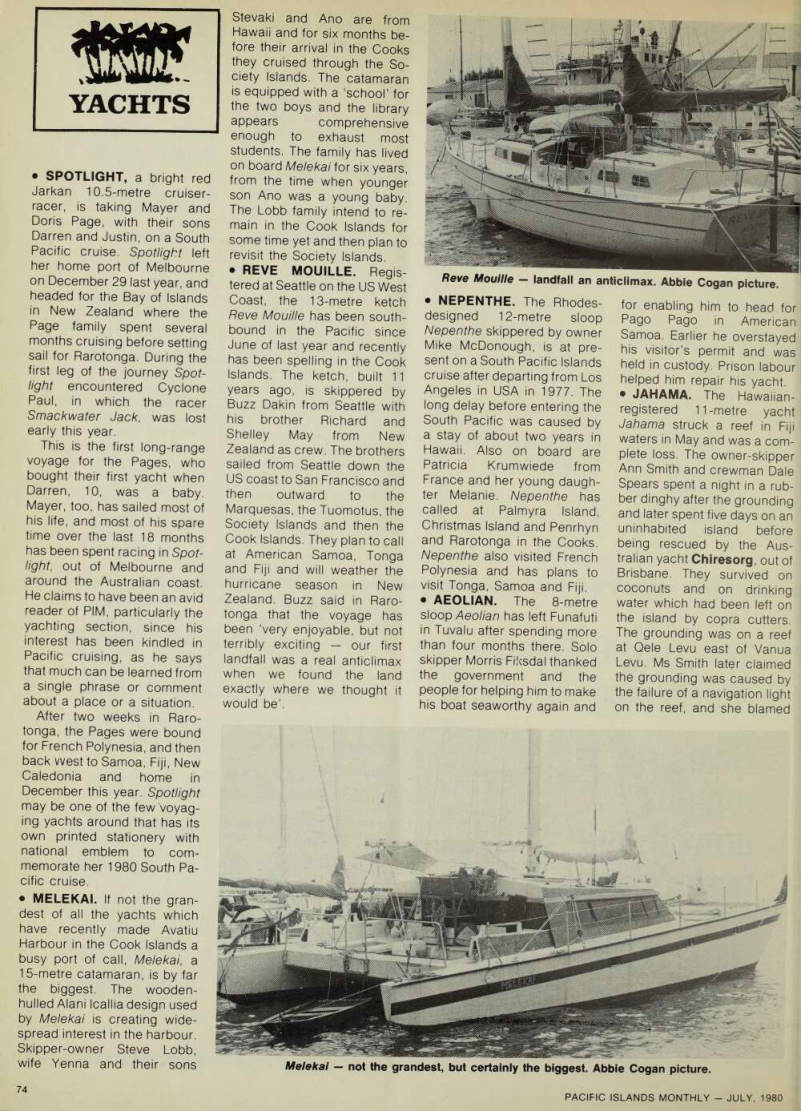
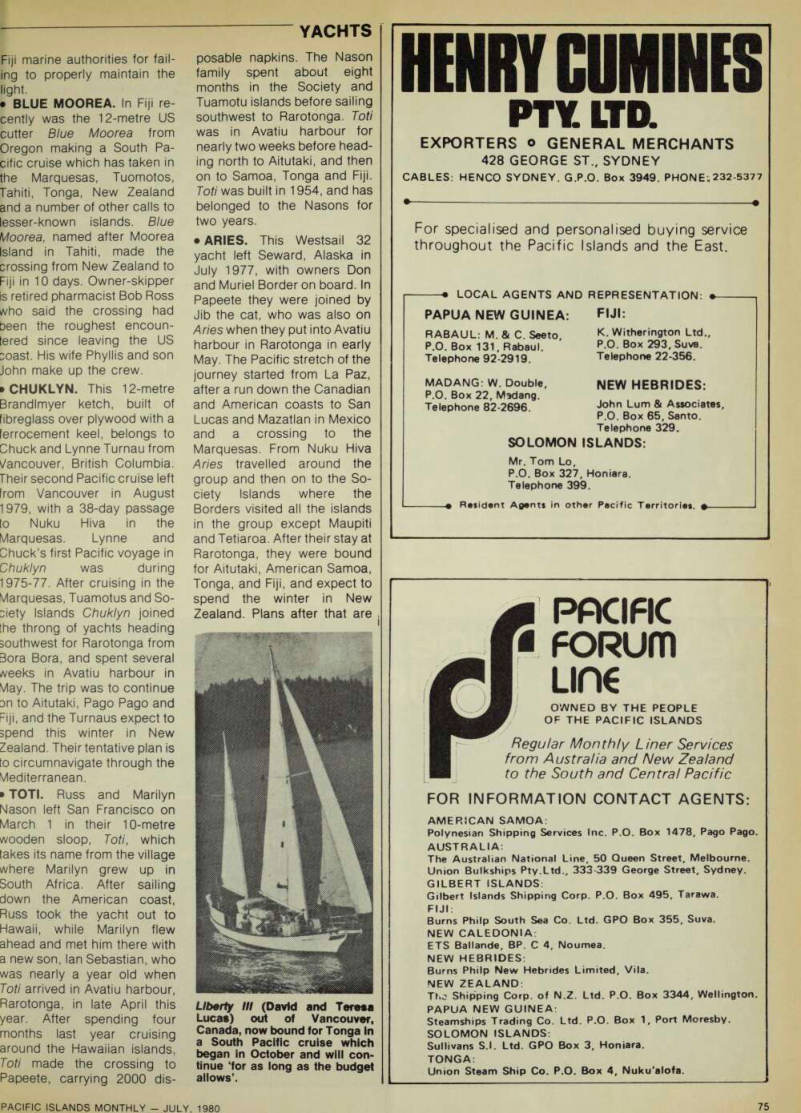
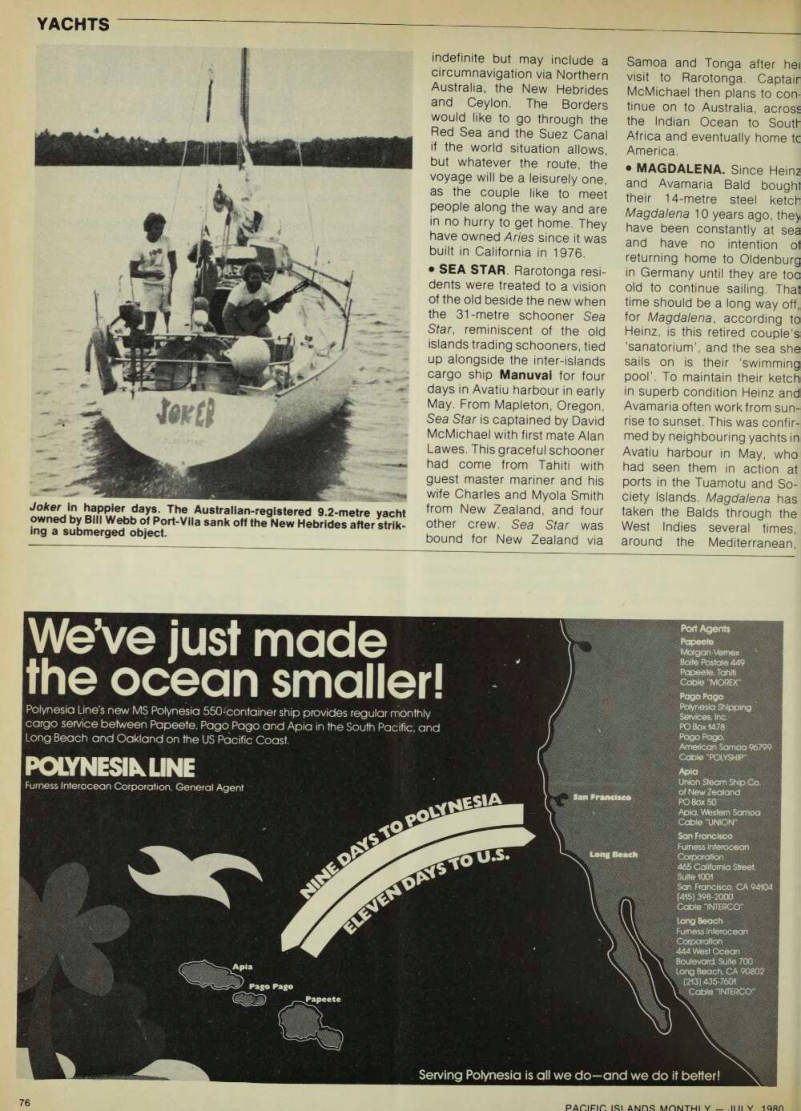
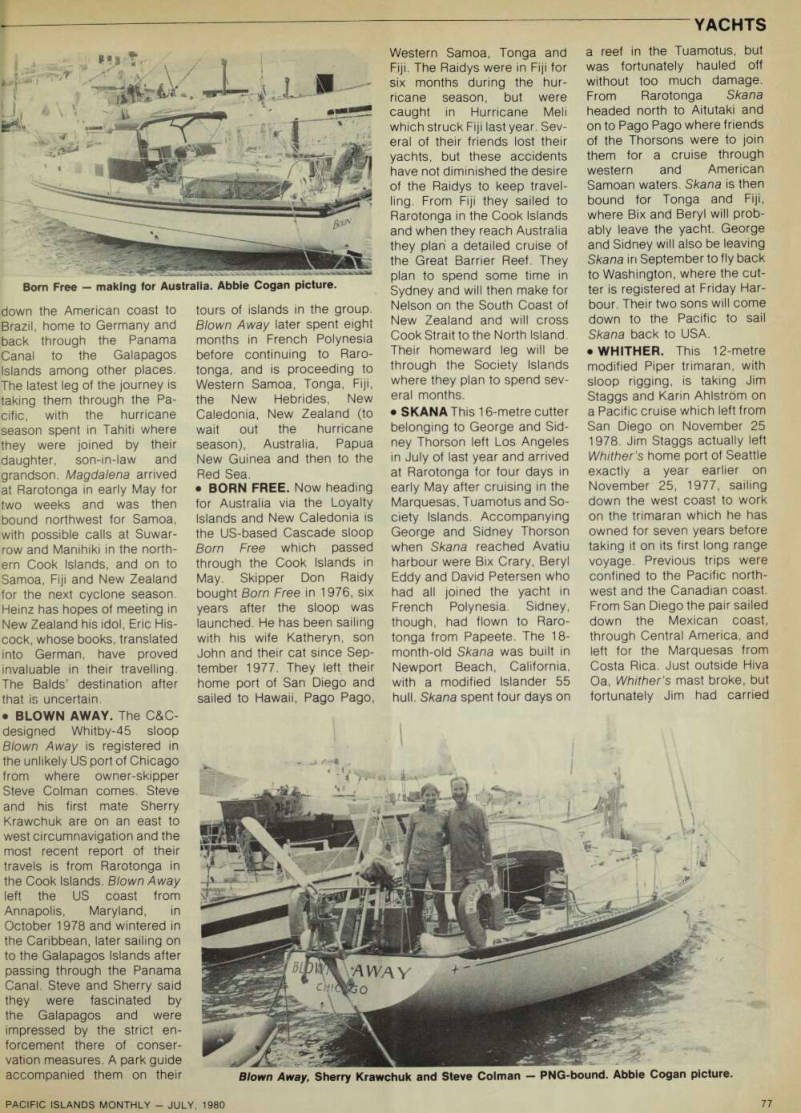
• SPOTLIGHT, a bright red Jarkan 10.5-metre cruiser racer, is taking Mayer and Doris Page, with their sons Darren and Justin, on a South Pacific cruise. Spotlight left her home port of Melbourne on December 29 last year, and headed for the Bay of Islands in New Zealand where the Page family spent several months cruising before setting sail for Rarotonga. During the first leg of the journey Spot light encountered Cyclone Paul, in which the racer Smackwater Jack, was lost early this year.
This is the first long-range voyage for the Pages, who bought their first yacht when Darren, 10, was a baby.
Mayer, too, has sailed most of his life, and most of his spare time over the last 18 months has been spent racing in Spot light, out of Melbourne and around the Australian coast.
He claims to have been an avid reader of PIM, particularly the yachting section, since his interest has been kindled in Pacific cruising, as he says that much can be learned from a single phrase or comment about a place or a situation.
After two weeks in Raro tonga, the Pages were bound for French Polynesia, and then back west to Samoa, Fiji, New Caledonia and home in December this year. Spotlight may be one of the few voyag ing yachts around that has its own printed stationery with national emblem to com memorate her 1980 South Pa cific cruise. • MELEKAI. If not the gran dest of all the yachts which have recently made Avatiu Harbour in the Cook Islands a busy port of call, Melekai, a 15-metre catamaran, is by far the biggest. The wooden hulled Alani Icallia design used by Melekai is creating wide spread interest in the harbour.
Skipper-owner Steve Lobb, wife Yenna and their sons
Stevaki and Ano are from Hawaii and for six months be fore their arrival in the Cooks they cruised through the So ciety Islands. The catamaran is equipped with a ‘school’ for the two boys and the library appears comprehensive enough to exhaust most students. The family has lived on board Melekai for six years, from the time when younger son Ano was a young baby.
The Lobb family intend to re main in the Cook Islands for some time yet and then plan to revisit the Society Islands.
• Reve Mouille. Regis
tered at Seattle on the US West Coast, the 13-metre ketch Reve Mouille has been south bound in the Pacific since June of last year and recently has been spelling in the Cook Islands. The ketch, built 11 years ago, is skippered by Buzz Dakin from Seattle with his brother Richard and Shelley May from New Zealand as crew. The brothers sailed from Seattle down the US coast to San Francisco and then outward to the Marquesas, the Tuomotus, the Society Islands and then the Cook Islands. They plan to call at American Samoa, Tonga and Fiji and will weather the hurricane season in New Zealand. Buzz said in Raro tonga that the voyage has been ‘very enjoyable, but not terribly exciting our first landfall was a real anticlimax when we found the land exactly where we thought it would be’.
• NEPENTHE. The Rhodes designed 12-metre sloop Nepenthe skippered by owner Mike McDonough, is at pre sent on a South Pacific Islands cruise after departing from Los Angeles in USA in 1977. The long delay before entering the South Pacific was caused by a stay of about two years in Hawaii. Also on board are Patricia Krumwiede from France and her young daugh ter Melanie. Nepenthe has called at Palmyra Island, Christmas Island and Penrhyn and Rarotonga in the Cooks.
Nepenthe also visited French Polynesia and has plans to visit Tonga, Samoa and Fiji. • AEOLIAN. The 8-metre sloop Aeolian has left Funafuti in Tuvalu after spending more than four months there. Solo skipper Morris Fiksdal thanked the government and the people for helping him to make his boat seaworthy again and
for enabling him to head for Pago Pago in American Samoa. Earlier he overstayed his visitor’s permit and was held in custody. Prison labour helped him repair his yacht. • JAHAMA. The Hawaiian registered 11-metre yacht Jahama struck a reef in Fiji waters in May and was a com plete loss. The owner-skipper Ann Smith and crewman Dale Spears spent a night in a rub ber dinghy after the grounding and later spent five days on an uninhabited island before being rescued by the Aus tralian yacht Chiresorg, out of Brisbane. They survived on coconuts and on drinking water which had been left on the island by copra cutters.
The grounding was on a reef at Qele Levu east of Vanua Levu. Ms Smith later claimed the grounding was caused by the failure of a navigation light on the reef, and she blamed
Reve Mouille - landfall an anticlimax. Abbie Cogan picture.
Melekai - not the grandest, but certainly the biggest. Abbie Cogan picture.
Fiji marine authorities for fail ing to properly maintain the light. • BLUE MOOREA. In Fiji re cently was the 12-metre US cutter Blue Moorea from Oregon making a South Pa cific cruise which has taken in the Marquesas, Tuomotos, Tahiti, Tonga, New Zealand and a number of other calls to lesser-known islands. Blue Moorea, named after Moorea Island in Tahiti, made the crossing from New Zealand to Fiji in 10 days. Owner-skipper is retired pharmacist Bob Ross who said the crossing had been the roughest encoun tered since leaving the US coast. His wife Phyllis and son John make up the crew. • CHUKLYN. This 12-metre Brandlmyer ketch, built of fibreglass over plywood with a ferrocement keel, belongs to Chuck and Lynne Turnau from Vancouver, British Columbia.
Their second Pacific cruise left from Vancouver in August 1979, with a 38-day passage to Nuku Hiva in the Marquesas. Lynne and Chuck’s first Pacific voyage in Chuklyn was during 1975-77. After cruising in the Marquesas, Tuamotus and So ciety Islands Chuklyn joined the throng of yachts heading southwest for Rarotonga from Bora Bora, and spent several weeks in Avatiu harbour in May. The trip was to continue an to Aitutaki, Pago Pago and Fiji, and the Turnaus expect to spend this winter in New Zealand. Their tentative plan is to circumnavigate through the Mediterranean. • TOTI. Russ and Marilyn Nason left San Francisco on March 1 in their 10-metre wooden sloop, Toti, which takes its name from the village where Marilyn grew up in South Africa. After sailing down the American coast, Russ took the yacht out to Hawaii, while Marilyn flew ahead and met him there with a new son, lan Sebastian, who was nearly a year old when Toti arrived in Avatiu harbour, Rarotonga, in late April this year. After spending four months last year cruising around the Hawaiian islands, Toti made the crossing to Papeete, carrying 2000 dis
posable napkins. The Nason family spent about eight months in the Society and Tuamotu islands before sailing southwest to Rarotonga. Toti was in Avatiu harbour for nearly two weeks before head ing north to Aitutaki, and then on to Samoa, Tonga and Fiji.
Toti was built in 1954, and has belonged to the Nasons for two years. • ARIES. This Westsail 32 yacht left Seward, Alaska in July 1977, with owners Don and Muriel Border on board. In Papeete they were joined by Jib the cat, who was also on Aries when they put into Avatiu harbour in Rarotonga in early May. The Pacific stretch of the journey started from La Paz, after a run down the Canadian and American coasts to San Lucas and Mazatlan in Mexico and a crossing to the Marquesas. From Nuku Hiva Aries travelled around the group and then on to the So ciety Islands where the Borders visited all the islands in the group except Maupiti and Tetiaroa. After their stay at Rarotonga, they were bound for Aitutaki, American Samoa, Tonga, and Fiji, and expect to spend the winter in New Zealand. Plans after that are
Liberty III (David and Teresa Lucas) out of Vancouver, Canada, now bound for Tonga in a South Pacific cruise which began in October and will con tinue ‘for as long as the budget allows’.
indefinite but may include a circumnavigation via Northern Australia, the New Hebrides and Ceylon. The Borders would like to go through the Red Sea and the Suez Canal if the world situation allows, but whatever the route, the voyage will be a leisurely one, as the couple like to meet people along the way and are in no hurry to get home. They have owned Aries since it was built in California in 1976. • SEA STAR. Rarotonga resi dents were treated to a vision of the old beside the new when the 31-metre schooner Sea Star , reminiscent of the old islands trading schooners, tied up alongside the inter-islands cargo ship Manuvai for four days in Avatiu harbour in early May. From Mapleton, Oregon, Sea Star is captained by David McMichael with first mate Alan Lawes. This graceful schooner had come from Tahiti with guest master mariner and his wife Charles and Myola Smith from New Zealand, and four other crew. Sea Star was bound for New Zealand via
Samoa and Tonga after hei visit to Rarotonga. Captain McMichael then plans to con tinue on to Australia, across the Indian Ocean to South Africa and eventually home tc America. • MAGDALENA. Since Heinz and Avamaria Bald bought their 14-metre steel ketch Magdalena 10 years ago, they have been constantly at sea and have no intention ol returning home to Oldenburg in Germany until they are too old to continue sailing. That time should be a long way off,, for Magdalena, according to Heinz, is this retired couple’s; ‘sanatorium’, and the sea she sails on is their ‘swimmingi pool’. To maintain their ketchi in superb condition Heinz andl Avamaria often work from sun rise to sunset. This was confir med by neighbouring yachts ini Avatiu harbour in May, who had seen them in action at ports in the Tuamotu and So ciety Islands. Magdalena has taken the Balds through the West Indies several times, around the Mediterranean,
Joker In happier days. The Australian-registered 9.2-metre vacht owned by Bill Webb of Port-Vila sank off the New Hebrides after strik ing a submerged object.
down the American coast to Brazil, home to Germany and back through the Panama Canal to the Galapagos Islands among other places.
The latest leg of the journey is taking them through the Pa cific, with the hurricane season spent in Tahiti where they were joined by their daughter, son-in-law and grandson. Magdalena arrived at Rarotonga in early May for two weeks and was then bound northwest for Samoa, with possible calls at Suwar row and Manihiki in the north ern Cook Islands, and on to Samoa, Fiji and New Zealand for the next cyclone season.
Heinz has hopes of meeting in New Zealand his idol, Eric His cock, whose books, translated into German, have proved invaluable in their travelling.
The Balds’ destination after that is uncertain.
• Blown Away. The C&C
designed Whitby-45 sloop Blown Away is registered in the unlikely US port of Chicago from where owner-skipper Steve Colman comes. Steve and his first mate Sherry Krawchuk are on an east to west circumnavigation and the most recent report of their travels is from Rarotonga in the Cook Islands. Blown Away left the US coast from Annapolis, Maryland, in October 1978 and wintered in the Caribbean, later sailing on to the Galapagos Islands after passing through the Panama Canal. Steve and Sherry said they were fascinated by the Galapagos and were impressed by the strict en forcement there of conser vation measures. A park guide accompanied them on their
tours of islands in the group.
Blown Away later spent eight months in French Polynesia before continuing to Raro tonga, and is proceeding to Western Samoa, Tonga, Fiji, the New Hebrides, New Caledonia, New Zealand (to wait out the hurricane season), Australia, Papua New Guinea and then to the Red Sea. • BORN FREE. Now heading for Australia via the Loyalty Islands and New Caledonia is the US-based Cascade sloop Born Free which passed through the Cook Islands in May. Skipper Don Raidy bought Born Free in 1976, six years after the sloop was launched. He has been sailing with his wife Katheryn, son John and their cat since Sep tember 1977. They left their home port of San Diego and sailed to Hawaii, Pago Pago,
Western Samoa, Tonga and Fiji. The Raidys were in Fiji for six months during the hur ricane season, but were caught in Hurricane Meli which struck Fiji last year. Sev eral of their friends lost their yachts, but these accidents have not diminished the desire of the Raidys to keep travel ling. From Fiji they sailed to Rarotonga in the Cook Islands and when they reach Australia they plan' a detailed cruise of the Great Barrier Reef. They plan to spend some time in Sydney and will then make for Nelson on the South Coast of New Zealand and will cross Cook Strait to the North Island.
Their homeward leg will be through the Society Islands where they plan to spend sev eral months. • SKANA This 16-metre cutter belonging to George and Sid ney Thorson left Los Angeles in July of last year and arrived at Rarotonga for four days in early May after cruising in the Marquesas, Tuamotus and So ciety Islands. Accompanying George and Sidney Thorson when Skana reached Avatiu harbour were Bix Crary, Beryl Eddy and David Petersen who had all joined the yacht in French Polynesia. Sidney, though, had flown to Raro tonga from Papeete. The 18month-old Skana was built in Newport Beach, California, with a modified Islander 55 hull. Skana spent four days on
a reef in the Tuamotus, but was fortunately hauled off without too much damage.
From Rarotonga Skana headed north to Aitutaki and on to Pago Pago where friends of the Thorsons were to join them for a cruise through western and American Samoan waters. Skana is then bound for Tonga and Fiji, where Bix and Beryl will prob ably leave the yacht. George and Sidney will also be leaving Skana in September to fly back to Washington, where the cut ter is registered at Friday Har bour. Their two sons will come down to the Pacific to sail Skana back to USA. • WHITHER. This 12-metre modified Piper trimaran, with sloop rigging, is taking Jim Staggs and Karin Ahlstrdm on a Pacific cruise which left from San Diego on November 25 1978. Jim Staggs actually left Whither's home port of Seattle exactly a year earlier on November 25, 1977, sailing down the west coast to work on the trimaran which he has owned for seven years before taking it on its first long range voyage. Previous trips were confined to the Pacific north west and the Canadian coast.
From San Diego the pair sailed down the Mexican coast, through Central America, and left for the Marquesas from Costa Rica. Just outside Hiva Oa, Whither’s mast broke, but fortunately Jim had carried
Born Free making for Australia. Abbie Cogan picture.
Blown Away, Sherry Krawchuk and Steve Colman - PNG-bound. Abbie Cogan picture.
wo pieces of extrusion with lim from Seattle on deck so he /vas able to build a new mast Dy splicing these together.
Wer a week long stay in Raro :onga the trimaran was bound : or Samoa, Fiji, Australia and :he Great Barrier Reef, the Solomons, Marshalls, Sardines, Marianas and eventually home to Seattle, /vith no definite date planned for the arrival. » HEIMAT. Another yacht from Vancouver which was in Avatiu Harbour in the Cook Islands in mid-April was Heimat, a 20-metre Westerly design which belongs to Karl and Henriette Bohlen. Heimat left Vancouver in June 1979, sailed direct to Hawaii, and then on to the Marquesas, Tuamotus, Papeete, Bora Bora and Rarotonga. Grant Bohlen accompanied his parents as far as Papeete be fore returning to university, and the Bohlens’ daughter and son-in-law will join them in Pago Pago for a three month cruise in the Fiji-Tonga area after their stop in Rarotonga.
Karl has been sailing, mainly around Vancouver and the north-west United States, for about seven years in a smaller yacht. This is their first long range voyage, which will prob ably continue on to New Zealand for the 1980-81 cyc lone season and on around the world ‘if the mate feels brave enough’. The Bohlens have owned Heimat, which was built in England in 1977 and freighted to Canada, for two years. • SPRAY. This 13-metre Ottawa-registered trimaran is owned and skippered by Howard Johnson, a Canadian who designed the boat him self. His crew are Adrian and Angela Lister, of Yorkshire, England. Spray, built in Cape town 10 years ago, has sailed across the Atlantic three times. On this trip Johnson voyaged from St. Croix to Panama, the Galapagos, the Marquesas, the Tuomotus, and the Society Islands. The Listers came aboard as crew in Tahiti, and sailed with John son to Rarotonga. From Rare-
tonga Spray will make the long journey back to St Croix via Aitutaki, American and West ern Samoa, Tonga, Fiji, New Zealand for the hurricane season (where his present crew will disembark), Aus tralia, the New Hebrides, Sri Lanka, South Africa and Brazil. • WHIRLWIND. This Holman and Rye 12-metre racer skip pered by Noel Murray is in Rarotonga for a brief visit.
Whirlwind has raced in the Admirals Cup and won the cup seven years ago. She has since competed in 16 races.
Whirlwind left her home port of Tauranga, New Zealand, in early May, with skipper Mur ray, his sons Kerry and Shawn, owner Doc Hubbard, and lan Riddell. The sleek racer is on its yearly cruise and is bound for Tahiti, Tonga, Samoa, Fiji and then back to New Zealand for Christmas.
Spray - Atlantic veteran in the Pacific. Abbie Cogan picture.
Advertisements & other items, pp. 75-79 (3 items)
Henry Cummer
PTY LTD.
EXPORTERS o GENERAL MERCHANTS
428 GEORGE ST., SYDNEY
CABLES: HENCO SYDNEY. G.P.O. Box 3949. PHONE; 232-5377 • •
For specialised and personalised buying service
throughout the Pacific Islands and the East.
LOCAL AGENTS AND REPRESENTATION: •-
PAPUA NEW GUINEA: FIJI:
RABAUL: M. & C. Seeto, P.O. Box 131, Rabaul.
Telephone 92-2919.
K, Witherington Ltd., P.O. Box 293, Suva.
Telephone 22-356.
MADANG: W. Double, NEW HEBRIDES:
P.O. Box 22, Madang.
Telephone 82-2696. John Lum & Associates, P.O. Box 65, Santo.
Telephone 329.
SOLOMON ISLANDS:
Mr, Tom Lo, P.O. Box 327, Honiara.
Telephone 399.
Resident Agents in other Pacific Territories. #-
■ PACIFIC
* FORUm
Line
OWNFD RY THF PFOI
OWNED BY THE PEOPLE
OF THE PACIFIC ISLANDS
Regular Monthly Liner Services
from Australia and New Zealand
to the South and Central Pacific
FOR INFORMATION CONTACT AGENTS:
AMERICAN SAMOA:
Polynesian Shipping Services Inc. P.O. Box 1478, Pago Pago
AUSTRALIA:
The Australian National Line, 50 Queen Street, Melbourne.
Union Bulkships Pty.Ltd., 333-339 George Street. Sydney.
GILBERT ISLANDS:
Gilbert Islands Shipping Corp. P.O. Box 495, Tarawa.
FIJI:
Burns Philp South Sea Co. Ltd. GPO Box 355, Suva.
NEW CALEDONIA:
ETS Ballande, BP. C 4, Noumea.
NEW HEBRIDES:
Burns Philp New Hebrides Limited. Vila.
NEW ZEALAND;
The Shipping Corp. of N.Z. Ltd. P.O. Box 3344, Wellington
PAPUA NEW GUINEA:
Steamships Trading Co. Ltd. P.O. Box 1, Port Moresby.
SOLOMON ISLANDS;
Sullivans S.l, Ltd. GPO Box 3, Honiara.
TONGA:
Union Steam Ship Co. P.O. Box 4, Nuku'alofa.
WeVe just made
the ocean smaller!
Polynesia Line's new MS Polynesia 550-container ship provides regular monthly cargo service between Papeete, Pago Pago and Apia in the South Pacific, and Long Beach and Oakland on the US Pacific Coast.
POLYNESIA. LINE
Furness Interocean Corporation, General Agent
|4BSIA
& B N?
Sk & V V Port Agents Papeete Morgan-Vemex Boite Poslaie 449 Papeete, Tahiti Cable "MOREX"
Pago Pago Polynesia Shipping Services, Inc.
PO Box 1478 Pago Pago.
American Samoa 96799 Cable "POLYSHIP"
Apia Unton Steam Ship Co. of New Zealand
POBoxSO
Apia Western Samoa Cable "UNION"
San Francisco Furness Interocean Corporation 465 California Street.
Suite 1001 San Francisco. CA 94104 (416) 398-2000 Cable "INTERCO"
Long Beach Furness Interocean Corporation 444 West Ocean Boulevard, Suite 700 Long Beach, CA 90802 (213)435-7601 Cable 'INTERCO*' ■ ' - .
Serving Polynesia is all we do—and we do it better!
7
GLOBAL SERVICE FOR SHIPPERS
V
THE BANK LINE
r -mis.
KAcnh /
Papua New Guinea & Solomon Islands
UK/Continent Service
Regular direct 28 day service
PAPUA NEW GUINEA and SOLOMON ISLANDS
to:
UNITED KINGDOM and CONTINENT
For particulars apply:
THE BANK LINE (AUSTRALASIA) PTY LTD.
18th Floor 1 York Street Sydney N.S.W. 2000 Australia Telephone; 272041 Telex: 24063
South Sea Freighters Limited
Announcing: A 30-day service between Singapore,
Malaysia, Papua New Guinea and the Solomon Islands m AGENTS: New Hebrides: South Sea Freighters Limited, PO Box 166 Port Vila • Singapore: Bienley & Co. (Pte) Ltd. Telex RS 25114, Phone: 98 1935 Pt Moresby: Nuigini Express Lines • Oro Bay: Carnell Carriers, Popondetta P.N.G. • Madang: B J. Back • Lae: Nuigini Express Lines • Wewak Burns Philp (N.G.) Ltd.
Kiett Burns Philp (N.G.) Ltd • Kimbe: Harrisons & Crossfield (P.N.G.) Ltd. • Rabaul. New Guinea Cocoa (Export) Co. Pty, Ltd. • Honiara: Island Co-operative Shipping Federation Ltd.
Serviced by MV Solomon Sea and MV Bismarck Sea.
Yachts
76
PACIFIC IS I AMDS MCNTHI Y .INI Y 1 PRO
78
pacific: islands mcnthi y .1111 v iasn
Services

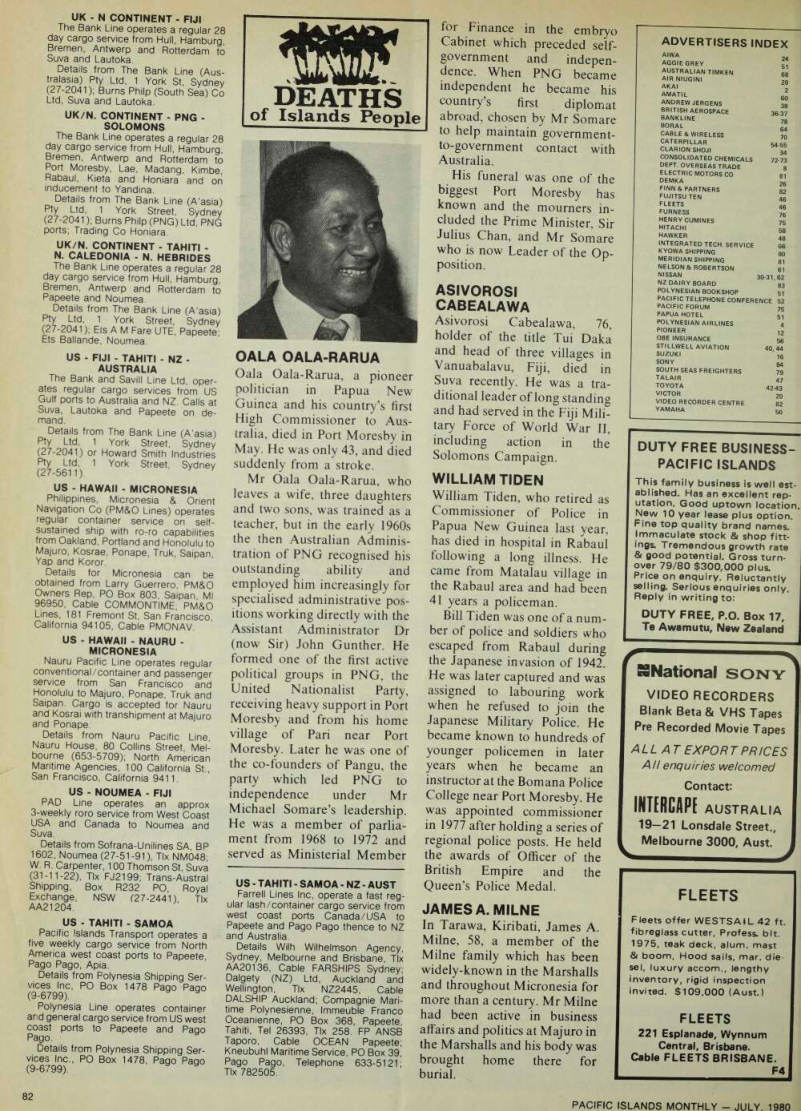
Shipping
Should any shipping company wish to have its services cargo and passenger included in these list ings they should contact PIM.
Australia - Fiji
Karlander (Aust) Pty Ltd operates monthly cargo services from Sydney to Suva and Lautoka.
Details from Karlander (Aust) Pty Ltd, 19-31 Pitt Street, Sydney (27-6301),’
Dalgety Shipping, 461 Bourke Street, Melbourne (60-0731), Burns Philp (SS) Co Ltd, Suva and Lautoka.
Sofrana-Unilines (Fiji Express Line) operates to Suva and Lautoka every three weeks from the main ports on the east coast of Australia and monthly to Lautoka from Melbourne and Sydney.
Details from Sofrana-Unilines, 19 Pitt Street, Sydney, (27-2031), Trans- Austral Shipping Pty Ltd, 570 Bourke Street, Melbourne (67-9162), ACTA Pty Ltd, Brisbane (221-3116), Elder-ANL Pty Ltd, Port Adelaide (47-5688), ANL Newcastle (049-24364), Clements & Marshall, Burnie, Tasmania (31-1833).
Australia - Fiji - Samoas -
Tonga
Pacific Forum Line operates a fully containerised service (Gen /Reefer) from Brisbane and Sydney to Lautoka,
Suva, Nukualofa, Apia and Paqo Pago.
Funafuti cargo transhipped at Suva.
Details from Pacific Forum Line, Syd ney; Union Bulkships, Sydney; ANL Brisbane; Burns Philp (SS) Co, Lau toka, Suva and Apia; Union Co Nukualofa; Polynesia Shipping Ser vices, Pago Pago or Pacific Forum Line Head Office, Apia.
Australia - Lord Howe Is -
Norfolk Is
Compagnie des Chargeurs Caledoniens operates four-weekly cargo service Sydney - Lord Howe Island and Norfolk Island.
Details Hetherington Kingsbury Pty Ltd, 37-49 Pitt Street, Sydney (27-1671). y
Australia - Nauru -
Kiribati
Nauru Pacific Line operates regular cargo /passenger service from Mel bourne to Nauru and Tarawa.
Details: Nauru Pacific Line, Nauru House, 80 Collins Street, Melbourne (653-5709), Nedlloyd Swire, 8 Spring Street. Sydney (2-0522).
Australia - New Caledonia
(And/Or) New Hebrides
Karlander operates a monthly service from Sydney to Noumea.
Details: Karlander (Aust) Pty Ltd. 19-31 Pitt Street, Sydney (27-6301).
Sofrana-Unilines ships serve Noumea every three weeks from the main ports along the east Australian coast.
Details from Sofrana-Unilines, 19 Pitt Street, Sydney (27-2031), Trans- Austral Shipping Pty Ltd, 570 Bourke Street, Melbourne (67-9162), ACTA Pty Ltd, Brisbane (221-3116), Elders-ANL Pty Ltd, Port Adelaide (47-5688), ANL, Newcastle (049-24364), Clements & Marshall, Burnie, Tasmania (31-1833).
Compagnie des Chargeurs Cale doniens operates a three-weekly con
tainerised cargo service from Sydney to Noumea.
Details Hetherington Kingsbury Ptv (27-1671 ? ) 49 P ' tt StrBet ’ Sydney Compagnie Generate Maritime oper ates a monthly service from Sydney to Noumea, Port Vila and Santo, using a self-sustained fully containerised vessel.
Details Compagnie Generate Mari time, 12 Castlereagh Street, Sydney (231-3700). y Daiwa Line operates 30 day service from Sydney to Vila and Santo.
Details Meridian Shipping & Trans port Agencies Pty Ltd, Box 3410 GPO Sydney 2001 (290-1633), Tlx AA25970.
Australia - Nz - Fiji -
Hawaii - Us
P & O liners call at Auckland, Suva.
Honolulu and Vancouver on eastbound and westbound voyages between Syd ney and the US.
Details from P & O Booking Centre, World Travel Headquarters Pty Ltd 33 Bligh Street, Sydney (231-6655).
AUSTRALIA - NZ - FIJI - TONGA - N. HEBRIDES - NOUMEA - PNG -
Solomons - Samoas - Tahiti
Sitmar Cruises operates a year-round cruise programme to include most of the above countries.
Details from Sitmar Cruises, 47 Elizabeth Street, Sydney (232-7511), P & O liners call at Auckland, Bay of Islands, Honiara, Lautoka, Noumea Nukualofa, Pago Pago, Papeete, Port Moresby, Santo, Savusavu, Suva, Vavau and Vila on cruises from Aus tralia.
Details from P & O Booking Centre, World Travel Headquarters Pty Ltd, 33 Bligh Street. Sydney (231-6655).
Australia - Micronesia
Nauru Pacific Line operates a regular container service from Melbourne to Majuro, Kosrae, Ponape, Truk, Guam and Saipan.
Details Nauru Pacific Line, Naun SSPIvJSSI C K? llins Street ' Melbourn, (653-5709), Nedlloyd Swire, 8 Sprirr Street, Sydney (2-0522).
Australia - Png
New Guinea Express Lines operate: three-weekly conventional and cor tamer services Melbourne, Sydney Brisbane, Port Moresby, Lae, Rabaui Alotau.
Details from New Guinea Expresi Lines PO Box R 73, Royal Exchang.
PO. Sydney (241-3991) MacArthu Shipping Agency Co, 82-92 Eagl< Street, Brisbane (229-3777), Nev, Guinea Express Lines, 327 Collin!
Street, Melbourne (61-3053), Niugin Express Lines in Port Moresbv (21-4572), Lae (42-1536), Rabtrao Niugim Pty Ltd, Rabaui (92-2911)!
Alotau Stevedoring & T’spor (61 -1318).
Karlander New Guinea Line's cargo vessels call at Melbourne, Sydney, Por Moresby, Lae, Madang, Wewak Manus, Kimbe, Rabaui. Popondetta Details from Karlander (Aust) Pty Ltd 19-31 Pitt Street, Sydney (27-6301)’
Dalgety Shipping, 461 Bourke Street' Melbourne (60-0731).
Australia-Png-Solomons
A. consortium of Conpac,, NGAL/PNGL have three container vessels operating on a 28 day turn around from Melbourne, Sydney andi Brisbane to Port Moresby, Lae, Rabaui, Kavieng, Wewak, Madang, Kieta and Honiara supplemented by Daiwa vessels, Pacific Princess and Fiji Maru extending from Sydney to Lae on a monthly basis.
Details from Burns, Philp & Co Ltd 51 Pitt Street, Sydney (2-0547) and Interocean Swire, 8 Spring Street, Syd ney. (2-0522).
Australia - Solomons -
Kiribati - Micronesia
Daiwa Line operates a container ser vice every 30 days from Sydney to
omara, Kieta, Tarawa and Guam. Gizo argoes transhipped at Honiara, aipan, cargoes transhipped at Kobe.
Details Meridian Shipping & Trans ort Agencies Pty Ltd, Box 3410 GPO ydney 2001 (290-1633). Tlx.
A 25970.
Australia - Solomons -
Northern Marianas-Taiwan
Japan
Daiwa Line offers a four-weekly ser
ice Sydney-Honiara-Guam-Taiwan
apan with transhipment at Kobe for laipan.
Details Meridian Shipping & Trans icrt Agencies Pty Ltd, Box 3410 GPO, Sydney 2001 (290-1633). Tlx. 0425970.
Australia - Tahiti
Compagnie Generate Maritime oper ites a monthly service from Sydney to ‘apeete using a self-sustained fully ontainerised vessel.
Details Compagnie Generate Mari me, 12 Castlereagh Street, Sydney 231-3700).
Australia - Tonga -
Samoas - Tahiti
Karlander operates a monthly cargo ervice from Melbourne and Sydney to Juku’alofa, Apia, Papeete, US west oast.
Details: Karlander (Aust) Pty Ltd, 9-31 Pitt Street, Sydney (27-6301).
Australia - W. Samoa
Compagnie Generate Maritime oper tes a monthly service from Sydney to kpia, using a self-sustained fully con ainerised vessel.
Details Compagnie Generate Mari me, 12 Castlereagh Street, Sydney 231-3700).
Far East - Fiji - New
Zealand
New Zealand Unit Express (NZUE) iperates a fortnightly palletised cargo ervice from Manila. Keelung, [aoshiung and Hong Kong to Lautoka, !uva and thence to NZ.
Details from Carpenters Shipping, Suva (312-244), Burns Philp, Suva 311-777), P & O S.N. Co, Wellington 736-477) or Nedlloyd Swire Pty Ltd, >ydney (20-522).
Nedlloyd operates bi-weekly cargo ervice with four ships from Sourabaya, lakarta, Bangkok, Port Kelang and Singapore to Suva and NZ ports.
Details from Nedlloyd (Aust) Pty Ltd, ! Spring St, Sydney (27 3801), Burns ’hilp (SS) Co Ltd, Suva and Lautoka.
Far East - Mid-S. Pacific
China Navigation's New Guinea Pa :ific Line (NGPL) operates a regular ;argo service from Hong Kong, Taiwan, /lanila, Port Kelang and Singapore to Vewak, Madang, Kimbe, Rabaul, Kieta, .ae, Port Moresby, Honiara, Santo, /ila, Noumea, Papeete, Pago Pago, \pia, Tarawa and Nauru.
Details from Steamships Trading Co., 3 ort Moresby (21-2000).
Kyowa Shipping Ltd. operates nonthly services from Hong Kong, faiwan, S. Korea and Japan, to Guam, Saipan, Solomons, New Caledonia, Fiji, Vestern and American Samoa, Tahiti, Dock Is., Tonga and New Hebrides.
Details: Hetherington Kingsbury Pty _td, 37-49 Pitt Street, Sydney 27-1671).
Daiwa Line operates 30-day service rom Moji, Kobe, Nagoya and Yokohama to Papeete, Pago Pago, 4pia, Suva, Lautoka, Noumea, Sydney, Honiara, Kieta, Tarawa and Guam.
Details: Meridian Shipping & Trans port Agencies Pty Ltd, Box 3410 GPO Sydney 2001 (290-1633) Tlx: \A25970.
Japan - Fiji - New Zealand
China Navigation, operates a nonthly service from main ports Japan o Suva and Lautoka and thence Moumea and NZ.
Details from Carpenters Shipping.
Suva (312-244).
Japan - Png
Mitsui O.S.K. Lines operates a monthly service from main ports Japan and Port Moresby, Rabaul, Lae, Madang, Kieta and Kimbe.
Details from J. C. Waller, Port Moresby (21-2919/21-1898).
JAPAN - GUAM - FIJI - TAHITI -
Samoa - N. Caledonia -
Solomons - Kiribati
Daiwa Lines runs a monthly cargo service from Japan via Guam to Lau toka, Suva, Papeete, Pago Pago, Apia, Sydney, Noumea, Honiara, Tarawa, Guam.
Details from Burns Philp (SS) Co Ltd, Suva.
Hawaii - Samoas - Tonga
Warner Pacific Line operates uni tized/palletized and reefer cargo service Honolulu /Pago Pago-Apia- Nuku'alofa. Line Islands and Suva by inducement.
Details from Hawaii-Pacific Maritime Inc., Honolulu, Hi 96801. Tel, (808) 521-9806 Freight Dept. Tlx (RCA): 723-8330 ITT 743-0040 Cables ‘Oral'.
New Caledonia - Fiji - West
Coast North America
PAD Line operates an approx. 3weekly ro-ro service from Noumea and Suva to Honolulu and West Coast USA and Canadian ports.
Details from Sofrana-Unilines SA, BP 1602, Noumea (27-51 -91), Tlx NMO4B; W. R. Carpenter, 100 Thomson St., Suva (31-11-22), Tlx FJ2199; Trans- Austral Shipping, Box R 232 PC, Royal Exchange, NSW (27-2441), Tlx AA21204.
Png - Uk/Continent
Bank Line operates regular cargo service from Kieta, Rabaul, Kimbe, Madang and Lae to Cardiff, Hamburg, Rotterdam and Antwerp.
Details from Bank Line (A’asia) Pty Ltd, 1 York Street, Sydney (27-2041); Burns Philp (PNG) Ltd, ports.
Png - Us
Bank Line operates regular cargo service from Kieta, Rabaul, Kimbe, Madang and Lae direct to New Orleans; calls at other US and Gulf and East Coast ports on inducement.
Details from Bank Line (A’asia) Pty Ltd, 1 York Street, Sydney (27-2041); Burns Philp (PNG) Ltd, PNG ports.
Solomons - Usa -
Uk/Continent
Bank Line operates regular cargo service from Honiara to New Orleans, Cardiff, Hamburg, Rotterdam and Ant werp.
Details from Bank Line (A’asia) Pty Ltd, 1 York Street, Sydney (27-2041); Trading Co, Honiara (389).
NZ - COOK IS - NIUE -
Tahiti
Shipping Corporation of NZ Ltd oper ates cargo services based on pallets and similar units from Auckland to Niue, Cook Islands and Tahiti, Details from the Shipping Corp of NZ Ltd, PO Box 3420, Auckland (797-210), Waterfront Commission, PO Box 61, Rarotonga; Lighterage and Stevedoring Co, Aitutaki; Niue Govt Offices. Niue Island Compagnie Mari time Polynesienne, B’P’ 368, Papeete, Tahiti.
Nz - Fiji
Reef operates a regular 18-day ser vice from Auckland to Suva and Lau toka.
Details from Reef Shipping Agencies, PO Box 3382, Auckland, NZ (77-1221-3).
Pacific Line with one ship operates fortnightly roro cargo service New Zealand, Lautoka, Suva.
Details: Sofrana Unilines, 18 Cus toms Street, Auckland (773-279) PO Box 3614, Telex: NZ2313.
NZ - FIJI - NORTH AMERICA (WC) Blue Star Line Ltd Pacific Coast con tainer services. Only direct service to and from New Zealand. Blue Star
vessels call at Suva and Honolulu on NZ-US-West Coast voyages.
Details from Blueport ACT (NZ) Ltd, PC Box 192, Wellington (739-029) , iuT ™'f»> L,d . GPO BOX 365, Suva, Fiji (jn-///).
NZ - FIJI - SAMOAS - TONGA Pacific Forum Line operates a fully containerised two-weekly service (Gen/Reefer) from Auckland to Lautoka, Suva, Apia, Pago Pago and Nuku’alofa.
Details from Pacific Forum Line, Wellington; Union Co, Auckland. Lautoka Suva Apia and Nuku’alofa; Polynesia Shipping Services. Pago Pago or Pacific Forum Line Head Office Apia Cl ■■
Solomons Png
Pacific Forum Line operates a fully containerised service (Gen/Reefer) from Lyttelton, Napier, Tauranga, Auckland to Suva, Lautoka, Noumea, Honiara, Kieta, Lae and Port Moresby Details from Pacific Forum Line, Wellington; Shipping Corporation of NZ, Lyttelton, Napier; Union Co, Tauranga, Auckland, Suva, Lautoka; Sofrana, Noumea; Steamships Trading Co Kieta Lae, Port Moresby; Sullivans (SI) Ltd Honiara or Pacific Forum Line Head Office, Apia.
Nz-N. Caledonia-N. Hebrides-
Png-Solomons
Sofrana Unilines with three ships operates to Vila and Santo, to Honiara and Papua New Guinea and to Norfolk Island and Noumea.
Details from Sofrana Umhnes, 18 Customs Street, Auckland (773-279), PO Box 3614, Telex NZ2313.
Nz - Tahiti
Compagnie Tahitienne Maritime SA with one ship operates monthly service New Zealand - Papeete.
Details from Sofrana Unilines, PC Box 3614, 18 Customs St, Auckland (773-279), Tlx NZ2313.
Tonga Samoas
™° A n omngafperates a four-weekly cargo service, Auckland - Nukualofa - Pago Pago - Apia - Auckland, Details from McKay Shipping Ltd, Downtown House, Queen Street, Auckland (30-229).
Warner Pacific Line services Auckland - Nuku alofa/Vavau/ Apia/Pago Pago fortnightly carrying general and freezer cargoes. Also Timaru - Nuku’alofa/Vavau/Apia every 21 days carrying freezer cargo.
Details from Air Marine Services (NZ) Ltd, PO Box 2505, Auckland (79M41 >■ Tele * NZ21555
Europe - Tahiti -
New Caledonia
Compagnie Generate Maritime oper ates services from Europe and Mediter ranean ports to Papeete and Noumea using three roro and two multi-purpose vessels thus ensuring a bi-monthly sail ing to and from.
Details Compagnie Generate Man time, 12 Castlereagh Street, Sydney (231-3700).
Hamburg-Sued operates monthly cargo services from Hamburg, Dunkirk and Le Havre to Papeete, Noumea, via Panama.
Details from Columbus Overseas Services Pty Ltd, 333 George Street, Sydney (290-2966), Columbus Mari time Services, 17 Albert Street.
Auckland (77-3460).
EUROPE - TAHITI - W. SAMOA -
P|J| . Caledonia
Nedlloyd offers regular cargo ser vices from Northern Europe and UK to Papeete, Apia, Fiji and New Caledonia, Details Nedlloyd (Aust) Pty Ltd, 8 Spring Street, Sydney (27-3801).
Uk - N Continent - Fiji
The Bank Line operates a regular 28 day cargo service from Hull, Hamburg, Bremen, Antwerp and Rotterdam to Suva and Lautoka.
Details from The Bank Line (Aus tralasia) Pty Ltd, 1 York St, Sydney (27-2041); Burns Philp (South Sea) Co Ltd, Suva and Lautoka.
Uk/N. Continent - Png -
Solomons
The Bank Line operates a regular 28 day cargo service from Hull, Hamburg, Bremen, Antwerp and Rotterdam to Port Moresby, Lae, Madang, Kimbe.
Rabaul, Kieta and Honiara and on inducement to Yandina.
Details from The Bank Line (A'asia) Pty Ltd, 1 York Street, Sydney (27-2041); Burns Philp (PNG) Ltd, PNG ports; Trading Co Honiara.
Uk/N. Continent - Tahiti -
N. Caledonia - N. Hebrides
The Bank Line operates a regular 28 day cargo service from Hull, Hamburg, Bremen, Antwerp and Rotterdam to Papeete and Noumea.
Details from The Bank Line (A’asia) Pty Ltd. 1 York Street, Sydney (27-2041); Ets A M Fare DTE, Papeete; Ets Ballande, Noumea.
US - FIJI - TAHITI - NZ -
Australia
The Bank and Savill Line Ltd, oper ates regular cargo services from US Gulf ports to Australia and NZ. Calls at Suva. Lautoka and Papeete on de mand.
Details from The Bank Line (A’asia) Pty Ltd, 1 York Street, Sydney (27-2041) or Howard Smith Industries Pty Ltd, 1 York Street, Sydney (27-5611). 1 y
Us - Hawaii - Micronesia
Philippines, Micronesia & Orient Navigation Co (PM&O Lines) operates regular container service on self sustained ship with ro-ro capabilities from Oakland, Portland and Honolulu to Majuro, Kosrae, Ponape, Truk, Saipan Yap and Koror.
Details for Micronesia can be obtained from Larry Guerrero, PM&O Owners Rep, PO Box 803, Saipan, Ml
96950, Cable Commontime; Pm&O
Lines, 181 Fremont St, San Francisco California 94105, Cable PMONAV.
Us - Hawaii - Nauru -
Micronesia
Nauru Pacific Line operates regular conventional/container and passenger service from San Francisco and Honolulu to Majuro, Ponape, Truk and Saipan. Cargo is accepted for Nauru and Kosrai with transhipment at Majuro and Ponape.
Details from Nauru Pacific Line, Nauru House, 80 Collins Street, Mel bourne (653-5709); North American Maritime Agencies, 100 California St,, San Francisco, California 9411.
Us - Noumea - Fiji
PAD Line operates an approx 3-weekly roro service from West Coast USA and Canada to Noumea and Suva.
Details from Sofrana-Unilines SA, BP 1602, Noumea (27-51 -91), Tlx NMO4B; W. R. Carpenter, 100 Thomson St, Suva (31-11-22), Tlx FJ2199; Trans-Austral Shipping, Box R 232 PO, Royal Exchange, NSW (27-2441), Tlx AA21204,
Us - Tahiti - Samoa
Pacific Islands Transport operates a five weekly cargo service from North America west coast ports to Papeete, Pago Pago, Apia.
Details from Polynesia Shipping Ser vices Inc, PO Box 1478 Pago Pago (9-6799).
Polynesia Line operates container and general cargo service from US west coast ports to Papeete and Pago Pago.
Details from Polynesia Shipping Ser vices Inc., PO Box 1478, Pago Pago (9-6799). y
US - TAHITI - SAMOA - NZ - AUST Farrell Lines Inc, operate a fast reg ular lash/container cargo service from west coast ports Canada /USA to Papeete and Pago Pago thence to NZ and Australia.
Details Wilh Wilhelmson Agency, Sydney, Melbourne and Brisbane, Tlx AA20136, Cable FARSHIPS Sydney; Dalgety (NZ) Ltd, Auckland and Wellington, Tlx NZ2445, Cable DALSHIP Auckland; Compagnie Mari time Polynesienne, Immeuble Franco Oceanienne, PC Box 368, Papeete, Tahiti, Tel 26393, Tlx 258. FP ANSB Taporo, Cable OCEAN Papeete; Kneubuhl Maritime Service, PC Box 39, Pago Pago, Telephone 633-5121; Tlx 782505.
Advertisements & other items, pp. 80-81 (1 item)
Kyowa Line
YOUR BUSINESS PARTNER
£3Pari^^HHongKong^^ffTaiwan^^Hsn<TDrea
To: New Caledon,a. Fiji. W Samoa, A Samoa. Tahiti, Cook Is., Tonga, New Hebrides. Ellice Is.. Nauru 10. Guam, Saipan, Truk, Ponape, Majuro, Yap, Koror
Taiwan^^HHongKong
To: Papua New Guinea, Other Pacific Islands.
AGENTS
Taiwan; Royal Steamship Corp, Ltd , Taipei S. Korea; Dong Sue Shipping Co,. Ltd , Seoul Hong Kong: Dahzun Enterprises Ltd.
Singapore: Ocean Shipping & Enterprises Pte.. Ltd Guam: Maritime Agencies of The, Pacific Ltd., Guam Saipan; Saipan Shipping Co, Inc, Saipan Solomon; Solomon Taiyo Ltd, Honiara Tahiti: JA. Cowan & Fils, Papeete Cooks: Eastern Associates Ltd, Rarotonga Tonga: E M Jones Ltd , Nukualofa New Hebrides: Pentecost Pacific S.A., Port Vila
Singapore ippine
Phillippines : Sky International Inc., Manila Ponape: United Micronesia Development Association, Ponape A.Samoa: Island Pacific Agencies Inc., Pago Pago W. Samoa: Morris Hedstrom Ltd , Apia Fiji; Carpenter Shipping, Suva & Lautoka Nauru; Nauru phosphate Corp.
PNG: Carpenter Shipping Agencies. Port Moresby. Rabaul New Caledonia: Agence Maritime Du Rond Point Du Pacific, Noumea Indonesia: P.T Porodisa Raya Shipping Lines, Jakarta Sabah; KOH Han Ming Shipping & Forwarding Agent. Kotakmabalu Sarawak: Pan Sarawak Agencies Sdn. Bhd., Sibu & Kuching Australia: Hethenngton Kingsbury Pty. Ltd , Sydney. N SW.
Newzealand; Hussell & Summers Ltd , Aukland
KYOWA SHIPPING CO., LTD.
HEAD OFFICE OSAKA OFFICE
sth FI., Suzumaru Bldg. 39-8, 2-chome, Nishi-Shinbashi, Minato-ku, Tokyo, Japan. Frontier Bldg., 3-13 Hirano-cho, Higashi-ku, Osaka, Japan.
Phone -03(437)2885(Rep.) Cables : “MARIQUEEN” Tokyo. Telex : 242-4651 Kyowa J. Phone : 06(227)0422(Rep.) Cables : “MARIQUEEN” Osaka. Telex : 522-3896 Kyowa 0.
ELECTRIC MOTORS & MACHINERY LTD.
POWERHOWSE ELECTRIC LTD.
Electric Motors Drip Proof
TEFC
Type “N”
F L P
Starters Slide Rails Pulley Belts
AC & DC
Alternators Generators v =1 Switch Board Meter Panels Motor Control Centres Cable Reels Cable Handling Gear Contractors Hardware
ELECTRIC MOTORS MACHINERY LTD.
POWER HOWSE ELECTRIC LTD.
164 Khyber Pass Rd, Newmarket, Auckland. New Zealand Ph 371-643 or 374-487
MOJI *KOBE—NAGOYA 'YOKOHAMA -GUAM 'MAJURO 'TARAWA 'NAURU 'LAUTOK^
£ BRIDGE OF THE SOUTH PACIFIC
BAIWA LINE
container/RO-RO ships bring JAPAN/FAR EAST and
AUSTRALIA/NEW ZEALAND
round to your doorway- Please contact us (Sr agent for whatever shipping need, for the best answer
THE BAIWA WAYICATION CO.. LTD.
Head Office : 15-15, I -chome. Awaza. Nish-ku. Osaka. Japan 550 Phone (06)531-0471 Telex 525-6324 I Cable “DAILINE^Osaka
KIETA«-HONIARA«-SANTO < ~VILA«-NOUMEA«-BRISBANE«-SYDNEY'-AUCKLANIjL^
>tn3><-*<fl.“<->&,<coa,<uo-*B.<a.uwhtd-iio:<a:of-ozo<
Deaths
of Islands People
Oala Oala-Rarua
Oala Oala-Rarua, a pioneer politician in Papua New Guinea and his country’s first High Commissioner to Aus tralia, died in Port Moresby in May. He was only 43, and died suddenly from a stroke.
Mr Oala Oala-Rarua, who leaves a wife, three daughters and two sons, was trained as a teacher, but in the early 1960 s the then Australian Adminis tration of PNG recognised his
outstanding ability and
employed him increasingly for
specialised administrative pos itions working directly with the Assistant Administrator Dr (now Sir) John Gunther. He formed one of the first active political groups in PNG, the United Nationalist Party, receiving heavy support in Port Moresby and from his home village of Pari near Port Moresby. Later he was one of the co-founders of Pangu, the party which led PNG to independence under Mr Michael Somare’s leadership.
He was a member of parlia ment from 1968 to 1972 and served as Ministerial Member
for Finance in the embryo Cabinet which preceded self government and indepen dence. When PNG became independent he became his country’s first diplomat abroad, chosen by Mr Somare to help maintain government to-government contact with Australia.
His funeral was one of the
biggest Port Moresby has
known and the mourners in cluded the Prime Minister, Sir Julius Chan, and Mr Somare who is now Leader of the Op position.
Asivorosi
Cabealawa
Asivorosi Cabealawa, 76, holder of the title Tui Daka and head of three villages in Vanuabalavu, Fiji, died in Suva recently. He was a tra ditional leader of long standing and had served in the Fiji Mili tary Force of World War 11, including action in the
Solomons Campaign.
William Tiden
William Tiden, who retired as Commissioner of Police in Papua New Guinea last year, has died in hospital in Rabaul following a long illness. He came from Matalau village in the Rabaul area and had been 41 years a policeman.
Bill Tiden was one of a num ber of police and soldiers who escaped from Rabaul during the Japanese invasion of 1942.
He was later captured and was
assigned to labouring work
when he refused to join the
Japanese Military Police. He
became known to hundreds of younger policemen in later years when he became an instructor at the Bomana Police College near Port Moresby, He was appointed commissioner in 1977 after holding a series of regional police posts. He held the awards of Officer of the British Empire and the Queen’s Police Medal.
James A. Milne
In Tarawa, Kiribati, James A.
Milne, 58, a member of the Milne family which has been widely-known in the Marshalls and throughout Micronesia for more than a century. Mr Milne had been active in business affairs and politics at Majuro in the Marshalls and his body was brought home there for burial.
Boral 2
Advertisers Index
Aiwa
Aggie Grey "
Australian Timken Ea
Air Niugini
Akai
Amatil -G
Andrewjergens 30
British Aerospace 3C 37
Bankline „
Boral 2
Cables. Wireless 70
Caterpillar 5.55
Clarion Shoji 34
Consolidated Chemicals 72-73
Dept. Ove Rseas Trade 8
Electric Motors Co 81
Demka '
Finn 8. Partners 82
Fujitsu Ten 46
Fleets 46
Furness 7 G
Henry Cumines 75
Hitachi 58
Hawker 48
Integrated Tech. Service 66
Kyowa Shipping 80
Meridian Shipping 81
Nelsons. Robertson 6 1
Nissan 30 . 31 02
Nz Dairy Board '33
Polynesian Bookshop 51
Pacific Telephone Conference 52
Pacific Forum 75
Papua Hotel 51
Polynesian Airlines 4
Pioneer 12
Qbe Insurance Ge
Stillwell Aviation 40 44
Suzuki ' 16
Sony 84
South Seas Freighters 79
talair 47
Toyota 42,43
Victor Jo
Video Recorder Centre 8 2
Yamaha 50
Advertisements & other items, pp. 82-84 (1 item)
Intercape Australia
DUTY FREE BUSINESS-
PACIFIC ISLANDS
This family business is well established. Has an excellent reputation. Good uptown location New 10 year lease plus option.
Fine top quality brand names.
Immaculate stock & shop fittings. Tremendous growth rate & good potential. Gross turnover 79/80 $300,000 plus.
Price on enquiry. Reluctantly selling. Serious enquiries only.
Reply in writing to:
DUTY FREE, P.O. Box 17,
Te Awamutu, Naw Zealand
"National SONY
VIDEO RECORDERS
Blank Beta & VHS Tapes Pre Recorded Movie Tapes
ALL AT EXPOR T PRICES
AH enquiries welcomed Contact:
INTERCAPE AUSTRALIA
19—21 Lonsdale Street., Melbourne 3000, Aust.
FLEETS
Fleets offer WESTSAIL 42 ft. fibreglass cutter, Profess, bit. 1975, teak deck, alum, mast & boom, Hood sails, mar. diesel, luxury accom., lengthy inventory, rigid inspection invited. $109,000 (Aust.)
FLEETS
221 Esplanade, Wynnum Central, Brisbane.
Cable FLEETS BRISBANE.
F 4
*3 ' m S 3 ' :c v m \m milk » JO \i'j
auciior
m non fat Ir te<l milk " jjaphg
J-.instant
Sd whole
*>Ulk --
ifiiiflp
New *»»«{
Zealand
ere* mstant New whole
eamery
bu S4k cr Uistan* Anchor Si
butter
m
■V.MA-' v
Jt»P Anchors . > 4 «&> / milk !lk r\ <» h^ r 111 ; o £53 lull" *5 cheese
BUTTER
m !V 1 Q x x £ '. w.\ -j «
s O V V \ \ \ \ \ \ \ \ \ \ $ )V 9/f
PfrCL
ICF-2001
Let your fingers .
travel the world.
Sony proudly presents an exciting world receiver with FM & AM that gives you the best value in its class. Frequency synthesized "calculator-type" tuning of the LW/MW/SW bands offers unprecedented convenience, versatility and wide frequency coverage.
We call it the ICF-2001. It captures broadcasts with a push of a button from virtually every source on the globe including marine, amateur radio and other fascinating short wave transmissions. Even citizen band.
Now world travelers can hear where they've been and where they're going. Or "practice" another language. Or literally share another culture. But you don't have to be versed in complicated radio lore to enjoy your foreign adventures because our world traveler is marvelously easy to use.
Sophisticated technology such as a frequency synthesizer for extreme stability as well as a microcomputer gives you four different tuning methods for fast, easy operation. Direct Access, Memory, Auto Scan and Manual tune in the exact frequency you re searching for. They're push-button easy and only Sony gives you the communication spectrum at your fingertips.
Sony's ICF-2001 brings home the world.
Bon voyage.