Hebrides: A sorely troubled
pp. 10-11 · Read in the full issue
run-up to freedom
Probably never before in its history has the New Hebrides, the condominium jointly administered by Britain and France since 1906, been the sub ject of such worldwide attention as during the month of June 1980. PIM associate editor MAL COLM SALMON backgrounds the secessionist crisis on the island of Santo, and the similar movement on the southern island of Tanna, and describes the local and foreign forces which have brought it about so short a time before the due independence date of July 30, 1980.
1. New Hebrides
background
At the country-wide New Hebrides elections of November 14, 1979, the Vanuaaku Party won 26 of the 39 seats in the Representative Assembly. This emphatic en dorsement by the electorate of VP policies surprised few people. Obvious exceptions, however, were certain very senior people in the French Residency in Port-Vila, who had clearly expected a much closer result, if not victory for the non-VP political forces.
Held simultaneously with
the Representative Assembly
poll were elections to two Re gional Assemblies which would sit on the islands of Santo and Tanna. These bodies had been provided for in the constitution agreed upon two months before in an obvious effort to meet to some extent the particularist/separatist ten dencies which are strongest in these two New Hebridean islands.
Unlike the outcome of the national poll, the results in these two elections did cause general surprise: for the VP won them too, by 8-7 majori ties in both places. It is beyond doubt that the regional as sembly election results, much more than the national one, set the stage for the troubles to come.
The seven successful non-VP candidates elected to the Rep resentative Assembly immedi ately announced a boycott of
its proceedings, claiming that
the elections were not fairly conducted. This boycott con tinues at time of writing.
More serious was that in the week after the elections the first civil disturbances, with strong secessionist overtones, occurred on Santo and Tanna (PIM Jan pp 13-17).
There was a resurgence of similar strife in February on the two islands, but, like the November incidents, they were
eventually brought under con
trol by various means. But order was not restored before secessionists on Santo had
proclaimed the ‘independence’
of the island renamed for the purpose ‘Vemerana’ and those on Tanna that of ‘Tafea’.
In April the New Hebrides Government announced that
the country’s independence
would be formally proclaimed on July 30. After some delay the decision was ratified by the British and then, with extreme reluctance, by the French, who declined, through the medium of Overseas Territory Minister Paul Dijoud, to accept ‘moral responsibility’ for the choice of this date.
But the choice of an
independence date certainly
acted as a catalyst for the se cessionists.
The events of May-June on Santo and Tanna had all the earmarks of a determined attempt to present the New Hebrides Government with a fait accompli of secessions on
July 30.
On Santo in late May Jimmy
Stevens presented himself as prime minister of‘Vemerana’, with a small ‘cabinet’ selected from among his 700-800 Na- Gnamel followers. Central government officials and police on the island were arrested. Hundreds of tourists and other foreigners were evacuated to Port-Vila.
But the most important feature of this new ‘secession’,
clearly distinguishing it from
the previous one, was the active participation in it of a number of French and mixed-race colons, reportedly armed with shot guns. Informed estimates put the combined strength of the Na-Griamel-co/ort force at about 1000 persons. There is reported to be a population of around 4000 in the area they claim to control. The Santo ‘secession’ was still in force at time of going to press.
On Tanna the secessionist moves were quelled after the British Resident Commissioner in the New Hebrides Andrew Stuart authorised the despatch of a police mobile unit of 26 men to the island.
Once on Tanna, the police set out to find the central government’s district commissioner and his assistant, who had been kidnapped.
Heading towards the village
where they were thought to be held, a stick of dynamite exploded on the readjust in front of their Land Rover. If the blast had occurred a matter of seconds later, the police would certainly have been killed, or at least seriously wounded. Im-
mediately after the explosion five secessionists started shoot ing at the police, firing about 80 rounds. The police beat a tactical retreat under cover of tear gas and smoke grenades, From accounts of those on the spot, it was a ‘miracle’ that no one was killed. In the con fusion, the district com missioner and his assistant, who were in fact held in the vil lage towards which the police were heading, managed to escape. At last report, Tanna was calm, and talks were proceeding with the secession ists. New Hebrides Govem ment sources have expressed their gratitude to Mr Stuart and to the police for their actions, One spokesman said: ‘lt’s a pity it hasn’t happened else where.’
During the months of March-April, in parallel with many of the events described above, more or less abortive political negotiations on the future of the New Hebrides took place in Paris and London between the New Hebridean parties and the British and French authorities, and, back at home, between the New Hebrides Government and the would-be secessionists at Lamap, on the island of Malekula, and in Santo Town, The Lamap-Santo talks pro duced no meeting of minds on the issues dividing the parties, issues which centre essentially on the degree of decentralis ation of powers between the central government and the islands.
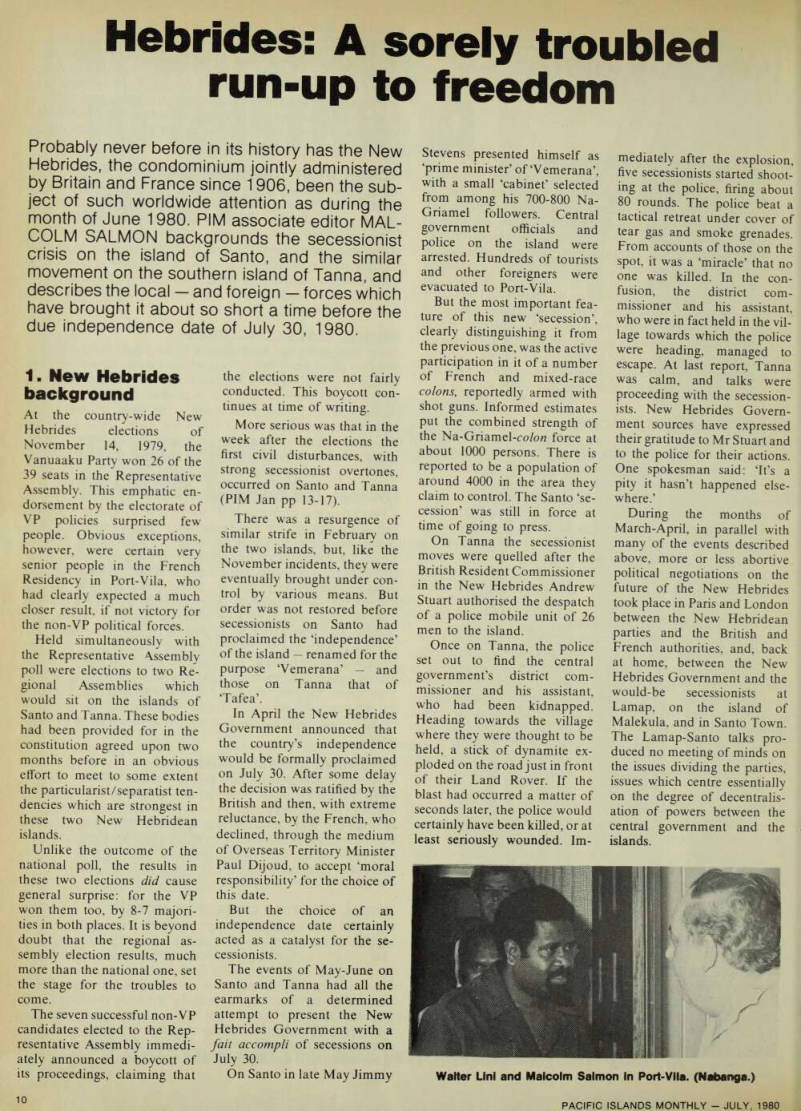
Waiter Lini and Maicoim Salmon in Port-Viia. (Nabanga.)
A secret secessionist plan al legedly discovered by the New Hebrides Government pro vided for the successive hiving off from the central govern ment of five centres Santo, Tanna, Malekula, Ambrym and finally Port-Vila itself. So the present score, at least in terms of this plan, can only be said to favour the govern ment.
2. The Phoenix
connection
Interviewed on Australian radio in June, the Carson City, Nevada, real estate developer Michael Oliver said of the Santo situation; ‘I am advis ing ... Without me, there would be blood flowing all over the place.’
Oliver is the founding father of the Phoenix Foundation (PIM June p 18), whose ideas are those of private enterprise fundamentalism no govern ment, ‘voluntary’ taxes, no social welfare, and so on.
Later in the interview, Oliver said; T would like to go to Santo and build a large sugar plantation and make some high-grade alcohol which can be used for like they do in Brazil. To alleviate
the gasoline shortage... That’s
my pet project.’
In early June, shortly after the Santo ‘secession’, the Phoenix Foundation distribu ted prospectuses to European residents of Port-Vila offering shares in a ‘Vemarana
Development Corporation’ in
a way that suggested it will vir tually run Santo if the secession should succeed.
Phoenix Foundation lawyer Thomas Eck (PIM June p 18) drafted the ‘Constitution of Vemarana’. (Tt reads more like a company prospectus,’ wrote one journalist who had studied
it closely.) Passing through
Port-Vila in April, Eck’s bag gage was searched and 1000 ‘Vemarana’ passports con tained in it were allegedly con fiscated by Customs officials.
Oliver admits financing
Jimmy Stevens’ frequent inter
national travels.
In the May 1976 Phoenix Foundation newsletter Oliver said the foundation’s financial assistance to Stevens’ move ment was ‘vital’, adding: ‘The minimum required is $250 000.’
The Phoenix Foundation is the principal source and on the evidence, an abundant source of the finance keeping the Santo secession going.
And the source of its political
support?
3. The French
connection
France can and does fre quently protest the purity of its intentions in the New Hebrides. But it has not yet suc ceeded in dispelling the sus
picion, widespread throughout
the Pacific, that it is playing a double game there.
The main reason for this sus picion can be stated in two words: New Caledonia.
The charge that the French want a weak and ‘destabilised’
New Hebrides after indepen dence for fear that a strong New Hebrides would act as a force of attraction for New Caledonia’s own Melanesian
population in their aspirations
for independence may be over simple. But it has enough plausibility to be widely be lieved, and that, politically speaking, is what counts.
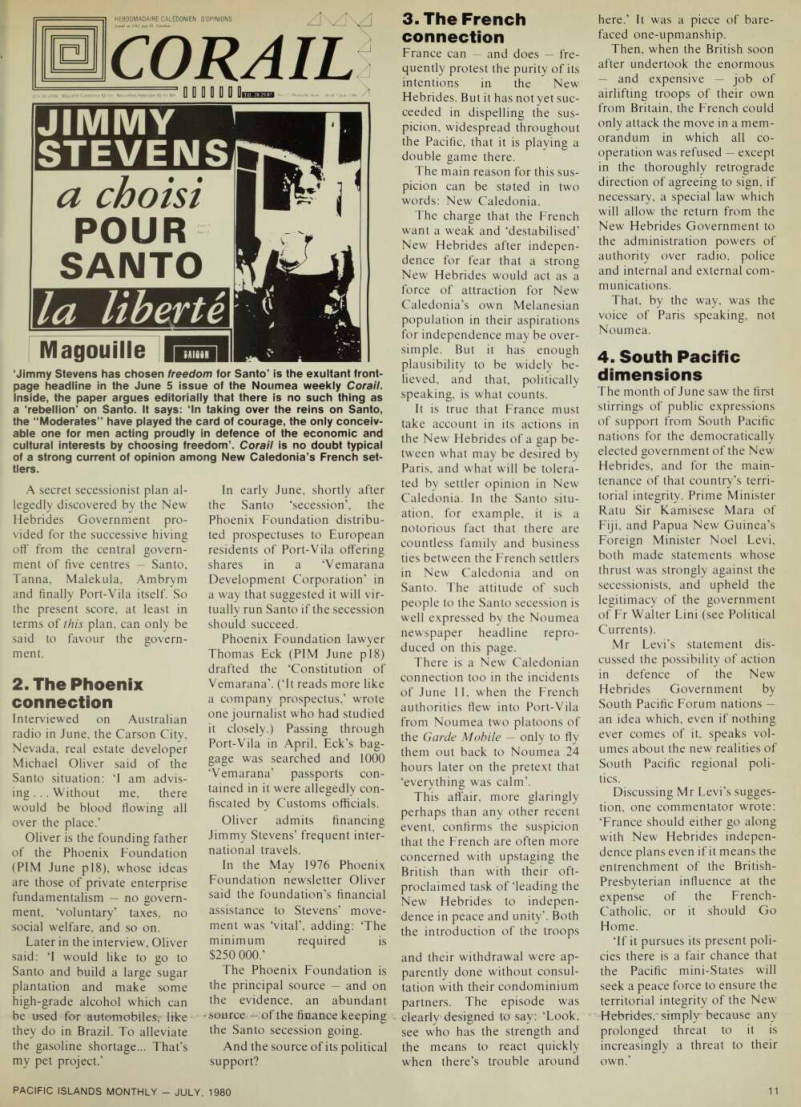
It is true that France must take account in its actions in the New Hebrides of a gap be tween what may be desired by Paris, and what will be tolera ted by settler opinion in New Caledonia. In the Santo situ ation, for example, it is a notorious fact that there are countless family and business ties between the French settlers in New Caledonia and on Santo. The attitude of such people to the Santo secession is well expressed by the Noumea newspaper headline repro duced on this page.
There is a New Caledonian connection too in the incidents of June 11, when the French authorities flew into Port-Vila from Noumea two platoons of the Garde Mobile only to fly them out back to Noumea 24 hours later on the pretext that ‘everything was calm’.
This affair, more glaringly perhaps than any other recent event, confirms the suspicion that the French are often more concerned with upstaging the British than with their oft
proclaimed task of‘leading the
New Hebrides to indepen dence in peace and unity’. Both the introduction of the troops and their withdrawal were ap parently done without consul tation with their condominium partners. The episode was clearly designed to say: ‘Look, see who has the strength and the means to react quickly when there’s trouble around
here.’ It was a piece of bare
faced one-upmanship.
Then, when the British soon after undertook the enormous - and expensive job of airlifting troops of their own from Britain, the French could only attack the move in a mem orandum in which all co operation was refused except
in the thoroughly retrograde
direction of agreeing to sign, if necessary, a special law which will allow the return from the New Hebrides Government to the administration powers of authority over radio, police and internal and external com munications.
That, by the way, was the voice of Paris speaking, not Noumea.
4. South Pacific
dimensions The month of June saw the first
stirrings of public expressions
of support from South Pacific nations for the democratically elected government of the New Hebrides, and for the main tenance of that country’s terri torial integrity. Prime Minister Ratu Sir Kamisese Mara of Fiji, and Papua New Guinea’s Foreign Minister Noel Levi, both made statements whose thrust was strongly against the secessionists, and upheld the legitimacy of the government of Fr Walter Lini (see Political Currents).
Mr Levi’s statement dis cussed the possibility of action in defence of the New Hebrides Government by South Pacific Forum nations an idea which, even if nothing ever comes of it, speaks vol umes about the new realities of
South Pacific regional poli
tics.
Discussing Mr Levi’s sugges tion, one commentator wrote: ‘France should either go along with New Hebrides indepen dence plans even if it means the entrenchment of the British- Presbyterian influence at the expense of the French- Catholic, or it should Go Home. if it pursues its present poli cies there is a fair chance that the Pacific mini-States will seek a peace force to ensure the territorial integrity of the New Hebrides,' simply because any prolonged threat to it is increasingly a threat to their own.’
‘Jimmy Stevens has chosen freedom for Santo’ is the exultant front page headline in the June 5 issue of the Noumea weekly Corail.
Inside, the paper argues editorially that there is no such thing as a rebellion’ on Santo. It says: ‘ln taking over the reins on Santo, the “Moderates” have played the card of courage, the only conceiv able one for men acting proudly in defence of the economic and cultural interests by choosing freedom’. Corail is no doubt typical of a strong current of opinion among New Caledonia’s French set tlers.