watches PNG policy
pp. 18-22 · Read in the full issue

Political
Currents
Irian Jaya movement watches PNG policy
Writing in PIM last month Pro fessor Ron Crocombe of the
University of the South Pacific
expressed the belief that any
objective description of racial
tensions in the Pacific zone would show that the most serious were between Indqnesians and Melanesians in Irian Jay a. Irian Jay a, with a basic Melanesian population, is a province of Indonesia and has long been the scene of an outlawed anti-Indonesia move ment, sometimes active, some times dormant, sometimes badly split in its own ranks.
The recently-defeated
Somare government in Papua New Guinea was criticised in its own country from time to time
for being too friendly with
Indonesia at the expense of fellow-Melanesians who are separatedfrom PNG by a border drawn on a map. But can any PNG government act much dif
ferently?
The following report is from a correspondent who has had re cent contact with what remains of the Free Papua Movement in Irian Jaya and who claims that the movement feels there could be a change in PNG attitudes.
The West Irian OPM (Free
Papua Movement) is optimistic
that the fortunes of the move ment and its relations with Papua New Guinea, under the new Chan government, will improve. Over the past two years relations have deterior ated as the PNG government has been torn between its sym pathy toward the Melanesians
of West Irian and the necessity to accommodate Indonesian demands for the return of
refugees and alleged OPM
insurgents.
Initial contacts with mem bers of the Chan government appear to reflect a common attitude and a need to compro mise. The OPM leaders hope that PNG will change or mod ify its policy towards them. In the coming months initial understanding and co
operation, particularly in mat
ters concerning refugees who
cross into PNG, is an OPM aim.
The guerilla leader Martin Tabu has been in Jakarta for talks with the Indonesian Government which has been negotiating for a settlement of differences. The government offered Tabu safe conduct to Jakarta and the talks primarily concerned the future of the OPM and its integration into Indonesia. As Tabu has now consolidated his control over the movement, he is accepted as its most influential represen tative.
Tabu has met Indonesian officials on a number of occasions. Both sides are wary of each other, because of pre vious bad faith. In mid 1978 a group of Indonesian officials, including the head of intelligence at Jayapura, met Tabu and a group of his fol lowers in a jungle clearing. The
officials arrived by helicopter
and during a confrontation, for which Tabu denies responsi bility, two Indonesians were
killed and the remainder held hostage. Over the next few months, their release was arranged by another rebel leader, Jacob Prai. Although
the hostages travelled through
the jungles with the rebels dur ing this period, they remained
in reasonably good health.
Reports emanating from the
OPM in West Irian state that the movement awaits the safe return of the guerilla leader. If he is detained, reprisals will ensue and the kidnapping of Indonesian officials in Jayapura could occur, the OPM says. It adds that any kid napped officials would be held until Tabu returns safely to his
jungle headquarters.
Mr Bonay, the former
Indonesian-appointed Irianese
Governor of Jayapura, was
also given a junket trip to
Jakarta back in 1969, just prior to the Indonesian takeover. He was pro-Indonesian for some time but is now in a PNG refugee camp. Bonay is the father of an exiled Air Niugini pilot involved in border con tacts in 1978 condemned by the PNG government.
Within West Irian the OPM is now attempting to con solidate into one organisation.
After Jacob Prai’s capture at Vanimo in September 1978, his group was without effective leadership until Martin Tabu took charge. In the interim,
Colonels Wajoi and Yuntuy
led the group. Last year Tabu and Seth Rumkorum agreed to combine groups. Rivalries and dissensions which were com monplace under Prai, par ticularly after Rumkorum and his followers broke away three years ago, have now been largely eliminated. Tabu leaves
military and intelligence mat
ters to Rumkorum, retaining
the administrative and political control for himself. Tabu now has firm control and disciplines members of the movement who act independently.
Rumkorum has maintained cordial relations with the PNG government. Last year, he acted as go-between for the successful escape from
Jayapura of Mr Bonay.
Tabu acknowledges that his
major problems are supplies,
communication . and infil tration by Indonesian agents.
Last year there were two abort ive efforts to arrange for mili tary and medical supplies from outside sympathisers. Both efforts failed, mainly because of poor communications. Tabu realises that he is isolated and his aim is an efficient com munication system from Markas Tabu (Fort Tabu) to Jayapura and the outside world.
Last June, spirits were low after the disastrous ambush
and gunbattle at Jayapura.
Twenty insurgents were killed
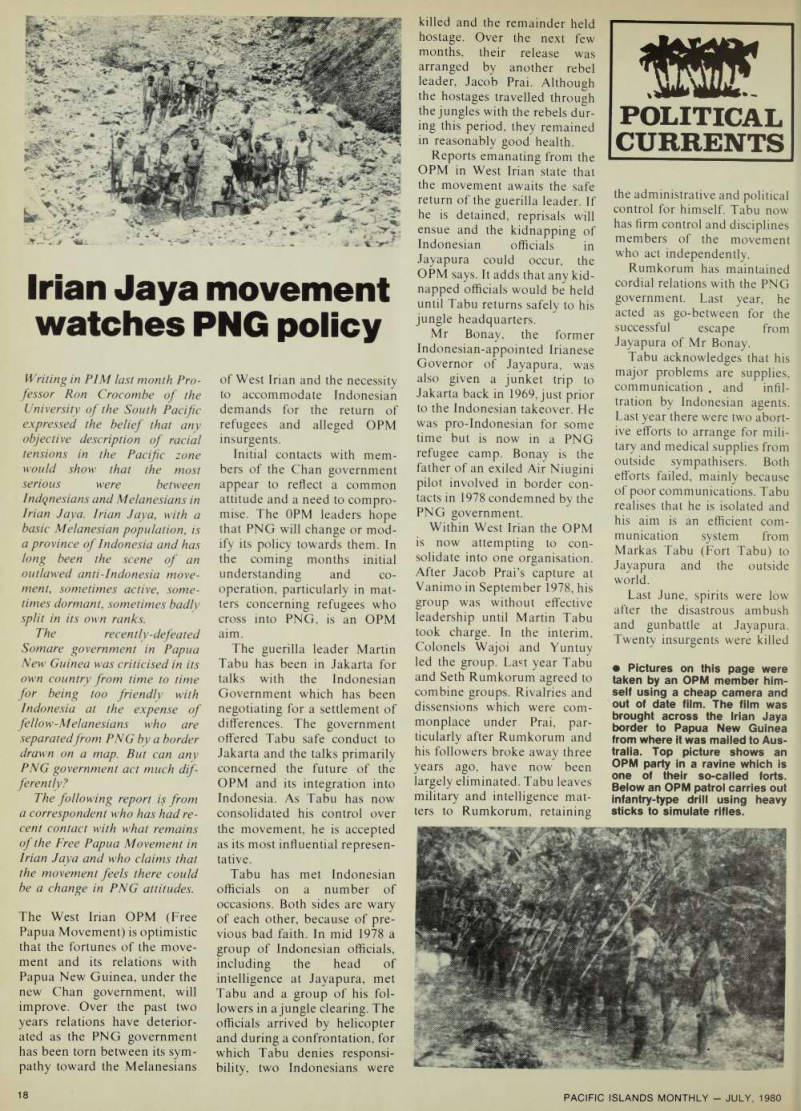
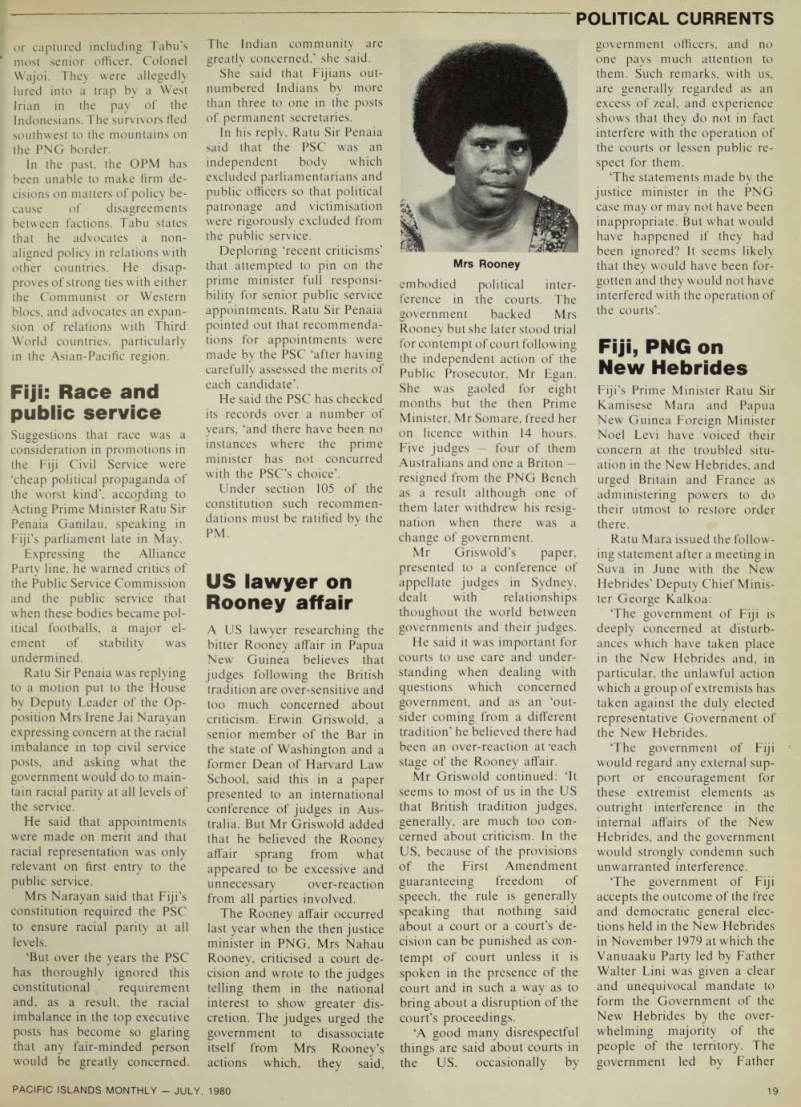
Pictures on this page were taken by an OPM member him self using a cheap camera and out of date film. The film was brought across the Irian Jaya border to Papua New Guinea from where it was mailed to Aus tralia. Top picture shows an OPM party in a ravine which is one of their so-called forts.
Below an OPM patrol carries out
infantry-type drill using heavy
sticks to simulate rifles.
or captured including Tabu’s most senior officer. Colonel
Wajoi. They were allegedly
lured into a trap by a West Irian in the pay of the Indonesians. The survivors fled southwest to the mountains on the PNG border.
In the past, the OPM has been unable to make firm de cisions on matters of policy be cause of disagreements between factions. Tabu states that he advocates a non aligned policy in relations with other countries. He disap proves of strong ties with either the Communist or Western blocs, and advocates an expan sion of relations with Third World countries, particularly in the Asian-Pacific region.
Fiji: Race and
public service
Suggestions that race was a consideration in promotions in the Fiji Civil Service were
‘cheap political propaganda of
the worst kind’, according to Acting Prime Minister Ratu Sir Penaia Ganilau, speaking in Fiji’s parliament late in May.
Expressing the Alliance Party line, he warned critics of the Public Service Commission and the public service that when these bodies became pol itical footballs, a major el ement of stability was undermined.
Ratu Sir Penaia was replying to a motion put to the House
by Deputy Leader of the Op
position Mrs Irene Jai Narayan expressing concern at the racial imbalance in top civil service posts, and asking what the government would do to main tain racial parity at all levels of the service.
He said that appointments were made on merit and that
racial representation was only
relevant on first entry to the
public service.
Mrs Narayan said that Fiji’s constitution required the PSC to ensure racial parity at all levels. ‘But over the years the PSC
has thoroughly ignored this
constitutional requirement
and, as a result, the racial imbalance in the top executive posts has become so glaring that any fair-minded person would be greatly concerned.
The Indian community are greatly concerned,’ she said.
She said that Fijians out numbered Indians by more than three to one in the posts of permanent secretaries.
In his reply, Ratu Sir Penaia said that the PSC was an
independent body which
excluded parliamentarians and public officers so that political patronage and victimisation were rigorously excluded from the public service.
Deploring ‘recent criticisms’ that attempted to pin on the
prime minister full responsi
bility for senior public service appointments, Ratu Sir Penaia pointed out that recommenda tions for appointments were made by the PSC ‘after having carefully assessed the merits of each candidate’.
He said the PSC has checked its records over a number of years, ‘and there have been no instances where the prime minister has not concurred with the PSC’s choice’.
Under section 105 of the constitution such recommen dations must be ratified by the PM.
US lawyer on
Rooney affair
A US lawyer researching the bitter Rooney affair in Papua New Guinea believes that
judges following the British
tradition are over-sensitive and too much concerned about criticism. Erwin Griswold, a senior member of the Bar in the state of Washington and a former Dean of Harvard Law School, said this in a paper presented to an international conference of judges in Aus tralia. But Mr Griswold added that he believed the Rooney affair sprang from what appeared to be excessive and unnecessary over-reaction from all parties involved.
The Rooney affair occurred last year when the then justice minister in PNG, Mrs Nahau Rooney, criticised a court de cision and wrote to the judges telling them in the national interest to show greater dis cretion. The judges urged the government to disassociate itself from Mrs Rooney’s actions which, they said,
embodied political inter ference in the courts. The government backed Mrs Rooney but she later stood trial for contempt of court following the independent action of the Public Prosecutor, Mr Egan.
She was gaoled for eight months but the then Prime Minister, Mr Somare, freed her on licence within 14 hours.
Five judges four of them Australians and one a Briton resigned from the PNG Bench as a result although one of them later withdrew his resig nation when there was a change of government.
Mr Griswold’s paper, presented to a conference of
appellate judges in Sydney,
dealt with relationships thoughout the world between governments and their judges.
He said it was important for courts to use care and under
standing when dealing with
questions which concerned government, and as an ‘out sider coming from a different tradition’ he believed there had been an over-reaction at *each stage of the Rooney affair.
Mr Griswold continued: ‘lt seems to most of us in the US that British tradition judges, generally, are much too con cerned about criticism. In the US, because of the provisions of the First Amendment guaranteeing freedom of speech, the rule is generally
speaking that nothing said
about a court or a court’s de cision can be punished as con tempt of court unless it is spoken in the presence of the court and in such a way as to bring about a disruption of the
court’s proceedings.
‘A good many disrespectful
things are said about courts in the US, occasionally by
government officers, and no one pays much attention to them. Such remarks, with us, are generally regarded as an excess of zeal, and experience shows that they do not in fact interfere with the operation of the courts or lessen public re spect for them.
The statements made by the justice minister in the PNG case may or may not have been inappropriate. But what would have happened if they had been ignored? It seems likely that they would have been for gotten and they would not have interfered with the operation of the courts’.
Fiji, PNG on
New Hebrides
Fiji’s Prime Minister Ratu Sir Kamisese Mara and Papua New Guinea Foreign Minister Noel Levi have voiced their concern at the troubled situ ation in the New Hebrides, and urged Britain and France as administering powers to do their utmost to restore order there.
Ratu Mara issued the follow ing statement after a meeting in Suva in June with the New Hebrides’ Deputy Chief Minis ter George Kalkoa: ‘The government of Fiji is deeply concerned at disturb ances which have taken place in the New Hebrides and, in particular, the unlawful action which a group of extremists has taken against the duly elected representative Government of the New Hebrides. ‘The government of Fiji would regard any external sup port or encouragement for these extremist elements as outright interference in the internal affairs of the New Hebrides, and the government would strongly condemn such unwarranted interference. ‘The government of Fiji accepts the outcome of the free and democratic general elec tions held in the New Hebrides in November 1979 at which the Vanuaaku Party led by Father Walter Lini was given a clear and unequivocal mandate to form the Government of the New Hebrides by the over
whelming majority of the
people of the territory. The government led by Father
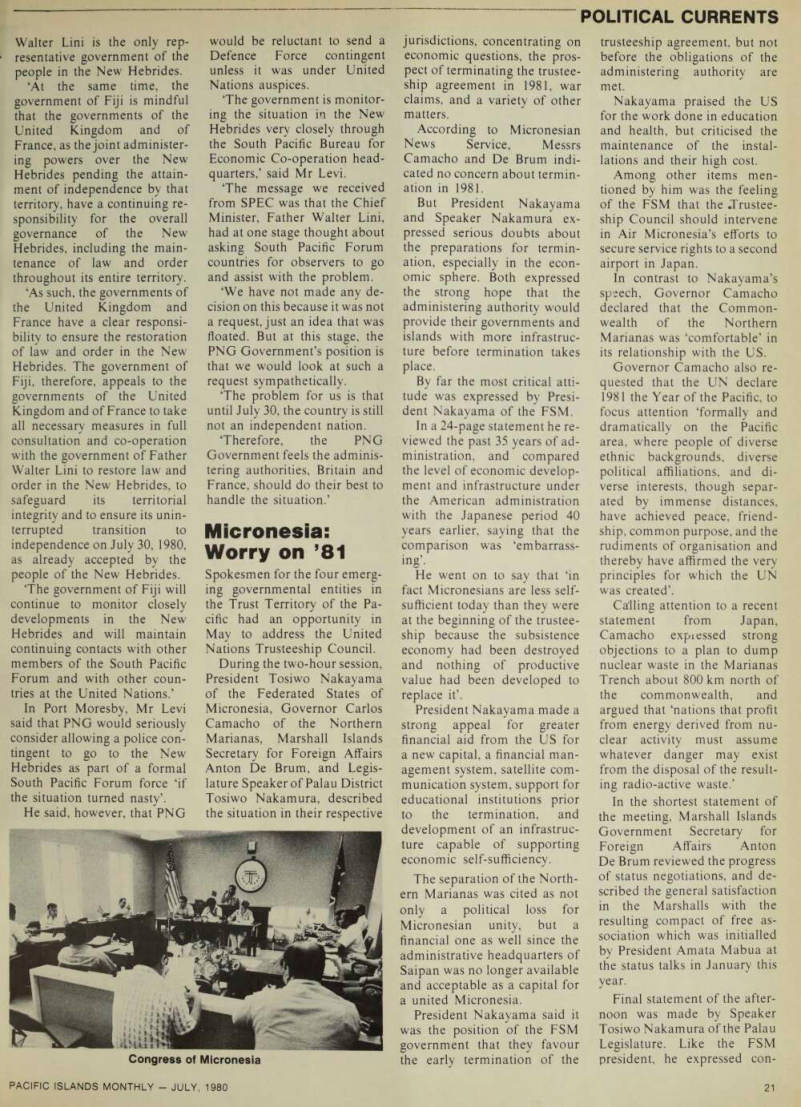
Mrs Rooney
Walter Lini is the only rep resentative government of the people in the New Hebrides. ‘At the same time, the government of Fiji is mindful that the governments of the United Kingdom and of France, as the joint administer ing powers over the New Hebrides pending the attain ment of independence by that territory, have a continuing re sponsibility for the overall governance of the New Hebrides, including the main tenance of law and order
throughout its entire territory.
‘As such, the governments of the United Kingdom and France have a clear responsi bility to ensure the restoration of law and order in the New Hebrides. The government of Fiji, therefore, appeals to the governments of the United Kingdom and of France to take all necessary measures in full consultation and co-operation with the government of Father Walter Lini to restore law and order in the New Hebrides, to safeguard its territorial integrity and to ensure its unin terrupted transition to independence on July 30, 1980,
as already accepted by the
people of the New Hebrides.
The government of Fiji will continue to monitor closely developments in the New Hebrides and will maintain continuing contacts with other members of the South Pacific Forum and with other coun tries at the United Nations.’
In Port Moresby, Mr Levi said that PNG would seriously consider allowing a police con tingent to go to the New Hebrides as part of a formal South Pacific Forum force ‘if the situation turned nasty’.
He said, however, that PNG
would be reluctant to send a Defence Force contingent unless it was under United Nations auspices. ‘The government is monitor ing the situation in the New Hebrides very closely through the South Pacific Bureau for Economic Co-operation head quarters,’ said Mr Levi. ‘The message we received from SPEC was that the Chief Minister, Father Walter Lini, had at one stage thought about asking South Pacific Forum countries for observers to go and assist with the problem. ‘We have not made any de cision on this because it was not a request, just an idea that was floated. But at this stage, the PNG Government’s position is that we would look at such a
request sympathetically.
‘The problem for us is that until July 30, the country is still not an independent nation. ‘Therefore, the PNG Government feels the adminis tering authorities, Britain and France, should do their best to handle the situation.’
Micronesia:
Worry on ’Bl
Spokesmen for the four emerg
ing governmental entities in
the Trust Territory of the Pa cific had an opportunity in May to address the United Nations Trusteeship Council.
During the two-hour session, President Tosiwo Nakayama of the Federated States of Micronesia, Governor Carlos Camacho of the Northern Marianas, Marshall Islands Secretary for Foreign Affairs Anton De Brum, and Legis lature Speaker of Palau District Tosiwo Nakamura, described the situation in their respective
jurisdictions, concentrating on
economic questions, the pros pect of terminating the trustee ship agreement in 1981, war claims, and a variety of other matters.
According to Micronesian News Service, Messrs Camacho and De Brum indi cated no concern about termin ation in 1981.
But President Nakayama and Speaker Nakamura ex pressed serious doubts about the preparations for termin ation, especially in the econ
omic sphere. Both expressed
the strong hope that the
administering authority would
provide their governments and islands with more infrastruc ture before termination takes
place.
By far the most critical atti tude was expressed by Presi dent Nakayama of the FSM.
In a 24-page statement he re viewed the past 35 years of ad ministration, and compared the level of economic develop ment and infrastructure under the American administration with the Japanese period 40 years earlier, saying that the comparison was ‘embarrass
ing’.
He went on to say that ‘in fact Micronesians are less self sufficient today than they were at the beginning of the trustee ship because the subsistence economy had been destroyed
and nothing of productive
value had been developed to
replace it’.
President Nakayama made a strong appeal for greater financial aid from the US for a new capital, a financial man agement system, satellite com munication system, support for educational institutions prior to the termination, and development of an infrastruc ture capable of supporting
economic self-sufficiency.
The separation of the North ern Marianas was cited as not only a political loss for Micronesian unity, but a financial one as well since the administrative headquarters of Saipan was no longer available and acceptable as a capital for a united Micronesia.
President Nakayama said it was the position of the FSM government that they favour the early termination of the
trusteeship agreement, but not before the obligations of the
administering authority are
met.
Nakayama praised the US
for the work done in education and health, but criticised the maintenance of the instal lations and their high cost.
Among other items men tioned by him was the feeling of the FSM that the .Trustee ship Council should intervene in Air Micronesia’s efforts to secure service rights to a second
airport in Japan.
In contrast to Nakayama’s speech, Governor Camacho declared that the Common wealth of the Northern Marianas was ‘comfortable’ in its relationship with the US.
Governor Camacho also re quested that the UN declare 1981 the Year of the Pacific, to focus attention ‘formally and dramatically on the Pacific area, where people of diverse ethnic backgrounds, diverse political affiliations, and di verse interests, though separ ated by immense distances, have achieved peace, friend ship, common purpose, and the rudiments of organisation and thereby have affirmed the very principles for which the UN was created’.
Calling attention to a recent statement from Japan, Camacho expiessed strong
objections to a plan to dump
nuclear waste in the Marianas Trench about 800 km north of the commonwealth, and argued that ‘nations that profit from energy derived from nu clear activity must assume whatever danger may exist from the disposal of the result ing radio-active waste.’
In the shortest statement of the meeting, Marshall Islands Government Secretary for Foreign Affairs Anton De Brum reviewed the progress of status negotiations, and de scribed the general satisfaction in the Marshalls with the resulting compact of free as sociation which was initialled by President Amata Mabua at the status talks in January this year.
Final statement of the after noon was made by Speaker Tosiwo Nakamura of the Palau Legislature. Like the FSM president, he expressed con
Congress of Micronesia
cern that the trusteeship might be terminated before an ad equate infrastructure was in place in Palau.
Speaker Nakamaru noted that ‘the trusteeship termin ation is, in the final analysis, the process of self determination to be decided by the people concerned, in this case by the Micronesians them selves, and not by the United States’.
Pay boost for
Apia MPs
Western Samoa’s parliamen tarians have received pay
boosts retrospective to January
1. 1980.
The prime minister now re ceives $lB 500 a year, including allowances (up from $l3 000, including allowances); Cabinet Ministers: $lO 000, plus $2500 allowances; and MPs from Savaii and Upolu $5500 a year,
including allowances.
Salary increases for the Head of State and the Council of
Deputies are to be approved by
act of parliament when it meets for the first time this year in July or August.
Saving Fiji
from Reds
A senior member of Fiji’s
parliamentary opposition, and
two businessmen who support the ruling Alliance Party, have teamed up to save Fiji from communism.
While the country isn’t in imminent danger of being sub merged by the Red threat, it may need saving in five years, according to National Feder ation Party MP Vijay Par-’ manandam, who is president of the Fiji Youth Anti-Com
munist League.
The league is affiliated with the Asian Youth Anti-Com munist League, which in turn is affiliated with the World Youth Anti-Communist League. The world body had about 30 countries as members, and in some the national league had other bodies affili ated with it.
Mr Parmanandam, a pros perous lawyer and business man. has taken up the cudgels with the help of Suva bus
company manager and city council member Maan Singh, and construction company
owner Vijay Ragwhan.
Mr Parmanandam said the main reason the league had been formed was that Fiji had broken off relations with Taiwan and recognised Red China.
Asked by The Fiji Times if there were dangers in having links with the Soviet Union or China. Mr Parmanandam said he thought there were dangers in having links with any com munist country. ‘We are naive in our foreign affairs understandably naive as we are a new country, not yet 10 years old.’ he said.
The Latos saga
wound up
An examination paper with spelling errors and typing mis takes was at the centre of a sharp row earlier this year be tween New Zealand and a number of Pacific States.
The Language Achievement Test for Overseas Students - Latos was administered
by New Zealand’s University
Grants Committee to Pacific and Asian students trying to get into New Zealand universi ties.
Unexpectedly, New Zealand toughened up the test this year and refused 13 of Western Samoa’s top 18 students places
in university, even though they
had passed all the tests that ordinary New Zealand students would have to pass.
At least two Tongan stu dents, winners of Auckland Star scholarships, were also bounced out on the basis of Latos. A number of Asian students were also affected.
Australia, quick to seize the
public relations advantage, im
mediately offered places in
Australian universities to the New Zealand rejects.
That was hardly the end of the matter because Western Samoa, Fiji and Tonga were stuck with education systems all geared towards New Zea land. Their students all aim to pass School Certificate (sat for in the third year of high school) and University Entrance (UE, sat for the following year).
Both papers are set in New Zealand, and are aimed mainly at the tens of thousands of New Zealanders who sit for them.
UE, as the name implies, is the
key to university education.
But in the last 10 years non- New Zealanders have been forced to sit for Latos as well.
The test is supposed to be a measure of language pro ficiency, but recently it was used as a device to cut back on the numbers of foreign students universities would have to handle. The universi ties claimed the test was an excellent way of judging language, but they declined to let anybody see it. The test is administered in secret, teachers are not allowed to see it, and students are not allowed even to take away the question sheets at the end of the examin ation.
Western Samoa’s Prime Minister Tupuola Efi him self educated at a New Zealand
university was outraged at
the way Latos was used to cut out his students. His anger was further increased by a secret New Zealand Ministry of Foreign Affairs report written by researcher Dr Patricia Kinloch.
Foreign Affairs had been telling the Samoan Govern
ment that Samoan students were failing their courses in greater numbers than other students, and that they failed their courses with lower levels of marks. Kinloch’s report showed this to be simply untrue. ‘We’re being conned,’ a spokesman for the Prime
Minister’s Department in Apia
told the official newspaper Savali.
Tupuola headed to Welling
ton with the report to back up his complaints, but found an unexpected ally in New Zealand’s Prime Minister Robert Muldoon who was annoyed at the universities as well.
Although funded by the
government, New Zealand universities are independent and cannot be directed by government. However, a re quest from the New Zealand Cabinet to take a look at the issue, as well as heavy press criticism, forced the uni versities to reconsider. In late May they suspended Latos and set up a sub-committee to examine it. It is believed Latos will remain buried for quite some time, and will re-emerge next year in a much changed form. Mike Field in Welling ton.
Victoria University - Latos reconsidered