Parliament
pp. 23-26 · Read in the full issue

Decline Of
There was barely room to move in the galleries and lob bies of the Papua New Guinea National Parliament for the no-confidence debate in March which unseated the govern ment. But the events of that day were unusual and generally the parliament has ceased to attract the attention it once did.
When the no-confidence processes were at their peak at tendants in the public gallery had to set time limits for visi tors, VIPs were standing in the Speaker’s gallery, the crowd in the entrance hall flowed onto the road outside and the car
park was one big traffic jam.
But for visitors, party officials, specialist observers and others who made up the crowd the occasion was something of an
exception in a long period dur
ing which parliament-watching
has been very much on the de cline.
The decline of day-to-day interest in the workings of par liament appears to be very much a result of how parlia ment has been conducting itself. Interest in politics and policies, as distinct from interest in parliament, still runs high. Whether the change in government will create new interest in parliamentary proceedings remains to be seen.
What has happened to the parliament which was once the focus of attention? In short, its own tensions and differences appear to have made it too
introspective. Regular
parliament-watchers, in their decreasing numbers, say it has become too wrapped in its own management and affairs coupled with a growing lack of discipline. This opinion is sup
ported by an analysis of de
bates which shows that last year the parliament spent almost half its time on matters connected with its own man agement, problems, pro cedures and priorities, and with
a heavy lacing of disorderly
incidents and time-wasting tac tics. In the immediate months after PNG gained its indepen dence there was a much
heavier emphasis on basic issues of national policy and national management. There were debates rather than argu
ments. During that period
party officials, lobbyists, minis terial staff, researchers and pressmen all with legitimate business in and around parlia ment never stayed away when parliament sat. ‘lt would be stupid not to be there,’ one party official said recently.
But the daily work of parlia ment no longer commands the same urgency, and many officials and advisers often find there are more important things to be done in the office rather than around parliament.
They continue to keep their eye on parliament, but it no longer commands their consuming attention.
Two things have led to the apparent decline of Parliament as an accepted fount of PNG politics and national manage ment. One is the growth and
the increasing experience of
the administrative structure which, while not acting outside the framework of regulations, no longer seeks as much direc tion. The other is a very real de cline in the way in which Parliament often conduct itself.
Near fights, personal attacks,
shouting matches and bad language had a certain pub licity attraction for a while.
One visitor, writing later for an
English publication, went so
far as to praise the House for its ‘lively, earthy and virile’ style compared to the staid pace of older legislature. But even ‘lively, earthy and virile’ antics, repeated time and time again for no real political reason, tend to pall and this has become very noticeable in
Png.
A verbal brawl which once would have received big cover age in the Port Moresby press now hardly rates a mention be cause it has become com
monplace.
The more serious aspect of the present situation is whether the government and the public service are usurping the powers of Parliament.
At least five commercial and civic organisations, which used to monitor Parliament closely from the public gallery, have
abandoned their regular vigil.
Members of the diplomatic corps, who once never failed to half fill the small speaker’s gal lery, now are only occasional visitors. They tend to confine their attendance to occasions when matters of direct import
ance to their missions are under discussion.
The press gallery, too, has reflected the change with parliamentary business no
longer being automatically
accepted for top news billing of
the day.
No matter how conscien tious they are, the newsmen who watch Parliament are not tied to the Gallery by the same urgency which was noticeable only two years ago.
There’s no shortage of gen eral day-to-day public interest in the affairs of Parliament.
Often the crowds trying to get into the public gallery overflow the facilities and the attendants have to organise a ‘shift’ system for visitors.
But this is a different sort of interest a curiosity or part of an education, not a solidly con sistent attendance by parlia mentary buffs who feel they have to be there.
A typical gallery today may
be a school civics class, a group of police cadets having a look at the system to which they have sworn their loyalty, per haps the wives and families of some of the members and always a sprinkling of tourists.
Several members made alle gations along these lines at the
parliamentary session just ended. The allegations were that the government and the public service were running the country and that too many members of parliament were allowing the situation to worsen. ‘A rubber stamp legis lature,’ one parliamentarian said.
The member for Wewak, Tony Bais, told the House bluntly that Parliament had deteriorated and decayed, that it had lost all its integrity and that the controllers of the country no longer took notice of parliamentary resolutions.
These are strong words, and technically they cannot be sub stantiated because PNG still follows the rules of a formal Westminster democracy. Par liamentary committees still apply the tests which would re veal departures from what a democracy demands. But it cannot be denied that much of the bloom has rubbed from the
optimistic legislature which
took over from Australian con trol to bring PNG to self government and indepen dence.
If there can be any criticism of the role of the PNG parlia ment in today’s national man agement, it is diffcult to escape the conclusion that the trouble stems from the parliament itself through the attitude of many of its members. Angus Smales.
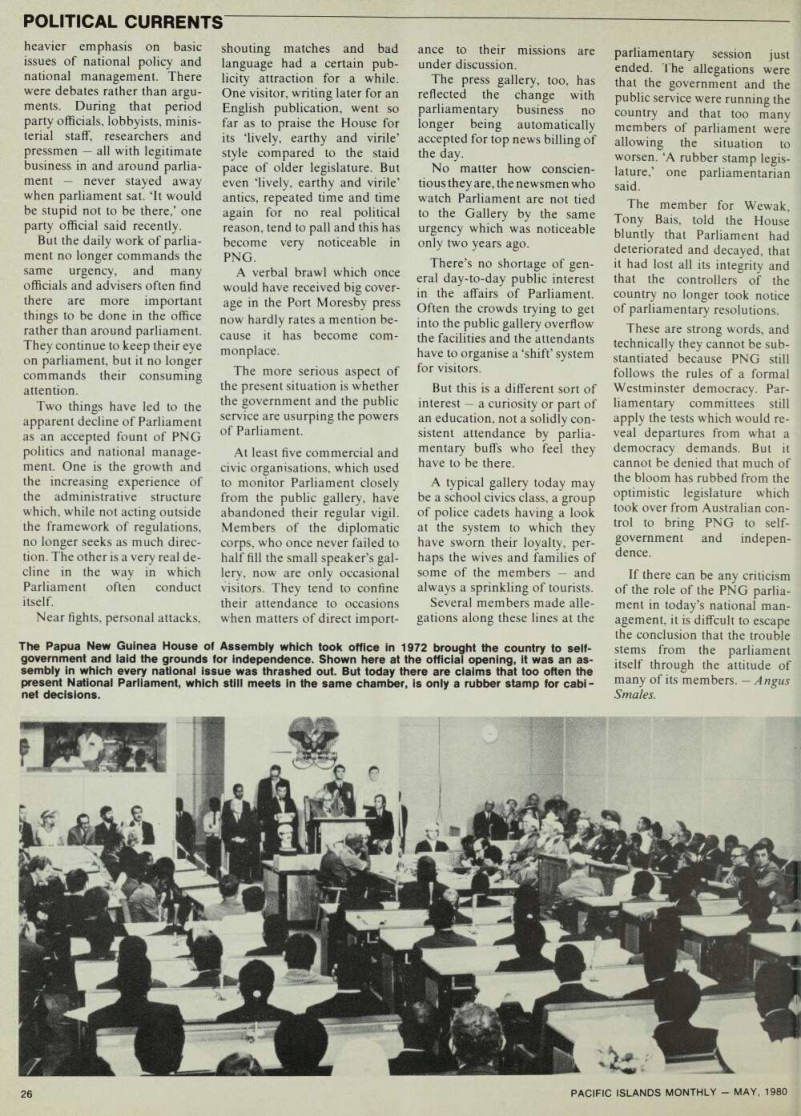
The Papua New Guinea House of Assembly which took office In 1972 brought the country to self government and laid the grounds for independence. Shown here at the official opening, it was an as sembly in which every national issue was thrashed out. But today there are claims that too often the present National Parliament, which still meets in the same chamber, is only a rubber stamp for cabi net decisions.