In Honolulu
pp. 22-23 · Read in the full issue
Leaders Meet
Last October a small but rep resentative group of Pacific Islanders was invited to Hawaii’s East West Center to plan an agenda for a much larger conference of Islands leaders scheduled to meet in Honolulu this March. The aim of the bigger conference: To discuss development goals and problems, to identify priorities so that work can begin on trying to resolve the problems, and to develop a better understanding between the Island leaders and inter national organisations who may be able to help them.
PlM’s Stuart Inder flew to Honolulu for the big con ference from March 26 to 29 and reports: It’s not surprising that a con ference of 60 Island leaders and their senior government advisers, and 60 delegates and observers from interested agencies and organisations didn’t achieve all that it set out to do. With the objectives so wide and the meeting so large, there was bound to be some woolliness, but the difficulties were compounded by the physical fact that not every body was seated in the same conference room.
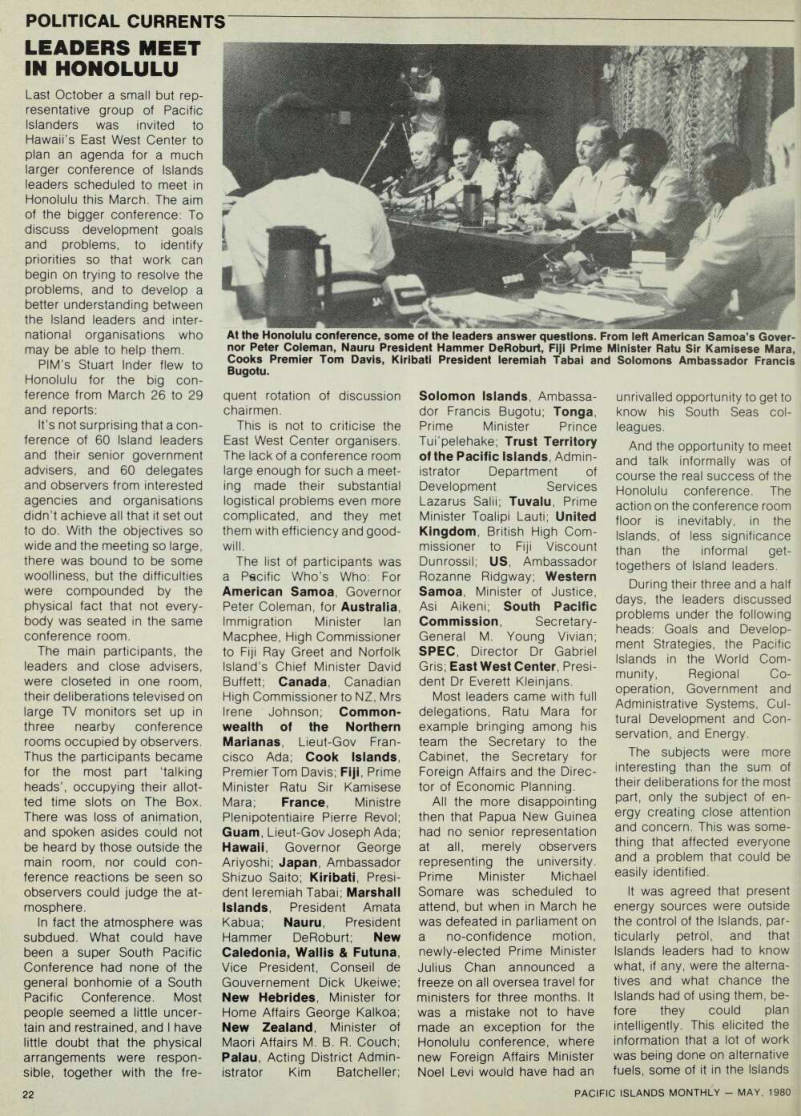
The main participants, the leaders and close advisers, were closeted in one room, their deliberations televised on large TV monitors set up in three nearby conference rooms occupied by observers.
Thus the participants became for the most part ‘talking heads’, occupying their allot ted time slots on The Box.
There was loss of animation, and spoken asides could not be heard by those outside the main room, nor could con ference reactions be seen so observers could judge the at mosphere.
In fact the atmosphere was subdued. What could have been a super South Pacific Conference had none of the general bonhomie of a South Pacific Conference. Most people seemed a little uncer tain and restrained, and I have little doubt that the physical arrangements were respon sible, together with the fre-
quent rotation of discussion chairmen.
This is not to criticise the East West Center organisers.
The lack of a conference room large enough for such a meet ing made their substantial logistical problems even more complicated, and they met them with efficiency and good will.
The list of participants was a Pacific Who’s Who: For American Samoa, Governor Peter Coleman, for Australia, Immigration Minister lan Macphee, High Commissioner to Fiji Ray Greet and Norfolk Island’s Chief Minister David Buffett: Canada, Canadian High Commissioner to NZ, Mrs Irene Johnson; Common wealth of the Northern Marianas, Lieut-Gov Fran cisco Ada; Cook Islands, Premier Tom Davis; Fiji, Prime Minister Ratu Sir Kamisese Mara; France, Ministre Plenipotentiaire Pierre Revol; Guam, Lieut-Gov Joseph Ada; Hawaii, Governor George Ariyoshi; Japan, Ambassador Shizuo Saito; Kiribati, Presi dent leremiah Tabai; Marshall Islands, President Amata Kabua; Nauru, President Hammer Deßoburt; New Caledonia, Wallis & Futuna, Vice President, Conseil de Gouvernement Dick Ukeiwe; New Hebrides, Minister for Home Affairs George Kalkoa; New Zealand, Minister of Maori Affairs M. B. R. Couch; Palau, Acting District Admin istrator Kim Batcheller;
Solomon Islands, Ambassa dor Francis Bugotu; Tonga, Prime Minister Prince Tui’pelehake; Trust Territory of the Pacific Islands, Admin istrator Department of Development Services Lazarus Salii; Tuvalu, Prime Minister Toalipi Lauti; United Kingdom, British High Com missioner to Fiji Viscount Dunrossil; US, Ambassador Rozanne Ridgway; Western Samoa, Minister of Justice, Asi Aikeni; South Pacific Commission, Secretary- General M. Young Vivian; SPEC, Director Dr Gabriel Gris: East West Center, Presi dent Dr Everett Kleinjans.
Most leaders came with full delegations, Ratu Mara for example bringing among his team the Secretary to the Cabinet, the Secretary for Foreign Affairs and the Direc tor of Economic Planning.
All the more disappointing then that Papua New Guinea had no senior representation at all, merely observers representing the university.
Prime Minister Michael Somare was scheduled to attend, but when in March he was defeated in parliament on a no-confidence motion, newly-elected Prime Minister Julius Chan announced a freeze on all oversea travel for ministers for three months. It was a mistake not to have made an exception for the Honolulu conference, where new Foreign Affairs Minister Noel Levi would have had an
unrivalled opportunity to get to know his South Seas col leagues.
And the opportunity to meet and talk informally was of course the real success of the Honolulu conference. The action on the conference room floor is inevitably, in the Islands, of less significance than the informal get togethers of Island leaders.
During their three and a half days, the leaders discussed problems under the following heads: Goals and Develop ment Strategies, the Pacific Islands in the World Com munity, Regional Co operation, Government and Administrative Systems, Cul tural Development and Con servation, and Energy.
The subjects were more interesting than the sum of their deliberations for the most part, only the subject of en ergy creating close attention and concern. This was some thing that affected everyone and a problem that could be easily identified.
It was agreed that present energy sources were outside the control of the Islands, par ticularly petrol, and that Islands leaders had to know what, if any, were the alterna tives and what chance the Islands had of using them, be fore they could plan intelligently. This elicited the information that a lot of work was being done on alternative fuels, some of it in the Islands
At the Honolulu conference, some of the leaders answer questions. From left American Samoa’s Gover nor Peter Coleman, Nauru President Hammer DeRoburt, Fiji Prime Minister Ratu Sir Kamisese Mara, Cooks Premier Tom Davis, Kiribati President leremiah Tabai and Solomons Ambassador Francis Bugotu.
themselves, but there was insufficient pooling of knowl edge. lan Macphee, who until re cently was Australia’s Minister for Productivity, was able to add some useful information of the type that the meeting organisers had hoped to draw out, by discussing alternatives to petrol in some detail. He said the petrol squeeze would continue for a little time yet, but meanwhile there was a serious future for electric cars made in Japan.
There was also interesting discussion on the possibility of fuel from sugar cane.
The question of whether existing government and administrative systems were suitable for the Islands, most of them having been initiated in colonial times by the colonial powers, drew surprisingly lack-lustre de bate, perhaps because as domestic political problems yet to be resolved they were too close to home to be suit able matters for discussion in a public forum.
Ratu Mara touched on this problem in another context with his usual insight when he summed up the discussion on regional co-operation. ‘The two hurdles of regional co operation are sovereignty and nationalism,’ he said. The two conflict. We have to be independent, yet we are all reaching out for help at the same time. When the two things conflict, we shy away.’
A message stressed by Ratu Mara in many ways during the conference, of which he was general chairman, was that the Pacific Islands had been ‘divided by our historic past’ and that unless the Islands now learned to work together and stand together they would be exploited by the technology of the advanced countries.
Sixty per cent of Pacific trade went out of the region because of traditional connec tions with places such as Lon don and Paris, and it was no wonder that the Islanders’ own shipping was unprofitable, he said. By analysing the prob lems in that area alone, and really co-operating, shipping
could be made to work profit ably. leremiah Tabai, Kiribati’s young President, stressed more than once that although the Pacific nations had to re ject ’the condition of depen dency’, there was a danger that regionalism could be come a sacred cow. The fact was that the individuality of each country had to be accepted, ‘else we are lost’.
Tuvalu Prime Minister Toalipi Lauti, who has had some unhappy experiences lately with overseas investors, said one of the Islands’ prob lems was that local business people hadn’t the knowledge or experience yet that put them on an equal footing with overseas businessmen.
The conference was vir tually free of political games manship, the leaders applying themselves to the discussion of their common problems without wasting ammunition on what used to be called the metropolitan powers. The exception was Guam’s Lieut- Gov Joseph (‘Gloomy Joe’) Ada, who lost few opportuni ties to tell of the continuing sins of what he termed ‘the Mother Country’ against Guam. ‘lndependent island states are fortunate,’ he said. They decide for themselves. Guam and some of us cannot make our decisions and have experts telling us what to do.’
What he had to say, while im portant to ‘Guam USA’, where there is a new nationalism developing following the move towards free association by its neighbouring islands, seemed strangely out of place at this conference, where the prob lem was not political autonomy but economic freedom.
How best this can be achieved in the Pacific, and how the other goals discussed at the conference can be reached, will be a matter for study by a Program Planning Committee established by the conference and led by Ton ga’s Dr S. Langi Kavaliku, who was the meeting’s efficient general secretary.
The committee will consist of government officials from Fiji, the Cooks, Hawaii, the Trust Territory of the Pacific
Islands, American and West ern Samoa and the Solomons, who will meet with organis ations, foundations, etc, to consider research and training programs. They will also examine the setting up of a Re gional Development Fund.
The conference also set up a Standing Committee to re view follow-up actions on a six-monthly basis, chaired by Ratu Sir Kamisese Mara, and whose members will be the President of Kiribati, a Gover nor representing the US flag territories, the Prime Minister of Papua New Guinea, the Premier of the Cooks, and the vice-president, Conseil de Gouvernement from one of the French territories. Secretary- General is, again, the effer vescent Dr Kavaliku.
The Program Planning Committee expects in the next few months to come up with a plan of strategies aimed at attacking the most serious problems involving rural development, the increase in urbanisation, reliable trans port and communications, ef fective regional co-operation, trade restrictions, shortage of skilled manpower, population pressures, development assis tance and the cost and supply of energy.
Dr Kavaliku says the first task is to identify the problems specifically, and this will be helped by a close study of the transcript of the Honolulu con ference and of the working papers submitted by the vari ous governments which took part.
There will be no separate secretariat, but assistance from the Pacific Islands Development Program at the East West Center.
Meanwhile, the Pacific leaders have agreed that there will be another general con ference like the Honolulu one in the latter part of next year, to be held this time in ‘one of the Island states in the South Pacific’.
By that time, no doubt, it should be clearer as to the exact role these conferences can play, and how they can work in association with the Forum, the SPC and SPEC if indeed they will be required to do so.