independence date
p. 21 · Read in the full issue
Political
Currents
July 30 named as New Hebrides independence date
At 8 pm on April 10 in Port- Vila it was officially an nounced that independence of the New Hebrides would be proclaimed on July 30. The an nouncement. which came after a day-long session of the coun cil of ministers, w as expected to be approved by the represen tative assembly in the follow ing week, and to be approved subsequently by the govern ments of Britain and France.
A senior New Hebridean pol itical figure told PIM in a tele phone interview on April 11 he was confident ‘the date will stick’.
July 30 is the last but one day that could have been chosen if the time-frame of
May-July agreed to earlier by
the representative assembly for the proclamation of indepen dence was to be adhered to (PIM Jan pl 3).
The announcement followed a series of inconclusive meet ings on the New Hebrides’ future which had moved back and forth between Paris and London throughout the latter half of March.
Taking part in these meet ings at various limes and places were delegations of the New Hebrides Government: of the
Independent opposition
(which acknowledges the legit
imacy of the govenrment, while disagreeing with it); and of the so-called Moderate op position (which in general does not accept the legitimacy of the government).
Also present at the talks at various times were the respon sible ministers - Paul Dijoud for France, and Peter Blaker for Britain; the two resident commissioners in the New Hebrides Andrew Stuart for Britain, and Jean-Jacques Robert for France; and Sir Reginald Hibberl, Britain’s ambassador to Paris.
Agreement was reached be fore leaving Europe that talks would be continued in Port-
Vila between the three New
Hebridean political groupings
starting April 9.
When the New Hebridean representatives arrived back home in the early days of April the question of an indepen dence date seemed more than ever ‘up in the air’. The pre viously accepted notion of independence on June 25
appeared increasingly improb
able. in view of the magnitude
of existing political divisions.
But a clue to the decision of the New' Hebrides Govern ment to ‘cut the Gordian knot’ and name a precise and rather early - date for independence is contained in a long telegram sent to Port-Vila from the office of Paul Dijoud which summed up the French view of the talks in Paris and London.
The French minister ex pressed the view that the New Hebrides situation was ‘stymied’ by the fact that the Moderates ‘who represent 40% of the population’ - no
longer accepted the govern
ment’s decisions and rejected its authority, thus making it im possible for the government to exercise its responsibilities
throughout the archipelago.
(February had witnessed proc lamations of‘independence’ on Santo chosen new name Vaemerana; and on Tanna chosen new name Tafea.) While saying that ‘there can be no question of France sup porting secessionist move ments’, but renouncing the idea of the use of force against any
political minority, Mr Dijoud
added that France would not accept either that anyone else - the government of an independent New Hebrides? should ‘engage in aggressive actions against unarmed popu lations’.
Mr Dijoud went on to outline three possible scenarios for a solution to the problem.
The first involved the fixing of
an early date for indepen dence. in the hope that the Melanesians would work out their problems between them selves. But he voiced the fear that such a solution could lead to the Vanuaakau Partv appealing for outside help, its opponents doing likewise, and the condominium being suc ceeded only by ‘chaos and civil war'.
The second possibility evoked by Mr Dijoud - and this seems to be the real clue to the selection of July 30 as the independence date - was as follows: ‘Purely and simply to maintain the condominium until such time as an atmos phere can be restored for the achievement of a com promise.' The third possibility, which appears to have had its origins in the general vicinity of Cloud Nine, is that government and opposition factions alike should immediately, and con
sistently henceforth, display
such quantities of goodw ill and sweet reasonableness as ‘to reach agreement allowing a tranquil accession to indepen dence with the support of France and Great Britain’.
There seems little doubt that it was Mr Dijoud’s introduc tion into the debate of the con cept of ‘maintenance of the condominium’ not even ex pressed, it should be noted, as
a ‘postponement of indepen
dence’ which was the spur for the government’s announce ment of April 10. The idea of
any kind of open-ended per petuation of the condominium would certainly have been anathema to it.
As PIM went to press the rumour mills of Vila were run ning hot. One notion gaining wide currency was that a new government of a coalition character and not as at pre sent all-Vanuaaku Party in composition would be an nounced. either at indepen dence or before.
Certainly, given the existing
balance of political forces, and the high stakes involved, it would appear probable that something will have to ‘give’.
But nothing in New Hebrides politics is simple, es
pecially these days.
The French requirement in terms of assurances from the government is considerable.
The New Hebridean leader interviewed by PIM said; ‘Of recent times, the French have been holding off in selecting a date for independence because
they want safeguards concern
ing the survival of the French language education system, guarantees about security of tenure for Frenchmen who hold land here, and a number of other assurances. ‘For these reasons they have been suggesting that there is no need to rush into indepen dence.' The link between acceptance of safeguards of French interests and future French aid to an independent New Hebrides was made very clear in the telegram from Mr Dijoud's office, which said in part: ‘The minister, Paul Dijoud. indicated that ... the nature and volume of the aid that France will be able to pro vide in future to the New Hebridean state are linked to the quality of the assurances that may be given by the New Hebrides Government.’
Malcolm Salmon
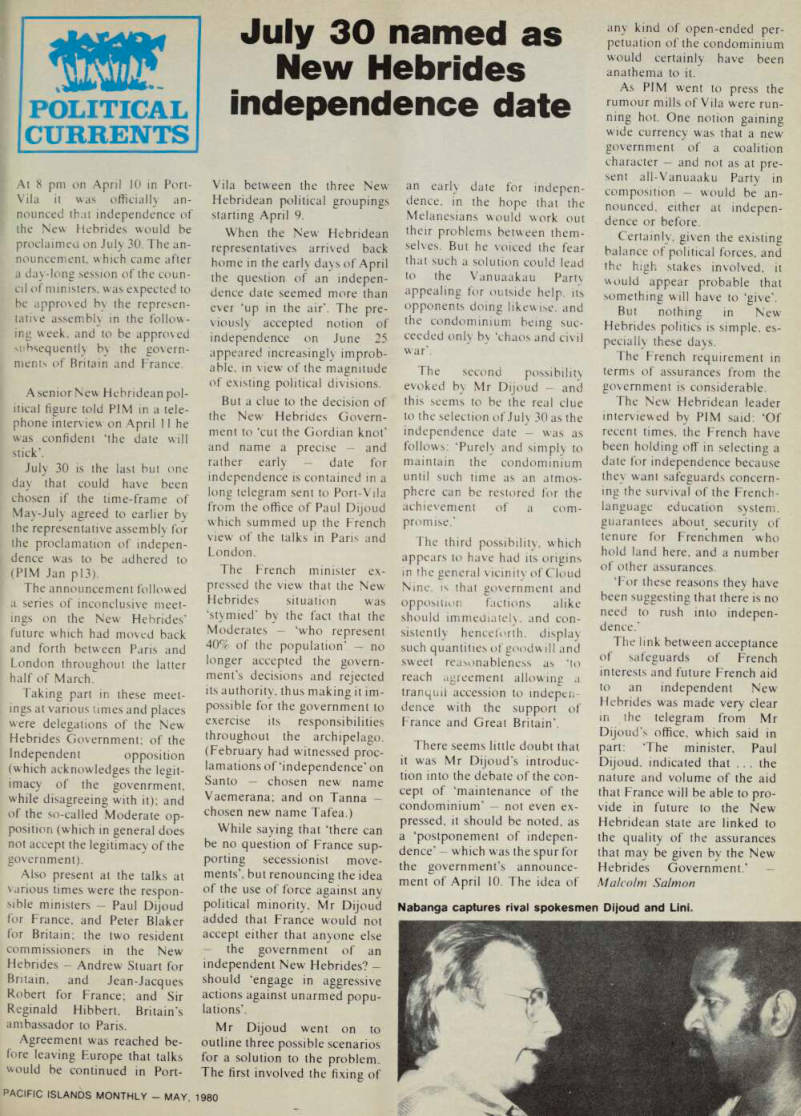
Nabanga captures rival spokesmen Dijoud and Lini.