Cyclone Wally
pp. 17-19 · Read in the full issue
Tropicalities
slams Fiji
A black Easter visitation to Fiji
by Cyclone Wally brought tor
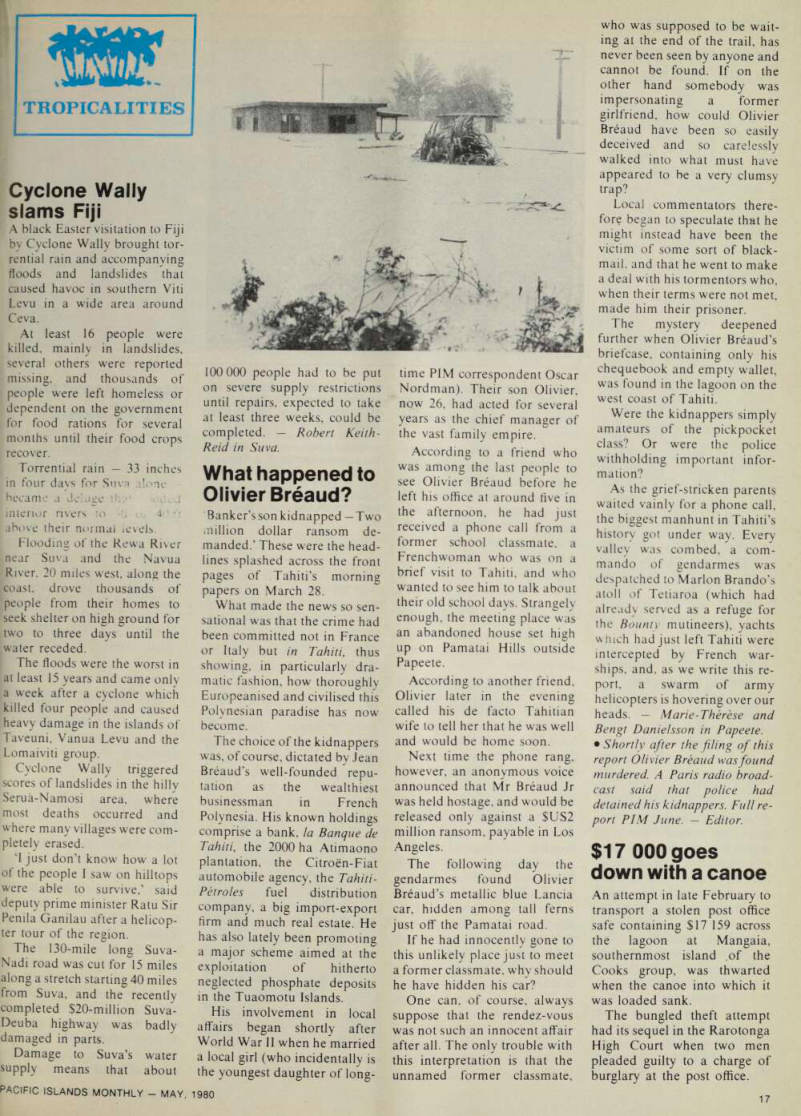
rential rain and accompanying floods and landslides that caused havoc in southern Viti Levu in a wide area around Ceva.
At least 16 people were killed, mainly in landslides, several others were reported missing, and thousands of people were left homeless or dependent on the government for food rations for several months until their food crops recover.
Torrential rain 33 inches in four days for Suvn alone became a deluge thj- -v .ed interior rivers io , 4- •• above their normal levels.
Flooding of the Rewa River near Suva and the Navua River. 20 miles west, along the coast, drove thousands of people from their homes to seek shelter on high ground for two to three days until the water receded.
The floods were the worst in at least 15 years and came only a week after a cyclone which killed four people and caused heavy damage in the islands of Taveuni, Vanua Levu and the Lomaiviti group.
Cyclone Wally triggered
scores of landslides in the hilly Serua-Namosi area, where most deaths occurred and where many villages were com
pletely erased.
’I just don’t know how a lot of the people I saw on hilltops were able to survive,’ said deputy prime minister Ratu Sir Penila Ganilau after a helicop ter tour of the region.
The 130-mile long Suva- Nadi road was cut for 15 miles along a stretch starting 40 miles from Suva, and the recently completed $2O-million Suva-
Deuba highway was badly
damaged in parts.
Damage to Suva’s water supply means that about
100 000 people had to be put on severe supply restrictions until repairs, expected to lake at least three weeks, could be completed. Robert Keith- Reid in Suva.
What happened to
Olivier Breaud?
Banker’s son kidnapped Two million dollar ransom de manded.’ These were the head lines splashed across the front pages of Tahiti’s morning papers on March 28.
What made the news so sen sational was that the crime had been committed not in France or Italy but in Tahiti , thus
showing, in particularly dra
matic fashion, how thoroughly Europeanised and civilised this Polynesian paradise has now become.
The choice of the kidnappers was, of course, dictated by Jean Breaud’s well-founded repu tation as the wealthiest businessman in French
Polynesia. His known holdings
comprise a bank, la Banque de Tahiti, the 2000 ha Atimaono plantation, the Citroen-Fiat automobile agency, the Tahiti- Petroles fuel distribution
company, a big import-export
firm and much real estate. He has also lately been promoting a major scheme aimed at the exploitation of hitherto neglected phosphate deposits in the Tuaomotu Islands.
His involvement in local
affairs began shortly after
World War II when he married a local girl (who incidentally is the youngest daughter of long
time PIM correspondent Oscar Nordman). Their son Olivier, now 26, had acted for several years as the chief manager of
the vast family empire.
According to a friend who was among the last people to see Olivier Breaud before he left his office at around five in the afternoon, he had just received a phone call from a former school classmate, a Frenchwoman who was on a brief visit to Tahiti, and who wanted to see him to talk about their old school days. Strangely
enough, the meeting place was
an abandoned house set high up on Pamatai Hills outside
Papeete.
According to another friend, Olivier later in the evening called his de facto Tahitian wife to tell her that he was well and would be home soon.
Next time the phone rang, however, an anonymous voice announced that Mr Breaud Jr was held hostage, and would be
released only against a SUS 2
million ransom, payable in Los
Angeles.
The following day the
gendarmes found Olivier Breaud’s metallic blue Lancia car, hidden among tall ferns just off the Pamatai road.
If he had innocently gone to
this unlikely place just to meet
a former classmate, why should he have hidden his car?
One can, of course, always suppose that the rendez-vous was not such an innocent affair after all. The only trouble with this interpretation is that the unnamed former classmate.
who was supposed to be wait ing at the end of the trail, has never been seen by anyone and cannot be found. If on the other hand somebody was impersonating a former girlfriend, how could Olivier Breaud have been so easily deceived and so carelessly walked into what must have appeared to be a very clumsy
trap?
Local commentators there fore began to speculate that he might instead have been the victim of some sort of black mail, and that he went to make a deal with his tormentors who, when their terms were not met, made him their prisoner.
The mystery deepened further when Olivier Breaud’s
briefcase, containing only his
chequebook and empty wallet, was found in the lagoon on the west coast of Tahiti.
Were the kidnappers simply
amateurs of the pickpocket class? Or were the police
withholding important infor
mation?
As the grief-stricken parents waited vainly for a phone call, the biggest manhunt in Tahiti’s history got under way. Every valley was combed, a com mando of gendarmes was despatched to Marlon Brando’s atoll of Tetiaroa (which had already served as a refuge for the Bounty mutineers), yachts which had just left Tahiti were
intercepted by French war
ships, and, as we write this re port, a swarm of army helicopters is hovering over our heads. Marie-Therese and Bengt Danielsson in Papeete. • Shortly after the filing of this report Olivier Breaud was found murdered. A Paris radio broad cast said that police had detained his kidnappers. Full re port PIM June. Editor.
$l7 000 goes
down with a canoe
An attempt in late February to transport a stolen post office safe containing $l7 159 across
the lagoon at Mangaia,
southernmost island of the Cooks group, was thwarted when the canoe into which it was loaded sank.
The bungled theft attempt had its sequel in the Rarotonga High Court when two men
pleaded guilty to a charge of
burglary at the post office.
Some fires are
fought in Apia
The Western Samoan govern ment offers some of the most generous incentives for over seas companies to set up business in Western Samoa.
These include duty-free
imports of capital equipment
and raw materials, as well as liberal tax holidays. Yet one of the most important things for which government has not pro vided adequately is fire protec tion.
Under Western Samoa’s ar chaic fire ordinance, the Fire Department based near the centre of town may not attend to fires more than 3.2 km (two miles) from the centre of town which, in this case, is Hans Keifs store, Taufusi Street.
All business enterprises in the industrial zone at Vaitele are beyond the two-mile limit and, therefore, under the ordinance are not entitled to fire protection. These enterprises include the West ern Samoa Breweries (makers of Vailima beer), Western Samoa Match Factory, Roth mans, Agriculture Store Cor poration, New Samoa Industries, the WSTEC Feed mill Plant, Boatcraft and several others.
In an interview, Mr Eric Janke, Chief Fire Officer, said he intended to enforce the pro visions of the fire ordinance, archaic as it is, and this would be done even to the extent of not attending any fire that might break out at the indus trial zone.
Mr Janke’s determination to enforce the law was amply demonstrated earlier this year when he turned down an urgent request from Mr Her man Retzlaff Sr and son ‘Fogi’ for assistance in putting out a fire at their copra shed just past the industrial zone. Even the most elementary assistance was refused and Retzlaff company had to sustain losses amounting to thousands of tala. The fact that Billie, Mr Retzlaffs wife, was the Prime Minister’s aunt did not help matters at all. ‘lt was just unfortunate that it was RetzlafTs copra shed that was affected. I would have refused assistance to anybody for that
matter because we cannot op erate outside the two-mile limit’, Mr Janke said shortly after the incident.
Mr Janke’s refusal to help put out the copra shed fire
angered many Apia business
men and the matter was taken up in a Chamber of Commerce meeting. The Chamber wrote to the Prime Minister express ing its concern at the Fire Department’s refusal to attend to fires outside the two-mile limit and since then a meeting was scheduled between Chamber representatives and Mr Janke in an atempt to solve
the problem.
Obviously, the first thing to be done is to change the law to allow the Fire Department to operate beyond the present limit. Mr Janke himself said this would be possible if his
department had more equip
ment.
At the time of writing, the Fire Department has only two trucks. One is quite useless and
requires a complete overhaul
once the part ordered arrives.
The other does not have a handbrake and its foot brake is faulty. This fact was cited by Mr Janke as one of the reasons he refused to give help in the Retzlaff fire. He was afraid the truck might hurt someone or be involved in an accident. A third truck, brand new, has been bought with government money from a New Zealand supplier and this was expected to arrive in mid-March. ‘Once we have the three trucks going
we should be able to provide fire protection beyond the two mile limit,’ said Mr Janke.
If Mr Janke does that, then he would be following the lead of his predecessor, Letaa Sulu Devoe, for many years the Chief Fire Officer. Letaa did not let the ordinance stop him from giving assistance to whomever needed it, whether a fire was within the two-mile limit or beyond. During his time many fire hydrants were
deliberately placed ouside the
two-mile limit so that assist ance could be given to houses, businesses and plantations in those areas.
The old fire ordinance must be updated. Common sense and business sense alike re quire it. Otherwise no foreign investor in his right mind would dream of investing in Western Samoa if required to put up a plant two miles or more from the centre of Apia town.
So the government’s whole development strategy would be defeated all because the Fire Department won’t use com mon sense, and the govern ment won’t bother to change a stupid law rFelise Va’a.
‘Holy smoke’ from
God’s Cessna
A sick joke doing the rounds of Port Vila, New Hebrides: On March 5 the Seventh-day Adventists’ new Cessna Sta tionair 206 caught fire while taxiing for take-off at Burton Field, Tanna. The pilot, an SDA pastor, noticed smoke coming from under his instrument panel while
completing his preflight
checks. He hurriedly stopped
his taxiing manoeuvre and abandoned the aircraft, which immediately burst into flames.
It is reliably reported that his final radio transmission logged at Port Vila’s Bauerfield con trol tower was ‘ Holy Smoke!’
The plane was badly
damaged.
An island ‘stars’in
SPC film
The South Pacific Commission has produced a film Story of an Island Managing Your Island 1 Environment for distribution to all SPC member countries.
The film was conceived, written and part-directed by 1 Arthur Dahl, the commission’s;
regional ecological adviser.
In Rarotonga for the Cook; Islands premiere of the film,, Mr Dahl told Cook Islands', News that while many govern ments in the SPC had ex pressed the desire for films, the: cost of making them had!
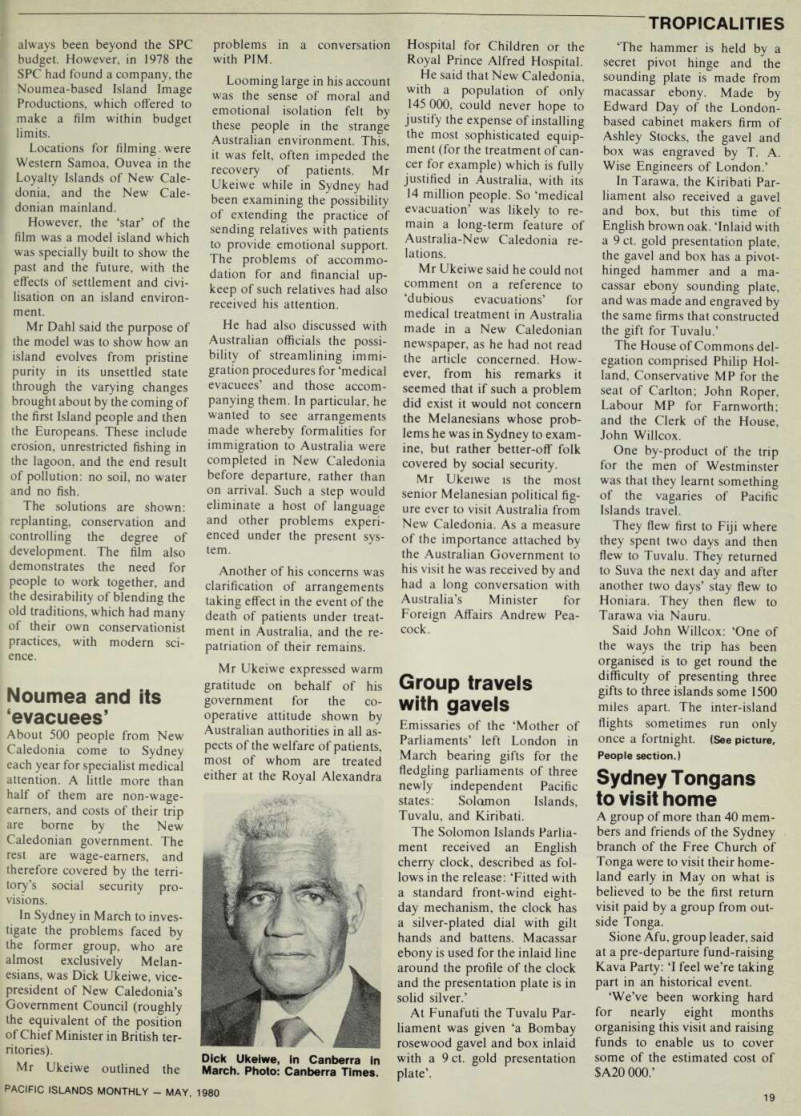
An actual-size reproduction of a souvenir sheet for the London 1980 International Stamp Exhi bition to be held from May 6-14.
Inset in the centre is a new $1 Western Samoa stamp. At left on the souvenir sheet is a Tower of London-type British Beefeater and at right a Samoan Talking Chief. Between them at top, a well-known London scene.
always been beyond the SPC budget. However, in 1978 the SPC had found a company, the Noumea-based Island Image Productions, which offered to make a film within budget limits.
Locations for filming, were Western Samoa, Ouvea in the Loyalty Islands of New Cale donia, and the New Cale donian mainland.
However, the ‘star’ of the film was a model island which was specially built to show the past and the future, with the effects of settlement and civi lisation on an island environ ment.
Mr Dahl said the purpose of the model was to show how an island evolves from pristine purity in its unsettled state
through the varying changes
brought about by the coming of
the first Island people and then the Europeans. These include erosion, unrestricted fishing in the lagoon, and the end result of pollution: no soil, no water and no fish.
The solutions are shown; replanting, conservation and
controlling the degree of
development. The film also demonstrates the need for people to work together, and the desirability of blending the old traditions, which had many of their own conservationist practices, with modern sci ence.
Noumea and its
‘evacuees’
About 500 people from New Caledonia come to Sydney each year for specialist medical attention. A little more than half of them are non-wage eamers, and costs of their trip are borne by the New Caledonian government. The rest are wage-earners, and therefore covered by the terri
tory’s social security pro
visions.
In Sydney in March to inves
tigate the problems faced by
the former group, who are almost exclusively Melan esians, was Dick Ukeiwe, vice president of New Caledonia’s Government Council (roughly the equivalent of the position of Chief Minister in British ter ritories).
Mr Ukeiwe outlined the
problems in a conversation with PIM.
Looming large in his account was the sense of moral and emotional isolation felt by these people in the strange Australian environment. This, it was felt, often impeded the recovery of patients. Mr Ukeiwe while in Sydney had
been examining the possibility
of extending the practice of sending relatives with patients to provide emotional support.
The problems of accommo dation for and financial up keep of such relatives had also received his attention.
He had also discussed with Australian officials the possi
bility of streamlining immi
gration procedures for ‘medical
evacuees’ and those accom panying them. In particular, he wanted to see arrangements made whereby formalities for immigration to Australia were completed in New Caledonia before departure, rather than on arrival. Such a step would eliminate a host of language
and other problems experi
enced under the present sys tem.
Another of his concerns was clarification of arrangements taking effect in the event of the death of patients under treat ment in Australia, and the re patriation of their remains.
Mr Ukeiwe expressed warm gratitude on behalf of his government for the co
operative attitude shown by
Australian authorities in all as pects of the welfare of patients, most of whom are treated either at the Royal Alexandra
Hospital for Children or the
Royal Prince Alfred Hospital.
He said that New Caledonia, with a population of only 145 000, could never hope to justify the expense of installing
the most sophisticated equip
ment (for the treatment of can cer for example) which is fully justified in Australia, with its 14 million people. So ‘medical evacuation’ was likely to re main a long-term feature of Australia-New Caledonia re lations.
Mr Ukeiwe said he could not comment on a reference to ‘dubious evacuations’ for medical treatment in Australia made in a New Caledonian newspaper, as he had not read the article concerned. How ever, from his remarks it seemed that if such a problem did exist it would not concern the Melanesians whose prob lems he was in Sydney to exam ine, but rather better-off folk
covered by social security.
Mr Ukeiwe is the most
senior Melanesian political fig
ure ever to visit Australia from New Caledonia. As a measure of the importance attached by the Australian Government to his visit he was received by and had a long conversation with Australia’s Minister for Foreign Affairs Andrew Pea cock.
Group travels
with gavels
Emissaries of the ‘Mother of Parliaments’ left London in March bearing gifts for the
fledgling parliaments of three
newly independent Pacific
states: Solomon Islands, Tuvalu, and Kiribati.
The Solomon Islands Parlia ment received an English cherry clock, described as fol lows in the release: ‘Fitted with a standard front-wind eight day mechanism, the clock has a silver-plated dial with gilt hands and battens. Macassar ebony is used for the inlaid line around the profile of the clock and the presentation plate is in solid silver.’
At Funafuti the Tuvalu Par liament was given ‘a Bombay rosewood gavel and box inlaid with a 9ct. gold presentation
plate’.
‘The hammer is held by a secret pivot hinge and the sounding plate is made from
macassar ebony. Made by
Edward Day of the London based cabinet makers firm of Ashley Stocks, the gavel and box was engraved by T. A.
Wise Engineers of London.’
In Tarawa, the Kiribati Par liament also received a gavel and box, but this time of English brown oak. ‘lnlaid with a 9 ct. gold presentation plate, the gavel and box has a pivot hinged hammer and a ma
cassar ebony sounding plate,
and was made and engraved by the same firms that constructed the gift for Tuvalu.’
The House of Commons del
egation comprised Philip Hol
land, Conservative MP for the seat of Carlton; John Roper, Labour MP for Farnworth; and the Clerk of the House, John Willcox.
One by-product of the trip for the men of Westminster was that they learnt something of the vagaries of Pacific Islands travel.
They flew first to Fiji where they spent two days and then flew to Tuvalu. They returned to Suva the next day and after another two days’ stay flew to Honiara. They then flew to Tarawa via Nauru.
Said John Willcox: ‘One of the ways the trip has been organised is to get round the
difficulty of presenting three
gifts to three islands some 1500 miles apart. The inter-island
flights sometimes run only
once a fortnight. (See picture.
People section.)
Sydney Tongans
to visit home
A group of more than 40 mem bers and friends of the Sydney branch of the Free Church of Tonga were to visit their home land early in May on what is believed to be the first return visit paid by a group from out
side Tonga.
Sione Afu, group leader, said
at a pre-departure fund-raising
Kava Party: ‘I feel we’re taking part in an historical event. ‘We’ve been working hard
for nearly eight months
organising this visit and raising funds to enable us to cover some of the estimated cost of
Sa2O 000.’
Dick Ukeiwe, in Canberra in March. Photo: Canberra Times.