Islands
Pacific
Monthly
i»ir\ i f i American Samoa US$l.25 Australia ASl.OO* Fiji Fsl.oo Hawaii &US mainland US$l.5O Nauru $A1.50 New Caledonia CFPI4O New Hebrides ASI.OO NZ, Cook Is. & Niue NZ$l.OO Norfolk Island Asl.oo Papua New Guinea Kl.OO Solomons SSI .00 Tahiti CFPISO Tonga Pl.OO USTT A Guam US$l.5O Western Samoa Tl.lO • Recommended retail price only.
Registered for posting as a publication Cateoory B.
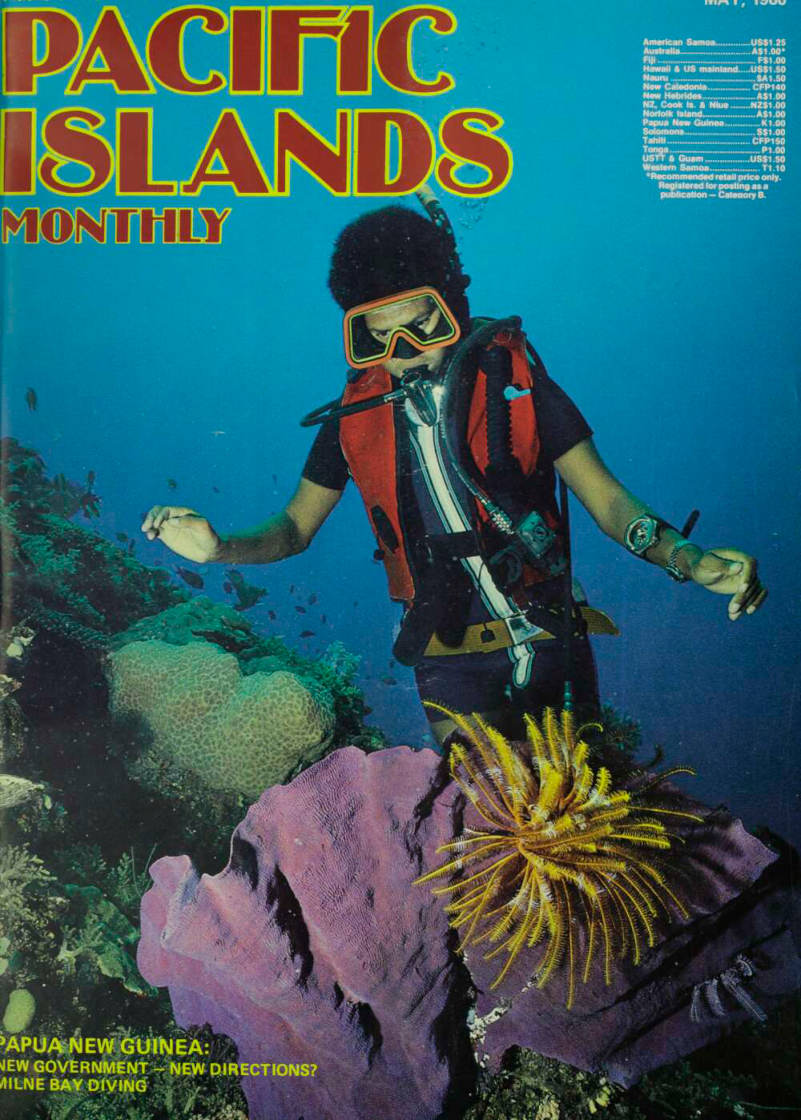
>Apu*New Guinea:
Jew Government - New Directions?
Ailne Bay Dlyinq >
Advertisements & other items, p. 2 (1 item)
PRO SERIES. The Tone
1 Zi *««« S® === M
PRO’SOI
of the Future Being Set Today
Introducing state-of-the-art audio for the 80’s. The Pro Series, from Akai. Representing the latest in digital processor technology and other space-age developments. A preeminent lineup of slim design component systems that have what your best customers expect from Akai. The finest in sound quality,
today and in the future.
PRO-601
Quartz Direct Drive Turntable.. model AP-QSOC DC Stereo Power Amplifier. .. model PA-WO4 Stereo Pre-Amplifier model PR-AO4 FM/AM Stereo Digital Synthesizer Tuner - model AT-VO4 Stereo Cassette Deck model GX-MlO Stereo Graphic Equalizer (Optional) model EA-GBO Audio Timer (Optional) model DT-100 Speaker SR-H5O/SW T5O Audio Rack model RM-H6l ’A long wave band model is also available
PRO-502
Turntable model AP-D3OC Stereo Integrated Amplifier model AM-UO2 FM/AM Stereo Tuner - model AT-KO2 Stereo Cassette Deck model CS-MO 2 Stereo Graphic Equalizer (Optional) model EA-G4O Audio Timer (Optional) model DT-100 Speaker SR-H3O/SW-T3O Audio Rack model RM-H 52 ‘A long wave band model is also available
PRO-501
Turntable model AP B20C(S) Stereo Integrated Amplifier model AM-UOl FM/AM Stereo Tuner - model AT-KO2(S) Stereo Cassette Deck model CS-MOl Audio Timer (Optional) model DT-100 Speaker SR-H3O/SW-T3O Audio Rack model RM-H5l ‘A long wave band model is also available JL 099 1980
MOSCOW
OFFICIAL SUPPLIER OF
VIDEO HOME SYSTEM
AKAI
AKAI ELECTRIC CO., LTI
Tokyo, Jap*
Approved by M.0.0C
PNG
S.O. Svensson (N.G.) Ltd.
P.O. Box 705, Port Moresby Tel: 2275 Fiji Islands Motibhai & Company Ltd.
P.O. Box 9175, Nadi International Airport Tel: 72-165 New Zealand Pye Ltd., Consumer Products Sector 110 Mt. Eden Rd., Mt. Eden, Auckland Tel; 686-437 New Caledonia Menard. Pacifique s.a.r.l.
B.P. H 2. Noumea Tel; 275222 Tahiti Etablissements Comimpex P.O. Box 200, Papeete Tel; 20477 New Hebrides (Islands) Burns Philp (New Hebrides) Co., Ltd.
P.O. Box 27, Port Vila, New Hebrides Islands Norfolk Island Burns Philp (Norfolk Island) Co.. Ltd.
P.O. Box 21. Norfolk Island Samoa Islands Burns Philp (South Sea) Co.. Ltd.
P.O. Box 129, Pago Pago, American Samoa Mariana Islands J.C. Tenorio Enterprises P.O. Box 137, Saipan Tel: 6444/8 Solomon Islands Security Electrical Co., Ltd.
P.O. Box 174, Honiara Tel: 881 Cook Islands JPS Enterprises Ltd.
P.O. Box 15, Rarotonga Tel: 2150, 2176 For more information, please send this coupon to oum distributor in your country or to AKAI ELECTRIC CO . U 12-14, 2-Chome. Higashi-Kojiya. Ohta-ku. Tokyo, Japas
Pacific Islands Monthly
Vol 51 No 5
May 1980
[Usps 952480]
Representatives
AUSTRALIA: Distribution: NSW & ACT: Allan Rodney Wright (Circulation) Pty Ltd, PO Box 907, Darlinghurst, NSW 2010; Elsewhere: Gordon & Gotch (A/asia) Ltd, Box 40, PO, Rosebery, NSW 2018 Advertising — Melbourne — Pa cific Publications (Aust.) Pty Ltd. Newspaper House, 247 Collins Street, Melbourne 3000, telephone 63 0211, ext. 1565 Jeff Gates, ext. 1858 Ida Padgett; Brisbane - D.
Wood, Anday Agency, Box 1918, GPO, Brisbane 4001, tele phone 44 3485, 44 1546: Adelaide - Hastwell Media, PO Box 30, Glen Osmond, SA 5064, 233 Glen Osmond Rd, Frewville, SA 5063, telephone 79 1869, Perth - Adrep, 62 Wickham St., East Perth, WA 6000, telephone 325 6395.
FIJI: Distribution and subscriptions — Desai Bookshops, PO Box 160, Suva, Fiji, telephone Suva 23036 Advertising — Fiji Times & Herald Ltd, 20 Gordon St, Suva, telephone 312 111, telex FJ2124.
FRENCH POLYNESIA: Distribution — Hachette Pacifique, 10 Ave Bruat, Papeete, telephone 25610.
HAWAII, UNITED STATES: Distribution PIM, Hawaii, PO Box 22250, Honolulu, Hawaii 96822.
JAPAN: Advertising and subscriptions — Universal Media Corporation, CPO Box 46, Tokyo, telephone 666 3036.
NEW CALEDONIA; Distribution — Depot Centre de Presse Michel Pentecost. CBP2, Noumea, telephone 27 2434, 27 4729.
NEW ZEALAND: Distribution — Gordon & Gotch, PO Box 584, 2 Carr Road, Mt, Roskill, Auckland 4 Advertising — International Media Representatives Ltd, PO Box 2313, Auckland, telephone 795 487; 493 389, cables Intereps, Auckland. Subscriptions - Ross Haines & Son Ltd, PO Box 1289, Auckland, telephone 769 042.
PAPUA NEW GUINEA: Distribution - Gordon & Gotch, PO Box 3395, Port Moresby, telephone 254551, 254855.
Advertising — PNG Post-Courier, PO Box 85, Port Moresby, telephone 21 2577.
UNITED KINGDOM: The Herald & Weekly Times Ltd, 8-10 Clifford’s Inn, Fetter Lane, London EC4A 1BU, telephone 01 831 6041, telex London 21989.
UNITED STATES MAINLAND: Advertising - Joshua B Powers Jr, Powers International Inc., 551 Fifth Ave, New York, New York 100 017, telephone 867 9580, telex 236514 Subscriptions — PIM, Hawaii, 2812 Kahawai St, honolulu, Hawaii 96822.
Subscriptions
PIM is airfreighted to most subscribers and agents in the Pacific Islands and the United States, but not the UK or the Continent.
Elsewhere: SAI6 Payment by personal cheque is accepted in Australian, US, New Zealand, UK and Fiji currency. For other remittances please obtain a bank draft in Australian dollars made payable to the ANZ Banking Group, 88 Wentworth Avenue, Sydney, Australia.
Published monthly by Pacific Publications (Aust.) Pty Ltd and printed in Australia by Paramac, Alexandria, NSW. Aus tralian cover price is recommended retail only. Registered at the GPO Sydney for transmission by post as a publication category B. Second class postage paid at Honolulu, Hawaii. Copyright © 1978 Pacific Publications (Aust.) Ptv
Ltd.
Postmaster Honolulu: Send address changes to PIM Hawaii, PO Box 22250, Honolulu, Hawaii 96822.
Aust.
Other American Samoa $13 $US16 Australia $12 Canada $14 $US18 Cook Islands $13 Fiji $12 $F12 French Polynesia $14
Cfp 1700
Guam $13 $US16 Hawaii $13 $US16 Japan $16 Y4500 Kiribati $13 Micronesia $13 $US16 Nauru $18 New Caledonia $14
Cfp 1700
New Hebrides $13 New Zealand $12 $NZ13.50 Niue $13 Norfolk Island $12 Northern Marianas $13 $US16 Papua New Guinea $13 K12 Solomon Islands $13 Tonga $13 Tuvalu $13 United Kingdom $15 10 US Mainland $14 $US18 Western Samoa $13
This Month’s Features
• NEW GOVERNMENT IN PAPUA NEW GUINEA - PIM Editor Angus Smales, a veteran of more than 20 years of journalism in PNG, outlines the hows and whys of the fall from power of Michael Somare and the rise of Sir Julius Chan 10 • TONGA There is strife at the top in Tonga’s Free Wesleyan Church. For some, the man in the eye of the storm is a man of the highest principle, for others an irresponsible boat-rocker 15 • TRAVEL Bob and Dinah Halstead share with us the exhilaration of a scuba diving safari in Papua New Guinea’s Milne Bay, and David Robie takes us to a treasured ‘home away from home’ he has found on Tonga’s main island of Tonga tapu 35 • BOOKS Reviews of new books on the career of the Cook Islands’ remarkable former leader Sir Albert Henry, the history of Samoa, and the century-long experi ence of the Indian population of Fiji 44 • PlM’s PACIFIC Judy Tudor continues her series on the 50th anniversary of PIM with an account of the 1950 s which, she says, came in like a ‘puling infant’ and made their exit like a ‘snarling tiger’. Read why on page 51 • NAURU Interpretations differ on how long it will be before Nauru’s crucial posphate reserves are exhausted 61 • SHIPS West Germany’s Columbus Line has announced a big extension of its services to the South Pacific, and the Pacific Forum Line has withdrawn from a recently formed shipowners’ association 68 Cover: Dinah Halstead explores the under-water glories of Milne Bay. Full report begins on p 35.
American Samoa 29 Books 44 Cook Islands 44 Deaths 81 Fifty Years of PIM 51
Fiji 17,47,63,65,69
French Polynesia 17,27,71 Island Press 49 Kiribati 29 Letters 5 Micronesia 63,71 Nauru 61 New Caledonia 19,29 New Hebrides 65
Pacific Report 9 Papua New Guinea 5,10,35,63,65,69,70 People 31 Political Currents 21 Samoa 45
Ships 68
Shipping Services 79 Tonga 15,19,41 Tradewinds 61 Tradewinds Intelligence 67 Travel 35 Tropicalities 17 Western Samoa 18 Yachts 73
Advertisements & other items, pp. 3-4 (2 items)
Founded 1930 by R. W. Robson
Publisher Stuart Inder Editor Angus Smales Associate Editor Malcolm Salmon Editorial Adviser John Carter Manager John Berry Advertising Sales Manager Steve Gray A Pacific Publications production 76 Clarence Street, Sydney 2000 GPO Box 3408 Sydney 2001 Cables: PACPUB Sydney Telex: 21242 (answers INTARAD) Telephone: Sydney 29 6693
Beehive Building
94 Elizabeth Street Melbourne, Victoria Australia 3000 G.P.O. Box 8 Melbourne, Victoria Australia 3001 *• es Telex: AA34552 Phone: 63 5094
YOUR GUARANTEE
FOR SERVICE
Kevin Egan
Letters
hits back
Tired as I am of the ‘Rooney Affair’ and its whole distasteful aftermath, your editorial com ment — ‘Strange ways of Mr Kevin Egan’ (PIM, Feb. p 9), forces me once again to raise my weary pen for the sake of your, and your readers’ enlight enment.
I sent you a copy of my annual report, with a short covering note, out of a sense of balance, everyone else with an interest in the Pacific having either requested or been sent one. I anticipated some criti cism of either the viewpoint that I put forward or the fact that I put forward a viewpoint at all. I did not, however, expect the fatuous trivia that you dished out in February by way of substitute for genuine, red-blooded criticism.
You made two points. The first related to the paper on which the covering letter was typed, full of pregnant refer ences to ‘xed’ out ‘Secretary For Law, Port Moresby’ head notes and national crests. Let me put your tender sensitivities to rest. That paper, far from
representing purloined
national property (heaven for bid) was part of a stockpile of identical paper previously used
by the last pre-independence
secretary forjustice. The paper, just like the office which used it, ceased to have any relevance
after mid-night on September
15 1975 (Independence Day)!
Rather than throw it away my officers and I have used it as scrap paper since then. So much for your first point.
Your second point related to Somare’s allegation, made after I left, that whilst overtly stating that I was leaving, covertly I was attempting to obtain a reappointment. What rot!! At the same time I believe he was also telling eager lis teners ‘Egan wanted to stay
but we didn’t want someone like him as Public Pros ecutor’.
It is noteworthy that you neglected to tell your readers that in a letter to the editor, published in the PNG Post- Courier on January 28 1980, page 4, I accused Somare of misleading the public in re spect of this matter, an alle gation to which that gentleman has never replied. Nevertheless his statements and reactions to the release of my report and my
departure, a departure which
has coincided with a general
exodus of long-serving expatri
ate lawyers in the country, are not without their significance.
For a start, my report con tained 33 pages of trenchant,
though objective, criticism re
lated to PNG’s present, un questionable, law and order crisis. To date Somare has not denied a single syllable of what I had to say. Rather predict ably, the only comment that has emanated from him is the one that you reported in Pacific
Report concerning my alleged
quest for reappointment. Even were it true, the question that
then immediately must spring
forward is ‘Well, so what?’
Quite clearly, finding himself
in a situation from which he could not extract himself with facts, the honourable gentle man has chosen to revert to a combination of two classic pol itical manoeuvres the red herring and the smear tactic.
Secondly his reactions
demonstrate quite clearly that
‘politically insensitive’ pros ecutions in PNG, regardless of their legality and merit, may well lead to censure in the form, effectively, of dismissal, under the present regime. For
tunately, those responsible for
drafting the Constitution fore saw the potential for such a cynical misuse of executive power, and for that reason the appointment of Judges and the Public Prosecutor is not the re sponsibility of the Executive but rather the Judicial and Legal Services Commission, consisting of the Chief Justice, Deputy Chief Justice, Chief Ombudsman, Minister for Jus tice and one other parliamen tarian.
That Somare is not prepared to pay even lip service to this enshrined constitutional tenet became obvious however in
November when he an nounced. in answer to a ques tion in parliament that ‘the government (emphasis mine) intended to appoint two more National Judges in February’.
This was said when the Com mission had not even con sidered the matter, and was a blatant attempt to coerce the Commission in futuro.
The truth concerning myself
is quite simple. In May, whilst
in Hong Kong, being con
cerned over recent trends in PNG, I raised the question of my appointment as Crown Counsel in the Colony with the
Assistant Attorney-General,
indicating then verbally, and a fortnight later in writing, that I would not be seeking reap pointment as Public Prosecutor in PNG at the expulsion of my term on November 23.
After Rooney’s release from
prison after serving only 24
hours I made a public state ment to this effect. This was in September. On October 19 I confirmed this decision, in writing, to the Judicial and Legal Services Commission.
Between September and October, however. I was ap proached by two members of the Judiciary, a number of senior police officers and others to reconsider my de cision. I communicated the fact of this approach to the Sec retary for Justice who offered to assist me if I wished to change my stance. I did not.
Having already resolved to go in May, is it at all likely that with the massive trauma caused after Mrs Rooney’s let ter to the Chief Justice in July I would be still actively seeking reappointment in November?
Kevin B. Egan
(Former) Public Prosecutor of Papua New Guinea Brisbane, Qld, Australia •In April, PIM published the full text of the annual report to which Mr Egan refers in his let ter. We made the space available because we considered the report to be of such importance. This decision was made before we received Mr Egan’s letter, but we are happy to publish his re marks. PIM apologises for the error in the published report in which Mr Egan’s name was given as Brian instead of Kevin.
Editor.
No ‘oddballs’
after all
Write in haste, repent at leisure. Sorry, Yanks, for my reference to ‘oddball chicken farmers’ in my article (PIM Mar p 17) It is not my style to denigrate the efforts of any individual, and I don’t like it myself when my own achievements are
denigrated.
Therefore I apologise most humbly to my Yank friends in Port-Vila who number among themselves 1) a manager of a very efficient frozen chicken operation 2) a manufacturer of household goods who is imparting his skills to New Hebridians 3) a new tourist complex operator 4) a superb
agriculturalist 5) a four-ring
Captain US Navy 6) an ex- Coastguard commander, etc.
All are doing their bit to de velop the New Hebrides.
So to Hank, Hoff, Chuck, Guv, Gus, Tom and Mack I say let’s call the dogs off and begin
again.
Ken Hutton
Santo New Hebrides
Levuka: An exciting
new project
Levuka, the old capital of Fiji, is the centre of an exciting new South Pacific project. In the long term it is planned to dedi cate the whole of Levuka, this fine historical gem, as an his toric site. The town is ideal for this. It is unique in this part of the world with almost all of its buildings dating back to the 19th century and with its his torical importance as the scene of the signing of the cession deed that joined Fiji with Great Britain. Here, the first school in Fiji began in 1879, the first town council was incor porated over 100 years ago and the first newspaper, the Fiji Times , began publication. The large Pacific business of Morris Hedstrom, now a part of the
Carpenter chain, began here
100 years ago.
In the plans it is hoped that the original old governor’s resi dence will become part of the National Trust. The big and
imposing building of the orig
inal Morris Hedstrom store, now also 100 years old, has been given to the National
Trust of Fiji for the use of the residents of Levuka.
Efforts are currently in hand to convert this fine building into a cultural centre for Levuka. It will comprise a mu seum (as a Levuka branch of the Fiji Museum and housing old Levuka pieces), a library (to be a part of the western re
gional library system of Fiji),
and a large meeting hall. Other parts of the building will be set aside for the youth of Levuka, the young women under the YMCA and a gymnasium for the young men and boys.
Although the building is
structurally strong and in excellent shape, much work is needed to re-roof, partition the interior and paint and furnish the building to achieve this use ful addition to the life of the people. The Levuka Historical and Cultural Society (a part of the National Trust of Fiji) is
running a campaign to gather
the funds necessary to achieve this end. The secretary is Adrian Anderson and the treasurer is Bhupendra Kumar, Box 17, Post Office, Levuka,
Fiji.
I know there are many readers of your excellent maga zine who have fond memories of Levuka. Many who have lived there or were born in Levuka and who went to school at the Levuka Public School, will be interested in these plans to preserve a wonderful cul
tural heritage.
Victor Carell
Northmead, NSW, Australia
‘Traitors’ in
Png
It appears very much that Lawrence Kavavar (PIM Mar p 9), as a student he claims to be, has learned very little indeed except to represent his country with arrogance and
ignorance. Perhaps Lawrence
Kavavar, like many other Papua New Guineans, should get the facts straight before
boasting and talking.
He would be well advised to check the records of the Dis trict Court in Daru, 1977/78, where he will find the convic tion of three men found guilty of eating parts of their dead relative. The use of over 700 tribal languages in a total
population of four million doesn’t particularly indicate national and cultural unity.
Indeed we all remember the PNG Deputy Prime Minister Ebia Olewale and his show offs at the recent South Pacific Conference. Even more we re member him for sending hun dreds of his own helpless brothers and sisters back across the border to his colonialist and imperialistic friends. We viv idly remember Ebia Olewale and the Somare Government for betraying their Melanesian brothers Jacob Prai and Otto Ondawame.
And who is being spoonfed by whom? With all his talk of independence in PNG Law rence Kavavar appears to for get that in spite of thousands of
millions paid by Australian
taxpayers since 1975, in spite of so-called ‘independence’, and in spite of all the royalties of
Bougainville Copper, very
little can be seen of general
development particularly in
rural areas and in education. In terms of PNG ‘independence’
Lawrence Kavavar should per
haps investigate some wings of
the government buildings in Waigani and Konedobu in which hundreds of Australian ‘advisers’ instruct the govern ment what to do and when. He cannot deny the fact that Burns
Philp, Carpenters and Steam
ships still run the economic affairs of his ‘independent’ country. Consequently, Law rence Kavavar, your ‘independence’ is just about as
much as Australia and Indonesia allows you.
So next time before you ridi cule and insult other South Pa cific nations you had better get your records straight. The ‘independence’ you have, Lawrence Kavavar you can have it and keep it.
Dorothy Wakau
Cairns, Qld, Australia
Of cannibals and
anthropophagy
As Lawrence F. Kavavar (PIM
Mar p 9) was probably infor
med by one of his teachers, cannibalism does not exactly mean ‘eating human flesh’ but means ‘eating your own species’. A dog is a cannibal if it eats another dog. The proper word for humans eating humans is antropophagy.
As far as antropophagy is concerned, personally, after 20 years spent in PNG and patrol ling the most primitive parts of the island (probably more than Mr Kavavar), I must mention that antropophagy cannot be
considered, exactly, a practice
‘from the past’. However, I do not see why a modern Papua New Guinean should be ashamed of a mainly ritual cus tom of some tribes.
Only a few years ago, an Australian magistrate in Daru very wisely decided that it was unfair to charge some men from the Upper Strickland, under the Queensland Crimi nal Code, of ‘dealing indecently with a corpse’. In
fact, generally, warriors con sume part of the body of an enemy, not in contempt, but in the belief that doing so is to as similate some of his virtues.
On the other hand, scientific research in PNG, which led Dr C. Gajdusek to the Nobel Prize for Medicine in 1975, established that the main cause of the disease kuru was necrophagy - the traditional consuming of dead relatives by villagers of the Fore tribe in the
Highlands.
I opposed, in articles and lec tures, mainly in France, an unfortunate generalisation by some reporters about cannibal ism and other spectacular prac tices, especially as far as PNG was concerned (my wife was bom in the country). Recently
the publication by Jacques and
Betty Villeminot, formerly visi
tors to PNG, of Nouvelle Guinee Les Papous Chasseurs de Tetes (head-hunting
Papuans), although mainly on
West Irian Asmats under Indonesian control but in the same island, should be more condemmed than the Tahitian reader of PIM. I criticised 13 years ago in Paris, with the sup port of a member of the PNG Assembly, a book by the same authors presenting the Trobriands as ‘island of love’.
John Huon
Atherton, Qld, Australia
Of yachties
and bad apples
The two letters on ‘Yachties and Tonga’ (PIM Dec 1979 p 7) brought back memories of our passage through Tonga in 1975.
At that time Tongan authori ties were said to be having trouble with a few yachties growing marijuana in an ob scure corner of their islands and, as a result, yachts were being restricted in their move ments about the islands.
Now the problem has sur faced again with regard to pirating of black coral. But I don’t think yachties as a group should be condemned because of the illegal acts of a few.
There will always be a few bad apples in any barrel. I learned as a kid to pick out the bad ones and save the rest rather than throw the whole lot away.
The issues of yachtie behav
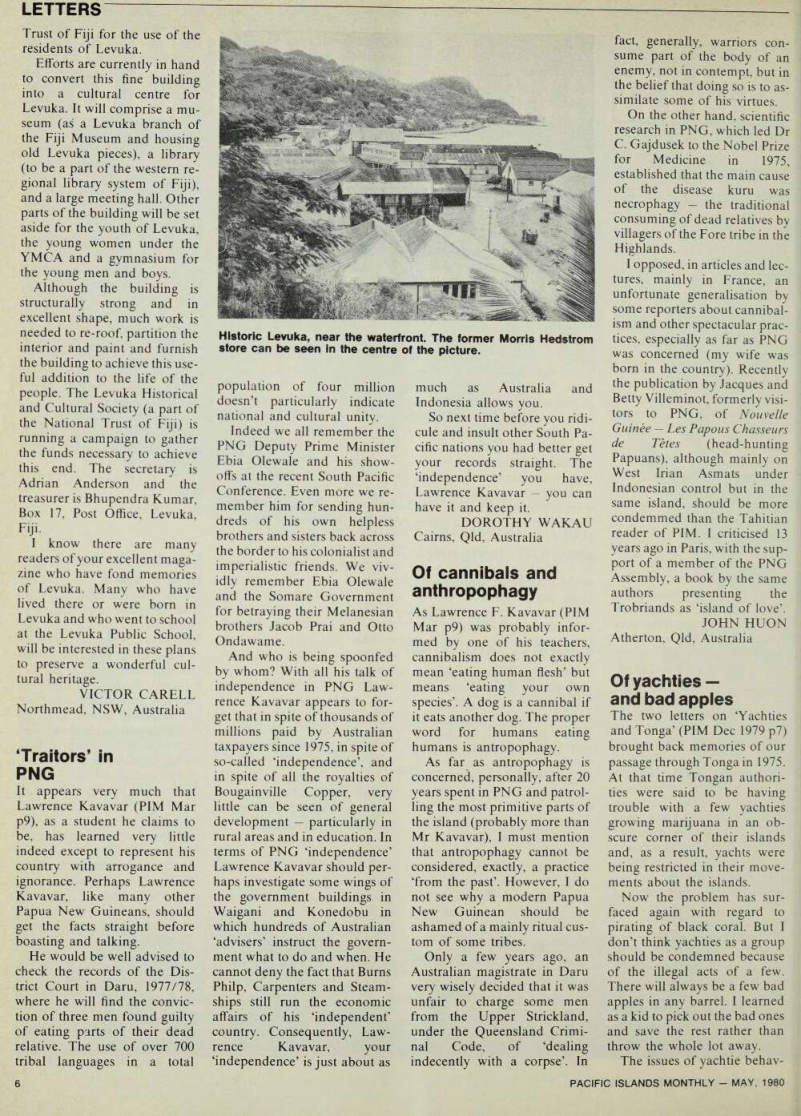
Historic Levuka, near the waterfront. The former Morris Hedstrom store can be seen In the centre of the picture.
iour, need for better communi cation between yachties and officials, and the question of how much yachties contribute to the local economy are not new. They are not much dif ferent from those we encoun tered when we enjoyed the hospitality of the Tongan islands five years ago. At that time (PIM Feb 1976 pp 23-25) I wrote to you explaining the yachties’ side, in hopes of promoting a better understand ing of both sides of the issue cutting enclosed. Those obser vations are still valid.
I believe the general situ ation has now improved, and some long-term benefits of yachties’ visits are now evident.
I refer to the recently established yacht charter business at the Port of Refuge Hotel on Vavau.
If it hadn’t been for the many yachties bringing back home their true-life experiences of visiting and sailing the waters of Tonga, that charter business would not exist. The hundreds of people who now charter those boats would not spend their vacation dollars in Tonga but probably would stay home or sail the Caribbean waters instead.
We cannot kill the goose that lays the golden egg. Instead, let’s lower the boom on the miscreants who make life bad for all of us.
Earl R. Hinz
Huntington Beach,
Calif. USA
Suwarrow as
she is
I just read ‘Problems in Tom Neale’s Paradise’ (PIM Feb Pl 4). I was greatly surprised that Mr Syme interpreted what he saw there as a problem rather than a blessing.
As I was on one of the yachts referred to I feel responsible to set the story straight.
First of all both yachts sailed from Pago Pago, not Western Samoa as claimed. Both were en route to Hawaii, but due to an extensive calm they took anchorage at Suwarrow and were there three days, not two months as claimed.
The Cook Islands Premier Dr Tom Davis did not show an noyance about the yachts. On the contrary he wrote three
pages in Tom Neale’s log book expressing gratitude and com mending the yachters for ‘mak ing Suwarrow a national
park’.
Also Tom Neale’s son, who was with the visiting party, wrote his thanks to the yachters for preserving his father’s house and grounds.
This log book was left by Tom Neale for entries from visiting yachts and is a tes timonial to the service they have done to his estate.
Premier Davis was so impressed with what he saw and read that he wrote in the back of the log book to send it to him when it was full of entries and he would put it in a museum as a tribute to Tom Neale. One of the girls on the yachts actually burst into tears
after reading the eloquent
message of Premier Davis. She had just spent three days dust ing and keeping house for Tom Neale.
If one were to land on this tiny island (only a few hundred metres long) one would find a well manicured pathway lead ing up to a group of shacks.
Pots and pans are neatly stacked, a bookshelf has a selection of books and ornaments, the dinner table is practically set for guests, even the bed is made. You’d find the
tool shed perfectly organised with a large variety of tools
(not just junk). The yards look
cleared, even the garden fence is repaired and standing up right. Yet you’d be the only person there.
Contrary to what Mr Syme appears to think, yachters would not steal Tom Neale’s cats, or chickens (it’s written in the log book ‘feed, don’t eat the chickens’), or anything from that place. If they did they’d be cast out by their own kind.
Is Mr Syme so naive as to think that if Tom Neale’s place was left to nature the buildings and water tanks would be in good repair, or that one could even find the path? As for the damaged trees, send a botanist and you’d get a different
opinion.
Fortunately, Premier Davis is more perceptive. The proof is in the log book which is now at Tom Neale’s shack awaiting the next yachter’s entry. For it is they who are the caretakers of this unique museum.
Larry Potter
Pago Pago
American Samoa
Historic issue of
Rabaul Times
I have a copy of the single sheet, special edition of The Rabaul Times dated Monday, September 4, 1939, which tells of the declaration of World War II the previous day. It is
in good condition, though
becoming brownish in colour because of its age of 40 years.
I bought it in Rabaul when I was a government clerk there.
I am wondering if PIM readers know of any other cop ies still in existence? There might be a few, but almost cer tainly not many. Most would have been destroyed during the invasion and occupation by the Japanese.
G B. Black
Nambour, Qld A Pacific Maths,
Logic contest
I refer to PIM Pacific Report (Mar p 7) where you call on young mathematicians to par ticipate in the 1980 Australian
Mathematics Competition.
Readers may be interested to learn of another such compe
tition in the Pacific region; the South Pacific Mathematics and Logic Competition which has been operating since 1972 (its Australian counterpart has been going for two years).
Our Maths and Logic Com petition started in Lae, Papua New Guinea, in 1972 but rap idly spread throughout the Pa cific. It is now operated from the University of the South Pa cific in Suva and from the Ministry of Education and Training in Honiara. If readers would like to have further in formation about our compe tition they may contact either myself at the address below or Richard Wah at PO Box 2393, Suva, Fiji.
Colin Meek
(Co-organiser)
PO Box 729 Honiara Solomon Islands
Help with the
Induna Star
As a survivor of the ill-fated garrison at Rabaul in 1942, the Committee of Lark Force As sociation, have charged me with the task of raising a Mem orial Book to all who were con cerned in the operations in the area.
One chapter has been given over to that of the Ist Indepen dent Company, stationed in Kavieng, with sections scat tered north and south of that point. The company had as its seagoing transport the Induna Star of 81 tons, which on
February 4 was captured by the
Japanese off Gilingil, New
Ireland; and from that time on lost sight of. Who the previous owner was we likewise do not know, and the Canberra War Museum is unable to help.
However, we have every reason to believe the vessel did operate out of Rabaul, and would have been fairly well known at the time; but with the passage of time there are fewer and fewer people to whom one can turn for the information.
Has anybody got a photograph of the Induna Star ? Could I also ask if somebody has a snap of Peter Harbour (Peterhafen) in the Witu Islands.
Douglas A. Aplin
17 Tyrall St, Box Hill N.
Victoria 3129
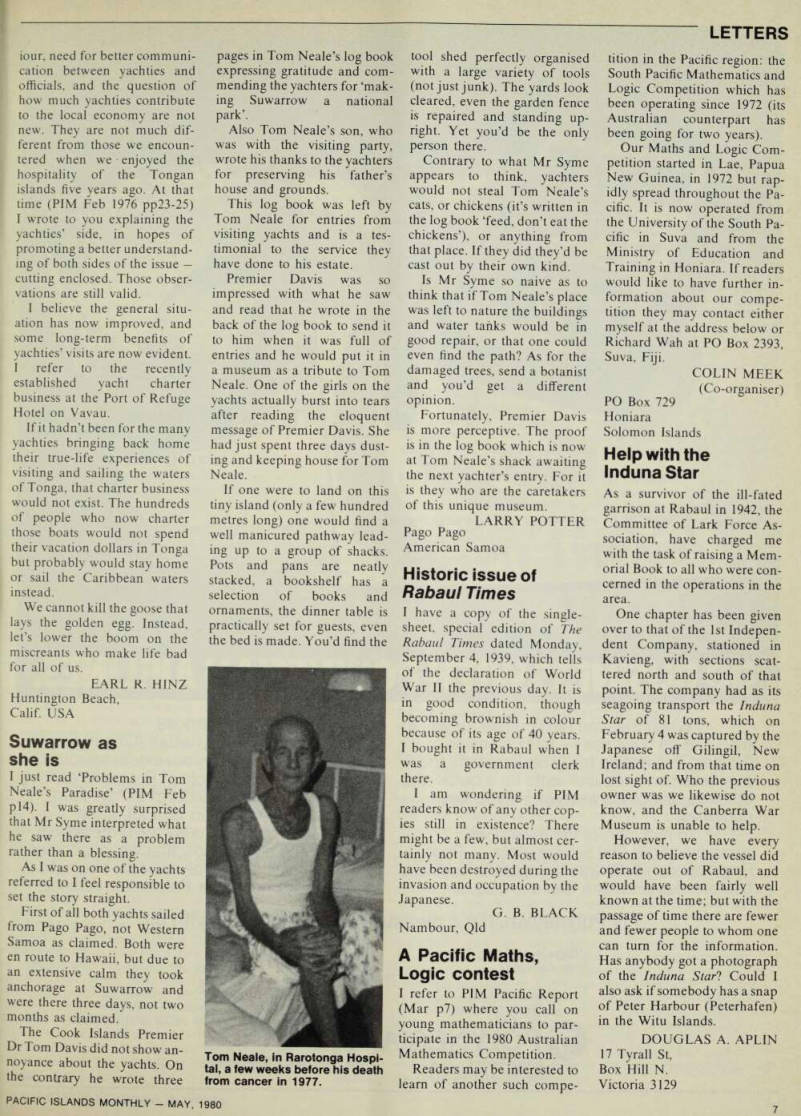
Tom Neale, in Rarotonga Hospi tal, a few weeks before his death from cancer in 1977.
Advertisements & other items, p. 8 (1 item)
Polynesian/Airlines
IS s ' A': , When the time next comes for you to fly out to do business fly Polynesian Airlines. Polynesian really understands the businessman’s requirements for a quick and efficient service between all Polynesian countries.
In fact, part of the reason we established our first service (Apia Pago Pago) back in 1959 was to meet the business sector’s demand for a fast and frequent service between the Samoas.
Since then Polynesian Airlines has spread its wings. Today our extensive route network covers the whole of Polynesia east of Fiji and now extends down to Auckland, New Zealand. And, as in ‘59 a lot of the people we’re carrying today are professional people. People who know that when it comes to flying anywhere in Polynesia on business there is only one airline. Polynesian Airlines, Fly Polynesian. It’s a pleasure doing business with us.
Offices in: Auckland, Tonga, Niue, Rarotonga.
WESTERN
WALLIS IS AMERICAN
G) Box 599 Apia, Western Samoa, Ph 21261.
Nandi Airport, Nandi Ph 72733
NIUE RAROTONGA
POLYNESIAN/AIRLINES
We are Polynesia.
Pacific Report
27 INVITATIONS TO ARTS FESTIVAL . . .
Twenty-seven nations and territories have been invited to take part in the Third South Pacific Festival of Arts hosted by Papua New Guinea from June 29 to July 12. Contingents of as many as 200 are expected to fly in from some of the larger countries.
PNG will have teams from each of the nation’s 20 provinces.
Recent visitors to the area say about 600 local canoes from the Papuan coast are expected to take part in the ‘armada’ which will be a feature of the festival (PIM Apr p 24). . . . BUT CYCLONE-HIT FIJI CAN’T MAKE IT Fiji, one of the main participants in the annual South Pacific Fes tival of Arts and host country for the first festival, has announced its withdrawal from this year’s arrangements. The reason given was a heavy strain on the country’s resources following Cyclone Wally (see pi 7). The announcement has come as a heavy blow to organisers of the festival, they had been banking on a Fiji contingent to provide a major content of the festival programme, and late last month tentative attempts were being made to obtain at least some representation from Fiji.
Political Heavies Huddle In Honolulu
One of the most impressive arrays of Pacific political leaders seen in years gathered in Honolulu at the end of March for a conference on problems of economic and social development in the Pacific. The conference was sponsored by the East-West Center. (Full report, Political Currents.)
Tahiti Politicians’ ‘U-Turn’
French Polynesia’s politics have been thrown into confusion by the announcement by the conservative opposition party of a sweeping new plan to expand the territory’s powers of self government (see p 27).
Protest Turns Pinochet Out Of Fiji
A widespread public protest in Fiji, claiming the repression of human rights in Chile, was instrumental in cutting short a visit to Fiji in April by the Chilean President, General Pinochet. Fiji had agreed to a two-day private stopover by General Pinochet on his way to the Philippines, although Chile announced the occasion as ‘accepting with pleasure an official invitation’. By the time General Pinochet arrived however a protest movement was in full swing including a peaceful demonstration and it was announced, too, that the Philippines had cancelled his planned six-day State visit. After a brief overnight stop in Suva it became obvious to General Pinochet and his party of nearly 40 that they were not welcome there and they turned round and went back to Chile without even making a call on Government House. The Suva protest movement, which was described by its organisers as ‘a triumph for human rights’, involved the Fiji Council of Trade Unions, the YWCA, university students, the Fiji Council of Churches, airlines staff, letters to newspapers and radio broadcasts.
Texas Land Subscriptions Frozen
Green Valley Acres, the land bubble in the US State of Texas into which Tuvaluans poured an estimated SUS7O 000, has burst. A statement issued in late March from the US Federal Trade Commission in Washington reports that the Federal Court in Texas has been asked to take control of money paid for land in West Texas. The statement lists three names of men involved in the land deals and gives details of alleged misrepresentations.
The men named include Sidney Gross, a Californian real estate dealer who had been involved in an abortive scheme to establish a fishing fleet for the Tuvalu government (PIM Apr p 56). The freezing of investments made in the land scheme suggests that some measure of repayment may eventually become available to islanders who put money into the scherne, but the full extent of the money now in trust was not known last month. Reports reaching Tuvalu suggest that people in Kiribati also put money into the Green Valley Acres scheme.
Tahiti Financier’S Son Murdered
Olivier Breaud, 26, son of French Polynesia’s wealthiest businessman, Jean Breaud, was kidnapped and murdered in Tahiti in March. His kidnappers had demanded a SUS 2 million ransom (see pl 7).
Australia To Get Png Aid Accounting
Sir Julius Chan’s new government in Papua New Guinea has undertaken to give Australia an annual report on how Australian aid is being spent. Australia at present provides about SA2OO million a year as a direct grant in aid to the PNG Budget, representing this year about one-third of PNG revenue. The grant is completely untied and Australia asks no questions about how it is spent, but Sir Julius is understood to believe that a general accounting will do much to promote a firm and continu ing aid arrangement during the period in which his country con solidates its self-reliance. The former Somare government was attempting to reduce its aid dependence by 4% in real terms each year, but Sir Julius said last month that this target could be excessive and in the long term could delay the economic development of his country.
Moruroa N-Test: Minister Accused
French Polynesian anti-nuclear campaigners have accused French Defence Minister Yvon Bourges, who has just completed a tour of French Pacific territories, of deception and conceal ment from Tahitian people and politicians about the nuclear pro gramme. In a statement in Papeete Mr Bourges had denied that France was about to conduct a nuclear test just before he flew off to Moruroa Atoll to witness France’s third underground blast there this year (on March 24). Eric Monod, a spokesman for the ecological movement la Ora Te Natura, described the epi sode as ‘another example of how the French authorities hide the truth from us’
Dengue Outbreak In Niue
Medical personnel from Fiji and New Zealand arrived in Niue late in March to help fight an outbreak of dengue fever, which posed a serious threat to the island’s 4000 people. One report said that four people had died of the disease of 600 who were affected
N-Free Pacific Meeting In Hawaii
An international conference for a nuclear-free Pacific is to be held in Hawaii this month. Delegates will include representatives from mainland US organisations, and others from Australia, Japan and a number of Island countries.
Banaba’S Economic Future Studied
A full-scale study of Banaba’s economic prospects will be under taken following a two-week visit by experts who found that the island has economic potential. The study will be financed by Britain, which formerly administered Ocean Island.
Noumea Paper On Chan Government
The Noumea weekly Corail, which recently resumed publication after several years, has described the election of the new Papua New Guinea Government headed by Sir Julius Chan as ‘an un pleasant setback for supporters of New Caledonian indepen dence’. The weekly added: ‘Up to now, Port Moresby has been their fiercest supporter.’
Rats Thrive On Radioactive Islet
A thriving population of rats has been found on the heavily radioactive islet of Runit, part of Enewetak Atoll, Marshall Islands. The rats have survived 40 atomic tests, which experts have said would leave Runit unsafe for humans for 25 000 years.
Hebrides Independence For July 30
The New Hebrides Government on April 10 ended speculation about the date of the country’s independence proclamation by announcing its choice of July 30 (see p2l).
Stuart Inder Leaves Executive Posts
Stuart Inder, Publisher and Chief Executive of Pacific Publi cations Pty Ltd, publishers of PIM and seven other national magazines, has relinquished those positions at his own request due to continuing ill-health. However he will remain with the company as an Associate Editor of all publications concerning the Pacific area. Mr John McDonald, Editor-in-Chief, and Mr John Berry, Manager, will be executives jointly responsible to the board of directors for the operations of the company. Mr Inder has resigned as a director, and Messrs McDonald and Berry have been appointed directors of the company. The Chair man of Pacific Publications, Mr R. H. Sampson, in April paid a tribute to Mr Inder for his contribution to the company over 23 years and, in particular, to the Pacific area. He said he was glad Mr Inder would remain with the company and continue to make these contributions without the pressures and strains of the Chief Executive position.
Advertisements & other items, p. 9 (1 item)
9
'ACIFIC ISLANDS MONTHLY - MAY, 1980
The government of Michael Somare, the man who led Papua
New Guinea to independence and became its first Prime Minister, was voted out of office in March by 57 votes to 49 in the National Parliament in Port Moresby.
The new Prime Minister is Sir Julius Chan, parliamentary leader of the Peoples Progress Party. He was Somare’s Deputy Prime Minister for a period of 15 months before split ting from the government in 1978 and taking his party into opposition.
Mr Somare’s coalition his own Pangu Party and part of the troubled United Party went down to a new alliance made up of the Peoples Progress Party, Papua Besena, the National Party, part of the United Party and the newly formed Melanesian Alliance.
Mr Somare had led his country for eight years, first as Chief Minister in the transitional period of self-government and
then as Prime Minister after independence was achieved from Australia in 1975.
Much of the leadership which has replaced him consists of men he sacked or alienated in the past two years, including the new Deputy Prime Minister lambakey Okuk who was the major force in the move which unseated Mr Somare.
No significant policy shifts are expected to flow from the new government, although a more ‘open door ’ attitude may be taken to some investment from overseas and PNG may consolidate its foreign relations in the direction of countries it recognises as close friends.
Mr Somare has undertaken to lead ‘a responsible oppo sition’but has made it clear that he plans a comeback. Under the PNG constitution at least six months must elapse before he can mount a no-confidence motion of the type which un seated him. The first general election he could fight is nearly two years away.
How Somare lost his leadership

in the political numbers game
By Angus Smales
In eight years leading his country Michael Somare fashioned a stability envied by a large part of the Third World and gave Papua New Guinea a reputation for political and
economic integrity.
Until the vote of 57 to 49 which brought him down in March Mr Somare had earned the title of the Great Survivor,
for easily withstanding three
no-confidence motions in two years. The numbers game in the PNG National Parliament has always been vague because of an extremely fluid party sys- . . . / \ J J tern m which casual voting . across party lines is not unusual / r J . ... , , (or even reprehensible) and . y party affiliations are as uncerf J x-f o tain as a lottery. Mr Somare , , .1 .. knew how to play the game, , . .u u relying on people rather than J . ° r r P . * , e .
Only three weeks before the ..•u j r . j vote which defeated the ... government a senior public ser- ° , t , r vant said you know what the , Chiefs like he sees the num- , , . bers come and go, he sees new . .. . 5 r , , parties and he hears of changed i w tu u . . ■ loyalties. Then he mst steps m, puts on a bit of a celebration, talks to a few people, and there he is - still in the chair’.
But this time it didn’t work.
What went wrong in a system
which had demonitrated politi-
cal stability and which had brought PNG from the heady days of independence to a respected position in the Pacific community?
To a large degree the change
was wrought not by matters of policy but by matters of per sonality. Mr Somare’s opponents have made much of the need for a change in out look, but their own attitudes since taking office do not
suggest significant change.
PNG politics have never been
steeped in marked divergences
of doctrine and except for a few issues which are now largely historical all parties have shown remarkably similar out looks and goals.
AliU , . ...
Although the politicians c v would never admit it them , . selves it is hard to escape the , . K conclusion that the real div . . ... , , 4 isions m PNG politics don t ... . . , , concern what tune should be . , , . . , , , „ .. played, but who should call it. £,, • r.u . , The irony of the recent change, too, is that the power figure , , , r „ who worked for the downfall r . u c of the Somare government was . n P X 4. . . c . not the new Prime Minister, Sir , , Julius Chan, but the new . n • . . , T Deputy Prime Minister, lum- U 1 rM 1 T . 1 . \A bakey Okuk. Late last year Mr .i .
Okuk resigned himself to the , , • , fact that , h f e ," ll g ht not have tha Pf rsonal followm S l u ° ca [ r >' ° ff the P nn \ e -"imstership but he co " tl " ued ‘° make the bullets \ nd bre the ammunition to shoot down Mr Somare ’
In earlier votes of no confidence Mr Okuk had been named as the incoming prime minister (the naming of a sue cessor is a constitutional re
quirement in any PNG vote of no-confidence), but for the March vote he courted the sup port of Sir Julius to take the top post. The reputation held by Sir Julius was undoubtedly a factor in the way the vote went, and it is doubtful if any other single figure could have com manded the appeal to defeat Mr Somare.
In assessing what went wrong with Mr Somare’s popu lar and parliamentary appeal many commentators have made much of the contentious Rooney affair last year and of the fact that early this year Mr Somare lost the support of two charismatic ministers, Father John Momis and John Kapu tin. (In the Rooney affair Mr Somare backed his Justice Minister, Mrs Nahau Rooney, in a constitutional contempt of court situation which led to the resignation of five judges who said they could no longer serve with honour in a country con temptuous of its courts).
However the real turn in Mr Somare’s fortunes can be traced back much earlier, and the recent loss of Father Momis and Mr Kaputin was a symptom rather than a cause.
The two developments which started the train of events leading to Mr Somare’s eclipse were the departure from the government of Sir Julius Chan’s Peoples Progress
Party in 1978 and the earlier sacking of Mr Okuk, Minister for Transport and Civil Avi ation.
The full story of Mr Somare’s dissatisfaction with Mr Okuk will probably never be told, but officially Mr Okuk was accused of not heeding government policies in his management of the important transport portfolio at the sensi tive time when Air Niugini, the national airline, was being con solidated.
In basic political terms Mr Somare’s action was probably unlucky rather than unwise, but the fact remains that the dismissal has rankled with Mr Okuk ever since. It led to the almost crusading manner in which Mr Okuk, normally an easy-going person with a dry sense of humour and a flexible approach to his politics, pur sued his goal of trying to bring down the Somare govern ment.
But even more significant was the situation which Mr Somare himself created in allowing Sir Julius and the
Peoples Progress Party to split
from the government on November 7, 1978.
The PPP had been a loyal partner to Mr Somare’s Pangu Party right back to self government days, and it was indeed only this support that had given Mr Somare the num bers to govern. Throughout
self-government and into independence this alliance ; continued although Sir Julius played very much second fiddle to the coalition heavies.
Press reports of the change of government made much of a claim that Sir Julius had been ‘Mr Somare’s deputy for seven I years’ but this was not so. The original Deputy Chief Minister [ was Sir John Guise who be came Governor-General at independence, and the first Deputy Prime Minister was Sir Maori Kiki who lost his seat at the 1977 general election.
Not until after the 1977 elec tion did Sir Julius negotiate a new coalition under Mr Somare and gain recognition as Deputy Prime Minister. The two leaders smiled and put their arms on each others shoulders as they made the an nouncement and posed for photographs on the lawns of the Prime Minister’s house.
The Chan breakaway came only 15 months later. After a series of late night emergency meetings with his party and in the wake of a spate of rumours he stood up in parliament and in a matter of fact statement with little apparent emotion announced the withdrawal of his party’s support. This took away 18 members from the government, including a hand ful of key ministers.
Sir Julius gave three main reasons for his move. He said his party was no longer being allowed to play a role in government, it was being de nied a voice in helping to man age the coalition to which it belonged, and it was concerned at ‘a dangerous brand of per sonalised control which has taken national management out of the cabinet room’.
Taken in isolation the PPP attitude was not immediately branded as a condemnation of Mr Somare’s style of manage ment. The attitude could well
have stemmed from political
jealousies or from an inflated idea of how much power the PPP believed it should exer cise. Accordingly there was a general belief Mr Somare
would strongly deny the accu
sations as a matter of political principle, no matter how well 3r how weakly the accusations night have been founded.
But Mr Somare astounded
his interviewers by saying flatly
that he had, indeed, kept the PPP out of some policy consul tations. ‘l’m the Prime Minister and leader of the government, it’s my responsibility to make decisions when they have to be made, and I make them,’ he said. Exactly why Mr Somare, whose entire political career had been built on the principle of consensus, should suddenly have adopted this line is dif ficult to understand.
There is no doubt that he had been under pressure from an extraordinary degree of irri
tation, intrigue, fluctuating
loyalties and political frus
trations. The final issue was his contentious personal code
proposition in which political
leaders were expected to rid themselves of property, invest ment and commercial involve ment. The PPP saw this as idealistic nonsense and be lieved that existing codes
safeguarded political probity,
but Mr Somare decided to push ahead. It may well be he felt himself so morally secure that dynamic unilateral action would entrench his leadership, but whatever the reason he acted out of character and made an error of judgment which in the long run was to cost him dearly.
Initially Mr Somare staved off the immediate challenge by enlisting the support of the United Party or more accu
rately by accepting a United
Party offer to join him.
This was a flattering development at the time and in terms of numbers he lost
nothing by the exchange. The
PPP took 18 men into oppo sition, and the United Party brought 18 men into govern ment. But in terms of quality and stability it became increasingly obvious in the ensuing months that for once in his political career Michael Somare had picked up the wrong end of the stick. In one way or another the mounting frustrations which plagued him until his defeat can all be traced to the situation in which he allowed the PPP to with draw its support.
Despite its name the United Party was anything but united in the events which led to the final confrontation in parlia ment and it eventually con solidated itself into two distinct
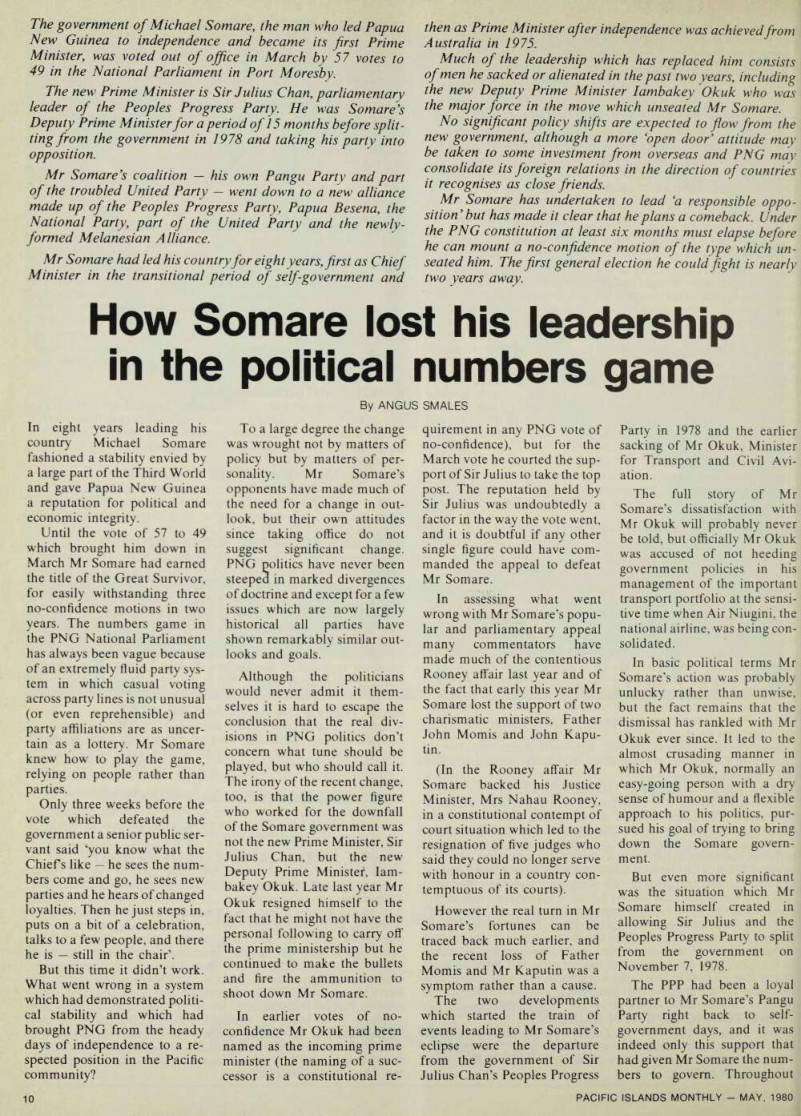
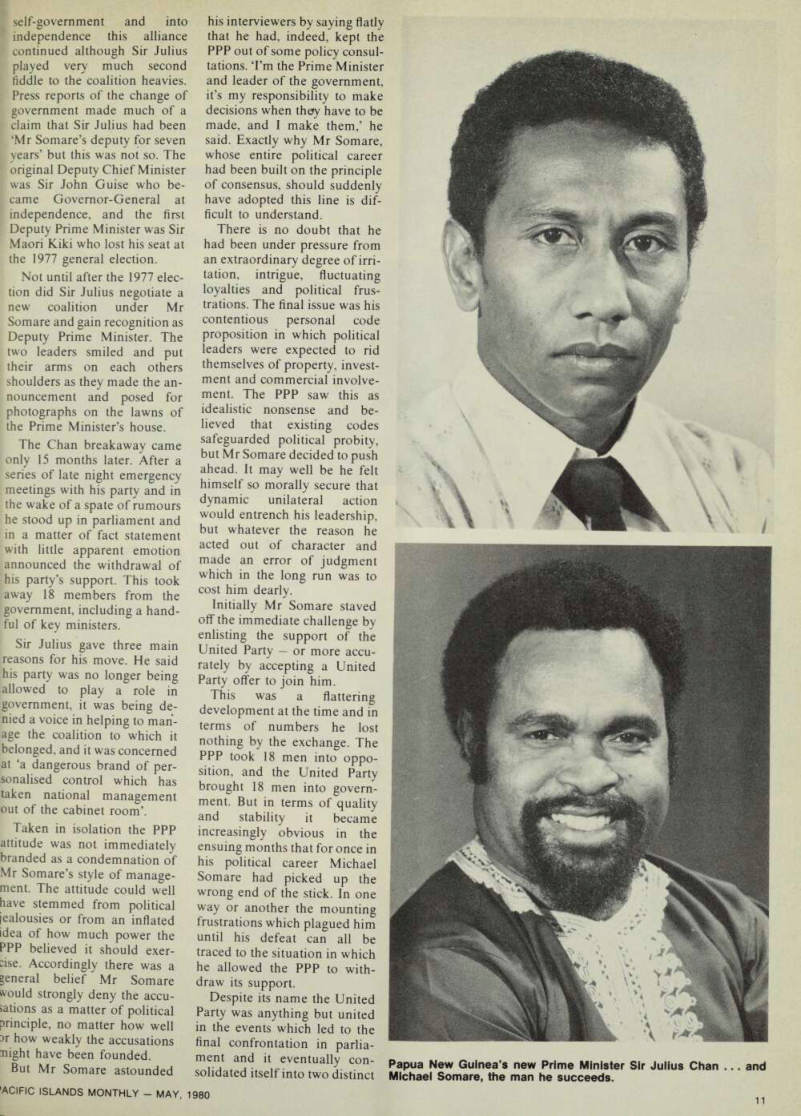
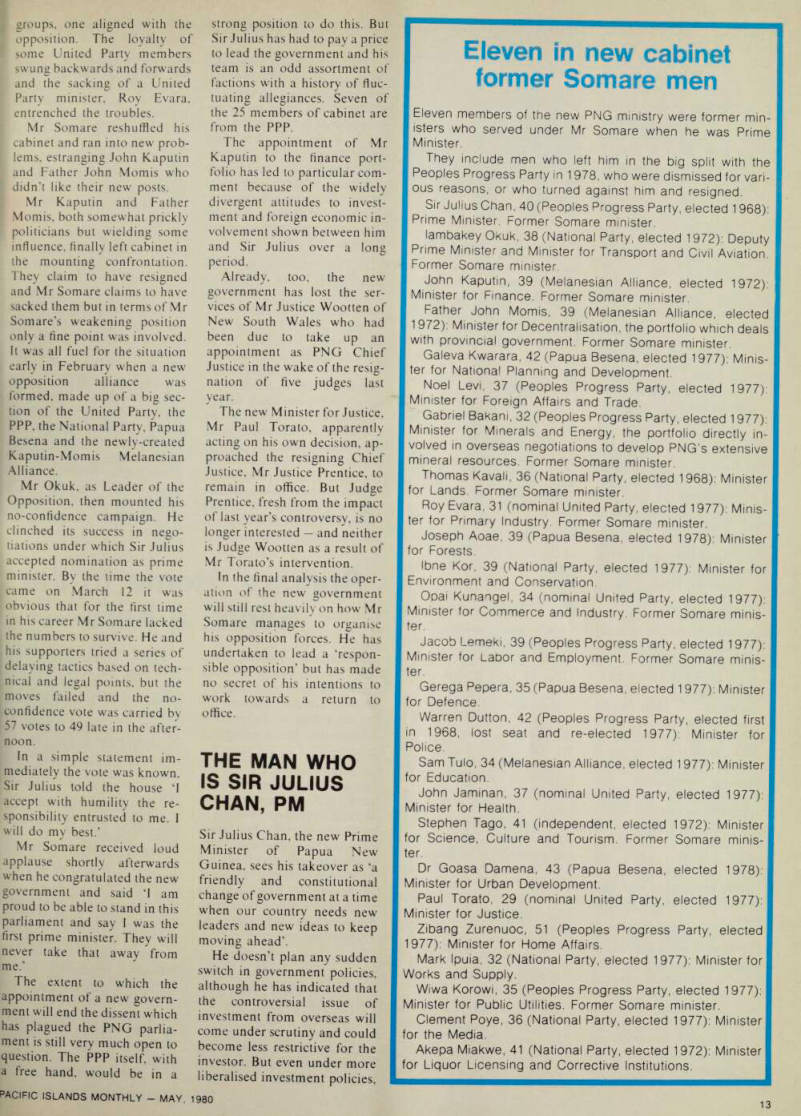
Papua New Guinea’s new Prime Minister Sir Julius Chan ... and Michael Somare, the man he succeeds.
groups, one aligned with the I opposition. The loyalty of I some United Party members I swung backwards and forwards \ and the sacking of a United Party minister, Roy Evara, [ entrenched the troubles.
Mr Somare reshuffled his [ cabinet and ran into new prob-
I lems, estranging John Kaputin
I and Father John Momis who \ didn’t like their new posts.
Mr Kaputin and Father ' Momis, both somewhat prickly politicians but wielding some influence, finally left cabinet in the mounting confrontation.
They claim to have resigned and Mr Somare claims to have sacked them but in terms of Mr
Somare’s weakening position
only a fine point was involved.
It was all fuel for the situation early in February when a new opposition alliance was formed, made up of a big sec tion of the United Party, the PPP, the National Party, Papua Besena and the newly-created Kaputin-Momis Melanesian Alliance.
Mr Okuk, as Leader of the Opposition, then mounted his no-confidence campaign. He clinched its success in nego tiations under which Sir Julius accepted nomination as prime minister. By the time the vote j came on March 12 it was I obvious that for the first time in his career Mr Somare lacked the numbers to survive. He and his supporters tried a series of delaying tactics based on tech nical and legal points, but the moves failed and the no confidence vote was carried by 57 votes to 49 late in the after noon.
In a simple statement im mediately the vote was known.
Sir Julius told the house ‘I accept with humility the re sponsibility entrusted to me. I will do my best.’
Mr Somare received loud applause shortly afterwards when he congratulated the new government and said ‘I am proud to be able to stand in this parliament and say I was the first prime minister. They will never take that away from me.’
The extent to which the appointment of a new govern ment will end the dissent which has plagued the PNG parlia ment is still very much open to question. The PPP itself, with a free hand, would be in a
strong position to do this. But Sir Julius has had to pay a price to lead the government and his team is an odd assortment of factions with a history of fluc
tuating allegiances. Seven of
the 25 members of cabinet are from the PPP.
The appointment of Mr Kaputin to the finance port folio has led to particular com ment because of the widely divergent attitudes to invest ment and foreign economic in volvement shown between him and Sir Julius over a long
period.
Already, too, the new government has lost the ser vices of Mr Justice Wootten of New South Wales who had been due to take up an appointment as PNG Chief Justice in the wake of the resig nation of five judges last year.
The new Minister for Justice, Mr Paul Torato, apparently acting on his own decision, ap proached the resigning Chief Justice, Mr Justice Prentice, to remain in office. But Judge Prentice, fresh from the impact of last year’s controversy, is no longer interested and neither is Judge Wootten as a result of Mr Torato’s intervention.
In the final analysis the oper ation of the new government will still rest heavily on how Mr Somare manages to organise his opposition forces. He has undertaken to lead a ‘respon sible opposition’ but has made no secret of his intentions to work towards a return to office.
Advertisements & other items, pp. 11-12 (2 items)
11
ACIFIC ISLANDS MONTHLY - MAY, 1980
inner ’s Edge
The rally's underway.
The competition is tough.
The skills that make up a champion are many.
The winner's edge — reliability. The kind of reliability you expect from Clarion car stereo.
High guality performance all the way.
Check out the full lineup. You'll find it in the winner's circle , every time. *
inner ’s Edge
In Car Entertainment Company
C Clarion
Clarion Co.. Ltd. Tokyo, Japan i
barton
Australia: Amalgamated Wireless (Australasia td 554 Whitman,i Road. Ashfield N.S W 2131/New Zealand: AWA New Zealand Limited P,O. Box 50248 Ponrua/Fiji ßffal & Co , ltd G*PO Box 362 Suva/Tahiti: HI-FI Shangrita , b.R. 200 Papeete/New Caledonia: Qaldis 8-P M.-1 HHIWa Cedex/Guam: Guam Radio & TV Shop P.O. Box 1939 Agana.
Ggirn New Hebrides; The Sound Ontre PO. Box 434 Vila/Cook Islands: South Seas International Ltd. P.O. Box 49 Rarotonga/ Papua Hew Guinea: Hagemeyer(RN.LL) Ply- Ltd PO. Bpx 1428, Boroko, Port Moresby. *** . J. It. .J iv . .LJ H r d/> rvl r\ ,1/ f Pi .-"V I \ / 1 O fO I Afl AC 554 W •c.'' i •< Dolby and the dbuble p symbol are trademarks of Dolby Laboratories.
Chan, Pm
The Man Who
Is Sir Julius
Sir Julius Chan, the new Prime Minister of Papua New Guinea, sees his takeover as ‘a friendly and constitutional change of government at a time when our country needs new leaders and new ideas to keep
moving ahead’.
He doesn’t plan any sudden switch in government policies, although he has indicated that the controversial issue of investment from overseas will come under scrutiny and could become less restrictive for the investor. But even under more liberalised investment policies,
he says the benefits likely to flow to the people as a whole will continue to be the main factor in regulatingrinvestment from outside. Observers of the PNG financial scene accept this as a genuinely-expressed attitude which suggests there will be little effective change from the investment policies of the Somare government.
It may be however, that the Chan government’s idea of what is good for the people as a whole is not necessarily the same as the Somare govern ment’s idea. Sir Julius himself, product of a business orientated family, would not be expected to have the same perspective as a Michael Somare, son of a policeman and product of civil service
activism politics.
It has been argued that the chances for any major liberalis ation of investment from over seas are watered down by the fact that Sir Julius has chosen John Kaputin as his Finance Minister, and Mr Kaputin has an avowed hatred of most pat terns of capitalist investment in Third World countries. Fric tions of an almost doctrinal nature could develop between these two men and could create one of the early internal testing points of the Chan cabinet.
Sir Julius has made two major announcements of econ
omic importance since taking
office. One involved his de cision to close down the contro versial scheme by which the government has been buying out non-national planters and
redistributing the properties (at
a price and on long term loans) to Papua New Guinea semi communal ownership. The other indicated the acceptance in principle to proceed with a copper and gold mine at Ok Tedi near the Indonesian border, a scheme which will involve the government in financial partnership with Aus tralian, West German and US interests.
Although both these an nouncements are significant in themselves, neither is par
ticularly important in assessing
the economic policies of the Chan government. The Ok Tedi scheme has clearly been a starter for some time, awaiting only formal acceptance by the government of the day, and the
ailing plantation redistribution
scheme had been under a sort of ‘terminal scrutiny’ by the Somare government for some time.
It’s the human rather than the political angles which, in the first few weeks, have been significant in assessing the new Prime Minister.
For a start, Sir Julius has undertaken to discuss with Mr Somare every major issue which comes up in the next six months or so and which appears to call for special attention. ‘Mr Somare is still my friend, and I know he will still talk to me’ Sir Julius said soon after taking office. And Mr Somare, for his part, is pre pared to co-operate. With the hint of a smile he told one newsman T taught Sir Julius well in the early days he
hasn’t forgotten’.
Forty-year-old Sir Julius is of Chinese and PNG extrac tion, born on Tanga Island in the islands region of northern PNG, and member of a family
with plantation, shipping,
trading and other commercial interests. Rabaul on New Bri tain and Namatanai on New Ireland have been the centres of the family’s interests.
He was educated at Marist
Brothers College, Ashgrove,
Queensland, and for a while held Australian citizenship under qualifications which Australia extended to PNG Asians, but at independence in PNG he took up his entitle ment to PNG citizenship.
He is married with four chil dren and was first elected to parliament then known as the Legislative Council and subject to final control by Aus tralia in 1968 when he was 29 years old. Less than two years later he became parliamentary leader of the
Peoples Progress Party, and at
self-government he formed the first national coalition with Somare’s Pangu Party. This is the coalition which led PNG into independence in 1975, although Sir Julius had to wait until the 1977 elections before he became Somare’s deputy at the formation of the second national coalition.
Fifteen months later he split with Somare and led his party into opposition. He was knighted in January this year for his service to politics, and many saw this as a tacit sugges
tion of his relinquishment of
active politics.
The man himself is slightly built, quiet and friendly. His sombre face lights up when he smiles. Some measure of his competence is the fact that his party is the only one since independence which has con tinued to function as a tightly
knit and properly organised
group. He was a competent
Minister for Primary Industry
and an impressive Minister for Finance.
It was Sir Julius who established the financial guidelines which led to the basic economic outlook of the Somare government, an out look which continues to be assured under the new govern ment even if there may be dif ferences in accent. The policies
involved are regulated foreign
investment on specified terms, the retention of a hard currency
by continuously relating the
value of the PNG kina to the average value of partner cur rencies, no discrimination against investment once accepted from overseas but incentives for local investment.
and formal controls over wages and prices.
Asa minister under Somare (he was five years in Finance, 15 months in Primary Industry) Sir Julius earned a reputation for attention to detail, impec cable working habits some thing which not all PNG ministers have learnt and a habit of careful research before
making decisions.
Sir Julius has successfully bucked the often expressed be lief in PNG that there is no place at the top for a man with a part background in the Asian community. In his quiet, mat ter of fact manner, Sir Julius has long been piling up the in gredients which have made him one of the most trusted men on the PNG political scene.
As he said soon after taking office ‘We do not claim to be the possessors of all wisdom.
Our government will be one of consultation, by debate inside and outside parliament, by consultation with provincial governments, agencies, insti tutions and the senior public servants who administer the decisions of parliament.’
former Somare men
Eleven in new cabinet former Somare men
Eleven members of the new PNG ministry were former min isters who served under Mr Somare when he was Prime Minister.
They include men who left him in the big split with the Peoples Progress Party in 1978, who were dismissed for vari ous reasons, or who turned against him and resigned.
Sir Julius Chan, 40 (Peoples Progress Party, elected 1968); Prime Minister. Former Somare minister. lambakey Okuk, 38 (National Party, elected 1972): Deputy Prime Minister and Minister for Transport and Civil Aviation.
Former Somare minister.
John Kaputin, 39 (Melanesian Alliance, elected 1972): Minister for Finance. Former Somare minister.
Father John Momis, 39 (Melanesian Alliance, elected 1972): Minister for Decentralisation, the portfolio which deals with provincial government. Former Somare minister.
Galeva Kwarara, 42 (Papua Besena, elected 1977): Minis ter for National Planning and Development.
Noel Levi, 37 (Peoples Progress Party, elected 1977): Minister for Foreign Affairs and Trade.
Gabriel Bakani, 32 (Peoples Progress Party, elected 1977): Minister for Minerals and Energy, the portfolio directly in volved in overseas negotiations to develop PNG’s extensive mineral resources. Former Somare minister.
Thomas Kavali, 36 (National Party, elected 1968): Minister for Lands. Former Somare minister.
Roy Evara, 31 (nominal United Party, elected 1977); Minis ter for Primary Industry. Former Somare minister.
Joseph Aoae. 39 (Papua Besena, elected 1978); Minister for Forests.
Ibne Kor, 39 (National Party, elected 1977): Minister for Environment and Conservation.
Opai Kunangel, 34 (nominal United Party, elected 1977): Minister for Commerce and Industry. Former Somare minis ter.
Jacob Lemeki, 39 (Peoples Progress Party, elected 1977): Minister for Labor and Employment. Former Somare minis ter.
Gerega Pepera, 35 (Papua Besena, elected 1977): Minister for Defence.
Warren Dutton, 42 (Peoples Progress Party, elected first in 1968, lost seat and re-elected 1977); Minister for Police.
Sam Tulo, 34 (Melanesian Alliance, elected 1977): Minister for Education.
John Jaminan, 37 (nominal United Party, elected 1977): Minister for Health.
Stephen Tago, 41 (independent, elected 1972); Minister for Science, Culture and Tourism. Former Somare minis ter.
Dr Goasa Damena, 43 (Papua Besena, elected 1978): Minister for Urban Development.
Paul Torato, 29 (nominal United Party, elected 1977): Minister for Justice.
Zibang Zurenuoc, 51 (Peoples Progress Party, elected 1977): Minister for Home Affairs.
Mark Ipuia, 32 (National Party, elected 1977); Minister for Works and Supply.
Wiwa Korowi, 35 (Peoples Progress Party, elected 1977): Minister for Public Utilities. Former Somare minister.
Clement Poye, 36 (National Party, elected 1977): Minister for the Media.
Akepa Miakwe, 41 (National Party, elected 1972): Minister for Liquor Licensing and Corrective Institutions.
Somare: Home to the Sepik

Sepik, a hero
Parliament defeated him, some of his closest allies of earlier days deserted him, but Michael Somare went home to his electorate in Papua New Guinea to a hero’s welcome.
Obviously disappointed,
perhaps bearing a trace of bit terness although he won’t admit it he flew home to Wewak a few days after the 57 to 49 vote in parliament which unseated his government. Two weeks earlier he had flown out of Wewak as Prime Minister, confident of defeating the challenge to his government.
He came home as Leader of the
Opposition.
His electorate hadn’t forgot ten him. The crowds at the air port were bigger than those which had greeted him five years earlier when he became Prime Minister. If ever an elec torate decided to cheer up a defeated national leader, this was the occasion.
There were flowers, and
back-slapping, and speeches,
and cries of ‘You’ll go back.’
Closer to Mr Somare himself, as he moved slowly through the press of people there were brief
exchanges of disappointment
and regret from men and women who pushed forward to shake his hand.
An open car took him from the airport and flowers were piled around him. He was driven to a sports ground where provincial and local govern ment officials spoke in his honour before another big crowd. Some almost pleaded with him to make an immedi ate bid to regain office, a process which is consti
tutionally impossible for at
least six months. But the theme of the speeches was an accep tance that it was only a matter of time before a Somare government was in office again.
(Continued on p77) K
The sports ground rally also made the point and this is
largely reflected throughout
PNG that no vote anywhere can take away the fact that Mr Somare was his country’s first
national leader, initially as
Chief Minister in the tran
sitional self-government stage
and then as Prime Minister
after full independence was
achieved from Australia. In all it’s been an innings of nearly a decade.
One of the most significant factors in his defeat has not been mentioned much in his )wn country but has emerged /ery clearly in the comments md reactions of PNG’s Pacific teighbours. It is that democra
ic principles of national
nanagement, which PNG
idopted, functioned smoothly
o allow a change of govern nent. Mr Somare neither intrenched himself in power tor created a situation where brce was needed to remove iim. Apart from some ragged
edges in practice, the consti tutional system has been proved sound and has reflected
national stability.
Mr Somare said on his first visit to Australia as Opposition Leader ‘I get annoyed at talk of a crisis in our affairs there never was a crisis. There was a vote and we lost it. And there can just as easily be another vote and we can win it.’
In an address to the Sydney Chamber of Commerce in Syd ney last month, Mr Somare said ‘Eight years after self government, five years after independence, the government of my country has changed
peacefully and democratically.
Papua New Guinea can take pride in the fact that the consti tutional and parliamentary sys tems which we built have worked. ‘The administrative structure which we developed func
tioned smoothly during the
change of government. It will continue to operate smoothly under the new cabinet. An
important testimony to my
government’s success is that there was a peaceful transition and that we handed over a
stable, growing and well-run
country.’
In Australia particularly the point has not been lost. In many island countries of the
Pacific the point, perhaps,
didn’t have to be made they recognise similar attitudes in their own politics.
Australian investment interests and other interests with links in PNG have par ticularly noticed Mr Somare’s failure to vilify the new govern ment or even to trenchantly cri ticise its policies. In some respects Mr Somare’s attitude is understandable because there have never been many differences in doctrine between the multitude of political par ties which his country has produced. The only real dif ferences were his own Pangu
Party’s call for self-government
12 years ago when no one else wanted self-government and
the sporadic Papua secession
calls of the Papua Besena Party a party which, is now represented in the new govern ment.
Mr Somare’s almost mag nanimous attitude towards his victorious opponents in his public attitudes, anyway has
kept his country’s image high
in terms of management and
stability.
At two press conferences in PNG since his defeat and in two subsequent interviews in Australia he made the follow
ing points:
• He will be active in oppo
sition but will not resort to pig headed blocking of the government for the mere sake of opposing it, • His target is to lead another Somare government into office
by ‘peaceful constitutional
means’, and • He does not believe there will be any significant shift in policies under the new govern
ment despite suggestions that
the government envisages a ‘wider door’ for investment from overseas.
Early this year Mr Somare told close friends that he was
considering stepping down as
Prime Minister by the middle of the year. At the time he was clearly tired, he had been troubled on and off with sick ness, and those who knew him well could see only too clearly how the years of leadership had taken their price.
But being beaten on a vote is a different matter from step ping down, and Mr Somare has more or less been forced into a new phase of his political ca reer. He refers to it jokingly as a ‘rest’ while he gets going again. There was no doubt, too, during his recent Sydney visit he looked fitter and more relaxed than he has for some time.
Quoting Milton’s Paradise Lost he told more than 200 business leaders who came to hear him speak ‘Solitude some times is best society, and short retirement urges sweet return’.
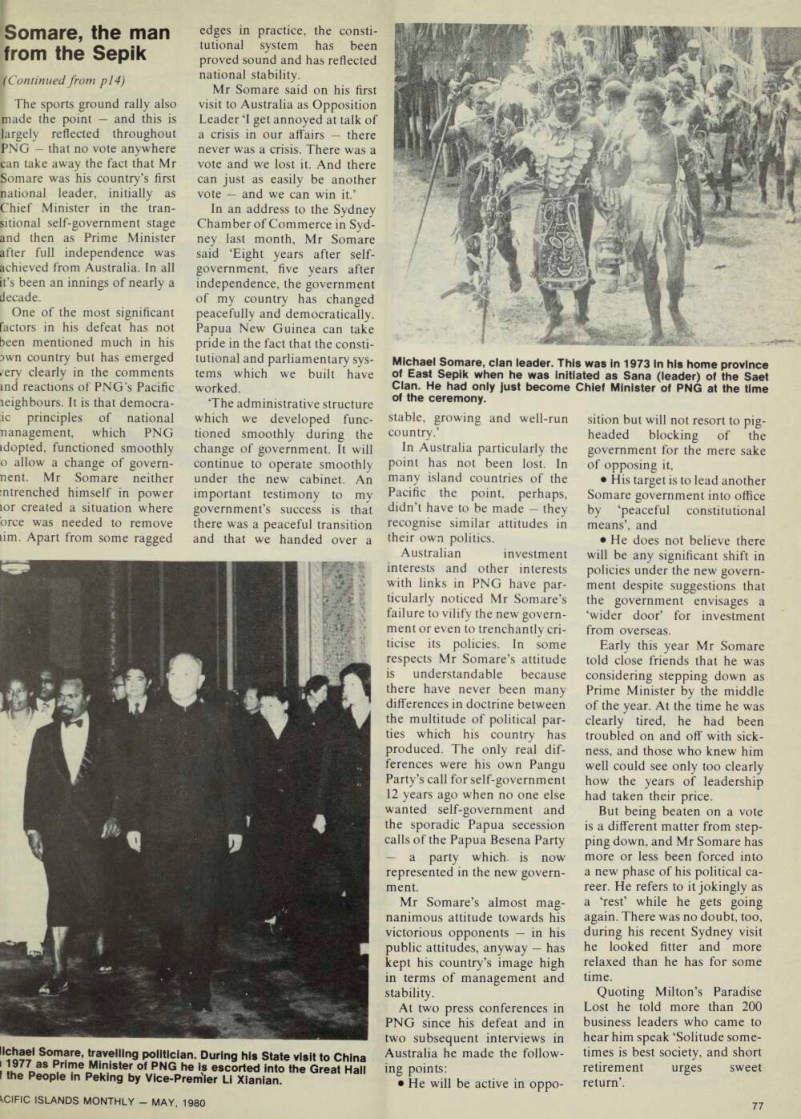
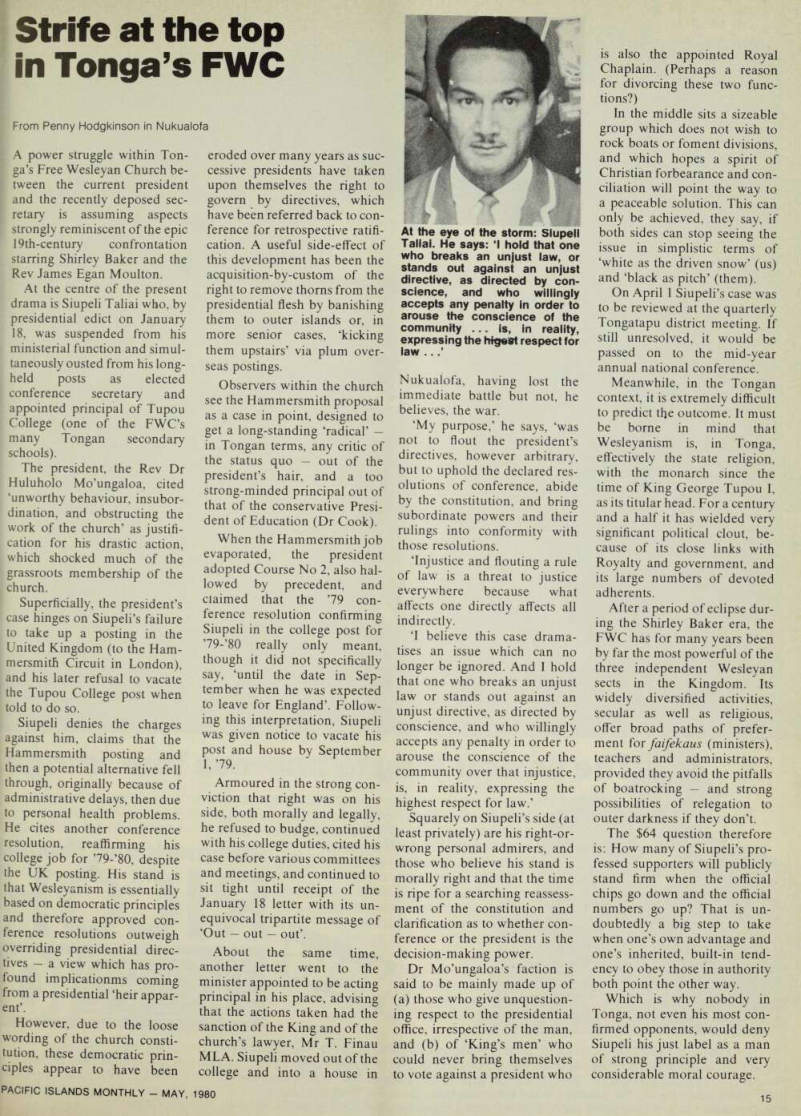
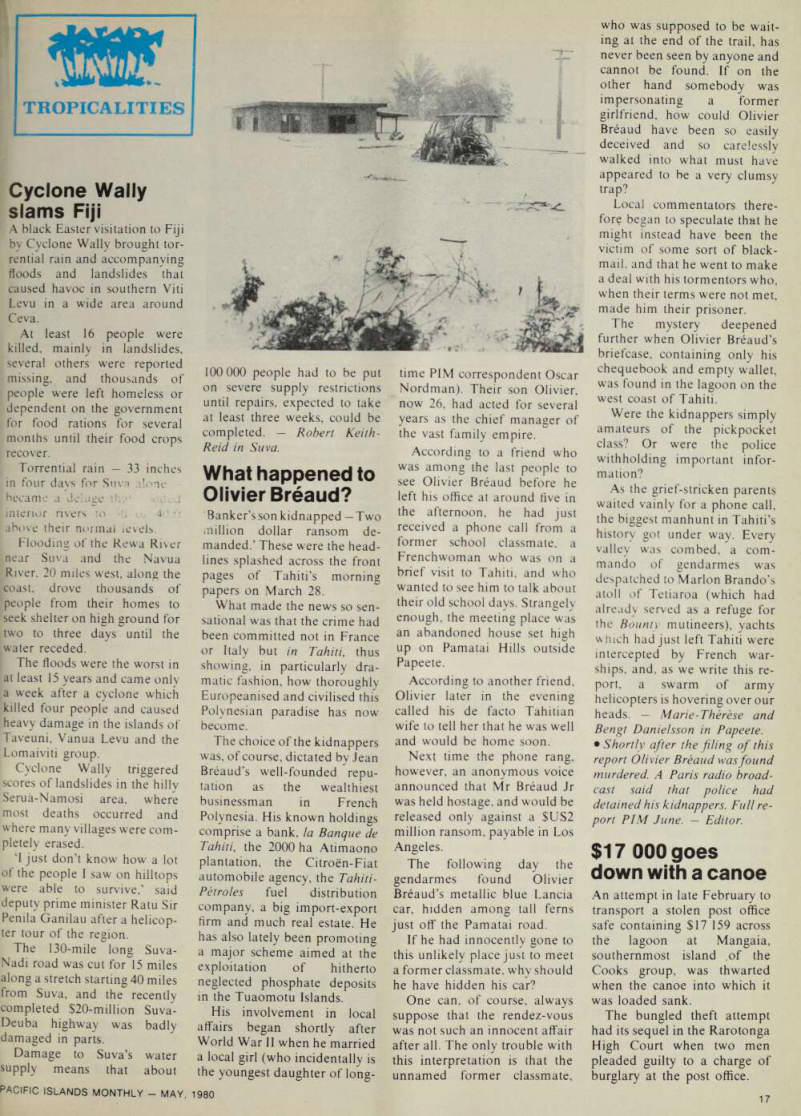
[?]lchael Somare, travelling politician. During his State visit to China [?]1997 as Prime Minister of PNG he Is escorted into the Great Hall [?] the People in Peking by Vice-Premier Li Xianian.
Michael Somare, clan leader. This was in 1973 In his home province of East Sepik when he was Initiated as Sana (leader) of the Saet Clan. He had only just become Chief Minister of PNG at the time of the ceremony.
Strife at the top
in Tonga’s FWC
From Penny Hodgkinson in Nukualofa
A power struggle within Ton ga’s Free Wesleyan Church be tween the current president and the recently deposed sec retary is assuming aspects f strongly reminiscent of the epic 19th-century confrontation starring Shirley Baker and the Rev James Egan Moulton.
At the centre of the present drama is Siupeli Taliai who, by presidential edict on January 18, was suspended from his ministerial function and simul taneously ousted from his long held posts as elected ; conference secretary and appointed principal of Tupou College (one of the FWC’s many Tongan secondary schools).
The president, the Rev Dr Huluholo Mo’ungaloa, cited ‘unworthy behaviour, insubor dination, and obstructing the work of the church’ as justifi cation for his drastic action, which shocked much of the grassroots membership of the church.
Superficially, the president’s case hinges on Siupeli’s failure to take up a posting in the United Kingdom (to the Ham mersmith Circuit in London), and his later refusal to vacate the Tupou College post when told to do so.
Siupeli denies the charges
against him, claims that the Hammersmith posting and then a potential alternative fell
through, originally because of
administrative delays, then due to personal health problems.
He cites another conference resolution, reaffirming his
college job for ’79-’BO, despite
the UK posting. His stand is
that Wesleyanism is essentially
based on democratic principles and therefore approved con ference resolutions outweigh overriding presidential direc tives a view which has pro
found implicationms coming
from a presidential ‘heir appar ent’.
However, due to the loose wording of the church consti tution, these democratic prin ciples appear to have been
eroded over many years as suc cessive presidents have taken upon themselves the right to govern by directives, which have been referred back to con ference for retrospective ratifi cation. A useful side-effect of this development has been the acquisition-by-custom of the right to remove thorns from the
presidential flesh by banishing
them to outer islands or, in more senior cases, ‘kicking them upstairs’ via plum over
seas postings.
Observers within the church see the Hammersmith proposal as a case in point, designed to get a long-standing ‘radical’ in Tongan terms, any critic of the status quo out of the president’s hair, and a too
strong-minded principal out of
that of the conservative Presi dent of Education (Dr Cook).
When the Hammersmith job evaporated, the president adopted Course No 2, also hal lowed by precedent, and claimed that the ’79 con ference resolution confirming Siupeli in the college post for
’79-’BO really only meant,
though it did not specifically say, ‘until the date in Sep tember when he was expected to leave for England’. Follow
ing this interpretation, Siupeli
was given notice to vacate his post and house by September 1, ’79.
Armoured in the strong con viction that right was on his side, both morally and legally, he refused to budge, continued with his college duties, cited his case before various committees and meetings, and continued to sit tight until receipt of the January 18 letter with its un
equivocal tripartite message of
‘Out out out’.
About the same time, another letter went to the minister appointed to be acting
principal in his place, advising
that the actions taken had the sanction of the King and of the church’s lawyer, Mr T. Finau MLA. Siupeli moved out of the college and into a house in
Nukualofa, having lost the immediate battle but not, he believes, the war. ‘My purpose,’ he says, ‘was not to flout the president’s directives, however arbitrary, but to uphold the declared res olutions of conference, abide by the constitution, and bring subordinate powers and their
rulings into conformity with
those resolutions. ‘lnjustice and flouting a rule of law is a threat to justice everywhere because what affects one directly affects all
indirectly.
‘I believe this case drama tises an issue which can no longer be ignored. And I hold that one who breaks an unjust law or stands out against an unjust directive, as directed by conscience, and who willingly accepts any penalty in order to arouse the conscience of the
community over that injustice,
is, in reality, expressing the highest respect for law.’
Squarely on Siupeli’s side (at least privately) are his right-or wrong personal admirers, and those who believe his stand is morally right and that the time is ripe for a searching reassess ment of the constitution and clarification as to whether con ference or the president is the
decision-making power.
Dr Mo’ungaloa’s faction is said to be mainly made up of (a) those who give unquestion ing respect to the presidential office, irrespective of the man, and (b) of ‘King’s men’ who could never bring themselves to vote against a president who
is also the appointed Royal
Chaplain. (Perhaps a reason
for divorcing these two func tions?) In the middle sits a sizeable group which does not wish to rock boats or foment divisions, and which hopes a spirit of Christian forbearance and con ciliation will point the way to a peaceable solution. This can only be achieved, they say, if both sides can stop seeing the issue in simplistic terms of ‘white as the driven snow’ (us) and ‘black as pitch’ (them).
On April 1 Siupeli’s case was to be reviewed at the quarterly
Tongatapu district meeting. If
still unresolved, it would be passed on to the mid-year annual national conference.
Meanwhile, in the Tongan context, it is extremely difficult to predict the outcome. It must be borne in mind that
Wesleyanism is, in Tonga,
effectively the state religion,
with the monarch since the
time of King George Tupou I,
as its titular head. For a century and a half it has wielded very
significant political clout, be
cause of its close links with Royalty and government, and its large numbers of devoted adherents.
After a period of eclipse dur ing the Shirley Baker era, the FWC has for many years been by far the most powerful of the
three independent Wesleyan
sects in the Kingdom. Its widely diversified activities, secular as well as religious, offer broad paths of prefer ment for faifekaus (ministers), teachers and administrators,
provided they avoid the pitfalls
of boatrocking and strong
possibilities of relegation to
outer darkness if they don’t.
The $64 question therefore is: How many of Siupeli’s pro fessed supporters will publicly stand firm when the official chips go down and the official numbers go up? That is un doubtedly a big step to take when one’s own advantage and one’s inherited, built-in tend ency to obey those in authority both point the other way.
Which is why nobody in Tonga, not even his most con firmed opponents, would deny Siupeli his just label as a man of strong principle and very considerable moral courage.
At the eye of the storm: Siupeli Talial. He says: ‘I hold that one who breaks an unjust law, or stands out against an unjust directive, as directed by con science, and who willingly accepts any penalty in order to arouse the conscience of the community ... is, in reality, expressing the htgest respect for law ...’
Advertisements & other items, p. 16 (1 item)
Does
KILUn
i as •u
** «l«NON 1:
!« r rn
RICOH
ll t i r id »j i » * r y
RICOH
% KR-10 v n 200*4 ** X - %, m •?*&
I IV Hl'
M *4 4» » 1111 8 42J * -* ■ v V Hoo\ ,105 ’3 15 3 % ni 1 017 A 5 b 2.6 4 2.8 «I \ I Pi •W The Easiest Way to Improve Your Image y - The easiest way to improve your image, from snapshots to high quality photographs, k is with the new Ricoh KRIO. The compact, lightweight SLR camera that gives you the Bk convenience of automatic exposures and the control of manual. With outstanding costA W performance. In a full-featured system ■ that includes auto flash, auto winder, XR , i Rikenon lenses and accessories.
Ricoh KRIO, automatic and manual, can improve your image in I more ways than one.
Automatic and Manual
$0
mmo
For more information about the Ricoh KRIO, write to RICOH COMPANY, LTD. 14-6, Ginza 6-chome, Chuoku, Tokyo 104, Japan.
Distributors: Australia Bell & Howell Australia Pty. Ltd. 0G.P.0. Box 4778, 55-69 Murray Street, Pyrmont, N.S.W., Australia, New Zealand H.E: Perry Ltd. #145 Victoria Street, PO. Box 111, Christchurch 1, New Zealand, Norfolk Is. Miltons Department Stores Ltd. oPO. Box 146, NorfolH Island 2899, South Pacific, Fiji Narseys Limited oßenwick Road, Suva, Fiji, Tahiti Ets. Coutimex • B.P. 617, Papeete, Tahiti (French PolynesiaX New Caledonia Omnium Caledonien Importation • Rue de L’Esperance, B.P. 2248, Magenta, Noumea, Nouvelle-Caledonie.
Cyclone Wally
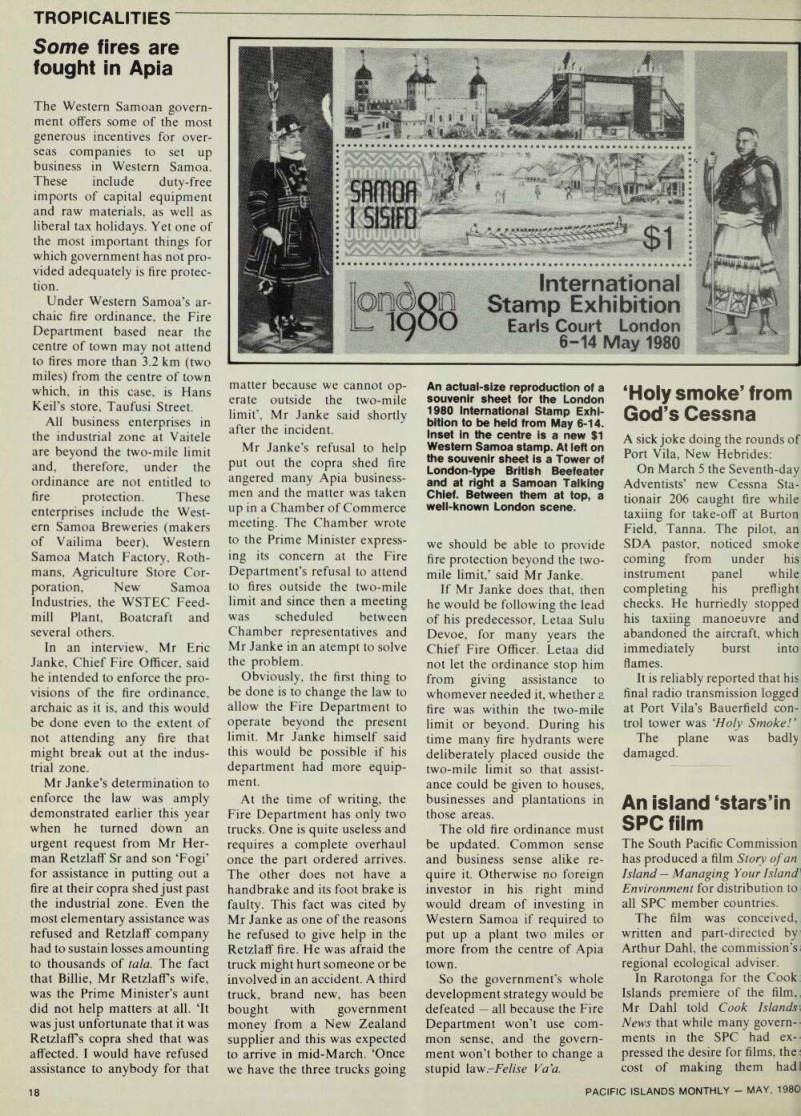
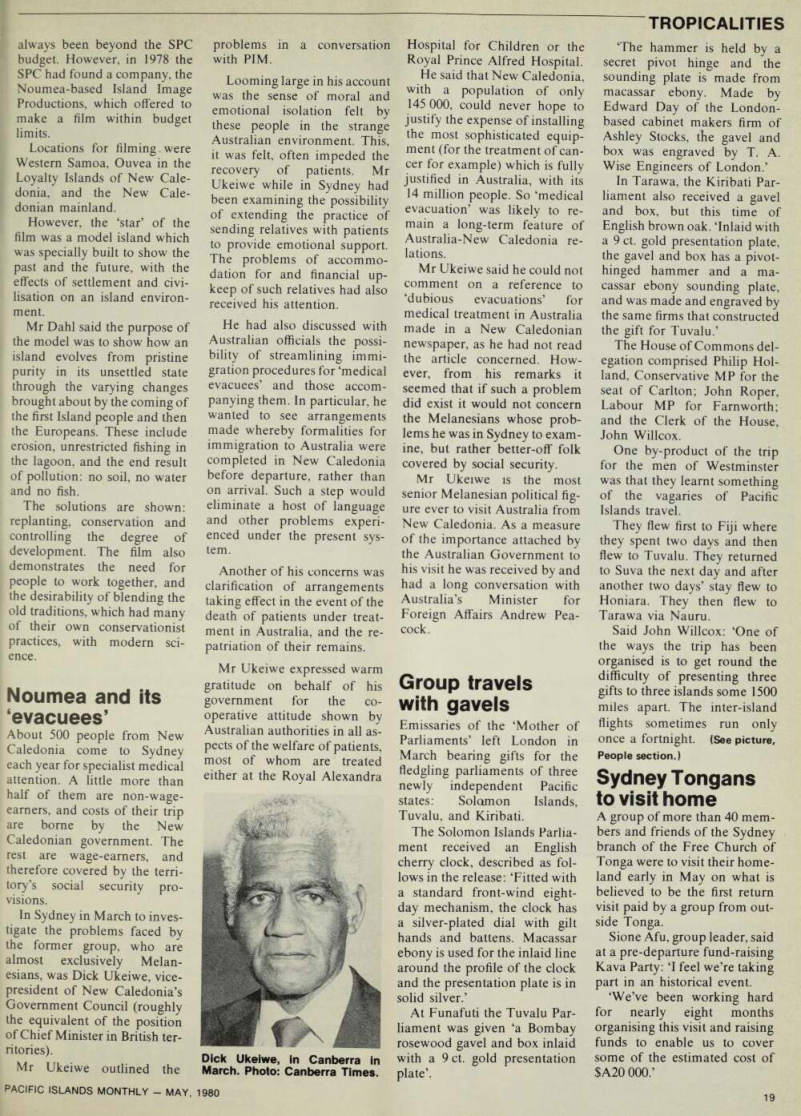
Tropicalities
slams Fiji
A black Easter visitation to Fiji
by Cyclone Wally brought tor
rential rain and accompanying floods and landslides that caused havoc in southern Viti Levu in a wide area around Ceva.
At least 16 people were killed, mainly in landslides, several others were reported missing, and thousands of people were left homeless or dependent on the government for food rations for several months until their food crops recover.
Torrential rain 33 inches in four days for Suvn alone became a deluge thj- -v .ed interior rivers io , 4- •• above their normal levels.
Flooding of the Rewa River near Suva and the Navua River. 20 miles west, along the coast, drove thousands of people from their homes to seek shelter on high ground for two to three days until the water receded.
The floods were the worst in at least 15 years and came only a week after a cyclone which killed four people and caused heavy damage in the islands of Taveuni, Vanua Levu and the Lomaiviti group.
Cyclone Wally triggered
scores of landslides in the hilly Serua-Namosi area, where most deaths occurred and where many villages were com
pletely erased.
’I just don’t know how a lot of the people I saw on hilltops were able to survive,’ said deputy prime minister Ratu Sir Penila Ganilau after a helicop ter tour of the region.
The 130-mile long Suva- Nadi road was cut for 15 miles along a stretch starting 40 miles from Suva, and the recently completed $2O-million Suva-
Deuba highway was badly
damaged in parts.
Damage to Suva’s water supply means that about
100 000 people had to be put on severe supply restrictions until repairs, expected to lake at least three weeks, could be completed. Robert Keith- Reid in Suva.
What happened to
Olivier Breaud?
Banker’s son kidnapped Two million dollar ransom de manded.’ These were the head lines splashed across the front pages of Tahiti’s morning papers on March 28.
What made the news so sen sational was that the crime had been committed not in France or Italy but in Tahiti , thus
showing, in particularly dra
matic fashion, how thoroughly Europeanised and civilised this Polynesian paradise has now become.
The choice of the kidnappers was, of course, dictated by Jean Breaud’s well-founded repu tation as the wealthiest businessman in French
Polynesia. His known holdings
comprise a bank, la Banque de Tahiti, the 2000 ha Atimaono plantation, the Citroen-Fiat automobile agency, the Tahiti- Petroles fuel distribution
company, a big import-export
firm and much real estate. He has also lately been promoting a major scheme aimed at the exploitation of hitherto neglected phosphate deposits in the Tuaomotu Islands.
His involvement in local
affairs began shortly after
World War II when he married a local girl (who incidentally is the youngest daughter of long
time PIM correspondent Oscar Nordman). Their son Olivier, now 26, had acted for several years as the chief manager of
the vast family empire.
According to a friend who was among the last people to see Olivier Breaud before he left his office at around five in the afternoon, he had just received a phone call from a former school classmate, a Frenchwoman who was on a brief visit to Tahiti, and who wanted to see him to talk about their old school days. Strangely
enough, the meeting place was
an abandoned house set high up on Pamatai Hills outside
Papeete.
According to another friend, Olivier later in the evening called his de facto Tahitian wife to tell her that he was well and would be home soon.
Next time the phone rang, however, an anonymous voice announced that Mr Breaud Jr was held hostage, and would be
released only against a SUS 2
million ransom, payable in Los
Angeles.
The following day the
gendarmes found Olivier Breaud’s metallic blue Lancia car, hidden among tall ferns just off the Pamatai road.
If he had innocently gone to
this unlikely place just to meet
a former classmate, why should he have hidden his car?
One can, of course, always suppose that the rendez-vous was not such an innocent affair after all. The only trouble with this interpretation is that the unnamed former classmate.
who was supposed to be wait ing at the end of the trail, has never been seen by anyone and cannot be found. If on the other hand somebody was impersonating a former girlfriend, how could Olivier Breaud have been so easily deceived and so carelessly walked into what must have appeared to be a very clumsy
trap?
Local commentators there fore began to speculate that he might instead have been the victim of some sort of black mail, and that he went to make a deal with his tormentors who, when their terms were not met, made him their prisoner.
The mystery deepened further when Olivier Breaud’s
briefcase, containing only his
chequebook and empty wallet, was found in the lagoon on the west coast of Tahiti.
Were the kidnappers simply
amateurs of the pickpocket class? Or were the police
withholding important infor
mation?
As the grief-stricken parents waited vainly for a phone call, the biggest manhunt in Tahiti’s history got under way. Every valley was combed, a com mando of gendarmes was despatched to Marlon Brando’s atoll of Tetiaroa (which had already served as a refuge for the Bounty mutineers), yachts which had just left Tahiti were
intercepted by French war
ships, and, as we write this re port, a swarm of army helicopters is hovering over our heads. Marie-Therese and Bengt Danielsson in Papeete. • Shortly after the filing of this report Olivier Breaud was found murdered. A Paris radio broad cast said that police had detained his kidnappers. Full re port PIM June. Editor.
$l7 000 goes
down with a canoe
An attempt in late February to transport a stolen post office safe containing $l7 159 across
the lagoon at Mangaia,
southernmost island of the Cooks group, was thwarted when the canoe into which it was loaded sank.
The bungled theft attempt had its sequel in the Rarotonga High Court when two men
pleaded guilty to a charge of
burglary at the post office.
Some fires are
fought in Apia
The Western Samoan govern ment offers some of the most generous incentives for over seas companies to set up business in Western Samoa.
These include duty-free
imports of capital equipment
and raw materials, as well as liberal tax holidays. Yet one of the most important things for which government has not pro vided adequately is fire protec tion.
Under Western Samoa’s ar chaic fire ordinance, the Fire Department based near the centre of town may not attend to fires more than 3.2 km (two miles) from the centre of town which, in this case, is Hans Keifs store, Taufusi Street.
All business enterprises in the industrial zone at Vaitele are beyond the two-mile limit and, therefore, under the ordinance are not entitled to fire protection. These enterprises include the West ern Samoa Breweries (makers of Vailima beer), Western Samoa Match Factory, Roth mans, Agriculture Store Cor poration, New Samoa Industries, the WSTEC Feed mill Plant, Boatcraft and several others.
In an interview, Mr Eric Janke, Chief Fire Officer, said he intended to enforce the pro visions of the fire ordinance, archaic as it is, and this would be done even to the extent of not attending any fire that might break out at the indus trial zone.
Mr Janke’s determination to enforce the law was amply demonstrated earlier this year when he turned down an urgent request from Mr Her man Retzlaff Sr and son ‘Fogi’ for assistance in putting out a fire at their copra shed just past the industrial zone. Even the most elementary assistance was refused and Retzlaff company had to sustain losses amounting to thousands of tala. The fact that Billie, Mr Retzlaffs wife, was the Prime Minister’s aunt did not help matters at all. ‘lt was just unfortunate that it was RetzlafTs copra shed that was affected. I would have refused assistance to anybody for that
matter because we cannot op erate outside the two-mile limit’, Mr Janke said shortly after the incident.
Mr Janke’s refusal to help put out the copra shed fire
angered many Apia business
men and the matter was taken up in a Chamber of Commerce meeting. The Chamber wrote to the Prime Minister express ing its concern at the Fire Department’s refusal to attend to fires outside the two-mile limit and since then a meeting was scheduled between Chamber representatives and Mr Janke in an atempt to solve
the problem.
Obviously, the first thing to be done is to change the law to allow the Fire Department to operate beyond the present limit. Mr Janke himself said this would be possible if his
department had more equip
ment.
At the time of writing, the Fire Department has only two trucks. One is quite useless and
requires a complete overhaul
once the part ordered arrives.
The other does not have a handbrake and its foot brake is faulty. This fact was cited by Mr Janke as one of the reasons he refused to give help in the Retzlaff fire. He was afraid the truck might hurt someone or be involved in an accident. A third truck, brand new, has been bought with government money from a New Zealand supplier and this was expected to arrive in mid-March. ‘Once we have the three trucks going
we should be able to provide fire protection beyond the two mile limit,’ said Mr Janke.
If Mr Janke does that, then he would be following the lead of his predecessor, Letaa Sulu Devoe, for many years the Chief Fire Officer. Letaa did not let the ordinance stop him from giving assistance to whomever needed it, whether a fire was within the two-mile limit or beyond. During his time many fire hydrants were
deliberately placed ouside the
two-mile limit so that assist ance could be given to houses, businesses and plantations in those areas.
The old fire ordinance must be updated. Common sense and business sense alike re quire it. Otherwise no foreign investor in his right mind would dream of investing in Western Samoa if required to put up a plant two miles or more from the centre of Apia town.
So the government’s whole development strategy would be defeated all because the Fire Department won’t use com mon sense, and the govern ment won’t bother to change a stupid law rFelise Va’a.
‘Holy smoke’ from
God’s Cessna
A sick joke doing the rounds of Port Vila, New Hebrides: On March 5 the Seventh-day Adventists’ new Cessna Sta tionair 206 caught fire while taxiing for take-off at Burton Field, Tanna. The pilot, an SDA pastor, noticed smoke coming from under his instrument panel while
completing his preflight
checks. He hurriedly stopped
his taxiing manoeuvre and abandoned the aircraft, which immediately burst into flames.
It is reliably reported that his final radio transmission logged at Port Vila’s Bauerfield con trol tower was ‘ Holy Smoke!’
The plane was badly
damaged.
An island ‘stars’in
SPC film
The South Pacific Commission has produced a film Story of an Island Managing Your Island 1 Environment for distribution to all SPC member countries.
The film was conceived, written and part-directed by 1 Arthur Dahl, the commission’s;
regional ecological adviser.
In Rarotonga for the Cook; Islands premiere of the film,, Mr Dahl told Cook Islands', News that while many govern ments in the SPC had ex pressed the desire for films, the: cost of making them had!
An actual-size reproduction of a souvenir sheet for the London 1980 International Stamp Exhi bition to be held from May 6-14.
Inset in the centre is a new $1 Western Samoa stamp. At left on the souvenir sheet is a Tower of London-type British Beefeater and at right a Samoan Talking Chief. Between them at top, a well-known London scene.
always been beyond the SPC budget. However, in 1978 the SPC had found a company, the Noumea-based Island Image Productions, which offered to make a film within budget limits.
Locations for filming, were Western Samoa, Ouvea in the Loyalty Islands of New Cale donia, and the New Cale donian mainland.
However, the ‘star’ of the film was a model island which was specially built to show the past and the future, with the effects of settlement and civi lisation on an island environ ment.
Mr Dahl said the purpose of the model was to show how an island evolves from pristine purity in its unsettled state
through the varying changes
brought about by the coming of
the first Island people and then the Europeans. These include erosion, unrestricted fishing in the lagoon, and the end result of pollution: no soil, no water and no fish.
The solutions are shown; replanting, conservation and
controlling the degree of
development. The film also demonstrates the need for people to work together, and the desirability of blending the old traditions, which had many of their own conservationist practices, with modern sci ence.
Noumea and its
‘evacuees’
About 500 people from New Caledonia come to Sydney each year for specialist medical attention. A little more than half of them are non-wage eamers, and costs of their trip are borne by the New Caledonian government. The rest are wage-earners, and therefore covered by the terri
tory’s social security pro
visions.
In Sydney in March to inves
tigate the problems faced by
the former group, who are almost exclusively Melan esians, was Dick Ukeiwe, vice president of New Caledonia’s Government Council (roughly the equivalent of the position of Chief Minister in British ter ritories).
Mr Ukeiwe outlined the
problems in a conversation with PIM.
Looming large in his account was the sense of moral and emotional isolation felt by these people in the strange Australian environment. This, it was felt, often impeded the recovery of patients. Mr Ukeiwe while in Sydney had
been examining the possibility
of extending the practice of sending relatives with patients to provide emotional support.
The problems of accommo dation for and financial up keep of such relatives had also received his attention.
He had also discussed with Australian officials the possi
bility of streamlining immi
gration procedures for ‘medical
evacuees’ and those accom panying them. In particular, he wanted to see arrangements made whereby formalities for immigration to Australia were completed in New Caledonia before departure, rather than on arrival. Such a step would eliminate a host of language
and other problems experi
enced under the present sys tem.
Another of his concerns was clarification of arrangements taking effect in the event of the death of patients under treat ment in Australia, and the re patriation of their remains.
Mr Ukeiwe expressed warm gratitude on behalf of his government for the co
operative attitude shown by
Australian authorities in all as pects of the welfare of patients, most of whom are treated either at the Royal Alexandra
Hospital for Children or the
Royal Prince Alfred Hospital.
He said that New Caledonia, with a population of only 145 000, could never hope to justify the expense of installing
the most sophisticated equip
ment (for the treatment of can cer for example) which is fully justified in Australia, with its 14 million people. So ‘medical evacuation’ was likely to re main a long-term feature of Australia-New Caledonia re lations.
Mr Ukeiwe said he could not comment on a reference to ‘dubious evacuations’ for medical treatment in Australia made in a New Caledonian newspaper, as he had not read the article concerned. How ever, from his remarks it seemed that if such a problem did exist it would not concern the Melanesians whose prob lems he was in Sydney to exam ine, but rather better-off folk
covered by social security.
Mr Ukeiwe is the most
senior Melanesian political fig
ure ever to visit Australia from New Caledonia. As a measure of the importance attached by the Australian Government to his visit he was received by and had a long conversation with Australia’s Minister for Foreign Affairs Andrew Pea cock.
Group travels
with gavels
Emissaries of the ‘Mother of Parliaments’ left London in March bearing gifts for the
fledgling parliaments of three
newly independent Pacific
states: Solomon Islands, Tuvalu, and Kiribati.
The Solomon Islands Parlia ment received an English cherry clock, described as fol lows in the release: ‘Fitted with a standard front-wind eight day mechanism, the clock has a silver-plated dial with gilt hands and battens. Macassar ebony is used for the inlaid line around the profile of the clock and the presentation plate is in solid silver.’
At Funafuti the Tuvalu Par liament was given ‘a Bombay rosewood gavel and box inlaid with a 9ct. gold presentation
plate’.
‘The hammer is held by a secret pivot hinge and the sounding plate is made from
macassar ebony. Made by
Edward Day of the London based cabinet makers firm of Ashley Stocks, the gavel and box was engraved by T. A.
Wise Engineers of London.’
In Tarawa, the Kiribati Par liament also received a gavel and box, but this time of English brown oak. ‘lnlaid with a 9 ct. gold presentation plate, the gavel and box has a pivot hinged hammer and a ma
cassar ebony sounding plate,
and was made and engraved by the same firms that constructed the gift for Tuvalu.’
The House of Commons del
egation comprised Philip Hol
land, Conservative MP for the seat of Carlton; John Roper, Labour MP for Farnworth; and the Clerk of the House, John Willcox.
One by-product of the trip for the men of Westminster was that they learnt something of the vagaries of Pacific Islands travel.
They flew first to Fiji where they spent two days and then flew to Tuvalu. They returned to Suva the next day and after another two days’ stay flew to Honiara. They then flew to Tarawa via Nauru.
Said John Willcox: ‘One of the ways the trip has been organised is to get round the
difficulty of presenting three
gifts to three islands some 1500 miles apart. The inter-island
flights sometimes run only
once a fortnight. (See picture.
People section.)
Sydney Tongans
to visit home
A group of more than 40 mem bers and friends of the Sydney branch of the Free Church of Tonga were to visit their home land early in May on what is believed to be the first return visit paid by a group from out
side Tonga.
Sione Afu, group leader, said
at a pre-departure fund-raising
Kava Party: ‘I feel we’re taking part in an historical event. ‘We’ve been working hard
for nearly eight months
organising this visit and raising funds to enable us to cover some of the estimated cost of
Sa2O 000.’
Dick Ukeiwe, in Canberra in March. Photo: Canberra Times.
Advertisements & other items, p. 20 (1 item)
VVlien tlie public talks,
we listen.
I K I ■ 1 £ h % ' Tmaß Australian stockmen demanded a better range bike.
We gave it to them.
To cope with the rugged conditions outback, the heat, dust and other demands that can take years off a bike’s life, Yamaha developed the AGI7S, one of the toughest, best handling and most powerful agricultural bikes ever built.
People all over the world wanted quiet, portable power.
We gave it to them.
Yamaha has applied its industry-leading small engine technology to portable generators, filling a growing need for low-cost, portable power generators. Five different models are now available, with 2-cycle and 4-cycle engines.
Southeast Asian boaters needed cheaper
operating costs.
We gave it to them.
By developing a lightweight, simple and long-lasting kerosene outboard, Yamaha has helped thousands of commercial boaters cope with rising fuel prices. These engines are now exported worldwide, wherever low cost, dependable outboard power is needed.
Yamaha listens to the world.
Yamaha’s worlwide service and information network keeps it ears open to changing public demands. That’s why we’re often the first to respond to user needs and always able to give you just what you want at the price you want to pay.
YAMAHA
YAMAHA MOTOR CO.. LTD.
2500 SHINGAI IWATA-SHI SHIZUOKA-KEN JAPAN
independence date
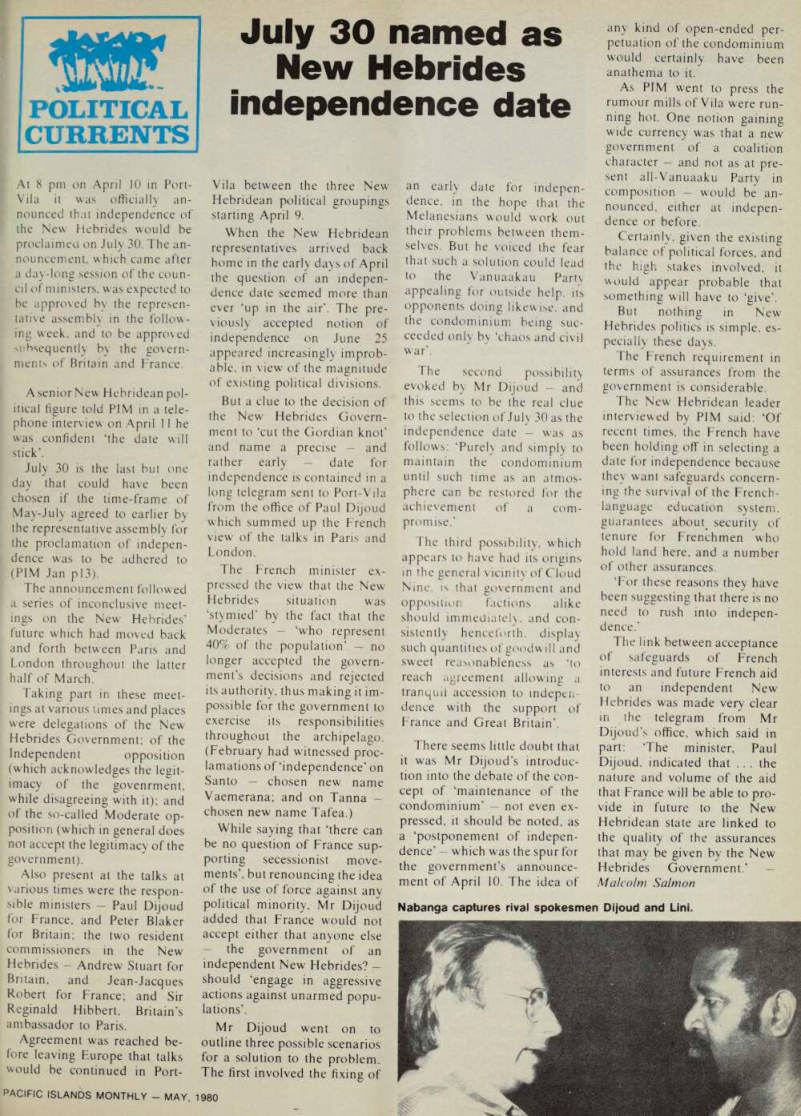
Political
Currents
July 30 named as New Hebrides independence date
At 8 pm on April 10 in Port- Vila it was officially an nounced that independence of the New Hebrides would be proclaimed on July 30. The an nouncement. which came after a day-long session of the coun cil of ministers, w as expected to be approved by the represen tative assembly in the follow ing week, and to be approved subsequently by the govern ments of Britain and France.
A senior New Hebridean pol itical figure told PIM in a tele phone interview on April 11 he was confident ‘the date will stick’.
July 30 is the last but one day that could have been chosen if the time-frame of
May-July agreed to earlier by
the representative assembly for the proclamation of indepen dence was to be adhered to (PIM Jan pl 3).
The announcement followed a series of inconclusive meet ings on the New Hebrides’ future which had moved back and forth between Paris and London throughout the latter half of March.
Taking part in these meet ings at various limes and places were delegations of the New Hebrides Government: of the
Independent opposition
(which acknowledges the legit
imacy of the govenrment, while disagreeing with it); and of the so-called Moderate op position (which in general does not accept the legitimacy of the government).
Also present at the talks at various times were the respon sible ministers - Paul Dijoud for France, and Peter Blaker for Britain; the two resident commissioners in the New Hebrides Andrew Stuart for Britain, and Jean-Jacques Robert for France; and Sir Reginald Hibberl, Britain’s ambassador to Paris.
Agreement was reached be fore leaving Europe that talks would be continued in Port-
Vila between the three New
Hebridean political groupings
starting April 9.
When the New Hebridean representatives arrived back home in the early days of April the question of an indepen dence date seemed more than ever ‘up in the air’. The pre viously accepted notion of independence on June 25
appeared increasingly improb
able. in view of the magnitude
of existing political divisions.
But a clue to the decision of the New' Hebrides Govern ment to ‘cut the Gordian knot’ and name a precise and rather early - date for independence is contained in a long telegram sent to Port-Vila from the office of Paul Dijoud which summed up the French view of the talks in Paris and London.
The French minister ex pressed the view that the New Hebrides situation was ‘stymied’ by the fact that the Moderates ‘who represent 40% of the population’ - no
longer accepted the govern
ment’s decisions and rejected its authority, thus making it im possible for the government to exercise its responsibilities
throughout the archipelago.
(February had witnessed proc lamations of‘independence’ on Santo chosen new name Vaemerana; and on Tanna chosen new name Tafea.) While saying that ‘there can be no question of France sup porting secessionist move ments’, but renouncing the idea of the use of force against any
political minority, Mr Dijoud
added that France would not accept either that anyone else - the government of an independent New Hebrides? should ‘engage in aggressive actions against unarmed popu lations’.
Mr Dijoud went on to outline three possible scenarios for a solution to the problem.
The first involved the fixing of
an early date for indepen dence. in the hope that the Melanesians would work out their problems between them selves. But he voiced the fear that such a solution could lead to the Vanuaakau Partv appealing for outside help, its opponents doing likewise, and the condominium being suc ceeded only by ‘chaos and civil war'.
The second possibility evoked by Mr Dijoud - and this seems to be the real clue to the selection of July 30 as the independence date - was as follows: ‘Purely and simply to maintain the condominium until such time as an atmos phere can be restored for the achievement of a com promise.' The third possibility, which appears to have had its origins in the general vicinity of Cloud Nine, is that government and opposition factions alike should immediately, and con
sistently henceforth, display
such quantities of goodw ill and sweet reasonableness as ‘to reach agreement allowing a tranquil accession to indepen dence with the support of France and Great Britain’.
There seems little doubt that it was Mr Dijoud’s introduc tion into the debate of the con cept of ‘maintenance of the condominium’ not even ex pressed, it should be noted, as
a ‘postponement of indepen
dence’ which was the spur for the government’s announce ment of April 10. The idea of
any kind of open-ended per petuation of the condominium would certainly have been anathema to it.
As PIM went to press the rumour mills of Vila were run ning hot. One notion gaining wide currency was that a new government of a coalition character and not as at pre sent all-Vanuaaku Party in composition would be an nounced. either at indepen dence or before.
Certainly, given the existing
balance of political forces, and the high stakes involved, it would appear probable that something will have to ‘give’.
But nothing in New Hebrides politics is simple, es
pecially these days.
The French requirement in terms of assurances from the government is considerable.
The New Hebridean leader interviewed by PIM said; ‘Of recent times, the French have been holding off in selecting a date for independence because
they want safeguards concern
ing the survival of the French language education system, guarantees about security of tenure for Frenchmen who hold land here, and a number of other assurances. ‘For these reasons they have been suggesting that there is no need to rush into indepen dence.' The link between acceptance of safeguards of French interests and future French aid to an independent New Hebrides was made very clear in the telegram from Mr Dijoud's office, which said in part: ‘The minister, Paul Dijoud. indicated that ... the nature and volume of the aid that France will be able to pro vide in future to the New Hebridean state are linked to the quality of the assurances that may be given by the New Hebrides Government.’
Malcolm Salmon
Nabanga captures rival spokesmen Dijoud and Lini.
In Honolulu
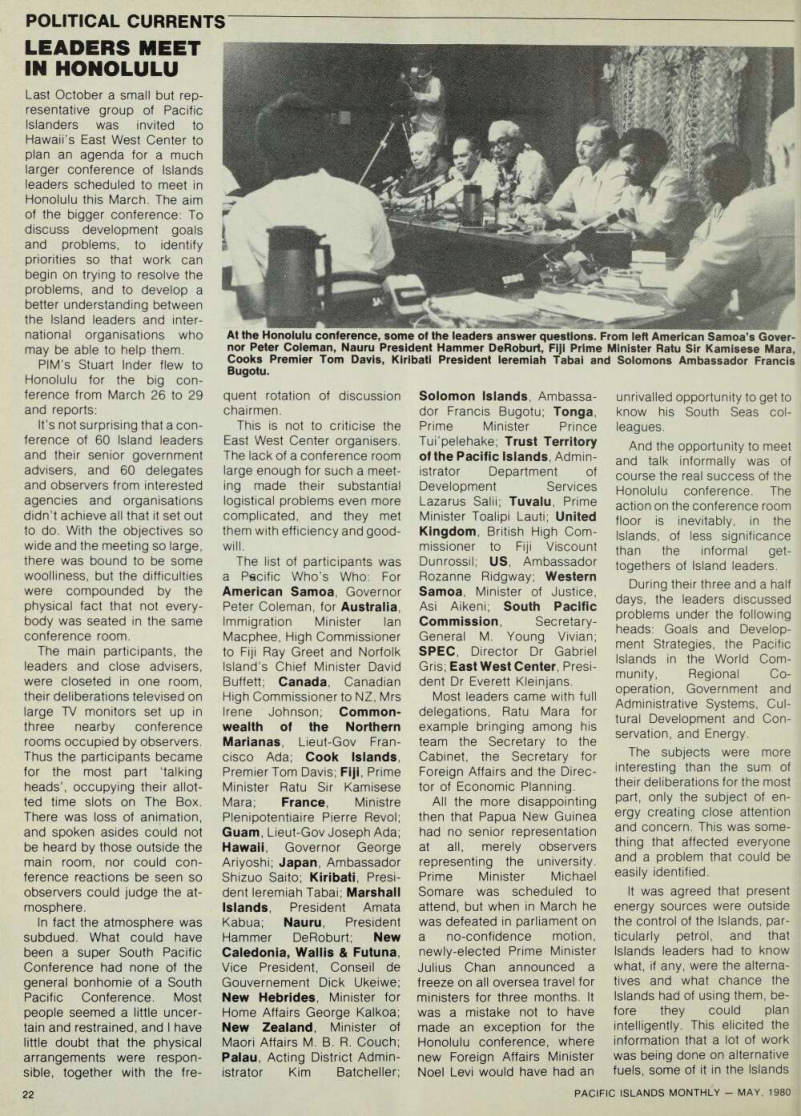
Leaders Meet
Last October a small but rep resentative group of Pacific Islanders was invited to Hawaii’s East West Center to plan an agenda for a much larger conference of Islands leaders scheduled to meet in Honolulu this March. The aim of the bigger conference: To discuss development goals and problems, to identify priorities so that work can begin on trying to resolve the problems, and to develop a better understanding between the Island leaders and inter national organisations who may be able to help them.
PlM’s Stuart Inder flew to Honolulu for the big con ference from March 26 to 29 and reports: It’s not surprising that a con ference of 60 Island leaders and their senior government advisers, and 60 delegates and observers from interested agencies and organisations didn’t achieve all that it set out to do. With the objectives so wide and the meeting so large, there was bound to be some woolliness, but the difficulties were compounded by the physical fact that not every body was seated in the same conference room.
The main participants, the leaders and close advisers, were closeted in one room, their deliberations televised on large TV monitors set up in three nearby conference rooms occupied by observers.
Thus the participants became for the most part ‘talking heads’, occupying their allot ted time slots on The Box.
There was loss of animation, and spoken asides could not be heard by those outside the main room, nor could con ference reactions be seen so observers could judge the at mosphere.
In fact the atmosphere was subdued. What could have been a super South Pacific Conference had none of the general bonhomie of a South Pacific Conference. Most people seemed a little uncer tain and restrained, and I have little doubt that the physical arrangements were respon sible, together with the fre-
quent rotation of discussion chairmen.
This is not to criticise the East West Center organisers.
The lack of a conference room large enough for such a meet ing made their substantial logistical problems even more complicated, and they met them with efficiency and good will.
The list of participants was a Pacific Who’s Who: For American Samoa, Governor Peter Coleman, for Australia, Immigration Minister lan Macphee, High Commissioner to Fiji Ray Greet and Norfolk Island’s Chief Minister David Buffett: Canada, Canadian High Commissioner to NZ, Mrs Irene Johnson; Common wealth of the Northern Marianas, Lieut-Gov Fran cisco Ada; Cook Islands, Premier Tom Davis; Fiji, Prime Minister Ratu Sir Kamisese Mara; France, Ministre Plenipotentiaire Pierre Revol; Guam, Lieut-Gov Joseph Ada; Hawaii, Governor George Ariyoshi; Japan, Ambassador Shizuo Saito; Kiribati, Presi dent leremiah Tabai; Marshall Islands, President Amata Kabua; Nauru, President Hammer Deßoburt; New Caledonia, Wallis & Futuna, Vice President, Conseil de Gouvernement Dick Ukeiwe; New Hebrides, Minister for Home Affairs George Kalkoa; New Zealand, Minister of Maori Affairs M. B. R. Couch; Palau, Acting District Admin istrator Kim Batcheller;
Solomon Islands, Ambassa dor Francis Bugotu; Tonga, Prime Minister Prince Tui’pelehake; Trust Territory of the Pacific Islands, Admin istrator Department of Development Services Lazarus Salii; Tuvalu, Prime Minister Toalipi Lauti; United Kingdom, British High Com missioner to Fiji Viscount Dunrossil; US, Ambassador Rozanne Ridgway; Western Samoa, Minister of Justice, Asi Aikeni; South Pacific Commission, Secretary- General M. Young Vivian; SPEC, Director Dr Gabriel Gris: East West Center, Presi dent Dr Everett Kleinjans.
Most leaders came with full delegations, Ratu Mara for example bringing among his team the Secretary to the Cabinet, the Secretary for Foreign Affairs and the Direc tor of Economic Planning.
All the more disappointing then that Papua New Guinea had no senior representation at all, merely observers representing the university.
Prime Minister Michael Somare was scheduled to attend, but when in March he was defeated in parliament on a no-confidence motion, newly-elected Prime Minister Julius Chan announced a freeze on all oversea travel for ministers for three months. It was a mistake not to have made an exception for the Honolulu conference, where new Foreign Affairs Minister Noel Levi would have had an
unrivalled opportunity to get to know his South Seas col leagues.
And the opportunity to meet and talk informally was of course the real success of the Honolulu conference. The action on the conference room floor is inevitably, in the Islands, of less significance than the informal get togethers of Island leaders.
During their three and a half days, the leaders discussed problems under the following heads: Goals and Develop ment Strategies, the Pacific Islands in the World Com munity, Regional Co operation, Government and Administrative Systems, Cul tural Development and Con servation, and Energy.
The subjects were more interesting than the sum of their deliberations for the most part, only the subject of en ergy creating close attention and concern. This was some thing that affected everyone and a problem that could be easily identified.
It was agreed that present energy sources were outside the control of the Islands, par ticularly petrol, and that Islands leaders had to know what, if any, were the alterna tives and what chance the Islands had of using them, be fore they could plan intelligently. This elicited the information that a lot of work was being done on alternative fuels, some of it in the Islands
At the Honolulu conference, some of the leaders answer questions. From left American Samoa’s Gover nor Peter Coleman, Nauru President Hammer DeRoburt, Fiji Prime Minister Ratu Sir Kamisese Mara, Cooks Premier Tom Davis, Kiribati President leremiah Tabai and Solomons Ambassador Francis Bugotu.
themselves, but there was insufficient pooling of knowl edge. lan Macphee, who until re cently was Australia’s Minister for Productivity, was able to add some useful information of the type that the meeting organisers had hoped to draw out, by discussing alternatives to petrol in some detail. He said the petrol squeeze would continue for a little time yet, but meanwhile there was a serious future for electric cars made in Japan.
There was also interesting discussion on the possibility of fuel from sugar cane.
The question of whether existing government and administrative systems were suitable for the Islands, most of them having been initiated in colonial times by the colonial powers, drew surprisingly lack-lustre de bate, perhaps because as domestic political problems yet to be resolved they were too close to home to be suit able matters for discussion in a public forum.
Ratu Mara touched on this problem in another context with his usual insight when he summed up the discussion on regional co-operation. ‘The two hurdles of regional co operation are sovereignty and nationalism,’ he said. The two conflict. We have to be independent, yet we are all reaching out for help at the same time. When the two things conflict, we shy away.’
A message stressed by Ratu Mara in many ways during the conference, of which he was general chairman, was that the Pacific Islands had been ‘divided by our historic past’ and that unless the Islands now learned to work together and stand together they would be exploited by the technology of the advanced countries.
Sixty per cent of Pacific trade went out of the region because of traditional connec tions with places such as Lon don and Paris, and it was no wonder that the Islanders’ own shipping was unprofitable, he said. By analysing the prob lems in that area alone, and really co-operating, shipping
could be made to work profit ably. leremiah Tabai, Kiribati’s young President, stressed more than once that although the Pacific nations had to re ject ’the condition of depen dency’, there was a danger that regionalism could be come a sacred cow. The fact was that the individuality of each country had to be accepted, ‘else we are lost’.
Tuvalu Prime Minister Toalipi Lauti, who has had some unhappy experiences lately with overseas investors, said one of the Islands’ prob lems was that local business people hadn’t the knowledge or experience yet that put them on an equal footing with overseas businessmen.
The conference was vir tually free of political games manship, the leaders applying themselves to the discussion of their common problems without wasting ammunition on what used to be called the metropolitan powers. The exception was Guam’s Lieut- Gov Joseph (‘Gloomy Joe’) Ada, who lost few opportuni ties to tell of the continuing sins of what he termed ‘the Mother Country’ against Guam. ‘lndependent island states are fortunate,’ he said. They decide for themselves. Guam and some of us cannot make our decisions and have experts telling us what to do.’
What he had to say, while im portant to ‘Guam USA’, where there is a new nationalism developing following the move towards free association by its neighbouring islands, seemed strangely out of place at this conference, where the prob lem was not political autonomy but economic freedom.
How best this can be achieved in the Pacific, and how the other goals discussed at the conference can be reached, will be a matter for study by a Program Planning Committee established by the conference and led by Ton ga’s Dr S. Langi Kavaliku, who was the meeting’s efficient general secretary.
The committee will consist of government officials from Fiji, the Cooks, Hawaii, the Trust Territory of the Pacific
Islands, American and West ern Samoa and the Solomons, who will meet with organis ations, foundations, etc, to consider research and training programs. They will also examine the setting up of a Re gional Development Fund.
The conference also set up a Standing Committee to re view follow-up actions on a six-monthly basis, chaired by Ratu Sir Kamisese Mara, and whose members will be the President of Kiribati, a Gover nor representing the US flag territories, the Prime Minister of Papua New Guinea, the Premier of the Cooks, and the vice-president, Conseil de Gouvernement from one of the French territories. Secretary- General is, again, the effer vescent Dr Kavaliku.
The Program Planning Committee expects in the next few months to come up with a plan of strategies aimed at attacking the most serious problems involving rural development, the increase in urbanisation, reliable trans port and communications, ef fective regional co-operation, trade restrictions, shortage of skilled manpower, population pressures, development assis tance and the cost and supply of energy.
Dr Kavaliku says the first task is to identify the problems specifically, and this will be helped by a close study of the transcript of the Honolulu con ference and of the working papers submitted by the vari ous governments which took part.
There will be no separate secretariat, but assistance from the Pacific Islands Development Program at the East West Center.
Meanwhile, the Pacific leaders have agreed that there will be another general con ference like the Honolulu one in the latter part of next year, to be held this time in ‘one of the Island states in the South Pacific’.
By that time, no doubt, it should be clearer as to the exact role these conferences can play, and how they can work in association with the Forum, the SPC and SPEC if indeed they will be required to do so.
Parliament

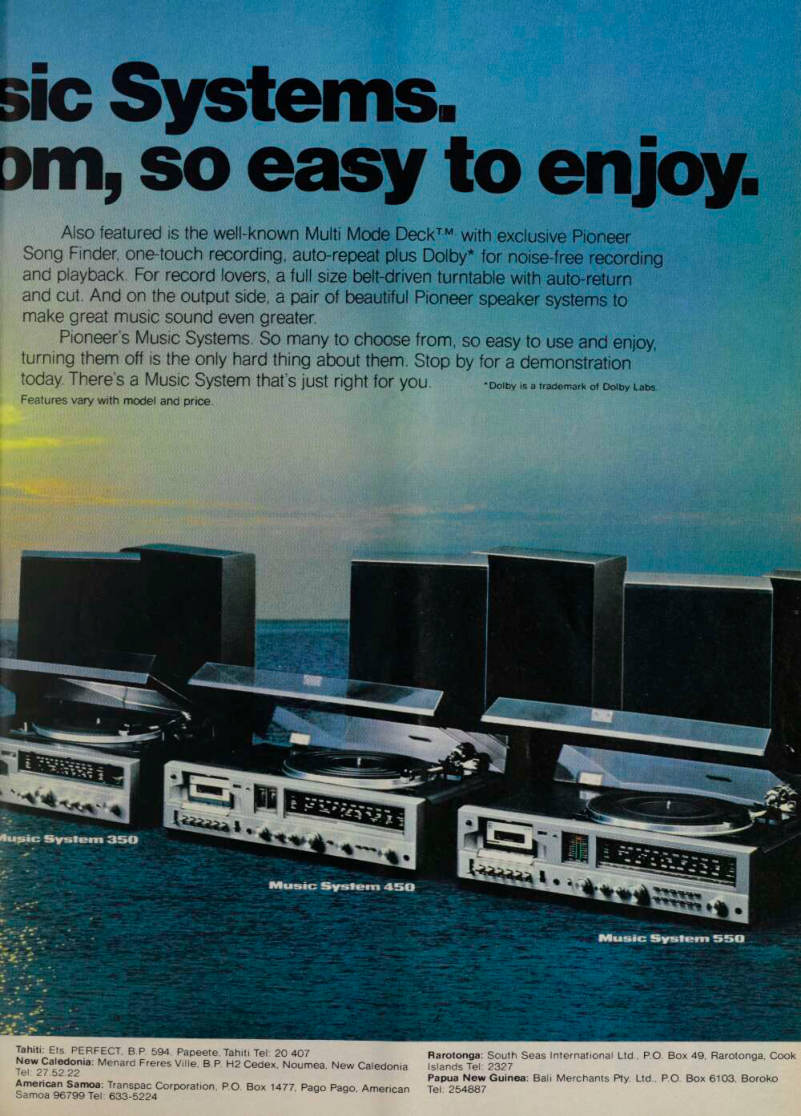
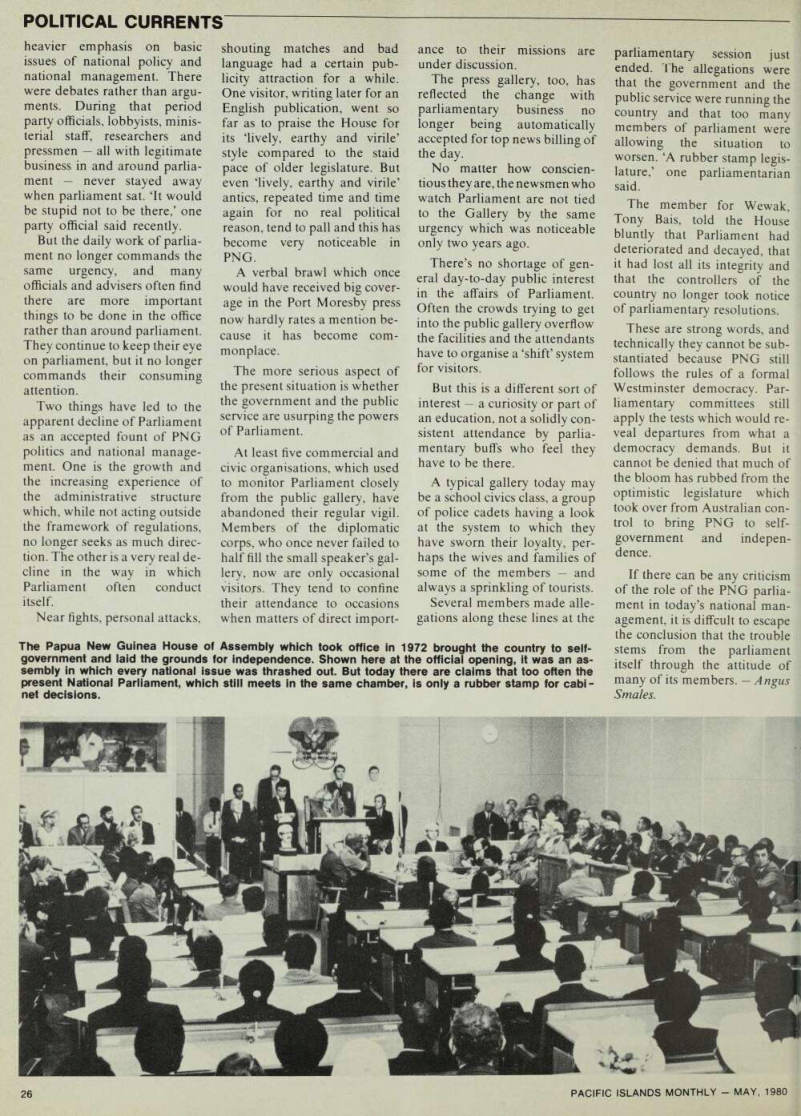
Decline Of
There was barely room to move in the galleries and lob bies of the Papua New Guinea National Parliament for the no-confidence debate in March which unseated the govern ment. But the events of that day were unusual and generally the parliament has ceased to attract the attention it once did.
When the no-confidence processes were at their peak at tendants in the public gallery had to set time limits for visi tors, VIPs were standing in the Speaker’s gallery, the crowd in the entrance hall flowed onto the road outside and the car
park was one big traffic jam.
But for visitors, party officials, specialist observers and others who made up the crowd the occasion was something of an
exception in a long period dur
ing which parliament-watching
has been very much on the de cline.
The decline of day-to-day interest in the workings of par liament appears to be very much a result of how parlia ment has been conducting itself. Interest in politics and policies, as distinct from interest in parliament, still runs high. Whether the change in government will create new interest in parliamentary proceedings remains to be seen.
What has happened to the parliament which was once the focus of attention? In short, its own tensions and differences appear to have made it too
introspective. Regular
parliament-watchers, in their decreasing numbers, say it has become too wrapped in its own management and affairs coupled with a growing lack of discipline. This opinion is sup
ported by an analysis of de
bates which shows that last year the parliament spent almost half its time on matters connected with its own man agement, problems, pro cedures and priorities, and with
a heavy lacing of disorderly
incidents and time-wasting tac tics. In the immediate months after PNG gained its indepen dence there was a much
heavier emphasis on basic issues of national policy and national management. There were debates rather than argu
ments. During that period
party officials, lobbyists, minis terial staff, researchers and pressmen all with legitimate business in and around parlia ment never stayed away when parliament sat. ‘lt would be stupid not to be there,’ one party official said recently.
But the daily work of parlia ment no longer commands the same urgency, and many officials and advisers often find there are more important things to be done in the office rather than around parliament.
They continue to keep their eye on parliament, but it no longer commands their consuming attention.
Two things have led to the apparent decline of Parliament as an accepted fount of PNG politics and national manage ment. One is the growth and
the increasing experience of
the administrative structure which, while not acting outside the framework of regulations, no longer seeks as much direc tion. The other is a very real de cline in the way in which Parliament often conduct itself.
Near fights, personal attacks,
shouting matches and bad language had a certain pub licity attraction for a while.
One visitor, writing later for an
English publication, went so
far as to praise the House for its ‘lively, earthy and virile’ style compared to the staid pace of older legislature. But even ‘lively, earthy and virile’ antics, repeated time and time again for no real political reason, tend to pall and this has become very noticeable in
Png.
A verbal brawl which once would have received big cover age in the Port Moresby press now hardly rates a mention be cause it has become com
monplace.
The more serious aspect of the present situation is whether the government and the public service are usurping the powers of Parliament.
At least five commercial and civic organisations, which used to monitor Parliament closely from the public gallery, have
abandoned their regular vigil.
Members of the diplomatic corps, who once never failed to half fill the small speaker’s gal lery, now are only occasional visitors. They tend to confine their attendance to occasions when matters of direct import
ance to their missions are under discussion.
The press gallery, too, has reflected the change with parliamentary business no
longer being automatically
accepted for top news billing of
the day.
No matter how conscien tious they are, the newsmen who watch Parliament are not tied to the Gallery by the same urgency which was noticeable only two years ago.
There’s no shortage of gen eral day-to-day public interest in the affairs of Parliament.
Often the crowds trying to get into the public gallery overflow the facilities and the attendants have to organise a ‘shift’ system for visitors.
But this is a different sort of interest a curiosity or part of an education, not a solidly con sistent attendance by parlia mentary buffs who feel they have to be there.
A typical gallery today may
be a school civics class, a group of police cadets having a look at the system to which they have sworn their loyalty, per haps the wives and families of some of the members and always a sprinkling of tourists.
Several members made alle gations along these lines at the
parliamentary session just ended. The allegations were that the government and the public service were running the country and that too many members of parliament were allowing the situation to worsen. ‘A rubber stamp legis lature,’ one parliamentarian said.
The member for Wewak, Tony Bais, told the House bluntly that Parliament had deteriorated and decayed, that it had lost all its integrity and that the controllers of the country no longer took notice of parliamentary resolutions.
These are strong words, and technically they cannot be sub stantiated because PNG still follows the rules of a formal Westminster democracy. Par liamentary committees still apply the tests which would re veal departures from what a democracy demands. But it cannot be denied that much of the bloom has rubbed from the
optimistic legislature which
took over from Australian con trol to bring PNG to self government and indepen dence.
If there can be any criticism of the role of the PNG parlia ment in today’s national man agement, it is diffcult to escape the conclusion that the trouble stems from the parliament itself through the attitude of many of its members. Angus Smales.
The Papua New Guinea House of Assembly which took office In 1972 brought the country to self government and laid the grounds for independence. Shown here at the official opening, it was an as sembly in which every national issue was thrashed out. But today there are claims that too often the present National Parliament, which still meets in the same chamber, is only a rubber stamp for cabi net decisions.
Advertisements & other items, pp. 24-25 (1 item)
Pioneer’s Mi
So many to choose f i
Pioneer’s working hard to make it easy for you to really enjoy your favorite music. Sure, our Music Systems are technically advanced, but not so complicated that you need a license to turn them on. So, were offering not only one or two. but ten great musical ideas to match your audio requirements and budget. In addition to our versatile 3-in-1 systems shown on these pages, we have equally wonderful 2-in-1 receiver/cassette deck combinations.
Easy operation plus big music power reproduces music so well, if you don't believe your ears, you can check the LED information panel. © s a For further information, please contact; Australia; Pioneer Marketing Service Pty. Ltd., P.O. Box 317, Mordialloc, Victoria, 3195 Tel; 90-9011 Fiji Islands; Brijlal & Company. G.P.O. Box No. 362, Suva, Fiji Islands Tel: 22258 New Zealand; Monaco Electronics Ltd., 5 Vernon Street. Auckland, New Zealand Tel: 33-883 Norfolk Island: Burns Philp (Norfolk Island) Ltd.. Norfolk Island. South Pacific New Hebrides: Burns Philp (New Hebrides) Ltd.. Vila, New Hebrides Nauru Island; Jacob Enterprises, P.O. Box No 4, Republic of Nauru
sic Systems.
xn, so easy to enjoy.
Also featured is the well-known Multi Mode Deck™ with exclusive Pioneer Song Finder, one-touch recording, auto-repeat plus Dolby* for noise-free recording and playback. For record lovers, a full size belt-driven turntable with auto-return and cut. And on the output side, a pair of beautiful Pioneer speaker systems to make great music sound even greater.
Pioneer's Music Systems. So many to choose from, so easy to use and enjoy, turning them off is the only hard thing about them. Stop by for a demonstration today. There's a Music System that's just right for you.
Features vary with model and price.
Dolby is a trademark of Dolby Labs. ■V* * % Tahiti: Ets. PERFECT, B P. 594. Papeete, Tahiti Tel: 20 407 New Caledonia: Menard Freres Ville, B P H 2 Cedex, Noumea, New Caledonia • 01. 27.52.22 American Samoa; Transpac Corporation, PO. Box 1477, Pago Pago American Samoa 96799 Tel; 633-5224 Rarotonga; South Seas International Ltd , P.O. Box 49, Rarotonga, Cook Islands Tel: 2327 Papua New Guinea; Bali Merchants Pty. Ltd., P.O. Box 6103, Boroko Tel; 254887
Gaston Flosse does a
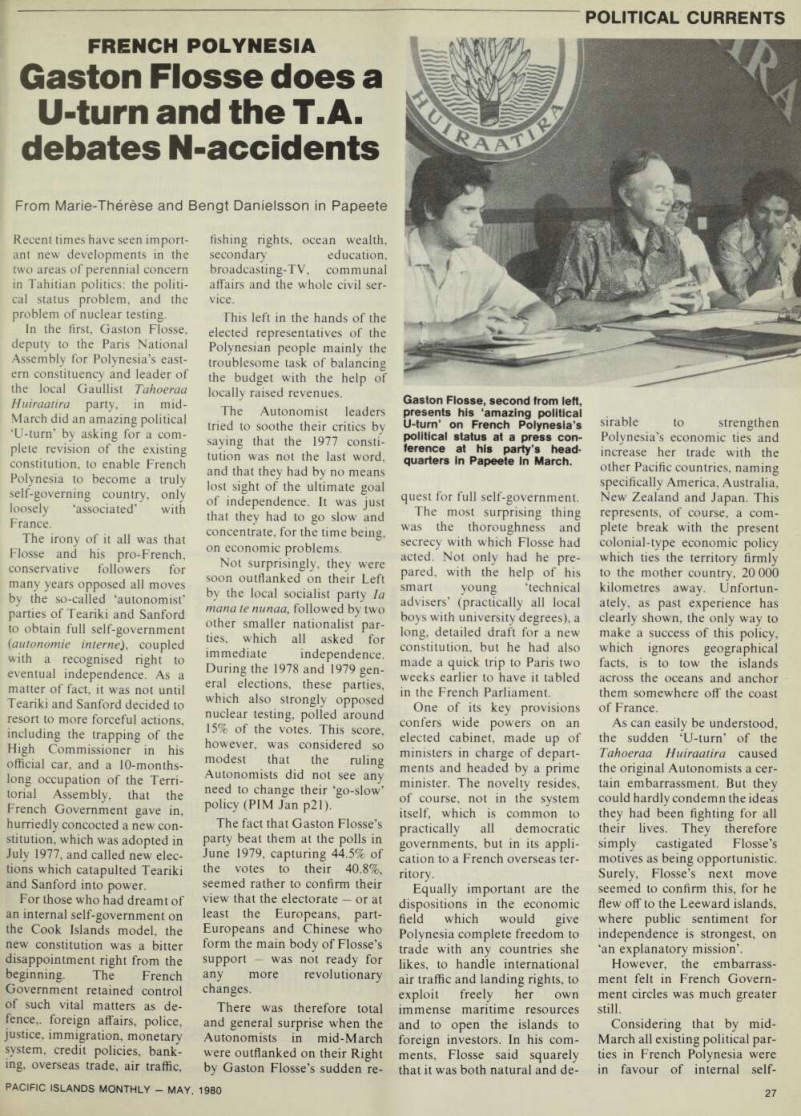
French Polynesia
Gaston Flosse does a U-turn and the T. A. debates N-accidents
From Marie-Therese and Bengt Danielsson in Papeete
Recent times have seen import ant new developments in the two areas of perennial concern in Tahitian politics; the politi cal status problem, and the
problem of nuclear testing.
In the first, Gaston Flosse, deputy to the Paris National
Assembly for Polynesia’s east
ern constituency and leader of the local Gaullist Tahoeraa Huiraatira party, in mid- March did an amazing political ‘U-tum’ by asking for a com plete revision of the existing constitution, to enable French Polynesia to become a truly
self-governing country, only
loosely ‘associated’ with France.
The irony of it all was that Flosse and his pro-French, conservative followers for many years opposed all moves by the so-called ‘autonomist’ parties of Teariki and Sanford to obtain full self-government (autonomie interne j, coupled with a recognised right to eventual independence. As a matter of fact, it was not until Teariki and Sanford decided to resort to more forceful actions, including the trapping of the High Commissioner in his official car, and a 10-months long occupation of the Terri torial Assembly, that the French Government gave in, hurriedly concocted a new con stitution, which was adopted in July 1977, and called new elec tions which catapulted Teariki and Sanford into power.
For those who had dreamt of an internal self-government on the Cook Islands model, the new constitution was a bitter
disappointment right from the
beginning. The French Government retained control of such vital matters as de
fence,. foreign affairs, police,
justice, immigration, monetary
system, credit policies, bank ing, overseas trade, air traffic,
fishing rights, ocean wealth,
secondary education,
broadcasting-TV, communal
affairs and the whole civil ser vice.
Phis left in the hands of the elected representatives of the
Polynesian people mainly the
troublesome task of balancing the budget with the help of locally raised revenues.
The Autonomist leaders tried to soothe their critics by saying that the 1977 consti tution was not the last word, and that they had by no means lost sight of the ultimate goal of independence. It was just that they had to go slow and concentrate, for the time being, on economic problems.
Not surprisingly, they were
soon outflanked on their Left by the local socialist party la mana te nunaa, followed by two other smaller nationalist par ties, which all asked for
immediate independence.
During the 1978 and 1979 gen eral elections, these parties, which also strongly opposed
nuclear testing, polled around
15% of the votes. This score, however, was considered so modest that the ruling Autonomists did not see any need to change their ‘go-slow’
policy (PIM Jan p2l).
The fact that Gaston Flosse’s party beat them at the polls in June 1979, capturing 44.5% of the votes to their 40.8%, seemed rather to confirm their view that the electorate or at least the Europeans, part- Europeans and Chinese who form the main body of Flosse’s support was not ready for any more revolutionary
changes.
There was therefore total and general surprise when the Autonomists in mid-March were outflanked on their Right by Gaston Flosse’s sudden re-
quest for full self-government.
The most surprising thing
was the thoroughness and secrecy with which Flosse had acted. Not only had he pre pared, with the help of his smart young ‘technical advisers’ (practically all local
boys with university degrees), a
long, detailed draft for a new constitution, but he had also made a quick trip to Paris two weeks earlier to have it tabled in the French Parliament.
One of its key provisions confers wide powers on an elected cabinet, made up of ministers in charge of depart ments and headed by a prime minister. The novelty resides, of course, not in the system itself, which is common to practically all democratic governments, but in its appli cation to a French overseas ter
ritory.
Equally important are the
dispositions in the economic field which would give
Polynesia complete freedom to
trade with any countries she likes, to handle international air traffic and landing rights, to
exploit freely her own
immense maritime resources and to open the islands to foreign investors. In his com ments, Flosse said squarely that it was both natural and de
sirable to strengthen Polynesia’s economic ties and increase her trade with the other Pacific countries, naming specifically America, Australia, New Zealand and Japan. This represents, of course, a com plete break with the present
colonial-type economic policy
which ties the territory firmly to the mother country, 20 000 kilometres away. Unfortun ately, as past experience has clearly shown, the only way to make a success of this policy,
which ignores geographical
facts, is to tow the islands across the oceans and anchor them somewhere off the coast of France.
As can easily be understood, the sudden ‘U-turn’ of the Tahoeraa Huiraatira caused the original Autonomists a cer tain embarrassment. But they could hardly condemn the ideas they had been fighting for all their lives. They therefore
simply castigated Flosse’s
motives as being opportunistic.
Surely, Flosse’s next move seemed to confirm this, for he flew off to the Leeward islands, where public sentiment for independence is strongest, on ‘an explanatory mission’.
However, the embarrass ment felt in French Govern ment circles was much greater still.
Considering that by mid-
March all existing political par ties in French Polynesia were in favour of internal self
Gaston Flosse, second from left, presents his ‘amazing political U-turn’ on French Polynesia’s political status at a press con ference at his party’s head quarters in Papeete in March.
government, and that those adopting the most ‘radical’ pos itions Tahoeraa Hiuraatira, la mana te nunaa, Te taata Tahiti tiama, Polynesian Liber ation Front represented about 60% of the electorate, the French Government seemed bound to accept a thorough re form of the existing consti tution, in line with the proclaimed - and noble principle of self-determination for all colonial peoples. Or. it seemed, the least it could do would be to accept a refer endum.
However, this is precisely the kind of thing that bothers the Paris government, which has always feared that any easing of the reins could lead to a breakaway. In the quite well founded view of Paris, an
independent Polynesia would
not allow any further nuclear tests to be made at the already
badly damaged Moruroa
Atoll.
The first official response came from High Com missioner Paul Cousseran who went on the air to announce that the old Autonomist parties
were quite happy with the pre sent constitution. His statement was greeted with a terse com munique from Autonomist
headquarters taking the
HiCom to task for presuming to speak in their name, and adding that the Autonomists had always believed the consti tution could and should be im
proved.
It was then the turn of Over seas Territory Minister Paul Dijoud who stated that he knew for certain that the ma jority of the inhabitants of French Polynesia did not wish to change the present consti tution, which was functioning in a perfectly satisfactory man ner. (How he was able to ascer tain this he did not make clear.) But, when all is said and done, Mr Dijoud and every body else knows that the only group of people empowered to make a decision on this vital matter are the 491 deputies who make up the French National Assembly. With the
solid majority enjoyed by
President Giscard d’Estaing in
this metropolitan body, the chances are practically zero that any piece of legislation distasteful to the government could be adopted or even reach the floor for debate.
Meanwhile, on March 13, French Polynesia’s Territorial
Assembly at long last staged a
sort of interim debate on the nuclear accidents at Moruroa Atoll on July 6 and 25 1979 (PIM Oct p 29). The accidents left a total of two dead, and 11 injured, six of them seriously.
The debate was necessarily ‘interim’ in character for the
simple reason that, having
received only very incomplete
information from French authorities concerning the acci dents, the five members of the
Territorial Assembly forming
its committee of inquiry into the accidents decided late last year to postpone the debate until they had received certain documents. These documents had not yet reached their hands by March 13.
They were:
(1) The CEP (body in charge of the Moruroa Tests)
experts’ own report about the accidents. (2) The report which ‘the team of internationally known scientists in the nuclear field’ (who were in fact all French and mostly engineers working for the French Atomic Energy Commission) had made
following their investigative
visits to Moruroa last year. (3) The geological report by the well-known French vol canologist Haroun Tazieff, in which he reportedly advises against using atolls for nuclear tests. (4) The reports about all other scientific studies made of the subsoil of Moruroa. (5) The annual reports issued by the Atomic Energy
Commission/CEP radiological
laboratory, set up 15 years ago, which had previously been
kept secret.
Perhaps the most important
information acquired by the
Territorial Assembly’s com mittee at the time of its investi
gations although nothing
was said to them officially about it was that the 28 underground blasts so far had
; damaged the periphery of the atoll so badly that the tech nicians had become very anxious to receive the long
awaited equipment (mostly
barges) which will enable them to drill bomb shafts into the centre of the lagoon, a new technique for which a CEP general more than a year ago (PIM Mar 1979 p 7) had used
the misleading English ex
pression ‘offshore drillings’.
The most moving speech at the March 13 debate was un
doubtedly that of old-style
Tahitian party leader John Teariki who reaffirmed, in highly personal terms, his total opposition to the Moruroa tests.
He said; ‘When I went there as a member of the committee of inquiry, it was my first visit to Moruroa. Although this atoll is part of my fatherland, I felt as if I were in a foreign country.’
Of the large revenues pro duced by the CEP/CEA im plantation (1 500 million francs annually) he said: ‘lt seems to me that the financial rewards thus derived are very small indeed, compared to the irrep arable harm done by the CEP/ CEA bases to our society in the economic, political and social fields. ‘This is why I deem it necess ary to reaffirm in the most sol emn terms that in my various capacities, as a Polynesian, a fisherman, a farmer, a council man and the leader of the Pupu here aia party, I have always been and I am still today against the CEP/CEA and against the continuation of the nuclear tests at Moruroa.’
In the vote, the 18-member Autonomist majority, includ ing Teariki’s party and Francis Sanford’s Ea api party, voted for adoption of the slender three-page report of the com mittee of inquiry, tacking on an amendment stressing the urgency of receiving the docu ments requested.
Gaston Flosse and the other nine members of the Tahoeraa Huiraatira group voted against, as a protest against the vague and inconclusive character of the Committee’s report.
They certainly had a point
there. But who bears the main blame for our imperfect
knowledge of what is going on at Moruroa? It seems to us that the report at least answers that
important question.
Canberra
Tarawa Ties
Stronger formal links with Australia may well be one of the developments from the independence last year of the
Republic of Kiribati, formerly
the Gilbert Islands.
This became apparent last month during a visit to Aus tralia by the Secretary to the Kiribati Cabinet, Mr A. T.
Teaotai, making what he de scribed as a ‘general familiaris ation tour’.
He hinted at a possible State visit to Australia by his
country’s 29-year-old President
leremiah Tabai, taking up an invitation which Australia is known to have extended some time ago.
Mr Teaotai said it was
becoming increasingly appar
ent that Australia was accept ing a greater responsibility in the Pacific region and this was welcomed by the Pacific com
munity.
He said his country looked to Australia for aid, not as a beg gar but as a regional partner which was anxious to develop itself and to reduce its econ omic dependency. The bulk of external aid to Kiribati at pre sent comes from Britain, the former administering power, and amounts to about SA4 million to be spent this year and next year.
Australian overseas aid is
already providing Kiribati with
a $4 million grant for civil en gineering and transport, and New Zealand is also providing aid.
Mr Teaotai said that much of the aid his country was already receiving was tied to specific projects at the time of allo cation. He looked to the time when Kiribati could establish the economic reputation which would allow it to receive a greater proportion of untied aid. ‘We don’t have much idea yet of how Australians operate, but we believe they are friendly and ready to co-operate with us and these are the sort of things
I have been following up,’ Mr Teaotai said in Sydney after spending two weeks in Can berra. Aid agencies were on his calling list during the visit.
High on the list of projects which Kiribati would like to see completed is the 3km causeway planned to connect Betio to Bairiki on Tarawa. A long-planned project to build a causeway was funded by a loan of $1.7 from the Asian
Development Bank. But nearly
two years of work has failed to produce a causeway and the
project is now bogged down by
legal wrangles.
There is strong evidence to suggest that Australia might be prepared to provide aid for at least a new feasibility study for the causeway. At present, how ever, Australian officials are understandably reluctant to become involved in a situation which might be seen as affect ing the legal ramifications of the first project.
As Mr Teaotai said during his visit to Sydney; ‘We are not
really blaming anyone it’s
past history now. All we know is that we still don’t have a causeway, we want one badly, and in the meantime the costs
of operating a ferry are going
higher and higher.’
Questions
On N.C.
Some Melanesians are working for independence for New Caledonia both inside and out side the territory, Australian Foreign Minister Andrew Pea cock said in a written reply tabled in the House of Rep resentatives in Canberra to a
question by former television
quiz ace, and now Labor MP,
Barry Jones.
Mr Jones had asked Mr Pea cock if he could say whether
the overwhelming majority of
Melanesians there wanted
independence and were agitat
ing inside and outside New Caledonia for that goal.
Mr Peacock said claims had been made by the Indepen dence Front Party that more than 80% of the Melanesian voters voted in favour of
independentist parties. Other
estimates ranged down to 64%.
In the absence of voter enrol ment by ethnic origin it was not
possible to be precise.
Mr Jones in an earlier ques tion had asked Mr Peacock if he could say whether indigenous Melanesians con stituted the largest single ethnic group in New Caledonia. Mr Peacock agreed that was the case and gave a breakdown of population figures as follows:
Indigenous Melanesians,
43.3% (65 000) of the popu lation; Europeans, 35.6% (49 700); Wallisians, Tahitians, Vietnamese, Indonesians and other small ethnic groups, 21.1% (29 400).
In reply to a further question from Mr Jones, Mr Peacock said the electoral lists did not reveal details whether the ma jority who voted against
independence in July, 1979,
was made up largely of recent arrivals, transient officials and members of the armed forces on their tour of duty.
Turning to another tack on New Caledonia, Mr Jones asked Mr Peacock if his atten tion had been drawn to reports that at night on January 6-7, a Melanesian was shot dead by a French police officer. If so, could he say whether the incident was followed by a wave of agitation, including the erection of road blocks, in favour of independence.
Mr Peacock replied that on January 9, a French police inspector was suspended from duty and committed to custody in respect of the fatal shooting.
Melanesian reaction was lim ited to the attendance of about 300 independentists at the fu neral. They marched, without incident, several kilometres with the funeral cortege on
January 10.
Pago Tells
Tokyo
The government of American Samoa has sent a strong letter of protest to United States Am bassador to Japan Mike Mans
field protesting against
possible dumping of nuclear
wastes in the Pacific by
Japan.
The letter associates American Samoa with earlier protests by Governor Carlos Camacho of the Common wealth of the Northern Marianas and others.
Advertisements & other items, pp. 28-30 (1 item)
Integrated Technical Services
• SALES
• ON SITE INSTALLATION
• FIELD SERVICE
• HF, VHP, UHF LINK AND MOBILE SYSTEMS
• GROUND AIR COMMUNICATIONS
• MARINE NAVIGATION AND COMMUNICATIONS
• AIRCRAFT ELECTRONIC SYSTEMS
DISTRIBUTORS OF:
• CODANHFSSB SYSTEMS
• PHILIPS VHF/UHFFM MOBILE SYSTEMS
• JRC MARINE RADAR, SOUNDERS, SATTELITE NAVIGATORS
• MAGNAVOX SATTELITE NAVIGATORS
• DECCA MARINE RADAR
• KING, MARCO, SUNAIR, COLLINS AIRCRAFT RADIO SYSTEMS
FIELD ENGINEERING INTEGRATED TECHNICAL SERVICES
P. O. Box 350. Cairns 4870. Queensland. Australia.
Phone: (070) 51 1616.51 4826.53 1356.51 3052. Telex: AA 48085
MANUFACTURERS OF;
• PORTABLE DEPTH FINDERS
• HF RADIO SCANNERS
• VOICE SCRAMBLERS
• MICROPROCESSOR BASED
CONTROL SYSTEMS
STATESMAN
STATESMAN
STATESMAN
CORONA
STATESMAN
STATESMAN
STATESMAN
STATESMAN
HALF CORONA CORVETTE
STATESMAN
LANCERS
COMMODORE
PANATELLA
PANATELLA
LONG
PANATELLA
STATESMAN
Smooth, mild cigars.
© W. D. & H. O. WILLS (AUSTRALIA) LIMITED
E6BO
People
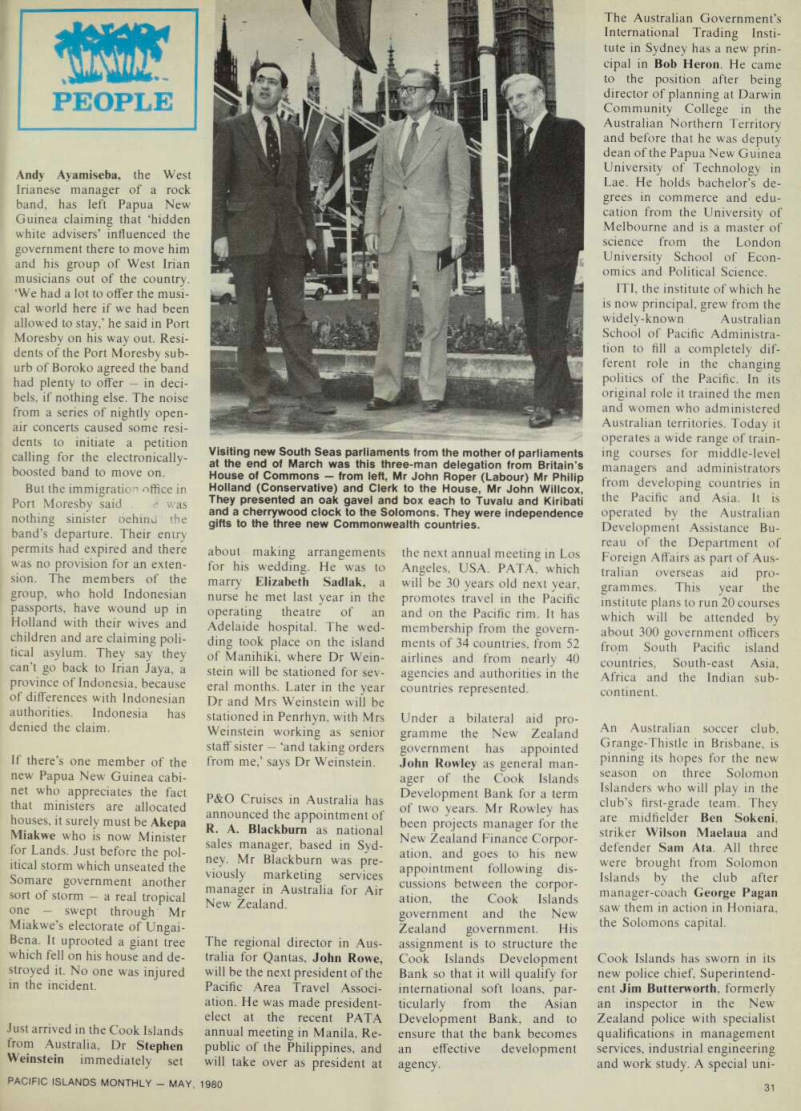
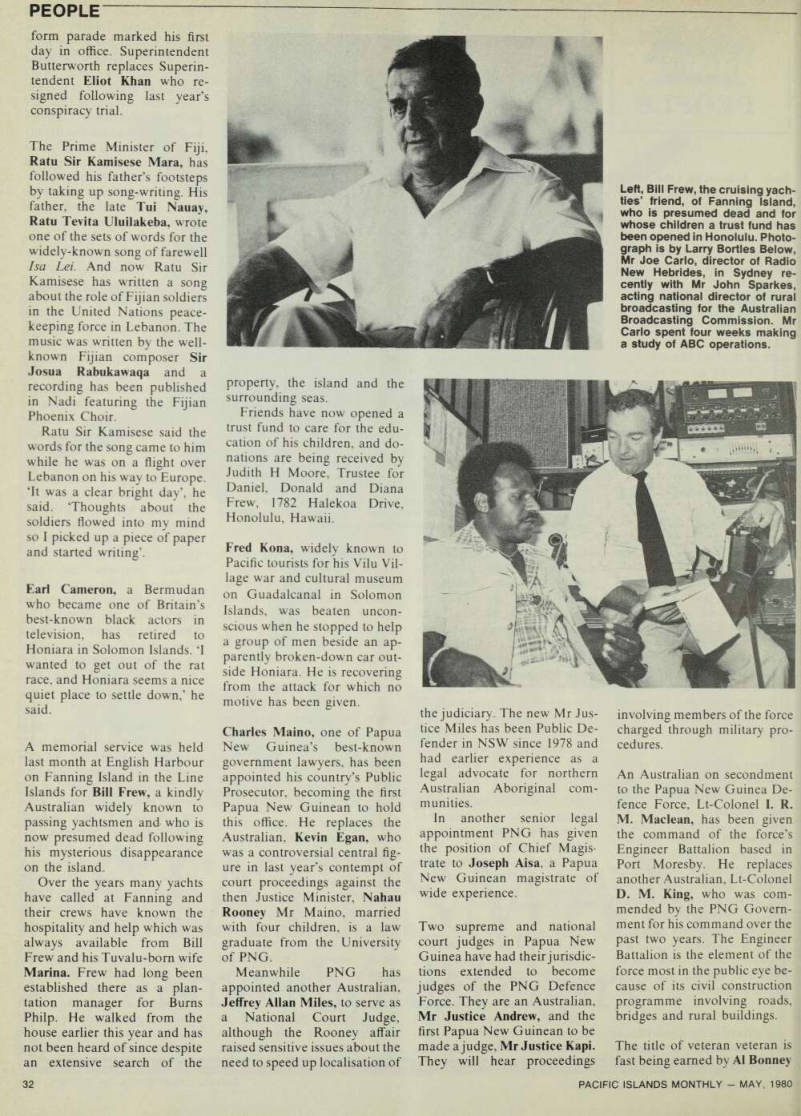
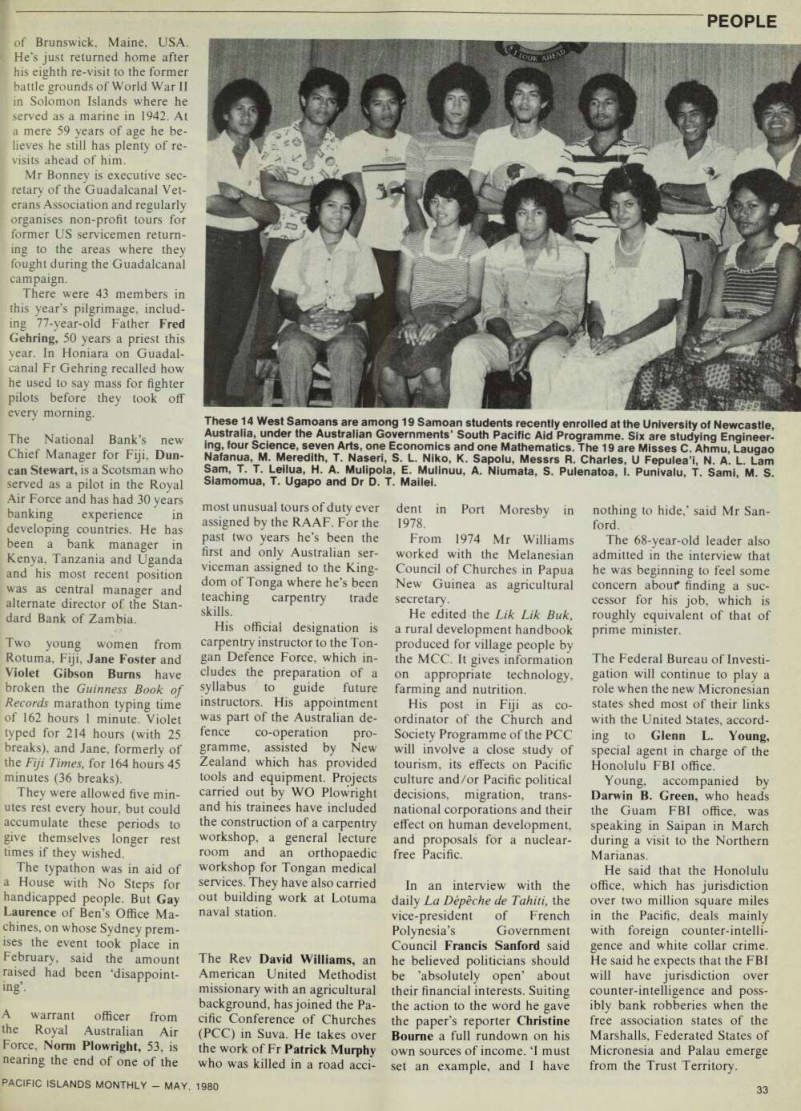
Andy Ayamiseba, the West Irianese manager of a rock band, has left Papua New Guinea claiming that ‘hidden white advisers’ influenced the government there to move him and his group of West Irian musicians out of the country. ‘We had a lot to offer the musi cal world here if we had been allowed to stay,’ he said in Port Moresby on his way out. Resi dents of the Port Moresby sub urb of Boroko agreed the band had plenty to offer in deci bels, if nothing else. The noise from a series of nightly open air concerts caused some resi dents to initiate a petition
calling for the electronically
boosted band to move on.
But the immigration office in Port Moresby said e was nothing sinister oehmu the band’s departure. Their entry permits had expired and there was no provision for an exten sion. The members of the group, who hold Indonesian passports, have wound up in Holland with their wives and children and are claiming poli
tical asylum. They say they
can’t go back to Irian Jaya, a province of Indonesia, because of differences with Indonesian authorities. Indonesia has denied the claim.
If there’s one member of the new Papua New Guinea cabi net who appreciates the fact that ministers are allocated houses, it surely must be Akepa Miakwe who is now Minister for Lands. Just before the pol itical storm which unseated the Somare government another sort of storm a real tropical one - swept through Mr Miakwe’s electorate of Ungai- Bena. It uprooted a giant tree which fell on his house and de stroyed it. No one was injured in the incident.
Just arrived in the Cook Islands from Australia, Dr Stephen Weinstein immediately set
about making arrangements for his wedding. He was to marry Elizabeth Sadlak, a nurse he met last year in the operating theatre of an Adelaide hospital. The wed ding took place on the island of Manihiki, where Dr Wein stein will be stationed for sev eral months. Later in the year Dr and Mrs Weinstein will be stationed in Penrhyn, with Mrs Weinstein working as senior staff sister ‘and taking orders from me,’ says Dr Weinstein.
P&O Cruises in Australia has announced the appointment of R. A. Blackburn as national sales manager, based in Syd ney. Mr Blackburn was pre
viously marketing services
manager in Australia for Air New Zealand.
The regional director in Aus tralia for Qantas, John Rowe, will be the next president of the Pacific Area Travel Associ ation. He was made president elect at the recent PATA annual meeting in Manila, Re public of the Philippines, and will take over as president at
the next annual meeting in Los Angeles, USA. PATA, which will be 30 years old next year, promotes travel in the Pacific and on the Pacific rim. It has membership from the govern ments of 34 countries, from 52 airlines and from nearly 40 agencies and authorities in the countries represented.
Under a bilateral aid pro gramme the New Zealand government has appointed John Rowley as general man ager of the Cook Islands Development Bank for a term of two years. Mr Rowley has been projects manager for the New Zealand Finance Corpor ation. and goes to his new
appointment following dis
cussions between the corpor ation, the Cook Islands government and the New Zealand government. His assignment is to structure the Cook Islands Development Bank so that it will qualify for international soft loans, par ticularly from the Asian Development Bank, and to ensure that the bank becomes an effective development agency.
The Australian Government’s International Trading Insti tute in Sydney has a new prin cipal in Bob Heron. He came to the position after being director of planning at Darwin
Community College in the
Australian Northern Territory and before that he was deputy dean of the Papua New Guinea
University of Technology in
Lae. He holds bachelor’s de grees in commerce and edu cation from the University of Melbourne and is a master of science from the London University School of Econ omics and Political Science.
ITL the institute of which he is now principal, grew from the
widely-known Australian
School of Pacific Administra tion to fill a completely dif ferent role in the changing politics of the Pacific. In its original role it trained the men and women who administered Australian territories. Today it operates a wide range of train ing courses for middle-level managers and administrators from developing countries in the Pacific and Asia. It is operated by the Australian Development Assistance Bu reau of the Department of Foreign Affairs as part of Aus tralian overseas aid pro grammes. This year the institute plans to run 20 courses which will be attended by about 300 government officers from South Pacific island countries, South-east Asia, Africa and the Indian sub continent.
An Australian soccer club, Grange-Thistle in Brisbane, is pinning its hopes for the new season on three Solomon Islanders who will play in the
club’s first-grade team. They
are midfielder Ben Sokeni, striker Wilson Maelaua and defender Sam Ata. All three were brought from Solomon Islands by the club after manager-coach George Pagan saw them in action in Honiara, the Solomons capital.
Cook Islands has sworn in its
new police chief, Superintend
ent Jim Butterworth, formerly an inspector in the New
Zealand police with specialist
qualifications in management services, industrial engineering and work study. A special uni
Visiting new South Seas parliaments from the mother of parliaments at the end of March was this three-man delegation from Britain’s House of Commons - from left, Mr John Roper (Labour) Mr Philip Holland (Conservative) and Clerk to the House, Mr John Willcox, They presented an oak gavel and box each to Tuvalu and Kiribati and a cherrywood clock to the Solomons. They were independence gifts to the three new Commonwealth countries.
form parade marked his first
day in office. Superintendent
Butterworth replaces Superin tendent Eliot Khan who re
signed following last year’s
conspiracy trial.
The Prime Minister of Fiji, Ratu Sir Kamisese Mara, has followed his father’s footsteps
by taking up song-writing. His
father, the late Tui Nanay, Ratu Tevita Uluilakeba, wrote one of the sets of words for the widely-known song of farewell Isa Lei. And now Ratu Sir Kamisese has written a song about the role of Fijian soldiers in the United Nations peace keeping force in Lebanon. The music was written by the well known Fijian composer Sir Josua Rabukawaqa and a
recording has been published
in Nadi featuring the Fijian Phoenix Choir.
Ratu Sir Kamisese said the words for the song came to him while he was on a flight over Lebanon on his way to Europe. ‘lt was a clear bright day’, he said. Thoughts about the soldiers flowed into my mind so I picked up a piece of paper and started writing’.
Earl Cameron, a Bermudan who became one of Britain’s best-known black actors in television, has retired to Honiara in Solomon Islands. T wanted to get out of the rat race, and Honiara seems a nice quiet place to settle down,’ he said.
A memorial service was held last month at English Harbour on Fanning Island in the Line Islands for Bill Frew, a kindly Australian widely known to passing yachtsmen and who is
now presumed dead following
his mysterious disappearance
on the island.
Over the years many yachts have called at Fanning and their crews have known the hospitality and help which was always available from Bill Frew and his Tuvalu-bom wife Marina. Frew had long been established there as a plan tation manager for Burns Philp. He walked from the house earlier this year and has not been heard of since despite an extensive search of the
property, the island and the
surrounding seas.
Friends have now opened a trust fund to care for the edu cation of his children, and do nations are being received by Judith H Moore, Trustee for Daniel, Donald and Diana Frew, 1782 Halekoa Drive, Honolulu, Hawaii.
Fred Kona, widely known to Pacific tourists for his Vilu Vil lage war and cultural museum on Guadalcanal in Solomon Islands, was beaten uncon scious when he stopped to help a group of men beside an ap parently broken-down car out side Honiara. He is recovering from the attack for which no motive has been given.
Charles Maino, one of Papua New Guinea’s best-known government lawyers, has been
appointed his country’s Public
Prosecutor, becoming the first Papua New Guinean to hold this office. He replaces the Australian, Kevin Egan, who was a controversial central fig ure in last year’s contempt of
court proceedings against the
then Justice Minister, Nahau Rooney Mr Maino, married with four children, is a law
graduate from the University
of PNG.
Meanwhile PNG has appointed another Australian, Jeffrey Allan Miles, to serve as a National Court Judge, although the Rooney affair raised sensitive issues about the need to speed up localisation of
the judiciary. The new Mr Jus tice Miles has been Public De fender in NSW since 1978 and had earlier experience as a legal advocate for northern Australian Aboriginal com munities.
In another senior legal
appointment PNG has given
the position of Chief Magis trate to Joseph Aisa, a Papua New Guinean magistrate of
wide experience.
Two supreme and national court judges in Papua New Guinea have had their jurisdic tions extended to become judges of the PNG Defence Force. They are an Australian, Mr Justice Andrew, and the first Papua New Guinean to be made a judge, Mr Justice Kapi.
They will hear proceedings
involving members of the force
charged through military pro
cedures.
An Australian on secondment to the Papua New Guinea De fence Force, Lt-Colonel I. R.
M. Maclean, has been given the command of the force’s Engineer Battalion based in
Port Moresby. He replaces
another Australian, Lt-Colonel D. M. King, who was com mended by the PNG Govern ment for his command over the past two years. The Engineer Battalion is the element of the force most in the public eye be cause of its civil construction programme involving roads,
bridges and rural buildings.
The title of veteran veteran is fast being earned by AI Bonney
Left, Bill Frew, the cruising yach ties’ friend, of Fanning Island, who is presumed dead and for whose children a trust fund has been opened in Honolulu. Photo graph is by Larry Bortles Below, Mr Joe Carlo, director of Radio New Hebrides, in Sydney re cently with Mr John Sparkes, acting national director of rural broadcasting for the Australian Broadcasting Commission. Mr Carlo spent four weeks making a study of ABC operations.
f of Brunswick, Maine, USA. > He’s just returned home after his eighth re-visit to the former battle grounds of World War II in Solomon Islands where he ■ served as a marine in 1942. At a mere 59 years of age he be lieves he still has plenty of re l visits ahead of him.
Mr Bonney is executive sec retary of the Guadalcanal Vet erans Association and regularly [ organises non-profit tours for former US servicemen return ing to the areas where they
fought during the Guadalcanal
campaign.
There were 43 members in this year’s pilgrimage, includ
ing 77-year-old Father Fred
Gehring, 50 years a priest this year. In Honiara on Guadal canal Fr Gehring recalled how he used to say mass for fighter pilots before they took off
every morning.
The National Bank’s new Chief Manager for Fiji, Dun can Stewart, is a Scotsman who served as a pilot in the Royal Air Force and has had 30 years
banking experience in
developing countries. He has been a bank manager in
Kenya, Tanzania and Uganda
and his most recent position was as central manager and alternate director of the Stan dard Bank of Zambia.
Two young women from Rotuma, Fiji, Jane Foster and Violet Gibson Burns have broken the Guinness Book of Records marathon typing time of 162 hours 1 minute. Violet typed for 214 hours (with 25 breaks), and Jane, formerly of the Fiji Times, for 164 hours 45 minutes (36 breaks).
They were allowed five min utes rest every hour, but could accumulate these periods to
give themselves longer rest
times if they wished.
The typathon was in aid of a House with No Steps for
handicapped people. But Gay
Laurence of Ben’s Office Ma chines, on whose Sydney prem ises the event took place in February, said the amount raised had been ‘disappoint
ing’.
A warrant officer from the Royal Australian Air Force, Norm Plowright, 53, is nearing the end of one of the
most unusual tours of duty ever assigned by the RAAF. For the past two years he’s been the first and only Australian ser viceman assigned to the King dom of Tonga where he’s been teaching carpentry trade skills.
His official designation is carpentry instructor to the Ton gan Defence Force, which in cludes the preparation of a syllabus to guide future instructors. His appointment was part of the Australian de fence co-operation pro gramme, assisted by New Zealand which has provided tools and equipment. Projects carried out by WO Plowright and his trainees have included the construction of a carpentry workshop, a general lecture room and an orthopaedic
workshop for Tongan medical
services. They have also carried out building work at Lotuma naval station.
The Rev David Williams, an American United Methodist missionary with an agricultural background, has joined the Pa cific Conference of Churches (PCC) in Suva. He takes over the work of Fr Patrick Murphy who was killed in a road acci
dent in Port Moresby in 1978.
From 1974 Mr Williams worked with the Melanesian Council of Churches in Papua New Guinea as agricultural secretary.
He edited the Lik Lik Buk, a rural development handbook
produced for village people by
the MCC. It gives information
on appropriate technology,
farming and nutrition.
His post in Fiji as co ordinator of the Church and Society Programme of the PCC will involve a close study of tourism, its effects on Pacific culture and/or Pacific political decisions, migration, trans national corporations and their effect on human development, and proposals for a nuclear free Pacific.
In an interview with the daily La Depeche de Tahiti, the vice-president of French
Polynesia’s Government
Council Francis Sanford said he believed politicians should
be ’absolutely open’ about
their financial interests. Suiting the action to the word he gave the paper’s reporter Christine Bourne a full rundown on his own sources of income, i must set an example, and I have
nothing to hide,’ said Mr San ford.
The 68-year-old leader also admitted in the interview that he was beginning to feel some concern about* finding a suc cessor for his job, which is roughly equivalent of that of
prime minister.
The Federal Bureau of Investi gation will continue to play a role when the new Micronesian states shed most of their links with the United States, accord ing to Glenn L. Young, special agent in charge of the Honolulu FBI office.
Young, accompanied by
Darwin B. Green, who heads the Guam FBI office, was speaking in Saipan in March during a visit to the Northern Marianas.
He said that the Honolulu office, which has jurisdiction over two million square miles in the Pacific, deals mainly with foreign counter-intelli gence and white collar crime.
He said he expects that the FBI will have jurisdiction over counter-intelligence and poss ibly bank robberies when the free association states of the Marshalls, Federated States of Micronesia and Palau emerge from the Trust Territory.
These 14 West Samoans are among 19 Samoan students recently enrolled at the University of Newcastle, Australia, under the Australian Governments’ South Pacific Aid Programme. Six are studying Engineer ing, four Science, seven Arts, one Economics and one Mathematics. The 19 are Misses C. Ahmu, Laugao Nafanua, M. Meredith, T. Naseri, S. L. Niko, K. Sapolu, Messrs R. Charles, U Fepulea’i, N. A. L. Lam Sam, T. T. Leilua, H. A. Mulipola, E. Mulinuu, A. Niumata, S. Pulenatoa, I. Punivalu, T. Sami, M S.
Siamomua, T. Ugapo and Dr D. T. Mailei.
Advertisements & other items, p. 34 (1 item)
Is it true that true hi-fi is complicated?
& ■ „■> N $ ( n; M, I Is it true that true hi-fi is complicated?
It’s true that the advanced electronics in Sansui’s new SUPER COMPO systems are very complex. But happily it’s also true that Sansui has made true hi-fi simple with “in-depth matching” systems: SUPER COMPO. Without depleting your budget or hogging your living room, SUPER COMPO easily fills your room with your favorite music in stirring stereo.
Today’s music sources sound so vivid because they have a dynamic and sonic range far wider than ever before. That’s why you need the latest audio advances found in all SUPER COMPO systems, created by Sansui, the hi-fi specialist.
Isn’t it great to discover that your family, too, can now enjoy the very best music on hi-fi? SUPER COMPO!
Only hi-fi,every thing hi-fi.
SANSUI ELECTRIC CO., LTD. 14-1 Izumi 2-chome, Suginami-ku, Tokyo 168, Japan • Australia VANFI (Aust.) Pty. Ltd. 162, Albert Road, South Melbourne, Victoria 3205, Australia Phone: 699-5473 / 283 Alfred Street, North Sydney, N.S.W. 2060, Australia Phone: 929-0293 • Fiji Prabhu Brothers Ltd. P.O. Box 183, Nadi Phone: 70183/4 • Papua New Guinea Oceania Indent Agency (P.N.G.) Pty. Ltd. Box 5518, Boroko, Port Moresby Phone: PM 256406 • New Zealand David Reid Electronics Ltd. C.P.O. Box 2630, Auckland, 1 Phone: 492-189 • New Caledonia Ets Michel MERCIER B.P. 1123, Noumea Phone: 27. 59. 11 • South Pacific Miltons Department Stores Limited P.O. Box 146, Norfolk Island 2899 • Central Pacific Nauru Co-operative Society Republic of Nauru • New Hebrides The Sound Centre P.O. Box 434, Port Villa • Cook Island United Island Traders Ltd. P.O. Box 1 &2, Rarotonga • Tahiti SIMEL P.O. Box 3338
Travel
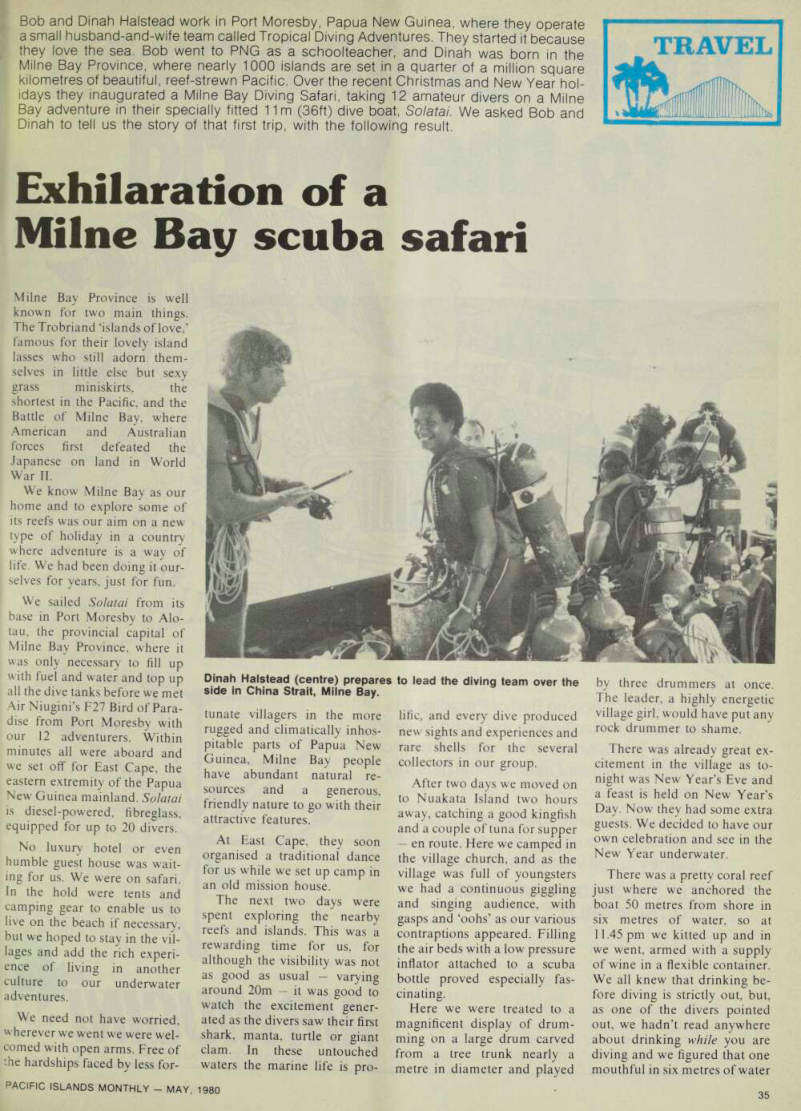
Bob and Dinah Halstead work in Port Moresby, Papua New Guinea, where they operate a small husband-and-wife team called Tropical Diving Adventures. They started it because they love the sea. Bob went to PNG as a schoolteacher, and Dinah was born in the Milne Bay Province, where nearly 1000 islands are set in a quarter of a million square kilometres of beautiful, reef-strewn Pacific. Over the recent Christmas and New Year hol idays they inaugurated a Milne Bay Diving Safari, taking 12 amateur divers on a Milne Bay adventure in their specially fitted 11 m (36ft) dive boat, Solatai. We asked Bob and Dinah to tell us the story of that first trip, with the following result.
Exhilaration of a Milne Bay scuba safari
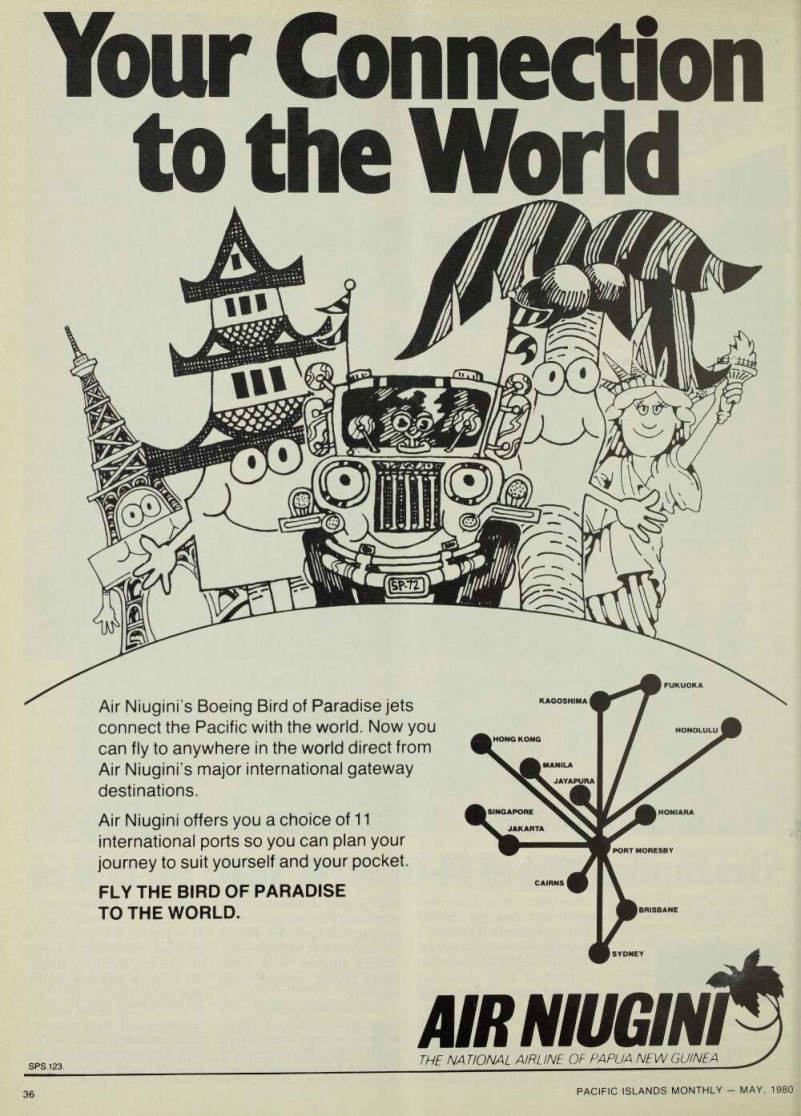
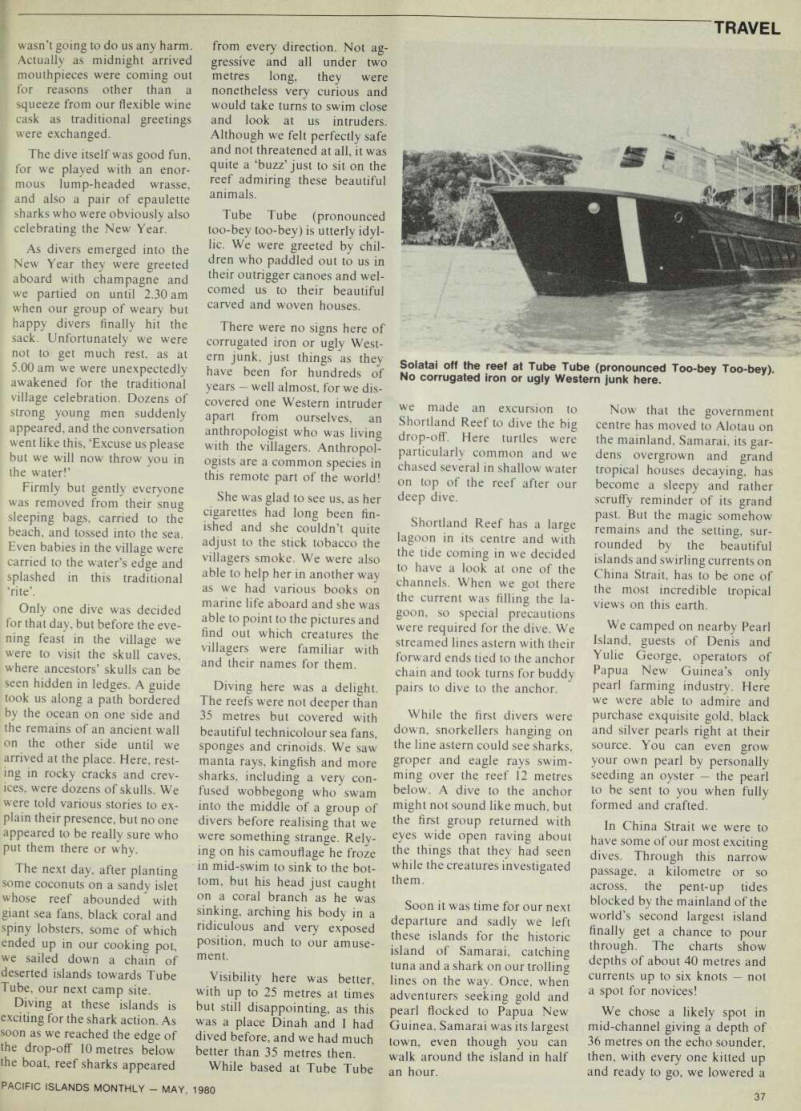

Milne Bay scuba safari
Milne Bay Province is well known for two main things.
The Trobriand ‘islands of love,’ famous for their lovely island lasses who still adorn them selves in little else but sexy grass miniskirts, the shortest in the Pacific, and the Battle of Milne Bay, where American and Australian forces first defeated the Japanese on land in World War 11.
We know Milne Bay as our home and to explore some of its reefs was our aim on a new type of holiday in a country where adventure is a way of life. We had been doing it our selves for years, just for fun.
We sailed Solatai from its base in Port Moresby to Alo tau, the provincial capital of Milne Bay Province, where it was only necessary to fill up with fuel and water and top up all the dive tanks before we met Air Niugini’s F 27 Bird of Para dise from Port Moresby with our 12 adventurers. Within minutes all were aboard and we set off for East Cape, the eastern extremity of the Papua New Guinea mainland. Solatai
is diesel-powered, fibreglass,
equipped for up to 20 divers.
No luxury hotel or even humble guest house was wait ing for us. We were on safari.
In the hold were tents and camping gear to enable us to live on the beach if necessary, but we hoped to stay in the vil lages and add the rich experi ence of living in another culture to our underwater adventures.
We need not have worried, wherever we went we were wel comed with open arms. Free of the hardships faced by less for-
tunate villagers in the more
rugged and climatically inhos
pitable parts of Papua New
Guinea, Milne Bay people
have abundant natural re sources and a generous, friendly nature to go with their attractive features.
At East Cape, they soon organised a traditional dance for us while we set up camp in an old mission house.
The next two days were
spent exploring the nearby
reefs and islands. This was a rewarding time for us, for although the visibility was not as good as usual varying around 20m it was good to watch the excitement gener ated as the divers saw their first shark, manta, turtle or giant clam. In these untouched waters the marine life is pro
lific, and every dive produced new sights and experiences and rare shells for the several collectors in our group.
After two days we moved on to Nuakata Island two hours
away, catching a good kingfish
and a couple of tuna for supper en route. Here we camped in the village church, and as the village was full of youngsters we had a continuous giggling and singing audience, with gasps and ‘oohs’ as our various
contraptions appeared. Filling
the air beds with a low pressure inflator attached to a scuba
bottle proved especially fas
cinating.
Here we were treated to a
magnificent display of drum
ming on a large drum carved from a tree trunk nearly a metre in diameter and played
by three drummers at once.
The leader, a highly energetic village girl, would have put any rock drummer to shame.
There was already great ex citement in the village as to night was New Year’s Eve and a feast is held on New Year’s Day. Now they had some extra guests. We decided to have our own celebration and see in the New Year underwater.
There was a pretty coral reef just where we anchored the boat 50 metres from shore in six metres of water, so at 11.45 pm we kitted up and in we went, armed with a supply of wine in a flexible container.
We all knew that drinking be fore diving is strictly out, but, as one of the divers pointed out, we hadn’t read anywhere about drinking while you are diving and we figured that one mouthful in six metres of water
Dinah Halstead (centre) prepares to lead the diving team over the side in China Strait, Milne Bay.
wasn’t going to do us any harm.
‘ Actually as midnight arrived
mouthpieces were coming out
for reasons other than a squeeze from our flexible wine cask as traditional greetings
were exchanged.
The dive itself was good fun, f for we played with an enor mous lump-headed wrasse, and also a pair of epaulette sharks who were obviously also celebrating the New Year.
As divers emerged into the New Year they were greeted aboard with champagne and we partied on until 2.30 am when our group of weary but happy divers finally hit the sack. Unfortunately we were not to get much rest, as at 5.00 am we were unexpectedly awakened for the traditional village celebration. Dozens of strong young men suddenly appeared, and the conversation went like this, ‘Excuse us please but we will now throw you in the water!’
Firmly but gently everyone
was removed from their snug sleeping bags, carried to the beach, and tossed into the sea.
Even babies in the village were carried to the water’s edge and splashed in this traditional ‘rite’.
Only one dive was decided for that day, but before the eve ning feast in the village we were to visit the skull caves, where ancestors’ skulls can be seen hidden in ledges. A guide took us along a path bordered by the ocean on one side and the remains of an ancient wall on the other side until we arrived at the place. Here, rest ing in rocky cracks and crev ices, were dozens of skulls. We were told various stories to ex plain their presence, but no one appeared to be really sure who put them there or why.
The next day, after planting some coconuts on a sandy islet whose reef abounded with giant sea fans, black coral and spiny lobsters, some of which ended up in our cooking pot, we sailed down a chain of deserted islands towards Tube Tube, our next camp site.
Diving at these islands is exciting for the shark action. As soon as we reached the edge of the drop-off 10 metres below the boat, reef sharks appeared
from every direction. Not ag gressive and all under two
metres long, they were
nonetheless very curious and would take turns to swim close and look at us intruders.
Although we felt perfectly safe and not threatened at all, it was quite a ‘buzz’just to sit on the reef admiring these beautiful animals.
Tube Tube (pronounced
too-bey too-bey) is utterly idyl
lic. We were greeted by chil dren who paddled out to us in their outrigger canoes and wel comed us to their beautiful carved and woven houses.
There were no signs here of corrugated iron or ugly West
ern junk, just things as they
have been for hundreds of years well almost, for we dis covered one Western intruder apart from ourselves, an
anthropologist who was living
with the villagers. Anthropol
ogists are a common species in this remote part of the world!
She was glad to see us, as her cigarettes had long been fin ished and she couldn’t quite adjust to the stick tobacco the villagers smoke. We were also able to help her in another way as we had various books on marine life aboard and she was able to point to the pictures and find out which creatures the villagers were familiar with and their names for them.
Diving here was a delight.
The reefs were not deeper than 35 metres but covered with beautiful technicolour sea fans, sponges and crinoids. We saw manta rays, kingfish and more sharks, including a very con fused wobbegong who swam into the middle of a group of divers before realising that we
were something strange. Rely
ing on his camouflage he froze in mid-swim to sink to the bot tom, but his head just caught on a coral branch as he was
sinking, arching his body in a
ridiculous and very exposed position, much to our amuse ment.
Visibility here was better, with up to 25 metres at times but still disappointing, as this was a place Dinah and I had dived before, and we had much better than 35 metres then.
While based at Tube Tube
we made an excursion to Shortland Reef to dive the big drop-off. Here turtles were particularly common and we chased several in shallow water on top of the reef after our
deep dive.
Shortland Reef has a large lagoon in its centre and with the tide coming in we decided to have a look at one of the channels. When we got there the current was filling the la goon, so special precautions were required for the dive. We streamed lines astern with their forward ends tied to the anchor chain and took turns for buddy pairs to dive to the anchor.
While the first divers were down, snorkellers hanging on the line astern could see sharks, groper and eagle rays swim ming over the reef 12 metres below. A dive to the anchor might not sound like much, but the first group returned with eyes wide open raving about the things that they had seen while the creatures investigated them.
Soon it was time for our next departure and sadly we left these islands for the historic island of Samarai, catching tuna and a shark on our trolling lines on the way. Once, when
adventurers seeking gold and
pearl flocked to Papua New Guinea, Samarai was its largest town, even though you can walk around the island in half an hour.
Now that the government centre has moved to Alotau on the mainland, Samarai, its gar dens overgrown and grand
tropical houses decaying, has
become a sleepy and rather scruffy reminder of its grand past. But the magic somehow remains and the setting, sur rounded by the beautiful islands and swirling currents on China Strait, has to be one of the most incredible tropical views on this earth.
We camped on nearby Pearl Island, guests of Denis and Yulie George, operators of
Papua New Guinea’s only
pearl farming industry. Here
we were able to admire and
purchase exquisite gold, black
and silver pearls right at their source. You can even grow your own pearl by personally seeding an oyster the pearl to be sent to you when fully formed and crafted.
In China Strait we were to have some of our most exciting dives. Through this narrow passage, a kilometre or so across, the pent-up tides blocked by the mainland of the world’s second largest island finally get a chance to pour through. The charts show depths of about 40 metres and currents up to six knots not a spot for novices!
We chose a likely spot in mid-channel giving a depth of 36 metres on the echo sounder, then, with every one kitted up and ready to go, we lowered a
Solatai off the reef at Tube Tube (pronounced Too-bey Too-bey) No corrugated iron or ugly Western junk here.
heavy line with a hefty lump of scrap-iron tied on with a thin cord. We felt the iron bump the bottom, hoisted it a metre or so and led the first group of seven down to the bottom as we drifted on. It was a parachute
entry go! go! go! over the
stern platform, onto the line and down to the bottom.
The bumping and dragging
of the weight attracts sharks and each time the lead diver descended he was greeted by an active large whaler but on seeing us crazy mob of divers appear, each time the shark, with a sharp flick of its tail, vanished. Every diver attached himself to the main line with a quick release loop on a shorter length so that he could swim clear and fly!
And fly we did! The drag caused by the slight difference in speed of Solatai in the sur face current and us at the bot tom meant we could stretch out our arms and soar and zoom on our individual lines. The bot tom ripped by. With 12 metre
visibilitiy we gasped as ledges
and gullies full of fish and thick with strange, stunted corals appeared and, in a flash, disap peared.
Occasionally we would run into turbulence and be bumped and thrown around like a small plane in a storm, but all the time rushing on, hanging in effortless motion, merely angling our fins and arms to lift over the next ledge. At 36 metres we had decided on 15 minutes bottom time, for the lead diver, then all would ascend to the surface after a five minute safety stop at three metres under the boat. On sur facing we could see that we had travelled well over a nautical mile, giving nearly five knots speed.
This was such an exhilarat ing experience that a repeat performance was demanded for the next day, and it was then, as the second group started to ascend, that our one fear materialised. The scrap stuck in a coral ledge, anchor ing us in this massive current.
Hanging on and trying to keep
your mask in place wasn’t easy!
The lead diver had to cut the thin cord holding the scrap and once again we were all on the move and ascent was effortless.
Although our safety factor was good, everyone had five min utes on the oxygen rig just to make sure the extra effort of hanging on in the current hadn’t produced any bends bubbles. But no one had any
problems.
This time we kept going with the current and were soon through China Strait and head ing into Milne Bay. Here in 1943 a furious battle was
fought as Japanese invaders
tried to gain a stepping stone to Port Moresby, but failed.
Fighting in the appalling mud and rain of the wet season, Australian and American troops for the first time stopped the Japanese advance.
Milne Bay itself is very deep, with only a very narrow coral ledge around its shores so that many of the wartime wrecks are impossible to dive. Dinah and I not long ago very sadly watched small oil drops surface and spread from a wartime wreck we had researched, but although we were only 30 metres or so from shore the echo sounder was reading 200 metres. At other times we had dived on the many small land ing barges and even a tractor dumped down the reef
slopes.
Now we were heading for the wartime wreck of a large coal refuelling barge sunk in a sheltered anchorage near
Waga Waga village directly
across the bay from Alotau.
The wreck has its bow out of the water and its stern in about 30 metres. Near the stern a tall lattice gantry reaches past the surface, its above-water part a rusty eyesore, its underwater frames festooned with clams, gorgonians and black coral. A huge groper lives on the wreck, but he avoided us this trip as we explored the holds still partly filled with coal, and admired corals on large winches and cables that had been used to transfer coal to the hungry warships. The same night we returned to the wreck to hunt for shell, but spent most of the time weaving our way
through the towering iron
framework of the gantry ad miring the blaze of colour in our torches.
We had been out for 12 nights and the tour was over.
Our adventurers informed us that they couldn’t possibly go back yet, and would be quite content to spend another week or so if that was all right with us. Why, we hadn’t even looked for the sunken Zero reported just a few kilometres up the coast, or dived the USS President Grant on the reef a few hours south of Samarai!.
But next year! Next year!
Samarai in China Strait, now a sleepy and rather scruffy reminder’ of a grand past. It was spic and span when this photograph was taken in 1966, but it is still a South Seas jewel, worth a visit for those wanting to get off the beaten track. You take a launch from the mainland at Alotau.
Advertisements & other items, pp. 36-40 (2 items)
Your Connection
to the World
\ \W UR G© v "s N N
(SFfD
m
FUKUOKA
KAGOSHIMA
Air Niugini’s Boeing Bird of Paradise jets connect the Pacific with the world. Now you can fly to anywhere in the world direct from
Air Niugini’s major international gateway
destinations.
Air Niugini offers you a choice of 11 international ports so you can plan your journey to suit yourself and your pocket.
FLY THE BIRD OF PARADISE
TO THE WORLD.
HONOLULU
KONG
MANILA
JAYAPURA
HONIARA
JAKARTA
PORT MORESBY
CAIRNS
BRISBANE
SYDNEY
SPS.I23.
JURNIUGINi
THE NA T/ONAL AIRLINE OF PAPUA NEW GUINEA
1:. gaß > »
pack a lot of power
PS r ■% '^r <-»<# yr» « *» •r^NSfets #^n *, • j -, \ ?/; Model DP-644 DIN Concept AM/FM-MPX Car Radio with Auto Reverse Cassette Car Stereo and 44 Watts Output Power These car stereo units feature an extra-compact design with a mere 135 mm chassis depth, so they take up little room. But there’s nothing little about their output power—an astounding 40 watts for the SP-785, 44 watts for the DP-644. And the LTM (Life Time Metal) playback head permits you to use normal or chrome/metal tapes and insures perfect
performance and long life.
So let these High Power units put new excitement into your driving hours.
Model SP-785 Auto Reverse Cassette Car Stereo with 40 Watts Output Power *
TEN CAR STEREO
Design and specifications subject to change without prior notice.
FUJITSU TEN LIMITED
Head Office: 2-28. Gosho-dori 1-chome. Hyogo-ku. Kobe, Japan Tokyo Office: (Export Section) Shuwa Onarimon Bldg., 2nd FI., 1-1. Shimbashi 6-chome, Minato-ku, Tokyo, Japan.
Phone; (03) 438-1611 Cable: TENFUJITSU TOKYO. Telex: 2425101 TENTOK J DSS ON - A Of F 7Qf/S |j Od Distributors: Papua New Guinea: CHIN H MEEN N SONS PTY. LTD. PO Box 1106, Boroko, Port Moresby, Papua New Guinea. Phone: 256546.
Guam: MICROPAC AUDIO INC. PO. Box 3478, Agana. Guam 96910. Phone: 472-8091.
Tahiti: FARE HI-FI STEREO. PO Box 269, Rue du Marechal Foch, Papeete New Hebrides: BURNS PHILP NEW HEBRIDES LIMITED. Vila, New Hebrides Cook Islands: AVATIU GENERAL TRADERS. PO, Box 27, Rarotonga Fiji: D. GOKAL& CO., LTD. G. PO. Box 501, Suva, Fiji Phone: 25259/22995.
Your
doorway
into the
fascinating
world of the South Seas 104 pages $4.00 or SUSS.OO posted.
Send to box 3408, GPO, Sydney, NSW, 2001, or use coupon insert in this issue.
J ORT MOl
♦ Right in tl business cfiti * A traditiomfor 1 comfort an&fint food ♦ All rdoms airconditioned Restaurant « Ea* * Banquet hall
LC. NEUMANN
manager Phone 21-262&VJ
Stay at Aggie Grey’s . . . the South Pacific’s
legendary hotel.
Situated right in the heart of Western Samoa. Enjoy Polynesian-style friendliness and service, in cool surroundings, superb entertainment and food.
Magnificent white sand beaches only a short drive away. Airconditioned rooms, swimming pool and full bar facilities.
Bookings through Union Steamship Company of NZ, Pan Am.
Air New Zealand or direct to Aggie Grey's, Apia. Western Samoa. Cables: ‘AGGIES' Apia.
the South Ricific,no other hotel group
When it comes to showing you
even comes close.
* 0 P OS With over 60 hotels throughout Australia and the South Pacific, Southern Pacific Hotel Corporation can offer you a variety of hotels and locations no other hotel group can even approach.
Our Boulevard, Parkroyal, Beachcomber, Travelodge and Holiday Inn hotels literally span the South Pacific. We can offer you the closest ski resort to the South Pole (Queenstown, New Zealand). See the New Guinea Mud Men close up (Port Moresby Travelodge). Big game fishing from Townsville, on Queensland’s North Coast. Or see the Geysers at Rotorua in New Zealand. Or a superb stay in a native style villa, sleeping over the gently lapping water at our Beachcomber Resort, Tahiti. In fact, just about anywhere you want to stay. From Australia to Western Samoa. From Tahiti to New Caledonia. From Papua New Guinea to Fiji. And the Cook Islands.
Over 60 hotels. Over 60 reasons why we’re the most accommodating people in the South Pacific.
For further information please write to us at G.PO. Box 537, Sydney, 2001. Australia, or for reservations telephone:- Sydney (02) 330601, Melbourne (03) 3871233, Brisbane (07) 2218586, Adelaide (08) 2236194, Perth (09) 3253811, Hobart (002) 34 7466 or (002) 34 6644, Darwin (089) 815388, Canberra (062) 491424, Auckland 33749 Telex: NZ2IOBB, Suva 24600 Telex: FJ2159, California (800) 4210536 Telex: 19-4569, Port Moresby 212266 Telex: 22248, Hong Kong 5232180 Telex: 63019, London (01) 5673444 Telex: 934946, Tokyo (03) 5082341 Telex: J 26810. Toronto 9239400 Telex: 210-6524797.
Australia. New Zealand. Fiji.
Tahiti. Cook Islands. Papua New Guinea.
New Caledonia. Western Samoa. Malaysia. 9
SOUTHERN PACIFIC HOTEL CORPORATION
Boulevard 9 Parkroyal 9 Beachcomber ©Travelodge 9 Holiday Inn
MASIUS/TVL3IB
Sela’s, where Tongan
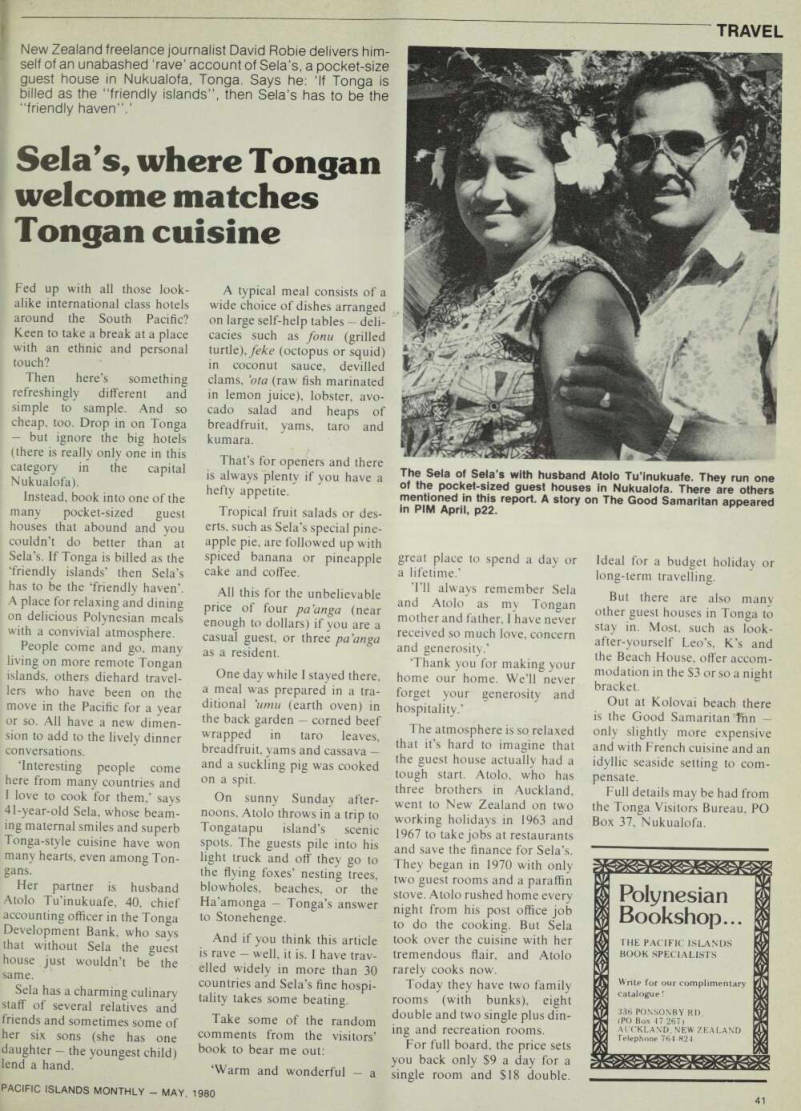
welcome matches Tongan cuisine
New Zealand freelance journalist David Robie delivers him self of an unabashed ‘rave’ account of Sela’s, a pocket-size guest house in Nukualofa, Tonga. Says he: ‘lf Tonga is billed as the “friendly islands’’, then Sela’s has to be the “friendly haven’’.’
Fed up with all those look alike international class hotels around the South Pacific?
Keen to take a break at a place with an ethnic and personal touch?
Then here’s something refreshingly different and simple to sample. And so cheap, too. Drop in on Tonga but ignore the big hotels (there is really only one in this category in the capital Nukualofa).
Instead, book into one of the many pocket-sized guest houses that abound and you couldn’t do better than at Sela’s. If Tonga is billed as the ‘friendly islands’ then Sela’s has to be the ‘friendly haven’.
A place for relaxing and dining on delicious Polynesian meals with a convivial atmosphere.
People come and go, many living on more remote Tongan islands, others diehard travel lers who have been on the move in the Pacific for a year or so. All have a new dimen sion to add to the lively dinner conversations. ‘lnteresting people come here from many countries and I love to cook for them,’ says 41-year-old Sela, whose beam ing maternal smiles and superb Tonga-style cuisine have won many hearts, even among Ton gans.
Her partner is husband Atolo Tu’inukuafe, 40, chief accounting officer in the Tonga Development Bank, who says that without Sela the guest house just wouldn’t be the same.
Sela has a charming culinary staff of several relatives and friends and sometimes some of her six sons (she has one daughter - the youngest child) lend a hand.
A typical meal consists of a wide choice of dishes arranged on large self-help tables - deli cacies such as form (grilled turtle), feke (octopus or squid) in coconut sauce, devilled clams, ’ota (raw fish marinated in lemon juice), lobster, avo cado salad and heaps of breadfruit, yams, taro and kumara.
That’s for openers and there is always plenty if you have a
hefty appetite.
Tropical fruit salads or des erts, such as Sela’s special pine apple pie, are followed up with spiced banana or pineapple cake and coffee.
All this for the unbelievable price of four pa’anga (near enough to dollars) if you are a casual guest, or three pa’anga as a resident.
One day while I stayed there, a meal was prepared in a tra ditional ’umu (earth oven) in the back garden corned beef wrapped in taro leaves, breadfruit, yams and cassava and a suckling pig was cooked on a spit.
On sunny Sunday after noons, Atolo throws in a trip to Tongatapu island’s scenic spots. The guests pile into his light truck and off they go to the flying foxes’ nesting trees, blowholes, beaches, or the
Ha’amonga Tonga’s answer
to Stonehenge.
And if you think this article is rave - well, it is. I have trav elled widely in more than 30 countries and Sela’s fine hospi
tality takes some beating.
Take some of the random comments from the visitors’ book to bear me out: ‘Warm and wonderful a
great place to spend a day or a lifetime.’
Til always remember Sela and Atolo as my Tongan mother and father, I have never received so much love, concern
and generosity.’
Thank you for making your home our home. We’ll never
forget your generosity and
hospitality.’
The atmosphere is so relaxed that it’s hard to imagine that the guest house actually had a tough start. Atolo, who has three brothers in Auckland, went to New Zealand on two working holidays in 1963 and 1967 to take jobs at restaurants and save the finance for Sela’s.
They began in 1970 with only
two guest rooms and a paraffin stove. Atolo rushed home every night from his post office job to do the cooking. But Sela took over the cuisine with her tremendous flair, and Atolo rarely cooks now.
Today they have two family
rooms (with bunks), eight double and two single plus din ing and recreation rooms.
For full board, the price sets you back only $9 a day for a single room and $lB double.
Ideal for a budget holiday or
long-term travelling.
But there are also many other guest houses in Tonga to stay in. Most, such as look after-yourself Leo’s, K’s and the Beach House, offer accom modation in the $3 or so a night bracket.
Out at Kolovai beach there is the Good Samaritan fhn only slightly more expensive and with French cuisine and an idyllic seaside setting to com pensate.
Full details may be had from the Tonga Visitors Bureau, PO Box 37, Nukualofa.
The Sela of Sela’s with husband Atolo Tu’inukuafe. They run one of the pocket-sized guest houses in Nukualofa. There are others mentioned in this report. A story on The Good Samaritan appeared in PIM April, p22.
Advertisements & other items, pp. 41-43 (1 item)
Bookshop...
Polynesian
THE PACIFIC ISLANDS
BOOK SPECIALISTS
Write for our complimentary catalogue!
336 PONSONBY Rl)
(PO Box 47 267)
AUCKLAND, NEW ZEALAND
Telephone 764-824
' m * m ** i * m m - A ■ m mm t* W •••,
The Toyota truck range. Built to be unbeatable.
Bad weather conditions, no problem.
Bad roads and driving surfaces, eaten up.
Difficult loads, no contest. Built tough. Built to take it.
There's a Toyota truck built for you.
HI * TOYOTA Land Cruiser Pickup TOYOTA Stout
TOYOTA Hi-Lux
TOYOTA Dyna
TOYOTA Toyo-Ace
TTM
TOYOTA Truck For unbeatable after service:
TOYOTA
PAPUA NEW GUINEA: ELA MOTORS, Scratchley Rd., Badili, P.O. Box 675, Port Moresby. U.S. TRUST TERRITORY: MICROL CORPORATION, P.O. 267 ' Saipan - FIJI ISLANDS: AUTOMOTIVE SUPPLIES COMPANY, P.O. Box 5177, Raiwaqa, Suva. AMERICAN SAMOA: BURNS PHILP pmm p^ SEA> C °" LTD ” Po ' B ° X 129 ' Pa9 ° Pa9 °' WESTERN SAMOA: BURNS PHILP (SOUTHSEA) CO., LTD., P.O. Box 188, Apia. TONGA: BURNS MPDmn S c° UTHSEA) C0 '' LTD ’' P °' B ° X 55, Nukualofa GUAM: ATKINS, KROLL (GUAM) LTD., P.O. Box 6248, Tamuning. NEW HEBRIDES: NEW flnrn ?^ S rt MOTORS ' Po ' B ° X 18, Vila ’ SOLOMON ISLANDS: MENDANA ENTERPRISES (5.1.) LTD., P.O. Box 174, Honiara. TAHITI: NIPPON B-P- 342, Papeete COOK ISLANDS: COOK ISLANDS TRADING CORPORATION LTD., P.O. Box 92, Rarotonga. NAURU ISLAND: NAURU irn PE D n TIVE SOCIETY. REPUBLIC OF KIRIBATI: TARAWA MOTORS, Box 36, Bairiki, Kiribati. NORFOLK ISLAND: MOUNT PITT (ENTERPRISES) LTD., P.O. Box 169. NEW CALEDON I A: SOCIETE IMPORTATION AUTOMOBILE DU PACIFIQUE, Rond-Poind du Pacific (Station Total) B.P. 438. Noumea.
Sir Albert_and
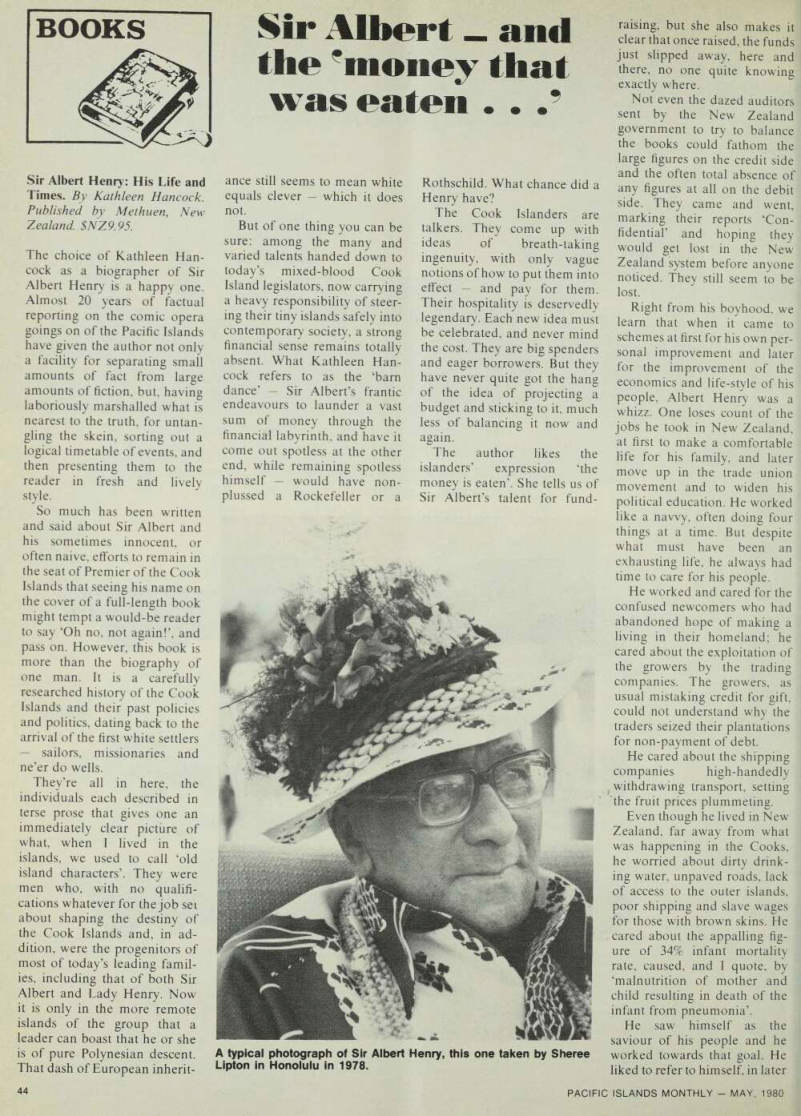
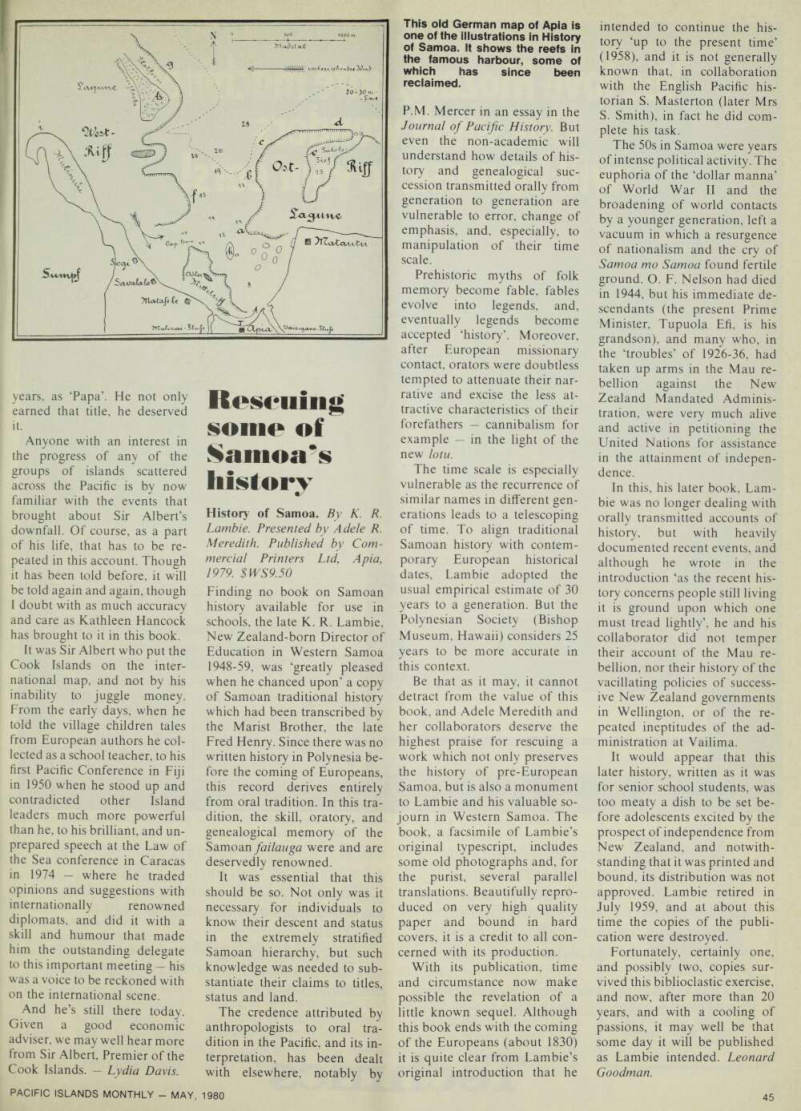
Books
Sir Albert_and the f 'money that was eaten ...'
Sir Albert Henry: His Life and Times. By Kathleen Hancock.
Published by Methuen, New Zealand. 5NZ9.95.
The choice of Kathleen Han cock as a biographer of Sir Albert Henry is a happy one.
Almost 20 years of factual reporting on the comic opera goings on of the Pacific Islands have given the author not only a facility for separating small amounts of fact from large amounts of fiction, but, having laboriously marshalled what is nearest to the truth, for untan gling the skein, sorting out a logical timetable of events, and then presenting them to the reader in fresh and lively
style.
So much has been written and said about Sir Albert and his sometimes innocent, or often naive, efforts to remain in the seat of Premier of the Cook Islands that seeing his name on the cover of a full-length book might tempt a would-be reader to say ‘Oh no, not again!’, and pass on. However, this book is more than the biography of one man. It is a carefully researched history of the Cook Islands and their past policies and politics, dating back to the arrival of the first white settlers sailors, missionaries and ne’er do wells.
They’re all in here, the individuals each described in terse prose that gives one an
immediately clear picture of
what, when I lived in the islands, we used to call ‘old island characters’. They were men who, with no qualifi cations whatever for the job sei about shaping the destiny of the Cook Islands and, in ad dition, were the progenitors of most of today’s leading famil ies, including that of both Sir Albert and Lady Henry. Now it is only in the more remote islands of the group that a leader can boast that he or she is of pure Polynesian descent.
That dash of European inherit
ance still seems to mean white equals clever which it does not.
But of one thing you can be sure; among the many and varied talents handed down to today’s mixed-blood Cook
Island legislators, now carrying
a heavy responsibility of steer
ing their tiny islands safely into
contemporary society, a strong financial sense remains totally absent. What Kathleen Han cock refers to as the ‘barn dance’ Sir Albert’s frantic endeavours to launder a vast sum of money through the financial labyrinth, and have it come out spotless at the other
end, while remaining spotless
himself would have non plussed a Rockefeller or a
Rothschild. What chance did a
Henry have?
The Cook Islanders are talkers. They come up with ideas of breath-taking
ingenuity, with only vague
notions of how to put them into effect and pay for them.
Their hospitality is deservedly
legendary. Each new idea must be celebrated, and never mind the cost. They are big spenders and eager borrowers. But they have never quite got the hang of the idea of projecting a budget and sticking to it, much less of balancing it now and
again.
The author likes the islanders’ expression ‘the money is eaten’. She tells us of Sir Albert’s talent for fund-
raising, but she also makes it clear that once raised, the funds just slipped away, here and there, no one quite knowing
exactly where.
Not even the dazed auditors sent by the New Zealand government to try to balance the books could fathom the large figures on the credit side and the often total absence of any figures at all on the debit side. They came and went, marking their reports ‘Con
fidential’ and hoping they
would get lost in the New Zealand system before anyone noticed. They still seem to be lost.
Right from his boyhood, we learn that when it came to schemes at first for his own per sonal improvement and later for the improvement of the economics and life-style of his people, Albert Henry was a whizz. One loses count of the jobs he took in New Zealand, at first to make a comfortable life for his family, and later move up in the trade union movement and to widen his political education. He worked like a navvy, often doing four things at a time. But despite what must have been an exhausting life, he always had time to care for his people.
He worked and cared for the confused newcomers who had abandoned hope of making a living in their homeland; he cared about the exploitation of the growers by the trading companies. The growers, as usual mistaking credit for gift, could not understand why the traders seized their plantations for non-payment of debt.
He cared about the shipping
companies high-handedly
withdrawing transport, setting
the fruit prices plummeting.
Even though he lived in New Zealand, far away from what was happening in the Cooks, he worried about dirty drink ing water, unpaved roads, lack of access to the outer islands, poor shipping and slave wages for those with brown skins. He cared about the appalling fig ure of 34% infant mortality rate, caused, and I quote, by ‘malnutrition of mother and child resulting in death of the infant from pneumonia’.
He saw himself as the saviour of his people and he worked towards that goal. He liked to refer to himself, in later
A typical photograph of Sir Albert Henry, this one taken by Sheree Lipton in Honolulu in 1978.
years, as ‘Papa’. He not only earned that title, he deserved it.
Anyone with an interest in the progress of any of the groups of islands scattered across the Pacific is by now familiar with the events that brought about Sir Albert’s downfall. Of course, as a part of his life, that has to be re peated in this account. Though it has been told before, it will
be told again and again, though
I doubt with as much accuracy and care as Kathleen Hancock has brought to it in this book.
It was Sir Albert who put the Cook Islands on the inter national map, and not by his
inability to juggle money.
From the early days, when he told the village children tales from European authors he col lected as a school teacher, to his first Pacific Conference in Fiji in 1950 when he stood up and contradicted other Island leaders much more powerful than he, to his brilliant, and un prepared speech at the Law of the Sea conference in Caracas in 1974 — where he traded
opinions and suggestions with
internationally renowned
diplomats, and did it with a skill and humour that made
him the outstanding delegate
to this important meeting — his was a voice to be reckoned with on the international scene.
And he’s still there today.
Given a good economic adviser, we may well hear more from Sir Albert, Premier of the
Cook Islands.
Lydia Davis.
Rescuing
some of Samoa's history
History of Samoa. By K. R.
Lambie. Presented by Adele R.
Meredith. Published by Com mercial Printers Ltd, Apia,
1979. Sws9.So
Finding no book on Samoan history available for use in schools, the late K. R. Lambie, New Zealand-born Director of Education in Western Samoa
1948-59, was ‘greatly pleased
when he chanced upon’ a copy of Samoan traditional history which had been transcribed by the Marist Brother, the late Fred Henry. Since there was no written history in Polynesia be fore the coming of Europeans, this record derives entirely from oral tradition. In this tra dition, the skill, oratory, and genealogical memory of the Samoan failauga were and are
deservedly renowned.
It was essential that this should be so. Not only was it necessary for individuals to know their descent and status in the extremely stratified Samoan hierarchy, but such knowledge was needed to sub stantiate their claims to titles, status and land.
The credence attributed by anthropologists to oral tra dition in the Pacific, and its in terpretation, has been dealt
with elsewhere, notably by
P.M. Mercer in an essay in the
Journal of Pacific History. But
even the non-academic will understand how details of his tory and genealogical suc cession transmitted orally from generation to generation are vulnerable to error, change of
emphasis, and, especially, to
manipulation of their time scale.
Prehistoric myths of folk memory become fable, fables evolve into legends, and,
eventually legends become
accepted ‘history’. Moreover,
after European missionary
contact, orators were doubtless tempted to attenuate their nar rative and excise the less at tractive characteristics of their forefathers cannibalism for example in the light of the new lotu.
The time scale is especially vulnerable as the recurrence of similar names in different gen erations leads to a telescoping of time. To align traditional Samoan history with contem porary European historical dates, Lambie adopted the usual empirical estimate of 30 years to a generation. But the
Polynesian Society (Bishop
Museum, Hawaii) considers 25 years to be more accurate in this context.
Be that as it may, it cannot detract from the value of this book, and Adele Meredith and her collaborators deserve the
highest praise for rescuing a
work which not only preserves the history of pre-European Samoa, but is also a monument to Lambie and his valuable so journ in Western Samoa. The book, a facsimile of Lambie’s
original typescript, includes
some old photographs and, for
the purist, several parallel
translations. Beautifully repro duced on very high quality paper and bound in hard covers, it is a credit to all con cerned with its production.
With its publication, time and circumstance now make possible the revelation of a
little known sequel. Although
this book ends with the coming of the Europeans (about 1830) it is quite clear from Lambie’s original introduction that he
intended to continue the his tory ‘up to the present time’ (1958), and it is not generally known that, in collaboration with the English Pacific his torian S. Masterton (later Mrs S. Smith), in fact he did com plete his task.
The 50s in Samoa were years of intense political activity. The euphoria of the ‘dollar manna’ of World War II and the broadening of world contacts by a younger generation, left a vacuum in which a resurgence of nationalism and the cry of Samoa mo Samoa found fertile ground. O. F. Nelson had died in 1944, but his immediate de scendants (the present Prime Minister, Tupuola Efi, is his grandson), and many who, in the ‘troubles’ of 1926-36, had taken up arms in the Mau re bellion against the New Zealand Mandated Adminis tration, were very much alive and active in petitioning the United Nations for assistance in the attainment of indepen dence.
In this, his later book, Lam bic was no longer dealing with orally transmitted accounts of
history, but with heavily
documented recent events, and although he wrote in the introduction ‘as the recent his tory concerns people still living it is ground upon which one must tread lightly’, he and his collaborator did not temper their account of the Mau re bellion, nor their history of the
vacillating policies of success
ive New Zealand governments in Wellington, or of the re peated ineptitudes of the ad ministration at Vailima.
It would appear that this later history, written as it was for senior school students, was too meaty a dish to be set be fore adolescents excited by the prospect of independence from New Zealand, and notwith standing that it was printed and bound, its distribution was not approved. Lambie retired in July 1959, and at about this time the copies of the publi cation were destroyed.
Fortunately, certainly one,
and possibly two, copies sur vived this biblioclastic exercise, and now, after more than 20 years, and with a cooling of passions, it may well be that some day it will be published as Lambie intended. Leonard Goodman.
This old German map of Apia is one of the illustrations in History of Samoa. It shows the reefs in the famous harbour, some of which has since been reclaimed.
Advertisements & other items, p. 46 (1 item)
Technics
CW
COUK»»”
rI r> ccnobaa :j * u Lx .•S- Picture shows. Ltoß: SL-10 turntable, SU-CO3 amplifier, ST-CO 3 tuner and RS-MO 2 cassette deck Technics hi-fi components have been hailed as state-of-the-art all over the world.
But the fact that our lives revolve around our direct-drive turntables hasn't blinded us to the fact that there are millions of people in the world who do not share our love affair with electronics.
Hence the new Concise Component Series.
A whole micro component system—including a direct-drive, linear-tracking turntable—only a fraction wider than the LPs it plays.
The big, beautiful sound coming out of these tiny units may surprise you, but it shouldn't.
After all, the young Mozart proved years ago that you don't have to be big to produce beautiful music.
Technics
Glifted writers
among the bores
The Indo-Fijian Experience.
Published by University of
Queensland Press. Edited by Subramani. 5F6.75.
May 1979 marked the hun dredth anniversary of the coming of the Indians to Fiji.
For the occasion a com mittee was set up to raise funds to build a commemorative multi-cultural centre on more than five hectares of government-donated land at Lautoka, Fiji’s second city on the main island of Viti Levu.
The ambitious project was estimated to cost an astronomi cal SF2 million. The committee came up with several ideas to raise this money. One was to publish and sell a book about the indenture period and events surrounding it.
The result? A book called
The Indo-Fijian Experience re
cently released by the Univer sity of Queensland Press.
The book of more than 200 pages, is a collection of articles, personal anecdotes, short stories and poems by a host of largely local writers. It is div ided into three sections, begin
ning with an interpretative
article on Indians in Fiji by Dr Ahmed Ali, a lecturer at the University of the South Pacific who is well known locally for his political commentaries.
Ali explains the forces that led the Indians to throw aside the shackles of tradition and custom and renounce their motherland in favour of a far away and unknown island
called Fiji. Among other things
the article tells of the dreaded sea voyages, their arrival, their contact with the ethnic Fijians, the indenture itself and the atti tude of the British Government towards them.
Ali offers, often with
probing deftness, insights into
the Indians’ quest for political
equality, their feelings of
insecurity and their deep
rooted desire to own land. He tells of the conflicting emotions
of a race that initially came to make a fortune and then return home, but who, as they began to put down roots in Fiji, gradually started to sever the umbilical cord that bound them to India.
I found some of Ali’s obser vations brilliant, his insights
piercing, occasionally harsh
and at times uncomfortable.
But despite its facinating con tent, Ali’s chief flaw is in mak ing his article a bit too academic and putting it be yond the reach of the average reader.
One of the most terrible maritime disasters in Fiji was the wreck of the indenture ship Syria in 1884. The wreck on Nasilai reef near Suva cost 70 lives. A relatively unknown local writer Brij V. Lai tells all about it in a simple narrative titled The Wreck of Syria.
Donald Brenneis’ article on the conflict in a rural Indian settlement in Fiji called Bhat gaon, and another article jointly written by Brenneis and Ram Padarath on song chal lenges in the same village, are presented as research papers in the book. I found both of them dull and more suitable for a re search textbook.
The second part begins with what I consider is the most brilliant piece in the whole book. It is a chapter from a book called Turn North-East of the Tombstone written by the late Walter Gill who worked for the Colonial Sugar Re
fining Company during the
indenture period.
It is a tragic-comic account of how a 22-year-old white overseer struggles to cope with the demanding work of being in charge of a group of inden tured labourers, assigning them work, running into strife while giving them their meagre pay, acting as their nursemaid, and attending to their wide range of peculiar and at times outrage ous problems. Gill is a superb story-teller and the result is
both captivating and hilarious.
His piece alone makes it worth ing buying the book you will
enjoy it.
Through The Time Tunnel by Vijendra Kumar of the Fiji Times is a touching account of how he successfully sets out to fulfil a childhood dream by visiting his grandmother’s birthplace in a small village in India which she had left several decades ago. Simply written, it has parallels with Roots the best-seller by Alex Hailey, and is likely to appeal to a wide spectrum of readers.
The second section also con
tains two pieces by the gifted
local writer and USP lecturer Raymond Pillai, both of which were published by PIM some time ago. Pillai’s style is unpre
tentious and unusually appeal
ing.
There are also four short stories by the book’s editor Subramani including Mari golds which was the winner of the first short story compe tition run by the South Pacific Association for Common wealth Literature and Language Studies last year.
I felt somehow let down after
reading Marigolds and his
other stories. Perhaps I unfairly expected a lot simply because of all the publicity about Mari golds. But I feel that in his
stories, particularly Marigolds
and No Man’s Land , Subramani fails to achieve the common ground a writer needs to share with his audience to get his work not only read but under stood.
The Guru , a short story by Satendra Nandan, another local writer and lecturer at the USP, is a humorous and fairly well written piece once you do away with excesses like the bit about ‘sweat trickling down the crotch’. Nandan’s flaw in writing is his use of vulgarity.
Some writers have the knack of
using vulgarity and giving it the
appearance of art but somehow when Nandan uses it it seems like sheer bad taste.
Sulochna Nand’s poem A Bastard Child is a sharply ob servant account of what it is like to be born the child of an Indian father and a Fijian mother. The poem has an
honesty and reality about it that is revealing and sad.
I found the style of writing in Sumant Kevat’s and Saten dra Nandan’s poems chaotic.
Both fail to establish what their poems are all about. The pace is often disjointed and ab rupt.
Vijay C. Mishra’s piece titled The Indo-Fijian Fiction is too
long, boring and simply not
suitable for a book such as this.
He simply fails to capture one’s interest. Let’s be frank. Does the average reader give a damn about such supposedly ‘schol
arly’ analysis? Again the piece
was more suited to a text book.
After going through the
whole book I feel it contains a few good pieces that make it
worth buying.
However, I have a feeling that because of its unattractive cover and the poor choice of much of the material the book is ultimately destined to gather dust on the shelves of reference
libraries.
Sarita Singh.
Advertisements & other items, pp. 47-48 (1 item)
Pleasure
ISLANDS
of the South
Pacific
A holiday guide adventure story and history all in one
COLIN SIMPSON'S
LATEST
239 pages, including 32 colour plates. $15.95 or SUSIB.SO posted.
Send to box 3408, GPO, Sydney, NSW, 20b 1, or use coupon insert in this issue.
IRHUEUinC
TO OUST noun
soon?
Uie can supply
business cnntacts
Businessmen travelling to Australia can call on the services of the Australian Trade Commissioner.
He can provide introductions to the Regional Offices of the Department of Trade and Resources located in all Australian capitals.
These offices have been established to directly introduce overseas businessmen to Australian manufacturers and trading companies.
He maintains a comprehensive register system of goods and services available from Australia. If it is available from Australia he can tell you who supplies it.
Easy communications and rapid shipping services make Australia a logical trading partner, and the Australian Trade Commissioner is here to assist development of two way trade.
l>*vl
Ask the expert who knows Australia The Australian Trade Commissioner can give you details of suppliers and also advise you on ways to research or develop markets in Australia. You can contact an Australian Trade Commissioner at these addresses:
FIJI
P.O. Box 1252, Suva.
Phone;3l 2844
PAPUA NEW GUINEA
P.O. Box 9129, Hohola.
Phone: 25 9333
NEW CALEDONIA
P.O. Box 22, Noumea.
Phone: 27 2414
Ask the Australian Trade Commissioner
Islands
From the
Press
From The Fiji Times The commander of Fiji’s 23-man contingent in Zimbabwe-Rhodesia, Major Aca Soqosoqo, told yesterday how they lived side-by-side with simmering violence and death. But the Fiji soldiers’ diplomacy, tact and untold patience ‘saved the day’, he said. T told my boys to act just like Fijians and that’s how we pulled off the job,’ he said .. . Major Soqosoqo said he was the first black man ever to join an all-white club in Rhodesia...
From Cook Islands News, Rarotonga A dramatic incident interrupted the usually long and tedious Sunday afternoon for the CIBNC announcer yesterday. An anonymous telephone caller with an apparent grudge against banks demanded that an announcement be made over the air that all paper money be taken to the local tip and burnt. If his demand was not complied with the caller threatened to come into the studio and kill the announcer. He also insisted that any new paper money to be issued should be printed with a Queen’s head on it, this new Queen to be chosen by the people of
Rarotonga...
From a letter to the PNG Post-Courier, Port Moresby I am a typical Southern Highlander and would like to ask the government why they are wasting their money on prisoners. I don’t know why the Justice Department is making the prison camps a better place to dwell in, wasting money buying expensive food like rice, meat, wheat, etc, and also providing better services like transport, shower blocks and clothing. In my opinion, the government and the Justice Department are funding unnecessary services. Prisoners should be locked up all day. They should be fed with pure brown rice, or kaukau where there is a place where kaukau is grown, made to work in public where the public can mock and joke at them and even laugh at those criminals who break the law. In the last few years killing was going on when people just committed crime in public, thinking that if they went to prison they would go and eat food and even grow fat sitting doing nothing. The state-of-emergency that was released last year was due to this thinking of the citizens of this country. At the moment I have seen and heard many citizens of this country saying ‘Mi go kalabus and mi go kaikai brown rice tasol’ and they just start creating all sorts of crime. The Southern Highlands Province is really and totally attracted by this phrase and villagers are attacking their neighbours or their enemies that they hate.
Southern Highlands used to be a very peaceful province apart from the other highlands provinces, but they don’t seem to take any notice of law and order for the country. Their goal is the prison camp, so I suggest the government do something about this existing behaviour by cutting the food supply ...
From The Fiji Times The Western Regional Library lost more than $5500 worth of library books last year, according to acting assistant librarian Mrs Pushpa Naresh. Mrs Naresh said thousands of books had not been
returned over the past three years and after issuing three notices to the people concerned without getting a reply, the library assumed the books were lost. She said the Government allocated $20,000 each year for the library to buy books. Of that amount, the library lost one quarter in unreturned books.
Solomon Islands News Drum The father of a man convicted of murder has been ordered to pay $ 1,000 compensation to the dead man’s family. The Magistrate who heard the case in the civil court at Auki, explained the claim was made under Malaita custom laws for compensation, which in this case were allowed under the Constitution of the Solomon Islands. He said in 1978 Ruruka, of North Malaita, was found guilty of murdering Alick Waio of South Malaita, and was sentenced to life imprisonment. The dead man’s family was represented by John Siho, who summoned Ruruka’s father Isake Tosika, to pay $1,400 compensation. Mr Tosika agreed that it was custom to pay compensation if a man from one tribe killed a man from another tribe. Because his son was jailed by law no compensation was payable, and he would not pay unless his son was released. He said even if compensation was payable, $1,400 was too much. It should be $lOO. The Magistrate said that because Ruruka was in prison did not prevent compensation payment.
Allowing for Ruruka’s imprisonment and considering all the evidence, he decided the compensation should be $ 1,000. He also ordered Mr Tosika to pay $75 costs claimed by the plaintiff (dead
man’s family).
Uni Tavur, Papua New Guinea student paper An Enga student leader has called on the government to stop foreign scholars studying village life to complete their degree courses. The president of Enga Pressure Group, Mike Mapusia, has said that ‘the Enga people have been made use of by writers and researchers from other countries who are in search of material for their personal doctoral or master degree courses. Previous researchers have raped the wealthy virgin culture of the Enga people.’ Mr Mapusia said. ‘Not only do the researchers benefit personally but the research papers create and present bad images of PNG traditional culture,’ he said. Mr Mapusia said this was because the writers were unfamiliar with their subjects. He said there were enough people in the country’s two universities who could write about PNG’s cultures. The Enga Provincial Government has also been asked to look into this matter...
From Pitcairn Miscellany, Pitcairn Island extract from article by German social scientist Birgit Groth, who is writing a thesis on Pitcairn society I am aware that some of the local people may feel a bit apprehensive of someone snooping around and then writing halftruths. But I shall sincerely attempt to do neither one nor the other. After all, a doctoral thesis is hardly an attempt at a bestseller, and a scientist’s ethics are hopefully a cut above those of the average journalist... I have been asked already about my first impressions. Certainly I came here too well prepared to expect grass skirts and the like. Even so, Pitcairn surprised me by being much less ‘backward’ than I thought it must be due to its isolation. The Pitcairners are much more educated and world-wise than I had expected, and the lifestyle in general, apart from the climate, the exotic surroundings and the mosquitoes to me resembles astonishingly the one I experienced as a child in my grandparents’ village in Germany. Maybe that’s why I already feel so much at home on Pitcairn Island!
From Marshall Islands Journal, Majuro There is a well known story of a married couple blessed with two sons, one an extreme optimist, the other a dour pessimist.
To cure their offspring of their respective imbalances, it was decided to give the pessimist a pony for Christmas, and the optimist a stable full of horse manure. The pessimist, of course, fretted when he saw his new pony: ‘lt will probably get sick and
die,’ he said. The optimist, on the other hand, gleefully jumped
into the pile of horse manure, began throwing it aside, and said, ‘I know there’s a pony in here somewhere’. Well, folks, sorry for all you pessimists out there, but we feel the tidal storm that struck Majuro has a pony in it and all we have to do is find it. We could look for cleaner beaches if all we do is not dirty them up again. We could look for improved housing if we can restrain ourselves from re-establishing the horrible shacks that were washed away. . . Ah, the list is interminable. The opportunity is ours .. .
From a letter to Solomon Islands News Drum, Honiara Since the Solomon Islands has gained independence, it has been great seeing a great number of our students going overseas, doing various diploma and degree courses. Among these students are some of our most beautiful and privileged girls. This is not at all bad, but the sad thing about these girls is that they can’t complete their specified courses successfully. I’m not saying that they are not intelligent or bright enough. The fact is that about 99% of them don’t think of the taxpayers when they go overseas.
Arriving at their place of study, they start to live a life which they had never lived since they had been at school. Questions from the opposite sex are always positive, not realising the long term consequences which they eventually realize when it is too late. The end product is a group of sorrowful parents, instead of happy ones, waiting for their daughter to return home with an unwanted product both for the parents, but especially the taxpayers. Therefore fellow students, especially the female ones, think twice about the male questions when you are overseas.
Don’t say ‘yes’ when you don’t know whether there is a demand for your product...
Reader’s letter signed ‘Steam and Dry’ in Nauru Post, Nauru Male chauvinism has reared its ugly head - the women of Nauru have been discriminated against by the decision to stop the Chinese laundry service - about the only real service Nauruan women enjoy. Many are too shy to have a ‘foreigner’ come into the home to do their ironing/cleaning. The Chinese who collect the laundry, mend it and bring it back starched provide an acceptable alternative. Expatriates can arrange for housegirls from Location, good luck to them. But why shouldn’t Nauruan women be able to enjoy their laundry service? If it’s a matter of using electricity then either meter the Location and charge for that used above a certain rate, or else stop the air conditioners and let the laundry service continue . . .
From the Norfolk Island News Norfolk Island seems to many visitors to be a simple, pleasant and uncomplicated place. But if you care to look more deeply, and to gain a more informed understanding of the Island, you will find it is as intricate as a piece of symphonic music ... As you talk with people on Norfolk you’ll doubtless hear disagreement on some of the opinions given; Islands attract individualists, with their own strong ideas about many things. But the subjects are keys to knowing Norfolk ...
From Atoll Pioneer, Tarawa, Kiribati Monica was understandably nervous in her first competition, but she has an immaculate swing which will make her a redoubtable opponent once her putting matches the same standard. She was helped throughout her round by some useful coaching from leuan whose serial golf shots and expansive nether regions were recently
given Pacific-wide acclaim . . .
Advertisements & other items, p. 50 (1 item)
In cooking
SPEED-E-GAS
is fast, efficient
and reliable.
Terminals throughout the Pacific.
For more information write Boral Gas Limited, 221 Miller Street, DAD AI North Sydney 2060 *Speed-E-Gas is known in Papua New Guinea, as Guinea Gas. In Tonga as Tonga Speed-E-Gas, and in Fiji as Fiji Gas.
SPEEDE-GAS
Q ss.
HOLT GS 13
The '50s: A loss of innocence

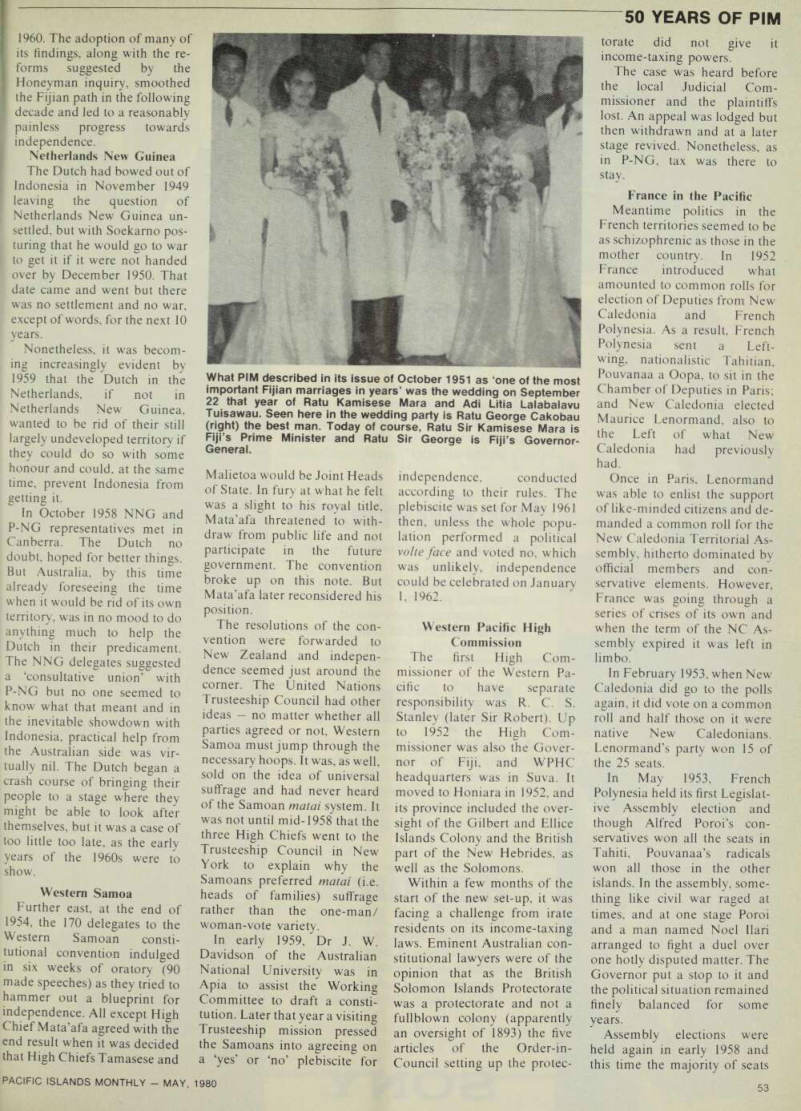

as politics hit the road
In her survey of PlM’s 50 years, JUDY TUDOR this month analyses the decade of the 1950 s which, she says, came into being like a ‘puling infant’ but went out like a ‘snarling tiger’. The difference? ‘By then politics were on the march in the once gay and feckless islands, portents of things to come.’ Her area-by-area study of the decade only underlines this basic point. But there are many lighter sides to this highly readable account of PIM, and the islands it serves, in the 19505.
If the decade of the 1950 s had come in like a puling infant, whimpering still at the postwar problems that took so long to solve in some of the territories and islands of the South Pa cific, it went out like a fully adult and snarling tiger. By then politics were on the march in the once gay and feckless islands, portents of things to come. We’ll survey the Pacific
piece by piece:
Papua-New Guinea.
In P-NG, the Liberal
Government’s Percy Spender
lasted barely a year as External Territories Minister before being sent to Washington as Australian Ambassador which was, so the story went, Prime Minister Menzies’ way of getting rid of a potential rival.
His place was taken by Paul Hasluck and he, in time, be came as controversial a figure as Labor’s Eddie Ward. The idea that a Liberal government in Canberra would reverse the
direction already taken by
Labor died hard and the death was made even more pro tracted by the fact that the Lib erals had initially announced that development of the Terri tory by Europeans (later called expatriates) was part of their policy and this many took to
mean that European develop
ment would be paramount.
Mr Hasluck’s most vocifer ous critics (apart from PIM) were those anxious to settle on the land and grow something but were then forced to wait for years, or even in vain, before the cumbersome land-leasing machinery delineated cocoa blocks, coffee blocks, tea estates, pastoral leases and so forth, and put them up for ten der. In the light of events, 15 or 20 years on, when the Terri tory of Papua-New Guinea be came the independent country
of Papua New Guinea, without
the hyphen, it might be thought
that land settlement for non indigenes was a wasted effort.
However, without white pioneering effort and know how, the country would not have been the going concern that it was at the time of
change-over.
Although a Legislative
Council had been provided for in the Papua-New Guinea Act of 1949, the first council was not set up until 1951. It con sisted of the Administrator as President, 16 official members, six European nominated members representing min ority groups, three nominated native members and three elected European members.
Although its composition was
criticised, Canberra remained unmoved, the election of the European members Don Bar rett (NG Islands), C. M. Jacob son (NG Mainland) and E.A.
James (Papua) duly took place
and council met for the first time at the end of 1951.
The venue was the old Red Cross Hall at Ela Beach but Canberra made up for the paucity of facilities with the at tendance of VIPs from South.
The ‘speech from the throne’
was read by Sir John Northcott, acting Governor-General of Australia, and Paul Hasluck and entourage were also there.
The show was impressive enough to have some formerly
cynical Territorians declaring
that it just might provide a ‘new
channel for reaching Moresby
or Canberra’.
They soon changed their
minds. The council was later declared to be just a glorified debating society, put there so that official members, against their own best interests, could force through ideas dreamed up in the back rooms of the
Canberra bureaucracy.
Two months earlier, Briga dier Donald M. Cleland had been appointed Assistant Ad ministrator. He was already known in the Territory, having been chairman of the wartime Production Control Board although in the interim he had been director of the Federal Secretariat of the Australian
Liberal Party.
Nine months later the Ward appointed Administrator, Co lonel J. K. Murray, retired, two years before his term of office was to expire. ‘Forced out of office’ was a more accurate way of putting it. At the time PIM
was as anti-Murray as it was anti-Ward and attributed his retirement to his being a stum bling block to the Liberal government’s desire to get on with developing land in the Territory. In view of the Hasluck regime’s later dila toriness over land develop ment, land obviously wasn’t the only bone of contention.
Although Murray might
have agreed with Ward over native policy, there all resem blance between the two men ceased. Ward was a ranting Trades Hall socialist of the old school, and probably was motivated more by a desire to get after private enterprise in P-NG the ‘exploiters’ than he was to better the lot of the indigenes. Murray was an aca demic and a gentleman and, in the Territory, a man before his time.
After a decent period as Act
ing Administrator, Brigadier
Cleland became Administrator and until the council took its next step towards democracy in 1964, sat impassively as its President while his Assistant Administrator, Dr John Gunther, with Machiavellian glee, fired the Canberra bullets that stung the private members and the private individuals
they represented.
In early 1959 it became obvious that Canberra was contemplating the introduction of income tax in Papua-New Guinea. A delegation was sent to Canberra to ask the minister for an examination of all as pects of tax in the Territory be
fore introducing something
which, it was plain, would be disastrous to development.
This was ignored and at the March session the income-tax bill was introduced without
warning, creating such violent
reaction that Administrator
Cleland adjourned the meeting
and flew to Canberra himself.
To no avail.
The bill reappeared at the resumed meeting; P-NG was to have Australian-type tax from July 1. complete with double taxation on company profits, pay-as-you-earn tax, deducted at source by em ployers, for wage and salary earners, and provisional tax for the rest. The official members
obediently voted it through
and the three elected members walked out of the building and
resigned.
An application for an injunc
tion restraining the Legislative
Council from passing the bill soon followed on the grounds that the resignation of the elected members made it unconstitutional. This unex
pectedly developed into an
attack on what was the P-NG ‘constitution’, the Papua-New Guinea Act itself, and the chal lenge went to the Australian High Court which was expected to hear it in August 1959. The case, in fact, did not come up for over a year and, in the interim, tax duly became
payable from July 1, a by
election was held for the three vacant seats, and these were won by anti-tax candidates, who took their seats and then
immediately resigned.
The Administration, not to
be caught again, simply did
without elected members until after the next council was installed in 1960. Income tax of course had continued to go
merrily on.
Fiji
Fiji’s problems were quite
different. Largely they hinged
on the fact that the land was secured to the native Fijians who were slow to develop it, while a larger, thrusting, more
enterprising migrant popu
lation of Indian stock, with a phenomenal birth-rate, hungered for and demanded access to what they believed was their fair share of it.
Fiji’s most important indus
try, the growing and processing of sugar cane, was moreover almost entirely in the hands of Indians who carried into the
1950 s the industrial disputation
that had bedevilled the indus
try during the war.
Trouble between the Col onial Sugar Refining Co and growers and/or mill workers was a continuing saga during the decade, not made easier by the CSR announcement in January 1957 that after the 1959-crushing season it would close its Nausori mill on the banks of the Rewa River which it had built shortly after it established itself in Fiji in 1880.
The cane grown in wet Nausori was poor in sugar con tent in comparison with the sugar processed in the company’s other four mills in the dry zones of Fiji. The Nausori land, argued the company, could be put to bet
ter use, including large-scale
rice growing. As events turned out rice also had its problems.
But in the interim, cane growers in the Rewa area were thrown into some panic and for a while Indian entrepreneurs had hopes that they could take over the mill and carry on where CSR left off.
Because of these problems of population and land, the col
ony ended the decade with a flurry of imported experts try ing to get to the bottom of it all and chart a course for the future that would be to the benefit of all communities.
By mid-1959, G. G.
Honeyman, QC, of the United Kingdom, was almost ready to release his report on the sugar
industry, following an inquiry
that had begun the previous year. Professor O. H. K. Spate, of the Australian National
University, had already
presented his monumental re port entitled The Fijian People Economic Problems and
Prospects although it was only
part of the basic material to
background the Burns Inquiry
which had been set up at the end of 1958 by the UK govern ment.
Under the chairmanship of Sir Alan Bums a panel of experts had the job of consider ing the future economic and social needs of Fiji, and to sub mit a programme for develop ment. Sir Alan and his associates arrived in Fiji in mid-1959 and released an exhaustive report in March
1960. The adoption of many of its findings, along with the re forms suggested by the Honeyman inquiry, smoothed the Fijian path in the following K decade and led to a reasonably
; painless progress towards
; independence.
Netherlands New Guinea The Dutch had bowed out of Indonesia in November 1949 leaving the question of Netherlands New Guinea un settled, but with Soekarno pos turing that he would go to war to get it if it were not handed over by December 1950. That date came and went but there was no settlement and no war, except of words, for the next 10 years.
Nonetheless, it was becom
ing increasingly evident by
1959 that the Dutch in the Netherlands, if not in Netherlands New Guinea, wanted to be rid of their still
largely undeveloped territory if
they could do so with some honour and could, at the same time, prevent Indonesia from
getting it.
In October 1958 NNG and P-NG representatives met in Canberra. The Dutch no doubt, hoped for better things.
But Australia, by this time
already foreseeing the time
when it would be rid of its own territory, was in no mood to do anything much to help the Dutch in their predicament.
The NNG delegates suggested a ‘consultative union’ with P-NG but no one seemed to know what that meant and in the inevitable showdown with
Indonesia, practical help from
the Australian side was vir tually nil. The Dutch began a crash course of bringing their people to a stage where they might be able to look after themselves, but it was a case of too little too late, as the early years of the 1960 s were to show.
Western Samoa Further east, at the end of 1954, the 170 delegates to the Western Samoan consti tutional convention indulged n six weeks of oratory (90 made speeches) as they tried to lammer out a blueprint for
ndependence. All except High
Chief Mata’afa agreed with the end result when it was decided hat High Chiefs Tamasese and
Malietoa would be Joint Heads of State. In fury at what he felt was a slight to his royal title, Mata’afa threatened to with draw from public life and not participate in the future government. The convention broke up on this note. But Mata’afa later reconsidered his
position.
The resolutions of the con vention were forwarded to New Zealand and indepen dence seemed just around the corner. The United Nations Trusteeship Council had other ideas no matter whether all parties agreed or not. Western Samoa must jump through the necessary hoops. It was, as well, sold on the idea of universal suffrage and had never heard of the Samoan matai system. It was not until mid-1958 that the three High Chiefs went to the Trusteeship Council in New York to explain why the Samoans preferred matai (i.e. heads of families) suffrage rather than the one-man/
woman-vote variety.
In early 1959, Dr J. W.
Davidson of the Australian National University was in Apia to assist the Working Committee to draft a consti tution. Later that year a visiting Trusteeship mission pressed the Samoans into agreeing on a ‘yes’ or ‘no’ plebiscite for
independence, conducted
according to their rules. The plebiscite was set for May 1961 then, unless the whole popu lation performed a political volte face and voted no, which
was unlikely, independence
could be celebrated on January 1, 1962.
Western Pacific High Commission The first High Com missioner of the Western Pa cific to have separate responsibility was R. C. S.
Stanley (later Sir Robert). Up to 1952 the High Com missioner was also the Gover nor of Fiji, and WPHC headquarters was in Suva. It moved to Honiara in 1952, and its province included the over sight of the Gilbert and Ellice Islands Colony and the British part of the New Hebrides, as well as the Solomons.
Within a few months of the start of the new set-up, it was facing a challenge from irate residents on its income-taxing laws. Eminent Australian con stitutional lawyers were of the opinion that as the British Solomon Islands Protectorate was a protectorate and not a
fullblown colony (apparently
an oversight of 1893) the five articles of the Order-in- Council setting up the protec
torate did not give it
income-taxing powers.
The case was heard before the local Judicial Com missioner and the plaintiffs lost. An appeal was lodged but then withdrawn and at a later stage revived. Nonetheless, as in P-NG, tax was there to stay.
France in the Pacific Meantime politics in the French territories seemed to be as schizophrenic as those in the mother country. In 1952 France introduced what amounted to common rolls for election of Deputies from New Caledonia and French Polynesia. As a result, French Polynesia sent a Left wing, nationalistic Tahitian, Pouvanaa a Oopa, to sit in the Chamber of Deputies in Paris; and New Caledonia elected Maurice Lenormand, also to the Left of what New Caledonia had previously had.
Once in Paris, Lenormand was able to enlist the support of like-minded citizens and de manded a common roll for the New Caledonia Territorial As
sembly, hitherto dominated by
official members and con servative elements. However, France was going through a series of crises of its own and when the term of the NC As sembly expired it was left in limbo.
In February 1953, when New Caledonia did go to the polls again, it did vote on a common roll and half those on it were native New Caledonians.
Lenormand’s party won 15 of the 25 seats.
In May 1953, French Polynesia held its first Legislat ive Assembly election and though Alfred Poroi’s con servatives won all the seats in Tahiti, Pouvanaa’s radicals won all those in the other islands. In the assembly, some thing like civil war raged at times, and at one stage Poroi and a man named Noel Ilari arranged to fight a duel over one hotly disputed matter. The Governor put a stop to it and the political situation remained finely balanced for some years.
Assembly elections were held again in early 1958 and this time the majority of seats
What PIM described in its issue of October 1951 as ‘one of the most important Fijian marriages in years’ was the wedding on September 22 that year of Ratu Kamisese Mara and Adi Litia Lalabalavu Tuisawau. Seen here in the wedding party is Ratu George Cakobau (right) the best man. Today of course. Ratu Sir Kamisese Mara is Fiji s Prime Minister and Ratu Sir George is Fiji’s Governor- General.
in both Tahiti and outer islands I went to Pouvanaa, although
public euphoria lasted only
until April when an attempt i was made to introduce income tax.
As a protest, shops and offices closed in Papeete and hundreds gathered at the as sembly building. Gendarmes failed to control the mob which began to throw stones and other missiles, while members cowered inside. The fire brig ade then dispersed the protes ters with their hoses. The assembly soon met and hur
riedly repealed the tax.
Meantime in New Cale donia trouble was brewing be tween Left and Right wing el ements, and when it came to the crunch the Governor sus pended the assembly and assumed responsibility while he consulted Paris.
Paris was in no mood for New Caledonia’s petty troubles the assembly would remain suspended until at least the end of the year while France and all its appendages voted oui or non to de Gaulle’s new consti tution.
New Caledonia voted over
whelmingly oui , but although
oui also won in French Polynesia, 9000 voters were for non and, furthermore, were resentful of what they alleged were the difficulties put in their
way during the campaign.
On October 10, 1958, the dis senters threw bottles of burn ing petrol into the house of a political opponent, the Gover nor ordered the arrest of Pouvanaa, whose house, when searched, was allegedly found to have an arsenal of so-called Molotov cocktails. Pouvanaa was held in gaol for a year without trial, then sentenced to eight years gaol and banish ment to France for 15.
It might be said that he went out with France’s Fourth Re public, except that he was feted when he was released from gaol many years later, and was eventually elected to the French Senate.
Prosperous ’Sos
In spite of troubles over land and taxes, most islands terri tories ended the decade more prosperous than they had
begun it. Even allowing for in flation, export figures showed this clearly. The value of P-NG exports rose from£s million in 1950 to £l9 million in 1959-60.
New industries, including cocoa, coffee, timber, cattle,
passionfruit, joined the old
standbys of copra and rubber to get a result that was con tributed to in an increasing de
gree by the indigenous
population. In Papua, how
ever, two promising industries failed. One was kenaf fibre, an alternative to jute, killed by government indifference. The other was cutch, a tanning agent extracted from mangrove bark. Its demise was the result of isolation in Papua’s Gulf
country, plus the inexperience
of those sent to do the job.
The value of Fiji’s exports doubled (from £7 million in 1950 to £l5 million at the end of the decade), and so did those of Western Samoa, providing the prosperity on which independence came with much greater ease.
Even Tonga, Cook Islands and the Solomons did better, and New Caledonia, through its nickel, outdid all others, boosting the value of exports from 519 million Pacific francs in 1950 to 4603 million by 1960.
In the British territories par
ticipating in the UK Ministry of Food’s nine-year agreement to purchase all copra, great dis content manifested itself among planters in the early ’sos, as free world price was double what they received. By the middle of the period, how ever, all was silence on the planting front as world price dropped steadily. As December 31, 1957, ap proached, marking the end of the agreement, something like apprehension gripped the erst while protesters.
They need not have worried.
A devastating and fortuitous drought in the Philippines af fected copra prices and by the end of 1958 they were around £Stg 100, cif, Europe.
Of the old industries that had kept P-NG and Fiji afloat in the 19305, only goldmining was in decline. Bulolo Gold Dredg ing, which had won fortunes in New Guinea for its share holders, began the decade working eight dredges and fin ished with three. New Guinea Goldfields took 13 years to pay its first postwar dividend of 3d a share. In Fiji, Loloma was almost worked out, although prospects for Emperor were reasonable.
At the root of the trouble was the US price of SUS3S per ounce of gold (£l5/12/2, in
Australian currency). It had been fixed in 1946 and was to continue without increase until the 19705. Between 1946 and 1959 the cost of production had risen about 500% and goldmin
ing remained a proposition
only with government assist ance and diversification into other industries.
Tourism, which was to loom large in the 60s and 70s in most
territories, had scarcely begun
in the 50s and where it had been recognised as a potential revenue earner Fiji. Tahiti and American Samoa it was
hamstrung through lack of
hotels.
In Suva the Grand Pacific continued as the only tourist hotel. The hurricane of 1952 had damaged others and demolished the old Club at the corner of Victoria Pde and Gordon St. In 1953, Morris Hedstrom Ltd, which owned the site, announced that a mod ern multi-storey hotel would be built and work soon com menced. It reached ground floor level, and the old Club Hotel licence providing a reason for reopening the bar, there all effort ceased for four years.
Building recommenced in 1957 when Northern Hotels undertook to run the hotel on completion. But the new Club stopped far short of original plans and provided Suva with only 18 more rooms for
clamouring tourists.
By the end of 1958 the GPH was also heading for reorganis ation. Back before World War I the Union Steam Ship Co of New Zealand had obtained the lease of a Suva harbourside swamp, reclaimed the land, and built on it its famous GPH.
The company paid no rent to government and, under the original agreement, govern ment was required to take over the hotel at an agreed valuation should the USS Co require it.
In December 1958 the com pany decided to call in its
option by announcing that it
would not seek a renewal of the original lease. The hotel was
subsequently dropped in the
government’s lap, tenders were
called for it as a going concern, and in 1959 it went to Cathay Hotels of Singapore who undertook to build a new bed
room block, renovate the exist-
I ing building and build a
swimming pool.
In the meantime, Korolevu remained the only resort hotel I on the Coral Coast; and Mr Barry Philp was running the old Mocambo, the cane and thatch ex-US officers’ club on Nadi Airport, as the only hotel in that area although, as the
new jet airport began to en
croach upon it, his thoughts turned to the idea of a new Mocambo on a nearby hill.
Papeete had a couple of modest hotels that provided stopgap accommodation until the real tourist boom began, but it suffered from lack of an airport. Not until 1959 did serious work begin on Faaa air port, built partly along an off shore reef.
American Samoa was also in process of upgrading Tafuna airport and made do with a
boarding house masquerading
as the Rainmaker Hotel. For all these territories it was a Catch 22 situation: What came first, the tourists or the beds to put them in?
Elsewhere tourism was ignored or, as in parts of
Polynesia, deliberately dis
couraged for fear that it might interfere with local customs.
By the end of the decade few islands were without air con nections to the outside world, either by flying boat or 2
increasingly, by land planes.
Jet airports were being built in Tahiti and American Samoa; Biak in NNG already had one and at Nadi, Fiji, the jet run way, new terminal building and control tower were ready when Qantas began the first
San-Francisco-Sydney Boeing
707 service in early July 1959.
For those who liked to travel by ship, the late ’sos had it all.
The two Matson vessels Mon terey and Mariposa provided monthly trans-Pacific services.
P&O 30 000-tonners sailed fre
quently from Sydney via
Islands ports to US West Coast ports, or through Panama to
Europe. Shaw Savill ships
Southern Cross and (later) Northern Star also played their part as did Messageries Mari times along with less frequent Italian and Dutch services. The Norwegian Pacific Islands
Transport Line ships carried passengers and freight between North American ports and the Islands. All, alas, are now de parted.
Burns Philp and New Guinea Australia Line ships kept communications open be tween Australia and the SW Pacific, as did the Union Co vessels between New Zealand,
Fiji and Polynesia. China
Navigation Line and Australia- West Pacific Line provided for passengers and freight between the Islands and the Far East.
There were direct cargo ser vices from London and Europe, while Bank Line vessels picked up copra and coconut oil.
Death And Disaster
The Pacific had its fair share of disasters during the decade. On January 21. 1951, after three days of rumbling, the whole northern side of Mt Lamington in the Northern District of Papua blew out horizontally in violent eruption, the lateral
blast killing everything and
everyone in its eight-mile path.
About 4000 Papuans and 30
Europeans perished including
the local District Com missioner and the Director of Native Labour. The head quarters station of Higatura was literally wiped off the map.
Rescue teams flew in from Moresby and government took over the relief and evacuation of the danger area.
Mt Lamington is a peak in
the Hydrographers Range. It
had apparently been dormant for centuries; not even local folklore had recorded past eruptions.
In late January 1952 the most destructive hurricane ever to hit Fiji cut a swathe 30 miles wide from Viti Levu Bay to Suva. Winds of up to 150 mph were recorded.
The city had almost no warn ing due to the swiftness of the storm itself and some foul-up in reports. For two hours it lashed the city after leaving a trail of ruin across the big island of Viti Levu, through the banana plantations on the rivers and the dairying country of Tailevu. Suva buildings that had weathered decades of
other storms were unroofed and some were demolished.
From that date, the face of the
city slowly changed to take on
a more modern look.
Just over a year later, on Sep tember 14, 1953, Suva and ad jacent areas were shaken by the strongest earthquake ever recorded there and this was fol lowed by a tidal wave that swept in over the reef that en closes Suva harbour, rose above the sea wall and flooded reclaimed land where many of
the city’s important buildings
stand.
The worst affected area was the NE corner of Kadavu, to the south, where a wave 15 ft high swept into a narrow bay, demolishing 40 houses and
drowning two people. Total
death toll was eight, five of
them through drowning.
The origin of the ’quake was not volcanic but subsidence or earth adjustment about 12 miles SW of Suva something that can be expected once in a few hundred years.
Nor was the South Pacific without its unpleasant scandals and murders that aroused the morbid interest of others far from the Pacific scene. On August 15, 1953 the Resident Commissioner of Niue, Mr C.
H. W. Larsen, was brutally murdered and his wife
seriously injured when three
men using machetes attacked them while they slept. The two Larsen children were un harmed and gave the alarm.
Mr Larsen was able to identify one of the men before he died and after five days of intensive activity, three men were
charged.
Defence counsel was sent from NZ but the men admitted their crime and remained
unrepentant. They alleged that
they had been badly treated by
the RC and considered that they had done Niue a good turn. They were sentenced to hang, but when an appeal was made to the NZ Full Court they were shuffled off to New Zealand. The appeal failed and they were on their way back to Niue when an appeal was made to the Privy Council. The prisoners were therefore diverted to Apia Gaol. The PC
also turned the appeal down.
Nonetheless the sentence was eventually commuted to life imprisonment in Auckland.
The Larsen murder by these
much-travelled prisoners
started a controversy as to whether the administration of Niue had been too harsh.
People also asked what part the
London Missionary Society,
which regarded Niue as a closed preserve, had played in local affairs, religious and otherwise.
In the Solomons the indiscreet silence of the BSI government and the Melanesian Mission over the murder of a 12-year-old
Malaita boy by an Englishman
named Reginald Poole ex ploded in January 1956 and newspapers in Australia and elsewhere were in full cry.
‘Hysteria in Sydney and
Honiara has been the keynote’, said PIM when some papers al leged that the murder, which had occurred on November 17, 1955 had been hushed-up.
Poole was tried by the Ju dicial Commissioner and three assessors. Rabaul lawyer Dudley Jones defended and a NSW government psychiatrist flew up to examine Poole. He had been a lay teacher with the Mission, first at Pawa, then at Maravovo. Before he left Pawa, two Solomon Islanders had told the headmaster that Poole was homosexual, but nothing was done about it. At Maravovo, on November 17, Poole had lunch with the Rev.
D. Hoey and ‘appeared quite
normal’. After the meal he went to his house, called out for the boy and almost within min utes rushed back to Hoey to say he had killed him. The young ster was found with a pickaxe sticking out of his side and bat tered about the head.
Poole was found guilty and sentenced to death. Some resi dents in BSI, including Mission personnel, believed that Poole should hang forthwith in case Solomon Islanders got the idea that there was one law for them, another for whites. Poole did not hang he was flown to the UK and committed to Broadmoor Asylum for the
criminally insane.
• See page 59 for further items from PlM’s 50 Years.
Advertisements & other items, pp. 52-54 (3 items)
50 Years Of Rim
Qbe Insurance Limited
offers expert insurance service
throughout the Islands.
Central Office: 82 Pitt Street, Sydney.
NEW CALEDONIA - T.A. Hagen , Ste. l/V.A. Johnston, S.A.R.L. - Noumea.
NEW HEBRIDES Manager: G.F. Donnelly, Vila. Santo Santr Burns Philp (New Hebrides) Ltd.
TAHITI - Arthur Chung: Immeuble 8.1., Front de Mer, Papeete.
NIUE, NORFOLK ISLAND, SAMOA, TONGA and other South Sea Islands - Burns Philp (South Sea) Company Ltd.
QUEENSLAND INSURANCE (FIJI) LIMITED
Head Office, 34 Usher St., SUVA. General Manager: L.G. Liddell. A.A.1.1.
Assistant Managers: Vijay Lai and J.T. Laidlaw. LAUTOKA Office, Burns Philp Bldg. District Manager: J. Dalton.
QUEENSLAND INSURANCE (P.N.C.) LIMITED
PAPUA NEW GUINEA -
Head Ofhce, PORT MORESBY. General Manager; J.M. Dawe. Assistant Manager: R.V. Masked.
District Managers at: LAE; I.R. Martin. MOUNT HAGEN D.F. Carroll ARAWA: J Longbut. MADANG: R.W V. Ceilings. RABAUL W.F. Tinker) Q E
• c artfe, •Items*** II •Ji
Sportable
Stereo
Have you heard about Sony's sensational new stereo cassette player called Soundabout? It's the free-spirited portable with a big stereo sound that's styled for sport, work and leisure.
tor Anybody
Soundabout loves different life styles and guys and girls of any age.
Detachable, featherlight headphones surround you and a friend with stunning stereo sound.
And an exciting Hot Line button lets you talk to each other.
Anywhere
Soundabout is the stereo-to-go that straps to your belt or swings from your shoulder on its own carrying strap.
It's so stylish and lightweight you'll want to take it shopping, traveling, funning and sunning.
Anytime.
Anytime you want to hear pure, intimate stereo sound, just turn on your Soundabout.
The sound is so sensational, you have to hear it to believe it.
The name is Soundabout.
TPS-L2
50 Years Of Rim
How PIM was born
A reminiscence by R. W. Robson, from RIM, September 1951: As a young reporter before World War I, I was the guest of the New Zealand government in Tutanekai which was taking the then Governor of New Zealand, Lord Liverpool, on a pleasant, cool-weather trip around the Cook Islands. The skipper, Captain Post, was a hard-bitten old lad; and the NZ Cabinet Minister accompanying His Excellency was a well-educated, tem peramental Maori, Dr Maui Pomare, later knighted.
Apart from vice-royalty we were a happy party. But his Ex, a tubby, pompous little man, did not mix readily with common roughnecks: and his lady, a pleasant, freckled woman, had no conversation beyond her favourite topic of white leghorn hens.
The Captain and Minister regarded them as a cross that was hard to bear. But vice-royalty retired early and it was our practice to gather each evening at 9.15 in the skipper’s cabin.
There the ritual never varied. The Aide pulled the cork, the Chief Engineer poured the shining liquor, the Minister led us in a round of more or less improper reminiscences, and the Old Man lifted his glass in a final toast: ‘Well, gentlemen, I give you Their Excellencies - Lord and Lady Liverpill.”
It was a chat with Bob McKegg there in Rarotonga in May 1914 which first gave me the idea of the Pacific Islands Monthly - given effect to 16 years later.
Advertisements & other items, pp. 55-58 (3 items)
50 Years Of Pim
Performance
dependable
marine engines
When fishing is your living, you know you need dependable gear working with minimum downtime and your engines have to deliver reliable power when and where you need it.
CATERPILLAR offers you a comprehensive selection of performance proven Cat Marine Diesel Engines from 85hp up to IOOOhp, backed by after sales service and replacement parts facilities that are second to none. r /XSW.'ys: 3) m [B s. ti & F—F—F £ a 22 b 9
Wis.
w
SIV
dependable
generator sets
Whatever your electric power needs, there’s a Catbuilt generator set to meet them. Caterpillar generators feature adjustment free fuel systems, large capacity radiators, heavy duty air cleaners and quick-change fuel and oil filters to ensure dependable performance throughout the islands, in all kinds of tropical conditions.
HASTINGS DEERING
LAE:
Milford Haven Road, Telephone 42 2355.
PORT MORESBY:
Telephone 256650.
BOUGAINVILLE:
Itakara Industrial Park, Arawa Telephone 959077
carptrac
SUVA: Carpenter Street, Raiwai.
Private Mail Bag, GPO Suva, Fiji. Ph. 381622.
Telex FJ2190 Cables CARPTRAC.
LAUTOKA: Veitari. Telephone 61877.
LABASA: Vulovi. Telephone 81868.
YOUR
CATERPILLAR
DEALER
Caterpillar, Cat and S are Trademarks of Caterpillar Tractor Co 8A10452
m. n •*rr c=a s . •^awr t T t h. -fin
JVC
-90
TECHRICALiRECORD SERIES
Here you see them: all of JVC’s wideranging products. At JVC, we think that every one of them is a star.
After all, it’s not every audio and video manufacturer that can offer the likes of the Super-A high fidelity amplifiers, the world’s first metaltape-compatible cassette decks, the JVC-invented VHS video cassette system or the revolutionary VHD video disc system which offers immense potential for the future. And that’s just naming a few of the major technological developments in the products you see here.
These products are only the result of 53 years of hard work in all aspects of audio and video. Over half a century of rigorous quality control, extensive research and a refusal to be daunted by obstacles in the way of innovative advances. The reason, we feel, why we were chosen for the 1980 Olympic Games.
At JVC, we’ve got over 10,000 dedicated men and women working around the world to bring you audio and video performance worthy to be called “all-star.”
Because we know that’s the only kind of performance worthy of you. 1
JVC
VICTOR COMPANY OF JAPAN, LIMITED
Australia: Hagemeyer (Australasia) 8.V., 25-27 Paul Street, North Ryde, NS W. 2113, Australia Tel. 887-1444 Fiji Islands: D. Gokal & Co., Ltd., G.P.O. Box 501, Corner of Pier Street & Renwick Road, Suva, Fiji Tel. 25259 Cook Islands: J & P. Ingram & Co., Ltd., PC. Box 55, Rarotonga, Cook Islands Tel. 378457 New Hebrides: Wu ke Luong, P C Box 113, Rue Higginson, Port-Vila, New (Hebrides Tel. 2115 New Caledonia: Caldis, 2, Route du Velodrome, B.P. Ml, Noumea, Cedex, New Caledonia Tel. 262350 Tahiti: Magasin Sincere. B.P. 215, Papeete, Tahiti Tel. 20060 Papua New Guinea: Hagemeyer (P.N.G.) Pty, Ltd., P.O. Box9oLae, Papua New Guinea Tel. 42-3200 New Zealand: Atlas Majestic Industries Ltd., 11, Albion Road, Otahuhu, (Auckland 6, New Zealand Tel. 27-67-099
50 Years Of Pim
More briefly
TONGA’S 50 years of friendship with Britain was celebrated in Nukualofa February 15-17, 1951. The Governor of Fiji was there for Britain.
CAPTAIN P. G. TAYLOR and his crew of three, in a Catalina flying-boat (Frigate Bird II) provided by the Australian Govern ment, reached Chile from Australia on March 27, 1951. The sur vey flight was via Noumea, Suva, West Samoa, Aitutaki, Papeete, Mangareva, Easter Island, and ending in Valparaiso in 13
days.
IN MID-1951, encouraged by the devastation caused by the erup tion of Mt Lamington, the Papua-New Guinea Administration announced that Rabaul would not be rebuilt as the HQ station for New Britain. A new site had been chosen about 20 miles away at Rapopo, near Kokopo. The new centre would be built ‘with all speed’. Of course it was not. Parts of Rabaul remained tropical slums until the move was officially called off seven years after the war.
NINETY Japanese were tried as war criminals at Manus between June 1950 and April 1951. Of these 32 were acquitted, 12 were hanged, and the rest imprisoned.
TOM NEALE and his tom cat were marooned by request on Suwarrow Island, Cook Islands, in September 1952. He later wrote a well-received book on his life of isolation on the atoll.
THE DEATH occurred in Suva on June 2, 1951, of Sir Maynard Hedstrom, co-founder of Morris Hedstrom Ltd, one of the big trading firms of Fiji and elsewhere. His founding partner, P. A.
Morris, had died in Sydney the previous year.
BY JUNE 1951 NZ watersiders had been on strike for three months and were to continue for another two. Union Co’s Matua had missed three trips to the Islands, which were now running out of supplies. Matua was in process of recruiting a volunteer crew.
IN JUNE, said PIM editorially in July 1951, ‘the P-NG Adminis tration paid no less than £8025 to the Kila Kila and Korobosea natives for 321 acres of land which is to be included in the district of Boroko, a new suburb of Port Moresby. In other words, the Administration paid the ridiculous price of $25 per acre for land in a muggy little valley tucked away in the hills at the back of PM when it is obvious that the only suitable place for European settlement there is the cool and accessible country close to the sea.’
IM MID-1951 Mr Harold Gatty established Fiji Airways as an internal air service for the colony despite the dire predictions of old-timers who remembered Guinea Airways’ efforts to do the same in the 19305, with float planes. This time, however, there were airfields at Nausori, Nadi and Lautoka, and strips at Labasa and Taveuni were soon built. The initial service was with de Havilland Rapide aircraft and the five-minute flip between Nadi and Lautoka at 12/6d became popular with local Indians trying flight for the first time. Within a year, however, Lautoka was abandoned.
JAMES NORMAN HALL, US novelist and co-author with Charles Nordhoff of Mutiny on the Bounty, died at his home on Tahiti on July 5, 1951. On July 11, Sir Albert Ellis, the man who first realised the worth of the phosphate on Ocean Island and Nauru, died in Auckland, NZ.
BY THE END of 1951 it had been decided to send a Fiji battalion to Malaya to fight terrorists. The decision produced considerable controversy in Fiji, and PIM asked editorially whether Malaya was sufficiently important to warrant it. The anti-terrorist cam paign there had already gone on for seven years. PIM did not doubt that there would be no difficulty in recruiting the necessary 1000 Fijians (nor was there), but asked whether it would not be better in the long term if they stayed home and gave more time to solving some of Fiji’s domestic problems. The Fijians who in
itially were to serve for two years ended up spending four in
Malaya.
SOMETIME in 1951 PIM said that tariff at the Royal Hawaiian Hotel in Honolulu was a frightening £3O a day. But it seemed that we had got our£’s and s’s mixed and an infuriated RH man ager wrote that the rates ranged from $lB-$2B single, and that included meals. In today’s terms they sound more like YMCA rates. But at the time we pointed out that our original paragraph was written more in sorrow than in anger there were few of us who would not like to see what things were like in Hawaii and beyond but, although planes shuttled back and forth like ex press trains, those in authority had decreed that hard currency $s and Stg. bloc£s should never be permitted to meet. There were ways around some of it, of course, by paying at the Sydney end.
Pan Am, apparently desperate for customers, advertised ‘Strato Clipper to London Double deck Strato Clippers fly direct from Sydney to San Francisco New York London. Superb food: complimentary champagne. No dollars needed fare payable in Australian £s.’ What’s more you could travel in a real private berth or a sleeperette which gave each passenger about six feet of room. Those were the days, before some idiot invented econ omy class, 10-in-a-row, 500 mph orbiting sardine cans. Fare in those days was about £265, Sydney-San Francisco.
THE DEATH occurred in Honolulu on December 1, 1951, of Sir Peter Buck (Te Rangi Hiroa). Son of an Irish father and a Maori mother, he had been director of the Bishop Museum in Honolulu since 1936 although always remaining a NZ citizen.
THE NEW HEBRIDES in 1952 was having its usual labour short age and this inspired one French planter to import 20 Italians as copra cutters. Their contracts were for three years and they were paid about £3O per month and all found. The experiment lasted weeks rather than years; contract or no contract the Italians left to take more highly paid jobs elsewhere.
IN APRIL 1952 Dr T. R. A. Davis, Chief Medical Officer in the Cook Islands, quit his job and with his wife and two young sons left on his 48-ft ketch for the USA where he was to take up a
post-graduate scholarship.
IT GAVE Fiji a laugh when some time after the Fiji hurricane of 1952 the Sydney Sun interviewed a woman traveller. The hur ricane had blown down most of the schools, she was reported to have said, and school was therefore being held in the breweries of which there were several in every small town. What the lady really said was that schools were being held in bures Fijian houses of native materials.
THE PARTNERSHIP of Bulolo Gold Dredging and the Aus tralian Government, set up to exploit the pine forests of Morobe, had been announced in 1949 by the then Territories Minister Eddie Ward but had gone into limbo with the change of Aus tralian Government. The plan was exhumed and dusted off in mid-1952 when Commonwealth New Guinea Timbers was formed, 51% Australian Government, 49% BGD owned. A ply mill was built at Bulolo and plans for systematic reafforestation made.
ALL VITI LEVU was interested in the making of the movie, His Majesty O’Keefe , with Burt Lancaster in the name role. Most of it was shot at Deuba but in July 1952 the old Customs house in Suva was temporarily turned into a 19th-century Hong Kong bank, with locals playing bit parts for one sequence of the film.
Western Samoa was also in the movie business in 1952 when one of James Michener’s stories from Return to Paradise was being filmed with Gary Cooper as the star.
ECONOMIC conditions were bad in American Samoa after the Navy pulled out in 1951 and in mid-1952 one batch of almost 1000 Samoans sailed from Pago Pago to Honolulu. The small amount of land in the American territory was unable to support the population which had increased from 6000 at the time the Navy set up its base in 1900 to 20 000 by the time the Navy left.
The 1952 exodus left 1000 behind who would be fitted into jobs in Guam, Hawaii and the US West Coast.
Advertisements & other items, pp. 59-60 (2 items)
50 Years Of Pim
by container
- V House kits (up to 150 j| square metres in size) fit a 6 metre container and are currently being exported to Pacific Islands. . i*
It arrives
and you build it
with a Spanner in a
matter of weeks.
Mim - T c°
H-ir
o’ _O- - "Logan Unit" kits consist of galvanised steel framed-insulated-asbestor cement sheeted modules 1 metre wide. Each kit contains all modules including windows and doors, roof members, root sheets, ceilings and fixing to complete a lock-up unit.
Erection of a kit on an established floor is about 8 days for 2 men. t J.
A Marlin Modular Home.
Marlin Modular Constructions supply (and construct where required) cyclone rated modular homes and buildings.
The system is adaptable for use as housing, schools, offices etc.
Marlin Modular Constructions Solomon Islands Representative: P.O. Box 149, Rocklea. 4106 Qld. Rolo Builders Ltd. P.O. Box 449, Australia. PH 345 4539 Honiara. Solomon Islands.
TRADE ENQUIRIES WELCOME.
<^. V 9 v AT
Nauru phosphate: How much
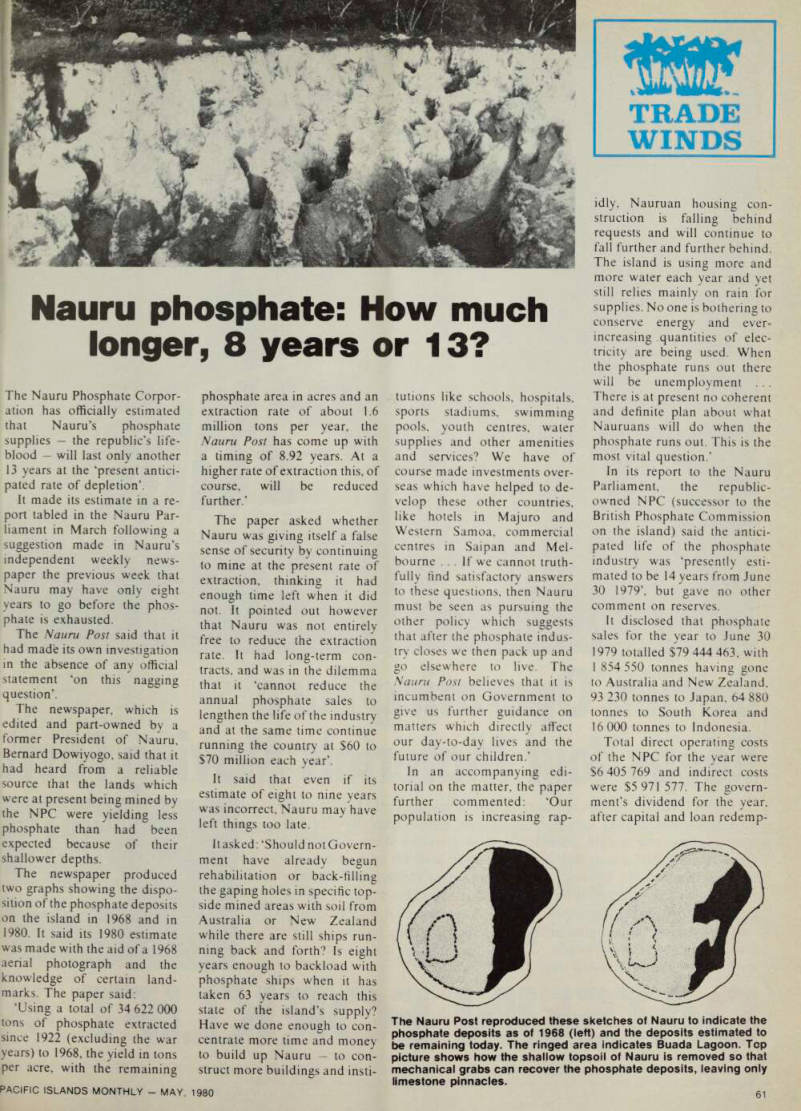

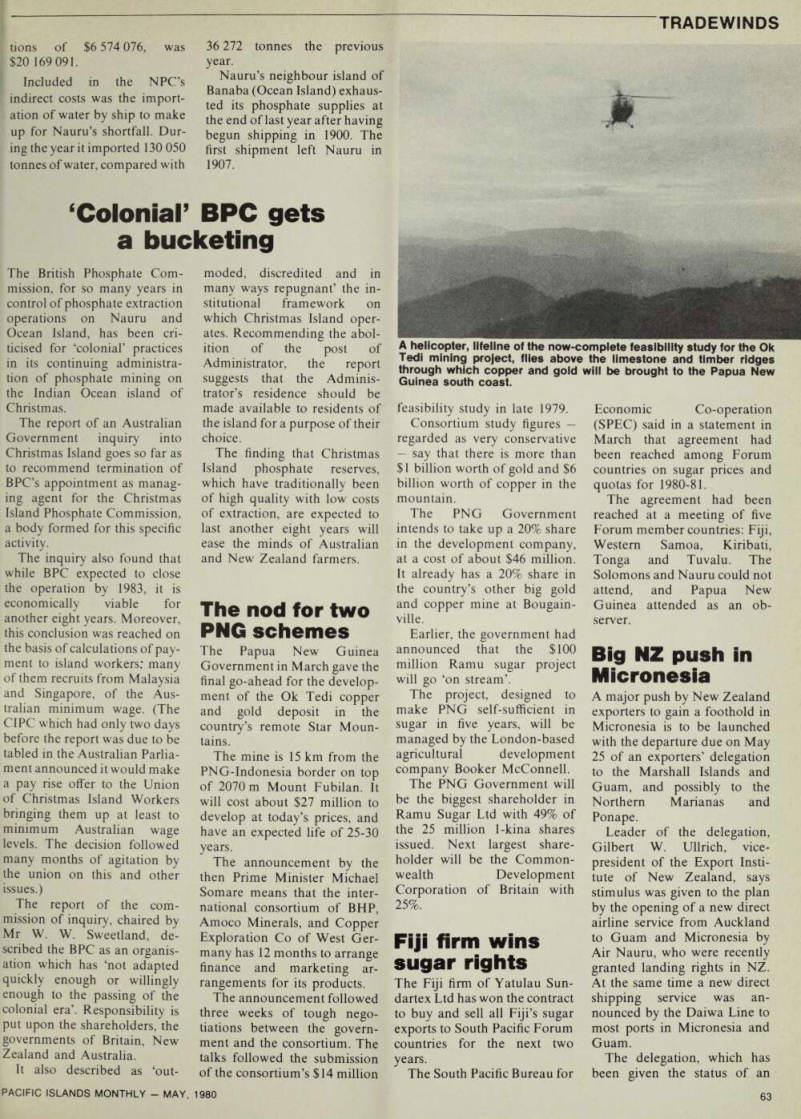
Trade
Winds
Nauru phosphate: How much longer, 8 years or 13?
The Nauru Phosphate Corpor
ation has officially estimated that Nauru’s phosphate
supplies the republic’s life
blood will last only another 13 years at the ‘present antici
pated rate of depletion’.
It made its estimate in a re port tabled in the Nauru Par liament in March following a suggestion made in Nauru’s
independent weekly news
paper the previous week that Nauru may have only eight years to go before the phos phate is exhausted.
The Nauru Post said that it had made its own investigation in the absence of any official statement ‘on this nagging
question’.
The newspaper, which is edited and part-owned by a former President of Nauru, Bernard Dowiyogo, said that it had heard from a reliable source that the lands which were at present being mined by the NPC were yielding less phosphate than had been expected because of their
shallower depths.
The newspaper produced
two graphs showing the dispo
sition of the phosphate deposits on the island in 1968 and in 1980. It said its 1980 estimate was made with the aid of a 1968 aerial photograph and the knowledge of certain land marks. The paper said: ‘Using a total of 34 622 000 tons of phosphate extracted since 1922 (excluding the war years) to 1968, the yield in tons per acre, with the remaining
phosphate area in acres and an extraction rate of about 1.6 million tons per year, the Nauru Post has come up with a timing of 8.92 years. At a higher rate of extraction this, of course, will be reduced further.’
The paper asked whether Nauru was giving itself a false
sense of security by continuing
to mine at the present rate of extraction, thinking it had enough time left when it did not. It pointed out however that Nauru was not entirely free to reduce the extraction rate. It had long-term con tracts. and was in the dilemma that it ‘cannot reduce the annual phosphate sales to lengthen the life of the industry and at the same time continue running the country at $6O to $7O million each year’.
It said that even if its estimate of eight to nine years was incorrect, Nauru may have left things too late.
Itasked; ‘Should not Govern
ment have already begun
rehabilitation or back-filling the gaping holes in specific top side mined areas with soil from Australia or New Zealand while there are still ships run ning back and forth? Is eight years enough to backload with phosphate ships when it has taken 63 years to reach this state of the island’s supply?
Have we done enough to con centrate more time and money to build up Nauru to con struct more buildings and insti
tutions like schools, hospitals, sports stadiums, swimming pools, youth centres, water supplies and other amenities and services? We have of course made investments over seas which have helped to de velop these other countries, like hotels in Majuro and Western Samoa, commercial centres in Saipan and Mel bourne ... If we cannot truth
fully find satisfactory answers
to these questions, then Nauru must be seen as pursuing the other policy which suggests that after the phosphate indus try closes we then pack up and go elsewhere to live. The Nauru Post believes that it is incumbent on Government to give us further guidance on matters which directly affect our day-to-day lives and the future of our children.’
In an accompanying edi torial on the matter, the paper further commented: ‘Our
population is increasing rap
idly, Nauruan housing con
struction is falling behind requests and will continue to fall further and further behind.
The island is using more and more water each year and yet still relies mainly on rain for supplies. No one is bothering to conserve energy and ever
increasing quantities of elec
tricity are being used. When the phosphate runs out there will be unemployment .. .
There is at present no coherent and definite plan about what Nauruans will do when the phosphate runs out. This is the most vital question.’
In its report to the Nauru Parliament, the republic owned NPC (successor to the British Phosphate Commission on the island) said the antici pated life of the phosphate
industry was ‘presently esti
mated to be 14 years from June 30 1979’, but gave no other comment on reserves.
It disclosed that phosphate sales for the year to June 30 1979 totalled $79 444 463, with 1 854 550 tonnes having gone to Australia and New Zealand, 93 230 tonnes to Japan, 64 880 tonnes to South Korea and 16 000 tonnes to Indonesia.
Total direct operating costs of the NPC for the year were $6 405 769 and indirect costs were $5 971577. The govern ment’s dividend for the year, after capital and loan redemp-
The Nauru Post reproduced these sketches of Nauru to indicate the phosphate deposits as of 1968 (left) and the deposits estimated to be remaining today. The ringed area indicates Buada Lagoon. Top picture shows how the shallow topsoil of Nauru is removed so that mechanical grabs can recover the phosphate deposits, leaving only limestone pinnacles.
tions of $6 574 076, was $2O 169 091.
Included in the NPC’s indirect costs was the import ation of water by ship to make up for Nauru’s shortfall. Dur ing the year it imported 130 050 tonnes of water, compared with
36 272 tonnes the previous year.
Nauru’s neighbour island of Banaba (Ocean Island) exhaus ted its phosphate supplies at the end of last year after having begun shipping in 1900. The first shipment left Nauru in 1907.
Advertisements & other items, p. 62 (1 item)
Datsun Forklift
•A 5 I
Datsun Operating Ease
Keeps Your Materials Moving Fast!
Datsun forklifts are unsurpassed time and effort savers. Just in case you have any doubts, consider these facts. Each Datsun features virtually the smallest turning radius in its class. Together with compact body dimensions that add up to remarkable tight-space maneuverability. Simple singlelever tilt/lift control, stable lowprofile styling and higher engine power enable easy handling of a full load anywhere. Remember Datsun forklifts enjoy a proven reputation for durability, lower maintenance and greater safety.
Ask your local dealer about the many other easy-to-operate Datsun advantages. And start moving materials fast!
DATSUN FORKLIFT
Loadlift Equipment Limited 2 Maurice Road, Penrose Auckland 6, New Zealand Tel: 663-714 Auckland Nissan Motor Co., (Australia) Pty. Ltd. Industrial Machinery Division Suite 1, 6th Floor, 100 William Street, Sydney, N.S.W. 2000, Australia Tel: 358-5444 Boroko Motors Ltd. P.O. Box 1259, Boroko, Via Port Moresby, Papua New Guinea Tel: 255255, 255-347
THE NAME OF QUALITY
NISSAN MOTOR CO. (TO
a bucketing
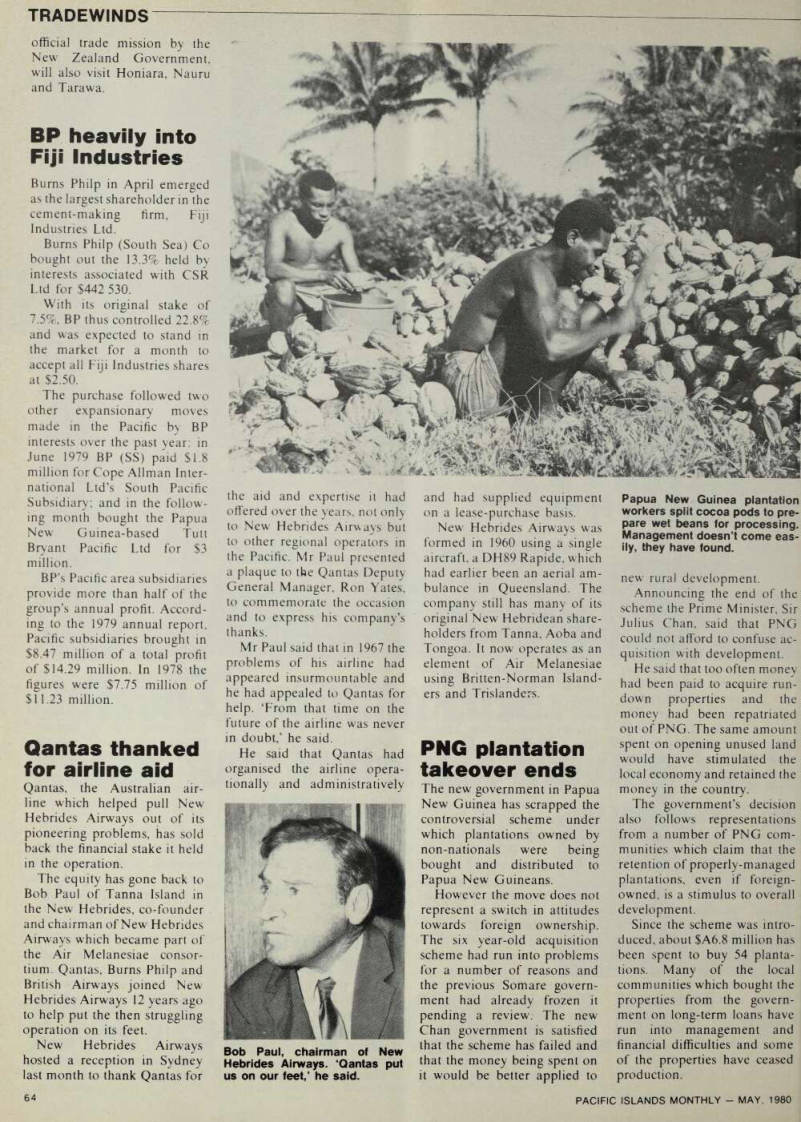
‘Colonial’ BPC gets a bucketing
The British Phosphate Com mission, for so many years in control of phosphate extraction operations on Nauru and Ocean Island, has been cri ticised for ‘colonial’ practices in its continuing administra tion of phosphate mining on the Indian Ocean island of Christmas.
The report of an Australian Government inquiry into Christmas Island goes so far as to recommend termination of BPC’s appointment as manag ing agent for the Christmas Island Phosphate Commission, a body formed for this specific
activity.
The inquiry also found that while BPC expected to close the operation by 1983, it is economically viable for another eight years. Moreover, this conclusion was reached on the basis of calculations of pay ment to island workers,* many of them recruits from Malaysia and Singapore, of the Aus tralian minimum wage. (The CIPC which had only two days before the report was due to be tabled in the Australian Parlia ment announced it would make a pay rise offer to the Union of Christmas Island Workers bringing them up at least to minimum Australian wage levels. The decision followed many months of agitation by the union on this and other issues.) The report of the com mission of inquiry, chaired by Mr W. W. Sweetland, de scribed the BPC as an organis ation which has ‘not adapted
quickly enough or willingly
enough to the passing of the colonial era’. Responsibility is put upon the shareholders, the governments of Britain, New Zealand and Australia.
It also described as ‘out
moded, discredited and in many ways repugnant’ the in stitutional framework on which Christmas Island oper ates. Recommending the abol ition of the post of Administrator, the report suggests that the Adminis trator’s residence should be made available to residents of the island for a purpose of their choice.
The finding that Christmas Island phosphate reserves, which have traditionally been of high quality with low costs of extraction, are expected to last another eight years will ease the minds of Australian and New Zealand farmers.
The nod for two
PNG schemes
The Papua New Guinea Government in March gave the final go-ahead for the develop ment of the Ok Tedi copper and gold deposit in the country’s remote Star Moun tains.
The mine is 15 km from the PNG-Indonesia border on top of 2070 m Mount Fubilan. It will cost about $27 million to
develop at today’s prices, and
have an expected life of 25-30 years.
The announcement by the then Prime Minister Michael Somare means that the inter national consortium of BHP, Amoco Minerals, and Copper Exploration Co of West Ger many has 12 months to arrange finance and marketing ar rangements for its products.
The announcement followed three weeks of tough nego tiations between the govern ment and the consortium. The talks followed the submission of the consortium’s $14 million
feasibility study in late 1979.
Consortium study figures — regarded as very conservative — say that there is more than $1 billion worth of gold and $6 billion worth of copper in the mountain.
The PNG Government intends to take up a 20% share in the development company, at a cost of about $46 million.
It already has a 20% share in the country’s other big gold and copper mine at Bougain ville.
Earlier, the government had announced that the $100 million Ramu sugar project will go ‘on stream’.
The project, designed to make PNG self-sufficient in sugar in five years, will be
managed by the London-based
agricultural development
company Booker McConnell.
The PNG Government will be the biggest shareholder in Ramu Sugar Ltd with 49% of the 25 million 1-kina shares issued. Next largest share holder will be the Common wealth Development Corporation of Britain with 25%.
Fiji firm wins
sugar rights
The Fiji firm of Yatulau Sun dartex Ltd has won the contract to buy and sell all Fiji’s sugar exports to South Pacific Forum countries for the next two years.
The South Pacific Bureau for
Economic Co-operation
(SPEC) said in a statement in March that agreement had been reached among Forum countries on sugar prices and quotas for 1980-81.
The agreement had been reached at a meeting of five Forum member countries: Fiji, Western Samoa, Kiribati, Tonga and Tuvalu. The Solomons and Nauru could not attend, and Papua New Guinea attended as an ob server.
Big NZ push in
Micronesia
A major push by New Zealand
exporters to gain a foothold in Micronesia is to be launched with the departure due on May 25 of an exporters’ delegation to the Marshall Islands and Guam, and possibly to the Northern Marianas and
Ponape.
Leader of the delegation, Gilbert W. Ullrich, vice president of the Export Insti tute of New Zealand, says stimulus was given to the plan by the opening of a new direct airline service from Auckland to Guam and Micronesia by Air Nauru, who were recently
granted landing rights in NZ.
At the same time a new direct shipping service was an nounced by the Daiwa Line to most ports in Micronesia and Guam.
The delegation, which has been given the status of an
A helicopter, lifeline of the now-complete feasibility study for the Ok Tedi mining project, flies above the limestone and timber ridges through which copper and gold will be brought to the Papua New Guinea south coast.
official trade mission by the New Zealand Government, will also visit Honiara, Nauru and Tarawa.
BP heavily into
Fiji Industries
Bums Philp in April emerged as the largest shareholder in the
cement-making firm. Fiji
Industries Ltd.
Bums Philp (South Sea) Co bought out the 13.3% held by interests associated with CSR Ltd for S442 530.
With its original stake of 7.5%, BP thus controlled 22.8% and was expected to stand in the market for a month to accept all Fiji Industries shares at $2.50.
The purchase followed two other expansionary moves made in the Pacific by BP interests over the past year: in June 1979 BP (SS) paid $1.8 million for Cope Allman Inter national Ltd’s South Pacific Subsidiary: and in the follow
ing month bought the Papua
New Guinea-based Tutt Bryant Pacific Ltd for $3 million.
BP’s Pacific area subsidiaries provide more than half of the group’s annual profit. Accord ing to the 1979 annual report.
Pacific subsidiaries brought in $8.47 million of a total profit of $14.29 million. In 1978 the figures were $7.75 million of $11.23 million.
Qantas thanked
for airline aid
Qantas, the Australian air line which helped pull New Hebrides Airways out of its
pioneering problems, has sold
back the financial stake it held in the operation.
The equity has gone back to Bob Paul of Tanna Island in the New Hebrides, co-founder and chairman of New Hebrides Airways which became part of the Air Melanesiae consor tium. Qantas, Burns Philp and
British Airways joined New
Hebrides Airways 12 years ago to help put the then struggling operation on its feel.
New Hebrides Airways hosted a reception in Sydney last month to thank Qantas for
the aid and expertise it had offered over the years, not only to New Hebrides Airways but to other regional operators in the Pacific. Mr Paul presented a plaque to the Qantas Deputy General Manager, Ron Yates, to commemorate the occasion and to express his company’s thanks.
Mr Paul said that in 1967 the problems of his airline had appeared insurmountable and he had appealed to Qantas for help. ‘From that time on the future of the airline was never in doubt,’ he said.
He said that Qantas had organised the airline opera
tionally and administratively
and had supplied equipment
on a lease-purchase basis.
New Hebrides Airways was formed in 1960 using a single aircraft, a DH89 Rapide. which had earlier been an aerial am bulance in Queensland. The company still has many of its original New Hebridean share holders from Tanna, Aoba and Tongoa. It now operates as an element of Air Melanesiae using Britlen-Norman Island ers and Trislanders.
PNG plantation
takeover ends
The new government in Papua New Guinea has scrapped the controversial scheme under
which plantations owned by
non-nationals were being bought and distributed to Papua New Guineans.
However the move does not represent a switch in attitudes towards foreign ownership.
The six year-old acquisition
scheme had run into problems for a number of reasons and the previous Somare govern ment had already frozen it pending a review. The new Chan government is satisfied that the scheme has failed and that the money being spent on it would be better applied to
new rural development.
Announcing the end of the scheme the Prime Minister. Sir Julius Chan, said that PNG could not afford to confuse ac
quisition with development.
He said that too often money had been paid to acquire run down properties and the money had been repatriated out of PNG. The same amount spent on opening unused land would have stimulated the local economy and retained the money in the country.
The government’s decision also follows representations from a number of PNG com munities which claim that the retention of properly-managed
plantations, even if foreign
owned, is a stimulus to overall
development.
Since the scheme was intro duced, about SA6.B million has been spent to buy 54 planta tions. Many of the local communities which bought the properties from the govern ment on long-term loans have run into management and financial difficulties and some of the properties have ceased
production.
Bob Paul, chairman of New
Hebrides Airways. ‘Qantas put
us on our feet,’ he said.
Papua New Guinea plantation workers split cocoa pods to pre pare wet beans for processing.
Management doesn’t come eas ily, they have found.
Advertisements & other items, pp. 65-68 (1 item)
Aiwa
*n AIWA
t 'A A S' ///
~J\ (ini component sys from
AIWA lor cmflsmonship
AIWA
AIWA Co , Ltd 11 9, Ueno 1 chome, Taito-ku, Tokyo. Japan Australia & New Zealand AIWA Australia Pty , Ltd , P.O Box 339, Rockdale.
NSW. Australia 2216 Tel 597-2388/2808 American Samoa Island Pacific Agencies Inc . P.O. Box 1018. Pago Pago, A Samoa Tel: 633 4687 Cook Islands Island Merchants Ltd . P.O Box 69, Rarotonga, Cook Islands Fiji D Ranchhod & Company, Corner of Vidilo St. & Vitogo PDE , P.O Box 18, Lautoka. Fiji Tel 60227/P Hargovind Bros.. Duty Free Centre, 190 Renwick Road, Suva, Fiji Tel 24350 Guam Micropac Audio, Inc , P.O. Box 3478, Agana, Guam 96910 Tel 472-8091 P.N.G. Oceania Indent Agency (P N G.) Pty, Ltd,, Box 5518, Boroko.
Port Moresby, P N G. Tel PM 256406 Solomon Islands Harvest Pacific Ltd , G.P.O. 517, Honiara, Solomon Islands Tel: 718 Tahiti Fare Hi-Fi Stereo, Rue du Marechal Foch, P.O. Box 269, Papeete, Tahiti R C 6604 A
Superior
WE COVER YOUR SLASHING
REQUIREMENTS
QUALITY RIGHT - PRICE RIGHT
CHECK OUR RANGE OF MACHINES
FOR THE ONE TO SUIT YOUR NEEDS EXTRA BOTTOM SEAL PROTECTION IN EVERY MODEL SLASHER MOWERS to suit Kubota/Mitsubishi
□ 36" L 36 T.P.L. □42"L42T.P.L
FROM .
TO IL f m f r ' 24 ECONOMY SLASHERS 75 h.p Box 2 1/16 Shaft □ 48" LL4 □ 54" LL4 5
□ 60"LL5 □ 72" LL6
MULTIPURPOSE SLASHERS
□ 10 LXIO □ 10' TX 10 □ 12 TXI2 □ 20 TX2O n 24 TX2*
GRASS SLASHERS
□ 42” L 42 □ 48" L4B
SUPPLIERS TO: GOVT. DEPTS, LOCAL AUTHORITIES,
CONTRACTORS and the MAN on the LAND Tick E 3 the machine you are interested in and send this advert for FREE brochure to:
SUPERIOR FARM EQUIPMENT PTY. LTD.,
782 Fairfield Road, Yeerongpilly Brisbane Old 4105 Phone; (07( 392 2788.
HEAVY DUTY SLASHERS SIOO Gear Box
□ 60" LXS □72 LX6
□ 84 " LX7 □ 15 Trail TXIS PRICES INCLUDE CLUTCH i CRIVESHAR ON ALL MODEIS ALL UNITS SOLD WITH FULL FACTORY WARRANTY SUPERIOR S EXTRA SEAL
PROTECTION ON EVERY SLASHER
NAME
ADDRESS
POSTCODE
IN OUR 86th YEAR SELLING ‘SERVICE’
TO THE PACIFIC ISLANDS
n o ‘a- -0 z H o IP > m 0-2
FOR:
Nelson & Robertson
PTY.LTD. (Established 1895)
Plantation House, 197 Clarence Street, Sydney.
Cables: ‘IVAN’, Sydney, Brisbane. Telex: AA22381, Sydney.
INDENTS - FROM AUSTRALIA, NEW ZEALAND and OVERSEAS.
FOODSTUFFS • SOFTGOODS • HARDWARE • MACHINERY TRAVEL • INSURANCE • CANNED FISH • JUTE GOODS
• REAL ESTATE •
BRANCH OFFICES:
Nelson & Robertson Pty. Ltd., P.O. Box 575, Brisbane, Qld., Australia.
P.O. Box 2092, Govt. Bldg., Suva, Fiji.
P.O. Box 258, Lautoka, Fiji.
P.O. Box 2420, CPO Auckland 1, New Zealand.
PAPUA NEW GUINEA
REPRESENTATIVES:
Rabtrad Nuigini Pty. Ltd., P.O. Box 219, Rabaul, P.N.G.
P.O. Box 1406, Lae, P.N.G.
P.O. Box 711, Madang, P.N.G P.O. Box 253, Kieta, P.N.G. o
TRADEWINDS INTELLIGENCE...TRADEWINDS INTELLIGENCE...TRADEWINDS INTELLIG
WORK is under way on a five-month SUS 2 500 000 renovation of the former Guam Tokyu Hotel. The new property, to be called Pacific Islands Village, is the first of a series of resort-recreational complexes to be operated by Pacific Islands Club, an activity of General Atlantic Development Corporation of Guam. The project is the first major new hotel activity on Guam in more than five years.
OFFICIALS of Fiji national carrier Air Pacific were in New Zealand in March to discuss leasing of an Air New Zealand Boeing 737 jet. Air Pacific is considering replacing its BAC-11 Is with Boeings, and wants to lease one until the first of its own can be delivered. Meanwhile, Fiji’s Minister of Transport, Civil Aviation and Tourism, Tomasi Vakatora, was visiting Israel (to discuss an offer of Boeing 707 s made during the recent visit to that country of Prime Minister Ratu Sir Kamisese Mara) and Canada (to probe possibilities of acquiring DCBs surplus to Canadian Pacific’s needs). Air Pacific wants long-range jets for services to Sydney, Melbourne, Hawaii and mainland USA and Canada.
JOHN Mangefel, Governor of Yap, has revealed that the United States has offered the Federated States of Micronesia SUS76S million as its financial assistance during the 15-year term of free association with the US. Micronesian News Service reports that the governor said 40% of the money would be used for economic development in the four states of the FSM: Yap, Truk, Ponape and Kosrae.
KIRIBATI is to try exporting its copra to Japan, due to the rise in transport costs to Europe. While Japan would pay a lower price than European customers, transport costs would be substantially lower. It was reported from Tawara in a news exchange with Peacesat terminals throughout the Pacific that about 1200 tonnes of Kiribati copra would be shipped to Japan on United Micronesian Development Association vessels in mid-March.
SOUTHERN Pacific Hotel Corporation has moved into what is called the ‘third phase’ of returns on its $6O million Pacific Harbour Resort project at Deuba, Fiji. It is a convention facility known as Treetops, able to accommodate up to 250 people for convention meetings. ‘First phase’ of the Deuba development, according to the SPHC offshoot Pacific Hotels and Development, was installing infrastructure such as canals and roads. ‘Second phase’ was construction of Pacific Harbour township. Now, the third phase is of the ‘commercial industries type’, including catering for business and corporate-type travel groups.
A CALL for a ‘reassessment’ of Australian aid to Papua New Guinea now that Sir Julius Chan has become prime minister was made in March by Richard Alston, chairman of the Australian Council for Overseas Aid. Mr Alston pointed out that Australia now provides $234.8 million a year to PNG, which is almost 50% of Australia’s total aid budget and about 30% of PNG’s income.
With the present aid agreement expiring next year, it was ‘particularly appropriate’ that the review should take place now, he said. He also pointed out that the agreement would expire at a time when ‘many developing countries such as Zimbabwe and Kampuchea would be likely to gain substantial benefits from a firm Australian aid commitment’.
SALT P roduced by villagers on the coast of Rakiraki, near Tavua, Fiji, is being sold to livestock farmers by the Commercial Undertaking Section of the Department of Agriculture. The project involves manufacture of salt from the evaporation of sea water.
An Australian salt expert, Lancelot Boord, helped people from the villages of Drauniivi, Togovere and Vunitogoloa to establish it in 1977.
BOUGAINVILLE Copper Ltd served notice in March that it will not give up its intention to search for other viable ore bodies in the Bougainville region. The group has encountered problems in looking beyond its special mining leases due to lack of approval from the Papua New Guinea Government. A company spokesman said discussions with the government would continue.
THE COOK Islands was hooked into the world satellite comminications network with the opening on March 1 of the new Cable & Wireless satellite earth station on Rarotonga. The $4 million station, which has been financed by Cable & Wireless, provides for instant communication with more than 300 other earth stations throughout the world.
A NEW primary school and 18 housing units for teachers and local residents were officially opened on Robinson Crusoe’s Island in the Juan Fernandez group in March. The ceremony was attended by a number of high-ranking Chilean government officials.
THE GOVERNMENT Council in Noumea has established a commission of inquiry into New Caledonia’s energy situation.
Part of its brief is to examine the possibilities of setting up an oil refinery in the territory.
NEW ZEALAND has made a cash grant of $76 000 to pay for a steel barge for Aitutaki Island and the upgrading of the island’s slipway. Part of the grant will also be used for the manufacture of moulds for concrete piles to be installed in Avatiu Harbour, Rarotonga.
GOVERNOR Carlos Camacho of the Northern Marianas has discussed a tentative proposal with major companies in Japan to investigate the feasibility of an experimental thermal energy conversion (OTEC) project in the Northern Marianas. The system would use water temperature differences at sea surface and various depths to generate energy. An experimental plant utilising the principle is already in operation in Hawaii, financed by the
US Department of Energy.
A GOVERNMENT task force headed by Lieutenant-Governor Francisco Ada has recommended that the Northern Marianas permit Northville Industries Corp to make a feasibility study of building a supertanker oil port and possibly a refinery in Rota.
Mendel Gryndsztejn, senior vice-president of the New York company, said the study might take up to two years and would cost almost SUSI million.
COMPAC, the underwater cable telephone which gave Fiji direct links with the outside world, will come to an end of its design life in about three years, and will be replaced by a new system.
COMPAC opened for Fiji to New Zealand and Australia late in 1962. The new trans-Pacific cable is expected to provide between 1200 and 1800 telephone circuits linking Sydney with Vancouver, via Norfolk Island, Fiji and Hawaii.
TONGA Visitors Bureau has just staged two visitor recruiting drives in Sydney. Tour agents were entertained by Tongan dancers, and at a Tongan-style buffet. In Japan, meanwhile, an estimated 40 million viewers saw a TV film of Tonga. The country’s cruise ship visitors in 1979 totalled 29 900, 3445 fewer than in 1978. But air visitors were up by 36 to 12 126.
TRADEWINDS INTELLIGENCE...TRADEWINDS INTELLIGENCE...TRADEWINDS INTELLIGE
YUASA
BATTERY
Indispensable on
Cars and Vehicles
that support Modern
Industrial Society
MANUFACTURERS OF All KINDS OF
ELECTRIC BATTERIES AND RELATED
ELECTRICAL APPLIANCES
YUASA BATTERY CO., LTD.
No. 12-11, 2-Chome, Higashi-Shimbashi Minato-ku, Tokyo 105, Japan Phone: Tokyo (03) 437-2411
Cable : YUASABATRY TOKYO
Telex : 29228 YBCTOK
Yuasa
of South Pacific [?]ervice
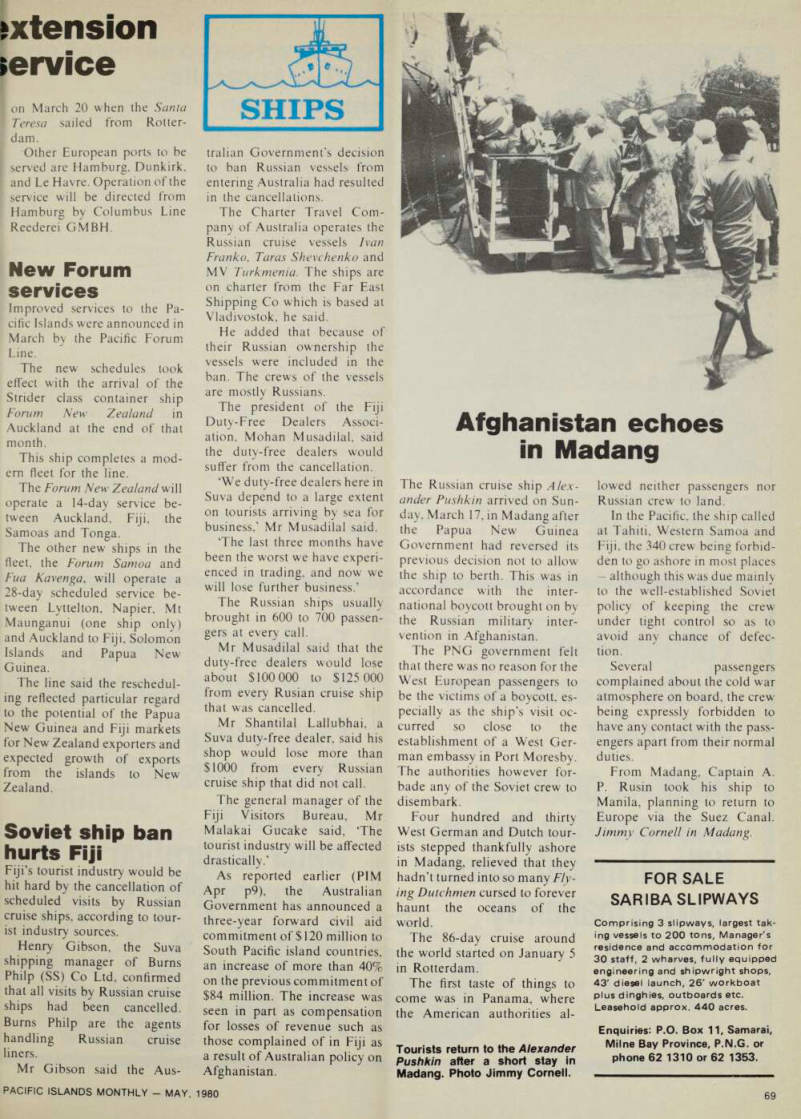
Columbus Line in bi[?]extension of South Pacific [?]ervice
The Columbus Line has an nounced that its service be tween Europe and the South Pacific has been extended to
include Fiji, Samoa. Tonga.
Solomon Islands and Papua New Guinea.
The Hamburg-Sued group, parent company of Columbus Line, started the service from Europe to the Pacific in 1968.
In recent years the service has concentrated mainly on cargo carried to the French ter ritories of Tahiti and New Caledonia.
In its earlv stages the new service will he ;un ; • , ncer with two modern sei riven tional cargo-liner Santa Teresa and Santa hies.
These ships will provide the service at eight-weekly inter vals.
On the southbound leg from Europe the ships will use the Panama Canal and the return voyage will be made via the Suez Canal.
President of Columbus Line, Erwin Ludewig, said the extended service was expected to make a significant contri
bution to regional develop
ment. ‘Hamburg-Sued and Colum bus Line have had a long and active association with the South Pacific,’ he said. ‘We share the view of re
gional governments and pri
vate business that the region’s growth potential will never be realised without reliable access to efficient transport services.
“While our estimates of the growth potential in the short term are conservative, we will continue to pay close attention to requests of shippers for vari ations in existing services.’
The extended services began
A Columbus Line container vessel heads out to sea from her German home port.
Erwin Ludewig
I on March 20 when the Santa * Teresa sailed from Rotter- I dam.
Other European ports to be [ served are Hamburg. Dunkirk.
I and Le Havre. Operation of the service will be directed from
Hamburg by Columbus Line
Reederei GMBH.
New Forum
services
Improved services to the Pa cific Islands were announced in March by the Pacific Forum Line.
The new schedules took effect with the arrival of the Strider class container ship Forum New Zealand in Auckland at the end of that month.
This ship completes a mod ern fleet for the line.
The Forum New Zealand will operate a 14-day service be tween Auckland, Fiji, the Samoas and Tonga.
The other new ships in the fleet, the Forum Samoa and Fua Kavenga , will operate a 28-day scheduled service be
tween Lyttelton, Napier, Mt
Maunganui (one ship only)
and Auckland to Fiji, Solomon Islands and Papua New Guinea.
The line said the reschedul
ing reflected particular regard
to the potential of the Papua New Guinea and Fiji markets for New Zealand exporters and expected growth of exports from the islands to New Zealand.
Soviet ship ban
hurts Fiji
Fiji’s tourist industry would be hit hard by the cancellation of scheduled visits by Russian cruise ships, according to tour ist industry sources.
Henry Gibson, the Suva shipping manager of Burns Philp (SS) Co Ltd, confirmed that all visits by Russian cruise ships had been cancelled.
Burns Philp are the agents handling Russian cruise liners.
Mr Gibson said the Aus-
Ships
tralian Government's decision to ban Russian vessels from entering Australia had resulted in the cancellations.
The Charter Travel Com pany of Australia operates the Russian cruise vessels Ivan Franko, Taras Shevchenko and MV Turkmenia. The ships are on charter from the Far East Shipping Co which is based at Vladivostok, he said.
He added that because of their Russian ownership the vessels were included in the ban. The crews of the vessels are mostly Russians.
The president of the Fiji Duty-Free Dealers Associ ation. Mohan Musadilal, said the duty-free dealers would suffer from the cancellation. ‘We duty-free dealers here in Suva depend to a large extent on tourists arriving by sea for business,' Mr Musadilal said. ‘The last three months have been the worst we have experi enced in trading, and now we will lose further business.’
The Russian ships usually
brought in 600 to 700 passen gers at every call.
Mr Musadilal said that the duty-free dealers would lose about $lOOOOO to $125 000 from every Rusian cruise ship that was cancelled.
Mr Shantilal Lallubhai, a Suva duty-free dealer, said his shop would lose more than $lOOO from every Russian cruise ship that did not call.
The general manager of the Fiji Visitors Bureau, Mr Malakai Gucake said, ‘The tourist industry will be affected
drastically.’
As reported earlier (PIM Apr p 9), the Australian Government has announced a three-year forward civil aid commitment of $l2O million to South Pacific island countries, an increase of more than 40% on the previous commitment of $B4 million. The increase was seen in part as compensation for losses of revenue such as those complained of in Fiji as a result of Australian policy on
Afghanistan.
Afghanistan echoes
in Madang
The Russian cruise ship Alex ander Pushkin arrived on Sun day, March 17, in Madang after the Papua New Guinea Government had reversed its previous decision not to allow the ship to berth. This was in accordance with the inter
national boycott brought on by
the Russian military inter vention in Afghanistan.
The PNG government felt that there was no reason for the West European passengers to be the victims of a boycott, es pecially as the ship’s visit oc curred so close to the establishment of a West Ger man embassy in Port Moresby.
The authorities however for bade any of the Soviet crew to disembark.
Four hundred and thirty West German and Dutch tour
ists stepped thankfully ashore
in Madang, relieved that they hadn’t turned into so many Fly ing Dutchmen cursed to forever haunt the oceans of the world.
The 86-day cruise around the world started on January 5 in Rotterdam.
The first taste of things to come was in Panama, where the American authorities al
lowed neither passengers nor Russian crew to land.
In the Pacific, the ship called at Tahiti, Western Samoa and Fiji, the 340 crew being forbid den to go ashore in most places - although this was due mainly to the well-established Soviet policy of keeping the crew under tight control so as to avoid any chance of defec tion.
Several passengers complained about the cold war atmosphere on board, the crew
being expressly forbidden to
have any contact with the pass engers apart from their normal duties.
From Madang, Captain A.
P. Rusin took his ship to Manila, planning to return to Europe via the Suez Canal.
Jimmy Cornell in Madang.
Tourists return to the Alexander Pushkin after a short stay in Madang. Photo Jimmy Cornell.
Advertisements & other items, p. 69 (2 items)
extension
service
Sariba Slipways
FOR SALE
Comprising 3 slipways, largest taking vessels to 200 tons, Manager's residence and accommodation for 30 staff, 2 wharves, fully equipped engineering and shipwright shops, 43' diesel launch, 26' workboat plus dinghies, outboards etc.
Leasehold approx. 440 acres.
Enquiries: P.O. Box 11, Samarai, Milne Bay Province, P.N.G. or phone 62 1310 or 62 1353.
shipping run
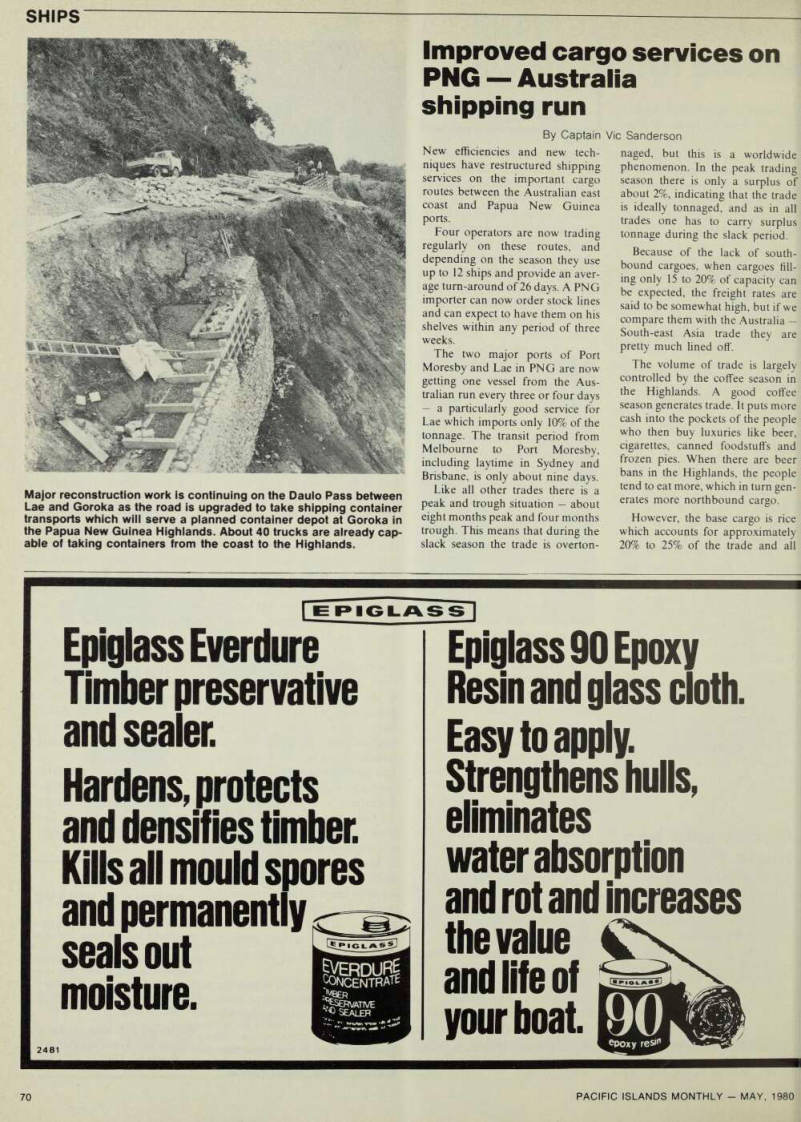

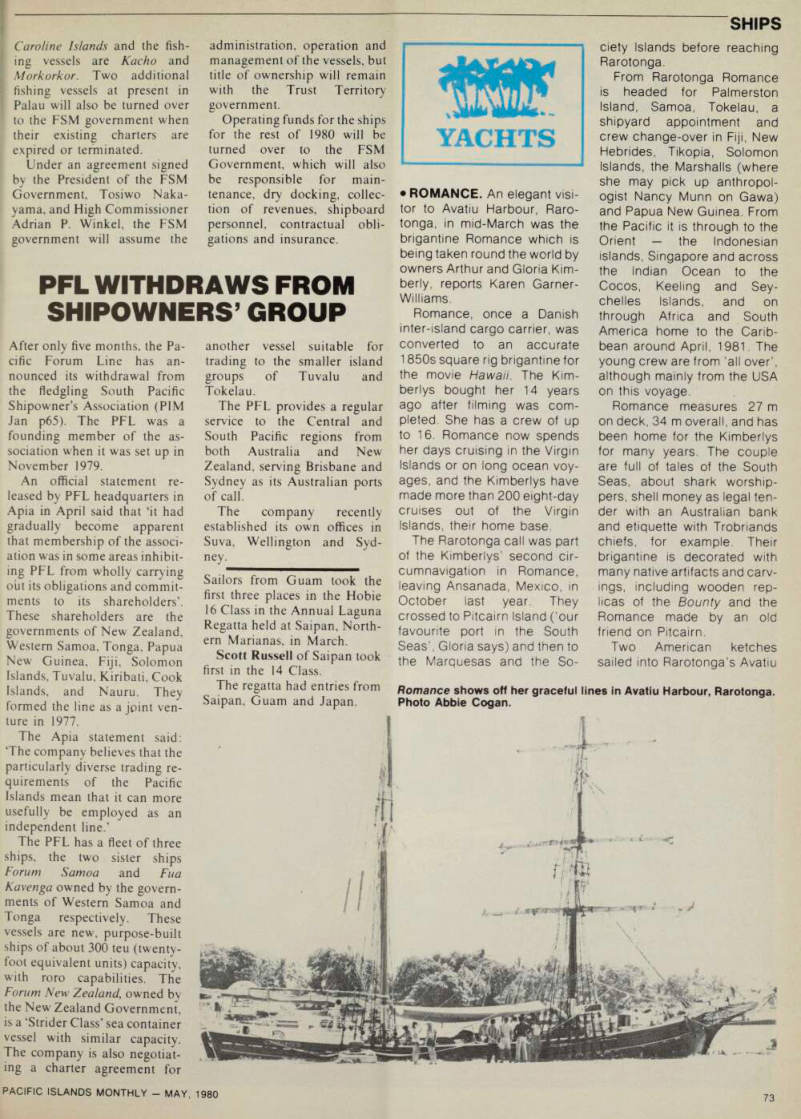
Improved cargo services on PNG Australia shipping run
By Captain Vic Sanderson
New efficiencies and new tech
niques have restructured shipping
services on the important cargo routes between the Australian east coast and Papua New Guinea ports.
Four operators are now trading regularly on these routes, and depending on the season they use up to 12 ships and provide an aver age tum-around of 26 days. A PNG importer can now order stock lines and can expect to have them on his shelves within any period of three weeks.
The two major ports of Port Moresby and Lae in PNG are now getting one vessel from the Aus tralian run every three or four days a particularly good service for Lae which imports only 10% of the tonnage. The transit period from Melbourne to Port Moresby,
including laytime in Sydney and
Brisbane, is only about nine days.
Like all other trades there is a peak and trough situation about eight months peak and four months trough. This means that during the slack season the trade is overton
naged, but this is a worldwide
phenomenon. In the peak trading
season there is only a surplus of about 2%, indicating that the trade is ideally tonnaged, and as in all trades one has to carry surplus tonnage during the slack period.
Because of the lack of south bound cargoes, when cargoes fill ing only 15 to 20% of capacity can be expected, the freight rates are said to be somewhat high, but if we compare them with the Australia - South-east Asia trade they are pretty much lined off.
The volume of trade is largely controlled by the coffee season in the Highlands. A good coffee season generates trade. It puts more cash into the pockets of the people who then buy luxuries like beer, cigarettes, canned foodstuffs and frozen pies. When there are beer bans in the Highlands, the people tend to eat more, which in turn gen erates more northbound cargo.
However, the base cargo is rice which accounts for approximately 20% to 25% of the trade and all
Major reconstruction work is continuing on the Daulo Pass between Lae and Goroka as the road is upgraded to take shipping container transports which will serve a planned container depot at Goroka in the Papua New Guinea Highlands. About 40 trucks are already cap able of taking containers from the coast to the Highlands.
shipping lines are competing for I Other foodstuffs, including
I frozen poultry which is extremely
popular, canned meat, canned fish, frozen pies, and frozen meat, make up the real general cargo trade.
Another base cargo is steel, including billets and sheeting, but this is mostly carried by one company still using conventional ships. The other companies use cellular container vessels.
Although most cargoes are car ried on contract with individual
shipping companies, machinery is
usually shipped by first available
vessel because it is often required
urgently.
The main commodities exported from PNG are plywood, sawn tim ber, coffee, cocoa, tea and personal effects.
Substantial quantities of ply
wood are produced in Bulolo, which is about 100 km southwest of Lae, and exported principally to Japan. The secondary market is Australia. PNG can produce ply wood more cheaply than the Philip pines and Malaysia who have to import the timber, letting PNG compete successfully with Korea, Japan and Taiwan where prices are
constantly rising.
Until recently the Port Moresby wharf was unable to cope with the tonnage put through it, and it was
obvious that a container station was required. Now a container depot in Port Moresby is well developed and a second depot has been established at Konedobu about 1.5 km from the wharf. This has cleared the congestion on the
Moresby waterfront.
Another interesting development
will be the establishment by a con sortium of all major shipping companies of a depot at Goroka in the Highlands, to also serve Mount Hagen. The road leading to this depot and to Mount Hagen is not good, but it is being improved and
containers are already going
there.
The road operators, especially over the past 18 months, have
gradually upgraded their equip
ment and are replacing their exist ing fleets with vehicles capable of taking containers into the High lands. Now there are about 40 trucks capable of doing this.
For firms wishing to trade with PNG there is a large market with enormous potential. It is a matter of going there and selling the pro duct, but it has to be done across the table. The Australian Trade Commissioner is trying to get the message to exporters that no longer can one sell by telephone, telex, or telegram. Merchants have to get off their tails and go there if they want to do business.
Tahiti Line
Has Its Say
PIM has received the following official comment from the Tahiti Line (Compagnie Tahi tienne Maritime SA) on our re port ‘A modern Bounty mutiny troubles NZ export link’ (PIM Dec 1979 p 61): It must be the fate of any ship named Bounty to have troubles with story-tellers.
Life aboard the first one has become, through popular tales, a hard-life sentence, and her captain a stone-hearted brutal beast of a shipmaster. In fact, life aboard the Bounty wasn’t any better or worse than on any ship of that time, and Captain Bligh became a rear-admiral, a tribute to his competence and
seamanship.
The troubles of the second Bounty were very different, as unions did not exist in the 18th century. But what writers of books and moviemakers did to the old Bounty newsmen have done to the new one.
Pacific Islands Monthly and
Nautical News mentioned in their issues of December 1979
and January 1980 respectively the difficulties met by today’s Bounty in New Zealand as if they had just happened, and would put the whole operation
in jeopardy.
We, as proud owners of the ship, would like to emphasise that these problems occurred in July 1979 and have long since been settled. For many months now the modern Bounty has been plying a very successful and busy trade. She has proven to be a rewarding link between Tahiti and New Zealand.
So please Messrs Newsmen, keep up with the Bounty and write about Rear-Admiral Bligh and his successful career instead of his past troubles with Fletcher Christian.
Seven ships
for the FSM
Seven US Trust Territory government ships and two fish ing vessels were transferred to the Federated States of Micronesia government on April 1. The seven ships are Micro Glory, Micro Trader, Micro Spirit, Micro Dawn, Yap Islander, Kaselehlia and
Caroline Islands and the fish ing vessels are Kacho and Morkorkor. Two additional fishing vessels at present in Palau will also be turned over to the FSM government when their existing charters are expired or terminated.
Under an agreement signed by the President of the FSM Government, Tosiwo Naka yama, and High Commissioner Adrian P. Winkel, the FSM government will assume the
administration, operation and management of the vessels, but title of ownership will remain with the Trust Territory government.
Operating funds for the ships for the rest of 1980 will be turned over to the FSM Government, which will also be responsible for main
tenance, dry docking, collec
tion of revenues, shipboard personnel, contractual obli gations and insurance.
Advertisements & other items, pp. 70-72 (2 items)
| Epig
EPIG
Epiglass Everdure Timber preservative and sealer.
Hardens,protects
and densities timber.
Kills all mould spores and permanently seals out moisture.
AS Epiglass 90 Epoxy Resin and glass cloth.
Easy to apply.
Strengthens hulls, eliminates water absorption and rot and increases the value and life of yourboat i
Epiglass E-Type
Antifouling.
Gives up to
months
growth-free
performance
Racing Red,
Blue, Green
and Gold.
12
amUouling
EPIGLAS S
COOK ISLANDS: Cook Island Trading Corporation Ltd FIJIAN ISLANDS; Burns Philp (SS) Co. Ltd NEW HEBRIDES: Burns Philp (NH) Ltd NOUMEA: Enterprise Guy Limousine NIUE ISLAND: Niue Island United PAGO PAGO: Max Haleck Inc, Burns Philp (SS) Ltd PAPUA NEW GUINEA: KIETA: Nikana Wholesalers, LAE; Faulkner-Tait (NG) Pty Ltd, MADANG: Burns Philp (NG) Co.
Ltd PORT MORESBY; S.A. Heath Co. Ltd, Steamships Honda Centre RABAUL: Elvee Trading Pty Ltd, WEWAK: Burns Philp (P N G.) SOLOMON ISLANDS: P.K.R Pacific Sales Co TAHITI: Marine Corail, Tahiti Sport, Comptior Polynesien TONGA: Burns Philp (SS) Co Ltd WESTERN SAMOA: Burns Philp (SS) Co Ltd, E. A Coxon Ltd, Gold Star Transport Co. Ltd, Morris Hedstrom Ltd NORFOLK ISLAND: Irvines Building Supplies
o u i
PUTYOUR
FOOT DOWN.
DEMAND
TIMKEN
BEARINGS!
TIMKEN
HGtSHRCD IRAQI MARK
If you’re hard headed about the bearings you use ... put your foot down!
Demand tapered roller bearings, and you’ll get the brand with proven quality, durability and performance.
The brand that’s given you a long i run for your money, wherever % it’s used.
On top of all this, you’ll benefit from our consistent supply, delivery, and sales and service engineering assistance available from Australian Timken and Authorized Bearing Distributors throughout the Pacific.
Another way of looking at it is that you’re not going to put your foot in it when you put your foot down and demand Timken bearings.
TIMKEN
REGISTERED TRADEMARK
TAPERED ROLLER BEARINGS
Distributors in the Pacific are: United Enterprises Ltd., Honiaria; Burns Philp South Sea Company, Suva; Sunbeam Transport Ltd., Lautoka: S.A.T.M.A., Noumea: D. L. Dent Industries Pty. Ltd., Boroko, PNG; Comptoirs Francais des Nouvelles-Hebrides, Port Vila; Bearing Service Company Ltd., Auckland: Niven Bearings Limited, Auckland.
4191 ATX
Ships
71
’ACIFIC ISLANDS MONTHLY - MAY, 1980
Pfl Withdraws From
Shipowners’ Group
After only five months, the Pa cific Forum Line has an nounced its withdrawal from the fledgling South Pacific Shipowner’s Association (PIM Jan p 65). The PFL was a founding member of the as sociation when it was set up in November 1979.
An official statement re leased by PFL headquarters in Apia in April said that ‘it had gradually become apparent that membership of the associ ation was in some areas inhibit
ing PFL from wholly carrying
out its obligations and commit ments to its shareholders’.
These shareholders are the governments of New Zealand,
Western Samoa, Tonga, Papua
New Guinea, Fiji, Solomon Islands, Tuvalu, Kiribati, Cook Islands, and Nauru. They formed the line as a joint ven ture in 1977.
The Apia statement said: ‘The company believes that the
particularly diverse trading re
quirements of the Pacific Islands mean that it can more usefully be employed as an
independent line.’
The PFL has a fleet of three ships, the two sister ships Forum Samoa and Fua Kavenga owned by the govern ments of Western Samoa and
Tonga respectively. These
vessels are new, purpose-built ships of about 300 teu (twenty
foot equivalent units) capacity,
with roro capabilities. The Forum New Zealand, owned by the New Zealand Government, is a ‘Strider Class’ sea container vessel with similar capacity.
The company is also negotiat ing a charter agreement for
another vessel suitable for trading to the smaller island groups of Tuvalu and Tokelau.
The PFL provides a regular service to the Central and South Pacific regions from both Australia and New Zealand, serving Brisbane and Sydney as its Australian ports of call.
The company recently established its own offices in
Suva, Wellington and Syd
ney.
Sailors from Guam took the first three places in the Hobie 16 Class in the Annual Laguna Regatta held at Saipan, North ern Marianas, in March.
Scott Russell of Saipan took first in the 14 Class.
The regatta had entries from
Saipan, Guam and Japan.
Yachts

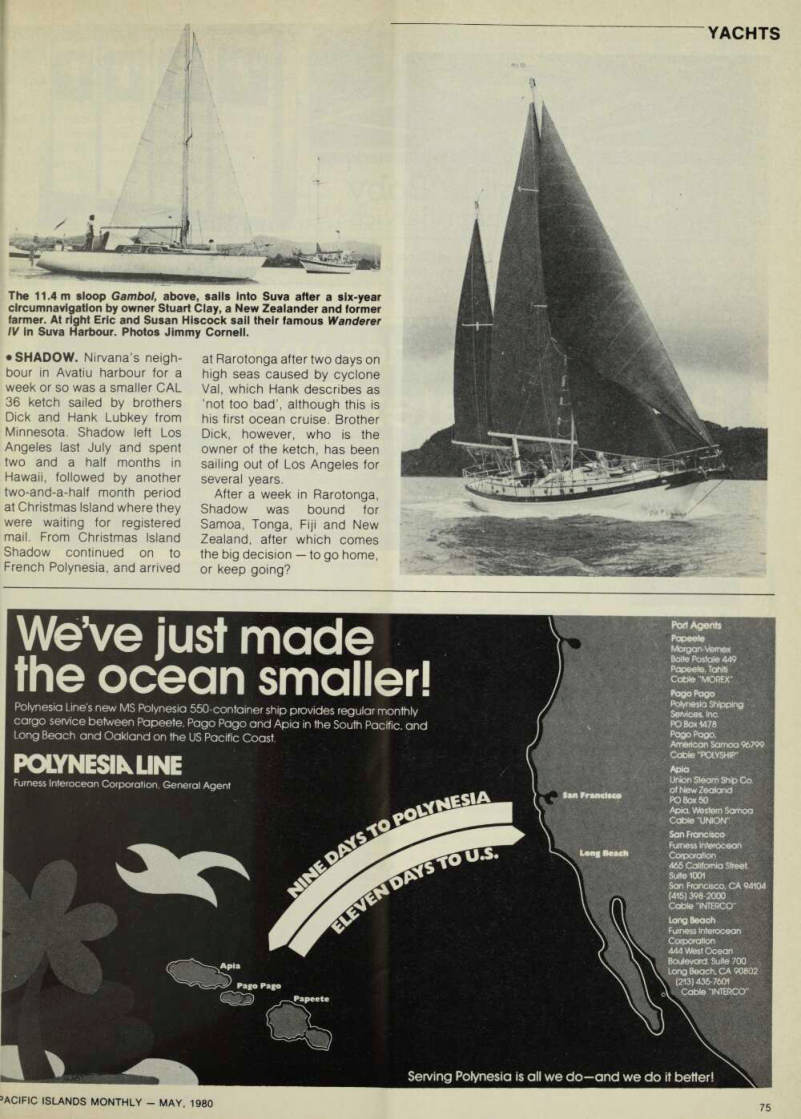
• ROMANCE. An elegant visi tor to Avatiu Harbour, Raro tonga, in mid-March was the brigantine Romance which is being taken round the world by owners Arthur and Gloria Kim berly, reports Karen Garner- Williams.
Romance, once a Danish inter-island cargo carrier, was converted to an accurate
1850 s square rig brigantine for
the movie Hawaii. The Kim berlys bought her 14 years ago after filming was com pleted. She has a crew of up to 16. Romance now spends her days cruising in the Virgin Islands or on long ocean voy ages, and the Kimberlys have made more than 200 eight-day cruises out of the Virgin Islands, their home base.
The Rarotonga call was part of the Kimberlys’ second cir cumnavigation in Romance, leaving Ansanada, Mexico, in October last year. They crossed to Pitcairn Island (‘our favourite port in the South Seas’, Gloria says) and then to the Marquesas and the So
ciety Islands before reaching Rarotonga.
From Rarotonga Romance is headed for Palmerston Island, Samoa, Tokelau, a shipyard appointment and crew change-over in Fiji, New Hebrides, Tikopia, Solomon Islands, the Marshalls (where she may pick up anthropol ogist Nancy Munn on Gawa) and Papua New Guinea. From the Pacific it is through to the Orient the Indonesian islands, Singapore and across the Indian Ocean to the Cocos, Keeling and Sey chelles Islands, and on through Africa and South America home to the Carib bean around April, 1981. The young crew are from ‘all over’, although mainly from the USA on this voyage.
Romance measures 27 m on deck, 34 m overall, and has been home for the Kimberlys for many years. The couple are full of tales of the South Seas, about shark worship pers, shell money as legal ten der with an Australian bank and etiquette with Trobriands chiefs, for example. Their brigantine is decorated with many native artifacts and carv ings, including wooden rep licas of the Bounty and the Romance made by an old friend on Pitcairn.
Two American ketches sailed into Rarotonga’s Avatiu
Romance shows off her graceful lines in Avatiu Harbour, Rarotonga.
Photo Abbie Cogan.
harbour at the end of March on the tail of tropical cyclone Val, which hit Niue but by-passed Rarotonga with nothing more than minor flooding and high winds. • NIRVANA. The 14 m CAL 3 Nirvana is being sailed in the Pacific by a crew of three for owner Lon Skinner, who comes from Medford, Oregon (hence Nirvana’s unusual home ‘port’ those who know Oregon are surprised to see the name of an inland town in scribed on an ocean-going yacht). Skinner flies out from the States to visit his craft and her crew Captain Larry Ryan, with Eric Le Buse and Sarah Moon in their various
ports of call. He made two trips to French Polynesia to see Nir vana between October 1979 and March of this year, and was expected to drop into Rarotonga for several weeks during the ketch’s month-long stay.
Nirvana left Hawaii bound for French Polynesia last October, and the crew were talking about heading for Samoa after the Cook Islands.
They commented that Pacific Publications’ South Seas Guide has proved an ex tremely useful addition to the nautical information they carry, providing all kinds of extra information about what to expect at the next port of call.
Rogue, a 12.6 m one-tonner racing yacht from Sydney, owned by retired merchant banker Roger White, takes part in a Sunday race in Suva harbour. Photo Jimmy Cornell.
• SHADOW. Nirvana’s neighhour in Avatiu harbour for a week or so was a smaller CAL 36 ketch sailed by brothers Dick and Hank Lubkey from Minnesota. Shadow left Los Angeles last July and spent two and a half months in Hawaii, followed by another two-and-a-half month period at Christmas Island where they were waiting for registered mail. From Christmas Island Shadow continued on to French Polynesia, and arrived
at Rarotonga after two days on high seas caused by cyclone Val, which Hank describes as ‘not too bad’, although this is his first ocean cruise. Brother Dick, however, who is the owner of the ketch, has been sailing out of Los Angeles for several years, After a week in Rarotonga, Shadow was bound for Samoa, Tonga, Fiji and New Zealand, after which comes the big decision to go home, or keep going?
The 11.4 m sloop Gambol, above, sails Into Suva after a six-year circumnavigation by owner Stuart Clay, a New Zealander and former farmer. At right Eric and Susan Hiscock sail their famous Wanderer IV in Suva Harbour. Photos Jimmy Cornell.
reef grounding
Apollo lost in reef grounding
The Australian champion international racing yacht Apollo was lost off the Queensland coast last month after striking a reef at
night.
Apollo, a 17-metre sloop, was leading the field in the Sydney- Gladstone race and was making about 12 knots under spinnaker when she struck the reef off Lady Elliott Island near Bun
daberg.
The crew, including millionaire owner Jack Rooklyn, got ashore without injury but an inspection at first light showed Apollo heeled over, smashed along the hull and beyond sal vage.
Rooklyn said the financial loss of the yacht was overshadowed by the sentimental loss suffered by him, his family and the crew.
Some of the crew members, in danger of their lives after the grounding, had to be ‘physically removed’ because they wanted to stay with the yacht, he said.
Rooklyn bought Apollo in 1970 from the Australian yachtsman Alan Bond, and four years ago spent SAIOO 000 on a refit.
Apollo gained line honours in the Sydney-Hobart race in 1978-79 and in the Sydney-Brisbane races of 1973 and 1977.
Advertisements & other items, pp. 74-78 (5 items)
Yachts
Gold
AND
RELICS
IBOUNTYI
HUNTER
ri
OUR AUSTRALIAN EXPERIENCE SINCE 1974
INDICATES TO US THAT THESE ARE MOST
ASSUREDLY FOR AUSTRALIAN CONDITIONS
THE VERY LATEST LIGHTWEIGHT MACHINES
FOR THE GREATEST
DEPTH PENETRA
IN
MAGNETIC GROUND CONDITIONS
(WHERE THE GOLD IS USUALLY LOCATED.)
BOUNTY HUNTER
"THE ONE THAT GETS THE GOLD"
MADE IN U.S.A.
25 MODELS - LIFETIME WARRANTY
-ALL PRICES
SEE THE RANGE - TEST THEM YOURSELF
AT ALL QUALITY DETECTOR STOCKISTS
AND DON'T SETTLE FOR ANYTHING LESS!
BOUNTY HUNTER HAS MORE VALUE PACKED
FEATURES. SOME MODELS ARE STANDARD
WITH 3 SEARCH COILS!
PHONE OR WRITE FOR FREE DATA PACKAGE
AND NEAREST DEALER LOCATION.
Sole S.W. Pacific Distributors & Factory-Approved Service Centre
HENDON DETECTOR COMPANY
An Associate of Southern Patagonian Holdings Pty Limited Office: 121 Plateau Rd. Telephone: (STD 02) 918 6288, 918 6667 (24 Hrs.) AH Mai! to: P.O. BOX lI.V, AVALON BEACH, NSW. 2107, AUSTRALIA Telex: 70560 Telegrams: "HEN DON AERO SYDNEY"
REPUTABLE NEW DEALERS ARE WELCOME -
NEVER SAY NO TO A CUSTOMER - WE CAN
PUT BOUNTY HUNTER GOLD DETECTORS ON
YOUR SHELVES IN 24 HOURS!
Yachts
We’ve just made
the ocean smaller!
Polynesia Line's new MS Polynesia 550-container ship provides regular monthly cargo service between Papeete, Pago Pago and Apia in the South Pacific, and Long Beach and Oakland on the US Pacific Coast.
POLYNESIA LINE
Furness Interocean Corporation, General Agent Port Agents Oh 9 A* K •S.
To u
o 3* £ K VS & Apia Pago Pago Papeete
Serving Polynesia
is all we do—and we do it better!
Morgan-Vemex Boife Postale 449 Papeete, Tahiti Cable “MOREX"
Pago Pago Polynesia Shipping Services, Inc.
PO Box 1478 Pago Pago.
American Samoa 96799 Cable "POLYSHIP"
Apia Union Steam Ship Co. of New Zealand
POBoxSO
Apia Western Samoa Cable "UNION"
San Francisco Fumess Interocean Corporation 465 California Street, Suite 1001 San Francisco, CA 94104 (415) 398-2000 Cable “INTERCO"
Long Beach Fumess Interocean . Corporation 444 West Ocean Boulevard, Suite 700 tong Beach, CA 90802 (213)435-7601 Cable "INTERCO"
WWWH
.'38* iT
PCI
Portacel
Paterson Candy
?ermutit-Boby
iouseman Service
r V Clarifying, Screening, Straining, Scraping, Separating, Filtering, Ultra filtration, Reverse Osmosis, Neutralising, Chemical treatment, Chlorine generation, Internal Treatment for boiler, cooling systems etc, Swimming pools, Demineralisation, Deionisation, Condensate polishing, Chlorinating, Recovery, Reuse, Sewage and effluent, etc.
It all adds up to
Portals Water Treatment
- one of the World's largest groups in the field.
Portals,in New Zealand alone, has a specialist staff of 75 including 8 Professional Engineers and has served New Zealand for over 50 years.
Portals Water Treatment (NZ) Ltd P.O. Box 13-558, Auckland 6, New Zealand.
Candy House, 11 Spring Street, Onehunga, Auckland. Telephone: 661-079 (7 lines) Telegrams: Portals Auckland. Telex: NZ 21175 ■ 1595 n
YOUR BUSINESS PARTNER
KYOWA
KYOWA LINE
To: Solomon, New Caledonia, Fiji, W Samoa, A. Samoa. Tahiti, Cook Is., Tonga, New Hebrides. Ellice Is., Nauru To: Guam, Saipan, Truk. Ponape, Majuro, Yap, Koror
g Singapore
Philippine
To; Papua New Guinea, Other Pacific Islands.
AGENTS
Taiwan; Royal Steamship Corp , Ltd . Taipei S. Korea; Dong Sue Shipping Co. Ltd., Seoul Hong Kong: Dahzun Enterprises Ltd Singapore: Ocean Shipping & Enterprises Pte, Ltd Guam: Maritime Agencies of The, Pacific Ltd , Guam Saipan; Saipan Shipping Co, Inc, Saipan Solomon: Solomon Taiyo Ltd , Honiara Tahiti: J.A. Cowan & Fils, Papeete Cooks: Eastern Associates Ltd , Rarotonga Tonga; E M. Jones Ltd , Nukualofa New Hebrides: Pentecost Pacific S.A., Port Vila Phillippines: Sky International Inc., Manila Ponape: United Micronesia Development Association, Ponape A.Samoa: Island Pacific Agencies Inc., Pago Pago W. Samoa: Morris Hedstrom Ltd , Apia Fiji: C arpenter Shipping, Suva & Lautoka Nauru: Nauru phosphate Corp.
PNG: Carpenter Shipping Agencies. Port Moresby, Rabaul New Caledonia: Agence Maritime Du Rond Point Du Pacific, Noumea Indonesia: P.T Porodisa Raya Shipping Lines, Jakarta Sabah: KOH Han Ming Shipping & Forwarding Agent , Kotakmabalu Sarawak: Pan Sarawak Agencies Sdn Bhd . Sibu & Kuching Australia: Hethenngton Kingsbury Pty. Ltd , Sydney. N S W.
Newzealand: Hussell & Summers Ltd , Aukland
KYOWA SHIPPING CO., LTD.
HEAD OFFICE OSAKA OFFICE
5th FI., Suzumaru Bldg. 39-8, 2-chome, Nishi-Shinbashi, Minato-ku, Tokyo, Japan. Frontier Bldg., 3-13 Hirano-cho, Higashi-ku, Osaka, Japan.
Phone : 03(437)2885(Rep.) Cables : “MARIQUEEN” Tokyo. Telex : 242-4651 Kyowa J. Phone : 06(227) 0422(Rep.) Cables : “MARIQUEEN" Osaka. Telex : 522-3896 Kyowa O.
V
GLOBAL SERVICE FOR SHIPPERS
V
THE
LINE
sf
Papua New Guinea & Solomon Islands
UK/Continent Service
Regular direct 28 day service
PAPUA NEW GUINEA and SOLOMON ISLANDS
to:
UNITED KINGDOM and CONTINENT
For particulars apply:
THE BANK LINE (AUSTRALASIA) PTY LTD.
18th Floor 1 York Street Sydney N.S.W. 2000 Australia Telephone: 272041 Telex; 24063
Somare, the man
from the Sepik JContinued from pi 4)
Services
Shipping
Should any shipping company wish to have its services cargo and passenger included in these list ings they should contact PIM.
Australia - Fiji
Karlander (Aust) Pty Ltd operates onthly cargo services from Sydney to jva and Lautoka.
Details from Karlander (Aust) Pty Ltd, )-31 Pitt Street. Sydney (27-6301), algety Shipping, 461 Bourke Street, elbourne (60-0731), Burns Philp (SS) o Ltd, Suva and Lautoka.
Sofrana-Unilines (Fiji Express Line) >erates to Suva and Lautoka every ree weeks from the main ports on the ist coast of Australia and monthly to tutoka from Melbourne and Sydney.
Details from Sofrana-Unilines, 19 Pitt reet, Sydney, (27-2031), Trans jstral Shipping Pty Ltd, 570 Bourke reet, Melbourne (67-9162). ACTA Pty j, Brisbane (221-3116), Elder-ANL y Ltd, Port Adelaide (47-5688), ANL, jwcastle (049-24364), Clements & arshall, Burnie, Tasmania 1-1833).
Australia - Fiji - Samoas -
Tonga
Pacific Forum Line operates a fully ntainerised service (Gen/Reefer) m Melbourne, Sydney to Lautoka, va, Pago Pago, Apia and iku’alofa. -unafuti cargo transhipped at Suva.
Details from Union Bulkships, Syd y; ANL Melbourne; Burns Philp, Lau :a and Suva; Polynesia Shipping rvices, Pago Pago; Burns Philp, ia; and Union Steamships Co, ku'alofa; or Pacific Forum Line, ad Office, Apia.
Australia - Lord Howe Is -
Norfolk Is
Dompagnie des Chargeurs ledoniens operates four-weekly go service Sydney - Lord Howe md and Norfolk Island.
Details Hetherington Kingsbury Pty I, 37-49 Pitt Street, Sydney ’-1671).
Australia - Nauru -
Kiribati
Jauru Pacific Line operates regular go/passenger service from Mel jrne to Nauru and Tarawa.
Details: Nauru Pacific Line, Nauru use, 80 Collins Street, Melbourne 3-5709), Nedlloyd Swire, 8 Spring set. Sydney (2-0522).
Ustralia - New Caledonia
(And/Or) New Hebrides
karlander operates a monthly service n Sydney to Noumea.
Details; Karlander (Aust) Pty Ltd 31 Pitt Street, Sydney (27-6301).
'Ofrana-Unilines ships serve umea every three weeks from the n ports along the east Australian ist.
Details from Sofrana-Unilines, 19 Pitt Jet, Sydney (27-2031), Trans itral Shipping Pty Ltd, 570 Bourke jet, Melbourne (67-9162), ACTA Pty . Brisbane (221-3116), Elders-ANL Ltd, Port Adelaide (47-5688), ANL vcastle (049-24364), Clements & shall, Burnie, Tasmania -1833). iompagnie des Chargeurs Cale liens operates a three-weekly con
tainerised cargo service from Sydney to Noumea.
Details Hetherington Kingsbury Pty Ltd, 37-49 Pitt Street, Sydney (27-1671).
Compagnie Generale Maritime oper ates a monthly service from Sydney to Noumea, Port Vila and Santo, using a self-sustained fully containerised vessel.
Details Compagnie Generale Mari time, 12 Castlereagh Street, Sydney (231-3700).
Daiwa Line operates 30 day service from Sydney to Vila and Santo.
Details Meridian Shipping & Trans port Agencies Pty Ltd, Box 3410 GPO Sydney 2001 (290-1633), Tlx: AA25970.
Australia - Nz - Fiji -
Hawaii - Us
P & O liners call at Auckland, Suva, Honolulu and Vancouver on eastbound and westbound voyages between Syd ney and the US.
Details from P & O Booking Centre, World Travel Headquarters Pty Ltd, 33 Bligh Street, Sydney (231-6655).
AUSTRALIA - NZ - FIJI - TONGA - N. HEBRIDES - NOUMEA - PNG -
Solomons - Samoas - Tahiti
Sitmar Cruises operates a year-round cruise programme to include most of the above countries.
Details from Sitmar Cruises, 47 Elizabeth Street, Sydney (232-7511).
P & O liners call at Auckland, Bay of Islands, Honiara, Lautoka, Noumea, Nukualofa, Pago Pago, Papeete, Port Moresby, Santo, Savusavu, Suva, Vavau and Vila on cruises from Aus tralia.
Details from P & O Booking Centre, World Travel Headquarters Pty Ltd, 33 Bligh Street, Sydney (231-6655).
Australia - Micronesia
Nauru Pacific Line operates a regular container service from Melbourne to Majuro, Kosrae, Ponape, Truk, Guam and Saipan.
Details Nauru Pacific Line, Nauru House, 80 Collins Street, Melbourne, (653-5709), Nedlloyd Swire, 8 Spring Street, Sydney (2-0522).
Australia - Png
New Guinea Express Lines operates three-weekly conventional and con tainer services Melbourne, Sydney, Brisbane. Port Moresby, Lae. Rabaul, Alotau.
Details from New Guinea Express Lines, PO Box R 73, Royal Exchange PO, Sydney (241-3991) MacArthur Shipping Agency Co, 82-92 Eagle Street, Brisbane (229-3777), New Guinea Express Lines, 327 Collins .Street, Melbourne (61-3053), Niugini Express Lines in Port Moresby (21-4572), Lae (42-1536), Rabtrad Niugini Pty Ltd, Rabaul (92-2911), Alotau Stevedoring & T'sport (61-1318).
Karlander New Guinea Line’s cargo vessels call at Melbourne, Sydney, Port Moresby, Lae, Madang, Wewak, Manus, Kimbe, Rabaul, Popondetta.
Details from Karlander (Aust) Pty Ltd 19-31 Pitt Street, Sydney (27-6301), Dalgety Shipping, 461 Bourke Street, Melbourne (60-0731).
Australia-Png-Solomons
A consortium of Conpac, NGAL/PNGL have three container vessels operating on a 28 day turn around from Melbourne, Sydney and Brisbane to Port Moresby. Lae, Rabaul, Kavieng, Wewak, Madang, Kieta and Honiara supplemented by Daiwa vessels, Pacific Princess and Fiji Maru extending from Sydney to Lae on a monthly basis.
Details from Burns, Philp & Co. Ltd. 51 Pitt Street, Sydney (2-0547) and Interocean Swire, 8 Spring Street, Syd ney. (2-0522).
Australia - Solomons -
Kiribati - Micronesia
Daiwa Line operates a container ser vice every 30 days from Sydney to
Advertisements & other items, p. 79 (2 items)
79
IFIC ISLANDS MONTHLY - MAY, 1980
Henry Cumines
PTY.LTD.
EXPORTERS o GENERAL MERCHANTS
428 GEORGE ST., SYDNEY
CABLES: HENCO SYDNEY. G.P.O. Box 3949. PHONE; 232-5377 • For specialised and personalised buying service throughout the Pacific Islands and the East.
LOCAL AGENTS AND REPRESENTATION:
PAPUA NEW GUINEA:
RABAUL; M. & C. Seeto P.O. Box 131, Rabaul.
Telephone 92-2919.
MADANG; W. Double, P.O. Box 22, Madang.
Telephone 82-2696.
SOLOMON
FIJI:
K. Witherington Ltd., P.O. Box 293, Suva.
Telephone 22-356.
NEW HEBRIDES:
John Lum & Associates, P.O. Box 65, Santo.
Telephone 329.
ISLANDS:
Mr. Tom Lo, P.O. Box 327, Honiara.
Telephone 399.
Resident Agents in other Pacific Territories.
■ PACIFIC
• FORUm
Line
OWNED BY THE PEOPLE
OF THE PACIFIC ISLANDS
Regular Monthly Liner Services
from Australia and New Zealand
to the South and Central Pacific
FOR INFORMATION CONTACT AGENTS:
AMERICAN SAMOA:
Polynesian Shipping Services Inc. P.O. Box 1478, Pago Pago.
AUSTRALIA:
The Australian National Line, 50 Queen Street, Melbourne.
Union Bulkships Pty.Ltd., 333-339 George Street, Sydney.
GILBERT ISLANDS:
Gilbert Islands Shipping Corp. P.O. Box 495, Tarawa.
FIJI:
Burns Philp South Sea Co. Ltd. GPO Box 355, Suva.
NEW CALEDONIA:
ETS Ballande, BP. C 4, Noumea.
NEW HEBRIDES:
Burns Philp New Hebrides Limited, Vila.
NEW ZEALAND:
The Shipping Corp. of N.Z. Ltd. P.O. Box 3344, Wellington.
PAPUA NEW GUINEA;
Steamships Trading Co. Ltd. P.O. Box 1, Port Moresby.
SOLOMON ISLANDS:
Sullivans S.l. Ltd. GPO Box 3, Honiara.
TONGA:
Union Steam Ship Co. P.O. Box 4, Nukualofa.
Honiara, Kieta, Tarawa and Guam. Gizo
cargoes transhipped at Honiara, Saipan, cargoes transhipped at Kobe, Details Meridian Shipping & Trans port Agencies Pty Ltd, Box 3410 GPO Sydney 2001 (290-1633), Tlx.
AA25970.
Australia - Solomons -
Northern Marianas-Taiwan
Japan
Daiwa Line offers a four-weekly ser vice Sydney-Honiara-Guam-Taiwan- Japan with transhipment at Kobe for Saipan.
Details Meridian Shipping & Trans port Agencies Pty Ltd, Box 3410 GPO, Sydney 2001 (290-1633). Tlx.
AA25970.
Australia - Tahiti
Compagnie Generate Maritime oper ates a monthly service from Sydney to Papeete using a self-sustained fully containerised vessel.
Details Compagnie Generate Mari time, 12 Castlereagh Street, Sydney (231 -3700).
Australia - Tonga -
Samoas - Tahiti
Karlander operates a monthly cargo service from Melbourne and Sydney to Nukualofa, Apia, Papeete, US west coast.
Details: Karlander (Aust) Pty Ltd, 19-31 Pitt Street, Sydney (27-6301).
Australia - W. Samoa
Compagnie Generate Maritime oper ates a monthly service from Sydney to Apia, using a self-sustained fully con tainerised vessel Details Compagnie Generate Mari time, 12 Castlereagh Street, Sydney (231-3700).
Far East - Fiji - New
Zealand
New Zealand Unit Express (NZUE) operates a fortnightly palletised cargo service from Manila, Keelung,
Kaoshiung and Hong Kong to Lautoka, Suva and thence to NZ, Details from Carpenters Shipping, Suva (312-244), Burns Philp, Suva (311-777), P & O S.N. Co, Wellington (736-477) or Nedlloyd Swire Pty Ltd, Sydney (20-522).
Nedlloyd operates bi-weekly cargo service with four ships from Sourabaya, Jakarta, Bangkok, Port Kelang and Singapore to Suva and NZ ports.
Details from Nedlloyd (Aust) Pty Ltd, 8 Spring St, Sydney (27 3801), Burns Philp (SS) Co Ltd, Suva and Lautoka.
Far East - Mid-S. Pacific
China Navigation’s New Guinea Pa cific Line (NGPL) operates a regular cargo service from Hong Kong, Taiwan, Manila, Port Kelang and Singapore to Wewak, Madang, Kimbe, Rabaul, Kieta, Lae, Port Moresby, Honiara, Santo, Vila, Noumea, Papeete, Pago Pago, Apia, Tarawa and Nauru.
Details from Steamships Trading Co,, Port Moresby (21-2000).
Kyowa Shipping Ltd, operates monthly services from Hong Kong, Taiwan, S. Korea and Japan, to Guam, Saipan, Solomons, New Caledonia, Fiji, Western and American Samoa, Tahiti, Cook Is., Tonga and New Hebrides.
Details: Hetherington Kingsbury Pty Ltd, 37-49 Pitt Street, Sydney (27-1671).
Daiwa Line operates 30-day service from Moji, Kobe, Nagoya and Yokohama to Papeete, Pago Pago, Apia, Suva, Lautoka, Noumea, Sydney, Honiara, Kieta, Tarawa, Guam and Taiwan.
Details: Meridian Shipping & Trans port Agencies Pty Ltd. Box 3410 GPO Sydney 2001 (290-1633) Tlx: AA25970.
Japan - Fiji - New Zealand
China Navigation, operates a monthly service from main ports Japan
to Suva and Lautoka and thence Noumea and NZ.
Details from Carpenters Shipping, Suva (312-244).
Japan - Png
Mitsui O.S.K. Lines operates a monthly service from main ports Japan and Port Moresby, Rabaul, Lae, Madang, Kieta and Kimbe.
Details from J. C. Waller, Port Moresby (21-1755).
JAPAN - GUAM - FIJI - TAHITI -
Samoa - N. Caledonia -
Solomons - Kiribati
Daiwa Lines runs a monthly cargo service from Japan via Guam to Lau toka, Suva, Papeete, Pago Pago, Apia, Sydney, Noumea, Honiara, Tarawa, Guam.
Details from Burns Philp (SS) Co Ltd, Suva.
Hawaii - Samoas - Tonga
Warner Pacific Line operates uni tized/palletized and reefer cargo ser vice every 30 days Honolulu /Pago Pago-Apia-Nuku’alofa. Line Islands and Suva by inducement.
Details from Hawaii-Pacific Maritime Inc,, Honolulu, Hi 96801. Tel. (808) 521-9806 Freight Dept. Tlx (RCA): 723-8330 ITT 743-0040 Cables ‘Oral’.
New Caledonia - Fiji - West
Coast North America
PAD Line operates an approx. 3weekly ro-ro service from Noumea and Suva to Honolulu and West Coast USA and Canadian ports.
Details from Sofrana-Unilines SA, BP 1602, Noumea (27-51 -91), Tlx NMO4B; W. R. Carpenter, 100 Thomson St., Suva (31-11-22), Tlx FJ2199; Trans- Austral Shipping, Box R 232 PO, Royal Exchange. NSW (27-2441), Tlx AA21204.
Png - Uk/Continent
Bank Line operates regular cargo
service from Kieta, Rabaul, Kimbe Madang and Lae to Cardiff, Hamburg Rotterdam and Antwerp.
Details from Bank Line (A'asia) Ptl Ltd, 1 York Street, Sydney (27-2041' Burns Philp (PNG) Ltd, ports.
Png - Us
Bank Line operates regular cargi service from Kieta, Rabaul, Kimbe Madang and Lae direct to New Orleans calls at other US and Gulf and Eas Coast ports on inducement.
Details from Bank Line (A’asia) Ft Ltd, 1 York Street, Sydney (27-2041 Burns Philp (PNG) Ltd, PNG ports.
Solomons - Usa -
Uk/Continent
Bank Line operates regular carg service from Honiara to New Orleans Cardiff, Hamburg, Rotterdam and An werp.
Details from Bank Line (A’asia) Pi Ltd, 1 York Street, Sydney (27-2041 Trading Co, Honiara (389).
NZ - COOK IS - NIUE -
Tahiti
Shipping Corporation of NZ Ltd ope ates cargo services based on pallet and similar units from Auckland to Niu< Cook Islands and Tahiti.
Details from the Shipping Corp of N Ltd, PO Box 3420, Aucklan (797-210), Waterfront Commission, Pi Box 61, Rarotonga; Lighterage an Stevedoring Co, Aitutaki; Niue Go' Offices, Niue Island Compagnie Mar time Polynesienne, B’P’ 368, Papeets Tahiti.
Nz - Fiji
Reef operates a regular 18-day se vice from Auckland to Suva and Lai toka.
Details from Reef Shipping Agencies PO Box 3382, Auckland. N (77-1221-3).
Pacific Line with one ship operate
fortnightly roro cargo service New Zealand, Lautoka, Suva.
Details: Sofrana Unilines, 18 Cus toms Street, Auckland (773-279) PO Box 3614, Telex: NZ2313.
NZ - FIJI - NORTH AMERICA (WC) Blue Star Line Ltd Pacific Coast con , tainer services. Only direct service to and from New Zealand. Blue Star vessels call at Suva and Honolulu on NZ-US-West Coast voyages.
Details from Blueport ACT (NZ) Ltd, PO Box 192, Wellington (739-029) , Burns Philp (SS) Co Ltd, GPO Box 355, Suva, Fiji (311-777).
Nz - Fiji - Png
Pacific Forum Line operates a con tainerised unitised/palletised service (Gen/Reefer) from Lyttelton and Auckland to Suva, Port Moresby, Lae and Kieta.
Details from Shipping Corporation of New Zealand Ltd, Auckland, Lyttelton Burns Philp, Suva, Steamships Trading Co in Port Moresby, Lae and Kieta. (As from end March, Service will be fully containerised) NZ - FIJI - SAMOAS - TONGA Pacific Forum Line operates a con tainerised service (Gen/Reefer) from Lyttelton, Napier, Auckland to Lautoka, Suva, Pago Pago, Apia and Nuku’alofa.
Details from Shipping Corp of New Zealand Ltd, Napier, Lyttelton and Wellington; Union Steamship Co, Auckland, Lautoka, Suva, Apia, Nuku’alofa; Polynesia Shipping Ser vices, Pago. Funafuti cargo tran shipped at Suva.
Nz-N. Caledonia-N. Hebrides
Png-Solomons
Sofrana Unilines with three ships op erates to Vila and Santo, to Honiara and P apua New Guinea and to Norfolk stand and Noumea.
Details from Sofrana Unilines, 18 Sustoms Street, Auckland (773-279), 3 0 Box 3614, Telex NZ2313.
Nz - Tahiti
Compagnie Tahitienne Maritime SA vith one ship operates monthly service slew Zealand - Papeete.
Details from Sofrana Unilines, PO Box 3614, 18 Customs St, Auckland 773-279), Tlx NZ2313.
Nz - Tonga - Samoas
Pacific Navigation of Tonga operates i four-weekly cargo service, Auckland Nuku’alofa - Pago Pago - Apia - Auckland.
Details from McKay Shipping Ltd, )owntown House, Queen Street, Auckland (30-229).
Warner Pacific Line services Auckland - Nuku’alofa/Vavau/ .pia/Pago Pago fortnightly carrying eneral and freezer cargoes. Also imaru - Nuku'alofa/Vavau/Apia every 1 days carrying freezer cargo.
Details from Air Marine Services (NZ) td, PO Box 2505, Auckland /96-841), Telex NZ21555.
Europe - Tahiti -
New Caledonia
Compagnie Generale Maritime oper tes services from Europe and Mediter mean ports to Papeete and Noumea sing three Ro-Ro and two multi urpose vessels thus ensuring a bi lonthly sailing to and from.
Details Compagnie Generale Mari ne, 12 Castlereagh Street, Sydney !31 -3700).
Hamburg-Sued operates monthly argo services from Hamburg, Dunkirk id Le Havre to Papeete, Noumea, via anama.
Details from Columbus Overseas arvices Pty Ltd, 333 George Street, /dney (290-2966), Columbus Mari ne Services, 17 Albert Street,
uckland (77-3460).
EUROPE - TAHITI - W. SAMOA -
Fiji - N. Caledonia
Nedlloyd offers regular cargo ser ies from Northern Europe and UK to
Papeete, Apia, Fiji and New Caledonia.
Details Nedlloyd (Aust) Pty Ltd, 8 Spring Street, Sydney (27-3801).
Uk - N Continent - Fiji
The Bank Line operates a regular 28 day cargo service from Hull, Hamburg, Bremen, Antwerp and Rotterdam to Suva and Lautoka.
Details from The Bank Line (Aus tralasia) Pty Ltd, 1 York St, Sydney (27-2041); Burns Philp (South Sea) Co Ltd, Suva and Lautoka.
Uk/N. Continent - Png -
Solomons
The Bank Line operates a regular 28 day cargo service from Hull, Hamburg, Bremen, Antwerp and Rotterdam to Port Moresby, Lae, Madang, Kimbe, Rabaul, Kieta and Honiara and on inducement to Yandina, Details from The Bank Line (A’asia) Pty Ltd, 1 York Street, Sydney (27-2041); Burns Philp (PNG) Ltd, PNG ports; Trading Co Honiara.
Uk/N. Continent - Tahiti -
N. Caledonia - N. Hebrides
The Bank Line operates a regular 28 day cargo service from Hull, Hamburg, Bremen, Antwerp and Rotterdam to Papeete and Noumea.
Details from The Bank Line (A’asia) Pty Ltd, 1 York Street, Sydney (27-2041); Ets A M Fare UTE, Papeete; Ets Ballande, Noumea.
US - FIJI - TAHITI - NZ -
Australia
The Bank and Savill Line Ltd, oper ates regular cargo services from US Gulf ports to Australia and NZ. Calls at Suva, Lautoka and Papeete on de mand.
Details from The Bank Line (A’asia) Pty Ltd, 1 York Street, Sydney (27-2041) or Howard Smith Industries Pty Ltd, 1 York Street, Sydney (27-5611).
Us - Hawaii - Micronesia
Philippines, Micronesia & Orient Navigation Co (PM&O Lines) operates regular container service on self sustained ship with ro-ro capabilities from Oakland, Portland and Honolulu to Majuro, Kosrae, Ponape, Truk, Saipan, Yap and Koror.
Details for Micronesia can be obtained from Larry Guerrero, PM&O Owners Rep, PO Box 803, Saipan, Ml
96950, Cable Commontime; Pm&O
Lines, 181 Fremont St, San Francisco, California 94105, Cable PMONAV.
Us - Hawaii - Nauru -
Micronesia
Nauru Pacific Line operates regular conventional/container and passenger service from San Francisco and Honolulu to Majuro, Ponape, Truk and Saipan. Cargo is accepted for Nauru and Kosrae with transhipment at Majuro and Ponape.
Details from Nauru Pacific Line, Nauru House, 80 Collins Street, Mel bourne (653-5709); North American Maritime Agencies, PO Box 7302, San Francisco. California 9411 (981-0343).
Us - Noumea - Fiji
PAD Line operates an approx 3-weekly ro-ro service from West Coast USA and Canada to Noumea and Suva.
Details from Sofrana-Unilines SA, BP 1602, Noumea (27-51 -91), Tlx NMO4B; W. R. Carpenter, 100 Thomson St, Suva (31-11-22), Tlx FJ2199; Trans-Austral Shipping, Box R 232 PO, Royal Exchange, NSW (27-2441), Tlx AA21204.
Us - Tahiti - Samoa
Pacific Islands Transport operates a five weekly cargo service from North America west coast ports to Papeete, Pago Pago, Apia.
Details from Polynesia Shipping Ser vices Inc, PO Box 1478 Pago Pago (9-6799).
Polynesia Line operates container
and general cargo service from US west coast ports to Papeete and Pago Pago, Details from Polynesia Shipping Ser vices Inc., PO Box 1478, Pago Pago (9-6799).
US - TAHITI - SAMOA - NZ - AUST Farrell Lines Inc, operate a fast reg ular lash/container cargo service from west coast ports Canada/USA to Papeete and Pago Pago thence to NZ and Australia.
Details Wilh Wilhelmson Agency, Sydney, Melbourne and Brisbane, Tlx AA20136, Cable FARSHIPS Sydney; Dalgety (NZ) Ltd, Auckland and Wellington, Tlx NZ2445, Cable DALSHIP Auckland; Compagnie Mari time Polynesienne, Immeuble Franco Oceanienne, PO Box 368, Papeete, Tahiti, Tel 26393, Tlx 258. FP ANSB Taporo, Cable OCEAN Papeete; Kneubuhl Maritime Service, PO Box 39, Pago Pago, Telephone 633-5121; Tlx 782505.
Advertisements & other items, p. 80 (1 item)
South Sea Freighters Limited
Announcing: A 30-day service between Singapore,
Malaysia, Papua New Guinea and the Solomon Islands «r ■ ' ■■ % ft AGENTS: New Hebrides: South Sea Freighters Limited, PO Box 166 Port Vila • Singapore: Bienley & Co. (Pte) Ltd. Telex RS 25114, Phone: 98 1935 Pt Moresby: Nuigini Express Lines • Oro Bay: Carnell Carriers, Popondetta P.N.G. • Madang: B J. Back • Lae: Nuigini Express Lines • Wewak Burns Philp (N.G.) Ltd.
Kiel* Burns Philp (N.G.) Ltd. • Kimbe; Harrisons & Crossfield (P.N.G.) Ltd. • Rabaul: New Guinea Cocoa (Export) Co. Pty. Ltd. • Honiara: Island Co-operative Shipping Federation Ltd Serviced by MV Solomon Sea and MV Bismarck Sea.
Deaths
of Islands People
Ratu Livai Tabucala,
Mbe
In Savusavu Hospital recently, aged 77. Among his many com munity interests he was chair man of the Savusavu hospital Board of Visitors, and was active in fund-raising for the new mortuary unit at the hospi tal.
Bruce Allan
At Vaimea, Western Samoa, recently. A New Zealand volunteer working as an instructor in carpentry at the Young Men’s Christian Associ ation, Mr Allan was killed when the motor cycle he was riding was struck by a taxi which had got out of control.
James L. Lewis
In New York USA on March 2, aged 71, from a heart attack.
James Lewis, who came from Danville, Pennsylvania, was a US citizen who became head of the Asia and Pacific Section of the United Nations Trustee ship Department, and had been living in retirement in New York. He had been a UN official since 1948.
He became widely known to administering officials and the
newly-emerging politicians of
Micronesia, Nauru, Papua New Guinea and Western Samoa during moves towards independence which were studied by UN.
Mr Lewis was the senior official in UN Trusteeship Council missions which moni tored the Australian adminis trations of Papua New Guinea and Nauru immediately before independence was granted. He also served as an official in UN teams which supervised elec tions and referendums in West Irian and on parts of the African continent. During World War II he served with the US Navy’s Pacific fleet.
A memorial service was held in the UN chapel in New York.
Cecil Joseph
Shorthouse
At Redcliffe, Queensland, February 1, 1980. Cec was a pre-war and post-war Terri torian, and a long-time em
ployee of Steamships, Papua
New Guinea. His funeral was attended by old PNG identities such as George Gough (ex superintendent Bomana Gaol), Jack Woods and Joe Roach of
Steamships Trading Company,
Mike Duffy, formerly of the Department of District Admin istration, Roy Barwick ex- Department of Native Labour, and Fred Allen, ex-STC.
Sarju Prasad
Saiju Prasad, who has died in Fiji, was more than 100 years old and came there under the original indentured labor sys tem which established the
Indo-Fijian community. He
served two terms as an inden tured worker after being re cruited in Africa and then settled in Vanua Levu. He spent most of his life in Vanua Levu and Taveuni and was active in Indian affairs in these islands. He leaves eight sons, four daughters and 150 grand children.
Gwen Read
At Ballarat, Victoria, Australia, on January 31. Gwen Read Mrs W. J. Read was one of the band of Australian women who sacrificed a normal life style to live in remote parts of Papua New Guinea with their husbands during the adminis trative contact periods of the
late 1930 s and immediately
after World War 11.
Incensed once by an Aus tralian politician who claimed Australians had it easy in PNG she planned a menu of bully
Advertisements & other items, p. 81 (1 item)
81
*CIFIC ISLANDS MONTHLY - MAY, 1980
beef and rice to welcome him

‘so he can eat the same as we do’.
She is survived by her hus band Jack Read, known widely as an administrative officer in PNG, a member of the famous Coastwatchers unit of World War 11, and more lately as a senior land titles com missioner based in Rabaul.
Geraldine Marlow
At Suva, Fiji, at the age of 96.
Mrs Marlow, known as Lulu Marlow, was the wife of Alf Marlow, founder of the Suva firm of Marlows. She was born in Levuka only nine years after the cession of Fiji and became one of her country’s pioneer women but she said in later years that she never regretted the hardships she had known. ‘lt’s a challenge to people to find out what they can really do,’ she said.
Bernard J. Viggers
In Brisbane, Australia, follow ing an illness which forced his retirement from Rabaul, Papua New Guinea. Bernie Viggers was one of the best known businessmen in the islands region of PNG, with a quiet and kindly manner which became something of a by word. Soon after World War 11, after military service in the area, he established a part nership with Mr L. F. (Harry) Croyden and continued to live in Rabaul until last year.
Ngaeikura Tou
In Auckland on March 15, aged 63. Dr Ngaeikura Tou, a doctor in the Cook Islands for 37 years, was a former Deputy Director and later Secretary of Health who represented the Cooks at many regional medi cal seminars and conferences.
He was a man who believed in the value of traditional Maori medicine and often claimed that China was not the only pioneer of the barefoot doctor system. The Cook Islanders had always had such a system in their traditional culture, he said. Dr Tou, who trained in New Zealand and Fiji, retired only last year and was living in Rarotonga where he was Com-. missioner of the High Court
and president of Rarotonga
Rotary Club. He was a member of the Cook Islands bowling team which won two gold medals at last year’s South Pa cific Games.
Advertising Index
Advertiser Page
Nissan Motor Co 62 84
Nelson & Robertson ' 66
Nz Dairy Board 83
Polynesian Bookshop 41
Polynesian Airlines 88
Portals Water Treatement 76
Pacific Forum 79
Papua Hotel 39
Peter Fisher 82
Pioneer 24-25
Qbe Insurance 52
Rex Webb Real Estate 82
Ricoh !6
Superior Farm Equipment 66
South Pacific Hotels 40
Sansui 34
Sony 54
South Seas Freighters 80
Sariba Slipways 69
Toyota Motor 42-43
Tatham 4
Victor 58
Video Recorder Centre 82
Yuasa Battery Co 68
Yamaha 20
Advertiser Page
Air Niugini 36
Aiwa 64
Amatil 30
Aggie Grey Hotel 39
Aust Timken 72
Akai 2
Bankline 78
Boral 50
Cumines, Henry 79
Clarion Shoji 12
Carptrac 56
Consolidated Chemicals 70-71
Dept Overseas Trade 48
Electric Motors Machinery Ltd 82
Fujitsu Ten 38
Fleets 82
Furness 75
Hayes, Harry 82
Hendon Detectors 74
Hilton, C 82
Integrated Technical Service 28
Kyowa Shipping 76
Marlin Modular Homes 60
Morehart 82
Matsushita 46
Advertisements & other items, pp. 82-84 (3 items)
Aluminium Barge
FOR SALE
76 ft. cruising ketch 14.6 ft. beam 10 ft. draft, teak hull and deck, copper sheathed—bronze fastened.
New rig and sails, 10 new winches, Gardiner 5 cyl., feathering prop., 2700 sq. ft. sail.
Excellent condition. Ideal family cruising boat. Price $A275,000.
Write: Captain Mike Morehart, Box 94, Russell, N.Z. Ph.: 694.
NEW
ALUMINIUM BARGE
40' by 1 2 , 3208 caterpillar diesel, large commercial jet unit, Very fast barge, front loading off beach. $63,000.00
PASSENGER LAUNCH
Built 1979 steel, surveyed 70 passengers. Gardiner diesel, great boat. $130,000.00
C. HILTON, KIWI RANCH,
P.B. ROTORUA, NEW ZEALAND,
PHONE: 53 533 ROTORUA
POSTAGE STAMPS
Office or bank workers.
Do you throw away envelopes?
I pay cash for postage stamps on envelopes from Pacific Islands. (No Australian or N.Z. required). Envelopes should be neatly opened. Send in quantities of at least 50 by surface mail or write for further details to:
HARRY HAYES
48 Trafalgar Street, Batley,
West Yo«J<shire WFI7 7HA,
United Kingdom
A FAIR DEAL IS ASSURED
SIX FUNCTION
SOLAR ALARM
WATCH IN
LATEST
STYLE
Distributors & Agents Wanted Contact:
INIERCAPE
AUSTRALIA
19-21 Lonsdale St.,””
Melbourne 3000 y
FLEETS
60 ft. ketch workboat, prof, bit. 1957, major re-fit 1976. 100 h.p. diesel. In survey, 8 berths, radar, pilot, raft etc. $52,500. 36 ft. sloop motor sailer, ideal world cruise $52,500.
FLEETS
221 Esplanade, Wynnum Central, Brisbane.
Cable FLEETS BRISBANE.
F3
Pty Ltd
ELECTRIC MOTORS & MACHINERY LTD.
POWERHOWSE ELECTRIC LTD.
Electric Motors - Drip Proof
TEFC
Type “N”
F L P
Starters Slide Rails Pulley Belts
AC & DC
Alternators Generators Switch Board Meter Panels Motor Control Centres Cable Reels Cable Handling Gear Contractors Hardware
ELECTRIC MOTORS MACHINERY LTD.
POWER HOWSE ELECTRIC LTD.
164 Khyber Pass Rd, Newmarket. Auckland. New Zealand. Ph 371-643 or 374-487
4
REX WEBB
REAL ESTATE PTY. LTD.
INVESTORS
We have many years’ experience in real estate on the Gold Coast, Old. and would like to offer you FREE advice on property investments in the fastest growing area in Australia. • Houses • Flats • Units • Land • Commercial Properties. All enquiries treated confidentially.
PHONE: (075) 37 2588 A.H.: 37 1486
BIGGERA WATERS SHOPPING CENTRE,
HOLLYWELL ROAD, BIGGERA WATERS, Q. 4216
PETER FISHER
TRADING
Pty Ltd
321 PITT St., SYDNEY, AUSTRALIA 2000
Telephone: 212 1475 Cables: "FISHERION" Sydney
EXPORTERS TO THE
PACIFIC ISLANDS
sfesr
•i.. -h r.*v * » % ■i. r t -,*• '
• *SSSm9zSS&*
- : «vv , • xJK. * ' £ rW*. s*s *?n
%X?A I
mm m ,->■
feSSl*
> & ■ .-■ V v> &&*%> .
W%t «-?
M n
3UKS£
AT . V. : f> 4 : P >-. nS £ - ' IK ft S 3 ■ *tf£S a *35 3 * - A WA w ss* tfim u ;■» S&lsSSr ;1»
SMB
U -L- -!W!
jS&SSSffIBm
mmSm
ra t •: *m y££s*' M fita r m t% ifS \mm » T *m« *** "■i / v.»* ■■ rnrra; Ik S H n P n -fat ■■■
I An. )tnr P ftl
SI
\j v J
tsmrj to Wn n JO nonfat Ir led m ii k wz% I
mmm
-, ftncnor
i .instant
,JnwwhoW
/ /** n /' t ir j
lili iii'il
✓ I x » ?°ouci
**L New ■ {^jJ
$1 Cr ®‘ New Zealand
Jag creamed
-sr AnciwL
sfesr
Anchors Mk <•* Alfchor
09MAYBC
m
‘su!]i
Sjfni,
:uk Anchor / . , iTTii. /a
milk
UTT
UtK-ftsstaised n '-ti'
JfiAUfl/
1 n*m p
»X P '“ AC STOCK ROTATION
H 0» Ik V-N' OP cheese "■ i s - ofe: 'V «M ?kha !Qd |aM At 7e^ ■*> 4 ,V Q *ll & P
mmmm
msmm
u 13£!« «:2* <ln *»< »»Wf
Datsun’s “extra” effort for total quality.
All because you deserve nothing but the best Dummy components for assembly practice.
Special shower tests on a “white body."
Datsun’s "pass/no pass sample."
Tough wheel strength testing.
Whenever you step into a Datsun, there's one thing you can always count on. Every Datsun comes from a winning combination of the highest technological know-how, the most advanced production techniques and the strictest quality control measures possible.
But there’s something else. Something uniquely Datsun. And that's what we call our ‘‘extra’’ effort. For instance, our system of inserting a “dummy’’ body into a current production line not only enables us to master the new procedures before actual production of a new model, but it also gives each of us a rare opportunity to gain firsthand knowledge on how a car in its entirety should be.
Special shower tests are conducted on a “white body’’ to analyze water flow under diverse motoring conditions in the rain. The results are fed back to the engineering and design department to ensure car body watertightness.
Then, there’s our “pass/no pass sample.’’ An authoritative guide for determining the best paint quality, it enables us to tell, virtually at a glance, whether a Datsun has been painted precisely and with the utmost care.
Datsun statistically picks samples from each lot of wheels and subjects them to rigorous strength tests.
If a sample fails to measure up to Datsun’s strict standards, it is promptly rejected along with the entire lot.
In other words, we leave nothing to chance. So whenever you travel in a Datsun, you ride not only on peak technology but also on our “extra’’ effort to make each Datsun a benchmark of quality.
DATSUN
American Samoa: B. F. KNEUBUHL INC., Pago Pago/Cook Islands: COOK ISLANDS MOTOR CENTRE LTD.. Rarotonga/Fiji: CARPENTERS MOTORS, Suva/Guam: DATSUN MOTOR SALES, Agana/Hawaii: NISSAN MOTOR CORPORATION IN HAWAII LTD., Honolulu/Kiribati: ATOLL AUTO STORES, Tarawa/Nauru: JACOB ENTERPRISES LTDV New Caledonia.
AGENCE ALMA S.A., Noumea/New Hebrides: PENTECOST S.A., Port Vila and Santo/Norfolk Islands: SIRIUS MOTORS/Papua New Guinea: BOROKO MOTOR S 1 T?- res . by/ Saipan: JOETEN MOTOR COMPANY INC./Solomon Islands: UNITED ENTERPRISES LTD., Honiara/Tahiti: TAHITIBULL S.A.R.L., Papeete/Western Samoa: MORRIS HEDSTROM LTD., Apia