Strife at the top
p. 15 · Read in the full issue
in Tonga’s FWC
From Penny Hodgkinson in Nukualofa
A power struggle within Ton ga’s Free Wesleyan Church be tween the current president and the recently deposed sec retary is assuming aspects f strongly reminiscent of the epic 19th-century confrontation starring Shirley Baker and the Rev James Egan Moulton.
At the centre of the present drama is Siupeli Taliai who, by presidential edict on January 18, was suspended from his ministerial function and simul taneously ousted from his long held posts as elected ; conference secretary and appointed principal of Tupou College (one of the FWC’s many Tongan secondary schools).
The president, the Rev Dr Huluholo Mo’ungaloa, cited ‘unworthy behaviour, insubor dination, and obstructing the work of the church’ as justifi cation for his drastic action, which shocked much of the grassroots membership of the church.
Superficially, the president’s case hinges on Siupeli’s failure to take up a posting in the United Kingdom (to the Ham mersmith Circuit in London), and his later refusal to vacate the Tupou College post when told to do so.
Siupeli denies the charges
against him, claims that the Hammersmith posting and then a potential alternative fell
through, originally because of
administrative delays, then due to personal health problems.
He cites another conference resolution, reaffirming his
college job for ’79-’BO, despite
the UK posting. His stand is
that Wesleyanism is essentially
based on democratic principles and therefore approved con ference resolutions outweigh overriding presidential direc tives a view which has pro
found implicationms coming
from a presidential ‘heir appar ent’.
However, due to the loose wording of the church consti tution, these democratic prin ciples appear to have been
eroded over many years as suc cessive presidents have taken upon themselves the right to govern by directives, which have been referred back to con ference for retrospective ratifi cation. A useful side-effect of this development has been the acquisition-by-custom of the right to remove thorns from the
presidential flesh by banishing
them to outer islands or, in more senior cases, ‘kicking them upstairs’ via plum over
seas postings.
Observers within the church see the Hammersmith proposal as a case in point, designed to get a long-standing ‘radical’ in Tongan terms, any critic of the status quo out of the president’s hair, and a too
strong-minded principal out of
that of the conservative Presi dent of Education (Dr Cook).
When the Hammersmith job evaporated, the president adopted Course No 2, also hal lowed by precedent, and claimed that the ’79 con ference resolution confirming Siupeli in the college post for
’79-’BO really only meant,
though it did not specifically say, ‘until the date in Sep tember when he was expected to leave for England’. Follow
ing this interpretation, Siupeli
was given notice to vacate his post and house by September 1, ’79.
Armoured in the strong con viction that right was on his side, both morally and legally, he refused to budge, continued with his college duties, cited his case before various committees and meetings, and continued to sit tight until receipt of the January 18 letter with its un
equivocal tripartite message of
‘Out out out’.
About the same time, another letter went to the minister appointed to be acting
principal in his place, advising
that the actions taken had the sanction of the King and of the church’s lawyer, Mr T. Finau MLA. Siupeli moved out of the college and into a house in
Nukualofa, having lost the immediate battle but not, he believes, the war. ‘My purpose,’ he says, ‘was not to flout the president’s directives, however arbitrary, but to uphold the declared res olutions of conference, abide by the constitution, and bring subordinate powers and their
rulings into conformity with
those resolutions. ‘lnjustice and flouting a rule of law is a threat to justice everywhere because what affects one directly affects all
indirectly.
‘I believe this case drama tises an issue which can no longer be ignored. And I hold that one who breaks an unjust law or stands out against an unjust directive, as directed by conscience, and who willingly accepts any penalty in order to arouse the conscience of the
community over that injustice,
is, in reality, expressing the highest respect for law.’
Squarely on Siupeli’s side (at least privately) are his right-or wrong personal admirers, and those who believe his stand is morally right and that the time is ripe for a searching reassess ment of the constitution and clarification as to whether con ference or the president is the
decision-making power.
Dr Mo’ungaloa’s faction is said to be mainly made up of (a) those who give unquestion ing respect to the presidential office, irrespective of the man, and (b) of ‘King’s men’ who could never bring themselves to vote against a president who
is also the appointed Royal
Chaplain. (Perhaps a reason
for divorcing these two func tions?) In the middle sits a sizeable group which does not wish to rock boats or foment divisions, and which hopes a spirit of Christian forbearance and con ciliation will point the way to a peaceable solution. This can only be achieved, they say, if both sides can stop seeing the issue in simplistic terms of ‘white as the driven snow’ (us) and ‘black as pitch’ (them).
On April 1 Siupeli’s case was to be reviewed at the quarterly
Tongatapu district meeting. If
still unresolved, it would be passed on to the mid-year annual national conference.
Meanwhile, in the Tongan context, it is extremely difficult to predict the outcome. It must be borne in mind that
Wesleyanism is, in Tonga,
effectively the state religion,
with the monarch since the
time of King George Tupou I,
as its titular head. For a century and a half it has wielded very
significant political clout, be
cause of its close links with Royalty and government, and its large numbers of devoted adherents.
After a period of eclipse dur ing the Shirley Baker era, the FWC has for many years been by far the most powerful of the
three independent Wesleyan
sects in the Kingdom. Its widely diversified activities, secular as well as religious, offer broad paths of prefer ment for faifekaus (ministers), teachers and administrators,
provided they avoid the pitfalls
of boatrocking and strong
possibilities of relegation to
outer darkness if they don’t.
The $64 question therefore is: How many of Siupeli’s pro fessed supporters will publicly stand firm when the official chips go down and the official numbers go up? That is un doubtedly a big step to take when one’s own advantage and one’s inherited, built-in tend ency to obey those in authority both point the other way.
Which is why nobody in Tonga, not even his most con firmed opponents, would deny Siupeli his just label as a man of strong principle and very considerable moral courage.
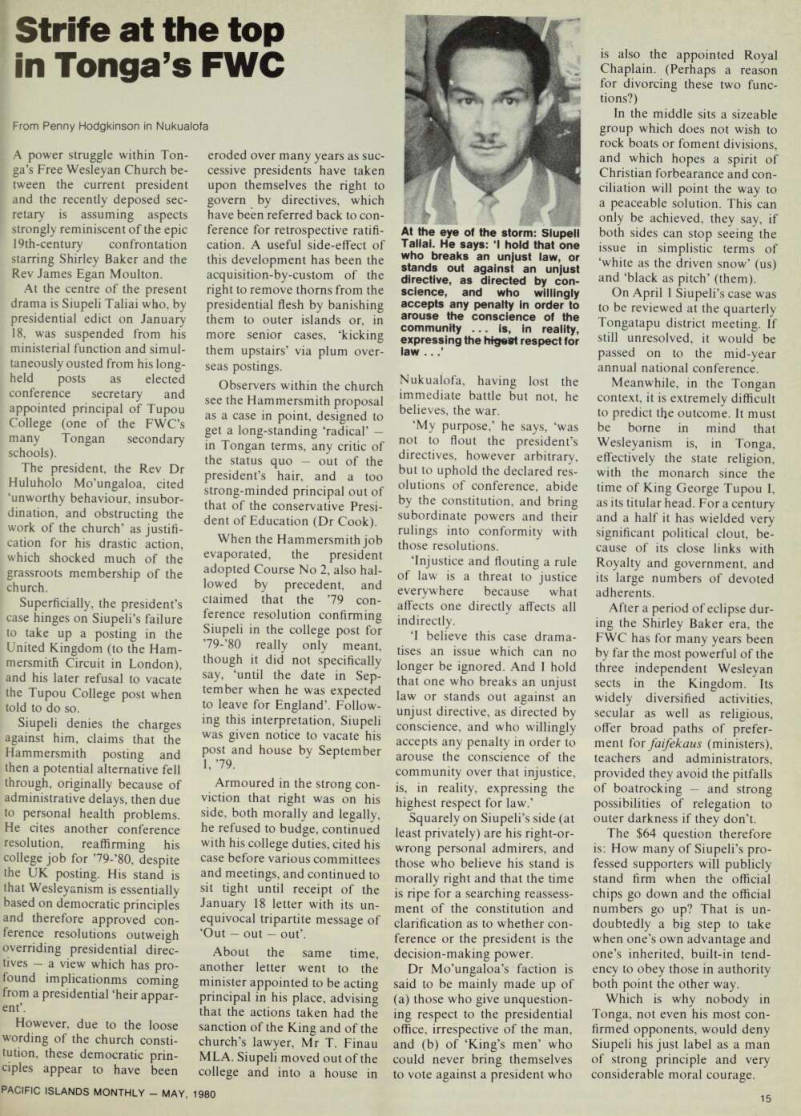
At the eye of the storm: Siupeli Talial. He says: ‘I hold that one who breaks an unjust law, or stands out against an unjust directive, as directed by con science, and who willingly accepts any penalty in order to arouse the conscience of the community ... is, in reality, expressing the htgest respect for law ...’