Gaston Flosse does a
pp. 27-29 · Read in the full issue
French Polynesia
Gaston Flosse does a U-turn and the T. A. debates N-accidents
From Marie-Therese and Bengt Danielsson in Papeete
Recent times have seen import ant new developments in the two areas of perennial concern in Tahitian politics; the politi cal status problem, and the
problem of nuclear testing.
In the first, Gaston Flosse, deputy to the Paris National
Assembly for Polynesia’s east
ern constituency and leader of the local Gaullist Tahoeraa Huiraatira party, in mid- March did an amazing political ‘U-tum’ by asking for a com plete revision of the existing constitution, to enable French Polynesia to become a truly
self-governing country, only
loosely ‘associated’ with France.
The irony of it all was that Flosse and his pro-French, conservative followers for many years opposed all moves by the so-called ‘autonomist’ parties of Teariki and Sanford to obtain full self-government (autonomie interne j, coupled with a recognised right to eventual independence. As a matter of fact, it was not until Teariki and Sanford decided to resort to more forceful actions, including the trapping of the High Commissioner in his official car, and a 10-months long occupation of the Terri torial Assembly, that the French Government gave in, hurriedly concocted a new con stitution, which was adopted in July 1977, and called new elec tions which catapulted Teariki and Sanford into power.
For those who had dreamt of an internal self-government on the Cook Islands model, the new constitution was a bitter
disappointment right from the
beginning. The French Government retained control of such vital matters as de
fence,. foreign affairs, police,
justice, immigration, monetary
system, credit policies, bank ing, overseas trade, air traffic,
fishing rights, ocean wealth,
secondary education,
broadcasting-TV, communal
affairs and the whole civil ser vice.
Phis left in the hands of the elected representatives of the
Polynesian people mainly the
troublesome task of balancing the budget with the help of locally raised revenues.
The Autonomist leaders tried to soothe their critics by saying that the 1977 consti tution was not the last word, and that they had by no means lost sight of the ultimate goal of independence. It was just that they had to go slow and concentrate, for the time being, on economic problems.
Not surprisingly, they were
soon outflanked on their Left by the local socialist party la mana te nunaa, followed by two other smaller nationalist par ties, which all asked for
immediate independence.
During the 1978 and 1979 gen eral elections, these parties, which also strongly opposed
nuclear testing, polled around
15% of the votes. This score, however, was considered so modest that the ruling Autonomists did not see any need to change their ‘go-slow’
policy (PIM Jan p2l).
The fact that Gaston Flosse’s party beat them at the polls in June 1979, capturing 44.5% of the votes to their 40.8%, seemed rather to confirm their view that the electorate or at least the Europeans, part- Europeans and Chinese who form the main body of Flosse’s support was not ready for any more revolutionary
changes.
There was therefore total and general surprise when the Autonomists in mid-March were outflanked on their Right by Gaston Flosse’s sudden re-
quest for full self-government.
The most surprising thing
was the thoroughness and secrecy with which Flosse had acted. Not only had he pre pared, with the help of his smart young ‘technical advisers’ (practically all local
boys with university degrees), a
long, detailed draft for a new constitution, but he had also made a quick trip to Paris two weeks earlier to have it tabled in the French Parliament.
One of its key provisions confers wide powers on an elected cabinet, made up of ministers in charge of depart ments and headed by a prime minister. The novelty resides, of course, not in the system itself, which is common to practically all democratic governments, but in its appli cation to a French overseas ter
ritory.
Equally important are the
dispositions in the economic field which would give
Polynesia complete freedom to
trade with any countries she likes, to handle international air traffic and landing rights, to
exploit freely her own
immense maritime resources and to open the islands to foreign investors. In his com ments, Flosse said squarely that it was both natural and de
sirable to strengthen Polynesia’s economic ties and increase her trade with the other Pacific countries, naming specifically America, Australia, New Zealand and Japan. This represents, of course, a com plete break with the present
colonial-type economic policy
which ties the territory firmly to the mother country, 20 000 kilometres away. Unfortun ately, as past experience has clearly shown, the only way to make a success of this policy,
which ignores geographical
facts, is to tow the islands across the oceans and anchor them somewhere off the coast of France.
As can easily be understood, the sudden ‘U-turn’ of the Tahoeraa Huiraatira caused the original Autonomists a cer tain embarrassment. But they could hardly condemn the ideas they had been fighting for all their lives. They therefore
simply castigated Flosse’s
motives as being opportunistic.
Surely, Flosse’s next move seemed to confirm this, for he flew off to the Leeward islands, where public sentiment for independence is strongest, on ‘an explanatory mission’.
However, the embarrass ment felt in French Govern ment circles was much greater still.
Considering that by mid-
March all existing political par ties in French Polynesia were in favour of internal self
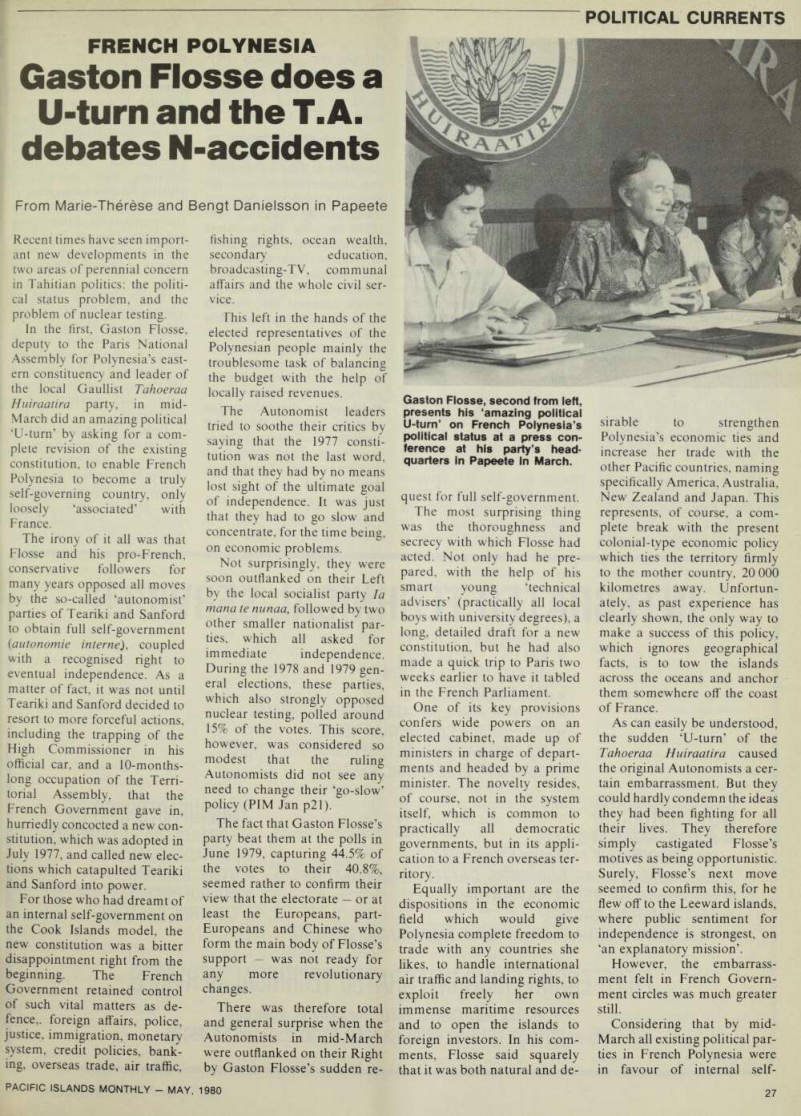
Gaston Flosse, second from left, presents his ‘amazing political U-turn’ on French Polynesia’s political status at a press con ference at his party’s head quarters in Papeete in March.
government, and that those adopting the most ‘radical’ pos itions Tahoeraa Hiuraatira, la mana te nunaa, Te taata Tahiti tiama, Polynesian Liber ation Front represented about 60% of the electorate, the French Government seemed bound to accept a thorough re form of the existing consti tution, in line with the proclaimed - and noble principle of self-determination for all colonial peoples. Or. it seemed, the least it could do would be to accept a refer endum.
However, this is precisely the kind of thing that bothers the Paris government, which has always feared that any easing of the reins could lead to a breakaway. In the quite well founded view of Paris, an
independent Polynesia would
not allow any further nuclear tests to be made at the already
badly damaged Moruroa
Atoll.
The first official response came from High Com missioner Paul Cousseran who went on the air to announce that the old Autonomist parties
were quite happy with the pre sent constitution. His statement was greeted with a terse com munique from Autonomist
headquarters taking the
HiCom to task for presuming to speak in their name, and adding that the Autonomists had always believed the consti tution could and should be im
proved.
It was then the turn of Over seas Territory Minister Paul Dijoud who stated that he knew for certain that the ma jority of the inhabitants of French Polynesia did not wish to change the present consti tution, which was functioning in a perfectly satisfactory man ner. (How he was able to ascer tain this he did not make clear.) But, when all is said and done, Mr Dijoud and every body else knows that the only group of people empowered to make a decision on this vital matter are the 491 deputies who make up the French National Assembly. With the
solid majority enjoyed by
President Giscard d’Estaing in
this metropolitan body, the chances are practically zero that any piece of legislation distasteful to the government could be adopted or even reach the floor for debate.
Meanwhile, on March 13, French Polynesia’s Territorial
Assembly at long last staged a
sort of interim debate on the nuclear accidents at Moruroa Atoll on July 6 and 25 1979 (PIM Oct p 29). The accidents left a total of two dead, and 11 injured, six of them seriously.
The debate was necessarily ‘interim’ in character for the
simple reason that, having
received only very incomplete
information from French authorities concerning the acci dents, the five members of the
Territorial Assembly forming
its committee of inquiry into the accidents decided late last year to postpone the debate until they had received certain documents. These documents had not yet reached their hands by March 13.
They were:
(1) The CEP (body in charge of the Moruroa Tests)
experts’ own report about the accidents. (2) The report which ‘the team of internationally known scientists in the nuclear field’ (who were in fact all French and mostly engineers working for the French Atomic Energy Commission) had made
following their investigative
visits to Moruroa last year. (3) The geological report by the well-known French vol canologist Haroun Tazieff, in which he reportedly advises against using atolls for nuclear tests. (4) The reports about all other scientific studies made of the subsoil of Moruroa. (5) The annual reports issued by the Atomic Energy
Commission/CEP radiological
laboratory, set up 15 years ago, which had previously been
kept secret.
Perhaps the most important
information acquired by the
Territorial Assembly’s com mittee at the time of its investi
gations although nothing
was said to them officially about it was that the 28 underground blasts so far had
; damaged the periphery of the atoll so badly that the tech nicians had become very anxious to receive the long
awaited equipment (mostly
barges) which will enable them to drill bomb shafts into the centre of the lagoon, a new technique for which a CEP general more than a year ago (PIM Mar 1979 p 7) had used
the misleading English ex
pression ‘offshore drillings’.
The most moving speech at the March 13 debate was un
doubtedly that of old-style
Tahitian party leader John Teariki who reaffirmed, in highly personal terms, his total opposition to the Moruroa tests.
He said; ‘When I went there as a member of the committee of inquiry, it was my first visit to Moruroa. Although this atoll is part of my fatherland, I felt as if I were in a foreign country.’
Of the large revenues pro duced by the CEP/CEA im plantation (1 500 million francs annually) he said: ‘lt seems to me that the financial rewards thus derived are very small indeed, compared to the irrep arable harm done by the CEP/ CEA bases to our society in the economic, political and social fields. ‘This is why I deem it necess ary to reaffirm in the most sol emn terms that in my various capacities, as a Polynesian, a fisherman, a farmer, a council man and the leader of the Pupu here aia party, I have always been and I am still today against the CEP/CEA and against the continuation of the nuclear tests at Moruroa.’
In the vote, the 18-member Autonomist majority, includ ing Teariki’s party and Francis Sanford’s Ea api party, voted for adoption of the slender three-page report of the com mittee of inquiry, tacking on an amendment stressing the urgency of receiving the docu ments requested.
Gaston Flosse and the other nine members of the Tahoeraa Huiraatira group voted against, as a protest against the vague and inconclusive character of the Committee’s report.
They certainly had a point
there. But who bears the main blame for our imperfect
knowledge of what is going on at Moruroa? It seems to us that the report at least answers that
important question.
Canberra
Tarawa Ties
Stronger formal links with Australia may well be one of the developments from the independence last year of the
Republic of Kiribati, formerly
the Gilbert Islands.
This became apparent last month during a visit to Aus tralia by the Secretary to the Kiribati Cabinet, Mr A. T.
Teaotai, making what he de scribed as a ‘general familiaris ation tour’.
He hinted at a possible State visit to Australia by his
country’s 29-year-old President
leremiah Tabai, taking up an invitation which Australia is known to have extended some time ago.
Mr Teaotai said it was
becoming increasingly appar
ent that Australia was accept ing a greater responsibility in the Pacific region and this was welcomed by the Pacific com
munity.
He said his country looked to Australia for aid, not as a beg gar but as a regional partner which was anxious to develop itself and to reduce its econ omic dependency. The bulk of external aid to Kiribati at pre sent comes from Britain, the former administering power, and amounts to about SA4 million to be spent this year and next year.
Australian overseas aid is
already providing Kiribati with
a $4 million grant for civil en gineering and transport, and New Zealand is also providing aid.
Mr Teaotai said that much of the aid his country was already receiving was tied to specific projects at the time of allo cation. He looked to the time when Kiribati could establish the economic reputation which would allow it to receive a greater proportion of untied aid. ‘We don’t have much idea yet of how Australians operate, but we believe they are friendly and ready to co-operate with us and these are the sort of things
I have been following up,’ Mr Teaotai said in Sydney after spending two weeks in Can berra. Aid agencies were on his calling list during the visit.
High on the list of projects which Kiribati would like to see completed is the 3km causeway planned to connect Betio to Bairiki on Tarawa. A long-planned project to build a causeway was funded by a loan of $1.7 from the Asian
Development Bank. But nearly
two years of work has failed to produce a causeway and the
project is now bogged down by
legal wrangles.
There is strong evidence to suggest that Australia might be prepared to provide aid for at least a new feasibility study for the causeway. At present, how ever, Australian officials are understandably reluctant to become involved in a situation which might be seen as affect ing the legal ramifications of the first project.
As Mr Teaotai said during his visit to Sydney; ‘We are not
really blaming anyone it’s
past history now. All we know is that we still don’t have a causeway, we want one badly, and in the meantime the costs
of operating a ferry are going
higher and higher.’
Questions
On N.C.
Some Melanesians are working for independence for New Caledonia both inside and out side the territory, Australian Foreign Minister Andrew Pea cock said in a written reply tabled in the House of Rep resentatives in Canberra to a
question by former television
quiz ace, and now Labor MP,
Barry Jones.
Mr Jones had asked Mr Pea cock if he could say whether
the overwhelming majority of
Melanesians there wanted
independence and were agitat
ing inside and outside New Caledonia for that goal.
Mr Peacock said claims had been made by the Indepen dence Front Party that more than 80% of the Melanesian voters voted in favour of
independentist parties. Other
estimates ranged down to 64%.
In the absence of voter enrol ment by ethnic origin it was not
possible to be precise.
Mr Jones in an earlier ques tion had asked Mr Peacock if he could say whether indigenous Melanesians con stituted the largest single ethnic group in New Caledonia. Mr Peacock agreed that was the case and gave a breakdown of population figures as follows:
Indigenous Melanesians,
43.3% (65 000) of the popu lation; Europeans, 35.6% (49 700); Wallisians, Tahitians, Vietnamese, Indonesians and other small ethnic groups, 21.1% (29 400).
In reply to a further question from Mr Jones, Mr Peacock said the electoral lists did not reveal details whether the ma jority who voted against
independence in July, 1979,
was made up largely of recent arrivals, transient officials and members of the armed forces on their tour of duty.
Turning to another tack on New Caledonia, Mr Jones asked Mr Peacock if his atten tion had been drawn to reports that at night on January 6-7, a Melanesian was shot dead by a French police officer. If so, could he say whether the incident was followed by a wave of agitation, including the erection of road blocks, in favour of independence.
Mr Peacock replied that on January 9, a French police inspector was suspended from duty and committed to custody in respect of the fatal shooting.
Melanesian reaction was lim ited to the attendance of about 300 independentists at the fu neral. They marched, without incident, several kilometres with the funeral cortege on
January 10.
Pago Tells
Tokyo
The government of American Samoa has sent a strong letter of protest to United States Am bassador to Japan Mike Mans
field protesting against
possible dumping of nuclear
wastes in the Pacific by
Japan.
The letter associates American Samoa with earlier protests by Governor Carlos Camacho of the Common wealth of the Northern Marianas and others.