known corner of Polynesia
pp. 35-37 · Read in the full issue
Travel
Wallis: Exploring a little known corner of Polynesia
I tried to send a telegram from I Vavau to Wallis, but no one in the Neiafu telegraph office I seemed to have heard of this I island some 500 km to the north-west of Tonga. The oper ator searched his list of tele graph stations, in vain, and the telegram wasn’t sent.
I thought this was an excep tional case, but then the situ ation repeated itself at the . Customs office in Apia, where I was met by the same blank stare when I mentioned Wallis as my next destination. ‘Wallis?
Where’s that?’ asked the cus , toms officer full of suspicion, I so I patiently explained to him that it was their nearest neigh bour to the west. Visibly annoyed with me for not having chosen some better known place for my cruising, he put down ‘Wallace’ on my clearance papers, but I decided to overlook the spelling mis take as by now I had started having my own doubts about the existence of this mysterious land. Even the modern nautical charts warn the mariner that Wallis may be lying about five miles further to the west than r its charted position, so it was I with no little satisfaction that I I watched a speck of land appearing out of the waves three days after leaving Savaii : behind. Thank God. Wallis ; does exist and. what’s more, exactly where it was marked on the map some two centuries
1 ago by the English captain
whose name it now bears.
Ashore in Mata Utu, the capital of the group of which Uvea is the largest island, set in a large lagoon. I noticed that the people looked and sounded very much like their brethren to the east. After all. this is still Polynesia, even if the official language is now French. .Georges Piliako, the curator of the as yet non-existent museum
Jlmmy Cornell, yachtsman and scribe, finds that the island of Wallis does indeed exist, despite the doubts of some people he met in Apia just before his departure. He also found that the Wallisians have shown great skill in preserv ing ancient Polynesian ways in the modern world, and that among their strongest desires is that they should become better known among their South Pacific neighbours.
of Wallis, didn’t seem at all sur prised at the ignorance of their neighbours and put the blame squarely on the ‘official’
language barrier. Wallis, along
with Futuna, a slightly larger island to the south-west, are surrounded by English speaking countries with which the tiny French territory has virtually no contacts at all.
There are no regular shipping or air links with neighbouring Tonga, Western Samoa or Fiji, although an air service to Suva and Apia was under consider ation. Yet the language and customs of the 6000 Wallisians are very similar to those of Tonga, while the 3000 Futunuans have more in com mon with the Samoans.
Although the show is very much run by the French ad ministration. the traditional hi
erarchy has been preserved on both islands, Wallis being still ruled by a king, Futuna by two, one for the district of Singave, one for Alo. I could not speak to the king of Wallis, Lavelua Tomasi Kulimoetoke. because according to custom he is not supposed to be spoken to di
rectly. so instead Georges
Piliako took me to the village of Vaimalau, on the western side of the island, to see one of the former district chiefs, Petelo Polelei.
An excellent road runs all around Uvea and nearly all 19 villages that make up Lavelua Kulimoetoke’s realm are situ ated on it. A few people live on some of the smaller islands in the lagoon, the only proper vil lage outside Uvea being on the island of Faioa.
Driving along the hard
packed coral road I was impressed by the neat appear ance of the villages, hardly any
European type houses being
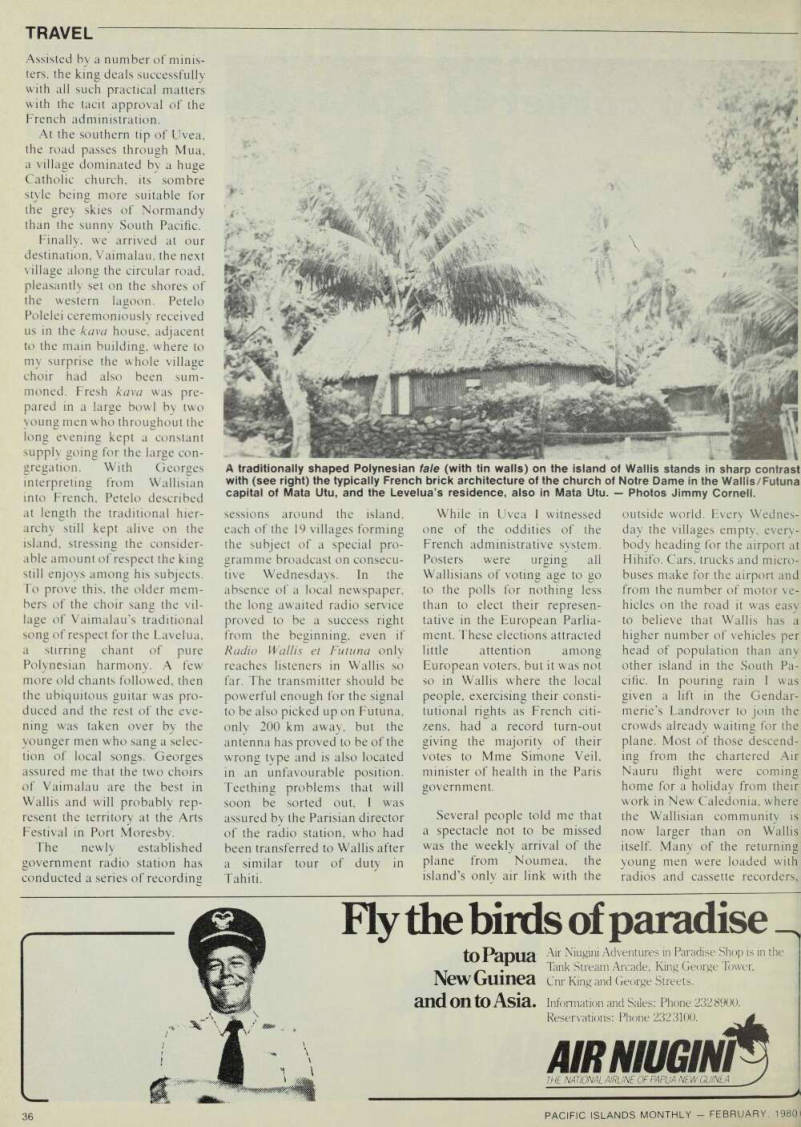
visible anywhere. The tra ditional thatched Polynesian fate has been kept in its original form. although in most instances the plaited pandanus walls have been replaced by corrugated tin walls with open
ings protected by plywood
shutters. Both the walls and the shutters are painted white and blue or white and red giving the villages a cheerful appear ance. Nowhere else that I have seen in the Pacific have local
style and imported materials
been blended so skilfully, thus preserving the airiness and simplicity of the traditional fale but taking advantage of the durability of manufactured building materials. Between the villages, the road passes well kept gardens, the greatest part of this fertile island being cultivated. The allocation of the customary lands for plant ing by villagers, as well as the regular rotation of crops, is one of Lavelua’s responsibilities.
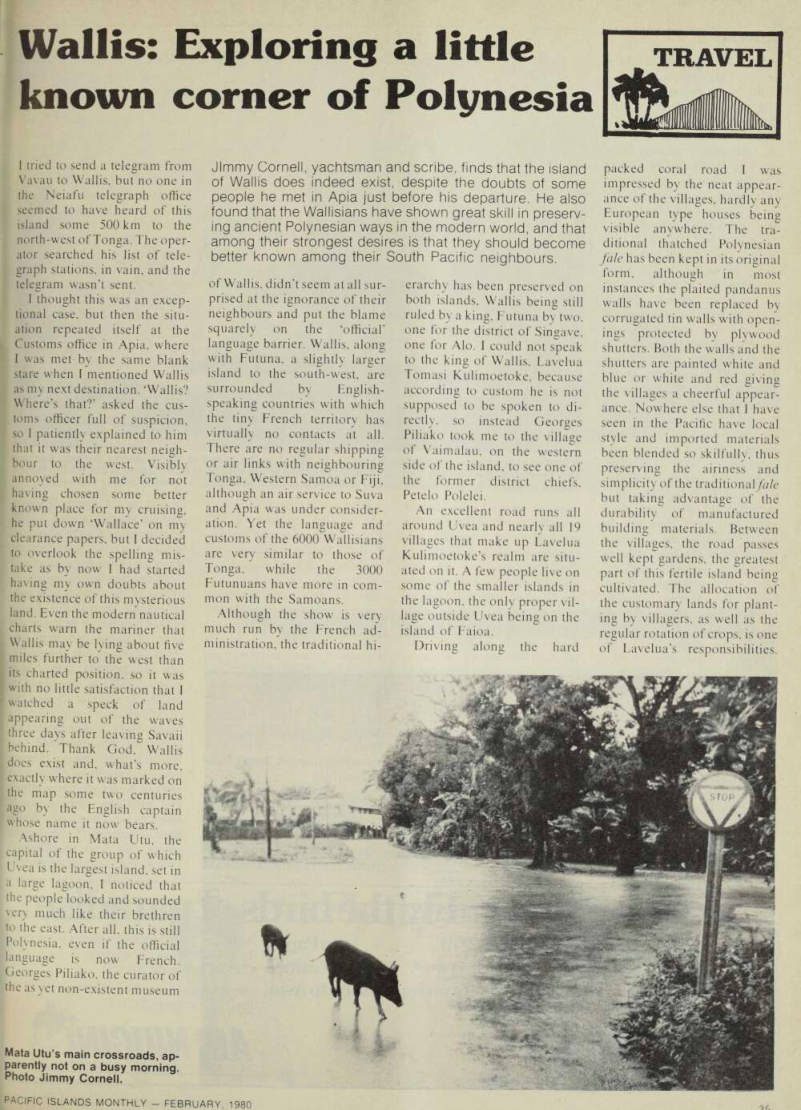
Mata Utu's main crossroads, ap parently not on a busy morning.
Photo Jimmy Cornell.
Assisted by a number of minis ters. the king deals successfully with all such practical matters with the tacit approval of the French administration.
At the southern tip of Uvea, the road passes through Mua.
a village dominated by a huge
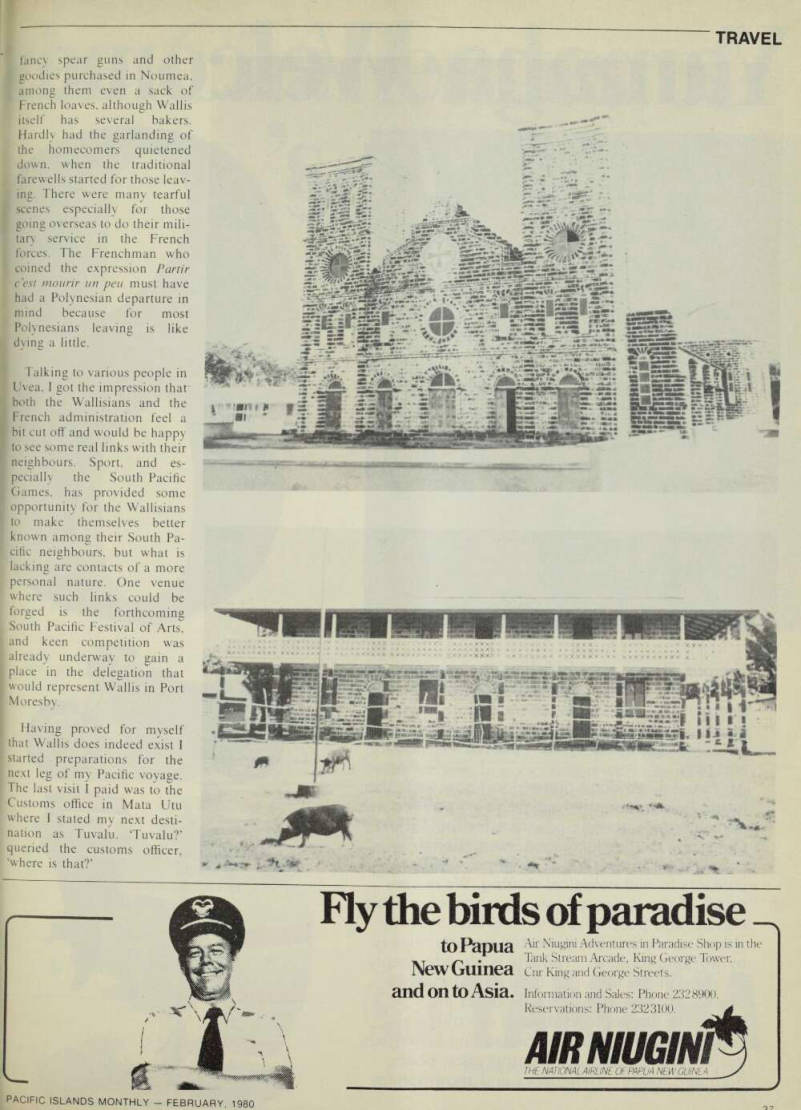
Catholic church, its sombre style being more suitable for the grey skies of Normandy than the sunny South Pacific.
Finally, we arrived at our destination, Vaimalau. the next village along the circular road, pleasantly set on the shores of the western lagoon. Petelo Polelei ceremoniously received us in the kava house, adjacent to the main building, where to my surprise the whole village choir had also been sum moned. Fresh kava was pre pared in a large bowl by two young men who throughout the
long evening kept a constant
supply going for the large con
gregation. With Georges
interpreting from Wallisian into French. Petelo described at length the traditional hier archy still kept alive on the island, stressing the consider able amount of respect the king still enjoys among his subjects.
To prove this, the older mem bers of the choir sang the vil lage of Vaimalau’s traditional song of respect for the Lavelua, a stirring chant of pure
Polynesian harmony. A few
more old chants followed, then the übiquitous guitar was pro duced and the rest of the eve ning was taken over by the younger men who sang a selec tion of local songs. Georges assured me that the two choirs of Vaimalau are the best in Wallis and will probably rep resent the territory at the Arts Festival in Port Moresby.
The newly established government radio station has conducted a series of recording
sessions around the island, each of the 19 villages forming the subject of a special pro gramme broadcast on consecu tive Wednesdays. In the absence of a local newspaper, the long awaited radio service proved to be a success right from the beginning, even if Radio Wallis et Futuna only reaches listeners in Wallis so far. The transmitter should be
powerful enough for the signal
to be also picked up on Futuna, only 200 km away, but the antenna has proved to be of the wrong type and is also located in an unfavourable position.
Teething problems that will
soon be sorted out, I was assured by the Parisian director of the radio station, who had been transferred to Wallis after a similar tour of duty in Tahiti.
While in Uvea I witnessed one of the oddities of the French administrative system.
Posters were urging all Wallisians of voting age to go to the polls for nothing less than to elect their represen tative in the European Parlia ment. These elections attracted little attention among European voters, but it was not so in Wallis where the local
people, exercising their consti
tutional rights as French citi zens, had a record turn-out giving the majority of their votes to Mme Simone Veil, minister of health in the Paris government.
Several people told me that a spectacle not to be missed was the weekly arrival of the plane from Noumea, the island’s only air link with the
outside world. Every Wednes day the villages empty, every
body heading for the airport at
Hihifo. Cars, trucks and micro buses make for the airport and from the number of motor ve hicles on the road it was easy to believe that Wallis has a higher number of vehicles per head of population than any other island in the South Pa cific. In pouring rain I was given a lift in the Gendar merie’s Landrover to join the crowds already waiting for the plane. Most of those descend ing from the chartered Air
Nauru flight were coming
home for a holiday from their work in New Caledonia, where the Wallisian community is now larger than on Wallis itself. Many of the returning young men were loaded with radios and cassette recorders,
A traditionally shaped Polynesian fate (with tin walls) on the island of Wallis stands in sharp contrast with (see right) the typically French brick architecture of the church of Notre Dame in the Wallis/Futuna capital of Mata Utu, and the Levelua’s residence, also in Mata Utu. Photos Jimmy Cornell.
i fancy spear guns and other A goodies purchased in Noumea.
I among them even a sack of f French loaves, although Wallis I itself has several bakers.
Hardly had the garlanding of • the homecomers quietened down, when the traditional - 4 farewells started for those leav j ing. There were many tearful i scenes especially for those B going overseas to do their mili- I tary service in the French I forces. The Frenchman who I coined the expression Partir c’est mourir un pen must have had a Polynesian departure in mind because for most
Polynesians leaving is like
, dying a little.
Talking to various people in B Uvea. I got the impression that I both the Wallisians and the I French administration feel a I bit cut off and would be happy I to see some real links with their ■ neighbours. Sport, and es- I pecially the South Pacific I Games, has provided some K opportunity for the Wallisians Ito make themselves better known among their South Pa- I cific neighbours, but what is lacking are contacts of a more personal nature. One venue [ where such links could be
forged is the forthcoming
South Pacific Festival of Arts, I and keen competition was
I already underway to gain a
I place in the delegation that I would represent Wallis in Port
I Moresby.
Having proved for myself that Wallis does indeed exist I I started preparations for the next leg of my Pacific voyage. 1 The last visit I paid was to the ■Customs office in Mata Utu where I stated my next desti nation as Tuvalu. Tuvalu?’ queried the customs officer, ‘where is that?’