Islands
pp. 29-33 · Read in the full issue

From the
Press
From consecutive issues of the monthly Pitcairn Miscellany, Pitcairn Island Ever seen a film eight times? Well that is how often ‘Silver Streak’ was shown at the Court House before being sent back. Most of those who saw the film eight times knew the script better than the actors.
The feature films which arrived on the last ship have catered for all kinds of tastes. Titles received were; Sherlock Holmes’
Smarter Brother, High Time, Super Cop, Wonderful World of the Brothers Grimm, Bad Day at Black Rock, Peeper. French Connection 11, Orchestra Wives, Pirates of Tortuga. Hombre. (Admission 40C first showing, 20C second showing, lOC third.
Children half price.) From Ollana’s column in The Observer, Apia, Western Samoa The year is drawing to a close and despite the spectre of petrol at $4 a gallon before the end of next year, the continued French bomb tests on our back door; the US contemplating dumping nuclear wastes on some Pacific island, and New Zealand’s immigration policy as tough as ever against Samoans, there still seems to be an air of optimism about the future. We can afford to be optimistic for should the civilised world collapse, we are one of the few places that could survive without much trouble
Arawa Bulletin, Arawa, North Solomon Province,
Papua New Guinea If you thought Kung-Fu mania had struck Panguna on Sunday afternoon, with all the children wandering around town in the judogis (hope that’s right Hugh and Gary?!) you were almost right. The Junior Judo Club held their gradings at the Squash Courts on Sunday. Congratulations to the 13 children who attended and were graded to their different classes.
Fiji Times, Suva
A Fiji Visitors Bureau board member watched an elderly woman tourist pay $9B for a vau wood sword, he told a board meeting yesterday. There was nothing I could do about it... If I tried the sword seller would have pushed me in the sea’, Mr Rajendra Singh said. He said the woman was accosted by the sword seller at the bottom of the gang plank of a cruise ship. ‘He asked her name and when she told him, he carved it on the sword straight away. She was embarrassed into buying it.’ FVB executive manager, Mr Malakai Gucake, said this sort of thine ‘happened all the time’... 5
Niugini News, Lae, Papua New Guinea
The East Sepik Provincial Government’s main office in Wewak closed on Monday for a week. The reason for the closure is not known. The people are very concerned about the sudden closure of the office, and have called on provincial government officials to explain the reason for it. The Prime Minister, Mr Michael Somare, was notified of the closure this morning, and has expressed his deep concern. There appears to be no good reason or the closure, and officials of the provincial government cannot be located for comment...
From Pacific Area Travel Association’s ‘Events in the Pacific’
November I—All Saints Eve. Candlelight procession to Roman Catholic cemetery on Rarotonga to decorate graves with thousands of flower garlands. Accommodation tight.
Samoa Times, Apia, comment by the managing editor, Leulu Felise Va’a, after visiting Suva One of the most impressive things about Fiji, and Suva in particular, is its advanced stage of development compared to Western Samoa. Suva is comparable to any Western city. In fact, some visitors say it is even better than many Western cities ... In short, Fiji shows all the signs of a wealthy country where the wages are high and the relations between the races are peaceful The Tuvalu News Sheet, Funafuti Nukufetau: The annual Day of the Volunteer (Aso Ote Volenitia) usually celebrated on Ist July was this year recognised on 9 November due to a shortage of imported food supplies at all the islands. Instead of local foods this year’s celebration was centred around newly-arrived luxuries such as bread, rice and corned beef. Food cargoes brought last week aboard the Nivanga were completely sold out on the beach, with people buying supplies directly from the workboat when it landed ashore.
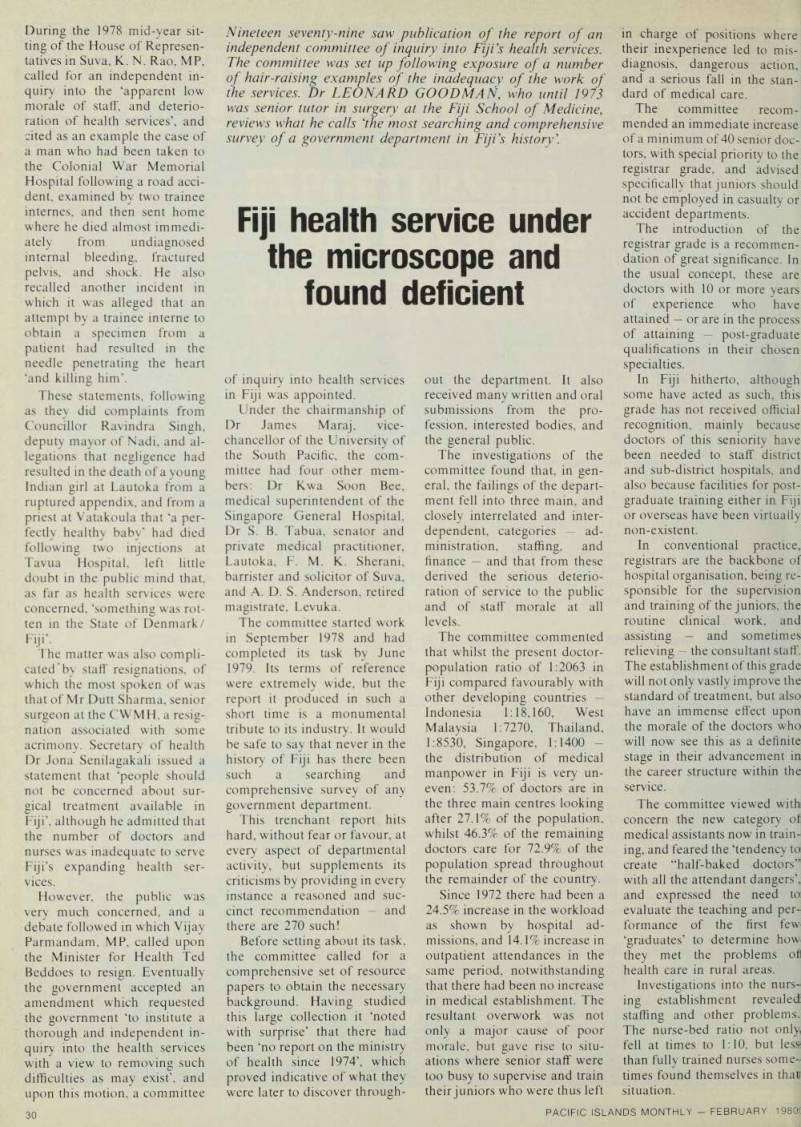
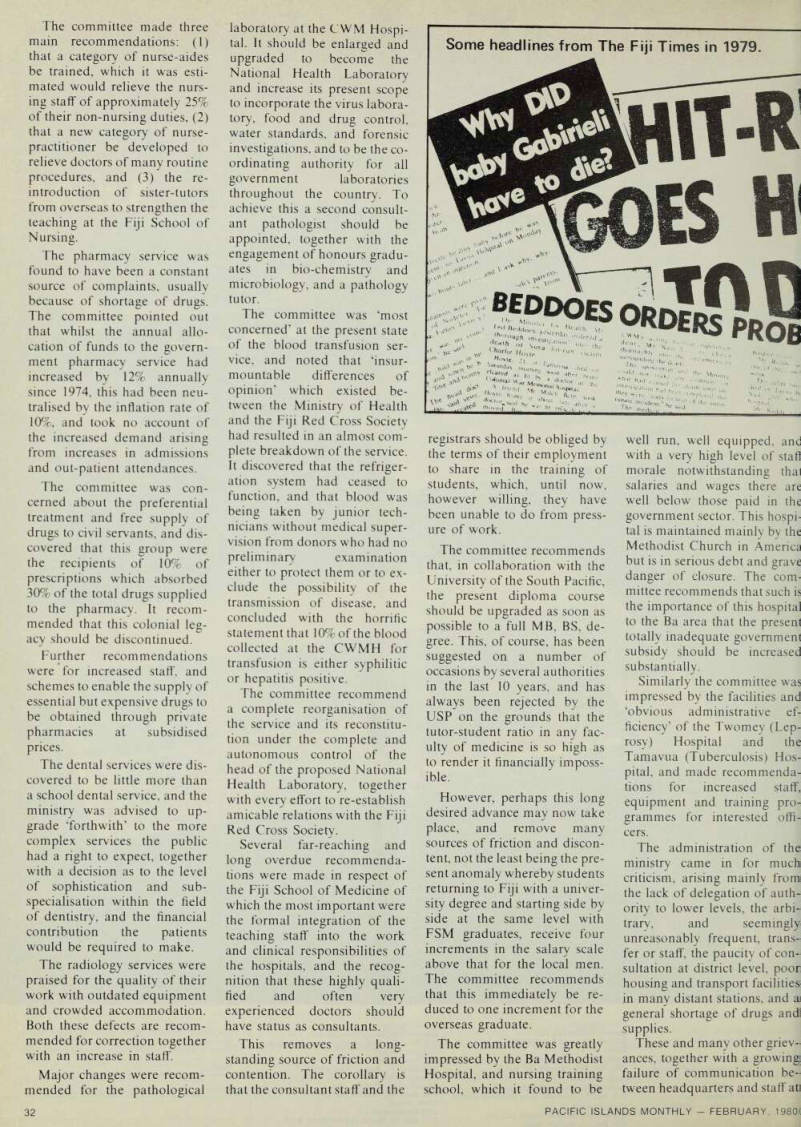
An incident during a golf match, reported in Atoll Pioneer, Tarawa There were some strange goings-on at the Ambo on Saturday morning. Some innocent passers-by thought they saw an enormous bird thrashing around high up in the fronds of a coconut tree . . .The buccaneering leuan Batten, disappointed at not having his name mentioned in last week’s golf column, had hit a ball into a coconut tree from whence it did not descend.
Being a man of infinite resource, leuan ascended with a skill acquired of many years practice and insisted on playing the ball as it lay, in the true spirit of his Welsh forefathers. With restricted swing and precarious balance, he finally returned the ball to a less elevated plane. It took five strokes.. .
“Great shot! But that coconut was too big for the hole!”
Nineteen seventy-nine saw publication of the report of an independent committee of inquiry into Fiji’s health services.
The committee was set up following exposure of a number of hair-raising examples of the inadequacy of the work of the services. Dr LEONARD GOODMAN, who until 1973 was senior tutor in surgery at the Fiji School of Medicine, reviews what he calls ‘the most searching and comprehensive survey of a government department in Fiji’s history’.
During the 1978 mid-year sit ting of the House of Represen tatives in Suva, K. N. Rao, MP. called for an independent in quiry into the ‘apparent low morale of staff, and deterio ration of health services’, and cited as an example the case of a man who had been taken to the Colonial War Memorial Hospital following a road acci dent, examined by two trainee internes, and then sent home where he died almost immedi
ately from undiagnosed
internal bleeding, fractured pelvis, and shock. He also recalled another incident in which it was alleged that an attempt by a trainee interne to obtain a specimen from a patient had resulted in the needle penetrating the heart ‘and killing him’.
These statements, following as they did complaints from Councillor Ravindra Singh, deputy mayor of Nadi, and al
legations that negligence had
resulted in the death of a young Indian girl at Lautoka from a ruptured appendix, and from a priest at Vatakoula that ‘a per
fectly healthy baby’ had died
following two injections at
Tavua Hospital, left little doubt in the public mind that, as far as health services were concerned, ‘something was rot ten in the State of Denmark/
Fiji'.
The matter was also compli
cated'by staff resignations, of
which the most spoken of was that of Mr Dutt Sharma, senior surgeon at the CWMH, a resig nation associated with some
acrimony. Secretary of health
Dr Jona Senilagakali issued a statement that ‘people should not be concerned about sur gical treatment available in Fiji’, although he admitted that the number of doctors and nurses was inadequate to serve
Fiji’s expanding health ser
vices.
However, the public was very much concerned, and a debate followed in which Vijay Parmandam, MP, called upon the Minister for Health Ted
Beddoes to resign. Eventually
the government accepted an amendment which requested the government ‘to institute a thorough and independent in quiry into the health services with a view to removing such difficulties as may exist’, and upon this motion, a committee
Fiji health service under the microscope and found deficient
of inquiry into health services
in Fiji was appointed.
Under the chairmanship of Dr James Maraj, vice chancellor of the University of the South Pacific, the com mittee had four other mem bers: Dr Kwa Soon Bee, medical superintendent of the
Singapore General Hospital,
Dr S. B. Tabua, senator and
private medical practitioner,
Lautoka, F. M. K. Sherani, barrister and solicitor of Suva, and A. D. S. Anderson, retired
magistrate, Levuka.
The committee started work in September 1978 and had completed its task by June 1979. Its terms of reference were extremely wide, but the report it produced in such a short time is a monumental tribute to its industry. It would be safe to say that never in the history of Fiji has there been such a searching and comprehensive survey of any
government department.
This trenchant report hits hard, without fear or favour, at every aspect of departmental
activity, but supplements its
criticisms by providing in every instance a reasoned and suc cinct recommendation and there are 270 such!
Before setting about its task, the committee called for a comprehensive set of resource papers to obtain the necessary background. Having studied this large collection it ‘noted with surprise’ that there had been ‘no report on the ministry of health since 1974’, which proved indicative of what they were later to discover through
out the department. It also received many written and oral submissions from the pro fession, interested bodies, and
the general public.
The investigations of the committee found that, in gen eral, the failings of the depart ment fell into three main, and closely interrelated and inter
dependent, categories ad
ministration, staffing, and finance and that from these derived the serious deterio ration of service to the public and of staff morale at all levels.
The committee commented that whilst the present doctor population ratio of 1:2063 in
Fiji compared favourably with
other developing countries Indonesia 1:18,160, West Malaysia 1:7270, Thailand, 1:8530, Singapore. 1:1400 the distribution of medical manpower in Fiji is very un even: 53.7% of doctors are in the three main centres looking after 27.1% of the population, whilst 46.3% of the remaining doctors care for 72.9% of the
population spread throughout
the remainder of the country.
Since 1972 there had been a 24.5% increase in the workload as shown by hospital ad missions, and 14.1% increase in outpatient attendances in the
same period, notwithstanding
that there had been no increase in medical establishment. The resultant overwork was not only a major cause of poor morale, but gave rise to situ ations where senior staff were too busy to supervise and train their juniors who were thus left
in charge of positions where their inexperience led to mis
diagnosis, dangerous action,
and a serious fall in the stan dard of medical care.
The committee recom mended an immediate increase of a minimum of 40 senior doc tors, with special priority to the
registrar grade, and advised
specifically that juniors should
not be employed in casualty or
accident departments.
The introduction of the registrar grade is a recommen dation of great significance. In the usual concept, these are doctors with 10 or more years of experience who have attained or are in the process
of attaining post-graduate
qualifications in their chosen
specialties.
In Fiji hitherto, although
some have acted as such, this grade has not received official
recognition, mainly because
doctors of this seniority have been needed to staff district and sub-district hospitals, and also because facilities for post
graduate training either in Fiji
or overseas have been virtually non-existent.
In conventional practice, registrars are the backbone of
hospital organisation, being re
sponsible for the supervision
and training of the juniors, the routine clinical work, and assisting and sometimes relieving the consultant staff.
The establishment of this grade will not only vastly improve the standard of treatment, but also have an immense effect upon the morale of the doctors who will now see this as a definite stage in their advancement in the career structure within the service.
The committee viewed with concern the new category oil medical assistants now in train ing, and feared the ‘tendency to create “half-baked doctors” with all the attendant dangers’, and expressed the need to: evaluate the teaching and per formance of the first few* ‘graduates’ to determine how> they met the problems of! health care in rural areas.
Investigations into the nurs ing establishment revealed! staffing and other problems.
The nurse-bed ratio not only, fell at times to 1:10, but less than fully trained nurses some times found themselves in thafl situation.
The committee made three main recommendations: (I) that a category of nurse-aides be trained, which it was esti mated would relieve the nurs ing staff of approximately 25% of their non-nursing duties, (2) that a new category of nurse practitioner be developed to relieve doctors of many routine procedures, and (3) the re introduction of sister-tutors from overseas to strengthen the teaching at the Fiji School of
Nursing.
The pharmacy service was found to have been a constant
source of complaints, usually
because of shortage of drugs.
The committee pointed out that whilst the annual allo cation of funds to the govern ment pharmacy service had
increased by 12% annually
since 1974, this had been neu tralised by the inflation rate of 10%, and took no account of the increased demand arising from increases in admissions and out-patient attendances.
The committee was con cerned about the preferential treatment and free supply of drugs to civil servants, and dis covered that this group were the recipients of 10% of prescriptions which absorbed 30% of the total drugs supplied to the pharmacy. It recom mended that this colonial leg acy should be discontinued.
Further recommendations were for increased staff, and schemes to enable the supply of essential but expensive drugs to
be obtained through private
pharmacies at subsidised
prices.
The dental services were dis covered to be little more than a school dental service, and the ministry was advised to up grade ‘forthwith’ to the more
complex services the public
had a right to expect, together with a decision as to the level of sophistication and sub specialisation within the field of dentistry, and the financial contribution the patients would be required to make.
The radiology services were praised for the quality of their work with outdated equipment and crowded accommodation.
Both these defects are recom mended for correction together with an increase in staff.
Major changes were recom
mended for the pathological
laboratory at the CWM Hospi tal. It should be enlarged and upgraded to become the National Health Laboratory and increase its present scope to incorporate the virus labora tory, food and drug control, water standards, and forensic investigations, and to be the co
ordinating authority for all
government laboratories throughout the country. To achieve this a second consult ant pathologist should be appointed, together with the engagement of honours gradu ates in bio-chemistry and
microbiology, and a pathology
tutor.
The committee was ‘most concerned’ at the present state of the blood transfusion ser vice, and noted that ‘insur mountable differences of opinion’ which existed be tween the Ministry of Health and the Fiji Red Cross Society had resulted in an almost com plete breakdown of the service.
It discovered that the refriger ation system had ceased to function, and that blood was
being taken by junior tech
nicians without medical super vision from donors who had no
preliminary examination
either to protect them or to ex clude the possibility of the transmission of disease, and concluded with the horrific statement that 10% of the blood collected at the CWMH for transfusion is either syphilitic or hepatitis positive.
The committee recommend
a complete reorganisation of
the service and its reconstitu tion under the complete and autonomous control of the head of the proposed National
Health Laboratory, together
with every effort to re-establish amicable relations with the Fiji Red Cross Society.
Several far-reaching and long overdue recommenda tions were made in respect of the Fiji School of Medicine of which the most important were the formal integration of the teaching staff into the work and clinical responsibilities of the hospitals, and the recog nition that these highly quali fied and often very experienced doctors should have status as consultants.
This removes a long standing source of friction and contention. The corollary is that the consultant staff and the
registrars should be obliged by
the terms of their employment to share in the training of students, which, until now,
however willing, they have
been unable to do from press ure of work.
The committee recommends that, in collaboration with the University of the South Pacific, the present diploma course should be upgraded as soon as possible to a full MB, BS, de gree. This, of course, has been suggested on a number of occasions by several authorities in the last 10 years, and has
always been rejected by the
USP on the grounds that the tutor-student ratio in any fac ulty of medicine is so high as to render it financially imposs ible.
However, perhaps this long
desired advance may now take place, and remove many sources of friction and discon tent, not the least being the pre
sent anomaly whereby students
returning to Fiji with a univer
sity degree and starting side by
side at the same level with FSM graduates, receive four increments in the salary scale above that for the local men.
The committee recommends that this immediately be re duced to one increment for the
overseas graduate.
The committee was greatly impressed by the Ba Methodist
Hospital, and nursing training
school, which it found to be
well run, well equipped, and with a very high level of staff morale notwithstanding thal salaries and wages there are well below those paid in the government sector. This hospi tal is maintained mainly by the Methodist Church in America but is in serious debt and grave danger of closure. The com mittee recommends that such is the importance of this hospital to the Ba area that the present
totally inadequate government
subsidy should be increased
substantially.
Similarly the committee was impressed by the facilities and ‘obvious administrative ef ficiency’ of the Twomey (Lep rosy) Hospital and the Tamavua (Tuberculosis) Hos pital, and made recommenda tions for increased staff,,
equipment and training pro
grammes for interested offi cers.
The administration of the ministry came in for much criticism, arising mainly fromi the lack of delegation of auth ority to lower levels, the arbi trary, and seemingly
unreasonably frequent, trans
fer or staff, the paucity of con sultation at district level, poon housing and transport facilities in many distant stations, and ai
general shortage of drugs andl
supplies.
These and many other griev ances, together with a growing failure of communication be tween headquarters and staff atl
Some headlines from The Fiji Times in 1979.
jail levels, were, perhaps,
the most significant factors res • ponsible for the obvious lower ing of morale throughout the I service. The committee com [ mented that it found unani mous agreement throughout the country that the deterio ration of morale and efficiency in almost every phase of departmental activity had begun about four years before its investigation, and had since sunk to its present depths.
In fairness to the permanent [secretary and the headquarters istaff, it must be mentioned that since promotion for clinical of ficers beyond the maximum of their salary scale could be only % transfer to the administrat ive sector, the most senior pos itions have, for very many years, been filled by erstwhile clinicians, and whilst some have proved to have had high administrative ability, others have not. Furthermore, these sometimes reluctant adminis trators of recent years have had to administer the department at a time of unprecedented economic stringency, which also coincided with increasing demands from a growing population.
' The committee has recom mended that a superscale of re muneration equivalent to that for directors be instituted for the most senior consultants.
This should retain these very experienced and senior officers
in the active clinical field.
Nevertheless, the recruit ment of some administrative grades from the ranks of doc tors with long clinical experi ence does have its advantages, since these officers are well aware from experience at first hand of the problems of their colleagues in often remote situ ations, and can interpret their
administration accordingly.
The committee has provided a detailed plan for the reor ganised structure of the admin istration of the Health Department which involves a stratified establishment with a
plethora of directors, principal
assistant secretaries, and other administrators to the utmost limits of the service.
It seems to the writer that in the very perfection of this plan lie the seeds of future discon tent, for there is a very real danger of creating an elite hier archy of bureaucrats unfamiliar with clinical medi cine since they left medical school out of touch with, but
controlling from their ivory
tower on the third floor of Government Buildings, the lives and actions of practical doctors who, at grassroots level, are endeavouring to per form those tasks for which the whole departmental structure exists, namely the prevention of disease and the relief of
individual suffering.
The unhappy results of such dichotomy to the harmony of
the profession in England should be borne in mind, and the possible divisive effect on staff morale carefully evalu ated before excluding clinic ians from the administrative
grades.
The committee was aware that the adoption of the very numerous recommendations offered in its report will have grave financial implications, even if the recommended sub stantial increase in staff cannot immediately be recruited.
Except for the relatively minor adjustments such as in creases in out-patient fees and the enforcement of their collec tion, and the removal of the privilege of free treatment and drugs for civil servants it realised that increased cost must be met from general rev enue, and commented that it is for government to decide to what extent it is prepared to subsidise the health services.
It makes the pointed com parison that whilst the percent age of the country’s operating budget allocated to health fell from 9.8% in 1973 to 8.6% in 1977, that for education rose from 20.3% to 22.1% over the
same period.
Finally, the committee recommended that notwith standing the present serious economic situation, reduction in expenditure for health ser vices cannot be contemplated.
On the contrary, it advised as essential, an increase in this
sector, which, because of neglect has now reached a dangerously low level. It ap preciated that steps taken by government to implement this proposal will not be popular, and comments that ‘whilst we must not rob Peter to pay Paul, we feel that it is time that Paul had some consideration’. But the committee does not offer any suggestion as to where 40 experienced doctors are to be found at this time.
The publication of this re port has already had reper cussions. A substantial and vociferous group within the department has accepted it as a censure on the present
departmental administration,
and called for the dismissal of these officials. This has provoked an equally substan tial and vocal section to issue a letter declaring their con fidence in the present secretary of health and his staff.
These demonstrations, how ever, are but an outward mani festation of an occult division
throughout the department, of
which the committee could not have been unaware, but upon which it made no comment namely racial dissonance.
Until this latent suspicion can be overcome and replaced by the mutual tolerance of all races in a united effort for the common purpose, no develop ment plan for any community service in Fiji can truly suc ceed.