Advertisements & other items, pp. 1-2 (2 items)
Pacific
ISLANDS
MONTHLY
’S** 'Milt Jmk- ■■£,:
H2S 30* .SO 50 140 00 .00 .00 00 .00 150 00 50 .10 ily.
Toyota
How to find a REAL economy car* When you look at a car billed as an economy
model, ask yourself a few questions.
What sort of fuel consumption can be expected?
Low? Good.
What about other operating costs? Oil, lubrication, that kind of thing. Low again? Great.
How about maintenance? The car has a low-breakdown record? You are definitely on the right track.
What is the average life of the car? Is it better than the average in your area? Super. That’s important in an economy car.
Now. How is the after service? Buying a car is not all in the price you know. Plenty of service outlets?
One economy car coming up. All you have to do is check the price. Then you can tell if you are really
getting an economy car.
You will probably find, after asking these questions about town, that REAL economy cars come down to Toyota, the world’s economy car builder.
See Toyota first. Then you won’t have to shop around.
IHE HAPPY ECONOMIZER
TOYOTA STARLET
The car that says economy in every way.
And you will be happy for it. Big inside.
Small outside. Miserly with petrol.
Without sacrificing comfort. A good buy in an economy car even for Toyota. 6 J
PAPUA NEW GUINEA:
ELA MOTORS,
Scratchley Rd., Badili, P.O. Box 675, Port Moresby.
U.S. TRUST
TERRITORY: MICROL
CORPORATION,
P.O. Box 267, Saipan.
FIJI ISLANDS;
AUTOMOTIVE
SUPPLIES CO., LTD.,
G.P.O. Box 355, Suva.
AMERICAN SAMOA;
BURNS PHILP
(SOUTHSEA) CO., LTD.,
P.O. 1057, Pago Pago.
WESTERN SAMOA:
BURNS PHILP
(SOUTHSEA) CO., LTD.,
P.O. Box 188, Apia.
TONGA: BURNS PHILP
(SOUTHSEA) CO., LTD.,
P.O. Box 55, Nukualofa.
GUAM: ATKINS, KROLL
(GUAM) LTD., P.O. Box
6248, Tamuning.
NEW HEBRIDES:
NEW HEBRIDES
MOTORS,
TOYOTA
SERVICE
TOYOTA
P.O. Box 18, Vila.
SOLOMON ISLANDS:
MENDANA
ENTERPRISES (S I.)
LTD., P.O. Box 174,
Honiara.
TAHITI: NIPPON
AUTOMOTO, B.P. 342,
Papeete.
COOK ISLANDS:
COOK ISLANDS
TRADING
CORPORATION LTD.,
P.O. Box 92, Rarotonga.
NAURU ISLAND:
NAURU COOPERATIVE
SOCIETY.
REPUBLIC OF KIRIBATI:
TARAWA MOTORS,
Box 36, Bairiki Tarawa.
NORFOLK ISLAND:
MOUNT PITT
(ENTERPRISES) LTD.,
P.O. Box 169
NEW CALEDONIA:
SOCIETE IMPORTATION
AUTOMOBILE DE
PACIFIQUE, Rond-Pomt du Pacific (Station Total) B.P. 438, Noumea.
The Toyota range includes: Toyota 1000, Toyota Starlet, Toyota Corolla, Toyota Celica, Toyota Corona, Toyota Cressida, Toyota Crown
Pacific Islands Monthly
Vol 51 No 2
February 1980
[Usps 952480]
Elsewhere: $A16 S Payment by personal cheque is accepted in Australian I US, New Zealand, UK and Fiji currency For other rermt- Itances please obtain a bank draft in Australian dollars made payable to the ANZ Banking Group, 88 Wentworth Avenue, Sydney, Australia
Representatives
AUSTRALIA: Distribution: NSW & ACT: Allan Rodney Wright (Circulation) Pty Ltd, PO Box 907, Darlinghurst NSW 2010 Elsewhere: Gordon & Gotch (A/asia) Ltd, Box 40, PO, Rosebery, NSW 2018 Advertising — Melbourne — Pa- cific Publications (Aust.) Pty Ltd, Newspaper House, 247 Collins Street, Melbourne 3000, telephone 63 0211, ext 1565 Jeff Gates, ext 1858 Ida Padgett Brisbane - D Wood, Anday Agency, Box 1918, GPO, Brisbane 4001, telephone 44 3485, 44 1 546: Adelaide — Hastwell Media, PO Box 30 Glen Osmond, SA. 5064, 233 Glen Osmond Rd, Frewville’
SA 5063, telephone 79 1869 Perth - Adrep, 62 Wickham St, East Perth, WA 6000, telephone 325 6359 FIJI: Distribution and subscriptions - Desai Booksnops PO Box 160, Suva, Fiji, telephone Suva 23036 Advertis ing - Fiji Times & Herald Ltd. 20 Gordon St Suva tele phone 312 111. telex FJ2124 FRENCH POLYNESIA: Distribution - Hacnette fPacifique, 10 Ave Bruat. Papeete, telephone 25610 HAWAII, UNITED STATES: Distribution PIM, Hawaii, PO Box 22250, Honolulu, Hawaii 96822 Advertising: Roger I [Brookes, PO Box 10217, Waialae - Kahala, Honolulu, Hawaii 96816. Tel: 521 4521 Telex: 743 0296.
JAPAN: Advertising and subscriptions - Universal Media Corporation CPO Box 46 Tokyo telephone 666 3036 MICRONESIA: Advertising: Roger I. Brookes, PO Box 110217, Waialae — Kahala, Honolulu, Hawaii 96816 Tel 521 4521. Telex: 743 0296.
NEW CALEDONIA: Distribution - Depot Centre de "Presse Michel Pentecost, CBP2 Noumea telephone [27 2434, 27 4729 NEW ZEALAND: Distribution - Gordon & Gotch PO Box 584 2 Carr Road. ML Roskill, Auckland 4 Advertising I- International Media Representatives Ltd, PO Box 2313 Auckland telephone 795 487: 493 389, cables Intereps, Auckland Subscriptions - Ross Haines & Son Ltd PO [Box 1289, Auckland, telephone 769 042 PAPUA NEW GUINEA: Distribution — Gordon and Gotch j(PNG) Pty Ltd, PO Box 3395, Port Moresby, telephone [25855 Advertising - PNG Post-Courier, PO Box 85 Port Moresby telephone 21 2577 UNITED KINGDOM: The Herald & Weekly Times Ltd 8-10 Clifford s Inn, Fetter Lane London EC4A 1BU telephone [0l 831 6041. telex London 21989 UNITED STATES MAINLAND Advertising — Joshua B Powers Jr, Powers International Inc . 551 Fifth Ave New [York New York 100 017 telephone 367 9580 telex [236514 Subscriptions - PiM Hawan 2812 Kahawai St [Honolulu. Hawaii 96822 [Published monthly by Pacific Publications (Aust ) Pty Ltd and printed in Australia by Paramac Alexandria NSW [Australian cover price is recommended retail only Regis tered at the GPO Sydney for transmission by post as a publication — category B Second class postage paid at [Honolulu, Hawaii Copyright ‘ 1978 Pacific Publications
(Aust ) Pty Ltd Postmaster Honolulu Send address changes to PIM Hawaii PO Box 22250 Honolulu, Hawaii 96822.
Subscriptions
plM is airfreighted to most subscribers and agents in the Pacific Islands and the United States Aust Other American Samoa $13 $US16 Australia $12 Canada $14 $US18 Cook Islands $13 Fiji $12 $F 12 French Polynesia $14
Cfp 1700
Guam $13 $US16 Gilbert Islands $13 Hawaii $13 $US16 Japan $16 V4500 Micronesia $13 $US16 Nauru $18 New Caledonia $14
Cfp 1700
New Hebrides $13 New Zealand $12 $NZ1350 Niue $13 Norfolk Island $12 Northern Marianas $13 $US16 Papua New Guinea $13 K12 Solomon Islands $13 Tonga $13
[Tuvalu
$13 United Kingdom $15 £io US Mainland $14 6US18 Western Samoa $13
This Month’s Features
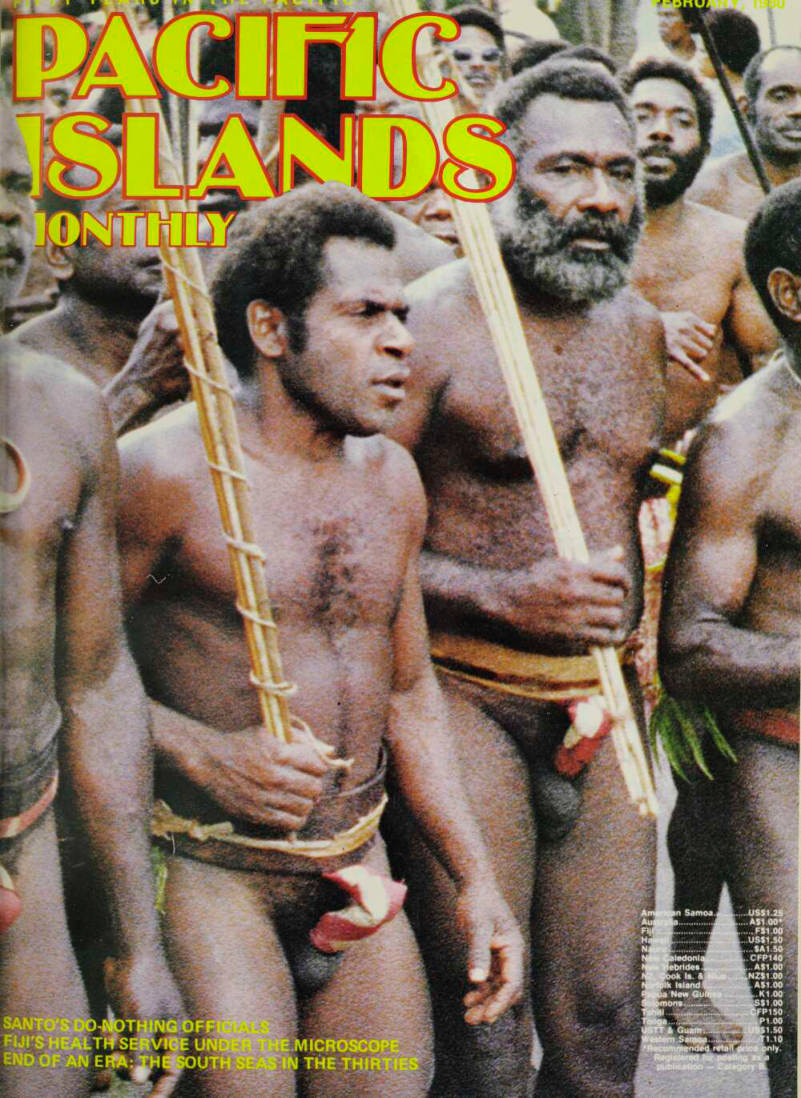
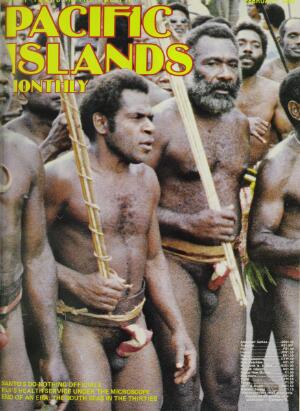
• New Hebrides A Santo community leader tells the story of how do-nothing official attitudes fuelled recent strife on the condominium’s big northern island lO • Pacific Press Births: A new daily on Guam, a new weekly on Nauru. Death: New Caledonia’s daily France Australe 9, 55 • Auckland, Polynesian City James Tully takes a close look at the New Zealand city which holds the world’s largest concentration of people of Polynesian origin l7 • Obituaries Tributes to Sir Jack Murray, first postwar administrator of Papua New Guinea, and to Tom Smith, former secretary-general of the South Pacific Commission 22, 73 • 50 Years of PIM Judy Tudor writes of PIM in the thirties, and calls the time ‘the end of an era’ 40 • Books Sir John Gunther and Dr Leonard Goodman review new works on aspects of Islands medical history, and Bengt Danielsson takes a tilt at a new American work on Tahiti 47 Cover: A group of young Small Namba men so-called from the type of penis covering they wear and to distinguish them from the Big Nambas travelled from the island of Malekula to take an active part in the highly successful National Arts Festival held in Vila in December.
Despite some attempts at sabotage, the festival turned out to be an impressive display of the growing sense of national unity as the New Hebrides approaches independence. It was the first time in history that people from the various islands of the group had got together to display their various arts, crafts and customs in a range of activities which took in everything from dancing to cooking. Photo Christine Coombe.
Books 47 Cook Islands 14, 59 Deaths 73 Fifty Years of PIM 40
Fiji 30, 47, 63
French Polynesia 24, 35, 51 Guam 55 Health 14, 30 Islands Press 29 Letters 5 Nauru 57, 59 New Hebrides 5, 10, 15 New Zealand 17 Niue 63 Pacific Report 9 Papua New Guinea 7, 15, 22, 27, 47, 55
People 21 Pitcairn Island 63 Political Currents 24 Ships 63 Shipping Services 69 Stamps 15 Tonga 13, 24 Tradewinds 55 Tradewinds Intelligence 61 Travel 35 Tropicalities 13 Tuvalu 55, 63 US Trust Territory 5 Western Samoa 25 Yachts 65 Yap 63
Advertisements & other items, pp. 3-4 (2 items)
3
PACIFIC ISLANDS MONTHLY - FEBRUARY, 1980
Founded 1930 by R. W. Robson Editor and Publisher Stuart Inder Associate Editor Malcolm Salmon Editorial Adviser John Carter Manager John Berry Advertising Sales Manager Steve Gray A Pacific Publications production 76 Clarence Street, Sydney 2000 GPO Box 3408 Sydney 2001 Cables: PACPUB Sydney Telex: Pacpub 21242 Telephone: Sydney 29 6693
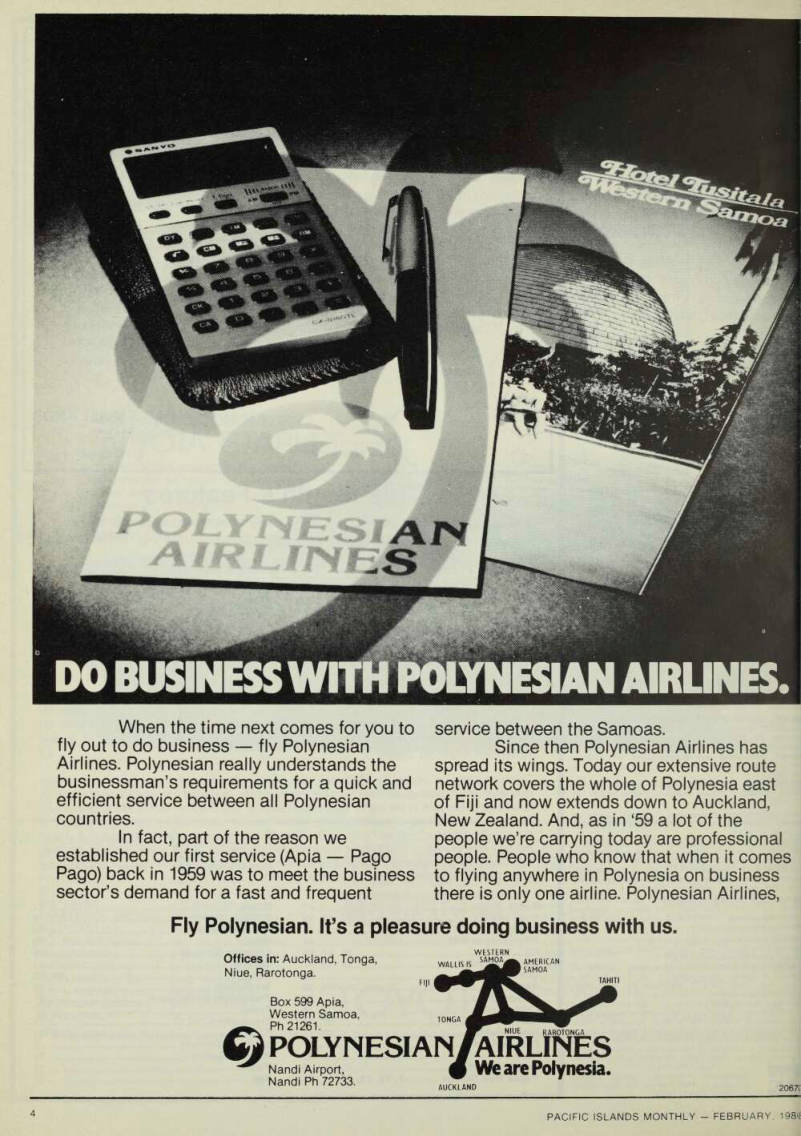
Polynesian /Airlines
*$&lS m < / A S When the time next comes for you to fly out to do business fly Polynesian Airlines. Polynesian really understands the businessman’s requirements for a quick and efficient service between all Polynesian countries.
In fact, part of the reason we established our first service (Apia Pago Pago) back in 1959 was to meet the business sector’s demand for a fast and frequent service between the Samoas.
Since then Polynesian Airlines has spread its wings. Today our extensive route network covers the whole of Polynesia east of Fiji and now extends down to Auckland, New Zealand. And, as in ‘59 a lot of the people we’re carrying today are professional people. People who know that when it comes to flying anywhere in Polynesia on business there is only one airline. Polynesian Airlines, Fly Polynesian. It’s a pleasure doing business with us.
Offices in: Auckland, Tonga, Niue, Rarotonga.
WESTERN
WALLIS IS AMERICAN
SAMOA
Box 599 Apia, Western Samoa, Ph 21261.
TONGA
NIUE RAROTONGA
POLYNESIAN /AIRLINES
We are Polynesia.
Nandi Airport, Nandi Ph 72733. 2067\
Trust Territory

Letters
What’s wrong
with the U.S.
Trust Territory
I have just returned to Europe following a six weeks’ visit to the South Pacific on the MV Lindblad Explorer which took me to several islands collec tively referred to as the United States Trust Territory but with such singular-sounding names as Merir Island, Palau Atoll, Yap, Sorol, Woleai, Ifalik, Lamotrek, Satawal, Pulap, Tamatham, Truk, Ponape and
Pingelap.
There is no doubt that among these are some of the most attractive coral and vol canic islands I have ever visi ted, inhabited by some of the friendliest and most colourful people in the world.
But as an individual with considerable experience in the running of an island archipel ago (Chief Minister of Seychelles 1970-75, Prime Minister 1975-76 and President 1976-77), I could not help being appalled at what I con sider to be an obvious lack of a defined, comprehensive and coordinated policy for the islands on the part of the
administering power.
Knowing the American people and the bureaucratic system which characterises their government relatively well, I am certain that the prevailing situation is more the result of benevolent neglect than benign malice. That is why I have not hesitated to seek publication of the follow
ing observations:
1. On several islands visited it was shocking to see in the midst of authentic native settlements of thatched houses that the re
cently completed churches,
hospitals and schools were mostly built of corrugated iron sheets, without the least regard for the aesthetic beauty of the islands. Surely it would have been more heartwarming if
those responsible for these necessary contributions to island life would have used the occasion as an opportunity to promote and encourage the survival of traditional skill and
craftmanship instead of putting
up what can only be described as ‘ugly scars on a beautiful face’.
In my view a church built in the style and image of one of those impressive native fish traps would have been far more in harmony with the local
setting and certainly more
pleasing as the House of God in the eyes of both natives and visitors! Native skill must be preserved at all cost. The US Government must look at their welfare hand-out philosophy with a better sense of enlight enment. The motivation could be kindheartedness but the long term consequences of such an attitude must not be overlooked. For example I saw very little fishing going on around the islands but noticed around several villages hun dreds of empty tins of canned fish from California and Japan.
It was also obvious that the skill to build and operate tra ditional outrigger canoes may
soon disappear. The backyards
of several homes were ‘decora
ted’ by huge outboard engines
prominently displayed on
imported stands. This reminded me of what hap pened in Seychelles when the engine craze hit our shores. It spelt the end of an era when one could tell a fisherman just
by looking at the healthy body
he sported!
2. In as much as I am a tra ditionalist, I can see no reason able argument to justify the preservation of customs and habits that are non-hygienic and a threat to health. In this respect I believe there is an urgent task of educating people on those islands where the beachfronts are now being used as latrines and refuse
dumps.
3. Certainly one of the more serious problems on some islands is alcoholism resulting from the tap
ping and drinking of toddy.
When one realises that the av erage coconut tree can produce four bottles of toddy a day, that fresh toddy can be as potent as wine and four days later be
come as strong as whisky, gin or vodka, one can see the danger inherent in a situation where an island is covered with coconut trees and the inhabi tants enjoy maximum leisure hours. In Seychelles where a similar situation prevailed for many years we were compelled to introduce a licensing system under which a householder could only legally tap one tree at a time. 4. Perhaps the greatest prob lem I see on the horizon of tomorrow is the political fu ture of the 2000-plus islands spread over 7.7 million square kilometres of the Pacific which constitute the US Trust Terri tory. What will happen to them when the US Trusteeship expires in 1981?
At the moment I find the
trend towards political frag
mentation most disturbing and
the following questions appear
to me most relevant and im portant for urgent consider ation: a) Bearing in mind the in ternational climate for independence or so-called independence is the US doing enough to prepare the islanders for the challenge of
responsible nationhood?
b) Considering the actual state of affairs, is there time
enough?
c) Can an island or a group of islands, not economically
viable, be truly indepen
dent? d) Will the islanders be able to safeguard their peace and relative happiness when they find themselves in the middle of the vicious current of big power politics where
geo-political considerations
are far more important than
the well-being of indigenous
people?
I hope that the observations I have made and the questions I have raised will be taken notice of, or at least be the sub ject of discussions and debate by those involved and/or interested in the political and
socio-economic development
of this area.
In conclusion let me state that I remain ready at all times to lend my personal support and share my own background experience with anyone engaged in the complex task of
formulating and defining a
policy for the future good
government of these beautiful islands and the well-being of its people.
James R. Mancham
Ex-President, Republic of Seychelles
London
Courage of the
Tannese dancers
For me the most moving spec tacle at the December New Hebrides National Arts Fes tival was the entrance of the Tannese dancing group.
This group had been stood over by the Tanna Kapiel strongarm men and threatened with their houses being burnt and families killed if they attended the festival. They were prevented from going to Vila on the ship which was
despatched for them, simply
because the ship was turned away by the ‘Moderate’ party representative, or so he claimed. These frightened
people were eventually
escorted onto various ships and aircraft which were passing by, and so arrived in Vila. They hastily teamed up with some of the Tannese in Vila and made up a troupe which emerged on the second last day of the fes tival.
A spontaneous cheer went up from the audience and many a tear was shed for these courageous people, who danced with gusto and aban don.
The Kapiels and Jonfrums threatened to beat them on their return but the people of Tanna rose in wrath and a large force of young men occupied the whole beach area to meet the ship that brought the dancers back and escorted them ashore. The would-be attackers retired in confusion to the sanctuary of the French
District Agent.
Tanna New Hebrides
Katherine Paul
Tribute from Neil
Naessens’ fan
While I am appreciative of the standard of PIM, I feel I must make one critical comment.
Here in Suva, we have TWO
daily newspapers, The Fiji
Times and the Fiji Sun.
Anyone outside Fiji regu larly reading PIM would not be aware of this simple fact, as I can’t remember ever having seen a mention of the Sun in
your columns. The Times is fre
quently quoted, but you totally
ignore the Sun, obviously
deliberately.
I would have to agree that the Times is possibly the better paper, but the Sun does have a wide following here, par ticularly since the arrival of Neil Naessens eight months or so ago. Naessens is without a doubt the best-known journal ist in Fiji today, while still remaining a bit of a mystery figure. Few people know him personally or have seen him around the social scene; he doesn’t appear to mix very much.
I would have thought PIM would at least have made men tion of Naessens’ existence, and possibly do a story on him. where he comes from, what sort of man he is, etc. I travel a lot around the Pacific be cause of my business, and from what I have seen elsewhere I am pretty sure there isn’t
another journalist anywhere in
the Pacific (including Hawaii) who could hold a candle to him. That isn’t just my opinion, there are thousands of people here who buy the Sun for no other reason than to read Naes sens’ daily column. Today’ and his articles are being discussed all day in factories and homes all around the country.
He has an amazing, easy flowing style and manages to come out with some very strong
viewpoints without being of
fensive. I simply don’t under stand why PIM has not bothered to tell us more about the man. I, for one, am curious.
Have you got something against the Sun, or Fiji, for that matter?
Hasan Subramani
Suva. Fiji i •We wish to assure PIM readers that we have met Neil Naessens, consider him to be an admirable member of our craft, and are satisfied he did not write us this letter under the nom-de plume of Hasan Subramani. - Editor.
East is East,
not South-East
Your article on the Easter Island Conference (PIM Dec p2l) quoted me as saying that for the next century, South East Asia will be the most important influence on the Pacific
Islands. What I said was East Asia (ie Japan, China, the Koreas, Hong Kong and one should include that piece of overseas China, Singapore).
South East Asia, I would have thought, is likely to be of interest to the Pacific Islands, but not of great significance.
R. G. Crocombe
Director, Institute of Pacific Studies Suva Fiji
‘lntelligent
comments’?
Apropos of the article by Bob Jones about Tonga (PIM Dec p 34) I would like to make the
following comment.
Having read Bob Jones’ printed thoughts about my own country, New Zealand, I have not been surprised that a poor boy who has become a finan cially rich man can think that he can make intelligent com ments. What does surprise me is that a rich magazine (which
is now obviously becoming
poor) thinks that Bob Jones can make intelligent comments about a Pacific nation such as
Tonga.
Nukualofa Tonga
J. G. Roberts
Small storm
in a desert
Finally I received a copy of the November issue of PIM. The reason the November issue was not available in Hawaii this year only you know. Some friends of mine from the South Pacific sent me a copy.
In regards to your November Pacific Report item (US REAL
Estate Agents Active
IN PACIFIC) it is obvious that you don’t know what you are
talking about.
(1) The real estate agents are not U.S., the land is. The company selling is not Human Resources and Development but C.I.L. of Hong Kong. (2) The selling price is not SUSSOOO an acre, it is SUS6OOO for FIVE acres. (3) By implication you are making a liar out of a highly respected U.S. agricultural scientist, Dr Sam Little, whose credentials are B.S. in agronomy, M.S. in soil fertility and a Ph.D. in soil chemistry.
He also has over 20 years ex perience in the Texas area.
(4) The Van Horn area where the land sold is located is known for its vast under ground water resources. (5) Desert land as a rule is very fertile (ours is) and can be made to produce in abundance if water is available. Israel is making a fortune from its des ert land.
To back up the above I have enclosed the following docu mentation. An agricultural re port by Dr Sam Little; a brochure by the Van Horn Chamber of Commerce, who credit our development worthy enough to include it in their brochure, and a company bro chure. So next time you feel in clined to write about this land, you at least can know what you are talking about. Further more, the subdivision meets all US legal requirements.
In my book honest people don’t hide behind an unnamed official; to do that usually means a made-up story. This letter was written at the urgent request of Mr Bula O’Brien, a very fine gentleman to those who know him, which obviously excludes you. I usually don’t bother to reply to
slander magazines.
Also upon his request copies will be sent to all Pacific Governments, agencies and other potentially interested parties including all land pur chasers.
A. Holgen
(Chairman Board of Directors) Collateral Investments Ltd 407-409 Gloucester Building Hong Kong Exactly what Mr Holgen is going on about is beyond us, unless it is a ham-fisted effort to
get some free publicity for some
real estate deal he may have in the wilds of Texas. PI M’s brief report was a warning from a US government official against Islanders investing in real estate in America unless they first saw the land. It was sound advice, and worth repeating. The report did not mention the Van Horn area, Dr Sam Little, Mr A. Hol gen or Collateral Investments Ltd, none of whose names we had heard before the receipt of
Mr Holgen’s slightly hysterical
letter, but we thank him for giv ing us the opportunity of adding his name and his company to our research dossiers. In view of Mr
Holgen’s charges of dishonesty
and slander, might we suggest he ponder his own likely position in respect of libel before he sends his letter to ‘Pacific govern ments, agencies’, etc. The November PIM was on sale in Honolulu as usual Editor
Back in the
Time Before
The article by Percy Chatterton
(Afterthoughts, PIM Sept,
p 87) on the subject of booze and money in Papua New Guinea is most saddening and takes me back to the time span 1927-1941 when I was a resi dent of Salamaua.
It was then a criminal act to
supply an indigene with liquor.
There were rumours that the occasional house-boy had been known to dip into his master’s household supply, but in all my years there I never experienced any instance of this in my household, where beer was kept in an unlocked ice box and spirits stood openly on a sideboard. To my houseboys it
was something quite apart
from their lives and experi ence.
Before ships unloaded at Lae all cargo was discharged at Salamaua, 18 miles away, and taken by launch to Lae for air freighting to Bulolo and Wau.
Beer came in straw-encased bottles, four dozen to a wooden case, and I remember a stack of 40 such cases remaining unguarded on the beachside at Lae for several weeks.
Similarly security screens
and locked bedroom doors were not necessary. Few bed rooms sported a door.
What an uncomplicated existence we led.
Bert E. Weston
Wollstonecraft NSW, Australia • Percy Chatterton’s popular
thought-provoking column
Afterthoughts, will in future
make only an occasional ap pearance in PIM, when he feels I have something to say’. Percy adds, T’ve recently celebrated my 81st birthday and feel a need to relax. ’ PIM has never published a column from Percy Chatterton in which he had nothing to say, but agrees he has earned the right to relax, even though he is unlikely to take it.
Editor.
Advertisements & other items, pp. 6-8 (1 item)
Demka
You better deal with...
(AUSTRALIA) PTY. LTD.
...if you want to deal better
...with the many manufacturers, established in various parts of the world, but on an exclusive basis and...
in the South Pacific only.
We are an exception for every manufacturer we represent, which is to the...
buyer’s advantage.
DEMKA
(AUSTRALIA) PTY. LTD
P.O. Box 340, Mascot N.S.W. 2020 Telex: 21416 AHA Sydney Cables: DEMKAY Sydney
JVC’s Metal-Tape-Compatible
Cassette Decks are pioneers
in quality tape recordl
I m i f 9 / The biggest advance in cas sette recording in years is the socalled “metal tape” now being introduced by tape manufacturers.
It stores four times as much magnetic energy as chrome tape.
It improves the overall recording/playback frequency response, gives a wider dynamic range at high frequencies gives lower recording/playback distortion, and improves signal-tonoise ratio at high frequencies.
It is, in a word, the ultimate for cassette recording and playback, and the JVC KD-A8 is the ultimate cassette deck for metal tape recording and playback.
The KD-A8 has our exclusive SA (Sen Alloy) Heads, perfect for metal tape recording. A micro computer-controlled system which we’ve named the B.E.S.T. Tuning System and which accurately and automatically adjusts for the bias, equalization and sensitivity of the tape you use. Plus many other advanced features.
The KD-A8 is at the very pinnacle of high fidelity excellence.
We know. We’re JVC, the innovative audio/video electronics company with 52 years of experience.
You can always count on us for true high fidelity sound reproduction.
Hear us, see us—in great detail—at your nearest authorized JVC dealer today.
JVC
Australia: Hagemeyer (Australasia)B V„ 25-27 Paul Street, North Ryde, N S W 2113, Australia TelBB7-1444 Fiji Islands: D Gokal & Co., Ltd., G.P.O Box 501, Corner of Pier Street & Renwick Road, Suva, Fiji Tel. 25259 Cook Islands; J & P Ingram & Co. Ltd., PO.Box 55, Rarotonga, Cook Islands Te 1.378457 New Hebrides; Wu ke Luong, P O Box 113, Rue Higginson. Port-Vila, New Hebrides Te 1,2115 New Caledonia: Caldis, 2, Route du Velodrome B P Ml, Noumea. Cedex, New Caledonia Tel 262350 Tahiti; Magasm Sincere, B P 215, Papeete. Tahiti Tel 20060 Papua New Guinea; Hagemeyer(P N G.)Pty, Ltd , POBox 90 Lae, Papua New Guinea Tel 42-3200 New Zealand; Atlas Majestic Industries Ltd , 11. Albion Road, Otahuhu, Auckland 6, New Zealand Tel 27-67-099
Pacific Report
High Level Turbulence In Fiji
After making it clear that he thinks it’s time the country’s British chief justice should quit office in favour of a local judge (PIM Dec 1979 p 9), Fiji’s Prime Minister Ratu Sir Kamisese Mara has also made it known he thinks it’s time for a change of governor general. Governor-General Ratu Sir George Cakobau has held office since 1972. Ratu Mara said in a December statement that this seven-year term was due to ‘peculiar circumstances’, and that he believed five years to be the right term for a G-G. In the course of the chief justice affair there were strong undercur rents of antagonism between the prime minister and the chief justice, and also between the prime minister and the governor
general.
Reforms Favoured For Samoa Polls
All citizens of Western Samoa of 21 and over should vote in general elections, but only matai should be candidates, accord ing to recommendations of a special committee appointed by the Western Samoa cabinet to investigate election methods in the country. The report is now before the parliament. At present, only matai may stand for election and have a vote in elec tions.
Micronesia’S Busy Political Activity
January was a busy time for developments affecting the various bits of the US Trust Territory of the Pacific now quickly separating. The most important was the resumption of political status talks in Kona, Hawaii, between the US Government and representatives of the Marshalls, the Federated States of Micronesia and Palau. The Marshall Islands Nitijela (parliament) had earlier indicated it was willing to endorse the Compact of Free Association with the US. The Seventh Palau Legislature opened on Koror, and was described by Trust Territory High Commissioner Adrian Winkel as ‘hopefully the last pre constitutional Palauan legislature and the beginning of a new era in Palau’. Toshiwo Nakamura was elected speaker. But the Palau legislature found itself without a Political Status Com mission to send to Kona following the resignation of Roman Tme tuchl, its long-time chairman. While it was electing a new chairman and commission it sent a small group to the Kona talks with limited authority to keep the seat warm. The Yap Legislature on January 21 was to consider a bill calling for a constitutional convention for Yap.
Strange Ways Of Mr Kevin Egan
Papua New Guinea’s outgoing Public Prosecutor Kevin Egan has circularised Australian newspapers with his final official re port. A covering letter by Mr Egan contains a bitter attack on the Somare Government and predicts ‘a military coup ... to save the nation from the politicians’. The copy received by PIM is on official letterhead with the words ‘Secretary for Law, Port Moresby, Papua New Guinea’ ‘xed’ out by typewriter. However, the letterhead still bears, unmutilated, the bird of paradise coat of arms of PNG, which is reserved for official purposes. In a comment on Mr Egan’s resignation, Prime Minister Somare has said that while the former public prosecutor had publicly foreshadowed his resignation in the wake of the Rooney affair (PIM Nov 1979 pi 7), he was privately sounding out senior offi cers of the Prime Minister’s and Justice Department, as well as those of the Judicial and Legal Services Commission, about the chances of reappointment for another term as public pros ecutor.
Cooks Freezes Foreigners’ Land Deals
The Cook Islands Government has frozen all purchases of land by non-Cook Islanders who are not permanent residents, any company with less than 50% local shareholding, and any non- Cook Islander (not a permanent resident) who is married to a Cook Islander, unless the lease arrangements are in their joint
names. The move follows growing concern at speculative pur chases of land by people who have no real stake in the country.
MRS STORY’S CASE RULED OUT IN Cl Cook Islands Chief Justice Sir Gaven Donne has ruled that the High Court cannot hear a case brought by former Speaker of the Legislative Assembly Mrs Marguerite Story alleging libel against the government-controlled Cook Islands News. The al leged libel was contained in an article written by former Cl Health Minister Dr Joe Williams. Chief Justice Donne said to proceed with the case would involve receiving evidence of proceedings of the legislative assembly, thus infringing parliamentary privilege. Mrs Story was claiming $225,000 damages.
Back To First-Past-The-Post On Norfolk
At a referendum in December Norfolk Islanders rejected the pro portional representation voting system under which the present Norfolk Island Legislative Assembly was elected. They voted 463-339 for a return to the first-past-the-post system used in elections to the old Norfolk Island Council. Immediately the re sults were known Norfolk’s Chief Minister David Buffett an nounced the assembly would introduce legislation to return to the old voting system in future elections. But meanwhile there is a strong move developing on Norfolk for the present assembly to be prorogued and for new elections to be held under first-past the-post rules.
Fiji’S Gaols Erupt
Fiji’s prison system was in chaos in December-January with riots and breakouts occuring at Suva, Lautoka and Labasa. In Suva a bulldozer was used to smash down the prison gates after 145 prisoners had taken control of the gaol. At Lautoka 129 prisoners broke out of Natabua prison on New Year’s Eve. As RIM went to press, recaptures were continuing. At Labasa, several pris oners went on a rampage of destruction on New Year’s Eve, breaking furniture and smashing down a dormitory door.
Rahimat Ali, 23, was gaoled for six months by Lautoka court on January 8 for supplying three bottles of methylated spirits, yaqona cigarettes and tobacco to prisoners on the night of December 24. Ali had been released from the gaol that day.
Heat Kills Three Soldiers In Nc
Three young French soldiers collapsed and died from heat exhaustion at the New Caledonian military camp of Plum on January 9. The soldiers, two aged 20 and one aged 22, had just completed a training march. They had only arrived in the territory on December 28.
Independent Paper For Nauru
January 1 saw publication of the first issue of an independent weekly newspaper for the Republic of Nauru. The Nauru Post is published by Nauru Publications, whose executive directors include two former presidents of the Republic, Bernard Dowiyogo and Lagumot Harris, now both in private enterprise.
Other directors are Reuben Kun and Rene Harris. Bernard Dowiyogo is Editor-in-Charge, and it was clear from the first two issues that the paper won’t hestitate if need to be critical of Nauru government policies. Issue number 2, under the heading ‘Rights Denied’, reports that a big number of voters in the Menen electorate for the important Nauru Local Government Council elections on December 29 were disenfranchised because their names were missing from the roll. The elections brought some surprises. The Republic’s President, Hammer Deßoburt, was re turned to the council unopposed and re-elected Head Chief of Nauru but Buraro Detudamo, one of the president’s right-hand men, and a councillor since before independence, lost his seat.
New faces were those of Bernard Dowiyogo, Kennan Adeang and Obeira Menke.
FRANCE AUSTRALE BOWS OUT AFTER 90 YEARS New Caledonia’s oldest daily, France Australe, has ceased pub lication. The daily’s main shareholder, the nickel company Societe le Nickel, decided to stop picking up the tab for the financial losses the paper has been suffering over a number of years. France Australe was first published in 1890.
paralysis
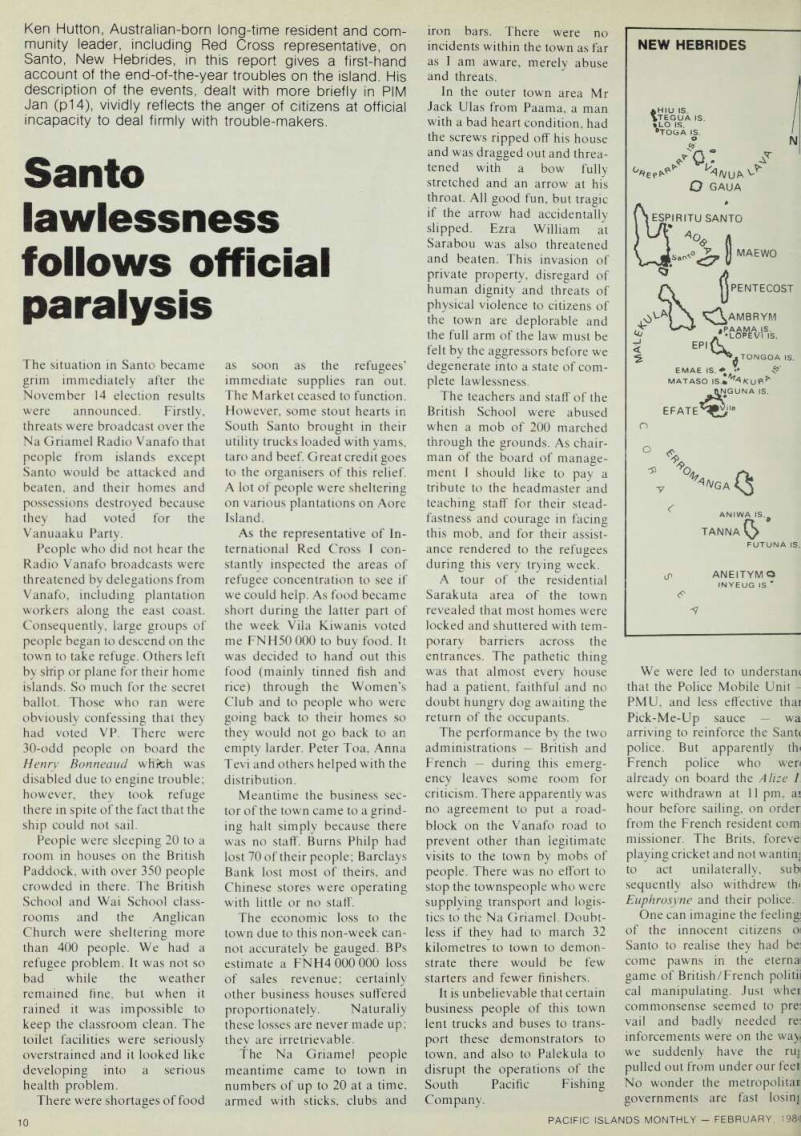
Santo lawlessness follows official paralysis
Ken Hutton, Australian-born long-time resident and com munity leader, including Red Cross representative, on Santo, New Hebrides, in this report gives a first-hand account of the end-of-the-year troubles on the island. His description of the events, dealt with more briefly in RIM Jan (pi 4), vividly reflects the anger of citizens at official incapacity to deal firmly with trouble-makers.
The situation in Santo became
grim immediately after the
November 14 election results were announced. Firstly, threats were broadcast over the Na Griamel Radio Vanafo that people from islands except Santo would be attacked and beaten, and their homes and
possessions destroyed because
they had voted for the
Vanuaaku Party.
People who did not hear the Radio Vanafo broadcasts were
threatened by delegations from
Vanafo, including plantation
workers along the east coast.
Consequently, large groups of
people began to descend on the town to take refuge. Others left by ship or plane for their home islands. So much for the secret ballot. Those who ran were
obviously confessing that they
had voted VP. There were 30-odd people on board the Henry Bonneaud which was disabled due to engine trouble;
however, they took refuge
there in spite of the fact that the ship could not sail.
People were sleeping 20 to a room in houses on the British Paddock, with over 350 people crowded in there. The British School and Wai School class rooms and the Anglican Church were sheltering more than 400 people. We had a refugee problem. It was not so bad while the weather remained fine, but when it rained it was impossible to keep the classroom clean. The toilet facilities were seriously overstrained and it looked like developing into a serious
health problem.
There were shortages of food
as soon as the refugees’ immediate supplies ran out.
The Market ceased to function.
However, some stout hearts in South Santo brought in their utility trucks loaded with yams, taro and beef. Great credit goes to the organisers of this relief.
A lot of people were sheltering on various plantations on Aore Island.
As the representative of In ternational Red Cross I con stantly inspected the areas of refugee concentration to see if we could help. As food became short during the latter part of the week Vila Kiwanis voted me FNHSO 000 to buy food. It was decided to hand out this food (mainly tinned fish and rice) through the Women’s Club and to people who were going back to their homes so they would not go back to an empty larder. Peter Toa, Anna Tevi and others helped with the distribution.
Meantime the business sec tor of the town came to a grind ing halt simply because there was no staff. Burns Philp had lost 70 of their people; Barclays Bank lost most of theirs, and Chinese stores were operating with little or no staff.
The economic loss to the town due to this non-week can not accurately be gauged. BPs estimate a FNH4 000 000 loss of sales revenue; certainly other business houses suffered
proportionately. Naturally
these losses are never made up; they are irretrievable.
The Na Griamel people meantime came to town in numbers of up to 20 at a time, armed with sticks, clubs and
iron bars. There were no incidents within the town as far as I am aware, merely abuse and threats.
In the outer town area Mr Jack Ulas from Paama, a man with a bad heart condition, had the screws ripped off his house and was dragged out and threa tened with a bow fully stretched and an arrow at his throat. All good fun, but tragic if the arrow had accidentally slipped. Ezra William at Sarabou was also threatened and beaten. This invasion of private property, disregard of human dignity and threats of physical violence to citizens of the town are deplorable and the full arm of the law must be felt by the aggressors before we degenerate into a state of com
plete lawlessness.
The teachers and staff of the British School were abused when a mob of 200 marched through the grounds. As chair man of the board of manage ment I should like to pay a tribute to the headmaster and teaching staff for their stead fastness and courage in facing this mob, and for their assist ance rendered to the refugees during this very trying week.
A tour of the residential Sarakuta area of the town revealed that most homes were locked and shuttered with tem porary barriers across the
entrances. The pathetic thing
was that almost every house had a patient, faithful and no doubt hungry dog awaiting the return of the occupants.
The performance by the two administrations British and French during this emerg ency leaves some room for criticism. There apparently was no agreement to put a road block on the Vanafo road to prevent other than legitimate visits to the town by mobs of people. There was no effort to stop the townspeople who were
supplying transport and logis
tics to the Na Griamel. Doubt less if they had to march 32 kilometres to town to demon strate there would be few starters and fewer finishers.
It is unbelievable that certain business people of this town lent trucks and buses to trans port these demonstrators to town, and also to Palekula to disrupt the operations of the South Pacific Fishing
Company.
We were led to understate that the Police Mobile Unit - PMU, and less effective that Pick-Me-Up sauce wa arriving to reinforce the Santc
police. But apparently th«
French police who wen already on board the Alize I were withdrawn at 11 pm, a» hour before sailing, on order from the French resident comi missioner The Brits, foreve: playing cricket and not wantin] to act unilaterally, sub sequently also withdrew th<
Euphrosyne and their police.
One can imagine the feeling! of the innocent citizens ch Santo to realise they had be; come pawns in the eternaf game of British/French politii cal manipulating. Just wher commonsense seemed to pre: vail and badly needed re; inforcements were on the way we suddenly have the ruj pulled out from under our feet No wonder the metropolitan governments are fast losing
New Hebrides
their credibility in this arena; if it has not yet been lost it is cer tainly sadly tarnished as a re sult of this effort, or rather
non-effort.
Where do we stand now?
The town has not recovered from this debacle. Even the fes tival of arts and the normal Christmas shopping spree were not enough to wipe out the damage already done. The threat still hangs over us. Any time some misguided character announces over that illegal Vanafo radio that the attack is on again (the most recently quoted date was 28 December and it did not happen) what do we do? We demonstrably are not able to rely on the two metropolitan governments for protection of our fundamental freedoms. The New Hebrides Government does not control the internal security of the country. The police forces are worse than useless in their pre sent structure. The law has not I acted, or even been seen to act, after this latest wave of threats f of violence.
I Airfields are closed down. At
Big Bay, for example, there are
logs and trees making it unus able. A woman died of tetanus at Big Bay because she could not be evacuated by air that’s only one of the tragedies. A child died because she was
evacuated by the frightened
parents instead of being admit ted to hospital. And no one seems to give a damn the ad ministrators, the politicians, the police, the parsons are all guilty men because they have not the guts to face up to this deplorable situation which ! threatens lives, the livelihood, the economy, indeed the very future of this town. [ Chief Minister Walter Lini was to head a delegation of senior ministers to Paris in January where discussions were planned with the respon sible British and French minis ters. Messrs Blaker and Dijoud.
On the agenda for the talks were an exchange of views on the exact date of indepen dence. and the problems of future economic aid from the metropolitan powers to independent New Hebrides.
French and British delegations were expected to visit New Hebrides in this connection the end of January.
A French caning
for the Australian press
The Vila weekly Nabanga, published in French and Bislama, carried in its December 22 issue a sting ing attack on Australian press treatment of recent events in the New Heb rides.
Nabanga’s director, Jean Massias, leads off by saying; ‘New Hebridean news appears only rarely in the Australian press. For the mass of Australians the New Hebrides archipelago is a distant group of islands far removed from the centre of their concerns.
Only the monthly RIM car ries in each issue an article, or several articles, devoted to this country. ‘However, on the occas ion of the elections of November 14, 1979, sev eral newspapers sent to the spot reporters who, each in his fashion, reported on events. ‘We have received The Age, The Sydney Morning Herald, The Canberra Times, The Australian, The Herald, The National Times, The Financial Re view, as well as a number of despatches from the Australian Associated Press agency. The various reports cover the period November 15-December 1. ‘Reading these articles leaves one dumbfounded at the low level of these dailies with one excep tion. Generally speaking the articles examined seem to have been written by people who are either ill informed or who have gath ered their information from one source only (which amounts to the same thing). All the cliches, all the tired old repetitions, are ponderously present to re mind us of with whom we are dealing. The develop
ment of the political life of the New Hebrides has been highly complicated in the period since 1975, full of turn-arounds, marked by subtle light and shade, re plete with official talks, cor ridor discussions and conversations held in strict privacy. But it appears in these publications as an affair reduced to the crud est of pictures in which the roles are played by English men who are content to let everything go to pot, colonialist Frenchmen who maintain bands of planters who are armed to the teeth, and ready at any moment to impose their rule, French speaking Melanesians who are a bit stupid because they speak French (really, I ask you . . .) and good
English-speaking Melan
esians (good because they speak English and worship a God who replies to them in the same language).
Australia is rarely men tioned, despite the various untoward initiatives of its brilliant representative in Vila who appears some times to overstep a little the bounds laid down by the Vienna Convention [gov erning the behaviour of diplomatic representa tives]. ‘An example of this sim plification of things? In all the 20 articles we have read we have found not a single reference to Gerard Leymang, despite the capi tal and vital role he has played as statesman, nego tiator and conciliator in resolving the crisis!’
With that off his chest, Mr Massias proceeds to a sav age dissection of the artic les of Sydney Morning Herald correspondent Mark Baker (’our old mate’, as he calls him, with heavy sar casm), and AAP’s Tony White.
His ire is particularly and understandably aroused by Baker’s suggestion that the new Vanuaaku Party govern ment is likely to permit the establishment in the New Hebrides of a government in-exile of the Kanak liber ation party in New Caledonia, Palika.
Mr Massias comments; ‘Nowhere is there any ref erence to the formal denial issued by Walter Uni of this false claim which has been widely publicised in the Australian press (see Nabanga 134 of November 21 1979, pi 1): ‘Fr Lini has not promised to support the creation of a government in-exile in the New Heb rides, and he has on several occasions told journalists that he is not convinced that this would be the best or most appro priate way of promoting the interests of the indepen dence movements con cerned.’
There is no doubt that Mr Massias has a point when he comments on the gen eral indifference of the Aus tralian public to New Hebridean affairs (one wonders however if the situation is much different in France). And he has cer tainly uncovered a good number of examples of less-than-responsible jour nalism in the course of his onslaught on the Australian press. So far so good.
But he is on much less secure ground when he widens the attack in pass ages like the following: There is an old law in the world of information which claims that a country gets the press it deserves. If ever that theory began to be proven, we would be most concerned for our neigh bours to the south-west be cause it could mean that Australia is suffering from an inferiority complex. We are not able to discuss further how well-founded such a complex would be.’
And, further on, a little more of the same . . .
Malcolm Salmon
Advertisements & other items, p. 12 (1 item)
jgfct
' * m *>- --. •••.'
. 9 . 4p* ■* 'et, - * S \ * V m .' * ... >rA SS
IBS*
✓ ✓ K T v il ■ rm ■:■ ■? i>s£ : ■ ■ & - /; b". ■ Y69E
Sydney’s Tongans
Tropicalities
Tonga’s lively
Pacific Week
Pacific Week, an annual event on the University of the South [Pacific Suva campus since [1976, went walkabout in 1979, to fetch up in Tonga, Labasa and Solomons Extension Centres of the world’s most
[decentralised university.
I Under the banner The Weight of Tradition - Is it Worth Carrying?’ USP Tonga launched a lively programme between November 6-11 which coincided, most happily and quite fortuitously, with an equally lively Tourism Week, and produced a convincing af firmative answer to the theme
question.
The activities mix embraced a keynote address, panel dis cussion, and essay compe tition; book and photographic displays; documentary films about the Pacific region; songs and dances of the Pacific; a two-day manual arts compe tition at the Centre, with ’umu lunches for competitors; and a traditional elaborate Tongan style feast on the Friday eve ning. [ The manual arts contests, with categories for weaving, tapa 'ingatu painting, and wood carving, attracted entrants of all ages. The many visitors who watched the two-day creative workshops were clearly fasci nated with the traditional tech niques used and with the quality of the finished pro ducts.
In fact, many of the entries were sold before completion, by agreement between contest ants and fast-workers among the spectators, who chose their own No 1 favourites long be fore the official judges got a look-in.
Tonga’s traditionalists, dedi cated to preserving her ancient skills and values in the teeth of increasing external pressures and influences, have good reason to feel encouraged by the USP Pacific Week. They
can now point out that:
• A widely representative
cross-section of the Tongan people took enthusiastic part in the programme, either as par
ticipants or as eagerly appreci
ative audience members, with teenagers and young adults well to the fore on all fronts; • Tongan wood carvers were
clearly encouraged to move
away from tourist gimmickry (such as the derivative Maori tiki) towards original creative
sculpture of genuine ethnic
value: • The Pacific Week pro gramme opened a window through which visitors and the
resident expatriate community
were able to glimpse more of the Teal Tonga’ than can ever emerge from a cruise ship mar ket or a tourist floor show.
Although the small and over-extended staff at the USP Centre may pale at the thought, Pacific Week ’79 indicates a real need to establish such a programme on an annual foot
ing, preferably co-ordinated
with current planning for an annual Tourism Week.
One is tempted to suggest, too, that the prize-winning
entries from the associated handicrafts contests could form the nucleus of a National Fine Arts Collection, properly housed and permanently on display along with what rare artifacts remain from Tonga’s long and fascinating cultural past. Penny Hodgkinson.
Sydney’s Tongans
turn it on
‘A girl can’t expect to be a Ton gan beauty if she’s skinny.’ This is how, with a laugh, Mrs Fatal Slender introduced the Tongan girls who recently presented a
great evening of Polynesian
entertainment in south Sydney,
organised by the newly-formed
Tongan ladies’ charity group
Lei’ofa.
Against a huge painted tapa cloth backdrop, the evening
brought together about 200
Australians and Tongans who were welcomed with a Tongan style feast roast suckling pig surrounded by about 20 dif ferent dishes. Rich coconut cream was served with veg etables and chicken, while many Australians had their
first taste of raw fish salad marinated in coconut milk.
Preparation of this Polynesian
feast was supervised by Mrs Maa’ta Taufa and Mrs Susana Thompson, who were among the estimated 2000 Tongans
living in Sydney.
Guests included the pianist John Toutai Tupou, first cousin of the King of Tonga, and Mrs Joyce Harkness, for
merly a missionary in the king
dom.
The entertainment began with the youngest of six
dancers 18-year-old Sydney
high school student Miss
Meleane Tio. Accompanied by
three Tongan drummers, she was soon bedecked with dollar notes tucked into her necklace, her bracelets, and at the waist
by appreciative guests.
Another graceful young dancer was Miss Luseane Sikuvea, who oiled her skin so that it shone and the dollar notes clung to her bare arms and shoulders.
Fiery torches in a Raroton gan dance, castanets with their keen Hawaiian rhythms and the swirling skirts of the Tahi tian tamure soon had guests
vibrating in Polynesian mood.
These dances were performed by a skilful foursome Norma Lufe, Amalani Latu, Ofa Lowry and Fatal Slender. They were joined on stage by young
singer Miss Nancy Mataiasia
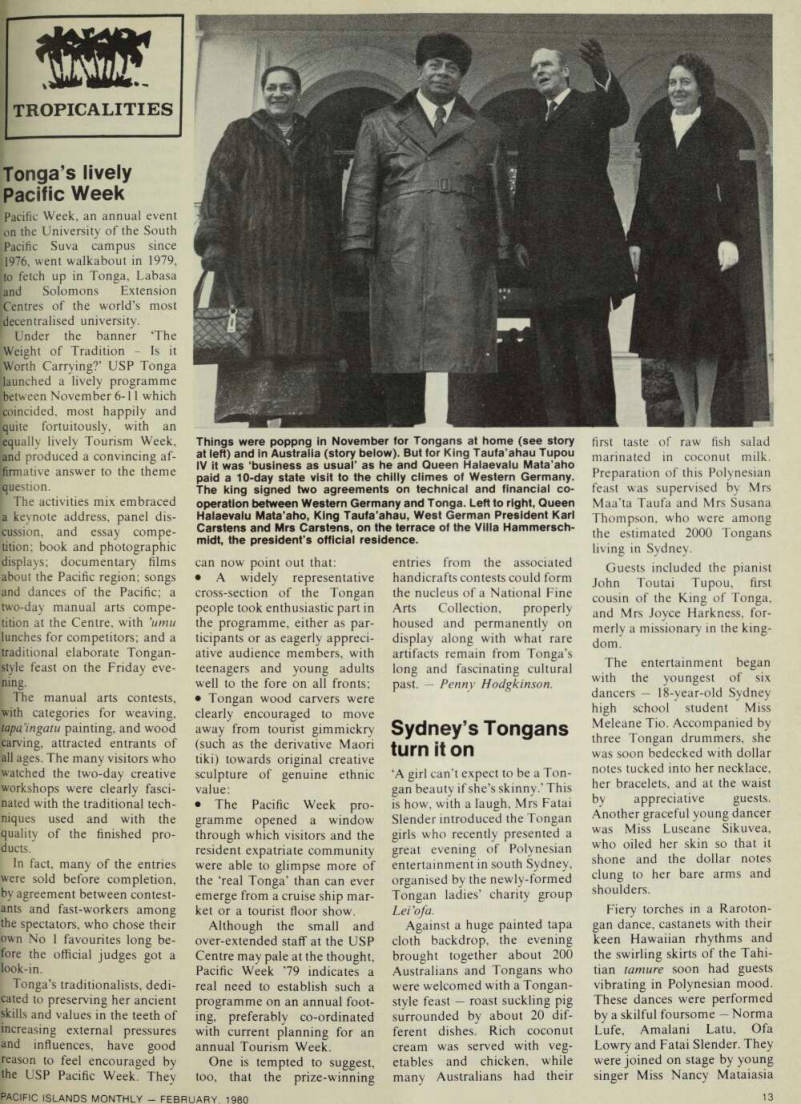
Things were poppng in November for Tongans at home (see story at left) and in Australia (story below). But for King Taufa’ahau Tupou IV it was ‘business as usual’ as he and Queen Halaevalu Mata’aho paid a 10-day state visit to the chilly climes of Western Germany.
The king signed two agreements on technical and financial co operation between Western Germany and Tonga. Left to right, Queen Halaevalu Mata’aho, King Taufa’ahau, West German President Karl Carstens and Mrs Carstens, on the terrace of the Villa Hammersch midt, the president’s official residence.
Lomu, from Nukualofa, who is studying at the Conserva torium of Music in Sydney.
This night of South Sea island treats was the first social function organised by the Ton gan ladies’ charity group LeVofa (meaning ‘current of love’). The group has been
formed by seven Tongan
women living in Sydney, who
want to help disadvantaged
families and children in the islands. As explained by Fatai Slender, who has been in Syd ney for more than 10 years, the
idea was prompted by a tragic
shipping disaster about a year ago when many families were bereaved through a voyage to the island of Niuatoputapu.
This small island, in the north of the Tongan group, is not far from Mrs Slender’s home of Tin Can Island, or Niuafo’ou, where she was known before her marriage as Fatai Moe- Manu Mounga’afi. The other six founders of LeVofa are Maa’ata and Lisita Taufa, Susana and Rosaline Thomp son, Luseane Sikuvea and Ofa
Lowry.
As the guests’ mood warmed up at the island night in Syd ney, the grand finale came from Tavake (Terry) Vaivao, who performed a daring fire dance as he tossed about two Samoan cane-knives with flames darting from both ends.
As the blazing knives lit up the darkened hall, guests were given a fiery farewell to this very successful evening
organised by Sydney’s Tongan
community - Helen Rous seau
Problems in Tom
Neale’s paradise
The rats have taken over the domain of the Flermit of Suwarrow Island, Tom Neale, who died on Rarotonga of can cer in December, 1977, but his house and the outbuildings are still in good repair. So reports Ronald Syme in the Cook Islands News after returning from a tour of the outer islands which he made with the Prem ier, Dr Tom Davis. ‘The late Tom Neale’s old house and outbuildings were still in reasonably good con dition and their simple con tents appear to have been left
largely untouched,’ Mr Syme
writes. ‘The galvanised water tanks were rust-free and sound and filled with an abundance of good, clean water. Rats were
extremely plentiful and would
undoubtedly prove a great plague to anyone attempting to live on the island. ‘There was no sign of any wild descendants of the cats owned by Tom Neale during his years of living in Suwar row.’
Which suggests (a): the rats turned the tables on the cats or
(b), some visiting yachties
shanghaied the cats believing
that life on a yacht would be
preferable to island living.
And, on the question of visit
ing yachties, Mr Syme reports,
‘The spectacle of two yachts anchored at Suwarrow did not meet with the Premier’s ap
proval. Apparently, the boats,
both of them illegal entrants, have been there for the past two months. ‘One of them at least had come direct from Western Samoa, where rhinoceros beetle and termites are a con siderable pest. Thus, it was not surprising to discover on going ashore that a large number of coconut palms had been de stroyed by such termites.’
The day of the
spirit healer
The success of a Samoan spirit healer in treating a young Samoan boy in Hutt Hospital.
Wellington, has underlined the value of using traditional heal ing techniques with certain cul ture-bound syndromes. Hutt
Hospital pediatrician. Dr
Michael Short, and a Health Department researcher. Dr Patricia Kinloch, now advocate the use of experienced healers in cases such as spirit pos session or musu. They say the cultural background of patients should be considered, es pecially in the diagnosis of social or mental disorders. This follows their analysis of a case (last May) involving an 11-
year-old Samoan boy whose
behaviour caused concern after a clash with his father.
According to their report in the December issue of the New Zealand Medical Journal the boy became uncommunicative after some harsh words and
mild physical punishment. He
was seen by the hospital’s casu alty department but sent home when no physical problem was found. When his withdrawn behaviour continued his gen eral practitioner arranged for
his admission to hospital fo< observation.
The boy had had a simila
episode lasting five days a few
months before after conflic: with his Samoan school teacher. The problem disap' peared after the teacher parents and the boy discussec the affair.
On examination the boy hac no symptoms of fever and wa: alert but he stared vacantly into space. In response to direc questions he shouted ‘yes’ 01 ‘no’. No conversation was poss ible and he gave the impressior
of not understanding English.
A wide range of tests failec to show any physiologica abnormalities.
On the third day after ad mission a Samoan health as sistant conducted a counselling session to see whether the boy’: symptoms were indicative o: musu or spirit possession. The latter was confirmed and the health assistant urged the use of a Samoan spirit healer. The boy was given temporary leave from hospital to visit a Samoar healer who exorcises spirits; and to attend church with some of his extended family. On tha day the healer exorcised the boy’s maternal grandfather.
The boy’s condition had im proved markedly when he re turned to hospital and he waj later discharged after five days there. He was well, alert anc
progressing normally at school
when checked after three anc six months.
Drs Short and Kinloch saic the most likely diagnosis was
drug ingestion, elective mutism
(an emotional disorder), oi childhood schizophrenia. All
were rejected.
The question also arose as tc whether we were confronted with a culture-bound syn drome, a ma’i fa’a Samoa “Samoan sickness”. ‘Superficially this seemed
unlikely because our patient
was born in New Zealand and had grown up here. And he
spoke English. Further investi
gation of the family revealed that Samoan was still the first language of the family, par ticularly of the patient’s mother. She had believed the
boy was possessed by a spirit
ma’i aitu prior to taking him to: the general practitioner. Heit
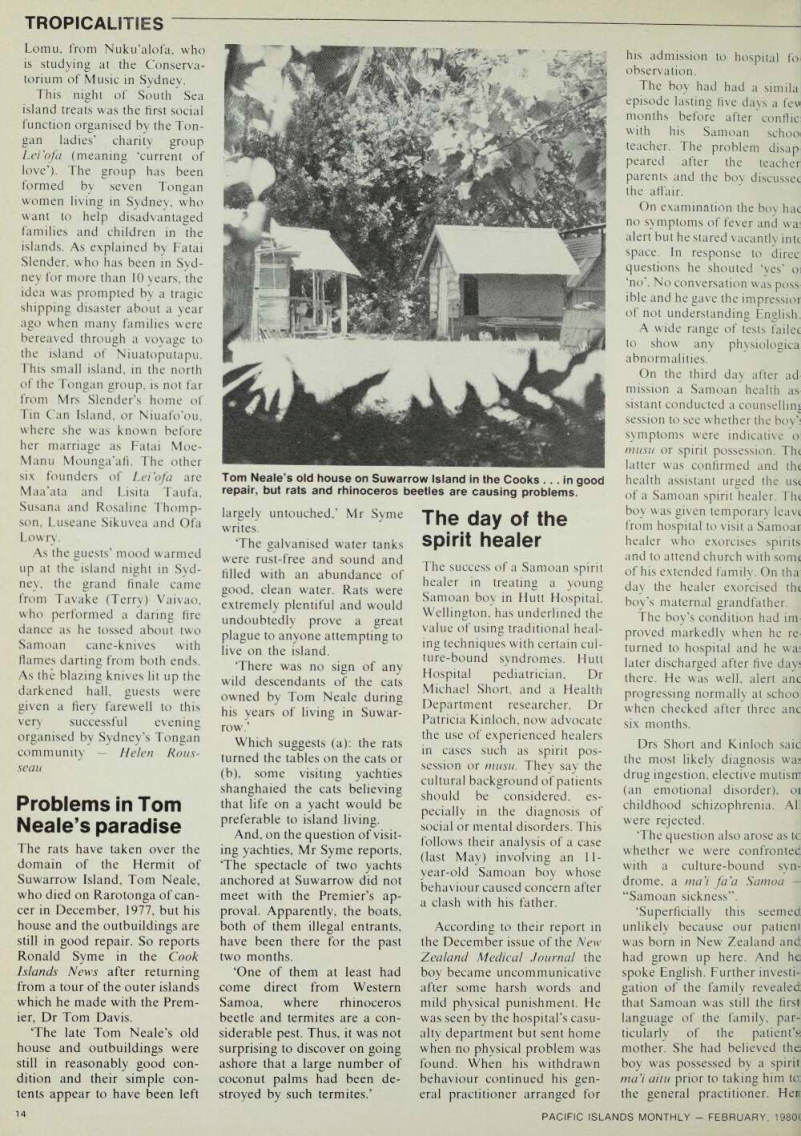
Tom Neale’s old house on Suwarrow Island In the Cooks ... in good repair, but rats and rhinoceros beetles are causing problems.
husband, however, had dismis sed this idea and insisted on I Western medical treatment for his son. That the mother was prepared to consider the possi bility of spirit possession made it possible for her son to have manifested it. The relations be tween husband and wife were found to be very strained and their tensions were often “worked out” through their re lationship with the boy. ‘lt was possible that the
patient’s response, a culturally
accepted one in the face of »great anxiety, enhanced his im fportance in the family and made possible the control of i his parents. Therefore, with some scepticism we enter tained two additional diag noses; musu and spirit
■possession.’
I Drs Short and Kinloch say the symptoms of musu and spirit possession are similar to one another and also to child-
Hiood schizophrenia.
I ‘Since we were dealing with ; a Samoan patient whose symp toms characterised a “Samoan sickness” it was decided to pur sue this before coming to the favoured diagnosis of child hood schizophrenia. The scep ticism with which the possible diagnosis of musu or spirit pos session were received was ameliorated by the “matter-of |fact” manner of the Samoan health assistant in her counsell ing session and in her obvious concern to do the right thing for the patient.’ \ Drs Short and Kinloch say dhe acceptance of her recom mendations was an experiment in treating patients from other
cultures by recognising their
cultural heritage and in using the healing skills within the patient’s own cultural group. ‘Since the Samoan spirit healer’s treatment was success ful we have concluded that our patient was possessed. He had no recollection of the time dur ing which he was possessed or of the treatment ritual of exor cism.’
They say it is useful to recog nise musu and spirit possession as culture-bound syndromes and recommend the use of healers with the skills to treat
such conditions.
James
fully.
Love from
Luganville
PlM’s Department of Heart Affairs has received a puzzling letter from the New Hebrides, and with the letter a gilt neck lace. Somewhere, it seems, there’s a young lady who may have aroused the ardour of Robin Maki, of Luganville (Santo). She might be on a PIM cover or on a photograph inside the magazine, but the letter was addressed to a Miss Reader, at PIM. Mr Makin im plied that a young lady had written to him ‘I find your nice letter’, he wrote. And added, ‘Well, well darling, here is my best love’.
Enclosed with the letter was the necklace, a gilt chain we don’t think it’s 18 carat from which was suspended a heart
shaped pendant of glittering
something or other.
The thought was as nice as the generosity, so it’s all here at PlM’s office waiting for its owner to whom Mr Makin sends his ‘best love’, if she will
kindly identify herself.
The golden
mothers of PNG
The mothers of Papua New Guinea are saving the country’s families about $2O million a year, an academic has discovered.
And how they do it is by breast-feeding their babies instead of putting them on the bottle, which estimates Dr Barry Shaw, of the Australian
National University’s Develop
ment Studies Centre, could
cost families as much as $2O million a year.
As PIM reported (July, 1976, Pl 3) Dr Cam Bowie, the Provincial Medical Officer at Goroka, led a campaign to ban bottle feeding because it was a health hazard, resulting in sick ness and semi-starvation as well as being unhygienic if bottles were not cleansed suf ficiently. He estimated the cost of bottle feeding at about KlO million a year.
Dr Shaw, who has been working on the economics of human milk production in Papua New Guinea, as part of a much larger study on food supplies and nutrition in PNG, has found that about 2.5% of total food consumed in PNG is in the form of human milk.
This amounts to about 67 million litres a year.
A reduction in the practice of breast-feeding could also cost the government dearly and raise the birth-rate!
‘Any significant reduction in
either the practice of breast feeding or its duration will re sult in increases in government expenditure, a decline in human welfare and an increase in food imports,’ Dr Shaw be lieves. ‘Any increase in child illness or mortality would increase health costs and reduce the ca pacity of the health system.
There was growing evidence that poor feeding very early in life could impair later learning
ability.
‘PNG women traditionally breast-fed their babies for the first three to five years, and this often acted as a birth-spacing
mechanism as breast-feeding resulted in a much slower return of ovulation after birth.
A reduction in breast-feeding could result in an increased birth rate which would require
increased spending on family
planning programmes.
‘Any marked reduction in breast-feeding would have adverse budgetary, balance of payment, welfare and demo
graphic effects.
‘A high-income country could cope with these changes, but for Papua New Guinea with a per capita income of around $5OO a year, it would be far more serious, especially in the long term.’
A Highlands’
Helen of Troy
of a clan in the Papua New Guinea Western
Highlands kidnapped a girl
belonging to another clan. As a result, there was a battle involving 800 tribesmen. Three died, shot to death by arrows.
More than 100 ha of crops were
destroyed. Eight hundred
houses were burned down.
Police were rushed to the area and restored order.
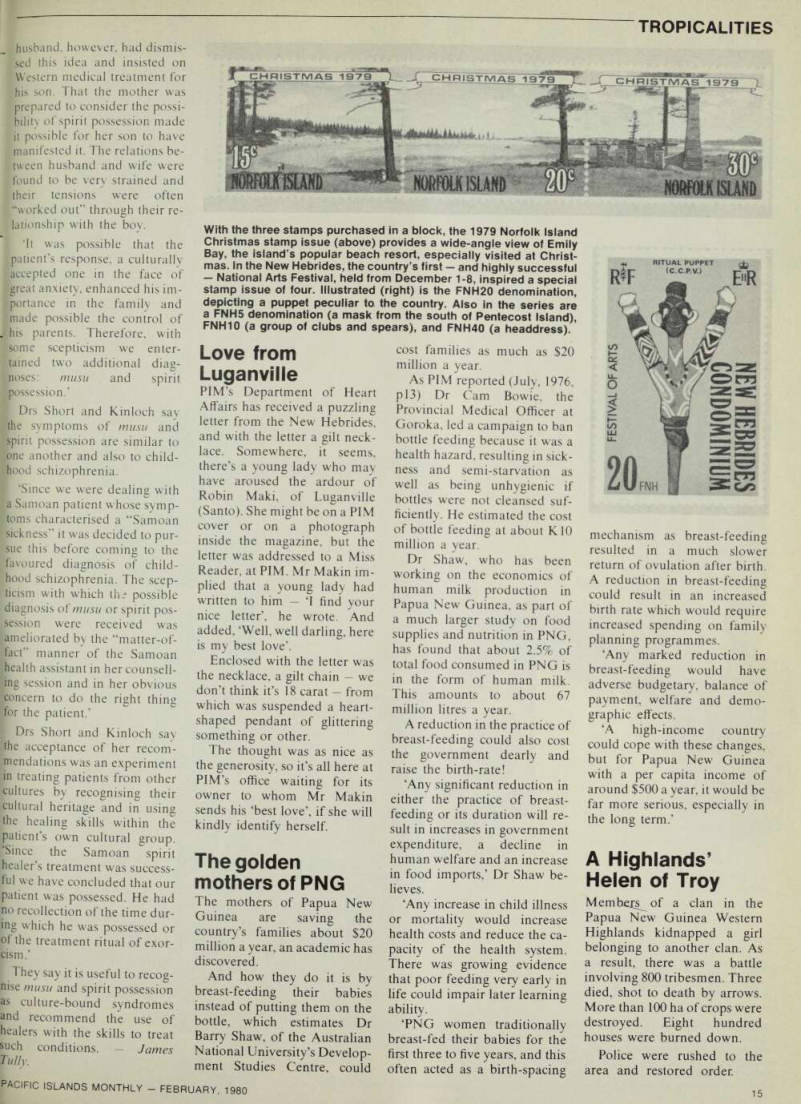
With the three stamps purchased in a block, the 1979 Norfolk Island Christmas stamp issue (above) provides a wide-angle view of Emily Bay, the island’s popular beach resort, especially visited at Christ mas. In the New Hebrides, the country’s first and highly successful National Arts Festival, held from December 1-8, inspired a special stamp issue of four. Illustrated (right) is the FNH2O denomination, depicting a puppet peculiar to the country. Also in the series are a FNHS denomination (a mask from the south of Pentecost Island), FNHIO (a group of clubs and spears), and FNH4O (a headdress).
Advertisements & other items, p. 16 (1 item)
Teac
n rM & 9.
I o o a Xpert ab dividen £v m §n\ a <l%
-s*»* « j-I
-—4*> H 1 « -- •-. r— s*»««sai
TEAC
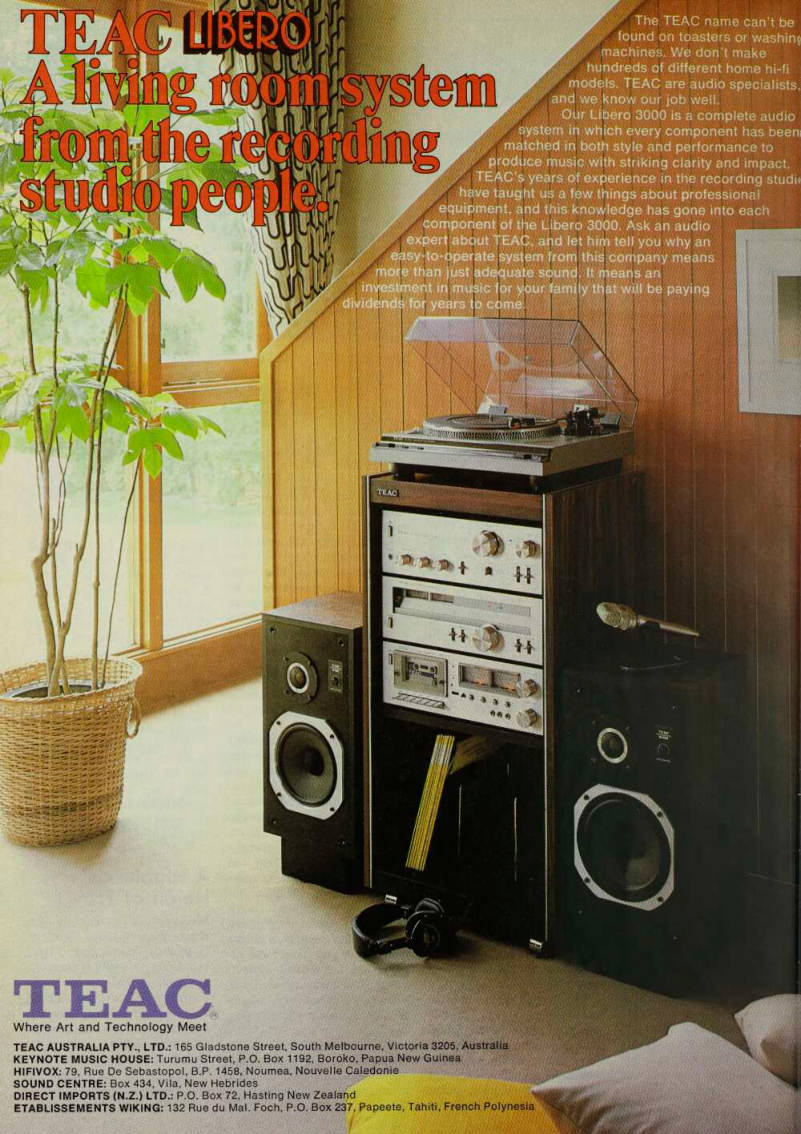
a Where Art and Technology Meet TEAC AUSTRALIA PTY., LTD.: 165 Gladstone Street. South Melbourne. Victoria 3205, Australia KEYNOTE MUSIC HOUSE; Turumu Street, P.O. Box 1192, Boroko, Papua New Guinea HIFIVOX: 79, Rue De Sebastopol, B.P. 1458, Noumea, Nouvelle Caledonia SOUND CENTRE: Box 434, Vila, New Hebrides DIRECT IMPORTS (N.Z.) LTD.: P.O. Box 72. Hasting New Zealand ETABLISSEMENTS WIKING: 132 Rue du Mai. Foch, P.O. Box 237, Papeete, Tahiti, French Pc
Auckland-Polynesian city
[Auckland has been tagged the biggest Polynesian city in the world.
James Tally, Pacific affairs writer with The Auckland Star, looks [at some of the problems which have sprung from New Zealand's I hitherto generally relaxed immigration policy tow ard people from \ certain Island groups, mainly the Cooks, Niue, Tokelau, Western Samoa and Tonga. Things are not as bad as they were, he reports, but race relations and the need to improve the lot of the disadvan -1 (aged Island minority in New Zealand remain major problems for government and local authorities to tackle.
It is bustling, colourful, Karangahape Road which gives Auckland the feel of a big. cosmopolitan city generally lacking in this sprawling, soulless metropolis. ‘K Rd’.
Auckland s tame and tatty version of Sydney s King’s Cross, is Instant Polynesia, a focal point for Auckland’s big population of Maoris and Pacific Islanders. Especially Islanders - Tongans, Samoans, Niueans, Cook Islanders, Fijians and Tokelauans. For the many who live in the surrounding suburbs o Ponsonby, Newton, Freeman’s Bay, Grey Lynn, K Rd
is their local shopping centre, It caters for- their needs.
Fruit shops sell taro, yams and coconuts’. The fish shops carry a wide range of seafood not often served in palagi (European) homes. Fabric shops have bright printed materials for lavalavas and other island-style dress, Basketware and other island handicrafts are sold. There are travel agents who specialise in arranging trips home to the Islands, On Sunday, Island families in long skirts and picture hats, lavalavas and dark suits, bibles
in hand, stroll along K Rd to the churches which still play a big part in their lives. Some wait for buses outside the pubs, strip clubs and massage par lours that make K Rd a tawdry focus of night life.
The skyline of K Rd recently acquired an island flavour with the opening of Samoa House
which has a large fale- style
hall. The building houses the Western Samoan consulate in Auckland and Nauru’s
consulate-general.
Step away from K Rd and Ponsonby and there isn’t much to suggest that Auckland is home to more than 40 000 Islanders, even in South Auckland suburbs like Otara and Mangere which have large numbers of Islanders.
Surprisingly, there are no restaurants specialising in Island dishes. Aucklanders ap
parently prefer French, Italian,
Greek and Lebanese food. The city’s night life has little with an Island flavour apart from two dance spots popular with the Island community Tan garoa’s Hut and the Reef comber.
Visit Auckland international airport and you might see crowds of Islanders with leis and shell necklaces waiting to meet or farewell relatives and friends on flights to and from
Apia and Rarotonga.
Auckland has been tagged
the biggest Polynesian city in
the world but it doesn’t show very much.
It’s not surprising that K Rd has become identified with Auckland’s growing Pacific Island population. Over the years, migrants lured by the prospect of jobs in New Zea
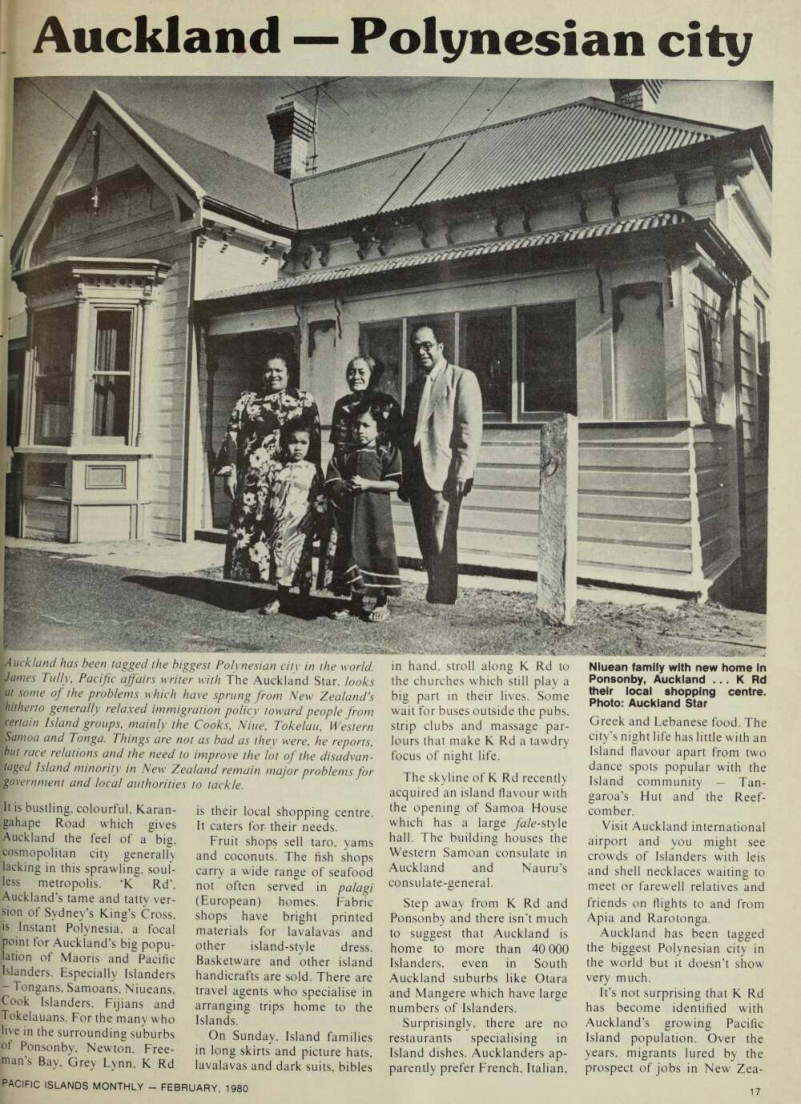
Niuean family with new home in Ponsonby, Auckland ... K Rd their local shopping centre.
Photo: Auckland Star
land factories, have tended to live in cheap housing areas.
Very often, that meant the old inner city suburbs around K Rd.
Housing is a major problem for Auckland’s Island families.
The wages for unskilled workers especially those with large families don’t stretch very far. The old wooden villas of the inner suburbs may often
provide only adequate accom
modation but rents are high.
Samoa-born Stephen
Niumata, a legal executive, who is president of the Pacific Islanders’ Housing and Wel fare Association explains: ‘Once they have obtained a place to stay the majority are faced with the problem of meeting payments of about SNZSO or $6O a week. The av erage labourer earns only $BO or $9O a week, which means they are paying out more than half their wages on rent. ‘Many try to solve this prob lem by inviting relatives or friends to live with them and thus share the burden but this is interpreted by landlords as
overcrowding.
‘lf the rental is high there can be anything up to a dozen people occupying a house. We receive many complaints of overcrowding each week and try to balance this by complain ing that rents are too high.’
Mr Niumata says bond re
quirements usually two
weeks rent create problems too. An islander may have to put up a $250 bond. Some arrive in Auckland with as little asslo. ‘Some stay at their relatives’ place for a while but this usually results in arguments.
We used to lend money but unfortunately we went broke as more often than not we were never repaid.’ The association still helps people over the Christmas period when every thing is closed.
Another problem is knowing
where to look for accommo dation. Until recently, Auckland accommodation was not advertised in the islands.
Western Samoa has taken the lead in helping prospective mi grants by running advertise ments in the Apia Press.
According to Mr Niumata, Islanders still face racial preju dice from landlords. The level.
he says, is ‘tolerable’. It used to be ‘very bad’.
In recent years Islanders have had to look increasingly to the outer suburb for accom modation. They’ve faced com petition for the old villas of Ponsonby from young pro fessional couples who realise the advantages of living close to the offices where they work.
It has become trendy to buy an old villa and restore it.
Mr Niumata says some Islanders are getting into financial difficulties because they have bought houses in outer suburbs without seeking the advice of lawyers.
Housing is just one of several
problems faced by Pacific
Islanders living in New Zealand. The picture is one of a disadvantaged minority. Im migration and its associated
socio-economic problems only
emerged as an issue when the New Zealand economy began to falter five years ago. Until then it was convenient to
'import' unskilled workers to do the dirty jobs and fill the gaps in industry. When the economic situation changed.
Islanders became a scapegoat.
Long-ignored problems came
out into the open.
Auckland was seen to have
ghettoes-in-embryo. Low
income Island families were living in overcrowded, sub standard accommodation. Mi grants faced immense problems adjusting to a new urban dollar-oriented life style for which they were largely un prepared. Too little was being done to combat the social prob lems arising from educational and other disadvantages. The disaffected young were seeking radical solutions, some form ing street gangs with names like "The Niggs’ and 'Polynesian Panthers’.
In its successful 1975 election campaign, the National Party
played on palagi bigotries and
exploited the immigration issue. A year later the word ‘overstayers’ became part ol the New Zealand vocabulary as random checks were made on Islanders to see if they had overstayed their work per mits.
The overstayers issue has died down but visit Auckland magistrate’s court and it be comes ovious that immigration officials are still busy. Cases are usually heard on Mondays
and Tuesdays.
The corridor and stairwef adjoining the courtroom arc usually crammed with relatives and friends of those defending alleged breaches of the Immi gration Act. At times there arc more than 80 cases on the list There is often confusion as tc who is who and court officers
frequently have difficult)
pronouncing names.
On a more positive note, the education department ha; extended specialist services tc schools with large numbers o] Polynesian students and re viewed the needs of Island chil dren. Closer attention is paid tc the all-important language skills needed to succeed in the education system. Two school; have ‘reception classes’ foi
newly-arrived migrant children
who are given intensive language instruction and an introduction to aspects of the palagi way of life.
Several schools have made < determined effort to foster c true multi-cultural atmosphere and make education more rele vant to the needs of then students.
Technical institutes an taking English languag* courses ~to the factory floor
Auckland University is giving
special help to Polynesian
students, and Radio Nev Zealand has opened a Maor and Pacific Islands broadcast ing unit in Auckland.
Another welcome move ha; been the establishment of the Pacific Islands Educational Re source Centre which has a staf of 12 including tutors for all the main Island groups. An ole school in Ponsonby was refur bished as the centre’s home.
Orientation officer Edgai Tu'lnukuafe talks about some of its services:
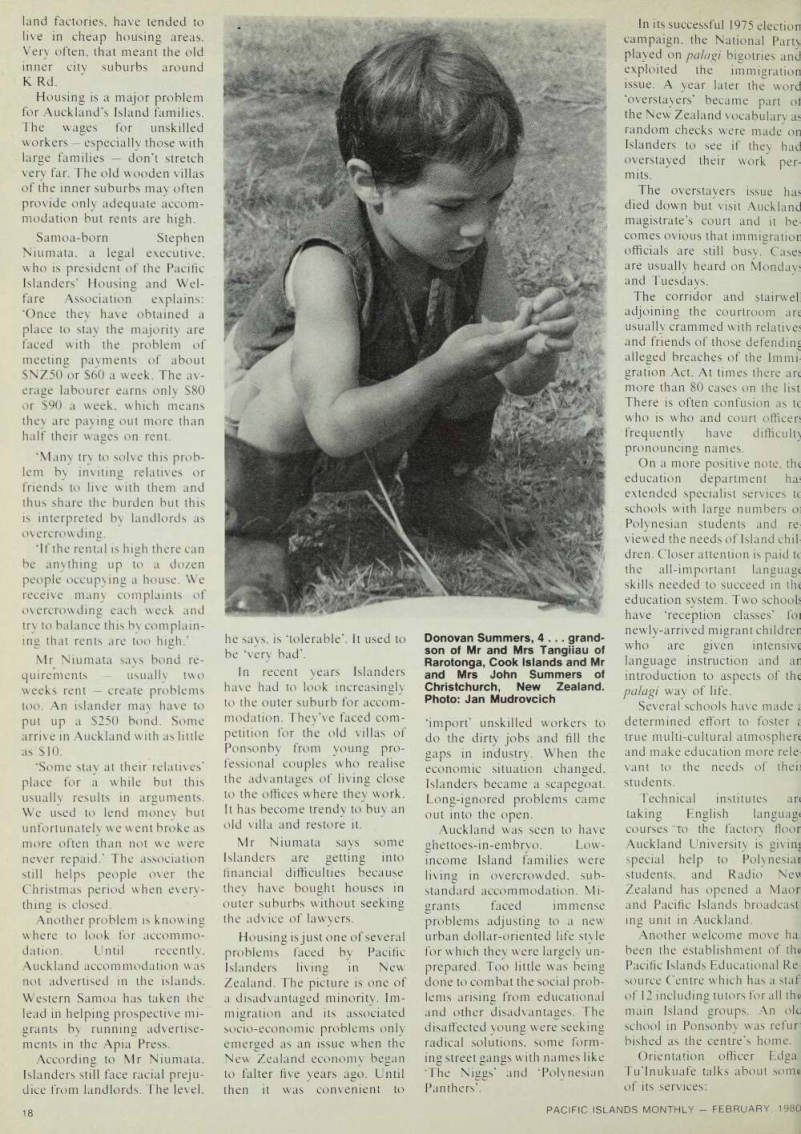
Donovan Summers, 4 . .. grand son of Mr and Mrs Tangiiau of Rarotonga, Cook Islands and Mr and Mrs John Summers of Christchurch, New Zealand.
Photo: Jan Mudrovcich
The centre runs courses at both the Auckland and North Shore Teachers’ Colleges to educate student teachers in the Pacific Island point of view.
This includes the understand ing of languages and dif ferences in culture and ways to assist Island children adapt to the different way of life in New Zealand. ‘Another course familiarises public servants with the five main Pacific Islands groups Samoans, Tongans, Cook Islanders, Niueans and Tokelauans. ‘Because many new migrants have no transport the centre trains voluntary workers who can then go out into the homes to teach basic English. There is special tutoring in school cer tificate and university entrance Lexamination English.' Mr Tu’lnukuafe said a trans lation service is offered free to j schools. The centre publishes resource material for schools and community groups some of its publications are in de mand in countries such as the I United States where sizable numbers of Samoans and Ton gans have migrated.
Pacific Islanders do a great deal themselves to cope with their particular problems and to preserve a cultural identity.
Three examples of this self help approach are the forma tion of the women’s organisation Pacifica, the work of the Polynesian Panthers, and the tremendous effort of a group of secondary school students in initiating a sub urban recreational and cultural centre.
Pacifica, with its 18 branches throughout New Zealand, works to assist Pacific Island women and to promote the role of Polynesian women in gen eral. More than 400 women attended its last national con ference. Workshops discussed such topics as the problems faced by young adult Islanders.
Pacifica has mounted a suc cessful fashion contest to raise funds for the continuing edu cation of Island women.
The Polynesian Panthers, now nine years old. had a bad image w hen they first appeared in Auckland. They w ere seen as a lawless Black Power gang bent on warfare with Whites, i Panthers leaders say they are
working for better European-
Polynesian understanding and
to help Polynesians survive in a city orientated to European living without losing their cul
tural identity.
The Panthers are fighting the front-line battle. They have been involved in community service, citizens’ advice and legal aid and provide emerg ency accommodation. They run homework schemes and have become a first-stop for all kinds of Polynesians in trouble.
Much of their time is devoted to counselling young people.
Otara’s Hillary College has
many Maoris and Pacific Islanders on its roll, reflecting the racial balance of this much
maligned suburb.
Five years ago a fourth form class talked about the reasons
why young Polynesians seemed
to be involved in crime. They decided a lack of recreational and social facilities was a big factor. Young people had no where to go and nothing to do.
Their ow n suburb was a classic example of bad planning hundreds of houses built be fore adequate social services and facilities were provided.
The student put up a case for a recreational and cultural centre where people of all races could mix. The government and local authority backed the
project. An appeal sponsored
by the Auckland Star news paper saw the children of Otara put heart and soul into fund
raising and the city responded.
The centre. Te Puke O Tara, became a reality.
Much remains to be done.
The longer Islanders are a
disadvantaged minority the
greater the danger of racial conflict. The longer they re main at the bottom of the socio-economic ladder the more Auckland is liable to de
velop ghettoes.
It’s a socio-economic prob lem at heart, one that touches almost every aspect of a per son’s life. It is showing up to an alarming degree in the area of health. especially child health.
The death rate for Poly nesian children between one month and one vear is twice
that for European children.
Most of the children in Auckland Hospital’s infec tious diseases block are
Polynesians. A study showed
that Polynesians in Auckland have a greater risk of being admitted to hospital, a greater chance of dying as a result of admission, and stay in hospital nearly twice as long as Euro peans. The incidence of tuber culosis said to be of epidemic proportions is 30 times greater among Pacific Island ers than among Europeans.
Medical school lecturer. Dr lan Scott; ‘We’re talking about a socio-economic problem.
Low socio-economic areas are less likely to attract doctors.’
Health services that depend on voluntary support and local fund-raising are not easy to promote in poorer suburbs.
Major crime files reflect the social scene. In 1976. Islanders committed 27.38% of all assaults yet made up only 4.86% of the population.
Another survey showed that although Maoris and Pacific Islanders aged between 14 and 30 were only 2.75% of the population, they committed 34.85% of detected violent offences.
Suggesting induction courses for Islanders entering New Zealand. Secretary for Maori Affairs Kara Puketapu said factors which probably con tribute to the high incidence of violent offending included the breakdown of family disci pline. urbanisation, below average academic attainment, excessive numbers in unskilled occupations and excessive
drinking.
In 1976 an Auckland Star investigative team studied the
city’s Island population and
their problems. They
concluded; ‘This could be the issue his torians say the city failed to see or neglected to deal with (in the seventies). Not rapid rail, or urban sprawl, but the growth of decadent suburbs, ghetto ac commodation for unskilled Island labour, either enticed here by agents for industry, or drawn by their own unsophisti cated ambition.’
Things have improved since
then but the basic premise re mains valid in Auckland in 1980.
English classes for Polynesian railway workers at Manukau Technical Institute .. . and strong emphasis too on self help. Photo: Auckland Star
Advertisements & other items, p. 20 (1 item)
See the world with Air New Zealand
I I V p H. - * % - See the world with Air New Zealand If your journey is to take you far or near, first see Air New Zealand or your travel agent to discuss the flights and fares that suit you best.
In the Pacific we fly to New Zealand, Australia, Fiji, Honolulu, Tahiti, Samoa, New Caledonia and Rarotonga. If you’re travelling farther, let us fly you to our Gateway cities to the world - Los Angeles, Hong Kong and Singapore, where you can connect with the airline of your choice.
And best of all, you’ll start by enjoying the special attentive service Air New Zealand is famous for.
Begin your trip with Air New Zealand
air new zeaiann
We fly the Pacific.
ANZ 79/12C
People
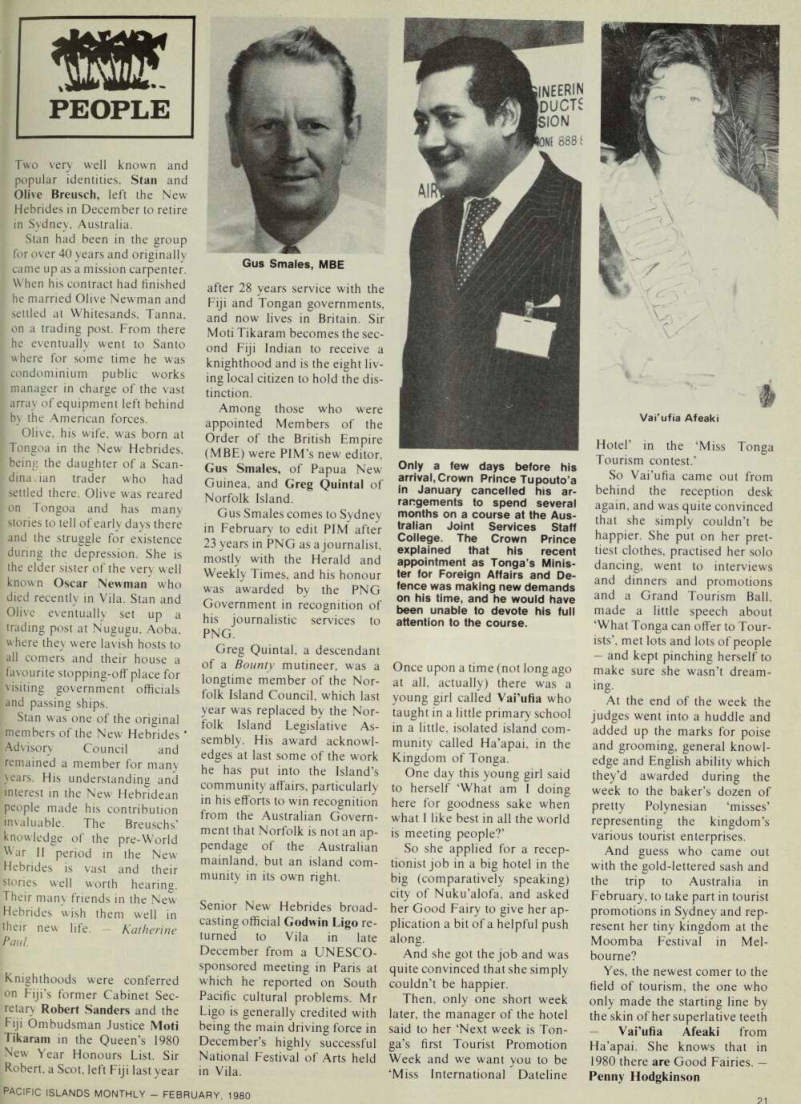
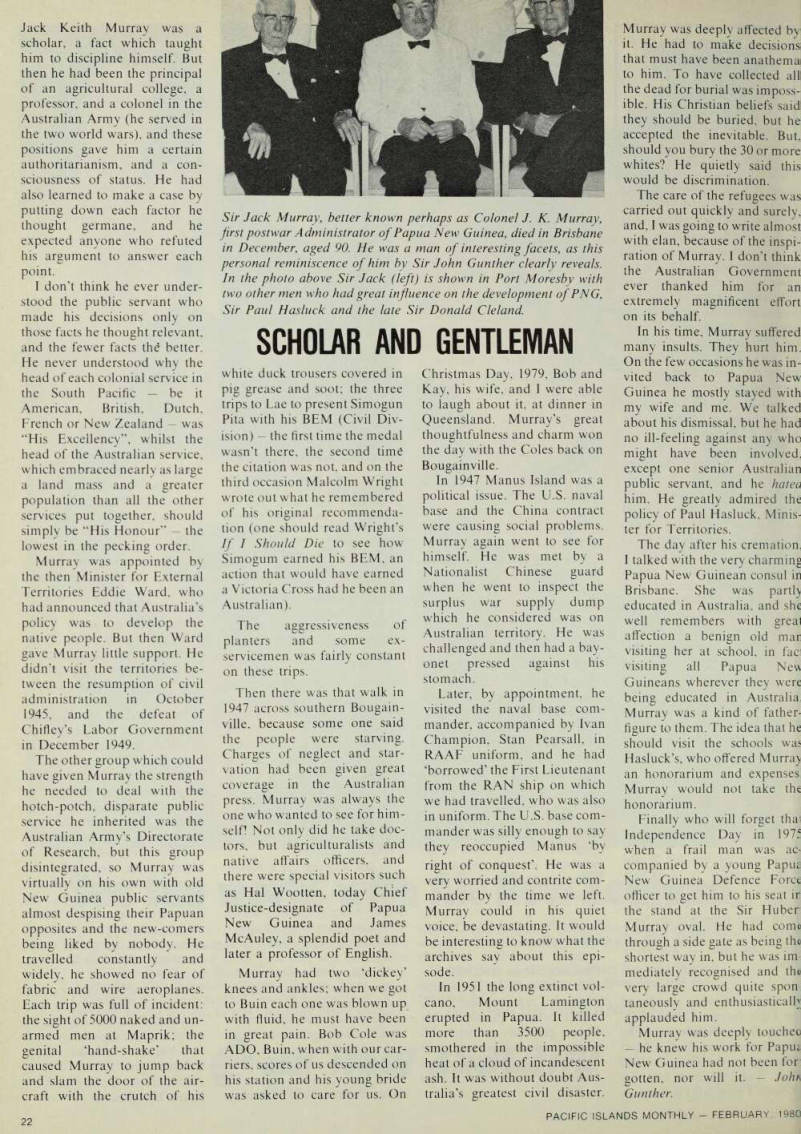
Two very well known and popular identities. Stan and Olive Breusch, left the New Hebrides in December to retire in Sydney. Australia.
Stan had been in the group for over 40 years and originally came up as a mission carpenter.
When his contract had finished he married Olive Newman and settled at Whitesands. Tanna. on a trading post. From there he eventually went to Santo where for some time he was condominium public works manager in charge of the vast array of equipment left behind by the American forces.
Olive, his wife, was born at Tongoa in the New Hebrides, being the daughter of a Scan dinavian trader who had settled there. Olive was reared on Tongoa and has many stories to tell of early days there and the struggle for existence during the depression. She is the elder sister of the very well known Oscar Newman who died recently in Vila. Stan and Olive eventually set up a trading post at Nugugu. Aoba. where they were lavish hosts to all comers and their house a favourite stopping-off place for visiting government officials
and passing ships.
Stan was one of the original members of the New Hebrides * Advisory Council and remained a member for many years. His understanding and interest in the New Hebridean people made his contribution invaluable. The Breuschs’ knowledge of the pre-World War II period in the New Hebrides is vast and their stories well worth hearing.
Their many friends in the New' Hebrides wish them well in their new' life. Katherine Paul.
Knighthoods were conferred on Fiji’s former Cabinet Sec retary Robert Sanders and the Fiji Ombudsman Justice Moti Tikaram in the Queen’s 1980 New Year Honours List. Sir Robert, a Scot, left Fiji last year
after 28 years service with the
Fiji and Tongan governments,
and now lives in Britain. Sir Moti Tikaram becomes the sec ond Fiji Indian to receive a knighthood and is the eight liv ing local citizen to hold the dis tinction.
Among those who were appointed Members of the Order of the British Empire (MBE) were PlM’s new editor, Gus Smales, of Papua New Guinea, and Greg Quintal of Norfolk Island.
Gus Smales comes to Sydney in February to edit PIM after 23 years in PNG as a journalist, mostly with the Herald and Weekly Times, and his honour was awarded by the PNG Government in recognition of his journalistic services to
Png.
Greg Quintal, a descendant of a Bounty mutineer, was a longtime member of the Nor folk Island Council, which last year was replaced by the Nor folk Island Legislative As sembly. His award acknowl edges at last some of the work he has put into the Island’s
community affairs, particularly
in his efforts to win recognition from the Australian Govern ment that Norfolk is not an ap pendage of the Australian mainland, but an island com munity in its own right.
Senior New Hebrides broad casting official Godwin Ligo re turned to Vila in late December from a UNESCO sponsored meeting in Paris at which he reported on South Pacific cultural problems. Mr Ligo is generally credited with being the main driving force in December’s highly successful National Festival of Arts held in Vila.
Once upon a time (not long ago at all, actually) there was a young girl called Vai’ufia who taught in a little primary school in a little, isolated island com munity called Ha’apai, in the
Kingdom of Tonga.
One day this young girl said to herself ‘What am I doing here for goodness sake when what I like best in all the world
is meeting people?’
So she applied for a recep tionist job in a big hotel in the
big (comparatively speaking)
city of Nuku’alofa, and asked her Good Fairy to give her ap plication a bit of a helpful push
along.
And she got the job and was quite convinced that she simply couldn’t be happier.
Then, only one short week later, the manager of the hotel said to her ‘Next week is Ton ga’s first Tourist Promotion Week and we want you to be ‘Miss International Dateline
Hotel’ in the ‘Miss Tonga Tourism contest.’
So Vai’ufia came out from behind the reception desk again, and was quite convinced that she simply couldn’t be happier. She put on her pret tiest clothes, practised her solo dancing, went to interviews and dinners and promotions and a Grand Tourism Ball, made a little speech about ‘What Tonga can offer to Tour ists’, met lots and lots of people and kept pinching herself to make sure she wasn’t dream
ing.
At the end of the week the judges went into a huddle and added up the marks for poise and grooming, general knowl
edge and English ability which
they’d awarded during the
week to the baker’s dozen of pretty Polynesian ‘misses’
representing the kingdom’s
various tourist enterprises.
And guess who came out with the gold-lettered sash and the trip to Australia in February, to take part in tourist promotions in Sydney and rep resent her tiny kingdom at the Moomba Festival in Mel bourne?
Yes, the newest comer to the field of tourism, the one who
only made the starting line by
the skin of her superlative teeth Vai’ufia Afeaki from Ha’apai. She knows that in 1980 there are Good Fairies.
Penny Hodgkinson
Gus Smales, MBE
Only a few days before his arrival,Crown Prince Tupouto’a In January cancelled his ar rangements to spend several months on a course at the Aus tralian Joint Services Staff College. The Crown Prince explained that his recent appointment as Tonga’s Minis ter for Foreign Affairs and De fence was making new demands on his time, and he would have been unable to devote his full attention to the course.
Vai'ufia Afeaki
Jack Keith Murray was a scholar, a fact which taught him to discipline himself. But then he had been the principal of an agricultural college, a professor, and a colonel in the Australian Army (he served in the two world wars), and these positions gave him a certain authoritarianism, and a con sciousness of status. He had also learned to make a case by putting down each factor he thought germane, and he expected anyone who refuted his argument to answer each
point.
I don’t think he ever under stood the public servant who made his decisions only on those facts he thought relevant, and the fewer facts the better.
He never understood why the head of each colonial service in the South Pacific be it American, British, Dutch, French or New Zealand was “His Excellency”, whilst the head of the Australian service, which embraced nearly as large a land mass and a greater population than all the other services put together, should simply be “His Honour” the lowest in the pecking order.
Murray was appointed by
the then Minister for External Territories Eddie Ward, who had announced that Australia’s policy was to develop the native people. But then Ward gave Murray little support. He didn’t visit the territories be tween the resumption of civil administration in October 1945, and the defeat of Chifley’s Labor Government in December 1949.
The other group which could have given Murray the strength he needed to deal with the
hotch-potch, disparate public
service he inherited was the Australian Army’s Directorate of Research, but this group
disintegrated, so Murray was
virtually on his own with old New Guinea public servants almost despising their Papuan opposites and the new-comers
being liked by nobody. He
travelled constantly and widely, he showed no fear of fabric and wire aeroplanes.
Each trip was full of incident: the sight of 5000 naked and un armed men at Maprik; the genital ‘hand-shake’ that caused Murray to jump back and slam the door of the air craft with the crutch of his
Scholar And Gentleman
white duck trousers covered in pig grease and soot; the three trips to Lae to present Simogun Pita with his BEM (Civil Div ision) the first time the medal wasn’t there, the second time the citation was not, and on the third occasion Malcolm Wright wrote out what he remembered of his original recommenda tion (one should read Wright’s If I Should Die to see how Simogum earned his BEM. an action that would have earned a Victoria Cross had he been an Australian).
The aggressiveness of planters and some ex servicemen was fairly constant on these trips.
Then there was that walk in 1947 across southern Bougain ville, because some one said
the people were starving.
Charges of neglect and star vation had been given great coverage in the Australian press. Murray was always the one who wanted to see for him self! Not only did he take doc tors, but agriculturalists and native affairs officers, and there were special visitors such as Hal Wootten, today Chief Justice-designate of Papua New Guinea and James McAuley, a splendid poet and later a professor of English.
Murray had two ‘dickey’ knees and ankles; when we got to Buin each one was blown up with fluid, he must have been in great pain. Bob Cole was ADO, Buin, when with our car riers, scores of us descended on his station and his young bride was asked to care for us. On
Christmas Day, 1979, Bob and Kay, his wife, and I were able to laugh about it, at dinner in Queensland. Murray’s great thoughtfulness and charm won the day with the Coles back on
Bougainville.
In 1947 Manus Island was a political issue. The U.S. naval base and the China contract
were causing social problems.
Murray again went to see for himself. He was met by a Nationalist Chinese guard when he went to inspect the
surplus war supply dump
which he considered was on Australian territory. He was challenged and then had a bay
onet pressed against his
stomach.
Later, by appointment, he
visited the naval base com
mander, accompanied by Ivan
Champion, Stan Pearsall, in RAAF uniform, and he had ‘borrowed’ the First Lieutenant from the RAN ship on which we had travelled, who was also in uniform. The U.S. base com mander was silly enough to say
they reoccupied Manus ‘by
right of conquest’. He was a very worried and contrite com mander by the time we left.
Murray could in his quiet voice, be devastating. It would be interesting to know what the archives say about this epi sode.
In 1951 the long extinct vol cano, Mount Lamington erupted in Papua. It killed more than 3500 people, smothered in the impossible heat of a cloud of incandescent ash. It was without doubt Aus tralia’s greatest civil disaster.
Murray was deeply affected by
it. He had to make decisions; that must have been anathemai to him. To have collected alii the dead for burial was imposs ible. His Christian beliefs said they should be buried, but he accepted the inevitable. But, should you bury the 30 or more whites? He quietly said this would be discrimination.
The care of the refugees was carried out quickly and surely, and, I was going to write almost with elan, because of the inspi ration of Murray. I don’t think the Australian Government ever thanked him for an
extremely magnificent effort
on its behalf.
In his time, Murray suffered many insults. They hurt him.
On the few occasions he was in vited back to Papua New Guinea he mostly stayed with my wife and me. We talked about his dismissal, but he had no ill-feeling against any who might have been involved, except one senior Australian public servant, and he hatea him. He greatly admired the policy of Paul Hasluck, Minis ter for Territories.
The day after his cremation.
I talked with the very charming Papua New Guinean consul in Brisbane. She was parti) educated in Australia, and she well remembers with great affection a benign old mar visiting her at school, in faci
visiting all Papua New
Guineans wherever they were being educated in Australia, Murray was a kind of father figure to them. The idea that he should visit the schools was Hasluck’s, who offered Murra) an honorarium and expenses, Murray would not take the honorarium.
Finally who will forget thai Independence Day in 197 f when a frail man was ac companied by a young Papua New Guinea Defence Force officer to get him to his seat in the stand at the Sir Huber Murray oval. He had come through a side gate as being the shortest way in, but he was im mediately recognised and the very large crowd quite spon taneously and enthusiastically
applauded him.
Murray was deeply toucheo he knew his work for Papua New Guinea had not been for gotten, nor will it. John Gunther.
Sir Jack Murray, better known perhaps as Colonel J. K. Murray, first postwar Administrator of Papua New Guinea, died in Brisbane in December, aged 90. He was a man of interesting facets, as this personal reminiscence of him by Sir John Gunther clearly reveals.
In the photo above Sir Jack (left) is shown in Port Moresby with two other men who had great influence on the development of PNG, Sir Paul Hasluck and the late Sir Donald Cleland.
Advertisements & other items, p. 23 (1 item)
Pl_&3Si
U-U&irjfc*
•■* .., «C
■ir% tS^^PSB
PL_&3SI
i % If % ' -'J*fcf » * *v A 1 , ■ m **. *** p % £-/T #4% £ t * *. • s9>3! 1 & '- « x PIOIVCEM Egg (Vlll11111111‘ 111
M PIOMEEH
StE«EO MAIN AMPUPita
pio/vGcn tsrg ( inn|iiMii>ft| fcjb*fe»« -aailfc. j&L*, r» „ ■->• - - -
P Jf CJHI
t* t .1 ) n GM-40
KP-77G
KP-707G
Super hi-fi for the super highway.
Supersystem is a super idea from Pioneer.
The great sounds you enjoy while sitting at home can now be a truly moving experience.
The cassette decks feature auto-reverse,
Dolby* separate bass/treble plus loudness
contour controls and a new playback head that can handle any tape available, including the new “metal tapes.” And the separate power amp delivers a solid 20 watts per channel. More than some home stereo amps. Of course, the speakers
are Pioneer designed for super performance.
Three individual speakers ingeniously mounted
in a single flush mount unit give you maximum sound in a minimum size.
So, if you’re travelin’ with Pioneer Supersystem Component Car Stereo, just slip into musical high gear and let the miles melt away while you boogie on down the disco highway. * Dolby is a registered trademark of Dolby Labs.
KP-707G Cassette Deck Power source DC 13.8 V (11 ~I6V allowable) Wow & flutter No more than 0.13% (WRMS) Frequency response 30~15,000Hz (±3dß) Signal-to-noise ratio More than 60dB (Dolby on w/chrome tape) KP-77G Cassette Deck Power source DC 13.8 V (11 ~I6V allowable) Wow & flutter No more than 0.13% (WRMS) Frequency response 30~15,000Hz (±3dß) Signal-to-noise ratio More than 52d8 GM-40 Power Amplifier Power output (max.) 20 watts per channel Total harmonic distortion. . .0.06% (at 1.5 W) Signal-to-noise ratio More than 80dB TS-168 Speakers Speaker Permanent dynamic type 3-way; 158 mm (6>£in.) cone woofer, 57mm (2Kin.)cone midrange, & 30mm (IXiein.) horn tweeter Input power (max.) 40 watts Frequency range 35~20,000Hz
CD PIONEER
For further information, please contact: . . -w. ■••uiivii, M. r ST 9 SerViCe LM ' P ° 31? ' M ° rdialte ’
Ne» Zea^ ri Mll CO S Pa r y ' GP P Box No 362 ’ Swa - F '» Wands Tel: 22258 NortdlfS' B “ ™' CS II , L 5 V®™" Street, Auckland. New Zealand Tel: New Hebrides- Rnmt Ph P laland) Ltd ’ Norfolk Island, South Pacific Nauru Island P (eW Hebrides > Ltd , Vila, New Hebrides "auru Island. Jacob Enterprises, P.O. Box No. 4, Republic of Nauru Tahiti: Ets. PERFECT, B.P. 594, Papeete, Tahiti Tel: 20 407 New Caledonia: Menard Freres Ville, B.P. H 2 Cedex, Noumea, New Caledonia Tel: 27.52.22 American Samoa: Transpac Corporation, P.O. Box 1477, Pago Pago, American Samoa 96799 Tel: 633-5224 Rarotonga: South Seas International Ltd., P.O, Box 49, Rarotonga Cook Islands Tel: 2327
Currents
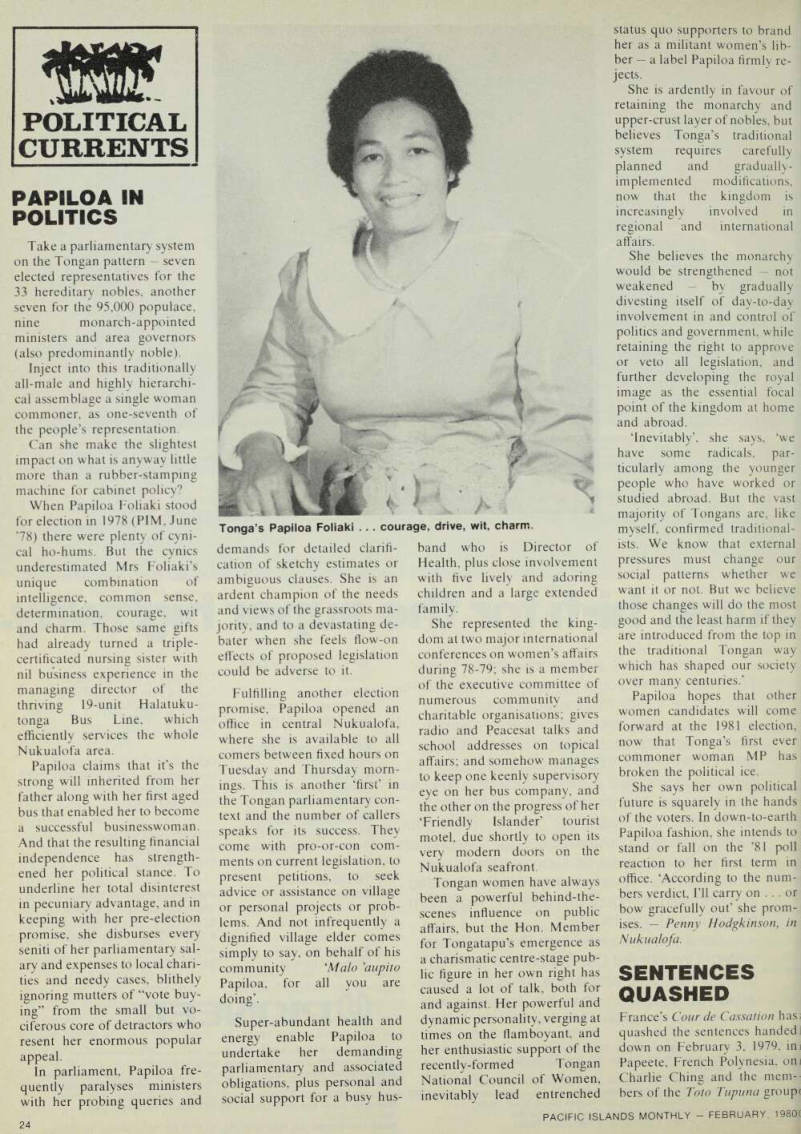
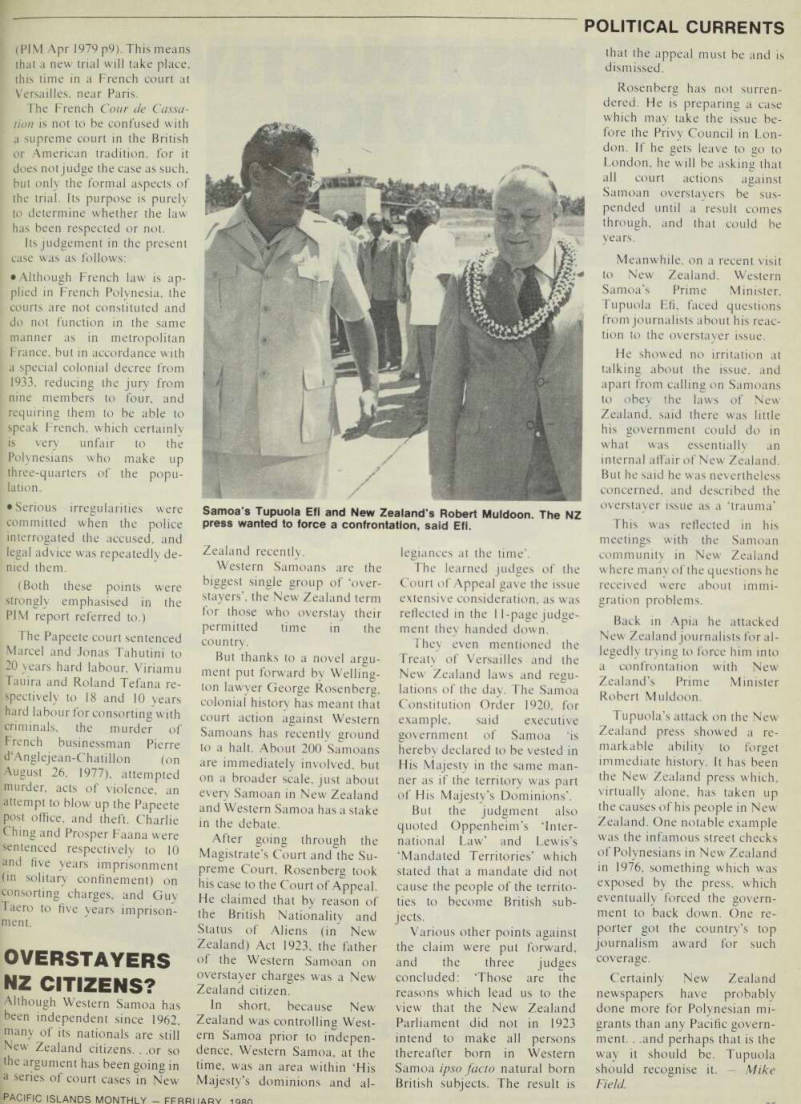

Political
Papiloa In
Politics
Take a parliamentary system on the Tongan pattern - seven elected representatives for the 33 hereditary nobles, another seven for the 95,000 populace,
nine monarch-appointed
ministers and area governors (also predominantly noble).
Inject into this traditionally
all-male and highly hierarchi cal assemblage a single woman commoner, as one-seventh of
the people’s representation.
Can she make the slightest impact on what is anyway little more than a rubber-stamping machine for cabinet policy?
When Papiloa Foliaki stood for election in 1978 (PIM, June ’7B) there were plenty of cyni cal ho-hums. But the cynics underestimated Mrs Foliaki’s unique combination of intelligence, common sense, determination, courage, wit and charm. Those same gifts had already turned a triple certificated nursing sister with nil business experience in the managing director of the thriving 19-unit Halatuku tonga Bus Line, which efficiently services the whole Nukualofa area.
Papiloa claims that it’s the strong will inherited from her father along with her first aged bus that enabled her to become a successful businesswoman.
And that the resulting financial
independence has strength
ened her political stance. To underline her total disinterest in pecuniary advantage, and in
keeping with her pre-election
promise, she disburses every seniti of her parliamentary sal ary and expenses to local chari ties and needy cases, blithely ignoring mutters of “vote buy ing” from the small but vo ciferous core of detractors who resent her enormous popular
appeal.
In parliament, Papiloa fre
quently paralyses ministers
with her probing queries and
demands for detailed clarifi cation of sketchy estimates or ambiguous clauses. She is an ardent champion of the needs and views of the grassroots ma jority, and to a devastating de bater when she feels flow-on
effects of proposed legislation
could be adverse to it.
Fulfilling another election
promise, Papiloa opened an
office in central Nukualofa, where she is available to all comers between fixed hours on
Tuesday and Thursday morn
ings. This is another ‘first’ in
the Tongan parliamentary con
text and the number of callers speaks for its success. They come with pro-or-con com ments on current legislation, to present petitions, to seek advice or assistance on village
or personal projects or prob
lems. And not infrequently a
dignified village elder comes
simply to say, on behalf of his community ‘Malo ’aupito Papiloa, for all you are
doing’.
Super-abundant health and energy enable Papiloa to undertake her demanding parliamentary and associated
obligations, plus personal and
social support for a busy hus
band who is Director of Health, plus close involvement with five lively and adoring children and a large extended
family.
She represented the king
dom at two major international conferences on women’s affairs during 78-79; she is a member of the executive committee of numerous community and
charitable organisations; gives
radio and Peacesat talks and school addresses on topical affairs; and somehow manages
to keep one keenly supervisory
eye on her bus company, and the other on the progress of her ‘Friendly Islander’ tourist motel, due shortly to open its very modern doors on the Nukualofa seafront.
Tongan women have always been a powerful behind-the scenes influence on public affairs, but the Hon. Member for Tongatapu’s emergence as a charismatic centre-stage pub lic figure in her own right has caused a lot of talk, both for and against. Her powerful and
dynamic personality, verging at
times on the flamboyant, and her enthusiastic support of the
recently-formed Tongan
National Council of Women, inevitably lead entrenched
status quo supporters to brand her as a militant women’s lib ber a label Papiloa firmly re
jects.
She is ardently in favour of
retaining the monarchy and
upper-crust layer of nobles, but believes Tonga’s traditional
system requires carefully
planned and gradually
implemented modifications,
now that the kingdom is increasingly involved in regional and international affairs.
She believes the monarchy would be strengthened not
weakened by gradually
divesting itself of day-to-day
involvement in and control of politics and government, while retaining the right to approve or veto all legislation, and
further developing the royal
image as the essential focal point of the kingdom at home and abroad. ‘lnevitably’, she says, ‘we have some radicals, par ticularly among the younger people who have worked or studied abroad. But the vast majority of Tongans are, like myself, confirmed traditional ists. We know that external pressures must change our social patterns whether we want it or not. But we believe those changes will do the most good and the least harm if they are introduced from the top in the traditional Tongan way which has shaped our society over many centuries.’
Papiloa hopes that other women candidates will come forward at the 1981 election, now that Tonga’s first ever commoner woman MP has broken the political ice.
She says her own political future is squarely in the hands of the voters. In down-to-earth Papiloa fashion, she intends to stand or fall on the ’Bl poll reaction to her first term in office. ‘According to the num bers verdict, I’ll carry on ... or bow gracefully out’ she prom ises. Penny Hodgkinson, in
Nukualofa.
Sentences
Quashed
France’s Courde Cassation has; quashed the sentences handed! down on February 3. 1979, ini Papeete, French Polynesia, oni Charlie Ching and the mem bers of the Toto Tupuna group*
Tonga’s Papiloa Foliaki . . . courage, drive, wit, charm
(PIM Apr 1979 p 9). This means f that a new trial will take place, this time in a French court at I Versailles, near Paris.
The French Cour de Cassa \ tion is not to be confused with a supreme court in the British [ or American tradition, for it does not judge the case as such, but only the formal aspects of the trial. Its purpose is purely ; to determine whether the law has been respected or not.
Its judgement in the present 1 case was as follows: • Although French law is ap plied in French Polynesia, the courts are not constituted and do not function in the same manner as in metropolitan France, but in accordance with a special colonial decree from 1933, reducing the jury from nine members to four, and ’ requiring them to be able to
; speak French, which certainly
is very unfair to the ! Polynesians who make up three-quarters of the popu lation. • Serious irregularities were committed when the police interrogated the accused, and legal advice was repeatedly de nied them. (Both these points were
strongly emphasised in the
PIM report referred to.) The Papeete court sentenced Marcel and Jonas Tahutini to 20 years hard labour, Viriamu iTauira and Roland Tefana re spectively to 18 and 10 years hard labour for consorting with criminals, the murder of French businessman Pierre
d‘Anglejean-Chatillon (on
August 26, 1977), attempted murder, acts of violence, an attempt to blow up the Papeete post office, and theft. Charlie Ching and Prosper Faana were sentenced respectively to 10 and five years imprisonment (in solitary confinement) on
consorting charges, and Guy
Taero to five years imprison ment.
Overstayers
Nz Citizens?
Although Western Samoa has been independent since 1962, many of its nationals are still New Zealand citizens.. .or so the argument has been going in a series of court cases in New
Zealand recently.
Western Samoans are the biggest single group of ‘over stayers’, the New Zealand term for those who overstay their permitted time in the country.
But thanks to a novel argu ment put forward by Welling
ton lawyer George Rosenberg,
colonial history has meant that court action against Western Samoans has recently ground to a halt. About 200 Samoans are immediately involved, but on a broader scale, just about every Samoan in New Zealand and Western Samoa has a stake in the debate.
After going through the Magistrate’s Court and the Su preme Court, Rosenberg took his case to the Court of Appeal.
He claimed that by reason of the British Nationality and Status of Aliens (in New Zealand) Act 1923, the father of the Western Samoan on overstayer charges was a New Zealand citizen.
In short, because New Zealand was controlling West ern Samoa prior to indepen dence, Western Samoa, at the time, was an area within 'His Majesty’s dominions and al
legiances at the time’.
The learned judges of the Court of Appeal gave the issue extensive consideration, as was
reflected in the I l-page judge
ment they handed down.
They even mentioned the Treaty of Versailles and the New Zealand laws and regu lations of the day. The Samoa Constitution Order 1920. for example. said executive government of Samoa 'is hereby declared to be vested in His Majesty in the same man ner as if the territory was part of His Majesty’s Dominions’.
But the judgment also
quoted Oppenheim’s ‘lnter
national Law’ and Lewis’s ‘Mandated Territories’ which stated that a mandate did not cause the people of the territo ties to become British sub
jects.
Various other points against
the claim were put forward, and the three judges concluded; ‘Those are the reasons which lead us to the view that the New Zealand Parliament did not in 1923 intend to make all persons thereafter born in Western Samoa ipso facto natural born British subjects. The result is
that the appeal must be and is dismissed.
Rosenberg has not surren dered. He is preparing a case which may take the issue be fore the Privy Council in Lon don. If he gets leave to go to London, he will be asking that all court actions against Samoan overstayers be sus pended until a result comes through, and that could be years.
Meanwhile, on a recent visit to New Zealand. Western Samoa’s Prime Minister, Tupuola Efi. faced questions from journalists about his reac tion to the overstayer issue.
He showed no irritation at talking about the issue, and apart from calling on Samoans to obey the laws of New Zealand, said there was little his government could do in what was essentially an internal affair of New Zealand.
But he said he was nevertheless concerned, and described the overstayer issue as a ‘trauma’
This was reflected in his meetings with the Samoan community in New Zealand where many of the questions he received were about immi
gration problems.
Back in Apia he attacked New Zealand journalists for al legedly trying to force him into a confrontation with New Zealand’s Prime Minister Robert Muldoon.
Tupuola’s attack on the New Zealand press showed a re
markable ability to forget
immediate history. It has been the New Zealand press which, virtually alone, has taken up the causes of his people in New Zealand. One notable example was the infamous street checks of Polynesians in New Zealand in 1976, something which was exposed by the press, which eventually forced the govern ment to back down. One re porter got the country’s top journalism award for such coverage.
Certainly New Zealand newspapers have probably done more for Polynesian mi grants than any Pacific govern ment. . .and perhaps that is the way it should be. Tupuola should recognise it. Mike Field.
Samoa’s Tupuola Efl and New Zealand’s Robert Muldoon. The NZ press wanted to force a confrontation, said Efl.
Whither The
Provinces?
During the final years of Aus tralian rule in PNG, regional demands for greater control over local affairs developed
rapidly.
Doubtless these growing pains were to be expected in a land of many distinct cultures - most of them mutually an tagonistic in a time of dra
matic political change.
Many observers thought that
these demands for authority should have been satisfied
through the existing local
government council system but, sadly, insufficient empha sis had been given to the development of local govern ment since its introduction after the Pacific war and now. when the need was greatest, local government did not hold the answer.
In 1972 just one year from self-government Area Auth orities were introduced in half a-dozen PNG districts, in tended to satisfy the clamour for local autonomy. They were introduced in haste, with inad equate powers and responsi bilities, and hardly had time to prove themselves. For the PNG Constitution was soon to provide for the establishment of provincial governments in the districts called ‘prov inces’ after independence with very real, but inadequa tely defined, powers.
By thus delegating to the provinces much of the re sponsibility for their own ad ministration. central govern
ment hoped to satisfy the aspir
ations of provincial politicians and power groups and yet hold the infant nation of PNG together.
It surprised nobody who had followed the modern history of PNG that the first provincial government was established on the troubled island of Bougain ville, in 1976. In February, 1977, the Simbu Interim Provincial Government was created in the Chimbu Prov ince.
The birth and early develop ment of the Simbu P.G. was watched and studied by a sym pathetic academic observer with long experience of PNG.
Bill Standish. Under the aus pices of the Institute of Applied Social and Economic Research (PO Box 5854 Boroko PNG), Standish has now published a monograph entitled Provincial Government in PNG: Early Lessons from Chimbu which contains invaluable lessons for the PNG Government, but which makes gloomy reading.
Admittedly, the Chimbu example is not typical of PNG (Standish notes that the Chimbu people as a whole are looked upon as ‘wild men’ in Port Moresby bureaucratic and political circles) but it is becoming apparent that what happened in Chimbu is tend ing to occur in other provincial governments.
This is what happened in Chimbu over the period of the Standish study (1977-78)!
Provincial politicans were preoccupied with status and the trappings of office, and showed almost no concern with
policy. They voted themselves
large salaries and allowances (when compared with the income of the average villager) and wasted money on un necessary motor vehicles, often used only for purposes of dis
play.
What decisions they made were frequently made hur riedly and illogically, often in the face of contrary advice from qualified advisers.
Many provincial politicians
were reluctant to face the pub lic and spent most of their time in town, away from their home base. Some ceased to attend the meetings of the local govern ment councils who originally put them into office. The Premier frequently arrived late for public occasions, and left
early.
There was a continual struggle for supremacy within the province. Public servants in a position to help or hinder the
workings of provincial govern
ment were often abused and
humiliated by provincial poli
ticians, in public. Relations be tween provincial and national politicians in Chimbu were generally sour; there was little co-operation, and public ser vants were torn between their loyalties to the two tiers of
government. Their morale and
performance plummeted.
Some Simbu provincial minis ters were even hostile to their own Provincial Secretary, who carried the major workload.
Favouritism was rife.
Field services of all kinds to the mass of the village people
deteriorated alarmingly.
The financial affairs of the provincial government were handled sloppily, extrava gantly and in some cases im properly, with little regard for the strict accountability of pub lic funds.
Acute local problems such as the upsurge in tribal fighting remained unresolved.
Standish is forced, obviously reluctantly, to the conclusion from his study of Simbu that frustration within the provin cial governments throughout PNG can only increase, given
the unrealistically high expec
tations which have been al lowed to rise. ‘Conflict with national bodies is likely to be perpetual
as provincial politicians pursue
their own interests, occasion ally in defiance of national aims and sometimes going against the best interests and welfare of the province and the mass of its people,’ Standish notes. He thinks conflict among the provinces them selves will probably continue, as each battles for an ever larger slice of the national cake.
The picture is not entirely unrelieved: Standish shows that there are some benefits to
be gained from provincial
government in the administrat ive sphere, but he believes the time is overdue for a major re view of provincial government and all of its implications. - James Sinclair
They Oppose
Waste Plan
Although the US Government has made it clear that it is a
long way from deciding
whether to use a Pacific island as a storage facility for spent nuclear fuel (PIM, Jan. p2l). its own Pacific territories are mak ing sure the government knows how they feel about the idea.
The matter came up for a hearing at a US Congressional subcommittee in Honolulu on December 27, when a number of US Island leaders had their say. At the hearing. Richard Scribner, a State Department special assistant, confirmed that preliminary evaluations had been made of Palmyra, Midway and Wake and no where else. The US had made no firm decisions, he said.
The lieutenant-governor of
Guam, Joseph Ada, opposing
any dumping plan, said the State Department had a his tory, specifically in Guam, ‘of becoming very nonchalant, of not caring about the Pacific and its peoples’.
Peter Coleman, governor of American Samoa, told the hearing that the United States would do irrevocable damage to its credibility if the nuclear spent fuel problem was not handled with sensitivity and
foresight.
Also speaking in opposition
was Carlos Camacho, governor of the Commonwealth of the Northern Mariana Islands, who declared the Pacific was
only being considered because
it seems far away to the vast majority of the American
population.
‘Fobbing off the risk on to distant people is immoral and barbaric, and is out of place in a government that prides itself on the observance of human rights’, Camacho said.
Hawaii Governor George Ariyoshi filed a statement with
the congressional hearing that
storing nuclear waste on Pal myra Island would be a great
security risk.
Leslie Fullard-Leo, one of three brothers who own Pal myra, testified that prospective lessees for sport fishing and industry had halted nego tiations for the island after the nuclear storage report became
public knowledge.
Several other witnesses also
spoke against the plan, includ
ing four scientists from the University of Hawaii.
Conducting the hearing were US congressmen Cecil Heftel and Daniel Akaka, both of Hawaii, Philip Burton of California and the Guam del egate to Congress Antonia B.
Won Pat. Lynn Thomas
Advertisements & other items, pp. 26-28 (1 item)
Constructive
ADVICE.
fS - V> Qfl. ' zr :: h pn Swamp Bulldozers as well as Swamp Dozer Shovels. m ;* Radio-Controlled Bulldozers and Dozer Shovels.
Electric Powered A wide range of Pipelayers.
Dozer Shovels.
Amphibious Bulldozers. a jt i cr; c *VS Wheel Loaders.
A wide selection of Off-Highway Slag Dump Trucks.
Dump Trucks.
And offer Motor Graders.
ana
* .» M iT *• . * Vibratory Rollers. Diesel Generator Sets. ■' *'»r Portable Air Compressors.
A wide selection of Diesel Engines.
Machine Tools. 4- 4 1 * Mechanical and Hydraulic Presses. A variety of Maypres Presses. OBS Power Presses. Tunnel-Boring Machines.
We're constructive in other ways. We offer castings, foundries, and important advice on construction and manufacturing projects.
•§• KOMATSU LTD.
Tokyo, Japan Komatsu overseas offices: Sydney, Singapore, Jakarta, Manila, Seoul, Bangkok, Bangalore, Teheran, Dubai, Jeddah, Riyadh, Ad Dammam, Baghdad, Ankara, Moscow, London, Brussels, Dusseldorf, Stuttgart, Warszawa, Paris, Madrid, Cairo, Alger, Abidjan, Lagos, Nairobi, Johannesburg, Toronto, San Francisco, Fort Le Arlington, Atlanta, Detroit, Mexico City, Habana, Panama, Sao Paulo, Caracas, Lima, Buenos Aires, and distributors in over 100 countries around the world.
Beehive Building 94 Elizabeth Street Melbourne, Victoria Australia 3000 G.P.O. Box 8 Melbourne, Victoria Australia 3001 es: Telex: AA34552 Phone: 63 5094
Islands
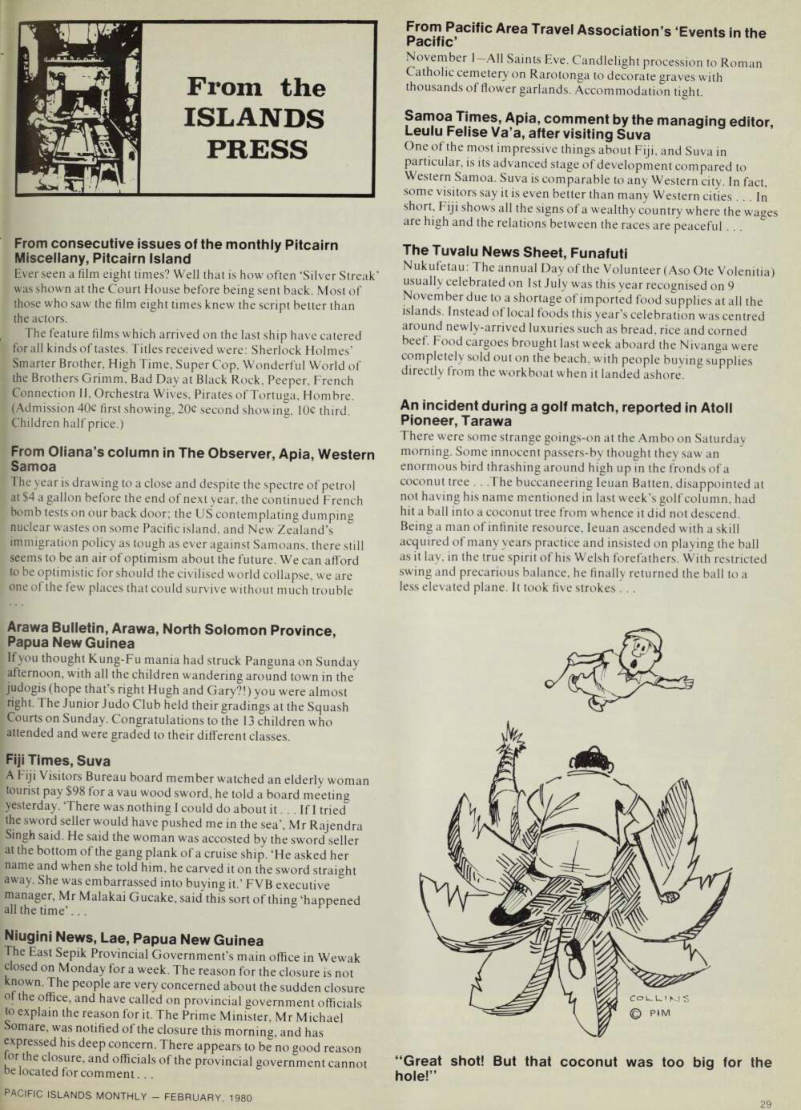

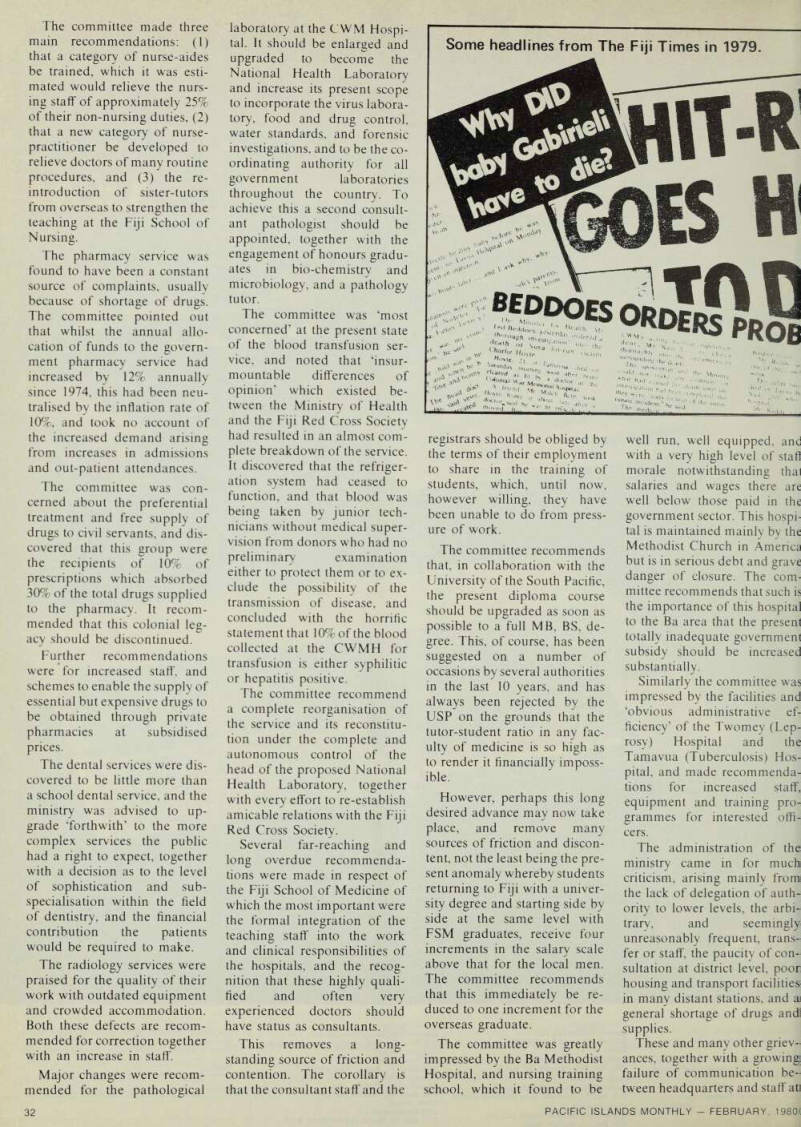
From the
Press
From consecutive issues of the monthly Pitcairn Miscellany, Pitcairn Island Ever seen a film eight times? Well that is how often ‘Silver Streak’ was shown at the Court House before being sent back. Most of those who saw the film eight times knew the script better than the actors.
The feature films which arrived on the last ship have catered for all kinds of tastes. Titles received were; Sherlock Holmes’
Smarter Brother, High Time, Super Cop, Wonderful World of the Brothers Grimm, Bad Day at Black Rock, Peeper. French Connection 11, Orchestra Wives, Pirates of Tortuga. Hombre. (Admission 40C first showing, 20C second showing, lOC third.
Children half price.) From Ollana’s column in The Observer, Apia, Western Samoa The year is drawing to a close and despite the spectre of petrol at $4 a gallon before the end of next year, the continued French bomb tests on our back door; the US contemplating dumping nuclear wastes on some Pacific island, and New Zealand’s immigration policy as tough as ever against Samoans, there still seems to be an air of optimism about the future. We can afford to be optimistic for should the civilised world collapse, we are one of the few places that could survive without much trouble
Arawa Bulletin, Arawa, North Solomon Province,
Papua New Guinea If you thought Kung-Fu mania had struck Panguna on Sunday afternoon, with all the children wandering around town in the judogis (hope that’s right Hugh and Gary?!) you were almost right. The Junior Judo Club held their gradings at the Squash Courts on Sunday. Congratulations to the 13 children who attended and were graded to their different classes.
Fiji Times, Suva
A Fiji Visitors Bureau board member watched an elderly woman tourist pay $9B for a vau wood sword, he told a board meeting yesterday. There was nothing I could do about it... If I tried the sword seller would have pushed me in the sea’, Mr Rajendra Singh said. He said the woman was accosted by the sword seller at the bottom of the gang plank of a cruise ship. ‘He asked her name and when she told him, he carved it on the sword straight away. She was embarrassed into buying it.’ FVB executive manager, Mr Malakai Gucake, said this sort of thine ‘happened all the time’... 5
Niugini News, Lae, Papua New Guinea
The East Sepik Provincial Government’s main office in Wewak closed on Monday for a week. The reason for the closure is not known. The people are very concerned about the sudden closure of the office, and have called on provincial government officials to explain the reason for it. The Prime Minister, Mr Michael Somare, was notified of the closure this morning, and has expressed his deep concern. There appears to be no good reason or the closure, and officials of the provincial government cannot be located for comment...
From Pacific Area Travel Association’s ‘Events in the Pacific’
November I—All Saints Eve. Candlelight procession to Roman Catholic cemetery on Rarotonga to decorate graves with thousands of flower garlands. Accommodation tight.
Samoa Times, Apia, comment by the managing editor, Leulu Felise Va’a, after visiting Suva One of the most impressive things about Fiji, and Suva in particular, is its advanced stage of development compared to Western Samoa. Suva is comparable to any Western city. In fact, some visitors say it is even better than many Western cities ... In short, Fiji shows all the signs of a wealthy country where the wages are high and the relations between the races are peaceful The Tuvalu News Sheet, Funafuti Nukufetau: The annual Day of the Volunteer (Aso Ote Volenitia) usually celebrated on Ist July was this year recognised on 9 November due to a shortage of imported food supplies at all the islands. Instead of local foods this year’s celebration was centred around newly-arrived luxuries such as bread, rice and corned beef. Food cargoes brought last week aboard the Nivanga were completely sold out on the beach, with people buying supplies directly from the workboat when it landed ashore.
An incident during a golf match, reported in Atoll Pioneer, Tarawa There were some strange goings-on at the Ambo on Saturday morning. Some innocent passers-by thought they saw an enormous bird thrashing around high up in the fronds of a coconut tree . . .The buccaneering leuan Batten, disappointed at not having his name mentioned in last week’s golf column, had hit a ball into a coconut tree from whence it did not descend.
Being a man of infinite resource, leuan ascended with a skill acquired of many years practice and insisted on playing the ball as it lay, in the true spirit of his Welsh forefathers. With restricted swing and precarious balance, he finally returned the ball to a less elevated plane. It took five strokes.. .
“Great shot! But that coconut was too big for the hole!”
Nineteen seventy-nine saw publication of the report of an independent committee of inquiry into Fiji’s health services.
The committee was set up following exposure of a number of hair-raising examples of the inadequacy of the work of the services. Dr LEONARD GOODMAN, who until 1973 was senior tutor in surgery at the Fiji School of Medicine, reviews what he calls ‘the most searching and comprehensive survey of a government department in Fiji’s history’.
During the 1978 mid-year sit ting of the House of Represen tatives in Suva, K. N. Rao, MP. called for an independent in quiry into the ‘apparent low morale of staff, and deterio ration of health services’, and cited as an example the case of a man who had been taken to the Colonial War Memorial Hospital following a road acci dent, examined by two trainee internes, and then sent home where he died almost immedi
ately from undiagnosed
internal bleeding, fractured pelvis, and shock. He also recalled another incident in which it was alleged that an attempt by a trainee interne to obtain a specimen from a patient had resulted in the needle penetrating the heart ‘and killing him’.
These statements, following as they did complaints from Councillor Ravindra Singh, deputy mayor of Nadi, and al
legations that negligence had
resulted in the death of a young Indian girl at Lautoka from a ruptured appendix, and from a priest at Vatakoula that ‘a per
fectly healthy baby’ had died
following two injections at
Tavua Hospital, left little doubt in the public mind that, as far as health services were concerned, ‘something was rot ten in the State of Denmark/
Fiji'.
The matter was also compli
cated'by staff resignations, of
which the most spoken of was that of Mr Dutt Sharma, senior surgeon at the CWMH, a resig nation associated with some
acrimony. Secretary of health
Dr Jona Senilagakali issued a statement that ‘people should not be concerned about sur gical treatment available in Fiji’, although he admitted that the number of doctors and nurses was inadequate to serve
Fiji’s expanding health ser
vices.
However, the public was very much concerned, and a debate followed in which Vijay Parmandam, MP, called upon the Minister for Health Ted
Beddoes to resign. Eventually
the government accepted an amendment which requested the government ‘to institute a thorough and independent in quiry into the health services with a view to removing such difficulties as may exist’, and upon this motion, a committee
Fiji health service under the microscope and found deficient
of inquiry into health services
in Fiji was appointed.
Under the chairmanship of Dr James Maraj, vice chancellor of the University of the South Pacific, the com mittee had four other mem bers: Dr Kwa Soon Bee, medical superintendent of the
Singapore General Hospital,
Dr S. B. Tabua, senator and
private medical practitioner,
Lautoka, F. M. K. Sherani, barrister and solicitor of Suva, and A. D. S. Anderson, retired
magistrate, Levuka.
The committee started work in September 1978 and had completed its task by June 1979. Its terms of reference were extremely wide, but the report it produced in such a short time is a monumental tribute to its industry. It would be safe to say that never in the history of Fiji has there been such a searching and comprehensive survey of any
government department.
This trenchant report hits hard, without fear or favour, at every aspect of departmental
activity, but supplements its
criticisms by providing in every instance a reasoned and suc cinct recommendation and there are 270 such!
Before setting about its task, the committee called for a comprehensive set of resource papers to obtain the necessary background. Having studied this large collection it ‘noted with surprise’ that there had been ‘no report on the ministry of health since 1974’, which proved indicative of what they were later to discover through
out the department. It also received many written and oral submissions from the pro fession, interested bodies, and
the general public.
The investigations of the committee found that, in gen eral, the failings of the depart ment fell into three main, and closely interrelated and inter
dependent, categories ad
ministration, staffing, and finance and that from these derived the serious deterio ration of service to the public and of staff morale at all levels.
The committee commented that whilst the present doctor population ratio of 1:2063 in
Fiji compared favourably with
other developing countries Indonesia 1:18,160, West Malaysia 1:7270, Thailand, 1:8530, Singapore. 1:1400 the distribution of medical manpower in Fiji is very un even: 53.7% of doctors are in the three main centres looking after 27.1% of the population, whilst 46.3% of the remaining doctors care for 72.9% of the
population spread throughout
the remainder of the country.
Since 1972 there had been a 24.5% increase in the workload as shown by hospital ad missions, and 14.1% increase in outpatient attendances in the
same period, notwithstanding
that there had been no increase in medical establishment. The resultant overwork was not only a major cause of poor morale, but gave rise to situ ations where senior staff were too busy to supervise and train their juniors who were thus left
in charge of positions where their inexperience led to mis
diagnosis, dangerous action,
and a serious fall in the stan dard of medical care.
The committee recom mended an immediate increase of a minimum of 40 senior doc tors, with special priority to the
registrar grade, and advised
specifically that juniors should
not be employed in casualty or
accident departments.
The introduction of the registrar grade is a recommen dation of great significance. In the usual concept, these are doctors with 10 or more years of experience who have attained or are in the process
of attaining post-graduate
qualifications in their chosen
specialties.
In Fiji hitherto, although
some have acted as such, this grade has not received official
recognition, mainly because
doctors of this seniority have been needed to staff district and sub-district hospitals, and also because facilities for post
graduate training either in Fiji
or overseas have been virtually non-existent.
In conventional practice, registrars are the backbone of
hospital organisation, being re
sponsible for the supervision
and training of the juniors, the routine clinical work, and assisting and sometimes relieving the consultant staff.
The establishment of this grade will not only vastly improve the standard of treatment, but also have an immense effect upon the morale of the doctors who will now see this as a definite stage in their advancement in the career structure within the service.
The committee viewed with concern the new category oil medical assistants now in train ing, and feared the ‘tendency to create “half-baked doctors” with all the attendant dangers’, and expressed the need to: evaluate the teaching and per formance of the first few* ‘graduates’ to determine how> they met the problems of! health care in rural areas.
Investigations into the nurs ing establishment revealed! staffing and other problems.
The nurse-bed ratio not only, fell at times to 1:10, but less than fully trained nurses some times found themselves in thafl situation.
The committee made three main recommendations: (I) that a category of nurse-aides be trained, which it was esti mated would relieve the nurs ing staff of approximately 25% of their non-nursing duties, (2) that a new category of nurse practitioner be developed to relieve doctors of many routine procedures, and (3) the re introduction of sister-tutors from overseas to strengthen the teaching at the Fiji School of
Nursing.
The pharmacy service was found to have been a constant
source of complaints, usually
because of shortage of drugs.
The committee pointed out that whilst the annual allo cation of funds to the govern ment pharmacy service had
increased by 12% annually
since 1974, this had been neu tralised by the inflation rate of 10%, and took no account of the increased demand arising from increases in admissions and out-patient attendances.
The committee was con cerned about the preferential treatment and free supply of drugs to civil servants, and dis covered that this group were the recipients of 10% of prescriptions which absorbed 30% of the total drugs supplied to the pharmacy. It recom mended that this colonial leg acy should be discontinued.
Further recommendations were for increased staff, and schemes to enable the supply of essential but expensive drugs to
be obtained through private
pharmacies at subsidised
prices.
The dental services were dis covered to be little more than a school dental service, and the ministry was advised to up grade ‘forthwith’ to the more
complex services the public
had a right to expect, together with a decision as to the level of sophistication and sub specialisation within the field of dentistry, and the financial contribution the patients would be required to make.
The radiology services were praised for the quality of their work with outdated equipment and crowded accommodation.
Both these defects are recom mended for correction together with an increase in staff.
Major changes were recom
mended for the pathological
laboratory at the CWM Hospi tal. It should be enlarged and upgraded to become the National Health Laboratory and increase its present scope to incorporate the virus labora tory, food and drug control, water standards, and forensic investigations, and to be the co
ordinating authority for all
government laboratories throughout the country. To achieve this a second consult ant pathologist should be appointed, together with the engagement of honours gradu ates in bio-chemistry and
microbiology, and a pathology
tutor.
The committee was ‘most concerned’ at the present state of the blood transfusion ser vice, and noted that ‘insur mountable differences of opinion’ which existed be tween the Ministry of Health and the Fiji Red Cross Society had resulted in an almost com plete breakdown of the service.
It discovered that the refriger ation system had ceased to function, and that blood was
being taken by junior tech
nicians without medical super vision from donors who had no
preliminary examination
either to protect them or to ex clude the possibility of the transmission of disease, and concluded with the horrific statement that 10% of the blood collected at the CWMH for transfusion is either syphilitic or hepatitis positive.
The committee recommend
a complete reorganisation of
the service and its reconstitu tion under the complete and autonomous control of the head of the proposed National
Health Laboratory, together
with every effort to re-establish amicable relations with the Fiji Red Cross Society.
Several far-reaching and long overdue recommenda tions were made in respect of the Fiji School of Medicine of which the most important were the formal integration of the teaching staff into the work and clinical responsibilities of the hospitals, and the recog nition that these highly quali fied and often very experienced doctors should have status as consultants.
This removes a long standing source of friction and contention. The corollary is that the consultant staff and the
registrars should be obliged by
the terms of their employment to share in the training of students, which, until now,
however willing, they have
been unable to do from press ure of work.
The committee recommends that, in collaboration with the University of the South Pacific, the present diploma course should be upgraded as soon as possible to a full MB, BS, de gree. This, of course, has been suggested on a number of occasions by several authorities in the last 10 years, and has
always been rejected by the
USP on the grounds that the tutor-student ratio in any fac ulty of medicine is so high as to render it financially imposs ible.
However, perhaps this long
desired advance may now take place, and remove many sources of friction and discon tent, not the least being the pre
sent anomaly whereby students
returning to Fiji with a univer
sity degree and starting side by
side at the same level with FSM graduates, receive four increments in the salary scale above that for the local men.
The committee recommends that this immediately be re duced to one increment for the
overseas graduate.
The committee was greatly impressed by the Ba Methodist
Hospital, and nursing training
school, which it found to be
well run, well equipped, and with a very high level of staff morale notwithstanding thal salaries and wages there are well below those paid in the government sector. This hospi tal is maintained mainly by the Methodist Church in America but is in serious debt and grave danger of closure. The com mittee recommends that such is the importance of this hospital to the Ba area that the present
totally inadequate government
subsidy should be increased
substantially.
Similarly the committee was impressed by the facilities and ‘obvious administrative ef ficiency’ of the Twomey (Lep rosy) Hospital and the Tamavua (Tuberculosis) Hos pital, and made recommenda tions for increased staff,,
equipment and training pro
grammes for interested offi cers.
The administration of the ministry came in for much criticism, arising mainly fromi the lack of delegation of auth ority to lower levels, the arbi trary, and seemingly
unreasonably frequent, trans
fer or staff, the paucity of con sultation at district level, poon housing and transport facilities in many distant stations, and ai
general shortage of drugs andl
supplies.
These and many other griev ances, together with a growing failure of communication be tween headquarters and staff atl
Some headlines from The Fiji Times in 1979.
jail levels, were, perhaps,
the most significant factors res • ponsible for the obvious lower ing of morale throughout the I service. The committee com [ mented that it found unani mous agreement throughout the country that the deterio ration of morale and efficiency in almost every phase of departmental activity had begun about four years before its investigation, and had since sunk to its present depths.
In fairness to the permanent [secretary and the headquarters istaff, it must be mentioned that since promotion for clinical of ficers beyond the maximum of their salary scale could be only % transfer to the administrat ive sector, the most senior pos itions have, for very many years, been filled by erstwhile clinicians, and whilst some have proved to have had high administrative ability, others have not. Furthermore, these sometimes reluctant adminis trators of recent years have had to administer the department at a time of unprecedented economic stringency, which also coincided with increasing demands from a growing population.
' The committee has recom mended that a superscale of re muneration equivalent to that for directors be instituted for the most senior consultants.
This should retain these very experienced and senior officers
in the active clinical field.
Nevertheless, the recruit ment of some administrative grades from the ranks of doc tors with long clinical experi ence does have its advantages, since these officers are well aware from experience at first hand of the problems of their colleagues in often remote situ ations, and can interpret their
administration accordingly.
The committee has provided a detailed plan for the reor ganised structure of the admin istration of the Health Department which involves a stratified establishment with a
plethora of directors, principal
assistant secretaries, and other administrators to the utmost limits of the service.
It seems to the writer that in the very perfection of this plan lie the seeds of future discon tent, for there is a very real danger of creating an elite hier archy of bureaucrats unfamiliar with clinical medi cine since they left medical school out of touch with, but
controlling from their ivory
tower on the third floor of Government Buildings, the lives and actions of practical doctors who, at grassroots level, are endeavouring to per form those tasks for which the whole departmental structure exists, namely the prevention of disease and the relief of
individual suffering.
The unhappy results of such dichotomy to the harmony of
the profession in England should be borne in mind, and the possible divisive effect on staff morale carefully evalu ated before excluding clinic ians from the administrative
grades.
The committee was aware that the adoption of the very numerous recommendations offered in its report will have grave financial implications, even if the recommended sub stantial increase in staff cannot immediately be recruited.
Except for the relatively minor adjustments such as in creases in out-patient fees and the enforcement of their collec tion, and the removal of the privilege of free treatment and drugs for civil servants it realised that increased cost must be met from general rev enue, and commented that it is for government to decide to what extent it is prepared to subsidise the health services.
It makes the pointed com parison that whilst the percent age of the country’s operating budget allocated to health fell from 9.8% in 1973 to 8.6% in 1977, that for education rose from 20.3% to 22.1% over the
same period.
Finally, the committee recommended that notwith standing the present serious economic situation, reduction in expenditure for health ser vices cannot be contemplated.
On the contrary, it advised as essential, an increase in this
sector, which, because of neglect has now reached a dangerously low level. It ap preciated that steps taken by government to implement this proposal will not be popular, and comments that ‘whilst we must not rob Peter to pay Paul, we feel that it is time that Paul had some consideration’. But the committee does not offer any suggestion as to where 40 experienced doctors are to be found at this time.
The publication of this re port has already had reper cussions. A substantial and vociferous group within the department has accepted it as a censure on the present
departmental administration,
and called for the dismissal of these officials. This has provoked an equally substan tial and vocal section to issue a letter declaring their con fidence in the present secretary of health and his staff.
These demonstrations, how ever, are but an outward mani festation of an occult division
throughout the department, of
which the committee could not have been unaware, but upon which it made no comment namely racial dissonance.
Until this latent suspicion can be overcome and replaced by the mutual tolerance of all races in a united effort for the common purpose, no develop ment plan for any community service in Fiji can truly suc ceed.
Advertisements & other items, pp. 31-34 (1 item)
Quality Video Entertainment
Aka Has The Features For
Akai video. Quality you can rely on. Features you can choose from.
VS-9800, with multi-speed remote-control playback.
VS-9700, with an 8-day built-in timer.
VP-7100, with a rechargeable battery for portability.
VC-60, with an easy-to use 6X zoom lens.
Akai video. Providing these quality features and more,
for every requirement.
j. 999
OFFICIAL SUPPLIER OF
VIDEO HOME SYSTEM
AKAI
AKAI ELECTRIC CO., LTD.
Tokyo, Japan VP-7100 VS-9800
wcai
VC-60 —jr mm C 7 cr O a C 7 9700 sr n tn n r»
AKAI
Approved by M.0.0.C
I.G. 3- Svensson (N.G.) Ltd. 3. Box 705, Port Moresby Tel: 2275 i Islands >tibhai & Company Ltd. 3. Box 9175, Nadi International Airport I: 72-165 iw Zealand e Ltd . Consumer Products Sector 3 Mt. Eden Rd., Mt. Eden, Auckland t 686-437 New Caledonia Menard Pacifique s.a.r.l.
B.P. H 2, Noumea Tel: 275222 Tahiti Etablissements Comimpex P.O. Box 200, Papeete Tel: 20477 New Hebrides (Islands) Burns Philp (New Hebrides) Co., Ltd.
P.O. Box 27, Port Vila, New Hebrides Islands Norfolk Island Burns Philp (Norfolk Island) Co., Ltd.
Samoa Islands Burns Philp (South Sea) Co.. Ltd.
P.O. Box 129, Pago Pago, American Samoa Mariana Islands J.C. Tenorio Enterprises P.O. Box 137, Saipan Tel: 6444/8 Solomon Islands Security Electrical Co., Ltd.
P.O. Box 174, Honiara Tel: 881 Cook Islands JPS Enterprises Ltd.
For more information, please send this coupon to our distributor in your country or to AKAI ELECTRIC CO., LTD. 12-14, 2-Chome, Higashi-Kojiya, Ohta-ku, Tokyo, Japan
#* I A i r i ' < £2 ' -w & X! fife v‘ & i 9* ii 1 I* <v* m m m s & H ri MS i I •V K It
some of our chiefs
In Papua New Guinea there are 717 different cultures, each represented by its own language and its own "chief”. Few men know this country better than our chief pilot. Captain John Regan.
He's logged more than 16,000 hours flying, much of that in Papua New Guinea.
John Regan is one of ninety highly skilled Australian, New Zealand, British, and American pilots flying our aircraft to seventeen places in Papua New Guinea and eight destinations overseas.
Aiumuemf
THE NA TKDNAL AIRLINE OF PAPUA NEW GUINEA
S.P.S. 001
known corner of Polynesia
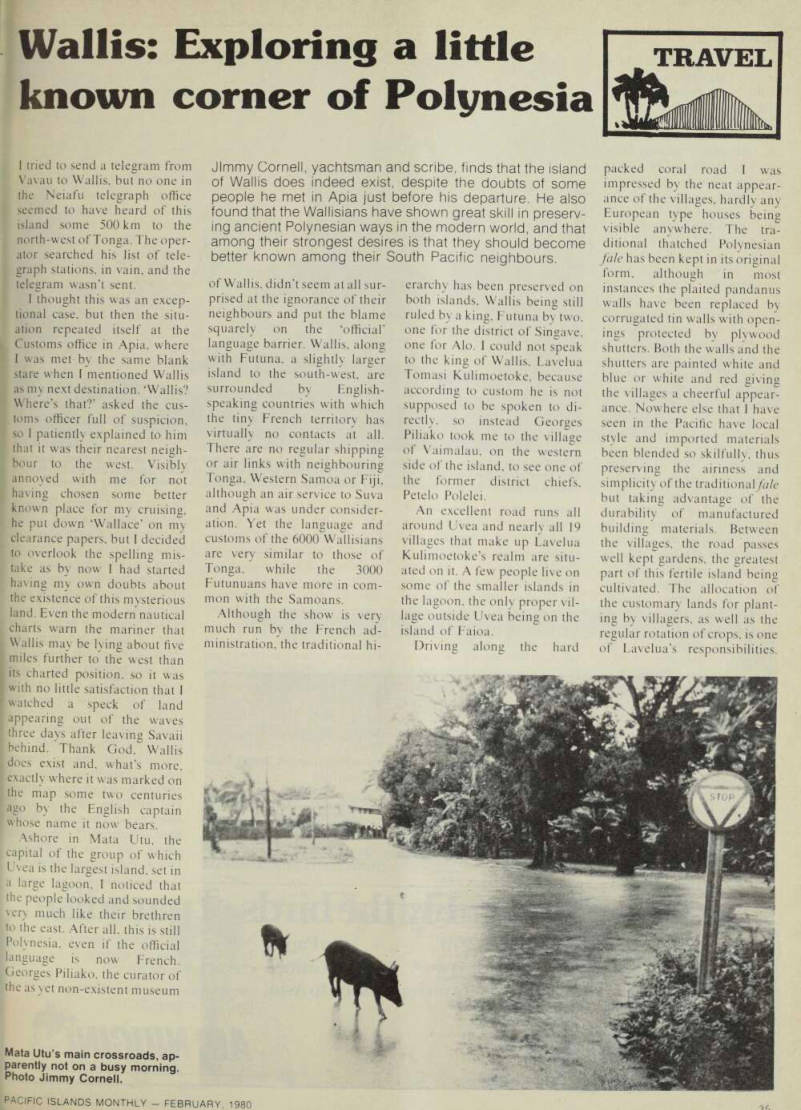
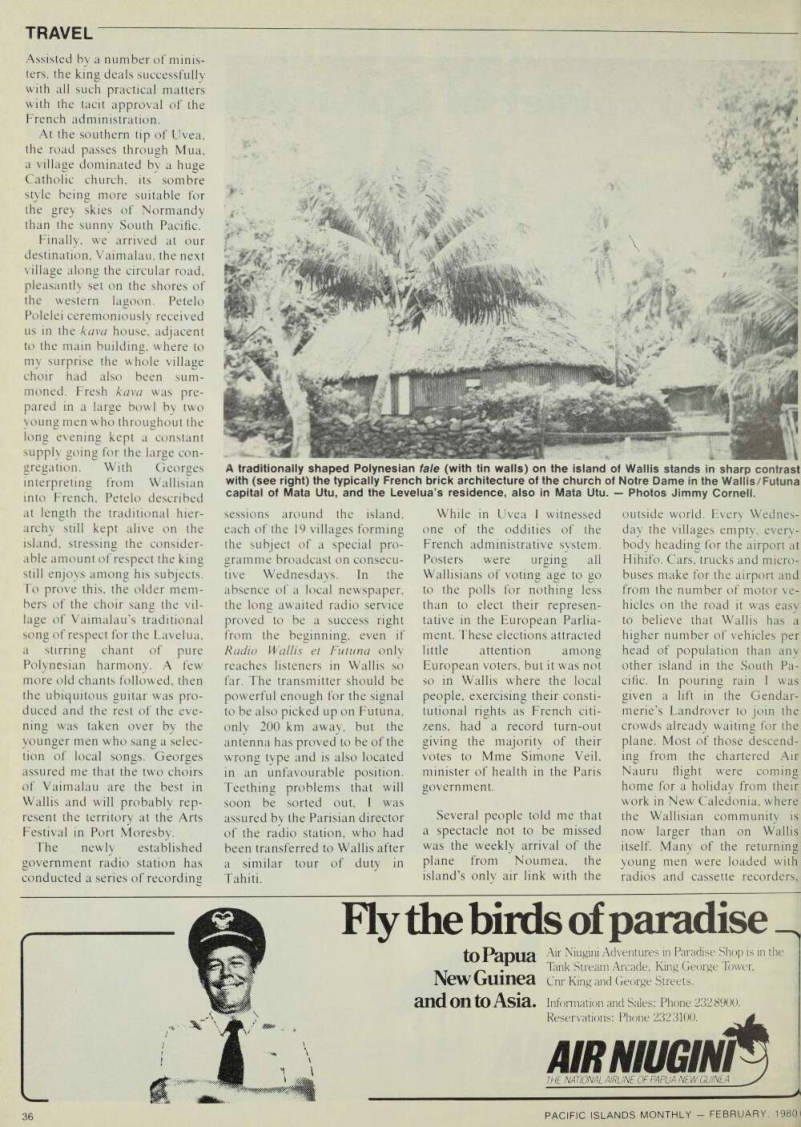
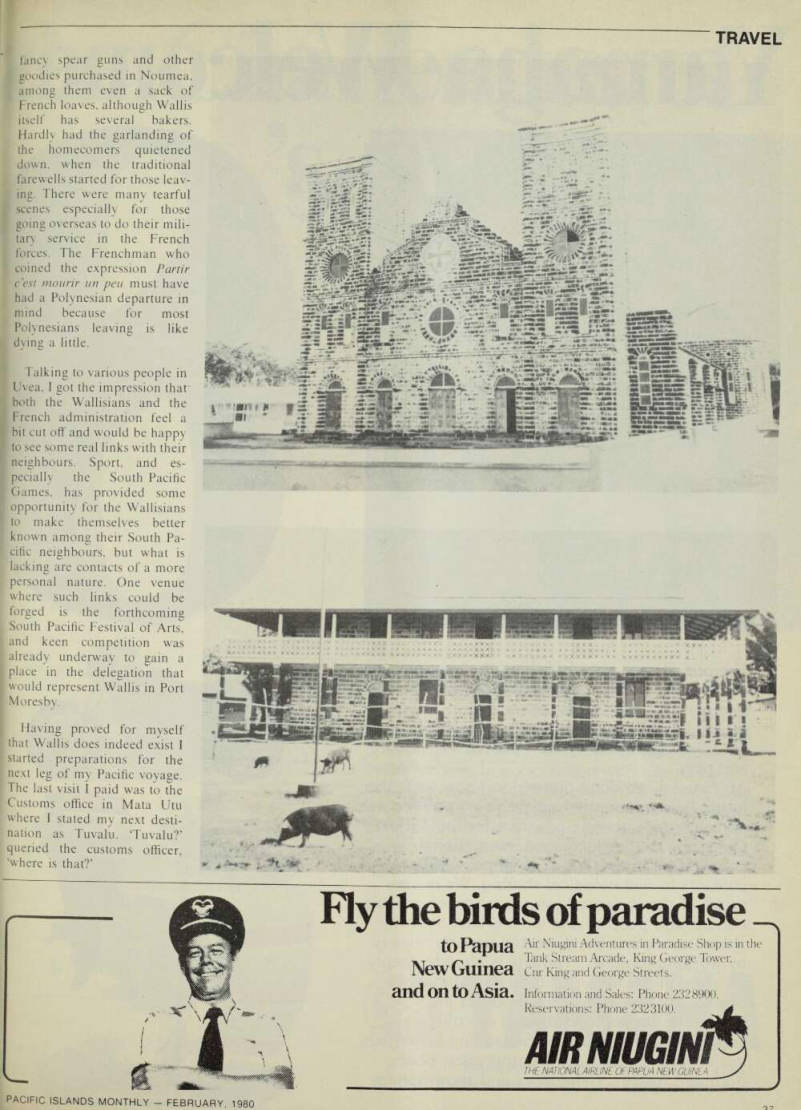
Travel
Wallis: Exploring a little known corner of Polynesia
I tried to send a telegram from I Vavau to Wallis, but no one in the Neiafu telegraph office I seemed to have heard of this I island some 500 km to the north-west of Tonga. The oper ator searched his list of tele graph stations, in vain, and the telegram wasn’t sent.
I thought this was an excep tional case, but then the situ ation repeated itself at the . Customs office in Apia, where I was met by the same blank stare when I mentioned Wallis as my next destination. ‘Wallis?
Where’s that?’ asked the cus , toms officer full of suspicion, I so I patiently explained to him that it was their nearest neigh bour to the west. Visibly annoyed with me for not having chosen some better known place for my cruising, he put down ‘Wallace’ on my clearance papers, but I decided to overlook the spelling mis take as by now I had started having my own doubts about the existence of this mysterious land. Even the modern nautical charts warn the mariner that Wallis may be lying about five miles further to the west than r its charted position, so it was I with no little satisfaction that I I watched a speck of land appearing out of the waves three days after leaving Savaii : behind. Thank God. Wallis ; does exist and. what’s more, exactly where it was marked on the map some two centuries
1 ago by the English captain
whose name it now bears.
Ashore in Mata Utu, the capital of the group of which Uvea is the largest island, set in a large lagoon. I noticed that the people looked and sounded very much like their brethren to the east. After all. this is still Polynesia, even if the official language is now French. .Georges Piliako, the curator of the as yet non-existent museum
Jlmmy Cornell, yachtsman and scribe, finds that the island of Wallis does indeed exist, despite the doubts of some people he met in Apia just before his departure. He also found that the Wallisians have shown great skill in preserv ing ancient Polynesian ways in the modern world, and that among their strongest desires is that they should become better known among their South Pacific neighbours.
of Wallis, didn’t seem at all sur prised at the ignorance of their neighbours and put the blame squarely on the ‘official’
language barrier. Wallis, along
with Futuna, a slightly larger island to the south-west, are surrounded by English speaking countries with which the tiny French territory has virtually no contacts at all.
There are no regular shipping or air links with neighbouring Tonga, Western Samoa or Fiji, although an air service to Suva and Apia was under consider ation. Yet the language and customs of the 6000 Wallisians are very similar to those of Tonga, while the 3000 Futunuans have more in com mon with the Samoans.
Although the show is very much run by the French ad ministration. the traditional hi
erarchy has been preserved on both islands, Wallis being still ruled by a king, Futuna by two, one for the district of Singave, one for Alo. I could not speak to the king of Wallis, Lavelua Tomasi Kulimoetoke. because according to custom he is not supposed to be spoken to di
rectly. so instead Georges
Piliako took me to the village of Vaimalau, on the western side of the island, to see one of the former district chiefs, Petelo Polelei.
An excellent road runs all around Uvea and nearly all 19 villages that make up Lavelua Kulimoetoke’s realm are situ ated on it. A few people live on some of the smaller islands in the lagoon, the only proper vil lage outside Uvea being on the island of Faioa.
Driving along the hard
packed coral road I was impressed by the neat appear ance of the villages, hardly any
European type houses being
visible anywhere. The tra ditional thatched Polynesian fate has been kept in its original form. although in most instances the plaited pandanus walls have been replaced by corrugated tin walls with open
ings protected by plywood
shutters. Both the walls and the shutters are painted white and blue or white and red giving the villages a cheerful appear ance. Nowhere else that I have seen in the Pacific have local
style and imported materials
been blended so skilfully, thus preserving the airiness and simplicity of the traditional fale but taking advantage of the durability of manufactured building materials. Between the villages, the road passes well kept gardens, the greatest part of this fertile island being cultivated. The allocation of the customary lands for plant ing by villagers, as well as the regular rotation of crops, is one of Lavelua’s responsibilities.
Mata Utu's main crossroads, ap parently not on a busy morning.
Photo Jimmy Cornell.
Assisted by a number of minis ters. the king deals successfully with all such practical matters with the tacit approval of the French administration.
At the southern tip of Uvea, the road passes through Mua.
a village dominated by a huge
Catholic church, its sombre style being more suitable for the grey skies of Normandy than the sunny South Pacific.
Finally, we arrived at our destination, Vaimalau. the next village along the circular road, pleasantly set on the shores of the western lagoon. Petelo Polelei ceremoniously received us in the kava house, adjacent to the main building, where to my surprise the whole village choir had also been sum moned. Fresh kava was pre pared in a large bowl by two young men who throughout the
long evening kept a constant
supply going for the large con
gregation. With Georges
interpreting from Wallisian into French. Petelo described at length the traditional hier archy still kept alive on the island, stressing the consider able amount of respect the king still enjoys among his subjects.
To prove this, the older mem bers of the choir sang the vil lage of Vaimalau’s traditional song of respect for the Lavelua, a stirring chant of pure
Polynesian harmony. A few
more old chants followed, then the übiquitous guitar was pro duced and the rest of the eve ning was taken over by the younger men who sang a selec tion of local songs. Georges assured me that the two choirs of Vaimalau are the best in Wallis and will probably rep resent the territory at the Arts Festival in Port Moresby.
The newly established government radio station has conducted a series of recording
sessions around the island, each of the 19 villages forming the subject of a special pro gramme broadcast on consecu tive Wednesdays. In the absence of a local newspaper, the long awaited radio service proved to be a success right from the beginning, even if Radio Wallis et Futuna only reaches listeners in Wallis so far. The transmitter should be
powerful enough for the signal
to be also picked up on Futuna, only 200 km away, but the antenna has proved to be of the wrong type and is also located in an unfavourable position.
Teething problems that will
soon be sorted out, I was assured by the Parisian director of the radio station, who had been transferred to Wallis after a similar tour of duty in Tahiti.
While in Uvea I witnessed one of the oddities of the French administrative system.
Posters were urging all Wallisians of voting age to go to the polls for nothing less than to elect their represen tative in the European Parlia ment. These elections attracted little attention among European voters, but it was not so in Wallis where the local
people, exercising their consti
tutional rights as French citi zens, had a record turn-out giving the majority of their votes to Mme Simone Veil, minister of health in the Paris government.
Several people told me that a spectacle not to be missed was the weekly arrival of the plane from Noumea, the island’s only air link with the
outside world. Every Wednes day the villages empty, every
body heading for the airport at
Hihifo. Cars, trucks and micro buses make for the airport and from the number of motor ve hicles on the road it was easy to believe that Wallis has a higher number of vehicles per head of population than any other island in the South Pa cific. In pouring rain I was given a lift in the Gendar merie’s Landrover to join the crowds already waiting for the plane. Most of those descend ing from the chartered Air
Nauru flight were coming
home for a holiday from their work in New Caledonia, where the Wallisian community is now larger than on Wallis itself. Many of the returning young men were loaded with radios and cassette recorders,
A traditionally shaped Polynesian fate (with tin walls) on the island of Wallis stands in sharp contrast with (see right) the typically French brick architecture of the church of Notre Dame in the Wallis/Futuna capital of Mata Utu, and the Levelua’s residence, also in Mata Utu. Photos Jimmy Cornell.
i fancy spear guns and other A goodies purchased in Noumea.
I among them even a sack of f French loaves, although Wallis I itself has several bakers.
Hardly had the garlanding of • the homecomers quietened down, when the traditional - 4 farewells started for those leav j ing. There were many tearful i scenes especially for those B going overseas to do their mili- I tary service in the French I forces. The Frenchman who I coined the expression Partir c’est mourir un pen must have had a Polynesian departure in mind because for most
Polynesians leaving is like
, dying a little.
Talking to various people in B Uvea. I got the impression that I both the Wallisians and the I French administration feel a I bit cut off and would be happy I to see some real links with their ■ neighbours. Sport, and es- I pecially the South Pacific I Games, has provided some K opportunity for the Wallisians Ito make themselves better known among their South Pa- I cific neighbours, but what is lacking are contacts of a more personal nature. One venue [ where such links could be
forged is the forthcoming
South Pacific Festival of Arts, I and keen competition was
I already underway to gain a
I place in the delegation that I would represent Wallis in Port
I Moresby.
Having proved for myself that Wallis does indeed exist I I started preparations for the next leg of my Pacific voyage. 1 The last visit I paid was to the ■Customs office in Mata Utu where I stated my next desti nation as Tuvalu. Tuvalu?’ queried the customs officer, ‘where is that?’
Advertisements & other items, pp. 36-39 (1 item)
Air Niugini
Fly the birds of paradise
to Papua
New Guinea
Air Niugini Adventures in Paradise Shop is in the Tank Stream Arcade, King George Tower, Cnr King and George Streets. and on to Asia. Information and Sales: Phone 232 8900.
Reservations: Phone 2323100.
AIR NIUGINI
-IE NATIONAL AIRLINE OF PAPUA NEW GUINEA >
r
Fly the birds of paradise
to Papua
New Guinea
and on to Asia.
Air Niugini Adventures in Paradise Shop is in the Tank Stream Arcade, King George Tower, Cnr King and George Streets.
Information and Sales: Phone 2328900.
Reservations: Phone 2323100. 4
AIR NIUGINI S
-IE NATIONAL AIRLINE OF PAPUA NEW GUINEA J
Yamaha Welcomes
m
msr
m CJ* •¥ m ««» The pundits are already calling the coming decade the “age of uncertainty”. About the only thing certain about it is that changes, as drastic as any in this century will occur which will have far-reaching impact on how people live, work and play.
At Yamaha, we don’t pretend to know what the future holds. Nevertheless, we’ve committed ourselves to a definite program for the 1980’s Our plans call for increased international cooperation in every area from personal contacts to technological sharing. We’re very aware of the increased interdependance among nations and peoples and we feel that the only way to overcome the expected uncertainties is by working together. Yamaha is already deeply involved in the lives and lifestyles of millions throughout the world. Our products are important to people as diverse as college commutters in the United States and fishermen in the Arabian Gulf. Our motorcycles, boats, outboard motors, generators and snowmobiles mm
the Challenges of
a - ’ r •m ■ cr fr f i W ; .v have helped make life easier and more enjoyable in over 140 countries.
In the next ten years, we intend to keep on supplying our top quality products at the lowest possible prices, while developing newer and better version in cooperation with our many overseas friends and affiliates. At the same time, we will strive to broaden our relationships with outer countries and peoples to become an “international company” in the truest and best sense of the word.
YAMAHA
YAMAHA MOTOR CO., LTD.
2500 SHINGAI IWATA-SHI SHIZUOKA-KEN JAPAN
When they began
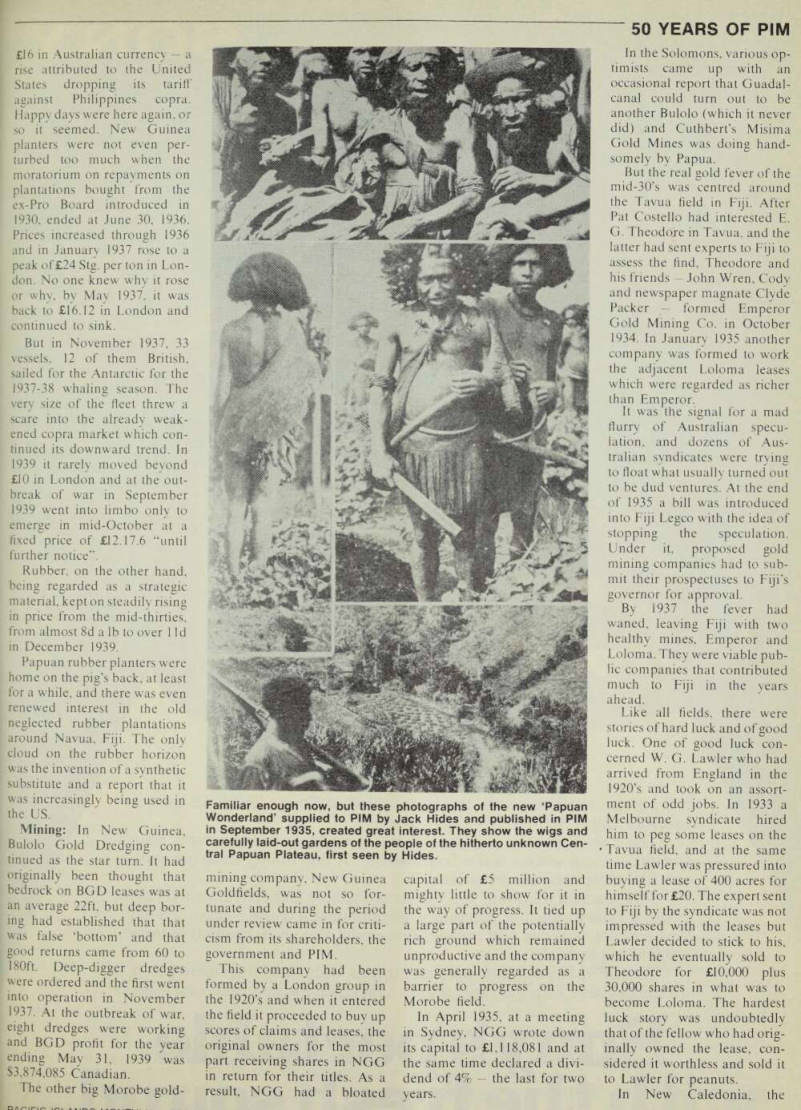

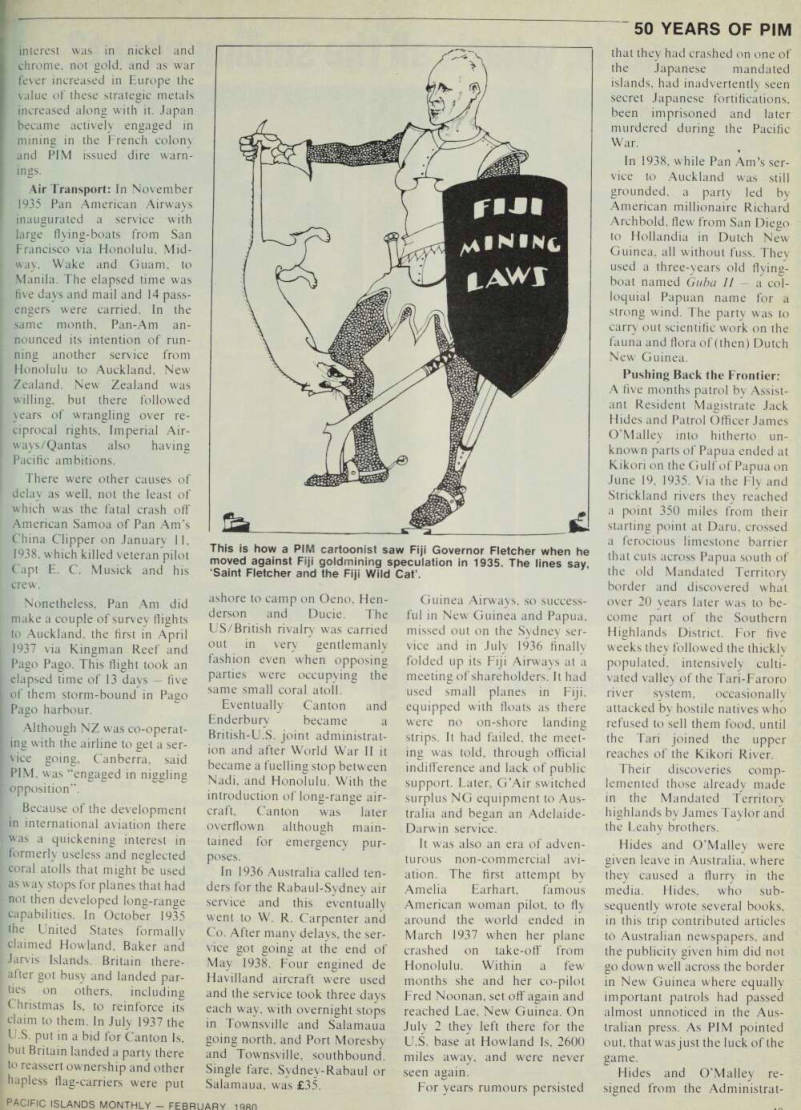
PM 1930.1980 50
When they began to roll back the frontiers
In this, PlM’s 50th anniversary year, RIM is reviewing the half-century of news highlights reported in its pages. Last month JUDY TUDOR, former RIM editor and publisher, looked at the first four years. Here, she reviews the busy period from 1935 to 1939 and finds it a time when the Pa cific frontiers began to expand, on the ground and in the air.
By 1935 the worst of the De pression years had been left be hind, especially in those islands that already had. or
were establishing, gold
mining. Even more traditional ways of earning an honest quid, such as copra production, began to do better.
The period did have its quota of disasters, such as the volcanic eruptions that for a while obliterated Rabaul. then the capital of the Mandated Territory of New Guinea, but on the credit side, long distance international air trans port was making timid beginnings, a development that, while it was not realised at the time, was going to shatter the isolation of even the remo test Pacific Island group for ever.
In exploration, the frontiers of the last unknown part of the Pacific, the vast island of New Guinea, were being rolled back by men like Jack Hides, James Taylor, Ivan and Claude
Champion, the Leahys and
others.
It was still, by and large, a European Pacific; at any rate, it was the European element that called the shots. To be European then, even if you
were an impoverished planter
or the lowest grade clerk in some Administration, was to be a big frog in a distinctly small
pool.
It was a good life, lived in a certain amount of euphoria; one in which you were aware of what went on in the wide world outside, where Hitler, Mussolini and what PIM called the ’Japanese menace’ were
casting their shadows before, but where it was still imposs ible for Islands residents to be lieve that that world could impinge on his own hunk of coral and coconuts or moun tain claim and jungle.
Politics: In the sense that it developed later, there was little local politicking, such heat as was generated being the gen eral curses local residents brought down on relevant metropolitan governments in Canberra, Westminster. Paris, Wellington etc. These were generally held to have no ap preciation of Islands life and
problems.
One exception was the West Samoan Mau which remained unchastened and collected towards the appeal of O.F.
Nelson against his 10 years banishment to New Zealand (See PIM Jan).
In May 1935 that appeal failed and there was gloom amongst the faithful in Samoa.
However, help was nearer than anyone had a right to think be cause, at the end of that year, a Labour Government was elected in New Zealand.
Not only did the new boys waive the rest of the Nelson period of banishment but sent him and his family back to Samoa at government expense, despatching three ministers to
form part of the welcome home committee.
During their visit the minis ters announced that most of the laws that had angered the Mau would be repealed; that back tax they had refused to pay would not be collected and that Chinese plantation labourers would be repatriated some thing that the Mau was en thusiastic about, but which others were not.
The ministers returned to NZ declaring that they had solved all Western Samoa’s
problems. PIM predicted that
they had not, and was soon
proved right.
Believing that it had won a famous victory, the Mau began to throw its weight about in the Fono of Faipule and the Legis lative Council which it had hitherto boycotted and managed to oust the non-Mau High Chief Malietoa Tanu from the latter. Those who had been anti-Mau now considered that they were hard done by and Samoa remained split into factions.
Mau-ism, nonetheless, began to lose its mana over the years ahead and to merge with a general Samoan desire for independence, which did not occur until 1960.
Meantime in Fiji reorganis
ation of both the Suva munici
pal council and the Legislative Council was proceeding as Whitehall’s way of getting round the Indian community’s demand for a common-roll.
The demoting of the city council to a nominated town council caused most heat and the outgoing council held a ref erendum on the subject. Sixty four voted for the new nominated council, 295 against. The government took no notice and in early 1936 installed seven government town councillors, two nomi nated Europeans, two nomi nated Indians and two
nominated Fijians.
There was, however, an entertaining tailpiece to the municipal council’s demise. At its last meeting it was decided as a sentimental gesture to give the retiring mayor the mayoral chain of office, the nominated board no longer requiring such a bauble.
When the town board audi tor discovered this largess he refused to certify the accounts and the ensuing wrangle went on for months. Finally three of the ex-councillors responsible for the gift were taken to court and ordered to pay £13.10 each to the town board, that being the value put upon the mayoral badge of office. The accused refused, took their case to the Supreme Court, where the
appeal was upheld.
The Old Unfaithfuls: Around March 1934 copra had sunk to £StgB c.i.f. London, its lowest price per ton ever. From there on it seemed that the way it went could only be up.
Sure enough, in January 1935 the price rose to £Stg 12.15.0, - approximately
£l6 in Australian currency a rise attributed to the United States dropping its tariff'
against Philippines copra.
Happy days were here again, or so it seemed. New Guinea planters were not even per turbed too much when the moratorium on repayments on
plantations bought from the
ex-Pro Board introduced in 1930, ended at June 30, 1936.
Prices increased through 1936 and in January 1937 rose to a peak of £24 Stg. per ton in Lon don. No one knew why it rose or why, by May 1937, it was back to £16.12 in London and continued to sink.
But in November 1937, 33 vessels, 12 of them British, sailed for the Antarctic for the 1937-38 whaling season. The very size of the fleet threw a scare into the already weak ened copra market which con tinued its downward trend. In 1939 it rarely moved beyond £lO in London and at the out break of war in September 1939 went into limbo only to emerge in mid-October at a fixed price of £12.17.6 “until further notice”.
Rubber, on the other hand,
being regarded as a strategic
material, kept on steadily rising
in price from the mid-thirties, from almost 8d a lb to over lid in December 1939.
Papuan rubber planters were
home on the pig’s back, at least for a while, and there was even renewed interest in the old neglected rubber plantations around Navua. Fiji. The only cloud on the rubber horizon was the invention of a synthetic substitute and a report that it was increasingly being used in the US.
Mining: In New Guinea, Bulolo Gold Dredging con tinued as the star turn. It had
originally been thought that
bedrock on BGD leases was at an average 22ft, but deep bor ing had established that that was false ‘bottom’ and that good returns came from 60 to
180 ft. Deep-digger dredges
were ordered and the first went into operation in November 1937. At the outbreak of war,
eight dredges were working
and BGD profit for the year ending May 31, 1939 was $3,874,085 Canadian.
The other big Morobe gold-
mining company. New Guinea Goldfields, was not so for tunate and during the period under review came in for criti cism from its shareholders, the government and PIM.
This company had been formed by a London group in the 1920’s and when it entered the field it proceeded to buy up scores of claims and leases, the original owners for the most part receiving shares in NGG in return for their titles. As a result, NGG had a bloated
capital of £5 million and mighty little to show for it in the way of progress. It tied up a large part of the potentially rich ground which remained unproductive and the company was generally regarded as a barrier to progress on the Morobe field.
In April 1935, at a meeting in Sydney, NGG wrote down its capital to £1,118,081 and at the same time declared a divi dend of 4% the last for two years.
In the Solomons, various op timists came up with an occasional report that Guadal canal could turn out to be another Bulolo (which it never did) and Cuthbert’s Misima Gold Mines was doing hand somely by Papua.
But the real gold fever of the mid-30’s was centred around the Tavua field in Fiji. After Pat Costello had interested E.
G. Theodore in Tavua. and the latter had sent experts to Fiji to assess the find. Theodore and his friends John Wren, Cody and newspaper magnate Clyde Packer formed Emperor Gold Mining Co. in October 1934. In January 1935 another company was formed to work the adjacent Loloma leases which were regarded as richer
than Emperor.
It was the signal for a mad flurry of Australian specu lation, and dozens of Aus tralian syndicates were trying to float what usually turned out to be dud ventures. At the end of 1935 a bill was introduced into Fiji Legco with the idea of
stopping the speculation.
Under it, proposed gold
mining companies had to sub mit their prospectuses to Fiji’s governor for approval.
By 1937 the fever had waned, leaving Fiji with two
healthy mines. Emperor and
Loloma. They were viable pub lic companies that contributed much to Fiji in the years ahead.
Like all fields, there were stories of hard luck and of good luck. One of good luck con cerned W. G. Lawler who had arrived from England in the 1920’s and took on an assort ment of odd jobs. In 1933 a Melbourne syndicate hired him to peg some leases on the Tavua field, and at the same time Lawler was pressured into buying a lease of 400 acres for himself for £2O. The expert sent to Fiji by the syndicate was not impressed with the leases but Lawler decided to stick to his, which he eventually sold to Theodore for £lO,OOO plus 30,000 shares in what was to become Loloma. The hardest luck story was undoubtedly that of the fellow who had orig inally owned the lease, con sidered it worthless and sold it to Lawler for peanuts.
In New Caledonia, the
Familiar enough now, but these photographs of the new ‘Papuan Wonderland’ supplied to PIM by Jack Hides and published in PIM in September 1935, created great interest. They show the wigs and carefully laid-out gardens of the people of the hitherto unknown Cen tral Papuan Plateau, first seen by Hides.
interest was in nickel and [ chrome, not gold, and as war fever increased in Europe the ! value of these strategic metals increased along with it. Japan
: became actively engaged in
mining in the French colony and PIM issued dire warn ings.
Air Transport: In November 1935 Pan American Airways inaugurated a service with large flying-boats from San Francisco via Honolulu. Mid way, Wake and Guam, to Manila. The elapsed time was five days and mail and 14 pass engers were carried. In the same month. Pan-Am an nounced its intention of run ning another service from Honolulu to Auckland. New Zealand. New Zealand was willing, but there followed years of wrangling over re
ciprocal rights, Imperial Air
ways/Qantas also having Pacific ambitions.
There were other causes of delay as well, not the least of which was the fatal crash off American Samoa of Pan Am’s China Clipper on January 11, 1938, which killed veteran pilot Capt E. C. Musick and his crew.
Nonetheless, Pan Am did make a couple of survey flights to Auckland, the first in April 1937 via Kingman Reef and Pago Pago. This flight took an elapsed time of 13 days five of them storm-bound in Pago
Pago harbour.
Although NZ was co-operat ing with the airline to get a ser vice going, Canberra, said PIM. was “engaged in niggling opposition”.
Because of the development in international aviation there was a quickening interest in formerly useless and neglected coral atolls that might be used as way stops for planes that had
not then developed long-range
capabilities. In October 1935 the United States formally claimed Howland, Baker and Jarvis Islands. Britain there after got busy and landed par ties on others, including Christmas Is, to reinforce its claim to them. In July 1937 the U.S. put in a bid for Canton Is, but Britain landed a party there to reassert ownership and other
hapless flag-carriers were put
ashore to camp on Oeno, Hen derson and Ducie. The US/British rivalry was carried out in very gentlemanly fashion even when opposing parties were occupying the same small coral atoll.
Eventually Canton and Enderbury became a British-U.S. joint administrat ion and after World War II it became a fuelling stop between Nadi, and Honolulu. With the introduction of long-range air craft, Canton was later overflown although main tained for emergency pur poses.
In 1936 Australia called ten ders for the Rabaul-Sydney air service and this eventually went to W. R. Carpenter and Co. After many delays, the ser vice got going at the end of May 1938. Four engined de Havilland aircraft were used and the service took three days each way. with overnight stops in Townsville and Salamaua going north, and Port Moresby and Townsville, southbound.
Single fare. Sydney-Rabaul or
Salamaua, was £35.
Guinea Airways, so success ful in New Guinea and Papua, missed out on the Sydney ser vice and in July 1936 finally folded up its Fiji Airways at a meeting of shareholders. It had used small planes in Fiji, equipped with floats as there were no on-shore landing strips. It had failed, the meet ing was told, through official indifference and lack of public support. Later, G’Air switched surplus NG equipment to Aus tralia and began an Adelaide- Darwin service.
It was also an era of adven turous non-commercial avi ation. The first attempt by Amelia Earhart, famous American woman pilot, to fly around the world ended in March 1937 when her plane crashed on take-off from Honolulu. Within a few months she and her co-pilot Fred Noonan, set off again and reached Lae, New Guinea. On July 2 they left there for the U.S. base at Howland Is, 2600 miles away, and were never
seen again.
For years rumours persisted
that they had crashed on one of the Japanese mandated islands, had inadvertently seen secret Japanese fortifications, been imprisoned and later murdered during the Pacific War.
In 1938, while Pan Am’s ser vice to Auckland was still grounded, a party led by American millionaire Richard Archbold, flew from San Diego to Hollandia in Dutch New Guinea, all without fuss. They used a three-years old flying boat named Cuba II a col loquial Papuan name for a strong wind. The party was to carry out scientific work on the fauna and flora of (then) Dutch New Guinea.
Pushing Back the Frontier: A five months patrol by Assist ant Resident Magistrate Jack Hides and Patrol Officer James O’Malley into hitherto un known parts of Papua ended at Kikori on the Gulf of Papua on June 19, 1935. Via the Fly and Strickland rivers they reached a point 350 miles from their starting point at Daru, crossed a ferocious limestone barrier that cuts across Papua south of the old Mandated Territory border and discovered what over 20 years later was to be come part of the Southern Highlands District. For five weeks they followed the thickly populated, intensively culti vated valley of the Tari-Faroro river system, occasionally attacked by hostile natives who refused to sell them food, until the Tari joined the upper reaches of the Kikori River.
Their discoveries comp lemented those already made in the Mandated Territory
highlands by James Taylor and
the Leahy brothers.
Hides and O’Malley were given leave in Australia, where they caused a flurry in the media. Hides, who sub sequently wrote several books, in this trip contributed articles td Australian newspapers, and the publicity given him did not go down well across the border in New Guinea where equally
important patrols had passed
almost unnoticed in the Aus tralian press. As PIM pointed out, that wasjust the luck of the game.
Hides and O’Malley re signed from the Administrat
This is how a PIM cartoonist saw Fiji Governor Fletcher when he moved against Fiji goldmining speculation in 1935. The lines say, Saint Fletcher and the Fiji Wild Cat’.
ion and went prospecting for S an Australia syndicate in the [ country they had discovered.
No mining eventuated but both contracted a strange form of ■ beri-beri. O’Malley, aged 37, died at Daru in September 1937; Hides, 31. died in Sydney nine months later.
Hides’ first book (Through Wildest Papua) was published in London in late 1935 and was well received by reviewers in Australia, but PIM complained that the publishers had made the “fatal mistake” of putting a price of 13/6 ($1.35) on it. and said ‘Australians won’t pay that sort of price for a book!’
In 1936 another important patrol was carried out in Papua by ADO Ivan Champion and Patrol Officer C. Anderson.
They left Daru on May 1 and from the end of that month nothing was heard of them until they turned up at Port Romilly at the mouth of the Purari on December 29. Ac companied by 27 volunteer
prisoners from Port Moresby
gaol, they got as far as present day Mendi. skirted Mt Giluwe and eventually found their way into the headwaters of the Purari River.
This patrol did not get the sort of publicity given to Hides and when a Dutchman, Dr A.
Colijn. succeeded in climbing
16,400 ft Mt Carstens, in Dutch New Guinea, in the same year, it was not even mentioned in the Australian press.
Eruption at Rabaul: Follow ing some days of ‘quakes and volcanic rumblings, the citizens of Rabaul were horrified on May 29, 1937 to see a small island called Vulcan, at one side of the harbour, explode into violent eruption. The
following day Matupi volcano,
on the other side of the har bour. also erupted and the two volcanoes together proceeded to cover the town with layers of ash and pumice. Many people were killed. There was a gen eral exodus and finally 8000 people were temporarily housed in a tent town near Kokopo about 20 miles away.
Volcanic activity continued into June, the formerly flat island of Vulcan ending as a 600 ft peak. European women and children were evacuated to Australia and the men returned
to Rabaul to clean up.
For months dust was a fea ture of the area and floating pumice a menace to shipping but arguments as to whether Rabaul should be abandoned and a new capital site chosen went on for years. A committee headed by former N..G. Ad ministrator. Brigadier-Gen. T.
Griffiths, was set up to locate a site and recommended the tablelands behind Lae. This was rejected by the Australia Government which sent the then Minister for Territories, W. M. Hughes, to take another look. He flew around for a week, then announced that the site would be Salamaua and that a road would be built from there directly over the moun tains to Wau.
A storm of protests in New Guinea and Australia followed on both counts. Australia procrastinated and nothing of any note was done before the Pacific War intervened. (After it. Papua and New Guinea were amalgamated and the capital of the combined terri tories was Port Moresby. The Wau road awaited the war also, was built by the Army, and went by a different route to that chosen by Billy Hughes.) Here and There: Atimaono Plantation in Tahiti was producing 900 tons of sugar an nually and in 1935 a tax on imported sugar was advocated as protection for the local industry. Meanwhile, all thought of sugar planting in Papua had fizzled out it would have interfered with the
Australian industry, especially
in relation to its export quota. • Three missionaries had been killed in 1934. in the recently discovered New Guinea High lands and as a result the whole area was closed to European settlement for 15 years. • In March 1935 PIM pub lished news of a new anti malaria drug, Atebrin, manufactured in Germany. It was claimed that two injections prevented recurrence, which was far from the truth. The drug was to become known to thousands of troops in New Guinea during the war. One of its characteristics was that it turned the skin yellow and it was also suspected by many
servicemen of having a bad effect on their sex life. In the post-war it was superseded by more effective anti-malarials. • Brigadier-General H. E.
Hart retired as Administrator of Western Samoa in 1935. Mr A. C. Turnbull was appointed Acting Administrator and was still “acting” in 1939. Only the NZ Government seemed to know the reason for the delay and it wasn’t saying. • In 1936 the Union Steam Ship Co’s new Islands vessel was christened Matua said to be Maori for “parent”. • Ludwig Schmidt, who had been found guilty of murdering [at least] four New Guinea natives and raping native women, was hanged on March 25, 1936 at Rabaul gaol the
only European in Papua New
Guinea ever to meet this fate. • The Colonial Sugar Refining Co. made pineapple canning in Fiji a viable industry when it purchased plant and interests of two defunct canning companies in October 1936.
The industry flourished until
the best pineapple growing
land was taken over at the beginning of the Pacific war to construct Nadi Airport. • For most Islands residents the abdication of King Edward VIII in December 1936 came as a complete shock. Few had heard of Mrs Simpson. Notes from the Cook Islands, pub lished in January PIM. said: ‘After a careful censorship of events which culminated in the abdication, information of an attenuated nature was released for the benefit of the native population. The Resident
Commissioner read out the public proclamation of ac cession of King George VI. Be yond the fact that the crown of Beritane has changed hands, the average Rarotongan knows little or nothing of what has re cently transpired and that little is a strangely mangled version of the facts.’ • In February 1937 the price of a copy of PIM went up by twopence to eightpence. • In the 1937-38 financial year, Papua cost Australia £48,810; New Guinea, £3650; and Nor folk Is. £4OBO. PIM asked edi torially: “Is Norfolk Island worth £4.000 a year to Aus tralia?” • T. H. Harrisson, an English ornithologist who took on the role of anthropologist when he spent some time in the New Hebrides, stirred up Con dominium residents when his book (Savage Civilization) was
published in 1938. Although
defended by the celebrated Miss Evelyn Cheeseman, FRES, FZS, he was generally regarded in the NH as an eccentric who didn’t know what he was talking about in relation to Big Nambas, or any thing else in the con dominium. • By 1939 two-thirds of the total area of Papua had been parcelled out to oil prospecting
companies Papua Oil
Development Ltd, Island Ex ploration Co. Pty Ltd; Oriomo Oil Ltd and Papuan Apinaipi Petroleum Co. Ltd. •In mid-May 1938, the Sigatoka-Navua section of Fiji’s Queen’s Rd was com
pleted, making it possible for
the first time to drive right round Viti Levu.
Queen Salote and Crown Prince Taufa’ahau (now King Taufa’ahau of Tonga) photographed in Sydney in 1935. PIM printed it in its October issue.
Advertisements & other items, pp. 41-46 (4 items)
50 Years Of Rim
Sony’s portable
CFM-31S/L
Fill your leisure hours with the fresh sound of Sony's CFM-31S cassetterecorder with FM/MW/SWI/SW2 radio.
The 2-way speaker produces three watts of incredibly sharp sound through a 12cm woofer and a scm tweeter. A fine tuning knob gives precise SW reception indoors or out.
At a touch of a button, you can record simply and conveniently. There is also a built-in electret condenser microphone, a pause button, a 3-digit tape counter, plus cue and review. This model also shuts itself off automatically after playback.
The CFM-31S is lightweight and travels with ease. Anywhere you go, it's the portable with the fresh sound. (CFM-31L with fm/mw/sw/lw is also available.)
Sony’s portable
with the fresh sound
Hey, world, what’s all the smiling about? w m m ¥ IlffP,; I r \ g m i I * i: * w m r I
“My Yanmar diesel engine!”
It’s the same the world over.
Yanmar diesel engine owners are happy owners.
Because we spend a lot of time and trouble developing ana producing diesel engines that they don’t have to spend a lot of time and trouble looking after. That are veritable misers in operation. And that just seem to go on running forever.
Marine engines. Industrial engines. Engines for generators, pumps, ships, boats, yachts, farm equipment and construction machinery.
Some 400,000 diesel engines every year. From 4 to 3,960 horsepower.
That’s a lot of engines.
And a lot of smiles.
TS(C) series 4~22 HP Industrial diesel engine QM series 14-33 HP Marine diesel engine The Power Pacing Progress
YANMAR
DIESEL ENGINE
Industrial use 4—3960 HP Marine propulsion use 5—1980 HP Marine auxiliary use 4—3190 HP
YANMAR DIESEL ENGINE CO.,LTD.
ill:' 254844 IC A A^s'^ANPACIFR C AGENCIES .INC L p O Box S' Pw^ : jo^er FEDERATION OF COOPERATIVE ASSOCIATIONS: PO. Box 100, Ponape, Eastern Caroline Is 96941 COOK .Ty S A Tel 28255 GILBERT GILBERT ISLANDS bb&kFpS ELECTRICS LTD PO Box 521, Honiara, Guadalcanal, Solomon TONGA E M JONES LTD.: P.O. Box 34, Nukualofa, Tonga Cable. JONES NUKU ALOFA TRUK KIUMAbA bNi thirmbt.
ECI 96942 WESTERN SAMOA MOTOR DISTRIBUTORS (SAMOA) LTD.; Tel: 825.
.* t* m m mm m m > © ■ \ i
ear
I ** rt - I ■1 % < m r H - - ,;- gtt ' . 1# 1
SSHE
a #1% : 92 B * a* 3^ i ‘Vj m v* * w c
50 Years Of Rim
43
PACIFIC ISLANDS MONTHLY - FEBRUARY tQftn
50 Years Of Pim
PACIFIC ISLANDS MONTHi V CCDDI IA □ -i nnn
Books
Two highly qualified reviewers here look at two recent books that deal with aspects of the development of Islands medical services. Sir John Gunther who has a medical degree, is a former Papua New Guinea Director of Health and vice-chancellor of the University of PNG. Dr Leonard Goodman is a former surgeon with wide administrative experience in the Islands and Africa, including the post of senior tutor in surgery at the Fiji School of Medicine.
The first barefoot doctors
That They Might Live, by Ellen Kettle, Published by F. P.
Leonard, 110 Bathurst St, Syd ney. SA2O
That extraordinary, imaginat
ive Australian, Dr ‘Nugget’
Coombs, arranged for the Commonwealth Reconstruc tion Training Scheme to be used for the communities of Papua and New Guinea. In Australia the scheme was to train individual returned ser vicemen, in Papua and New Guinea it could be applied to those communities affected by war. Was there one that hadn’t been?
And so in 1946 the Depart ment of Public Health was able to set up what became known as the aid post orderly training scheme. It had its own cash funds, and the department could deal directly with the Commonwealth War Disposals Commission. Five special schools were rapidly set up, and then a sixth. The idea was to promote in the quickest way
possible a widespread grass
roots net-work of village aid posts.
Four principles were estab lished: a village would volun teer to enter the scheme; they would select a trainee, who need have no lingua franca indeed, he would be illiterate; they would build him a house; and plant a garden. The Department of Public Health would train him to treat the killer diseases: pneumonia, dysentry, malaria cerebro spinal meningitis. He would be
taught to give intramuscular
injections and if found adapt
able enough, intravenous injec
tions.
He would work for his own
community and those adjoin
ing, otherwise he would lead a normal village life. He would be paid about half the wage of the hospital assistant. The training would take a year at least, or as long as was re quired.
In 1946 the population of
Papua and New Guinea was estimated to be in excess of 1,000,000. The aim was to train one of these special orderlies for each 1000 of population.
Years later, China using the same principles, launched the ‘barefoot doctor’ and earned world wide kudos, when in fact it was a marked first for Papua and New Guinea.
Matron Kettle, in her That They Might Live, seems to miss the main thrust of this 1946 scheme. Matron Kettle’s book is dedicated to the Christian missionaries of Papua New Guinea.
Anything that brings back
memories of friends and ac
quaintances is always pleasant.
How well I remember Sister Clematia, of Anelaua Leprosy Hospital, with habit flying be hind her like some great white bird of prey, as she came hurt ling down the hill on her bicycle to greet and not to repel her visitors as their ship ap
proached her island’s jetty.
Then there were Constance Fairhall of Gemo, and Sister Camillus of St. Theresa’s Hospital who got what they needed by their obvious de votion. Give them their inch and they could stretch it to their mile! And Theodore Braun and Agnes Hoeger splendid doctors; the industrious sur vivors of the horrors of Ramale; and Jean Henderson and Pat Durdin, heroines of the disastrous Mt. Lamington vol
canic eruption; Dorothy Beale
and many, many others. They are all in That They Might Live.
The comings and goings of other nursing pioneers are recorded: whom they married and what children they had.
There are anecdotes and many stories, some of which I’m sure are apocryphal. When put together it is the saga of brave people wanting to serve - suf
fering hardships, and indigni
ties, improvising, and seldom if ever giving up.
Matron Kettle has managed to put together not only the activities of individual missionaries but some of the history of their church’s secular role. She has taken more than 300,000 words to do it,
although included are only
brief mentions of government activity, which are sometimes critical and often incorrect, especially when she accuses the late Senior Matron Thorburn of being interested only in
European hospitals.
In fact. Matron Kettle’s comments about the development of health policy in 1946-47 made from hearsay and 23 years afterwards, are at the best her own views. Matron Kettle did not herself encounter the social and resource problems of that time, and the priorities.
It is unfortunate that she should misspell the name of Mrs D. E. Ure, so well re-
spected. who laboured greatly
to relieve the lot of the Hanuabadans in those early days, as ‘Ewer’.
That They Might Live
although well worth-while, very badly needed a competent editor. The layout into regions and towns and missions is la borious; there is much rep etition we are told at least three times that Dr Cleazy trained as a reconstruction sur geon in Vellore, India. There are many errors of fact Sogeri was not a jungle but a well developed plantation area before the 1939-45 war; there is much misspelling; some maps are almost impossible to use; the 300,000 words should be cut to 120,000; and it is a pity the covers were not of bet ter material (those on my copy after three days are bent and disfigured). On the other hand the index seems excellent, Matron Kettle is back in the Northern Territory. I wonder why the Commonwealth and the State governments have never used Papua New Guinea’s medical teaching facilities to train aboriginals to care for their own. John Gunther.
The man behind

Suva's FSM
Misi Utu: Dr. D. W. Hoodless and the Development of Medi cal Education in the South Pa cific. By Margaret W. Guthrie.
Published by the Institute of Pacific Studies, University of the South Pacific, Suva. Price unavailable.
It would have been quite im possible for Dr. Margaret Guthrie to have written her father’s biography without at the same time relating the his tory of the development of medical education in Fiji, with which the name of David Winn Hoodless is synonymous. The two stories are intertwined.
Hoodless himself, born at the end of the 19th century in
Nottingham. England, found
his way to the Queen Victoria
College, Suva, in 191 1 as an as sistant master, and from there to the Lau provincial school in Lakeba in 1915 where, in this remote situation, he became an expert in the Fijian language
■ and Fijian custom and, finally I found a new interest in the I study of human anatomy and I physiology which made him I determined to study medicine.
He had already, before arriv ■ ing in Fiji, won himself a BSc I in mathematics and had held I academic appointments at the I University of Manchester and I the Nautical Training College, I HMS Worcester.
With the ending of the war [ in 1918. DWH found himself I with two years accumulated leave, during which he went to London and completed the I pre-clinical course in medicine
[ at King’s College Hospital
Medical School.
When he returned to Fiji it I was as superintendent of I schools, and in this position he I made no secret of his convic- I tion that a corps of young I Fijians should be assisted to [obtain an educational and societal background to fit them I for future responsibilities. This I was regarded at that time as an extremely radical view, but Hoodless persisted. and amongst those who benefited I from his foresight were the late Ratu Jone Doviverata (brother ’of the late Ratu Sir Lala Sukuna) and who became the first Fijian graduate in medi cine, from the University of Otago and as Dr. Tom Dovi, a [ much-loved medical officer in
Fiji.
But Dr. Hoodless’ story really starts in 1883, when Dr. (later Sir) William McGregor, chief medical officer of Fiji, i had been so concerned at the [devastating effects of introduced diseases to which the Fijian had no natural immunity, and fearful of a smallpox epidemic which could arise with the continuing influx of Indian migrant labour, conceived the idea of training a few Fijian youths of rank in the elements of the rec ognition and treatment of dis ease, and practical vaccination.
These young men were legally certified as Native Medical Practitioners, and under supervision, sent to re mote areas where their newly acquired knowledge - rein forced by their social status enabled them to give practical, if elementary, treatment, and
to vaccinate the population
against smallpox.
The first NMP’s were cer tified in 1888, and they proved so successful that they were in demand even in neighbouring territories. Over the years the course of training was greatly extended, and the opening ol the Colonial War Memorial Hospital in Suva in 1923 marked a great advance in their
training and the development
of the medical services in Fiji.
About this time. Dr. S. M.
Lambert of the Rockefeller Foundation was working in the South Pacific on public health measures, and was so impres sed by the skilled assistance he received from NMP’s that he suggested a Central Medical School be established in Suva to take young men from all South Pacific territories for training.
With a substantial grant from the Rockefeller Foundation and the support of neighbour ing administrations, the school enlarged. extended and renamed Central Medical School, opened in 1928 with D.
W. Hoodless as its first prin
cipal.
It was in this role that Hoodless’ educational experi ence, his genius for communi cation. and his extrovert personality found their fullest expression, and he, his life’s work.
With students from different
language areas the teaching
had to be in English, and Hoodless not only had the task of organising and running the school, but also of ensuring that the students’ knowledge of
English became adequate for
the basic science course and subsequent clinical instruction at the CWM Hospital. He had by this time married Hilda Adlington, headmistress of the Suva Girls’ Grammar School.
In October 1934. while on leave in England, he completed his qualifying examinations
from Charing Cross Hospital
Medical School, after which he returned to Fiji to continue his work at the Central Medical School until his retirement in 1947. The school continued to expand and instruction was
extended continuously to keep
pace with the increasing complexities of modern medi cine.
The present main building at Tamavua - a gift from the UK Government - was opened by the Queen in 1953, and in 1961 renamed the Fiji School of Medicine, and its qualified students, medical officers.
The progressive develop ment and improvement of the academic instruction brought unexpected problems. On one hand some students com plained that after so long and complete a course they finished not with a degree but a dip loma which is not recognised for general registration outside Fiji (although it is now recog nised by the Australasian Royal Colleges for entry to the
Fellowship Examinations).
On the other hand there was the converse where some students complained that after such a long, technical training they were posted to rural areas or remote islands where they were frustrated and angry that their knowledge and skill did not have, in those situations,
the supporting facilities they
had been trained and taught to use and expect.
From time to time there have been suggestions that the training at the FSM should be up-graded to a degree course, but until now the heavy cost of
establishing a medical faculty
at the young University of the South Pacific has rendered these suggestions unaccept able.
However, presumably in an ticipation of this, in 1975 the Ministry of Health in Fiji, insti tuted a three-year course for medical assistants, and so medical education in Fiji has gone full circle from its origin in 1888. and once again there is established a two-tier stan dard of medical care.
Hoodless retired to Suva and continued a very active life in the educational, medical and social fields, and travelled widely. It was during a visit to England that he died in 1954.
Those of us who knew him are now few, but his work will be remembered not only by the Hoodless House extensions of the FSM at the CWM Hospital, but by this monograph - long overdue and which should be required study for all students at the FSM past, present and future. Leonard Goodman
Advertisements & other items, pp. 47-50 (2 items)
Pacific Islands Monthi V _ Pfrrmadv Iqqa
PACIFIC ISLANDS MONTHI V PFRRmadv iqqa
Bookshop...
Polynesian
THE PACIFIC ISLANDS
BOOK SPECIALISTS
Write for our complimentary catalogue!
OH PONSONBY RI)
(PO Box -17 267)
At CKLAND, NEW ZEALAND
Telephone 764-824
LET MicH SHOW YOU
I A BETTER WAY
Victa 8 h.p. Tiller (Model 408). • Independent rear tine and wheel drive trans missions #5 forward speeds plus reverse #Chain driven totally enclosed gear boxes • Nine (9) handle positions instantly adjustable either vertically or horizontally by squeeze trigger • 14" dia. tines 20" tilling width * Throttle, gear shift and handle adjustment levers are all conveniently located on handle assembly #Separate transmission levers for tine drive or wheel drive • Instant depth control with spring loaded pin engagement of multi-position depth bar #Tractor tread tyres combined with front mounted counterweight for maximum traction. OPTIONAL ATTACHMENTS: Hilling Plough: Twin ploughshares adjustable in width and in angle to produce hills or furrows.
Cultivating Points: Four cultivating point assemblies, adjustable in spacing.
NOTE: The above must be used with "A"
Frame Assembly and two depth wheels, which are rear mounted.
For professional results.
Victa 5 h.p. Tiller (Model 355). Worm drive gear box. Forward speed plus neutral pr and reverse, and accepting a wide range of optional attach- V ments. 5 h.p. B & S pull-start *' j 4-stroke engine. Heavy-duty m tines adjustable from 305 mm (12") to 660 mm (26") Wl - |jU cultivating widths.
W Weight 95 kg (210 lb). JP it Victa 3 h.p. Till-it Tiller (Model 030). Lightweight, portable, compact tiller.
Special features include: 3 h.p. Briggs & Stratton engine with easy pullstart. Spring steel "jt tines adjust to 254 mm (10") or 457 mm (18") cultivating widths. Weight; 27 kg (60 lb).
Victa 3.5 h.p. Tiller (Model 100). Rugged heavy duty model with 3.5 h.p. B & S pull-start 4-stroke engine. Long-life oil filled cast iron gear box. 16 spring steel tines 12" diameter adjust from 305 mm (12") to 660 mm (26") cultivating widths. Weight 63 kg (140 lb). Optional attachments: Furrow opener, sweep plough, pneumatic front tyre kit.
SEE A Vims
DEALER NOW
FORA
DEMONSTRATION.
Your
doorway
into the
fascinating
world of the South Seas Mu 104 pages $4.00 or SUSS.OO posted.
Order form on special insert in this issue.
V 4 comfort andd*in£ food ♦ All rooms f i airconditioned * Restaurant ♦ Ba ♦ Banquet hall
.C. NEUMANN
manager Phone 21*2622^ a* Stay at Aggie Grey’s the South Pacific’s legendary hotel.
Situated right in the heart of Western Samoa. Enjoy Poly nesian-style friendliness and service, in t ool.surroundings, superb entertainment and food.
Magnificent white sand beaches only a short drive away. Airconditioned rooms, swimming pool and full bar facilities.
Hookings through Union Steam ship Company of NZ. Pan Am.
Air New Zealand or direct to Aggie Urey’s, Apia, Western Samoa. Cables; ACCIES Apia.
Get your hi-fi act together.
If you’re aiming to set up the hi-fi system that will turn your pad into the original magic carpet, here’s how to do
it right first time.
After all, Kenwood’s engineers are gurus when it comes to getting the most out of reproduced music.
Take the system displayed here.
It’s built around the KA-405 fast-response amplifier. which is incredibly quiet during record playing sessions It's built to live in harmony with the KT-413. A highly
accurate, auto-sequential tuner.
The KX-500 offers you the rich potential of recording witH metal tape. While the KD-1500 automatic cut turntable
provides easy operation and high performance.
The LS-60 speaker system makes sure the sound come:; naturally. And there’s an attractive audio rack to keep your pad neat and tidy.
The Kenwood system. It’s one of the simplest anti safest—ways to get into the real high-fidelity act.
KA 405 Fast response integrated amplifier 55W/ch
KT4I3
Auto tuning F M/A.M stereo tuner 60dB selectivity KD 1500 Automatic cut turntable
W/F 0 05% (WRMS)
KX 500 Stereo 2-head cassette (took with met?* tape capability W/F 0.05% (WRMS) LS-60 70W 3-way 3-speaker system.
SRC-95
Audio rack m P m i.» t jr* / V ■ -r ■
TRIO-KENWOOD CORPORATION
6-17, 3-chome, Aobadai, Meguro-ku, Tokyo, Japan.
AUSTRALIA TRIO-KENWOOD (AUSTRALIA) PTY. LTD. Australia Tel, 439-4322 NEW ZEALAND JOHN GILBERT &CO., LTD. Auckland Tel. 30-839 FIJI THE DOMINION IMPORT & EXPORT PROMOTIONS Nadi Tel 72-165 PAPUA NEW GUINEA S O. SVENSSON (N.G ) LTD Port Moresby Tel. 24-2275/2285 NORFOLK ISLAND BURNS PHILP (NORFOLK ISLAND) LTD.
SOLOMON ISLANDS TECHNIQUE RADIOS CENTRE LTD. Honiara Tel 416 NEW CALEDONIA HI-FI VOX Noumea Tel 27-2466 NEW HEBRIDES RUE HIGGINSON Vila Tel 2556 TAHITI MAI SON AURORE Papeete Tel. 29703 AMERICAN SAMOA ISLAND PACIFIC AGENCIES, INC. Pago Pago Tel. 633-4687
REPUBLIC OF NAURU NAURU CO-OPERATIVE SOCIETY
MARIANA ISLANDS J C. TENORIO ENTERPRISES Saipan Tel 6445
Touring Tahiti
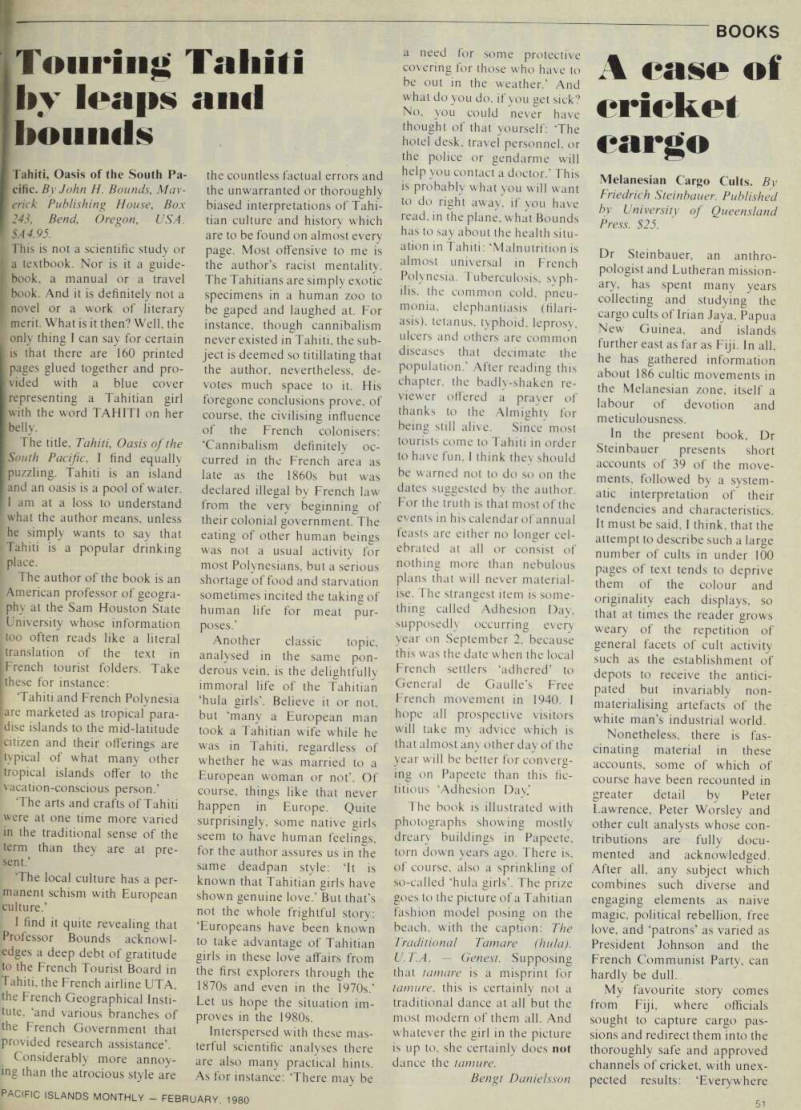
by leaps and bounds
I Tahiti, Oasis of the South Pa- I cific. By John H. Bounds, Mav- I erick Publishing House, Box 1 243, Bend, Oregon, USA.
I $ A 4.95. i This is not a scientific study or a textbook. Nor is it a guide- I book, a manual or a travel I book. And it is definitely not a [ novel or a work of literary merit. What is it then? Well, the t only thing I can say for certain I is that there are 160 printed
[ pages glued together and pro-
Ivided with a blue cover I representing a Tahitian girl [with the word TAHITI on her
I belly.
The title, Tahiti, Oasis of the
I South Pacific, I find equally
[puzzling. Tahiti is an island I and an oasis is a pool of water.
I I am at a loss to understand what the author means, unless he simply wants to say that Tahiti is a popular drinking
place.
The author of the book is an American professor of geogra phy at the Sam Houston State University whose information : too often reads like a literal [translation of the text in French tourist folders. Take these for instance; ‘Tahiti and French Polynesia [are marketed as tropical para dise islands to the mid-latitude citizen and their offerings are typical of what many other tropical islands offer to the vacation-conscious person.’ ‘The arts and crafts of Tahiti were at one time more varied in the traditional sense of the term than they are at pre sent.’ ‘The local culture has a per manent schism with European culture.’
I find it quite revealing that Professor Bounds acknowl edges a deep debt of gratitude to the French Tourist Board in Tahiti, the French airline UTA, the French Geographical Insti tute, ‘and various branches of the French Government that provided research assistance’.
Considerably more annoy ing than the atrocious style are
the countless factual errors and the unwarranted or thoroughly biased interpretations of Tahi tian culture and history which are to be found on almost every page. Most offensive to me is the author’s racist mentality.
The Tahitians are simply exotic specimens in a human zoo to be gaped and laughed at. For instance, though cannibalism never existed in Tahiti, the sub ject is deemed so titillating that the author, nevertheless, de votes much space to it. His foregone conclusions prove, of course, the civilising influence of the French colonisers: ‘Cannibalism definitely oc curred in the French area as late as the 1860 s but was declared illegal by French law from the very beginning of their colonial government. The eating of other human beings was not a usual activity for most Polynesians, but a serious shortage of food and starvation sometimes incited the taking of human life for meat pur poses.’
Another classic topic, analysed in the same pon derous vein, is the delightfully immoral life of the Tahitian ‘hula girls’. Believe it or not, but ‘many a European man took a Tahitian wife while he was in Tahiti, regardless of whether he was married to a European woman or not’. Of course, things like that never
happen in Europe. Quite
surprisingly, some native girls
seem to have human feelings, for the author assures us in the same deadpan style: ‘lt is known that Tahitian girls have shown genuine love.’ But that’s not the whole frightful story: ‘Europeans have been known to take advantage of Tahitian girls in these love affairs from the first explorers through the 1870 sand even in the 19705.’
Let us hope the situation im proves in the 1980 s.
Interspersed with these mas terful scientific analyses there are also many practical hints.
As for instance: ‘There may be
a need for some protective covering for those who have to be out in the weather.’ And what do you do, if you get sick?
No, you could never have thought of that yourself; The hotel desk, travel personnel, or the police or gendarme will help you contact a doctor.' This is probably what you will want to do right away, if you have read, in the plane, what Bounds has to say about the health situ ation in Tahiti; ‘Malnutrition is almost universal in French
Polynesia. Tuberculosis, syph
ilis. the common cold, pneu monia, elephantiasis (filari
asis). tetanus, typhoid, leprosy,
ulcers and others are common diseases that decimate the
population.’ After reading this
chapter, the badly-shaken re
viewer offered a prayer of thanks to the Almighty for being still alive. Since most tourists come to Tahiti in order to have fun. I think they should be warned not to do so on the dates suggested by the author.
For the truth is that most of the events in his calendar of annual feasts are either no longer cel ebrated at all or consist of nothing more than nebulous plans that will never material ise. The strangest item is some
thing called Adhesion Day,
supposedly occurring every
year on September 2. because this was the date when the local French settlers ‘adhered’ to General de Gaulle’s Free French movement in 1940. 1
hope all prospective visitors
will take my advice which is that almost any other day of the year will be better for converg ing on Papeete than this fic titious ‘Adhesion Day.’
The book is illustrated with
photographs showing mostly
dreary buildings in Papeete,
torn down years ago. There is, of course, also a sprinkling of so-called ‘hula girls’. The prize goes to the picture of a Tahitian fashion model posing on the beach, with the caption: The Traditional Tamare (hula).
U.T.A. — Genest. Supposing that tamare is a misprint for tamure , this is certainly not a traditional dance at all but the most modern of them all. And whatever the girl in the picture is up to, she certainly does not dance the tamure.
Bengt Danielsson
cargo


A case of cricket cargo
Melanesian Cargo Cults. By Friedrich Steinbauer. Published
by University of Queensland
Press. $25.
Dr Steinbauer, an anthro pologist and Lutheran mission ary, has spent many years
collecting and studying the
cargo cults of Irian Jaya, Papua New Guinea, and islands further east as far as Fiji. In all. he has gathered information about 186 cultic movements in the Melanesian zone, itself a labour of devotion and meticulousness.
In the present book. Dr Steinbauer presents short accounts of 39 of the move ments, followed by a system atic interpretation of their tendencies and characteristics.
It must be said, I think, that the attempt to describe such a large number of cults in under 100 pages of text tends to deprive them of the colour and
originality each displays, so
that at times the reader grows weary of the repetition of general facets of cult activity such as the establishment of depots to receive the antici pated but invariably non materialising artefacts of the white man’s industrial world.
Nonetheless, there is fas cinating material in these accounts, some of which of course have been recounted in greater detail by Peter Lawrence, Peter Worsley and other cult analysts whose con tributions are fully docu mented and acknowledged.
After all, any subject which combines such diverse and engaging elements as naive magic, political rebellion, free love, and ‘patrons’ as varied as President Johnson and the French Communist Party, can hardly be dull.
My favourite story comes from Fiji, where officials sought to capture cargo pas sions and redirect them into the thoroughly safe and approved channels of cricket, with unex
pected results: ‘Everywhere
S new cricket clubs were opened «... and a multitude of offices with high-sounding names were created, such as major general, lord high admiral, and secretary for foreign affairs. [Soon the play became serious.
The group elected its own governor, and a supreme court I judge. The cricket clubs I became the cells of a political I movement .. .’ : Friedrich Steinbauer well understands, however, that behind these often bizarre manifestations there lie serious
and profoundly moving crises
brought on by the attempt of Melanesians to comprehend,
I assimilate and adapt to rapid
j and drastic changes which have
■ vastly changed their lives and
■ upset the cosmology by which
I their ancient ways were ■ordered. Indeed, I believe that [Dr Steinbauer, in his introduc- Ition, is inclined to over-drama- Itise the current significance of [the cultic movements by claim ing that ‘they affect indeed the
[worldwide political, religious
! and intellectual spheres in which we are all involved’ and that ‘what takes place today in
the Pacific is of greater impor tance than was once thought’.
These are obviously truisms in one sense, but they tend to downgrade the overall ten dency over time for the cults to become transformed into or subsumed within movements with more modern aims and procedures, such as co operatives, welfare associa tions and even political parties.
Cults and cult manifestations will be with us for some time to come, and the aspirations and frustrations they express will surface in many different forms, but they themselves are
essentially transitional
movements which are in the process of being transcended.
Dr Steinbauer has elabor ated the most comprehensive and detailed typology of the cargo cults to date. Broadly, he divides them into three groups based on their predominant characteristics: 64% are
labelled magico-mechanical,
having the acquisition of
wealth as their mam aim; 18% are classed as religious in
nature; and a further 18% are viewed as primarily social political. The predominance of each type is related to a specific environment: magical cults are concentrated among mountain dwellers, religious cults among the more sophisticated coastal
populations bordering
Indonesia and Polynesia, and political cults among long established marine populations with a well-defined identity. Dr Steinbauer goes well beyond
this ordering, however, explor
ing such variables as bio climatic differences, the influence of drugs, and the characteristics of the leaders.
A full analysis of the Stein
bauer technique would require
a learned article to do it justice.
I can only say that, while I find his samples often too small to support his conclusions, and the data on many of the cult movements too sparse to justify firm type-casting, there is undoubtedly much in his approach to stimulate further specialist study in the field. The general reader may find this half of the book dense and
technical.
Rex Mortimer
Advertisements & other items, pp. 52-54 (1 item)
Aviation In The South Pacific
THE EXCITING NEW MERLIN IMS
IS ABOUT TO CHANGE.
i'ML\
I Merlin 1118 is an aircraft that is very much in touch with the 1980 s.
It presents an impressive array of features that will upgrade standards of aviation comfort and operation in the South Pacific area.
Merlin 1118 from Swearingen
Aviation Corporation has speed,
around 355 mph cruise, thanks to
powerful twin turboprops.
Merlin 1118 has quiet comfort Slow turning props plus noise barrier acoustic walls to dampen sound add to passenger comfort.
Then there’s pressurisation and a roomy cabin for up to 10 people.
Merlin 1118 has endurance, with an operational range of 2,425 nautical miles plus IFR reserves.
Merlin 1118 is distributed by Stillwell Aviation in the South Pacific. Inaugural demonstration test flights will be conducted in If you’d like to inspect and discuss the exciting new Merlin 1118 when it visits your area, contact Stillwell Aviation now. Join us on our program of demo flights by completing the coupon below. the region soon. 0
WE'RE FLYING YOUR WAY.
JOIN US FOR A DEMO FLIGHT.
Captain Neil Morris.
B.S. Stillwell Aviation.(AMsia) Pty. Ltd.
P.O. Box 161, Kew. Victoria, 3101/Australia.
Please register my name for your demonstration flights of Swearingen Merlin 1118.
Name Address B.S. Stillwell Aviation (A/Asia) Pty. Ltd.
P.O. Box 161, Kew, Victoria, 3101, Australia. Phone (03) 80 4485.
OVER 600 PAGES
OF ALL THE
LATEST IN
MACHINERY
FOR THE
MODERN FARMER!
• Tractors • Stationary Engines • Welding • Hand and Power Tools • Earthmoving • Alternative Energy wind, solar etc.— • Electronics • Trailers • Materials Handling • Chain Saws - • Many other sections
1980 POWER
FARMING
TECHNICAL
ANNUAL
SA9POSTED
ANYWHERE
Order from;
POWER FARMING BOOKSHOP
Box 3408, GPO, Sydney.
NSW, 2000, Australia.
offers expert insurance service
throughout the Islands.
QBE INSURANCE LIMITED
Central Office: 82 Pitt Street, Sydney.
NEW CALEDONIA T.A. Hagen_ Ste lA/.A. Johnston, S.A.R.L. ■ Noumea.
NEW HEBRIDES Manager: G.F. Donnelly, Vila: Santo Santr: Burns Phi/p (New Hebrides) Ltd.
TAHITI - Arthur Chung: Immeub/e 8.1., Front de Mer, Papeete.
NIUE, NORFOLK ISLAND, SAMOA, TONGA and other South Sea Islands Burns Philp (South Sea) Company Ltd.
QUEENSLAND INSURANCE (FIJI) LIMITED
Head Office, 34 Usher St., SUVA. General Manager: L.G. Liddell. A.A.1.1.
Assistant Managers: Vijay Lal and J.T. Laidlaw. LAUTOKA Office, Burns Philp Bldg. District Manager: J. Dalton.
QUEENSLAND INSURANCE (RN.C.) LIMITED
PAPUA NEW GUINEA -
Head Ofhce, PORT MORESBY. General Manager: J.M, Dawe. Assistant Manager: R.V. Maskell.
District Managers at: LAE: I.R Martin. MOUNT HAGEN: D.F , Carroll ARAWA: J Longbut MADANG R.W.V. Ceilings. RABAUL: W.F. Tinker)
OUT" P
OFF
v * *
SMZmKiI
// • £ r Spending a lot of time on cross-country travel or errands?
Seeking something with dependable power, yet economical?
Make it in good time with one of our "get-about" machines.
Go with a Suzuki! choose one of our performance-proven motorcycles, just answering your travel needs.
pOW| B
MOOB
m
a no
DTBS
Look further into Suzuki's traditional excellence and discover the results in our 4-wheel drive vehicles and fleet of outboard motors something to satisfy your every motoring need.
Going by land or by sea . . . go with a Suzuki.
SUZUKI MOTOR CO, LTD
Hamamatsu, Japan
SUZUKI 4 WHEEL
DRIVE VEHICLE
SUZUKI
SOLOMON ISLANDS SOLOMON ISLAND SERVICE STATION LTD. • NEW CALEDONIA STE. SUPERCAL • PAPUA NEW GUINEA TUTT BRYANT PACIFIC LTD. • NEW HEBRIDES HENRI LEROUX • NIUE ISLAND BURNS PHILP (SOUTH SEA) CO., LTD. • PONAPE LEO ETSCHEIT • TAHITI NIPPON AUTOMOTO • ELLICE ISLAND TUVALU COOPERATIVE WHOLESALE SOCIETY LTD. • GUAM & SAIPAN ISLAND CYCLERY, INC. • NORFOLK MARTIN'S AGENCIES LTD. • SAMOA PACIFIC PRODUCTS, INC. • TARAWA GILBERT ISLANDS COOPERATIVE FEDERATION LIMITED • TONGA MORRIS HEDSTROM LTD. • WESTERN CAROLINES BECHESRRAK T. COMPANY • AMBROSE D. MINGINFEL'S WHOLESALER • EASTERN CAROLINES KIOMASA STORE
Barclays in
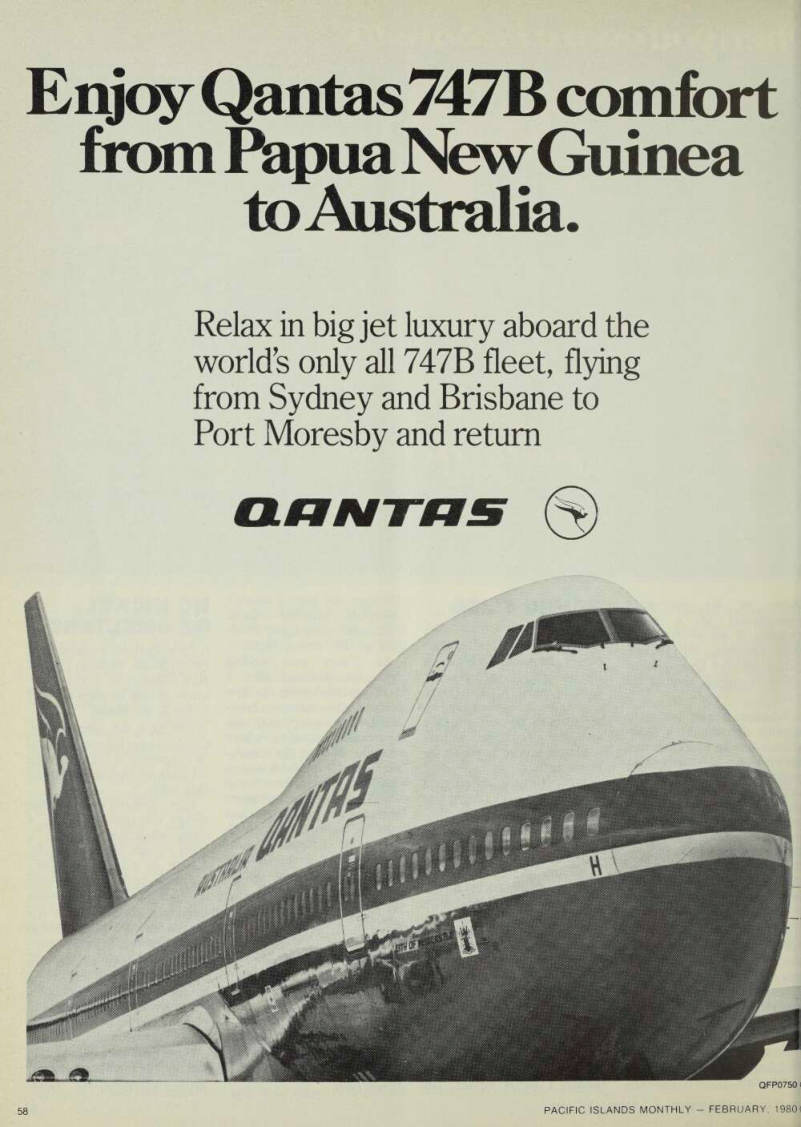
Trade
Winds
Blue Chip out,
Barclays in
on Tuvalu
[ Tuvalu plans to withdraw the $550 380 which Prime Minister ‘ Toalipi Lauti invested with I Californian real estate dealer Mr Sidney Gross and his Blue I Chip Realty Investments. [ (PIM, May, 1979, p 42). The [ money is needed to buy the I Tuvaluans a share in a bank [ which Barclays Bank Inter- I national will establish in Tuvalu as a joint venture with the Tuvalu Government.
Parliament was told at its December session that the government had accepted pro posals from Barclays to establish the bank with the government owning 75% and Barclays 25% of the capital share issue. Prime Minister Lauti said the money invested with Blue Chip Realty was now needed for the banking ven ture. The long-term aim was for Tuvalu to acquire Barclays’ share so that, eventually, the bank would be wholly owned : by the government and people of Tuvalu.
While at Funafuti last Sep tember, Mr Gross told the Prime Minister that the orig inal investment had earned $3l 560.50 so that Tuvalu’s stake in Blue Chip was almost $582 000 by last September.
While in Funafuti Mr Gross asked for a charter to open a bank in Tuvalu. No further in formation was offered to Par liament by the Prime Minister.
The ‘Speech from the Throne’ given by the Speaker, Elia Tavita, in the absence through illness of the Governor-General, Sir Fiatau Penitala, was strongly criticised by the four-member Oppo sition which claimed that the government used the speech for self-praise. Mr Faati Naisali (Nukulaelae) challen
ged the government to have Parliament dissolved and have fresh elections because he was losing confidence in the government’s policies.
Opposition members also attacked the government’s monetary policies, alleging that so far as money was concerned.
Tuvalu’s relations with the United Kingdom had gone sour and complicated when, previously, they were simple and easy.
From Copper
Into Gold?
If the price of gold keeps rising, perhaps Bougainville Copper will change its name to ‘Bougainville Gold’, according to a January comment by an Australian financial writer.
The price of gold had just passed SUS6OO an ounce on world markets.
The 740 000 ounces of gold produced annually on Bougainville had a current market value of just over SA4OO million. This compared with the market value of $350 million of its annual pro duction of 175 000 tonnes of copper.
If the price of gold remains anywhere near present levels, Bougainville’s profits would benefit very considerably as would the Papua New Guinea Government, which is entitled to 70% of ‘excess’ profits made by the company.
New Paper
On Guam
The Guam Tribune, the island’s second daily newspaper, struggled into existence on December 1, 1979. The first 120-page, tabloid-size issue featured a congratulatory letter from the White House addres sed to publisher Mark Pan gilinan and signed by President
Jimmy Carter.
The Tribune, christened by 50 people who shared a US $lOOO prize in a pre publication contest, is the cap stone in Mark Pangilinan’s commercial empire on Guam.
The astute, 51-year-old Filipino entrepreneur laid his business cornerstone when he arrived on the war-ravished island.
In 1946 the 18-year-old
sailor from the Philippines was persuaded to establish a tailor ing shop to cater to the thou sands of Filipino construction workers who were too small in stature for available U.S. ready-to-wear garments. His string of prosperous
companies, which employ 1000
persons, ranges from a propane gas distributor and Honda automobile dealership to a
five-storey department store
with supermarket and esca lators. His only serious business blunder was a million dollar amusement park which failed to catch the interest of
honeymooning Japanese tour
ists.
Marcus Pangilinan’s organ isational and management skills have been lent to the Guam Power Authority and the University of Guam Board of Regents. He served success fully as chairman of both bodies, an accomplishment of no little significance for a high
school graduate. Pangilinan
has also been a central, unify
ing figure in the linguistically
and politically divided Filipino
community of Guam, which treats him as an elder states man.
The Guam Tribune meets the
Pacific Daily News (PDN)
head-on in the morning mar ket. The ‘Trib’ bills itself as
“your community newspaper.”
a jab at the national and inter national scope of its competi tor, the western link in the hundred-U.S.-cities Gannett newspaper and television chain, which proclaims that it is published “Where America’s
day begins.”
The Tribune's maiden issue, which was delivered free to every household on Guam, fol lowed on the heels of three me
diocre practice issues. Major
technical problems cropped up
in establishing a dependable
connection with the Washing ton Post/Los Angeles Times Wire Service. Most of the syn dicated comic strips got lost in the mail and the new equip
ment for processing photo
graphs onto rubberised mats arrived in defective condition.
On the positive side, the pub lisher corralled a four-months’
supply of newsprint in a tight
supply market.
The Compugraphic typeset ter, which produces type from strips of film, and the new 8-unit Goss Community web offset press, which prints a
single-colour, 64-page edition
at 18,500 copies per hour, have worked perfectly, except dur ing a four-hour island power cut which occurred the day be fore the printing plant’s emerg ency power generator was hooked up.
George M. Dobry came in from California as associate publisher and Glenda Moore, an experienced figure in Guam newspaper work, is managing editor. Moore writes the edi torials.
In the paper’s first week the staff squarely faced the dif ficult decision whether to print a news story that came out of the local courts. The Tribune broke the news that Mrs Jan Chargualaf Tanaka, wife of
Thomas Tanaka, speaker of th« Guam Legislature, had re: quested separate maintenanc: for herself and their six chil! dren and a monthly stipend a U 553,500 on grounds that he husband had committei adultery. Mrs Mary Elaine Sa Nicolas Cadigan, the directa of the Guam Department c Education, was named in thi suit. The ‘Trib’ reported thi with a headline on page 4. Thi PDN buried the same report ii police news the followini
day.
Subsequently, Mrs Cadigai
submitted letters of resignatioi to Gov. Paul Calvo and to thi elected Board of Education She wrote that she wished t«; pursue ‘further studies in edu. cation.’
Advertising money is the lifl blood of Guam’s communi cations media. With two com mercial colour televisioc stations (including a multi channel island-wide cable T v company) and four commen cial radio stations seekim
shares of the advertising expenditures of a rather anaemic, if not artificial, civ ilian economy, can the in flation afflicted Guam public i afford to support another 25c
daily?
I Whether it can or not, it appears that the M. V. Pan gilinan family of enterprises, always heavy advertisers in the pages of the PDN, are cau tiously beginning to throw a share of their budgets in favour of their sibling, the Guam Trib une. The reading public, still hungry for the variety of news it was promised, has found the hard news in the two papers
largely repetitious.
When establishment of the Tribune was still a rumour, Joseph C. Murphy, editor of the rival PDN for over a dec ade. estimated that an invest ment of four million dollars would be required to start a new daily in Guam. Publisher Pangilinan recently stated that he is committed to keeping the fledgling newspaper alive for three years. - Larry Lawcock
Nauru Flies
To Nz
A weekly air service between Nauru and Auckland began on December 1. And Nauru’s consul-general, Mr Les Davis, expects trade between the two countries to ‘take-off with the arrival of a fast, direct and re liable air service between the two countries.
Air Nauru is offering a
special commodity freight rate
of 38C a kilogram for perish able goods as an incentive for Auckland exporters.
The one-way economy fares to Nauru ($271), Port Vila ($170) and Honiara ($230) are well below those available on other airlines.
From December 8 Air Nauru’s flight schedule was for a 10.30 pm arrival at Auckland on Saturdays and a 12.15 pm
departure the next day.
The inaugural flight on
December 1 was celebrated that night at Auckland’s swish Hotel Inter-Continental when President Hammer Deßoburt hosted a buffet dinner. The
following day New Zealand’s
Transport Minister Colin Maclachlan joined the Presi dent on the return flight.
Air Nauru won landing rights to Auckland after a seven-year battle with the New Zealand Government. Presi
dent Deßoburt explained why
the republic wanted to fly here when he opened the Consu late-General in Auckland a year ago. He said then that it would enhance closer relations between the two countries and help Air Nauru’s ‘north-south
operation’ the linking of
New Zealand and Australia with Central Pacific islands like Guam and Kiribati.
He agreed that Nauru was turning to New Zealand rather than its traditional mentor Australia for certain kinds of assistance.
Almost all the expatriates working on Nauru come from New Zealand. Others are being recruited. Six couples will go there in January to take up teaching posts and seven com puter operators are wanted.
James fully
Nc Nickel,
Nz Smelter?
A New Zealand businessman, Ernest Smith, wants to process New Caledonian nickel ore at a new smelter he plans to build in the South Island. ‘We have the energy, New Caledonia has the ore,’ he says. ‘We’re islands in the same area I think we should be helping each other.’
New Zealand’s renewable energy resources would be a major attraction for such a plant and the New Cale donian ore is of high quality.
French trade commissioner in New Zealand, Christian Beaucoup says his office has
approached five large groups
on Mr Smith’s behalf.
Should the right partner turn up, finding the $6O million re
quired for the project might not
be much of a problem. The plant would be a small one by world standards.
New Zealand’s Minister of Energy, Mr Birch, said that Mr Smith’s company, NZ Nickel
• Smelters Ltd, could negotiate a I bulk electricity tariff con cession with the government.
Nauru:
Seaborn
Power?
I Nauru is moving heavily into
an experiment designed to gen
erate electricity by using tem
perature differences in the sea.
If the experiment is successful the Nauru Government will order four 2500 kw plants at an estimated cost of $6O-80 million. The electricity will be used to desalinate water which will be used for the island’s agriculture. Contractor for the project is the Tokyo Electric Power Service Company Ltd.
Cl Produce
For Usa
The door permitting Cook Islands produce to enter the United States mainland opened a little in December when the US Department of Agriculture approved the entry of Cl fresh pineapple, taro and tarua.
The items are the first from a list of Cl produce to be given the go-ahead. The list was sent to the USDA by Cooks Premier Dr Tom Davis.
Describing the move as ‘a useful start’, a Cl Ministry of
Agriculture spokesman said
there were still many Cl pro ducts for which entry rights were being sought. One of these is pawpaw. The spokes man said he believed the local variety would be welcomed by American consumers.
Bhanabhais
Sell Big
In one of the biggest foreign property investments in Fiji for some time, a trust company, Prescom, has paid a total of SF2 025 000 for two buildings in central Suva, the Hotel Suva and a property on the corner of Cumming St and Renwick Rd.
Prescom Ltd is a Fiji-registered company with head office in the Channel Islands and three Dutchmen as directors. Both properties were sold by the Bhanabhai family, most of whom live in Hong Kong or India.
Advertisements & other items, pp. 55-62 (2 items)
Henry Cumines
AUCTION
SOUTH SEAS ISLANDS
LUXURIOUS VILLA
Set in an acre of landscaped grounds on Soqulu Plantation on Taveuni Island (the third largest of the Fiji group), this architect-designed villa captures magnificent views across Somo Somo Strait to Vanua Levu.
Soqulu Plantation has been carefully designed and developed over the years to provide a luxurious setting for those wishing a tropical retreat away from the generally accepted tourist resorts.
The property is offered fully furnished and included is a 2-door station sedan.
To be offered to Public Auction in the theatrette, Australia Square, Sydney, Australia, on Friday 18th April, 1980, at 10.30 am.
For brochure, further details and inspections, contact Joint Agents:
LAND TRANSACTIONS LIMITED,
3 Mai Street, Suva. Phone Suva 22451.
or RICHARDSON & WRENCH LIMITED,
Auction Department, 92 Pitt Street, Sydney.
Phone (02) 232 8522.
HENRY CUMINES
PTY. LTD.
EXPORTERS o GENERAL MERCHANTS
428 GEORGE ST., SYDNEY
CABLES; HENCO SYDNEY. G.P.O. Box 3949. PHONE; 232-5377
For specialised and personalised buying service
throughout the Pacific Islands and the East.
• LOCAL AGENTS AND REPRESENTATION:
PAPUA NEW GUINEA: FIJI:
RABAUL: M. & C. Seeto, P.O. Box 131, Rabaul.
Telephone 92-2919.
K. Witherington Ltd., P.O. Box 293, Suva.
Telephone 22-356.
MADANG: W. Double. NEW HEBRIDES:
P.O, Box 22, Madang.
Telephone 82-2696. John Lum & Associates, P.O. Box 65, Santo.
Telephone 329..
SOLOMON ISLANDS:
Mr. Tom Lo, P.O. Box 327, Honiara.
Telephone 399.
Resident Agents in other Pecific Territories.
For more information contact: • Kelvinator Australia Limited .. . Adelaide, South Australia • Truk Cooperative Association ... Truk, Eastern Caroline Islands • Ben Inc... Yap District, Western Caroline Islands • Cook Islands Trading Corporation , Ltd. .. Rarotonga, Cook Islands • Carpenters Fiji Li Enterprises ... Majuro, Marshall Islands • Electric Radio Noumea ... Noumea, New Caledonia • Pentecost Pacific SA... Port-Vilai Pacific Traders, Inc... Pago Pago, American Samoa • Motor Distributors (Samoa) Ltd.. . Apia, Western Samoa • Guadalcanal Ele
whenyouownaKelvinator
■ Refrigerators, Freezers, Gas and Electric Ranges, Air Conditioners, Automatic Washers and Dryers, Wringer Washers, Microwave Ovens, Humidifiers, Dehumidifiers.
Water Coolers, Commercial Air Conditioners and Refrigerators.
Q Q < 0 i rises •.. Ponape, Eastern Caroline Islands • Western Carolines Trading Co.. . Palau, Western Caroline Islands • Family Chain Stores, ► Suva, Fiji • Pacific International Co., Inc. . . Agana, Guam • M.S. Villagomez Enterprises ... Saipan, Mariana Islands • Robert Reimers •brides • Fisher & Paykel Ltd... Panmure, New Zealand • Bums Philp (New Guinea) Ltd.. . Port Moresby, Papua New Guinea • South i . Honiara, Solomon Islands • Ets. ReneSolari etFils .. . Papeete, Tahiti • E.M. Jones ... Nukualofa, Tonga
Enjoy Qantas747B comfort
from Papua New Guinea
to Australia.
Relax in big jet luxury aboard the
world's only all 7478 fleet, flying
from Sydney and Brisbane to
Port Moresby and return
OIHNTHS
a m WM n m m * M mm* ■ . l P ! Ll ■vF; ■PP m
Perex
Agencies Ltd.
Specialists in KITSET FURNITURE.
PACIFIC AGENTS "Personality” Brand.
Perex Kraft "Alternative” Caskets
fcrrr
I Comer Bunks $ - converts to two single beds
BRANCHES NOW OPEN IN QUEENSLAND
at 3255 PACIFIC HIGHWAY - UNDERWOOD
r r e . x / 9encies Ltd 87 Fort st Auckland Phone 795-872 Telex Ex Inst. NZ 21796 Perex T PLEASE SUPPLY ME WITH FURTHER DETAILS.
I NAME
I I L
ADDRESS
pim
p6 ERy* * A O o in & 6/
FOR
IN OUR 85th YEAR SELLING ‘SERVICE’
TO THE PACIFIC ISLANDS . . .
Nelson&Robertson
PTY. LTD. (Established 1895)
Plantation House, 197 Clarence Street, Sydney.
Cables: ‘IVAN’, Sydney, Brisbane. Telex: AA22381, Sydney.
INDENTS - FROM AUSTRALIA, NEW ZEALAND and OVERSEAS.
FOODSTUFFS • HARDWARE • TRAVEL • CANNED FISH MACHINERY • INSURANCE • SOFTGOODS • JUTE GOODS
• REAL ESTATE •
D I
BRANCH OFFICES:
PAPUA NEW GUINEA
REPRESENTATIVES:
Nelson & Robertson Pty. Ltd,, P.O. Box 575, Brisbane, Qld., Australia.
P.O. Box 2092, Govt. Bldg., Suva, Fiji. P.O. Box 258, Lautoka, Fiji.
P.O. Box 2420, CPO Auckland 1, New Zealand.
Rabtrad Niugini Pty. Ltd., P.O. Box 219, Rabaul, P.N.G.
P.0.80x 1406, Lae, P.N.G. P.O. Box 711, Madang, P.N.G.
P.0.80x 253, Kieta, P.N.G. _fl)
Simply A Pleasure
For The Whole Family.
Isn’t it time you started taking better pictures?
It’s easy. Start with the new Ricoh KRS. Mow, snapshots are no longer potshots.. .professional results are no longer a mystery. Quite simply, here’s one SLR camera the whole family can use.
A Handling Beauty Just the right size and weight make the KRS a pleasure to handle and carry. Insert your favorite 35mm film and the fun begins.
KR-5
Ricoh
And versatile 3-way focusing, for edge-to-edge sharpness.
An SLR Viewfinder What you see is what you get.
A large, bright through-the-lens view, for accurate composition. * <■
II ?r 1 I
o CdS Type TTL Metering Simply match the two viewfinder needles to set exposure.
Ricoh’s advanced electronics assure optimum light measurement. Day or night, indoors or out.
Choice of Interchangeable Lenses Group shots? Portraits?
Close-ups? Whatever the situation, take your choice of the high quality, easy-changing XR Rikenon lens selection.
And accessories.
i riflii RICOH
Ilf!
For more information about the Ricoh KRS, write to X RICOH COMPANY, LTD. 14-6, Ginza 6-chome, Chuo-ku,Tokyo 104, Japan. ) Distributors: Australia Bell & Howell Australia Pty. Ltd. •G.P.O. Box 4778, 55-69 Murray Street, Pyrmont, N.S.W., m * y Australia. New Zealand HE. Perry Ltd. *145 Victoria Street, P.O. Box 111, Christchurch 1, New Zealand, Norfolk Is.
Miltons Department Stores Ltd. •P.O. Box 146, Norfork Island 2899, South Pacific, Fiji Narseys Limited •Renwick Road, Suva, Fiji. Tahiti Ets.
Coutimex •B.P 617, Papeete, Tahiti (French Polynesia) New Caledonia Omnium Caledonien Importation «Rue de L’Esperance, B.P. 2248, Magenta, Noumea, Nouvelle-Caledonie.
TRADEWINDS INTELLIGENCE...TRADEWINDS INTELLIGENCE.
FIJI ELECTRICITY Authority launched mid-December a $2.5 million bond issue to help finance the Monasavu hydro-electricity scheme in Viti Levu. Fifteen year bonds totalling $1.5 million will return 8.4% a year interest and the balance of $1 million is at 7.5% for five years.
COMMERCIAL BANKS in Fiji are restricting loans to duty free dealers. Bank of New Zealand regional manager John Galt has [said according to a Fiji Times report. Mr Galt said this was in line with the Central Monetary Authority’s guidelines that banks should lend more to ‘productive’ areas and less to duty free store owners with stockpiles of goods. Those dealers had a lot of dead stock financed by bank overdrafts.
EMPEROR GOLD Mining Company at Vatukoula, Fiji, recruited 234 workers last year, bringing the payroll figures to 889 by the end of November, demonstrating the improvement in mining operations. If exploration, which has increased, uncovers more gold deposits, the workforce will be increased to 1600.
NAURU HOUSE, the 52-storey building in Collins Street, Melbourne, one of Nauru’s intelligent investments, which can house a bigger population than the island, has a new, and impressive tenant, the Australian Conciliation and Arbitration Commission.
And all eyes and ears were on the building recently. The first decision to come out of the commission’s quarters was the ruling of the Full Bench on the national wage hearing.
THE DRAMATIC December take-over of the giant Australian company Ansett Transport Industries by media tycoon Rupert Murdoch was aided by the action of the Nauru Phosphate Royalties Trust in selling to Murdoch 1 075 000 shares it held in Ansett.
The sale took place at a critical moment for the massive take-over bid.
KIRIBATI announced in January that it would increase customs tariffs on a wide range of consumer goods including staple foods, beer and tobacco to compensate for loss of revenue from phosphate mining on Banaba. Finance Minister Tiwau Awira said in his budget speech that 1980 revenue would fall by more than SA7 million compared with 1979. Estimated total revenue was $l3 million.
THE AUSTRALIAN Government has decided not to approve a new air fares package proposed by the International Air Transport Association (lATA) for the Australia-Japan route. The Australian Minister for Transport, Mr Hunt, said in December that one of the fares proposed for a Sydney-Tokyo round trip is about 50% higher on a cents per kilometre basis and the comparable fare for a Sydney-Singapore round trip. He said a request for immediate talks had been made to the Japanese Government.
AIR PACIFIC has decided to buy two more Brazilian-built Bandeirante aircraft. The Fiji airline already operates one Bandeirante. Air Pacific’s net profit for 1978-79 was $l5lOOO, compared with $627 000 in the previous year. The loss occurred in spite of increases in earnings and passenger and cargo business.
There was a loss of $5OO 000 caused by delays in starting extra flights to New Zealand.
BURNS, Philp & Co gained control of more than 50% of the ordinary capital of Hanimex Corporation Ltd, manufacturers of photographic and electronic equipment, over the end-of-year period. In late December BP bought 40% of Hanimex for $l9 million from Melbourne businessmen Abe Goldberg and Morris Joss. Subsequent acquisitions brought its share to 52%.
INTEGRATED TECHNICAL SERVICES
• SALES
• ON SITE INSTALLATION
• FIELD SERVICE
• HF,VHF, UHF LINK AND MOBILE SYSTEMS
• GROUND AIR COMMUNICATIONS
• MARINE NAVIGATION AND COMMUNICATIONS
• AIRCRAFT ELECTRONIC SYSTEMS
DISTRIBUTORS OF:
• CODANHFSSB SYSTEMS
• PHILIPS VHF/UHFFM MOBILE SYSTEMS
• JRC MARINE RADAR, SOUNDERS, SATTELITE NAVIGATORS
• MAGNAVOX SATTELITE NAVIGATORS
• DECCA MARINE RADAR
• KING, MARCO, SUNAIR, COLLINS AIRCRAFT RADIO SYSTEMS
FIELD ENGINEERING INTEGRATED TECHNICAL SERVICES
P. 0. Box 350, Cairns 4870, Queensland, Australia.
Phone: (070) 51 1616,51 4826,53 1356,51 3052. Telex: AA 48085
MANUFACTURERS OF:
• PORTABLE DEPTH FINDERS
• HF RADIO SCANNERS
• VOICE SCRAMBLERS
• MICROPROCESSOR BASED
CONTROL SYSTEMS
CHLORIDE
A I * Chloride is the largest and only manufacturer of both lead acid and nickel cadmium alkaline batteries in Australia.
The Company is equipped and qualified to offer advice, guidance and service on any battery requirement no matter how large or small.
On the question of size, it could be as small as a battery for a hearing aid the dimensions of a coat button or a power station battery weighing as much as 40 tonnes.
Again it could be a no break D.C. Power System for a computer or emergency lighting for a hospital.
The Chloride Company operates in 40 countries throughout the world, and when you consider that in Australia alone its production is approaching VA million batteries per year, it gives some idea of the far reaching role that batteries play in our lives.
A selection of Chloride Automotive and Industrial Batteries.
Chloride Batteries Australia Limited
P.O. Box 141, Bankstown. IM.S.W. 2200. Australia. Telephone: 77 0177. Telex: 21262
57
'ACIFIC ISLANDS MONTHLY - FEBRUARY, 1960
ships serving Pitcairn?
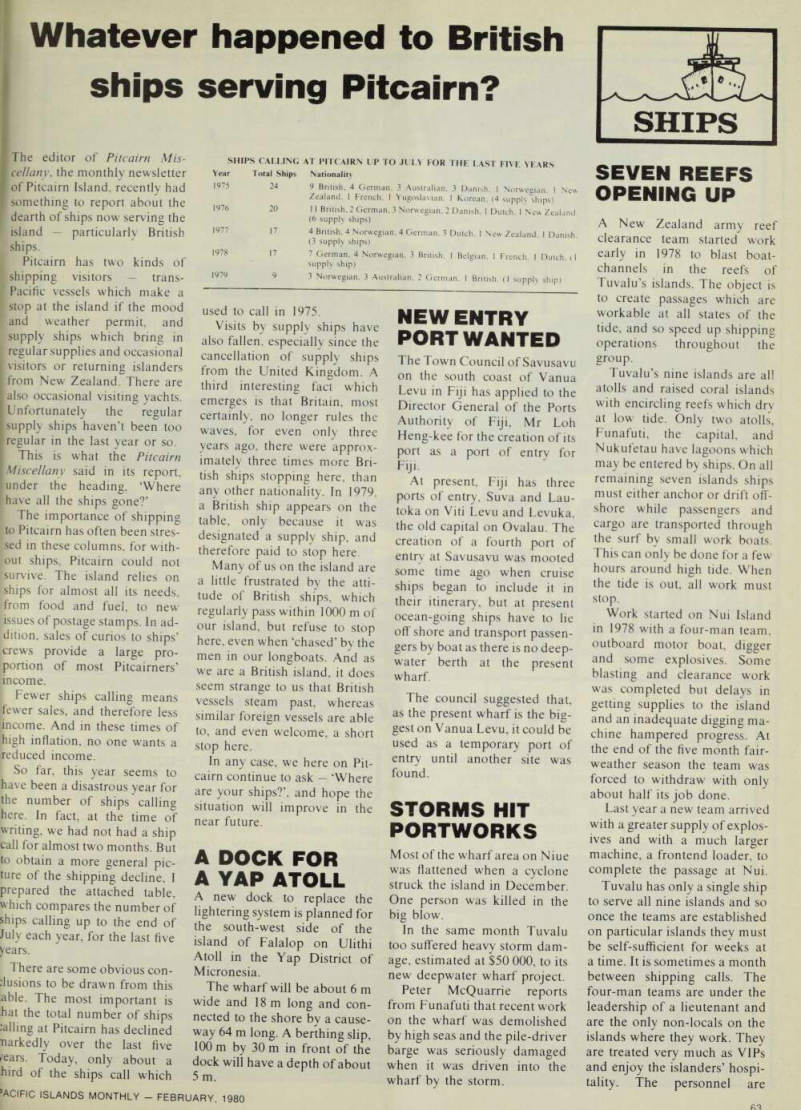

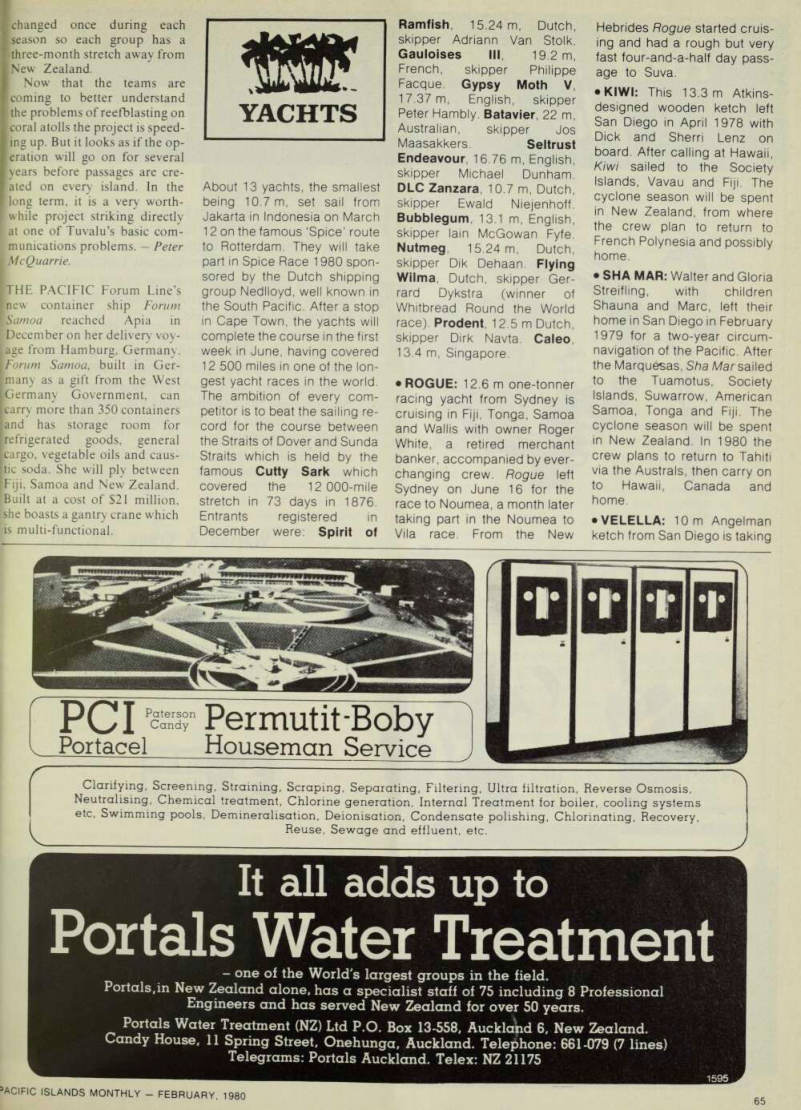
Ships
Whatever happened to British ships serving Pitcairn?
I The editor of Pitcairn Mis cellany’, the monthly newsletter of Pitcairn Island, recently had something to report about the dearth of ships now serving the island particularly British
ships.
Pitcairn has two kinds of
I shipping visitors trans
pacific vessels which make a * stop at the island if the mood and weather permit, and
supply ships which bring in
[ regular supplies and occasional
[visitors or returning islanders
[from New Zealand. There are
[also occasional visiting yachts.
[Unfortunately the regular [supply ships haven’t been too I regular in the last year or so.
This is what the Pitcairn I Miscellany said in its report,
[under the heading, ‘Where
[ have all the ships gone?’
The importance of shipping
to Pitcairn has often been stres sed in these columns, for with out ships, Pitcairn could not survive. The island relies on i ships for almost all its needs, [from food and fuel, to new issues of postage stamps. In ad dition, sales of curios to ships’
jcrews provide a large pro
portion of most Pitcairners’ income.
Fewer ships calling means
fewer sales, and therefore less income. And in these times of ■high inflation, no one wants a [reduced income.
So far, this year seems to have been a disastrous year for the number of ships calling here. In fact, at the time of writing, we had not had a ship call for almost two months. But to obtain a more general pic ture of the shipping decline, I prepared the attached table, which compares the number of ships calling up to the end of July each year, for the last five years.
There are some obvious con clusions to be drawn from this able. The most important is hat the total number of ships calling at Pitcairn has declined markedly over the last five
f'ears. Today, only about a
bird of the ships call which
SHIPS CALLING AT PITCAIRN UP TO JULY FOR THE LAST FIVE YEARS
used to call in 1975.
Visits by supply ships have
also fallen, especially since the
cancellation of supply ships
from the United Kingdom. A third interesting fact which emerges is that Britain, most certainly, no longer rules the waves, for even only three years ago, there were approx imately three times more Bri tish ships stopping here, than any other nationality. In 1979. a British ship appears on the table, only because it was
designated a supply ship, and
therefore paid to stop here.
Many of us on the island are a little frustrated by the atti tude of British ships, which regularly pass within 1000 m of our island, but refuse to stop here, even when ‘chased’ by the men in our longboats. And as we are a British island, it does seem strange to us that British vessels steam past, whereas similar foreign vessels are able to, and even welcome, a short stop here.
In any case, we here on Pit cairn continue to ask - ‘Where are your ships?’, and hope the situation will improve in the near future.
A Dock For
A Yap Atoll
A new dock to replace the lightering system is planned for the south-west side of the island of Falalop on Ulithi Atoll in the Yap District of Micronesia.
The wharf will be about 6 m wide and 18 m long and con nected to the shore by a cause way 64 m long. A berthing slip, 100 m by 30 m in front of the dock will have a depth of about 5 m.
New Entry
Port Wanted
The Town Council of Savusavu on the south coast of Vanua Levu in Fiji has applied to the Director General of the Ports Authority of Fiji, Mr Loh Heng-kee for the creation of its port as a port of entry for
Fiji.
At present, Fiji has three ports of entry, Suva and Lau toka on Viti Levu and Levuka, the old capital on Ovalau. The creation of a fourth port of entry at Savusavu was mooted some time ago when cruise ships began to include it in their itinerary, but at present ocean-going ships have to lie off shore and transport passen gers by boat as there is no deep water berth at the present wharf.
The council suggested that, as the present wharf is the big gest on Vanua Levu, it could be used as a temporary port of entry until another site was found.
Storms Hit
Portworks
Most of the wharf area on Niue was flattened when a cyclone struck the island in December.
One person was killed in the
big blow.
In the same month Tuvalu too suffered heavy storm dam age, estimated at $5O 000, to its
new deepwater wharf project.
Peter McQuarrie reports from Funafuti that recent work on the wharf was demolished
by high seas and the pile-driver
barge was seriously damaged
when it was driven into the wharf by the storm.
Seven Reefs
Opening Up
A New Zealand army reef clearance team started work early in 1978 to blast boat channels in the reefs of Tuvalu’s islands. The object is to create passages which are workable at all states of the tide, and so speed up shipping operations throughout the group.
Tuvalu’s nine islands are all atolls and raised coral islands with encircling reefs which dry at low tide. Only two atolls, Funafuti, the capital, and Nukufetau have lagoons which may be entered by ships. On all
remaining seven islands ships
must either anchor or drift off shore while passengers and cargo are transported through the surf by small work boats.
This can only be done for a few hours around high tide. When the tide is out, all work must stop.
Work started on Nui Island in 1978 with a four-man team, outboard motor boat, digger and some explosives. Some blasting and clearance work was completed but delays in getting supplies to the island and an inadequate digging ma chine hampered progress. At the end of the five month fair weather season the team was forced to withdraw with only about half its job done.
Last year a new team arrived with a greater supply of explos ives and with a much larger machine, a frontend loader, to complete the passage at Nui.
Tuvalu has only a single ship
to serve all nine islands and so once the teams are established on particular islands they must be self-sufficient for weeks at a time. It is sometimes a month between shipping calls. The four-man teams are under the leadership of a lieutenant and are the only non-locals on the islands where they work. They are treated very much as VIPs and enjoy the islanders’ hospi tality. The personnel are
Year Total Ships Nationality 1975 24 9 British. 4 German. 3 Australian. 3 Danish. I Norwegian. 1 New Zealand, 1 French, 1 Yugoslavian. 1 Korean. (4 supply ships) 1976 20 11 British. 2 German. 3 Norwegian. 2 Danish, I Dutch. 1 New Zealand (6 supply ships) 1977 17 4 British. 4 Norwegian, 4 German. 3 Dutch, 1 New Zealand. 1 Danish. (3 supply ships) 1978 17 7 German. 4 Norwegian. 3 British. 1 Belgian. 1 French. 1 Dutch. (1
supply ship)
1979 9 3 Norwegian, 3 Australian. 2 German. 1 British. (1 supply ship)
I changed once during each ■ season so each group has a I three-month stretch away from ■ New Zealand. [ Now that the teams are ■ coming to better understand
I the problems of reefblasting on
[coral atolls the project is speed-
I ing up. But it looks as if the op leration will go on for several ■years before passages are cre mated on every island. In the [long term, it is a very worth
f while project striking directly
at one of Tuvalu’s basic com munications problems. Peter
I McQuarrie.
THE PACIFIC Forum Line’s
[new container ship Forum
tSamoa reached Apia in ' December on her delivery voy
|age from Hamburg, Germany.
\forum Samoa, built in Ger many as a gift from the West [Germany Government, can carry more than 350 containers land has storage room for
refrigerated goods, general
cargo, vegetable oils and caus tic soda. She will ply between Fiji. Samoa and New Zealand.
Built at a cost of $2l million, she boasts a gantry crane which is multi-functional.
Advertisements & other items, pp. 63-65 (2 items)
63
*ACIFIC ISLANDS MONTHLY FEBRUARY, 1980
developing the
V t m m H ’ 8* r -T
wheel loaders
Throughout the Pacific Islands you will find CATERPILLAR working to develop the land.
Caterpillar wheel loaders are among those machines. They are dependable, with the adjustment-free Cat diesel engine, rugged planetary power shift transmission and long-life sealed hydraulic system to keep you working.
Caterpillar wheel loaders give you 4-wheel drive, articulated steering and caliper disc brakes to get you in, out and around, fast. You can rely on Caterpillar to get the job done economically'and efficiently.
All CATERPILLAR equipment is backed by CAT PLUS service. CAT PLUS is a package of programmes designed to help you protect your investments and get the maximum return on your machines. CAT PLUS is the most comprehensive service programme available... .anytime, anywhere.
When you invest in CATERPILLAR equipment you have the full backing of your CAT Dealer and
CAT PLUS.
CAT
PLUS
HASTINES PEERING
BA 10451
LAE :
Milford Haven Road, Telephone 42 2355
PORT MORESBY :
Telephone 256650
BOUGAINVILLE ;
Itakara Industrial Park, Arawa. Telephone 959077 0 SUVA : Carpenter Street, Raiwai.
Private Mail Bag, GPOSuva. Fiji. Ph. 381622, Telex FJ2190 Cables CARPTRAC LAUTOKA : Veitari. Telephone 61877 LABASA ; Vulovi, Telephone 81888
YOUR
CATERPILLAR
DEALER
Caterpillar. Cat and CB are Trademarks of Caterpillar Tractor Co.
' rs
PCI 1
Portacel
Paterson Candy
Permutit-Boby
Houseman Service
I I I- Clarifying, Screening, Straining, Scraping, Separating, Filtering, Ultra filtration, Reverse Osmosis, Neutralising, Chemical treatment, Chlorine generation, Internal Treatment for boiler, cooling systems etc, Swimming pools, Demineralisation, Deionisation, Condensate polishing, Chlorinating, Recovery, Reuse, Sewage and effluent, etc.
It all adds up to
Portals Water Treatment
- one of the World's largest groups in the field.
Portals,in New Zealand alone, has a specialist staff of 75 including 8 Professional Engineers and has served New Zealand for over 50 years.
Portals Water Treatment (NZ) Ltd P.O. Box 13-558, Auckland 6, New Zealand.
Candy House, 11 Spring Street, Onehunga, Auckland. Telephone: 661-079 (7 lines) Telegrams: Portals Auckland. Telex: NZ 21175 1595
Yachts

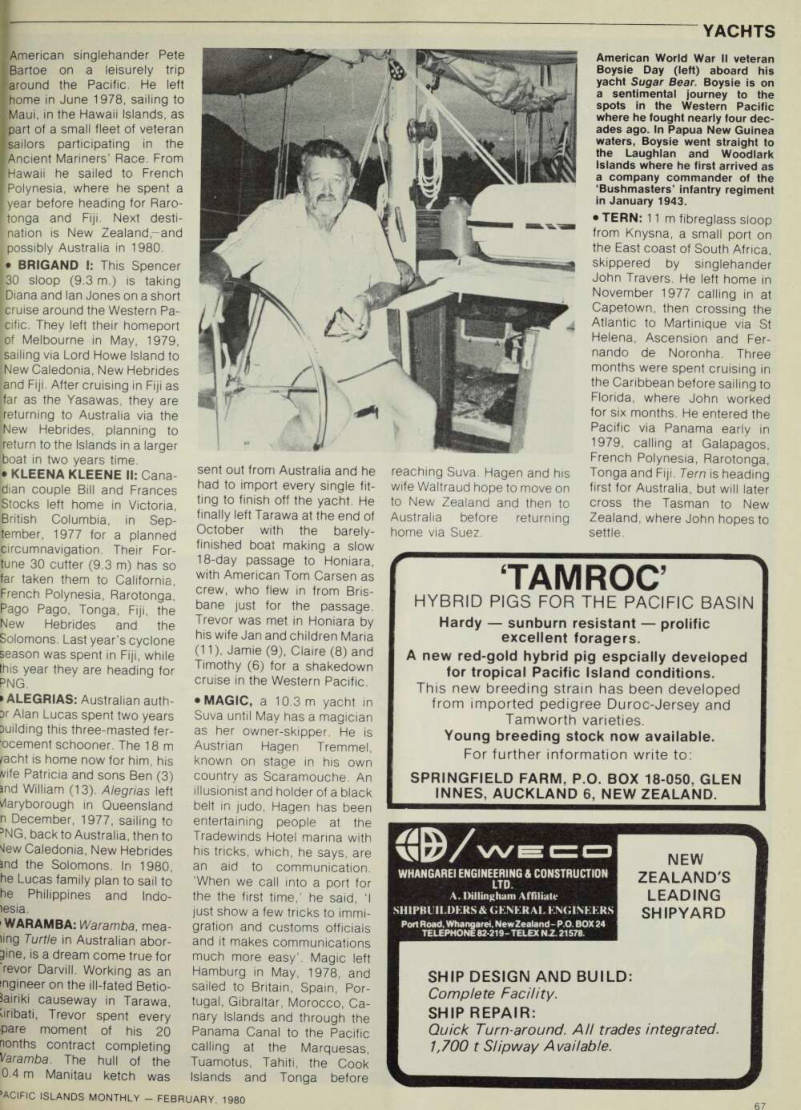
About 13 yachts, the smallest being 10.7 m, set sail from Jakarta in Indonesia on March 12 on the famous ‘Spice’ route to Rotterdam. They will take part in Spice Race 1980 spon sored by the Dutch shipping group Nedlloyd, well known in the South Pacific. After a stop in Cape Town, the yachts will complete the course in the first week in June, having covered 12 500 miles in one of the lon gest yacht races in the world.
The ambition of every com petitor is to beat the sailing re cord for the course between the Straits of Dover and Sunda Straits which is held by the famous Cutty Sark which covered the 12 000-mile stretch in 73 days in 1876.
Entrants registered in December were; Spirit of
Ramfish. 15.24 m, Dutch, skipper Adriann Van Stolk.
Gauloises 111, 19.2 m, French, skipper Philippe Facque. Gypsy Moth V, 17.37 m, English, skipper Peter Hambly Batavier, 22 m, Australian, skipper Jos Maasakkers. Seltrust Endeavour, 16.76 m, English, skipper Michael Dunham.
DLC Zanzara, 10.7 m, Dutch, skipper Ewald Niejenhoff.
Bubblegum, 13.1 m, English, skipper lain McGowan Fyfe.
Nutmeg, 15.24 m, Dutch, skipper Dik Dehaan. Flying Wilma, Dutch, skipper Ger rard Dykstra (winner of Whitbread Round the World race) Prodent, 12.5 m Dutch, skipper Dirk Navta. Caleo, 13.4 m, Singapore. • ROGUE: 12.6 m one-tonner racing yacht from Sydney is cruising in Fiji, Tonga, Samoa and Wallis with owner Roger White, a retired merchant banker, accompanied by ever changing crew. Rogue left Sydney on June 16 for the race to Noumea, a month later taking part in the Noumea to Vila race. From the New
Hebrides Rogue started cruis ing and had a rough but very fast four-and-a-half day pass age to Suva. • KIWI: This 13.3 m Atkins designed wooden ketch left San Diego in April 1978 with Dick and Sherri Lenz on board. After calling at Hawaii, Kiwi sailed to the Society Islands, Vavau and Fiji. The cyclone season will be spent in New Zealand, from where the crew plan to return to French Polynesia and possibly home. • SHA MAR: Walter and Gloria Streifling, with children Shauna and Marc, left their home in San Diego in February 1979 for a two-year circum navigation of the Pacific. After the Marquesas, Sha Mar sailed to the Tuamotus, Society Islands, Suwarrow, American Samoa, Tonga and Fiji. The cyclone season will be spent in New Zealand. In 1980 the crew plans to return to Tahiti via the Australs, then carry on to Hawaii, Canada and home. • VELELLA: 10 m Angelman ketch from San Diego is taking
i American singlehander Pete Bartoe on a leisurely trip around the Pacific. He left I home in June 1978, sailing to Maui, in the Hawaii Islands, as part of a small fleet of veteran sailors participating in the [Ancient Mariners’ Race. From he sailed to French [Polynesia, where he spent a [year before heading for Raro- [ tonga and Fiji. Next desti- I nation is New Zealand,-and [possibly Australia in 1980. • BRIGAND I; This Spencer [3O sloop (9.3 m.) is taking [Diana and lan Jones on a short [cruise around the Western Pa cific. They left their homeport of Melbourne in May, 1979, sailing via Lord Howe Island to New Caledonia, New Hebrides and Fiji. After cruising in Fiji as far as the Yasawas, they are [returning to Australia via the New Hebrides, planning to return to the Islands in a larger boat in two years time.
• Kleena Kleene Ii: Cana
dian couple Bill and Frances [Stocks left home in Victoria, [British Columbia, in Sep tember, 1977 for a planned circumnavigation. Their For tune 30 cutter (9.3 m) has so far taken them to California, French Polynesia, Rarotonga, Pago Pago, Tonga, Fiji, the New Hebrides and the Solomons. Last year’s cyclone season was spent in Fiji, while this year they are heading for
Png.
> ALEGRIAS: Australian auth or Alan Lucas spent two years building this three-masted fer 'ocement schooner. The 18 m (acht is home now for him, his vife Patricia and sons Ben (3) md William (13). Alegrias left Maryborough in Queensland n December, 1977, sailing to 3 NG, back to Australia, then to slew Caledonia, New Hebrides ind the Solomons. In 1980, he Lucas family plan to sail to he Philippines and Indo lesia.
I WARAMBA: Waramba, mea ling Turtle in Australian abor igine, is a dream come true for revor Darvill. Working as an engineer on the ill-fated Betio iairiki causeway in Tarawa, Jribati, Trevor spent every pare moment of his 20 nonths contract completing Varamba. The hull of the 0.4 m Manitau ketch was
sent out from Australia and he had to import every single fit ting to finish off the yacht. He finally left Tarawa at the end of October with the barely finished boat making a slow 18-day passage to Honiara, with American Tom Carsen as crew, who flew in from Bris bane just for the passage.
Trevor was met in Honiara by his wife Jan and children Maria (11), Jamie (9), Claire (8) and Timothy (6) for a shakedown cruise in the Western Pacific. • MAGIC, a 10.3 m yacht in Suva until May has a magician as her owner-skipper. He is Austrian Hagen Tremmel, known on stage in his own country as Scaramouche. An illusionist and holder of a black belt in judo, Hagen has been entertaining people at the Tradewinds Hotel marina with his tricks, which, he says, are an aid to communication. ‘When we call into a port for the the first time,’ he said, ‘I just show a few tricks to immi gration and customs officials and it makes communications much more easy’. Magic left Hamburg in May, 1978, and sailed to Britain, Spain, Por tugal, Gibraltar, Morocco, Ca nary Islands and through the Panama Canal to the Pacific calling at the Marquesas, Tuamotus, Tahiti, the Cook Islands and Tonga before
reaching Suva. Hagen and his wife Waltraud hope to move on to New Zealand and then to Australia before returning home via Suez.
• TERN: 11 m fibreglass sloop from Knysna, a small port on the East coast of South Africa, skippered by singlehander John Travers. He left home in November 1977 calling in at Capetown, then crossing the Atlantic to Martinique via St Helena, Ascension and Fer nando de Noronha. Three months were spent cruising in the Caribbean before sailing to Florida, where John worked for six months. He entered the Pacific via Panama early in 1979, calling at Galapagos, French Polynesia, Rarotonga, Tonga and Fiji. Tern is heading first for Australia, but will later cross the Tasman to New Zealand, where John hopes to settle.
American World War II veteran Boysie Day (left) aboard his yacht Sugar Bear. Boysie is on a sentimental journey to the spots in the Western Pacific where he fought nearly four dec ades ago. In Papua New Guinea waters, Boysie went straight to the Laughlan and Woodlark Islands where he first arrived as a company commander of the
‘Bushmasters’ infantry regiment
in January 1943.
Advertisements & other items, pp. 65-68 (3 items)
65
a ACIFIC ISLANDS MONTHLY FEBRUARY, 1980
plumbing supplies Mist
Total service 0n ...
% f 'V You can get all your needs from one supply source: water taps, valves, copper tube, tools and a host of other fittings and related plumbing equipment for domestic, industrial and multi-storey buildings.
Watson & Crane Pty Ltd have over 20,000 plumbing items in stock at their central warehouse located at Waterloo, NSW, Australia.
Years of experience in handling and shipping right throughout the South Pacific add up to another big reason for you to deal with Watson & Crane Pty Ltd.
Representatives call regularly at Papua New Guinea, the Solomons, New Hebrides and Fiji Islands to personally discuss your requirements and appropriate credit arrangements.
Write, cable or telephone today for complete plumbers' supplies service.
Watson & Crane Pty. Ltd. 1037 Bourke Street, Waterloo,
NSW 2017.
Phone: Sydney 699-1333.
Telex: AA 25548.
Cables: "Watcrane" Sydney.
Pacific Island distributors of Crano Enfield copper tube for water, sanitation, engineering, refrigeration and air conditioning.
WATSON & CRANE
are organised to fulfil your needs
wherever you are in the South Pacific
TAM ROC’
HYBRID PIGS FOR THE PACIFIC BASIN
Hardy sunburn resistant prolific excellent foragers.
A new red-gold hybrid pig espcially developed for tropical Pacific Island conditions.
This new breeding strain has been developed from imported pedigree Duroc-Jersey and Tamworth varieties.
Young breeding stock now available.
For further information write to:
SPRINGFIELD FARM, P.O. BOX 18-050, GLEN
INNES, AUCKLAND 6, NEW ZEALAND.
a®/ W
WHANGAREI ENGINEERING & CONSTRUCTION
LTD.
A. Dillingham Affiliate
SHIPBUILDKRS & GKNKRAL KNGINKKRS
Port Road, Whangarei, New Zealand - P.O. BOX 24 TELEPHONE 82-219 - TELEX N Z. 21578.
NEW
ZEALAND'S
LEADING
SHIPYARD
SHIP DESIGN AND BUILD:
Complete Facility.
SHIP REPAIR:
Quick Turn-around. AH trades integrated. 1,700 t Slipway A vaitable.
man
Australia S
Dorf makes water come alive-with
high performance, colour co-ordinated,
maintenance free...taps, showers and accessories.
Dorf...the best way to
fiandlewater.
mm
GOLDEN DOLPHIN
BASIN SET DE-4A
V Vw X.
EXPOSED BATH MIXER Dt
& >1MI:
BASIN MIXER
(ADJUSTABLE) DE-4
I: h ,
Dorf Industries
Manufacturers of taps, showers and plumbing fittings
DISTRIBUTORS FOR MALAYSIA:
William Jacks &Co (M)Sdn. Bhd Petaling Jaya-Tel. 774011 and also at - Chartered Bank Chambers Union Street, Penang-Tel. 64731 Dorf Branch Office Inchcape House, Alexander Road, Singapore 5-Tel. 646076 Dorf Head Office 1503 Centre Road, Clayton, 3168. Australia. Phone 5441011. Telex Dorfv AA 34449
Yachts
67
’ACIFIC ISLANDS MONTHLY - FEBRUARY, 1980
Services
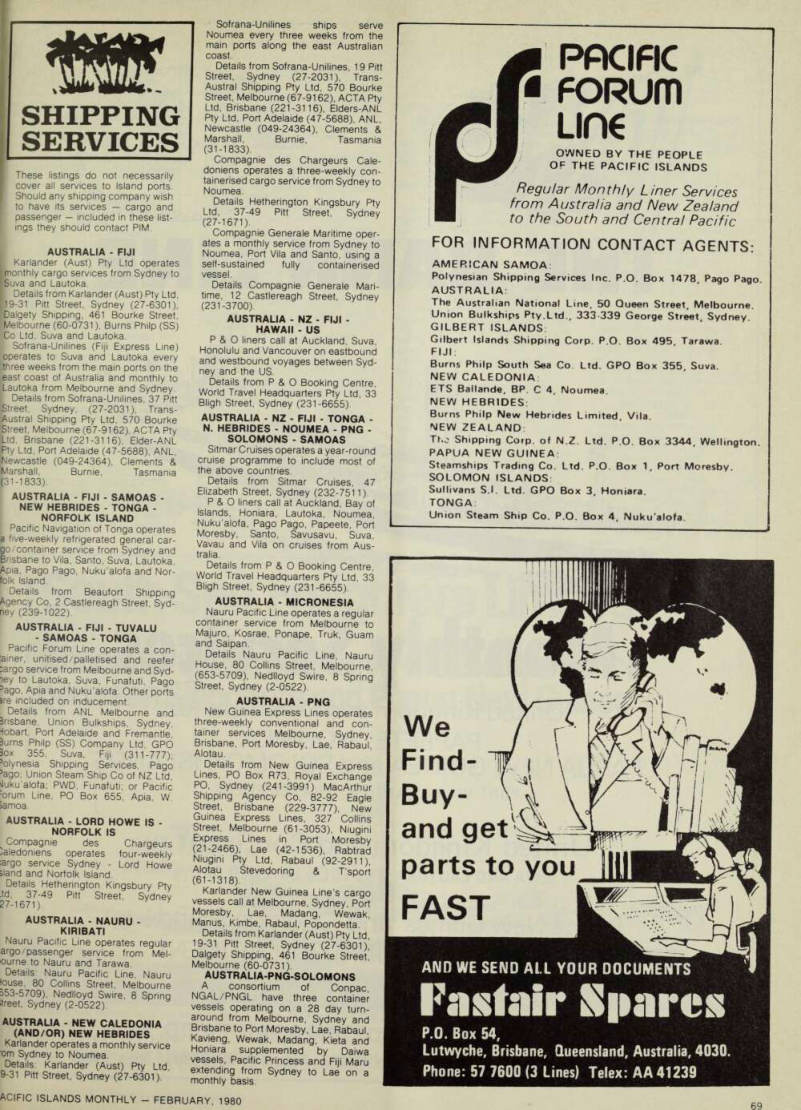
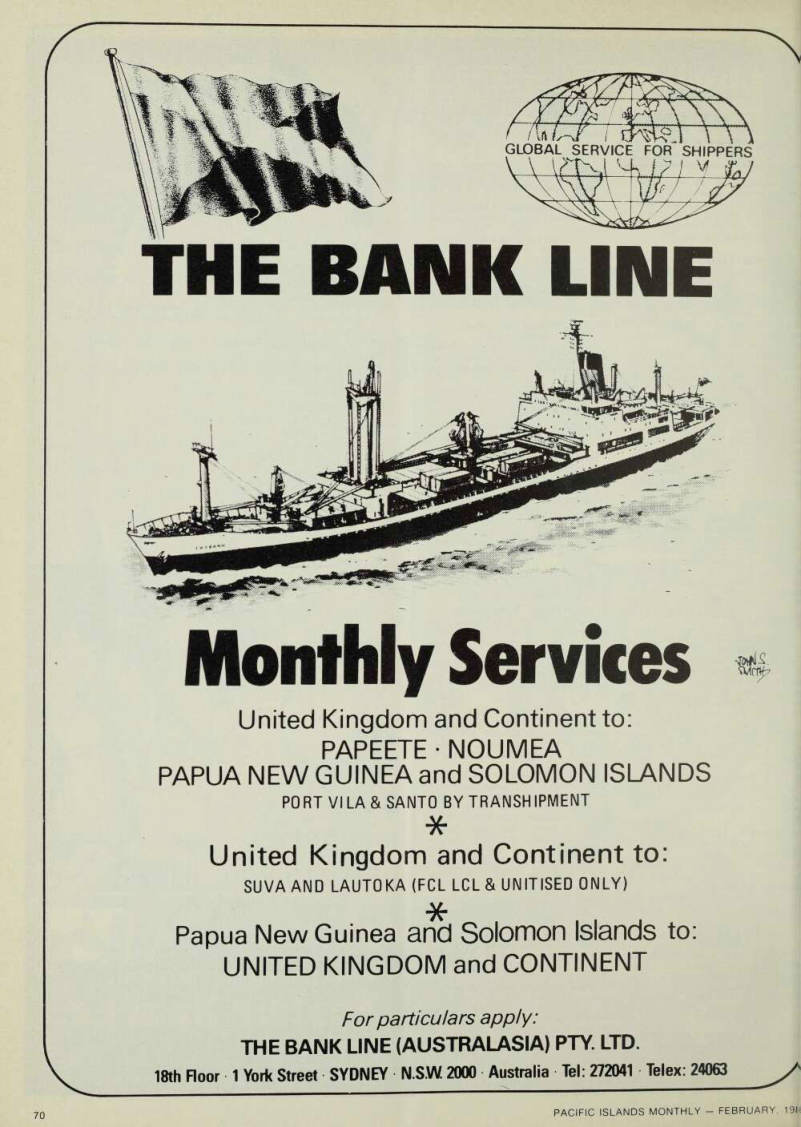
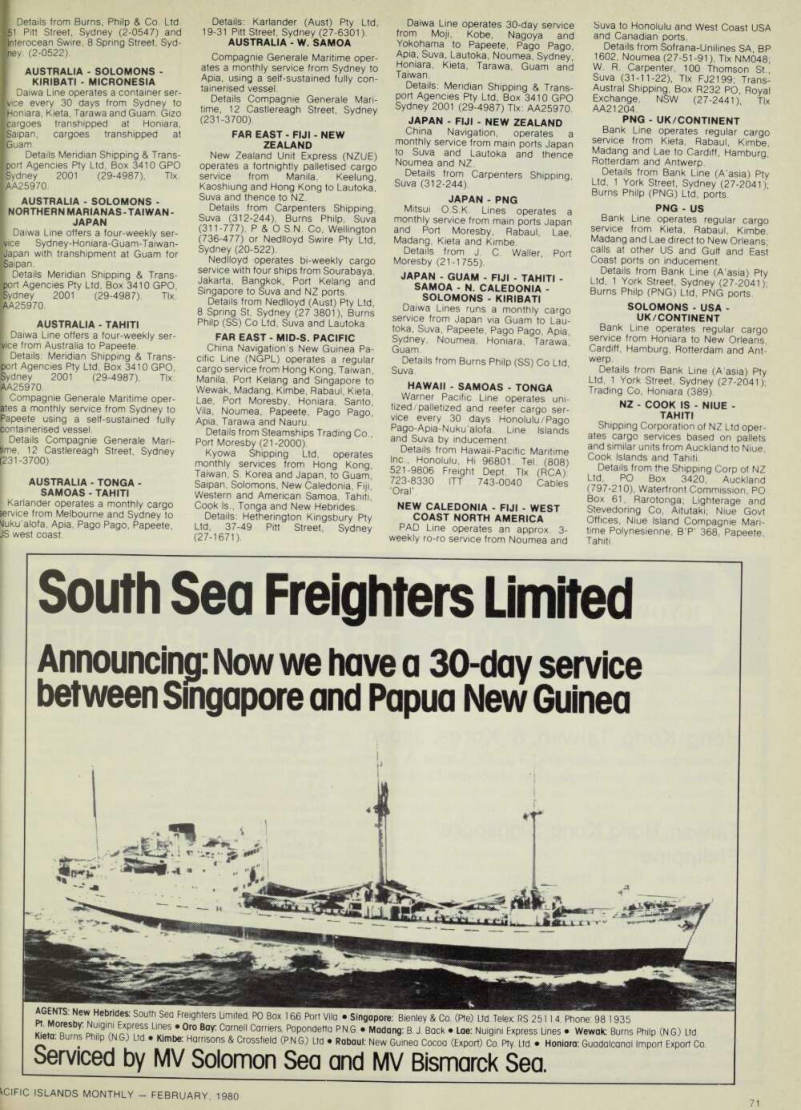
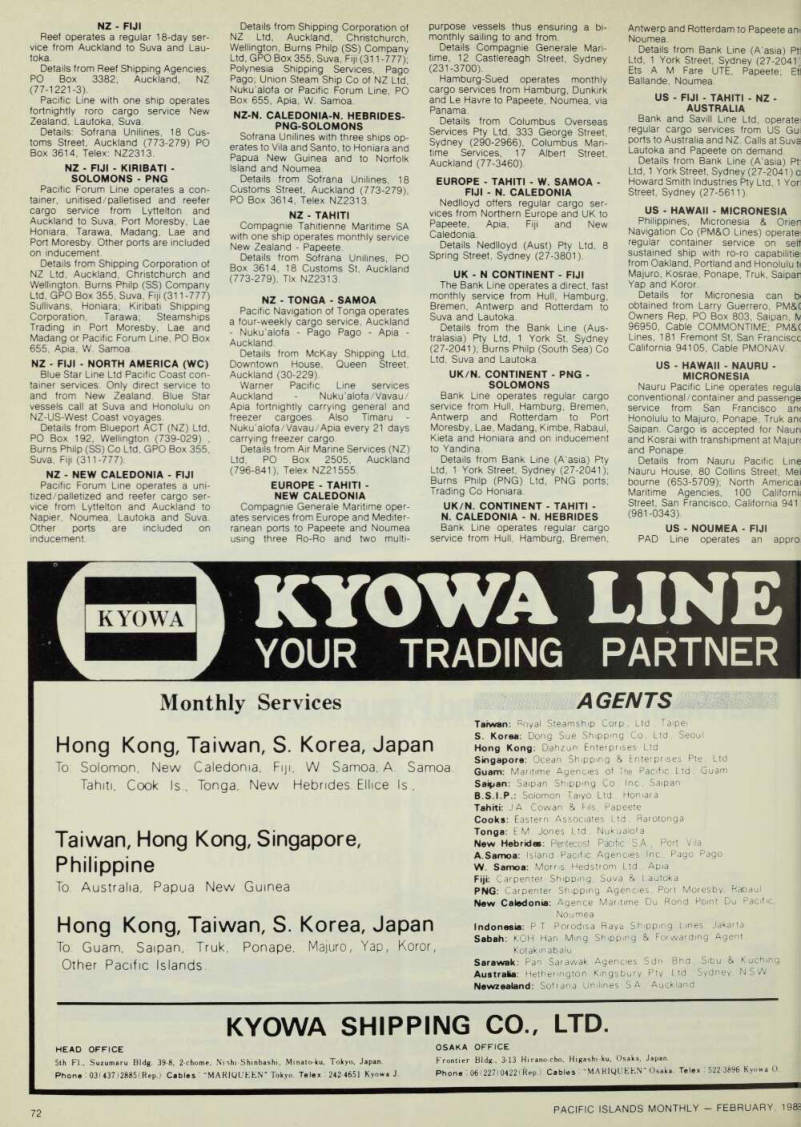
Shipping
These listings do not necessarily cover all services to Island ports.
B Should any shipping company wish B to have its services cargo and I passenger included in these list- II ings they should contact PIM.
Australia - Fiji
■ Karlander (Aust) Pty Ltd operates Imonthly cargo services from Sydney to iSuva and Lautoka.
I Details from Karlander (Aust) Pty Ltd, |I9-31 Pitt Street, Sydney (27-6301), toalgety Shipping, 461 Bourke Street, [Melbourne (60-0731), Burns Philp (SS) [Co Ltd, Suva and Lautoka.
I Sofrana-Unilines (Fiji Express Line) operates to Suva and Lautoka every [three weeks from the main ports on the east coast of Australia and monthly to Lautoka from Melbourne and Sydney, f Details from Sofrana-Unilines, 37 Pitt (Street, Sydney, (27-2031). Trans- Shipping Pty Ltd, 570 Bourke Street, Melbourne (67-9162), ACTA Pty Ltd, Brisbane (221-3116), Elder-ANL Pty Ltd, Port Adelaide (47-5688), ANL, Newcastle (049-24364), Clements & Marshall, Burnie, Tasmania 131-1833).
Australia - Fiji - Samoas -
New Hebrides - Tonga -
Norfolk Island
[ Pacific Navigation of Tonga operates ja five-weekly refrigerated general car go 'container service from Sydney and Brisbane to Vila, Santo, Suva, Lautoka, Apia, Pago Pago, Nukualofa and Nor folk Island.
Details from Beaufort Shipping Agency Co, 2 Castlereagh Street, Syd ney (239-1022).
Australia - Fiji - Tuvalu
-Samoas - Tonga
Pacific Forum Line operates a con lamer, unitised/palletised and reefer :argo service from Melbourne and Syd iey to Lautoka, Suva, Funafuti, Pago 3 ago, Apia and Nukualofa, Other ports ire included on inducement Details from ANL Melbourne and Brisbane, Union Bulkships, Sydney, Hobart, Port Adelaide and Fremantle, Burns Philp (SS) Company Ltd, GPO Box 355, Suva, Fiji (311-777); ’olynesia Shipping Services, Pago ’ago; Union Steam Ship Co of NZ Ltd.
Huku'alofa; PWD, Funafuti; or Pacific ■orum Line, PO Box 655, Apia, W. >amoa.
Australia - Lord Howe Is -
Norfolk Is
n Compagnie des Chargeurs )aledoniens operates four-weekly :argo service Sydney - Lord Howe stand and Norfolk Island.
Details Hetherington Kingsbury Pty td, 37-49 Pitt Street, Sydney 27-1671). y
Australia - Nauru -
Kiribati
Nauru Pacific Line operates regular argo/passenger service from Mel bourne, to Nauru and Tarawa.
Details: Nauru Pacific Line, Nauru louse, 80 Collins Street, Melbourne 353-5709), Nedlloyd Swire, 8 Spring street. Sydney (2-0522).
Australia - New Caledonia
(And/Or) New Hebrides
Karlander operates a monthly service om Sydney to Noumea.
Details: Karlander (Aust) Pty Ltd 9-31 Pitt Street, Sydney (27-6301).
Sofrana-Unilines ships serve Noumea every three weeks from the main ports along the east Australian coast.
Details from Sofrana-Unilines, 19 Pitt Street. Sydney (27-2031), Trans- Austral Shipping Pty Ltd, 570 Bourke Street, Melbourne (67-9162), ACTA Pty Ltd, Brisbane (221-3116), Elders-ANL Pty Ltd, Port Adelaide (47-5688), ANL, Newcastle (049-24364), Clements & Marshall, Burnie, Tasmania (31-1833).
Compagnie des Chargeurs Cale donians operates a three-weekly con tainerised cargo service from Sydney to Noumea.
Details Hetherington Kingsbury Pty Ltd, 37-49 Pitt Street, Sydney (27-1671).
Compagnie Generate Maritime oper ates a monthly service from Sydney to Noumea, Port Vila and Santo, using a self-sustained fully containerised vessel.
Details Compagnie Generate Mari time, 12 Castlereagh Street, Sydney (231-3700).
Australia - Nz - Fiji -
Hawaii - Us
P & O liners call at Auckland, Suva, Honolulu and Vancouver on eastbound and westbound voyages between Syd ney and the US.
Details from P & O Booking Centre, World Travel Headquarters Pty Ltd, 33 Bligh Street, Sydney (231-6655).
AUSTRALIA - NZ - FIJI - TONGA - N. HEBRIDES - NOUMEA - PNG -
Solomons -Samoas
Sitmar Cruises operates a year-round cruise programme to include most of the above countries.
Details from Sitmar Cruises, 47 Elizabeth Street, Sydney (232-7511).
P & O liners call at Auckland, Bay of Islands, Honiara, Lautoka, Noumea, Nukualofa, Pago Pago, Papeete, Port Moresby, Santo, Savusavu, Suva, Vavau and Vila on cruises from Aus tralia.
Details from P & O Booking Centre, World Travel Headquarters Pty Ltd, 33 Bligh Street, Sydney (231-6655).
Australia - Micronesia
Nauru Pacific Line operates a regular container service from Melbourne to Majuro, Kosrae, Ponape, Truk, Guam and Saipan, Details Nauru Pacific Line, Nauru House, 80 Collins Street, Melbourne, (653-5709), Nedlloyd Swire, 8 Spring Street, Sydney (2-0522).
Australia - Png
New Guinea Express Lines operates three-weekly conventional and con tainer services Melbourne, Sydney, Brisbane. Port Moresby, Lae, Rabaul, Alotau, Details from New Guinea Express Lines, PO Box R 73, Royal Exchange PC, Sydney (241-3991) MacArthur Shipping Agency Co, 82-92 Eagle Street, Brisbane (229-3777), New Guinea Express Lines, 327 Collins Street, Melbourne (61-3053), Niugini Express Lines in Port Moresby (21-2466), Lae (42-1536), Rabtrad Niugini Pty Ltd, Rabaul (92-2911), Alotau Stevedoring & T’sport (61-1318).
Karlander New Guinea Line’s cargo vessels call at Melbourne, Sydney, Port Moresby, Lae, Madang, Wewak, Manus, Kimbe, Rabaul, Popondetta.
Details from Karlander (Aust) Pty Ltd, 19-31 Pitt Street. Sydney (27-6301),’
Dalgety Shipping, 461 Bourke Street Melbourne (60-0731)
Australia-Png-Solomons
A consortium of Conpac, NGAL/PNGL have three container vessels operating on a 28 day turn around from Melbourne, Sydney and Brisbane to Port Moresby, Lae, Rabaul, Kavieng, Wewak, Madang, Kieta and Honiara supplemented by Daiwa vessels, Pacific Princess and Fiji Maru extending from Sydney to Lae on a monthly basis.
■ Details from Burns, Philp & Co. Ltd.
K 1 Pitt Street, Sydney (2-0547) and ■nterocean Swire, 8 Spring Street, Syd
ney (2-0522).
I Australia - Solomons -
Kiribati - Micronesia
Daiwa Line operates a container ser vice every 30 days from Sydney to ■Honiara, Kieta, Tarawa and Guam. Gizo I Cargoes transhipped at Honiara, I Saipan, cargoes transhipped at
I Guam
Details Meridian Shipping & Trans port Agencies Pty Ltd, Box 3410 GPO ■Sydney 2001 (29-4987), Tlx.
Kaa25970.
Australia - Solomons -
Northern Marianas-Taiwan
Japan
I Daiwa Line offers a four-weekly ser vice Sydney-Honiara-Guam-Taiwan- Uapan with transhipment at Guam for Saipan.
I Details Meridian Shipping & Trans port Agencies Pty Ltd, Box 3410 GPO, Sydney 2001 (29-4987). Tlx. (AA25970.
Australia - Tahiti
Daiwa Line offers a four-weekly ser vice from Australia to Papeete, f Details: Meridian Shipping & Trans jport Agencies Pty Ltd, Box 3410 GPO, Sydney 2001 (29-4987), Tlx: AA25970. 1 Compagnie Generale Maritime oper ates a monthly service from Sydney to Papeete using a self-sustained fully fcontainerised vessel.
I Details Compagnie Generale Mari time, 12 Castlereagh Street, Sydney [231-3700).
Australia - Tonga -
Samoas - Tahiti
i Karlander operates a monthly cargo lervice from Melbourne and Sydney to iluku’alofa, Apia, Pago Pago, Papeete, JS west coast.
Details: Karlander (Aust) Pty Ltd, 19-31 Pitt Street, Sydney (27-6301).
Australia - W. Samoa
Compagnie Generate Maritime oper ates a monthly service from Sydney to Apia, using a self-sustained fully con tainerised vessel.
Details Compagnie Generale Mari time, 12 Castlereagh Street, Sydney (231-3700).
Far East - Fiji - New
Zealand
New Zealand Unit Express (NZUE) operates a fortnightly palletised cargo service from Manila, Keelung, Kaoshiung and Hong Kong to Lautoka, Suva and thence to NZ.
Details from Carpenters Shipping, Suva (312-244), Burns Philp, Suva (311-777), P & O S.N. Co, Wellington (736-477) or Nedlloyd Swire Pty Ltd, Sydney (20-522).
Nedlloyd operates bi-weekly cargo service with four ships from Sourabaya, Jakarta, Bangkok, Port Kelang and Singapore to Suva and NZ ports.
Details from Nedlloyd (Aust) Pty Ltd, 8 Spring St, Sydney (27 3801), Burns Philp (SS) Co Ltd, Suva and Lautoka.
Far East - Mid-S. Pacific
China Navigation's New Guinea Pa cific Line (NGPL) operates a regular cargo service from Hong Kong, Taiwan, Manila, Port Kelang and Singapore to Wewak, Madang, Kimbe, Rabaul, Kieta, Lae, Port Moresby, Honiara, Santo, Vila, Noumea, Papeete, Pago Pago, Apia, Tarawa and Nauru.
Details from Steamships Trading Co., Port Moresby (21-2000).
Kyowa Shipping Ltd. operates monthly services from Hong Kong, Taiwan, S. Korea and Japan, to Guam, Saipan, Solomons, New Caledonia, Fiji, Western and American Samoa, Tahiti, Cook Is., Tonga and New Hebrides.
Details: Hetherington Kingsbury Pty Ltd, 37-49 Pitt Street, Sydney (27-1671).
Daiwa Line operates 30-day service from Moji, Kobe, Nagoya and Yokohama to Papeete, Pago Pago, Apia, Suva, Lautoka, Noumea, Sydney, Honiara, Kieta, Tarawa, Guam and Taiwan.
Details: Meridian Shipping & Trans port Agencies Pty Ltd, Box 3410 GPO Sydney 2001 (29-4987) Tlx: AA25970.
Japan - Fiji - New Zealand
China Navigation, operates a monthly service from main ports Japan to Suva and Lautoka and thence Noumea and NZ.
Details from Carpenters Shipping Suva (312-244).
Japan - Png
Mitsui O.S.K, Lines operates a monthly service from main ports Japan and Port Moresby, Rabaul, Lae Madang, Kieta and Kimbe.
Details from J. C. Waller, Port
Moresby (21-1755).
JAPAN - GUAM - FIJI - TAHITI -
Samoa - N. Caledonia -
Solomons - Kiribati
Daiwa Lines runs a monthly cargo service from Japan via Guam to Lau toka, Suva, Papeete, Pago Pago, Apia, Sydney, Noumea, Honiara, Tarawa, Guam.
Details from Burns Philp (SS) Co Ltd, Suva.
Hawaii - Samoas - Tonga
Warner Pacific Line operates uni tized/palletized and reefer cargo ser vice every 30 days Honolulu/Pago Pago-Apia-Nuku’alofa. Line Islands and Suva by inducement.
Details from Hawaii-Pacific Maritime Inc., Honolulu, Hi 96801. Tel. (808) 521-9806 Freight Dept. Tlx (RCA) 723-8330 ITT 743-0040 Cables ‘Oral’.
New Caledonia - Fiji - West
Coast North America
PAD Line operates an approx. 3weekly ro-ro service from Noumea and
Suva to Honolulu and West Coast USA and Canadian ports.
Details from Sofrana-Unilines SA, BP 1602, Noumea (27-51 -91), Tlx NMO4B; W, R. Carpenter, 100 Thomson St Suva (31-11-22), Tlx FJ2199; Trans- Austral Shipping, Box R 232 PC, Royal Exchange, NSW (27-2441). Tlx AA21204,
Png - Uk/Continent
Bank Line operates regular cargo service from Kieta, Rabaul, Kimbe, Madang and Lae to Cardiff, Hamburg, Rotterdam and Antwerp.
Details from Bank Line (A'asia) Pty Ltd, 1 York Street, Sydney (27-2041 )• Burns Philp (PNG) Ltd, ports.
Png - Us
Bank Line operates regular cargo service from Kieta, Rabaul, Kimbe, Madang and Lae direct to New Orleans; calls at other US and Gulf and East Coast ports on inducement.
Details from Bank Line (A’asia) Pty Ltd, 1 York Street, Sydney (27-2041)- Burns Philp (PNG) Ltd, PNG ports.
Solomons - Usa -
Uk/Continent
Bank Line operates regular cargo service from Honiara to New Orleans, Cardiff, Hamburg, Rotterdam and Ant werp.
Details from Bank Line (A’asia) Pty Ltd, 1 York Street, Sydney (27-2041) Trading Co, Honiara (389), NZ - COOK IS - NIUE -
Tahiti
Shipping Corporation of NZ Ltd oper ates cargo services based on pallets and similar units from Auckland to Niue, Cook Islands and Tahiti, Details from the Shipping Corp of NZ Ltd, PO Box 3420, Auckland (797-210), Waterfront Commission, PC Box 61, Rarotonga; Lighterage and Stevedoring Co, Aitutaki; Niue Govt Offices. Niue Island Compagnie Mari time Polynesienne, B’P’ 368, Papeete Tahiti.
Nz - Fiji
Reef operates a regular 18-day ser vice from Auckland to Suva and Lau toka.
Details from Reef Shipping Agencies, PO Box 3382, Auckland, NZ (77-1221-3).
Pacific Line with one ship operates fortnightly roro cargo service New Zealand, Lautoka, Suva.
Details: Sofrana Unilines, 18 Cus toms Street, Auckland (773-279) PO Box 3614, Telex: NZ2313.
Nz - Fiji - Kiribati -
Solomons - Png
Pacific Forum Line operates a con tainer, unitised/palletised and reefer cargo service from Lyttelton and Auckland to Suva, Port Moresby, Lae Honiara, Tarawa, Madang, Lae and Port Moresby. Other ports are included on inducement.
Details from Shipping Corporation of NZ Ltd, Auckland, Christchurch and Wellington. Burns Philp (SS) Company Ltd, GPO Box 355, Suva, Fiji (311 -777) Sullivans, Honiara; Kiribati Shipping Corporation, Tarawa; Steamships Trading in Port Moresby, Lae and Madang or Pacific Forum Line, PO Box 655, Apia, W. Samoa NZ - FIJI - NORTH AMERICA (WC) Blue Star Line Ltd Pacific Coast con tainer services. Only direct service to and from New Zealand. Blue Star vessels call at Suva and Honolulu on NZ-US-West Coast voyages Details from Blueport ACT (NZ) Ltd, PO Box 192, Wellington (739-029) , Burns Philp (SS) Co Ltd, GPO Box 355, Suva, Fiji (311-777).
Nz - New Caledonia - Fiji
Pacific Forum Line operates a uni tized/palletized and reefer cargo ser vice from Lyttelton and Auckland to Napier, Noumea, Lautoka and Suva.
Other ports are included on inducement.
Details from Shipping Corporation of NZ Ltd, Auckland, Christchurch, Wellington, Burns Philp (SS) Company Ltd, GPO Box 355, Suva, Fiji (311 -777); Polynesia Shipping Services, Pago Pago; Union Steam Ship Co of NZ Ltd, Nuku’alofa or Pacific Forum Line. PO Box 655, Apia. W. Samoa.
Nz-N. Caledonia-N. Hebrides
Png-Solo Mons
Sofrana Unilines with three ships op erates to Vila and Santo, to Honiara and Papua New Guinea and to Norfolk Island and Noumea.
Details from Sofrana Unilines, 18 Customs Street, Auckland (773-279), PO Box 3614, Telex NZ2313.
Nz - Tahiti
Compagnie Tahitienne Maritime SA with one ship operates monthly service New Zealand - Papeete.
Details from Sofrana Unilines, PO Box 3614, 18 Customs St, Auckland (773-279), Tlx NZ2313.
Nz- Tonga - Samoa
Pacific Navigation of Tonga operates a four-weekly cargo service, Auckland - Nukualofa - Pago Pago - Apia - Auckland.
Details from McKay Shipping Ltd.
Downtown House, Queen Street, Auckland (30-229), Warner Pacific Line services Auckland - Nuku’alofa/Vavau/ Apia fortnightly carrying general and freezer cargoes. Also Timaru - Nuku’alofa/Vavau/Apia every 21 days carrying freezer cargo.
Details from Air Marine Services (NZ) Ltd, PO Box 2505, Auckland (796-841), Telex NZ21555.
Europe - Tahiti -
New Caledonia
Compagnie Generate Maritime oper ates services from Europe and Mediter ranean ports to Papeete and Noumea using three Ro-Ro and two multi
purpose vessels thus ensuring a bi monthly sailing to and from.
Details Compagnie Generate Mari time, 12 Castlereagh Street, Sydney (231-3700).
Hamburg-Sued operates monthly cargo services from Hamburg, Dunkirk and Le Havre to Papeete, Noumea, via Panama.
Details from Columbus Overseas Services Pty Ltd, 333 George Street, Sydney (290-2966), Columbus Mari time Services, 17 Albert Street, Auckland (77-3460).
EUROPE - TAHITI - W. SAMOA -
Fiji - N. Caledonia
Nedlloyd offers regular cargo ser vices from Northern Europe and UK to Papeete, Apia, Fiji and New Caledonia.
Details Nedlloyd (Aust) Pty Ltd, 8 Spring Street, Sydney (27-3801).
Uk - N Continent - Fiji
The Bank Line operates a direct, fast monthly service from Hull, Hamburg, Bremen, Antwerp and Rotterdam to Suva and Lautoka.
Details from the Bank Line (Aus tralasia) Pty Ltd, 1 York St, Sydney (27-2041); Burns Philp (South Sea) Co Ltd, Suva and Lautoka.
Uk/N. Continent - Png -
Solomons
Bank Line operates regular cargo service from Hull, Hamburg, Bremen, Antwerp and Rotterdam to Port Moresby, Lae, Madang, Kimbe, Rabaul, Kieta and Honiara and on inducement to Yandina.
Details from Bank Line (A’asia) Pty Ltd, 1 York Street, Sydney (27-2041); Burns Philp (PNG) Ltd, PNG ports; Trading Co Honiara,
Uk/N. Continent - Tahiti -
N. Caledonia - N. Hebrides
Bank Line operates regular cargo service from Hull, Hamburg, Bremen,
Antwerp and Rotterdam to Papeete am Noumea.
Details from Bank Line (A’asia) Ptl Ltd, 1 York Street, Sydney (27-2041; Ets A M Fare UTE, Papeete; Etl Ballande, Noumea.
US - FIJI - TAHITI - NZ -
Australia
Bank and Savill Line Ltd, operate; regular cargo services from US Gui ports to Australia and NZ. Calls at Suva Lautoka and Papeete on demand.
Details from Bank Line (A'asia) Ptl Ltd, 1 York Street, Sydney (27-2041) a Howard Smith Industries Pty Ltd, 1 Yor Street, Sydney (27-5611).
Us - Hawaii - Micronesia
Philippines, Micronesia & Orien Navigation Co (PM&O Lines) operate; regular container service on self sustained ship with ro-ro capabilitie; from Oakland, Portland and Honolulu t; Majuro, Kosrae, Ponape, Truk, Saipar Yap and Koror.
Details for Micronesia can b< obtained from Larry Guerrero, PM&O Owners Rep. PO Box 803, Saipan, h
96950, Cable Commontime; Pm&O
Lines, 181 Fremont St, San Franciscc California 94105, Cable PMONAV.
Us - Hawaii - Nauru -
Micronesia
Nauru Pacific Line operates regulai conventional/container and passenge service from San Francisco am Honolulu to Majuro, Ponape, Truk an; Saipan. Cargo is accepted for Naun and Kosrai with transhipment at Majur; and Ponape.
Details from Nauru Pacific Line Nauru House, 80 Collins Street, Mel bourne (653-5709); North Americai Maritime Agencies, 100 Californis Street, San Francisco, California 941 (981 -0343).
Us - Noumea - Fiji
PAD Line operates an appro;
ro-ro service from West Coast ISA and Canada to Noumea and uva.
Details from Sofrana-Unilines SA, BP 602, Noumea (27-51-91), Tlx NMO4B; I. R, Carpenter, 100 Thomson St, Suva 51-11-22), Tlx FJ2199; Trans-Austral hipping, Box R 232 PC, Royal xchange, NSW (27-2441), Tlx A 21204.
Us - Tahiti - Samoa
Pacific Islands Transport operates a /e weekly cargo service from North merica west coast ports to Papeete, ago Pago, Apia.
Details from Polynesia Shipping Ser ces Inc, PC Box 1478 Paqo Paqo 1-6799).
Polynesia Line operates container id general cargo service from US west )ast ports to Papeete and Pago ago.
Details from Polynesia Shipping Ser ies Inc., PC Box 1478. Pago Paqo -6799).
US - TAHITI - SAMOA - NZ - AUST Farrell Lines Inc, operate a fast reg ar lash/container cargo service from ast coast ports Canada/USA to tpeete and Pago Pago thence to NZ id Australia.
Details With Wilhelmson Agency, 'dney, Melbourne and Brisbane Tlx \20136. Cable FARSHIPS Sydney; ilgety (NZ) Ltd, Auckland and ellmgton, Tlx NZ2445, Cable \LSHIP Auckland; Compagnie Mari ne Polynesienne, Immeuble Franco :eanienne, PC Box 368, Papeete ihiti, Tel 26393, Tlx 258. FP ANSB iporo, Cable OCEAN Papeete; leubuhl Maritime Service, PO Box 39, igo Pago, Telephone 633-5121 : < 782505.
Advertisements & other items, pp. 69-72 (3 items)
69
ACIFIC ISLANDS MONTHLY FEBRUARY, 1980
Fasfair Spares
p PACIFIC
• FORUm
LIHC
OWNED BY THE PEOPLE
OF THE PACIFIC ISLANDS
Regular Monthly Liner Services
from Australia and New Zealand
to the South and Central Pacific
FOR INFORMATION CONTACT AGENTS:
AMERICAN SAMOA
Polynesian Shipping Services Inc. P.O. Box 1478, Pago Pago.
AUSTRALIA:
The Australian National Line, 50 Queen Street, Melbourne.
Union Bulkships Pty.Ltd., 333-339 George Street Sydney
GILBERT ISLANDS:
Gilbert Islands Shipping Corp. P.O. Box 495 Tarawa
FIJI:
Burns Philp South Sea Co Ltd. GPO Box 355 Suva.
NEW CALEDONIA
ETS Ballande, BP. C 4, Noumea.
NEW HEBRIDES:
Burns Philp New Hebrides Limited, Vila.
NEW ZEALAND
Tho Shipping Corp. of N.Z. Ltd. P.O. Box 3344, Wellington.
PAPUA NEW GUINEA
Steamships Trading Co. Ltd. P.O. Box 1. Port Moresby.
SOLOMON ISLANDS:
Sullivans S.l. Ltd. GPO Box 3, Honiara.
TONGA
Union Steam Ship Co. P.O. Box 4, Nukualofa.
£ -E We / f Find- TT ( ' S\ Buy “ Vi and get Y>R parts to you
FAST
i i
AND WE SEND ALL YOUR DOCUMENTS
Fasfair Spares
P.O. Box 54, Lutwyche, Brisbane, Queensland, Australia, 4030.
Phone: 57 7600 (3 Lines) Telex: AA 41239
n s C
GLOBAL SERVICE FOR SHIPPERS
V
THE
LINE
Monthly Services
United Kingdom and Continent to:
PAPEETE • NOUMEA
PAPUA NEW GUINEA and SOLOMON ISLANDS
PO RT VI LA & SANTO BY TRANSHIPMENT * United Kingdom and Continent to: SUVA AND LAUTOKA (FCL LCL & UNITISED ONLY) Papua New Guinea and Solomon Islands to;
UNITED KINGDOM and CONTINENT
For particulars apply:
THE BANK LINE (AUSTRALASIA) PTY. LTD.
18th Floor 1 York Street SYDNEY N.S.W. 2000 Australia Tel: 272041 Telex: 24063
South Sea Freighters Limited
Announcing: Now we have a 30-day service
between Singapore and Papua New Guinea
* -iITJ •• p *** % « . 0 Pt M n r«h eW M Hebrid c eS: SoUth Sea Freighters Umltecl - PO Box 166 Port Vila • Singapore: Bienley &Co (Pte) Ltd. Telex RS 2511 4, Phone: 98 1935 Kiptn- Philn'rw rfi Li * 0S l * Bay: Carnell Carriers - Popondetto PNG. • Madang: B. J. Back • Lae: Nuigini Express Lines • Wewak; Burns Philp (N.G) Ltd. . P C .) Ltd. • Kimbe: Harrisons & Crossfield (P N G.) Ltd • Rabaul: New Guinea Cocoa (Export) Co. Pty. Ltd. • Honiara: Guadalcanal Import Export Co.
Serviced by MV Solomon Sea and MV Bismarck Sea.
1 w
KYOWA LINE
YOUR TRADING PARTNER
Monthly Services AGENTS
Hong Kong, Taiwan, S. Korea, Japan
To: Solomon, New Caledonia, Fiji. W Samoa, A Samoa Tahiti, Cook Is., Tonga, New Hebrides. Ellice Is.,
Taiwan, Hong Kong, Singapore,
Philippine
To Australia, Papua New Guinea
Hong Kong, Taiwan, S. Korea, Japan
To: Guam, Saipan, Truk, Ponape, Majuro, Yap, Koror, Other Pacific Islands.
Taiwan: Royal Steamship Corp. Ltd, Taipei S. Korea; Dong Sue Shipping Co, Ltd, Seoul Hong Kong: Dahzun Enterprises Ltd Singapore: Ocean Shipping & Enterprises Pte . Ltd Guam: Maritime Agencies of The Pacific Ltd Guam Saipan: Saipan Shipping Co, Inc. Saipan 8.5.1. P.: Solomon Taiyo Ltd Honiara Tahiti: JA Cowan & Fils. Papeete Cooks; Eastern Associates Ltd. Rarotonga Tonga: E M Jones Ltd , Nukualofa New Hebrides: Pentecost Pacific S.A., Port Vila A.Samoa: sland Pacific Agencies Inc, Pago Pago W. Samoa: Morris Hedstrom Ltd, Apia Fiji: Carpenter Shipping. Suva & Lautoka PNG: Carpenter Shipping Agencies Port Moresby. Raoaul New Caledonia: Agence Maritime Du Rond Point Du Pacific, Noumea Indonesia: P T Porodisa Raya Shipping Lines Jakarta Sabah; KOH Han Ming Shipping & Forwarding Agent.
Kotakmabalu Sarawak; Pan Sarawak Agencies Sdn Bho . Sibu & Kuching Australia; Hethenngton Kingsbury Pty Ltd Sydney. NSW Newzealand: Sofrana Unilmes S A Auckland
KYOWA SHIPPING CO., LTD.
HEAD OFFICE
sth FI., Suzumaru Bldg. 39-8, 2-chome, Nishi-Shinbashi, Minato-ku, Tokyo, Japan.
Phone : 03(437)2885(Rep.) Cables : “MARIQUEEN” Tokyo. Telex : 242-4651 Kyowa J.
OSAKA OFFICE
Frontier Bldg., 3-13 Hirano-cho. Higashi ku, Osaka, Japan.
Phone :06 (227) 04221 Rep i Cables “MARIQUEEN" Osaka. Telex : 522-3896 Kyowa 0.
71
(CIFIC ISLANDS MONTHLY - FEBRUARY, 1980
Deaths
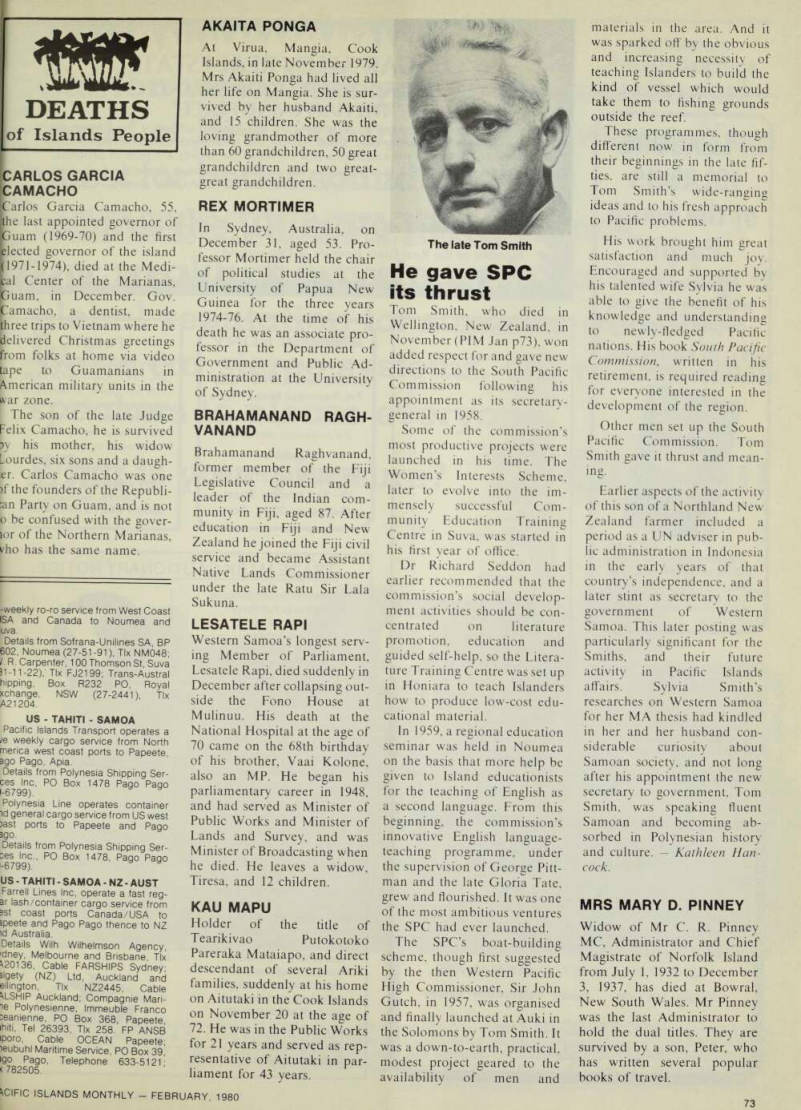
of Islands People
Carlos Garcia
Camacho
tarlos Garcia Camacho, 55, [the last appointed governor of puam (1969-70) and the first elected governor of the island 1971-1974), died at the Medi al Center of the Marianas, juam, in December. Gov. 2amacho, a dentist, made three trips to Vietnam where he
delivered Christmas greetings
from folks at home via video tape to Guamanians in American military units in the war zone.
The son of the late Judge Felix Camacho, he is survived by his mother, his widow Lourdes, six sons and a daught er. Carlos Camacho was one )f the founders of the Republi :an Party on Guam, and is not o be confused with the gover tor of the Northern Marianas, vho has the same name.
Akaita Ponga
At Virua, Mangia, Cook Islands, in late November 1979.
Mrs Akaiti Ponga had lived all her life on Mangia. She is sur vived by her husband Akaiti, and 15 children. She was the loving grandmother of more than 60 grandchildren, 50 great grandchildren and two great
great grandchildren.
Rex Mortimer
In Sydney, Australia, on December 31, aged 53. Pro fessor Mortimer held the chair of political studies at the
University of Papua New
Guinea for the three years 1974-76. At the time of his death he was an associate pro fessor in the Department of Government and Public Ad ministration at the University
of Sydney.
Brahamanand Ragh
Vanand
Brahamanand Raghvanand,
former member of the Fiji Legislative Council and a leader of the Indian com
munity in Fiji, aged 87. After
education in Fiji and New Zealand he joined the Fiji civil service and became Assistant Native Lands Commissioner under the late Ratu Sir Lala Sukuna.
Lesatele Rapi
Western Samoa’s longest serv ing Member of Parliament, Lesatele Rapi, died suddenly in December after collapsing out side the Fono House at Mulinuu. His death at the National Hospital at the age of 70 came on the 68th birthday of his brother, Vaai Kolone, also an MP. He began his parliamentary career in 1948, and had served as Minister of Public Works and Minister of Lands and Survey, and was Minister of Broadcasting when he died. He leaves a widow, Tiresa, and 12 children.
Kau Mapu
Holder of the title of Tearikivao Putokotoko Pareraka Mataiapo, and direct descendant of several Ariki families, suddenly at his home on Aitutaki in the Cook Islands on November 20 at the age of 72. He was in the Public Works for 21 years and served as rep resentative of Aitutaki in par liament for 43 years.
He gave SPC
its thrust
Tom Smith, who died in Wellington. New Zealand, in November (PIM Jan p 73), won added respect for and gave new directions to the South Pacific Commission following his appointment as its secretary general in 1958.
Some of the commission’s most productive projects were launched in his time. The Women’s Interests Scheme, later to evolve into the im mensely successful Com
munity Education Training
Centre in Suva, was started in his first year of office.
Dr Richard Seddon had earlier recommended that the commission’s social develop ment activities should be con centrated on literature promotion, education and guided self-help, so the Litera ture Training Centre was set up in Honiara to teach Islanders how to produce low-cost edu cational material.
In 1959, a regional education seminar was held in Noumea on the basis that more help be given to Island educationists for the teaching of English as a second language. From this beginning, the commission’s
innovative English language
teaching programme, under the supervision of George Pitt man and the late Gloria Tate, grew and flourished. It was one of the most ambitious ventures the SPC had ever launched.
The SPC’s boat-building
scheme, though first suggested
by the then Western Pacific High Commissioner, Sir John Gutch, in 1957, was organised and finally launched at Auki in the Solomons by Tom Smith. It was a down-to-earth, practical, modest project geared to the availability of men and
materials in the area. And it was sparked off by the obvious
and increasing necessity of
teaching Islanders to build the kind of vessel which would take them to fishing grounds outside the reef.
These programmes, though different now in form from their beginnings in the late fif ties, are still a memorial to Tom Smith’s wide-ranging ideas and to his fresh approach to Pacific problems.
His work brought him great satisfaction and much joy.
Encouraged and supported by
his talented wife Sylvia he was able to give the benefit of his
knowledge and understanding
to newly-fledged Pacific nations. His book South Pacific Commission, written in his retirement, is required reading for everyone interested in the
development of the region.
Other men set up the South Pacific Commission. Tom Smith gave it thrust and mean
ing.
Earlier aspects of the activity of this son of a Northland New Zealand farmer included a period as a UN adviser in pub lic administration in Indonesia in the early years of that
country’s independence, and a
later stint as secretary to the government of Western Samoa. This later posting was
particularly significant for the
Smiths, and their future activity in Pacific Islands affairs. Sylvia Smith’s researches on Western Samoa for her MA thesis had kindled in her and her husband con siderable curiosity about Samoan society, and not long after his appointment the new secretary to government, Tom Smith, was speaking fluent Samoan and becoming ab
sorbed in Polynesian history
and culture. Kathleen Han cock.
Mrs Mary D. Pinney
Widow of Mr C. R. Pinney MC, Administrator and Chief Magistrate of Norfolk Island from July 1, 1932 to December 3, 1937, has died at Bowral, New South Wales. Mr Pinney was the last Administrator to hold the dual titles. They are survived by a son, Peter, who has written several popular books of travel.
The late Tom Smith
Advertisements & other items, p. 73 (1 item)
73
VCIFIC ISLANDS MONTHLY FEBRUARY, 1980
Advertisers Index
Air New Zealand 20
Amatil 12
Aggie Grey 49
Akai 31
Air New Guinea 34,36,37
Bankline 70
Corrie, D 74
Carptrac 64
Chloride 62
Clarion Shoji 75
Demkaaust 6
Davies &Collison 74
Dorf Industries 68
EDGAR ALLEN Real Estate 74
Fleets 74
FISHER, Peter 74
Fastair Spares 69
Henry Cumines 59
Integrated Tech. Serv. 61
Komatsu 26
Kyowa Shipping 72
Kelvinator 56-57
Nelson & Robertson 59
N. Z. Police 46
Nissan 76
Papua Hotel 49
Pioneer 23
Perex Industries 55
Portals 65
Pacific Forum 69
Polynesian Bookshop 47
Polynesian Air 4
Q. B. E. Insurance 53
Qantas 58
Richardson & Wrench 55
Ricoh 60
Stilwell Aviation 52
South Seas Freighters 71
Sony 42
Suzuki 54
Teaccorp 16
Toyota 2
Tatham 28
Trio Kenwood 50
Victa 48
Val U-Pak Products 67
Video Recorder Centre 74
Victor 8
Watson & Crane 66
Whangarei Engine 67
Yanmar 44
Yamaha 38-39
Advertisements & other items, pp. 74-76 (2 items)
Pty Ltd
CLASSIFIED
ADVERTISEMENTS
EDGAR ALLEN REAL ESTATE
GLADSTONE QUEENSLAND
“THE HAPPENING PLACE”
We are proud to be associated with Gladstone, where 9 major future developments, totalling over $8350 million, are scheduled. Comalco Aluminium Smelter, Railway Yard extensions and Clinton Coal facility are now in progress.
THE TIME TO INVEST IS NOW we have prime investment properties including houses from $A32,000, building allotments from $A4,000, motels, country hotels, etc.
Details of investment properties and investment advice gladly given free of charge and without obligation. Please contact Cath Peterson (ex PNG/Solomon Is), Edgar Allen Real Estate, 35 Tank Street, Gladstone, Queensland, Australia. A member of the Real Estate Institute of Queensland.
PLEASURE
ISLANDS
of the South
Pacific
A holiday guide adventure story and history all in one
COLIN SIMPSON'S
LATEST
♦ 239 pages including 32 colour plates $15.95 or SUSIB.SO posted Send to box 3408' GPO Sydney , NSW, 2001, or use coupon insert in this issue.
FOR SALE
Supermarket—well establishedlovely tropical beach area north of Cairns. Current weekly turnover s4,ooo—ss,ooo—reasonable rentlong lease—modern premises. $45,000 plus S.A.V.
Write Box 2210 Cairns.
PETER FISHER
TRADING
Pty Ltd
321 PITT St. f SYDNEY, AUSTRALIA 2000 Telephone: 212 1475 Cables: "FISHERION" Sydney
EXPORTERS TO THE
PACIFIC ISLANDS
Subaru
SONY
VIDEO RECORDERS
Blank Beta & VMS Tapes Pre Recorded Movie Tapes
ALL AT EXPOR T PR ICES
AII enquiries welcomed Contact:
INTERCAPE AUSTRALIA
19—21 Lonsdale Street., Melbourne 3000, Aust. k A
FLEETS
60 ft. ketch workboat, prof, bit. 1957, major re-fit 1976. 100 h.p. diesel. In survey, 8 berths, radar, pilot, raft etc. $52,500. 36 ft. sloop motor sailer, ideal world cruise $52,500.
FLEETS
221 Esplanade, Wynnum Central, Brisbane.
Cable FLEETS BRISBANE.
TRADE MARK CAUTIONARY NOTICE:
Fuji Jukogyo Kabushiki Kaisha also trading as Fuji Heavy Industries Ltd., of 7-2 Nishishinjuku 1-chome, Shinjuku-ku Tokyo, Japan, wish it to be known that they are the owners of the four trade marks shown above and that the first three trade marks are used by Fuji Jukogyo Kabushiki Kaisha on or in connection with vehicles; apparatus for locomotion by land, air or water.
The first and fourth trade marks are used in respect of engines, motors, generators, agricultural machinery and their parts and accessories.
Proceedings will be taken against any third party found to be using the first three marks or any closely similar mark on or in connection with vehicles; apparatus for locomotion by land, air or water and in the case of the first and fourth marks in connection with engines, motors, generators, agricultural machinery and their parts and accessories.
Patent Attorneys:
DAVIES & COLLISON
Melbourne, Australia to 2
SUBARU
4
Robin
Clarion welcomes you to the wonderful world of Hi-Fi car audio. A never-ending quest for better sound quality assures the ultimate performance.
Our wealth of experience is backed by a global reputation for superior quality.
We've car stereo systems, car radios nnH speakers to please everyone.
In Car Entertainment Company What is your pleasure? @ Clarion Clarion Co.. Ltd. Tokyo. Japan r i T 248 Mafi j n rdo if c" 13 '* 3 R ° ad ' ASh,ield NSW - 2131/New Zealand: AWA New Zealand Limited P.O. Box edex/Guam- Tv\hnn do G p °, Q Bdx f 2 Suva,Tahiti: HI-FI Shangrila B.P 200 Papeete/New Caledonia: Caldis B.P. Ml Noumea outh Seas International Ltd O B ° X. 1939 *9ana Guam 96910/New Hebrides: The Sound Centre P.O. Box 434, Vi1a/Cook Islands: Ltd. P.O. Box 49 Rarotonga/Papua New Guinea: Hagemeyer (P.N.G.) Pty. Ltd. P.O. Box 1428, Boroko, Port Moresby. ‘Dolby and the double-D symbol are trademarks of Dolby Laboratories.
N\\
It’s a Datsun “Banjo’.’..
always in tune for motoring perfection
; m - -- ' % Your car’s “banjo” contains the rear axle gears and is welded between the two axle shaft housings.
So what? Simply this...if it’s defective and *- raying the welded < oint breaks, you can have an expensive repair bill, not to mention the inconvenience.
But, you can relax when you own a Datsun.
In addition to the highly automated production line, mass production techniques, and engineering and design excellence, Datsun’s “extra” effort makes the difference... and that means x-raying both welded joints of every banjo assembly. X-rays do the same for Datsun as they do for your doctor.
They give the inside story and, in this case, show if there are any defects in the welded joint no matter how small. Datsun’s “extra” effort gives you the highest quality.
But, that’s not all. Each morning, test welds are made, cut in half and carefully examined by qualified workers with over 20 years of on-the-job experience. Checking. Checking.
Checking. That’s Datsun’s way of assuring you’re never disappointed.
TMf NAM* Of OUALIT
Datsun’s “extra” effort for total quality. DATSUN
NISSAN
NISSAN MOTOR CO LTD
Datsun Distributors: Boroko Motors Ltd. PO. Box 1259, Boroko, Port Moresby, P N G. /Carpenters Motors, Sales Division 61-63 Foster SL Walu Mo-ris .
Hedstrom Ltd. PO. Box 189, Apia, Western Samoa/ United Enterprises Ltd. PO. Box 262, Honiara, Solomon '| la nds/ Sinus MotorsißO 80x 34 Norfolk ,fl J^ a^ br^e * / prises PO. Box 4, Republic of Nauru/Cook Islands Motor Center Ltd, PO. Box 74, Rarotonga, Cook Islands, South Pacific/ Pentecost Pacific; s .A_PO_ Box 119. I New Hebr des/ Agence Alma S A. B P A 3 Noumea Cedex, New Caledonia/ Tahitibull S.A.R.L. B P 359, Papeete. Tahiti / Gilbert Islands Government, Supply Division PO. Box 71, Ba.nki, Tarawa, Gilbert Islands