Currents
pp. 24-27 · Read in the full issue

Political
Papiloa In
Politics
Take a parliamentary system on the Tongan pattern - seven elected representatives for the 33 hereditary nobles, another seven for the 95,000 populace,
nine monarch-appointed
ministers and area governors (also predominantly noble).
Inject into this traditionally
all-male and highly hierarchi cal assemblage a single woman commoner, as one-seventh of
the people’s representation.
Can she make the slightest impact on what is anyway little more than a rubber-stamping machine for cabinet policy?
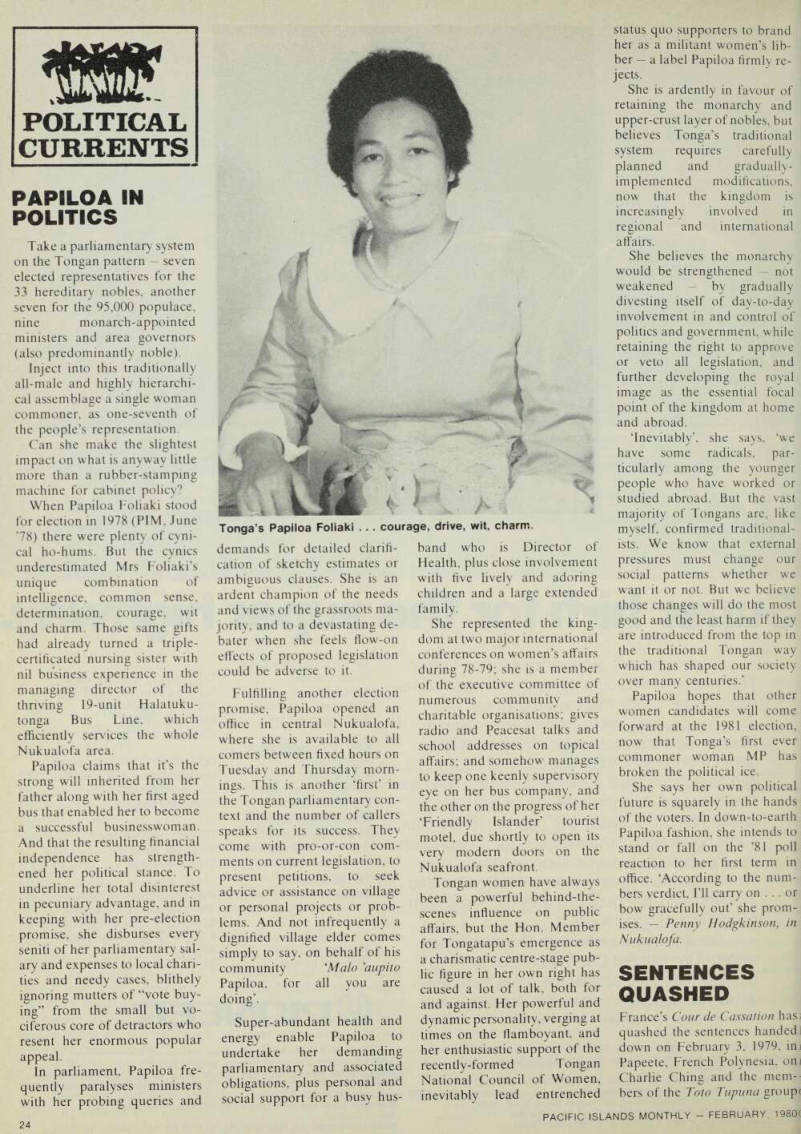
When Papiloa Foliaki stood for election in 1978 (PIM, June ’7B) there were plenty of cyni cal ho-hums. But the cynics underestimated Mrs Foliaki’s unique combination of intelligence, common sense, determination, courage, wit and charm. Those same gifts had already turned a triple certificated nursing sister with nil business experience in the managing director of the thriving 19-unit Halatuku tonga Bus Line, which efficiently services the whole Nukualofa area.
Papiloa claims that it’s the strong will inherited from her father along with her first aged bus that enabled her to become a successful businesswoman.
And that the resulting financial
independence has strength
ened her political stance. To underline her total disinterest in pecuniary advantage, and in
keeping with her pre-election
promise, she disburses every seniti of her parliamentary sal ary and expenses to local chari ties and needy cases, blithely ignoring mutters of “vote buy ing” from the small but vo ciferous core of detractors who resent her enormous popular
appeal.
In parliament, Papiloa fre
quently paralyses ministers
with her probing queries and
demands for detailed clarifi cation of sketchy estimates or ambiguous clauses. She is an ardent champion of the needs and views of the grassroots ma jority, and to a devastating de bater when she feels flow-on
effects of proposed legislation
could be adverse to it.
Fulfilling another election
promise, Papiloa opened an
office in central Nukualofa, where she is available to all comers between fixed hours on
Tuesday and Thursday morn
ings. This is another ‘first’ in
the Tongan parliamentary con
text and the number of callers speaks for its success. They come with pro-or-con com ments on current legislation, to present petitions, to seek advice or assistance on village
or personal projects or prob
lems. And not infrequently a
dignified village elder comes
simply to say, on behalf of his community ‘Malo ’aupito Papiloa, for all you are
doing’.
Super-abundant health and energy enable Papiloa to undertake her demanding parliamentary and associated
obligations, plus personal and
social support for a busy hus
band who is Director of Health, plus close involvement with five lively and adoring children and a large extended
family.
She represented the king
dom at two major international conferences on women’s affairs during 78-79; she is a member of the executive committee of numerous community and
charitable organisations; gives
radio and Peacesat talks and school addresses on topical affairs; and somehow manages
to keep one keenly supervisory
eye on her bus company, and the other on the progress of her ‘Friendly Islander’ tourist motel, due shortly to open its very modern doors on the Nukualofa seafront.
Tongan women have always been a powerful behind-the scenes influence on public affairs, but the Hon. Member for Tongatapu’s emergence as a charismatic centre-stage pub lic figure in her own right has caused a lot of talk, both for and against. Her powerful and
dynamic personality, verging at
times on the flamboyant, and her enthusiastic support of the
recently-formed Tongan
National Council of Women, inevitably lead entrenched
status quo supporters to brand her as a militant women’s lib ber a label Papiloa firmly re
jects.
She is ardently in favour of
retaining the monarchy and
upper-crust layer of nobles, but believes Tonga’s traditional
system requires carefully
planned and gradually
implemented modifications,
now that the kingdom is increasingly involved in regional and international affairs.
She believes the monarchy would be strengthened not
weakened by gradually
divesting itself of day-to-day
involvement in and control of politics and government, while retaining the right to approve or veto all legislation, and
further developing the royal
image as the essential focal point of the kingdom at home and abroad. ‘lnevitably’, she says, ‘we have some radicals, par ticularly among the younger people who have worked or studied abroad. But the vast majority of Tongans are, like myself, confirmed traditional ists. We know that external pressures must change our social patterns whether we want it or not. But we believe those changes will do the most good and the least harm if they are introduced from the top in the traditional Tongan way which has shaped our society over many centuries.’
Papiloa hopes that other women candidates will come forward at the 1981 election, now that Tonga’s first ever commoner woman MP has broken the political ice.
She says her own political future is squarely in the hands of the voters. In down-to-earth Papiloa fashion, she intends to stand or fall on the ’Bl poll reaction to her first term in office. ‘According to the num bers verdict, I’ll carry on ... or bow gracefully out’ she prom ises. Penny Hodgkinson, in
Nukualofa.
Sentences
Quashed
France’s Courde Cassation has; quashed the sentences handed! down on February 3. 1979, ini Papeete, French Polynesia, oni Charlie Ching and the mem bers of the Toto Tupuna group*
Tonga’s Papiloa Foliaki . . . courage, drive, wit, charm
(PIM Apr 1979 p 9). This means f that a new trial will take place, this time in a French court at I Versailles, near Paris.
The French Cour de Cassa \ tion is not to be confused with a supreme court in the British [ or American tradition, for it does not judge the case as such, but only the formal aspects of the trial. Its purpose is purely ; to determine whether the law has been respected or not.
Its judgement in the present 1 case was as follows: • Although French law is ap plied in French Polynesia, the courts are not constituted and do not function in the same manner as in metropolitan France, but in accordance with a special colonial decree from 1933, reducing the jury from nine members to four, and ’ requiring them to be able to
; speak French, which certainly
is very unfair to the ! Polynesians who make up three-quarters of the popu lation. • Serious irregularities were committed when the police interrogated the accused, and legal advice was repeatedly de nied them. (Both these points were
strongly emphasised in the
PIM report referred to.) The Papeete court sentenced Marcel and Jonas Tahutini to 20 years hard labour, Viriamu iTauira and Roland Tefana re spectively to 18 and 10 years hard labour for consorting with criminals, the murder of French businessman Pierre
d‘Anglejean-Chatillon (on
August 26, 1977), attempted murder, acts of violence, an attempt to blow up the Papeete post office, and theft. Charlie Ching and Prosper Faana were sentenced respectively to 10 and five years imprisonment (in solitary confinement) on
consorting charges, and Guy
Taero to five years imprison ment.
Overstayers
Nz Citizens?
Although Western Samoa has been independent since 1962, many of its nationals are still New Zealand citizens.. .or so the argument has been going in a series of court cases in New
Zealand recently.
Western Samoans are the biggest single group of ‘over stayers’, the New Zealand term for those who overstay their permitted time in the country.
But thanks to a novel argu ment put forward by Welling
ton lawyer George Rosenberg,
colonial history has meant that court action against Western Samoans has recently ground to a halt. About 200 Samoans are immediately involved, but on a broader scale, just about every Samoan in New Zealand and Western Samoa has a stake in the debate.
After going through the Magistrate’s Court and the Su preme Court, Rosenberg took his case to the Court of Appeal.
He claimed that by reason of the British Nationality and Status of Aliens (in New Zealand) Act 1923, the father of the Western Samoan on overstayer charges was a New Zealand citizen.
In short, because New Zealand was controlling West ern Samoa prior to indepen dence, Western Samoa, at the time, was an area within 'His Majesty’s dominions and al
legiances at the time’.
The learned judges of the Court of Appeal gave the issue extensive consideration, as was
reflected in the I l-page judge
ment they handed down.
They even mentioned the Treaty of Versailles and the New Zealand laws and regu lations of the day. The Samoa Constitution Order 1920. for example. said executive government of Samoa 'is hereby declared to be vested in His Majesty in the same man ner as if the territory was part of His Majesty’s Dominions’.
But the judgment also
quoted Oppenheim’s ‘lnter
national Law’ and Lewis’s ‘Mandated Territories’ which stated that a mandate did not cause the people of the territo ties to become British sub
jects.
Various other points against
the claim were put forward, and the three judges concluded; ‘Those are the reasons which lead us to the view that the New Zealand Parliament did not in 1923 intend to make all persons thereafter born in Western Samoa ipso facto natural born British subjects. The result is
that the appeal must be and is dismissed.
Rosenberg has not surren dered. He is preparing a case which may take the issue be fore the Privy Council in Lon don. If he gets leave to go to London, he will be asking that all court actions against Samoan overstayers be sus pended until a result comes through, and that could be years.
Meanwhile, on a recent visit to New Zealand. Western Samoa’s Prime Minister, Tupuola Efi. faced questions from journalists about his reac tion to the overstayer issue.
He showed no irritation at talking about the issue, and apart from calling on Samoans to obey the laws of New Zealand, said there was little his government could do in what was essentially an internal affair of New Zealand.
But he said he was nevertheless concerned, and described the overstayer issue as a ‘trauma’
This was reflected in his meetings with the Samoan community in New Zealand where many of the questions he received were about immi
gration problems.
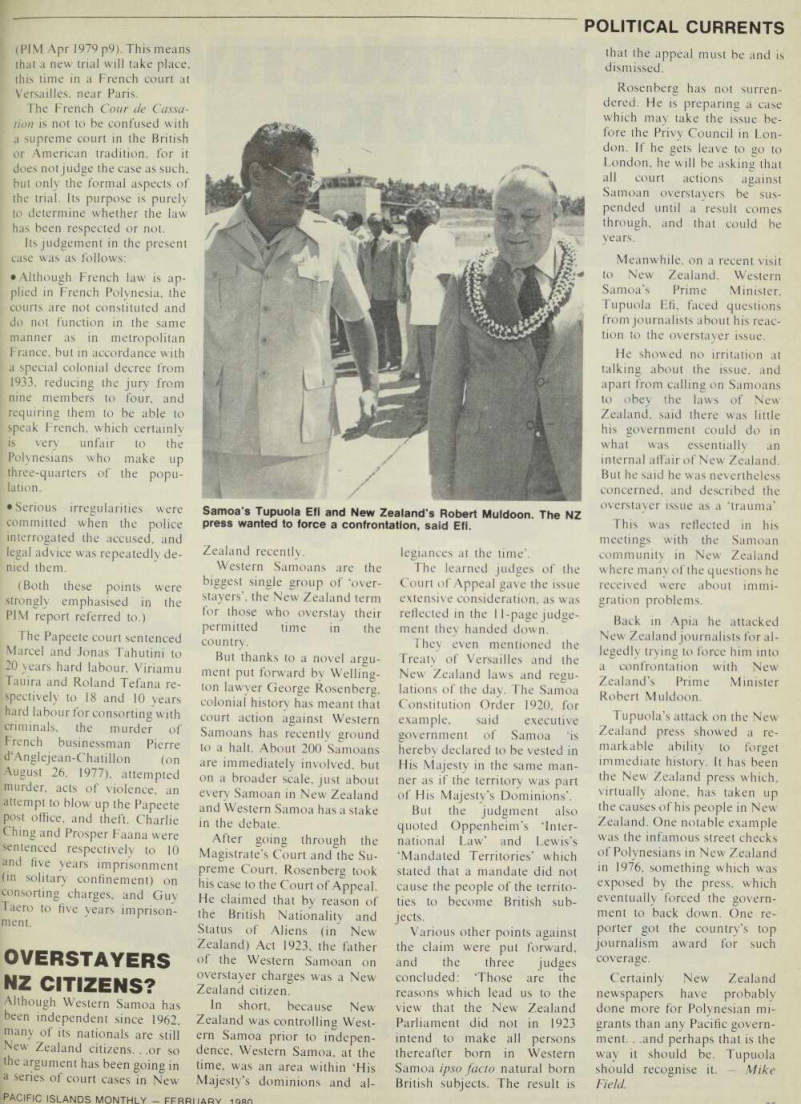
Back in Apia he attacked New Zealand journalists for al legedly trying to force him into a confrontation with New Zealand’s Prime Minister Robert Muldoon.
Tupuola’s attack on the New Zealand press showed a re
markable ability to forget
immediate history. It has been the New Zealand press which, virtually alone, has taken up the causes of his people in New Zealand. One notable example was the infamous street checks of Polynesians in New Zealand in 1976, something which was exposed by the press, which eventually forced the govern ment to back down. One re porter got the country’s top journalism award for such coverage.
Certainly New Zealand newspapers have probably done more for Polynesian mi grants than any Pacific govern ment. . .and perhaps that is the way it should be. Tupuola should recognise it. Mike Field.
Samoa’s Tupuola Efl and New Zealand’s Robert Muldoon. The NZ press wanted to force a confrontation, said Efl.
Whither The
Provinces?
During the final years of Aus tralian rule in PNG, regional demands for greater control over local affairs developed
rapidly.
Doubtless these growing pains were to be expected in a land of many distinct cultures - most of them mutually an tagonistic in a time of dra
matic political change.
Many observers thought that
these demands for authority should have been satisfied
through the existing local
government council system but, sadly, insufficient empha sis had been given to the development of local govern ment since its introduction after the Pacific war and now. when the need was greatest, local government did not hold the answer.
In 1972 just one year from self-government Area Auth orities were introduced in half a-dozen PNG districts, in tended to satisfy the clamour for local autonomy. They were introduced in haste, with inad equate powers and responsi bilities, and hardly had time to prove themselves. For the PNG Constitution was soon to provide for the establishment of provincial governments in the districts called ‘prov inces’ after independence with very real, but inadequa tely defined, powers.
By thus delegating to the provinces much of the re sponsibility for their own ad ministration. central govern
ment hoped to satisfy the aspir
ations of provincial politicians and power groups and yet hold the infant nation of PNG together.
It surprised nobody who had followed the modern history of PNG that the first provincial government was established on the troubled island of Bougain ville, in 1976. In February, 1977, the Simbu Interim Provincial Government was created in the Chimbu Prov ince.
The birth and early develop ment of the Simbu P.G. was watched and studied by a sym pathetic academic observer with long experience of PNG.
Bill Standish. Under the aus pices of the Institute of Applied Social and Economic Research (PO Box 5854 Boroko PNG), Standish has now published a monograph entitled Provincial Government in PNG: Early Lessons from Chimbu which contains invaluable lessons for the PNG Government, but which makes gloomy reading.
Admittedly, the Chimbu example is not typical of PNG (Standish notes that the Chimbu people as a whole are looked upon as ‘wild men’ in Port Moresby bureaucratic and political circles) but it is becoming apparent that what happened in Chimbu is tend ing to occur in other provincial governments.
This is what happened in Chimbu over the period of the Standish study (1977-78)!
Provincial politicans were preoccupied with status and the trappings of office, and showed almost no concern with
policy. They voted themselves
large salaries and allowances (when compared with the income of the average villager) and wasted money on un necessary motor vehicles, often used only for purposes of dis
play.
What decisions they made were frequently made hur riedly and illogically, often in the face of contrary advice from qualified advisers.
Many provincial politicians
were reluctant to face the pub lic and spent most of their time in town, away from their home base. Some ceased to attend the meetings of the local govern ment councils who originally put them into office. The Premier frequently arrived late for public occasions, and left
early.
There was a continual struggle for supremacy within the province. Public servants in a position to help or hinder the
workings of provincial govern
ment were often abused and
humiliated by provincial poli
ticians, in public. Relations be tween provincial and national politicians in Chimbu were generally sour; there was little co-operation, and public ser vants were torn between their loyalties to the two tiers of
government. Their morale and
performance plummeted.
Some Simbu provincial minis ters were even hostile to their own Provincial Secretary, who carried the major workload.
Favouritism was rife.
Field services of all kinds to the mass of the village people
deteriorated alarmingly.
The financial affairs of the provincial government were handled sloppily, extrava gantly and in some cases im properly, with little regard for the strict accountability of pub lic funds.
Acute local problems such as the upsurge in tribal fighting remained unresolved.
Standish is forced, obviously reluctantly, to the conclusion from his study of Simbu that frustration within the provin cial governments throughout PNG can only increase, given
the unrealistically high expec
tations which have been al lowed to rise. ‘Conflict with national bodies is likely to be perpetual
as provincial politicians pursue
their own interests, occasion ally in defiance of national aims and sometimes going against the best interests and welfare of the province and the mass of its people,’ Standish notes. He thinks conflict among the provinces them selves will probably continue, as each battles for an ever larger slice of the national cake.
The picture is not entirely unrelieved: Standish shows that there are some benefits to
be gained from provincial
government in the administrat ive sphere, but he believes the time is overdue for a major re view of provincial government and all of its implications. - James Sinclair
They Oppose
Waste Plan
Although the US Government has made it clear that it is a
long way from deciding
whether to use a Pacific island as a storage facility for spent nuclear fuel (PIM, Jan. p2l). its own Pacific territories are mak ing sure the government knows how they feel about the idea.
The matter came up for a hearing at a US Congressional subcommittee in Honolulu on December 27, when a number of US Island leaders had their say. At the hearing. Richard Scribner, a State Department special assistant, confirmed that preliminary evaluations had been made of Palmyra, Midway and Wake and no where else. The US had made no firm decisions, he said.
The lieutenant-governor of
Guam, Joseph Ada, opposing
any dumping plan, said the State Department had a his tory, specifically in Guam, ‘of becoming very nonchalant, of not caring about the Pacific and its peoples’.
Peter Coleman, governor of American Samoa, told the hearing that the United States would do irrevocable damage to its credibility if the nuclear spent fuel problem was not handled with sensitivity and
foresight.
Also speaking in opposition
was Carlos Camacho, governor of the Commonwealth of the Northern Mariana Islands, who declared the Pacific was
only being considered because
it seems far away to the vast majority of the American
population.
‘Fobbing off the risk on to distant people is immoral and barbaric, and is out of place in a government that prides itself on the observance of human rights’, Camacho said.
Hawaii Governor George Ariyoshi filed a statement with
the congressional hearing that
storing nuclear waste on Pal myra Island would be a great
security risk.
Leslie Fullard-Leo, one of three brothers who own Pal myra, testified that prospective lessees for sport fishing and industry had halted nego tiations for the island after the nuclear storage report became
public knowledge.
Several other witnesses also
spoke against the plan, includ
ing four scientists from the University of Hawaii.
Conducting the hearing were US congressmen Cecil Heftel and Daniel Akaka, both of Hawaii, Philip Burton of California and the Guam del egate to Congress Antonia B.
Won Pat. Lynn Thomas