When they began
pp. 40-45 · Read in the full issue

PM 1930.1980 50
When they began to roll back the frontiers
In this, PlM’s 50th anniversary year, RIM is reviewing the half-century of news highlights reported in its pages. Last month JUDY TUDOR, former RIM editor and publisher, looked at the first four years. Here, she reviews the busy period from 1935 to 1939 and finds it a time when the Pa cific frontiers began to expand, on the ground and in the air.
By 1935 the worst of the De pression years had been left be hind, especially in those islands that already had. or
were establishing, gold
mining. Even more traditional ways of earning an honest quid, such as copra production, began to do better.
The period did have its quota of disasters, such as the volcanic eruptions that for a while obliterated Rabaul. then the capital of the Mandated Territory of New Guinea, but on the credit side, long distance international air trans port was making timid beginnings, a development that, while it was not realised at the time, was going to shatter the isolation of even the remo test Pacific Island group for ever.
In exploration, the frontiers of the last unknown part of the Pacific, the vast island of New Guinea, were being rolled back by men like Jack Hides, James Taylor, Ivan and Claude
Champion, the Leahys and
others.
It was still, by and large, a European Pacific; at any rate, it was the European element that called the shots. To be European then, even if you
were an impoverished planter
or the lowest grade clerk in some Administration, was to be a big frog in a distinctly small
pool.
It was a good life, lived in a certain amount of euphoria; one in which you were aware of what went on in the wide world outside, where Hitler, Mussolini and what PIM called the ’Japanese menace’ were
casting their shadows before, but where it was still imposs ible for Islands residents to be lieve that that world could impinge on his own hunk of coral and coconuts or moun tain claim and jungle.
Politics: In the sense that it developed later, there was little local politicking, such heat as was generated being the gen eral curses local residents brought down on relevant metropolitan governments in Canberra, Westminster. Paris, Wellington etc. These were generally held to have no ap preciation of Islands life and
problems.
One exception was the West Samoan Mau which remained unchastened and collected towards the appeal of O.F.
Nelson against his 10 years banishment to New Zealand (See PIM Jan).
In May 1935 that appeal failed and there was gloom amongst the faithful in Samoa.
However, help was nearer than anyone had a right to think be cause, at the end of that year, a Labour Government was elected in New Zealand.
Not only did the new boys waive the rest of the Nelson period of banishment but sent him and his family back to Samoa at government expense, despatching three ministers to
form part of the welcome home committee.
During their visit the minis ters announced that most of the laws that had angered the Mau would be repealed; that back tax they had refused to pay would not be collected and that Chinese plantation labourers would be repatriated some thing that the Mau was en thusiastic about, but which others were not.
The ministers returned to NZ declaring that they had solved all Western Samoa’s
problems. PIM predicted that
they had not, and was soon
proved right.
Believing that it had won a famous victory, the Mau began to throw its weight about in the Fono of Faipule and the Legis lative Council which it had hitherto boycotted and managed to oust the non-Mau High Chief Malietoa Tanu from the latter. Those who had been anti-Mau now considered that they were hard done by and Samoa remained split into factions.
Mau-ism, nonetheless, began to lose its mana over the years ahead and to merge with a general Samoan desire for independence, which did not occur until 1960.
Meantime in Fiji reorganis
ation of both the Suva munici
pal council and the Legislative Council was proceeding as Whitehall’s way of getting round the Indian community’s demand for a common-roll.
The demoting of the city council to a nominated town council caused most heat and the outgoing council held a ref erendum on the subject. Sixty four voted for the new nominated council, 295 against. The government took no notice and in early 1936 installed seven government town councillors, two nomi nated Europeans, two nomi nated Indians and two
nominated Fijians.
There was, however, an entertaining tailpiece to the municipal council’s demise. At its last meeting it was decided as a sentimental gesture to give the retiring mayor the mayoral chain of office, the nominated board no longer requiring such a bauble.
When the town board audi tor discovered this largess he refused to certify the accounts and the ensuing wrangle went on for months. Finally three of the ex-councillors responsible for the gift were taken to court and ordered to pay £13.10 each to the town board, that being the value put upon the mayoral badge of office. The accused refused, took their case to the Supreme Court, where the
appeal was upheld.
The Old Unfaithfuls: Around March 1934 copra had sunk to £StgB c.i.f. London, its lowest price per ton ever. From there on it seemed that the way it went could only be up.
Sure enough, in January 1935 the price rose to £Stg 12.15.0, - approximately
£l6 in Australian currency a rise attributed to the United States dropping its tariff'
against Philippines copra.
Happy days were here again, or so it seemed. New Guinea planters were not even per turbed too much when the moratorium on repayments on
plantations bought from the
ex-Pro Board introduced in 1930, ended at June 30, 1936.
Prices increased through 1936 and in January 1937 rose to a peak of £24 Stg. per ton in Lon don. No one knew why it rose or why, by May 1937, it was back to £16.12 in London and continued to sink.
But in November 1937, 33 vessels, 12 of them British, sailed for the Antarctic for the 1937-38 whaling season. The very size of the fleet threw a scare into the already weak ened copra market which con tinued its downward trend. In 1939 it rarely moved beyond £lO in London and at the out break of war in September 1939 went into limbo only to emerge in mid-October at a fixed price of £12.17.6 “until further notice”.
Rubber, on the other hand,
being regarded as a strategic
material, kept on steadily rising
in price from the mid-thirties, from almost 8d a lb to over lid in December 1939.
Papuan rubber planters were
home on the pig’s back, at least for a while, and there was even renewed interest in the old neglected rubber plantations around Navua. Fiji. The only cloud on the rubber horizon was the invention of a synthetic substitute and a report that it was increasingly being used in the US.
Mining: In New Guinea, Bulolo Gold Dredging con tinued as the star turn. It had
originally been thought that
bedrock on BGD leases was at an average 22ft, but deep bor ing had established that that was false ‘bottom’ and that good returns came from 60 to
180 ft. Deep-digger dredges
were ordered and the first went into operation in November 1937. At the outbreak of war,
eight dredges were working
and BGD profit for the year ending May 31, 1939 was $3,874,085 Canadian.
The other big Morobe gold-
mining company. New Guinea Goldfields, was not so for tunate and during the period under review came in for criti cism from its shareholders, the government and PIM.
This company had been formed by a London group in the 1920’s and when it entered the field it proceeded to buy up scores of claims and leases, the original owners for the most part receiving shares in NGG in return for their titles. As a result, NGG had a bloated
capital of £5 million and mighty little to show for it in the way of progress. It tied up a large part of the potentially rich ground which remained unproductive and the company was generally regarded as a barrier to progress on the Morobe field.
In April 1935, at a meeting in Sydney, NGG wrote down its capital to £1,118,081 and at the same time declared a divi dend of 4% the last for two years.
In the Solomons, various op timists came up with an occasional report that Guadal canal could turn out to be another Bulolo (which it never did) and Cuthbert’s Misima Gold Mines was doing hand somely by Papua.
But the real gold fever of the mid-30’s was centred around the Tavua field in Fiji. After Pat Costello had interested E.
G. Theodore in Tavua. and the latter had sent experts to Fiji to assess the find. Theodore and his friends John Wren, Cody and newspaper magnate Clyde Packer formed Emperor Gold Mining Co. in October 1934. In January 1935 another company was formed to work the adjacent Loloma leases which were regarded as richer
than Emperor.
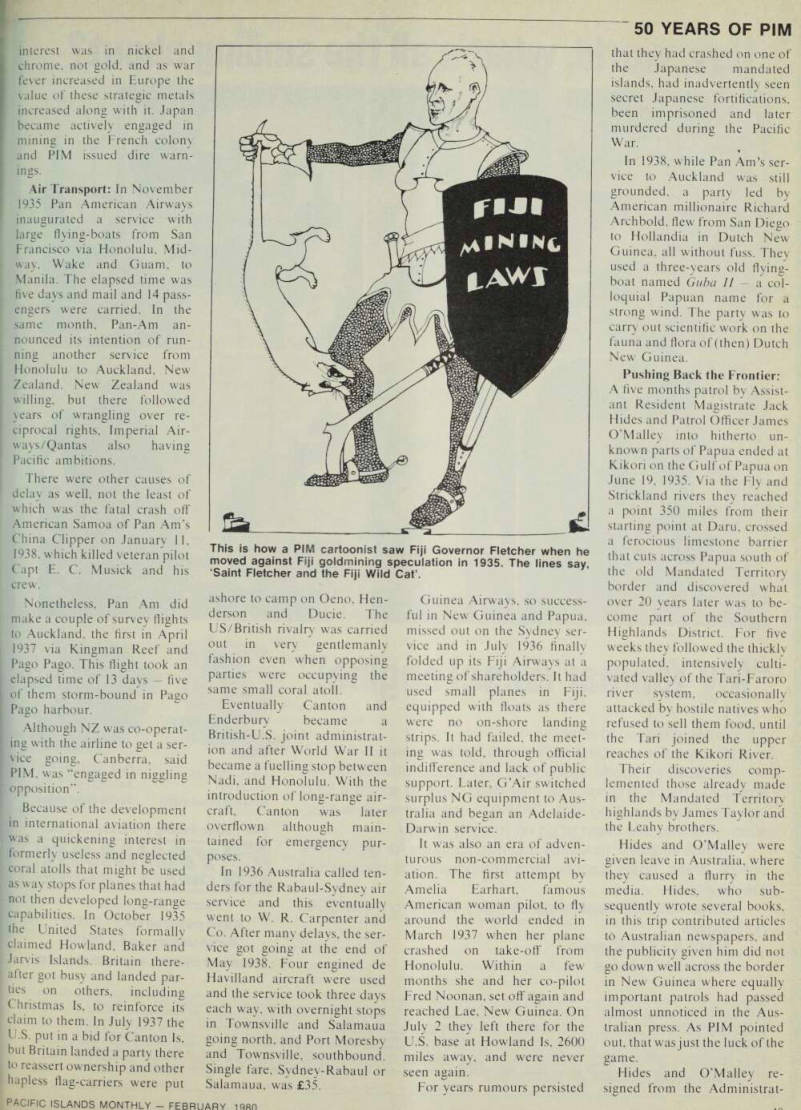
It was the signal for a mad flurry of Australian specu lation, and dozens of Aus tralian syndicates were trying to float what usually turned out to be dud ventures. At the end of 1935 a bill was introduced into Fiji Legco with the idea of
stopping the speculation.
Under it, proposed gold
mining companies had to sub mit their prospectuses to Fiji’s governor for approval.
By 1937 the fever had waned, leaving Fiji with two
healthy mines. Emperor and
Loloma. They were viable pub lic companies that contributed much to Fiji in the years ahead.
Like all fields, there were stories of hard luck and of good luck. One of good luck con cerned W. G. Lawler who had arrived from England in the 1920’s and took on an assort ment of odd jobs. In 1933 a Melbourne syndicate hired him to peg some leases on the Tavua field, and at the same time Lawler was pressured into buying a lease of 400 acres for himself for £2O. The expert sent to Fiji by the syndicate was not impressed with the leases but Lawler decided to stick to his, which he eventually sold to Theodore for £lO,OOO plus 30,000 shares in what was to become Loloma. The hardest luck story was undoubtedly that of the fellow who had orig inally owned the lease, con sidered it worthless and sold it to Lawler for peanuts.
In New Caledonia, the
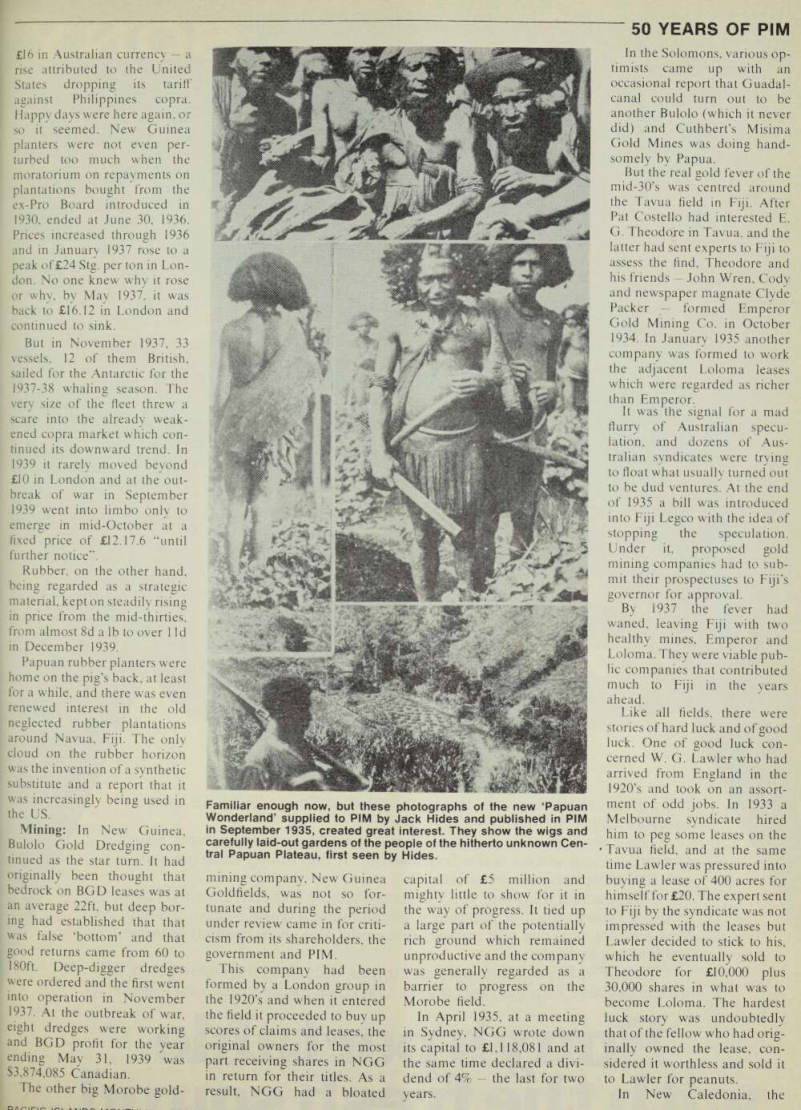
Familiar enough now, but these photographs of the new ‘Papuan Wonderland’ supplied to PIM by Jack Hides and published in PIM in September 1935, created great interest. They show the wigs and carefully laid-out gardens of the people of the hitherto unknown Cen tral Papuan Plateau, first seen by Hides.
interest was in nickel and [ chrome, not gold, and as war fever increased in Europe the ! value of these strategic metals increased along with it. Japan
: became actively engaged in
mining in the French colony and PIM issued dire warn ings.
Air Transport: In November 1935 Pan American Airways inaugurated a service with large flying-boats from San Francisco via Honolulu. Mid way, Wake and Guam, to Manila. The elapsed time was five days and mail and 14 pass engers were carried. In the same month. Pan-Am an nounced its intention of run ning another service from Honolulu to Auckland. New Zealand. New Zealand was willing, but there followed years of wrangling over re
ciprocal rights, Imperial Air
ways/Qantas also having Pacific ambitions.
There were other causes of delay as well, not the least of which was the fatal crash off American Samoa of Pan Am’s China Clipper on January 11, 1938, which killed veteran pilot Capt E. C. Musick and his crew.
Nonetheless, Pan Am did make a couple of survey flights to Auckland, the first in April 1937 via Kingman Reef and Pago Pago. This flight took an elapsed time of 13 days five of them storm-bound in Pago
Pago harbour.
Although NZ was co-operat ing with the airline to get a ser vice going, Canberra, said PIM. was “engaged in niggling opposition”.
Because of the development in international aviation there was a quickening interest in formerly useless and neglected coral atolls that might be used as way stops for planes that had
not then developed long-range
capabilities. In October 1935 the United States formally claimed Howland, Baker and Jarvis Islands. Britain there after got busy and landed par ties on others, including Christmas Is, to reinforce its claim to them. In July 1937 the U.S. put in a bid for Canton Is, but Britain landed a party there to reassert ownership and other
hapless flag-carriers were put
ashore to camp on Oeno, Hen derson and Ducie. The US/British rivalry was carried out in very gentlemanly fashion even when opposing parties were occupying the same small coral atoll.
Eventually Canton and Enderbury became a British-U.S. joint administrat ion and after World War II it became a fuelling stop between Nadi, and Honolulu. With the introduction of long-range air craft, Canton was later overflown although main tained for emergency pur poses.
In 1936 Australia called ten ders for the Rabaul-Sydney air service and this eventually went to W. R. Carpenter and Co. After many delays, the ser vice got going at the end of May 1938. Four engined de Havilland aircraft were used and the service took three days each way. with overnight stops in Townsville and Salamaua going north, and Port Moresby and Townsville, southbound.
Single fare. Sydney-Rabaul or
Salamaua, was £35.
Guinea Airways, so success ful in New Guinea and Papua, missed out on the Sydney ser vice and in July 1936 finally folded up its Fiji Airways at a meeting of shareholders. It had used small planes in Fiji, equipped with floats as there were no on-shore landing strips. It had failed, the meet ing was told, through official indifference and lack of public support. Later, G’Air switched surplus NG equipment to Aus tralia and began an Adelaide- Darwin service.
It was also an era of adven turous non-commercial avi ation. The first attempt by Amelia Earhart, famous American woman pilot, to fly around the world ended in March 1937 when her plane crashed on take-off from Honolulu. Within a few months she and her co-pilot Fred Noonan, set off again and reached Lae, New Guinea. On July 2 they left there for the U.S. base at Howland Is, 2600 miles away, and were never
seen again.
For years rumours persisted
that they had crashed on one of the Japanese mandated islands, had inadvertently seen secret Japanese fortifications, been imprisoned and later murdered during the Pacific War.
In 1938, while Pan Am’s ser vice to Auckland was still grounded, a party led by American millionaire Richard Archbold, flew from San Diego to Hollandia in Dutch New Guinea, all without fuss. They used a three-years old flying boat named Cuba II a col loquial Papuan name for a strong wind. The party was to carry out scientific work on the fauna and flora of (then) Dutch New Guinea.
Pushing Back the Frontier: A five months patrol by Assist ant Resident Magistrate Jack Hides and Patrol Officer James O’Malley into hitherto un known parts of Papua ended at Kikori on the Gulf of Papua on June 19, 1935. Via the Fly and Strickland rivers they reached a point 350 miles from their starting point at Daru, crossed a ferocious limestone barrier that cuts across Papua south of the old Mandated Territory border and discovered what over 20 years later was to be come part of the Southern Highlands District. For five weeks they followed the thickly populated, intensively culti vated valley of the Tari-Faroro river system, occasionally attacked by hostile natives who refused to sell them food, until the Tari joined the upper reaches of the Kikori River.
Their discoveries comp lemented those already made in the Mandated Territory
highlands by James Taylor and
the Leahy brothers.
Hides and O’Malley were given leave in Australia, where they caused a flurry in the media. Hides, who sub sequently wrote several books, in this trip contributed articles td Australian newspapers, and the publicity given him did not go down well across the border in New Guinea where equally
important patrols had passed
almost unnoticed in the Aus tralian press. As PIM pointed out, that wasjust the luck of the game.
Hides and O’Malley re signed from the Administrat
This is how a PIM cartoonist saw Fiji Governor Fletcher when he moved against Fiji goldmining speculation in 1935. The lines say, Saint Fletcher and the Fiji Wild Cat’.
ion and went prospecting for S an Australia syndicate in the [ country they had discovered.
No mining eventuated but both contracted a strange form of ■ beri-beri. O’Malley, aged 37, died at Daru in September 1937; Hides, 31. died in Sydney nine months later.
Hides’ first book (Through Wildest Papua) was published in London in late 1935 and was well received by reviewers in Australia, but PIM complained that the publishers had made the “fatal mistake” of putting a price of 13/6 ($1.35) on it. and said ‘Australians won’t pay that sort of price for a book!’
In 1936 another important patrol was carried out in Papua by ADO Ivan Champion and Patrol Officer C. Anderson.
They left Daru on May 1 and from the end of that month nothing was heard of them until they turned up at Port Romilly at the mouth of the Purari on December 29. Ac companied by 27 volunteer
prisoners from Port Moresby
gaol, they got as far as present day Mendi. skirted Mt Giluwe and eventually found their way into the headwaters of the Purari River.
This patrol did not get the sort of publicity given to Hides and when a Dutchman, Dr A.
Colijn. succeeded in climbing
16,400 ft Mt Carstens, in Dutch New Guinea, in the same year, it was not even mentioned in the Australian press.
Eruption at Rabaul: Follow ing some days of ‘quakes and volcanic rumblings, the citizens of Rabaul were horrified on May 29, 1937 to see a small island called Vulcan, at one side of the harbour, explode into violent eruption. The
following day Matupi volcano,
on the other side of the har bour. also erupted and the two volcanoes together proceeded to cover the town with layers of ash and pumice. Many people were killed. There was a gen eral exodus and finally 8000 people were temporarily housed in a tent town near Kokopo about 20 miles away.
Volcanic activity continued into June, the formerly flat island of Vulcan ending as a 600 ft peak. European women and children were evacuated to Australia and the men returned
to Rabaul to clean up.
For months dust was a fea ture of the area and floating pumice a menace to shipping but arguments as to whether Rabaul should be abandoned and a new capital site chosen went on for years. A committee headed by former N..G. Ad ministrator. Brigadier-Gen. T.
Griffiths, was set up to locate a site and recommended the tablelands behind Lae. This was rejected by the Australia Government which sent the then Minister for Territories, W. M. Hughes, to take another look. He flew around for a week, then announced that the site would be Salamaua and that a road would be built from there directly over the moun tains to Wau.
A storm of protests in New Guinea and Australia followed on both counts. Australia procrastinated and nothing of any note was done before the Pacific War intervened. (After it. Papua and New Guinea were amalgamated and the capital of the combined terri tories was Port Moresby. The Wau road awaited the war also, was built by the Army, and went by a different route to that chosen by Billy Hughes.) Here and There: Atimaono Plantation in Tahiti was producing 900 tons of sugar an nually and in 1935 a tax on imported sugar was advocated as protection for the local industry. Meanwhile, all thought of sugar planting in Papua had fizzled out it would have interfered with the
Australian industry, especially
in relation to its export quota. • Three missionaries had been killed in 1934. in the recently discovered New Guinea High lands and as a result the whole area was closed to European settlement for 15 years. • In March 1935 PIM pub lished news of a new anti malaria drug, Atebrin, manufactured in Germany. It was claimed that two injections prevented recurrence, which was far from the truth. The drug was to become known to thousands of troops in New Guinea during the war. One of its characteristics was that it turned the skin yellow and it was also suspected by many
servicemen of having a bad effect on their sex life. In the post-war it was superseded by more effective anti-malarials. • Brigadier-General H. E.
Hart retired as Administrator of Western Samoa in 1935. Mr A. C. Turnbull was appointed Acting Administrator and was still “acting” in 1939. Only the NZ Government seemed to know the reason for the delay and it wasn’t saying. • In 1936 the Union Steam Ship Co’s new Islands vessel was christened Matua said to be Maori for “parent”. • Ludwig Schmidt, who had been found guilty of murdering [at least] four New Guinea natives and raping native women, was hanged on March 25, 1936 at Rabaul gaol the
only European in Papua New
Guinea ever to meet this fate. • The Colonial Sugar Refining Co. made pineapple canning in Fiji a viable industry when it purchased plant and interests of two defunct canning companies in October 1936.
The industry flourished until
the best pineapple growing
land was taken over at the beginning of the Pacific war to construct Nadi Airport. • For most Islands residents the abdication of King Edward VIII in December 1936 came as a complete shock. Few had heard of Mrs Simpson. Notes from the Cook Islands, pub lished in January PIM. said: ‘After a careful censorship of events which culminated in the abdication, information of an attenuated nature was released for the benefit of the native population. The Resident
Commissioner read out the public proclamation of ac cession of King George VI. Be yond the fact that the crown of Beritane has changed hands, the average Rarotongan knows little or nothing of what has re cently transpired and that little is a strangely mangled version of the facts.’ • In February 1937 the price of a copy of PIM went up by twopence to eightpence. • In the 1937-38 financial year, Papua cost Australia £48,810; New Guinea, £3650; and Nor folk Is. £4OBO. PIM asked edi torially: “Is Norfolk Island worth £4.000 a year to Aus tralia?” • T. H. Harrisson, an English ornithologist who took on the role of anthropologist when he spent some time in the New Hebrides, stirred up Con dominium residents when his book (Savage Civilization) was
published in 1938. Although
defended by the celebrated Miss Evelyn Cheeseman, FRES, FZS, he was generally regarded in the NH as an eccentric who didn’t know what he was talking about in relation to Big Nambas, or any thing else in the con dominium. • By 1939 two-thirds of the total area of Papua had been parcelled out to oil prospecting
companies Papua Oil
Development Ltd, Island Ex ploration Co. Pty Ltd; Oriomo Oil Ltd and Papuan Apinaipi Petroleum Co. Ltd. •In mid-May 1938, the Sigatoka-Navua section of Fiji’s Queen’s Rd was com
pleted, making it possible for
the first time to drive right round Viti Levu.
Queen Salote and Crown Prince Taufa’ahau (now King Taufa’ahau of Tonga) photographed in Sydney in 1935. PIM printed it in its October issue.