Simpson’s
pp. 56-57 · Read in the full issue
pleasure islands of the South Pacific
Pleasure Islands of the South Pacific. By Colin Simpson. Pub lished by Methuen of Australia. $A 14.95.
After 19 other travel books that have covered most places on earth between Russia and Bali and Japan and Spain, Colin Simpson, Australia’s most pro lific travel writer, is back in the Pacific where he began (with Adam in Ochre and Adam with Arrows) some time in the early 1950’5.
Pleasure Islands of the South
Pacific covers Fiji, New
Caledonia, New Hebrides, Rarotonga and Aitutaki, French Polynesia and Easter Island. He had planned to cover Tonga and the Samoas also but no one in authority answered his letters or seemed interested, which is par for the course in those islands where government officials appar ently consider letter writing is
a disgusting European habit.
Simpson is no purist when it comes to travel he sees nothing wrong in being a tour ist or writing for tourists. As such he takes on schedules that are strenuous to say the least,
often leaping across landscapes
in a series of one-night stands.
Not that that blunts his percep tions experienced travellers don’t have to stay a month to
find out whether the place is agreeable to them or not.
On this swing across the Pa cific a week in Easter Island is the longest he stayed anywhere which probably has more to do with air schedules than a belief that this isolated island would hold the interest of the aver age tourist for that length of time. Simpson himself was obviously carried away by its mysterious past and its enig matic statues, devoting twice his average amount of space to this section of the book, although he admits that it hardly qualifies for the normal pleasure resort in spite of the modem 60-room hotel with swimming pool that is a de cided advance on the tent ac-j commodation supplied when Chile’s national airline first put the island on the travellers’! map. Apart from guided tours of the historical sites, every other tourist gimmick is con-1
spicuously absent.
Fiji, says Simpson after two]
weeks on the run there, has a lot to offer and is very good at looking after the visitor, who]
doesn’t easily forget the Fijian I
with the big grin and his ‘Bula’! Thousands of happy] Australians will agree with ] him.
New Caledonia and its capi tal Noumea, a blown-awayl French provincial town, he makes sound far more interest-j
ing, although the average Aus-1
tralian and New Zealander, to I whom it is the nearest piece of
foreign soil, probably prefers!
Fiji.
Rarotonga, in the Cooks, I was much to the Simpson I liking, ‘as Tahiti used to be,’ I but Aitutaki turned out to be I much like Rarotonga used to I be, before its jet airstrip and conversion to tourism.
After a few halcyon days in j Raro, the author decided to j take a side trip to Aitutaki. The j flight was uneventful but at the I motel he is booked in by the j cook, the manager having gone I golfing. A girl shows him to I room by standing outside on I the steps and pointing. Tf she I had come in,’ says Simpson, ‘she would have seen that the I previous occupants had left I two very dead and salty crabs I on the occasional table.’
What he doesn’t say is that ft
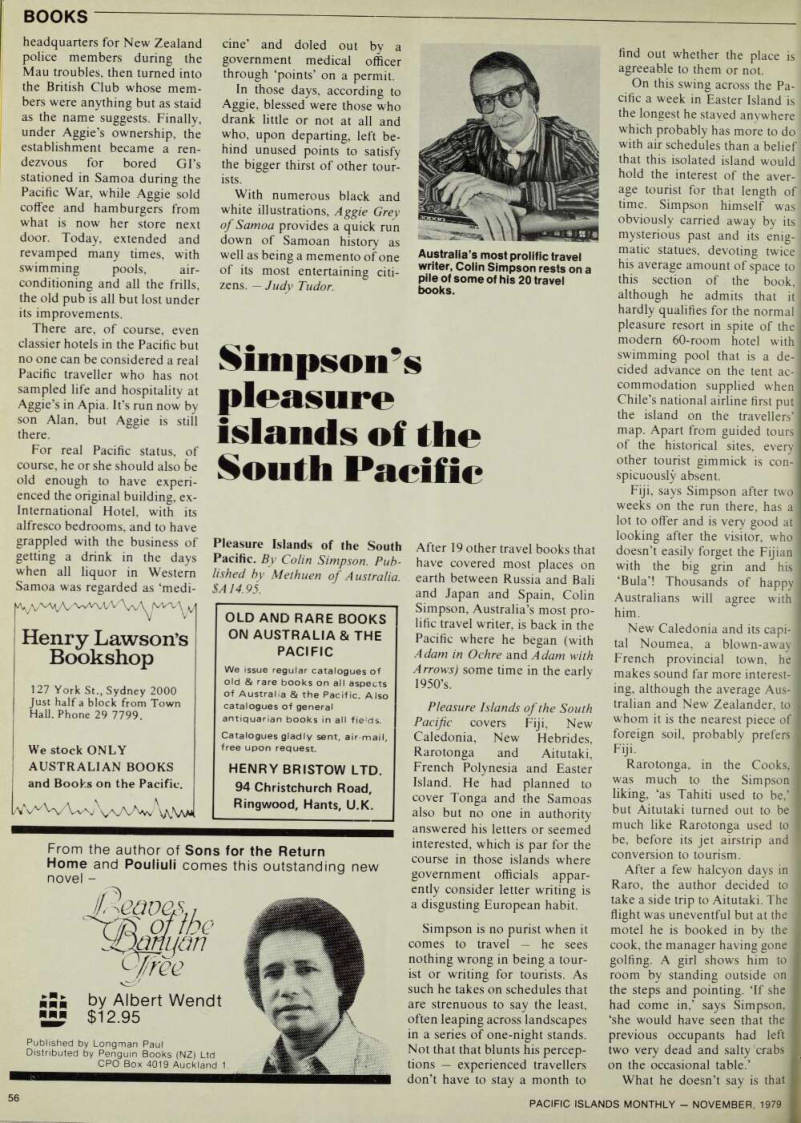
Australia’s most prolific travel writer, Colin Simpson rests on a pile of some of his 20 travel books.
the girl wouldn’t have cared anyway.
When he went to the bar, the whisky bottle was empty. ‘Boss, he got the key to the store room, so no whisky’ gin and tonic was off because there was no tonic. The barman (surprise, surprise) had never heard of a Bloody Mary and hadn’t any tomato juice anyway.
Dinner was worse; breakfast next morning still no tomato
juice. Paw-paw? There was
one, says the waitress, ‘but they ate it at that table over there.’
Simpson returned thankfully
to Rarotonga, realising that whatever you go to Aitutaki for, it isn’t food or drink.
French Polynesia, scenically
beautiful as ever, the people unchanged by tourism at least so far as they are still like Kipling’s cat that walked on its wild lone in the wild woods, they don’t really give a damn for anyone they don’t find interesting, which covers most visitors. Waitresses still treat you like the Invisible Man; tourists and hotel manage ments sigh for big gangs of happy Fijians with wide grins and many bulas, and a bit more
friendly inefficiency.
On Bora Bora an Australian tells him a story that, he thinks, illustrates the local attitude.
At eight a.m. the Aussie is wakened by two Bora Borans, the older of whom says: ‘We gotta paint this door.’ After breakfast the Australian returns to find that the door has been removed and rests on trestles under a tree.
The younger Bora Boran
stands by the door, drumming
a rhythm at one end. A maid who was doing the rooms leaves what she was about and joins him, and drums at the Dther end of the door. The gar dener joins them to drum in the middle, then runs off and :omes back with a guitar. With
the guitar going, the maid goes
mto a dance. Then back comes the older Islander with the tin Df paint, sits down, puts the tin Detween his legs and proceeds to slap out rhythm on the lid t)f the can.
On Moorea, Simpson samples the Club Med and two Dther hotels; moves on to Bora Bora for another Club Med md another hotel; flies to
Huahine and finally to Ran giroa in the Tuamotus.
In brief, Pleasure Islands of the South Pacific is good, aver age Simpson, a tourist with de cided views of his own but a writer who has a gift of taking all the well-known things most of us know about an area and
turning them into something
new and interesting.
Like all Simpson books it is very well produced, with excellent maps and dozens of colour plates, mostly from the author’s own camera.
Judy Tudor.