Pacific

Islands
Monthly
Pim
November 1979
American Samoa US$l.25 Australia ASl.OO* FIJI Fsl.oo Hawaii US$l.5O Nauru 5A1.50 New Caledonia CFPI4O New Hebrides A 51.00 NZ. Cook Is. A Niue NZ$l.OO Norfolk Island Asl.oo Papua New Guinea Kl.OO Solomons SSI. 00 Tahiti CFPISO Tonga ...PI .00 USTT & Guam US$l.25 Western Samoa Tl.lO "Recommended retail price only.
Registered for posting as a publication - Category B.
Cover: Linda, a performer at Nett Cultural Center, Pon ape, in repose. Photo: Harry Hargett
Advertisements & other items, p. 2 (1 item)
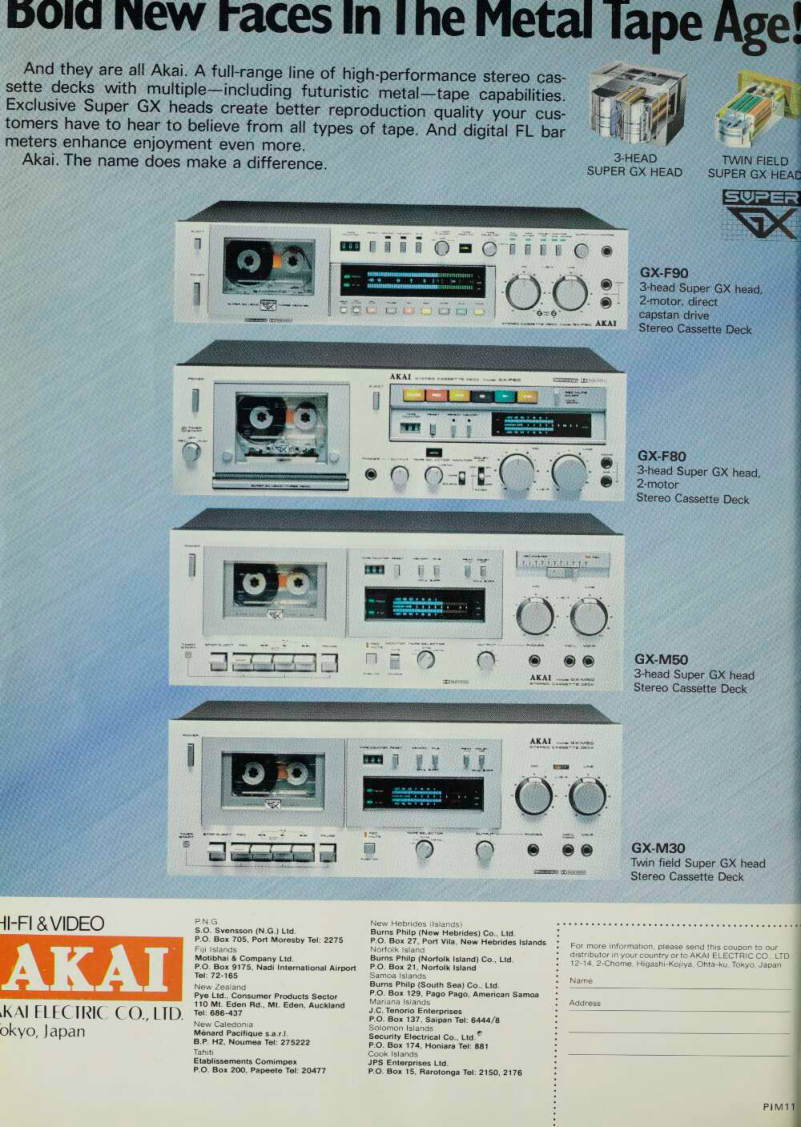
Akai
Doia new races In I he Metal Tape Age!
And they are all Akai. A full-range line of high-performance stereo cassette decks with multiple—including futuristic metal—tape capabilities.
Exclusive Super GX heads create better reproduction quality your customers have to hear to believe from all types of tape. And digital FL bar
meters enhance enjoyment even more.
Akai. The name does make a difference.
3-HEAD
SUPER GX HEAD
GX-F9O
3-head Super GX head,
2-motor, direct
capstan drive
Stereo Cassette Deck
AKAI
TWIN FIELD
SUPER GX HEA
S^RER
■fir
■6 o t
GX-FBO
head Super GX head,
-motor
Stereo Cassette Deck
BBS H 8 B
□.tt- n n i
n © ©
AKAI
GX-M5O
3-head Super GX head
Stereo Cassette Deck
a® l I !J IJ_
o ©
GX-M3O
Twin field Super GX head Stereo Cassette Deck
TI-FI & VIDEO
AKAI
>KAI ELECTRIC CO., LTD
okyo, Japan
PNG.
S.O. Svensson (N.G.) Ltd.
P.O. Box 705, Port Moresby Tel; 2275 Fiji Islands Motibhai & Company Ltd.
P.O. Box 9175, Nadi International Airport Tel: 72-165 New Zealand Pye Ltd., Consumer Products Sector 110 Mt. Eden Rd., Mt. Eden, Auckland Tel; 686-437 New Caledonia Menard Pacifique s.a.r.l.
B.P. H 2, Noumea Tel; 275222 Tahiti Etablissements Comimpex P.O. Box 200, Papeete Tel: 20477 New Hebrides (Islands) Burns Philp (New Hebrides) Co., Ltd.
P.O. Box 27, Port Vila, New Hebrides Islands Norfolk Island Burns Philp (Norfolk Island) Co., Ltd.
P.O. Box 21, Norfolk Island Samoa Islands Burns Philp (South Sea) Co., Ltd.
P.O. Box 129, Pago Pago, American Samoa Mariana Islands J.C. Tenorio Enterprises P.O. Box 137, Saipan Tel: 6444/8 Solomon Islands Security Electrical Co., Ltd.
P.O. Box 174, Honiara Tel: 881 Cook Islands JPS Enterprises Ltd.
P.O. Box 15, Rarotonga Tel; 2150, 2176 For more information, please send this coupon to our distributor in your country or to AKAI ELECTRIC CO., LTD. 12-14, 2-Chome, Higashi-Kojiya, Ohta-ku, Tokyo, Japan Name Address PI Mll
(Usps 952480)
Pim
Pacific Islands Monthly
ilsoNo It
November 1979
(Usps 952480)
Elsewhere SAI6 yment by personal cheque is accepted in Australian i. New Zealand, UK and Fiji currency For other remit tees please obtain a bank draft in Australian dollars ide payable to the ANZ Banking Group, 88 Wentworth enue Sydney, Australia
Representatives
ISTRALIA; Distribution: NSW & ACT: Allan Rodney ight (Circulation) Pty Ltd, PO Box 907. Darlinghurst, !W 2010, Elsewhere: Gordon & Gotch (A/asia) Ltd, Box , PO, Rosebery, NSW 2018 Advertising Melbourne Pacific Publications (Aust.) Pty Ltd, sth Floor. Alley ilding, 75-77 Flinders Lane, Melbourne 3000, tele one 63*0211, ext 1565 Jeff Gates, ext 1858 Ida Pad tt: Brisbane D Wood, Anday Agency, Box 1918. >O, Brisbane 4001 telephone 44 3485. 44 1546: elaide Hastwell Media, PO Box 30, Glen Osmond, , 5064 233 Glen Osmond Rd, Frewville, SA 5063. tele one 79 1869 Perth Adrep, 62 Wickham St, East Perth, \ 6000, telephone 325 6359.
Jl: Distribution and subscriptions Desai Bookshops ) Box 160, Suva, Fiji, telephone Suva 23036 Advertis -3 - Fiji Times & Herald Ltd, 20 Gordon St, Suva, tele tone 312 111, telex FJ2124 lENCH POLYNESIA: Distribution - Hacnette icifique, 10 Ave Bruat, Papeete, telephone 25610 VWAII, UNITED STATES: Distribution PIM, Hawaii. PO )x 22250, Honolulu, Hawaii 96822 PAN: Advertising and subscriptions Universal Jdia Corporation CPO Box 46, Tokyo, telephone 6 3036 :W CALEDONIA: Distribution Depot Centre de esse Michel Pentecost. CBP2 Noumea telephone 2434. 27 4729 ■W ZEALAND: Distribution Gordon & Gotch PO Box 4, 2 Carr Road, Mt Roskill, Auckland 4 Advertising International Media Representatives Ltd, PO Box 2313 ickland, telephone 795 487; 493 389, cables Intereps, ickland Subscriptions Ross Haines & Son Ltd PO >x 1289. Auckland, telephone 769 042 tPUA NEW GUINEA: Distribution Robert Brown & isoc . PO Box 3395, Port Moresby, telephone 25855 Ivertising PNG Post-Courier PO Box 85 Port Dresby, telephone 21 2577 'UTED KINGDOM; The Herald & Weekly Times Ltd 8-10 ifford s Inn. Fetter Lane, London EC4A IBU. telephone 831 6041. telex London 21989 'JITED STATES MAINLAND Advertising - Joshua B )wers Jr, Powers International Inc , 551 Fifth Ave New )rk. New York 100 017 telephone 367 9580 telex 6514 Subscriptions PIM Hawaii 2812 Kahawai St, jnolulu, Hawaii 96822 iblished monthly by Pacific Publications (Aust ) Pty Ltd id printed in Australia by Paramac. Alexandria NSW jstralian cover price is recommended retail only Regis 'ed at the GPO Sydney for transmission by post as a iblication category B Second class postage paid at moiulu, Hawaii Copyright c 1978 Pacific Publications
(Aust) Pty Ltd Postmaster Honolulu Send address changes to PIM Hawaii, PO Box 22250 Honolulu. Hawaii 96822
Subscriptions
M is airfreighted to most subscribers and agents In the Pacific Islands and the United States Aust Other nencan Samoa $13 $US16 istralia $12 inada $14 $US18 jok Islands $13 i $12 $F12. ench Polynesia $14
Cfp 1700'
jam $13 $US16 Ibert Islands $13 iwau $13 $US16 pan $16 V4500 cronesia $13 $US16 luru $18 !w Caledonia $14
Cfp 1700
sw Hebrides $13 iw Zealand $12 $NZ1350 ue $13 irfolk Island $12 irthern Marianas $13 $US16 ipua New Guinea $13 K12 >lomon Islands $13 inga $13 valu $13 iited Kingdom $15 £10 > Mainland $14
Sus18
astern Samoa $13
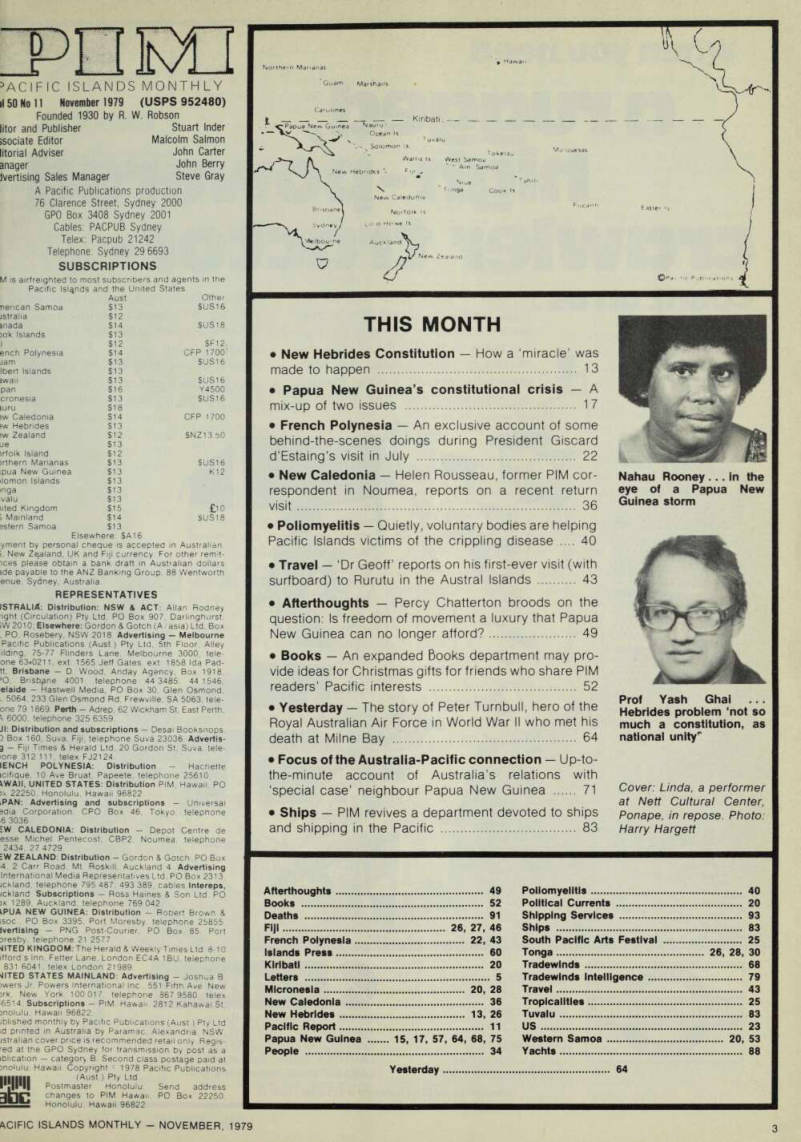
This Month
• New Hebrides Constitution How a miracle’ was made to happen 13 • Papua New Guinea’s constitutional crisis A mix-up of two issues 17 • French Polynesia An exclusive account of some behind-the-scenes doings during President Giscard d’Estaing’s visit in July 22 • New Caledonia Helen Rousseau, former PIM cor respondent in Noumea, reports on a recent return visit 36 • Poliomyelitis Quietly, voluntary bodies are helping Pacific Islands victims of the crippling disease ... 40 • Travel ‘Dr Geoff’ reports on his first-ever visit (with surfboard) to Rurutu in the Austral Islands 43 • Afterthoughts Percy Chatterton broods on the question: Is freedom of movement a luxury that Papua New Guinea can no longer afford? 49 • Books An expanded Books department may pro vide ideas for Christmas gifts for friends who share PIM readers’ Pacific interests 52 • Yesterday The story of Peter Turnbull, hero of the Royal Australian Air Force in World War II who met his death at Milne Bay 64 • Focus of the Australia-Pacific connection Up-to the-minute account of Australia’s relations with ‘special case’ neighbour Papua New Guinea 71 • Ships PIM revives a department devoted to ships and shipping in the Pacific 83
Afterthoughts 49 Books 52 Deaths 91
Fiji 26, 27, 46
French Polynesia 22, 43 Islands Press 60 Kiribati 20 Letters 5 Micronesia 20, 28 New Caledonia 36 New Hebrides 13, 26 Pacific Report 11 Papua New Guinea 15, 17, 57, 64, 68, 75 People 34
Poliomyelitis 40 Political Currents 20 Shipping Services 93 Ships 83 South Pacific Arts Festival 25 Tonga 26, 28, 30 Tradewlnds 68 Tradewlnds Intelligence 79 Travel 43 Tropicalltles 25 Tuvalu 83 US 23 Western Samoa 20, 53 Yachts 88
Yesterday 64
Nahau Rooney ... in the eye of a Papua New Guinea storm
Prof Yash Ghai ...
Hebrides problem ‘not so much a constitution, as national unity’
Advertisements & other items, pp. 3-4 (2 items)
3
ACIFIC ISLANDS MONTHLY - NOVEMBER, 1979
Founded 1930 by R. W. Robson liter and Publisher Stuart Inder sociate Editor Malcolm Salmon litorial Adviser John Carter anager John Berry Jvertising Sales Manager Steve Gray A Pacific Publications production 76 Clarence Street, Sydney 2000 GPO Box 3408 Sydney 2001 Cables; PACPUB Sydney Telex: Pacpub 21242 Telephone: Sydney 29 6693
high-powered
When you need
a rugged,
crawler tractor-
count on us m Caterpillar track type tractors are built tough to tackle the rugged terrain commonly found in developing areas of the Pacific Islands. For
maximum dependability the high-
powered Cat-built engine features an adjustment-free fuel system, a
large radiator and heavy duty air
cleaners to ensure continuous performance in hot, dusty conditions.
Whether your job is dozing or ripping-or any other crawler application-you can count on Cat-built track type tractors to meet your demands. f
. Ar ei&fcLA&
lam
B s a f m % iff* v*v. ■•••«•**
mmm
% sesssi ••• • • • • acs S'.'-'J- • •• m & w !K?
S9S V<- N.-.- 50? ass* 4* '“Hi ■as Sv £
RCS
Sis >.
SK r«*t < as % •w flea V* • €
HASTINGS DURING
LAE:
Milford Haven Road, Telephone 42 2355.
PORT MORESBY:
Telephone 256650.
BOUGAINVILLE:
Itakara Industrial Park, Arawa Telephone 959077
carptrac
SUVA: Carpenter Street, Raiwai.
Private Mail Bag, GPO Suva, Fiji. Ph. 381622.
Telex FJ2190 Cables CARPTRAC.
LAUTOKA: Veitari. Telephone 61877.
LABASA: Vulovi. Telephone 81868.
YOUR
CATERPILLAR
DEALER
Caterpillar, Cat and CB are Trademarks of Caterpillar Tractor Co.
Letters
Acre on the
eluctant missionary
entirely agree with Nigel
Lrauth (PIM, Aug, p 6) that le Institute of Papua New juinea Studies should be con eming itself with the present s well as the past, though per aps in the field of factual laterial rather than that of fic on.
I doubt whether the institute ;, in the long run, doing a good im to Papua New Guinean
reative writing by providing a
idtered workshop for PNG’s ovelists and a subsidised üblishing channel for their ovels. This kindly process de rives them of the kind of
ough editing’ which Nigel
rauth admits John Kolia’s ork stands in need of.
Some sort of a case could, no oubt, be made for giving this ind of aid to beginners in the
rt of novel writing, though it
lould be noted that our pion ;r PNG novelist, Vincent Eri, lanaged very well without it tid finished up in the Penguin st.
But John Kolia, currently the :ting director of the institute, not a beginner. My reluctant fissionary is his fourth novel, ad it is surely time for this riter to be thrown in at the eep end and left to sink or vim.
Nigel Krauth suggests that jmmercial publishers have •st interest in PNG. If so, I link that their interest would s quickly revived if a new avel of the calibre of Vincent ri’s The Crocodile appeared in
ieir in-trays.
Nigel Krauth accuses me of lack of sympathy with ‘dis aught humanity’. Not so. I >uld have very much sym athy with John Kolia’s Judy ; a reluctant Christian. But a Juctant missionary is a con adiction in terms. One does it, or at least one should not, y to convert others to a faith le is not sure about oneself.
Nigel Krauth refers to the
‘policy’ of the institute. I find this hard to gauge; but I notice that out of 10 publications listed back of the title page of My Reluctant Missionary, no fewer than seven are by John Kolia. Of the remaining three, only one is by an indigenous Papua New Guinean.
John Kolia is, of course, quite entitled to write what he likes, and to get it published if he can. But I am one of a num ber of PNG taxpayers who would like to be reassured that public funding of the institute is not being used to subsidise the publication of such highly tendentious fictional material.
Percy Chatterton
Port Moresby
Png
‘Reflections by
a Coral Reef’
I wrote the attached poem very late one Saturday night when I was teaching on Guam back in 1974-1976. It summed up a few of the changes a Statesider like me had to get used to, from phones not working, to drivers passing you at 90 mph on the street shoulder, to no buses or
public transport, to learning
that one had to live with all of these ‘O.O.G.’s’ (only on Guam’s).
Now that I am living the quiet life of a graduate student at the University of Colorado at Boulder, it seems a shame that there is no one I can share my little poem with any more who could enjoy the meaning of life on an island in Micronesia, If possible, I would appreciate it if you could print my poem in your magazine. It seems a shame to let it sit in a drawer in Boulder, when there are so many Islanders who could appreciate the little differences that make
island living so unique.
Marilyn Kaminski
Boulder Colorado
Usa
‘Reflections By A Coral
Reef’
To the tune of ‘Home on the Range’
By Marilyn Kaminski
Sunday, Nov 23,1975,2.45 am. 1 Oh, give me a land, Where the snowstorm is banned, And tropical breezes blow sweet.
Where never is heard, “Yon comes an iceberg!”
And you never wear shoes on your feet.
CHORUS: Guam, Guam in the sea, Oh, you look awfully good to me, Though you go far and wide, You will just find your stride.
Takes you back to the island of Guam. 2. You eat Australian beef.
And get high on a reef, And the mountains inspire you to heights.
Though it always is hot, It’s a pretty nice spot.
From the dawn to the tropical nights.
Chorus.
3. How could anyone lurk, Where the telephones work, And they take the mail right to your door?
Where the houses are brick, Without louvres to click, It’s so easy it must be a bore.
Chorus.
4. And how could you take, No coral to make.
Your car wheels skid from lane to lane.
Few mosquitos or boonie cats, And there are no fruit bats, Or many earthquakes or typhoons with rain.
Chorus.
5. Oh, how could you live, Where a bus ride would give.
You a look at too many pale faces?
Where subways go fast, And the radios blast.
Twenty stations from the world of rat races.
PIM regrets that space
problems preclude us from
publishing the final four verses
of reader Kaminski's pome, A nd trusts she is now settling down in her far-off Colorado home.
That ‘Pacific
Quebec’ again
In the past, local politicians in Tahiti and New Caledonia
have occasionally protested
against the hypocritical stand
of their ‘home’ government in Paris which is all for the independence of French Quebec but refuses to grant more freedom to its own ‘terri tories’ in the Pacific.
A former French journalist.
Daniel Tardieu, who lived for some time in Tahiti in the early 19705, has now added, in a let ter published in PIM. June, a new twist to the Quebec Saga
by twisting the facts.
In his view, the only problem is the ‘incorrect’ attitude of the
English-speaking peoples of
the Pacific, the editor of PIM and us, the under-signed cor
respondents of the magazine,
towards ‘the French-speaking
islands, with their population of some 320 000 people’ who are all perfectly happy with the present system of govern ment.
The simple truth, of course, as everybody knows, is that in the whole of French Polynesia, New Caledonia and the Wallis group there is not a single island where the French
language is the commonly
spoken mother tongue of the majority of the inhabitants, who are either Polynesians or Melanesians. And how does Mr Tardieu arrive at a popu lation figure of 320 000? Even if we leave out the New Hebrides, as he has obviously done, because of the embar rassing fact that they will soon achieve independence, the total is definitely wrong. As for Mr Tardieu’s contention that the majority of peoples in the French possessions are not in favour of independence, it is flatly contradicted by the re cent territorial elections in New Caledonia, the only ones so far where independence was the main issue. Not less than 82.5% of the Melanesians voted for
independence. What the figure
would be in French Polynesia, if a similar choice were given to the Islanders, is anybody’s guess.
Certainly, there can be found in some of the large islands a varying number of French officials, troops, nu clear test technicians,
gendarmes, businessmen,
planters, missionaries, and so on. But to equate the situation of these minority groups with that of the compact majority of French Canadians living in Quebec, as Mr Tardieu does, constitutes a deliberate attempt to create confusion in the minds of PIM readers, to say the least. Incidentally, if any valid comparison between Canada and the South Pacific can be made at all, these
‘French-speaking Islanders’
are rather matched by the
cordially detested ‘English
overlords’ in Quebec.
Having fabricated a totally
fictitious ‘Pacific Quebec’ con sisting of 320 000 French citi zens, Mr Tardieu makes a strong plea for a more tolerant attitude, meaning a hands-off policy and no criticism of the
ld-fashioned colonial lethods, from the govern lents and mass media in the
3-called English-speaking
art of the ocean. It must there ire have been a rather chilling xperience for him to read in le June issue of PIM, immedi tely after his own letter, what le most conservative and well isposed statesman in this inglish’ half of the Pacific has > say on this subject: ‘New ealand’s Prime Minister obert Muldoon has spoken of
le “growing difficulties”
iced by France in the South acific as “the major French domes. New Caledonia and rench Polynesia, become lore and more restive in as iring to independence”. He iid New Zealand’s position as that it wished “to see in
je time a wholly independent
Duth Pacific” .. .’
As for ourselves, we shall mtinue to report as correctly id completely as possible, in rite of all the pressures, reals and abuse to which we e subjected, all major events French Polynesia.
Marie-Therese And Bengt
Danielsson
pehue niti
/hat are the Games
II about?
ne can expect that the South acific Games will eventually ivelop towards the point here it will be too expensive •r any of, the Pacific Islands
mntries realistically to stage
em.
What are the South Pacific ames all about anyway? arely they at best can be tiled a third-rate gathering of »orting l urants who will iver make the grade in the Big ne. The Big One is the Olym cs not the ex-British mpire’s second-class Olym cs called the Commonwealth ames. Our local Pacific-style ini-games should be called a
iendly get-together.
Many participants are not e nationals of the country ey represent. Surely this must op! What is the point of send g a New Zealand golfer, or ustralian tennis player, to present Papua New Guinea Suva? Does this mean that VG has no national golfer or nnis player of sufficient stan
dard to represent this country?
If this is the case, then surely no one should represent Papua New Guinea in that sport!
The size of any contingent
can easily be limited by setting
minimum standards, and limit ing participants to nationals of each country and none of this ‘four years residence rule’ nonsense, either.
Participant numbers can also be limited by looking hard at the type of sports covered. In particular, sailing stands out to me. Ten years ago the boat selected was a Fireball; a good
boat, capable of being built by
the sailor for much less than KlOOO then. The committee then selected the Laser Kl2OO or so, professionally built only. Now they have moved into the big class Hobie Cat 16s more than
K2Loo (Sus3Ooo) In Png.
This is an expensive class. Has the committee ever considered what chance any national has (certainly in PNG, but prob ably every other place too) of ever owning or sailing a Hobie 16? PNG can’t even boast one national boat owner who races
regularly so perhaps the
selection committee could have a second thought about boats.
Why not eliminate sailing
unless it is done in a lakatoi?
I’m serious. Port Moresby sails up to 80 of these each weekend.
But if that type is not wide spread in the Pacific it would be unfair to select lakatois.
It seems to me the Games have run their predictable course and should be stopped, on account of the cost/benefit analysis. The cost is great and just what benefit does anyone but a select group of (often ex patriate) second-rate sports as pirants get from such expensive hoo-ha?
John Gardner
Boroko
Png
Goodbye Tim!
PIM has always had an unsur
passed reputation for predict
ing forthcoming events as well as its ability for exercising an
impeccable sense of timing.
There is no better illustration of this than the message that appears on pp 34-35 of August
Pim.
Dr Tim Kuberski, who has
been the epidemiologist with the South Pacific Commission for the past two years, is about to leave that post to return to the United States. During his time with the commission, Dr Kuberski has contributed con siderably to the SPC’s health programme. Dr Kuberski has
been held in high regard by
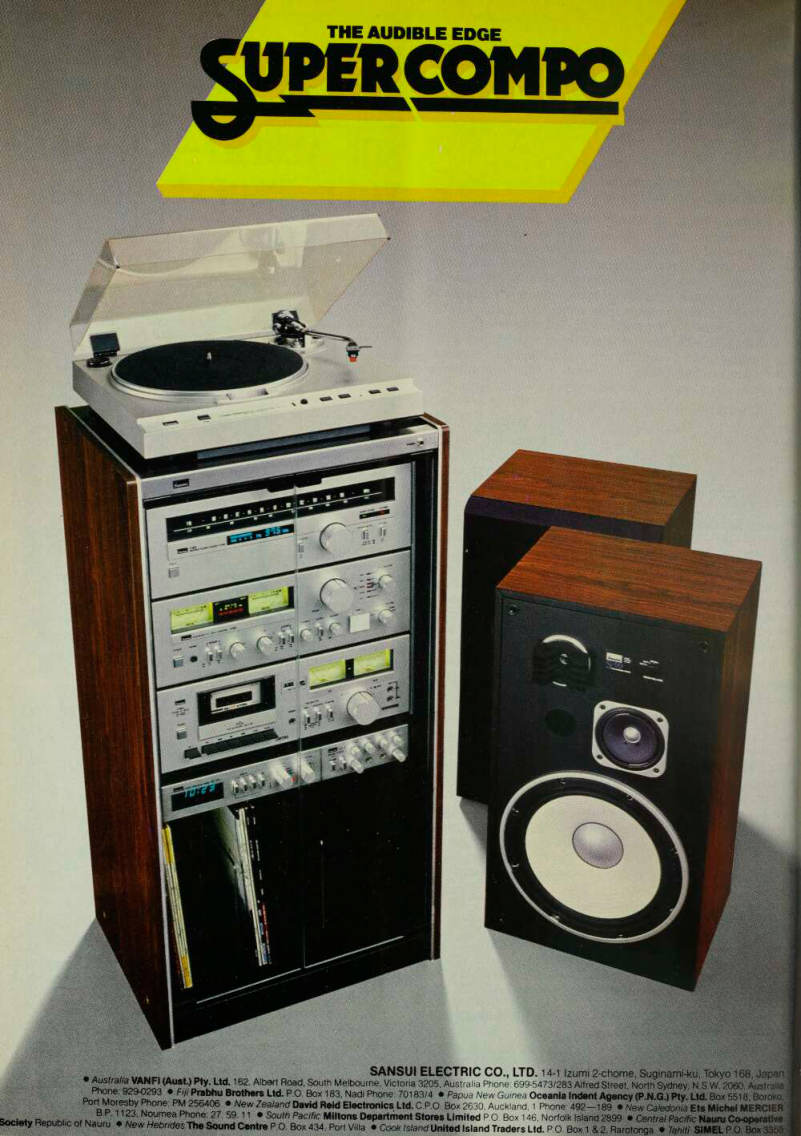
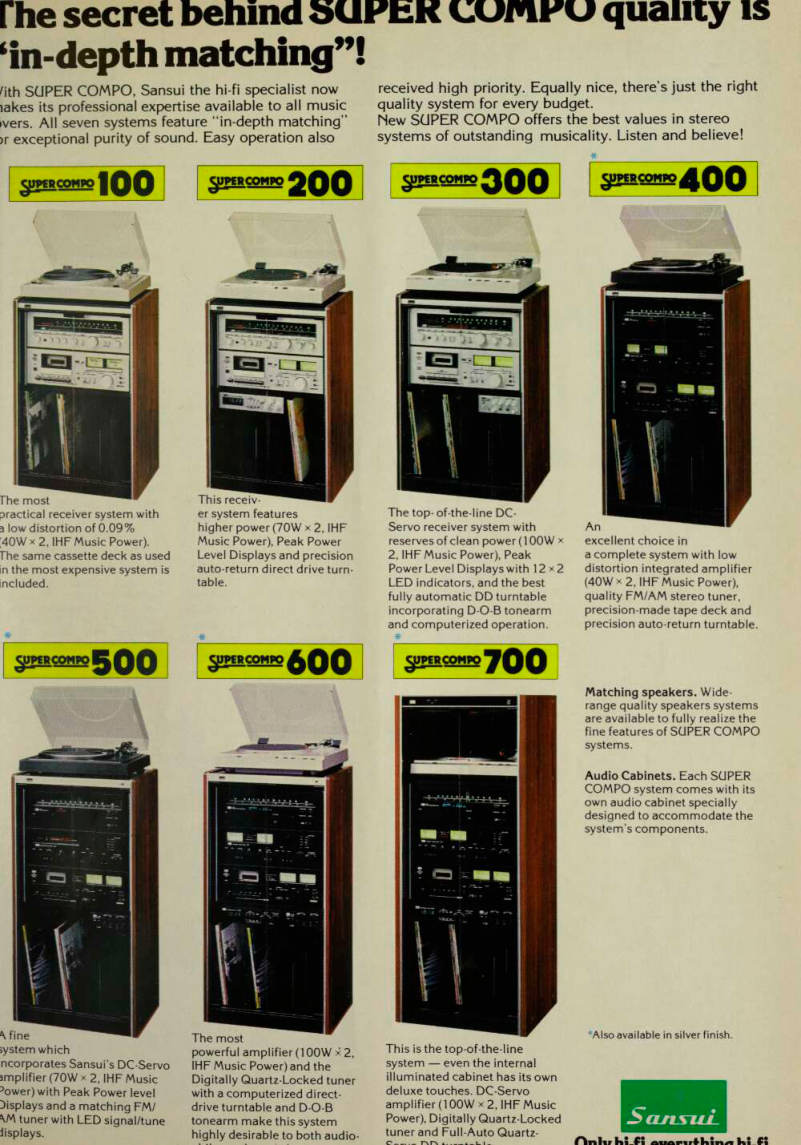
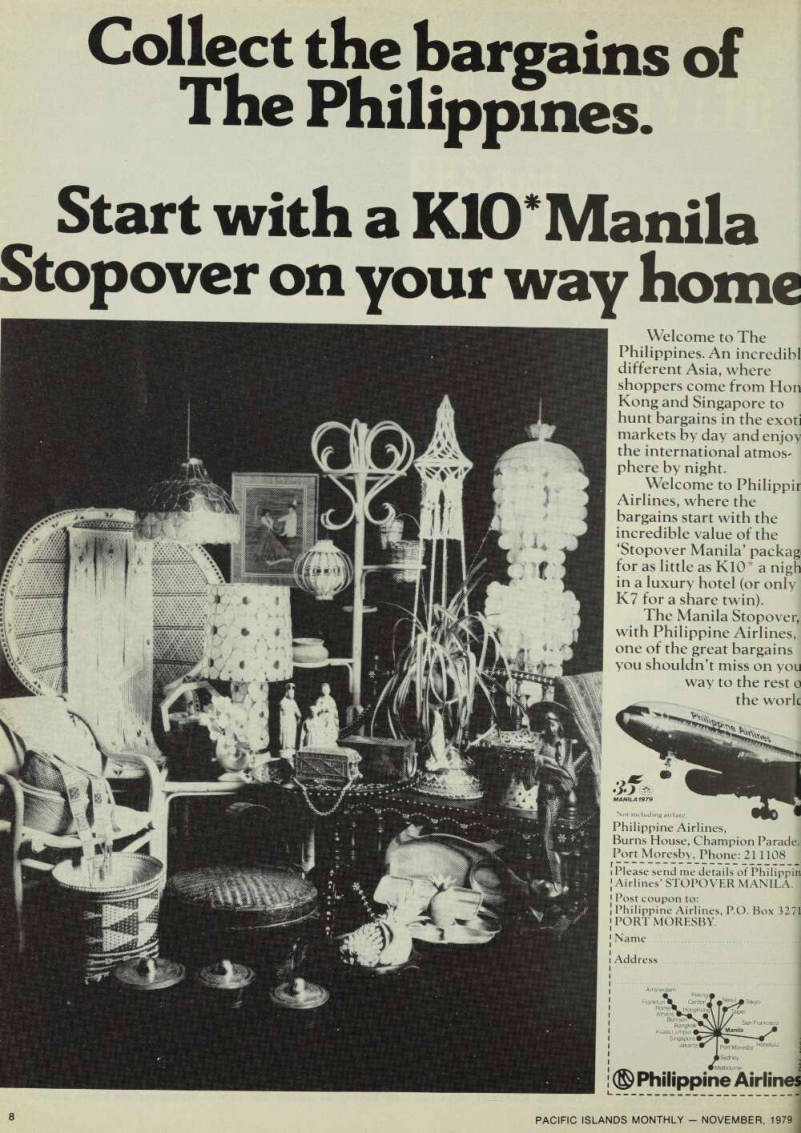
both Pacific Island and over seas medical workers who will all be very sorry to see him leave the SPC. PIM could have found no better way to farewell him than with the message on that double page Sansui adver tisement.
Paul Zimmet
Associate Professor Southern Memorial Hospital Caulfield, Victoria Australia
Sharing his
Holiday Love Affair
As if I had not told enough
people yet! Friends, work
mates, neighbours and even an assorted group of patients in the doctor’s waiting room, but here I go again, talking about my recent ocean voyage to the Pacific Islands.
Here I was on the mature side of 50 about to start a new extension of my life as a winemaker, a consultant, but my wife decided that she wanted to experience a sea cruise. I had just never got around to it. In any case, I had worried about wasting the time and money, being seasick, and of having to attend the cap
tain’s cocktail party, and Bingo
nights.
But there I was doing all the ‘done’ things, like having a cabin party, throwing streamers and waving farewell as the white liner pulled away from the wharf at Sydney Cove. With some 800 other passengers I was embarked on my first sea voyage.
Life on board was not how I had envisaged it at all. I very
quickly developed an affection
for the ship, and the atmos phere made all of us friends.
The ship’s roll was a gentle roll.
It was luxury afloat, with port breaks to ensure that the luxury is appreciated. Returning to the ship was like ‘going home’.
The crew, intent on provid ing service, succeeded mag nificently, and nowhere was this more apparent than in the dining room. Entertainment was virtually continuous and there was broadening of the mind with lectures. Certainly the time never dragged, and I even made it to the Bingo.
Having served in the New Guinea war zone in R.A.A.F. aircrew during World War 11, I was anxious to experience again the real tropics and the real jungle, and I was more than satisfied. Fiji, New Hebrides and New Caledonia stirred the memory, but my real return was in the Solomon Islands, in a jungle setting with a Guadalcanal Museum
organised by the Solomon
Islanders very sad, but satis
fying.
The various market places visited and the happy natives
Clever PIM’s message for Tim. (See the letter from Zim.)
do not know why one always lys “happy”, but it seems anonymous with the Island
rs met my anticipations,
lowever some islands are
lowing signs of “commer
alism”. This is a great pity id should be curbed by the Jthorities. The sight of native
lildren begging was fortu
ately not common, but it did :cur.
I found life on board par
cularly pleasing because, at
iproximately half the Aus alian price, I battled on with daily bottle of 1973 vintage
loet and Chandon chap
iagne another pleasant side
jnefit of the trip.
It is neither right or proper i presume that my friends will ijoy the same vacation, but I
we been boldly recommend
g a life on the ocean waves all and sundry. After all, a 1-day cruise ‘away from it all’ the South Pacific without a emish must create some loy ty in me.
R. W. ‘Scotty’ Ireland
>at Harbour 5W istralia
luestions for
Ir Malandain
ind it surprising that Bernard alandain of the French mbassy in Fiji has been Jremely quiet of late on
rench nuclear testing. Why
is he, who has so often Tended these tests on the ounds of their harmlessness, id nothing to say on the July » explosion at Moruroa? With e South Pacific Games now ell under way, Mr Malandain ould be seeking maximum iblicity for the humanitarian mefits of French nuclear sts.
Could it be that the South
icific Games participants,
irticularly those from French
might just react
angerously’ if a debate on the jestion were going on now in
e Fiji papers?
One thing is clear: history )es not teach the French
ilers anything. French nu
ear experimentation is like
iose developments which in
H 6 culminated in ‘Operation
rossroads’, an operation hich, according to the US ilitary governor of the
Marshalls at the time, involved
experiments designed ‘for the
good of mankind and to end all wars’. And yet three decades later the innocent inhabitants of Bikini and Enewetak are still
plagued by these ‘humani
tarian’ American exper iments!
Marie-Therese Danielsson (PIM, Aug, P 5) raises six ques tions about nuclear testing. I am also anxious for Mr Malan dain’s answers. And, in the interest of truth, I would also ask the following of Mr Malan dain: (1) An explanation and justi fication, on humanitarian
grounds, of the underground
explosion of July 25.
(2) An explanation of the ac cidents which occurred on Moruroa on July 6, which incidentally killed two and
injured four.
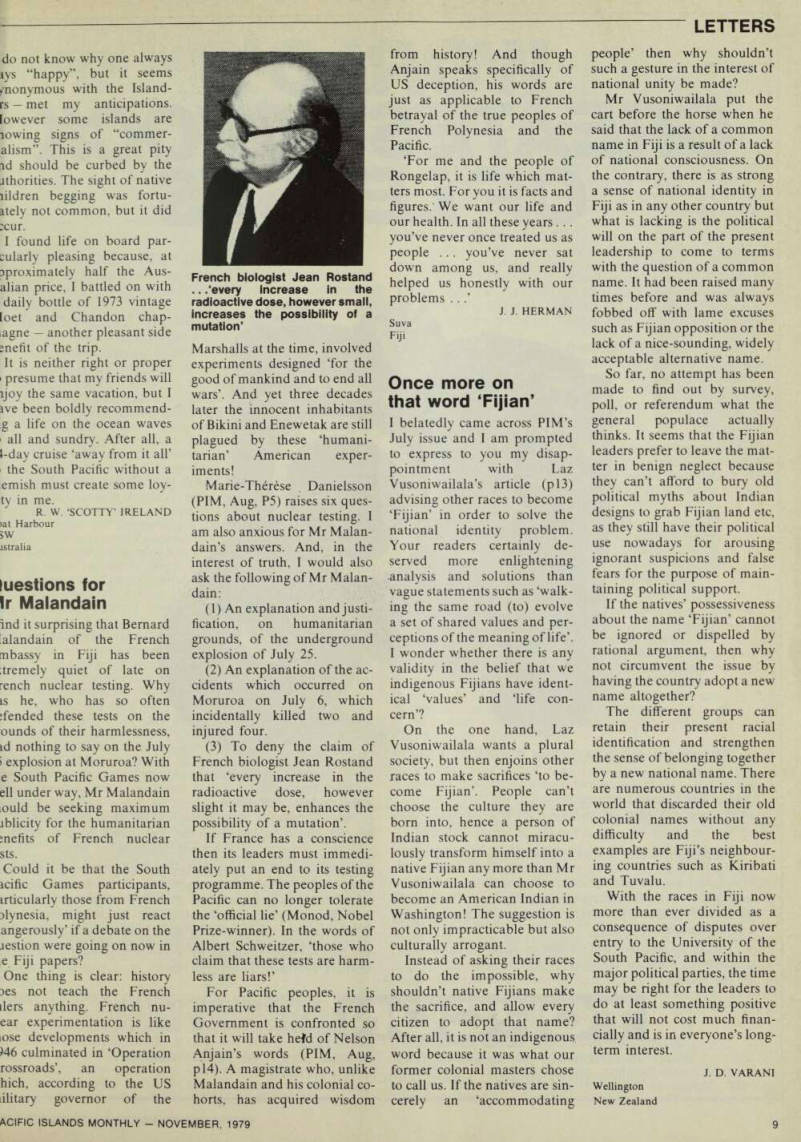
(3) To deny the claim of French biologist Jean Rostand that ‘every increase in the radioactive dose, however slight it may be, enhances the possibility of a mutation’.
If France has a conscience then its leaders must immedi ately put an end to its testing programme. The peoples of the Pacific can no longer tolerate the ‘official lie’ (Monod, Nobel Prize-winner). In the words of Albert Schweitzer, ‘those who claim that these tests are harm less are liars!’
For Pacific peoples, it is imperative that the French Government is confronted so that it will take hefd of Nelson
Anjain’s words (PIM, Aug,
p 14). A magistrate who, unlike Malandain and his colonial co horts, has acquired wisdom
from history! And though
Anjain speaks specifically of
US deception, his words are just as applicable to French betrayal of the true peoples of French Polynesia and the Pacific. ‘For me and the people of Rongelap, it is life which mat ters most. For you it is facts and figures. We want our life and our health. In all these years ... you’ve never once treated us as people ... you’ve never sat down among us, and really helped us honestly with our
problems ...’
J. J. Herman
Suva Fiji Once more on
that word ‘Fijian’
I belatedly came across PI M’s July issue and I am prompted to express to you my disap pointment with Laz Vusoniwailala’s article (pi 3) advising other races to become ‘Fijian’ in order to solve the
national identity problem.
Your readers certainly de served more enlightening •analysis and solutions than vague statements such as ‘walk ing the same road (to) evolve a set of shared values and per ceptions of the meaning of life’.
I wonder whether there is any validity in the belief that we
indigenous Fijians have ident
ical ‘values’ and ‘life con cern’?
On the one hand, Laz Vusoniwailala wants a plural society, but then enjoins other races to make sacrifices ‘to be
come Fijian’. People can’t
choose the culture they are born into, hence a person of Indian stock cannot miracu lously transform himself into a native Fijian any more than Mr Vusoniwailala can choose to become an American Indian in
Washington! The suggestion is
not only impracticable but also
culturally arrogant.
Instead of asking their races to do the impossible, why shouldn’t native Fijians make the sacrifice, and allow every citizen to adopt that name?
After all, it is not an indigenous word because it was what our former colonial masters chose to call us. If the natives are sin
cerely an ‘accommodating
people’ then why shouldn’t
such a gesture in the interest of national unity be made?
Mr Vusoniwailala put the cart before the horse when he said that the lack of a common name in Fiji is a result of a lack of national consciousness. On the contrary, there is as strong a sense of national identity in Fiji as in any other country but what is lacking is the political will on the part of the present leadership to come to terms with the question of a common name. It had been raised many times before and was always fobbed off with lame excuses such as Fijian opposition or the lack of a nice-sounding, widely acceptable alternative name.
So far, no attempt has been made to find out by survey, poll, or referendum what the
general populace actually
thinks. It seems that the Fijian leaders prefer to leave the mat ter in benign neglect because they can’t afford to bury old
political myths about Indian
designs to grab Fijian land etc,
as they still have their political
use nowadays for arousing
ignorant suspicions and false
fears for the purpose of main
taining political support.
If the natives’ possessiveness about the name ‘Fijian’ cannot
be ignored or dispelled by
rational argument, then why not circumvent the issue by having the country adopt a new
name altogether?
The different groups can retain their present racial identification and strengthen the sense of belonging together by a new national name. There are numerous countries in the world that discarded their old colonial names without any difficulty and the best
examples are Fiji’s neighbour
ing countries such as Kiribati and Tuvalu.
With the races in Fiji now more than ever divided as a consequence of disputes over entry to the University of the South Pacific, and within the
major political parties, the time
may be right for the leaders to do at least something positive that will not cost much finan
cially and is in everyone’s long
term interest.
J. D. Varani
Wellington New Zealand
French biologist Jean Rostand ... ‘every Increase In the radioactive dose, however small, increases the possibility of a mutation’
Advertisements & other items, pp. 5-10 (4 items)
5
kCIFIC ISLANDS MONTHLY - NOVEMBER. 1979
Beehive Building
94 Elizabeth Street Melbourne, Victoria Australia 3000 G.P.O. Box 8 Melbourne, Victoria Australia 3001 Telex: AA34552 Phone: 63 5094
Collect the bargains of
The Philippines.
Start with a Klo* Manila
Stopover on your way home
mm * fv r
ITf
X Welcome to The Philippines. An incredibl different Asia, where shoppers come from Hon Kong and Singapore to hunt bargains in the exot markets by day and the international atmosphere by night.
Welcome to Philippii Airlines, where the bargains start with the incredible value of the ‘Stopover Manila’ packag for as little as Klo* a nigh in a luxury hotel (or only K 7 for a share twin).
The Manila Stopover, with Philippine Airlines, one of the great bargains you shouldn’t miss on you way to the rest c the work •Jo m.
MANILA 1979
Not including airfare.
Philippine Airlines, Burns House, Champion Parade Port Moresby, Phone: 211108 Please send me details of Philippin Airlines’ STOPOVER MANILA Post coupon to: Philippine Airlines, P.O. Box 3271
PORT MORESBY
Sydney Melbourne
® Philippine Airlines
WORLD’S
GREATEST STOCK
OF LENSES
Topcon AM Bayonet Mount The new AM bayonet mount (* ) is compatible with one of the most extensive ranges of lenses available on the market. It's backed up by more than 100 fixed-focal length lenses (from 15mm wide angle to 500 mm telephoto) and more than 50 zoom lenses (from 24-48 mm to 120-300 mm), all with automatic diaphragm action, as well as with preset and manual diaphragm lenses, going up to the I,ooomm telephoto. (* The new AM bayonet mount is identical to the "K" bayonet mount.) Topcon Auto Winder-II Auto-Winding is an original Topcon idea, developed to let the photographer keep his eye glued to the finder eyepiece, even while following fastbreaking actions. The new Auto Winder-II is just the right size and correct weight for hand-holding, as well as being perfectly balanced for handling-ease, and makes an ideal combination with the RM 300 for shooting fast actions. With a 2 frames per second shooting speed, at all shutter speeds up to the fastest 1/1,000 second, no picture will ever get away from the Auto Winder-11.
TOKYO KOGAKU KIKAI K.K.
(TOKYO OPTICAL CO.,LTD.)
75-1, Hasunuma-cho, ltabashi-ku, Tokyo 174/Japan Telex: 0272-2384 TOPCON J Phone: Tokyo 967-1101 Cable: TOPTCO TOKYO
Letters
7
\CIFIC ISLANDS MONTHLY - NOVEMBER, 1979
Letters
9
ACIFIC ISLANDS MONTHLY - NOVEMBER, 1979
Pacific Report
Jew Hebrides Settles Constitution
vitally important step along the New Hebrides’ painful path 0 independence was taken in September when the country’s :onstitutional planning committee unanimously agreed on a :onstitution for the new republic. This agreement clears the way or elections to be held on November 14, with independence fated for the first half of 1980. May is tipped as the most likely nonth. (See PlM’s exclusive background report beginning >13.)
: Ive Png Judges Step Down
: ive of the eight judges of Papua New Guinea’s National Court lave resigned in the wake of the country’s controversial ‘Rooney
Affair’ (see pi 7).
Listoric Treaty For Us, Kiribati
he US and Kiribati have signed an historic treaty in which the JS renounces its previous claims to 14 islands in the Line and ’hoenix groups, and which contains provisions for widespread ©-operation, including joint economic ventures between Kiribati and American Samoa (see p2O).
Louth Pacific Conference In Session
he 1979 annual South Pacific Conference was meeting in ’apeete, Tahiti, as PIM went to press. Stuart Inder, editor and üblisher of PIM, was in Papeete for the conference and will sport on its work in PIM December.
Econd Png Minister Gaoled
apua New Guinea’s National Planning Minister, John Kaputin, fas gaoled by the National Court for 10 weeks with hard labour 1 mid-October for disobeying a court order to produce an nnual report and other documents of the New Guinea Develop lent Corporation within a stipulated period. Mr Kaputin is chair lan of the corporation which is owned by villagers in New ritain. He is the second PNG minister to receive a gaol sentence i recent weeks. The Justice Minister, Mrs Nahau Rooney, had een sentenced to eight months imprisonment a month before efore contempt of court.
Ense Scenes In Noumea
iot police and pro-independence demonstrators faced each ther in Noumea for two hours during September 24 cel brations to mark 126 years of French rule in New Caledonia, bout 800 demonstrators, mostly Melanesians, had marched om a park where they had been authorised to hold their only üblic meeting on the day of the anniversary. They were onfronted in a narrow street by police armed with batons, tear as and riot shields. A delegation of protesters was taken to se French officials. The rest returned to the park to continue leir meeting. Several kilometres away, the highlight of the anni- Brsary celebrations a parade by about 800 French soldiers, ailors and airmen was watched by about 2000 Melanesians, uropeans and Polynesians. Among those impassively looking n were 100 riot police flown in specially from Paris for the ccasion. In Suva on the anniversary day about 500 chanting emonstrators occupied the French embassy and hurled abuse t the charge d’affaires Bernard Malandain. They were led by le New Caledonian Kanak independence leader Pastor Jubily lea, and members of a leftwing Suva-based group, the Pacific eople’s Action Front. Earlier in the month, 70% of New ;aledonia’s schools were closed by a strike in protest at the acking of three Melanesian teachers. In one demonstration six eople were seriously hurt and 18 arrested. Riot police used jargas and batons to break up the 200-strong demon tration.
Rench Experts Confirm N-Accidents
‘ scientific investigative party sent from France at the insistence f the territorial assembly confirmed late in September that there 'ere two unrelated accidents at Mororoa on July 5 and 25. Two len died in the first accident when acetone gases exploded i an underground laboratory. The second occurred when a omb stuck partway down an atoll shaft and was exploded, ausing a tidal wave which injured seven people on Moruora.
Scientists insisted neither event brought radioactivity hazards and said defence secrecy was the reason for initial official de nials of the accidents. The bomb explosion was obviously mass ive as Wellington recorded 6.3 on the Richter scale at that time. (See RIM reports on both incidents, Sep p 7, Oct p 23).
Tuvaluan Islands On Hard Rations
Tuvalu’s outer islands had a near famine in September because the country’s only ship, the MV Nivaga, was in dry-dock in Suva for overhaul. Imported foodstuffs ran out and people on four of the islands were said to be existing only on local produce.
Three islands had resorted to rationing. ‘ln spite of this problem,’ reported the Tuvalu News Sheet, ‘life on the outer islands seemed to be jolly-well fun’.
Deoki Fiji’S New A-G
Andrew Deoki, Fiji’s former director of public prosecutions who emigrated to Australia three years ago, has been named by Prime Minister Ratu Sir Kamisese Mara as the country’s new attorney-general. He took over from Sir John Falvey in October.
Sir John, who resigned from the job in 1977, had been tem porarily doing it following the dismissal of Sir Vijay Singh (RIM Sep p 7).
Fire Damages Png London Display
A fire in September partly destroyed Papua New Guinea’s per manent cultural exhibition in London. PNG’s high commission reported that about Kl 5 000 worth of artifacts were damaged when the fire broke out in the PNG gallery of the Commonwealth Institute.
Next Games In Apia, 1983
The South Pacific Games Council has aproved Western Samoa’s request to postpone the Seventh South Pacific Games to 1983 from the planned date of 1981. The unanimous decision was taken following Western Samoa’s plea that the extra time was needed for preparations.
Marshalls Tie Taiwan Knot
The government of Marshall Islands will establish diplomatic re lations with Taiwan when the US trusteeship ends in 1981, according to a report in the Honolulu Advertiser. Other Micronesian groups are expected to follow suit.
Strike Action Hits Kiribati
Newly independent Kiribati in September was in the throes of a strike which disrupted ferry services between Bairiki and Betio, overseas air flights, and some essential services, and resulted in the sacking of a number of workers. A trade union covering government workers on Bikenibeu, Bairiki and Betio ordered its members, including co-operative federation workers, to strike in protest at the alleged forced retirement by the public service commission of an employee, Highland Muller. Later, about 100 of the sacked unionists marched to the president’s office to pet ition for their reinstatement.
Pope Upgrades Micronesian Vicariate
Pope John Paul II has raised the apostolic vicariate of the Caroline and Marshall Islands to the level of a diocese, the apos tolic delegate in the United States announced. The Pope named Nishop Martin J. Neylon, a US Jesuit who has been serving as vicar apostolic since 1971, as first bishop of the new dio- Qogo
Png Seeks Overseas Help On Forests
Papua New Guinea’s Department of Commerce is calling for applications from overseas companies or groups to manage three forestry development corporations. The corporations, owned jointly by the government, the respective provincial governments and the people of the areas to be logged, plan to harvest by selective logging 160 000 ha in Sagarai-Gadaisu (Milne Bay Province), 70 000 ha in Kumusi (Northern Province), and 95 000 ha in Umboi (Morobe Province). The contracts for three management teams of four to eight persons will be for an initial period of five to eight years and production for each corporation is expected to reach 7000 to 10 000 cubic metres a month over about 20 years of logging.
Churches Urge Nc Independence
The Pacific Conference of Churches has supported a call for independence of the Melanesian people of New Caledonia. In a September statement, the PCC said its support followed ‘unanimous action’ taken last month by the 45-member synod
of the Evangelical Church in New Caledonia and the Loyalty Islands. It was the first time the church had gone on record sup porting Melanesian independence. The statement urged mem ber churches and related organisations ‘to bring the Evangical Church’s statement to he notice of their governments’ and to make ‘special prayers for all the people of New Caledonia in this critical time of tension and difficulty’.
US REAL ESTATE AGENTS ACTIVE IN PACIFIC American real estate agents have been busy in Kiribati and Fiji offering land for sale in the United States and their sales talk has prompted an American official to issue a warning through PIM. ‘lt is folly,’ he told PIM in Sydney, ‘to invest in real estate in America unless the would-be purchaser has seen the land.
Some land dealers are genuine but some land being offered, especially in states like Texas, is desert and certainly not a sound investment.' The people of Nuito and Nanumanga in Tuvalu have bought land in the USA offered for sale at SUSSOOO an acre by a part-Tuvaluan, Mr Bula Tokotasi O’Brien, who is employed by the firm Human Resources and Development Inc of Majuro in the Marshall Islands. The people of Nanumea in Tuvalu, who also bought land, have decided to cancel contracts, the Tuvalu News Sheet reports. Mr O’Brien was in Tuvalu in September with Californian real estate Mr Sidney Gross. Mr Gross has invested more than $554 000 of Tuvalu’s money in the United States at an interest rate of 15 per cent and is helping Tuvalu to establish a fishing industry. Mr Gross told the Tuvaluans dur ing his visit in September (PIM Oct p 7) that their investment had already earned them $3l 560.50 in interest.
1980 South Pacific Conference In Png
Papua New Guinea’s National Executive Council has agreed to host the 1980 South Pacific Conference, probably in one of the provinces outside Port Moresby. Minister for Foreign Affairs and Trade Ebia Olewale said the success of the recent South Pacific transport ministers and civil aviation and shipping conference held in Mt Hagen proved that major conferences could be staged outside Port Moresby.
HAS THE US STOPPED LOOKING FOR N-DUMP?
The US Ambassador to Western Samoa, Mrs Anne C Martindell, has said that the US Government has ‘halted’ plans to find a Pacific island or atoll which could be used as a dump for nuclear waste from such countries as Japan, Korea and Taiwan (PIM Oct p 23). The Apia newspaper, The Observer, quoted her as saying: ‘We realise it’s a sensitive issue since France has been testing its nuclear bombs in the area. This is why we have im mediately stopped the studies of the islands.’ However, an October report from Washington said that the US and Japan have agreed to ‘look further’ into a proposal to store nuclear waste on a remote Pacific island. The report said talks in Tokyo between senior officials had resulted in both sides moving towards a decision on whether a full-scale feasibility study was warranted. Each government would now examine such factors as the cost of research, and whether it is prepared to pay for it.
South Pacific Games In The Black
The South Pacific Games Committee will make a profit from the 1979 Games, despite earlier fears that there would be a loss.
Committee treasurer John Creighton said he was sure the com mittee would do better than break even, mainly thanks to the soccer and rugby finals. Creighton said that during the two finals, more than $2O 000 was taken at the gates for each of the games, not including money raised from sales of season tickets. Basketball and boxing also helped as money-raisers.
Other sports chipped in, but to a lesser degree. Timesball, the Fiji Times Qantas Funßun and other fund-raising bodies made valuable contributions. Creighton said more than $5OO 000 had been put down as expenditure.
Fiji Party Official Resigns
The secretary-general of Fiji’s ruling Alliance Party, Senator Akanisi Dreunimisimisi, has resigned her position. Earlier, Prime Minister Ratu Kamisese Mara had told the senator he could not continue working with her. He said he had been concerned about a flow of information from Alliance headquarters without his knowledge. The senator had also been asked about rumours concerning the prime minister circulated at the height of the Sir Vijay Singh affair (PIM Aug p3l).
Fao Plan To Help Fisheries
A new programme established by the Food and Agriculture Or ganisation aimed at helping fisheries development in countries with extended ocean fishing limits could greatly benefit many Pacific Island nations and territories. Announced in August by the Rome-based organisation, the programme covers every as pect of fisheries management. According to FAO, more than 90 nations now have extended sea limits, many of them up to 200 nautical miles, as opposed to eight countries only 12 years ago Nearly all Island nations in the Pacific have established their own 200-mile fishing and economic zones.
Adb Analysis Of Islands Agriculture
‘Pacific Agriculture Choices and Constraints’ was the theme of a report on the South Pacific Agricultural Survey, a pioneer project of the Asian Development Bank. All seven South Pacific developing member countries (DMCs) of the bank - Cook Islands, Fiji, Kiribati, Papua New Guinea, Solomon Islands, Tonga and Western Samoa were covered in the survey. A sub-regional seminar will be held in Apia in January to discuss the survey’s findings. Major matters to be taken up include; the need for increased adoption of the plantation mode of manage ment for major crops, and the associated need for new forms of landholding: shortage of rural labour in some areas and con sequent need for capital-intensive development: the generally poor state of the coconut industry: the need for rural service centres and for co-ordination of transport and agriculture; prob lems of providing services/facilities for populations in economi cally non-viable places; the role of government in national development, including the key role national development banks: and the scope for regional co-operation, especially in the field of marketing.
Olewale At Tahiti Independence Rally
Papua New Guinera’s Deputy Prime Minister Ebia Olewale absented himself from a dinner for delegation leaders at the South Pacific Conference hosted by the French High Com missioner in Papeete in October to attend a pro-independence rally instead. The rally was organised by four small local political parties advocating independence. According to press reports, he was rebuked for his action by Australia’s Minister for Pro ductivity lan Macphee. Mr Olewale calimed Mr Macphee had told him he had ‘encouraged the people to revolt against France’, and added: ‘What nonsense, I just told them that we supported their demands for independence.’
$55 000 For A Tuvalu Passport?
The Tuvalu Government is considering a suggestion from Californian real estate dealer Mr Sidney Gross on how to raise $27 million by selling citizenship to stateless people. Mr Gross, who is handling Tuvalu’s financial affairs in the United States, saw Prime Minister Toalipi Lauti in Funafuti in September and outlined the scheme by which Tuvalu passports could be sold, to about 500 stateless families at $55 000 each. Opinions in Funafuti are mainly against the scheme, arguing that such a scheme would upset Tuvalu’s cultural, social and economic bal ance. Some fear international terrorists would be ‘in the market’ for such facilities. Mr Gross has also asked for a Tuvaluan char-1 ter to open a bank.
Tongan Royals In Nz, Australia
King Taufa’ahau Tupou IV and Oueen Mata’aho of Tonga made state visits to both New Zealand and Australia in October. ] The visits followed invitations issued during celebrations of the , King’s 60th birthday last year.
Expansion For Forum Line
The Pacific Forum Line is to open offices in Suva and Wellington. I By February next year the line plans to have disposed of its con-1 ventional ships and have three new roll-on-roll-off container! ships in their place.
Resident Australian Hicom For Apia
Australian Minister for Foreign Affairs Andrew Peacock has an-1 nounced the appointment of Allan Deacon as Australia’s first resident high commissioner to Apia, Western Samoa. Previously] Australia’s high commissioners to Fiji were accredited to West-1 ern Samoa.
Diplomatic Ties For W. Samoa, Indonesia
Indonesia and Western Samoa are to establish diplomatic re-j lations. Indonesia becomes the 26th country with which Western!
Samoa has such relations.
Advertisements & other items, p. 11 (1 item)
11
ACIFIC ISLANDS MONTHLY - NOVEMBER, 1979
A New Hebrides constitution
Vila’s ‘political miracle’: A New Hebrides constitution
Hailed os 'a marvellous minor political miracle' by rhe British resident commissioner in the New Hebrides,, Andrew Stuart the success in September of the country's constitutional planning committee in reaching agreement on a consti tution for rhe soon-to-be independent republic is one of rhe most important developments in Pacific politics for some time In rhe article below, a PIM correspondent who was in Vila during rhe final stages of rhe committee's work, and in o position to observe this work closely, backgrounds rhe momentous events which hove cleared the way for general elections in rhe New Hebrides on November 14, and for New Hebridean independence in the first half of 1980 with May widely ripped os the most likely dote.
ls dawn was about to break on
le morning of September 19,
979 over Vila, New Hebrides, le constitutional conference fas still deadlocked over two uestions on the constitution. )ne concerned the powers to e vested in the regions or dis icts, and the other the method f adoption of the constitution, ifter a long, intense and motional debate, the con jrence resolved these ques ons, and thus cleared the path
) general elections on
lovember 14 and indepen
ence to follow as soon as the uestion of the powers to be ested in the districts of Santo nd Tanna is resolved by the
ew representative assembly,
he new assembly will have imsiderably more powers than s predecessor; and its election nd the installing of the new Duncil of ministers will clearly lark the establishment of self
ovemment, with only de
mce, currency and certain spects of internal security re
;rved to the metropolitan
owers.
The conference, at which the rench minister Paul Dijoud nd the British minister Peter laker were participants, was re culmination of several tenths of work by the consti
itional planning committee,
he boycott by the Vanuaaku
arty, generally acknowledged
) be the majority party, of the 977 elections to the assembly reduced an impasse in the
Duntry. The assembly, elec
ons to which produced no
ontest, consisted entirely of
•ancophones, variously label
ed as the moderates, or
federal party. The council of ministers came from the same group. The legitimacy of the assembly and the council was questioned from the very beginning. Meanwhile, the Vanuaaku Party carried its earlier boycott to what it con sidered the next logical step the establishment of a pro visional independent govern ment, which was facilitated by the thinness of administration on the ground and the over whelming support for VP in some parts of the country. The impasse was broken by the VP agreeing to call off its own government, and to join with
the moderates in a council of ministers as the government of national unity. Given the his tory of New Hebrides politics, the GNU was an inherently un stable body, and was unable to provide the momentum towards constitutional progress that was expected of it.
The impasse was further broken by an important initiat ive of Paul Dijoud in February 1979 when he visited Vila. He then lifted what was generally referred to as the French veto on independence. But he insisted that the country must first prepare and adopt a con stitution for independence, be-
fore the ‘unrepresentative’ assembly was dissolved, and fresh elections held, a position which was contrary to that of the VP, who considered that elections and a genuinely rep resentative assembly were pre requisites to the preparation of the constitution. Dijoud went on to make suggestions for con stitutional provisions: bi
lingualism, proportional
representation, and decentral isation or powers, all con cerned to ensure suitable
minority protection. Further,
he set a tight time table. The council of ministers, assisted by two foreign experts, were to prepare the draft constitution, to be submitted to the metro politan powers in June, and then referred to a referendum.
Under his proposals, indepen
dence could well come before the end of the year.
The Dijoud Plan met with considerable opposition, apart from that of the VP. Many complained that the time table was too tight, and, more im
portantly, the francophones
became nervous at the imminence of independence implicit in the proposals. Thus, when the constitutional advisers came there was con siderable confusion about, and some measure of opposition to, the proposals. The idea of a referendum had already been dropped at the behest of the GNU, but precisely how the constitution would be adopted was unclear. The two advisers were Professors Yash Ghai and Charles Zorgbibe, the former with considerable experience of constitutional work in the Pacific, the latter with none.
Professor Ghai’s analysis appears to have been that the fundamental problem was not the drafting of a constitution but creating the conditions for
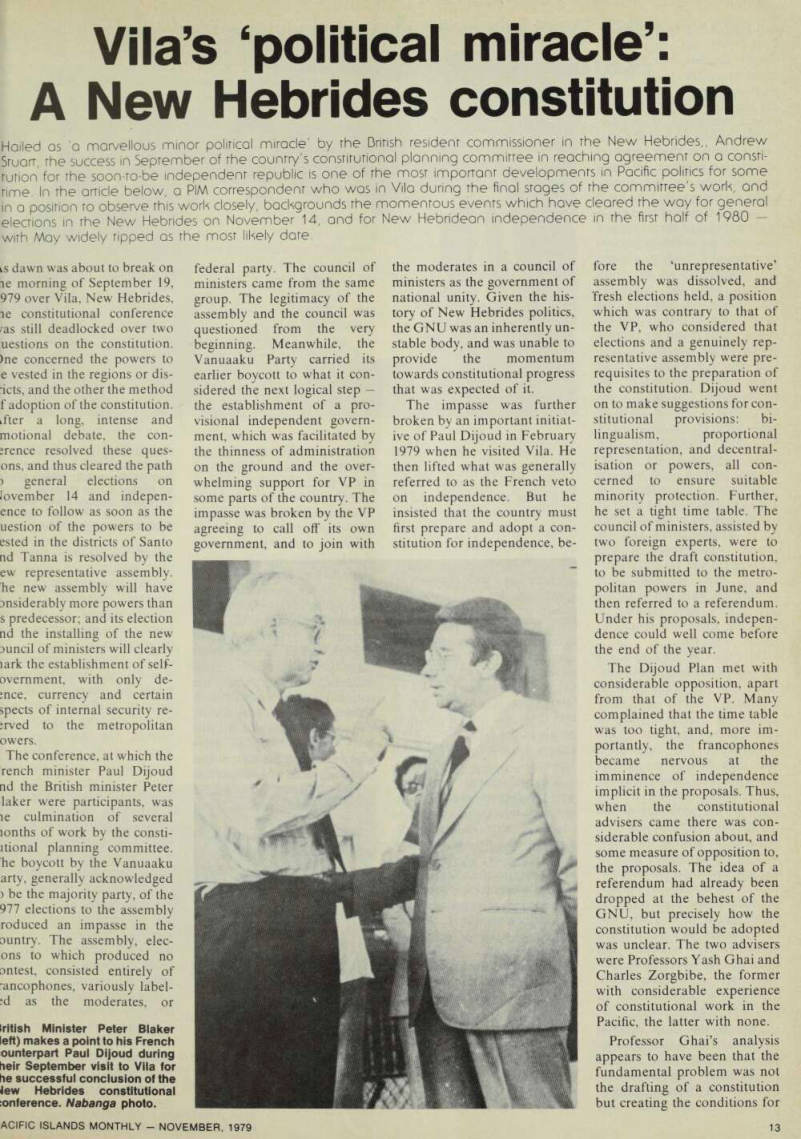
British Minister Peter Blaker (Left) makes a point to his French counterpart Paul Dijoud during heir September visit to Vila for he successful conclusion of the New Hebrides constitutional conference. Nabanga photo.
national unity. There was no doubt that the country was deeply divided, but the div isions were the result of the condominium. It was import ant that the New Hebrideans should transcend these div isions in order to find the true basis of unity in their common Melanesian heritage. In many ways this was the last oppor tunity for them to find the basis of unity, and so Professor Ghai reportedly urged the council of ministers, the different parties, churches and chiefs to expand the membership of the body charged with the basic re
sponsibility for drafting the
constitution, so that its deliber ations would begin the process of healing the national wounds, and the constitution would
enjoy greater legitimacy. The
constitutional planning com mittee was thus established in early April, on the initiative of the New Hebrideans and owing nothing to the metro
politan powers. Although its
legal status was ambiguous,it
was as representative a body as it was possible to put together in the circumstances, and the success with which it was established was an early indi cation that if the New Hebrideans were left to them selves, they were capable of resolving their differences in an amicable way.
Once the CPC took on board the task of drafting the consti tution, the vast majority of its members worked diligently and honestly. With the help of option papers prepared by the consultants, the committee held long debates on various aspects of the constitution, de bates which showed a sure grasp of the problems of the country and which were evi dence of the wish of the mem bers to find common ground and to understand the points of view of other sides. As the dis
cussions proceeded, they cut
across party lines. There was very quickly agreement on a parliamentary system, but there was considerable contro versy as to whether there should be a ‘constitutional’ or executive head of state.
Two of the most difficult issues were the system of elec tions, the moderates wanting
proportional representation,
and the VP wanting single member constituencies, and
the powers to be vested in the districts or regions (the term preferred by the moderates).
The latter issue threatened to abort the committee’s work of many months, and was not re solved until the last minutes of the conference.
There was a wide measure of agreement on the judiciary,
public services, languages and
land. It was also easy to find agreement on citizenship, de spite at one point a rather rigid and racist line taken by the Bri tish Government (withdrawn later when it was discovered that there was little in the pro posals of the CPC which need arouse the wrath of the Enoch Powells).
The conference concluded with the decision that the com mittee would travel round the islands to explain the consti tution to the people and seek their views on it. The com mittee would then reassemble in Vila when the two resident commissioners would sign the constitution on behalf of their governments, and it would then come into effect on the
eve of independence. Despite
some of the attacks which have been made on the constitution
it is generaly acknowledged
that it is very democratic; it provides for free and fair elec tions, and the government will always be responsible to the unicameral parliament. The ju
diciary is completely indepen
dent, and the Supreme Court is the final arbiter of disputes about the constitution and re sponsible to ensure that consti tutional rights and guarantees are respected. The constitution protects the fundamental human rights of all citizens, and provides for the establish ment of an ombudsman to
investigate complaints of
maladministration, discrimi nation, etc. The status of English and French as official languages is preserved, and Bislama will become the national language as well as an official language. There is to be a council of chiefs with the pri mary responsibility to safe guard and promote custom and tradition, and with important consultative functions in re spect to certain kinds of legis lation, including land.
On land, the constitution provides a basis for the return of alienated land to the
indigenous people and enables
the government to exercise greater control over land trans actions than before.
One issue the constitution does not resolve definitively is decentralisation. The com mittee was unanimous in its support of the need to decen tralise, but there was disagree ment on the extent of decentralisation and the pro cedure to determine this. An
overwhelming majority
wanted the question to be re
solved by the new Assembly' after receiving the report of a special commission; a small
minority wanted regional
powers agreed at the con-| ference and entrenched in the constitution.
The ultimate compromise was that the assembly would retain the power to make the decision on the devolution of powers to the regions and islands, but that Santo and s Tanna would elect their re gional assemblies on the same ; day as the general elections, and these would enter into I negotiations with the central government on the powers to be devolved, leaving the final ! decision on the assembly be fore independence. All in all, the constitution provides suit able guarantees for all groups, and in particular the French-1
speaking ‘minority’. It is clear 1
that each group has had to make compromises in order to reach agreement.
The constitution is therefore not only a considerable tech- I nical and political achievement j of the committee, but it is also evidence of the fact that the New Hebrideans are capable
of solving their own political <
differences, especially if the :
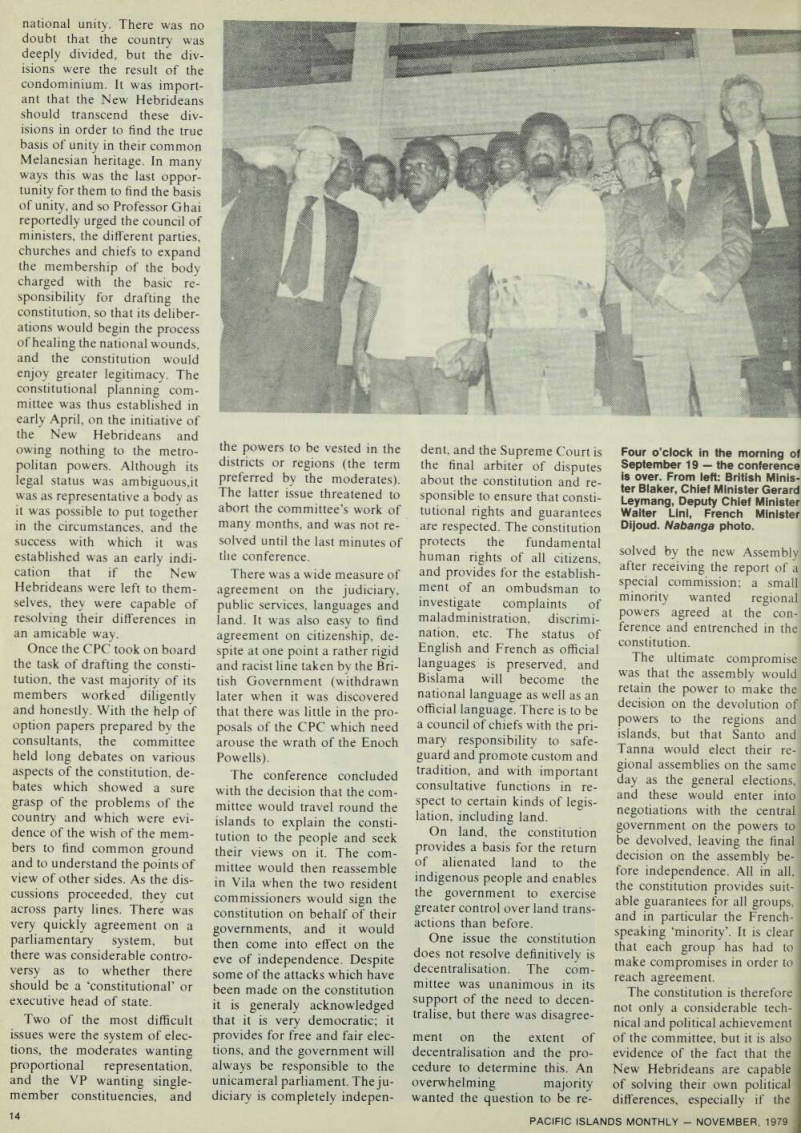
Four o’clock in the morning of September 19 the conference is over. From left: British Minis ter Blaker, Chief Minister Gerard Leymang, Deputy Chief Minister Walter Uni, French Minister Dijoud. Nabanga photo.
netropolitan powers do not nterfere unduly. There was a trong suspicion among the nembers of the committee that >n issues on which it was dif icult to get an agreement, one
>r the other metropolitan
lower was inciting a small ninority to be recalcitrant. De pite such interference, which
he ‘cognoscenti’ freely ack
lowledged, the committee suc eeded in its mission.
The ultimate success of the ommittee can only be judged •ver time, but it can be stated hat its work has truly laid the
»asis of national unity, fragile
hough the basis may be. It was he view of many observers hat the work and the spirit of he committee may have
irought about a qualitative
hange in the politics of the Jew Hebrides. Under the
iatient and gentle chairman
hip of Father Leymang, the ommittee worked on the basis f consensus, which meant in ractice that even one member f the Committee could hold p agreement on any point, 'here was therefore a strong icentive to concede points, to
ompromise and to persuade
ather than to threaten. The de ates helped to clear the air,
nd better understanding of
ae points of view of the dif jrent groups by others was stablished. It was clear that le political groups could no mger be facilely divided into nglophones and fran-
Dphones. Many prominent
ancophones co-operated with te VP, while among the mod rates there were at least two
nglophones. A very positive
)le was played by the
Tabwamesaana-Nakamal al liance. Many observers were impressed by the sense of re
sponsibility and maturity
shown by the VP, not least by those members of it who have been constantly attacked for being ‘communists’ and ‘Marx ists’.
A factor which ultimately facilitated co-operation among the New Hebrideans was their realisation that if the matter was left to the metropolitan powers, the interests of the New Hebrides would be poorly served. They realised that the NH was a small pawn in the game of international re lations, including the EEC, that Britain and France conduct with each other, and that this pawn would be lightly sacrificed. Those who saw the supine performance of the Bri tish minister would have been more than confirmed in their suspicions. Few expect that the two metropolitan powers will now desist from their intrigues.
Yet others may decide to try to divide the leadership of the VP in their mistaken and simplistic belief that a few communists exist who should be isolated.
Unless these outsiders want to see an area of instability in the Pacific, they would be well advised to let the New Hebrideans get on with the already difficult task of
national integration and unity
without external sabotage.
If the urge to carry on the Battle of Waterloo is too strong, they should be told to carry it on elsewhere, as Pro fessor Ghai stated in his fare well message to the committee.
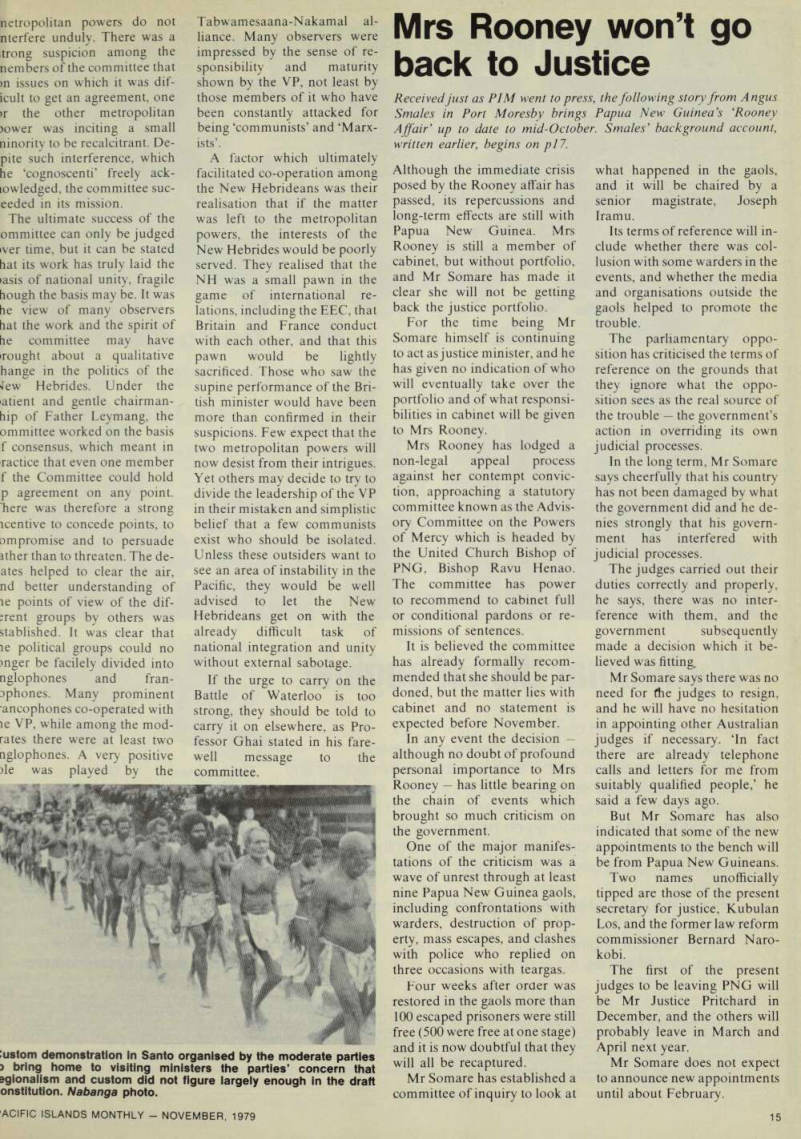
Custom demonstration In Santo organised by the moderate parties [?] bring home to visiting ministers the parties’ concern that regionalism and custom did not figure largely enough in the draft constitution Nabanga photo.
Advertisements & other items, p. 13 (1 item)
13
ACIFIC ISLANDS MONTHLY - NOVEMBER, 1979
Mrs Rooney won’t go
back to Justice
Received just as PIM went to press, the following story from Angus Smales in Port Moresby brings Papua New Guinea’s ‘Rooney Affair’ up to date to mid-October. Smales ’ background account, written earlier, begins on pi 7.
Although the immediate crisis posed by the Rooney affair has
passed, its repercussions and
long-term effects are still with Papua New Guinea. Mrs Rooney is still a member of cabinet, but without portfolio, and Mr Somare has made it clear she will not be getting
back the justice portfolio.
For the time being Mr Somare himself is continuing to act asjustice minister, and he has given no indication of who will eventually take over the portfolio and of what responsi bilities in cabinet will be given to Mrs Rooney.
Mrs Rooney has lodged a
non-legal appeal process
against her contempt convic tion, approaching a statutory committee known as the Advis ory Committee on the Powers of Mercy which is headed by the United Church Bishop of PNG, Bishop Ravu Henao.
The committee has power to recommend to cabinet full or conditional pardons or re missions of sentences.
It is believed the committee
has already formally recom
mended that she should be par doned, but the matter lies with cabinet and no statement is expected before November.
In any event the decision although no doubt of profound
personal importance to Mrs
Rooney has little bearing on the chain of events which brought so much criticism on the government.
One of the major manifes tations of the criticism was a wave of unrest through at least nine Papua New Guinea gaols, including confrontations with warders, destruction of prop erty, mass escapes, and clashes with police who replied on three occasions with teargas.
Four weeks after order was restored in the gaols more than 100 escaped prisoners were still free (500 were free at one stage) and it is now doubtful that they will all be recaptured.
Mr Somare has established a committee of inquiry to look at
what happened in the gaols, and it will be chaired by a
senior magistrate, Joseph
Iramu.
Its terms of reference will in clude whether there was col lusion with some warders in the events, and whether the media and organisations outside the gaols helped to promote the trouble.
The parliamentary oppo sition has criticised the terms of reference on the grounds that they ignore what the oppo sition sees as the real source of the trouble the government’s action in overriding its own
judicial processes.
In the long term, Mr Somare says cheerfully that his country has not been damaged by what the government did and he de nies strongly that his govern ment has interfered with
judicial processes.
The judges carried out their
duties correctly and properly,
he says, there was no inter ference with them, and the
government subsequently
made a decision which it be lieved was fitting.
Mr Somare says there was no need for the judges to resign, and he will have no hesitation in appointing other Australian judges if necessary. ‘ln fact
there are already telephone
calls and letters for me from
suitably qualified people,’ he
said a few days ago.
But Mr Somare has also indicated that some of the new appointments to the bench will be from Papua New Guineans.
Two names unofficially tipped are those of the present secretary for justice, Kubulan Los, and the former law reform commissioner Bernard Naro kobi.
The first of the present judges to be leaving PNG will be Mr Justice Pritchard in December, and the others will probably leave in March and April next year.
Mr Somare does not expect to announce new appointments until about February.
Advertisements & other items, pp. 15-16 (2 items)
15
ACIFIC ISLANDS MONTHLY - NOVEMBER, 1979
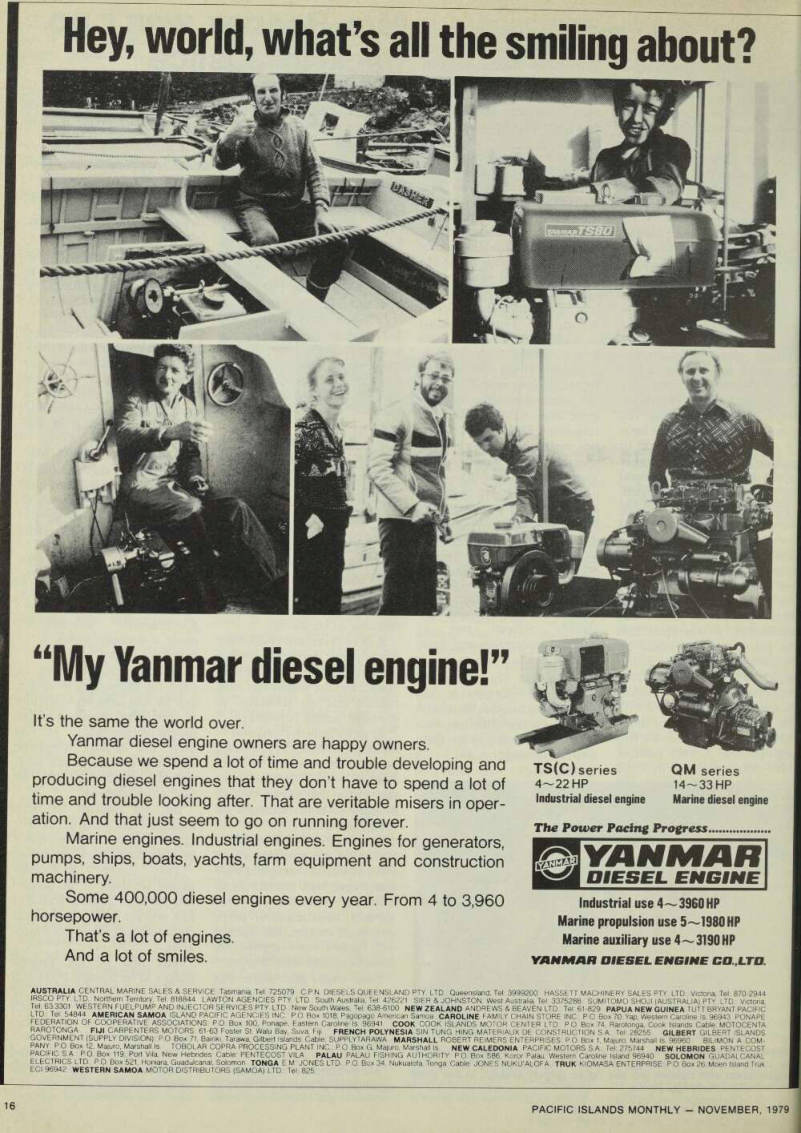
“My Yanmar diesel engine!”
Hey, world, what’s all the smiling about? mm f % “ft \ o ~S 0 % 4* * a* & r v
It’s the same the world over.
Yanmar diesel engine owners are happy owners.
Because we spend a lot of time and trouble developing ana producing diesel engines that they don’t have to spend a lot of time and trouble looking after. That are veritable misers in operation. And that just seem to go on running forever.
Marine engines. Industrial engines. Engines for generators, pumps, ships, boats, yachts, farm equipment and construction machinery.
Some 400,000 diesel engines every year. From 4 to 3,960 horsepower.
That’s a lot of engines.
And a lot of smiles.
TS(C) series 4-22 HP Industrial diesel engine QM series 14-33 HP Marine diesel engine The Power Pacing Progress.
YANMAR
DIESEL EMDIME
Industrial use 4—3960 HP Marine propulsion use 5—1980 HP Marine auxiliary use 4—3190 HP
YANMAR DIESEL ENGINE CD.,LTD.
AUSTRALIA CENTRAL MARINE SALES & SERVICE Tasmania, Tel; 725079 CR N. DIESELS QUEENSLAND PTY. LTD.: Queensland, Tel: 3999200 HASSETT MACHINERY SALES PTY. LTD.: Victoria, Tel 870-2944 L R SCO PTY. LTD.: Northern Territory, Tel: 818844 LAWTON AGENCIES PTY. LTD.: South Australia, Tel: 426221 SIER & JOHNSTON: West Australia, Tel: 3375288 SUMITOMO SHOJI (AUSTRALIA) PTY LTD.: Victoria, TeL 63 330 1 WESTERN FUELPUMP AND INJECTOR SERVICES PTY LTD : New South Wales, Tel: 638-6100 NEW ZEALAND ANDREWS & BEAVEN LTD Tel: 61-829 PAPUA NEW GUINEA TUTT BRYANT PACIFIC LTD : Tel: 54844 AMERICAN SAMOA ISLAND PACIFIC AGENCIES INC.: P.O. Box 1018, Pagopago American Samoa CAROLINE FAMILY CHAIN STORE INC.: P.O Box 70, Yap, Western Caroline Is 96943 PONAPE o E 2^ R £ nON OF COOPERATIVE ASSOCIATIONS: P.O. Box 100, Ponape, Eastern Caroline Is. 96941 COOK COOK ISLANDS MOTOR CENTER LTD.. P.O. Box 74, Rarotonga, Cook Islands Cable: MOTOCENTA RAROTONGA FIJI CARPENTERS MOTORS: 61-63 Foster St. Walu Bay, Suva, Fiji FRENCH POLYNESIA SIN TUNG HING MATERIAUX DE CONSTRUCTION S.A.: Tel; 28255 GILBERT GILBERT ISLANDS GOVERNMENT (SUPPLY DIVISION): P.O Box 71, Bairiki, Tarawa, Gilbert Islands Cable: SUPPLYTARAWA MARSHALL ROBERT REIMERS ENTERPRISES: P.O. Box 1, Majuro. Marshall Is 96960 BILIMON A COM- PANY: P.O. Box 12, Maiuro, Marshall Is. TOBOLAR COPRA PROCESSING PLANT INC.: P.O Box G, Majuro, Marshall Is NEW CALEDONIA PACIFIC MOTORS S.A Tel 275744 NEW HEBRIDES PENTECOST PACIFIC S.A: P.O. Box 119, Port Vila, New Hebrides Cable: PENTECOST VILA PALAU PALAU FISHING AUTHORITY: P.O. Box 586, Koror Palau, Western Caroline Island 96940 SOLOMON GUADALCANAL ELECTRICS LTD.: P.O, Box 521, Honiara, Guadalcanal, Solomon TONGA E M. JONES LTD.: P.O. Box 34, Nukualofa, Tonga Cable: JONES NUKU'ALOFA TRUK KIOMASA ENTERPRISE: P.O. Box 26 Moen Island Truk ECI 96942 WESTERN SAMOA MOTOR DISTRIBUTORS (SAMOA) LTD : Tel: 825
PNG’s ‘Rooney

Affair’: A mix-up of two issues
Angus Smales in Port Moresby reviews the constitutional crisis vhich has shaken Papua New Guinea since July, and is far from iaving worked itself out yet. He sees the crisis as basically involving wo distinct issues, which regrettably have become ‘completely nixed up with one another ’.
Vly Dear Chief Justice .. .’ •egan the Papua New Guinea ustice Minister, Mrs Rooney, i a letter she wrote to the "hief Justice Sir William Pren ice. The date was July 11 this ear. In the months since then lie letter has become a centre
iece of political controversy,
nd the constitutional clash it as created is still unresolved in lany essential issues.
It initiated a clash of con epts over the relationship be veen the government and the idiciary, and the chain of vents which it started has in luded the resignation of five
jdges, the gaoling and
ngaoling of a minister of tate, and now it has produced erhaps a question mark over ic role and future of the ju iciary. And somewhere in California the bearded, be
pectacled, political scientist
'ho unwittingly triggered the
ntire tangle is about to write book on what he describes as he need for a miracle if emocracy is to be preserved in NG’.
Now I don’t necessarily gree with his remarks, but that olitical scientist is Dr Ralph Temdas, who modestly told a
leeting of Port Moresby
Rotary Club shortly before he was expelled from PNG that he has something of a reputation for ‘giving governments a bit of a jolt’. Dr Premdas had six years in PNG as a university lecturer, and government and opposition alike found him a
helpful honorary adviser for
a while, anyway. But in June he had his residence permit re voked. He was accused by the Prime Minister, Mr Somare, of meddling in affairs of govern ment and of undermining the sovereignty of PNG national ism.
He lost a ministerial appeal, but he successfully applied to the National Court to remain in Port Moresby while he pur
sued a legal appeal. His appeal
(which he subsequently lost)
was preceded by Mrs Rooney’s
famous letter to Sir William Prentice, a letter which she cir culated very widely at the time.
In the letter Mrs Rooney asserted the right of the government to deport whom it liked, she criticised the court for intervening in a matter which ‘is a sole prerogative of government’ and she rounded off her remarks with a little homily to the judges to use
‘greater discretion in making
their decisions’.
In many respects it was a naive letter and it could have been a thoughtless mistake all this was argued later in court but it disturbed Sir William because of its circu lation and because of the notion it contained that the state could direct the courts.* Mrs Rooney wouldn’t with draw it, and in open court Sir William disclosed it (and the
subsequent correspondence)
and then, as he put it, ‘invited the government to defend the constitution and the courts’.
The inference was clear some form of government in itiative was necessary to with draw the letter, apologise, and reassert the concept of the independence of the courts.
Mr Justice Pritchard, who had granted a breathing space to Dr Premdas in the first place, resigned and wrote a stern letter to Mrs Rooney in
doing so.
But the days passed, the government took no action, and Mrs Rooney dug in her heels. She was quoted in the media as ‘having no confidence
in foreign judges who are only
interested in administering foreign laws’. This was a direct reference to the fact that so far PNG has none of its own nationals on the bench. Seven of its judges are Australian and the eighth is a Briton.
Eventually the parliamen
tary opposition initiated an action to gaol Mrs Rooney and those who ‘abetted her’ for unconstitutionally inter
fering with the independence
of the courts.
The Public Prosecutor, Mr
Egan, intervened by right, and
then proceeded with a Su preme Court notice of motion alleging three counts of con
temp against Mrs Rooney.
By a four to one majority, Mrs Rooney was found guilty and she was gaoled for eight months. Mr Justice Kearney
dissented by proposing dis
missal of one of the charges and proposing a total fine equivalent to 400 Kina on the other two.
Hardly was Mrs Rooney in gaol and indeed there was considerable sympathy for her even from her detractors than the government got her out again. The Prime Minister, Mr Somare, who had assumed the Justice portfolio, exercised a constitutional and criminal code process freeing her on li
cence, although not nullifying
the conviction and the sen tence.
Now whatever may be the rights or wrongs of what has
happened, the judges saw
themselves in a situation where they had gone to great lengths to demonstrate the indepen dence of the courts only to have the end result effectively and somewhat emotionally nega ted by the state.
In addition they had under
gone an experience suggesting
that in some matters at least the government is no longer interested in wanting an
independent judiciary.
In the upshot, four of them the Chief Justice, Sir William Prentice, the Deputy Chief Justice, Mr Justice Raine, Mr Justice Wilson, and Mr Justice Saldanha fol lowed Mr Justice Pritchard’s course by resigning. The three
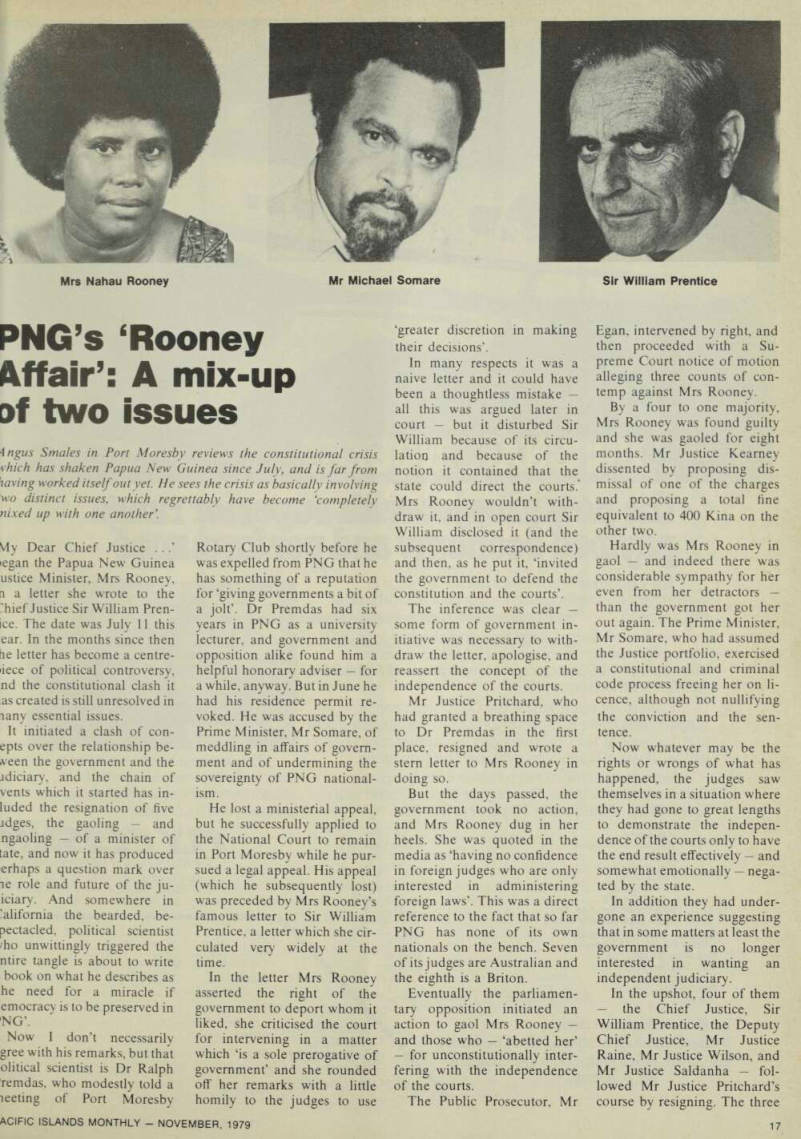
Mrs Nahau Rooney
Mr Michael Somare
Sir William Prentice
judges who did not resign were Mr Justice Kearney, Mr Justice Greville Smith and Mr Justice Andrew.
Although the issues involved in the contempt hearing against Mrs Rooney are complex and
wide-ranging, the political
issues stand out very clearly.
From the prime minister down there seems to have been
a genuine inability to appreci
ate the real distinction between executive and judicial powers, although this system was freely chosen at independence and it was written into the PNG con stitution.
The current government atti tude appears to rest on what can be described as a distinct cultural gap between Mr Somare’s society and the socie ties which developed a rather precise system of judicial sep aration. The suitability of the
system for PNG’s requirements
may well be open to serious question, and the present
controversy in fact highlights
this situation.
But what has happened is that the argument about the suitability of the situation is being confused today with the arguments about what has hap pened to Mrs Rooney.
When Mrs Rooney’s letter vas first disclosed, the solution vould have been so simple if
;he government had recognised
;he issues, but the government xmtinued to think in terms of thrashing out a precedent’. But the government wasn’t power less to legitimately make its points about Dr Premdas, either, as we shall see shortly.
The judges indeed are foreign in terms of citizenship.
There is no denying that this is
a regrettable situation. But
PNG itself gave them the con stitution and the laws under
which they operate and
charged them by oath to follow these principles. This is the point which Mr Damien Kereku made so well the other day. Much of the emotional ar gument in this issue has claimed that the legal system used by PNG is a foreign con cept or a hangover from
colonialism or some equally
emotive background situation.
There may well be much val idity in this argument, but there
is one very important point
which appears to have been
largely overlooked. When Mrs Rooney wrote to the judges, she was indeed cutting across a line of separation which under the present constitution and structure she had no right to cross.
But this doesn’t mean that a government to use a rather blunt way of putting it is ‘at the mercy’ of its judiciary.
Everything that Mrs Rooney
wanted to achieve could have been engineered as a concept within the law by taking the matter to parliament and get ting parliament to make appro
priate legislation. ‘The power
lies with the people’ says the constitution. Parliament is their forum, and parliament makes the rules for the judges.
This is what a democratic Westminster Parliament sys tem is all about to use the ideas of the people and their elected representatives to lay down the rules about the sort of controls that you want in
your society. (You also deter mine the sort of society that you want, but here I am refer ring specifically to controls and checks in any national situation which may arise.) I’d like to look, too, at what I think is another over-emotive issue concerned in this situ ation. My wife expressed sym pathy to a Papua New Guinean lawyer the other day over the fact that Mrs Rooney had been gaoled. What she said had nothing to do with the legal issues involved, but no one likes to see people go to gaol over issues of society rather than over issues of what per haps we could call vice.
Now we were quite upset by the lawyer’s answer. He said
‘your people put her in gaol’.
If this highlights one thing, it highlights the urgent need to
phase Papua New Guinean
judges into the system as soon as possible. If an intelligent lawyer who thinks that white
judges applied some law of their own, then the country indeed is heading along a sorry road.
I might add, too, that the judges themselves have been aware of this need for a long time, and there is no shortage of material on record about their attempts to achieve a planned phasing out of re
sponsibilities.
The position now is that two different issues are being cri ticised and two different issues
are being questioned in public.
But sadly these two issues are
being completely mixed up
with each other. The first issue is whether or not PNG is at the mercy of some foreign imported law which is quite unsuitable for a Melanesian so ciety. There is much to support this argument, but I don’t think the structure is necessarily as foreign as some people believe.
It’s not as foreign as they be lieve if parliament is used properly and if urgent steps are taken to train in Papua New Guinea judges. It’s not the structure so much but the laws within that structure which per haps need very close atten tion.
The second issue and this is certainly the stronger in terms of public criticism is that the government has inter vened in a manner which appears to negate what the court hearing was all about. It’s intervened in a matter concern ing the separation of executive and judicial functions. Many of the critics say it has flown in the face of its own laws. In fact the process used to free Mrs Rooney was designed to allow the release of long-term pris oners slightly ahead of time to help their rehabilitation.
Of course Mrs Rooney should never have gone to
gaol.
But the real tragedy was that she and the government fol lowed an illegitimate course to achieve a result which could have been achieved quite legi
timately through parliament.
The echoes of her letter will take a long time to die away, but in the meantime PNG appears to be courting trouble
by claiming allegiance to one
system and sometimes practis
ing another.
From the Papua New Guinea Post-Courier
Advertisements & other items, pp. 17-18 (2 items)
17
ACIFIC ISLANDS MONTHLY NOVEMBER, 1979
payload econffliyandperl^
■lll 1 I I ■ m A H
the newpropjet with superior range
The Conquest is an aeroplane so superior in performance and efficiency, it’s not called a turboprop.
But apropjet.
It takes off from a short field and climbs to 33,000 feet in 26 minutes; it cruises at 293 knots; it carries a huge load of 4,293 pounds of passengers and fuel; and it flies farther than many jets.
Even more remarkable, the Conquest propjet
outperforms every turboprop ever built-while using less fuel. Incredibly, the Conquest gets six statute miles per gallon. That’s efficiency to rival many piston twins.
Compared to the most popular turboprop, the Conquest climbs faster, flies higher, cruises faster and flies farther.. .while using 30 percent less fuel.
This aeroplane has set new standards of performance and efficiency If it were anything less, we wouldn’t call it Conquest.
Max. Speed Max. Rec. Cruise Speed Max. Range Max. Usable Fuel Rate of Climb Twin Engine Single Engine Twin Engine Max. Cert. Alt Single Engine Service Ceiling Takeoff Dist. Over 50 ft Obstacle Landing Dist. Over 50 ft Obstacle Max. Ramp Weight Max. Zero Fuel Weight Max. Useful Load Max. Seating Engines .295 knots .293 knots 2,196 n.m. 475 gals 2,435 fpm ... 715fpm ...33,000 ft ...21,380 ft The World's Number 1 Business Airline Cessna Central Information Center (P.O. Boxsl, Bankstown. N.S.W. 2200) Telephone 70 0661 ..2,465 ft .. 1,875 ft 9,9251 b .8,100 lb .4,293 lb ll Name. . Garrett Aißesearch TPE-331 -8-401 S ; 625 hp V Position.
Pacific Area Representatives:
Noumea-Montagnat Mining, Mr. R. Gutschlag.
Fiji (Suva)-Bums Philp South Sea Company,
Mr. A.Jessop. <
Company.
/ PLEASE SEND ...
MEMORE Address
• INFORMATION
ON THE
CESSNA CONQUEST Tdephone .P/code..
20/ RIM
When Custom,
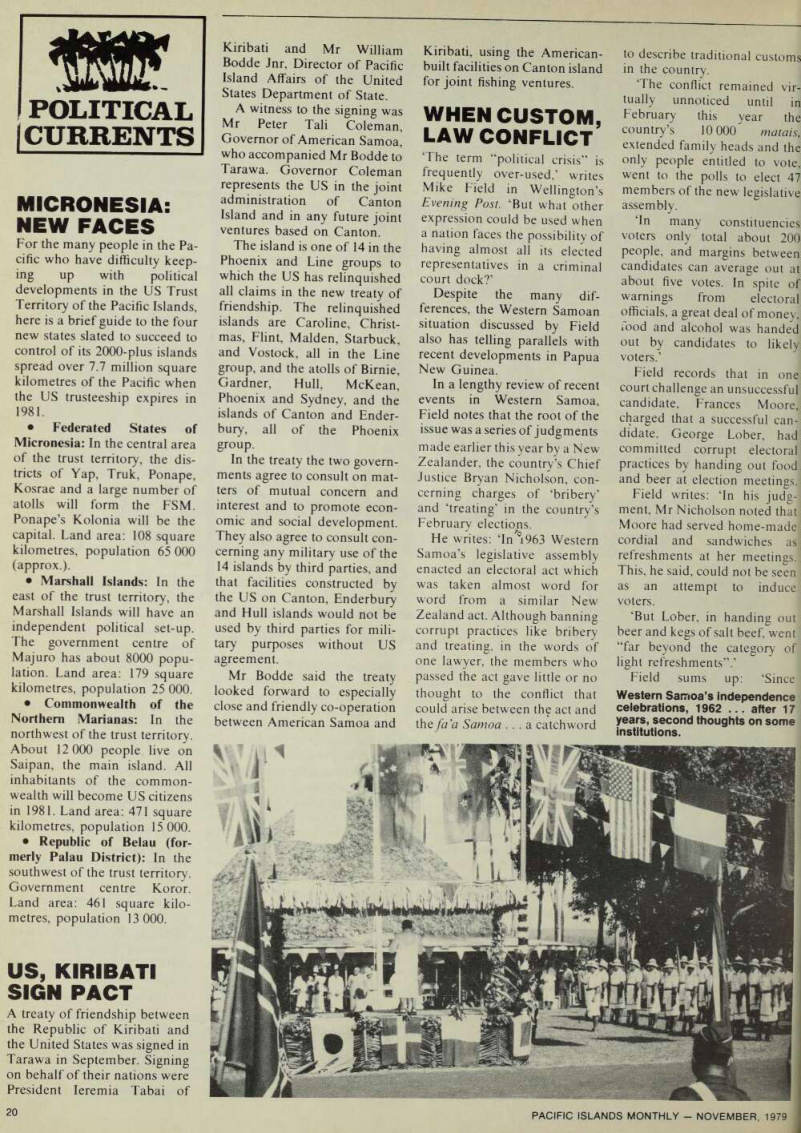
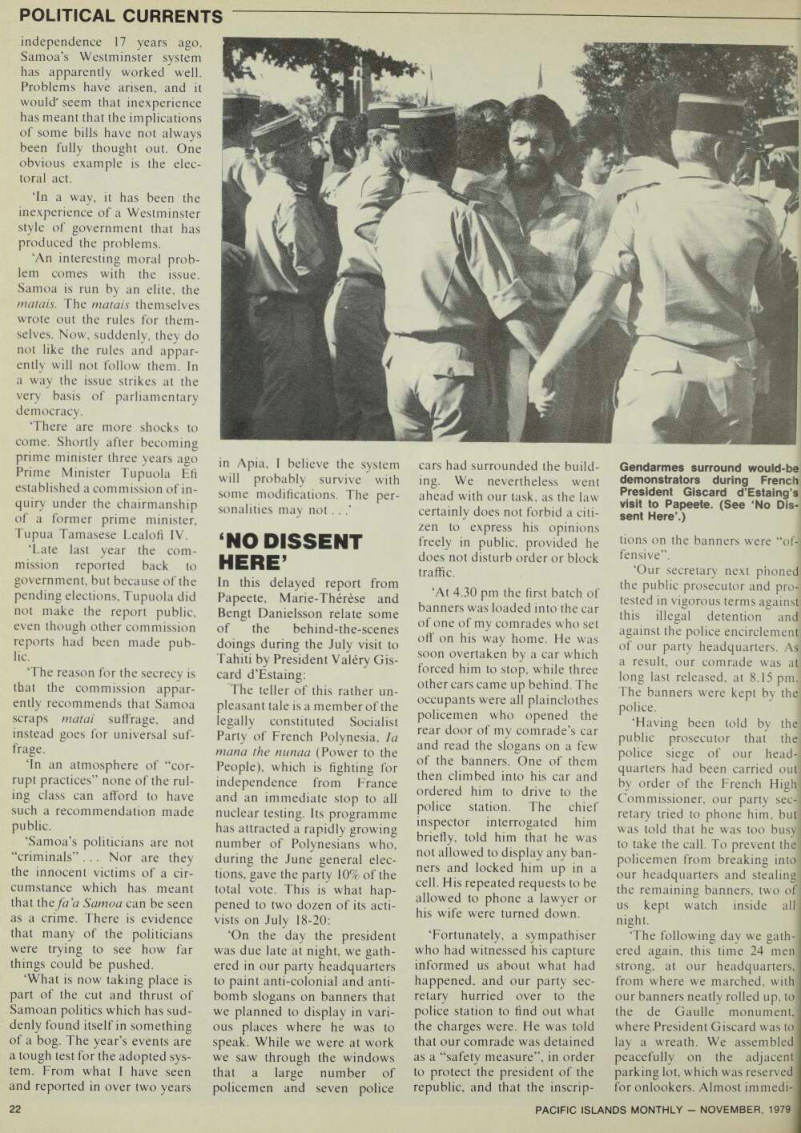
Political
Currents
Kiribati and Mr William Bodde Jnr, Director of Pacific Island Affairs of the United States Department of State.
A witness to the signing was Mr Peter Tali Coleman, Governor of American Samoa, who accompanied Mr Bodde to Tarawa. Governor Coleman represents the US in the joint administration of Canton Island and in any future joint ventures based on Canton.
The island is one of 14 in the Phoenix and Line groups to which the US has relinquished all claims in the new treaty of
friendship. The relinquished
islands are Caroline, Christ mas, Flint, Malden, Starbuck, and Vostock, all in the Line group, and the atolls of Birnie, Gardner, Hull, McKean, Phoenix and Sydney, and the islands of Canton and Ender bury, all of the Phoenix group.
In the treaty the two govern ments agree to consult on mat ters of mutual concern and interest and to promote econ omic and social development.
They also agree to consult con cerning any military use of the 14 islands by third parties, and that facilities constructed by the US on Canton, Enderbury and Hull islands would not be used by third parties for mili tary purposes without US agreement.
Mr Bodde said the treaty looked forward to especially close and friendly co-operation between American Samoa and
Kiribati, using the American built facilities on Canton island
for joint fishing ventures.
When Custom,
Law Conflict
‘The term “political crisis” is frequently over-used,’ writes Mike Field in Wellington’s Evening Post. ‘But what other expression could be used when a nation faces the possibility of having almost all its elected representatives in a criminal court dock?’
Despite the many dif ferences, the Western Samoan situation discussed by Field also has telling parallels with recent developments in Papua New Guinea.
In a lengthy review of recent events in Western Samoa, Field notes that the root of the issue was a series of judgments made earlier this year by a New Zealander, the country’s Chief Justice Bryan Nicholson, con
cerning charges of ‘bribery’
and ‘treating’ in the country’s February elections.
He writes; Western Samoa’s legislative assembly enacted an electoral act which was taken almost word for word from a similar New
Zealand act. Although banning
corrupt practices like bribery and treating, in the words of one lawyer, the members who passed the act gave little or no thought to the conflict that could arise between the act and the fa’a Samoa ... a catchword
Micronesia:
New Faces
For the many people in the Pa cific who have difficulty keep ing up with political developments in the US Trust Territory of the Pacific Islands, here is a brief guide to the four new states slated to succeed to control of its 2000-plus islands spread over 7.7 million square kilometres of the Pacific when the US trusteeship expires in 1981. • Federated States of Micronesia: In the central area of the trust territory, the dis tricts of Yap, Truk, Ponape, Kosrae and a large number of atolls will form the FSM.
Ponape’s Kolonia will be the capital. Land area: 108 square kilometres, population 65 000
(approx.).
• Marshall Islands: In the east of the trust territory, the Marshall Islands will have an
independent political set-up.
The government centre of Majuro has about 8000 popu lation. Land area: 179 square kilometres, population 25 000. • Commonwealth of the Northern Marianas: In the northwest of the trust territory.
About 12 000 people live on Saipan, the main island. All inhabitants of the common wealth will become US citizens in 1981. Land area: 471 square kilometres, population 15 000. • Republic of Belau (for merly Palau District): In the southwest of the trust territory.
Government centre Koror.
Land area: 461 square kilo metres, population 13 000.
Us, Kiribati
Sign Pact
A treaty of friendship between the Republic of Kiribati and the United States was signed in
Tarawa in September. Signing
on behalf of their nations were President leremia Tabai of
to describe traditional customs in the country.
The conflict remained vir tually unnoticed until in February this year the country’s 10 000 matais, extended family heads and the only people entitled to vote, went to the polls to elect 47 members of the new legislative
assembly.
‘ln many constituencies voters only total about 200 people, and margins between candidates can average out at about five votes. In spite of warnings from electoral officials, a great deal of money, iood and alcohol was handed out by candidates to likely voters.’
Field records that in one court challenge an unsuccessful candidate, Frances Moore, charged that a successful can didate, George Lober, had committed corrupt electoral practices by handing out food and beer at election meetings.] Field writes; ‘ln his judg ment, Mr Nicholson noted that Moore had served home-made cordial and sandwiches as refreshments at her meetings.!
This, he said, could not be seen as an attempt to induce voters. ‘But Lober, in handing out < beer and kegs of salt beef, went “far beyond the category of
light refreshments”.’
Field sums up: ‘Since
Western Samoa’s independence celebrations, 1962 ... after 17 years, second thoughts on some institutions.
independence 17 years ago, Samoa’s Westminster system has apparently worked well.
Problems have arisen, and it would' seem that inexperience has meant that the implications of some bills have not always been fully thought out. One obvious example is the elec toral act. ‘ln a way, it has been the inexperience of a Westminster style of government that has produced the problems.
‘An interesting moral prob
lem comes with the issue.
Samoa is run by an elite, the matais. The matais themselves wrote out the rules for them selves. Now, suddenly, they do not like the rules and appar ently will not follow them. In a way the issue strikes at the very basis of parliamentary
democracy.
‘There are more shocks to
come. Shortly after becoming
prime minister three years ago Prime Minister Tupuola Efi established a commission of in
quiry under the chairmanship
of a former prime minister, Tupua Tamasese Lealofi IV. ‘Late last year the com mission reported back to government, but because of the
pending elections, Tupuola did
not make the report public, even though other commission reports had been made pub lic. ‘The reason for the secrecy is that the commission appar ently recommends that Samoa scraps matai suffrage, and instead goes for universal suf
frage.
‘ln an atmosphere of “cor rupt practices” none of the rul ing class can afford to have such a recommendation made public. ‘Samoa’s politicians are not “criminals” ... Nor are they the innocent victims of a cir cumstance which has meant that the fa’a Samoa can be seen as a crime. There is evidence that many of the politicians were trying to see how far
things could be pushed.
‘What is now taking place is part of the cut and thrust of Samoan politics which has sud denly found itself in something of a bog. The year’s events are a tough test for the adopted sys tem. From what I have seen and reported in over two years
in Apia, I believe the system will probably survive with some modifications. The per
sonalities may not. ..’
‘No Dissent
Here’
In this delayed report from Papeete, Marie-Therese and Bengt Danielsson relate some of the behind-the-scenes
doings during the July visit to
Tahiti by President Valery Gis
card d’Estaing;
The teller of this rather un pleasant tale is a member of the legally constituted Socialist Party of French Polynesia, la mana the nunaa (Power to the People), which is fighting for independence from France and an immediate stop to all nuclear testing. Its programme has attracted a rapidly growing number of Polynesians who, during the June general elec tions, gave the party 10% of the total vote. This is what hap pened to two dozen of its acti vists on July 18-20: ‘On the day the president was due late at night, we gath ered in our party headquarters to paint anti-colonial and anti bomb slogans on banners that we planned to display in vari ous places where he was to speak. While we were at work we saw through the windows that a large number of
policemen and seven police
cars had surrounded the build ing. We nevertheless went ahead with our task, as the law certainly does not forbid a citi zen to express his opinions freely in public, provided he does not disturb order or block traffic. ‘At 4.30 pm the first batch of banners was loaded into the car of one of my comrades who set off on his way home. He was soon overtaken by a car which forced him to stop, while three other cars came up behind. The occupants were all plainclothes
policemen who opened the
rear door of my comrade’s car and read the slogans on a few of the banners. One of them then climbed into his car and ordered him to drive to the police station. The chief
inspector interrogated him
briefly, told him that he was not allowed to display any ban ners and locked him up in a cell. His repeated requests to be allowed to phone a lawyer or his wife were turned down.
‘Fortunately, a sympathiser
who had witnessed his capture informed us about what had happened, and our party sec retary hurried over to the police station to find out what the charges were. He was told that our comrade was detained as a “safety measure”, in order to protect the president of the republic, and that the inscrip
tions on the banners were “of-j fensive”. ‘Our secretary next phoned] the public prosecutor and pro ] tested in vigorous terms against this illegal detention and
against the police encirclement
of our party headquarters. As a result, our comrade was at long last released, at 8.15 pm.
The banners were kept by the
police.
‘Having been told by the public prosecutor that the] police siege of our head-] quarters had been carried out by order of the French High Commissioner, our party sec-j retary tried to phone him, but] was told that he was too busy] to take the call. To prevent the
policemen from breaking into]
our headquarters and stealing
the remaining banners, two of us kept watch inside all
night.
‘The following day we gath-;
ered again, this time 24 men strong, at our headquarters, from where we marched, with our banners neatly rolled up, to the de Gaulle monument, where President Giscard was to lay a wreath. We assembled peacefully on the adjacent parking lot, which was reserved for onlookers. Almost immedi
Gendarmes surround would-be demonstrators during French President Giscard d’Estaing’s visit to Papeete. (See ‘No Dis sent Here’.)
tely a police car drove up and ut stepped an officer who sked us what we were doing lere. We replied that we were tere. like everybody else, to emonstrate our feelings
awards the president. He
sked us to show him the ogans on our banners, but we ffused, saying that they were ot for him, but for the presient. He shouted back: “No emonstrations are allowed ere!” ‘We retorted: “Then you ught to chase away all the eople standing here with rench flags in their hands. By
aving these flags, they’re also
emonstrating their feelings
>wards the president.” The
olice officer seemed quite
uzzled by our bent for logical
masoning and called up the rench High Commissioner on is car radio to obtain spiritual
Dmfort and guidance. His
boss’s reply was so loud that we could all hear it: we were to be taken straight to gaol before the president appeared on the scene. The police officer made the mistake of invoking the law, for we were very eager indeed to hear which law or regulation it was that forbids a citizen from standing in a pub lic parking lot to demonstrate his disapproval of the policies
pursued by the government.
He was, of course, unable to quote any precise law and therefore decided to tackle, without further delay, a task he was better equipped for: he beckoned to a squad of about 40 police and the drivers of two big vans to come over and fetch us. ‘Well aware that the slightest resistance on our part would be an extremely welcome pretext for beating us senseless, we let them herd us into the vans. We
were driven to the police station, where 10 of us were packed into a two-man cell, while the remaining 14 were locked up in a slightly more spacious one. There was only standing room in my cell and the heat almost suffocated us.
We asked for a little water, but this was refused, as well as our requests to be allowed to go outside to urinate. ‘ln the meantime, as we learned later, our wives had
phoned the public prosecutor
who seemed surprised by this
new, illegal detention. They
told him that they were all going to Place Tarahoi, with our children, at the time when the president was to deliver his key speech and heckle him until we were released. Since all 36 journalists and radio and TV reporters who had come out from France to cover the
great event were present such an eventuality appeared so dis tasteful in ruling circles that we were soon liberated.’
Let us only add that the la mana te nunaa group, much wiser after this harrowing ex
perience, eventually succeeded
in displaying a few banners be fore the eyes of the startled president when he was return ing from a visit to historic Point Venus. However, none of the
metropolitan journalists wit
nessed the incident. Since they were, of course, kept in com plete ignorance of the other abortive demonstrations, nothing was ever published in the French and foreign press to tarnish the official image of the
beloved president receiving the
unanimous homage of the happy inhabitants of French Polynesia. This, after all, was the main aim of the whole
police operation.
Advertisements & other items, p. 21 (1 item)
of sound
■ * .i . •-!>• ■ v l«
TEN
T - ■1 y / . *»* r, W A ' f"‘
* L / (XT' Int
®7 ' ,f!f r® /20
\9, I 40- ySlt £* 3 f- SS-& S 5 ~\y°
Let “TE X” take you
to a new world
of sound
With perfect “TEN” auto sound in your car. you’ll tune in on whole new worlds of listening enjoyment.
These “TEN" winners are packed with outstanding features that assure you of better, richer sound, plus the kind of effortless operation that can never interfere with your driving. And they’re meticulously designed and tested to make certain they will stand up under the toughest service conditions.
So for your companion on the road, select a superb “TEN" sound system and discover for yourself a new world of listening pleasure. *2232-
i|| ■ CABSiTTiBTWWO » |l*
y m
’"MM 97 TOm
f \ Z 5 =1 2- < ► mil. fg CASSETTE «« m- w Qm
MONO QST
DP-620 Automatic Eject Cassette Car Stereo with AM/FM Stereo Radio DP-640 Auto Reverse Cassette Car Stereo with AM/FM Stereo Radio
IMI
FUJITSU TEN LIMITED
JAPAN
Head Office: 2-28, Gosho-dori 1-chome, Hyogo-ku, Kobe, Japan.
Tokyo Office: Shuwa Onarimon Bldg., 2nd FI.. 1-1, Shimbashi 6-chome, Minato-ku, Tokyo, Japan. (Export Section) Phone: (03) 438-1611 Cable: TENFUJITSU TOKYO. Telex: 2425101 TENTOK J.
Distributors: Papua New Guinea: CHIN H MEEN N SONS PTY. LTD. P.O. Box 1106, Boroko, Port Moresby. Papua New Guinea. Phone: 256546.
French Polynesia: FARE HI-FI STEREO. P.O. Box 269, Rue du Marechal Foch, Papeete, Tahichi, French Polynesia. Phone: 2. 48. 14 Fiji: D. GOKAL & CO., LTD. G. P.O. Box 501, Suva, Fiji. Phone: 25259/22995.
Guam: MICROPAC AUDIO INC. P.O. Box 3478, Agana, Guam 96910. Phone: 472-8091
agitated scientist
The case of the agitated scientist
A few months back I was working away in the Hamilton Library in Hawaii, writes a PIM correspondent from Honolulu. I gradually became aware of the presence of a neighbour who was leafing in a rather agitated manner through reference books on the Pacific Islands, including the Pacific Islands Yearbook.
His search seemed to be getting him nowhere, and his evident exasperation grew accordingly. Eventu ally, the librarian introduced him to me, sug
gesting that I might possibly
be of some help.
It turned out that my rather frantic neighbour was a scientist employed by one of the United States nu clear agencies, and that he had a profound interest in
questions of the sovereignty
of various islands in the Pa cific, especially the smaller coral atolls.
He referred to an old map which showed that the US had formal claims to most of the northern Cook Islands, to Tokelau, to many of the islands of Kiribati (then still the Gilbert Islands) and of Tuvalu (for merly the Ellice Islands).
The map also showed that
there was a sharing of sover eignty between the US and Great Britain over Canton and Enderbury Islands. He didn’t hesitate to trot out the old chestnut of the US Guano Act of 1856, and took some convincing that the US did not indeed have any territorial rights, as sug gested by that act, over the Cook Islands, Tokelau, Tuvalu or sundry other Pa cific Island nations.
I was curious as to why a
gentleman in his position
was making such inquiries,
and I asked. His reply was that the US had entered into agreements with countries like South Korea and Taiwan according to which, in return for certain pro visions safeguarding the peaceful uses of nuclear en ergy, the US would under take to dispose of nuclear wastes from these countries.
Because this was a federal matter it was virtually cer tain that no state within the US, including Hawaii, would sanction the dump ing of these wastes within their territories. Therefore, it was essential to find some place or places over which the US had some claim, which were not incorpor ated within the US, where nuclear waste dumps could be set up. The argument then went that isolated coral atolls seemed to offer the best solution an attitude that would certainly be
challenged by the many
people who are familiar with, and have been moved
by, the examples set by the
exploitation, for the pur pose of developing nuclear weapons, of such places as Bikini and Moruroa.
I was naive enough to suggest that the US in fact did have some isolated islands over which her claims were undisputed.
For instance, there was Johnston Island, which had already had a role in nu clear testing. Couldn’t it be used? Oh no, came the scientist’s reply, that would never do. Johnston Island was already being used to
store chemical warfare el ements .. .
After this memorable
personal experience, I was
immensely gratified to learn
of the firm attitude of oppo sition taken by Pacific Island Leaders at the July meeting of the South Pacific Forum in Honiara to tenta tive US plans to store nu clear wastes in either
Midway, Wake or Palmyra
(PIM September).
Perhaps it is appropriate
at this point to recall an Associated Press despatch
from Washington early this
year which stated that the ‘US Army plans to blow up 26 deteriorating land mines
containing deadly chemi
cals, exploding them in
place at Dugway Proving
Ground, Utah’. The then US Secretary for Health, Education and Welfare, Joseph A. Califano, was quoted in the despatch as saying: Tt is clear that the existence of these land mines is a cause for grave concern. Because of their deteriorating condition and their exposure to the el ements, their continued existence poses an ongoing danger to public health and
safety.’
Advertisements & other items, pp. 23-24 (2 items)
Political Currents
23
ACIFIC ISLANDS MONTHLY - NOVEMBER, 1979
See the world with Air New Zealand
Wm r . 1
w « > 9 i * mmm A mm %; ipfcl * * i % * ■ * % - * u. c - * A Wisi - '*m ! ■ ... % * mk •> m See the world with Air New Zealand If your journey is to take you far or near, first see Air New Zealand or your travel agent to discuss the flights and fares that suit you best.
In the Pacific we fly to New Zealand, Australia, Fiji, Honolulu, Tahiti, Samoa, New Caledonia and Rarotonga. If you’re travelling farther, let us fly you to our Gateway cities to the world - Los Angeles, Hong Kong and Singapore, where you can connect with the airline of your choice.
And best of all, you’ll start by enjoying the special attentive service Air New Zealand is famous for.
Begin your trip with Air New Zealand
air new zeaiano
We fly the Pacific.
ANZ 79/12 C
many things
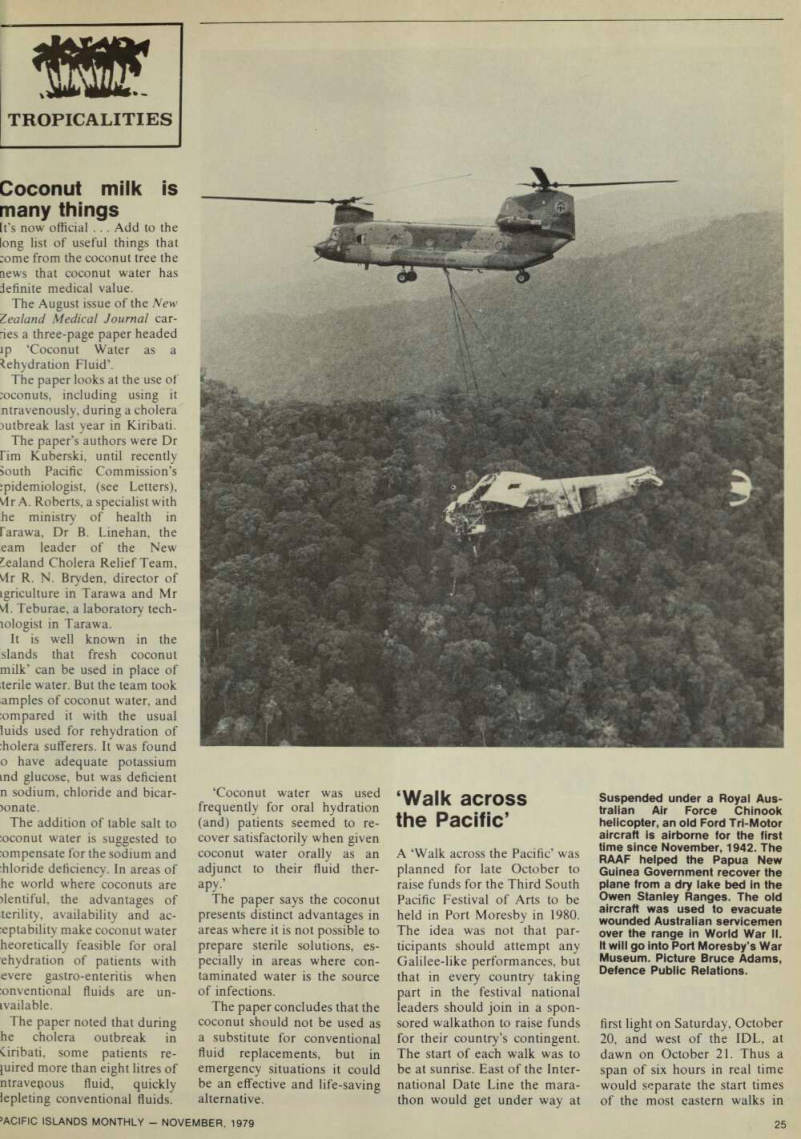
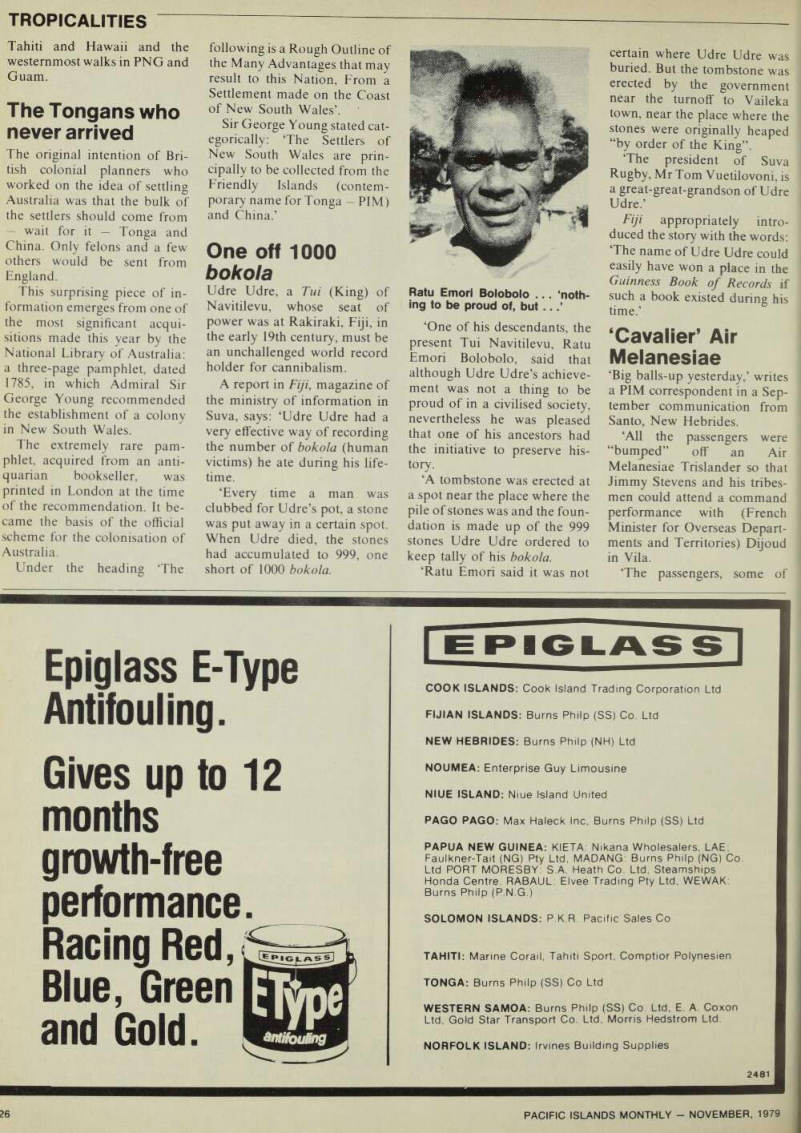
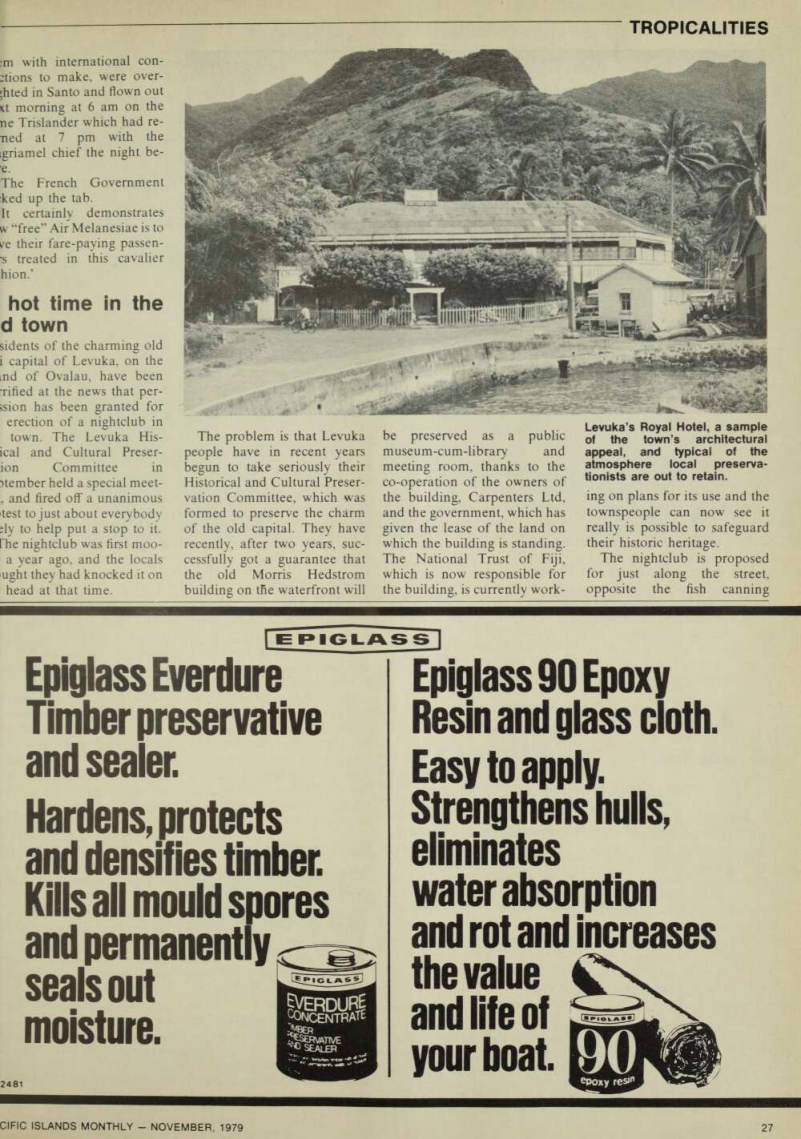
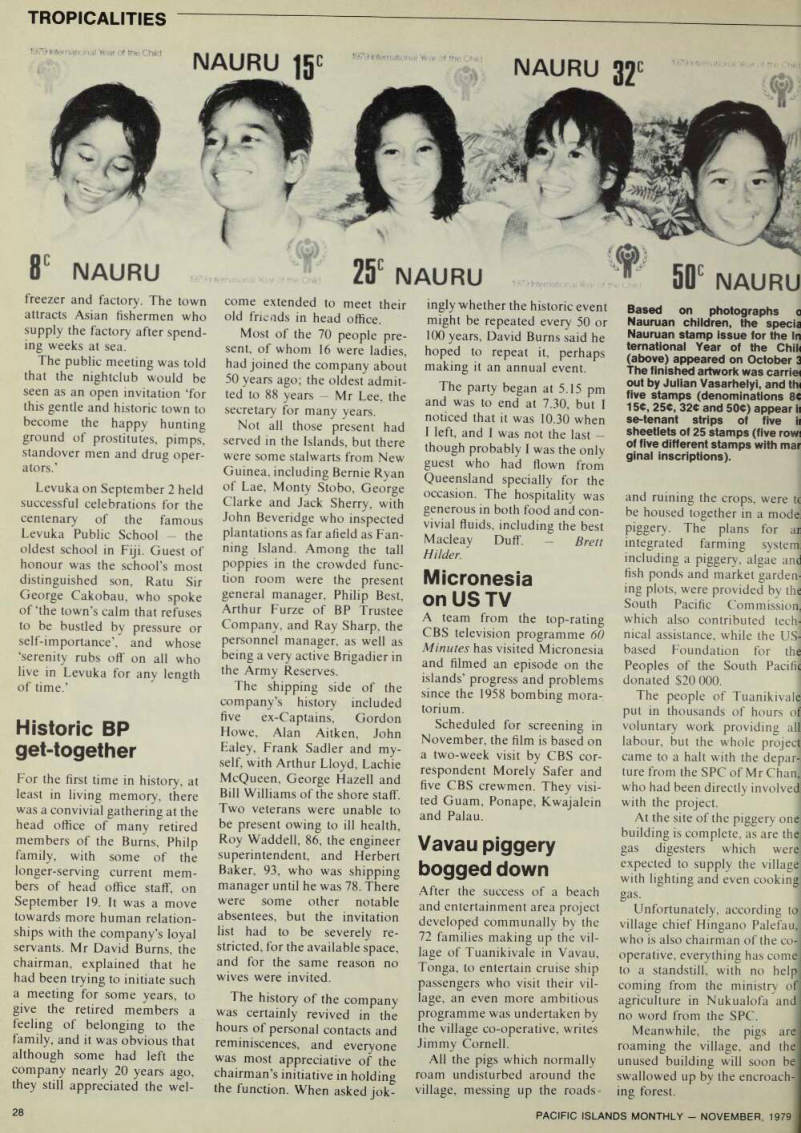
Tropicalities
Coconut milk is
It’s now official . . . Add to the long fist of useful things that :ome from the coconut tree the news that coconut water has definite medical value.
The August issue of the New Zealand Medical Journal car ries a three-page paper headed ip ‘Coconut Water as a
dehydration Fluid’.
The paper looks at the use of
coconuts, including using it
ntravenously, during a cholera
outbreak last year in Kiribati.
The paper’s authors were Dr
fim Kuberski, until recently
South Pacific Commission’s epidemiologist, (see Letters), Vir A. Roberts, a specialist with he ministry of health in farawa, Dr B. Linehan, the earn leader of the New Zealand Cholera Relief Team, vlr R. N. Bryden, director of igriculture in Tarawa and Mr vl. Teburae, a laboratory tech lologist in Tarawa.
It is well known in the slands that fresh coconut milk’ can be used in place of terile water. But the team took amples of coconut water, and :ompared it with the usual luids used for rehydration of :holera sufferers. It was found
o have adequate potassium
ind glucose, but was deficient n sodium, chloride and bicar >onate.
The addition of table salt to :oconut water is suggested to :ompensate for the sodium and :hloride deficiency. In areas of he world where coconuts are
ilentiful, the advantages of
terility, availability and ac
:eptability make coconut water heoretically feasible for oral
ehydration of patients with
evere gastro-enteritis when :onventional fluids are un ivailable.
The paper noted that during he cholera outbreak in
Ciribati, some patients re
quired more than eight litres of
ntravepous fluid, quickly
lepleting conventional fluids.
‘Coconut water was used
frequently for oral hydration
(and) patients seemed to re
cover satisfactorily when given
coconut water orally as an adjunct to their fluid ther
apy.’
The paper says the coconut presents distinct advantages in areas where it is not possible to prepare sterile solutions, es pecially in areas where con taminated water is the source of infections.
The paper concludes that the coconut should not be used as a substitute for conventional fluid replacements, but in emergency situations it could be an effective and life-saving alternative.
‘Walk across
the Pacific’
A ‘Walk across the Pacific’ was planned for late October to raise funds for the Third South Pacific Festival of Arts to be held in Port Moresby in 1980.
The idea was not that par ticipants should attempt any Galilee-like performances, but that in every country taking part in the festival national leaders should join in a spon sored walkathon to raise funds
for their country’s contingent.
The start of each walk was to be at sunrise. East of the Inter national Date Line the mara thon would get under way at
first light on Saturday, October 20, and west of the IDL, at dawn on October 21. Thus a span of six hours in real time would separate the start times of the most eastern walks in
Suspended under a Royal Aus tralian Air Force Chinook helicopter, an old Ford Tri-Motor aircraft is airborne for the first time since November, 1942. The RAAF helped the Papua New Guinea Government recover the plane from a dry lake bed in the Owen Stanley Ranges. The old aircraft was used to evacuate wounded Australian servicemen over the range in World War II.
It will go into Port Moresby’s War Museum. Picture Bruce Adams, Defence Public Relations.
Tahiti and Hawaii and the westernmost walks in PNG and Guam.
The Tongans who
never arrived
The original intention of Bri tish colonial planners who worked on the idea of settling Australia was that the bulk of the settlers should come from - wait for it - Tonga and China. Only felons and a few others would be sent from
England.
This surprising piece of in formation emerges from one of the most significant acqui sitions made this year by the National Library of Australia:
a three-page pamphlet, dated
1785, in which Admiral Sir
George Young recommended
the establishment of a colony in New South Wales.
The extremely rare pam phlet, acquired from an anti quarian bookseller, was printed in London at the time of the recommendation. It be came the basis of the official scheme for the colonisation of Australia.
Under the heading ‘The
following is a Rough Outline of the Many Advantages that may result to this Nation, From a Settlement made on the Coast of New South Wales’.
Sir George Young stated cat egorically: ‘The Settlers of New South Wales are prin cipally to be collected from the Friendly Islands (contem porary name for Tonga -PIM) and China.’
One off 1000
bokola
Udre Udre, a Tui (King) of Navitilevu, whose seat of power was at Rakiraki, Fiji, in the early 19th century, must be an unchallenged world record holder for cannibalism.
A report in Fiji, magazine of the ministry of information in Suva, says: ‘Udre Udre had a very effective way of recording the number of bokola (human victims) he ate during his life time. ‘Every time a man was clubbed for Udre’s pot, a stone was put away in a certain spot.
When Udre died, the stones had accumulated to 999, one short of 1000 bokola.
‘One of his descendants, the present Tui Navitilevu, Ratu Emori Bolobolo, said that although Udre Udre’s achieve ment was not a thing to be proud of in a civilised society, nevertheless he was pleased that one of his ancestors had the initiative to preserve his tory. ‘A tombstone was erected at a spot near the place where the pile of stones was and the foun dation is made up of the 999 stones Udre Udre ordered to keep tally of his bokola. ‘Ratu Emori said it was not
certain where Udre Udre was buried. But the tombstone was erected by the government near the turnoff to Vaileka town, near the place where the
stones were originally heaped
“by order of the King”. ‘The president of Suva u gby, Mr Tom Vuetilovoni, is a great-great-grandson of Udre Udre.’
Fiji appropriately intro duced the story with the words: ‘The name of Udre Udre could easily have won a place in the Guinness Book of Records if such a book existed during his time.’
‘Cavalier’ Air
Melanesiae
‘Big balls-up yesterday,’ writes
a PIM correspondent in a Sep tember communication from Santo, New Hebrides. ‘All the passengers were “bumped” off an Air Melanesiae Trislander so that Jimmy Stevens and his tribes men could attend a command performance with (French Minister for Overseas Depart ments and Territories) Dijoud in Vila. ‘The passengers, some of
Ratu Emori Bolobolo ... ‘noth ing to be proud of, but ...'
:m with international con :tions to make, were over ;hted in Santo and flown out *t morning at 6 am on the ne Trislander which had re ned at 7 pm with the igriamel chief the night be e.
The French Government ;ked up the tab.
It certainly demonstrates w “free” Air Melanesiae is to
ye their fare-paying passen
•s treated in this cavalier hion.’
hot time in the
d town
sidents of the charming old i capital of Levuka, on the md of Ovalau, have been •rifled at the news that per »sion has been granted for erection of a nightclub in town. The Levuka His ical and Cultural Preser ion Committee in itember held a special meet , and fired off a unanimous test to just about everybody ;ly to help put a stop to it. fhe nightclub was first moo a year ago, and the locals ught they had knocked it on head at that time.
The problem is that Levuka people have in recent years begun to take seriously their Historical and Cultural Preser vation Committee, which was formed to preserve the charm of the old capital. They have recently, after two years, suc cessfully got a guarantee that the old Morris Hedstrom building on the waterfront will
, , , be preserved as a public
museum-cum-library and
meeting room, thanks to the co-operation of the owners of
the building, Carpenters Ltd,
and the government, which has given the lease of the land on which the building is standing.
The National Trust of Fiji, which is now responsible for the building, is currently work-
ing on plans for its use and the townspeople can now see it really is possible to safeguard their historic heritage.
The nightclub is proposed for just along the street,
opposite the fish canning
Levuka's Royal Hotel, a sample of the town’s architectural appeal, and typical of the atmosphere local preserva tionists are out to retain.
freezer and factory. The town attracts Asian fishermen who supply the factory after spend mg weeks at sea.
The public meeting was told that the nightclub would be seen as an open invitation ‘for this gentle and historic town to
become the happy hunting
ground of prostitutes, pimps, standover men and drug oper a tors ’
Levuka on September 2 held successful celebrations for the centenary of the famous Levuka Public School - the oldest school in Fiji. Guest of honour was the school’s most distinguished son, Ratu Sir George Cakobau, who spoke to ‘be S: S d C by m pressure ot self-importance', and whose serenity rubs off on all who live in Levuka for any length
Historic BP
get-together
P . . , For the first time in history, at least m living memory, there was a convivial gathering at the head office of many retired members of the Burns, Philp family, with some of the longer-serving current mem bers of head office staff, on September 19. It was a move towards more human relation ships with the company’s loyal servants. Mr David Burns, the chairman, explained that he had been trying to initiate such a meeting for some years, to give the retired members a feeling of belonging to the family, and it was obvious that although some had left the company nearly 20 years ago, they still appreciated the wel
come extended to meet their old friends in head office.
Most of the 70 people pre sent, of whom 16 were ladies, had joined the company about 50 years ago; the oldest admit ted to 88 years Mr Lee, the secretary for many years.
Not all those present had served in the Islands, but there were some stalwarts from New
Guinea, including Bernie Ryan
of Lae, Monty Stobo, George Clarke and Jack Sherry, with
John Beveridge who inspected
plantations as far afield as Fan ning Island. Among the tall poppies in the crowded func tion room were the present general manager, Philip Best, Arthur Furze of BP Trustee Company, and Ray Sharp, the personnel manager, as well as being a very active Brigadier in the Army Reserves.
The shipping side of the company’s history included five ex-Captains, Gordon Howe, Alan Aitken, John Ealey, Frank Sadler and my self, with Arthur Lloyd, Lachie McQueen, George Hazell and Bill Williams of the shore staff.
Two veterans were unable to be present owing to ill health, Roy Waddell, 86, the engineer superintendent, and Herbert Baker, 93, who was shipping manager until he was 78. There were some other notable absentees, but the invitation list had to be severely re stricted, for the available space, and for the same reason no wives were invited.
The history of the company was certainly revived in the hours of personal contacts and reminiscences, and everyone was most appreciative of the chairman’s initiative in holding the function. When asked jok
ingly whether the historic event might be repeated every 50 or 100 years, David Burns said he hoped to repeat it, perhaps making it an annual event.
The party began at 5.15 pm and was to end at 7.30, but I noticed that it was 10.30 when I left, and I was not the last
though probably I was the only
guest who had flown from Queensland specially for the occasion. The hospitality was generous in both food and con vivial fluids, including the best Macleay Duff. - Brett Milder.
Micronesia
on US TV
A team from the top-rating CBS television programme 60 Minutes has visited Micronesia and filmed an episode on the islands’ progress and problems since the 1958 bombing mora torium.
Scheduled for screening in November, the film is based on a two-week visit by CBS cor
respondent Merely Safer and
five CBS crewmen. They visi
ted Guam, Ponape, Kwajalein
and Palau.
Vavau piggery
bogged down
After the success of a beach and entertainment area project
developed communally by the
72 families making up the vil lage of Tuanikivale in Vavau, Tonga, to entertain cruise ship passengers who visit their vil lage, an even more ambitious programme was undertaken by
the village co-operative, writes
Jimmy Cornell.
All the pigs which normally roam undisturbed around the village, messing up the roads
and ruining the crops, were tc be housed together in a model piggery. The plans for an
integrated farming systeml
including a piggery, algae and
fish ponds and market garden
ing plots, were provided by the
South Pacific Commission, which also contributed techl nical assistance, while the US based Foundation for the Peoples of the South Pacific donated $2O 000.
The people of Tuanikivale put in thousands of hours of
voluntary work providing
labour, but the whole project came to a halt with the depar-j ture from the SPC of Mr Chan, who had been directly involved] with the project.
At the site of the piggery one
building is complete, as are the!
gas digesters which were expected to supply the village! with lighting and even cooking gas.
Unfortunately, according to
village chief Hingano PalefauJ
who is also chairman of the co-J
operative, everything has come]
to a standstill, with no help!
coming from the ministry of]
agriculture in Nukualofa and]
no word from the SPC.
Meanwhile, the pigs are]
roaming the village, and the unused building will soon be swallowed up by the encroach
ing forest.
Based on photographs o[?] Nauruan children, the special Nauruan stamp issue for the In ternational Year of the Children (above) appeared on October 3[?] The finished artwork was carried out by Julian Vasarhelyi, and the five stamps (denominations 8$ 15$, 255$, 32$ and 50$) appear in se-tenant strips of five in sheetlets of 25 stamps (five rows of five different stamps with mar
ginal inscriptions).
Advertisements & other items, pp. 25-29 (3 items)
25
>ACIFIC ISLANDS MONTHLY - NOVEMBER, 1979
Etypej
Epiglass E-Type
Antifouling.
Gives up to
months
growth-free
performance
Racing Red,
Blue, Green
and Gold.
12
Etypej
antifouling
[epiglass]
COOK ISLANDS; Cook Island Trading Corporation Ltd FIJIAN ISLANDS: Burns Philp (SS) Co. Ltd NEW HEBRIDES: Burns Philp (NH) Ltd NOUMEA: Enterprise Guy Limousine NIUE ISLAND: Niue Island United PAGO PAGO: Max Haleck Inc, Burns Philp (SS) Ltd PAPUA NEW GUINEA: KIETA: Nikana Wholesalers. LAE; Faulkner-Tait (NG) Pty Ltd, MADANG: Burns Philp (NG) Co.
Ltd PORT MORESBY: S.A. Heath Co. Ltd, Steamships Honda Centre. RABAUL: Elvee Trading Pty Ltd, WEWAK: Burns Philp (P.N.G.) SOLOMON ISLANDS: P.K.R. Pacific Sales Co TAHITI: Marine Corail, Tahiti Sport. Comptior Polynesien TONGA: Burns Philp (SS) Co Ltd WESTERN SAMOA; Burns Philp (SS) Co Ltd. E. A. Coxon Ltd, Gold Star Transport Co. Ltd, Morris Hedstrom Ltd.
NORFOLK ISLAND: Irvines Building Supplies 2481
Epiglass Everdure Timber preservative and sealer.
Hardens, protects and densities timber.
Kills all mould spores and permanently seals out moisture. 2481 Epiglass 90 Epoxy Resin and glass cloth.
Easy to apply.
Strengthens hulls, eliminates water absorption and rot and increases the value and life of your boat. i
Looking for handy, reliable transport from home to town?
For performing everyday tasks?
Go with a Suzuki! choose one of our rugged,
high-performing 4-wheel drive vehicles,
just meeting your transport needs.
M
MORE
fob
|W* w Look into the traditional excellence of Suzuki's performanceproven motorcycles and fleet of outboard motors something to satisfy your every motoring need. Going by land or by sea . . . go with a Suzuki.
and
DTBS
SUZUKI
SUZUKI TS 125
SUZUKI MOTOR CO, LTD
Hamamatsu, Japan SOLOMON ISLANDS SOLOMON ISLAND SERVICE STATION LTD. • NEW CALEDONIA STE. SUPERCAL • PAPUA NEW GUINEA TUTT BRYANT PACIFIC LTD. • NEW HEBRIDES HENRI LEROUX • NIUE ISLAND BURNS PHILP (SOUTH SEA) CO., LTD. • PONAPE LEO ETSCHEIT • TAHITI NIPPON AUTOMOTO • ELLICE ISLAND TUVALU COOPERATIVE WHOLESALE SOCIETY LTD. • GUAM & SAIPAN ISLAND CYCLERY, INC. • NORFOLK MARTIN'S AGENCIES LTD. • SAMOA PACIFIC PRODUCTS, INC. • TARAWA GILBERT ISLANDS COOPERATIVE FEDERATION LIMITED • TONGA MORRIS HEDSTROM LTD. • WESTERN CAROLINES BECHESRRAK T. COMPANY • AMBROSE D. MINGINFEL'S WHOLESALER • EASTERN CAROLINES KIOMASA STORE
Tropicalities
27
CIFIC ISLANDS MONTHLY - NOVEMBER, 1979
jack-in-the-box
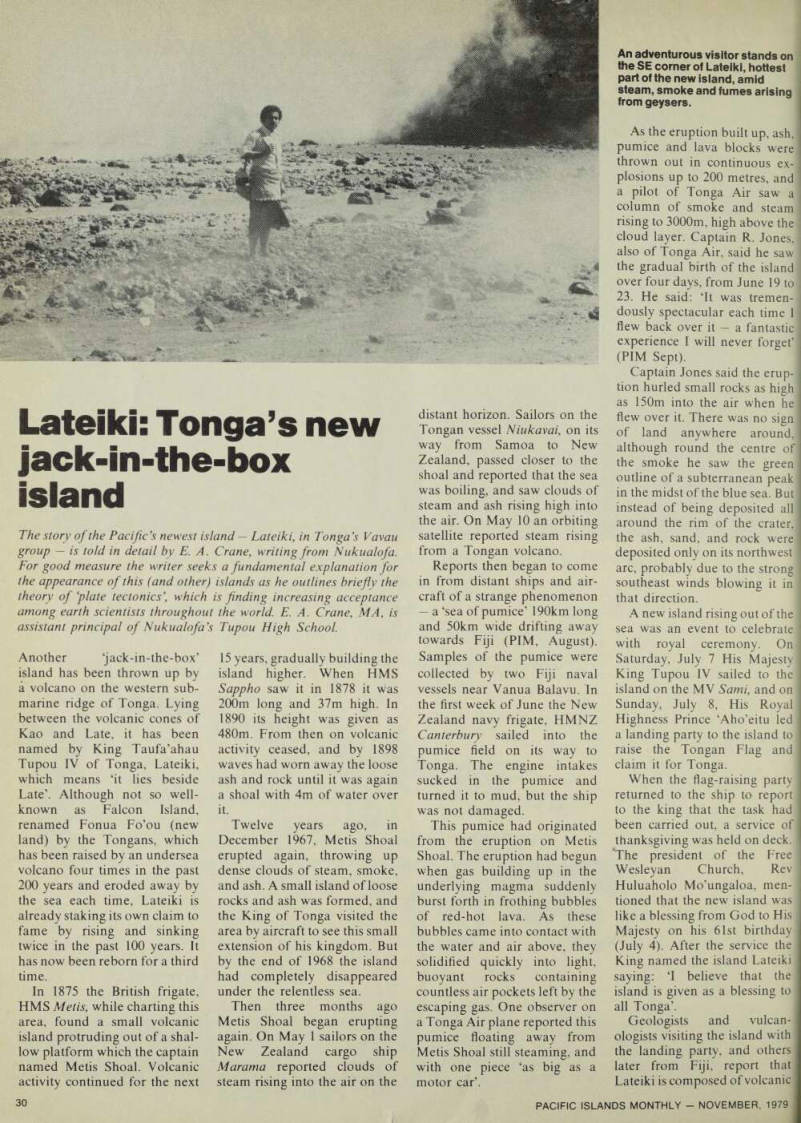
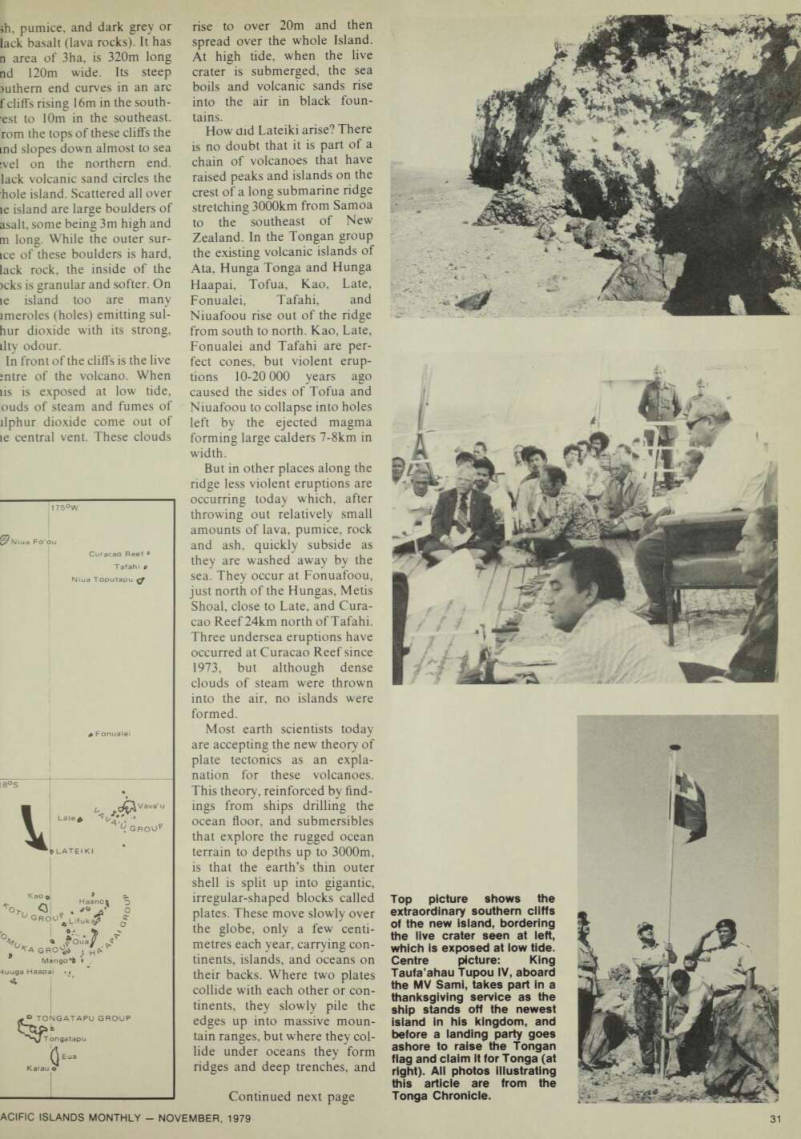

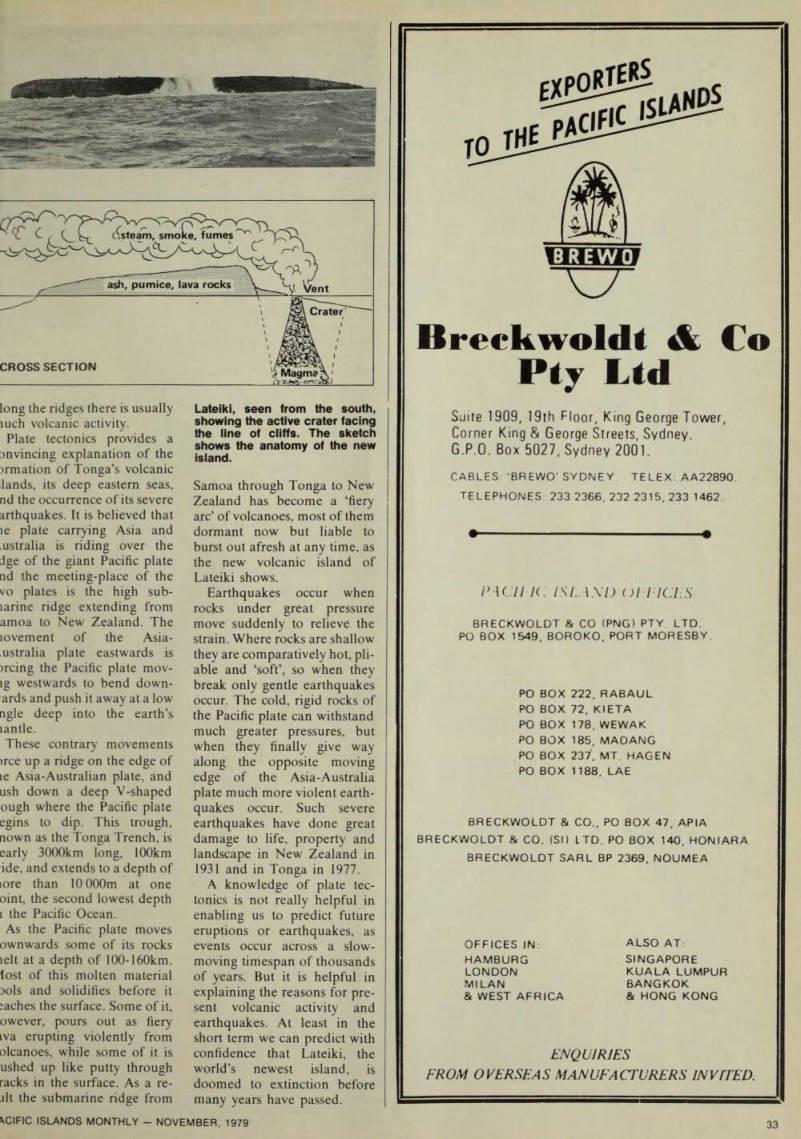
Lateiki: Tonga’s new jack-in-the-box island
The story of the Pacific's newest island Lateiki, in Tonga's Vavau group is told in detail by E. A. Crane, writing from Nukualofa.
For good measure the writer seeks a fundamental explanation for the appearance of this (and other) islands as he outlines briefly the theory of ‘plate tectonics', which is finding increasing acceptance among earth scientists throughout the world. E. A. Crane, MA, is assistant principal of Nukualofa's Tupou High School.
Another ‘jack-in-the-box’
island has been thrown up by a volcano on the western sub-
marine ridge of Tonga. Lying
between the volcanic cones of Kao and Late, it has been
named by King Taufa’ahau
Tupou IV of Tonga, Lateiki, which means ‘it lies beside Late’. Although not so wellknown as Falcon Island, renamed Fonua Fo’ou (new land) by the Tongans, which has been raised by an undersea volcano four times in the past 200 years and eroded away by the sea each time, Lateiki is already staking its own claim to
fame by rising and sinking
twice in the past 100 years. It has now been reborn for a third time.
In 1875 the British frigate, HMS Metis, while charting this area, found a small volcanic island protruding out of a shallow platform which the captain named Metis Shoal. Volcanic activity continued for the next
15 years, gradually building the island higher. When HMS Sappho saw it in 1878 it was 200 m long and 37m high. In 1890 its height was given as 480 m. From then on volcanic activity ceased, and by 1898 waves had worn away the loose ash and rock until it was again a shoal with 4m of water over it.
Twelve years ago, in December 1967, Metis Shoal
erupted again, throwing up
dense clouds of steam, smoke, and ash. A small island of loose rocks and ash was formed, and the King of Tonga visited the area by aircraft to see this small extension of his kingdom. But by the end of 1968 the island
had completely disappeared
under the relentless sea.
Then three months ago
Metis Shoal began erupting
again. On May 1 sailors on the New Zealand cargo ship Marama reported clouds of steam rising into the air on the
distant horizon. Sailors on the Tongan vessel Niukavai, on its way from Samoa to New Zealand, passed closer to the shoal and reported that the sea was boiling, and saw clouds of steam and ash rising high into the air. On May 10 an orbiting
satellite reported steam rising
from a Tongan volcano.
Reports then began to come in from distant ships and air craft of a strange phenomenon a ‘sea of pumice’ 190 km long and 50km wide drifting away towards Fiji (PIM, August).
Samples of the pumice were collected by two Fiji naval vessels near Vanua Balavu. In the first week of June the New Zealand navy frigate, HMNZ Canterbury sailed into the pumice field on its way to
Tonga. The engine intakes
sucked in the pumice and turned it to mud, but the ship was not damaged.
This pumice had originated
from the eruption on Metis Shoal. The eruption had begun when gas building up in the
underlying magma suddenly
burst forth in frothing bubbles of red-hot lava. As these bubbles came into contact with the water and air above, they
solidified quickly into light,
buoyant rocks containing
countless air pockets left by the escaping gas. One observer on
a Tonga Air plane reported this
pumice floating away from
Metis Shoal still steaming, and with one piece ‘as big as a motor car’.
As the eruption built up, ash, pumice and lava blocks were thrown out in continuous ex plosions up to 200 metres, and a pilot of Tonga Air saw a column of smoke and steam rising to 3000 m, high above the cloud layer. Captain R. Jones, also of Tonga Air, said he saw the gradual birth of the island over four days, from June 19 to 23. He said: it was tremen dously spectacular each time I flew back over it a fantastic experience I will never forget’
(PIM Sept).
Captain Jones said the erup tion hurled small rocks as high as 150 m into the air when he flew over it. There was no sign of land anywhere around, although round the centre of the smoke he saw the green outline of a subterranean peak in the midst of the blue sea. But instead of being deposited all around the rim of the crater, the ash, sand, and rock were deposited only on its northwest arc, probably due to the strong southeast winds blowing it in that direction.
A new island rising out of the sea was an event to celebrate with royal ceremony. On
Saturday, July 7 His Majesty
King Tupou IV sailed to the island on the MV Sami, and on
Sunday, July 8, His Royal
Highness Prince ‘Aho’eitu led a landing party to the island to raise the Tongan Flag and claim it for Tonga.
When the flag-raising party returned to the ship to report to the king that the task had been carried out, a service of thanksgiving was held on deck. ‘The president of the Free Wesleyan Church, Rev Huluaholo Mo’ungaloa, men tioned that the new island was like a blessing from God to His Majesty on his 61st birthday (July 4). After the service the King named the island Lateiki saying: ‘I believe that the island is given as a blessing to
all Tonga’.
Geologists and vulcan ologists visiting the island with the landing party, and others later from Fiji, report that Lateiki is composed of volcanic
An adventurous visitor stands on the SE corner of Lateiki, hottest part of the new island, amid steam, smoke and fumes arising from geysers.
>h. pumice, and dark grey or lack basalt (lava rocks). It has n area of 3ha, is 320 m long nd 120 m wide. Its steep mthem end curves in an arc f cliff's rising 16m in the south west to 10m in the southeast, rom the tops of these cliff's the md slopes down almost to sea ivel on the northern end. lack volcanic sand circles the hole island. Scattered all over ic island are large boulders of
asalt, some being 3m high and
m long. While the outer sur ice of these boulders is hard, lack rock, the inside of the >cks is granular and softer. On ic island too are many
imeroles (holes) emitting sul
hur dioxide with its strong,
ilty odour.
In front of the cliff's is the live mtre of the volcano. When lis is exposed at low tide, ouds of steam and fumes of ilphur dioxide come out of ic central vent. These clouds
rise to over 20m and then spread over the whole Island.
At high tide, when the live crater is submerged, the sea boils and volcanic sands rise into the air in black foun tains.
How did Lateiki arise? There is no doubt that it is part of a chain of volcanoes that have raised peaks and islands on the crest of a long submarine ridge stretching 3000 km from Samoa to the southeast of New Zealand. In the Tongan group the existing volcanic islands of Ata, Hunga Tonga and Hunga Haapai, Tofua, Kao, Late, Fonualei, Tafahi, and Niuafoou rise out of the ridge from south to north. Kao, Late, Fonualei and Tafahi are per fect cones, but violent erup tions 10-20 000 years ago caused the sides of Tofua and Niuafoou to collapse into holes left by the ejected magma forming large calders 7-Bkm in width.
But in other places along the ridge less violent eruptions are
occurring today which, after
throwing out relatively small
amounts of lava, pumice, rock and ash, quickly subside as they are washed away by the sea. They occur at Fonuafoou, just north of the Hungas, Metis Shoal, close to Late, and Cura cao Reef 24km north of Tafahi.
Three undersea eruptions have occurred at Curacao Reef since 1973, but although dense clouds of steam were thrown into the air, no islands were formed.
Most earth scientists today are accepting the new theory of plate tectonics as an expla nation for these volcanoes.
This theory, reinforced by find
ings from ships drilling the
ocean floor, and submersibles that explore the rugged ocean terrain to depths up to 3000 m, is that the earth’s thin outer shell is split up into gigantic, irregular-shaped blocks called plates. These move slowly over the globe, only a few centi metres each year, carrying con tinents, islands, and oceans on their backs. Where two plates collide with each other or con tinents, they slowly pile the edges up into massive moun tain ranges, but where they col lide under oceans they form ridges and deep trenches, and Continued next page
Top picture shows the extraordinary southern cliffs of the new island, bordering the live crater seen at left, which is exposed at low tide.
Centre picture: King Taufa’ahau Tupou IV, aboard the MV Sami, takes part in a thanksgiving service as the ship stands off the newest island in his kingdom, and before a landing party goes ashore to raise the Tongan flag and claim it for Tonga (at right). All photos illustrating this article are from the
Tonga Chronicle.
long the ridges there is usually
mch volcanic activity.
Plate tectonics provides a
rmvincing explanation of the
urination of Tonga’s volcanic
lands, its deep eastern seas, nd the occurrence of its severe arthquakes. It is believed that ic plate carrying Asia and ustralia is riding over the dge of the giant Pacific plate nd the meeting-place of the
vo plates is the high sub
larine ridge extending from
amoa to New Zealand. The lovement of the Asia
.ustralia plate eastwards is
ircing the Pacific plate mov ig westwards to bend down ards and push it away at a low ngle deep into the earth’s lantle.
These contrary movements >rce up a ridge on the edge of
ic Asia-Australian plate, and
ush down a deep V-shaped
ough where the Pacific plate
egins to dip. This trough,
nown as the Tonga Trench, is early 3000 km long, 100 km ide, and extends to a depth of lore than 10 000 m at one oint, the second lowest depth i the Pacific Ocean.
As the Pacific plate moves ownwards some of its rocks iclt at a depth of 100-160 km. lost of this molten material dols and solidifies before it caches the surface. Some of it, owever, pours out as fiery
iva erupting violently from
olcanoes, while some of it is ushed up like putty through racks in the surface. As a re alt the submarine ridge from
Samoa through Tonga to New Zealand has become a ‘fiery arc’ of volcanoes, most of them dormant now but liable to burst out afresh at any time, as the new volcanic island of Lateiki shows.
Earthquakes occur when rocks under great pressure move suddenly to relieve the strain. Where rocks are shallow
they are comparatively hot, pli
able and ‘soft’, so when they
break only gentle earthquakes
occur. The cold, rigid rocks of the Pacific plate can withstand much greater pressures, but
when they finally give way
along the opposite moving
edge of the Asia-Australia plate much more violent earth quakes occur. Such severe earthquakes have done great damage to life, property and landscape in New Zealand in 1931 and in Tonga in 1977.
A knowledge of plate tec tonics is not really helpful in enabling us to predict future
eruptions or earthquakes, as
events occur across a slow
moving timespan of thousands
of years. But it is helpful in explaining the reasons for pre sent volcanic activity and earthquakes. At least in the short term we can predict with confidence that Lateiki, the world’s newest island, is doomed to extinction before many years have passed.
Lateiki, seen from the south, showing the active crater facing the line of cliffs. The sketch shows the anatomy of the new island.
Advertisements & other items, pp. 31-33 (3 items)
31
ACIFIC ISLANDS MONTHLY - NOVEMBER. 1979
Tparker
% . m s, **%T#!#> .s SS, w #> w- V^.'N
More of an asset
than just a pen.
Parker 75.
It takes four precious metals to make a Parker 75 pen like this. Sterling silver for the case, 14ct gold for the beautifully responsive nib, and a wear-resistant alloy V of platinum and ruthenium for the tip. \ It’s even more exceptional. The nib can turn 360° to write at the angle most natural to you.
A lifetime investment. * Also in 22ct gold and stainless steel.
Pencils, ball pens to match. m v ■ w 1 ■ Tm\ ■ v * \ ••
tPARKER
Worlds most wanted pens ■ \ N • N A V & ■f \ ' •e^N V x ' \ L>- ,N ' ' SfcV\ - S '' !*V' • - > A* ■y -** s ™SKf* PI % '' V Ww 066.P490R
THE
export^
pAClflt
irm
Breekwoldt & Co
Ply Ltd
Suite 1909, 19th Floor, King George Tower,
Corner King & George Streets, Sydney.
G.P.O. Box 5027, Sydney 2001.
CABLES: BREWO' SYDNEY TELEX AA22890.
TELEPHONES: 233 2366, 232 2315. 233 1462. <•
EACH IC ISLAM) Oi l ICES
BRECKWOLDT & CO (PNG) PTY LTD.
PO BOX 1549, BOROKO, PORT MORESBY.
PO BOX 222, RABAUL
PO BOX 72. KIETA
PO BOX 178, WEWAK
PO BOX 185, MADANG
PO BOX 237. MT. HAGEN
PO BOX 1188, LAE
BRECKWOLDT & CO., PO BOX 47, APIA BRECKWOLDT & CO. (SI) LTD. PO BOX 140, HONIARA
BRECKWOLDT SARL BP 2369, NOUMEA
OFFICES IN:
HAMBURG
LONDON
MILAN
& WEST AFRICA
ALSO AT:
SINGAPORE
KUALA LUMPUR
BANGKOK
& HONG KONG
ENQUIRIES
FROM OVERSEAS MANUFACTURERS INVITED .
33
\CIFIC ISLANDS MONTHLY - NOVEMBER, 1979
People
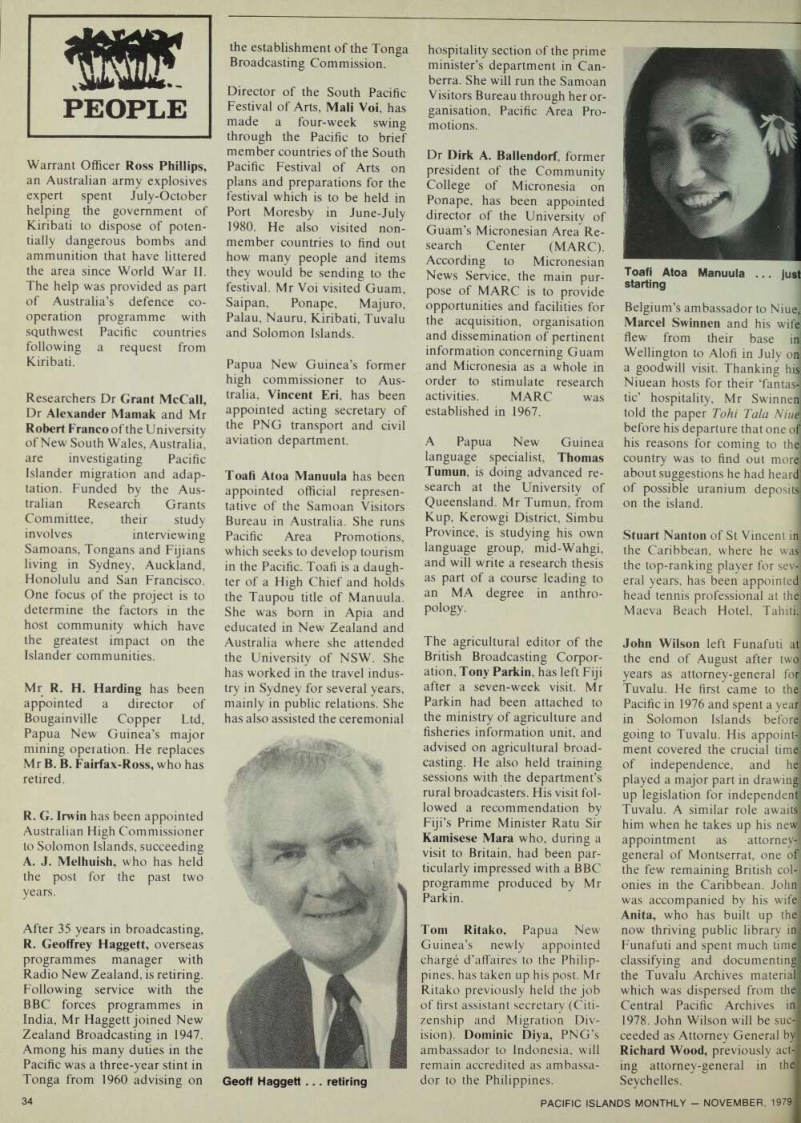
Warrant Officer Ross Phillips, an Australian army explosives expert spent July-October helping the government of Kiribati to dispose of poten
tially dangerous bombs and
ammunition that have littered the area since World War 11.
The help was provided as part of Australia’s defence co operation programme with squthwest Pacific countries following a request from Kiribati.
Researchers Dr Grant McCall, Dr Alexander Mamak and Mr Robert Franco of the University of New South Wales, Australia, are investigating Pacific
Islander migration and adap
tation. Funded by the Aus tralian Research Grants Committee, their study
involves interviewing
Samoans, Tongans and Fijians
living in Sydney, Auckland,
Honolulu and San Francisco.
One focus of the project is to determine the factors in the host community which have the greatest impact on the Islander communities.
Mr R. H. Harding has been appointed a director of
Bougainville Copper Ltd,
Papua New Guinea’s major
mining operation. He replaces
Mr B. B. Fairfax-Ross, who has retired.
R. G. Irwin has been appointed Australian High Commissioner to Solomon Islands, succeeding A. J. Melhuish, who has held the post for the past two years.
After 35 years in broadcasting, R. Geoffrey Haggett, overseas programmes manager with Radio New Zealand, is retiring.
Following service with the BBC forces programmes in India, Mr Haggett joined New Zealand Broadcasting in 1947.
Among his many duties in the Pacific was a three-year stint in Tonga from 1960 advising on
the establishment of the Tonga
Broadcasting Commission.
Director of the South Pacific Festival of Arts, Mali Voi, has made a four-week swing through the Pacific to brief member countries of the South Pacific Festival of Arts on plans and preparations for the festival which is to be held in
Port Moresby in June-July
1980. He also visited non member countries to find out how many people and items they would be sending to the festival. Mr Voi visited Guam,
Saipan, Ponape, Majuro,
Palau, Nauru, Kiribati, Tuvalu and Solomon Islands.
Papua New Guinea’s former high commissioner to Aus tralia, Vincent Eri, has been
appointed acting secretary of
the PNG transport and civil
aviation department.
Toafi Atoa Manuula has been appointed official represen tative of the Samoan Visitors Bureau in Australia. She runs Pacific Area Promotions, which seeks to develop tourism in the Pacific. Toafi is a daugh ter of a High Chief and holds the Taupou title of Manuula.
She was born in Apia and educated in New Zealand and Australia where she attended the University of NSW. She has worked in the travel indus try in Sydney for several years, mainly in public relations. She has also assisted the ceremonial
hospitality section of the prime minister’s department in Can berra. She will run the Samoan Visitors Bureau through her or ganisation, Pacific Area Pro motions.
Dr Dirk A. Ballendorf. former
president of the Community
College of Micronesia on Ponape, has been appointed director of the University of Guam’s Micronesian Area Re search Center (MARC).
According to Micronesian News Service, the main pur pose of MARC is to provide opportunities and facilities for
the acquisition, organisation
and dissemination of pertinent information concerning Guam and Micronesia as a whole in order to stimulate research activities. MARC was established in 1967.
A Papua New Guinea
language specialist, Thomas
Tumun, is doing advanced re search at the University of Queensland. Mr Tumun, from
Kup, Kerowgi District, Simbu
Province, is studying his own
language group, mid-Wahgi,
and will write a research thesis as part of a course leading to an MA degree in anthro
pology.
The agricultural editor of the
British Broadcasting Corpor
ation, Tony Parkin, has left Fiji after a seven-week visit. Mr Parkin had been attached to the ministry of agriculture and fisheries information unit, and advised on agricultural broad casting. He also held training sessions with the department’s rural broadcasters. His visit fol lowed a recommendation by Fiji’s Prime Minister Ratu Sir Kamisese Mara who, during a visit to Britain, had been par ticularly impressed with a BBC
programme produced by Mr
Parkin.
Tom Ritako, Papua New
Guinea’s newly appointed
charge d’affaires to the Philip pines, has taken up his post. Mr Ritako previously held the job of first assistant secretary (Citi zenship and Migration Div ision). Dominic Diya, PNG’s ambassador to Indonesia, will remain accredited as ambassa dor to the Philippines.
Belgium’s ambassador to Niue, Marcel Swinnen and his wife flew from their base in|
Wellington to Alofi in July oJ
a goodwill visit. Thanking his!
Niuean hosts for their ‘fantas-j
tic’ hospitality, Mr SwinneiJ
told the paper Tohi Tala Niuei before his departure that one or his reasons for coming to the] country was to find out more] about suggestions he had heard
of possible uranium deposits!
on the island.
Stuart Nanton of St Vincent in the Caribbean, where he was!
the top-ranking player for sevi
eral years, has been appointed head tennis professional at the Maeva Beach Hotel, Tahiti.
John Wilson left Funafuti at the end of August after two!
years as attorney-general fori
Tuvalu. He first came to the!
Pacific in 1976 and spent a yean in Solomon Islands before] going to Tuvalu. His appoint-] ment covered the crucial time]
of independence, and he]
played a major part in drawing]
up legislation for independent]
Tuvalu. A similar role awaits him when he takes up his new]
appointment as attorney!
general of Montserrat, one of the few remaining British col-J onies in the Caribbean. John was accompanied by his wife Anita, who has built up the]
now thriving public library in]
Funafuti and spent much time!
classifying and documenting]
the Tuvalu Archives material] which was dispersed from the] Central Pacific Archives ini 1978. John Wilson will be suc-J ceeded as Attorney General byi
Richard Wood, previously act-j
ing attorney-general in the!
Seychelles.
Geoff Haggett ... retiring
Toafi Atoa Manuula ... just starting
Advertisements & other items, p. 35 (1 item)
Yamaha
W- • B X r 2it \
Sophisticated Performance in a
Sensible New Size
The all new Yamaha 30 is one of the most advanced middleweights ever built. This remarkable, high performance engine has such sophisticated engineering refinements as a third scavenging passage between the piston and cylinder, electronic C.D.I. ignition and Yamaha’s exclusive fuel recirculation system. Other features seldom found on engines this size include through-the-prop exhaust and thermostatically controlled cooling. Quiet, economical and convenient, this new Yamaha entry gives you the power and convenience of a much larger motor in a size that makes a lot of sense.
YAMAHA
Back to Noumea for un grand manage
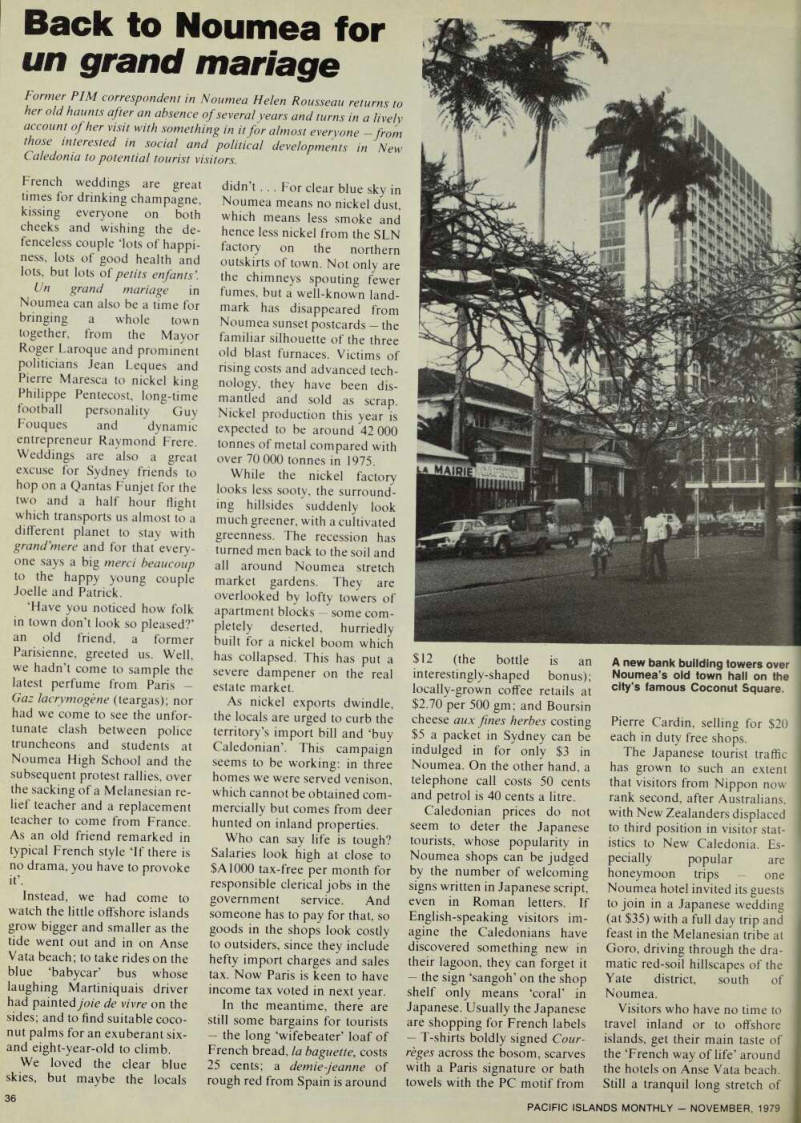
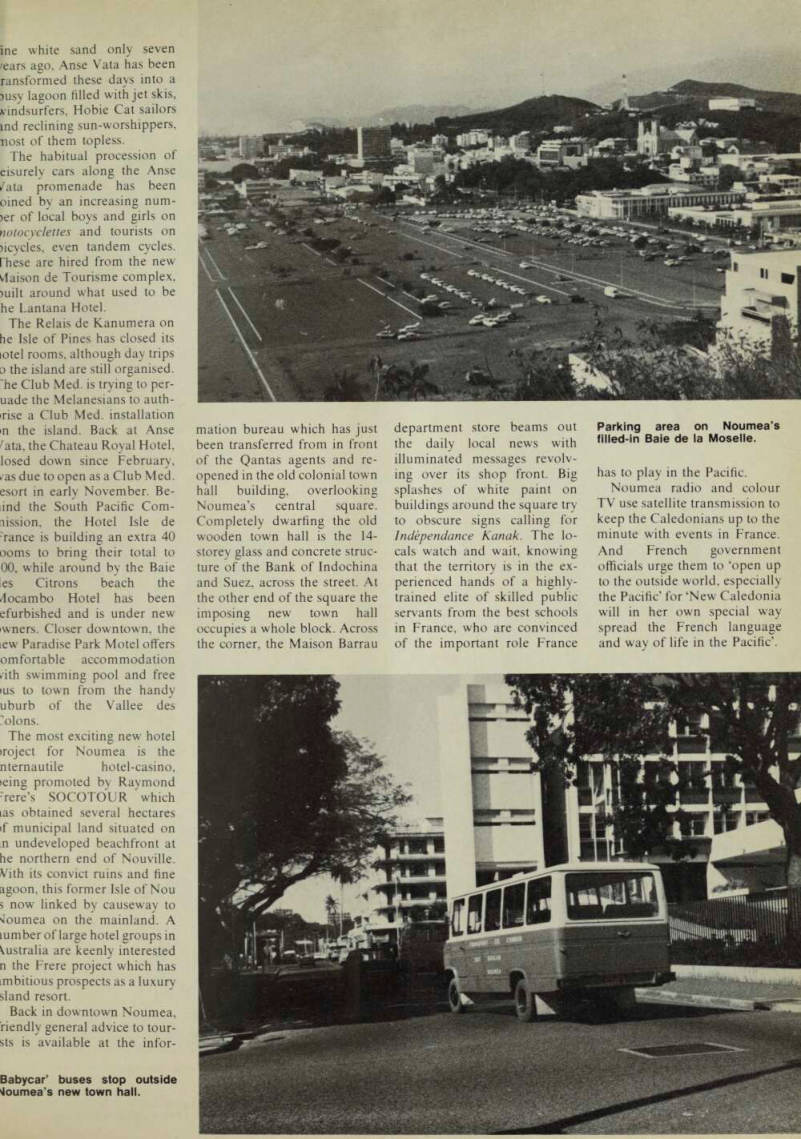
un grand manage
formfr PIM correspondent in Noumea Helen Rousseau returns to her old haunts after an absence of several years and turns in a lively account of her visit with something in it for almost everyone - from those interested in social and political developments in New Caledonia to potential tourist visitors.
French weddings are great
times for drinking champagne,
kissing everyone on both cheeks and wishing the de fenceless couple ‘lots of happi ness, lots of good health and lots, but lots of petits enfants\ Un grand manage in Noumea can also be a time for bringing a whole town together, from the Mayor
Roger Laroque and prominent
politicians Jean Leques and Pierre Maresca to nickel king
Philippe Pentecost, long-time
football personality Guy
Fouques and dynamic
entrepreneur Raymond Frere.
Weddings are also a great excuse for Sydney friends to hop on a Qantas Funjet for the two and a half hour flight which transports us almost to a different planet to stay with grand’mere and for that every one says a big merci beaucoup to the happy young couple Joelle and Patrick. ‘Have you noticed how folk in town don’t look so pleased?’ an old friend, a former Parisienne, greeted us. Well, we hadn’t come to sample the latest perfume from Paris
Gaz lacrymogene (teargas); nor
had we come to see the unfor tunate clash between police truncheons and students at Noumea High School and the subsequent protest rallies, over the sacking of a Melanesian re lief teacher and a replacement teacher to come from France.
As an old friend remarked in typical French style ‘lf there is no drama, you have to provoke it’.
Instead, we had come to watch the little offshore islands grow bigger and smaller as the tide went out and in on Anse Vata beach; to take rides on the blue ‘babycar’ bus whose
laughing Martiniquais driver
had painted joie de vivre on the sides; and to find suitable coco nut palms for an exuberant six and eight-year-old to climb.
We loved the clear blue skies, but maybe the locals
didn’t . . . For clear blue sky in Noumea means no nickel dust, which means less smoke and hence less nickel from the SEN factory on the northern outskirts of town. Not only are
the chimneys spouting fewer
fumes, but a well-known land mark has disappeared from Noumea sunset postcards - the familiar silhouette of the three old blast furnaces. Victims of rising costs and advanced tech nology, they have been dis mantled and sold as scrap.
Nickel production this year is expected to be around 42 000 tonnes of metal compared with over 70 000 tonnes in 1975.
While the nickel factory looks less sooty, the surround
ing hillsides suddenly look
much greener, with a cultivated greenness. The recession has turned men back to the soil and all around Noumea stretch
market gardens. They are
overlooked by lofty towers of apartment blocks some com
pletely deserted, hurriedly
built for a nickel boom which has collapsed. This has put a severe dampener on the real estate market.
As nickel exports dwindle, the locals are urged to curb the
territory’s import bill and ‘buy
Caledonian’. This campaign seems to be working: in three homes we were served venison, which cannot be obtained com mercially but comes from deer hunted on inland properties.
Who can say life is tough?
Salaries look high at close to SAIOOO tax-free per month for responsible clerical jobs in the government service. And someone has to pay for that, so goods in the shops look costly to outsiders, since they include
hefty import charges and sales
tax. Now Paris is keen to have income tax voted in next year.
In the meantime, there are still some bargains for tourists the long ‘wifebeater’ loaf of French bread, la baguette, costs 25 cents; a demie-jeanne of rough red from Spain is around
$l2 (the bottle is an
interestingly-shaped bonus);
locally-grown coffee retails at $2.70 per 500 gm; and Boursin cheese aux fines herbes costing $5 a packet in Sydney can be indulged in for only $3 in Noumea. On the other hand, a telephone call costs 50 cents and petrol is 40 cents a litre.
Caledonian prices do not seem to deter the Japanese tourists, whose popularity in Noumea shops can be judged by the number of welcoming signs written in Japanese script, even in Roman letters. If English-speaking visitors im agine the Caledonians have discovered something new in their lagoon, they can forget it the sign ‘sangoh’ on the shop shelf only means ‘coral’ in Japanese. Usually the Japanese are shopping for French labels T-shirts boldly signed Cour reges across the bosom, scarves with a Paris signature or bath towels with the PC motif from
Pierre Cardin, selling for $2O each in duty free shops.
The Japanese tourist traffic has grown to such an extent that visitors from Nippon now rank second, after Australians, with New Zealanders displaced to third position in visitor stat istics to New Caledonia. Es pecially popular are
honeymoon trips one
Noumea hotel invited its guests
to join in a Japanese wedding
(at $35) with a full day trip and feast in the Melanesian tribe at Goro, driving through the dra matic red-soil hillscapes of the Yate district, south of Noumea.
Visitors who have no time to travel inland or to offshore islands, get their main taste of the ‘French way of life’ around the hotels on Anse Vata beach.
Still a tranquil long stretch of
A new bank building towers over Noumea’s old town hall on the city’s famous Coconut Square.
ine white sand only seven 'ears ago, Anse Vata has been ransformed these days into a
msy lagoon filled with jet skis,
vindsurfers, Hobie Cat sailors
md reclining sun-worshippers,
nost of them topless.
The habitual procession of eisurely cars along the Anse
/ata promenade has been
oined by an increasing num >er of local boys and girls on notocyclettes and tourists on
)icycles, even tandem cycles,
fhese are hired from the new
Faison de Tourisme complex,
milt around what used to be he Lantana Hotel.
The Relais de Kanumera on he Isle of Pines has closed its
lotel rooms, although day trips
o the island are still organised, 'he Club Med. is trying to per uade the Melanesians to auth orise a Club Med. installation •n the island. Back at Anse the Chateau Royal Hotel, losed down since February, /as due to open as a Club Med. esort in early November. Be ind the South Pacific Com mission, the Hotel Isle de Tance is building an extra 40 ooms to bring their total to 00, while around by the Baie es Citrons beach the docambo Hotel has been efurbished and is under new owners. Closer downtown, the iew Paradise Park Motel offers omfortable accommodation
/ith swimming pool and free
ms to town from the handy üburb of the Vallee des Colons.
The most exciting new hotel iroject for Noumea is the ntemautile hotel-casino,
»eing promoted by Raymond
Tere’s SOCOTOUR which ias obtained several hectares »f municipal land situated on n undeveloped beachfront at he northern end of Nouville.
Vith its convict ruins and fine agoon, this former Isle of Nou s now linked by causeway to Noumea on the mainland. A lumber of large hotel groups in
Australia are keenly interested
n the Frere project which has imbitious prospects as a luxury sland resort.
Back in downtown Noumea, fiendly general advice to tour sts is available at the infor-
mation bureau which has just been transferred from in front of the Qantas agents and re opened in the old colonial town
hall building, overlooking
Noumea’s central square.
Completely dwarfing the old
wooden town hall is the 14storey glass and concrete struc ture of the Bank of Indochina and Suez, across the street. At the other end of the square the imposing new town hall occupies a whole block. Across the corner, the Maison Barrau
department store beams out the daily local news with illuminated messages revolv
ing over its shop front. Big
splashes of white paint on buildings around the square try to obscure signs calling for Independance Kanak. The locals watch and wait, knowing that the territory is in the experienced hands of a highlytrained elite of skilled public servants from the best schools in France, who are convinced of the important role France
has to play in the Pacific, Noumea radio and colour TV use satellite transmission to keep the Caledonians up to the minute with events in France, And French government officials urge them to ‘open up to the outside world, especially the Pacific’for‘New Caledonia will in her own special way
spread the French language
and way of life in the Pacific’.
Parking area on Noumea’s filled-in Baie de la Moselle.
Babycar’ buses stop outside Noumea’s new town hall.
Advertisements & other items, pp. 38-39 (1 item)
_ Pioneer’s Mi
Pioneer’s Mi
So many to choose f i
Pioneers working hard to make it easy for you to really enjoy your favorite music. Sure our Music Systems are technically advanced, but not so complicated that you need a license to turn them on. So, we’re offering not only one or two but ten great musical ideas to match your audio requirements and budget. In addition to our versatile 3-m-1 systems shown on these pages, we have equally wonderful
2-m-l receiver/cassette deck combinations.
Easy operation plus big music power reproduces music so well if you don’t believe your ears, you can check the LED information panel.
Music System 750 Music System 850 or further information, please contact; Australia; Pioneer Marketing Service Ry. Ltd., P.O. Box 317 Mordialloc 'ictoria, 3195 Tel; 90-9011 iji islands: Brijlal & Company, G.P.O. Box No. 362, Suva Fiji Islands el: 22258 New Zealand: Monaco Electronics Ltd., 5 Vernon Street, Auckland, New Zealand Tel; 33-883 Norfolk Island: Burns Philp (Norfolk Island) Ltd., Norfolk Island, South Pacific New Hebrides; Burns Philp (New Hebrides) Ltd., Vila. New Hebrides Nauru Island: Jacob Enterprises, P.O. Box No. 4, Republic of Nauru
4c Systems.
«n, so easy to enjoy.
Also featured is the well-known Multi Mode Deck™ with exclusive Pioneer Song Finder, one-touch recording, auto-repeat plus Dolby* for noise-free recording and playback. For record lovers, a full size belt-driven turntable with auto-return and cut. And on the output side, a pair of beautiful Pioneer speaker systems to
make great music sound even greater.
Pioneer’s Music Systems. So many to choose from, so easy to use and enjoy, turning them off is the only hard thing about them. Stop by for a demonstration today. There’s a Music System that’s just right for you. -Dolby is a trademark of Dolby Labs.
Features vary with model §nd price. • Tahiti: Ets. PERFECT, B.P. 594, Papeete, Tahiti Tel: 20 407 New Caledonia: Menard Freres Ville, B.P. H 2 Cedex, Noumea, New Caledonia Tel: 27.52.22 American Samoa: Transpac Corporation, P.O. Box 1477, Pago Pago, American Samoa 96799 Tel: 633-5224 Rarotonga: South Seas International Ltd., P.O. Box 49, Rarotonga, Coo Islands Tel; 2327 Papua New Guinea: Bali Merchants Pty. Ltd., P.O. Box 6103, Boroko Tel; 254887
Helping Islands Polio Victims
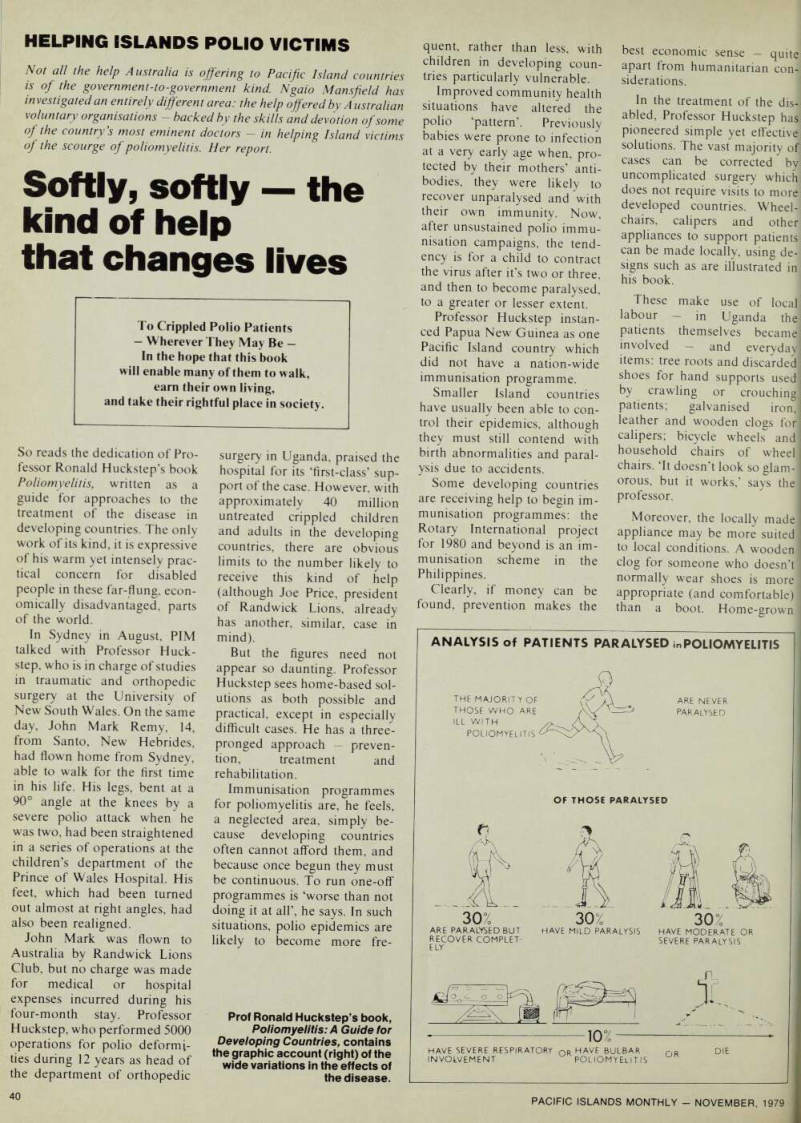
N °t all the help Australia is offering to Pacific Island countries is of the government-to-government kind. Ngaio Mansfield has investigated an entirely different area: the help offered by A ustralian voluntary organisations - backed by the skills and devotion of some of the country’s most eminent doctors - in helping Island victims of the scourge of poliomyelitis. Her report.
Softly, softly the kind
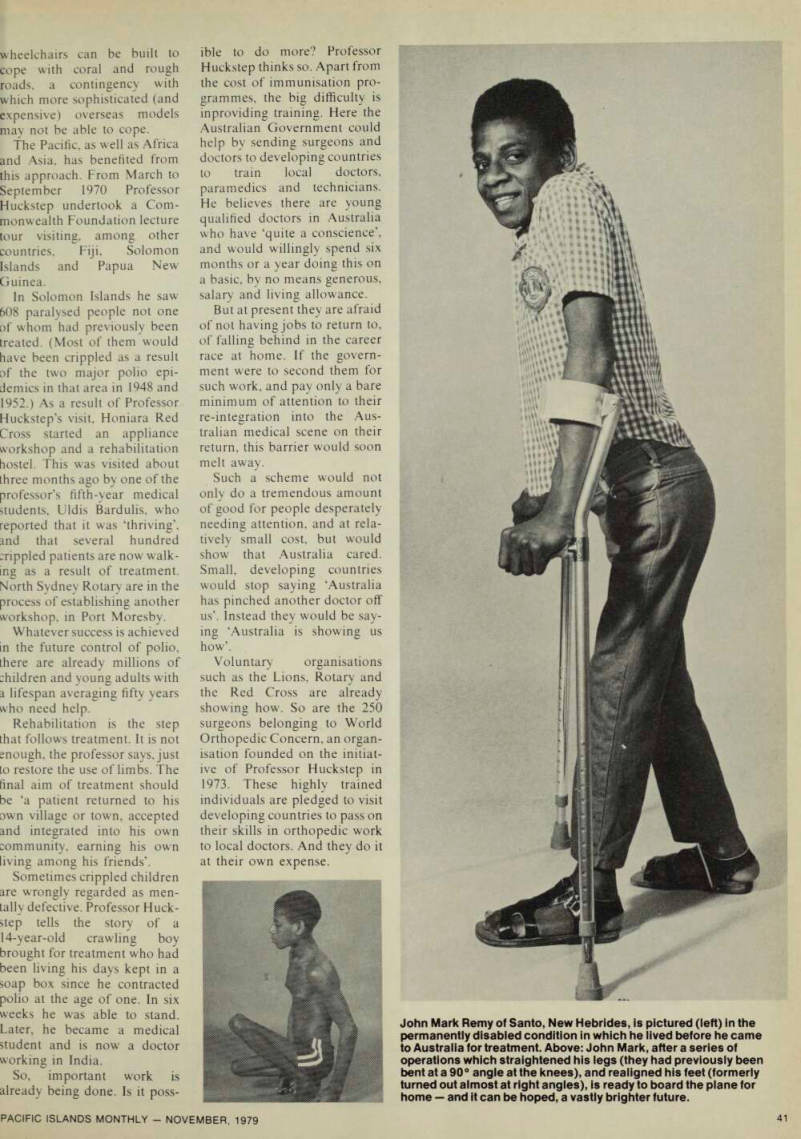
kind of help that changes lives
To Crippled Polio Patients - Wherever They May Be - In the hope that this book will enable many of them to walk, earn their own living, and take their rightful place in society.
So reads the dedication of Professor Ronald Huckstep’s book Poliomyelitis, written as a guide for approaches to the treatment of the disease in
developing countries. The only
work of its kind, it is expressive of his warm yet intensely practical concern for disabled people in these far-flung, econ-
omically disadvantaged, parts
of the world.
In Sydney in August, PIM talked with Professor Huckstep, who is in charge of studies in traumatic and orthopedic surgery at the University of New South Wales. On the same day, John Mark Remy, 14, from Santo, New Hebrides, had flown home from Sydney, able to walk for the first time in his life. His legs, bent at a 90° angle at the knees by a severe polio attack when he was two, had been straightened in a series of operations at the children s department of the Prince of Wales Hospital. His feet, which had been turned out almost at right angles, had also been realigned.
John Mark was flown to Australia by Randwick Lions Club, but no charge was made for medical or hospital expenses incurred during his four-month stay. Professor
Huckstep, who performed 5000
operations for polio deformities durine 12 vears as head of ues aunng iz years as bead ot the department of orthopedic
surgery in Uganda, praised the hospital for its ‘first-class’ sup port of the case. However, with approximately 40 million untreated crippled children and adults in the developing countries, there are obvious limits to the number likely to receive this kind of help
(although Joe Price, president
of Randwick Lions, already has another, similar, case in mind).
But the figures need not appear so daunting. Professor Huckstep sees home-based sol utions as both possible and
practical, except in especially
difficult cases. He has a three pronged approach preven tion, treatment and rehabilitation.
Immunisation programmes for poliomyelitis are, he feels, a neglected area, simply be cause developing countries often cannot afford them, and because once begun they must be continuous. To run one-off programmes is ‘worse than not doing it at all’, he says. In such
situations, polio epidemics are
likely to become more fre
quent, rather than less, with children in developing coun tries particularly vulnerable.
Improved community health situations have altered the polio ‘pattern’. Previously babies were prone to infection at a very early age when, pro tected by their mothers’ anti bodies, they were likely to recover unparalysed and with their own immunity. Now, after unsustained polio immu nisation campaigns, the tend ency is for a child to contract the virus after it’s two or three, and then to become paralysed, to a greater or lesser extent.
Professor Huckstep instan ced Papua New Guinea as one Pacific Island country which did not have a nation-wide immunisation programme.
Smaller Island countries have usually been able to con trol their epidemics, although they must still contend with birth abnormalities and paral ysis due to accidents.
Some developing countries are receiving help to begin im munisation programmes: the Rotary International project for 1980 and beyond is an im munisation scheme in the
Philippines.
Clearly, if money can be found, prevention makes the
best economic sense quite apart from humanitarian con siderations.
In the treatment of the dis abled, Professor Huckstep has pioneered simple yet effective solutions. The vast majority of cases can be corrected by uncomplicated surgery which does not require visits to more developed countries. Wheel chairs, calipers and other appliances to support patients can be made locally, using de signs such as are illustrated in his book.
These make use of local labour in Uganda the patients themselves became involved and everyday items: tree roots and discarded: shoes for hand supports used
by crawling or crouching
patients; galvanised iron,] leather and wooden clogs for calipers; bicycle wheels and household chairs of wheel chairs. Tt doesn’t look so glam-j orous, but it works,’ says the professor.
Moreover, the locally made appliance may be more suited 1 to local conditions. A wooden! clog for someone who doesn’t] normally wear shoes is more appropriate (and comfortable) than a boot. Home-grown
Prof Ronald Huckstep’s book, Poliomyelitis: A Guide for Developing Countries, contains the graphic account (right) of the wide variations in the effects of the disease.
wheelchairs can be built to cope with coral and rough
roads, a contingency with
which more sophisticated (and
expensive) overseas models may not be able to cope.
The Pacific, as well as Africa and Asia, has benefited from this approach. From March to September 1970 Professor Huckstep undertook a Com monwealth Foundation lecture tour visiting, among other countries, Fiji, Solomon Islands and Papua New Guinea.
In Solomon Islands he saw
508 paralysed people not one
of whom had previously been treated. (Most of them would have been crippled as a result
of the two major polio epi
demics in that area in 1948 and 1952.) As a result of Professor Huckstep’s visit, Honiara Red
Cross started an appliance
workshop and a rehabilitation hostel. This was visited about three months ago by one of the
professor’s fifth-year medical
students, Uldis Bardulis, who reported that it was ‘thriving’, and that several hundred crippled patients are now walk ing as a result of treatment.
North Sydney Rotary are in the
process of establishing another
workshop, in Port Moresby.
Whatever success is achieved in the future control of polio, there are already millions of children and young adults with
a lifespan averaging fifty years
who need help.
Rehabilitation is the step that follows treatment. It is not
enough, the professor says, just
to restore the use of limbs. The final aim of treatment should be ‘a patient returned to his
own village or town, accepted
and integrated into his own
community, earning his own
living among his friends’.
Sometimes crippled children
are wrongly regarded as men
tally defective. Professor Huck step tells the story of a
14-year-old crawling boy
brought for treatment who had been living his days kept in a soap box since he contracted polio at the age of one. In six weeks he was able to stand.
Later, he became a medical student and is now a doctor working in India.
So, important work is already being done. Is it poss
ible to do more? Professor Huckstep thinks so. Apart from the cost of immunisation pro grammes, the big difficulty is
inproviding training. Here the
Australian Government could help by sending surgeons and doctors to developing countries to train local doctors, paramedics and technicians.
He believes there are young qualified doctors in Australia who have ‘quite a conscience’, and would willingly spend six months or a year doing this on a basic, by no means generous,
salary and living allowance.
But at present they are afraid of not having jobs to return to, of falling behind in the career race at home. If the govern ment were to second them for such work, and pay only a bare minimum of attention to their re-integration into the Aus tralian medical scene on their return, this barrier would soon melt away.
Such a scheme would not only do a tremendous amount
of good for people desperately
needing attention, and at rela tively small cost, but would show that Australia cared.
Small, developing countries would stop saying ‘Australia has pinched another doctor off us’. Instead they would be say ing ‘Australia is showing us how’.
Voluntary organisations
such as the Lions, Rotary and the Red Cross are already showing how. So are the 250 surgeons belonging to World Orthopedic Concern, an organ isation founded on the initiat ive of Professor Huckstep in 1973. These highly trained individuals are pledged to visit developing countries to pass on their skills in orthopedic work to local doctors. And they do it at their own expense.
John Mark Remy of Santo, New Hebrides, is pictured (left) in the permanently disabled condition in which he lived before he came to Australia for treatment. Above: John Mark, after a series of operations which straightened his legs (they had previously been bent at a 90° angle at the knees), and realigned his feet (formerly turned out almost at right angles), is ready to board the plane for home and it can be hoped, a vastly brighter future.
Advertisements & other items, p. 42 (1 item)
some of our chiefs
V,
It IS
I 1 W •* f l: m •••:** » v -r -T- -r m r>- ■»r xs>.fc a id •. v ;v? *&!ss :^v- *v >3?- : I •»> .a K ■ fl
HP*MW
5«5 te g* V-* <■*
IsP
*•' m EJ?* . ■&&***£ 4 • :* 4?
some of our chiefs
In Papua New Guinea there are 717 different cultures, each represented by its own language and its own "chief”. Few men know this country better than our chief pilot, Captain,John Regan.
He's logged more than 16,000 hours flying, much of that in Papua New Guinea.
John Regan is one of ninety highly skilled Australian, New Zealand, British, and American pilots flying our aircraft to seventeen places in Papua New Guinea and eight destinations overseas.
aißNiueiNi
THE NA T/ONAL AIRLINE OF PAPUA NEW GUINEA
S.P.S. 001
Travel
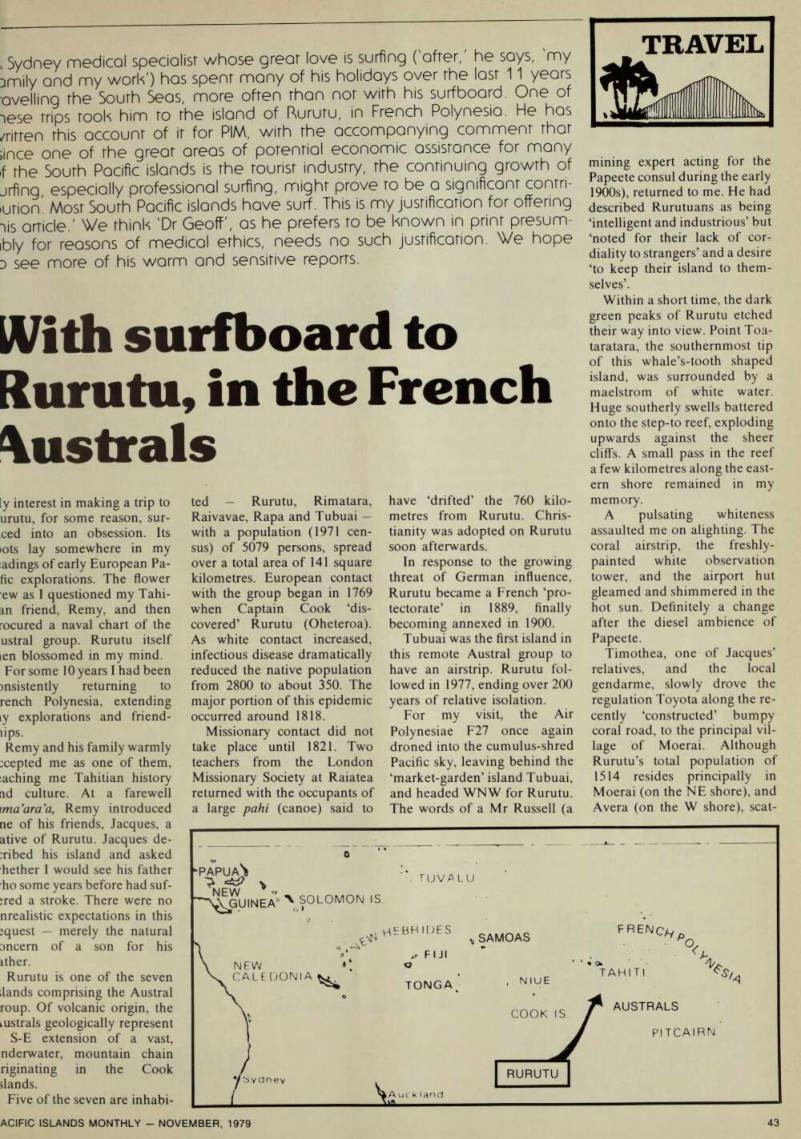
, Sydney medicol specialist whose great love is surfing ('after,' he soys, my amily and my work') has spent many of his holidays over rhe losr 11 years ovelling rhe Sourh Seas, more often rhon nor wirh his surfboard. One of tese trips rook him ro rhe island of Rururu, in French Polynesia. He has zrirren rhis account of ir for PIM, wirh rhe accompanying comment rhor iince one of rhe greor oreos of porenriol economic assistance for many f rhe Sourh Pacific islands is rhe rourisr industry, rhe continuing growth of jrfing especially professional surfing, might prove ro be o significant conrri lurion Most Sourh Pacific islands hove surf. This is my justification for offering iis article.' We rhink 'Dr Geoff', os he prefers ro be known in print presum ibly for reasons of medicol ethics, needs no such justification. We hope 3 see more of his worm ond sensitive reports.
Australs
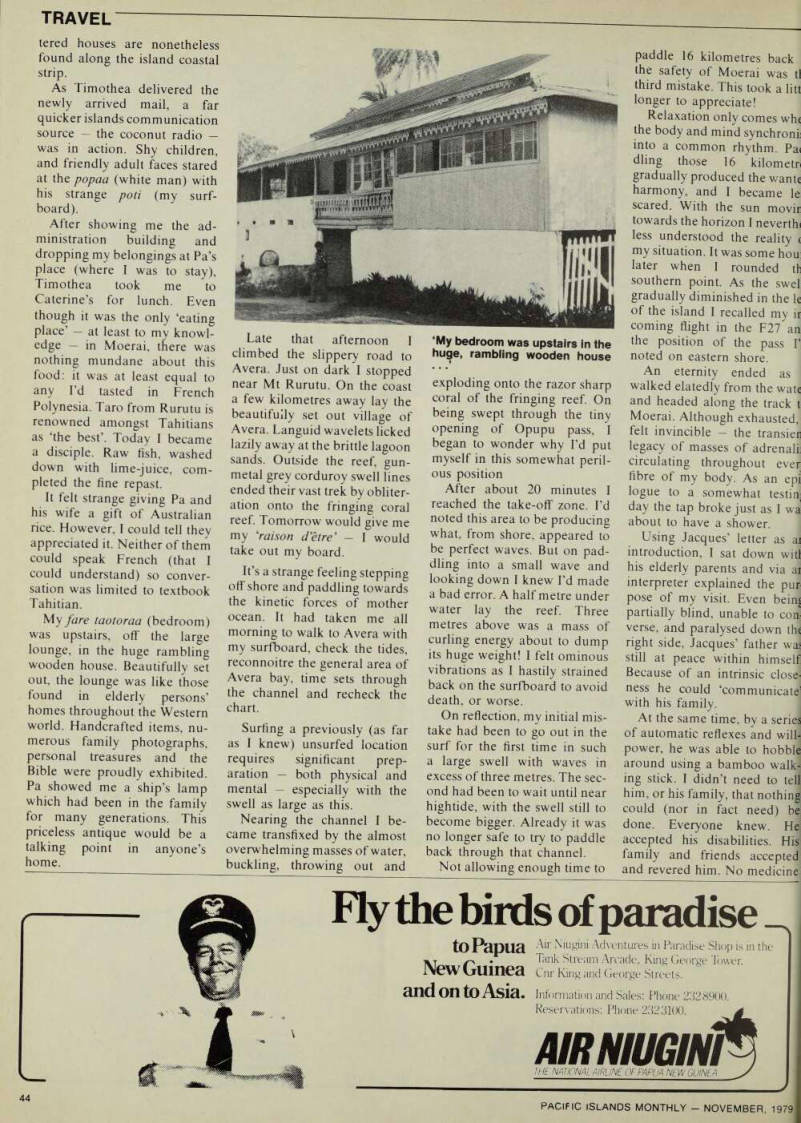
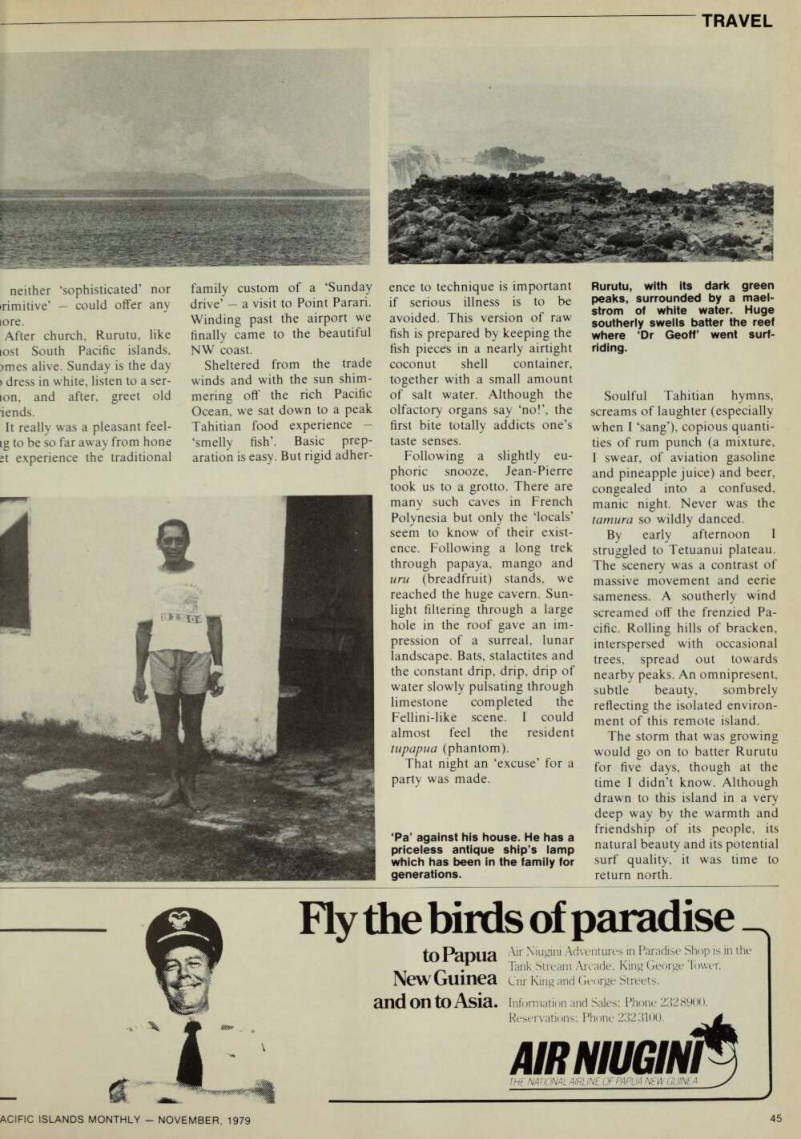
With surfboard to Rurutu, in the French Australs
[y interest in making a trip to urutu, for some reason, sur ced into an obsession. Its iots lay somewhere in my adings of early European Pa
fic explorations. The flower
ew as 1 questioned my Tahi an friend, Remy, and then rocured a naval chart of the ustral group. Rurutu itself ten blossomed in my mind.
For some 10 years I had been msistently returning to rench Polynesia, extending ly explorations and friend lips.
Remy and his family warmly xepted me as one of them, aching me Tahitian history id culture. At a farewell ima’ara’a, Remy introduced ne of his friends, Jacques, a ative of Rurutu. Jacques de :ribed his island and asked hether I would see his father ho some years before had suf ;red a stroke. There were no nrealistic expectations in this jquest merely the natural mcem of a son for his ither.
Rurutu is one of the seven ilands comprising the Austral roup. Of volcanic origin, the
Lustrals geologically represent
S-E extension of a vast, nderwater, mountain chain riginating in the Cook dands.
Five of the seven are inhabi
ted Rurutu, Rimatara, Raivavae, Rapa and Tubuai with a population (1971 cen sus) of 5079 persons, spread over a total area of 141 square kilometres. European contact with the group began in 1769 when Captain Cook ‘dis covered’ Rurutu (Oheteroa).
As white contact increased, infectious disease dramatically reduced the native population from 2800 to about 350. The
major portion of this epidemic
occurred around 1818.
Missionary contact did not take place until 1821. Two teachers from the London
Missionary Society at Raiatea
returned with the occupants of a large pahi (canoe) said to
have ‘drifted’ the 760 kilo metres from Rurutu. Chris tianity was adopted on Rurutu soon afterwards.
In response to the growing threat of German influence, Rurutu became a French ‘pro tectorate’ in 1889, finally becoming annexed in 1900.
Tubuai was the first island in this remote Austral group to have an airstrip. Rurutu fol lowed in 1977, ending over 200 years of relative isolation.
For my visit, the Air Polynesiae F 27 once again droned into the cumulus-shred Pacific sky, leaving behind the ‘market-garden’ island Tubuai, and headed WNW for Rurutu.
The words of a Mr Russell (a
mining expert acting for the Papeete consul during the early 1900 s), returned to me. He had described Rurutuans as being ‘intelligent and industrious’ but ‘noted for their lack of cor diality to strangers’ and a desire ‘to keep their island to them selves’.
Within a short time, the dark green peaks of Rurutu etched their way into view. Point Toa taratara, the southernmost tip of this whale’s-tooth shaped island, was surrounded by a maelstrom of white water.
Huge southerly swells battered onto the step-to reef, exploding upwards against the sheer cliffs. A small pass in the reef a few kilometres along the east ern shore remained in my memory.
A pulsating whiteness assaulted me on alighting. The coral airstrip, the freshly painted white observation tower, and the airport hut gleamed and shimmered in the hot sun. Definitely a change after the diesel ambience of Papeete.
Timothea, one of Jacques’ relatives, and the local gendarme, slowly drove the regulation Toyota along the re cently ‘constructed’ bumpy coral road, to the principal vil
lage of Moerai. Although
Rurutu’s total population of 1514 resides principally in Moerai (on the NE shore), and Avera (on the W shore), scat-
tered houses are nonetheless found along the island coastal strip.
As Timothea delivered the newly arrived mail, a far quicker islands communication source the coconut radio was in action. Shy children, and friendly adult faces stared at the popaa (white man) with his strange poti (my surf board).
After showing me the ad ministration building and dropping my belongings at Pa’s place (where I was to stay), Timothea took me to Caterine’s for lunch. Even though it was the only ‘eating place’ at least to my knowl edge in Moerai, there was nothing mundane about this food: it was at least equal to any I’d tasted in French Polynesia. Taro from Rurutu is renowned amongst Tahitians as ‘the best’. Today I became a disciple. Raw fish, washed down with lime-juice, com pleted the fine repast.
It felt strange giving Pa and his wife a gift of Australian rice. However, I could tell they appreciated it. Neither of them could speak French (that I could understand) so conver sation was limited to textbook Tahitian.
My fare taotoraa (bedroom) was upstairs, off the large lounge, in the huge rambling wooden house. Beautifully set out, the lounge was like those found in elderly persons’ homes throughout the Western world. Handcrafted items, nu
merous family photographs,
personal treasures and the Bible were proudly exhibited.
Pa showed me a ship’s lamp which had been in the family for many generations. This priceless antique would be a talking point in anyone’s home.
Late that afternoon I climbed the slippery road to Avera. Just on dark I stopped near Mt Rurutu. On the coast a few kilometres away lay the beautifully set out village of Avera. Languid wavelets licked lazily away at the brittle lagoon sands. Outside the reef, gun metal grey corduroy swell lines ended their vast trek by obliter ation onto the fringing coral reef. Tomorrow would give me my "raison d'etre ’ I would take out my board.
It’s a strange feeling stepping off shore and paddling towards the kinetic forces of mother ocean. It had taken me all morning to walk to Avera with my surfboard, check the tides, reconnoitre the general area of Avera bay, time sets through the channel and recheck the chart.
Surfing a previously (as far as I knew) unsurfed location
requires significant prep
aration both physical and mental especially with the swell as large as this.
Nearing the channel I be came transfixed by the almost overwhelming masses of water,
buckling, throwing out and
exploding onto the razor sharp coral of the fringing reef. On
being swept through the tiny
opening of Opupu pass, I began to wonder why I’d put myself in this somewhat peril
ous position
After about 20 minutes I reached the take-olf zone. I’d noted this area to be producing what, from shore, appeared to be perfect waves. But on pad dling into a small wave and looking down I knew I’d made a bad error. A half metre under water lay the reef. Three metres above was a mass of curling energy about to dump its huge weight! I felt ominous vibrations as I hastily strained back on the surfboard to avoid death, or worse.
On reflection, my initial mis take had been to go out in the surf for the first time in such a large swell with waves in excess of three metres. The sec ond had been to wait until near hightide, with the swell still to become bigger. Already it was no longer safe to try to paddle back through that channel.
Not allowing enough time to
paddle 16 kilometres back the safety of Moerai was tl third mistake. This took a litt longer to appreciate!
Relaxation only comes whc the body and mind synchronii into a common rhythm. Pa< dling those 16 kilometn gradually produced the wante harmony, and I became le: scared. With the sun movir towards the horizon I neverth( less understood the reality ( my situation. It was some hou; later when I rounded th southern point. As the swel gradually diminished in the le of the island I recalled my ir coming flight in the F 27 an the position of the pass I* noted on eastern shore.
An eternity ended as walked elatedly from the wate and headed along the track t Moerai. Although exhausted, felt invincible the transien legacy of masses of adrenalii
circulating throughout ever
fibre of my body. As an epi logue to a somewhat testing day the tap broke just as I wa about to have a shower.
Using Jacques’ letter as ai introduction, I sat down witl his elderly parents and via at interpreter explained the pur pose of my visit. Even partially blind, unable to con verse, and paralysed down the right side, Jacques’ father was still at peace within himself Because of an intrinsic close ness he could ‘communicate’ with his family.
At the same time, by a series of automatic reflexes and willJ power, he was able to hobble around using a bamboo walkJ ing stick. I didn’t need to tell him, or his family, that nothing could (nor in fact need) be done. Everyone knew. He accepted his disabilities. His family and friends accepted and revered him. No medicine
‘My bedroom was upstairs in the huge, rambling wooden house ...'
neither ‘sophisticated’ nor •rimitive’ could offer any lore.
After church, Rurutu, like lost South Pacific islands, )mes alive. Sunday is the day ) dress in white, listen to a ser lon, and after, greet old iends.
It really was a pleasant feel ig to be so far away from hone
st experience the traditional
family custom of a ‘Sunday drive’ a visit to Point Parari.
Winding past the airport we finally came to the beautiful NW coast.
Sheltered from the trade winds and with the sun shim mering oft' the rich Pacific Ocean, we sat down to a peak Tahitian food experience - ‘smelly fish’. Basic prep aration is easy. But rigid adher-
ence to technique is important if serious illness is to be avoided. This version of raw
fish is prepared by keeping the
fish pieces in a nearly airtight
coconut shell container, together with a small amount of salt water. Although the olfactory organs say ‘no!’, the first bite totally addicts one’s taste senses.
Following a slightly eu
phoric snooze, Jean-Pierre took us to a grotto. There are many such caves in French Polynesia but only the ‘locals’ seem to know of their exist ence. Following a long trek through papaya, mango and uru (breadfruit) stands, we reached the huge cavern. Sun
light filtering through a large
hole in the roof gave an im pression of a surreal, lunar landscape. Bats, stalactites and
the constant drip, drip, drip of
water slowly pulsating through
limestone completed the Fellini-like scene. I could almost feel the resident
tupapua (phantom).
That night an ‘excuse’ for a party was made.
Soulful Tahitian hymns,
screams of laughter (especially
when I ‘sang’), copious quanti
ties of rum punch (a mixture, I swear, of aviation gasoline and pineapple juice) and beer, congealed into a confused, manic night. Never was the tamura so wildly danced.
By early afternoon I
struggled to Tetuanui plateau.
The scenery was a contrast of massive movement and eerie sameness. A southerly wind screamed off the frenzied Pa cific. Rolling hills of bracken, interspersed with occasional trees, spread out towards
nearby peaks. An omnipresent,
subtle beauty, sombrely
reflecting the isolated environ ment of this remote island.
The storm that was growing would go on to batter Rurutu for five days, though at the time I didn’t know. Although drawn to this island in a very deep way by the warmth and friendship of its people, its natural beauty and its potential surf quality, it was time to return north.
Rurutu, with its dark green peaks, surrounded by a mael strom of white water. Huge southerly swells batter the reef where ‘Dr Geoff’ went surf riding.
‘Pa’ against his house. He has a priceless antique ship’s lamp which has been in the family for generations.
Advertisements & other items, pp. 43-46 (3 items)
43
ACIFIC ISLANDS MONTHLY - NOVEMBER, 1979
Fly the birds of paradise _
jC
Fly the birds of paradise
to Pclpua N* l1 ©™ Adventures in Paradise Shop is in the . Tank Stream Arcade, King George Tower, IMCW IxUinea Cnr King and George Streets. and on to Asia. Information and Sales: Phone 2328900.
Reservations; Phone 2323100, reservations: FMone 2323100. A
aiRMUGiNr
-iE NATIONAL AIRLINE OF PAPUA NEW GUINEA
Fly the birds of paradise
to Papua
New Guinea
and on to Asia.
Air Niugini Adventures in Paradise Shop is in the Tank Stream Arcade, King George Tower.
Cnr King and George Streets.
Information and Sales; Phone 2328900.
Reservations: Phone 2323100.
AIRNIUGINi
THE NATIONAL AIRLINE OF PAPUA NEW GUINEA y
Your
doorway
into the
fascinating
world of the South Seas 104 pages $4.00 or SUSS.OO posted.
Order form on special insert in this issue.
PORT MOl
* Right in tl business cei * A traditioj, comfort food ♦ All rooms airconditioned * Restaurant ♦ Bai * Banquet hall
*A. C. NEUMANN
manager Phone 21*2622 LbJi
Stay at Aggie Grey’s . . . the South Pacific’s
legendary hotel.
Situated right in the heart of Western Samoa. Enjoy Polynesian-style friendliness and service, in cool surroundings, superb entertainment and food.
Magnificent white sand beaches only a short drive away. Airconditioned rooms, swimming pool and full bar facilities.
Bookings through Union Steamship Company of NZ, Pan Am, Air New Zealand or direct to Aggie Grey’s, Apia, Western Samoa. Cables: ’AGGIES' Apia.
Travel
45
ACIFIC ISLANDS MONTHLY - NOVEMBER, 1979
Hibiscus Festival
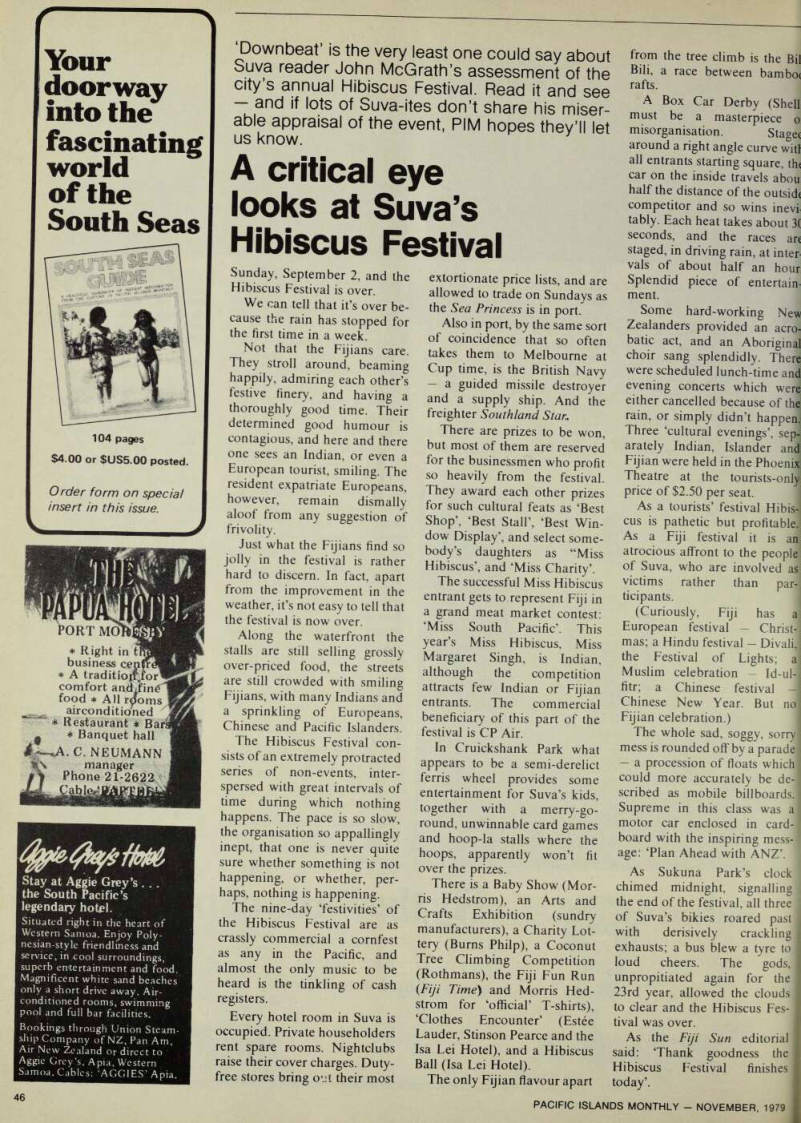
A critical eye looks at Suva’s Hibiscus Festival
Downbeat’ is the very least one could say about Suva reader John McGrath’s assessment of the city’s annual Hibiscus Festival. Read it and see and if lots of Suva-ites don’t share his miser able appraisal of the event, RIM hopes thev’ll let us know.
Sunday, September 2, and the Hibiscus Festival is over.
We can tell that it’s over be cause the rain has stopped for the first time in a week.
Not that the Fijians care.
They stroll around, beaming
happily, admiring each other’s
festive finery, and having a thoroughly good time. Their determined good humour is contagious, and here and there one sees an Indian, or even a
European tourist, smiling. The
resident expatriate Europeans, however, remain dismally aloof from any suggestion of
frivolity.
Just what the Fijians find so jolly in the festival is rather hard to discern. In fact, apart from the improvement in the weather, it’s not easy to tell that the festival is now over.
Along the waterfront the stalls are still selling grossly over-priced food, the streets are still crowded with smiling Fijians, with many Indians and
a sprinkling of Europeans,
Chinese and Pacific Islanders.
The Hibiscus Festival con sists of an extremely protracted series of non-events, inter spersed with great intervals of
time during which nothing
happens. The pace is so slow, the organisation so appallingly inept, that one is never quite sure whether something is not happening, or whether, per
haps, nothing is happening.
The nine-day ‘festivities’ of the Hibiscus Festival are as crassly commercial a cornfest as any in the Pacific, and almost the only music to be heard is the tinkling of cash registers.
Every hotel room in Suva is occupied. Private householders rent spare rooms. Nightclubs raise their cover charges. Duty free stores bring out their most
extortionate price lists, and are allowed to trade on Sundays as the Sea Princess is in port.
Also in port, by the same sort of coincidence that so often takes them to Melbourne at Cup time, is the British Navy a guided missile destroyer and a supply ship. And the freighter Southland Star ; There are prizes to be won, but most of them are reserved for the businessmen who profit so heavily from the festival.
They award each other prizes for such cultural feats as ‘Best Shop’, ‘Best Stall’, ‘Best Win dow Display’, and select some
body’s daughters as “Miss
Hibiscus’, and ‘Miss Charity’.
The successful Miss Hibiscus entrant gets to represent Fiji in a grand meat market contest; ‘Miss South Pacific’. This year’s Miss Hibiscus, Miss
Margaret Singh, is Indian,
although the competition attracts few Indian or Fijian entrants. The commercial beneficiary of this part of the festival is CP Air.
In Cruickshank Park what appears to be a semi-derelict ferris wheel provides some entertainment for Suva’s kids, together with a merry-go round, unwinnable card games and hoop-la stalls where the hoops, apparently won’t fit over the prizes.
There is a Baby Show (Mor ris Hedstrom), an Arts and Crafts Exhibition (sundry manufacturers), a Charity Lot tery (Bums Philp), a Coconut
Tree Climbing Competition
(Rothmans), the Fiji Fun Run (Fiji Time\ and Morris Hed strom for ‘official’ T-shirts), ‘Clothes Encounter’ (Estee Lauder, Stinson Pearce and the Isa Lei Hotel), and a Hibiscus Ball (Isa Lei Hotel).
The only Fijian flavour apart
from the tree climb is the Bi Bili, a race between bambo rafts.
A Box Car Derby (She! must be a masterpiece o
misorganisation. Stage
around a right angle curve wit all entrants starting square, th car on the inside travels abou half the distance of the outsid competitor and so wins inevi tably. Each heat takes about 3( seconds, and the races are staged, in driving rain, at inter vals of about half an hour Splendid piece of entertain ment.
Some hard-working New Zealanders provided an acro batic act, and an Aborigina choir sang splendidly. There were scheduled lunch-time and evening concerts which were either cancelled because of the rain, or simply didn’t happen Three ‘cultural evenings’, sep arately Indian, Islander and Fijian were held in the Phoenix Theatre at the tourists-only price of $2.50 per seat.
As a tourists’ festival Hibis cus is pathetic but profitable.
As a Fiji festival it is an atrocious affront to the people of Suva, who are involved as victims rather than par
ticipants.
(Curiously, Fiji has a European festival - Christ mas; a Hindu festival Divali,j the Festival of Lights; a Muslim celebration - Id-ul- ( fitr; a Chinese festival —i Chinese New Year. But no
Fijian celebration.)
The whole sad, soggy, sorry mess is rounded off by a parade - a procession of floats which could more accurately be de-| scribed as mobile billboards.
Supreme in this class was a motor car enclosed in card board with the inspiring mess-] age: ‘Plan Ahead with ANZ’. As Sukuna Park’s clock
chimed midnight, signalling
the end of the festival, all three ; of Suva’s bikies roared past I
with derisively crackling j
exhausts; a bus blew a tyre to j loud cheers. The gods, I unpropitiated again for the I 23rd year, allowed the clouds I to clear and the Hibiscus Fes-1 tival was over.
As the Fiji Sun editorial I said: ‘Thank goodness the I Hibiscus Festival finishes I today’.
Advertisements & other items, pp. 47-48 (1 item)
The G-Series from JVC.
A different musical experience.
K i * Beautifully designed stereo systems from JVC the fabulous G-Series —with coordinated looks and feel.
Distinctive musical experiences sure to appeal to every kind of music lover.
In every system, the kind of careful attention to detail that has helped make our reputation.
In every system, our beautiful ease of operation, handsome good looks, excellent cost/performance value.
Not to mention your choice of big or small power outputs. separate tuners and amplifiers, the ultimate in precision and accuracy.
We know. We’re JVC, the innovative audio/video electronics company with 52 years of experience.
At JVC, details count. And this is why you can always count on us for true high-fidelity reproduction. Visit a JVC dealer today and audition the different G-Series systems.
I JVC G-SERIES HI-FI SYSTEMS
JVC
Australia: Hagemeyer (Australasia) 8.V., 25-27 Paul Street, North Ryde, N.S.W. 2113, Australia Te 1.887-1444 Fiji Islands: D. Gokal & Co.. Ltd., G.P.O, Box 501, Corner of Pier Street & Renwick Road, Suva, Fiji Tel. 25259 Cook Islands: J. & P. Ingram & Co., Ltd., P.0.80x 55, Rarotonga, Cook Islands Te 1.378457 New Hebrides: Wu ke Luong, P.0.80x 113, Rue Higginson, Port-Vila, New Hebrides Te 1.2115 New Caledonia: Caldis, 2, Route du Velodrome, B.P. Ml. Noumea, Cedex, New Caledonia Te 1.262350 Tahiti; Magasin Sincere, B.P. 215, Papeete, Tahiti Te 1.20060 Papua New Guinea: Hagemeyer(P.N.G.)Pty, Ltd., P.0.80x 90 Lae, Papua New Guinea Te 1.42-3200 New Zealand: Atlas Majestic Industries Ltd., 11, Albion Road, Otahuhu, Auckland 6, New Zealand Te 1.27-67-099
Over 5,000 rooms.
2.1 million guests this year.
More than4,2oo employees.
other
hotel
the
Three reasons why no
group can stay with us.
Over 5000 rooms. 61 hotels and resorts. 21 years of experience. That’s a lot of staying power.
But our contribution to the South Pacific goes far beyond simply being the biggest hotel and resort group in the region. It’s what our size means that counts. It means we can provide me Se^onn r , more 111311 two million people who stay with us annually, And with 4200 people m our organisation to look after our guests, the word “service’ really means something.
At the same time 4200 people employed is a lot of jobs. Again, a vital contribution to the economy of the South Pacific. And in the future we 11 have an even bigger contribution to make. . Because we believe the South Pacific increasingly will become a centre for world tourism. Many thousands of tourists will pour millions of dollars into the South Pacific economy. Hundreds of businesses will benefit. Jobs will be assured, and many new jobs created.
We’re prepared for that right now. And our investment is on the line to prove it.
For reservations or further information regarding investment in the South Pacific ! 2 B S7 a,erß » adßushc “‘^ B >y.^W.2° ll.Aaslr 1 I.Aaslra ia.
Boulevard. Park Royal.
Beachcomber. Travelodge.
Holiday Inn.
9 \m B H * Australia ® New Zealand 9 Fiji 9 Tahiti 9 Cook Islands 9 Papua New Guinea 9 New Caledonia Western Samoa
MASIUS TVL26
Afterthoughts
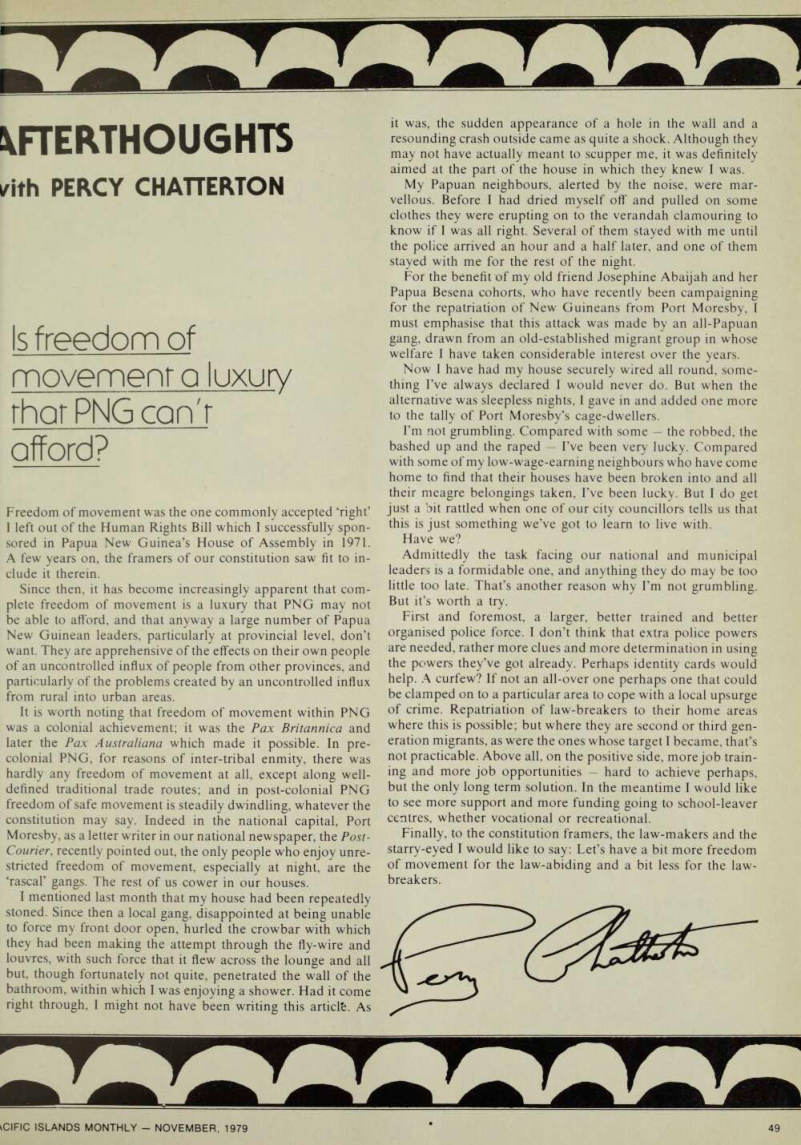
[?]Ith Percy Chatterton
Is freedom of movement a luxury that PNG can't afford?
Freedom of movement was the one commonly accepted Tight’
I left out of the Human Rights Bill which I successfully spon sored in Papua New Guinea’s House of Assembly in 1971.
A few years on, the framers of our constitution saw fit to in clude it therein.
Since then, it has become increasingly apparent that com plete freedom of movement is a luxury that PNG may not be able to afford, and that anyway a large number of Papua New Guinean leaders, particularly at provincial level, don’t want. They are apprehensive of the effects on their own people of an uncontrolled influx of people from other provinces, and particularly of the problems created by an uncontrolled influx from rural into urban areas.
It is worth noting that freedom of movement within PNG was a colonial achievement; it was the Pax Britannica and later the Pax Australiana which made it possible. In pre colonial PNG, for reasons of inter-tribal enmity, there was hardly any freedom of movement at all, except along well defined traditional trade routes; and in post-colonial PNG freedom of safe movement is steadily dwindling, whatever the constitution may say. Indeed in the national capital, Port Moresby, as a letter writer in our national newspaper, the Post- Courier , recently pointed out, the only people who enjoy unre stricted freedom of movement, especially at night, are the ‘rascal’ gangs. The rest of us cower in our houses.
I mentioned last month that my house had been repeatedly stoned. Since then a local gang, disappointed at being unable to force my front door open, hurled the crowbar with which they had been making the attempt through the fly-wire and louvres, with such force that it flew across the lounge and all but, though fortunately not quite, penetrated the wall of the bathroom, within which I was enjoying a shower. Had it come right through, I might not have been writing this article. As
it was, the sudden appearance of a hole in the wall and a resounding crash outside came as quite a shock. Although they may not have actually meant to scupper me, it was definitely aimed at the part of the house in which they knew I was.
My Papuan neighbours, alerted by the noise, were mar vellous. Before I had dried myself off and pulled on some clothes they were erupting on to the verandah clamouring to know if I was all right. Several of them stayed with me until the police arrived an hour and a half later, and one of them stayed with me for the rest of the night.
For the benefit of my old friend Josephine Abaijah and her Papua Besena cohorts, who have recently been campaigning for the repatriation of New Guineans from Port Moresby. I must emphasise that this attack was made by an all-Papuan gang, drawn from an old-established migrant group in whose welfare I have taken considerable interest over the years.
Now I have had my house securely wired all round, some thing I’ve always declared I would never do. But when the alternative was sleepless nights, I gave in and added one more to the tally of Port Moresby’s cage-dwellers.
I’m not grumbling. Compared with some the robbed, the bashed up and the raped I’ve been very lucky. Compared with some of my low-wage-earning neighbours who have come home to find that their houses have been broken into and all their meagre belongings taken. I’ve been lucky. But I do get just a bit rattled when one of our city councillors tells us that this is just something we’ve got to learn to live with.
Have we?
Admittedly the task facing our national and municipal leaders is a formidable one, and anything they do may be too little too late. That’s another reason why I’m not grumbling.
But it’s worth a try.
First and foremost, a larger, better trained and better organised police force. I don’t think that extra police powers are needed, rather more clues and more determination in using the powers they’ve got already. Perhaps identity cards would help. A curfew? If not an all-over one perhaps one that could be clamped on to a particular area to cope with a local upsurge of crime. Repatriation of law-breakers to their home areas where this is possible; but where they are second or third gen eration migrants, as were the ones whose target I became, that’s not practicable. Above all, on the positive side, more job train ing and more job opportunities - hard to achieve perhaps, but the only long term solution. In the meantime I would like to see more support and more funding going to school-leaver centres, whether vocational or recreational.
Finally, to the constitution framers, the law-makers and the starry-eyed I would like to say: Let’s have a bit more freedom of movement for the law-abiding and a bit less for the law breakers.
Advertisements & other items, pp. 49-51 (2 items)
49
kCIFIC ISLANDS MONTHLY - NOVEMBER, 1979
Tofiota
a# i . « ’ ; m*- M 3b
m* ir
% * -4
TOfIOTA
•«f» -- *rdb-.
, M -** f ‘ ■«€ :- ' ® m :: ' v : ’ ! * ' if- & *8& ite - - I; . . ■ zmssm % ° >■% W ' • : &M. B 9i f ® : m . mm
■MI
WSWOTfcL
ifi rs 4
TOYOTA
The Toyota truck range. Built to be unbeatable.
Bad weather conditions, no problem.
Bad roads and driving surfaces, eaten up.
Difficult loads, no contest. Built tough. Built to take it.
There's a Toyota truck built for you. * y- -1 4 u TOYOTA Land Cruiser Pickup
TOYOTA Dyna
TOYOTA Stout
TOYOTA Hi-Lux
TOYOTA Toyo-Ace TOYOTA Truck
TOYOTA
For unbeatable after service: PAPUA NEW GUINEA: ELA MOTORS, Scratchley Rd„ Badili, P.O. Box 675, Port Moresby. U.S. TRUST TERRITORY: MICROL CORPORATION, P.O.
Box 267, Saipan. FIJI ISLANDS: AUTOMOTIVE SUPPLIES CO., LTD., G.P.O. Box 355, Suva. AMERICAN SAMOA: BURNS PHILP (SOUTHSEA) CO., LTD., P.O. 1057, Pago Pago. WESTERN SAMOA: BURNS PHILP (SOUTHSEA) CO., LTD., P.O. Box 188, Apia, TONGA: BURNS PHILP (SOUTHSEA) CO-, LTD., P.O. Box 55, Nukualofa. GUAM: ATKINS, KROLL (GUAM) LTD., P.O. Box 6248, Tamuning. NEW HEBRIDES: NEW HEBRIDES MOTORS, P.O. Box 18, Vila SOLOMON ISLANDS: MENDANA ENTERPRISES (5.1.) LTD., P.O. Box 174, Honiara, TAHITI: NIPPON AUTOMOTO B.P. 342 v COOK ISLANDS: COOK ISLANDS TRADING CORPORATION LTD., P.O. Box 92, Rarotonga. NAURU ISLAND: NAURU COOPERATIVE SOCIETY, GILBERT ISLANDS: TARAWA MOTORS, Box 36, Bairiki Tarawa. NORFOLK ISLAND: MOUNT PITT (ENTERPRISES) LTD P O Box 169 NEW CALEDONIA: SOCIETE IMPORTATION AUTOMOBILE DE PACIFIQUE. Rond-Point du Pacific (Station Total) B.P 438 Noumea
Monumental work
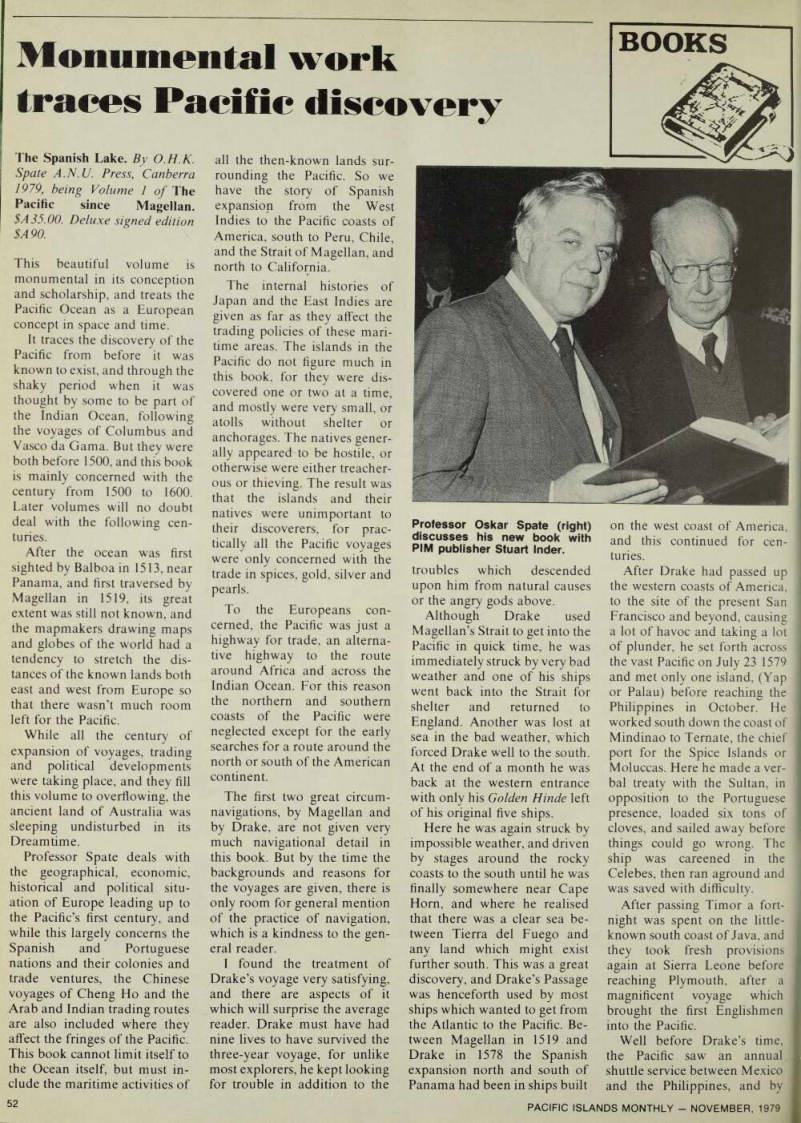
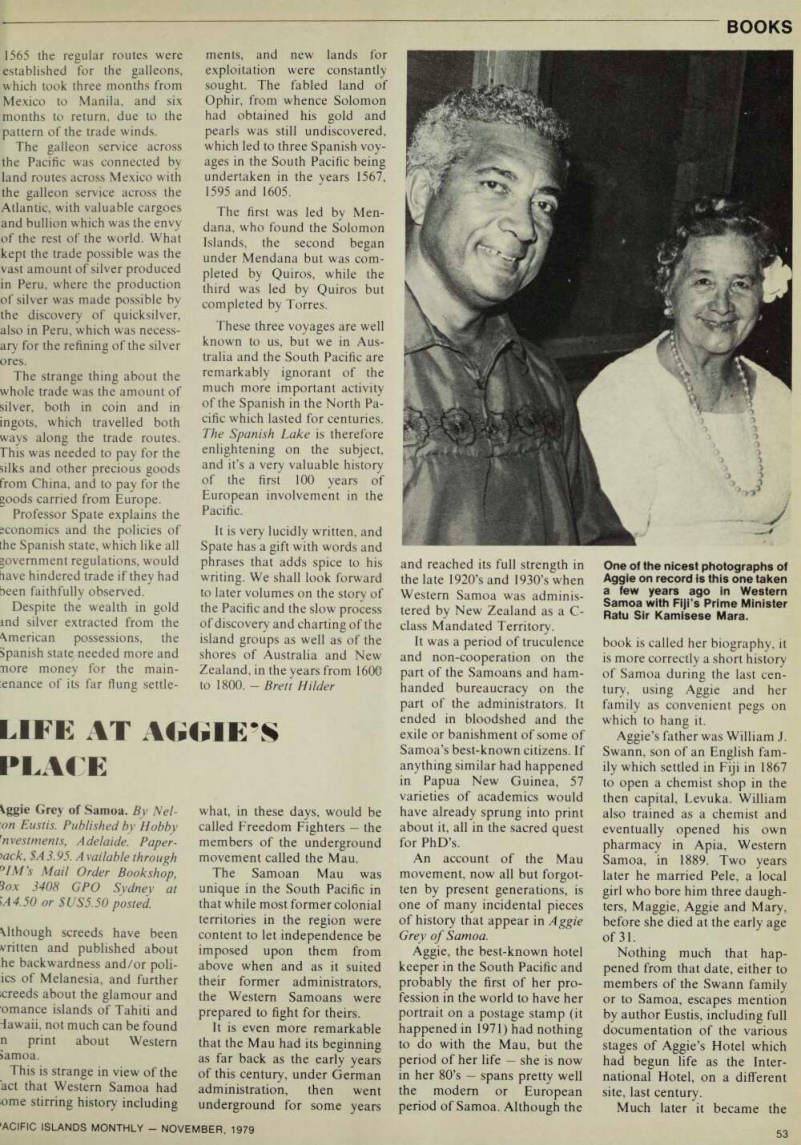
Books
Monumental work traces Pacific discovery
The Spanish Lake. By O.H.K.
Spate A.N.U. Press, Canberra 1979, being Volume 1 of The Pacific since Magellan. $ A 35.00. Deluxe signed edition
Sa9O.
This beautiful volume is monumental in its conception and scholarship, and treats the Pacific Ocean as a European concept in space and time.
It traces the discovery of the Pacific from before it was known to exist, and through the shaky period when it was thought by some to be part of the Indian Ocean, following the voyages of Columbus and Vasco da Gama. But they were both before 1500, and this book is mainly concerned with the century from 1500 to 1600.
Later volumes will no doubt deal with the following cen turies.
After the ocean was first sighted by Balboa in 1513, near Panama, and first traversed by Magellan in 1519, its great extent was still not known, and
the mapmakers drawing maps
and globes of the world had a tendency to stretch the dis tances of the known lands both east and west from Europe so that there wasn’t much room left for the Pacific.
While all the century of
expansion of voyages, trading
and political developments
were taking place, and they fill
this volume to overflowing, the ancient land of Australia was sleeping undisturbed in its Dreamtime.
Professor Spate deals with the geographical, economic, historical and political situ ation of Europe leading up to the Pacific’s first century, and while this largely concerns the
Spanish and Portuguese
nations and their colonies and trade ventures, the Chinese voyages of Cheng Ho and the Arab and Indian trading routes are also included where they affect the fringes of the Pacific.
This book cannot limit itself to the Ocean itself, but must in clude the maritime activities of
all the then-known lands sur rounding the Pacific. So we have the story of Spanish expansion from the West Indies to the Pacific coasts of America, south to Peru, Chile, and the Strait of Magellan, and north to California.
The internal histories of Japan and the East Indies are given as far as they affect the trading policies of these mari time areas. The islands in the Pacific do not figure much in this book, for they were dis covered one or two at a time, and mostly were very small, or atolls without shelter or anchorages. The natives gener ally appeared to be hostile, or otherwise were either treacher ous or thieving. The result was that the islands and their natives were unimportant to their discoverers, for prac tically all the Pacific voyages were only concerned with the trade in spices, gold, silver and
pearls.
To the Europeans con cerned, the Pacific was just a highway for trade, an alterna tive highway to the route around Africa and across the Indian Ocean. For this reason the northern and southern coasts of the Pacific were neglected except for the early searches for a route around the north or south of the American continent.
The first two great circum
navigations, by Magellan and
by Drake, are not given very much navigational detail in this book. But by the time the backgrounds and reasons for the voyages are given, there is only room for general mention of the practice of navigation, which is a kindness to the gen eral reader.
I found the treatment of Drake’s voyage very satisfying, and there are aspects of it which will surprise the average reader. Drake must have had nine lives to have survived the three-year voyage, for unlike
most explorers, he kept looking
for trouble in addition to the
troubles which descended upon him from natural causes or the angry gods above.
Although Drake used Magellan’s Strait to get into the Pacific in quick time, he was immediately struck by very bad weather and one of his ships went back into the Strait for shelter and returned to England. Another was lost at sea in the bad weather, which forced Drake well to the south.
At the end of a month he was back at the western entrance with only his Golden Hinde left of his original five ships.
Here he was again struck by impossible weather, and driven by stages around the rocky coasts to the south until he was
finally somewhere near Cape
Horn, and where he realised that there was a clear sea be tween Tierra del Fuego and any land which might exist further south. This was a great
discovery, and Drake’s Passage
was henceforth used by most ships which wanted to get from the Atlantic to the Pacific. Be tween Magellan in 1519 and Drake in 1578 the Spanish expansion north and south of Panama had been in ships built
on the west coast of America, and this continued for cen turies.
After Drake had passed up the western coasts of America, to the site of the present San
Francisco and beyond, causing
a lot of havoc and taking a lot of plunder, he set forth across the vast Pacific on July 23 1579 and met only one island, (Yap or Palau) before reaching the Philippines in October. He worked south down the coast of Mindinao to Ternate, the chief port for the Spice Islands or Moluccas. Here he made a ver bal treaty with the Sultan, in
opposition to the Portuguese
presence, loaded six tons of cloves, and sailed away before things could go wrong. The ship was careened in the Celebes, then ran aground and was saved with difficulty.
After passing Timor a fort night was spent on the little known south coast of Java, and
they took fresh provisions
again at Sierra Leone before
reaching Plymouth, after a
magnificent voyage which
brought the first Englishmen
into the Pacific.
Well before Drake’s time, the Pacific saw an annual shuttle service between Mexico and the Philippines, and by
Professor Oskar Spate (right) discusses his new book with PIM publisher Stuart Inder.
1565 the regular routes were established for the galleons, which took three months from Mexico to Manila, and six months to return, due to the pattern of the trade winds.
The galleon service across the Pacific was connected by land routes across Mexico with the galleon service across the Atlantic, with valuable cargoes and bullion which was the envy of the rest of the world. What kept the trade possible was the vast amount of silver produced in Peru, where the production of silver was made possible by
the discovery of quicksilver,
also in Peru, which was necess ary for the refining of the silver ores.
The strange thing about the whole trade was the amount of silver, both in coin and in ingots, which travelled both ways along the trade routes.
This was needed to pay for the
silks and other precious goods
from China, and to pay for the
goods carried from Europe.
Professor Spate explains the
economics and the policies of the Spanish state, which like all
government regulations, would
have hindered trade if they had
been faithfully observed.
Despite the wealth in gold md silver extracted from the
\merican possessions, the
Spanish state needed more and iiore money for the main tenance of its far flung settle
ments, and new lands for exploitation were constantly sought. The fabled land of Ophir, from whence Solomon had obtained his gold and pearls was still undiscovered, which led to three Spanish voy ages in the South Pacific being undertaken in the years 1567, 1595 and 1605.
The first was led by Men dana, who found the Solomon Islands, the second began under Mendana but was com pleted by Quiros, while the third was led by Quiros but
completed by Torres.
These three voyages are well known to us, but we in Aus tralia and the South Pacific are
remarkably ignorant of the
much more important activity
of the Spanish in the North Pa cific which lasted for centuries.
The Spanish Lake is therefore
enlightening on the subject,
and it’s a very valuable history of the first 100 years of European involvement in the Pacific.
It is very lucidly written, and Spate has a gift with words and phrases that adds spice to his writing. We shall look forward to later volumes on the story of the Pacific and the slow process of discovery and charting of the island groups as well as of the shores of Australia and New Zealand, in the years from 1600
to 1800.
Brett Hilder
Life At Aggie's
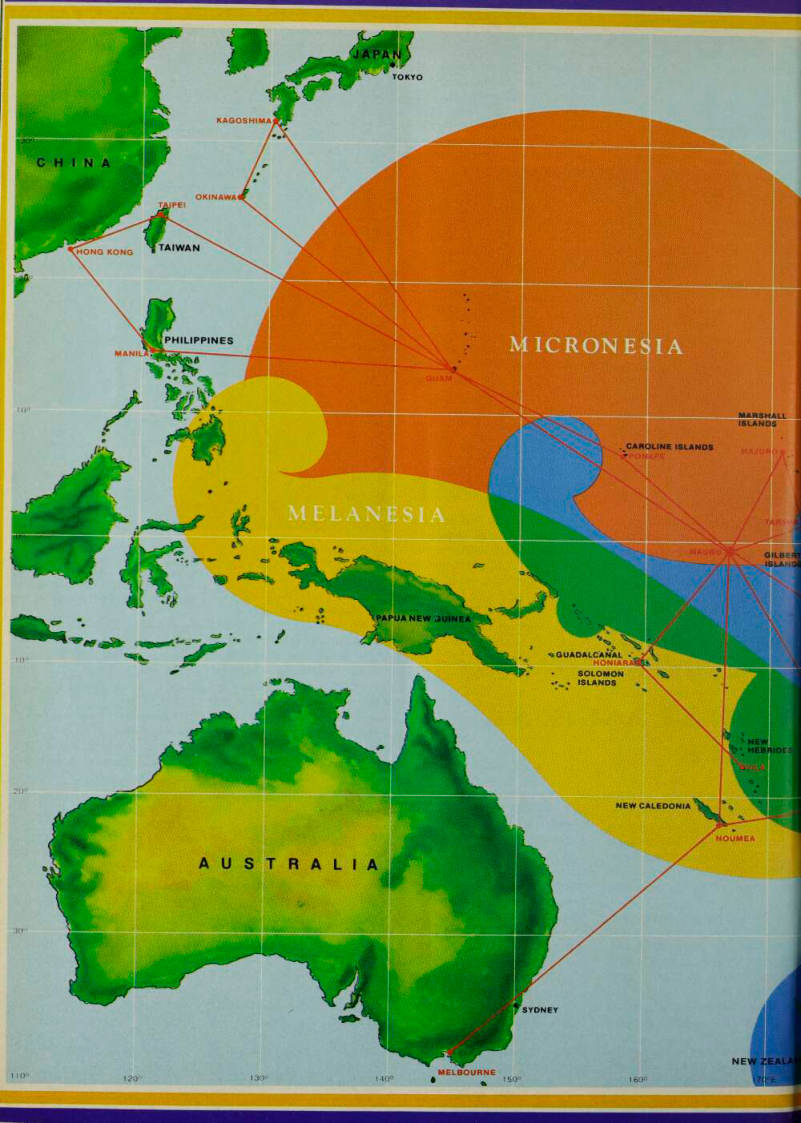
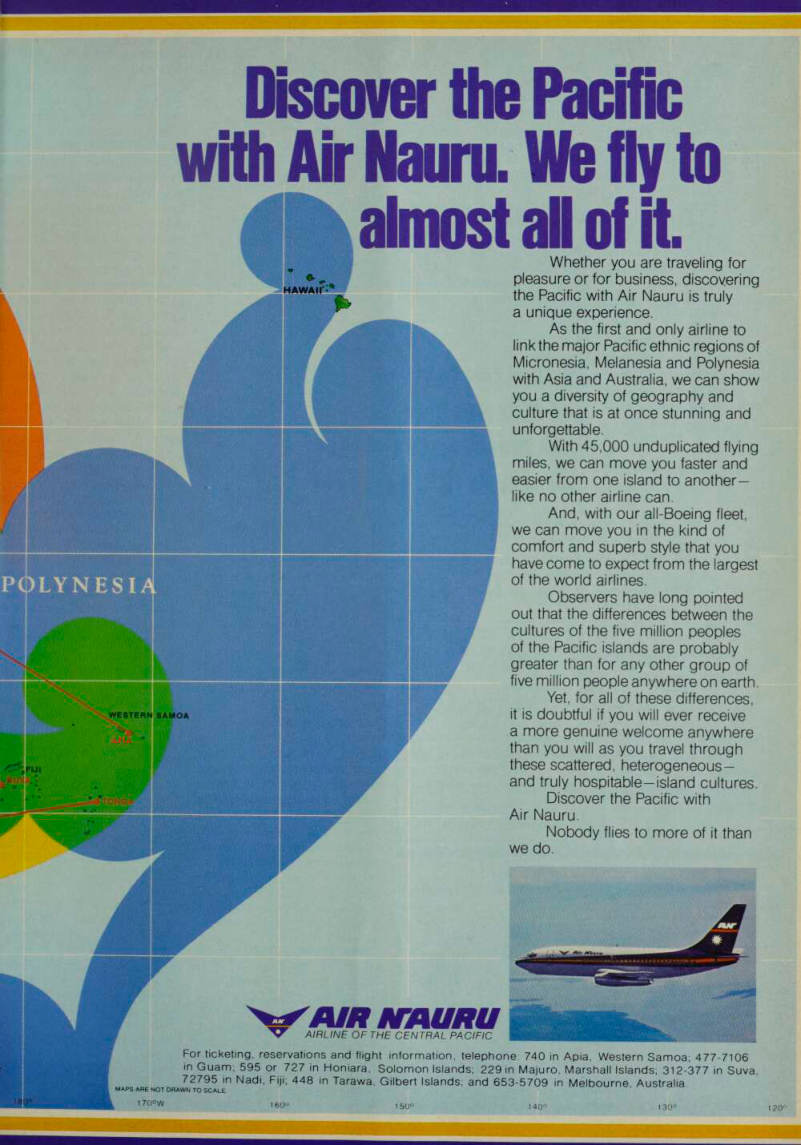
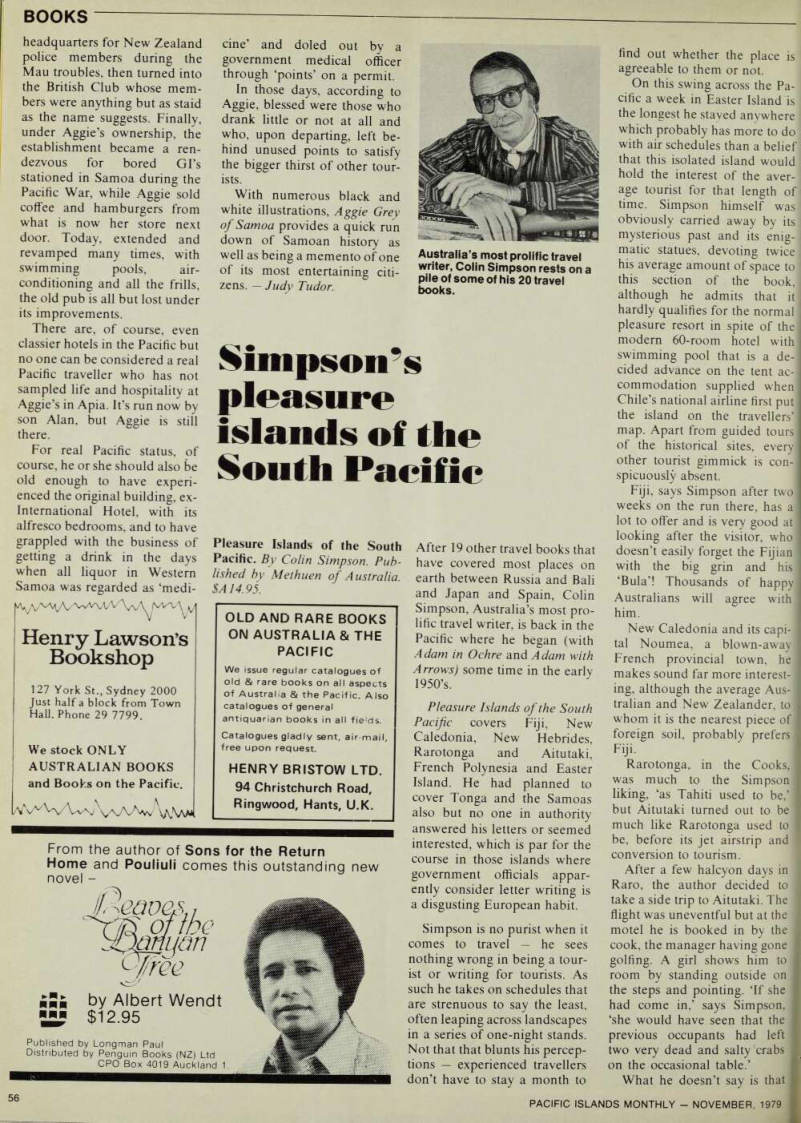
Place
Vggie Grey of Samoa. By Mel on Eustis. Published by Hobby r nvestments, Adelaide. Paper back, $A 3.95. A vail able through
°lM’s Mail Order Bookshop,
3ox 3408 GPO Sydney at >A 4.50 or SUSS.SO posted.
Although screeds have been vritten and published about he backwardness and/or poli ics of Melanesia, and further creeds about the glamour and omance islands of Tahiti and dawaii, not much can be found n print about Western Jamoa.
This is strange in view of the act that Western Samoa had
ome stirring history including
what, in these days, would be called Freedom Fighters the members of the underground movement called the Mau.
The Samoan Mau was unique in the South Pacific in that while most former colonial territories in the region were content to let independence be imposed upon them from above when and as it suited their former administrators, the Western Samoans were prepared to fight for theirs.
It is even more remarkable that the Mau had its beginning as far back as the early years of this century, under German administration, then went underground for some years
and reached its full strength in the late 1920’s and 1930’s when Western Samoa was adminis tered by New Zealand as a C class Mandated Territory.
It was a period of truculence and non-cooperation on the part of the Samoans and ham handed bureaucracy on the part of the administrators. It ended in bloodshed and the exile or banishment of some of Samoa’s best-known citizens. If
anything similar had happened
in Papua New Guinea, 57 varieties of academics would have already sprung into print about it, all in the sacred quest for PhD’s.
An account of the Mau movement, now all but forgot ten by present generations, is one of many incidental pieces of history that appear in Aggie
Grey of Samoa.
Aggie, the best-known hotel keeper in the South Pacific and probably the first of her pro fession in the world to have her portrait on a postage stamp (it happened in 1971) had nothing to do with the Mau, but the period of her life she is now in her 80’s spans pretty well the modem or European period of Samoa. Although the
book is called her biography, it is more correctly a short history of Samoa during the last cen tury, using Aggie and her family as convenient pegs on which to hang it.
Aggie’s father was William J.
Swann, son of an English fam ily which settled in Fiji in 1867 to open a chemist shop in the then capital, Levuka. William also trained as a chemist and
eventually opened his own
pharmacy in Apia, Western
Samoa, in 1889. Two years later he married Pele, a local girl who bore him three daugh
ters, Maggie, Aggie and Mary,
before she died at the early age of 31.
Nothing much that hap
pened from that date, either to members of the Swann family or to Samoa, escapes mention by author Eustis, including full documentation of the various stages of Aggie’s Hotel which had begun life as the Inter national Hotel, on a different site, last century.
Much later it became the
One of the nicest photographs of Aggie on record is this one taken a few years ago in Western Samoa with Fiji’s Prime Minister Ratu Sir Kamisese Mara.
headquarters for New Zealand
police members during the
Mau troubles, then turned into the British Club whose mem bers were anything but as staid as the name suggests. Finally,
under Aggie’s ownership, the
establishment became a ren dezvous for bored Gl’s stationed in Samoa during the Pacific War, while Aggie sold coffee and hamburgers from what is now her store next door. Today, extended and revamped many times, with swimming pools, air conditioning and all the frills, the old pub is all but lost under
its improvements.
There are, of course, even classier hotels in the Pacific but no one can be considered a real Pacific traveller who has not sampled life and hospitality at Aggie’s in Apia. It’s run now by son Alan, but Aggie is still there.
For real Pacific status, of course, he or she should also be old enough to have experi enced the original building, ex- Intemational Hotel, with its alfresco bedrooms, and to have grappled with the business of getting a drink in the days when all liquor in Western Samoa was regarded as ‘medi
cine’ and doled out by a government medical officer through ‘points’ on a permit.
In those days, according to Aggie, blessed were those who drank little or not at all and who, upon departing, left be hind unused points to satisfy the bigger thirst of other tour ists.
With numerous black and white illustrations, Aggie Grey of Samoa provides a quick run down of Samoan history as well as being a memento of one of its most entertaining citi
zens.
Judy Tudor.
Advertisements & other items, pp. 53-56 (2 items)
Books
53
’ACIFIC ISLANDS MONTHLY NOVEMBER, 1979
<Japan )
: ; p
TOKYO
KAGOSHIMA
CHINA
OKINAWA
TAIPEi
m
TAIWAN
KONG
J W f
i PHILIPPINES
t(l
MANILA?
r w, .
CA
NE ISLANDS
V Jf. r. \ <*> \e\~~ i 4 tf--
PUA NEW GUINEA S
v c? - t
GUADALCANAL
HONIAR
SOLOMON
„ . ISLANDS
NEW CALEDONIA
NOUMEA
AUSTRALIA
J
SYDNEY
NE
MELBOURNE
• 150°
Discover the Pacific
with Air Naum We fly to
almost al of it
V WESTERN
SAMOA
APIA
r Whether you are traveling for pleasure or for business, discovering the Pacific with Air Nauru is truly a unique experience.
As the first and only airline to link the major Pacific ethnic regions of Micronesia, Melanesia and Polynesia with Asia and Australia, we can show you a diversity of geography and culture that is at once stunning and unforgettable.
With 45,000 unduplicated flying miles, we can move you faster and easier from one island to anotherlike no other airline can.
And, with our all-Boeing fleet, we can move you in the kind of comfort and superb style that you have come to expect from the largest of the world airlines.
Observers have long pointed out that the differences between the cultures of the five million peoples of the Pacific islands are probably greater than for any other group of five million people anywhere on earth.
Yet, for all of these differences, it is doubtful if you will ever receive a more genuine welcome anywhere than you will as you travel through these scattered, heterogeneous— and truly hospitable-island cultures.
Discover the Pacific with Air Nauru.
Nobody flies to more of it than we do.
V/Wfl
V AIRLINE OF THE CENTRAL PACIFIC
For ticketing, reservations and flight information, telephone: 740 in Apia. Western Samoa; 477-7106 in Guam; 595 or 727 in Honiara, Solomon Islands; 229 in Majuro. Marshall Islands; 312-377 in Suva, 72795 in Nadi, Fiji; 448 in Tarawa, Gilbert Islands; and 653-5709 in Melbourne. Australia
MAPS ARE NOT DRAWN TO SCALE
OLD AND RARE BOOKS
ON AUSTRALIA & THE
PACIFIC
We issue regular catalogues of old & rare books on all aspects of Australia & the Pacific. Also catalogues of general antiquarian books in all fie ! ds.
Catalogues gladly sent, air mail, free upon request.
HENRY BRISTOW LTD.
94 Christchurch Road,
Ringwood, Hants, U.K.
Henry Lawson’s
Bookshop
127 York St., Sydney 2000 Just half a block from Town Hall. Phone 29 7799.
We stock ONLY
AUSTRALIAN BOOKS
and Books on the Pacific.
From the author of Sons for the Return Home and Pouliuli comes this outstanding new novel - ■ ■■ mmn
Reaves.
o
anmn
by Albert Wendt $12.95 Published by Longman Paul Distributed by Penguin Books (NZ) Ltd CPO Box 4019 Auckland 1
Simpson’s
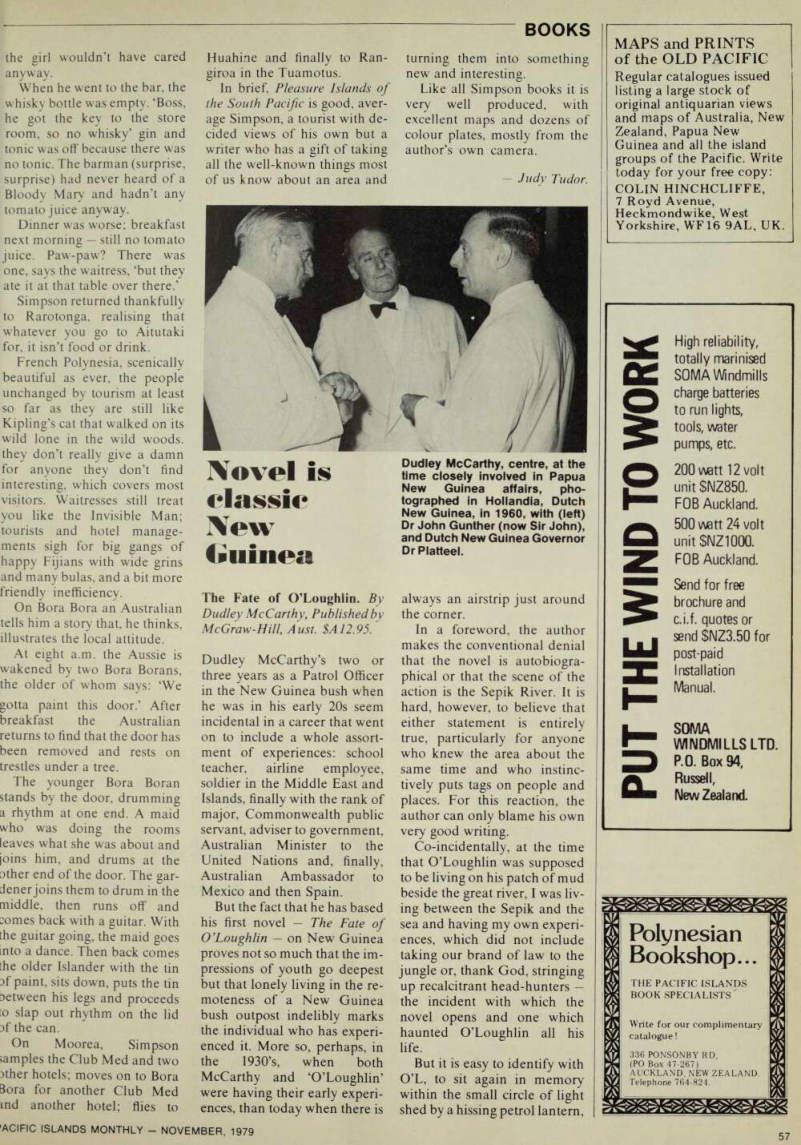
pleasure islands of the South Pacific
Pleasure Islands of the South Pacific. By Colin Simpson. Pub lished by Methuen of Australia. $A 14.95.
After 19 other travel books that have covered most places on earth between Russia and Bali and Japan and Spain, Colin Simpson, Australia’s most pro lific travel writer, is back in the Pacific where he began (with Adam in Ochre and Adam with Arrows) some time in the early 1950’5.
Pleasure Islands of the South
Pacific covers Fiji, New
Caledonia, New Hebrides, Rarotonga and Aitutaki, French Polynesia and Easter Island. He had planned to cover Tonga and the Samoas also but no one in authority answered his letters or seemed interested, which is par for the course in those islands where government officials appar ently consider letter writing is
a disgusting European habit.
Simpson is no purist when it comes to travel he sees nothing wrong in being a tour ist or writing for tourists. As such he takes on schedules that are strenuous to say the least,
often leaping across landscapes
in a series of one-night stands.
Not that that blunts his percep tions experienced travellers don’t have to stay a month to
find out whether the place is agreeable to them or not.
On this swing across the Pa cific a week in Easter Island is the longest he stayed anywhere which probably has more to do with air schedules than a belief that this isolated island would hold the interest of the aver age tourist for that length of time. Simpson himself was obviously carried away by its mysterious past and its enig matic statues, devoting twice his average amount of space to this section of the book, although he admits that it hardly qualifies for the normal pleasure resort in spite of the modem 60-room hotel with swimming pool that is a de cided advance on the tent ac-j commodation supplied when Chile’s national airline first put the island on the travellers’! map. Apart from guided tours of the historical sites, every other tourist gimmick is con-1
spicuously absent.
Fiji, says Simpson after two]
weeks on the run there, has a lot to offer and is very good at looking after the visitor, who]
doesn’t easily forget the Fijian I
with the big grin and his ‘Bula’! Thousands of happy] Australians will agree with ] him.
New Caledonia and its capi tal Noumea, a blown-awayl French provincial town, he makes sound far more interest-j
ing, although the average Aus-1
tralian and New Zealander, to I whom it is the nearest piece of
foreign soil, probably prefers!
Fiji.
Rarotonga, in the Cooks, I was much to the Simpson I liking, ‘as Tahiti used to be,’ I but Aitutaki turned out to be I much like Rarotonga used to I be, before its jet airstrip and conversion to tourism.
After a few halcyon days in j Raro, the author decided to j take a side trip to Aitutaki. The j flight was uneventful but at the I motel he is booked in by the j cook, the manager having gone I golfing. A girl shows him to I room by standing outside on I the steps and pointing. Tf she I had come in,’ says Simpson, ‘she would have seen that the I previous occupants had left I two very dead and salty crabs I on the occasional table.’
What he doesn’t say is that ft
Australia’s most prolific travel writer, Colin Simpson rests on a pile of some of his 20 travel books.
the girl wouldn’t have cared anyway.
When he went to the bar, the whisky bottle was empty. ‘Boss, he got the key to the store room, so no whisky’ gin and tonic was off because there was no tonic. The barman (surprise, surprise) had never heard of a Bloody Mary and hadn’t any tomato juice anyway.
Dinner was worse; breakfast next morning still no tomato
juice. Paw-paw? There was
one, says the waitress, ‘but they ate it at that table over there.’
Simpson returned thankfully
to Rarotonga, realising that whatever you go to Aitutaki for, it isn’t food or drink.
French Polynesia, scenically
beautiful as ever, the people unchanged by tourism at least so far as they are still like Kipling’s cat that walked on its wild lone in the wild woods, they don’t really give a damn for anyone they don’t find interesting, which covers most visitors. Waitresses still treat you like the Invisible Man; tourists and hotel manage ments sigh for big gangs of happy Fijians with wide grins and many bulas, and a bit more
friendly inefficiency.
On Bora Bora an Australian tells him a story that, he thinks, illustrates the local attitude.
At eight a.m. the Aussie is wakened by two Bora Borans, the older of whom says: ‘We gotta paint this door.’ After breakfast the Australian returns to find that the door has been removed and rests on trestles under a tree.
The younger Bora Boran
stands by the door, drumming
a rhythm at one end. A maid who was doing the rooms leaves what she was about and joins him, and drums at the Dther end of the door. The gar dener joins them to drum in the middle, then runs off and :omes back with a guitar. With
the guitar going, the maid goes
mto a dance. Then back comes the older Islander with the tin Df paint, sits down, puts the tin Detween his legs and proceeds to slap out rhythm on the lid t)f the can.
On Moorea, Simpson samples the Club Med and two Dther hotels; moves on to Bora Bora for another Club Med md another hotel; flies to
Huahine and finally to Ran giroa in the Tuamotus.
In brief, Pleasure Islands of the South Pacific is good, aver age Simpson, a tourist with de cided views of his own but a writer who has a gift of taking all the well-known things most of us know about an area and
turning them into something
new and interesting.
Like all Simpson books it is very well produced, with excellent maps and dozens of colour plates, mostly from the author’s own camera.
Judy Tudor.
Guinea
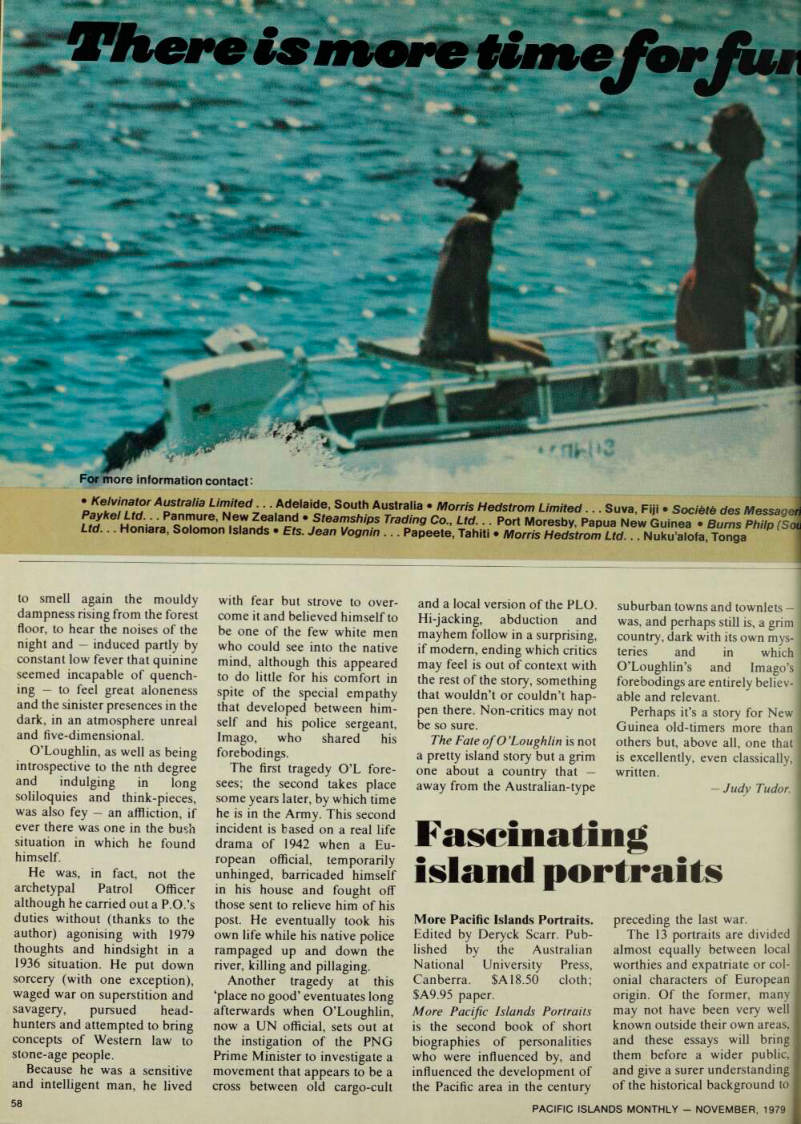
Novel is classic New Guinea
The Fate of O’Loughlin. By
Dudley McCarthy, Published by
McGraw-Hill, Aust. $A 12.95.
Dudley McCarthy’s two or
three years as a Patrol Officer in the New Guinea bush when he was in his early 20s seem incidental in a career that went on to include a whole assort ment of experiences: school teacher, airline employee, soldier in the Middle East and Islands, finally with the rank of
major, Commonwealth public
servant, adviser to government, Australian Minister to the United Nations and, finally, Australian Ambassador to Mexico and then Spain.
But the fact that he has based his first novel The Fate of O’Loughlin on New Guinea proves not so much that the im
pressions of youth go deepest
but that lonely living in the re moteness of a New Guinea bush outpost indelibly marks the individual who has experi enced it. More so, perhaps, in the 1930’5, when both
McCarthy and ‘O’Loughlin’
were having their early experi
ences, than today when there is
always an airstrip just around
the comer.
In a foreword, the author makes the conventional denial that the novel is autobiogra phical or that the scene of the action is the Sepik River. It is hard, however, to believe that either statement is entirely true, particularly for anyone who knew the area about the same time and who instinc tively puts tags on people and places. For this reaction, the author can only blame his own
very good writing.
Co-incidentally, at the time
that O’Loughlin was supposed
to be living on his patch of mud beside the great river, I was liv ing between the Sepik and the sea and having my own experi ences, which did not include taking our brand of law to the jungle or, thank God, stringing up recalcitrant head-hunters the incident with which the novel opens and one which haunted O’Loughlin all his life.
But it is easy to identify with O’L, to sit again in memory within the small circle of light
shed by a hissing petrol lantern,
Dudley McCarthy, centre, at the time closely involved in Papua New Guinea affairs, pho tographed in Hollandia, Dutch New Guinea, in 1960, with (left) Dr John Gunther (now Sir John), and Dutch New Guinea Governor Dr Platteel.
to smell again the mouldy dampness rising from the forest floor, to hear the noises of the night and - induced partly by constant low fever that quinine seemed incapable of quenching - to feel great aloneness and the sinister presences in the dark, in an atmosphere unreal and five-dimensional.
O’Loughlin, as well as being introspective to the nth degree
and indulging in long
soliloquies and think-pieces,
was also fey an affliction, if ever there was one in the bush situation in which he found himself.
He was, in fact, not the archetypal Patrol Officer although he carried out a P.O.’s duties without (thanks to the author) agonising with 1979 thoughts and hindsight in a 1936 situation. He put down sorcery (with one exception), waged war on superstition and savagery, pursued headhunters and attempted to bring concepts of Western law to stone-age people.
Because he was a sensitive and intelligent man, he lived
with fear but strove to over come it and believed himself to be one of the few white men who could see into the native
mind, although this appeared
to do little for his comfort in
spite of the special empathy
that developed between him self and his police sergeant, Imago, who shared his
forebodings,
The first tragedy O’L fore sees; the second takes place some years later, by which time he is in the Army. This second incident is based on a real life drama of 1942 when a Eu ropean official, temporarily unhinged, barricaded himself in his house and fought off those sent to relieve him of his post. He eventually took his own life while his native police rampaged up and down the
river, killing and pillaging,
Another tragedy at this
‘place no good’ eventuates long
afterwards when O’Loughlin, now a UN official, sets out at the instigation of the PNG Prime Minister to investigate a movement that appears to be a cross between old cargo-cult
and a local version of the PLO.
Hi-jacking, abduction and mayhem follow in a surprising, if modem, ending which critics may feel is out of context with the rest of the story, something that wouldn’t or couldn’t hap pen there. Non-critics may not be so sure.
The Fate of O’Loughlin is not a pretty island story but a grim one about a country that away from the Australian-type
suburban towns and townlets was, and perhaps still is, a grim country, dark with its own mys teries and in which O’Loughlin’s and Imago’s forebodings are entirely believ able and relevant.
Perhaps it’s a story for New Guinea old-timers more than others but, above all, one that
is excellently, even classically,
written.
Judy Tudor.
Advertisements & other items, pp. 57-59 (2 items)
Books
57
'ACIFIC ISLANDS MONTHLY - NOVEMBER, 1979
Bookshop...
MAPS and PRINTS
of the OLD PACIFIC Regular catalogues issued listing a large stock of original antiquarian views and maps of Australia, New Zealand, Papua New Guinea and all the island groups of the Pacific. Write today for your free copy:
COLIN HINCHCLIFFE,
7 Royd Avenue, Heckmondwike, West Yorkshire, WFI6 9AL, UK.
tc % o High reliability, totally marinised SOMA Windmills charge batteries to run lights, tools, water pumps, etc. 200 watt 12 volt unit SNZBSO.
FOB Auckland. 500 watt 24 volt unit SNZIOOO.
FOB Auckland.
Send for free brochure and c.i.f. quotes or send SNZ3.SO for post-paid Installation Manual.
SOMA
WINDMILLS LTD.
P.O. Box 94, Russell, New Zealand.
Polynesian
Bookshop...
THE PACIFIC ISLANDS
BOOK SPECIALISTS '
Write for our complimentary catalogue!
336 PONSONBY RD,
(PO Box 47-267)
AUCKLAND, NEW ZEALAND
Telephone 764-824.
7^ : Si muk i WM
j|B&l
i€# i BH For more information contact: • KeMnatO'/iusti-alia Limited. Adelaide, South Australia • Morris Hedstrom Limited ... Suva, Fiji. Societe des Messaae, rr e HTniarasTmon,:i 2 H?! a pf/ Steamship Trading Co., Ltd... Port Moresby, Papua New Guinea f Ltd. . Honiara, Solomon Islands • Ets. Jean Vognm ... Papeete, Tahiti • Morris Hedstrom Ltd... Nukualofa, Tonga
Refrigerators, Freezers, Gas and Electric Ranges, Air Conditioners, Automatic Washers and Dryers, Wringer Washers, Humidifiers, Dehumidifiers, Water Coolers, Commercial Air Conditioners and Refrigeration.
SB*. ’3L
LEONARD
whiles Neo-Caledoniennes ... Noumea, New Caledonia • New Hebrides Motors Ltd... Port-Vila, New Hebrides • Fisher & 'ompany ... Pago Pago, American Samoa • Morris Hedstrom Limited ... Apia, Western Samoa • Security Electrical Co.,
Fascinating
island portraits
More Pacific Islands Portraits.
Edited by Deryck Scan - . Published by the Australian National University Press, Canberra. $A 18.50 cloth; $A9.95 paper.
More Pacific Islands Portraits is the second book of short
biographies of personalities
who were influenced by, and influenced the development of the Pacific area in the century
preceding the last war.
The 13 portraits are divided almost equally between local worthies and expatriate or col onial characters of European origin. Of the former, many may not have been very well known outside their own areas, and these essays will bring them before a wider public, and give a surer understanding of the historical background to
day’s territories.
All the biographies illustrate s reaction of individuals to
2 dynamic situations which
Dse in the interplay of newly troduced factors, colonial, re ;ious, political and commer il. Some resisted, passively or lively, some played off one wer or religious sect against other, and some soon iployed the new ideas of mmerce to their personal vantage.
In all the varying geographi l areas certain local lividuals reached promi nce or notoriety, such as the
lisilines in the Loyalty
ands, the Nanpei family in •nape, Apolosi in Fiji. The tivities of these and many
iers changed the history of
2se areas and so also the
entual route to indepen
nce.
Most of the personalities of iropean origin represented in is book are well known and jendary names, but these Jays add flesh to the bones, d the figures which emerge i not always recognisable as
the persons we had thought them to be. Arthur Grimble now appears as a frustrated academic, a difficult man both to his superiors and his inferiors, and although we had become to suspect as much from the recent disclosures at the Banaban trial in London, he certainly was not the urbane figure we mentally built up whilst listening to him reading his stories on the BBC 25 years ago. Possibly by then he had been mellowed by a transfer to the Caribbean and a knight hood.
Being the man on the spot changed the lives of many of these expatriates. Stevenson, seeking health, became in volved in Samoan politics, both local and international; Wood ford, chasing butterflies, emerged as a reluctant admin istrator in the Solomons, and Thurston, a bare-footed cast away on Rotuma, the defender of Fijians, became High Com missioner of the Western Pa cific, Governor of Fiji and grand panjandrum of the South Seas.’
But perhaps the most enig matic of this collection of
exceptionally individualistic
personalities is St. Julian. A man of confusingly obscure origins who became a success ful journalist in Australia with a long-standing interest in Pa cific territories, he left a secure job in Australia, relatively late in life, to accept the offer of Chief Justice and Chancellor of Fiji, notwithstanding that he was completely bereft of any
formal legal training. His
appointment ended with Ces sion, and on his final exit from the scene he had only his Hawaiian knighthood and a
compassionate pension
which he did not live to draw to show for his work.
These monographs by vari
ous authors are a fascinating addition to our knowledge of the men who influenced the Pacific at a time when it was
evolving rapidly under the
impact of the Eurcpean, and this slim volume is worthy of its dedication to the late Pro fessor Jim Davidson, of the ANU. Well printed, and with
extensive bibliographies, it is of that high standard of scholar ship that we have learned to expect from the ANU’s
Department of Pacific History.
It would have been nice to have
had the lily gilded with photo
graphs or drawings of these influential and colourful per
sonalities.
Leonard Good -
man.
The late Professor Jim David son, first Professor of Pacific History at the Australian National University, to whom ‘More Pacific Island Portraits’ is dedicated.
Advertisements & other items, p. 59 (1 item)
59
CIFIC ISLANDS MONTHLY - NOVEMBER, 1979
Islands
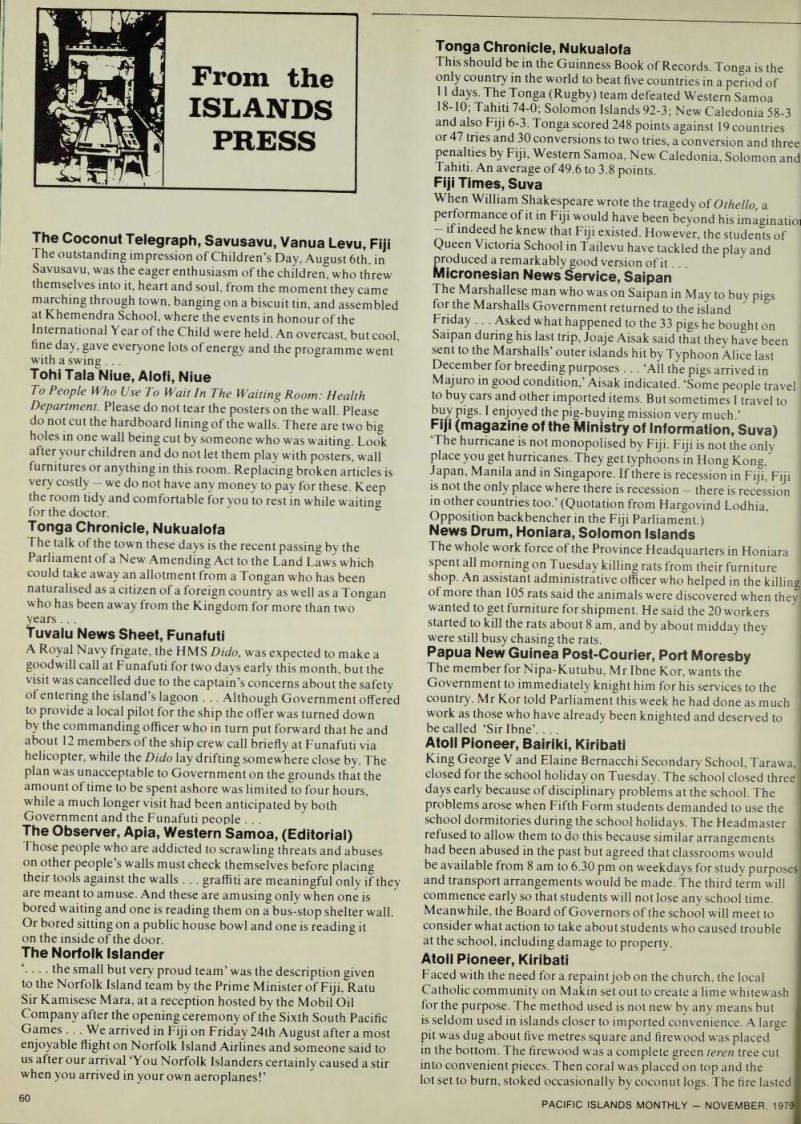
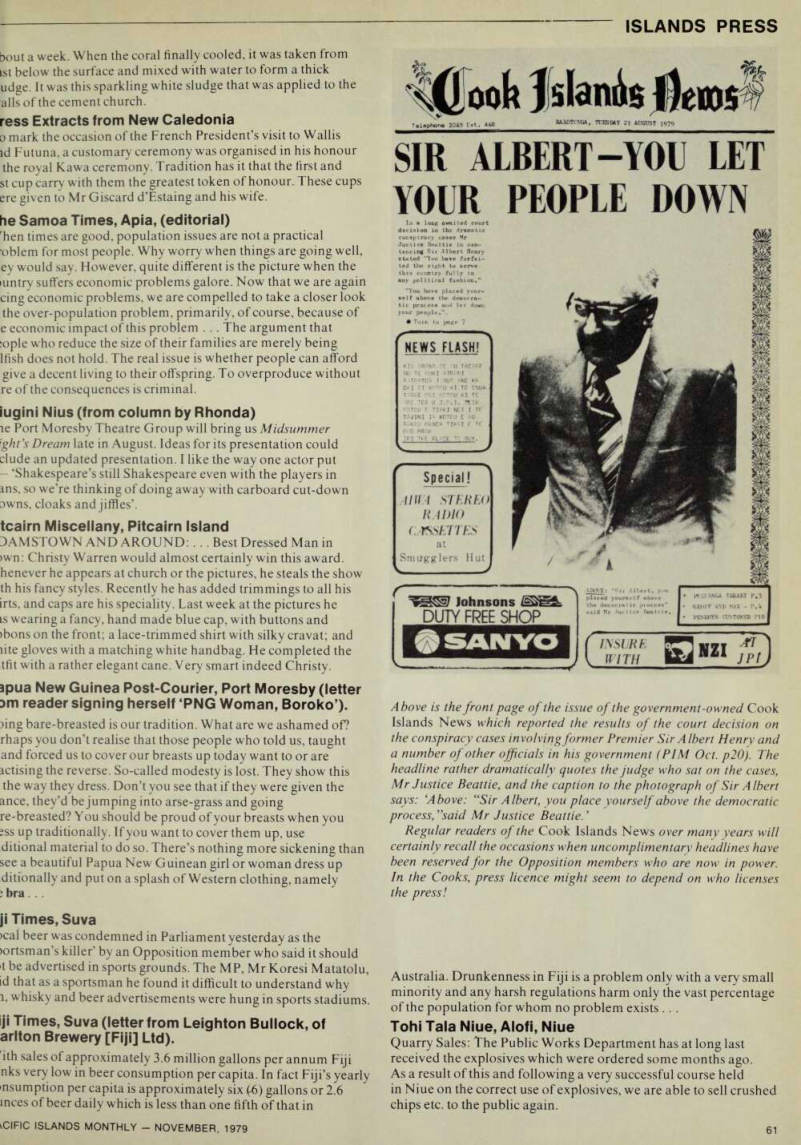
From the
Press
The Coconut Telegraph, Savusavu, Vanua Levu, Fiji The outstanding impression of Children’s Day, August 6th, in Savusavu, was the eager enthusiasm of the children, who threw themselves into it, heart and soul, from the moment they came marching through town, banging on a biscuit tin, and assembled at Khemendra School, where the events in honour of the International Year of the Child were held. An overcast, but cool, fine day, gave everyone lots of energy and the programme went with a swing ...
Tohi Tala Niue, Alofi, Niue To People Who Use To Wait In The Waiting Room: Health Department. Please do not tear the posters on the wall. Please do not cut the hardboard lining of the walls. There are two big holes in one wall being cut by someone who was waiting. Look after your children and do not let them play with posters, wall furnitures or anything in this room. Replacing broken articles is very costly we do not have any money to pay for these. Keep the room tidy and comfortable for you to rest in while waiting for the doctor.
Tonga Chronicle, Nukualofa
The talk of the town these days is the recent passing by the Parliament of a New Amending Act to the Land Laws which could take away an allotment from a Tongan who has been naturalised as a citizen of a foreign country as well as a Tongan who has been away from the Kingdom for more than two years ...
Tuvalu News Sheet, Funafuti
A Royal Navy frigate, the HMS Dido, was expected to make a goodwill call at Funafuti for two days early this month, but the visit was cancelled due to the captain’s concerns about the safety of entering the island’s lagoon . . . Although Government offered to provide a local pilot for the ship the offer was turned down by the commanding officer who in turn put forward that he and about 12 members of the ship crew call briefly at Funafuti via helicopter, while the Dido lay drifting somewhere close by. The plan was unacceptable to Government on the grounds that the amount of time to be spent ashore was limited to four hours, while a much longer visit had been anticipated by both Government and the Funafuti people .. .
The Observer, Apia, Western Samoa, (Editorial)
Those people who are addicted to scrawling threats and abuses on other people’s walls must check themselves before placing their tools against the walls ... graffiti are meaningful only if they are meant to amuse. And these are amusing only when one is bored waiting and one is reading them on a bus-stop shelter wall.
Or bored sitting on a public house bowl and one is reading it on the inside of the door.
The Norfolk Islander ... the small but very proud team’ was the description given to the Norfolk Island team by the Prime Minister of Fiji, Ratu Sir Kamisese Mara, at a reception hosted by the Mobil Oil Company after the opening ceremony of the Sixth South Pacific Games . . . We arrived in Fiji on Friday 24th August after a most enjoyable flight on Norfolk Island Airlines and someone said to us after our arrival ‘You Norfolk Islanders certainly caused a stir when you arrived in your own aeroplanes! ’
Tonga Chronicle, Nukualofa
This should be in the Guinness Book of Records. Tonga is the only country in the world to beat five countries in a period of 11 days. The Tonga (Rugby) team defeated Western Samoa 18-10; Tahiti 74-0; Solomon Islands 92-3; New Caledonia 58-3 and also Fiji 6-3. Tonga scored 248 points against 19 countries or 47 tries and 30 conversions to two tries, a conversion and three penalties by Fiji, Western Samoa, New Caledonia, Solomon and Tahiti. An average of 49.6 to 3.8 points.
Fiji Times, Suva
When William Shakespeare wrote the tragedy of Othello, a performance of it in Fiji would have been beyond his imaginatioi - if indeed he knew that Fiji existed. However, the students of Queen Victoria School in Tailevu have tackled the play and produced a remarkably good version of it.
Micronesian News Service, Saipan
The Marshallese man who was on Saipan in May to buy pigs for the Marshalls Government returned to the island Friday .. . Asked what happened to the 33 pigs he bought on Saipan during his last trip, Joaje Aisak said that they have been sent to the Marshalls’ outer islands hit by Typhoon Alice last December for breeding purposes... ‘All the pigs arrived in Majuro in good condition,’ Aisak indicated. ‘Some people travel 1 to buy cars and other imported items. But sometimes I travel to buy pigs. I enjoyed the pig-buying mission very much.’
Fiji (magazine of the Ministry of Information, Suva) The hurricane is not monopolised by Fiji. Fiji is not the only place you get hurricanes. They get typhoons in Hong Kong, Japan, Manila and in Singapore. If there is recession in Fiji, Fiji is not the only place where there is recession - there is recession m other countries too.’ (Quotation from Hargovind Lodhia, Opposition backbencher in the Fiji Parliament.) News Drum, Honiara, Solomon Islands The whole work force of the Province Headquarters in Honiara spent all morning on Tuesday killing rats from their furniture shop. An assistant administrative officer who helped in the killing of more than 105 rats said the animals were discovered when they wanted to get furniture for shipment. He said the 20 workers started to kill the rats about 8 am, and by about midday they were still busy chasing the rats.
Papua New Guinea Post-Courier, Port Moresby
The member for Nipa-Kutubu, Mr Ibne Kor, wants the Government to immediately knight him for his services to the country. Mr Kor told Parliament this week he had done as much work as those who have already been knighted and deserved to be called ‘Sir Ibne’...
Atoll Pioneer, Bairiki, Kiribati
King George V and Elaine Bernacchi Secondary School, Tarawa, dosea for the school holiday on Tuesday. The school closed three days early because of disciplinary problems at the school. The problems arose when Fifth Form students demanded to use the I school dormitories during the school holidays. The Headmaster I refused to allow them to do this because similar arrangements had been abused in the past but agreed that classrooms would be available from 8 am to 6.30 pm on weekdays for study purposes and transport arrangements would be made. The third term will commence early so that students will not lose any school time.
Meanwhile, the Board of Governors of the school will meet to consider what action to take about students who caused trouble at the school, including damage to property.
Atoll Pioneer, Kiribati Faced with the need for a repaint job on the church, the local Catholic community on Makin set out to create a lime whitewash for the purpose. The method used is not new by any means but is seldom used in islands closer to imported convenience. A large j pit was dug about five metres square and firewood was placed in the bottom. The firewood was a complete green teren tree cut into convenient pieces. Then coral was placed on top and the lot set to burn, stoked occasionally by coconut logs. The fire lasted
bout a week. When the coral finally cooled, it was taken from ist below the surface and mixed with water to form a thick udge. It was this sparkling white sludge that was applied to the alls of the cement church, ress Extracts from New Caledonia 0 mark the occasion of the French President’s visit to Wallis id Futuna, a customary ceremony was organised in his honour the royal Kawa ceremony. Tradition has it that the first and st cup carry with them the greatest token of honour. These cups ere given to Mr Giscard d’Estaing and his wife.
he Samoa Times, Apia, (editorial)
r hen times are good, population issues are not a practical oblem for most people. Why worry when things are going well, ey would say. However, quite different is the picture when the iuntry suffers economic problems galore. Now that we are again cing economic problems, we are compelled to take a closer look the over-population problem, primarily, of course, because of e economic impact of this problem . . . The argument that ;ople who reduce the size of their families are merely being Ifish does not hold. The real issue is whether people can afford give a decent living to their offspring. To overproduce without re of the consequences is criminal.
iugini Nius (from column by Rhonda)
ie Port Moresby Theatre Group will bring us Midsummer ght’s Dream late in August. Ideas for its presentation could elude an updated presentation. I like the way one actor put ‘Shakespeare’s still Shakespeare even with the players in ms, so we’re thinking of doing away with carboard cut-down
awns, cloaks and jiffies’.
tcairn Miscellany, Pitcairn Island 3AMSTOWN AND AROUND:.. . Best Dressed Man in >wn: Christy Warren would almost certainly win this award, henever he appears at church or the pictures, he steals the show th his fancy styles. Recently he has added trimmings to all his irts, and caps are his speciality. Last week at the pictures he is wearing a fancy, hand made blue cap, with buttons and )bons on the front; a lace-trimmed shirt with silky cravat; and lite gloves with a matching white handbag. He completed the tfit with a rather elegant cane. Very smart indeed Christy. apua New Guinea Post-Courier, Port Moresby (letter 3m reader signing herself ‘PNG Woman, Boroko’). fing bare-breasted is our tradition. What are we ashamed of? rhaps you don’t realise that those people who told us, taught and forced us to cover our breasts up today want to or are actising the reverse. So-called modesty is lost. They show this the way they dress. Don’t you see that if they were given the ance, they’d be jumping into arse-grass and going re-breasted? You should be proud of your breasts when you iss up traditionally. If you want to cover them up, use ditional material to do so. There’s nothing more sickening than see a beautiful Papua New Guinean girl or woman dress up ditionally and put on a splash of Western clothing, namely ; bra . . .
ji Times, Suva
>cal beer was condemned in Parliament yesterday as the >ortsman’s killer’ by an Opposition member who said it should 1 be advertised in sports grounds. The MP, Mr Koresi Matatolu, id that as a sportsman he found it difficult to understand why i, whisky and beer advertisements were hung in sports stadiums. ji Times, Suva (letter from Leighton Bullock, of
arlton Brewery [Fiji] Ltd).
ith sales of approximately 3.6 million gallons per annum Fiji nks very low in beer consumption per capita. In fact Fiji’s yearly •nsumption per capita is approximately six (6) gallons or 2.6 mces of beer daily which is less than one fifth of that in
Above is the front page of the issue of the government-owned Cook Islands News which reported the results of the court decision on the conspiracy cases involving former Premier Sir Albert Henry and a number of other officials in his government (PIM Oct. p2O). The headline rather dramatically quotes the judge who sat on the cases, Mr Justice Beattie, and the caption to the photograph of Sir A Ibert says: ‘Above: “Sir Albert, you place yourself above the democratic process, ’’said Mr Justice Beattie. ’
Regular readers of the Cook Islands News over many years will certainly recall the occasions when uncomplimentary headlines have been reserved for the Opposition members who are now in power.
In the Cooks, press licence might seem to depend on who licenses
the press!
Australia. Drunkenness in Fiji is a problem only with a very small minority and any harsh regulations harm only the vast percentage of the population for whom no problem exists ...
Tohi Tala Niue, Alofi, Niue Quarry Sales: The Public Works Department has at long last received the explosives which were ordered some months ago.
As a result of this and following a very successful course held in Niue on the correct use of explosives, we are able to sell crushed
chips etc. to the public again.
Advertisements & other items, pp. 61-63 (2 items)
Islands Press
61
kCIFIC ISLANDS MONTHLY NOVEMBER, 1979
Ypercoiik)
M 9m mmmmm mmm
THE AUDIBLE EDGE
■ -- ' " 09^ c %C: r c? •j i h % mm m w ELECTRIC CO., LTD. 144 1- • Australia VAN FI (Aust.) Pty. Ltd. 162. Albert Road, South Melbourne. Victoria 3205, Australia Phone 699-5473/28-' Phone; 929-0293 • F///Prabhu Brothers Ltd. P.O. Box 183. Nadi Phone; 70183/4 • Papua New Guinea Oceania Port Moresby Phone; PM 256406 e New Zealand David Reid Electronics Ltd. C.P.O. Box 2630, Auckland, i Phone; tuvi-H, Dom Kiv K, BP ' I*?, 3, Noumea Phone: 27 5a 11 • South Pad*: Miltons Department Stores Limited P 0 Box 1 46, Norfolk Society Republic of Nauru e New Hebrides The Sound Centre P.O. Box 434, Port Villa Cook Island United Island Traders Ltd. P.O.
Fhe secret behind ollFbK cunru quality is
‘in-depth matching”!
f\ih SUPER COMPO, Sansui the hi-fi specialist now lakes its professional expertise available to all music ivers. All seven systems feature “in-depth matching” >r exceptional purity of sound. Easy operation also received high priority. Equally nice, there’s just the right
quality system for every budget.
New SUPER COMPO offers the best values in stereo systems of outstanding musicality. Listen and believe!
Fhe most practical receiver system with a low distortion of 0.09% 40W x 2, IHF Music Power).
Fhe same cassette deck as used in the most expensive system is included.
This receiver system features higher power (70W x 2, IHF Music Power), Peak Power Level Displays and precision auto-return direct drive turntable. *- i i The top- of-the-line DC- Servo receiver system with reserves of clean power (100 W x 2, IHF Music Power), Peak Power Level Displays with 12x2 LED indicators, and the best fully automatic DD turntable incorporating D-O-B tonearm and computerized operation. * \ fine system which ncorporates Sansui’s DC-Servo amplifier (70W x 2, IHF Music ? ower) with Peak Power level Displays and a matching FM/ \M tuner with LED signal/tune
iisplays.
The most
powerful amplifier (100 W x 2,
IHF Music Power) and the Digitally Quartz-Locked tuner with a computerized directdrive turntable and D-O-B tonearm make this system highly desirable to both audio- This is the top-of-the-line system even the internal illuminated cabinet has its own deluxe touches. DC-Servo amplifier (100 W x 2, IHF Music Power), Digitally Quartz-Locked tuner and Full-Auto Quartzr An excellent choice in a complete system with low distortion integrated amplifier (40W x 2, IHF Music Power), quality FM/AM stereo tuner, precision-made tape deck and precision auto-return turntable.
Matching speakers. Wide-
range quality speakers systems
are available to fully realize the fine features of SUPER COMPO systems.
Audio Cabinets. Each SUPER COMPO system comes with its own audio cabinet specially designed to accommodate the
system’s components.
Also available in silver finish.
Soltls^lL
Anlitkifi iaa fa
Milne Bay - The Place
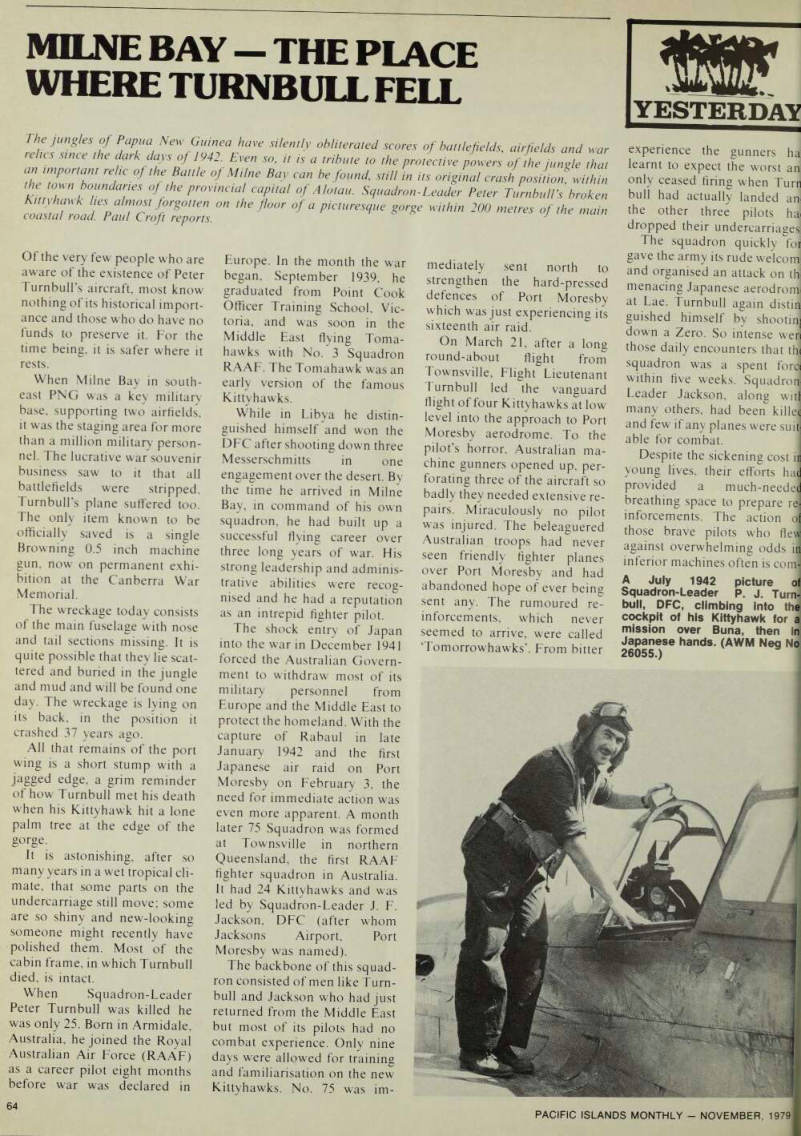
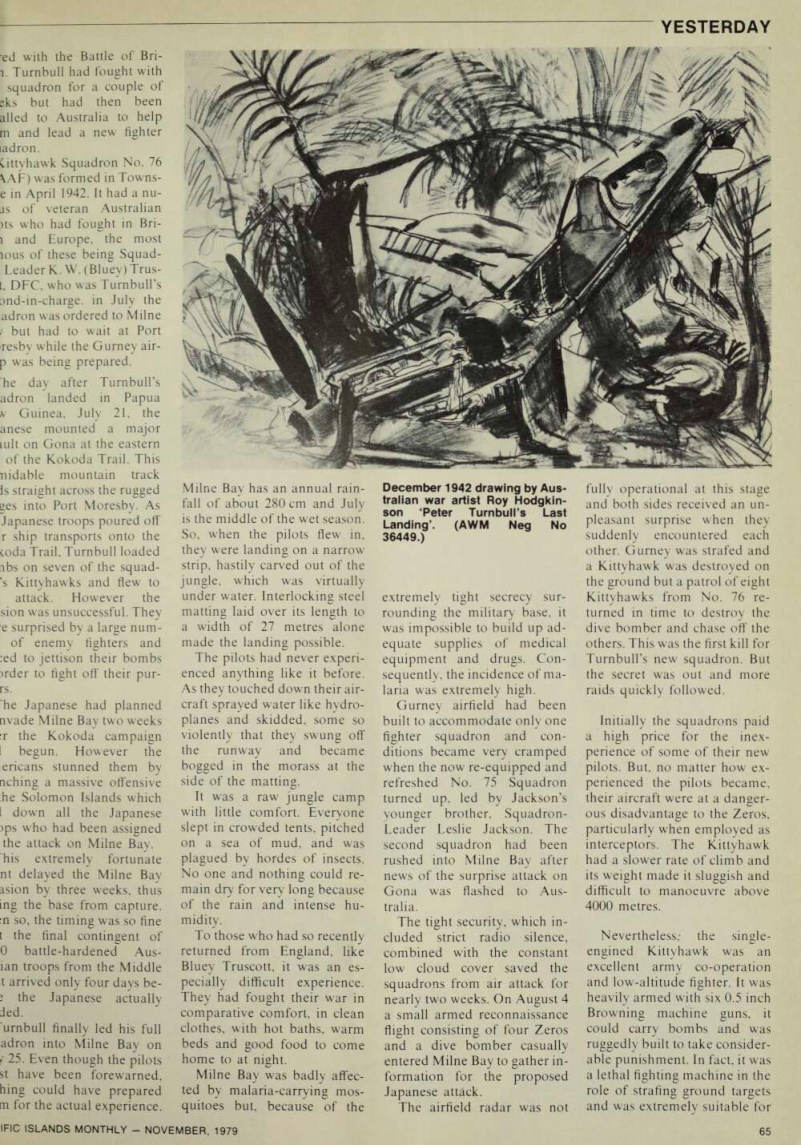
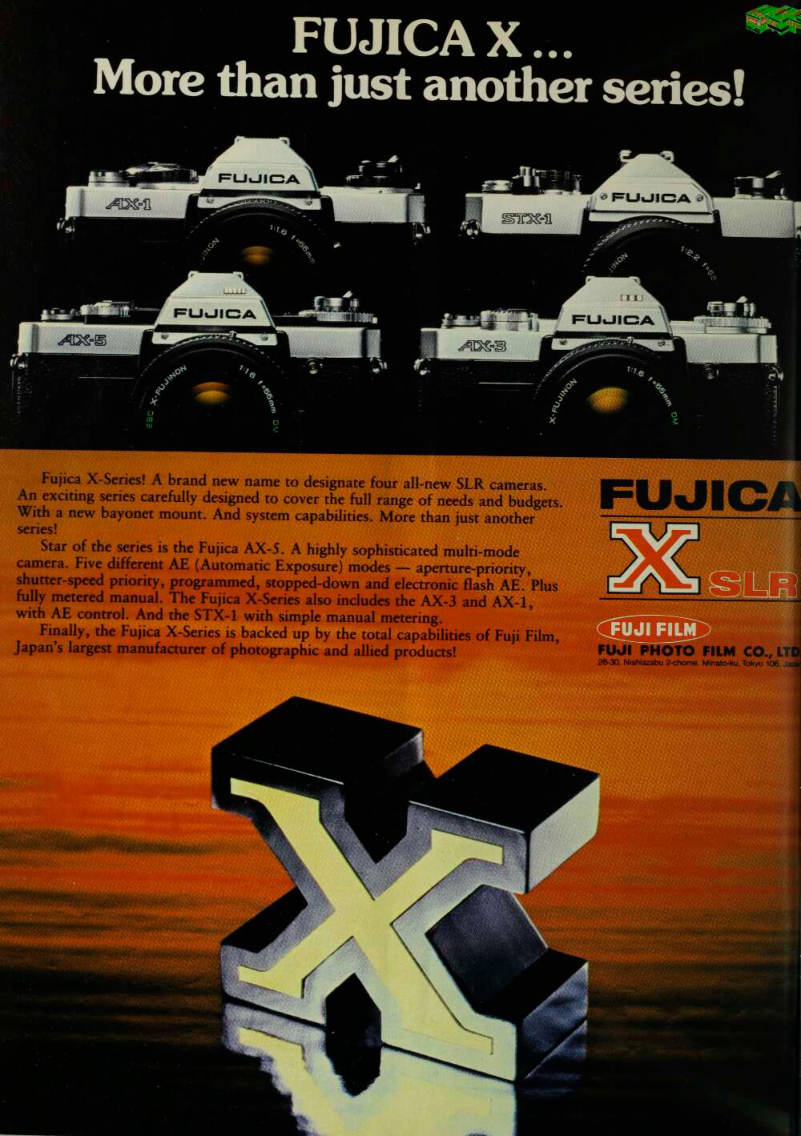
Yesterday
Where Turnbull Fell
The jungles of Papua New Guinea have silently obliterated scores of battlefields, airfields and war re ICS since the dark days of 1942. Even so, it is a tribute to the protective powers of the Jungle that ,he'7n h relic of the Battle of Milne Bay can be found, still in its original crash position, within J of the provincial capita / of Alotau. Squadron-Leader Peter Turnbull's broken Kittyhawk lies almost forgotten on the floor of a picturesque gorge within 200 metres of the main coastal road Paul Croft reports. J
Of the very few people who are aware of the existence of Peter Turnbull’s aircraft, most know nothing of its historical import ance and those who do have no funds to preserve it. For the time being, it is safer where it rests.
When Milne Bay in south east PNG was a key military base, supporting two airfields, it was the staging area for more than a million military person nel. The lucrative war souvenir business saw to it that all battlefields were stripped.
Turnbull’s plane suffered too.
The only item known to be officially saved is a single Browning 0.5 inch machine gun, now on permanent exhi bition at the Canberra War Memorial.
The wreckage today consists
of the main fuselage with nose and tail sections missing. It is quite possible that they lie scat tered and buried in the jungle and mud and will be found one
day. The wreckage is lying on
its back, in the position it crashed 37 years ago.
All that remains of the port wing is a short stump with a jagged edge, a grim reminder of how Turnbull met his death when his Kittyhawk hit a lone palm tree at the edge of the gorge.
It is astonishing, after so many years in a wet tropical cli mate, that some parts on the undercarriage still move; some are so shiny and new-looking
someone might recently have
polished them. Most of the cabin frame, in which Turnbull died, is intact.
When Squadron-Leader
Peter Turnbull was killed he was only 25. Born in Armidale, Australia, he joined the Royal Australian Air Force (RAAF) as a career pilot eight months before war was declared in
Europe. In the month the war
began, September 1939, he
graduated from Point Cook Officer Training School. Vic toria, and was soon in the Middle East flying Toma hawks with No. 3 Squadron RAAF. The Tomahawk was an early version of the famous
Kittyhawks.
While in Libya he distin guished himself and won the DFC after shooting down three Messerschmitts in one engagement over the desert. By the time he arrived in Milne Bay, in command of his own squadron, he had built up a successful flying career over three long years of war. His strong leadership and adminis trative abilities were recog nised and he had a reputation as an intrepid fighter pilot.
The shock entry of Japan into the war in December 1941 forced the Australian Govern ment to withdraw most of its military personnel from Europe and the Middle East to protect the homeland. With the capture of Rabaul in late January 1942 and the first Japanese air raid on Port Moresby on February 3. the need for immediate action was even more apparent. A month later 75 Squadron was formed at Townsville in northern Queensland, the first RAAF fighter squadron in Australia.
It had 24 Kittyhawks and was led by Squadron-Leader J. F.
Jackson, DFC (after whom Jacksons Airport, Port Moresby was named).
The backbone of this squad ron consisted of men like Turn bull and Jackson who had just returned from the Middle East but most of its pilots had no combat experience. Only nine days were allowed for training and familiarisation on the new Kittyhawks. No. 75 was im
mediately sent north to strengthen the hard-pressed defences of Port Moresby which was just experiencing its sixteenth air raid.
On March 21. after a long round-about flight from Townsville, Flight Lieutenant Turnbull led the vanguard flight of four Kittyhawks at low level into the approach to Port Moresby aerodrome. To the pilot’s horror. Australian ma chine gunners opened up, per forating three of the aircraft so badly they needed extensive re pairs. Miraculously no pilot
was injured. The beleaguered
Australian troops had never seen friendly fighter planes over Port Moresby and had abandoned hope of ever being sent any. The rumoured re inforcements, which never seemed to arrive, were called ‘Tomorrowhawks’. From bitter
experience the gunners hJ learnt to expect the worst an only ceased firing when Turn bull had actually landed an the other three pilots haj
dropped their undercarriages
The squadron quickly for gave the army its rude welcom] and organised an attack on thl menacing Japanese aerodrom at Lae. Turnbull again distin guished himself by shootinj down a Zero. So intense wer those daily encounters that th squadron was a spent fore within five weeks. Squadron'
Leader Jackson, along witl
many others, had been killed and few if any planes were suit able for combat.
Despite the sickening cost in young lives, their efforts had provided a much-needea breathing space to prepare rel inforcements. The action o those brave pilots who flevJ against overwhelming odds in inferior machines often is corn]
A July 1942 picture of Squadron-Leader P. j. Turn bull, DFC, climbing into the cockpit of his Kittyhawk for a mission over Buna, then in Japanese hands. (AWM Neg No 26055.)
■ed with the Battle of Bri i. Turnbull had fought with squadron for a couple of sks but had then been ailed to Australia to help m and lead a new fighter ladron.
Cittyhawk Squadron No. 76
\AF) was formed in Towns e in April 1942. It had a nu ns of veteran Australian )ts who had fought in Bri i and Europe, the most
ious of these being Squad-
Leader K. W. (Bluey) Trus t. DEC, who was Turnbull’s
and-in-charge. in July the
adron was ordered to Milne f but had to wait at Port resby while the Gurney air
p was being prepared.
he day after Turnbull’s adron landed in Papua v Guinea, July 21, the anese mounted a major lult on Gona at the eastern of the Kokoda Trail. This nidable mountain track
is straight across the rugged
ges into Port Moresby. As
Japanese troops poured off
r ship transports onto the coda Trail, Turnbull loaded lbs on seven of the squad ’s Kittyhawks and flew to attack. However the sion was unsuccessful. They e surprised by a large num of enemy fighters and :ed to jettison their bombs irder to fight off their pur rs.
he Japanese had planned
nvade Milne Bay two weeks
:r the Kokoda campaign
1 begun. However the
ericans stunned them by aching a massive offensive he Solomon Islands which I down all the Japanese ips who had been assigned the attack on Milne Bay. his extremely fortunate
nt delayed the Milne Bay
asion by three weeks, thus ing the base from capture, in so, the timing was so fine t the final contingent of 0 battle-hardened Aus ian troops from the Middle t arrived only four days be-
J the Japanese actually
Jed. urnbull finally led his full adron into Milne Bay on
/ 25. Even though the pilots
st have been forewarned, hing could have prepared m for the actual experience.
Milne Bay has an annual rain fall of about 280 cm and July is the middle of the wet season.
So, when the pilots flew in, they were landing on a narrow strip, hastily carved out of the
jungle, which was virtually
under water. Interlocking steel matting laid over its length to a width of 27 metres alone made the landing possible.
The pilots had never experi enced anything like it before.
As they touched down their air craft sprayed water like hydro planes and skidded, some so violently that they swung off the runway and became bogged in the morass at the side of the matting.
It was a raw jungle camp with little comfort. Everyone slept in crowded tents, pitched on a sea of mud, and was plagued by hordes of insects.
No one and nothing could re main dry for very long because of the rain and intense hu
midity.
To those who had so recently returned from England, like Bluey Truscott, it was an es
pecially difficult experience.
They had fought their war in comparative comfort, in clean clothes, with hot baths, warm beds and good food to come home to at night.
Milne Bay was badly affec
ted by malaria-carrying mos
quitoes but, because of the
extremely tight secrecy sur
rounding the military base, it was impossible to build up ad equate supplies of medical
equipment and drugs. Con
sequently, the incidence of ma
laria was extremely high.
Gurney airfield had been built to accommodate only one
fighter squadron and con
ditions became very cramped when the now re-equipped and refreshed No. 75 Squadron turned up, led by Jackson’s younger brother, Squadron- Leader Leslie Jackson. The second squadron had been rushed into Milne Bay after news of the surprise attack on Gona was flashed to Aus tralia.
The tight security, which in cluded strict radio silence, combined with the constant low cloud cover saved the squadrons from air attack for nearly two weeks. On August 4 a small armed reconnaissance flight consisting of four Zeros and a dive bomber casually entered Milne Bay to gather in formation for the proposed
Japanese attack.
The airfield radar was not
fully operational at this stage and both sides received an un
pleasant surprise when they
suddenly encountered each other. Gurney was strafed and a Kittyhawk was destroyed on the ground but a patrol of eight Kittyhawks from No. 76 re turned in time to destroy the dive bomber and chase off the others. This was the first kill for Turnbull’s new squadron. But the secret was out and more raids quickly followed.
Initially the squadrons paid
a high price for the inex perience of some of their new pilots. But, no matter how ex
perienced the pilots became,
their aircraft were at a danger ous disadvantage to the Zeros,
particularly when employed as
interceptors. The Kittyhawk
had a slower rate of climb and its weight made it sluggish and difficult to manoeuvre above 4000 metres.
Nevertheless; the single
engined Kittyhawk was an
excellent army co-operation and low-altitude fighter. It was heavily armed with six 0.5 inch Browning machine guns, it could carry bombs and was ruggedly built to take consider able punishment. In fact, it was a lethal fighting machine in the role of strafing ground targets and was extremely suitable for
December 1942 drawing by Aus tralian war artist Roy Hodgkin son Peter Turnbull’s Last Landing’. (AWM Neg No 36449.)
e vital role it played in the :tory at Milne Bay.
Eight days before the
panese landed the Allies had ;en forewarned of the attack,
lis remarkable piece of
telligence was possible
rough the work of ingenious merican technicians who had cretly broken the famous irple Code, the highest code ‘ the Japanese Government, ansequently, a flight of Hud ns, long range armed recon ussance aircraft, arrived on
ugust 23 and immediately
;gan patrolling out towards
e Trobriand Islands in search
‘ the expected Japanese land
g fleet. On August 25 their forts were rewarded when e large Japanese convoy was
rotted speeding towards
fine Bay. No help could be :pected from the American avy which was already ;avily committed in the >lomon Islands.
All afternoon the air force ied to find the convoy. Nine
merican Flying Fortresses
id flown up from Australia at could not locate it through e thick cloud cover. How ler, as night drew closer the mvoy finally came into range
the waiting Kittyhawks
hich had been loaded up with Dmbs.
Turnbull led the last and ost successful attack. Swoop ig in to little more than mast sight through a storm of
iti-aircraft fire, his squadron
dentlessly bombed and rafed the convoy. The attack ;sulted in a corvette being ink and two other vessels amaged. Machine gun fire died and wounded many oops crowded on the ships’ ecks.
Turnbull led his squadron ack to base in complete dark ess.
Behind them the Japanese anvoy entered Milne Bay and
egan unloading troops and
quipment on a deserted beach n the northern arm of the bay. hey were undefeated warriors ith a fearsome reputation and n enthusiasm born from an nbroken string of victories on
md. But they had gravely
nderestimated the strength of te Allies at Milne Bay and 'ere landing on the wrong each, an area surrounded by
swamps and a long way from Gurney, their objective.
As a light-hearted gesture of determination, the men of 75 and 76 Squadrons vowed never to shave clean again until the battle had been won. 75 Squad ron vowed to shave only on the right side of the face and 76 Squadron the left.
The next couple of days
proved exhausting. Everyone
gave completely of themselves under extremely difficult con ditions. Few men in the squad rons slept as ground staff prepared the aircraft for battle.
Probably never before had a squadron been based so close to troops in action. The Kittyhawks were in effect air borne artillery, being over their targets within minutes after taking off.
At first light Turnbull led his
squadron off the water-logged
runway and scudded under the low ceiling of dense cloud to bomb and strafe the landing craft and supply dumps that the Japanese had put ashore
during the night. The deadly
strafing attack continued unmercifully as often as the aircraft could be refuelled and re-armed. By the end of the day the Japanese had suffered heavy losses from which they never really recovered.
During the night of August 26, the Australian troops were forced back from K.B. Mission (now a suburb of Alotau) and a new Japanese convoy arrived with reinforcements. The Japanese control over the local seas meant that no one knew whether a second attack would be launched from a completely new direction. The Japanese were now fighting at night and
resting during the day in order
to avoid the lethal strafing attacks of the Kittyhawks. The position looked serious and even greater efforts were re
quired.
Turnbull carried a frightful
responsibility. A shortage of
staff dictated that he must de vise and direct the operations for his squadron as well as fly them.
At first light on August 27 Turnbull raced his squadron into the air to repeat the pre vious days successes. He had only just returned from his first dawn raid when a very strange
incident stunned everyone into momentary bewilderment and disbelief. Out of the heavy clouds and low early morning
mists appeared eight Japanese
dive bombers escorted by 12 Zeros which had dropped into the Gurney landing circuit with their landing gear down. The
optimistic Japanese had
expected the attack to be mov ing on schedule and by this stage Gurney airstrip should have been captured.
As the moment of realisation dawned on both sides, all hell broke loose with the Japanese pilots diving to the attack and every gun on the ground open ing up at the low flying aircraft.
Turnbull raced to an anti aircraft gun at the edge of the runway and fought shoulder to shoulder with the gunners.
Luckily, Squadron Leader
Jackson’s Kittyhawks were still in the air and they returned to
help disperse the attackers.
This engagement lost the Japanese at least seven aircraft to the Allies’ two.
As the attackers disap
peared, Turnbull’s squadron
was quickly in the air. Their efforts forced the Japanese troops to retire and enable the Australians to retake the stra tegic K.B. Mission. So deter mined were the pilots that their guns belched 85 000 rounds during the course of the day’s feverish fighting. The barrels had worn smooth and widened from 0.5 to 0.6 inches, making them suitable only for strafing attacks.
Before the morning’s air raid one of Turnbull’s returning
pilots had spotted a Japanese
tank bogged in a creek east of K. B. Mission. This creek runs through a short jungle gorge into Sandersons Bay, a pic turesque inlet on the north coast of Milne Bay. It is now used as the small boat harbour for Alotau. The Japanese had landed with two light tanks which were causing havoc among the poorly-equipped Australian troops in the front line. However, by the time the pilot could return to attack the tank, it had been moved and hidden in the jungle. Despite a continuous search for the two tanks all day they remained undiscovered.
This situation was extremely
frustrating for the weary Turn bull who felt a personal re sponsibility to save the army from further harassment from these tanks. He reasoned that since the Japanese were only coming out at night he should make a final search before
nightfall.
Turnbull rushed his flight to K. B. Mission and began sweeping southward along the track, skimming low across the tops of palm trees at around 500 km an hour. Within min utes his aircraft had arrived at Sandersons Bay where a large body of Japanese troops were
spotted just emerging from the
gorge onto the main track.
Turnbull instinctively twisted his aircraft into a tight turn and swooped in over Cameron Pla teau where the Alotau hospital now stands. As the plateau forms one wall of the gorge this manoeuvre enabled Turnbull to obtain a clear line of fire down the ravine and onto the track.
As the Kittyhawk crested the edge of the plateau it was seen to strike a tall palm tree with the left wing. It then flipped on its back and plunged straight into the gorge. Within seconds
the crumpled wreckage had
been swallowed by the jungle.
It was more than a week before Turnbull’s body could be reached by the advancing Aus tralian troops who by then were very familiar with the legend of Peter Turnbull.
No one really knows how an
experienced pilot with Turn
bull’s reputation could make such an error of judgement.
One theory is that his aircraft was damaged by enemy fire.
However, most believe the ac cident was the result of excess stress on both man and ma chine.
In honour of Squadron Leader Peter Turnbull and in
recognition of the significant
contribution made by his pilots in the Battle of Milne Bay, the second airfield constructed at Milne Bay was called Turnbull Strip. It was at this partly con structed airfield that the
Japanese advance was finally
stopped and Milne Bay be came famous as the site of the first land defeat for the Japanese in the Second World War.
Advertisements & other items, pp. 65-67 (3 items)
Yesterday
65
IFIC ISLANDS MONTHLY - NOVEMBER, 1979
Fujica X...
More than just another series!
r i : . wmnimm mmmi s* f ,p» n
ggl
Fujica X-Senes! A brand new name to designate four all-new SLR cameras.
An exciting series carefully designed to cover the full range of needs and budgets.
With a new bayonet mount. And system capabilities. More than just another series!
Star of the series is the Fujica AX-5. A highly sophisticated multi-mode camera. Five different AE (Automatic Exposure) modes aperture-priority, shutter-speed priority, programmed, stopped-down and electronic flash AE. Plus fully metered manual. The Fujica X-Series also includes the AX-3 and AX-1, with AE control. And the STX-1 with simple manual metering.
Finally, the Fujica X-Series is backed up by the total capabilities of Fuji Film, Japan’s largest manufacturer of photographic and allied products! -■'mam
FUJI PHOTO FILM CO., L7I
26-30. Nishiazabu 2-chome, Minato-ku, Tokyo 106, lIS lliisii i ii ■i ■ : mm. ... ' ■
Yesterday
67
ACIFIC ISLANDS MONTHLY - NOVEMBER, 1979
Australia-Pacific
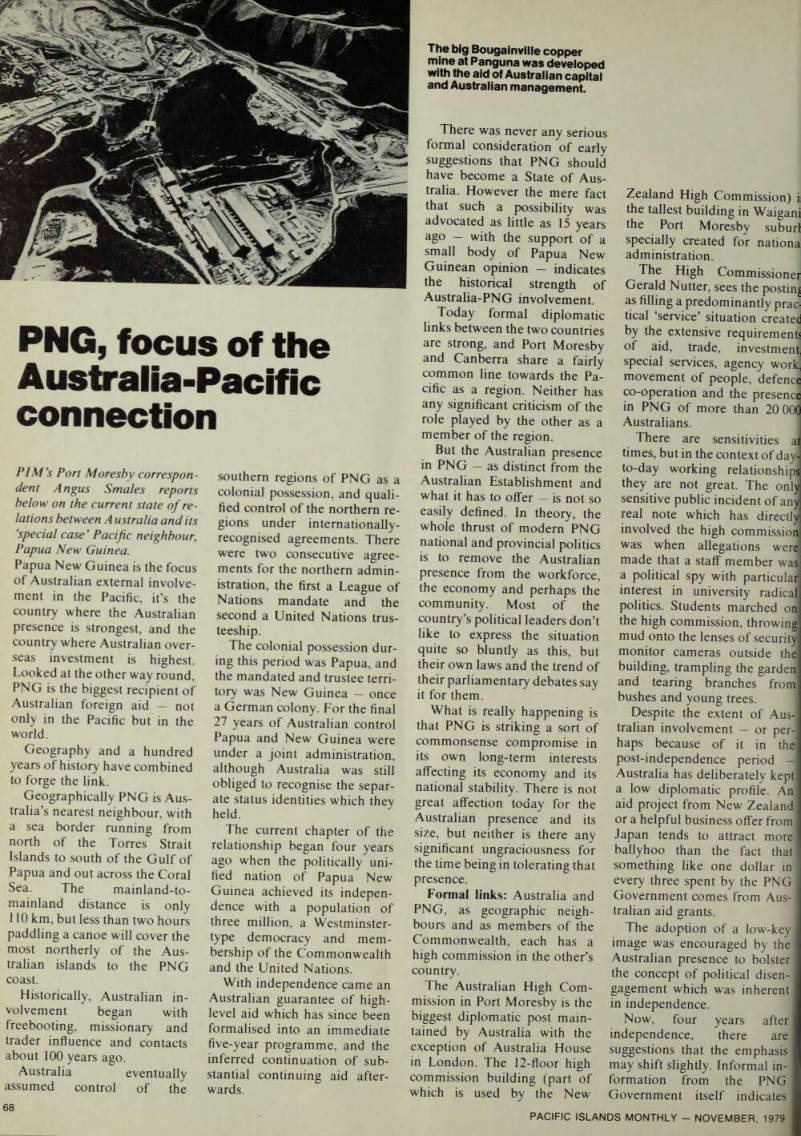

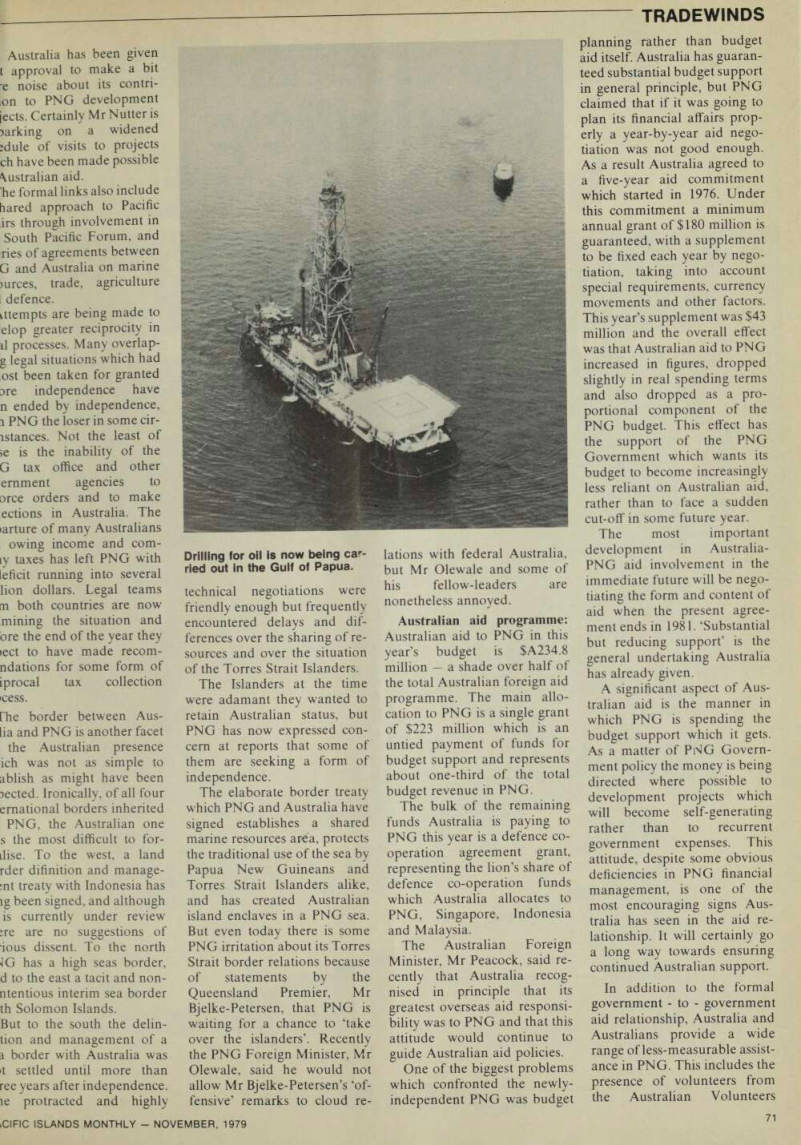
PNG, focus of the Australia-Pacific connection
PI M's Port Moresby correspon dent Angus Smales reports below on the current state of re lations between A ustralia and its • special case' Pacific neighbour, Papua New Guinea.
Papua New Guinea is the focus of Australian external involve ment in the Pacific, it’s the country where the Australian presence is strongest, and the country where Australian over seas investment is highest.
Looked at the other way round, PNG is the biggest recipient of Australian foreign aid not only in the Pacific but in the world.
Geography and a hundred years of history have combined to forge the link.
Geographically PNG is Aus tralia’s nearest neighbour, with a sea border running from north of the Torres Strait Islands to south of the Gulf of Papua and out across the Coral Sea. The mainland-to mainland distance is only 110 km, but less than two hours paddling a canoe will cover the most northerly of the Aus tralian islands to the PNG coast.
Historically, Australian in volvement began with
freebooting, missionary and
trader influence and contacts about 100 years ago.
Australia eventually
assumed control of the
southern regions of PNG as a colonial possession, and quali fied control of the northern re
gions under internationally
recognised agreements. There were two consecutive agree ments for the northern admin istration, the first a League of Nations mandate and the second a United Nations trus
teeship.
The colonial possession dur ing this period was Papua, and the mandated and trustee terri tory was New Guinea once a German colony. For the final 27 years of Australian control Papua and New Guinea were under a joint administration, although Australia was still obliged to recognise the separ ate status identities which they held.
The current chapter of the
relationship began four years
ago when the politically uni fied nation of Papua New Guinea achieved its indepen dence with a population of three million, a Westminster type democracy and mem bership of the Commonwealth and the United Nations.
With independence came an Australian guarantee of high level aid which has since been formalised into an immediate five-year programme, and the inferred continuation of sub stantial continuing aid after wards.
There was never any serious formal consideration of early suggestions that PNG should have become a State of Aus tralia. However the mere fact that such a possibility was advocated as little as 15 years ago with the support of a small body of Papua New Guinean opinion indicates the historical strength of Australia-PNG involvement.
Today formal diplomatic
links between the two countries are strong, and Port Moresby and Canberra share a fairly common line towards the Pa cific as a region. Neither has any significant criticism of the role played by the other as a member of the region.
But the Australian presence in PNG as distinct from the Australian Establishment and what it has to offer is not so easily defined. In theory, the whole thrust of modem PNG national and provincial politics is to remove the Australian presence from the workforce, the economy and perhaps the community. Most of the country’s political leaders don’t like to express the situation quite so bluntly as this, but their own laws and the trend of their parliamentary debates say it for them.
What is really happening is that PNG is striking a sort of commonsense compromise in its own long-term interests affecting its economy and its national stability. There is not great affection today for the Australian presence and its size, but neither is there any significant ungraciousness for the time being in tolerating that presence.
Formal links: Australia and PNG, as geographic neigh bours and as members of the Commonwealth, each has a high commission in the other’s country.
The Australian High Com mission in Port Moresby is the
biggest diplomatic post main
tained by Australia with the exception of Australia House in London. The 12-floor high commission building (part of which is used by the New
Zealand High Commission) i: the tallest building in Waigani the Port Moresby suburl specially created for nationa administration.
The High Commissioner Gerald Nutter, sees the posting as filling a predominantly prac tical ‘service’ situation created by the extensive requirements of aid, trade, investment; special services, agency work, movement of people, defence co-operation and the presence in PNG of more than 20 00(1 Australians.
There are sensitivities afl times, but in the context of day] to-day working relationships they are not great. The onld sensitive public incident of anJ real note which has directlJ involved the high commission was when allegations were made that a staff member was! a political spy with particular] interest in university radical! politics. Students marched on the high commission, throwing mud onto the lenses of security! monitor cameras outside the
building, trampling the garden!
and tearing branches from! bushes and young trees.
Despite the extent of Aus-I tralian involvement or per-l haps because of it in the! post-independence period -I Australia has deliberately kept I a low diplomatic profile. Anl aid project from New Zealand I or a helpful business offer from 1 Japan tends to attract morel ballyhoo than the fact that 1 something like one dollar in I every three spent by the PNG I Government comes from Aus-1 tralian aid grants.
The adoption of a low-key I image was encouraged by the I Australian presence to bolster I the concept of political disen-1 gagement which was inherent I in independence.
Now, four years after I independence, there are I suggestions that the emphasis I may shift slightly. Informal in- I formation from the PNG I Government itself indicates I
The big Bougainville copper mine at Panguna was developed with the aid of Australian capital and Australian management.
Australia has been given t approval to make a bit •e noise about its contri on to PNG development jects. Certainly Mr Nutter is marking on a widened xlule of visits to projects ch have been made possible \ustralian aid. he formal links also include
hared approach to Pacific
irs through involvement in South Pacific Forum, and ries of agreements between G and Australia on marine
mrces, trade, agriculture
defence. atempts are being made to elop greater reciprocity in il processes. Many overlap g legal situations which had ost been taken for granted
?re independence have
n ended by independence,
i PNG the loser in some cir istances. Not the least of >e is the inability of the G tax office and other emment agencies to orce orders and to make ections in Australia. The •arture of many Australians owing income and com iy taxes has left PNG with
ieficit running into several
lion dollars. Legal teams m both countries are now mining the situation and ore the end of the year they icct to have made recom ndations for some form of iprocal tax collection >cess. fhe border between Aus lia and PNG is another facet the Australian presence ich was not as simple to ablish as might have been aected. Ironically, of all four emational borders inherited PNG, the Australian one s the most difficult to for ilise. To the west, a land rder difinition and manage ;nt treaty with Indonesia has
ig been signed, and although
is currently under review ;re are no suggestions of ious dissent. To the north JG has a high seas border, d to the east a tacit and non ntentious interim sea border th Solomon Islands.
But to the south the delin tion and management of a a border with Australia was T settled until more than
ree years after independence,
le protracted and highly
technical negotiations were
friendly enough but frequently
encountered delays and dif ferences over the sharing of re sources and over the situation of the Torres Strait Islanders.
The Islanders at the time were adamant they wanted to retain Australian status, but PNG has now expressed con cern at reports that some of them are seeking a form of
independence.
The elaborate border treaty which PNG and Australia have signed establishes a shared marine resources arda, protects the traditional use of the sea by Papua New Guineans and Torres Strait Islanders alike, and has created Australian island enclaves in a PNG sea.
But even today there is some PNG irritation about its Torres Strait border relations because of statements by the Queensland Premier, Mr Bjelke-Petersen, that PNG is waiting for a chance to ‘take over the islanders’. Recently the PNG Foreign Minister, Mr Olewale, said he would not allow Mr Bjelke-Petersen’s ‘of fensive’ remarks to cloud re
lations with federal Australia, but Mr Olewale and some of his fellow-leaders are
nonetheless annoyed.
Australian aid programme: Australian aid to PNG in this year’s budget is $A234.8 million a shade over half of the total Australian foreign aid programme. The main allo cation to PNG is a single grant of $223 million which is an untied payment of funds for budget support and represents about one-third of the total budget revenue in PNG.
The bulk of the remaining funds Australia is paying to PNG this year is a defence co operation agreement grant, representing the lion’s share of defence co-operation funds which Australia allocates to PNG, Singapore, Indonesia and Malaysia.
The Australian Foreign Minister, Mr Peacock, said re cently that Australia recog nised in principle that its greatest overseas aid responsi bility was to PNG and that this attitude would continue to
guide Australian aid policies.
One of the biggest problems which confronted the newly independent PNG was budget
planning rather than budget
aid itself. Australia has guaran teed substantial budget support in general principle, but PNG claimed that if it was going to plan its financial affairs prop erly a year-by-year aid nego tiation was not good enough.
As a result Australia agreed to a five-year aid commitment which started in 1976. Under this commitment a minimum annual grant of $lBO million is
guaranteed, with a supplement
to be fixed each year by nego tiation, taking into account
special requirements, currency
movements and other factors.
This year’s supplement was $43 million and the overall effect was that Australian aid to PNG
increased in figures, dropped
slightly in real spending terms and also dropped as a pro portional component of the PNG budget. This effect has the support of the PNG Government which wants its
budget to become increasingly
less reliant on Australian aid, rather than to face a sudden cut-off in some future year.
The most important development in Australia- PNG aid involvement in the immediate future will be nego tiating the form and content of aid when the present agree ment ends in 1981. ‘Substantial but reducing support’ is the
general undertaking Australia
has already given.
A significant aspect of Aus tralian aid is the manner in which PNG is spending the budget support which it gets.
As a matter of PNG Govern ment policy the money is being directed where possible to
development projects which
will become self-generating rather than to recurrent government expenses. This attitude, despite some obvious deficiencies in PNG financial management, is one of the
most encouraging signs Aus
tralia has seen in the aid re lationship. It will certainly go a long way towards ensuring continued Australian support.
In addition to the formal government - to - government aid relationship, Australia and Australians provide a wide range of less-measurable assist ance in PNG. This includes the presence of volunteers from the Australian Volunteers
Drilling for oil Is now being ca-ried out In the Gulf of Papua.
>road scheme, and volunteer alth, education and technical >rkers in church missions, istralian community service ganisations also direct many their projects to PNG.
Defence: One of the stron st links in the Australia-PNG ationship today is in defence -operation, but this is also an ja where misunderstanding the Australian role can easily cur. Australia has no defence esence’ in PNG and has no fence or military treaty with 4G, but the two countries ve letters of understanding defence co-operation and is arrangement has a wide ect. Like all such arrange mts there are ultimate politi l considerations on both ies, but in essence the re ionship is a technical one.
Under the arrangement Aus ilia makes an annual defence -operation grant to PNG was about $lO million in the
;t budget helps train Papua
jw Guineans for their own fence force, provides access
equipment and expertise,
akes available the services of
illed Australian personnel,
d detaches some formed
.istralian units for specific
>ks (usually engineering) in
sIG.
PNG permits Australia to e its territory and facilities
r training exercises, an
(portunity taken particularly
r the RAAF for its Caribou
id Hercules squadrons. Re
ntly, too, there was a major
mbined infantry exercise in
vfG.
There are two main con lerations in the Australian iproach to defence co leration in PNG. One is the nple extension of aid which iplies to the entire PNG corn
unity under responsibilities
knowledged by successive
ustralian governments. The her is that Australia’s own ffence concepts are far better
rved by supporting a loyal
id efficient defence force in a
righbouring country than by
ly attempts to negotiate an
ustralian military sphere. As
result Australia extends
inds, general aid, personnel
id expertise to the PNG De uce Force but PNG calls ie tune and controls its own ffence affairs.
At present there are 247 Aus tralians in the PNG Defence Force, of whom 170 are on di rect loan from all three Aus tralian defence services. They cover a broad range of special
skills - engineers, signals
experts, pilots, technicians, ship’s company and medical and headquarters staff officers.
Many of them fill training roles, but not necessarily so.
The number of Australians in the PNG Defence Force is being gradually reduced as a matter of policy, but there is no target date to phase them out and specialists on short-term attachments are likely to be with the force for many years yet.
In addition there are 161 Papua New Guinean officers and men at Australian training establishments 109 Army, 29 RAAF and 23 RAN but be cause of what the PNG De fence Force calls ‘culture shock’ problems, it prefers to train as many of its men as
possible on home ground.
Investment: Australia re mains the biggest overseas investor in PNG, following the pattern set in pre independence times. The Aus tralian involvement is mainly direct investment, but it also provides a channel for the investment of some funds originating in other parts of the world. This occurs when inter
national companies use their Australian subsidiaries for
PNG expansion.
The nature of Australian investment covers every facet of service, manufacturing, business and commerce in PNG, and a declining share in
agriculture.
In the past 10 years as ac
curately as widely divergent re
cords and currency approximations allow the rate of Australian investment in PNG has been running at an average of $lO5 million a year.
Repatriated earnings on Aus
tralian investment were $6O million last year, but the
amount of capital generating
this figure is not available from current records.
The Australian investment pattern of the past 10 years in cluded two high-intensity periods the first in the very early 70s and the second quite recently. But it also included the year of self-government, 1973, and the year of indepen dence, 1975, when more Aus tralian capital was pulled out than was put in.
The total net loss of Aus tralian investment during those years was about $4O million, not a large figure in the overall pattern. However, it is a sig nificant indication of the some what mercurial attitude of Australian sources towards political and allied factors in PNG. This attitude runs
through the whole range of Australian involvement the investment market itself, the firms already established in PNG, the Australians who may have expertise as well as capital to offer, and the financial insti tutions.
Many of the current invest ment statistics, depending on their source, vary widely. This is because of differing defi nitions involving branch and subsidiary funds, the position of unremitted and undistribu ted profits, and the situation of Australian money controlled by permanent residents who are classified as financial tem poraries. One point is clear, however, and that is that Aus tralian investment attitudes in
particular are increasingly sen
sitive to PNG conditions and politics, and this in turn in the eyes of Australian investors is increasing the speculative com ponent of PNG investment.
Recent suggestions of attempted government inter ference in a court matter (although the matter was of a non-financial nature) affected at least one finely-balanced investment deal.
It is doubtful if this sensi
tivity is fully grasped by many
PNG leaders who say they are committed to encouraging external investment. There appears to be a belief that Aus tralian investors are clamour ing to get in or to hang on to
what they already have at any price. Australia is probably more sensitive than other coun tries to the PNG financial scene because of the earlier
long-standing association
when PNG politics were simply an extension of Aus tralian management and con ditions.
It is true that PNG contains good, continuing and new investment potential for Aus tralian capital, but certainly not at any price. The speculative issues are now high enough to dictate a raised threshold for
assessing viability. This situ
ation exists despite guarantees on the repatriation of earnings, on capital, and on non discrimination, which are extended to all approved investment enterprises.
Agriculture, once the back bone of Australian financial in volvement in PNG, is no longer a proposition for the investor from outside except for special major developments which are usually partnerships between government and a de veloper.
Plantation properties, many of them Australian soldier settler allocations in the 19205, are being acquired by the government for resale to PNG village communities. The Lands Minister, Mr Sali, told parliament recently that the government planned to have all plantations out of the hands of non-nationals within three years.
PNG is also expressing con cern that its private banking system, dominated by Aus tralian banking firms or their subsidiaries, is not sufficiently flexible. Some critics claim that even the nationally-owned PNG Banking Corporation is too much steeped in Australian concepts.
The government is expected to make an early announce ment for plans to establish an internationally - connected merchant banking company, although on present indi cations Australian interests will have a share of the proposed company.
Tourism: Just under 60% of all tourists flying to PNG are from Australia, not counting visitors from further overseas who come via Australia. This
amounts to about 12 000 visi tors a year - not a large num ber for a big island country right on the Australian door step.
In the accommodation andj travel industries, too, there’s some questioning of how many of these visitors should be classified as tourists in the strict I sense. Many of them are seen
more accurately as ‘short-terml
visitors’ coming to PNG be cause they have friends or rela-i fives already there.
Lack of uniformity in the mi- 1 gration and travel cards of the two countries also tends to ob scure the facts, although many of these statistical record prob lems are now being corrected. (Cruise ships bring 15 000 visitors from Australian ports and through PNG ports everyl year, but the ‘hullo and good bye’ nature of these visits is not the hard-core type of tourism] which PNG would like to] attract. In any event there are] indications that the cruise ship visits are producing a declining number of visitors as far as PNG is concerned.
A number of factors appear! to be discouraging a really high j level of Australian tourisn in: PNG, not the least of which is the psychological factor which says, ‘if you’re going overseas anyway, there’s not much point I in only going as far as your own front door’. More practical is I
the comparatively high cost of ;
air travel from Australia and on PNG internal routes. This is 1
heightened today by new I
cheaper fare structures on I
popular long-haul tourist I
routes which do not include
Png.
There is also some criticism I in the Australian travel indus- I try that Air Niugini, the PNG 1 national carrier, pays lip ser- ] vice to PNG tourism but is I unwilling to pay the ‘whole sale’ agency commissions offered by some airlines from other countries.
Whatever the reasons, many I PNG interests criticise Aus- j tralian agency interests for al
legedly not really trying hard to
sell the PNG tour. There are I tentative plans to increase pro motion in Australia.
Like investment but often ; with less reason PNG politi- j cal and social developments j
to have a significant t on tourist interest from alia. The so-called ‘state
icrgency’ proclaimed re-
in the PNG highlands to ) down on tribal warfare »ood case in point. The of emergency’ sounded lore dramatic than the ion it named and caused 3 in tourist interest. There probably be long-term its however because
ssness in the highlands,
being cleaned up, was iting the tourist industry
irely practical grounds.
ide: Australia is PNG’s st trade partner and the ice of trade runs strongly astralia’s {favour. Figures m put the value of Ausn exports to PNG at 5290 m, and the value of PNG rts to Australia at $6O )n odstuffs of all types. -
d, packaged, fresh and
n are a major part o f the alian export marked in , but the overall trade sts of a big range o f raw rials and manufactured
goods of all types ranging from clothing and stationery, through electrical and mechan ical equipment, to vehicles and machinery.
The vehicle market has suf fered heavy inroads at Japanese hands in the past six to eight years, but generally Australia has retained its PNG markets at constant or rising levels.
Despite the growth of
Japanese electronic equipment sales throughout the Pacific, Australia continues to provide a significant export to PNG of specialised electrical and elec tronic equipment and domestic
appliances,
Australian purchases from PNG are made up of cocoa, coffee, gold, timber and rub ber.
Existing terms of trade be tween the two countries are not complex, with Australia grant ing special export access to PNG products. Endorsed by successive governments, Aus tralia has given undertakings that PNG will continue to retain special access.
Png Freezes
Plantation
Take-Overs
Papua New Guinea has set a three-year target date to ac quire all plantation proper ties owned by non-citizens.
The properties are mainly owned by A ustralians, Australian-based companies and Chinese with Australian nationality. PI M's Port Moresby correspondent Angus Smales comments on the problems raised by the plan, and how they have led to a temporary freeze on its implementation.
About 80 plantation properties previously owned by non nationals of Papua New Guinea have been taken over by the government since the plantation acquisition scheme was established about the time of independence.
They have been sold to nationals individuals, com munity and village groups, companies either as going concerns, as nucleus-type
estates, or divided for smallholder use. The transfers from non-national interests have generally been trouble free, with the government showing a willingness to nego tiate where there has been dif ference of opinion over values.
The total number of proper ties to which the acquisition act could apply was estimated at 1200 when the scheme was first established. However, this is now being reviewed, and it is believed that 800 would have been a closer estimate. The confusion was caused by the fact that many properties con sist of up to four individual parcels of land, often
physically separated, and the
original estimate was based on the separate parcels rather than on properties as entities.
There is also some doubt now about whether the state ment by Lands Minister Boyamo Sali that all properties will have been acquired within three years will necessarily apply. The entire scheme has been frozen while a committee
eview looks at it and makes to cabinet. ; recommendations were »ected to be made early in vember. They were to take ) account land pressures, liable finances, statistics on
at has already been
ieved and the problems of king sure that management DK under the new national
nership.
V register of properties to
ich the act applies is also ng drawn up. 4any groups who have en over the first 80 proper ; have run into financial iblems, sometimes because an obvious lack of expertise, t sometimes claiming that previous owners let the )perties run down when time s running out. fhere is some political inion that in areas where id pressures are not urgent : retention of properly and rly run foreign-owned or sed properties is an advan ;e to an area.
Basic government policy is the acquisition of all
aperties not owned by
tionals, but the mechanics d time-scale of the process ; subject to continuing re ;w to suit general and scific circumstances.
N O.K. For
>K Tedi?
nal decisions by the consor im of mining companies on 2 multi-million-dollar Ok
:di copper project in Papua
New Guinea are expected by the end of November.
Senior executives of the companies met top PNG officials and politicians in Port Moresby in September to dis cuss PNG’s economic outlook and development strategy.
The consortium partners sent a delegation headed by the Sir James McNeill, chairman of Australia’s largest company, Broken Hill Proprietary, the president of AMOCO Min erals, Ray Ballmer, and direc tors of the German company,
Kupfer Exploration.
PNG Prime Minister Michael Somare told them at a dinner in their honour: ‘Know ing the potential effects of the project, and knowing that PNG is exploiting a non-renewable resource, the government has set out to make sure our country receives a fair bar
gain.’
The Ok Tedi project, if it goes ahead, will cost K5OO million. More than Kl 2 million has already been spent by the consortium on feasibility studies.
There will be a large cost to the PNG Government as well, Mr Somare said. ‘lf the govern ment takes up its entitlement to 20% equity in the project, that will involve a commitment of K 35 million.’
Guam Talks
On Energy
An energy technology work shop held on Guam in August- September is believed to have been the first time Trust Terri tory and Guam government officials have got together to pledge support for alternate energy research.
Participants included energy experts from the United States, Peace Corps officials, various governors, legislators and Trust
Territory officials.
Unable to attend due to pressure of other business, High Commissioner Adrian P.
Winkel had a speech read to the workshop which named solar, wind, hydropower, ocean thermal, and fuel from biomass as some of the indigenous en ergy resources that can be de veloped in the Trust
Territory.
[?]er Marriott, newly appointed [?]ort sales engineer for Mono [?]ps (Australia) Pty Ltd. Mr Marriott's main responsibility be to service the company’s [?]anded operations in the [?]th Pacific.
Advertisements & other items, pp. 69-82 (7 items)
Seiko Men’s Dress Quartz Collection.
As Seiko enters its second decade of world leadership in quartz technology:
So slim, so elegant. So superbly accurate.
Now you can own a quality Seiko Quartz dress watch that represents a new level in fashionable sophistication. Here is impeccable styling combined with the unsurpassed accuracy and dependability of Seiko Quartz. Crafted with trim good looks.
Engineered with Seiko's uniquely advanced technology. In a variety of starkly beautiful styles to satisfy men of excellent taste everywhere.
It's what you'd expect from Seiko, the company that sold the world's first quartz watch and that never ends its quest for quality and dedication to technology. Seiko Quartz.s£ I \ I* . • 1 \ * * ./-’..‘lf f •
SEIKO
Someday all watches will be made this way.
1. Ladies single stone diamond pendant in 9ct gold 2. Dimensional alphabet pendant in 9ct gold 9' 3. Ladies seven stone diamond pendant in 18ct gold 10! 4. Ladies two stone ruby & diamond pendant in 18ct gold 11 5. Ladies diamond set tag pendant In 9ct gold 12 o. Gents diamond signet ring in 9ct gold 13. 7. Gents Greek zodiac pendants in sterling silver 14.
Gents sporting motif pendant in pure silver fourteen **— . -1 oiivei Ladies fourteen stone diamond earrings in 18ct gold Ladies two stone diamond eternity ring in 18ct gold Ladies five stone engagement ring in 18ct gold Ladies three stone engagement ring in 18ct gold Ladies five stone curved eternity ring in 18ct gold Ladies seventeen ■ **- 18ct ring * & C m * & .o**'"
' 9 mm mm
THE MASTERY REMAINS
THE SAME
Because we are Manufacturing Wholesalers, you are ensured of top quality jewellery at competitive prices right through our product range. Whether the product is Sterling Silver or 18 Carat Gold set with precious stones, you are sure of a Masterly job from Master Jewellers.
Experienced designers, Expert craftsmen, Sophisticated equipment, St r ict quality control... adds up to first class jewellery in every way.
ALAN J. SWEENEY LIMITED
P.O. Box 68001, Auckland, New Zealand. Telephone 761-012 The benefits that we, as Manufacturing Wholesalers offer are manifold from our very comprehensive client service to real “Value for Money” merchandise. Give us a call - we’re Jeweller’s Jewellers.
ALAN J. SWEENEY PTY LIMITED
P.O. Box 162, Crows Nest N.S.W. 2065, Sydney, Australia. Phone 433-213.
STOCKED BY LEADING JEWELLERS THROUGHOUT THE PACIFIC - TRADE ENQUIRIES WELCOME.
Component-like
flexibility.
In a compact.
The SDT-110S
Hitachi 3-in-l Music System Changing the look, and sound in home stereo.
I^Mr^K^ M D W .l S !' //FM^ MPX ? ereo 3 band rec eption. RMS output power 15WX2 •Cassette Deck: Normal/CrOz tape selector. Auto Stop. 5-digit tape counter, urntaole. Belt-drive 2-speed turntable. Auto cut/Auto lift/Auto return mechanism. • Speaker System, 2-way speaker system (16cm woofers and scm tweeters).
HITACHI
/4/?//>-
HEAT
SEALING.
SHRINK
mw.
CONTACT A USTRA LIA'S
FOREMOST MANUFACTURERS
OF HE A T SEALING EQUIPMENT
SERVING INDUSTRY
IN AUSTRALIA & THE PACIFIC ISLANDS
FOR OVER 25 YEARS.
HELIX ELECTRICAL PRODUCTS PTY. LTD.
27 Rosebery Avenue, Rosebery, NSW 2018, Australia. 663 0487.
THE BROWNBUILT
STORAGE
WIZ
Compactus
multi-purpose
Mobile Storage
Accommodates contents of ten 4-drawer filing cabinets in about half the floor area , allowing more profitable use of the space saved. Cabinets roll smoothly apart for instant access. No permanent fixing of tracks to floor.
Ideal for use in multi-storey buildings because of low overall weight. All cabinets lock centrally.
For free expert advice and brochures contact: ‘Registered Trade Mark lilXJWllDlllit BROWNBUILT ITD., Cnr. Bath Rd. and Waratah St., Sutherland, N.S.W., Australia 2232.
AGENTS - SOLOMON ISLANDS: NCR Corporation, Honiara NEW HEBRIDES: NCR Corporation, Vila NEW CALEDONIA: NCR Corporation Noumea PNG: Brownbuilt (PNG) Pty Ltd., Port Moresby & Lae FIJI; Lysaght Brownbuilt Ind (Fiji) Ltd , Suva. HAWAII Records Management Services Inc., Honolulu.
offers expert insurance service
throughout the Islands.
m INSURANCE UNITED
Central Office: 82 Pitt Street, Sydney.
MEW CALEDONIA -- T.A. Hagen, Ste. lA/.A. Johnston , S.A.R.L. ■ Noumea.
NEW HEBRIDES - Manager: G.F. Donnelly, Vila: Santo Santr: Burns Phi Ip (New Wedrides) Ltd.
TAHITI - Arthur Chung: Immeuble Bjl.„/Front de Mer, Papeete.
NIUE. NORFOLK ISLAND, SAMOA, TONGA and other South Sea Islands - Burns Philp (South Sea) Company Ltd.
QUEENSLAND INSURANCE (FIJI) LIMITED
Head Office, 34 Usher St., SUVA. General Manager:4..G. Liddell. A.A.1.1. .
Assistant Managers: Vijay Lai and J.T. Laidlaw. LAUTOKA Office, Burns Philp Bldg. District Manager. J. Da on
QUEENSLAND INSURANCE (P.M.C.) LIMITED
PAPUA NEW GUINEA -
Head Office. PORT MORESBY, G eneral Manager: J.M. Dawe. Assistant Manager: R.V. Masked.
LAE °I.R HAGEN D F Carroll ARAWA; J .Longbut MADANG R.W.V. Col'ings. RABAUL W.F Tinker.
CONSTRUCTIVE
ADVICE.
Jr* & v> £**■ |»- \seJS Swamp Bulldozers as well as Swamp Dozer Shovels.
Dozer Shovels.
Radio-Controlled Bulldozers Electric Powered and Dozer Shovels.
Dozer Shovels.
A wide range of Pipelayers.
A Amphibious Bulldozers.
Wheel Loaders.
As well as Motor Scrapers. - JL 1 Li Soil Compactors.
Trash Compactors.
Towing Tractors.
' i . £1 ■S-ils A wide selection of Diesel Engines.
Machine Tools. t s» Mechanical and Hydraulic Presses. A variety of Maypres Presses. OBS Power Presses. Tunnel-Boring Machines.
We're constructive in other ways. We offer castings, foundries, and important advice on construction and manufacturing projects.
•H KOMATSU LTD
Tokyo, Japan Moscow“tondoii 3 Bru ssels *D •' S'' '.^ gkok ' Ban 9 alore - Teheran, Dubai, Jeddah, Riyadh, Ad Dammam, Baghdad, Ankara, Arlington Atlanta Detroit Mexfco Ctv T o' n ' ' A ' 96r ' Abidjan ' La 9° s - Nairobi, Johannesburg. Toronto, San Francisco, Fort Lee gton, Atlanta. Detroit, Mexico City, Habana, Panama, Sao Paulo, Caracas, Lima, Buenos Aires, and distributors in over 100 countries around the world
HENRY CUMINES
PTY LTD.
EXPORTERS o GENERAL MERCHANTS
428 GEORGE ST.. SYDNEY
CABLES: HENCO SYDNEY. G.P.O. Box 3949. PHONE; 232-5377
For specialised and personalised buying service
throughout the Pacific Islands and the East.
LOCAL AGENTS AND REPRESENTATION: •-
PAPUA NEW GUINEA:
RABAUL: M. & C. Seeto, P.O. Box 131, Rabaul.
Telephone 92-2919.
FIJI:
K. Witherington Ltd., P.O. Box 293, Suva.
Telephone 22-356.
MADANG; W. Double, P.O. Box 22, Madang.
Telephone 82-2696.
NEW HEBRIDES:
John Lum & Associates, P.O. Box 65, Santo.
Telephone 329..
SOLOMON ISLANDS;
Mr. Tom Lo, P.O. Box 327, Honiara.
Telephone 399.
Resident Agents in other Pacific Territories.
REFRIGERATION & AIR CONDITIONING PARTS
PARTS
COMPRESSORS, FORCED DRAFT COOLERS,
PREFAB COOLROOMS, VALVES, GAUGES,
RELAYS, CAPACITORS, FITTINGS, TOOLS,
BOOKS, REFRIGERANT, RECORDERS,
CONTROLS.
Suppliers to the refrigeration,
heating and air conditioning
industries
52 SKARRATT ST, AUBURN,
SYDNEY, N.S.W. 2144
PHONE: 648 4166 TELEX: AA20977
A Piece of
, Rare Earth...
Security for holidays, retirement and investmen
Soqulu Plantation
Taveuni Island, Fiji
The concept of Soqulu offers the pleasure of owning a private holiday home in the relaxed mood of the South Seas. Soqulu Plantation Limited is a wholly owned subsidiary of Stinson Pearce Holdings Limited one of Fiji’s argest private enterprise groups, being formerly Jardine Matheson &Co (Mjg Limited. The new leisure community was evolved in a pollution free environment preserving the areas’ dramatic landscape, its beauty and its
tranquillity. 1
Free Flight Inspection
Available to all lot purchaserson payment of normal deposit. Vendor terms are also available. Have a week-end mini vacation now! Call us right away and arrange your lot purchase and flight to Soqulu Plantation.
CaM into our office, Monday to Friday, 9am-spm, 6th floor, Leyland House, 332 Oxford Street, Woollahra, N.S.W. 2025 or call Sydney Australia (02) 389 8644 Freehold land Many shrewd Australians and overseas investors from all walks of life have already secured for themselves a new life style opportunity on Soqulu Plantation bv purchasing in the first pre-release. Early investors have shown substantially increased capital value on their original purchase.
An investment in Soqulu Plantation offers the security of freehold land in a South Pacific paradise-an offshore investors’ ; dream on the garden island of Taveuni, Fiji.
Fiji, the developing international resort of the Pacific has become the investment opportunity of the future with its central i kxation excellent jet access and romantic and appealing climate Hare real estate is an essential investment and the best hedoe against inflation. y
Development
expenditure to dare on Soqulu exci Total development >w UUlC u„uu H uiij exceeds $5.3 million. 12 miles of am 3 6 K^ oads ’ 11 bricl 9 es and 19 reserves have been constructet All subdivision development is virtually complete. Homesites ha\ been specially placed to ensure wide water views of the beautiful Somosomo Straits. The already completed Country Club with its own landscaped swimming pool provides a community centre fo residents and visitors alike. The adjoining foreshore recreational park contains lawn bowling green, tennis courts and a 9 hole executive golf course. There’s also game fishing, sailing, and th« best waters in the world for scuba diving.
Island in the sun Taveuni, the third largest island in the Fijian Group, has a daily air service to Suva the capital. Waiyevo, the main centre, has shops, hospital, churches and the international Taveuni Travelodge Hotel.' With a rapidly developing community and great scenic beauty laveum, with its year round equable climate, has all the facilities' of a south sea island resort. Its strategic location to major tourism markets, political and social stability, the hospitality and friendly nature of the Fijian people, ensures investors that this island in thi sun will produce the rewards they are seeking.
Post this coupon to:
SOQULU PLANTATION
PO Box 131, Bondi Junction, NSW 2022, Australia.
Please tell me all about offshore investment and living the good life on Taveuni.
Name Address.
Post Code Telephone No.
C Soqulu §)L
an v
ten
AUTHORISED BY TROIS INVESTMENT LIMITED, Th,rd Floor, 1 /3 Wyndham Street, Hong Kong. Australian Taveuni Island, Fiji Telephone: Sydney (02)389 8644 j representative office-332 Oxford Street, Woollahra NSW 2025. Telex Market AA23990 Phone (02) 389 8644
UDEWINDS INTELLIGENCE... TRADEWINDS INTELLIGENCE.
I CARPENTER Eloldings Ltd increased consolidated ■ating profit to $6 623 000 in the nine months ended March ► the company journal WRC News reports. This amount comd with an operating loss of $147 000 in the corresponding months of 1978.
I FOOD and Agriculture Organisation of the United Nations eptember sent a team to Fiji for a seven-weeks study tour he country’s coconut industry. According to the Savusavu ithly The Coconut Telegraph, the team will study: whether muts are the best use for land now planted with them; which mut products have the best long-term prospects; the possibiliof exporting coconut oil: the form of organisation needed evelop the industry; and the development of a more appropri-
pricing formula.
WKER Siddeley Engineering Pty Ltd’s New Zealand branch been appointed as New Zealand and South Pacific agents Onan equipment. The company hopes it will be able to meet problems faced by owners of cruising yachts who often have culty in obtaining service and spare parts in the region for r Onan marine generating sets. >ORTING of Tongan tomatoes is a serious threat to New land’s glasshouse industry, according to Mr K. Seagrave, rman of the glasshouse growers’ sub-committee of the Vegee and Process Growers’ Federation. He said increased imports I achieve nothing but a lowering of prices to a level that will meconomic for the Islands, as well as damaging for the New land glasshouse industry which the consumer now relies RBERT R. ‘Bert’ Unpingco became general manager of the im Visitors Bureau on July I and Joseph B. Cepeda has imed the newly created post of deputy manager. Mr Unpingco iaced Martin Pray who resigned on June 30 to return to lolulu.
E NEW Zealand Government recently handed over to the stem Samoa government four new blocks at the Tuasivi Dist Hospital, worth about $WS120 000. The new unit is reported >e a gift of the New Zealand Government under NZ bilateral E PONAPE Development Bank (PDB), which opened for iness early this year, may be bankrupt, according to a report he Saipan paper. Commonwealth Examiner. The paper reports t testimony given to the Federated States of Micronesia Conss committee on resources and development by Ponapeans 0 invested money in the bank revealed that the bank may be
>ed for good.
[E CONTRACT for the new School of Social and Economic velopment buildings at the University of the South Pacific SP) in Suva has been won by the Suva-based Milan Group ji) Ltd. The contract is worth $F1 787 000 and is part of more n $2 million being provided for buildings, furniture, fittings 1 consultancy under Australia’s South Pacific Aid Programme ninistered by the Australian Development Assistance Bull.
IE AUSTRALIAN Government recently handed over a 500 000 grant to Western Samoa to assist with development igrammes. $300 000 was given to increase the Western Samoa wemment’s equity in the Development Bank of Western moa, and the rest went to the Rural Development Fund. The nations were part of Australia’s bilateral aid to Western moa.
VO AUCKLAND hospital administrators and a nursing sister nt to Tonga in August to help set up a new 28-bed hospital
in the Haapai group. The hospital, which replaces an old one, is paid for from the New Zealand foreign aid programme.
AUSTRALIA is providing agricutural equipment to help farmers clear land and plant crops in the New Hebrides. Most of the equipment will be used on the island of Efate and hired out to farmers, from small vegetable gardeners to cattle owners.
BRITAIN’S Trade Minister John Nott has said that his country would resist pressure to replace its cane sugar supplies from Fiji with European beet sugar. Mr Nott said Britain realised sugar was ‘crucial’ to Fiji and would protect the interests of cane sugar producers in talks with the European Common Market.
AIR PACIFIC’S two new Brazilian-built Bandeirante aircraft were ferried to Fiji from Brazil by Air Pacific pilots in September.
THE PROS and cons of Qantas’ use of Boeing 747 s on flights to Port Moresby came under scrutiny in the Australian Senate in September. Replying to a question suggesting that arrivals of fully loaded 747 s overstrained Port Moresby’s terminal facilities and PNG’s domestic aircraft fleet, Transport Minister Peter Nixon said that although there had been some criticism, the use of smaller aircraft could result in higher costs per passenger kilometre, and might lead to fare increases. He said: ‘This would possibly attract stronger criticism than that levelled at existing services.’
THE LONGEST recorded distance that a skipjack has travelled is between Solomon Islands and New Caledonia, officials of the South Pacific Commission’s skipjack programme report. When found in Solomon Islands the fish, which had been tagged in New Caledonia 276 days before, had migrated 1636 km travelling at an average of 5.9 km a day. It had grown in length from 41 to 52 cm.
MANUFACTURING
ENGINEERS.
CRAIG KAY ENGINEERING
are a company involved in toolmaking, machine building and have the expertise to cover a wide range of precision engineering services.
CRAIG KAT
ENGINEERING’S
recent developments have included the creation of a 'wheeling machine' primarily aimed at the motor body building industry and already proven in its effectiveness.
A press tool measuring approx. 1.8 x 1.4 metres and weighing 4.5 tonnes (possibly one of the largest press tools to be built in New Zealand) designed for the manufacture of steel roofing tiles has been exported to Australia and 2 more similar tools are currently in negotiation for the U.S.A. market.
CRAIG KAY ENGINEERING
J I invite overseas manufacturing companies and similar interested parties to contact them with regard to manufacturing under licence in New Zealand and can offer, as consultants, assistance in establishing agencies and plants and analyses of markets, locations, availability of specific skills etc. in New Zealand.
For further information contact Murray Greenwood, Manager, CRAIG KAY ENGINEERING P.O. Box 58-074 East Tamaki, Auckland, New Zealand.
Margate Industrial Park, Harris Road,Otara.
Phone Papatoetoe 46-935
. .TRADEWINDS INTELLIGENCE..
Fill your leisure hours with the fresh sound of Sony's CFM-31S cassetterecorder with FM/MW/SW,/SW 2 radio.
The 2-way speaker produces three watts of incredibly sharp sound through a 12cm woofer and a scm tweeter. A fine tuning knob gives precise SW reception indoors or out.
At a touch of a button, you can record simply and conveniently. There is also a built-in electret condenser microphone, a pause button, a 3-digit tape counter, plus cue and review. This model also shuts itself off automatically after playback. , The CFM-31S is lightweight and travels with ease. Anywhere you go, it s the portable with the fresh sound. (CFM-sil with fm/mw/sw/lw is also available.)
. Sony’s portable
with the fresh sound.
RADEWINDS INTELLIGENCE .. .TRADEWINDS INTELLIGENCE...TRAD
STEADY improvement in prices for nickel ore and nickel on world market has been greeted with highly audible sighs of ef by New Caledonian business circles.
E HEBRITEL satellite telecommunications ground station in i became operational in June. It will offer 24-hour, seven-day phone, telegraphic and telex services to all points on the globe users will have to wait until 1980 before they can dial interional numbers on their own phones, as the necessary equipnt has not arrived.
CORDING to the Noumea daily Nouvelles Caledoniennes.
P585 million ($A5.573 million) has been invested over the pasi years in the hotel trade in ‘Noumea and the bush (this sum ludes investments in the Chateau Royal Hotel). The paper saic t all indications were that, despite inevitable difficulties, the t decade will be marked by an enormous increase in investnts in New Caledonia’s tourist sector.
AINI-GENERATOR driven by the water of a nearby stream igned by an electrical engineering lecturer and his student* he NSW Institute of Technology, Sydney, will supply villager: Kolombangara Island, Solomon Islands, with electricity. Th( a came from an Australian non-profit organisation callec
ACE (Appropriate Technology and Community Environment
ich researches technologies for the Pacific and Asia.
OUT 77 villages in the New Hebrides will get better wate plies during the next two years with the help of a grant o 330 000 from Australia, according to the Australian Infor tion Service (AIS) newsletter. The project, which started ir
1976, will continue providing materials, equipment, technical supervision and installation costs. The newsletter adds that the New Hebrides Government is giving high priority to the rural water supply programme.
MARIE BAILEY, Norfolk Island tour operator, has spread her wings with the purchase of a Cessna 172 which will give visitors the opportunity of scenic air flights around the island.
GORDON Sioni Pacific Advertising, Papua New Guinea’s largest advertising agency, has opened a Lae office to meet the growing needs of the private sector in Lae.
THREE third-level airlines in Lae, Papua New Guinea Co-Air, Talair and Chee Air - because of increasing costs, including fuel prices, raised all air and charter fares by 10% from June 4.
TOKELAU Islands’ administration, based in Apia, is negotiating with the Cook Islands shipping company, Silk & Boyd, to charter a vessel to take supplies to the three atolls in the group. The atolls have been without shipping since the Cenpac Rounder ran aground during Fiji’s Cyclone Meli in April.
COST OF transforming Noumea’s Chateau Royal Hotel into a Club Mediterranee resort will be higher than expected, according to Jean Combard, president of the French firm Sodececotour. Mr Combard told the Noumea daily Nouvelles Caledoniennes that the conversion would cost CFP3OO million (5A3.371 million), making ‘all profit estimates very tight’. On staffing questions he said that after collective bargaining had been completed, an employment office would be opened.
.TRADEWINDS INTELLIGENCE...TRADEWINDS
INTELLIGENCE...
n the home
FEED-E-GAS
s fast, efficient
md reliable %
Terminals throughout the Pacific. H )r more information write 3ral Gas Limited, 221 Miller Street, m North Sydney 2060 .
IvKAL *Speed-E-Gas is known in Papua New Guinea, Guinea Gas. In Tonga Has Tonga Speed-E-Gas, BBBwi and in Fiji as Fiji Gas.
SPEEDEGAS
w m t «> Speed-E-Gas stove is available from Speed-E-Gas dealers throughout the Pacific.
HOLT T8L363
METCARBON
Pty Limited
ANTHRACITE
filter media
ACTIVATED CARBON
powered and granulated
DESALINATION
EQUIPMENT
vapour compression and multi-effect distillation
ZEOLITES
iron and manganese removal
GARNET
3 EDEN ST,
CROWS NEST 2065
PHONE: (02) 9290393
PO BOX 785
NORTH SYDNEY 2060
TELEX:24O76
SHIP FOR SALE
“IW.V. HELEN”
FROZEN FOOD
STORAGE
THERE’S ALWAYS A BETTER WAY
Big savings in operating and service costs are achieved; in commercial frozemfoodi rooms through the use ®ff a hot gas defrosting system instead of electrical defrosting; This is not a reverse cyclie system.
The system, developed toy Triangle Refrigeration Ftyv llttU, is eminently suitable for tropical and sub-tropicali areas, where most frozen food is imported, and where an inefficient freezing;system can cause heavy losses The hot gas defrost system operates much more efficient! does not impart as much heat to room and product during defrosting when compared with electric defrost systems. This permits more frequent defrost;periods, resulting in; a clean coil and rapid recovery of temperature after defrost: It is more economical in power consumption, an impurtanttfbctor in areas where electricity costs are high.
Service is reduced to the lowest possible level as thenHsmerely a flow of hot refrigerant gas to the coils— there are no electrical elements; replacement of which is the most common problem with electrical defrosting.
The system may be used in all commercial frozen foodiroomsfncluding retail wholesale and distribution points-.
It is particularly advantageous imp laces such as Papua NewvGuinea where aoumber of Triangle systems' are operating very successfully.
Accessible Hermetic Compressors may be used to further reduce service costs, as there are no shaft; seals which are a potential leak sourcetmd and no belts-which require adjustment and replacement.
The horsepower required is less than that required for belt driven systems.
Triangle ma nufacture Forced Draft Coolers, Blast Freezer Coils, Air Cooled Condensers and special coils to customer requirement. They are also major distributors for Kelvinator and Prestcold Commercial Equipment.
They have re tcently added to their range a special "quick couple" type refrigeration system for fr ozen food rooms and cool rooms.
This system 1 tas flexible hose connections between the unit and the room. The system is prec :harged with refrigerant and completely pre wired This eliminate 'S the need for a qualified refrigeration mechanic to install them.
The only requirement is for a licensed electrician to provide power to a 3 phase or srotgfe phase outlet.
These "quick c ouple" units can be supplied with either belt driven compressors or accessible hr irmetic compressors Theraarmfactui r ers also specialise in water chillers, air conditioning, glass door cabinets and rel rigeration equipment for supermarkets and for all types of commercial and) industrial re frigeration..
A AH enquiries are welcome and should be directed to:
TRIANGLE REFRIGERATION PTY. LTD.
47-49 Buckley Street, Marrickville, NSW, Australia 2204.
Phone (02) 519-4622. Cable "TRIFRIG" Sydney.
Tradewinds
71
iCIFIC ISLANDS MONTHLY - NOVEMBER, 1979
Tradewinds
73
ISLANDS MONTHLY - NOVEMBER, 1979
Tradewinds
75
IFIC ISLANDS MONTHLY - NOVEMBER, 1979
Tradewinds
77
kCIFIC ISLANDS MONTHLY - NOVEMBER, 1979
79
CIFIC ISLANDS MONTHLY - NOVEMBER, 1979
81
3IFIC ISLANDS MONTHLY - NOVEMBER, 1979
North Sky in debut as new
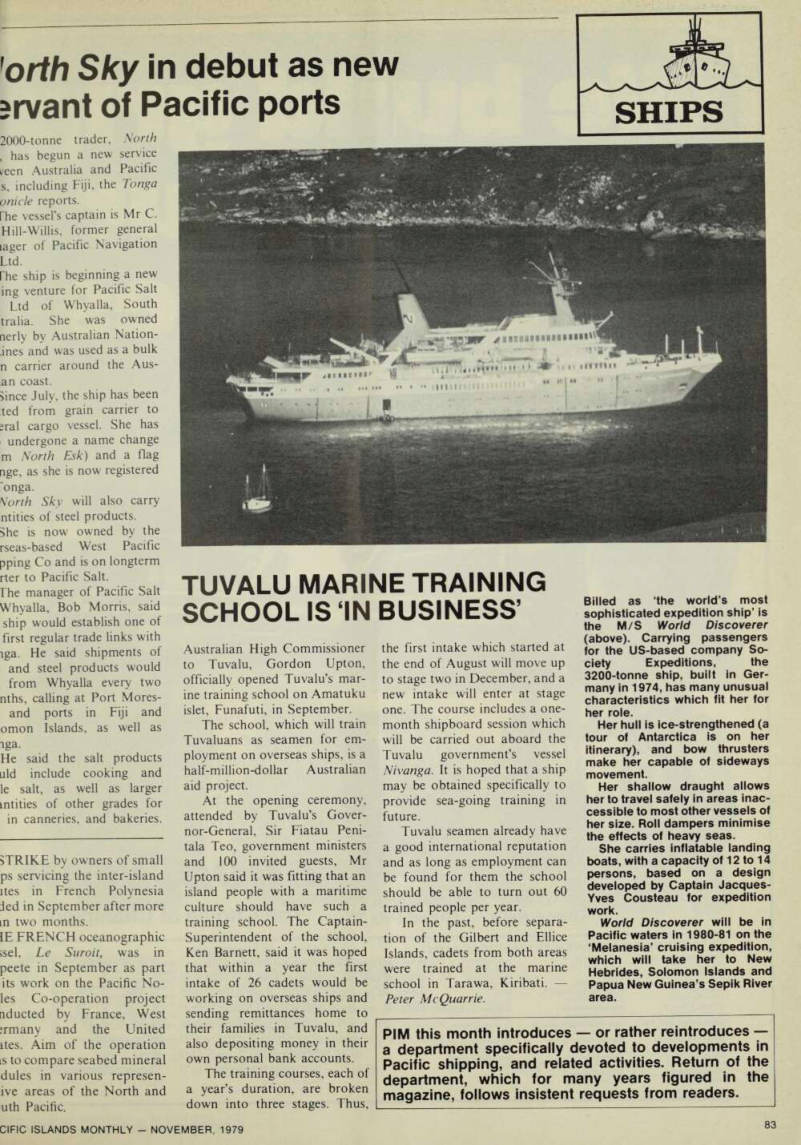
servant of Pacific ports
Ships
2000-tonne trader. North , has begun a new service yeen Australia and Pacific s, including Fiji, the Tonga onicle reports, fhe vessel’s captain is Mr C.
Hill-Willis, former general lager of Pacific Navigation Ltd. fhe ship is beginning a new ing venture for Pacific Salt Ltd of Whyalla, South tralia. She was owned nerly by Australian Nation .ines and was used as a bulk n carrier around the Aus an coast. since July, the ship has been ted from grain carrier to ;ral cargo vessel. She has undergone a name change m North Esk ) and a flag nge, as she is now registered 'onga.
North Sky will also carry ntities of steel products.
She is now owned by the rseas-based West Pacific pping Co and is on longterm rter to Pacific Salt.
The manager of Pacific Salt Whyalla, Bob Morris, said ship would establish one of first regular trade links with iga. He said shipments of and steel products would from Whyalla every two nths, calling at Port Mores and ports in Fiji and omon Islands, as well as iga.
He said the salt products aid include cooking and le salt, as well as larger mtities of other grades for in canneries, and bakeries.
STRIKE by owners of small ps servicing the inter-island
ites in French Polynesia
ted in September after more in two months.
IE FRENCH oceanographic
>sel, Le Suroit, was in peete in September as part its work on the Pacific No
les Co-operation project
aducted by France, West
;rmany and the United ites. Aim of the operation is to compare seabed mineral dules in various represen ive areas of the North and uth Pacific.
Tuvalu Marine Training

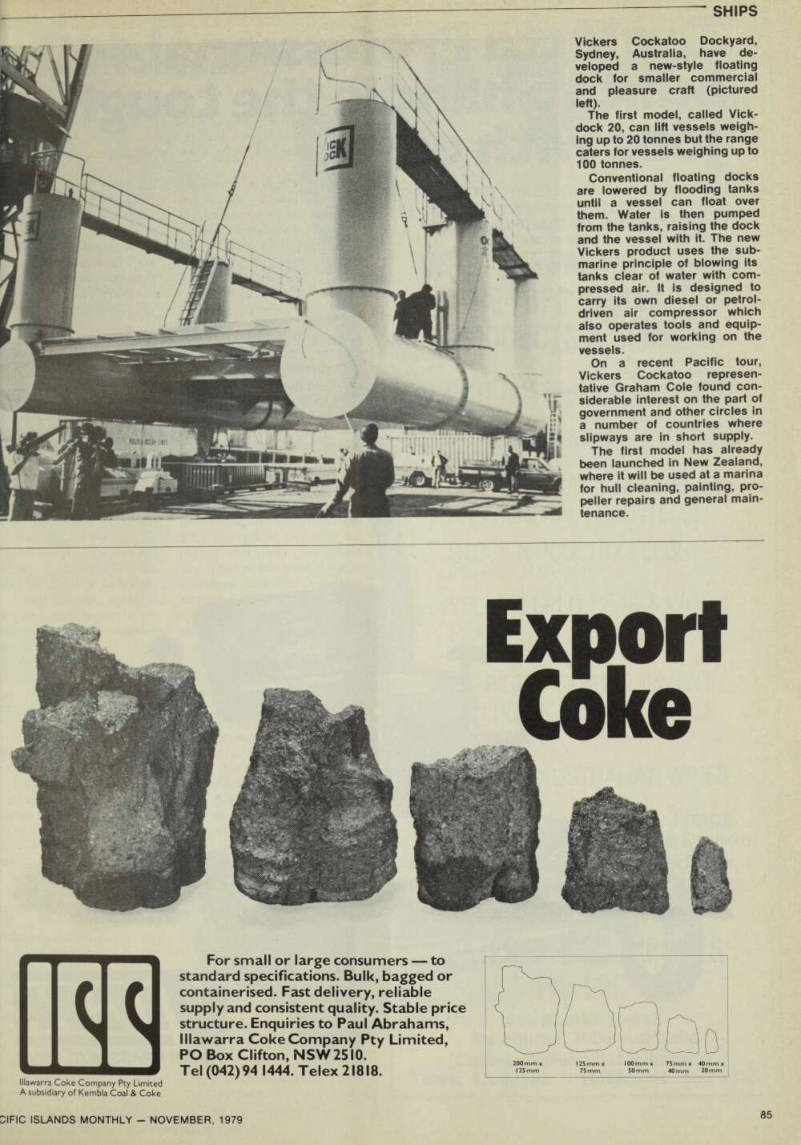
School Is In Business’
Australian High Commissioner to Tuvalu, Gordon Upton, officially opened Tuvalu’s mar ine training school on Amatuku islet, Funafuti, in September.
The school, which will train Tuvaluans as seamen for em ployment on overseas ships, is a half-million-dollar Australian aid project.
At the opening ceremony, attended by Tuvalu’s Gover nor-General, Sir Fiatau Peni tala Teo, government ministers and 100 invited guests, Mr Upton said it was fitting that an island people with a maritime culture should have such a training school. The Captain- Superintendent of the school, Ken Barnett, said it was hoped that within a year the first intake of 26 cadets would be working on overseas ships and sending remittances home to their families in Tuvalu, and also depositing money in their own personal bank accounts.
The training courses, each of a year’s duration, are broken down into three stages. Thus,
the first intake which started at the end of August will move up to stage two in December, and a new intake will enter at stage one. The course includes a one month shipboard session which will be carried out aboard the Tuvalu government’s vessel Nivanga. It is hoped that a ship may be obtained specifically to
provide sea-going training in
future.
Tuvalu seamen already have a good international reputation and as long as employment can be found for them the school should be able to turn out 60 trained people per year.
In the past, before separa tion of the Gilbert and Ellice Islands, cadets from both areas were trained at the marine school in Tarawa, Kiribati.
Peter McQuarrie.
RIM this month introduces or rather reintroduces a department specifically devoted to developments in Pacific shipping, and related activities. Return of the department, which for many years figured in the magazine, follows insistent requests from readers.
Billed as ‘the world’s most sophisticated expedition ship’ is the M/S World Discoverer
(above). Carrying passengers
for the US-based company So ciety Expeditions, the 3200-tonne ship, built in Ger many in 1974, has many unusual characteristics which fit her for her role.
Her hull is ice-strengthened (a tour of Antarctica is on her itinerary), and bow thrusters make her capable of sideways movement.
Her shallow draught allows her to travel safely in areas inac cessible to most other vessels of her size. Roll dampers minimise the effects of heavy seas.
She carries inflatable landing boats, with a capacity of 12 to 14 persons, based on a design
developed by Captain Jacques-
Yves Cousteau for expedition work.
World Discoverer will be in Pacific waters in 1980-81 on the
‘Melanesia’ cruising expedition,
which will take her to New Hebrides, Solomon Islands and Papua New Guinea’s Sepik River area.
Vickers Cockatoo Dockyard, Sydney, Australia, have de veloped a new-style floating dock for smaller commercial and pleasure craft (pictured left).
The first model, called Vick dock 20, can lift vessels weigh ing up to 20 tonnes but the range caters for vessels weighing up to 100 tonnes.
Conventional floating docks are lowered by flooding tanks until a vessel can float over them. Water is then pumped from the tanks, raising the dock and the vessel with it. The new Vickers product uses the sub marine principle of blowing its tanks clear of water with com pressed air. It is designed to carry its own diesel or petrol driven air compressor which also operates tools and equip ment used for working on the vessels.
On a recent Pacific tour, Vickers Cockatoo represen tative Graham Cole found con siderable interest on the part of government and other circles in a number of countries where slipways are in short supply.
The first model has already been launched in New Zealand, where it will be used at a marina for hull cleaning, painting, pro peller repairs and general main tenance.
Advertisements & other items, pp. 83-86 (3 items)
83
CIFIC ISLANDS MONTHLY - NOVEMBER, 1979
Goodfvear
4 '
GBOO+S
GBOO
Grand Rally
GBOO+S
Grand Prix 70
Richard Pieris & Co.. Ltd Colombo. Sri Lanka Nepal Motor Company (P) Ltd
Biratnagar, Nepal
Navana Ltd Dacca, Bangladesh Olethelm & Co., Ltd.
Bangkok, Thailand Landis Brothers & Co., Ltd Hong Kong Guam Tire & Supply Co.
Agana, Guam Susupe Enterprises Saipan. Mariana Is Micro! Corporation Saipan. Mariana is Truk Trading Co.
Truk E., Caroline is
PAM.I
Kolonia. Ponape Island Transport Service Co.
Majuro, Marshall Is Yap Cooperative Ass.
Yap, W Caroline Is Cook Islands Motor Centre Ltd Rarotonga. Cook Is Ngiratkel Elpison Co. Ltd.
Koror. Palau Boroko Motors Ltd Port Moresby, Papua New Guinea Solomon Motors Ltd.
Honiara, Solomon Is Santo Engineers Santo. New Hebrides Pacific Motors Vila New Hebrides
S.G.A.
Noumea. New Caledonia Ouncombe Bay Garage Norfolk Is Coral Island Motors Suva, Fiji Morris Hedstrom Ltd.
Nukualofa, Tonga Morris Hedstrom Ltd.
Apia, Western Samoa Western Samoa Transport Cooperative Society Ltd Apia, Western Samoa Samoa Motors Inc Pago Pago. American Samoa Service Mobil Papeete. Tahiti
You can trust Goodyear technology
to give you grip. World champion
racing drivers do. So drive on steel
belted radial car tyres developed by
Goodyear. Built for grip in any
weather. Extra high mileage too.
GOODfVEAR
The Choice of Champions
GOODYEAR SUBSIDIARIES
The Goodyear TyreS Rubber Co. (Ausl ) Ltd Sydney. AUSTRALIA Tel: 31 -0311 Goodyear India Limited New Delhi 1, INDIA Tel: 46886/9 PT Goodyear Indonesia Bogor. Republic of Indonesia Tel: 3371/2 Nippon Goodyear Kabushiki Kaisha Tokyo. JAPAN Tel: 582-0481/8 Goodyear Malaysia Berhad Selangor. MALAYSIA Tel: 36250V5 The Goodyear Tyre S Rubber Co ol New Zealand, Limited Lower Hutt, NEW ZEALAND. Tel 684-389 The Goodyear Tyre S Rubber Company of the Philippines, Limited Makati-Metro Manila Republic of the Philippines Tel: 89-20-41 Goodyear Singapore Pvt Limited Geylang SINGAPORE 14 Tel 408281/3 Goodyear Taiwan Limited Taipei, TAIWAN Tel: 5117135/8 Goodyear (Thailand) Limited Bangkok. THAILAND Tel: 252-6141/5
FOR FURTHER INFORMATION
PLEASE CONTACT
Goodyear International Corporation Room 1603. Wing On Center 111 Connaught Road Central
HONGKONG Tel: 5-433331
HRMEI7I 0252
Export
Coke
For small or large consumers to standard specifications. Bulk, bagged or containerised. Fast delivery, reliable supply and consistent quality. Stable price structure. Enquiries to Paul Abrahams, lllawarra Coke Company Pty Limited, PO Box Clifton, NSW2SIO.
Tel (042) 94 1444. Telex 21818. lllawarra Coke Company Pty Limited A subsidiary of Kembla Coal & Coke
JOOqo
200 mm x 125 mm x lOOmmx 75mm x 40mm x 125 mm 75mm 50mm 40mm 20mm
TheVkta Professional 460
Dili It to handle the tough
jobs with east" 6
PROFESSIONAL 460 FEATURES
Victa Hi-Torque 6 two-stroke 160 cc engine.
Larger fuel tank 2.3 litres as against 1 litre Heavy duty wheels.
Easy pull zip starter Safety blade disc 46 cm (18") cut Concealed throttle cable LM carburettor Folding handle 8 position height adjuster Noise reducing muffler Side chute with safety cover Lightweight (weighs only 54 lb) Rugged 14-gauge steel baseplate Specifications and models subject to alteration without notice or obligation
ICTA
TURNS GRASS INTO LAWN
85
SHIPS
DIFIC ISLANDS MONTHLY - NOVEMBER, 1979
[?]vigator
[?]ter, the electronic [?]vigator
ter mariner Captain Vic Sanderson writes on a revolutionary electronic device, the so-called Digital Navigation Computer 17, which vastly simplifies the work of the navigator.
small transistor radio has only brought news, music entertainment into homes, s and boats - to the navi r it has brought accurate : signals, which are of the
nee when calculating longi-
For practical purposes, it made the chronometer su luous. gain, the small hand-held ette recorder makes it poss for the navigator of any el, however large or small, ;cord course changes, tran -3f landmarks, weather con
ins and everything that
ild be written in the ship’s at times when writing Id either be difficult or rfere with other duties, t a slightly more complex 1 is the pocket calculator :h has reduced the time re ed for solving complex cal tions, including the ility of the ship, to a frac of that required by other ms and with greater accu r than, say, with logarithmic es. he heart of the pocket cal itor is a tiny silicon chip, no >er than a little finger, ch contains many minute trical components and cir ries. Initially it cost millions lollars to complete the de i and set up the production , but once the output paid initial costs, they became liable for a very few dollars ti. hen we come to the most e-consuming task of all for
navigator, conservatively
mated at one and a half irs of calculation per day, ch is the daily ritual of
iblishing the ship’s position
m celestial observations fol
ed by sight reduction.
Vith the development of
;rocircuitry, as used in
inary pocket calculators, it
5 only a matter of time be e a calculator for sight uction was created. This s first achieved by the well )wn nautical instrument nufacturer C. Plath of Ham
burg. Now a slightly different but even more versatile instrument, at about one-fifth the price, has been produced by Tamaya of Japan. It is known as the Digital Navi gation Computer NC-77.
This computer, which is only a little larger than the average hand-held calculators, pro duces results for a multitude of
navigation problems, ranging
from running fix to distance off by vertical sextant angle. It in cludes dead reckoning by Mer
cator sailing; course planning
by great circle sailing, together
with distance, initial course and intermediate points on the great circle.
Other features are finding the height and tide for a se lected time and velocity of the tidal currents at any time re quired; also, finding the course
and speed made good through
a current and the course to steer and speed to maintain to make good to the intended
point.
Above all, the NC-77 will compute celestial navigation problems and solve these by
producing position lines and
fixes in less than 90 seconds.
The NC-77 is programmed with astronomical data for the sun up to the year 2000, and from this data can compute Greenwich hour angle by the sun, Aries, equation of time and declination for the sun without using a nautical alma nac with the latter only re quired for planets, stars and moon.
The instrument is supplied with an excellent handbook,
not only explaining step by step
how the available information is to be fed into it in order to get required results, but also explaining at great length the fundamentals of astronaviga tion.
In Australia at a price of around $3OO to the professional navigator, and, because of sales tax, slightly more to the yacht ing fraternity, it must be con sidered an absolute steal.
Advertisements & other items, pp. 87-88 (2 items)
Ships
87
:iFIC ISLANDS MONTHLY - NOVEMBER, 1979
Pty. Ltd.
W/y £xpO
THE WATER WHEEL GROUP OF COMPANIES,
Winners of Australia’s Top Export Award and Flour Millers for over 100 years,
OFFER THE PACIFIC ISLANDS
THE TOPS IN QUALITY
PRODUCTS & SERVICE
BEST AUSTRALIAN WHEATEN
FLOUR
(High Protein, Roller. Stone ground Wholemeal, Bakers, Cake etc)
COMPLETE RANGE OF FROZEN
AND GENERAL FOOD ITEMS
STOCK & POULTRY FEEDS
(Pellets or Mash form)
YELLOW SPLIT PEAS & WHOLE
PEAS
(Machine-Dressed)
REFRIGERATION EQUIPMENT
INCLUDING SALT WATER ICE
MAKERS
QUALITY AUSTRALIAN WINES
Papua New Guinea, Fiji, Tonga, Western Samoa, American Samoa, New Hebrides, New Caledonia, Solomon Islands and Micronesia.
All Enquiries Welcome To:
WATER WHEEL EXPORTS
Pty. Ltd.
493 Bourke Street, Melbourne, 3000, Australia Cables: Watermill-Melbourne.
Telex: AA 32165 Telephone: 602 1433
FORESTMIL
PORTABLE
SAWMILL
Latest design features mean - faster production - less maintenance - easier to operate and service.
Powered by diesel engine or electric motor.
V /T m 3 7* Portable Sawm.il ' Forestmil produces any size accurate timber ready to use up to 12" x 9" x24'.
Purchase price and operating cost of Forestmil is less than other sawing equipment with similar production capacity, Forestmil reduces timber waste and also reduces log transport cost. Timber is sawn direct from the log in the forest.
Forestmil can be moved to a new location in one hour.
Forestmil will saw hardwood or softwood from logs of any diameter.
Over 1000 Forestmils are sawing timber in 23 countries.
Forestmil has been manufactured for 18 years.
For literature and prices please contact the manufacturers.
Iml Mac Quarrie Industries Pty.Ltd.
Hi P-O- Box 20, Coburg 3058, Victoria, Australia.
Phone: 350-3411. Telex: 33729. Cables; Macbound. Melbourne.
Yachts

• JELLICLE. Veteran Pacific voyager Mike Bales was encountered recently in Funafuti by PlM’s yachting correspondent Jimmy Cornell.
On his well-tried and worn 8 m wooden folkboat, Mike has already spent many years cruising Pacific waters to be come a familiar sight in many of the islands. A retired naval officer, veteran of World War 11, twice court-martialled but
still honourably discharged
from the Royal Navy, Com mander Mike Bales, RN, left the UK in 1959 aboard Jellicle.
In his 14 years spent in the Pa cific, Mike has worked on vari ous islands, but always returns to Tonga, for which he has a special affection and where he has been involved in several projects, from skippering the ship TOFUA to teaching navi gation. Speaking Tongan well, he always sails with a Tongan crew, sharing with young Ton gans his vast experience of the sea. His latest crew is Peter Pasikala, with whom he has sailed from New Zealand to Fiji, Wallis, Futuna and Tuvalu, before continuing to the New Hebrides, New Caledonia and PNG. Life aboard Jellicle is kept as simple as possible.
Mike is a purist who believes in following the tradition of the early small boat sailors such as Joshua Slocum. After 20 years and nearly 160 000 km of sailing in his small boat, Mike still has no desire to change it for anything bigger or more fancy. • ROSCOP. This 14 m fibreglass ketch from Antwerp is taking Belgian couple Rein and Marie-Louise Mortier on a voyage around the world.
They left Belgium in April 1977, sailing for the Canaries and across the Atlantic to the West Indies. They cruised the Caribbean Islands before tran siting the Panama Canal in July 78. From the Galapagos, Roscop sailed for Easter Island, then the Marquesas and the rest of French
Polynesia. American Sa was the next stop en roul Fiji, from where the Mor plan to sail to Australia for cyclone season. •ORPLID. Headed for I Zealand and Australia is German yawl Orplid f Bremen, with Rolf and Ste Stukenberg on board. Buil a cadet training ship, classic wooden yacht was viously well known as HAMBURG VI She took in several trans-Atlantic ra before being bought by F who cruised for nine yean the Mediterranean before i
pff on the present world >e. Leaving in 1976. Orplid it two years in the Carib , entering the Pacific in :h of this year. The route iji included Galapagos, ch Polynesia and rican Samoa.
N I. This 13 m wooden h from Seattle called in at n September on her way ew Zealand. The Califor couple Dick and Sherri i left in April 1978 bound Hawaii, Tahiti, American oa and Tonga. After the one season they plan to rn to French Polynesia and probably home.
Lemark. The 10.7 M
man class sloop has been e for the last 10 years for British couple Beryl and i Allmark. They left the UK [heir previous yacht, 8 m : IN, cruising for two years European waters. After uiring the larger Telemark, Allmarks set off for the bbean, where they spent e years among the islands, ama Canal was transited in 1978 on the way to the quesas, Tuamotu and So
ciety Islands, Tonga and Fiji.
En route to Australia, they plan to visit New Caledonia. • POTPOURRI. Potpourri of Port Hueneme, California, was cruising in Fiji waters during August and September. Al and Karen Huso left the States on board their 10.6 m cutter in August ’7B bound for Hawaii.
Since then they have visited Tahiti, Rarotonga, American Samoa and Vava’u. From Fiji, Potpourri is planning to sail to the New Hebrides and New Caledonia to spend the cy clone season in New Zealand. • DIOGENES. Gustaf Wollmar is on his second circum navigation in his 16 m yacht Diogenes. On the first voyage he left Massachusetts, in 1974 bound for Panama. Crossing the Pacific via Galapagos, French Polynesia, Cook Islands, New Zealand, Fiji and Papua New Guinea. Diogenes returned to the USA via South Africa and the Cape of Good Hope. After watching the America’s Cup in Newport in 1977, Gustaf left immediately for a second trip around the
world. This time from Panama he sailed up to San Francisco, then on to French Polynesia, Cooks, American Samoa and Fiji. Although sometimes taking crew, he has single handed this large yacht on several of the passages. From
Fiji he is bound for Australia.
• Le Voyageur. Le
Voyageur is American singlehander Sam Craig. He left Los Angeles in his Catalina 27 sloop in July ’7B and made a 21 days passage to Hawaii.
He worked and surfed a season there, before sailing for the Line Islands, American Samoa and Tonga. En route for Australia, Sam plans to stop in the New Hebrides and New Caledonia.
• Fawn Of Chichester.
Another yacht bound for Aus tralia is the British Cavalier 30, Fawn of Chichester from Cowes. Alice Sampson and Roger Morgan left Burnham on-Crouch in August 1977, crossing the Atlantic via Madeira and the Canaries. The Lesser Antilles, Columbia and Panama were visited before entering the Pacific in May, ’7B. They sailed via the Galapagos, French Polynesia and the Cooks to spend the last cyclone season in New Zealand. This year Fawn of Chichester has cruised in Tonga and Fiji and plans to call at the New Hebrides and New
Caledonia on her way to Bris bane.
• Aragon. This Grp 10.4 M
cutter in the Skookum class from Portland, Oregon, is taking Doug and Janet Bogar dus on a Pacific cruise. So far they have visited the Marquesas, Tuamotu and So ciety Islands, the two Samoas, Vava’u and Fiji. After New Zealand their future plans are still undecided.
•Canard Laque. The
black Hong Kong-built Clipper 42 ketch is named after the Chinese delicacy Peking Duck. Her owners Swiss couple Ute and Pierre Graf, have already logged over 65 000 km in eight years of cruising in European, Atlantic and Pacific waters. Their Pa cific cruise started in 1977 and has taken them to French Polynesia, Hawaii, Alaska, Bri tish Columbia and California.
Back in Tahiti, Ute and Pierre sailed in June 1979 for Suwar row, both Samoas and Fiji. En route to Queensland, they plan to visit the New Hebrides, Sol mon Islands and Papua New Guinea. • BECAUSE. Dick Thuiller. a retired building contractor from Victoria, BC, Canada, is seeking a new way of life on the ocean, after his wife was killed when a plane he was piloting crashed. He built Be cause, an 11 m cutter, sturdy enough to take him anywhere in the world. Sailing the yacht singlehanded he left Canada in June '7B calling at Hawaii, French Polynesia, Rarotonga, American and Western Samoa, Tonga and Fiji. His next stop - New Zealand. • TARA 11. The Vancouver 27
sloop of Canadian coi George and Suzanne Har left Vancouver, BC, in Aus 77. After sailing the US V coast, the Hartleys sper year in Hawaii working cruising. Kiribati, Tuvalu Fiji were visited en route Australia. • TRUST, 11.9 m cutter fi Whakatane, New Zealand taking yacht designer Mick chard on a shakedown crj among the islands of south-western Pacific. Ei yachts have so far been b in this fast cruising class Orchard 39. Mick sinj handed the boat from N Zealand to Tonga in Ap where he was joined by ci members lan Williams and v Craing, the first of a batch people to join Trust at vari< stages of the voyage, th object being to experience ( shore cruising. After visit Haapai and Vavau, Tr sailed on to Western Sarr with Wallis and Fiji on the il erary before returning to Ni Zealand. • SHANNON, 12.2 m ket( from Santa Barbara, Califc nia, in the Sea Wolf 40 clas arrived in Vavau, Tonga, at tl end of May. Singlehand Jack Knapp left home in Mi 1978 hoping to eventually fu his dream of sailing around tf world. After spending thr( months in Hawaii, Jack saik to Tahiti, where for six montf he sailed among the Socie Islands. En route to Tong; Western Samoa and Fiji. R 30 years Jack has worked £ a commercial fisherman fist ing, mainly for albacore, fror Mexico to Canada.
Sydney & Suva
The third Sydney to Suv yacht race over a course 1 1734 nautical miles, th longest race in the Au{ tralian ocean racing caler dar, begins on May 24 198 and is expected to attract record number of entries including yachts wit famous names in the racin world. The race, held ever two years, is being spor sored next year by the Syd ney brewers, Tooth and Co supporter of several yacht ing events in Australia Support for the even comes from the top, the Australian Governor General having started the races and the Governor General of Fiji presenting the trophies. The 1978 win" ner was RAGAMUFFIN skippered by Syd Fischer who led the Australian team to victory in the tragic Admiral’s Cup contest in Britain’s waters in August.
One big attraction for com petitors is that the race dovetails with the Pan Am Clipper Cup in Hawaii, many of the yachts, after reaching Suva, continuing on to Hawaii for the Clipper event. Middle Harbour Yacht Club of Sydney, organiser of the Tooths KB Sydney to Suva race, is one of the leading Australian clubs. Its managing sec retary is Alan Cameron, well known in Suva where he worked for several years with Air Pacific.
New Agents For
Onan Gear
Hawker Siddeley Engineering Pty Ltd have been appointed New Zealand and South Pa cific agents for Onan equip ment.
The company’s New Zealand manager, Mr T.
Arthurs, reports that owners of Cruising yachts fitted with Qnan marine generating sets have often had difficulties obtaining service and spares while in the South Pacific.
The company aims to mini mise the resulting disruptions to yachts’ programmes.
The company may be con tacted by letter at PC Box 33-787, Takapuna, Auckland, 9, and by cable to ‘Hawkeng’, Auckland.
Advertisements & other items, pp. 89-90 (2 items)
Yachts
89
kCIFIC ISLANDS MONTHLY - NOVEMBER, 1979
Nelson&Robertson
n6Eft>
* o * -0 V.
A/ C.
FOR
BRANCH OFFICES:
PAPUA NEW GUINEA
REPRESENTATIVES
-x-r-vtrT-- x 1 V I ■■ 1. 1 mM - v-wVX \ .A.V Itl t t *■ a
IN OUR 85th YEAR SELLING ‘SERVICE’
TO THE PACIFIC ISLANDS . . .
Nelson&Robertson
PTY. LTD. (Established 1895)
Plantation House, 197 Clarence Street, Sydney.
Cables: ‘IVAN*, Sydney, Brisbane. Telex: AA22381, Sydney.
INDENTS - FROM AUSTRALIA, NEW ZEALAND and OVERSEAS.
FOODSTUFFS • HARDWARE • TRAVEL • CANNED FISH MACHINERY • INSURANCE • SOFTGOODS • JUTE GOODS
• REAL ESTATE •
Nelson & Robertson Ply. Ltd., P.O. Box 575, Brisbane, Old., Australia.
P.O. Box 2092, Govt, Bldg., Suva, Fiji. P.O. Box 258, Lautoka, Fiji.
P.O. Box 2420, CPO Auckland 1, New Zealand Rabtrad Niugini Pty. Ltd., P.O. Box 219, Rabaul, P.N.G.
P.0.80x 1406, Lae, P.N.G. P.O. Box 711, Madang, P.N.G.
P.O. Box 253, Kieta, P.N.G.
m
tXi
BOUNTY
HUNTER
AND
RELICS
OUR AUSTRALIAN EXPERIENCE SINCE 1974
INDICATES TO US THAT THESE ARE MOST
ASSUREDLY FOR AUSTRALIAN CONDITIONS
THE VERY LATEST LIGHTWEIGHT MACHINES
FOR THE GREATEST
DEPTH PENETRA TKDN
IN
MAGNETIC GROUND CONDITIONS
(WHERE THE GOLD IS USUALLY LOCATED.)
BOUNTY HUNTER
"THE ONE THAT GETS THE GOLD"
MADE IN U.S.A.
20 MODELS - LIFETIME WARRANTY
-ALL PRICES
SEE THE RANGE - TEST THEM YOURSELF
AT ALL QUALITY DETECTOR STOCKISTS
AND DON'T SETTLE FOR ANYTHING LESS!
BOUNTY HUNTER HAS MORE VALUE PACKED
FEATURES SOME MODELS ARE STANDARD
WITH 3 SEARCH COILS!
PHONE OR WRITE FOR FREE DATA PACKAGE
AND NEAREST DEALER LOCATION.
Sole S.W. Pacific Distributors & Factory-Approved Service Centre
HENDON DETECTOR COMPANY
An Associate of Southern Patagonian Holdings Pty Limited Office: 121 Plateau Rd. Telephone: (3 Lines) STD 02 - 918 6667 (24 HRS.) AH Mai! to: P.O. BOX l IV , AVALON BEACH, NSW. 2107, AUSTRALIA
REPUTABLE NEW DEALERS ARE WELCOME -
NEVER SAY NO TO A CUSTOMER - WE CAN
PUT BOUNTY HUNTER GOLD DETECTORS ON
YOUR SHELVES IN 24 HOURS!
Frostpak
Koolatron
INDUSTRIES
Portable Electronic
Solid State Refrigerators
For people on the move Ideal for Campers & Caravans Indispensable for Travellers and Holidaymakers A must for Truckdrivers Popular with Yachts.
Aircraft and Fishermen For Medical & Technical purposes & Food Samples ■ Big cooling performance ■ No Gas - No Compress! ■ Large 33 Litre capacity ■ Unaffected by motion I or level ■ No noise or vibration 1 ■ Low Battery Drain ■ Low Weight - 7 KG ■ Virtually Indestructablej ■ 2 Year Guarantee From 5199.00 incl. Sales Tax Connects to 12V Battery or Cigarette Lighter Operates on 240 V with Battery Charger 297 Williamstown Road, Port Melbourne 3027 Phone 645 2068 Telex 32571
Deaths
Islands People
I. K. B. Borron
es Sawers Kidston Brad : Borron, born in Suva in , at his house there after a illness. Together with his Zena, who died two years he was well known for his
anthropy and generosity,
home, Borron House, used le Allied Command Head rters in World War 11, was ated by Jimmy Braddon to Fiji National Trust. He irited the Mago Island te, which is now managed ais son James. A true Kai he will be remembered by
ly friends.
Ine Tui Kleis
)rmer Speaker of Tuvalu’s
ise of Assembly, on his le island of Nui, aged 48. cated at the old Elisefou
School on Vaitapu, and in Western Samoa, New Zealand and Italy, Sione Tui Kleis did a short stint in the former Gil bert and Ellice Islands Colony civil service before being ordained a Catholic priest in 1961. In 1964 he left the clergy to return to government ser vice. After working as a broad caster with Radio Tarawa, he was elected to the GEIC Legis lative Assembly, and later selected as minister for com merce and natural resources before the Gilberts and Tuvalu separated in 1975. He was fluent in Tuvaluan, Gilbertese, Samoan, French, Italian and
English.
John Sachs
At his home in Suva, of a mas sive heart attack, on September 23. John Sachs, 45, was on the staff of The Fiji Times for 20 years, lately as commercial printing manager. He was born at Nausori, one of an old European family in Fiji, his grandfather being one of the original settlers at Tailevu.
John Sachs 'was involved in
many community activities in cluding YMCA and Harry Charman’s sports club, and was president of the Fiji Master Printers’ Association. Former executive director of The Fiji Times, Mr L. G. Usher, in a tribute, described Mr Sachs as ‘having absolute integrity, in both his working and private life, and he could be depended upon completely’. He leaves a wife, Dorothy, and four chil dren.
Roger Heard
Suddenly in Sydney in August,
aged 82. He designed the pile
light at the entrance to Suva harbour, having gone to Fiji in 1920 to join the Public Works Department. He returned to Australia in 1924. He married Florence Beddows, second daughter of William Beddows, who operated the Vunivasa copra estate on Taveuni.
M. J. Raniga
At Ba, Fiji, aged 64. Coming to Fiji from India in 1939, Mr Raniga worked as a goldsmith in Ba and Suva before return ing to Ba in 1953 to found Popular Novelties Ltd, spring board for Maganlal Jiwa and Sons, the town’s biggest indus trial concern. Founded as a dis tribution company, Popular Novelties later began manufac turing its distribution lines,
beginning with curry powder
and moving on to confec tionery. Retired, Mr Raniga spent his last few years concen trating on a private charitable trust set up in the family name.
He is survived by his wife, four sons, two daughters and 16
grandchildren.
Rev Minoru Louis
On Guam, aged 42. Originally from Ponape, at the time of his death, he was assistant pastor of the Faith Presbyterian Reformed Church on Guam.
He was also director of Faith Hospitality House, a ministry for Micronesian students on Guam, and a representative of the United Bible Society to Guam and Micronesia.
Kunju
A Girmitya, Kunju, at Savusavu, Vanua Levu, Fiji, aged 87. Kunju survived the
Girmit Centenary (of the first arrival of indentured Indian labourers in Fiji) by only three months.
R Lawrence Isa
he first Shortlands man to be ordained a Catholic priest, Father Lawrence Isa, at Gizo, Solomon Islands. Father Isa had been working with the Gil bertese settlement around Gizo. He was ordained in 1968.
E. J. Robson
Eric John Robson, in Lae, Papua New Guinea, aged 65.
Bom in New South Wales, Australia, Eric Robson first went to Rabaul, New Britain, in 1938 as a police officer, later transferring to the medical ser vice.
In World War 11, he was attached to the Allied Intelligence Bureau, and be came one of the elite band of coastwatchers, operating along the Morobe coastal as well as inland areas behind Japanese lines.
After the war he was posted to Mumeng, in Morobe, where he remained until his death.
The building of Mumeng’s
hospital and primary school
was largely due to his efforts.
Among his other activities were the running of a roadside res taurant at Mumeng, and a spell with the Commonwealth Department of Works.
He was awarded the Independence Medal (PNG) and received it at Mumeng on the country’s second Indepen dence Day in 1976, along with his better-known fellow resi dent, the late Mick Leahy (PIM April p 7, May p6B). By this time Eric Robson had become a PNG citizen
A. P. Elkin
Emeritus Professor A. P. Elkin,
Anglican minister, anthropol
ogist, and author, in Sydney, Australia, aged 88. Professor Elkin was a former editor of Oceania, a journal mainly con cerned with the study of the indigenous peoples of Aus tralia, Papua New Guinea and the Pacific Island countries.
His field work took him to many remote places in these areas.
Advertisements & other items, pp. 91-92 (2 items)
91
CIFIC ISLANDS MONTHLY - NOVEMBER. 1979
ijyJ GROUP
* ALUMINIUM BARGE
40 ft. + 12 ft. built 1976. Demonstration vessel. Repowered 1979 new Cat V 8 diesel engine. 10/31 Hamilton commercial jet unit. Winch operated bow landing door. Fast, economical, maintenance-free, $63,000 F. 0.8. Auckland. N.Z.
► PASSENGER LAUNCH
45 ft. x 15 ft. x 5 ft., launched Dec. 1978, steel (Dimet treatment) N.Z. Govt, survey for 70 passengers... could be increased. Gardiner 6 I w diesel engine 9 knots.
A beautiful vessel. Big main cabin bus type seating. Great value. $135,000
» PASSENGER BUSES
One 38 seater 1960 S.B. Bedford. Rebuilt 1978. A tour bus with plenty of luggage space. 330 Bedford diesel engine. New seats, carpets, etc. $14,000 One similar to above without new seats or carpets, petrol engine. 330 could be fitted tor purchaser $9,000
APPLY
C. HILTON
PRIVATE BAG, ROTORUA, NEW ZEALAND.
PHONE ROTORUA 53533.
rR CAWTHRON
H m TECHNICAL
ijyJ GROUP
CONSULTANTS & ANALYSTS
• Feasibility Studies • Environmental Studies • Resource Evaluation • Land Use Investigations • Biological Surveys • Forestry & Agriculture Box 175, Nelson Phone 82-31 Telex CTG NZ3429
S' for" shippers ux V
THE BANK LINE
r
Monthly Services
United Kingdom and Continent to:
PAPEETE • NOUMEA
PAPUA NEW GUINEA and SOLOMON ISLANDS
PORT VILA & SANTO BY TRANSHIPMENT
United Kingdom and Continent to:
SUVA AND LAUTOKA (FCL LCL & UNITISED ONLY) Papua New Guinea and Solomon Islands to:
UNITED KINGDOM and CONTINENT
vwctt?
For particulars apply:
THE BANK LINE (AUSTRALASIA) PTY. LTD.
18th floor 1 York Street SYDNEY N.S.W 2000 Australia Tel: 272041 Telex; 24063
Shipping
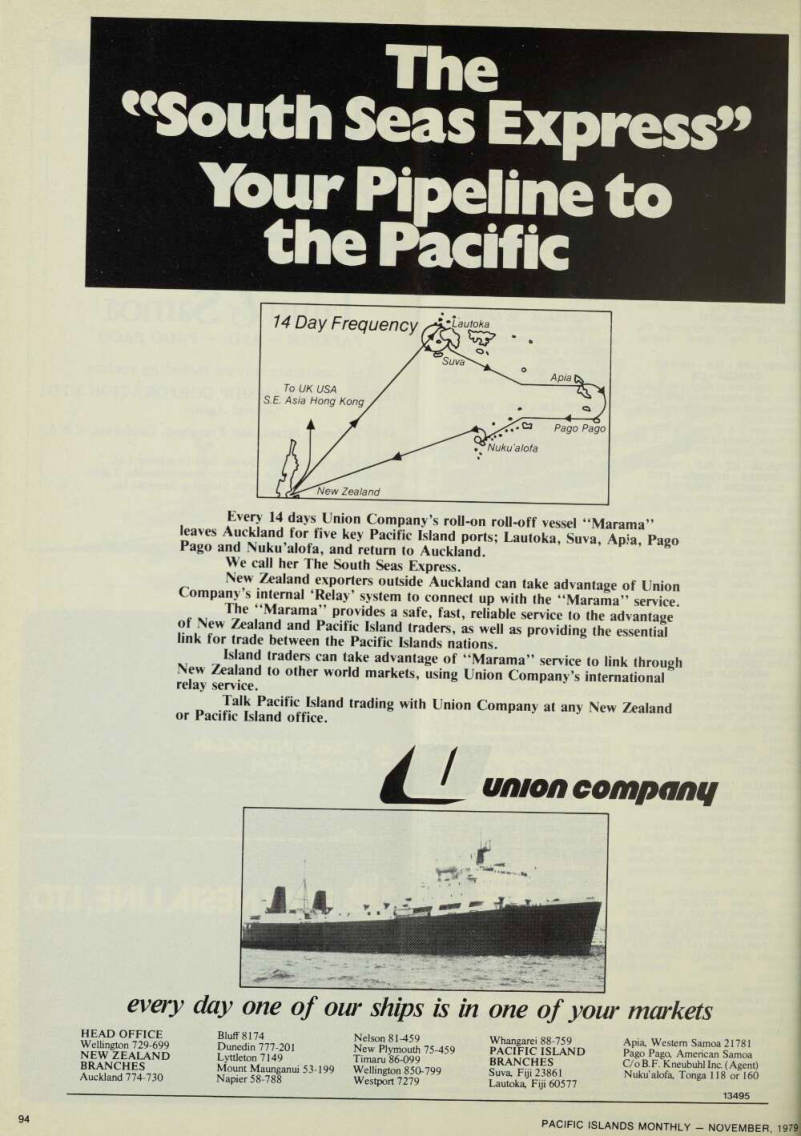
Services
jse listings do not necessarily /er all services to Island ports.
Duld any shipping company wish have its services cargo and jsenger included in these list s they should contact PIM.
Ydney - Lord Howe Is -
Norolk Is
mpagnie des Chargeurs loniens operates four-weekly > service Sydney - Lord Howe j and Norfolk Island, tails Hetherington Kingsbury Pty 37-49 Pitt Street. Sydney 671).
DNEY - NZ - FIJI - HAWAII -
Canada - Us
V O liners call at Auckland, Suva, ilulu and Vancouver on eastbound vestbound voyages between Syd jnd the US. tails from P & O Booking Centre, J Travel Headquarters Pty Ltd, 33 Street, Sydney (231-6655). iTRALIA - NZ - FIJI - TONGA -
Hebrides - Noumea - Png -
Solomons -Samoas
mar Cruises operates a year-round e programme to include most of ibove countries. >tails from Sitmar Cruises, 47 beth Street, Sydney (232-7511). i O liners call at Auckland, Bay of ds, Honiara, Lautoka, Noumea, j'alofa, Pago Pago, Papeete. Port isby, Santo, Savusavu, Suva, iu and Vila on cruises from Aus i. stalls from P & O Booking Centre, d Travel Headquarters Pty Ltd, 33 i Street, Sydney (231 -6655).
Ustralia - Fiji - Samoas -
New Hebrides - Tonga -
Norfolk Island
icific Navigation of Tonga operates e-weekly refrigerated general car container service from Sydney and cane to Vila, Santo, Suva, Lautoka, , Pago Pago, Nuku'alofa and Nor- Island.
Dtails from Beaufort Shipping ncy Co, 2 Castlereagh Street, Syd (239-1022).
Jstralia - New Caledonia
(And/Or) New Hebrides
arlander operates a monthly service i Sydney to Noumea, etails; Karlander (Aust) Pty Ltd, )1 Pitt Street, Sydney (27-6301).
Dfrana-Unilines ships serve imea every three weeks from the n ports along the east Australian st. etails from Sofrana-Unilines, 19 Pitt iet, Sydney (27-2031), Trans tral Shipping Pty Ltd, 570 Bourke set, Melbourne (67-9162), ACTA Pty Brisbane (221-3116), Elders-ANL Ltd, Port Adelaide (47-5688), ANL, vcastle (049-24364), Clements & shall, Burnie, Tasmania -1833). tempagnie des Chargeurs Cale liens operates a three-weekly con erised cargo service from Sydney to jmea. (etails Hetherington Kingsbury Pty , 37-49 Pitt Street, Sydney -1671). )ompagnie Generate Maritime oper s a monthly service from Sydney to jmea, Port Vila and Santo, using a -sustained fully containerised isel.
Details Compagnie Generale Mari time, 12 Castlereagh Street, Sydney (231-3700).
Australia - Fiji
Karlander (Aust) Pty Ltd operates monthly cargo services from Sydney to Suva and Lautoka.
Details from Karlander (Aust) Pty Ltd, 19-31 Pitt Street, Sydney (27-6301), Dalgety Shipping, 461 Bourke Street, Melbourne (60-0731). Burns Philp (SS) Co Ltd, Suva and Lautoka.
Sofrana-Unilines (Fiji Express Line) operates to Suva and Lautoka every three weeks from the main ports on the east coast of Australia and monthly to Lautoka from Melbourne and Sydney.
Details from Sofrana-Unilines, 37 Pitt Street, Sydney, (27-2031), Trans- Austral Shipping Pty Ltd, 570 Bourke Street, Melbourne (67-9162), ACTA Pty Ltd, Brisbane (221-3116), Elder-ANL Pty Ltd, Port Adelaide (47-5688), ANL, Newcastle (049-24364), Clements & Marshall, Burnie, Tasmania (31-1833).
Australia - W. Samoa
Compagnie Generale Maritime oper ates a monthly service from Sydney to Apia, using a self-sustained fully con tainerised vessel.
Details Compagnie Generale Mari time, 12 Castlereagh Street, Sydney (231-3700).
Australia - Fiji - Tuvalu
- Samoas - Tonga
Pacific Forum Line operates a con tainer, unitised/palletised and reefer cargo service from Melbourne and Syd ney to Lautoka, Suva, Funafuti, Pago Pago, Apia and Nuku'alofa. Other ports are included on inducement.
Details from ANL Melbourne and Brisbane, Union Bulkships, Sydney, Hobart, Port Adelaide and Fremantle, Burns Philp (SS) Company Ltd, GPO Box 355, Suva, Fiji (311-777); Polynesia Shipping Services, Pago Pago; Union Steam Ship Co of NZ Ltd, Nuku’alofa; PWD, Funafuti; or Pacific Forum Line, PO Box 655, Apia, W.
Samoa.
Australia - Northern
Marianas - Micronesia
u Pacific Line operates a regular container service from Melbourne to Saipan, Truk, Ponape and Kosrai.
Details Nauru Pacific Line, Nauru House, 80 Collins Street, Melbourne, (653-5709), Nedlloyd Swire, 8 Spring Street, Sydney (2-0522).
Australia - Tonga -
Samoas - Tahiti
Karlander operates a monthly cargo service from Melbourne and Sydney to Nuku’alofa, Apia, Pago Pago, Papeete, US west coast.
Details: Karlander (Aust) Pty Ltd, 19-31 Pitt Street, Sydney (27-6301).
Australia - Tahiti
Daiwa Line offers a four-weekly ser vice from Australia to Papeete.
Details: Meridian Shipping & Trans port Agencies Pty Ltd, Box 3410 GPO, Sydney 2001 (29-4987), Tlx: AA25970.
Compagnie Generale Maritime oper ates a monthly service from Sydney to Papeete using a self-sustained fully containerised vessel.
Details Compagnie Generale Mari time, 12 Castlereagh Street, Sydney (231-3700).
Australia - Png
New Guinea Express Lines operates three-weekly conventional and con tainer services Melbourne, Sydney, Brisbane, Port Moresby, Lae, Rabaul, Alotau.
Details from New Guinea Express Lines, PO Box R 73, Royal Exchange PO, Sydney (241-3991) MacArthur Shipping Agency Co, 82-92 Eagle Street, Brisbane (229-3777), New Guinea Express Lines, 327 Collins Street, Melbourne (61-3053), Niugin Express Lines in Port Moresby (21-2466), Lae (42-1536), Rabtrad
Nlugini Pty Ltd, Rabaul (92-2911), Alotau Stevedoring & T’sport (61-1318).
Karlander New Guinea Line's cargo vessels call at Melbourne, Sydney, Port Moresby, Lae, Madang, Wewak, Manus, Kimbe, Rabaul, Popondetta.
Details from Karlander (Aust) Pty Ltd, 19-31 Pitt Street, Sydney (27-6301), Dalgetty Shipping, 461 Bourke Street, Melbourne (60-0731).
Australia-Png-Solomons
A consortium of Conpac, NGAL/PNGL have three container vessels operating on a 28 day turn around from Melbourne, Sydney and Brisbane to Port Moresby, Lae, Rabaul, Kavieng, Wewak Madang, Kieta and Honiara supplemented by Daiwa vessels, Pacific Princess and Fiji Maru extending from Sydney to Lae on a monthly basis.
Details from Burns, Philp & Co. Ltd. 51 Pitt Street, Sydney (2-0547) and Interocean Swire, 8 Spring Street, Syd ney. (2-0522).
Australia-Solomons
Northern Marianas-Taiwan
Japan
Daiwa Line offers a four-weekly ser
vice Sydney-Honiara-Guam-Taiwan-
Japan with transhipment at Guam for Saipan.
Details Meridian Shipping & Trans port Agencies Pty Ltd, Box 3410 GPO, Sydney 2001 (29-4987). Tlx.
AA25970.
Australia - Solomons -
Gilbert Is - Micronesia
Daiwa Line operates a container ser vice every 30 days from Sydney to Honiara, Kieta, Tarawa and Guam. Gizo cargoes transhipped at Honiara, Saipan, cargoes transhipped at Guam.
Details Meridian Shipping & Trans port Agancies Pty Ltd, Box 3410 GPO Sydney 2001 (29-4987), Tlx.
AA25970.
Australia - Nauru -
Majuro
Nauru Pacific Line operates regular cargo/passenger service from Mel bourne to Nauru and Majuro.
Details: Nauru Pacific Line, Nauru House, 80 Collins Street. Melbourne (653-5709), Nedlloyd Swire, 8 Spring Street, Sydney (2-0522).
Png - Uk/Continent
Bank Line operates regular cargo service from Kieta, Rabaul, Kimbe, Madang and Lae to Cardiff, Hamburg, Rotterdam and Antwerp.
Details from Bank Line (A'asia) Pty Ltd, 1 York Street, Sydney (27-2041); Burns Philp (PNG) Ltd, ports.
Png - Us
Bank Line operates regular cargo service from Kieta, Rabaul, Kimbe, Madang and Lae direct to New Orleans; calls at other US and Gulf and East Coast ports on inducement.
Details from Bank Line (A’asia) Pty Ltd. 1 York Street, Sydney (27-2041); Burns Philp (PNG) Ltd, PNG ports.
Solomons - Usa -
Uk/Continent
Bank Line operates regular cargo service from Honiara to New Orleans, Cardiff, Hamburg, Rotterdam and Ant werp.
Details from Bank Line (A’asia) Pty Ltd, 1 York Street, Sydney (27-2041); Trading Co, Honiara (389).
Far East - Fiji - New
Zealand
New Zealand Unit Express (NZUE) operates a fortnightly palletised cargo service from Manila, Keelung, Kaoshiung and Hong Kong to Lautoka, Suva and thence to NZ.
Details from Carpenters Shipping, Suva (312-244), Burns Philp, Suva (311-777), P & O S.N. Co, Wellington (736-477) or Nedlloyd Swire Pty Ltd, Sydney (20-522).
Nedlloyd operates bi-weekly cargo service with four ships from Sourabaya, Jakarta, Bangkok, Port Kelang and Singapore to Suva and NZ ports.
Details from Nedlloyd (Aust) Pty Ltd, 8 Spring St. Sydney (27 3801), Burns Philp (SS) Co Ltd. Suva and Lautoka.
Japan - Fiji - New Zealand
China Navigation, operates a monthly service from main ports Japan to Suva and Lautoka and thence Noumea and NZ.
Details from Carpenters Shipping, Suva (312-244).
Japan - Png
Mitsui O.S.K. Lines operates a monthly service from main ports Japan and Port Moresby, Rabaul, Lae, Madang, Kieta and Kimbe.
Details from J. C. Waller, Port Moresby (21-1755).
Far East - Mid-S. Pacific
New Guinea Pacific Line (NGPL) op erates a regular cargo service from Hong Kong, Taiwan, Manila, Port Kelang and Singapore to Wewak, Madang, Kimbe, Rabaul, Kieta, Lae, Port Moresby, Honiara, Santo, Vila, Noumea, Papeete. Pago Pago, Apia, Tarawa and Nauru.
Details from Steamships Trading Co..
Port Moresby (21-2000).
Kyowa Shipping Ltd, operates monthly services from Hong Kong, Taiwan, S. Korea and Japan, to Guam, Saipan, Solomons, New Caledonia, Fiji, Western and American Samoa, Tahiti.
Cook Is., Tonga and New Hebrides.
Details; Hetherington Kingsbury Pty Ltd, 37-49 Pitt Street, Sydney (27-1671).
Daiwa Line operates 30-day service from Moji, Kobe, Nagoya and Yokohama to Papeete, Pago Pago, Apia, Suva, Lautoka, Noumea, Sydney, Honiara, Kieta, Tarawa, Guam and Taiwan.
Details: Meridian Shipping & Trans port Agencies Pty Ltd, Box 3410 GPO Sydney 2001 (29-4987) Tlx: AA25970.
North Europe - Tahiti -
New Caledonia
Hamburg-Sued operates monthly cargo services from Hamburg, Dunkirk and Le Havre to Papeete. Noumea, via Panama.
Details from Columbus Overseas Services Pty Ltd, 333 George Street, Sydney (290-2966), Columbus Mari time Services, 17 Albert Street, Auckland (77-3460).
Europe - Pacific Islands
Compagnie Generale Maritime oper ates services from Europe and Mediter ranean ports to Papeete and Noumea using three Ro-Ro and one multi purpose vessel thus ensuring a bi monthly sailing to and from.
Details Compagnie Generale Mari time, 12 Castlereagh Street, Sydney (231-3700).
EUROPE - TAHITI - W. SAMOA -
Fiji - N. Caledonia
Nedlloyd offers regular cargo ser vices from Northern Europe and UK to Papeete, Apia, Fiji and New Caledonia.
Details Nedlloyd (Aust) Pty Ltd, 8 Spring Street, Sydney (27-3801).
JAPAN - GUAM - FIJI - TAHITI -
Samoa - N. Caledonia -
Solomons - Gilberts
Daiwa Lines runs a monthly cargo service from Japan via Guam to Lau toka. Suva, Papeete, Pago Pago, Apia, Sydney, Noumea, Honiara, Tarawa, Guam.
Details from Burns Philp (SS) Co Ltd, Suva.
Noumea - Fiji - West Coast
North America
PAD Line operates an approx 3-weekly RO-RO service from Noumea and Suva to Honolulu and West Coast USA and Canadian ports.
Details from Sofrana-Unilines SA, BP 1602, Noumea (27-51 -91), Tlx NMO4B - R Carpenter, 100 Thomson St, Suva (31-11-22), Tlx FJ2199; Trans-Austral Shipping, Box R 232 PO, Royal Exchange, NSW (27-2441), Tlx AA1204.
West Coast North America -
Noumea - Fiji
PAD Line operates an approx 3-weekly RO-RO service from West Coast USA and Canada to Noumea and Suva.
Details from Sofrana-Unilines SA BP 1602, Noumea (27-51 -91), Tlx NMO4B W R Carpenter, 100 Thomson St, Suva (31-11-22), Tlx FJ2199; Trans Austral Shipping, Box R 232 PO, Royal Exchange, NSW (27-2441) Tlx AA21204.
Nz - New Caledonia - Fiji
Pacific Forum Line operates a uni tized/palletized and reefer cargo ser vice from Lyttelton and Auckland to Napier, Noumea, Lautoka and Suva.
Other ports are included on inducement.
Details from Shipping Corporation of NZ Ltd, Auckland, Christchurch Wellington, Burns Philp (SS) Company Ltd, GPO Box 355, Suva, Fiji (311 -777); Polynesia Shipping Services, Pago Pago; Union Steam Ship Co of NZ Ltd, Nukualofa or Pacific Forum Line, PO Box 655, Apia, W. Samoa.
Nz-N. Caledonia-N. Hebrides
Png-Solomons
Sofrana Unilines with three ships op erates to Vila and Santo, to Honiara and Papua New Guinea and to Noumea.
Details from Sofrana Unilines, 18 Customs Street, Auckland (773-279) PO Box 3614, Telex NZ2313.
Nz - New Caledonia
- Solomons - Gilberts -
Micronesia
Union Co/Daiwa Line operates a container service from New Zealand
through Sydney to Guam.
Details: Union Steam Ship Co of NZ Ltd, PO Box 12, Auckland.
Nz - Tahiti
Compagnie Tahitienne Maritime SA with one ship operates monthly service New Zealand - Papeete, Details from Sofrana Unilines, PO , B ° X 3 614 ' 18 Customs St, Auckland (773-279). Tlx NZ2313.
NZ - FIJI - NORTH AMERICA (WC) Blue Star Line Ltd Pacific Coast con tainer services. Only direct service to and from New Zealand. Blue Star vessels call at Suva and Honolulu on NZ-US-West Coast voyages.
Details from Blueport ACT (NZ) Ltd PO Box 192, Wellington (739-029) Burns Philp (SS) Co Ltd, GPO Box 355’
Suva, Fiji (311-777).
Nz - Fiji
Reef operates a regular 18-day ser vice from Auckland to Suva and Lau toka.
Details from Reef Shipping Agencies PO Box 3382, Auckland, NZ (77-1221-3).
Pacific Line with one ship operates fortnightly roro cargo service New Zealand, Lautoka, Suva.
Details. Sofrana Unilines, 18 Cus toms Street, Auckland (773-279) PO Box 3614, Telex. NZ2313.
Nz - Fiji - Gilberts -
Solomons - Png
Pacific Forum Line operates a con tainer, unitised/palletised and reefer cargo service from Lyttelton and Auckland to Suva, Port Moresby, Lae Honiara, Tarawa, Madang, Lae and Port Moresby. Other ports are included on inducement.
Details from Shipping Corporation of NZ Ltd, Auckland, Christchurch and Wellington. Burns Philp (SS) Company Ltd, GPO Box 355. Suva, Fiji (311-777) Sullivans, Honiara; Gilbert Islands Ship ping Corporation, Tarawa: Steamships
Trading in Port Moresby, Lae and Madang or Pacific Forum Line, PO Box 655, Apia, W. Samoa.
Union Steam Ship Co of NZ operates a roll-on, roll-of, container/unitised ser vice from Auckland to Lautoka-Suva- Pago Pago-Apia-Nuku-alofa on a 14 day frequency.
Details from Union Steam Ship Co of NZ Ltd, PO Box 12, Auckland or from Branch offices/agents in Fiji, Tonga and the Samoas.
Nz - Tonga - Samoa
Pacific Navigation of Tonga operates a four-weekly cargo service. Auckland - Nukualofa - Pago Pago - Apia - Auckland.
Details from McKay Shipping Ltd, Downtown House, Queen Street Auckland (30-229).
Warner Pacific Line services Auckland - Nuku'alofa/Vavau/ Apia fortnightly carrying general and freezer cargoes. Also Timaru - Nuku'alofa/Vavau/Apia every 21 days carrying freezer cargo.
Details from Air Marine Services (NZ) Ltd, PO Box 2505, Auckland (796-841). Telex NZ21555.
NZ - COOK IS - NIUE -
Tahiti
Shipping Corporation of NZ Ltd oper ates cargo services based on pallets and similar units from Auckland to Niue Cook Islands and Tahiti.
Details from the Shipping Corp of NZ yj- P° Box 3420, Auckland (797-210); Waterfront Commission, PO Box 61, Rarotonga, Lighterage and Stevedoring Co. Aitutaki, Niue Govt Offices, Niue Island Compagnie Mari time Polynesienne. B’P' 368, Papeete Tahiti.
Uk - N Continent - Fiji
The Bank Line operates a direct, fast monthly service from Hull, Hamburg Bremen, Antwerp and Rotterdam to Suva and Lautoka.
Details from the Bank Line ( ralasia) Pty Ltd, 1 York St, Sy (27-204 1 ); Burns Philp (South Ses Ltd, Suva and Lautoka.
Uk/N. Continent - Tahiti
N. Caledonia - N. Hebride
Bank Line operates regular c< service from Hull, Hamburg, Bren Antwerp and Rotterdam to Papeete Noumea.
Details from Bank Line (A'asia) Ltd, 1 York Street, Sydney (27-20 Ets A M Fare LITE, Papeete: Ballande, Noumea.
Uk/N. Continent - Png -
Solomons
Bank Line operates regular c{ service from Hull, Hamburg, Bren Antwerp and Rotterdam to Moresby, Lae, Madang, Kimbe, Rab Kieta and Honiara and on inducen to Yandina.
Details from Bank Line (A’asia) Ltd, 1 York Street, Sydney (27-20' Burns Philp (PNG) Ltd, PNG pc Trading Co Honiara.
Honolulu - Samoas - Tong
Warner Pacific Line operates i ized/palletized and reefer cargo i vice every 45 days Honolulu/R Pago-Apia-Nuku’alofa. Line Isla 1 and Suva by inducement.
Details from Hawaii-Pacific Marit Inc, Honolulu, Hi 96801. Tel (8 (531-4841) Tlx (RCA): 723-83301 743-0040. Cables ‘Oral’
US - FIJI - TAHITI - NZ -
Australia
Bank and Savill Line Ltd, opera regular cargo services from US G ports to Australia and NZ. Calls at Su Lautoka and Papeete on demand.
Details from Bank Line (A’asia) I Ltd, 1 York Street, Sydney (27-2041] Howard Smith Industries Pty Ltd 1 Y( Street. Sydney (27-5611).
Advertisements & other items, pp. 93-97 (3 items)
93
CIFIC ISLANDS MONTHLY - NOVEMBER, 1979
Transport
ISLANDS
LINE
MS AFRICANSTARS
Express Freight Service between Pacific Coast Ports of U.S.A. and...
Tahiti 6 Samoa
PAPEETE APIA PAGO PAGO
Full container service including reefers.
GENERAL STEAMSHIP CORPORATION LTD.
General Agents 400 California Street, San Francisco, California, U.S.A.
APIA: Bums Philp (South Sea) Company Ltd.
PAPEETE: Agence Maritime Internationale, Tahiti PAGO PAGO: Polynesia Shipping Services Inc.
Express Freight Service between U S Pacific Coast Ports &
PAPEETE APIA PAGO PAGO
Full Container Service including Refrigeration
GENERAL AGENTS
* FURNESS INTEROCE4N
465 CALIFORNIA STREET SAN FRANCISCO CA 94104 Cable iNTERCQ) • rw* 910372 7350 • RCA 279 207
• TEL (4151 390 2000
POLYNESIA LINE, LID.
AGENTS
PAPEETE MORGAN; Vernex Boite Postale 449. Papeete Phone 309 Cables MOREX PAGO PAGO POLYNESIA SHIPPING SERVICES. INC . Pago Pago Phpne 633-5169 Cables POLYSHIP APIA - UNION S S CO . of N.Z Ltd . P O Box 50, Apia. Western Samoa Phone 570 Cables UNION
The
"South Seas Express
Your Pipeline to
the Pacific
14 Day Frequency
ZLautoka • .
To U USA
S.E. Asia Hong Apia k C 3 Pago Pago Nuku'alofa New Zealand Every 14 days Union Company’s roll-on roll-off vessel “Manama” leaves Auckland for five key Pacific Island ports; Lautoka, Suva, Apia, Pago Pago and Nukualofa, and return to Auckland.
We call her The South Seas Express.
New Zealand exporters outside Auckland can take advantage of Union Company s internal Relay system to connect up with the “Manama” service - m T ? C . M “' rafT ! a ” P™ vides a safe, fast, reliable service to the advantage * of New Zealand and Pacific Island traders, as well as providing the essential link for trade between the Pacific Islands nations.
Island traders can take advantage of “Manama” service to link through New Zealand to other world markets, using Union Company’s international relay service.
D J a, k , Pa( - ific ktond trading with Union Company at any New Zealand or Pacific Island office. /
union company
f
IPT • «•
every day one of our ships is in one of your markets
HEAD OFFICE
Wellington 729-699
NEW ZEALAND
BRANCHES
Auckland 774-730 Bluff 8174 Dunedin 777-201 Lytdeton 7149 Mount Maunganui 53-199 Napier 58-788 Nelson 81-459 New Plymouth 75-459 Timaru 86-099 Wellington 850-799 Westport 7279 Whangarei 88-759
PACIFIC ISLAND
BRANCHES
Suva, Fiji 23861 Lautoka, Fiji 60577 Apia, Western Samoa 21781 Pago Pago, American Samoa C/oB.F. Kneubuhl Inc. (Agent) Nuku’alofa, Tonga 118 or 160 13495
integrated
technical
SERVICES
• SALES
• ONSITE INSTALLATION
• FIELD SERVICE
• HF, VHF, UHF LINK AND MOBILE SYSTEMS
• GROUND/AIR COMMUNICATIONS SYSTEMS
• MARINE NAVIGATION AND
COMMUNICATIONS SYSTEMS
• AVIONICS SYSTEMS
MANUFACTURERS OF:
• PORTABLE DEPTH FINDERS
• HF RADIO SCANNERS
• MICROPROCESSER BASED PROCESS
CONTROL SYSTEMS
Field Engineering Section, Integrated Technical Services, P 0. Box 350, Cairns 4870, Queensland, Australia.
Phone: (070) 51-1616, 51*4826, 53-1356, 51-3052 Telex: AA48085.
■ PACIFIC
i FORUm
Line
OWNED BY THE PEOPLE
OF THE PACIFIC ISLANDS
Regular Monthly Liner Services
from Australia and New Zealand
to the South and Central Pacific
FOR INFORMATION CONTACT AGENTS;
AMERICAN SAMOA
Polynesian Shipping Services Inc. P.O. Box 1478, Pago Pago.
AUSTRALIA.
The Australian National Line, 50 Queen Street, Melbourne.
Union Bulkships Pty.Ltd., 333-339 George Street, Sydney.
GILBERT ISLANDS;
Gilbert Islands Shipping Corp. P.O. Box 495. Tarawa.
FIJI:
Burns Philp South Sea Co. Ltd. GPO Box 355, Suva.
NEW CALEDONIA:
ETS Ballande. BP. C 4, Noumea.
NEW HEBRIDES:
Burns Philp New Hebrides Limited, Vila.
NEW ZEALAND;
The Shipping Corp. of N.Z. Ltd. P.O. Box 3344, Wellington
PAPUA NEW GUINEA:
Steamships Trading Co. Ltd. P.O. Box 1, Port Moresby.
SOLOMON ISLANDS;
Sullivans S.l. Ltd. GPO Box 3, Honiara.
TONGA.
Union Steam Ship Co. P.O. Box 4, Nukualofa.
KYOWA LINE
YOUR TRADING PARTNER
Monthly Services
AGENTS
Hong Kong, Taiwan, S. Korea, Japan
To: Solomon, New Caledonia, Fiji, W Samoa, A. Samoa.
Tahiti, Cook Is., Tonga, New Hebrides. Ellice Is.,
Taiwan, Hong Kong, Singapore,
Philippine
To: Australia, Papua New Guinea
Hong Kong, Taiwan, S. Korea, Japan
To: Guam, Saipan, Truk, Ponape, Majuro, Yap, Koror,
Other Pacific Islands.
Taiwan; Royal Steamship Corp , Ltd , Taipei S. Korea: Dong Sue Shipping Co, Ltd , Seoul Hong Kong: Dahzun Enterprises Ltd Singapore: Ocean Shipping & Enterprises Pte, Ltd.
Guam; Maritime Agencies of The Pacific Ltd., Guam Saipan: Saipan Shipping Co, Inc. Saipan 8.5.1. P.: Solomon Taiyo Ltd, Honiara Tahiti: JA. Cowan & Fils, Papeete Cooks: Eastern Associates Ltd , Rarotonga Tonga; E M Jones Ltd , Nukualofa New Hebrides: Pentecost Pacific S.A., Port Vila A.Samoa: Island Pacific Agencies Inc., Pago Pago W. Samoa: Morns Hedstrom Ltd . Apia Fiji; Carpenter Shipping. Suva & Lautoka PNG: C arpenter Shipping Agencies, Port Moresby, Raoaul New Caledonia: Agence Maritime Du Rond Point Du Pacific, Noumea Indonesia: P.T. Porodisa Raya Shipping Lines, Jakarta Sabah: KOH Han Ming Shipping & Forwarding Agent.
Kotakmabalu Sarawak: Pan Sarawak Agencies Sdn Bhd . Sibu & Kuching Australia; Hethenngton Kingsbury Pty Ltd, Sydney, NSW Newzealand: Sofrana Unilmes S.A, Auckland.
KYOWA SHIPPING CO., LTD.
HEAD OFFICE OSAKA OFFICE
sth FI., Suzumaru Bldg. 39-8, 2-chome, Nishi-Shinbashi, Minato-ku, Tokyo, Japan. Frontier Bldg., 3-13 Hirano-cho, Higashi ku, Osaka, Japan.
Phone 03(437)2885(Rep.) Cables : “MARIQUEEN” Tokyo. Telex ■ 242-4651 Kyowa J. Phone : 06(227) 0422(Rep.) Cables ■ “MARIQUEEN” Osaka. Telex : 522-3896 Kyowa 0.
NAVIGATION
CORRESPONDENCE
COURSE
COVERING COASTAL AND
OCEAN SAILING FOR ALL
BOAT OWNERS
CONTACT:
G. W. DUNSFORD & ASSOC. LTD.,
SCHOOL OF NAVIGATION,
P.O. BOX 4076
AUCKLAND, NEW ZEALAND
CLASSIFIED
iOT A BOAT FOR SALE?
are selling a boat in the biggest in the world, why not advertise it (biggest magazine in that ocean 1? re read by seafarers from Sydney Societies, from New Zealand to jrthern Marianas. And that's only acific Island readers You'd be rised how many yachting siasts, professional fishermen ea cargo operators from around n of the Pacific Basin look to PIM ip them informed of what's going ;ide the Basin
|/wecD
VNGAREI ENGINEERING & CONSTRUCTION
LTD.
A. Dillingham Affiliate
’BUILDERS & GENERAL ENGINEERS
t Road Whangarei, New Zealand -P.O. BOX 24 * TELEPHONE B2-21 9 - TELEX N.Z. 21578.
NEW
ZEALAND'S
LEADING
SHIPYARD
SHIP DESIGN AND BUILD:
Complete Facility.
SHIP REPAIR:
Quick Turn-around. All trades integrated. 1,700 t Slipway A vailable.
PETER FISHER
TRADING
Pty Ltd
321 PITT St. f SYDNEY, AUSTRALIA 2000 Telephone: 212 1475 Cables: "FISHERION” Sydney
EXPORTERS TO THE
PACIFIC ISLANDS
95
CIFIC ISLANDS MONTHLY - NOVEMBER, 1979
Advertisers Index
Cai 2
R New Zealand 24
R Niugini 42,44,45
Sgie Grey's 46
R Nauru 54. 55
:trol 77
Lownbuilt 74
)Ral 81
Knkline 92
Ieckwoldt 33
Krptrac 4
Jnsolidated Chems 26 27
Jmines 77
Iaig Kay 79
Wvthorn 91
.Arion 99
Unsford 97
Jji 66
Ustair Spares 97
Leets 98
Jrness 93
Ujitsu Ten 21
Oodyear 84
Eneralsteam 93
Itachi 72
Elix 74
Ancock &Offner 82
Endon 90
Ilton 91
.Lawarracoke 85
'Jtegrated Tech Serv 95
Omatsu 76
Yowa 96
Kelvinator 58 59
Macquarrie 88
Metcarbon 82
Nissan 100
Nelson & Robertson 89
Orams Marine 97
Philippine Air 8
Parker 32
Pioneer 3839
Papua Hotel 46
Pacific Forum 95
Peter Fisher 97
Price Waterhouse 98
Qbe 75
Queensland Marine 97
Rex Aviation 18
Suzuki 29
Sansui 62-63
Seiko 69
Sweeney 70
Sony 80
Tatham 6
Tokyo Kogaku 10
Toyota 50-51
Trois Investment 78
Triangle Refrigeration 82
Union Steamship 94
Victor 47
Victa 86
Waterwheel 87
Whangarei 97
Yanmar 16
Yamaha 35
Advertisements & other items, pp. 97-100 (2 items)
97
:IFIC ISLANDS MONTHLY - NOVEMBER, 1979
Fastair Spares
AND WE SEND Ail YOUR DOCUMENTS
P.O. Box 54, Lutwyche, Brisbane, Queensland, Australia, 4030 Phone: 57 7600 (3 Lines) Telex: AA 41239
Office Suite 2 Mac Donnell Lane 26 Abbott St Cairns Ph0ne(070)514039 A/Hrs 93 7268 Telex QUMAR AA 48475 Mail PO Box 1871. Cairns 4870 Captain Donald A Hopper
T Enq (CEO
oueensiflnp mflßine brokerage
COMMERCIAL SHIPPING SALES & CHARTERS
We sell barges, ferries, refrigerated and general
cargo vessels, dredges, trawlers, yachts, charter
fishing vessels and landing craft. Listings wanted.
Lighters, 100 tonne $7,500
Tugs $60,000 - $200,000
Wooden cargo 60' 45 ton $35,000
Servicing Australia and the South West Pacific.
SA IL ING TO NEW ZEA LAND or Contemplating building a boat in timber.
New boats to 65ft., Rigging—Slipways, Engine repairs—s/s welding-Alterations and general maintenance.
Qualified tradesman.
Contact GRAMS MARINE LIMITED,
Riverside Drive,
WHANGAREI.
Phone 89581 Bus. 84467 After Hours.
CLASSIFIED
FOR SALE
r, LEETS 49 n 9 ' ncn p lankea Ketch Rig Motor Sailer profess bit 1966 6LX Gardner 4 cyl diesel aux , Master s -abin, 2 toilets & showers deep freeze and refrig . Auto Pilot. S.S.B radio etc Ready ror World Cruise $127,000 FLEETS 221 Esplanade, Wynnum Central, Brisbane. Cable FLEETS
BRISBANE' .
Consultants - Plantation
Asian Area
Requirements are as follows; SfiSM L n s^i n 0 e v!arsfxn P OnSUltant aca^mically
SrEI SsSsS'SS s’" 5 ’"
cost sccommodado^and^nf^^cdon^f^i^ty^ste^^ lll3Bl3 ° n IOW assi 9 nmenls ’ which will be on a 24 month contract, realistic remuneration and conditions will apply.
Please submit your detailed resume in strictest confidence to: The Project Director, Box 2422, GPO, Sydney, NSW 2001, Australia.
No information will be released without your permission.
ON SALE NOW!
6th SOUTH PACIFIC
GAMES HANDBOOK
A complete record of the first five games from 1963 to 1975 Only $A2.50 (posted) To obtain your copy of this limited edition please send remittance to:
PACIFIC PUBLICATIONS
(Aust) Pty Ltd GPO Box 3408, Sydney 2001 Australia
These two Pacific guides
are always wanted
eoo
The Pacific Islands Year Book is the standard reference book on all the islands of the Pacific Ocean. 500 pages crammed with facts and statistics and detailed histories. The Papua New Guinea Handbook and Travel Guide does the same thing for Papua New Guinea, but in even more detail. Both books include hotel guides, separate full colour maps and heavy clear plastic jackets.
DISTRIBUTORS: VIC: Harry J Hewitt & Sons, 156 Collins St, Melbourne 3000. (Tel 63 2143), NSW: AN&AW Reed, 53 Myooria Rd. Terrey Hills 2084. (Tel 450 2555). WA: The University of Western 370 3127) T# ' 3182! ' QL _° Univ#r,it V ° f Queensland Press, PO Box 42, St Lucia 4067 1 el 370 3127) PNG: Robert Brown & Associates Pty Ltd, PO Box 3395, Port Moresby. (Tel 25 4551) UK and 109 Great Russell St, London WCIB 3ND. (Tel 01 580 401D.NZ: Ross Haines MQ^ n 0 Ltd |l P c Box a l2B9 ' Auckland, (Tel 375 114). FIJI: Desai Bookshops, GPO Box 160, Suva. (Tel 23 036) USA: Books From Australia, 25 Vanzant St, Norwalk, Connecticut 06855.
pacific publications
76 clarence street, Sydney, n.s.w. australia.
The rally s underway.
The competition is tough.
The skills that make up a champion are many.
The winner's edge— reliability. The kind of reliability you expect from Clarion car stereo.
High quality performance all the way.
Check out the full lineup. You'll find it in the winner's circle, every time.
he (inner ’s Edge
' 157 In Car Entertainment Company
E Clarion
Clarion Co., Ltd. Tokyo. Japan % -
iii
*•* c matta Road, A i I i
Datsun s “pass/no pass sample”
so you pass with flying colors
The “pass/no pass sample”...an example of Datsun s extra effort that makes sure your car gets the best in paint quality. And, that way, captures the admiration of your friends with flying colors.
Here’s how it works.
Serving as an authoritative guide—rather like a dictionary to a writer—the “pass/no pass sample” illustrates the various key points for painting a car, against which our workers can critically compare a car as it emerges from the paint line. Following Datsun s philosophy that every worker should be a specialist” at his job, all our workers along the paint line know the “pass/no pass sample” by heart.
So that they can tell, virtually at a glance, whether a car’s paint has the right sort of finish, luster and depth. Otherwise, it’s “no pass...
And there are no shortcuts either.
So we do the "extra.” Like plating the panel stamping dies to facilitate rinsing and elimination of particles that could undermine the stamping process. Before painting, the panels are carefully examined for any hint of imperfection... if found, the panel is N ■mmm v* Datsun’s “pass/no pass sample. 1 smoothened with a whetstone to a satin finish.
Finally, the panel is rotated through various angles to receive the light reflections that allow the discovery of any imperfection, no matter how small. Then, and only then, is a panel sent for painting.
Checking... checking... and more checking. That’s simply because Datsun thinks you deserve only the very best. :a i
Datsun’s “extra”effort for total quality. DATSUN
StromTtd bU p°o : BoTS M A t S?a re Mo ; e Motors, Sales Division 61-63 Foster St Walu Bay, Suva, Fiji Islands Private Mail Bag/ Morris p“ e pO Box? m n o o° B ° X 262 ’ H ° n ' ara ' Solomon 's'ands/Sirius Motors PO. Box 34, Norfolk Island, South Pacific/Jacob Enter- Agence P 359, Papeete, Tahiti /Gilbert Islands Government, Supply Division PO. Box 71, Bairiki, Tarawa, Gilbert Islands