Pacific

Islands
Monthly
Pim
October 1979
American Samoa US$l.25 Australia A sl.oo* FIJI Fsl.oo Hawaii US$l.5O Nauru $A1.50 New Caledonia CFPI4O New Hebrides Asl.oo NZ, Cook Is. & Niue NZ$l.OO Norfolk IsUdb Asl.oo Papua NdKjGuiilla .™,K1.00
S$L.Oo
ag- - -jba
Sompafific Games
HDWfflft'ftMtL
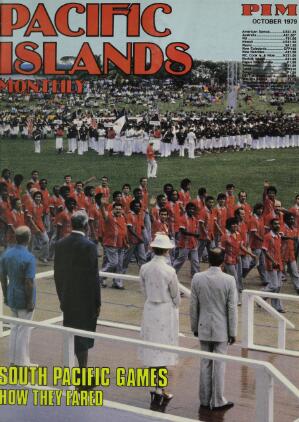
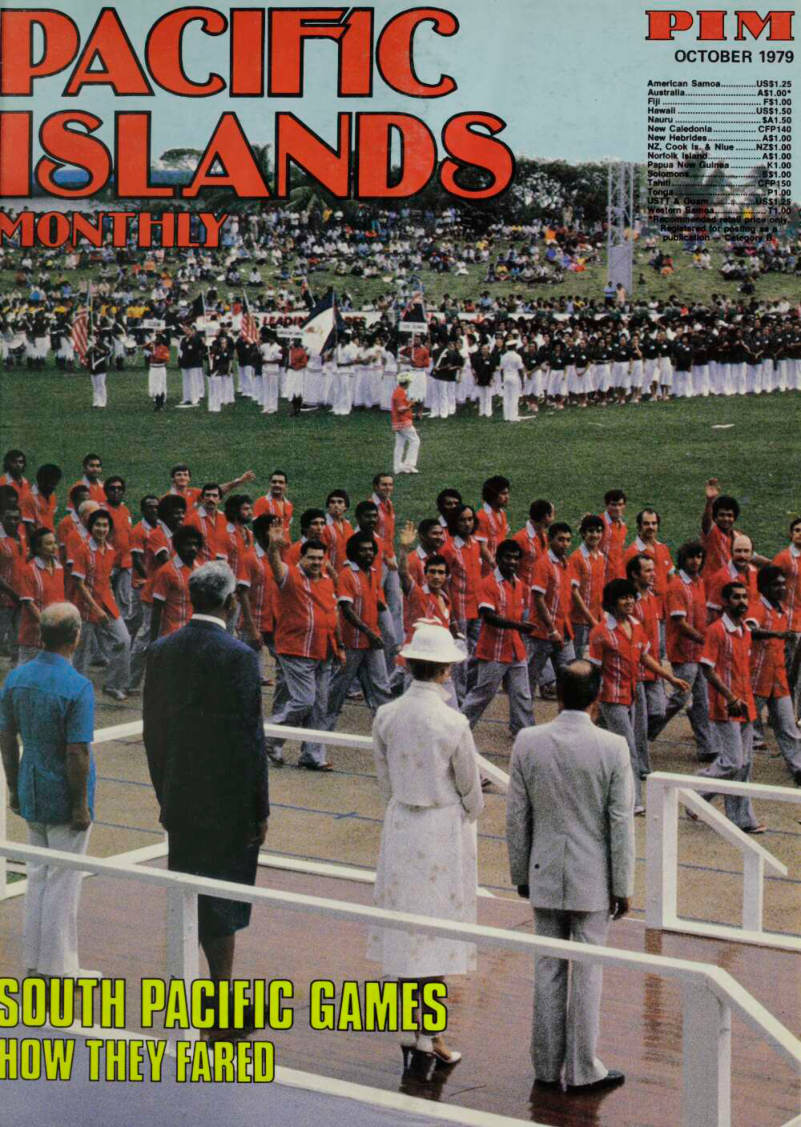
Cover: Princess Alexandra opens the sixth South Pa cific Games in Fiji's National Stadium. Photo: Anne Livingston
Advertisements & other items, p. 2 (1 item)
Toyota
How to find a REAL economy car* When you look at a car billed as an economy
model, ask yourself a few questions.
What sort of fuel consumption can be expected?
Low? Good.
What about other operating costs? Oil, lubrication, that kind of thing. Low again? Great.
How about maintenance? The car has a low-breakdown record? You are definitely on the right track.
What is the average life of the car? Is it better than the average in your area? Super. That’s important in an economy car.
Now. How is the after service? Buying a car is not all in the price you know. Plenty of service outlets?
One economy car coming up. All you have to do is check the price. Then you can tell if you are really getting an economy car.
You will probably find, after asking these questions about town, that REAL economy cars come down to Toyota, the world’s economy car builder.
See Toyota first. Then you won’t have to shop around.
IHE HAPPY ECONOMIZER
TOYOTA STARLET
The car that says economy in every way.
And you will be happy for it. Big inside.
Small outside. Miserly with petrol.
Without sacrificing comfort. A good buy in an economy car even for Toyota.
W J i e £
PAPUA NEW GUINEA:
ELA MOTORS,
Scratchley Rd., Badili, P.O. Box 675, Port Moresby.
U.S. TRUST
TERRITORY: MICROL
CORPORATION,
P.O. Box 267, Saipan.
FIJI ISLANDS:
AUTOMOTIVE
SUPPLIES CO., LTD.,
G.P.O. Box 355, Suva.
AMERICAN SAMOA:
BURNS PHILP
(SOUTHSEA) CO., LTD.,
P.O. 1057, Pago Pago.
WESTERN SAMOA:
BURNS PHILP
(SOUTHSEA) CO., LTD.,
P.O. Box 188, Apia.
TONGA: BURNS PHILP
(SOUTHSEA) CO., LTD.,
P.O. Box 55, Nukualofa.
GUAM: ATKINS, KROLL
(GUAM) LTD., P.O. Box
6248, Tamuning.
NEW HEBRIDES:
NEW HEBRIDES
MOTORS, P.O. Box 18, Vila.
TOYOTA
SERVICE
TOYOTA
SOLOMON ISLANDS:
MENDANA
ENTERPRISES (5.1.)
LTD., P.O. Box 174,
Honiara.
TAHITI: NIPPON
AUTOMOTO, B.P. 342,
Papeete.
COOK ISLANDS:
COOK ISLANDS
TRADING
CORPORATION LTD.,
P.O. Box 92, Rarotonga.
NAURU ISLAND:
NAURU COOPERATIVE
SOCIETY.
GILBERT ISLANDS:
TARAWA MOTORS,
Box 36, Bairiki Tarawa.
NORFOLK ISLAND:
MOUNT PITT
(ENTERPRISES) LTD.,
P.O. Box 169
NEW CALEDONIA:
SOCIETE IMPORTATION
AUTOMOBILE DE
PACIFIQUE, Rond-Point du Pacific (Station Total) B.P. 438, Noumea.
The Toyota range includes: Toyota 1000, Toyota Starlet, Toyota Corolla, Toyota Celica, Toyota Corona, Toyota Cressida, Toyota Crown
Pacific Islands Monthly
Pim
Vol 50 No 10
October 1979
(Usps 952480)
Elsewhere: SAI6 Payment by personal cheque is accepted in Australian, US, New Zealand, UK and Fiji currency. For other remit tances please obtain a bank draft in Australian dollars made payable to the ANZ Banking Group, 88 Wentworth
Avenue, Sydney, Australia.
Representatives
AUSTRALIA: Distribution: NSW & ACT: Allan Rodney Wright (Circulation) Pty Ltd, PO Box 907, Darlinghurst, NSW 2010, Elsewhere: Gordon & Gotch (A/asia) Ltd, Box 40, PO, Rosebery, NSW 2018 Advertising Melbourne - Pacific Publications (Aust.) Pty Ltd, sth Floor, Alley Building, 75-77 Flinders Lane, Melbourne 3000, tele phone 63*0211, ext. 1565 Jeff Gates, ext 1858 Ida Pad gett; Brisbane D. Wood, Anday Agency, Box 1918, GPO, Brisbane 4001, telephone 44 3485. 44 1546: Adelaide Hastwell Media, PO Box 30, Glen Osmond, SA. 5064, 233 Glen Osmond Rd, Frewville, SA 5063, tele phone 79 1869 Perth Adrep, 62 Wickham St, East Perth, WA 6000, telephone 325 6359.
FIJI: Distribution and subscriptions Desai Bookshops.
PO Box 160, Suva, Fiji, telephone Suva 23036 Advertis ing - Fiji Times & Herald Ltd, 20 Gordon St, Suva, tele phone 312 111, telex FJ2124 FRENCH POLYNESIA; Distribution Hachette Pacifique, 10 Ave Bruat, Papeete, telephone 25610.
HAWAII, UNITED STATES: Distribution PIM. Hawaii, PO Box 22250, Honolulu, Hawaii 96822.
JAPAN: Advertising and subscriptions Universal Media Corporation, CPO Box 46, Tokyo, telephone 666 3036 NEW CALEDONIA: Distribution Depot Centre de Presse Michel Pentecost, CBP2, Noumea, telephone 27 2434, 27 4729 NEW ZEALAND: Distribution Gordon &-Gotch, PO Box 584, 2 Carr Road, Mt. Roskill, Auckland 4 Advertising International Media Representatives Ltd, PO Box 2313.
Auckland, telephone 795 487; 493 389, cables Intereps, Auckland Subscriptions Ross Haines & Son Ltd. PO Box 1289, Auckland, telephone 769 042 PAPUA NEW GUINEA; Distribution Robert Brown & Assoc., PO Box 3395, Port Moresby, telephone 25855 Advertising - PNG Post-Courier, PO Box 85, Port Moresby, telephone 21 2577 UNITED KINGDOM: The Herald & Weekly Times Ltd, 8-10 Clifford's Inn, Fetter Lane, London EC4A IBU, telephone 01 831 6041, telex London 21989.
UNITED STATES MAINLAND: Advertising Joshua B Powers Jr, Powers International Inc . 551 Fifth Ave New York, New York 100 017, telephone 867 9580, telex 236514 Subscriptions - PIM, Hawaii, 2812 Kahawai St, Honolulu, Hawaii 96822 Published monthly by Pacific Publications (Aust.) Pty Ltd and printed in Australia by Paramac, Alexandria, NSW.
Australian cover price is recommended retail only. Regis tered at the GPO Sydney for transmission by post as a publication category B Second class postage paid at Honolulu. Hawaii. Copyright c 1978 Pacific Publications
(Aust.) Pty Ltd.
Postmaster Honolulu: Send address changes to PIM Hawaii. PO Box 22250, Honolulu, Hawaii 96822.
Subscriptions
PIM is airfreighted to most subscribers and agents in the Pacific Islands and the United States Aust.
Other American Samoa $13 $US16 Australia $12 Canada $14 $US18 Cook Islands $13 Fiji $12 $F12 French Polynesia $14
Cfp 1700
Guam $13 $US16 Gilbert Islands $13 Hawaii $13 $US16 Japan $16 Y4500 Micronesia $13 $US16 Nauru $18 New Caledonia $14
Cfp 1700
New Hebrides $13 New Zealand $12 $NZ13.50 Niue $13 Norfolk Island $12 Northern Marianas $13 $US16 Papua New Guinea $13 K12 Solomon Islands $13 Tonga $13 Tuvalu $13 United Kingdom $15 £io US Mainland $14
Sus18
Western Samoa $13
This Month
• Sixth South Pacific Games A success, but will they be the last of the extravaganzas? Results in full 9 • Cook Islands The curtain falls at last on the long running conspiracy trial drama 20 • Papua New Guinea The third parliamentary chal lenge in 13 months to Michael Somare’s leadership is easily beaten off 22 • Western Samoa Tupuola Efi survives the gravest challenge yet in his brief but remarkable career.. . 22 • Moruroa Atoll More on the fatal accident of July 6, and the nuclear explosion of July 25 23 • Palmyra Atoll ‘Paradise is not for sale’, the Fullard- Leo family tells Washington 23 • Fiji-A close look at the way Fiji’s tourist industry is headed 25 • Australia in the Pacific An overview of the Aus tralian presence, and reports from correspondents on the spot 31 • Agriculture Papua New Guinea faces big problems in growing import-substitution foodstuffs 79
Afterthoughts 66 Australia in the Pacific 31-60 Books 63 Cook Islands 20, 50 Deaths 87
Fiji 25, 45, 70
French Polynesia 23, 58 Islands Press 75 Letters 4 Lord Howe 71 Micronesia 63, 71 New Caledonia 54 New Hebrides 54 New Zealand 70
Pacific Report 7 Palmyra 23, 27 Papua New Guinea 22, 66, 79 People 67 Political Currents 22 Shipping Services 87 Solomon Islands 49-52, 63, 79 South Pacific Games 9-19 Tonga 53, 70 Tradewlnds 79 Tradewlnds Intelligence 81 Travel 25-29 Tropicalltles 70 Western Samoa 22
Yachts 83
The Cooks’ Sir Albert Henry ... ‘You’ve let your people down,’ said the judge
Western Samoa’s Tup uola Efl ... a grave chal lenge survived
Advertisements & other items, p. 3 (1 item)
3
’ACIFIC ISLANDS MONTHLY - OCTOBER, 1979
Founded 1930 by R. W. Robson Publisher Stuart Inder Editorial Adviser John Carter Manager John Berry A Pacific Publications production 76 Clarence Street, Sydney 2000 GPO Box 3408 Sydney 2001 Cables: PACPUB Sydney Telex: Pacpub 21242 Telephone: Sydney 29 6693
Letters
Questions for
Air Niugini
After reading with interest your, to me rather uncritical, survey of aviation in the Pacific
region (PIM July), perhaps you
will permit me to point to the other side of the coin - at least as far as one of the carriers is concerned - and tell your readers about Air Niugini, the airline that is never on time.
Being one of its constant vic tims, I am not out to slight this airline, its management or its staff. I would also resent suggestions that I pick on one particular airline in the region, being fully aware that here in PNG with our ‘Melanesian ways’, efficiency in the com
plex operations business of
modem air travel is not easily achieved.
But in the case of Air Niugini the old adage of ‘Enough is
Enough’ must surely apply.
Only by spreading criticism
and making a wider public aware of this inefficiency can one hope for any improve ment. Smooth and glossy pulicity alone does not make an airline efficient, nor do profits. As air travel has be come every man’s mode of travel, it is essential that time tables are kept, or that at least every effort is made to keep them. In Air Niugini’s case it appears as if nobody cares, at least not the airline itself. Most times lateness of services are not even announced I guess because it means loss of face leaving the waiting travellers to sweat it out.
Naturally, every airline has inevitable emergencies and breakdowns (sometimes it’s the weather) which are beyond control and best intentions. But here in PNG we have a national airline which prides itself to be primus inter pares with the international airline fraternity, which runs sched ules where being on time is the exception, not the other way round. And this is no exagger-
ation, as any air traveller in this country will vouch for.
Unfortunately, most of us have learned to treat it as a bad joke and a fact of life here.
Business people have become cynical and resigned to it, although it upsets one’s rou tines and stomachs, given the lack of facilities at nearly all of our airports. That’s another saga as well. In Port Moresby at least one is lucky. The aptly
named good old Gateway
Hotel is close enough to amble across to for sustenance or a spot or two to drown one’s sor rows. If only Air Niugini would be smart or interested enough to put a TV monitor or a PA system there!
But it is the general flying and paying public that suffers, women and children in par ticular. And it is about time that a concerned criticism was levelled at Air Niugini in this respect, as it is not fulfilling its duties and obligations as a transport operator.
One asks oneself whether it is really necessary for this air line to run before it can walk.
Why must it try to play in the
big league, with tremendous
and rushed growth, and remaining ‘thin on the ground’? The problem with the airline is that it has too small a fleet to service the nation efficiently. Not to mention its efforts on the international scene. In its hungry effort to dominate aviation in this country, the management and
its policy are driving other car riers out of the air, but cannot fill the vacuum. Apart from other reasons, many times the whole day’s schedule is late be cause of problems with one air craft. Or a pilot has reached his legal flying hours limit because of delays and there is no re placement. Is that good for business or image, even for a
monopoly? And getting away
with it unscathed only because of an uncritical public?
Monopoly, high fares and
profits alone are not enough.
Nor is a good safety record.
So, through your publication
I should like to ask Air Niugini, its management and political masters, to have a good look at itself and at where it is going.
Would it not be better to admit to teething problems, and oper ational ones as well? Run less services, but provide the basic requirement of any transport operator be on time. PNG can’t afford and doesn’t need an airline that appears large and flies lots of fancy aircraft with glossy liveries, etc. It needs an airline that provides an efficient and reliable ser vice. Then we can be proud of it, no matter what its size.
PO Box 636
Lae Papua New Guinea
F. G. Iseke
Students: A word
from Julius Nyerere
Editor Bob Hawkins’ comment on ‘Students?’ PIM, July, was wise and timely, not only for Papua New Guinea, but also for other countries.
Students everywhere would do well to read the following message from the President of Tanzania, Julius Nyerere, which is displayed at the University of Dar es Salaam: ‘Those who receive this privi lege (of education) therefore have a duty to repay the sacri fice which others have made.
They are like the man who has been given all the food avail able in a starving village in order that he might have
strength to bring back supplies
from a distant place. If he takes his food and does not bring help to his brothers, he is a traitor. Similarly, if any of the young men and women who are given an education by the republic adopt attitudes of su periority or fail to use their
knowledge to help the develop
ment of this country, then they are betraying our Union.’
(Rev) Sydney Jacka
Region President (Australia, NZ, PNG), Reorganised Church of Jesus Christ of Latter Day Saints Protest from an
Aussie Fijian
As a Bilong befor in Salamaua/Wau/Bulolo 1934/ 37, you will know I have been a PIM reader for a long time.
I continued readership later in Fiji 1938/1961, and knew Mr Robson and met Judy Tudor in the old days in the Solomons and elsewhere, so I have an instinctive feeling about the
credibility of PIM reporting.
However I, as an Ocker, must confess to feelings of nausea (bel bilong me hot tomus) at such blatant blah emanating from your Mr Keith-Reid’s
pro-Kiwi, anti-Aussie garbage
in June issue entitled ‘Fiji Just like Home’.
I served in the Fiji Army 1939-53 and was close to Fijians and part-Europeans all 23 years I lived in and loved
Fiji, playing rugby, cricket,
boxing, fishing and being one
of them, so although it might be pardonable for you not to notice the de ni bulumakau in
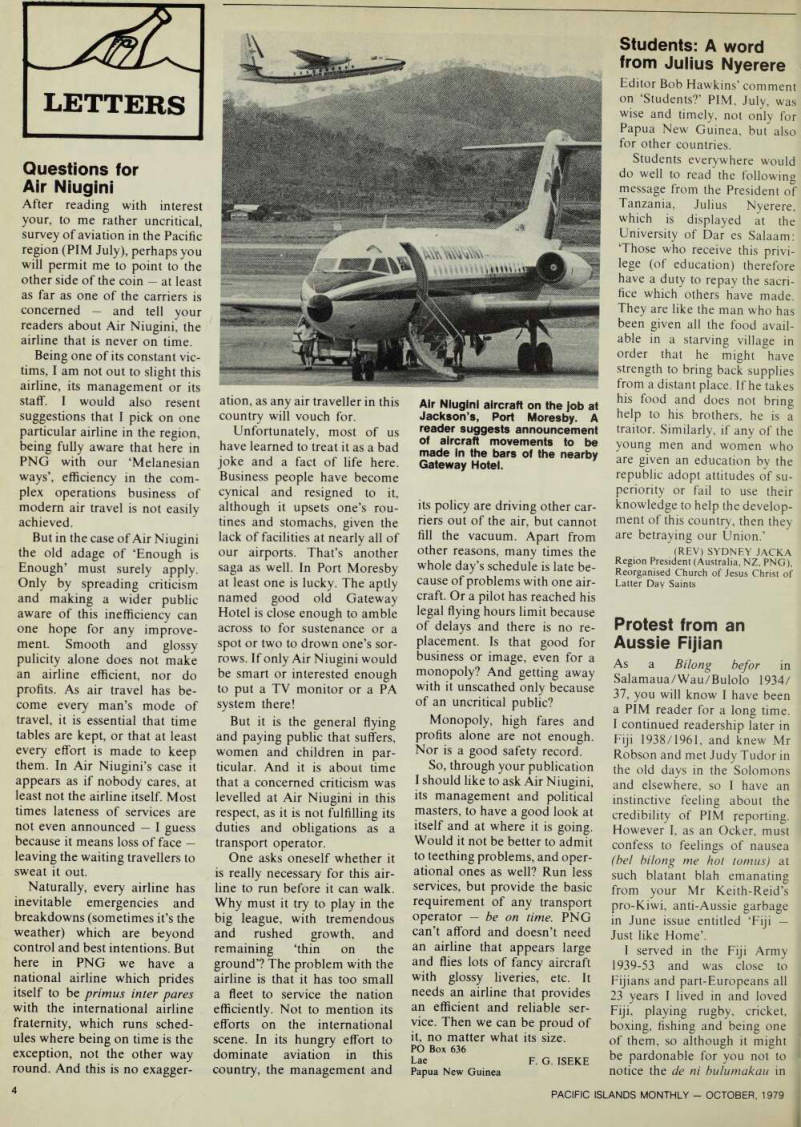
Air Niugini aircraft on the Job at Jackson’s, Port Moresby. A reader suggests announcement of aircraft movements to be made in the bars of the nearby
Gateway Hotel.
Keith-Reid’s article, it sticks out a mile to me, and any other
Aussie-Fijian.
As far as Fijians or part-
Fijians going to NZ and feeling
‘just like going home’ is con cerned, it was practically im possible for them to obtain an entry permit to ‘Godzone’, and the locals, far from considering Kiwiland as ‘an extension of
home territory’, quite defi
nitely resented the ‘barrier atti tude’ emanating from NZ Immigration officialdom. Past records going back 30 years will prove that barrier was very real and very effective in frus trating any Fijian ideas of im migration, and this is still the
case today.
I wonder if Mr Keith-Reid has ever heard the Fijian word macawa. It was a commonly used nickname for Kiwis par ticularly in Suva, where most Kiwis lived. It was both deris ive and quite derogatory as the rough translation means ‘no
account’, so the reported
brotherly love, etc, in his article is a little far-fetched, as Fijian
people are conservatively
minded, and I cannot credit they could have changed all that much. I, for one, read Mr
Keith-Reid’s ‘Song of Praise’
3f NZ efforts with a wry but unbelieving smile unless Mr K.eith-Reid is a Kiwi (is he?).
If he is, everything falls into.
Diace.
E. Mayo-Gaskell
~nd 9 'Jew Zealand Robert Keith-Reid is English born. Now in his late thirties, he has lived in Fiji since boyhood.
- Ed, Pim.
3e more specific,
slease!
am a Pacific Islander and I am 'ery concerned about what ;ome New Zealand news papers publish on Pacific slanders working in New Zealand. Most of the time hese articles give a very bad mage of the Pacific Islands as i whole.
Often you read in New Zealand newspapers that Pa ific Islanders took part in a ight or did this and that. This
s really degrading. Why can’t
he papers be more specific?
Vhich Islanders did all that?
Vhich country did they come rom?
I am not a racist but I would like to point out that only Tonga, Samoa, Niue, Tokelau, Cook Islands and Fiji have many of their people working in New Zealand. Other coun tries like Solomon Islands, Papua New Guinea, New Hebrides, Tuvalu, Kiribati and others hardly have any of their
people working in New
Zealand. Why is it that they have to suffer under the name Pacific Islander when it is someone from another country who causes trouble in Auckland?
New Zealand newspapers and their reporters to other papers must be more specific when dealing with Pacific Islanders in New Zealand.
Please don’t just class all Islanders as troublemakers be cause that isjust not true. There are only a few Pacific Island countries who have citizens in New Zealand, not all Pacific Island countries.
Clarence Marae
University of PNG Port Moresby
In quest of
Goss china
Some of your readers may have vases, cups and saucers, models and other ornaments on their shelves with the mark of W. H.
Goss on the base, and have
possibly wondered where they
originally came from.
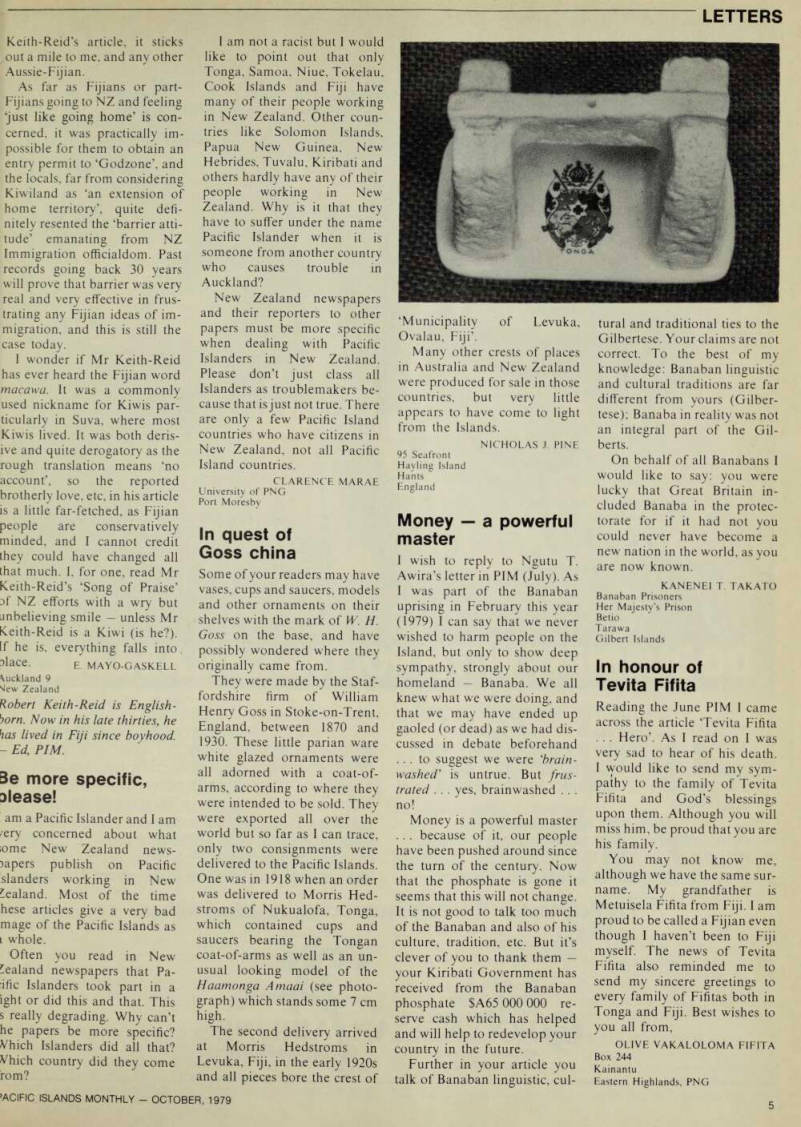
They were made by the Staf fordshire firm of William Henry Goss in Stoke-on-Trent, England, between 1870 and 1930. These little parian ware white glazed ornaments were all adorned with a coat-of arms, according to where they were intended to be sold. They were exported all over the world but so far as I can trace,
only two consignments were
delivered to the Pacific Islands.
One was in 1918 when an order was delivered to Morris Hed stroms of Nukualofa, Tonga, which contained cups and
saucers bearing the Tongan
coat-of-arms as well as an un usual looking model of the Haamonga Amaai (see photo graph) which stands some 7 cm
high.
The second delivery arrived at Morris Hedstroms in Levuka, Fiji, in the early 1920 s and all pieces bore the crest of
‘Municipality of Levuka,
Ovalau, Fiji’.
Many other crests of places in Australia and New Zealand were produced for sale in those countries, but very little appears to have come to light from the Islands.
Nicholas J. Pine
95 Seafront Hayling Island Hants England
Money a powerful
master I wish to reply to Ngutu T.
Awira’s letter in PIM (July). As I was part of the Banaban uprising in February this year (1979) I can say that we never wished to harm people on the Island, but only to show deep
sympathy, strongly about our
homeland Banaba. We all knew what we were doing, and that we may have ended up gaoled (or dead) as we had dis cussed in debate beforehand ... to suggest we were ‘ brain washed ’ is untrue. But frus trated ... yes, brainwashed .. . no!
Money is a powerful master ... because of it, our people have been pushed around since the turn of the century. Now that the phosphate is gone it seems that this will not change.
It is not good to talk too much of the Banaban and also of his culture, tradition, etc. But it’s clever of you to thank them your Kiribati Government has received from the Banaban phosphate SA6S 000 000 re serve cash which has helped and will help to redevelop your country in the future.
Further in your article you talk of Banaban linguistic, cul
tural and traditional ties to the Gilbertese. Your claims are not correct. To the best of my
knowledge: Banaban linguistic
and cultural traditions are far different from yours (Gilber tese); Banaba in reality was not an integral part of the Gil berts.
On behalf of all Banabans I would like to say: you were lucky that Great Britain in cluded Banaba in the protec torate for if it had not you could never have become a new nation in the world, as you are now known.
Kanenei T. Takato
Banaban Prisoners Her Majesty’s Prison Betio Tarawa Gilbert Islands In honour of
Tevita Fifita
Reading the June PIM I came across the article ‘Tevita Fifita . . . Hero’. As I read on I was very sad to hear of his death.
I would like to send my sym pathy to the family of Tevita Fifita and God’s blessings upon them. Although you will miss him, be proud that you are
his family.
You may not know me, although we have the same sur
name. My grandfather is
Metuisela Fifita from Fiji. I am proud to be called a Fijian even though I haven’t been to Fiji myself. The news of Tevita Fifita also reminded me to send my sincere greetings to every family of Fifitas both in Tonga and Fiji. Best wishes to you all from,
Olive Vakaloloma Fifita
Box 244 Kainantu Eastern Highlands, PNG
Advertisements & other items, pp. 5-6 (2 items)
Letters
5
’ACIFIC ISLANDS MONTHLY - OCTOBER, 1979
€) Polynesian^Virlines
■ IT
g£»lO(«
% IP €■> «£A <» :-S
AIV
S
i: *ir
m r
rfTrTTTTT
YNESIAN AIRLINES.
DO BUSINESS Wl
When the time next comes for you to fly out to do business fly Polynesian Airlines. Polynesian really understands the businessman’s requirements for a quick and efficient service between all Polynesian countries.
In fact, part of the reason we established our first service (Apia Pago Pago) back in 1959 was to meet the business sector’s demand for a fast and frequent service between the Samoas.
Since then Polynesian Airlines has spread its wings. Today our extensive route network covers the whole of Polynesia east of Fiji and now extends down to Auckland, New Zealand. And, as in ‘59 a lot of the people we’re carrying today are professional people. People who know that when it comes to flying anywhere in Polynesia on business there is only one airline. Polynesian Airlines, Fly Polynesian. It’s a pleasure doing business with us.
Offices in: Auckland, Tonga, Niue, Rarotonga.
Box 599 Apia, Western Samoa, Ph 21261.
WESTERN SAMOA
AMERICAN
SAMOA
RAROTONGA
€) POLYNESIAN^VIRLINES
Nandi Airport, Nandi Ph 72733.
We are Polynesia.
Pacific Report
Png Justice Minister Gaoled
In a move likely to have far-reaching repercussions on relations between government and judiciary in Papua New Guinea, the country’s Justice Minister, Mrs Nahau Rooney, was sentenced to eight months imprisonment in September by four Supreme Court judges. She faced three charges of contempt of court.
As PIM went to press, it was announced that the Somare Cabinet, which throughout was united in support of Mrs Rooney, had freed her after one day in gaol.
Curtain Rung Down On Cooks Trial
The curtain was finally rung down on the Cook Islands’ long running conspiracy trial drama on August 20. Licking their wounds along with some lesser fry are the Cooks former premier of 13 years, Sir Albert Henry, and New York millionaire Finbar Kenny. While there was speculation in New Zealand that, following his conviction, Sir Albert might lose his knighthood, he showed he has not lost his fighting spirit by announcing his intention to appeal against a three-year ban on his political activity handed down by the trial judge, Mr Justice Beattie. (Full report, p 20.)
Tupuola Efi Survives
Western Samoa’s Prime Minister Tupuola Efi has survived in office by winning three of the four seats contested in vital August by-elections. Results in the seats in February’s general elections had been declared void following charges of corrupt practices. [Political Currents.)
Somare Beats ‘No-Confidence’ Bid
D apua New Guinea’s Prime Minister Michael Somare in Sep :ember easily survived the third opposition attempt in 13 months :o overthrow him. His government won a parliamentary vote on a motion of no-confidence by 63 votes to 34. (Political Cur ents.)
\ Republic In New Hebrides
t is expected that the constitution of the future republic in the view Hebrides will be finally established at a conference to be leld in Vila at an early date. It is also hoped that election arrange nents will be sufficiently advanced to meet the tentative election late of October 17 set by the Government of National Unity.
Palmyra Owners Won’T Sell
he Fullard-Leo family of Honolulu, owners of Palmyra Atoll vhich has been studied by US government authorities as a posa ble site for a spent nuclear fuel dump, have flatly turned down ©ported US Government offers to buy the atoll for an alleged )rice of SUSIB million. Their refusal was based on environmental
jrounds. (Political Currents.)
Rhe Rise Of Donald F. Mchenry
he man who wrote Micronesia: A Trust Betrayed, a highly criti :al study of American administration in Micronesia, was ippointed by President Carter in September as the new US am >assador to the United Nations, following the resignation of Andrew Young. The new ambassador, Donald F. McHenry, had >een Mr Young’s deputy since 1976.
Australia’S Aid To Pacific Up Again
he Australian Government is committing $B4 million in aid funds d the countries of the South Pacific over the next three years, rise of $2l million over the previous three years. Bulk of the lew expenditure commitment would go towards projects in Fiji onga. Western Samoa. Tuvalu, Kiribati, Solomon Islands, New lebrides, Cook Islands and Niue. (See Australia in the Pa ific.)
■Urope’S $2.9 Million For Fiji
he Commission of the European Communities decided in august to grant an additional SFBOO 000 to help repair damage aused by hurricane Meli. The amount brought the com lission s total commitment to Fiji, following hurricanes Fay and
Meli, to $2.9 million. The funds go primarily to rebuilding schools and houses, a job which is already well under way under the Prime Minister’s Hurricane Relief Committee.
Noumea Symposium On Marine Riches
A symposium on the exploitation of marine resources in the French Pacific territories was held in Noumea on September 16-20. Describing the possibility of exploiting these resources as ‘a blessing for the economies’ of the territories, an official release said that representatives of the French Government’s inter-ministerial mission of the sea, scientific organisations active in the territories, senior officials in charge of territorial economic activities and private businessmen took part. The sym posium was presided over by Paul Dijoud, secretary of state for overseas departments and territories.
PAN AM TO PULL OUT OF SOUTH PACIFIC Pan American, the first international airline to operate commer cial flights to American Samoa (beginning 1959), plans to quit the South Pacific routes from October 29. Pan Am recently filed an application with the US Civil Aeronautics Board to allow them to discontinue the Honolulu to American Samoa and Los Angeles-Tahiti routes. No reasons were given for the airline’s decision.
Development Parley In Canberra
Representatives of South Pacific island countries and small islands in the Indian Ocean met in Canberra in September for a conference sponsored by the Australian National University’s Development Studies Centre. The main resolution urged further studies into problems of mobilisation of finance, diversification of source of earning foreign exchange, and the overall problem of the viability of the economies of small island states.
SIDNEY GROSS: CHEQUE IN HAND TO TUVALU California businessman Sidney Gross has visited Tuvalu to make personal delivery of a cheque for more than $3O 000 as the first interest payment on Tuvalu’s $5OO 000-plus investment with.his company Blue Chip Realty Investment (PIM May, September)
Non-Visitors Only Permitted
The lawyer for six Tahitians imprisoned at Fresnes, France, for a bomb attack on Papeete’s telephone exchange and the murder of a French businessman (PIM April) has demanded that they be allowed visitors other than members of their family - who are in Tahiti and unable to travel to France.
Fasi Calls For A Boycott
Mayor Frank Fasi of Honolulu called in September for a boycott of the sixth Pacific-Asia Congress of Municipalities in Adelaide, Australia. Mr Fasi, founder and first life-member of PACOM, made the call in protest at the Australian Government’s attitude to the delegation from Taiwan. The government had announced that they would not be admitted to Australia unless they signed a declaration that they were not representing the Taiwanese government.
Tulagi Makes A Catch
Solomon Islands’ police patrol boat Talagi, a gift from Australia, has apprehended a Japanese long-line trawler fishing 10 nauti cal miles off the Santa Ysabel coast. Captain Nubuyoshi Sakae was fined a total of $l5 000 in Honiara court in August for offences under the Fisheries Act. The High Court also ordered the confiscation of 45 tonnes of fish found on board the ship, Hokai Maru No 11.
Controls For Fiji’S Press?
Fiji’s Acting Prime Minister Ratu Sir Penaia Ganilau said in August that the country’s newspapers may have to be controlled if they continued to ‘distort’ government statements by not publishing them in full. The Minister of State for Information Ratu William Tonganivalu said Singapore’s tough press control laws were appropriate for Third World countries like Fiji.
Suva Gaol’S Over-The-Wall Experts
Suva Gaol had a rash of prisoner escapes in August, beginning with a mass breakout by 20 prisoners. Most were recaptured within 48 hours, but four made a second escape from Suva Cen tral Police Station where they were being held before transfer
back to the gaol. Seven more prisoners escaped from the gaol a few days after the mass break-out. The appearance of seven escapers at Suva court was postponed when warders refused to enter the main cell block at the gaol to bring out the men because about 100 inmates had gone on a rampage. Controller of Prisons Wally Smith, recalled from holiday in Australia, blamed the escapes and gaol disorders on a shortage of prison staff.
Greek Ambassador To Png
The first ambassador of Greece to Papua New Guinea, Nicolas Diamantopolous, has presented his credentials to Acting Governor-General Kingsford Dibela.
Missile Launcher For Papeete
A French navy missile-launching patrol craft, La Combattante, is to join the armed forces establishment in French Polynesia.
It is expected in Papeete on November 5.
Saipan Hotel Sues Mobil
The Saipan Beach Intercontinental Inn has filed a SUS 3 million suit against Mobil Petroleum Co Inc over a series of propane gas explosions which rocked the hotel in July, injuring 10 hotel employees.
How Official Is Tahitian?
A November 1978 decision that Tahitian is the second official language of French Polynesian after French has been reaffirmed by Francis Sanford, vice-president of the government council.
His action followed complaints by local associations that they were having difficulties getting approval for their statutes drawn up in Tahitian. The high commissioner’s office announced that there was no objection to Tahitian-language statutes, provided they were accompanied by a version in French.
Upton Helps Lelean Memorial
Gordon Upton, Australian high commissioner to Fiji, has launched a $5O 000 fund-raising appeal to help the Lelean Mem orial School in Suva maintain and expand school buildings. He said it was ‘a most appropriate way of contributing to the well being of children in the International Year of the Child’. The school, which has a policy of racial and inter-community inte gration and is co-educational, is associated with the Methodist church.
A Peace Park For Betio?
Naotudu Fujihira, a cook with the Japanese navy in World War 11, wants to set up a peace park on Betio islet, Kiribati, to com memorate the Japanese and American servicemen who died in the fierce battle fought there in 1943. Mr Fujihira was stationed on Betio in 1943, and was transferred to Makin on September 25 just two months before the US attack on Betio, in which 4500 Japanese and 3500 Americans died. Only 17 Japanese survived the attack.
Nadzab Airport ‘A Great Pity’
In a statement in Papua New Guinea in August, Australian De fence Minister Jim Killen described the redevelopment of Nad zab airport as ‘a great pity’. The redevelopment, which cost $lB million of Australian public money, has left the airport unable to handle jumbo jets or even Boeing 7075, with a runway 30 metres narrower than the internationally accepted standard, and handling only seven flights a day by small planes. Nadzab is 50 km from Lae, which already has the busiest airport in
Png.
Thumbs Down On Torres Turtles
Australia’s multi-million dollar turtle farming project in the Torres Strait is to be closed after eight years’ operation. Minister for Aboriginal Affairs Senator Chaney said six years of research had shown that turtle farming could not become a viable business.
The minister said his department would be transferring funds from the turtle project to an emu farming project at Wiluna, West ern Australia, and a crocodile farming scheme at Edward River, Queensland.
Regular Defence Parleys For Oz, Png
Papua New Guinea and Australia are to have regular annual ministerial discussions on questions of defence. The decision
was reported in a communique issued following talks in PNG between Australian Defence Minister Jim Killen and his PNG counterpart Gai Duwabane.
A Franco-Australian Adventure Comedy
The Australian Film Commission and France’s Centre National de la Cinematographie are considering co-production of a film set in the New Hebrides. The film is to be directed by French born Henri Saffran, who lives in Sydney, and directed the inter nationally successful Australian film Storm Boy. The proposed film is an adventure comedy based on the true story of the cre ation of an airline.
Fiji Thinking Big On Cassava
A $2O million scheme to turn cassava into engine fuel could be cutting Fiji’s petrol needs by nearly 20% by late 1981. At least five overseas companies, including a big multi-national fuel firm, are interested in intense cassava cultivation on about 4000 ha of land in Viti Levu and Vanua Levu. Australia has meanwhile banned imports of cassava, ‘unless there is need for new genetic material’. Minister for Health Ralph Hunt said the ban had been imposed so that development of cassava as a fuel or source of food would not be jeopardised by disease brought in from elsewhere.
Japanese Make Film On Sir Maori
Four members of Nippon Hoso Kykai (NHK), the Japanese Broadcasting Corporation, are in Papua New Guinea to film a colour documentary on the life of Sir Maori Kiki, former deputy prime minister of PNG.
Amelia And A Silver Container
Aviatrix Amelia Earhart buried a silver container after she crash landed on a Pacific atoll, a witness has told Vincent Loomis, former US air force pilot who is searching in the Marshall Islands for the remains of Earhart’s plane (PIM September). Loomis hopes the witness may be able to lead him to the spot where the container is buried, and that it may shed light on the fate of Earhart and her navigator, Fred Noonan.
Usp In Kiribati, Cooks, Now
The Kiribati Centre of the University of the South Pacific was officially opened as part of the Kiribati independence cel ebrations in July. A few days later another new USP centre was opened in the Cook Islands. A similar centre was opened in Solomon Islands in November 1977.
Micronesia: Jobs For The Elderly
The US Trust Territory of the Pacific Office on Ageing has received SUS 449 000 from the US Department of Labor for em ployment of elderly Micronesians.
Taiwan-Fsm Fisheries Accord
An agreement permitting Taiwanese boats to fish in waters con trolled by the Federated States of Micronesia has been approved by a committee of the FSM Congress.
‘Country Outcasts’ In Png
Australia’s top Aboriginal country music group, Country Out casts, toured Papua New Guinea in August. The tour was arran ged by the Australian Arts Council as part of the lead-up to the South Pacific Festival of Arts to be held in PNG in June 1980.
Png Dancers In Cover-Up
Bare-breasted performers from Papua New Guinea’s Rabao Dancers group were forced to cover up before thev were allowed to give a lunchtime performance in the streets of Melbourne, Australia. The order, reluctantly imposed by Melbourne City Council’s arts officer, applied to men as well as women. The dancers told the press that the official had told them he could lose his job if there was a public outcry against their appearing topless.
Pearls Auctioned In Tuamotus
Four thousand cultured pearls produced by local co-operatives were up for sale at an auction at Takapoto, in the Tuamotus, French Polynesia. Tahiti jewel merchants were joined at the August auction by Japanese and American buyers.
Advertisements & other items, p. 7 (1 item)
7
*CIFIC ISLANDS MONTHLY - OCTOBER, 1979
Last Of The Super Games
Two-and-a-half-thousand play ers and officials in Suva for the Sixth South Pacific Games were too many by far even though Stan Brown and his army of organisers coped mag nificently with this five loaves and two small fishes predica ment, writes Bob Hawkins. The lesson has been learned but perhaps not well enough in time for the 1983 seventh shames in Western Samoa. With a competitor/official target of 1500 in mind, it seems a total 3f this magnitude could loom larger to tiny Apia than did 2500 to Suva. But first, back to his year’s sporting extrava ganza.
Naturally, in 12 days of shames, from the August 28
Dpening to September 8 closing
:eremonies, there were vhinges and groans, moments ?f bitterness and defiance, and he odd flash of pure
chauvinism. But, most import
ant, when the lonely late revel er had sung his last hurrah, not i word of serious justified dis ient was to be heard. Even the ~rench Polynesians whose
miforms were clearly labelled
fahiti had stopped corn gaining about the food and iccommodation.
Perhaps the supreme accol ide came from a Parisien who bllowed the games with a :ealously critical eye. What did
he think after it was all over? ‘Zee Games? Not bad, eh?’ he conceded. That, in the context of an ex-British colony’s efforts under French scrutiny, was not
faint praise.
We mustn’t overdo the con gratulations. There was the odd negative in overall perform ance - to which organisers
would freely admit. Perhaps
most obvious was the impetus (or lack of it) of track and field events in the magnificently upgraded National Stadium at Buckhurst Park. Without going into the hows of it, serious thought should be given over the next four years about concertina-ing stadium events to keep spectators involved. It
might even mean integrating
rugby and soccer with track events. The benefits would be
twofold happier, occupied
spectators; possibly a shorter,
more dynamic, cheaper
games.
The desirability of a tighter schedule came up time and
again with competitors and
officials. Obviously it needs a great deal of thought. And there are major problems to consider - like how often a boxer can front up to have his brain jolted around in a time span shorter than the Suva games’ duration. Stan Brown, who also is retiring president of the Fiji Amateur Boxing As sociation, has a few ideas on
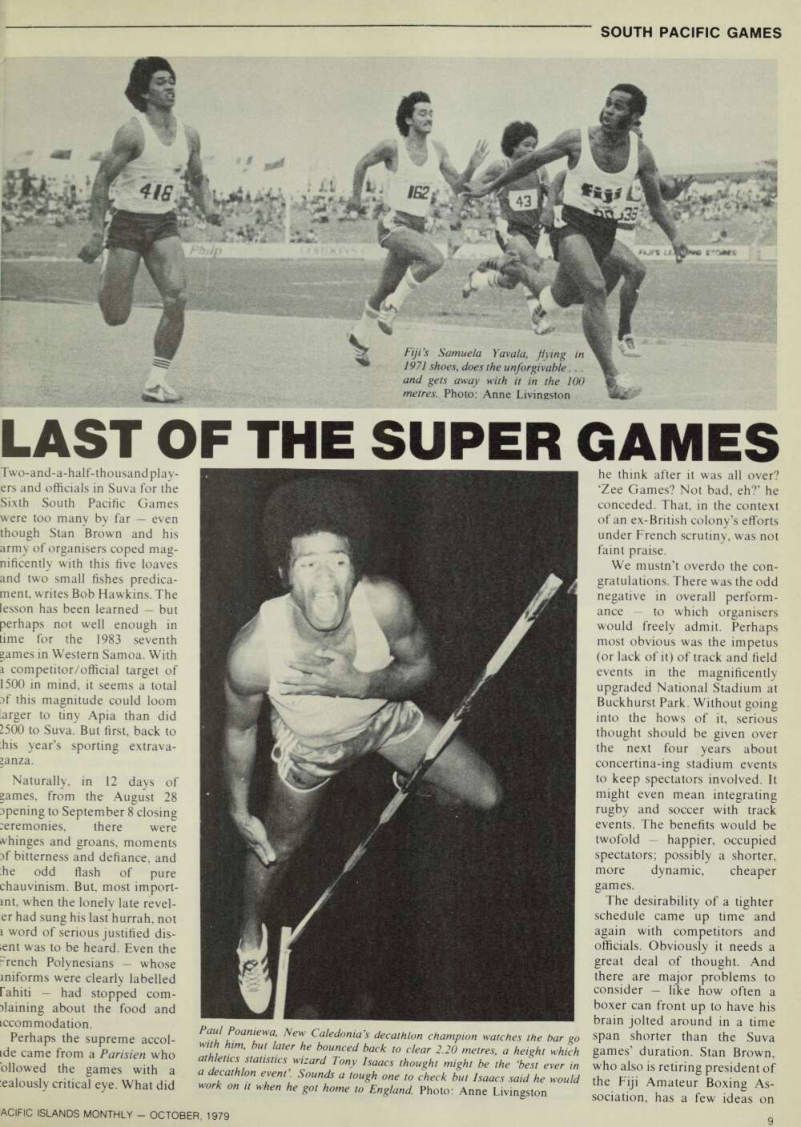
Fiji’s Samuela Yavala, flying in 1971 shoes, does the unforgivable ... and gets away with it in the 100 metres. Photo: Anne Livingston
Paul Poaniewa, Mew Caledonia’s decathlon champion watches the bar go with him, but later he bounced back to clear 2.20 metres, a height which athletics statistics wizard Tony Isaacs thought might be the ‘best ever in a decathlon evenl’. Sounds a tough one to check but Isaacs said he would work on it when he got home to England. Photo: Anne Livingston
that one (see Boxing, page 17).
Accommodation standards was another area in which it would have been pleasing to have seen an improvement.
But, honestly, what could have been done? Find 2500 spare beds? They didn’t exist in Fiji before the games. They don’t exist now. And they would have cost a mint to make.
The only egalitarian option
facing the organising com
mittee was to provide a floor space for one and all. After all, this was the Pacific - a place where money does not flow
exactly freely not Montreal,
where the long-term comfort of private householders was a prime consideration in the building of the Olympic Vil lage in 1976.
Food? Two-thousand-five hundred food boxes, three times a day, for a minimum of 12 days, adds up to a mountain of victuals and a fortune in cost. Each meal was prepared on scientific advice to meet the extra needs of the human body called upon to perform way above normal requirements.
When complaints began to roll in about the diet, the fruit con tent was increased. Compared to some Island diets, those boxes must have resembled a feast. But one would still sym pathise with the Tahitian who put it this way: ’We don’t mind sleeping on the floor. It’s our way, like many Islanders. But food? We eat more when we aren’t in training than we are getting here and here we are expected to give our every thing.’ But, not to worry about the French Polynesians. Word has it that almost every avail able hire car in Suva was snapped up by these affluent colony dwellers. And when the official diet proved unaccept able they all delved into their franc-laden pockets and ar
ranged a pick-up and delivery
service with a Suva Chinese
restaurant relying mainly on
snap-cooked vegetables to pro
vide them with the sustenance
they felt they were lacking.
Perhaps the most niggling
games issue but one which aggravated only a few teams and individuals was the question of eligibility. It was perhaps a measure of the
bloody-minded officiousness
which tends to characterise sports officials (especially of amateur bodies) worldwide, that an Islander could actually be prevented from competing in his own games.
Outstanding Tongan athlete
Senitisi Latu, who had spent most of the previous year living in Melbourne, Australia, was barred on residential grounds from performing by the sheer cussedness of 16 of the 30 who voted at a Suva meeting of the games council. They fell back on rule 19 of the council’s char ter which, over the years, as a consequence of amendments, has become pure gobble dygook. I have read it. I have not understood it. I don’t think it can be understood because I don’t think it actually means
anything intelligible. Before
1983 it must be wiped from the
charter entirely and replaced
by a ruling which:
• allows Island-bom people, if they still hold any kind of Island nation or territory citi zenship even if they are not resident in the Pacific, to com pete in the games if selected for their national team; and • allows expatriate residents of
the Islands (that is people not born in the Islands) to compete as long as they satisfy a stated residential time requirement.
It should be as simple as that.
And, for that matter, the Miriama Chambaults of the Pacific should be allowed to compete for the team of their nationality, if they wish, not the team of the nation in which, by force of circumstances, they find themselves living.
There really isn’t much more to complain about. But from a
journalist’s viewpoint, most
frustrating was the problem
with competitors’ names. I would have been able to tell you much more about what went on at the games if I had been able to spend less time
identifying not just correct
spelling of names, but which was a given name and which was a surname. Once again there was a lack of consistency.
This matter needs serious con sideration in organising com mittee deliberations before 1983. Athletics and swimming results returns to the media centre were not bad at all. But from most other sports there was a general disregard of the fact that in many Island
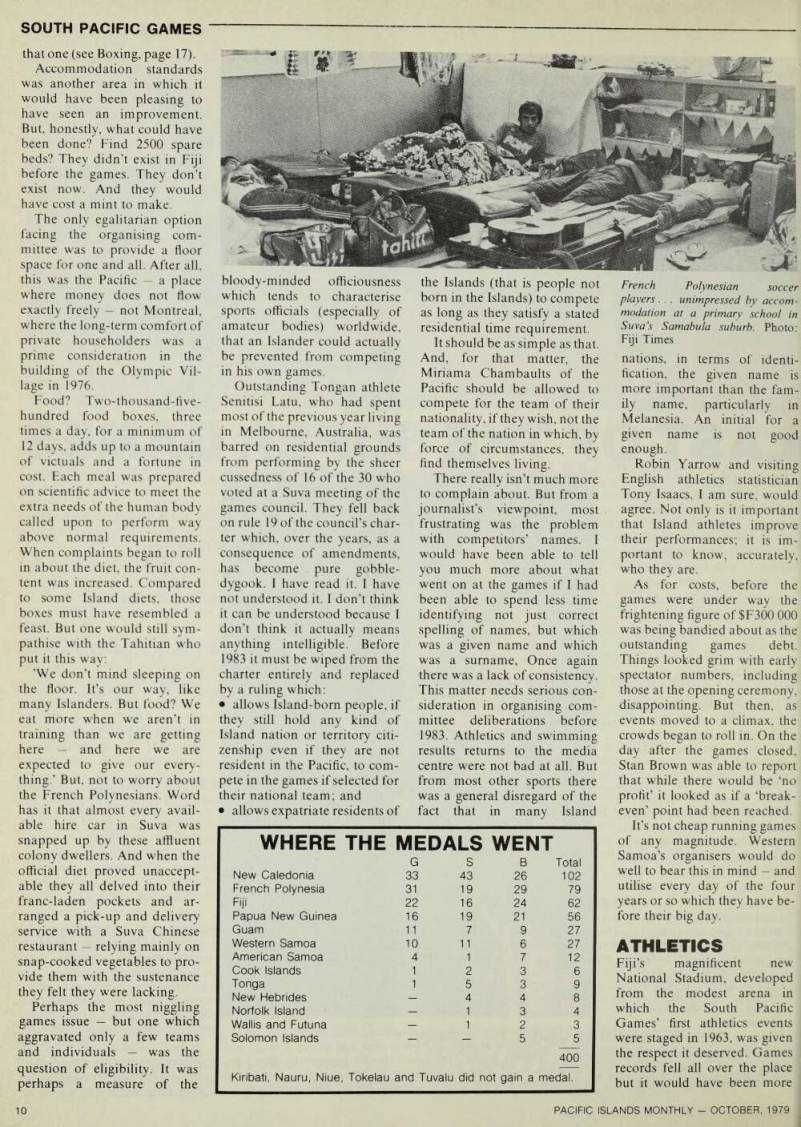
French Polynesian soccer
players. . . unimpressed by accom
modation at a primary school in Suva’s Samabula suburb. Photo; Fiji Times nations, in terms of identi fication, the given name is more important than the fam
ily name, particularly in
Melanesia. An initial for a given name is not good
enough.
Robin Yarrow and visiting English athletics statistician Tony Isaacs, I am sure, would agree. Not only is it important that Island athletes improve their performances; it is im portant to know, accurately, who they are.
As for costs, before the games were under way the frightening figure of SF3OO 000 was being bandied about as the outstanding games debt.
Things looked grim with early spectator numbers, including those at the opening ceremony, disappointing. But then, as events moved to a climax, the crowds began to roll in. On the day after the games closed, Stan Brown was able to report that while there would be ‘no profit’ it looked as if a ‘break even’ point had been reached.
It’s not cheap running games of any magnitude. Western Samoa’s organisers would do well to bear this in mind and utilise every day of the four years or so which they have be
fore their big day.
Athletics
Fiji’s magnificent new
National Stadium, developed from the modest arena in which the South Pacific Games’ first athletics events were staged in 1963, was given the respect it deserved. Games records fell all over the place but it would have been more
atisfying if there had been a ;reater spread of gold. How ever, the French domination of rack a id field, in the long run, an do nothing but good for sland competition. Even in his games, the challenge from
he super-fit, luxuriously
rained athletes of the French srritories spurred competitors rom elsewhere to give their verything to prove that, like 'lack, poor but independent is •eautiful.
When time for reminiscing omes along, which will be the ames that will come to mind mong those who gave their all t the 25 000 capacity stadium
i September 1979?
You really couldn’t go past dain Lazare - not just the larathon Man who romped ome in record time, seven linutes ahead of his nearest
rival, but the man from New Caledonia who cleaned up four other gold medals from 1500 to 10 000 metres including the 3000 metres steeplechase and a silver in the 800 metres. A re markable performance in any class. • Or his team mate Brigitte Hardel who seemed to be in everything golds for the 100, 200 and 400 metres and silvers in the 100 metre hurdles, long jump and the 4 x 400 metres
relay.
• And then there was Jean- Claude Duhaze of French
Polynesia who triple-golded
with the shot put, discus and hammer. • And New Caledonia’s Yan nick Talon for his long and triple jump firsts; and Paul
Poaniewa who jumped high
enough for the gold and did everything right for the pen tathlon number one placing; and Miriama Chambault, the Fijian who hated winning her two golds 100 metres and
long jump for the territory in
which she now lives, New Caledonia; and Marie-Chris tine Sealeu of New Caledonia
shot put and discus; and the indomitable, irrepressible Dan niele Guyonnet of French
Polynesia who romped home
in the decathlon and soared up and away from everyone in the
high jump.
These are just a few of the names we will remember from track and field 1979. Then
there’s Guam’s Betty Boppart
who set a games record in the 3000 metres but got the head lines for her pre-sam run over the marathon course which she completed inside the time to qualify for the Boston mara thon in the US next April. They wouldn’t let her run against the men. Veteran 1971 400-metres winner Samuela Yavala of Fiji
donned his Papeete golden
running shoes and raced to the 100 metres gold this time. If
Five-gold-Alain Lazare from 1500 netres to marathon congratulates [?]ew Caledonia team mate Christele Barthelemy after her shock but [?]rilliantly-deserved 1500 metre vie [?]ry over Fiji favourite Rucila Radinibega. Photo Ann Living ston
They called her the ‘flying house girl'... New Caledonia's multi-medallist, Brigitte Hardel.
Photo: Anne Livingston
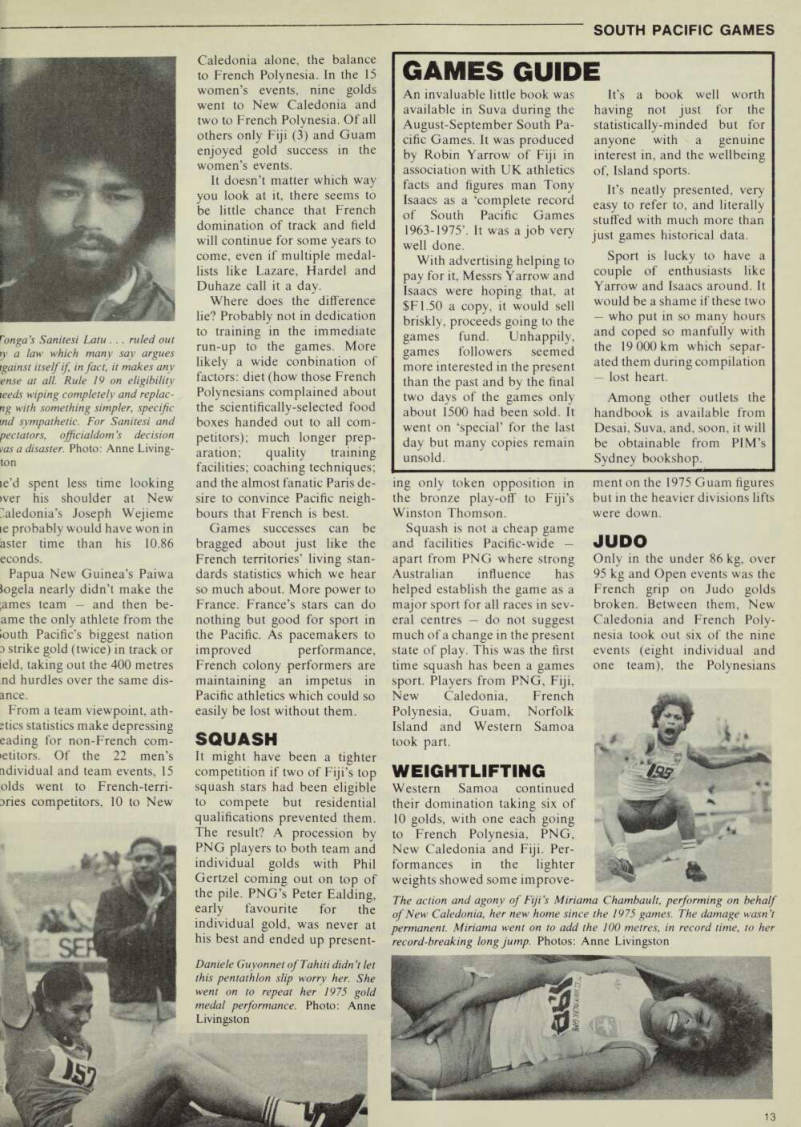
Guam’s Betty Boppart met enough red tape to make her gnash her teeth ... particularly when officials wouldn't let her compete in the men's marathon event. But they did relent to the extent of letting her start, in the dark, 80 minutes before the men on the last day of the games. And 26 miles 380 yards (for some reason the marathon remains imperial) and two hours 58 minutes 43 seconds later, fresh as a daisy, Betty had comfortably got inside the qualifying time for next year's big Boston marathon event in the United States. Photo: Anne Livingston
Papua New Guinea's Paiwa Bogela home free in the 400 metres hurdles... then he sprinted for a second gold over the same distance without the jumps. Photo: Anne Livingston
ed spent less time looking »ver his shoulder at New
Caledonia’s Joseph Wejieme
le probably would have won in aster time than his 10.86 econds.
Papua New Guinea’s Paiwa logela nearly didn’t make the ;ames team and then be ame the only athlete from the
louth Pacific’s biggest nation
d strike gold (twice) in track or ield, taking out the 400 metres nd hurdles over the same dis ance.
From a team viewpoint, ath
stics statistics make depressing
eading for non-French com •etitors. Of the 22 men’s adividual and team events, 15 olds went to French-terri 3ries competitors, 10 to New
Caledonia alone, the balance to French Polynesia. In the 15 women’s events, nine golds went to New Caledonia and two to French Polynesia. Of all others only Fiji (3) and Guam enjoyed gold success in the women’s events.
It doesn’t matter which way you look at it, there seems to be little chance that French domination of track and field will continue for some years to come, even if multiple medal lists like Lazare, Hardel and Duhaze call it a day.
Where does the difference lie? Probably not in dedication to training in the immediate run-up to the games. More likely a wide conbination of factors: diet (how those French
Polynesians complained about
the scientifically-selected food boxes handed out to all com
petitors); much longer prep
aration; quality training
facilities; coaching techniques;
and the almost fanatic Paris de sire to convince Pacific neigh bours that French is best.
Games successes can be bragged about just like the French territories’ living stan dards statistics which we hear so much about. More power to France. France’s stars can do nothing but good for sport in the Pacific. As pacemakers to
improved performance,
French colony performers are
maintaining an impetus in
Pacific athletics which could so easily be lost without them.
Squash
It might have been a tighter competition if two of Fiji’s top squash stars had been eligible to compete but residential qualifications prevented them.
The result? A procession by PNG players to both team and individual golds with Phil Gertzel coming out on top of the pile. PNG’s Peter Ealding, early favourite for the individual gold, was never at his best and ended up present
ing only token opposition in
the bronze play-off to Fiji’s Winston Thomson.
Squash is not a cheap game and facilities Pacific-wide apart from PNG where strong Australian influence has helped establish the game as a major sport for all races in sev eral centres do not suggest much of a change in the present state of play. This was the first time squash has been a games sport. Players from PNG, Fiji, New Caledonia, French Polynesia, Guam, Norfolk Island and Western Samoa took part.
Weightlifting
Western Samoa continued their domination taking six of 10 golds, with one each going to French Polynesia, PNG, New Caledonia and Fiji. Per formances in the lighter
weights showed some improve
ment on the 1975 Guam figures but in the heavier divisions lifts were down.
Judo
Only in the under 86 kg, over 95 kg and Open events was the French grip on Judo golds broken. Between them, New Caledonia and French Poly nesia took out six of the nine events (eight individual and one team), the Polynesians
[?] on go’s Sanitesi Latu ... ruled out [?]y a law which many say argues [?]gainst itself if, in fact, it makes any [?]ense at all. Rule 19 on eligibility
[?]eeds wiping completely and replac
ing with something simpler, specific
[?]nd sympathetic. For Sanitesi and
spectators, officialdom ’s decision
[?]as a disaster. Photo: Anne Living ton
Daniele Guyonnet of Tahiti didn ’t let this pentathlon slip worry her. She went on to repeat her 1975 gold medal performance. Photo: Anne
Livingston
The action and agony of Fiji’s Miriama Chambault, performing on behalf of New Caledonia, her new home since the 1975 games. The damage wasn’t permanent. Miriama went on to add the 100 metres, in record time, to her record-breaking long jump. Photos; Anne Livingston
playing second fiddle to New Caledonia which landed five gold, seven silver and three bronze.
French Polynesia’s tally was one gold, one silver and eight bronze. Guam’s Ricardo Bias in the over 95 kg and Open and Fiji’s Viliame Takayawa in the under 86 kg events broke the monotony.
Swimming
Better than ever before was the verdict of technical head John Gledding. What else could he say? In every event the games record was broken. More im portant, said Gledding, was that when news got out about what was going on down at Suva’s Olympic pool, swim ming became a spectator sport too.
Men’s team honours went French Polynesia’s way with seven out of 11 golds. Henri Noble, three individual golds, got the nod as the best men’s performer, but Guam’s Hollis
Kimbrough, also three golds,
can .ook back with immense pleasure on the day he slashed eight whole seconds off the 400 metres freestyle record.
In the women’s (?) events it was a much different story.
Without a superb all-round performance by New Cale
donia’s Patricia Legras (three
firsts) the French wouldn’t have had a look-in on the individual gold market. But the question mark is provoked by
water-babies Judy Macaskill of
Fiji and Trudy Chang of PNG.
Both 12, they took out two golds a piece. With Henri Noble, an ‘old man’ of 18, the swimming might as well be re labelled ‘boys’ and ‘girls’ with the ‘men’ and ‘women’ compet ing at their peril.
Volleyball
With a blend of strict disci
pline, power play and
individual brilliance, American Samoa methodically wrested control of men’s vol leyball, a sport which has been dominated in every games since 1963 by French teams. In 1963 and 1966 French Poly nesia were volleyball kings; in 1969, 1971 and 1975 honours went to New Caledonia.
Only in their first game, co
incidentally against the team
they were to thrash in the final, New Caledonia, did the Samoans drop a set. After that it was 3-0 right through to the gold medal. But the fighting spirit which, as usual, marked French territories’ per formances in all sports was there to the end in the men’s final. Trailing 15-6, 15-4, New Caledonia fought every inch of the way to a 15-11 third set de feat. French Polynesia had little trouble disposing of Guam 3-0 for the bronze.
In women’s volleyball, French Polynesia returned to the throne, having been edged out in the 1975 games by New Caledonia after taking the gold in 1966, 1969 and 1971. (Women’s volleyball was not played in the 1963 games.) New Caledonia were victims 3-1.
In an unbeaten run, French
Polynesia’s women dropped
only two sets.
American Samoa met much sterner opposition from Fiji in the play-off for the bronze be fore getting up 3-2.
Visiting volleyball official from New Zealand, Joseph Ang, described the men’s stan dard as ‘quite pleasing’ and, in comparison with the women’s showings, of a higher standard.
He felt that the pool system often criticised for forcing a likely silver winner into a bronze situation had not worked against the teams on this occasion in either men’s or
women’s competition.
American Samoa, New Caledonia and French
Polynesia stood out clearly
from the rest in the men’s com petition, he said, while in the women’s competition New Caledonia and French Polynesia were clearly the tops
with American Samoa some distance back in third place.
Ang paid special tribute, in the women’s competition, to Guam’s ‘small girls who played so well’ and Tuvalu’s girls for their courage in facing up to teams of much higher stan dards. He gave full marks for organisation.
Hockey
When Fiji romped home 4-1 against Papua New Guinea in the play-off for semi-final places it seemed the final would be a formality. The only question unanswered was who would miss out on a medal in this four-cornered contest Western Samoa or Solomon Islands such was the chasm between the standards of the top and bottom two.
As it turned out, Western Samoa proved too good against Solomons for the bronze and Fiji horrified their supporters before scrambling to a 2-1 golden victory over PNG after trailing 1-0 at half time.
It’s up to hockey to establish itself Pacific-wide or miss out on future Island and South Pa cific Games. Pacific hockey as sociations would be better to look to staging their own per iodic competitions. It seems they intend to.
Netball
Netball is to women’s basket ball what rugby union is to
rugby league. Statements like
that are likely to invite a punch in the face but it is a fact that league and women’s basketball have benefited enormously over the years by recruiting from union and netball re spectively. In the Islands, union
is barely affected by league
apart from those players who have been enticed away by Bri tain and Australia but net ball will always see a drain to women’s basketball. But the
stars keep coming and Fiji,
after behind-the-scenes drama, looked to schoolgirl Lusiana Delana for the big effort in overcoming Cook Islands in the match which decided the
gold.
The decider was much more clear-cut than the thriller be tween the two teams almost a week earlier which led to a Cooks protest. At full time in that match Fiji were leading
41-39 but Cooks claimed that the end had come 90 seconds early and won their point with competition officials.
They needn’t have bothered.
The re-match saw Fiji rub in their superiority with a comfortable 45-35 margin to take the gold. Papua New Guinea took the bronze.
A visiting umpire said she had seen some ‘very good net ball but it doesn’t last’. Fiji and Cooks were clearly the best teams followed some way be hind by PNG but there were ‘no others’.
This was the first compe tition since 1966 in Noumea when Cooks topped the com petition. In 1969 in Port Moresby PNG fielded a side and, there being no compe tition, was awarded the gold.
Basketball
Pacific Island basketball is
grouped along with New
Zealand and Australia in the Oceania zone for Olympic
competition but, according to
visiting technical officials, it will be some years before any Island national team can expect to give either Aus tralasian side a run for its money in the competition for an Olympic place. But Aus tralasia is doing its bit to push standards across the Pacific. As well as getting coaches into the region it is also working on ways to get foreign teams particularly from the United States which undertake tours in Australia and New Zealand to drop in for games with top Island basketballers.
A technical official from
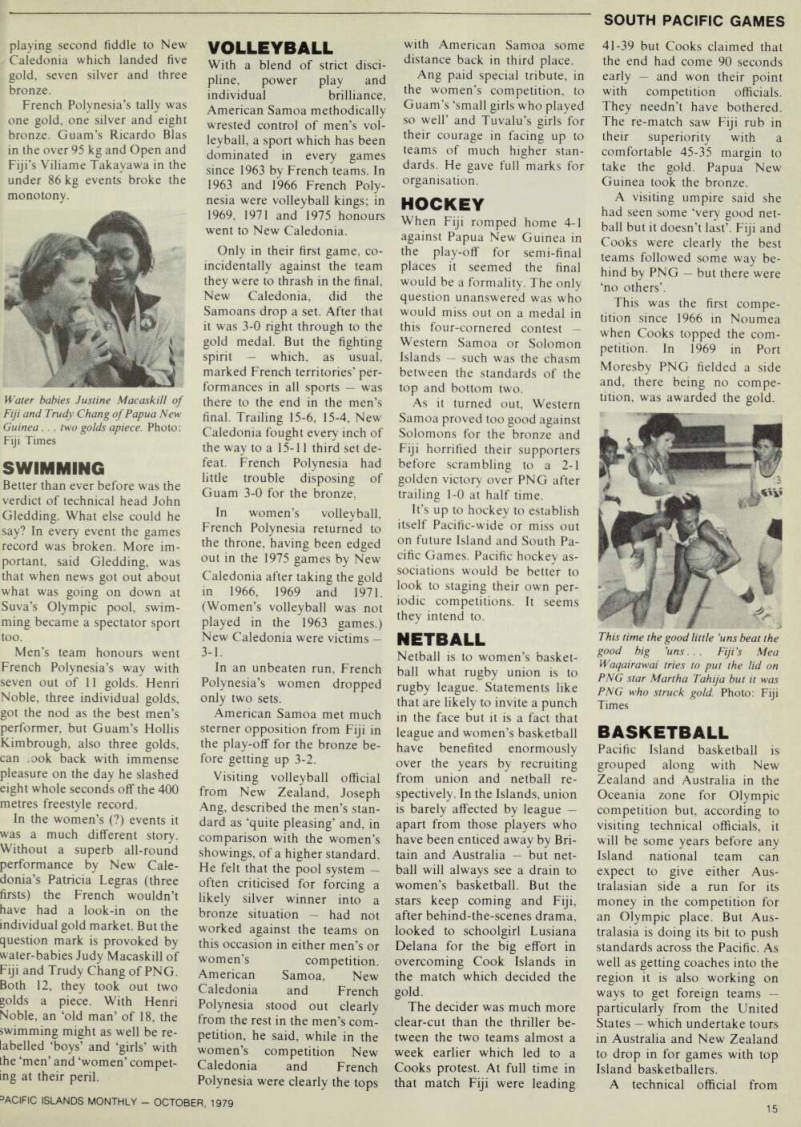
Water babies Justine Macaskill of Fiji and Trudy Chang of Papua New Guinea... two golds apiece. Photo: Fiji Times
This time the good little ’uns beat the
good big ’ uns... Fiji's Mea
Waqairawai tries to put the lid on PNG star Martha Tahija but it was PNG who struck gold. Photo; Fiji Times
New Zealand, Pat Neville, who assisted in coaching the Solomon Islands women’s team, gave this assessment of the state of basketball play in the Pacific: a top-rank of five teams (Guam, Tahiti, American Samoa, PNG and, with reservations, Fiji), with New Caledonia having ‘dropped back a bit’ in relation to the top teams, and then a long gap to Solomon Islands, Nauru, Northern Marianas and Western Samoa.
There could be no com plaints by either men or women in the final distribution of medals. Guam confirmed their ranking as top Island group but were kept on their toes by a talented French Polynesian combination before taking out the final 113-106 while American Samoa edged out Papua New Guinea for the bronze.
The women, as usual, played a purer if less dynamic basket ball than the men. There was no doubting the rights of PNG and Fiji to battle out the final.
However this proved some thing of a disappointment after a stirring earlier encounter be tween these teams which went into extra time before PNG made a winning break.
The final saw the shorter
PNG players cleverly outwit
the comparative Amazons of Fiji. When Tina Hazelman was conned into fouling herself off five minutes from time Fiji might as well have thrown in the towel. Piling on the press ure and penalty points, PNG were well clear at the end, 78-65.
But watch out for Fiji’s girls in 1983. There’s a wealth of teenage talent in the side, with Hazelman, if she can resist the urge to mix it with the oppo sition, and Julie Apted, the pick of the bunch. PNG’s was a fine team effort with Cecilia Mondumi, Kaia Kapa and Martha Tahija the spear heads.
Lawn Bowls
The ‘British’ game, played for the first time, attracted five starters Papua New Guinea, Fiji, Western Samoa, Cook Islands and Norfolk Island but there are hopes that Solomon Islands will become
interested. There’s even talk of a French connection in the not too-distant future.
This year honours were well
spread, all competitors taking
home at least three medals, Fiji with four golds in their tally of six and PNG with two golds in a total of seven. Men’s singles top honours went to PNG’s Tom Menton, but general ac
claim judged Fiji’s Maraia
Lum On as the overall star with
an impressive singles victory
and a pairs gold shared with
Willow Fong.
Cricket
Tonga probably are still won
dering how they came to topple
mighty Papua New Guinea in a game which had an amazing 10 LBW decisions. Set only 91 to win PNG crumbled before Vakavelo Kolotau’s medium pacers to a 17-run defeat.
And Tonga are still wonder ing how they came to be demolished in the semi-final by New Hebrides after an un beaten run. But that’s limited over cricket. One wonders if it is necessary for cricket to be on the South Pacific Games agenda. It is a spectacle in itself and would attract much bigger crowds if staged outside of the games.
Fortunately for PNG the Tonga match was the first of the competition and it had time to rally itself to a semi-final
placing against Fiji, the only
serious opposition. In the semi PNG’s players had to hold their breath as Fiji battled gamely to within 20 runs of the target 198.
The final, against New Hebrides, was a formality with
PNG overhauling the under dogs’ total of 53 with the loss of only one wicket.
The play-off for the bronze
found Fiji struggling again, this
time against Tonga who had hit up a formidable 183 for the loss of six wickets. At one stage Fiji were seven down for 160 but tail-enders saved the day, the host side earning the bronze with eight wickets down.
Western Samoa, Tuvalu and New Caledonia have a long way to go before they will be able to dent the medallists’ armour. Perhaps, by 1983, if cricket sneaks onto the Apia games list which it shouldn’t New Caledonia’s cricketing girls will have taught their men a googly or two.
Table Tennis
French domination in the men’s events continued with New Caledonia playing second fiddle to French Polynesia, everyone else being also-rans.
However, Fiji’s all-round depth in the women’s matches enabled them to retain superi ority in the teams event, an honour it has enjoyed since 1971. There was also gold for
veteran Fiji campaigners Akisi
Renner (a competitor since 1963) and Laisa Naivalulevu in
the women’s doubles, an event they won at Guam in 1975.
Tahiti’s Victor Lau was in
everything, systematically
disposing of New Caledonia’s Roger Lao Yan in the singles, and teaming with Felix Lieou Kui in the doubles and
women’s singles champion
Luana Trafton in the mixed doubles to take out those
golds.
Tennis
A double tum-up highlighted the French-dominated tennis competitions at Suva’s mag nificent five new all-weather Victoria Park hardcourts.
When New Caledonia’s 1975
singles gold medallist Gerard
Winter went down to French
Polynesia’s Philippe Rauzy in a
three-hour thriller in the final of the teams event, their singles re-encounter was awaited with intense interest. And, for a mo ment, it seemed Winter was to regain his crown when he romped to a 6-2 first set win.
But Rauzy then cleaned him up in the next two sets. Tennis is still markedly a French pre serve but its capital has moved from Noumea to Papeete.
Of the tennis golds only one did not go back to Papeete the men’s doubles title which, predictably, went to Noumea.
Yachting
Yachting golds in the previous
games always went to the host country - PNG in 1969, French Polynesia in 1971, Guam in 1975. But this year hosts Fiji were not in the hunt. ‘World class’ was one experi enced sailor’s description of the performance of French Polynesia’s crewmen in the seven Hobie Cat 16 races.
Gold winners, French Polynesia I (J. and N. Salmon), won four of the seven races and placed second in the other three. Silver w nners, French Polynesia 111 (D. Arnould and G. Sachet) won two races, placed second twice, third once and fifth twice. New Caledonia I (A. Mazoyer and N. Cale) took the bronze for consist ency, placing second twice, third three times and fourth twice. Papua New Guinea, overall fourth, came on strong toward the end of the racing, winning Race 7 and placing third in Race 1, which was
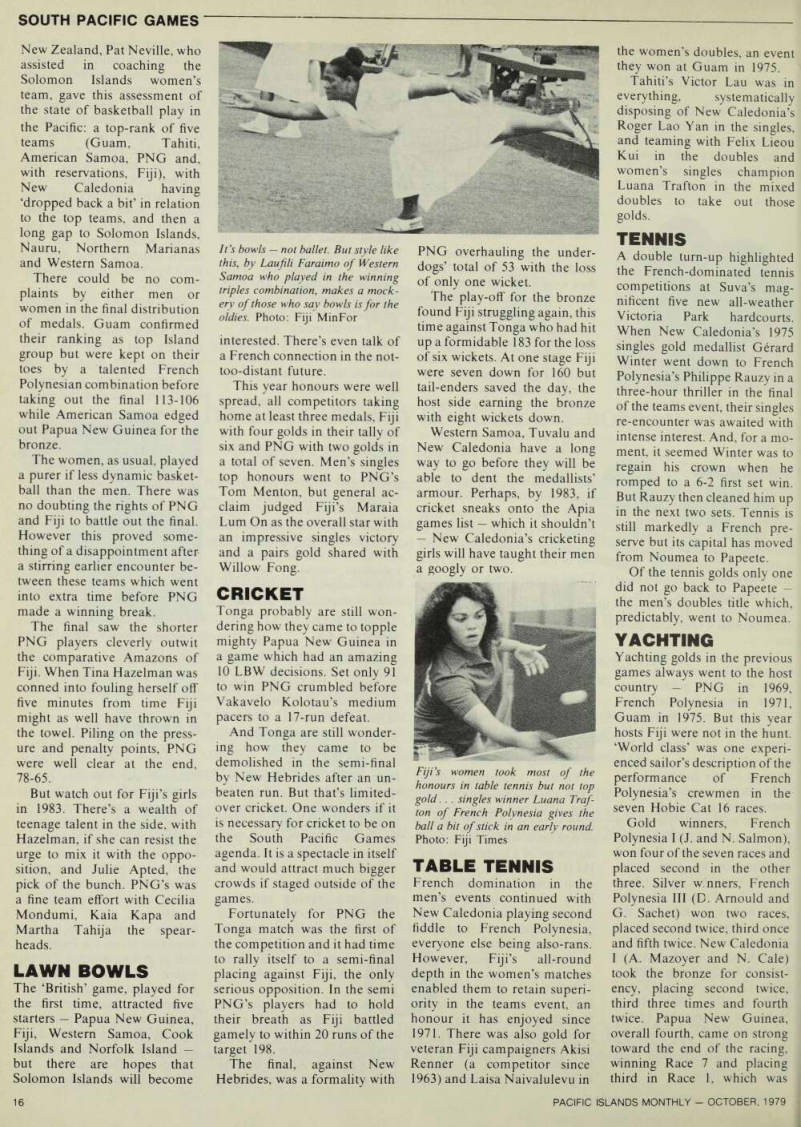
It’s bowls not ballet. But style like
this, by Laufili Faraimo of Western
Samoa who played in the winning triples combination, makes a mock ery of those who say bowls is for the oldies. Photo: Fiji Min For
Fiji’s women took most of the honours in table tennis but not top gold. . . singles winner Luana Traf ton of French Polynesia gives the ball a bit of stick in an early round.
Photo: Fiji Times
re-run as the final event after being abandoned earlier be cause no crew completed the course within the allowed
elapsed time.
Soccer
French criticism of the pool draws for soccer before the games started seemed, by the time the semi-finals were reached, to have some justifi cation. In a first semi-final thriller French Polynesia and New Caledonia matched each other move for move. The Tahitians, rather fortunately, won 3-2 and it looked as if New Caledonia had been unjustly relegated to bronze status. The
performances of Fiji and
Solomon Islands in the second semi-final did nothing to change this thinking. In an exciting but scrappy game Fiji got up 2-0 in extra time. Goals count but one got the feeling Solomon Islands would have provided better final oppo sition for French Polynesia.
As it turned out. New Caledonia did nothing in their play-off with Solomons to
suggest their superb perform
ance against French Polynesia was anything more than a flash in the pan. Apart from a precise execution of the offside trap which for some reason the Solomons’ forwards never countered - New Caledonia forfeited all claims to any kind of medal, submitting meekly to a 3-1 pounding.
In the final which followed, before a crowd estimated at around 20 000, there was little doubt as to which team was su perior, even though Fiji held the Tahitians to a draw until 10 minutes into the second half. It was a case of French discipline
and method against a hopeful,
physical, driving team of Fiji
individuals. That 55-minute E>oal which set French Polynesia on the path to de
served victory was the first Fiji
aad conceded in the whole ournament, an indication of low much was owed to a dour, irickwall defence for the host country’s place in the final. 50LF *or a while it looked like a
Jean Papua New Guinea
weep of the team events but
i bright start by PNG’s women
vas not maintained and
individual gold medallist Kim
Young spearheaded American
Samoa’s gold-winning team effort. PNG’s men never looked back and were still going away from the field in the final round.
In the men’s individual event it was a case of the master out mastered when teenager Kundi Umba tied with the man he used to caddy for, Phil Frame, and then went on to beat him at the fourth hole in a play-off.
Boxing
The finals line-up had Western
Samoans jumping eight in
with a golden chance. But, in the words of boxing director Hector Hatch, the ‘Western Samoans fought their hearts out in the semis while the others reserved themselves’. Of those eight Western Samoans only three struck out success fully for gold.
Stan Brown, chairman of the games organising committee and retiring president of the
Fiji Amateur Boxing Associ
ation, summed it up this way; ‘Like all finals, the boxers per formed less well in the finals ... At the end of 10 days of
competition they are tired, they
hurt, they’re bruised. You always get inferior boxing in the finals ...’
Boxing at this games, accord ing to Hatch, was much more rugged, a little less scientific.
Observing that even in the Olympics it is the aggressive boxer who usually comes out on top, Hatch said he thought some coaches, with little time to bring their men along, had concentrated on making the most of their natural abilities as
fighters.
Flatch’s pick of the bunch were Western Samoa’s Tanalai Folasi (welterweight) for his combination of technical skill and aggression, and Fiji’s Joe
Nitiva (light welterweight) who
‘picked his punches beautifully
and is a devastating hitter’.
Nitiva needed only one punch in each of his first two fights, and then bided his time in the final against Western Samoa’s Tuasiui Poto, not wasting a blow.
Hatch reckons the best boxer of the whole bunch, Anthony Naidu of Fiji, did himself out of the gold against American Samoa’s Douglas Westbrook by forgetting his skills and
fighting too aggressive a
bout.
While a track man might thrive on daily competition, a boxer needs time to recuperate and this factor vindicates a growing feeling that the games are too long, both from financial and spectator interest viewpoints. Stan Brown be lieves the way around this would be for the number of boxers allowed to compete in, say, an eight-day games, to be limited, resulting in fewer bouts in the run to the final.
The final gold count in the boxing showed a fairly even distribution of medals over the 11 divisions - Western Samoa three, Fiji. PNG and New Caledonia two each and American Samoa and French Polynesia one each.
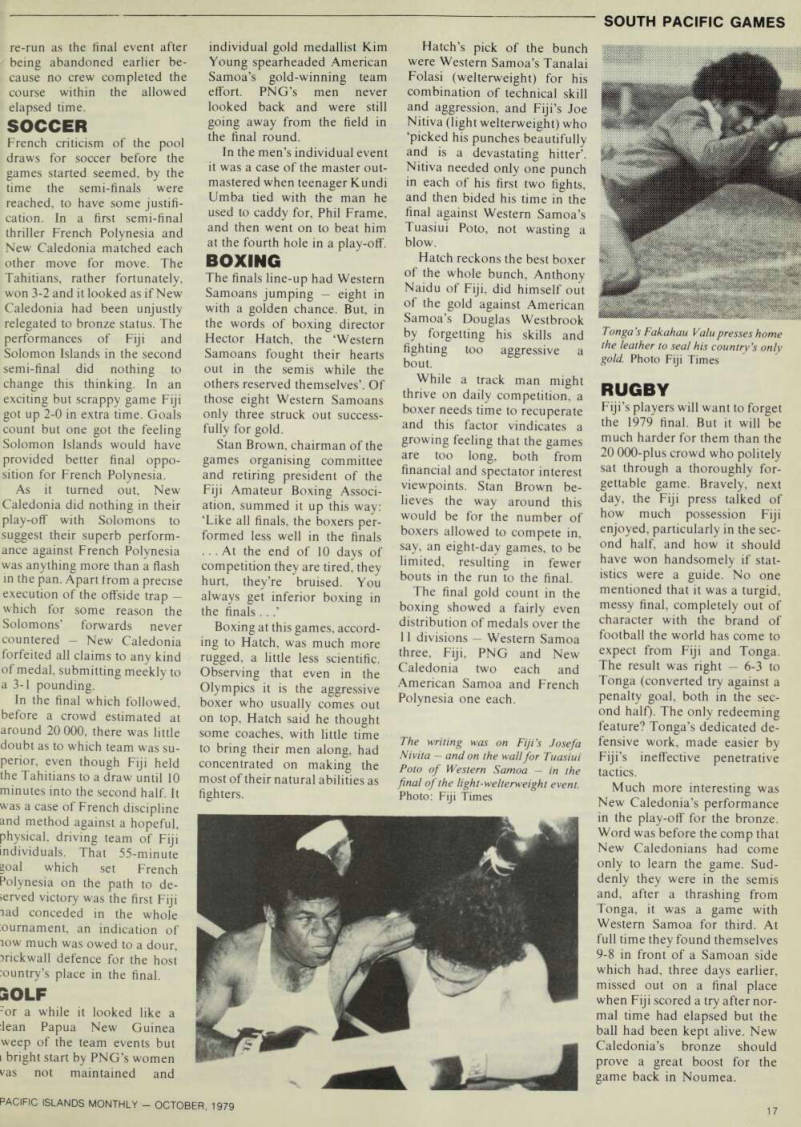
The writing was on Fiji's Josef a Nivita and on the wall for Tuasiui Poto of Western Samoa in the final of the light-welterweight event.
Photo: Fiji Times
Rugby
Fiji’s players will want to forget
the 1979 final. But it will be much harder for them than the 20 000-plus crowd who politely sat through a thoroughly for gettable game. Bravely, next day, the Fiji press talked of
how much possession Fiji
enjoyed, particularly in the sec ond half, and how it should have won handsomely if stat istics were a guide. No one mentioned that it was a turgid, messy final, completely out of character with the brand of football the world has come to expect from Fiji and Tonga.
The result was right 6-3 to Tonga (converted try against a penalty goal, both in the sec ond half). The only redeeming feature? Tonga’s dedicated de fensive work, made easier by
Fiji’s ineffective penetrative
tactics.
Much more interesting was New Caledonia’s performance in the play-off for the bronze.
Word was before the comp that New Caledonians had come only to leam the game. Sud denly they were in the semis and, after a thrashing from Tonga, it was a game with Western Samoa for third. At full time they found themselves 9-8 in front of a Samoan side which had, three days earlier, missed out on a final place when Fiji scored a try after nor mal time had elapsed but the ball had been kept alive. New Caledonia’s bronze should prove a great boost for the game back in Noumea.
Tonga's Fakahau Valupresses home the leather to seal his country's only gold. Photo Fiji Times
Advertisements & other items, p. 9 (1 item)
9
SOUTH PACIFIC GAMES
ACIFIC ISLANDS MONTHLY - OCTOBER, 1979
Where The Medals Went
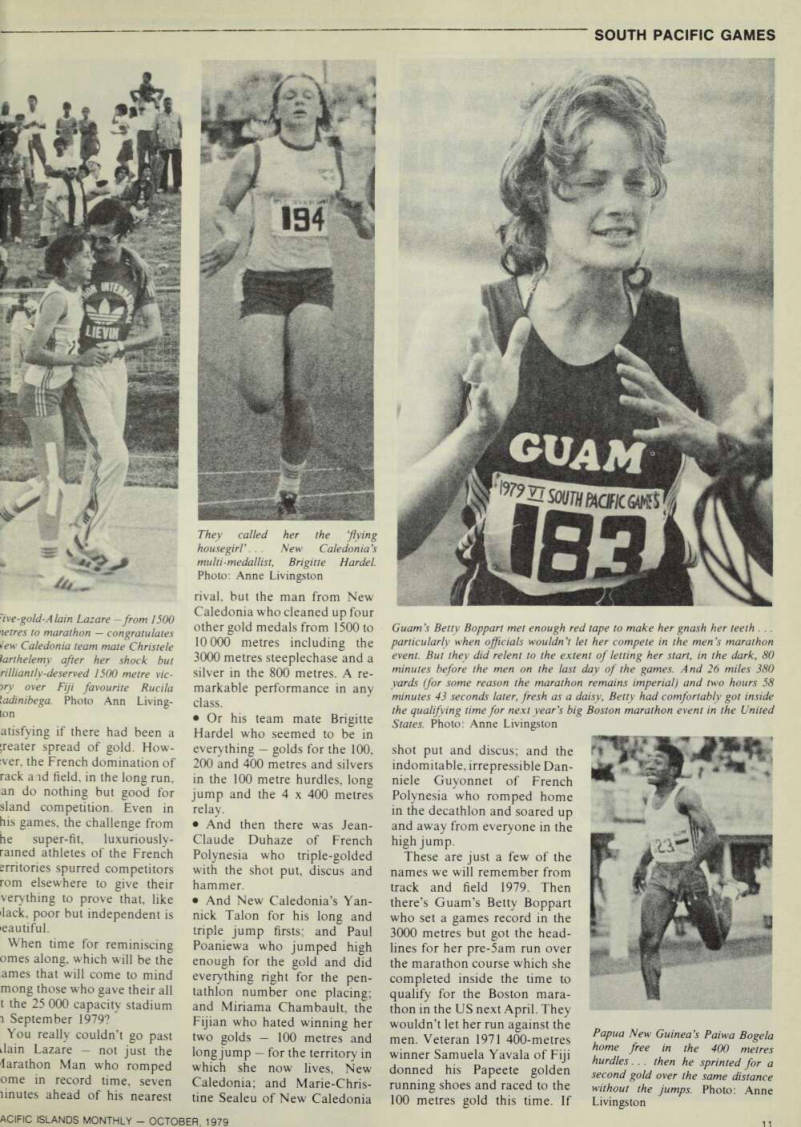
G S B Total New Caledonia 33 43 26 102
French Polynesia
31 19 29 79
Fiji
22 16 24 62 Papua New Guinea 16 19 21 56 Guam 11 7 9 27 Western Samoa 10 11 6 27 American Samoa 4 1 7 12 Cook Islands 1 2 3 6
Tonga
1 5 3 9 New Hebrides — 4 4 8 Norfolk Island — 1 3 4 Wallis and Futuna — 1 2 3 Solomon Islands 5 5 400 Kiribati, Nauru, Niue, Tokelau and Tuvalu did not gain a medal.
Advertisements & other items, pp. 11-12 (2 items)
11
SOUTH PACIFIC GAMES
ACIFIC ISLANDS MONTHLY OCTOBER, 1979
and engines
When you need
more than fust the
best machines
and engines
count on
Whether you need earthmoving, agricultural, materials handling or forestry machines or industrial engines and generator sets you'll want full support ... before and after you buy.
That's what you'll get with Cat-built machines and engines and our Cat Plus services.
Our Cat Plus program starts by offering you expert assistance in job planning and machine or engine selection. And, helps ensure your equipment has the right attachments to meet your requirements.
We can also tailor purchase arrangements to fit your needs.
A team of specialist mechanics can help with on-site machine or engine problems, as well as carrying out regular service or major overhauls in our wellequipped workshops. Our extensive local parts supplies help avoid long hold-ups on the job. And, our people can work with you to help prevent downtime and keep it to a minimum when trouble does occur. Caterpillar-built equipment includes track and wheel-type dozers and loaders, motor graders, wheel tractor-scrapers, excavators, compactors, off-highway trucks, log loaders, skidders and lift-trucks, And a wide range of genrator sets and industrial engines.
We are your direct access to this equipment and Cat Plus. We are a local business, staffed, stocked and equipped to offer you the full benefits of Caterpillarbuilt equipment and Cat Plus services.
Why not contact us today? f Telephone 256650. j! mm
:: ifllHi
>; k-
NSW
y v
HASTINGS DIERING
LAE:
Milford Haven Road, Telephone 42 2355.
PORT MORESBY;
BOUGAINVILLE.
Itakara Industrial Park, Arawa Telephone 959077.
carptrac
SUVA: Carpenter Street, Raiwai.
Private Mail Bag, GPO Suva, Fiji Ph. 381622.
Telex FJ2190 - ■ Cables CARPTRAC.
LAUTOKA: Veitari, Telephone 61877.
LABASA : Vulovi, Telephone 81888. □3
YOUR
CATERPILLAR
DEALER
8A10453
Games Guide
An invaluable little book was available in Suva during the August-September South Pa cific Games. It was produced by Robin Yarrow of Fiji in association with UK athletics facts and figures man Tony Isaacs as a ‘complete record of South Pacific Games 1963-1975’. It was a job very well done.
With advertising helping to
pay for it, Messrs Yarrow and Isaacs were hoping that, at 5F1.50 a copy, it would sell
briskly, proceeds going to the
games fund. Unhappily, games followers seemed more interested in the present than the past and by the final two days of the games only about 1500 had been sold. It went on ‘special’ for the last day but many copies remain unsold.
It’s a book well worth having not just for the statistically-minded but for anyone with a genuine interest in, and the wellbeing of, Island sports.
It’s neatly presented, very easy to refer to, and literally stuffed with much more than just games historical data.
Sport is lucky to have a couple of enthusiasts like Yarrow and Isaacs around. It would be a shame if these two who put in so many hours and coped so manfully with the 19 000 km which separ
ated them during compilation
lost heart.
Among other outlets the handbook is available from Desai, Suva, and, soon, it will be obtainable from PlM’s
Sydney bookshop.
Advertisements & other items, pp. 13-15 (3 items)
13
SOUTH PACIFIC GAMES
More than4,2oo employees.
Overs,ooo rooms.
2.1 million guests this year.
G)
other
hotel
Three reasons why no
group can stay with us.
Over 5000 rooms. 61 hotels and resorts. 21 years of experience. That’s a lot of staying power.
But our contribution to the South Pacific goes far beyond simply being the biggest hotel and resort group in the region.
Its what our size means that counts. It means we can provide th? best service for the more than two million people who stay with us annually^ And with 4200 people in our organisation to look after our guests, the word “service” really means something.
At the same time 4200 people employed is a lot of jobs. Again, a vital contribution to the economy of the South Pacific. And in the future, we’ll have an even bigger contribution to make.
Because we believe the South Pacific increasingly will become a centre for world tourism. Many thousands of tourists will pour millions of dollars into the South Pacific economy. Hundreds of businesses will benefit. Jobs will be assured, and many new jobs created.
We’re prepared for that right now. And our investment is on the line to prove it.
For reservations or further information regarding investment in the South Pacific please contact us at:- 110 Bayswater Road,Rushcutters BayN.S.W. 2011. Australia.
Telephone: 310388. Telex: 21365 Boulevard. Park Royal.
Beachcomber. Travelodge.
Holiday Inn.
9
.sotrrm-Kiv mane motel cobboirmiom
9 Australia 9 New Zealand 9 Fiji 9 Tahiti ® Cook Islands 9 Papua New Guinea 9 New Caledonia 9 Western Samoa
MASIUS TVL26O9
15
SOUTH PACIFIC GAMES
3 ACIFIC ISLANDS MONTHLY - OCTOBER, 1979
The Medal Winners
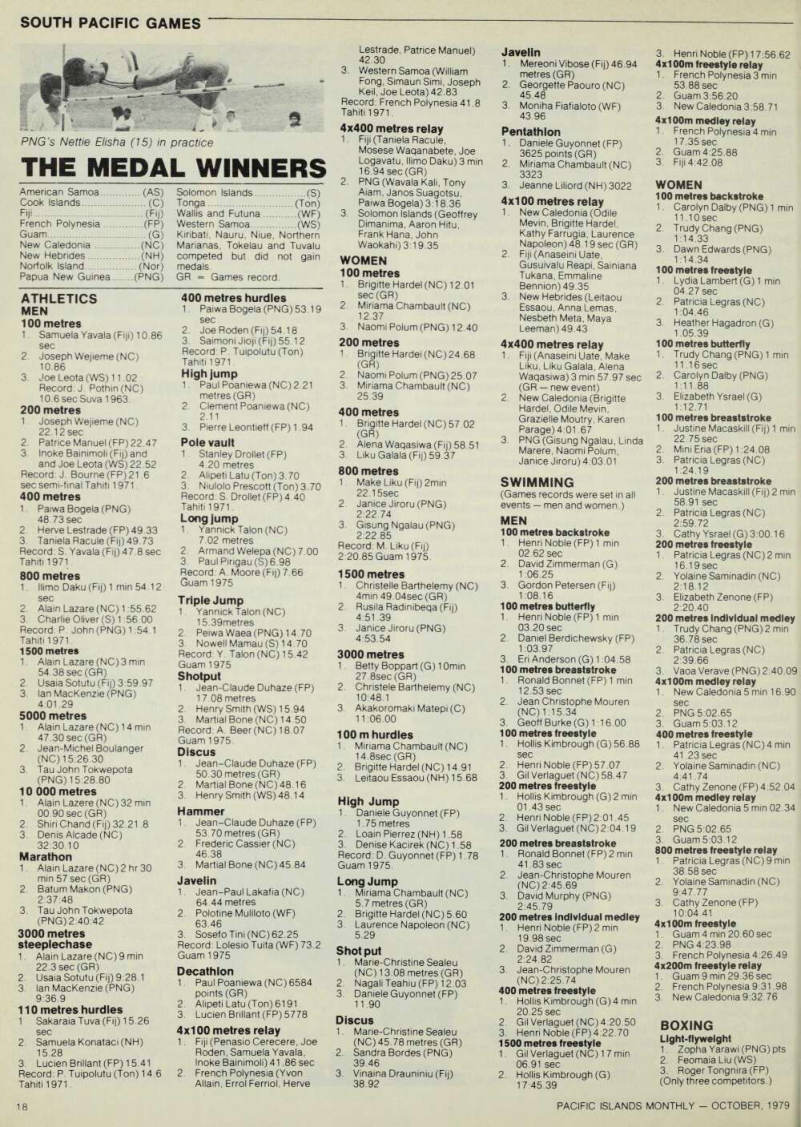
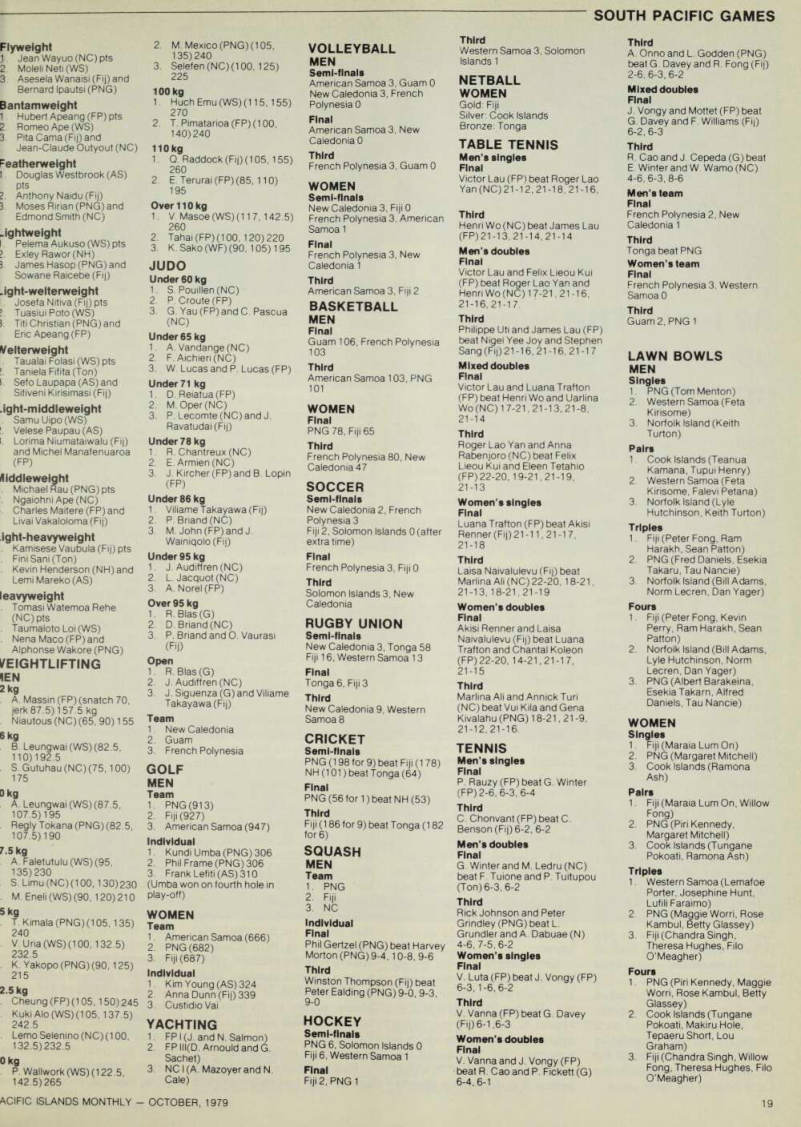
American Samoa (AS) Cook Islands (C) Fiji (Fij) French Polynesia (FP) Guam (G) New Caledonia (NC) New Hebrides (NH) Norfolk Island (Nor) Papua New Guinea (PNG)
Solomon Islands (S) Tonga (Ton) Wallis and Futuna (WF) Western Samoa (WS) Kiribati. Nauru, Niue, Northern Marianas, Tokelau and Tuvalu competed but did not gain medals.
GR = Games record.
Athletics
Men
100 metres 1. Samuela Yavala (Fiji) 10.86 sec 2. Joseph Wejieme (NC) 10.86 3. Joe Leota (W5)11.02 Record: J. Pothin (NC) 10.6 sec Suva 1963 200 metres 1 Joseph Wejieme (NC) 22.12 sec 2. Patrice Manuel (FP) 22.47 3. Inoke Bainimoli (Fij) and and Joe Leota (WS) 22.52 Record: J Bourne (FP) 21.6 sec semi-final Tahiti 1971. 400 metres 1. Paiwa Bogela (PNG) 48.73 sec 2. Herve Lestrade (FP) 49.33 3. Taniela Racule (Fij) 49.73 Record: S. Yavala (Fij) 47.8 sec Tahiti 1971. 800 metres 1. llimo Daku (Fij) 1 min 54.12 sec 2. Alain Lazare(NC) 1:55.62 3. Charlie Oliver (S) 1:56.00 Record: P. John (PNG) 1 54.1 Tahiti 1971. 1500 metres 1. Alain Lazare(NC)3 min 54.38 sec (GR) 2. UsaiaSotutu (Fij) 3:59.97 3. lan MacKenzie(PNG) 4:01.29 5000 metres 1. Alain Lazare(NC) 14 min 47,30 sec (GR) 2. Jean-Michel Boulanger (NC) 15:26,30 3. Tau JohnTokwepota
(Png) 15:28.80
10 000 metres 1. Alain Lazere(NC) 32 min 00.90 sec (GR) 2. Shiri Chand (Fij) 32.21.8 3. Denis Alcade(NC) 32:30.10 Marathon 1. Alain Lazare(NC)2 hr 30 min 57 sec (GR) 2. Batum Makon (PNG) 2:37:48 3. Tau JohnTokwepota
(Png)2:40:42
3000 metres
steeplechase
1. Alain Lazare (NC)9 min 22.3 sec (GR) 2. UsaiaSotutu (Fij) 9:28.1 3. lan MacKenzie(PNG) 9:36.9 110 metres hurdles 1 Sakaraia Tuva (Fij) 15.26 sec 2. Samuela Konataci (NH) 15.28 3. Lucien Brillant (FP) 15.41 Record; P. Tuipolutu (Ton) 14.6 Tahiti 1971.
400 metres hurdles 1. Paiwa Bogela (PNG) 53.19 sec 2. Joe Roden (Fij) 54 18 3. Saimoni Jioji (Fij) 55.12 Record: P. Tuipolutu (Ton) Tahiti 1971,
High jump
1 Paul Poaniewa(NC) 2.21 metres (GR) 2. Clement Poaniewa(NC) 2.11 3. Pierre Leontieff (FP) 1.94 Pole vault 1. Stanley Drollet (FP) 4.20 metres 2. AlipetiLatu (Ton) 3.70 3. Niulolo Prescott (Ton) 3.70 Record: S. Drollet (FP) 4 40 Tahiti 1971.
Long jump
1. Yannick Talon (NC) 7.02 metres 2. Armand Welepa (NC) 7.00 3. Paul Pirigau (S) 6.98 Record A Moore (Fij) 7.66 Guam 1975
Triple Jump
1 Yannick Talon (NC) 15.39metres 2 PeiwaWaea (PNG) 14.70 3 Nowell Mamau (S) 14.70 Record Y Talon (NC) 15.42 Guam 1975
Shotput
1 Jean-Claude Duhaze (FP) 17.08 metres 2 Henry Smith (WS) 15.94 3 Martial Bone (NC) 14.50 Record: A. Beer (NC) 18.07 Guam 1975.
Discus 1 Jean-Claude Duhaze (FP) 50.30 metres (GR) 2 Martial Bone (NC) 48.16 3 Henry Smith (WS) 48,14 Hammer 1. Jean-Claude Duhaze (FP) 53.70 metres (GR) 2. Frederic Gassier (NC) 46.38 3. Martial Bone (NC) 45.84 Javelin 1 Jean-PaulLakafia(NC) 64.44 metres 2. Polotine Muliloto (WF) 63.46 3. SosefoTini(NC)62.2s Record: Lolesio Tuita (WF) 73.2 Guam 1975 Decathlon 1. Paul Poaniewa(NC) 6584 points (GR) 2. Alipeti Latu (Ton) 6191 3. Lucien Brillant(FP)s77B 4xloo metres relay 1. Fiji (Penasio Cerecere, Joe Roden, Samuela Yavala, Inoke Bainimoli) 41.86 sec 2. French Polynesia (Yvon Allain, Errol Ferriol, Herve
Lestrade, Patrice Manuel) 42.30 3, Western Samoa (William Fong, Simaun Simi, Joseph Keil, Joe Leota) 42.83 Record: French Polynesia 41.8 Tahiti 1971. 4x400 metres relay 1. Fiji (Taniela Racule, Mosese Waqanabete, Joe Logavatu, llimo Daku) 3 min 16.94 sec (GR) 2. PNG (Wavala Kali, Tony Aiam, Janos Suagotsu, Paiwa Bogela) 3:18.36 3. Solomon Islands (Geoffrey Dimanima, Aaron Hitu, Frank Hana, John Waokahi)3:l9.3s
Women
100 metres 1. Brigitte Hardel (NC) 12.01 sec (GR)
2 MiriamaChambault(NC)
12.37 3. Naomi Polum (PNG) 12.40 200 metres 1 Brigitte Hardel (NC) 24.68 (GR) 2 Naomi Polum (PNG) 25.07
3. MiriamaChambault(NC)
25.39 400 metres 1 Brigitte Hardel (NC) 57.02 (GR) 2 Alena Waqasiwa (Fij) 58.51 3. Liku Galala (Fij) 59.37 800 metres 1 Make Liku (Fij) 2min 22.155ec 2 Janice Jiroru (PNG) 2:22.74 3, Gisung Ngalau (PNG) 2:22.85 Record: M. Liku (Fij) 2:20.85 Guam 1975. 1500 metres 1. Christelle Barthelemy (NC) 4min 49.045ec (GR) 2. Rusila Radinibeqa (Fij) 4:51.39 3. Janice Jiroru (PNG) 4:53.54 3000 metres 1. Betty Boppart (G) 10min 27.8 sec (GR) 2. Christele Barthelemy (NC) 10:48 1 3. Akakoromaki Matepi (C) 11:06.00 100 m hurdles 1. MiriamaChambault(NC) 14.8 sec (GR) 2. Brigitte Hardel (NC) 14.91 3. Leitaou Essaou (NH) 15.68
High Jump
1. Daniele Guyonnet (FP) I. metres 2. Loain Pierrez(NH) 1,58 3. Denise Kacirek(NC) 1.58 Record: D. Guyonnet (FP) 1.78 Guam 1975.
Long Jump
1. Miriama Chambault(NC) 5.7 metres (GR) 2. Brigitte Hardel (NC) 5.60 3. Laurence Napoleon (NC) 5.29
Shot put
1. Marie-Christine Sealeu (NC) 13.08 metres (GR) 2. NagaliTeahiu(FP) 12.03 3. Daniele Guyonnet (FP) 11.
Discus 1. Marie-Christine Sealeu (NC) 45.78 metres (GR) 2. Sandra Bordes (PNG) 39.46 3. VinainaDrauniniu(Fij) 38.92
Javelin 1. Mereoni Vibose (Fij) 46.94 metres (GR) 2. Georgette Paouro (NC) 45.48 3. Moniha Fiafialoto (WF) 43.96 Pentathlon 1. DanieleGuyonnet(FP) 3625 points (GR)
2. MiriamaChambault(NC)
3323 3. Jeanne Liliord(NH) 3022 4xloo metres relay 1. New Caledonia (Odile Mevin, Brigitte Hardel, Kathy Farrugia, Laurence Napoleon) 48.19 sec (GR) 2. Fiji (Anaseini Date, Gusuivalu Reapi, Sainiana Tukana, Emmaline Bennion) 49.35 3. New Hebrides (Leitaou Essaou, Anna Lemas, Nesbeth Meta, Maya Leeman) 49.43 4x400 metres relay 1. Fiji (Anaseini Date, Make Liku, Liku Galala, Alena Waqasiwa) 3 min 57.97 sec (GR new event) 2. New Caledonia (Brigitte Hardel, Odile Mevin, Grazielle Moutry, Karen Parage) 4:01.67 3. PNG (Gisung Ngalau, Linda Marere, Naomi Polum, Janice Jiroru) 4:03.01
Swimming
(Games records were set in all events men and women.)
Men
100 metres backstroke 1. Henri Noble (FP) 1 min 02.62 sec 2. David Zimmerman (G) 1:06.25 3. Gordon Petersen (Fij) 1:08,16 100 metres butterfly 1. Henri Noble (FP) 1 min 03.20 sec 2. Daniel Berdichewsky (FP) 1:03.97 3. Eri Anderson (G) 1:04.58 100 metres breaststroke 1. Ronald Bonnet (FP) 1 min 12.53 sec 2. Jean Christophe Mouren (NC) 1:15.34 3. Geoff Burke (G) 1:16.00 100 metres freestyle 1. Hollis Kimbrough (G) 56.88 sec 2. Henri Noble (FP) 57.07 3. Gil Verlaguet(NC) 58.47 200 metres freestyle 1. Hollis Kimbrough (G) 2 min 01.43 sec 2. Henri Noble (FP) 2:01.45 3. Gil Verlaguet (NC) 2:04.19 200 metres breaststroke 1 Ronald Bonnet (FP) 2 min 41.83 sec 2. Jean-Christophe Mouren (NC) 2:45.69 3. David Murphy (PNG) 2:45.79 200 metres individual medley 1. Henri Noble (FP) 2 min 19.98 sec 2. David Zimmerman (G) 2:24.82 3. Jean-Christophe Mouren (NC)2:25.74 400 metres freestyle 1. Hollis Kimbrough (G) 4 min 20.25 sec 2. Gil Verlaguet (NC) 4:20.50 3. Henri Noble (FP) 4:22.70 1500 metres freestyle 1. Gil Verlaguet (NC) 17 min 06.91 sec 2. Hollis Kimbrough (G) 17:45.39
3. Henri Noble (FP) 17:56.62 4xloom freestyle relay 1 French Polynesia 3 min 53.88 sec 2. Guam 3:56.20 3 New Caledonia 3:58.71 4xloom medley relay 1. French Polynesia 4 min 17.35 sec 2. Guam 4:25.88 3. Fiji 4:42.08
Women
100 metres backstroke 1. Carolyn Dalby (PNG) 1 min 11.10 sec 2 Trudy Chang (PNG) 1:14.33 3. Dawn Edwards (PNG) 1:14.34 100 metres freestyle 1. Lydia Lambert (G) 1 min 04,27 sec 2. Patricia Legras (NC) 1:04.46 3. Heather Hagadron (G) I. 100 metres butterfly 1. Trudy Chang (PNG) 1 min 11. sec
2. Carolyn Dalby (PNG)
1:11.88 3. Elizabeth Ysrael (G) 1:12.71 100 metres breaststroke 1. Justine Macaskill (Fij) 1 min 22.75 sec 2. Mini Eria(FP) 1:24.08 3. Patricia Legras (NC) 1:24.19 200 metres breaststroke 1. Justine Macaskill (Fij) 2 min 58.91 sec 2. Patricia Legras (NC) 2:59.72 3. Cathy Ysrael (G) 3:00.16 200 metres freestyle 1. Patricia Legras (NC) 2 min 16.19 sec 2. YolaineSaminadin(NC) 2:18.12 3. Elizabeth Zenone (FP) 2:20.40 200 metres individual medley 1. Trudy Chang (PNG) 2 min 36.78 sec 2. Patricia Legras (NC) 2:39.66 3. VaoaVerave (PNG) 2:40.09 4xloom medley relay 1. New Caledonia 5 min 16.90 sec
2. Png 5:02.65
3. Guam 5:03.12 400 metres freestyle 1. Patricia Legras (NC) 4 min 41.23 sec 2. YolaineSaminadin(NC) 4:41.74 3. Cathy Zenone (FP) 4:52.04 4xloom medley relay 1. New Caledonia 5 min 02.34 S6C
2. Png 5:02.65
3. Guam 5:03.12 800 metres freestyle relay 1. Patricia Legras (NC) 9 min 38.58 sec 2. YolaineSaminadin (NC) 9:47.77 3. Cathy Zenone (FP) 10:04.41 4xloom freestyle 1 Guam 4 min 20.60 sec
2, Png 4:23.98
3. French Polynesia 4:26.49 4x200m freestyle relay 1, Guam 9 min 29.36 sec 2. French Polynesia 9:31.98 3 New Caledonia 9:32.76
Boxing
Llght-flywelght 1. Zopha Yarawi (PNG) pts 2. Feomaia Liu (WS) 3. Roger Tongnira(FP) (Only three competitors.)
PNG's Nettie Elisha (15) in practice
Flyweight 1 Jean Wayuo (NC) pts 2. Moleli Neti (WS) 3 Asesela Wanaisi(Fij)and Bernard Ipautsi (PNG) Bantamweight 1 Hubert Apeang (FP) pts 2 Romeo Ape (WS) 3 Pita Cama (Fij) and Jean-Claude Outyout (NC) Featherweight I Douglas Westbrook (AS) pts I Anthony Naidu (Fij) 3 Moses Ririan (PNG) and Edmond Smith (NC) Jghtweight 1 Pelema Aukuso (WS) pts >. Exley Rawer (NH) 3 James Hasop (PNG) and Sowane Raicebe (Fij) .ight-welterweight . Josefa Nitiva (Fij) pts ?. Tuasiui Poto(WS) 5. Titi Christian (PNG) and Eric Apeang (FP) Velterweight . Taualai Folasi (WS) pts !. Taniela Fifita(Ton) I. Sefo Laupapa(AS)and Sitiveni Kirisimasi (Fij) .ight-middleweight . Samu Uipo (WS) I. Velese Paupau (AS) l. Lorima Niumataiwalu (Fij) and Michel Manafenuaroa (FP) Middleweight . Michael Rau (PNG) pts . Ngaiohni Ape (NC) . Charles Maitere(FP) and Livai Vakaloloma (Fij) ight-heavyweight . Kamisese Vaubula (Fij) pts . FiniSani(Ton) . Kevin Henderson (NH) and Lemi Mareko (AS) leavyweight . Tomasi Watemoa Rehe (NC) pts . Taumaloto Loi (WS) . Nena Maco(FP)and Alphonse Wakore (PNG)
/Eightlifting
Men
2 kg . A. Massin (FP) (snatch 70, jerk 87.5) 157.5 kg . Niautous (NC) (65,90) 155 6 kg B Leungwai (WS) (82.5, 110)192.5 . S. Gutuhau (NC) (75,100) 175 D kg A, Leungwai (W5)(87.5, 107.5) Regly Tokana (PNG) (82.5, 107.5) 7.5 kg A. Faletutulu (WS)(9S, 135)230 S. (100,130)230 M. Eneli(WS) (90.120)210 5 kg T. Kimala(PNG)(los,l3s) 240 V.Uria(WS) (100,132.5) 232.5 K. Yakopo (PNG) (90,125) 215 2.5 kg Cheung (FP) (105,150)245 Kuki Alo (W5)(105,137.5) 242.5 Lemo Selenino (NC) (100, 132.5) 0 kg . P. Wallwork (WS) (122.5, 142.5)
2. M. Mexico (PNG) (105, 135)240 3. Selefen (NC)(100,125) 225 100 kg 1. Huch Emu (WS) (115,155) 270 2. T, Pimatarioa (FP) (100, 140)240 110 kg 1 Q. Raddock(Fij)(los,lss) 260 2. E. Terurai (FP) (85, 110) 195 Over 110 kg 1. V. Ma50e(W5)(117,142,5) 260 2. Tahai(FP) (100, 120)220 3. K.Sako(WF) (90,105)195
Judo
Under 60 kg 1. S. Pouillen(NC) 2. P. Croute(FP) 3. G. Yau (FP)and C. Pascua (NC) Under 65 kg 1. A. Vandange (NC) 2. F. Aichieri (NC) 3. W. Lucas and P. Lucas (FP) Under 71 kg 1. D. Reiatua(FP) 2. M. Oper(NC) 3. P. Lecomte (NC) and J.
Ravatudai (Fij) Under 78 kg 1. R. Chantreux (NC) 2. E. Armien (NC) 3. J. Kircher(FP)and B. Lopin (FP) Under 86 kg 1. Viliame Takayawa (Fij) 2. P. Briand(NC) 3. M. John (FP) and J.
Wainiqolo (Fij) Under 95 kg 1. J. Audiffren (NC) 2. L. Jacquot (NC) 3. A. Norel(FP) Over 95 kg 1. R. Bias (G) 2. D. Briand(NC) 3. P. Briand and O. Vaurasi (Fij) Open 1. R. Bias (G) 2. J. Audiffren (NC) 3. J. Siguenza(G) and Viliame Takayawa (Fij) Team 1. New Caledonia 2. Guam 3. French Polynesia
Golf
Men
Team
1. Png (913)
2. Fiji (927) 3. American Samoa (947) Individual 1. Kundi Umba (PNG) 306 2. Phil Frame (PNG) 306 3. Frank Lefiti (AS) 310 (Umba won on fourth hole in play-off)
Women
Team 1. American Samoa (666)
2. Png (682)
3. Fiji (687) Individual 1. Kim Young (AS) 324 2. Anna Dunn (Fij) 339 3. Custidio Vai
Yachting
1. FP I (J. and N. Salmon) 2. FP lll(D. Arnould and G.
Sachet) 3. NC I (A. Mazoyerand N Cale)
Volleyball
Men
Semi-finals American Samoa 3, Guam 0 New Caledonia 3, French Polynesia 0 Final American Samoa 3, New Caledonia 0 Third French Polynesia 3, Guam 0
Women
Semi-finals New Caledonia 3, FijiO French Polynesia 3. American Samoa 1 Final French Polynesia 3, New Caledonia 1 Third American Samoa 3, Fiji 2
Basketball
Men
Final Guam 106, French Polynesia 103 Third American Samoa 103, PNG 101
Women
Final PNG 78, Fiji 65 Third French Polynesia 80, New Caledonia 47
Soccer
Semi-finals New Caledonia 2, French Polynesia 3 Fiji 2, Solomon Islands 0 (after extra time) Final French Polynesia 3, Fiji 0 Third Solomon Islands 3, New Caledonia
Rugby Union
Semi-finals New Caledonia 3, Tonga 58 Fiji 16, Western Samoa 13 Final Tonga 6, Fiji 3 Third New Caledonia 9, Western Samoa 8
Cricket
Semi-finals PNG (198 for 9) beat Fiji (178) NH (101) beat Tonga (64) Final PNG (56 for 1) beat NH (53) Third Fiji (186 for 9) beat Tonga (182 for 6)
Squash
Men
Team
1. Png
2. Fiji 3. NC Individual Final Phil Gertzel (PNG) beat Harvey Morton (PNG) 9-4,10-8, 9-6 Third Winston Thompson (Fij) beat Peter Ealding (PNG) 9-0, 9-3 9-0
Hockey
Semi-finals PNG 6, Solomon Islands 0 Fiji 6, Western Samoa 1 Final Fiji 2, PNG 1
Third Western Samoa 3, Solomon Islands 1
Netball
Women
Gold: Fiji Silver: Cook Islands Bronze: Tonga
Table Tennis
Men’s singles Final Victor Lau (FP) beat Roger Lao Yan(NC)2l-12,21-18,21-16, Third Henri Wo (NC) beat James Lau (FP) 21-13. 21-14.21-14 Men’s doubles Final Victor Lau and Felix Lieou Kui (FP) beat Roger Lao Yan and Henri Wo (NC) 17-21,21-16, 21-16,21-17.
Third Philippe Uti and James Lau (FP) beat Nigel Yee Joy and Stephen Sang (Fij) 21-16. 21-16, 21-17 Mixed doubles Final Victor Lau and Luana Trafton (FP) beat Henri Wo and Uarlina
Wo(Nc)I7-21,21-13,21-8,
21-14 Third Roger Lao Yan and Anna Rabenjoro (NC) beat Felix Lieou Kui and Eleen Tetahio (FP) 22-20, 19-21,21-19, 21-13 Women’s singles Final Luana Trafton (FP) beat Akisi Renner (Fij) 21-11,21-17, 21-18 Third Laisa Naivalulevu (Fij) beat MarlinaAli(NC) 22-20,18-21, 21-13,18-21,21-19 Women’s doubles Final Akisi Renner and Laisa Naivalulevu (Fij) beat Luana Trafton and Chantal Koleon (FP) 22-20, 14-21,21-17, 21-15 Third Marlina Ali and Annick Turi (NC) beat Vui Kila and Gena Kivalahu (PNG) 18-21,21-9, 21-12,21-16.
Tennis
Men’s singles Final P. Rauzy (FP) beat G. Winter (FP) 2-6, 6-3, 6-4 Third C. Chonvant (FP) beat C.
Benson (Fij) 6-2, 6-2 Men’s doubles Final G. Winter and M, Ledru (NC) beat F. Tuione and P. Tuitupou (Ton) 6-3, 6-2 Third Rick Johnson and Peter Grindley (PNG) beat L.
Grundler and A. Dabuae (N) 4-6, 7-5, 6-2 Women’s singles Final V. Luta (FP) beat J. Vongy (FP) 6-3,1-6,6-2 Third V. Vanna (FP) beat G. Davey (Fij) 6-1,6-3 Women’s doubles Final V. Vanna and J. Vongy (FP) beat R. Cao and P. Fickett (G) 6-4,6-1
Third A. Onno and L. Godden (PNG) beat G, Davey and R. Fong (Fij) 2-6, 6-3, 6-2 Mixed doubles Final J. Vongy and Mottet (FP) beat G. Davey and F. Williams (Fij) 6-2,6-3 Third R. Cao and J. Cepeda (G) beat E. Winter and W Wamo (NC) 4-6, 6-3, 8-6 Men's team Final French Polynesia 2, New Caledonia 1 Third Tonga beat PNG Women’s team Final French Polynesia 3. Western Samoa 0 Third Guam 2, PNG 1
Lawn Bowls
Men
Singles 1. PNG (Tom Menton) 2. Western Samoa (Feta Kirisome) 3. Norfolk Island (Keith Turton) Pairs 1. Cook Islands (Teanua Kamana, Tupui Henry) 2. Western Samoa (Feta Kirisome, Falevi Petana) 3 Norfolk Island (Lyle Hutchinson, Keith Turton) Triples 1. Fiji (Peter Fong, Ram Harakh, Sean Patton) 2. PNG (Fred Daniels, Esekia Takaru, Tau Nancie) 3. Norfolk Island (Bill Adams, Norm Lecren, Dan Yager) Fours 1. Fiji (Peter Fong, Kevin Perry, Ram Harakh, Sean Patton) 2. Norfolk Island (Bill Adams, Lyle Hutchinson, Norm Lecren, Dan Yager) 3. PNG (Albert Barakeina, Esekia Takarn, Alfred Daniels, Tau Nancie)
Women
Singles 1. Fiji(Maraia Lum On) 2. PNG (Margaret Mitchell) 3. Cook Islands (Ramona Ash) Pairs 1. Fiji (Maraia Lum On, Willow Fong) 2. PNG (Piri Kennedy, Margaret Mitchell) 3. Cook Islands (Tungane Pokoati, Ramona Ash) Triples 1. Western Samoa (Lemafoe Porter, Josephine Hunt, Lufili Faraimo) 2. PNG (Maggie Worn, Rose Kambul, Betty Glassey) 3. Fiji (Chandra Singh, Theresa Hughes, Filo O’Meagher) Fours 1. PNG (Piri Kennedy, Maggie Worn, Rose Kambul, Betty Glassey) 2. Cook Islands (Tungane Pokoati, Makiru Hole, Tepaeru Short, Lou Graham) 3. Fiji (Chandra Singh, Willow Fong, Theresa Hughes, Filo O'Meagher)
Advertisements & other items, p. 19 (1 item)
19
SOUTH PACIFIC GAMES
ACIFIC ISLANDS MONTHLY - OCTOBER, 1979
conspiracy trial
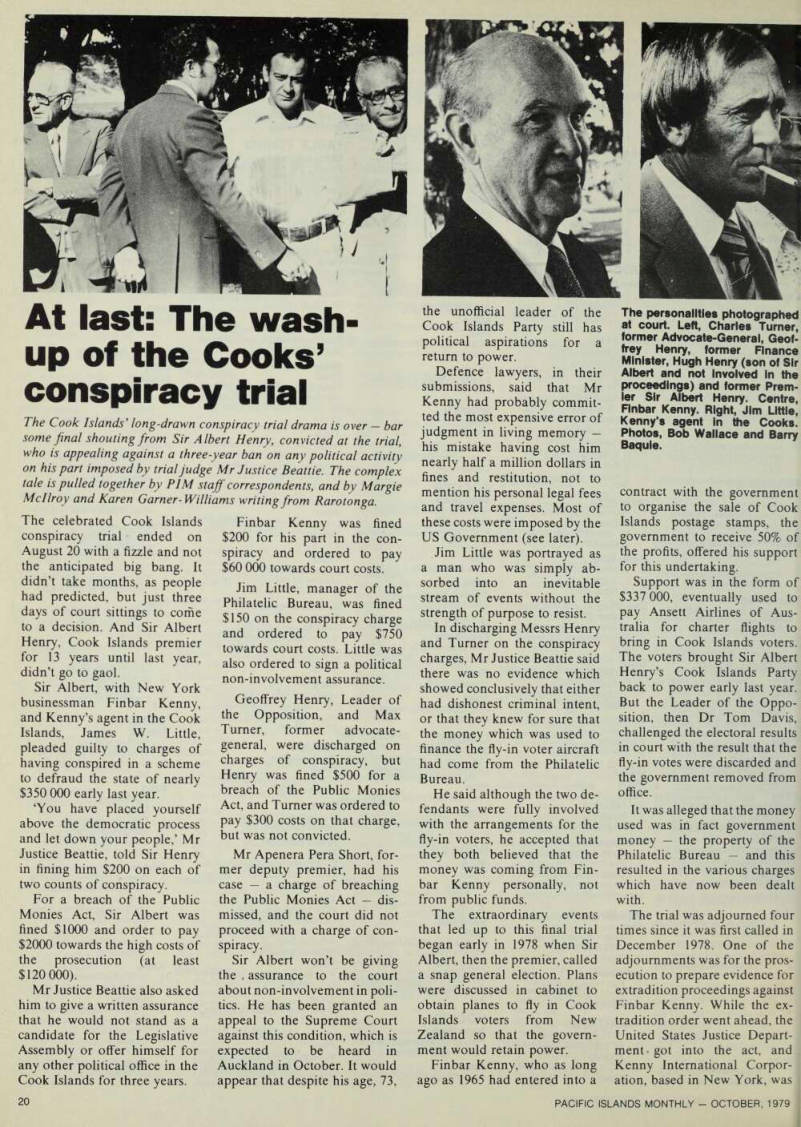
At last: The wash up of the Cooks’ conspiracy trial
The Cook Islands' long-drawn conspiracy trial drama is over bar some final shouting from Sir Albert Henry, convicted at the trial, who is appealing against a three-year ban on any political activity on his part imposed by trial judge Mr Justice Beattie. The complex tale is pulled together by PIM staff correspondents, and by Margie Mcllroy and Karen Garner-Williams writing from Rarotonga.
The celebrated Cook Islands conspiracy trial ended on August 20 with a fizzle and not
the anticipated big bang. It
didn’t take months, as people had predicted, but just three days of court sittings to come to a decision. And Sir Albert Henry, Cook Islands premier for 13 years until last year, didn’t go to gaol.
Sir Albert, with New York businessman Finbar Kenny, and Kenny’s agent in the Cook Islands, James W. Little, pleaded guilty to charges of having conspired in a scheme to defraud the state of nearly $350 000 early last year. ‘You have placed yourself above the democratic process and let down your people,’ Mr Justice Beattie, told Sir Henry in fining him $2OO on each of two counts of conspiracy.
For a breach of the Public Monies Act, Sir Albert was fined $lOOO and order to pay $2OOO towards the high costs of the prosecution (at least $l2O 000).
Mr Justice Beattie also asked him to give a written assurance that he would not stand as a candidate for the Legislative Assembly or offer himself for any other political office in the Cook Islands for three years.
Finbar Kenny was fined $2OO for his part in the con spiracy and ordered to pay $6O 000 towards court costs.
Jim Little, manager of the Philatelic Bureau, was fined $l5O on the conspiracy charge and ordered to pay $750 towards court costs. Little was also ordered to sign a political non-involvement assurance.
Geoffrey Henry, Leader of the Opposition, and Max Turner, former advocate general, were discharged on charges of conspiracy, but Henry was fined $5OO for a breach of the Public Monies Act, and Turner was ordered to pay $3OO costs on that charge, but was not convicted.
Mr Apenera Pera Short, for mer deputy premier, had his case a charge of breaching the Public Monies Act dis missed, and the court did not proceed with a charge of con
spiracy.
Sir Albert won’t be giving the . assurance to the court about non-involvement in poli tics. He has been granted an appeal to the Supreme Court against this condition, which is expected to be heard in Auckland in October. It would appear that despite his age, 73,
the unofficial leader of the Cook Islands Party still has
political aspirations for a
return to power.
Defence lawyers, in their submissions, said that Mr
Kenny had probably commit
ted the most expensive error of
judgment in living memory
his mistake having cost him nearly half a million dollars in fines and restitution, not to mention his personal legal fees and travel expenses. Most of these costs were imposed by the US Government (see later).
Jim Little was portrayed as a man who was simply ab sorbed into an inevitable stream of events without the strength of purpose to resist.
In discharging Messrs Henry
and Turner on the conspiracy charges, Mr Justice Beattie said there was no evidence which showed conclusively that either had dishonest criminal intent, or that they knew for sure that the money which was used to finance the fly-in voter aircraft had come from the Philatelic Bureau.
He said although the two de fendants were fully involved with the arrangements for the fly-in voters, he accepted that they both believed that the money was coming from Fin
bar Kenny personally, not
from public funds.
The extraordinary events that led up to this final trial began early in 1978 when Sir Albert, then the premier, called a snap general election. Plans were discussed in cabinet to obtain planes to fly in Cook Islands voters from New Zealand so that the govern ment would retain power.
Finbar Kenny, who as long ago as 1965 had entered into a
contract with the government to organise the sale of Cook Islands postage stamps, the government to receive 50% of the profits, offered his support for this undertaking.
Support was in the form of $337 000, eventually used to pay Ansett Airlines of Aus tralia for charter flights to bring in Cook Islands voters.
The voters brought Sir Albert Henry’s Cook Islands Party back to power early last year.
But the Leader of the Oppo sition, then Dr Tom Davis, challenged the electoral results in court with the result that the fly-in votes were discarded and the government removed from office.
It was alleged that the money used was in fact government money the property of the Philatelic Bureau and this resulted in the various charges which have now been dealt with.
The trial was adjourned four times since it was first called in December 1978. One of the adjournments was for the pros ecution to prepare evidence for
extradition proceedings against
Finbar Kenny. While the ex tradition order went ahead, the United States Justice Depart ment • got into the act, and Kenny International Corpor ation, based in New York, was
The personalities photographed at court. Left, Charles Turner, former Advocate-General, Geof frey Henry, former Finance Minister, Hugh Henry (son of Sir Albert and not involved in the proceedings) and former Prem ier Sir Albert Henry. Centre, Flnbar Kenny. Right, Jim Little, Kenny’s agent in the Cooks.
Photos, Bob Wallace and Barry Baquie.
Advertisements & other items, p. 21 (1 item)
Akai
Bold New Faces In The Metal Tape Age!
And they are all Akai. A full-range line of high-performance stereo cassette decks with multiple—including futuristic metal—tape capabilities.
Exclusive Super GX heads create better reproduction quality your customers have to hear to believe from all types of tape. And digital FL bar
meters enhance enjoyment even more.
Akai. The name does make a difference.
wrj
3-HEAD
SUPER GX HEAD
TWIN FIELD
SUPER GX HEAD
SiJIRER
I I b I O a O I ill C i m m
AKAI
AKAI
! if v *
e O Ojzß Bi
no 81 9 6 GO
in -i o O
TO L 1
AKAI
I U IJL
31 —c ar u? ' • ’t - v i 3 W Q
GX-F9O
3-head Super GX head, 2-motor, direct capstan drive Stereo Cassette Deck
GX-FBO
3-head Super GX head, 2-motor Stereo Cassette Deck
GX-M5O
3-head Super GX head Stereo Cassette Deck
GX-M3O
Twin field Super GX head Stereo Cassette Deck
HI-FI & VIDEO
AKAI
(KAI ELECTRIC CO., LTD.
bkyo, Japan
P.N.G,
S.O. Svensson (N.G.) Ltd.
P.O. Box 705, Port Moresby Tel: 2275 Fiji Islands Motibhai & Company Ltd.
P.O. Bo* 9175, Nadi International Airport Tel: 72-165 New Zealand Pye Ltd., Consumer Products Sector 110 Mt. Eden Rd., Mt. Eden, Auckland Tel: 686-437 New Caledonia Menard Pacifique s.a.r.l.
B.P. H 2, Noumea Tel: 275222 Tahiti Etablissements Comimpex P.O. Bo* 200, Papeete Tel: 20477 New Hebrides (Islands) Burns Philp (New Hebrides) Co., Ltd.
P.O. Box 27, Port Vila, New Hebrides Islands Norfolk Island Burns Philp (Norfolk Island) Co., Ltd.
P.O. Box 21, Norfolk Island Samoa Islands Burns Philp (South Sea) Co., Ltd.
P.O. Bo* 129, Pago Pago, American Samoa Mariana Islands J.C. Tenorio Enterprises P.O. Box 137, Saipan Tel: 6444/8 Solomon Islands Security Electrical Co., Ltd.
P.O. Box 174, Honiara Tel: 881 Cook Islands JPS Enterprises Ltd.
P.O. Box 15, Rarotonga Tel: 2150, 2176 For more information, please send this coupon to our distributor in your country or to AKAI ELECTRIC CO., LTD. 12-14, 2-Chome, Higashi-Kojiya, Ohta-ku, Tokyo, Japan Name Address
Somare Wins
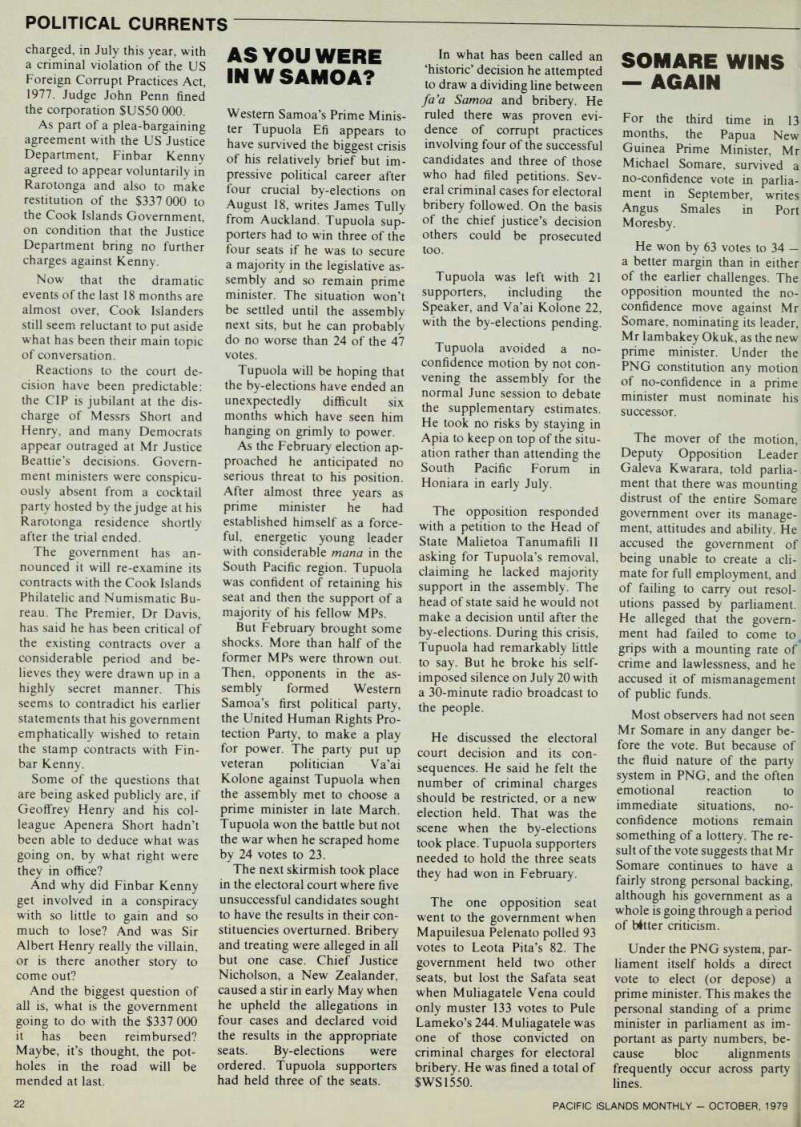
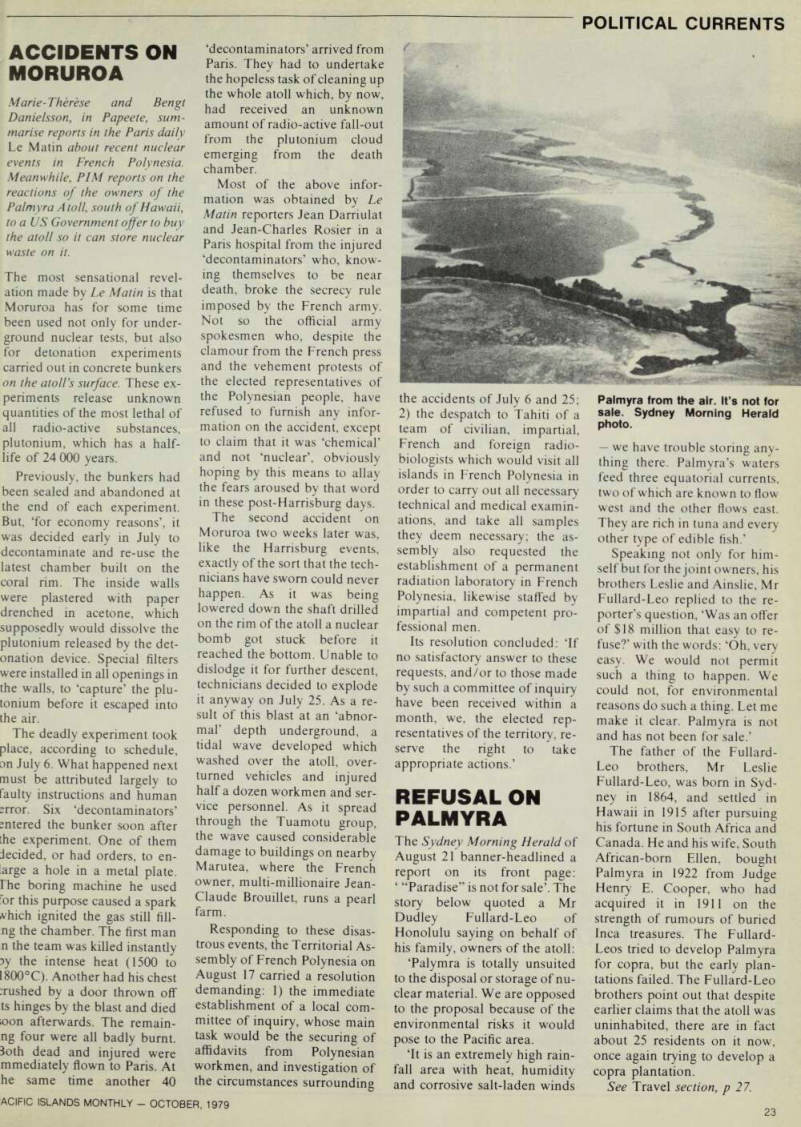
charged, in July this year, with a criminal violation of the US
Foreign Corrupt Practices Act,
1977. Judge John Penn fined the corporation SUSSO 000.
As part of a plea-bargaining agreement with the US Justice
Department, Finbar Kenny
agreed to appear voluntarily in Rarotonga and also to make restitution of the $337 000 to the Cook Islands Government, on condition that the Justice
Department bring no further
charges against Kenny.
Now that the dramatic events of the last 18 months are almost over, Cook Islanders still seem reluctant to put aside what has been their main topic of conversation.
Reactions to the court de cision have been predictable: the CIP is jubilant at the dis charge of Messrs Short and Henry, and many Democrats appear outraged at Mr Justice Beattie’s decisions. Govern ment ministers were conspicu ously absent from a cocktail party hosted by the judge at his
Rarotonga residence shortly
after the trial ended.
The government has an nounced it will re-examine its contracts with the Cook Islands Philatelic and Numismatic Bu reau. The Premier, Dr Davis, has said he has been critical of the existing contracts over a considerable period and be lieves they were drawn up in a highly secret manner. This seems to contradict his earlier statements that his government emphatically wished to retain the stamp contracts with Fin
bar Kenny.
Some of the questions that are being asked publicly are, if Geoffrey Henry and his col league Apenera Short hadn’t been able to deduce what was going on, by what right were they in office?
And why did Finbar Kenny get involved in a conspiracy with so little to gain and so much to lose? And was Sir Albert Henry really the villain, or is there another story to come out?
And the biggest question of all is, what is the government going to do with the $337 000 it has been reimbursed?
Maybe, it’s thought, the pot holes in the road will be mended at last.
As You Were
In W Samoa?
Western Samoa’s Prime Minis ter Tupuola Efi appears to have survived the biggest crisis of his relatively brief but im pressive political career after four crucial by-elections on August 18, writes James Tully from Auckland. Tupuola sup porters had to win three of the four seats if he was to secure a majority in the legislative as sembly and so remain prime minister. The situation won’t be settled until the assembly next sits, but he can probably do no worse than 24 of the 47 votes.
Tupuola will be hoping that the by-elections have ended an unexpectedly difficult six months which have seen him hanging on grimly to power.
As the February election ap proached he anticipated no serious threat to his position.
After almost three years as prime minister he had established himself as a force ful, energetic young leader with considerable mana in the
South Pacific region. Tupuola
was confident of retaining his seat and then the support of a majority of his fellow MPs.
But February brought some
shocks. More than half of the former MPs were thrown out.
Then, opponents in the as sembly formed Western Samoa’s first political party, the United Human Rights Pro tection Party, to make a play for power. The party put up veteran politician Va’ai
Kolone against Tupuola when
the assembly met to choose a prime minister in late March.
Tupuola won the battle but not the war when he scraped home by 24 votes to 23.
The next skirmish took place in the electoral court where five unsuccessful candidates sought to have the results in their con stituencies overturned. Bribery and treating were alleged in all but one case. Chief Justice Nicholson, a New Zealander, caused a stir in early May when he upheld the allegations in four cases and declared void the results in the appropriate seats. By-elections were ordered. Tupuola supporters had held three of the seats.
In what has been called an ‘historic’ decision he attempted to draw a dividing line between fa’a Samoa and bribery. He ruled there was proven evi dence of corrupt practices involving four of the successful candidates and three of those who had filed petitions. Sev eral criminal cases for electoral bribery followed. On the basis of the chief justice’s decision others could be prosecuted too.
Tupuola was left with 21 supporters, including the Speaker, and Va’ai Kolone 22,
with the by-elections pending.
Tupuola avoided a no confidence motion by not con vening the assembly for the normal June session to debate the supplementary estimates.
He took no risks by staying in Apia to keep on top of the situ ation rather than attending the South Pacific Forum in
Honiara in early July.
The opposition responded
with a petition to the Head of State Malietoa Tanumafili II
asking for Tupuola’s removal,
claiming he lacked majority
support in the assembly. The head of state said he would not make a decision until after the
by-elections. During this crisis,
Tupuola had remarkably little to say. But he broke his self imposed silence on July 20 with a 30-minute radio broadcast to
the people.
He discussed the electoral court decision and its con sequences. He said he felt the number of criminal charges should be restricted, or a new election held. That was the scene when the by-elections
took place. Tupuola supporters
needed to hold the three seats they had won in February.
The one opposition seat went to the government when Mapuilesua Pelenato polled 93 votes to Leota Pita’s 82. The government held two other seats, but lost the Safata seat when Muliagatele Vena could only muster 133 votes to Pule Lameko’s 244. Muliagatele was one of those convicted on criminal charges for electoral bribery. He was fined a total of
Swsisso.
Somare Wins
Again
For the third time in 13 months, the Papua New Guinea Prime Minister, Mr Michael Somare, survived a no-confidence vote in parlia ment in September, writes Angus Smales in Port
Moresby.
He won by 63 votes to 34 a better margin than in either of the earlier challenges. The opposition mounted the no confidence move against Mr Somare, nominating its leader, Mr lambakey Okuk, as the new prime minister. Under the PNG constitution any motion of no-confidence in a prime minister must nominate his successor.
The mover of the motion,
Deputy Opposition Leader
Galeva Kwarara, told parlia ment that there was mounting distrust of the entire Somare government over its manage ment, attitudes and ability. He accused the government of being unable to create a cli mate for full employment, and of failing to carry out resol utions passed by parliament.
He alleged that the govern ment had failed to come to t grips with a mounting rate of crime and lawlessness, and he accused it of mismanagement of public funds.
Most observers had not seen Mr Somare in any danger be fore the vote. But because of the fluid nature of the party system in PNG, and the often emotional reaction to immediate situations, no confidence motions remain something of a lottery. The re sult of the vote suggests that Mr Somare continues to have a fairly strong personal backing, although his government as a whole is going through a period of bitter criticism.
Under the PNG system, par liament itself holds a direct vote to elect (or depose) a prime minister. This makes the personal standing of a prime minister in parliament as im portant as party numbers, be cause bloc alignments frequently occur across party lines.
Accidents On
Moruroa
Marie-Therese and Bengt Danielsson, in Papeete, sum marise reports in the Paris daily Le Matin about recent nuclear events in French Polynesia.
Meanwhile, PIM reports on the reactions of the owners of the Palmyra A toll, south of Hawaii, to a US Government offer to buy the atoll so it can store nuclear waste on it.
The most sensational revel ation made by Le Matin is that Moruroa has for some time been used not only for under ground nuclear tests, but also for detonation experiments carried out in concrete bunkers on the atoll’s surface. These ex periments release unknown quantities of the most lethal of all radio-active substances, plutonium, which has a half life of 24 000 years.
Previously, the bunkers had been sealed and abandoned at the end of each experiment.
But, ‘for economy reasons’, it was decided early in July to decontaminate and re-use the latest chamber built on the coral rim. The inside walls were plastered with paper drenched in acetone, which supposedly would dissolve the plutonium released by the det
onation device. Special filters
were installed in all openings in
the walls, to ‘capture’ the plu
tonium before it escaped into the air.
The deadly experiment took
place, according to schedule,
on July 6. What happened next
must be attributed largely to faulty instructions and human -rror. Six ‘decontaminators’ entered the bunker soon after the experiment. One of them decided, or had orders, to en large a hole in a metal plate.
Die boring machine he used "or this purpose caused a spark vhich ignited the gas still fili ng the chamber. The first man n the team was killed instantly ?y the intense heat (1500 to 1800°C). Another had his chest :rushed by a door thrown off ts hinges by the blast and died icon afterwards. The remain ng four were all badly burnt.
Both dead and injured were mmediately flown to Paris. At he same time another 40
‘decontaminators’ arrived from Paris. They had to undertake the hopeless task of cleaning up the whole atoll which, by now, had received an unknown amount of radio-active fall-out from the plutonium cloud emerging from the death chamber.
Most of the above infor mation was obtained by Le Matin reporters Jean Darriulat and Jean-Charles Rosier in a Paris hospital from the injured ‘decontaminators’ who, know ing themselves to be near death, broke the secrecy rule imposed by the French army.
Not so the official army spokesmen who, despite the clamour from the French press and the vehement protests of the elected representatives of the Polynesian people, have refused to furnish any infor mation on the accident, except to claim that it was ‘chemical’ and not ‘nuclear’, obviously
hoping by this means to allay
the fears aroused by that word
in these post-Harrisburg days.
The second accident on Moruroa two weeks later was, like the Harrisburg events, exactly of the sort that the tech nicians have sworn could never happen. As it was being lowered down the shaft drilled on the rim of the atoll a nuclear bomb got stuck before it reached the bottom. Unable to dislodge it for further descent, technicians decided to explode it anyway on July 25. As a re sult of this blast at an ‘abnor
mal’ depth underground, a
tidal wave developed which washed over the atoll, over turned vehicles and injured half a dozen workmen and ser vice personnel. As it spread through the Tuamotu group, the wave caused considerable
damage to buildings on nearby
Marutea, where the French owner, multi-millionaire Jean- Claude Brouillet, runs a pearl farm.
Responding to these disas trous events, the Territorial As sembly of French Polynesia on August 17 carried a resolution demanding; 1) the immediate establishment of a local com mittee of inquiry, whose main task would be the securing of affidavits from Polynesian workmen, and investigation of the circumstances surrounding
the accidents of July 6 and 25; 2) the despatch to Tahiti of a team of civilian, impartial, French and foreign radio biologists which would visit all islands in French Polynesia in order to carry out all necessary technical and medical examin ations, and take all samples they deem necessary; the as sembly also requested the establishment of a permanent radiation laboratory in French
Polynesia, likewise staffed by
impartial and competent pro fessional men.
Its resolution concluded: ‘lf no satisfactory answer to these requests, and/or to those made by such a committee of inquiry have been received within a month, we, the elected rep resentatives of the territory, re serve the right to take
appropriate actions.’
Refusal On
Palmyra
The Sydney Morning Herald of August 21 banner-headlined a report on its front page: ‘ “Paradise” is not for sale’. The story below quoted a Mr Dudley Fullard-Leo of Honolulu saying on behalf of his family, owners of the atoll;
‘Palymra is totally unsuited
to the disposal or storage of nu clear material. We are opposed to the proposal because of the environmental risks it would pose to the Pacific area. ‘lt is an extremely high rain fall area with heat, humidity and corrosive salt-laden winds
we have trouble storing any
thing there. Palmyra’s waters
feed three equatorial currents, two of which are known to flow west and the other flows east.
They are rich in tuna and every other type of edible fish.’
Speaking not only for him self but for the joint owners, his brothers Leslie and Ainslie, Mr Fullard-Leo replied to the re porter’s question, ‘Was an offer of $lB million that easy to re fuse?’ with the words: ‘Oh, very easy. We would not permit such a thing to happen. We could not, for environmental reasons do such a thing. Let me make it clear. Palmyra is not and has not been for sale.’
The father of the Fullard- Leo brothers, Mr Leslie Fullard-Leo, was born in Syd ney in 1864, and settled in Hawaii in 1915 after pursuing his fortune in South Africa and Canada. He and his wife. South African-born Ellen, bought Palmyra in 1922 from Judge Henry E. Cooper, who had acquired it in 1911 on the strength of rumours of buried Inca treasures. The Fullard- Leos tried to develop Palmyra for copra, but the early plan tations failed. The Fullard-Leo brothers point out that despite earlier claims that the atoll was uninhabited, there are in fact about 25 residents on it now,
once again trying to develop a
copra plantation.
See Travel section, p 27.
Palmyra from the air. It’s not for sale. Sydney Morning Herald photo.
Advertisements & other items, pp. 23-24 (2 items)
Political Currents
23
ACIFIC ISLANDS MONTHLY - OCTOBER, 1979
some of ouixljiefs
x. tT H 4-' Sb* SK -'- . .-/• & %
■ftk
~,i V m . w -*■'■ rl« 1 ii
IP I
iSL/^Sf
*> 18 :- •
some of ouixljiefs
In Papua New Guinea there are 717 different cultures, each represented by its own language and its own "chief". Few men know this country better than our chief pilot. Captain John Regan.
He's logged more than 16,000 hours flying, much of that in Papua New Guinea.
John Regan is one of ninety highly skilled Australian, New Zealand, British, and American pilots flying our aircraft to seventeen places in Papua New Guinea and eight destinations overseas.
AIRNIUGINI %
THE NA TIONAL AIRLINE OF PAPUA NEW GUINEA
S.P.S. 001
Travel
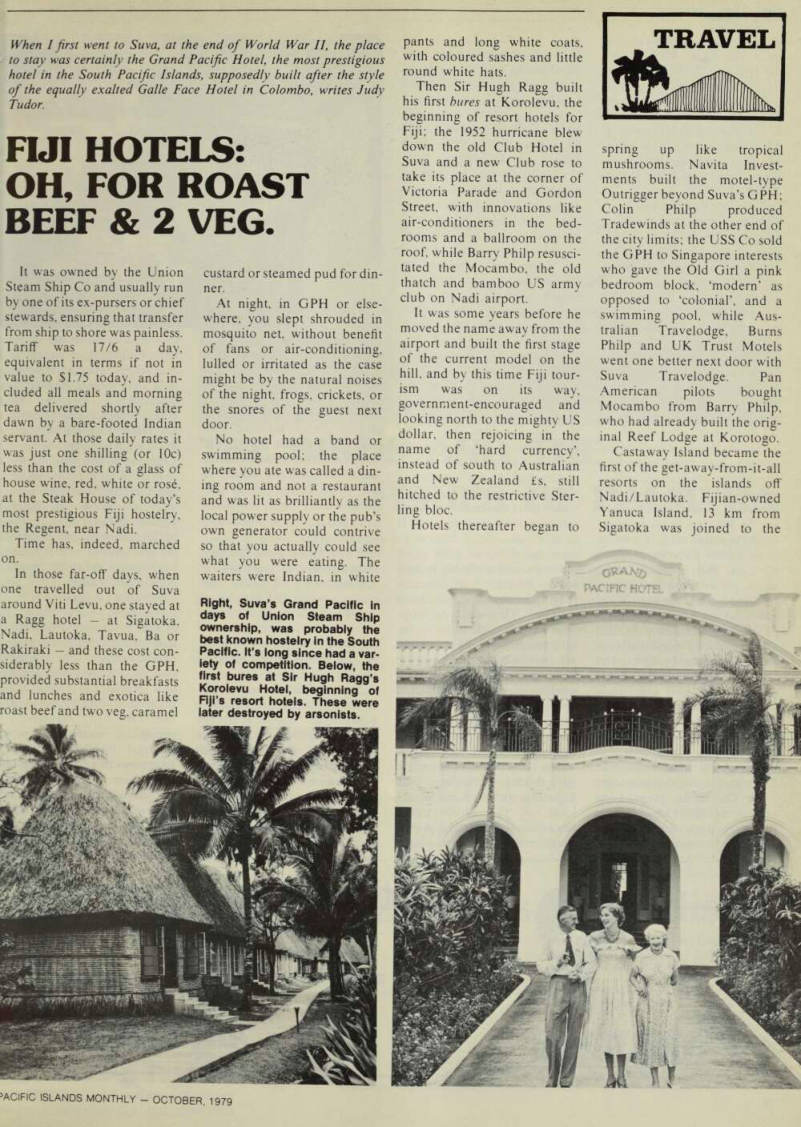
When I first went to Suva, at the end of World War 11, the place to stay was certainly the Grand Pacific Hotel, the most prestigious hotel in the South Pacific Islands, supposedly built after the style of the equally exalted Galle Face Hotel in Colombo, writes Judy Tudor.
Fiji Hotels:
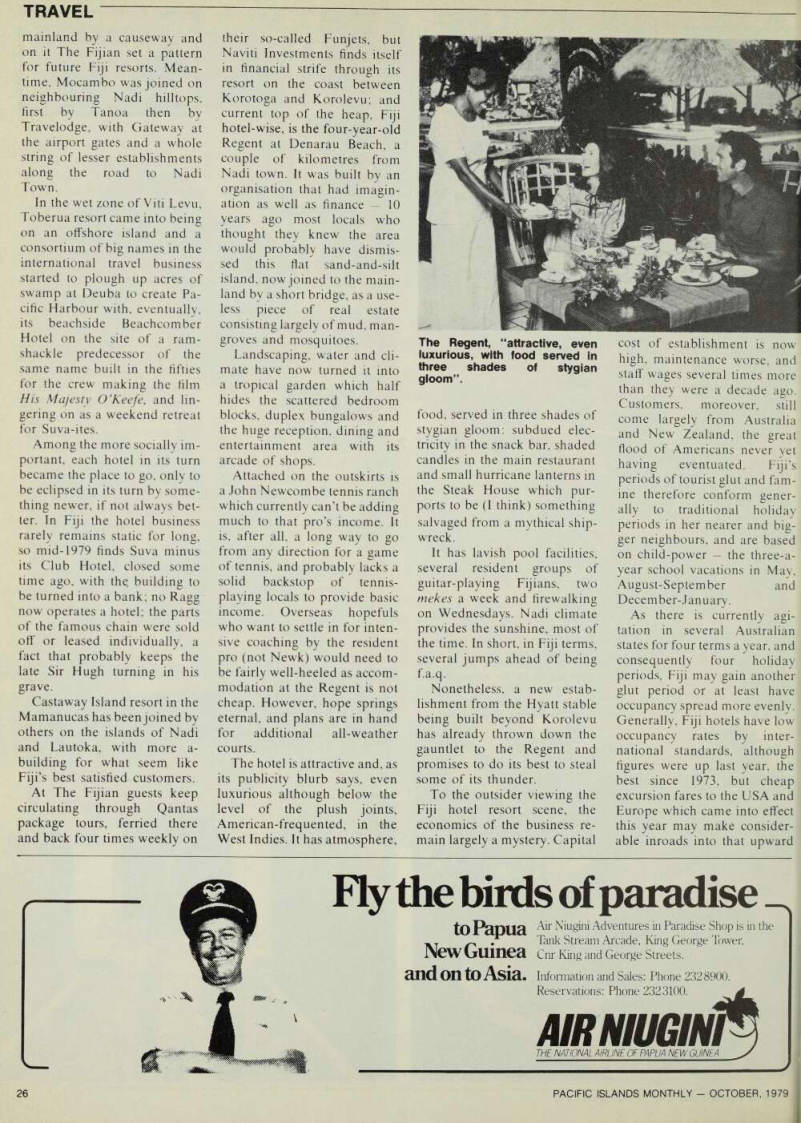
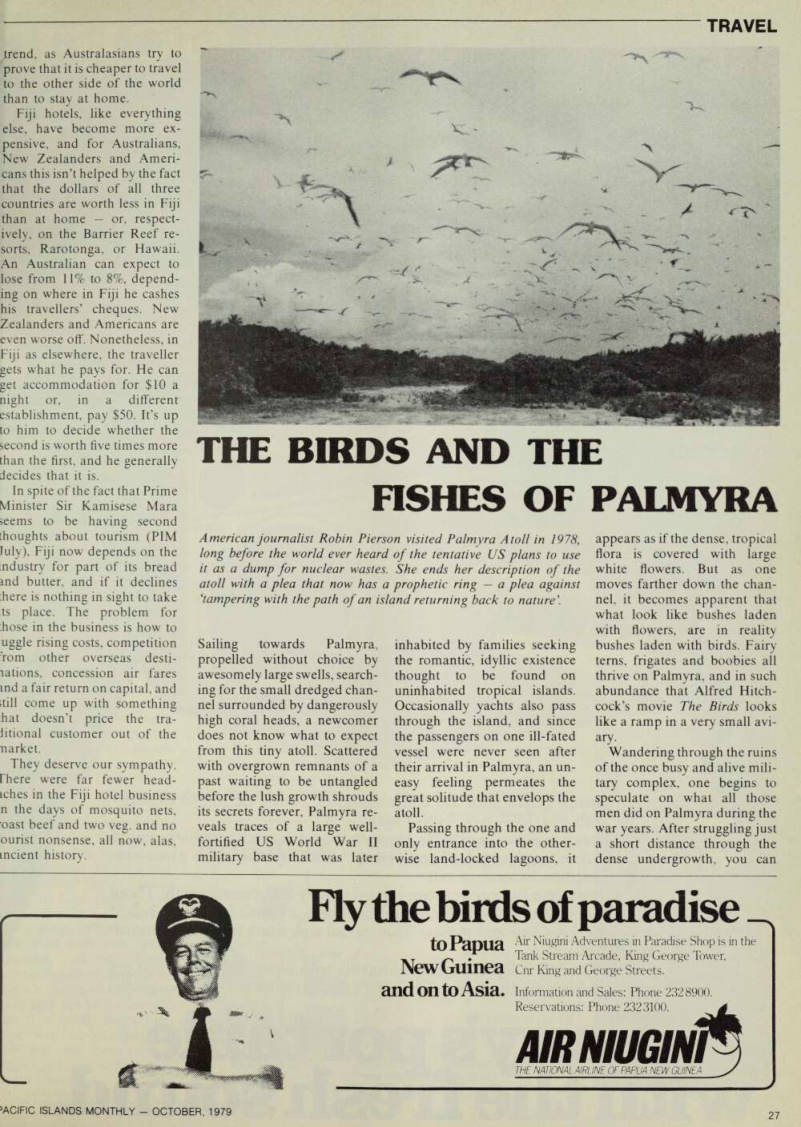
Oh, For Roast
Beef & 2 Veg.
It was owned by the Union Steam Ship Co and usually run by one of its ex-pursers or chief stewards, ensuring that transfer from ship to shore was painless.
Tariff was 17/6 a day, equivalent in terms if not in value to $1.75 today, and in cluded all meals and morning tea delivered shortly after dawn by a bare-footed Indian servant. At those daily rates it was just one shilling (or 10c) less than the cost of a glass of house wine, red, white or rose, at the Steak House of today’s
most prestigious Fiji hostelry,
the Regent, near Nadi.
Time has, indeed, marched on.
In those far-off days, when one travelled out of Suva around Viti Levu, one stayed at a Ragg hotel at Sigatoka, Nadi, Lautoka, Tavua, Ba or Rakiraki and these cost con siderably less than the GPH, provided substantial breakfasts and lunches and exotica like roast beef and two veg, caramel
custard or steamed pud for din ner.
At night, in GPH or else where, you slept shrouded in mosquito net, without benefit of fans or air-conditioning, lulled or irritated as the case might be by the natural noises of the night, frogs, crickets, or the snores of the guest next door.
No hotel had a band or
swimming pool; the place
where you ate was called a din ing room and not a restaurant and was lit as brilliantly as the local power supply or the pub’s own generator could contrive so that you actually could see what you were eating. The waiters were Indian, in white
pants and long white coats, with coloured sashes and little round white hats.
Then Sir Hugh Ragg built his first bures at Korolevu, the beginning of resort hotels for Fiji; the 1952 hurricane blew down the old Club Hotel in Suva and a new Club rose to take its place at the corner of Victoria Parade and Gordon Street, with innovations like air-conditioners in the bed rooms and a ballroom on the roof, while Barry Philp resusci tated the Mocambo, the old thatch and bamboo US army club on Nadi airport.
It was some years before he moved the name away from the airport and built the first stage of the current model on the hill, and by this time Fiji tour ism was on its way,
government-encouraged and
looking north to the mighty US dollar, then rejoicing in the name of ‘hard currency’, instead of south to Australian and New Zealand £s, still hitched to the restrictive Ster
ling bloc.
Hotels thereafter began to
spring up like tropical
mushrooms. Navita Invest ments built the motel-type
Outrigger beyond Suva’s G PH;
Colin Philp produced
Tradewinds at the other end of the city limits; the USS Co sold the GPH to Singapore interests who gave the Old Girl a pink bedroom block, ‘modern’ as opposed to ‘colonial’, and a swimming pool, while Aus tralian Travelodge, Burns Philp and UK Trust Motels went one better next door with Suva Travelodge. Pan
American pilots bought
Mocambo from Barry Philp,
who had already built the orig inal Reef Lodge at Korotogo.
Castaway Island became the first of the get-away-from-it-all resorts on the islands off
Nadi/Lautoka. Fijian-owned
Yanuca Island, 13 km from Sigatoka was joined to the
Right, Suva’s Grand Pacific in days of Union Steam Ship ownership, was probably the best known hostelry In the South Pacific. It’s long since had a var iety of competition. Below, the first bures at Sir Hugh Ragg’s Korolevu Hotel, beginning of Fiji's resort hotels. These were later destroyed by arsonists.
mainland by a causeway and on it The Fijian set a pattern for future Fiji resorts. Mean time, Mocambo was joined on
neighbouring Nadi hilltops,
first by Tanoa then by
Travelodge, with Gateway at
the airport gates and a whole string of lesser establishments along the road to Nadi Town.
In the wet zone of Viti Levu, Toberua resort came into being on an offshore island and a consortium of big names in the international travel business started to plough up acres of swamp at Deuba to create Pa cific Harbour with, eventually, its beachside Beachcomber Hotel on the site of a ram shackle predecessor of the same name built in the fifties for the crew making the film
His Majesty O'Keefe , and lin
gering on as a weekend retreat for Suva-ites.
Among the more socially im portant, each hotel in its turn became the place to go, only to be eclipsed in its turn by some thing newer, if not always bet ter. In Fiji the hotel business rarely remains static for long, so mid-1979 finds Suva minus its Club Hotel, closed some time ago, with the building to be turned into a bank; no Ragg now operates a hotel; the parts of the famous chain were sold off or leased individually, a fact that probably keeps the late Sir Hugh turning in his grave.
Castaway Island resort in the Mamanucas has been joined by others on the islands of Nadi and Lautoka, with more a building for what seem like Fiji’s best satisfied customers.
At The Fijian guests keep
circulating through Qantas
package tours, ferried there and back four times weekly on
their so-called Funjets, but Naviti Investments finds itself in financial strife through its resort on the coast between Korotoga and Korolevu; and current top of the heap. Fiji hotel-wise, is the four-year-old Regent at Denarau Beach, a couple of kilometres from Nadi town. It was built by an organisation that had imagin ation as well as finance 10 years ago most locals who thought they knew the area would probably have dismis sed this flat sand-and-silt island, now joined to the main land by a short bridge, as a use less piece of real estate consisting largely of mud, man groves and mosquitoes.
Landscaping, water and cli mate have now turned it into a tropical garden which half hides the scattered bedroom
blocks, duplex bungalows and
the huge reception, dining and
entertainment area with its arcade of shops.
Attached on the outskirts is a John Newcombe tennis ranch which currently can’t be adding much to that pro’s income. It is, after all, a long way to go from any direction for a game of tennis, and probably lacks a solid backstop of tennis playing locals to provide basic income. Overseas hopefuls who want to settle in for inten sive coaching by the resident pro (not Newk) would need to be fairly well-heeled as accom modation at the Regent is not
cheap. However, hope springs
eternal, and plans are in hand for additional all-weather courts.
The hotel is attractive and, as its publicity blurb says, even luxurious although below the level of the plush joints.
American-frequented, in the West Indies. It has atmosphere,
food, served in three shades of stygian gloom: subdued elec tricity in the snack bar, shaded candles in the main restaurant and small hurricane lanterns in the Steak House which pur ports to be (I think) something
salvaged from a mythical ship
wreck.
It has lavish pool facilities, several resident groups of guitar-playing Fijians, two mekes a week and firewalking on Wednesdays. Nadi climate provides the sunshine, most of the time. In short, in Fiji terms, several jumps ahead of being f- a <F Nonetheless, a new estab lishment from the Hyatt stable
being built beyond Korolevu
has already thrown down the gauntlet to the Regent and promises to do its best to steal some of its thunder.
To the outsider viewing the Fiji hotel resort scene, the economics of the business re main largely a mystery. Capital
cost of establishment is now high, maintenance worse, and , , staff wa g es several times more than they were a decade ago.
Customers, moreover, still come largely from Australia and New Zealand, the great flood of Americans never yet having eventuated Fiji’s periods of tourist glut and fam ine therefore conform gener
ally to traditional holiday
periods in her nearer and big ger neighbours, and are based on child-power the three-a year school vacations in May,
August-September and
December-January.
As there is currently agi tation in several Australian states for four terms a year, and
consequently four holiday
periods, Fiji may gain another glut period or at least have
occupancy spread more evenly,
Generally, Fiji hotels have low occupancy rates by inter national standards, although figures were up last year, the best since 1973, but cheap excursion fares to the USA and Europe which came into effect this year may make consider able inroads into that upward
The Regent, “attractive, even luxurious, with food served in three shades of stygian gloom”.
trend, as Australasians try to prove that it is cheaper to travel to the other side of the world than to stay at home.
Fiji hotels, like everything
else, have become more ex pensive, and for Australians, New Zealanders and Ameri cans this isn’t helped by the fact that the dollars of all three countries are worth less in Fiji than at home or, respect ively, on the Barrier Reef re sorts, Rarotonga, or Hawaii.
An Australian can expect to lose from 11% to 8%, depend ing on where in Fiji he cashes his travellers’ cheques. New Zealanders and Americans are even worse off. Nonetheless, in Fiji as elsewhere, the traveller gets what he pays for. He can get accommodation for $lO a night or, in a different establishment, pay $5O. It’s up to him to decide whether the second is worth five times more than the first, and he generally decides that it is.
In spite of the fact that Prime Minister Sir Kamisese Mara seems to be having second thoughts about tourism (PIM
luly), Fiji now depends on the
ndustry for part of its bread md butter, and if it declines there is nothing in sight to take ts place. The problem for hose in the business is how to
uggle rising costs, competition
Tom other overseas desti rations, concession air fares md a fair return on capital, and ;till come up with something hat doesn’t price the tra litional customer out of the narket.
They deserve our sympathy,
fhere were far fewer head iches in the Fiji hotel business n the days of mosquito nets, oast beef and two veg. and no ourist nonsense, all now, alas,
indent history.
Advertisements & other items, p. 26 (2 items)
Travel
Fly the birds of paradise
to Papua New Guinea and on to Asia.
Air Niugini Adventures in Paradise Shop is in the Tank Stream Arcade, King George Tower, Cnr King and George Streets.
Information and Sales: Phone 2328900.
The Birds And The
Fishes Of Palmyra
American journalist Robin Pierson visited Palmyra Atoll in 1978, long before the world ever heard of the tentative US plans to use it as a dump for nuclear wastes. She ends her description of the atoll with a plea that now has a prophetic ring a plea against ‘tampering with the path of an island returning back to nature ’.
Sailing towards Palmyra,
propelled without choice by
awesomely large swells, search
ing for the small dredged chan
nel surrounded by dangerously
high coral heads, a newcomer does not know what to expect from this tiny atoll. Scattered with overgrown remnants of a past waiting to be untangled before the lush growth shrouds its secrets forever, Palmyra re veals traces of a large well fortified US World War II military base that was later
inhabited by families seeking
the romantic, idyllic existence thought to be found on uninhabited tropical islands.
Occasionally yachts also pass
through the island, and since the passengers on one ill-fated vessel were never seen after their arrival in Palmyra, an un easy feeling permeates the great solitude that envelops the atoll.
Passing through the one and only entrance into the other wise land-locked lagoons, it
appears as if the dense, tropical flora is covered with large white flowers. But as one moves farther down the chan nel, it becomes apparent that what look like bushes laden with flowers, are in reality bushes laden with birds. Fairy terns, frigates and boobies all thrive on Palmyra, and in such abundance that Alfred Hitch cock’s movie The Birds looks like a ramp in a very small avi ary.
Wandering through the ruins
of the once busy and alive mili tary complex, one begins to speculate on what all those men did on Palmyra during the war years. After struggling just a short distance through the dense undergrowth, you can
Advertisements & other items, pp. 27-30 (3 items)
Travel
27
>ACIFIC ISLANDS MONTHLY - OCTOBER, 1979
Airniuginr
Fly the birds of paradise
to Papua
New Guinea
and on to Asia.
Air Niugini Adventures in Paradise Shop is in the Tank Stream Arcade, King George Tower, Cnr King and George Streets.
Information and Sales: Phone 2328900.
Reservations: Phone 2323100. £
AIRNIUGINr
THE NATIONAL AIRLINE OF PAPUA NEW GUINEA
LET Vtm SHOW YOU
WAY I
professional results.
Victa 8 h.p. Tiller (Model 408). • Independent rear tine and wheel drive transmissions #5 forward speeds plus reverse ©Chain driven totally enclosed gear boxes ©Nine (9) handle positions instantly adjustable either vertically or horizontally by squeeze trigger © 14" dia. tines - 20" tilling width * Throttle, gear shift and handle adjustment levers are all conveniently located on handle assembly ©Separate transmission levers for tine drive or wheel drive © Instant depth control with spring loaded pin engagement of multi-position depth bar ©Tractor tread tyres combined with front mounted counterweight for maximum traction. OPTIONAL ATTACHMENTS: Hilling Plough: Twin ploughshares adjustable in width and in angle to produce hills or furrows.
Cultivating Points: Four cultivating point assemblies, adjustable in spacing.
NOTE: The above must be used with "A"
Frame Assembly and two depth wheels, which are rear mounted.
Victa 5 h.p. Tiller (Model 355). Worm drive gear box. Forward speed plus neutral |r and reverse, and accepting a wide range of optional attachments. 5 h.p. B& S pull-start ; J 4-stroke engine. Heavy-duty m \ tines adjustable from 305 mm * * J (12") to 660 mm (26") ' * Mm cultivating widths.
W Weight 95 kg (210 lb). jB Victa 3 h.p. Till-it Tiller (Model 030). Lightweight, portable, compact tiller.
Special features include: 3 h.p. Briggs & Stratton engine with easy pullstart. Spring steel "J? tines adjust to 254 mm (10") or 457 mm (18") cultivating widths. Weight: 27 kg (60 lb).
Victa 3.5 h.p. Tiller (Model 100). Rugged heavy duty model with 3.5 h.p. B & S pull-start 4-stroke engine. Long-life oil filled cast iron gear box. 16 spring £ steel tines 12" diameter adjust from 305 mm (12") to 660 mm (26") cultivating widths. Weight 63 kg (140 lb). Optional attachments: Furrow opener, sweep plough, pneumatic front tyre kit.
SEE A I m
DEALER NOW
FORA
DEMONSTRATION.
Sony’s portable
Fill your leisure hours with the fresh sound of Sony's CFM-31S cassetterecorder with FM/MW/SWI/SW2 radio.
The 2-way speaker produces three watts of incredibly sharp sound through a 12cm woofer and a scm tweeter. A fine tuning knob gives precise SW reception indoors or out.
At a touch of a button, you can record simply and conveniently. There is also a built-in electret condenser microphone, a pause button, a 3-digit tape counter, plus cue and review. This model also shuts itself off automatically after playback.
The CFM-31S is lightweight and travels with ease. Anywhere you go, it's the portable with the fresh sound. (CFM-31L with fm/mw/sw/lw is also available.)
Sony’s portable
with the fresh sound
f jiM r*-
x„. mu /> /I J
opv
ORT MO
♦ Right in t business ce * A tradition , comfort food ♦ All rooms airconditioned * Restaurant * Ba ♦ Banquet hall
.C. NEUMANN
manager Phone 21*2622^ Stay at Aggie Grey’s . . . the South Pacific’s legendary hotel.
Situated right in the heart of Western Samoa. Enjoy Poly nesian-style friendliness and service, in cool surroundings, superb entertainment and food.
Magnificent white sand beaches only a short drive away. Airconditioned rooms, swimming pool and full bar facilities.
Bookings through Union Steamship Company of NZ. Pan Am.
Air New Zealand or direct to Aggie Urey's. Apia. Western Samoa. Cables: AC.CIES' Apia.
Frostpak
ff b /(• -r i I
Koolatron
INDUSTRIES
Portable Electronic
Solid State Refrigerators
For people on the move Ideal for Campers & Caravans Indispensable for Travellers and Holidaymakers A must for Truckdnvers Popular with Yachts.
Aircraft and Fishermen For Medical & Technical purposes & Food Samples ■ Big cooling performance ■ No Gas - No Compressor ■ Large 33 Litre capacity ■ Unaffected by motion or level ■ No noise or vibration ■ Low Battery Drain ■ Low Weight - 7 KG ■ Virtually Indestructable ■ 2 Year Guarantee From 5199.00 incl. Sales Tax Connects to 12V Battery or Cigarette Lighter Operates on 240 V with Battery Charger 297 Williamstown Road, Port Melbourne 3027 Phone 645 2068 Telex 32571
»et a tiny inkling of what an
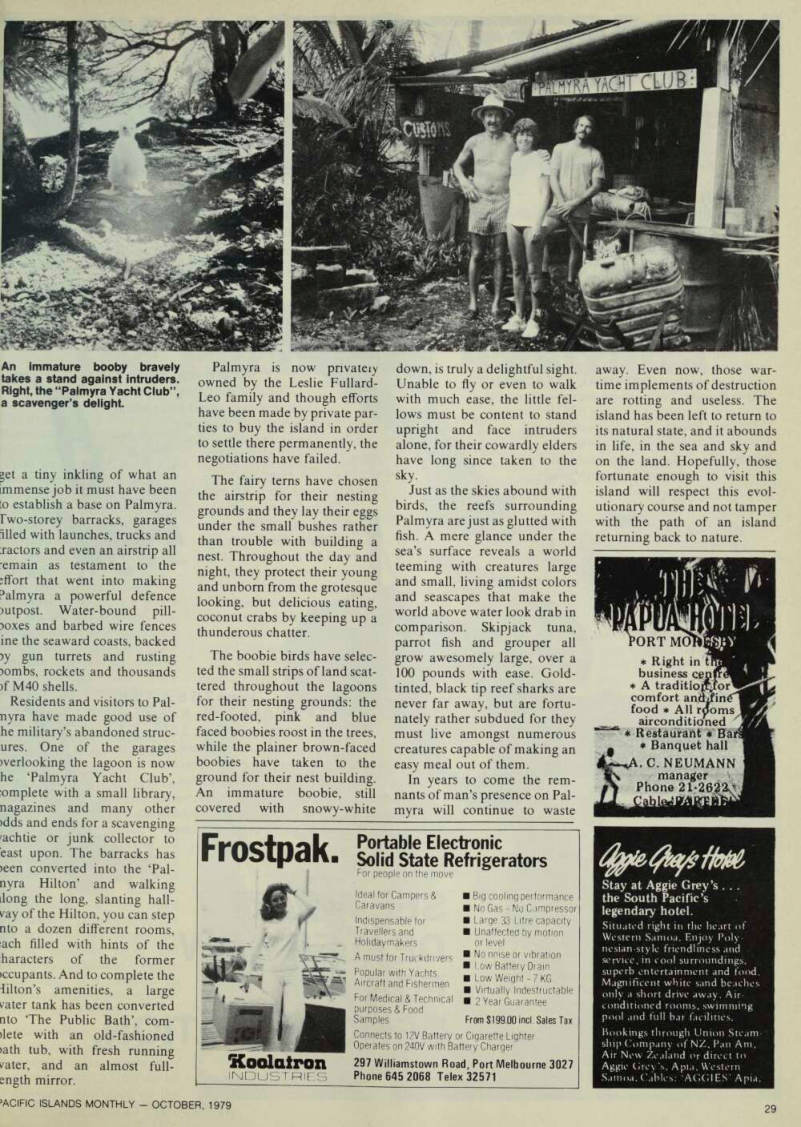
immense job it must have been to establish a base on Palmyra, fwo-storey barracks, garages illed with launches, trucks and tractors and even an airstrip all •emain as testament to the effort that went into making 3 almyra a powerful defence butpost. Water-bound pill boxes and barbed wire fences ine the seaward coasts, backed )y gun turrets and rusting bombs, rockets and thousands )f M4O shells.
Residents and visitors to Pal nyra have made good use of he military’s abandoned struc ures. One of the garages werlooking the lagoon is now he ‘Palmyra Yacht Club’, :omplete with a small library, nagazines and many other )dds and ends for a scavenging 'achtie or junk collector to east upon. The barracks has >een converted into the ‘Pal
nyra Hilton’ and walking
Jong the long, slanting hall
way of the Hilton, you can step nto a dozen different rooms, ach filled with hints of the haracters of the former >ccupants. And to complete the
filton’s amenities, a large
yater tank has been converted nto ‘The Public Bath’, com >lete with an old-fashioned >ath tub, with fresh running and an almost full sngth mirror.
Palmyra is now pnvateiy owned by the Leslie Fullard- Leo family and though efforts have been made by private par ties to buy the island in order to settle there permanently, the negotiations have failed.
The fairy terns have chosen the airstrip for their nesting
grounds and they lay their eggs
under the small bushes rather than trouble with building a nest. Throughout the day and night, they protect their young and unborn from the grotesque
looking, but delicious eating,
coconut crabs by keeping up a thunderous chatter.
The boobie birds have selec ted the small strips of land scat
tered throughout the lagoons
for their nesting grounds: the red-footed, pink and blue faced boobies roost in the trees, while the plainer brown-faced boobies have taken to the ground for their nest building.
An immature boobie, still covered with snowy-white
down, is truly a delightful sight.
Unable to fly or even to walk with much ease, the little fel lows must be content to stand upright and face intruders alone, for their cowardly elders have long since taken to the
sky.
Just as the skies abound with birds, the reefs surrounding
Palmyra are just as glutted with
fish. A mere glance under the sea’s surface reveals a world
teeming with creatures large
and small, living amidst colors and seascapes that make the world above water look drab in
comparison. Skipjack tuna,
parrot fish and grouper all grow awesomely large, over a 100 pounds with ease. Gold tinted, black tip reef sharks are never far away, but are fortu nately rather subdued for they must live amongst numerous creatures capable of making an easy meal out of them.
In years to come the rem nants of man’s presence on Pal myra will continue to waste
away. Even now, those war time implements of destruction are rotting and useless. The island has been left to return to its natural state, and it abounds in life, in the sea and sky and on the land. Hopefully, those fortunate enough to visit this island will respect this evol utionary course and not tamper with the path of an island returning back to nature.
An immature booby bravely takes a stand against intruders.
Right, the “Palmyra Yacht Club”, a scavenger’s delight.
Advertisements & other items, p. 29 (1 item)
29
’ACIFIC ISLANDS MONTHLY - OCTOBER, 1979
Australia Inthe Pacific
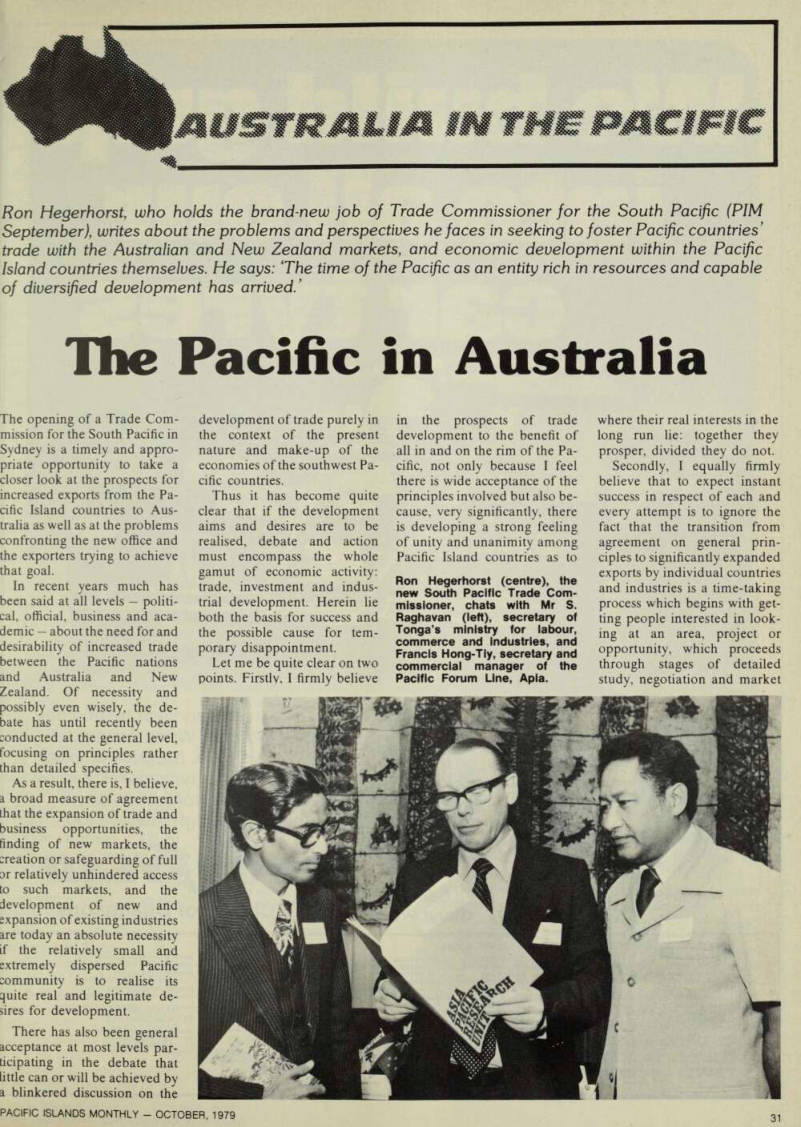
Ron Hegerhorst, who holds the brand-new job of Trade Commissioner for the South Pacific (PIM September), writes about the problems and perspectives he faces in seeking to foster Pacific countries' trade with the Australian and New Zealand markets, and economic development within the Pacific Island countries themselves. He says: The time of the Pacific as an entity rich in resources and capable of diversified development has arrived
The Pacific in Australia

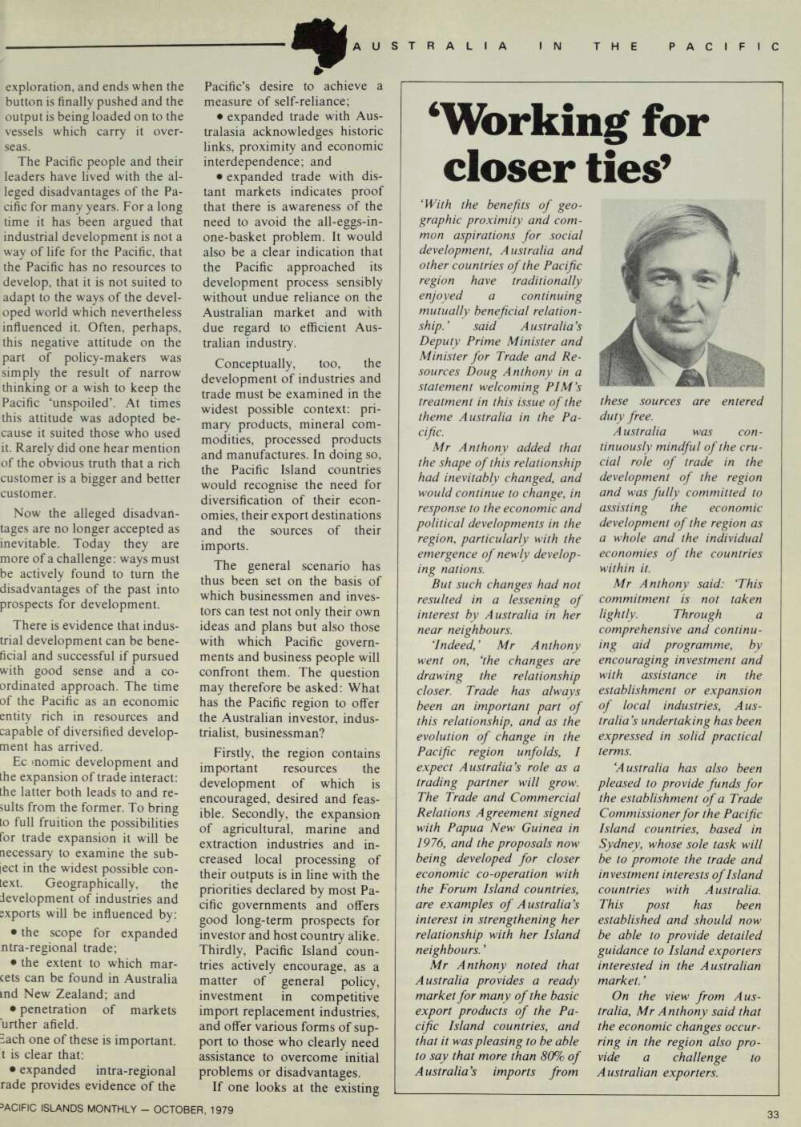
The opening of a Trade Com mission for the South Pacific in Sydney is a timely and appro priate opportunity to take a closer look at the prospects for increased exports from the Pa cific Island countries to Aus tralia as well as at the problems confronting the new office and the exporters trying to achieve
that goal.
In recent years much has been said at all levels politi cal, official, business and aca demic about the need for and desirability of increased trade between the Pacific nations and Australia and New
Zealand. Of necessity and
possibly even wisely, the de bate has until recently been conducted at the general level,
focusing on principles rather
than detailed specifies.
As a result, there is, I believe, a broad measure of agreement that the expansion of trade and business opportunities, the finding of new markets, the creation or safeguarding of full dt relatively unhindered access to such markets, and the development of new and
expansion of existing industries
are today an absolute necessity if the relatively small and
extremely dispersed Pacific
community is to realise its quite real and legitimate de
sires for development.
There has also been general acceptance at most levels par ticipating in the debate that little can or will be achieved by a blinkered discussion on the
development of trade purely in the context of the present nature and make-up of the economies of the southwest Pa cific countries.
Thus it has become quite clear that if the development aims and desires are to be realised, debate and action must encompass the whole gamut of economic activity: trade, investment and indus trial development. Herein lie both the basis for success and the possible cause for tem
porary disappointment.
Let me be quite clear on two points. Firstly, I firmly believe
in the prospects of trade development to the benefit of all in and on the rim of the Pa cific, not only because I feel there is wide acceptance of the principles involved but also be cause, very significantly, there is developing a strong feeling of unity and unanimity among Pacific Island countries as to
where their real interests in the long run lie: together they prosper, divided they do not.
Secondly, I equally firmly believe that to expect instant success in respect of each and every attempt is to ignore the fact that the transition from agreement on general prin ciples to significantly expanded exports by individual countries and industries is a time-taking process which begins with get ting people interested in look ing at an area, project or opportunity, which proceeds through stages of detailed study, negotiation and market
Ron Hegerhorst (centre), the new South Pacific Trade Com missioner, chats with Mr S.
Raghavan (left), secretary of Tonga’s ministry for labour, commerce and industries, and Francis Hong-Tly, secretary and commercial manager of the Pacific Forum Line, Apla.
exploration, and ends when the button is finally pushed and the output is being loaded on to the vessels which carry it over seas.
The Pacific people and their leaders have lived with the al leged disadvantages of the Pa cific for many years. For a long time it has been argued that industrial development is not a way of life for the Pacific, that the Pacific has no resources to develop, that it is not suited to adapt to the ways of the devel oped world which nevertheless influenced it. Often, perhaps, this negative attitude on the part of policy-makers was simply the result of narrow thinking or a wish to keep the Pacific ‘unspoiled’. At times this attitude was adopted be cause it suited those who used it. Rarely did one hear mention of the obvious truth that a rich customer is a bigger and better customer.
Now the alleged disadvan
tages are no longer accepted as
inevitable. Today they are
more of a challenge: ways must be actively found to turn the disadvantages of the past into
prospects for development.
There is evidence that indus trial development can be bene ficial and successful if pursued with good sense and a co ordinated approach. The time of the Pacific as an economic entity rich in resources and
capable of diversified develop
ment has arrived.
Ec »nomic development and the expansion of trade interact: the latter both leads to and re mits from the former. To bring to full fruition the possibilities for trade expansion it will be accessary to examine the sub let in the widest possible con
text. Geographically, the
development of industries and exports will be influenced by: • the scope for expanded
ntra-regional trade;
• the extent to which mar kets can be found in Australia md New Zealand; and • penetration of markets urther afield.
Bach one of these is important, t is clear that:
• expanded intra-regional
rade provides evidence of the
Pacific’s desire to achieve a measure of self-reliance; • expanded trade with Aus tralasia acknowledges historic links, proximity and economic
interdependence; and
• expanded trade with dis tant markets indicates proof that there is awareness of the need to avoid the all-eggs-in one-basket problem. It would also be a clear indication that the Pacific approached its
development process sensibly
without undue reliance on the Australian market and with due regard to efficient Aus
tralian industry.
Conceptually, too, the development of industries and trade must be examined in the
widest possible context: pri
mary products, mineral com
modities, processed products
and manufactures. In doing so, the Pacific Island countries would recognise the need for diversification of their econ omies, their export destinations and the sources of their
imports.
The general scenario has thus been set on the basis of which businessmen and inves tors can test not only their own ideas and plans but also those with which Pacific govern ments and business people will confront them. The question may therefore be asked: What has the Pacific region to offer the Australian investor, indus trialist, businessman?
Firstly, the region contains
important resources the development of which is encouraged, desired and feas ible. Secondly, the expansion of agricultural, marine and extraction industries and in creased local processing of their outputs is in line with the priorities declared by most Pa cific governments and offers
good long-term prospects for
investor and host country alike.
Thirdly, Pacific Island coun tries actively encourage, as a matter of general policy, investment in competitive
import replacement industries,
and offer various forms of sup port to those who clearly need assistance to overcome initial
problems or disadvantages.
If one looks at the existing
industry scene in the Pacific re gion it becomes apparent that those industries which have
acknowledged and adjusted to
the prevailing local circum stances, are in the longer term the most steadily successful.
They have not come in on the basis of unduly high short-term expectations, but looked at their markets for their develop ment potential rather than immediate return. They too will be the beneficiaries of
export development, having
first secured a sound home base.
Where then, do we go from here? What must be done to achieve the twin objectives of increased trade and diversified industrial development? The action is twofold: create aware ness and a suitable climate.
To create a suitable climate to enable Pacific Island coun tries to build on their present rather small and narrow econ omic bases is a task they cannot perform alone. Assistance is needed in the form of joint government action to open up markets away from their small domestic outlets. It is gratifying
to be able to note that action has already begun to establish a framework to provide oppor tunities for Pacific products in the Australian (and New Zealand) markets, the aim being to achieve over as wide a range as possible progress
ively duty-free and unrestric
ted access.
The other, very essential, task is to create in the business community of Australia a high level of awareness of and con fidence in the Pacific region as a supplier of resources, a sound haven for investment and a suitable location for industrial development activity. This is a task for which the Pacific, its governments and represen
tatives carry primary responsi
bility themselves. It is good to note that on this front also action has begun.
The region is moving in the right direction. Now the momentum must be main tained. This can be best done by a realistic and positive ap proach to both objectives and
problems, together with co
operative and co-ordinated action. Do it our way: the friendly Pacific way.
Seminar got
down to
tin tacks
Business and government del egations from the Cook Islands, Fiji, Tonga and West ern Samoa took part in an August trade and investment drive directed at the Australian market.
Their activity was part of the South Pacific Business Development Seminar the first event of its kind con ducted by the Asia Pacific Re search Unit at a Sydney hotel.
About 50 Australian business men and women paid to attend the seminar. Aus tralian companies were found, with a few exceptions, to have a general lack of knowledge about the SPEC nations.
Australian companies re sponded with most interest to Island proposals for business projects in food processing, fish canning, cut flowers, coconut timber utilisation, coconut oil supply and resource-based industries.
Negotiations were started i n t o a f ru j t an( j vegetable can nery, roof shingle and furniture production, dried banana supply to Sydney health food
shops, Australian supply of
coconut oil processing equip
ment, and cassava flour supply to a snack food company, The seminar also identified products which would not find a ready market in Australia, These included lower quality handicrafts, recorded music cassettes with Island music ‘strange’ to Australian ears, and ballet shoes, Island representatives were ur g ed to make direct contact with the Sydney market, and ta ke a first-hand look at what Australians want to buy before undertaking a costly sales drive Said ApRU director for Aus . tralia Bob Thompson: ‘There are four mi|lion peop)e in Syd . ney. That is seven times the entire population of Fiji, and one of the largest markets any where in the world. Goods that find a ready market in Sydney will be saleable anywhere in the world, subject to price con siderations.’
Advertisements & other items, p. 32 (1 item)
Good-Year
■ a
GBOO+S
GBOO
Grand Rally
GBOO+S
Grand Prix 70
You can trust Goodyear technology
to give you grip. World champion
racing drivers do. So drive on steel
belted radial car tyres developed by
Goodyear. Built for grip in any
weather. Extra high mileage too.
GOOD-YEAR
The Choice of Champions
GOODYEAR DISTRIBUTORS IN S.E. ASIA AND PACIFIC BASIN Richard Pieris & Co., Ltd.
Colombo. Sri Lanka Nepal Motor Company (P) Ltd.
Biratnagar, Nepal Navana Ltd.
Dacca, Bangladesh Diethelm & Co.. Ltd.
Bangkok, Thailand Landis Brothers &Co Ltd.
Hong Kong Guam Tire & Supply Co.
Agana. Guam Susupe Enterprises Saipan. Mariana Is Microl Corporation Saipan. Mariana Is Truk Trading Co.
Truk E , Caroline Is
PAM.I.
Kolonia, Ponape Island Transport Service Co.
Majuro. Marshall Is Yap Cooperative Ass.
Yap, W Caroline Is Cook Islands Motor Centre Ltd.
Rarotonga. Cook Is Ngiratkel Etpison Co Ltd.
Koror. Palau Boroko Motors Ltd Port Moresby. Papua New Guinea Solomon Motors Ltd.
Honiara. Solomon Is Santo Engineers Santo. New Hebrides Pacific Motors Vila. New Hebrides
S.G.A.
Noumea. New Caledonia Buncombe Bay Garage Norfolk Is Coral Island Motors Suva, Fiji Morris Hedstrom Ltd.
Nukualofa, Tonga Morris Hedstrom Ltd.
Apia. Western Samoa Western Samoa Transport Cooperative Society Ltd Apia. Western Samoa Samoa Motors Inc Pago Pago. American Samoa Service Mobil Papeete Tahiti
GOODYEAR SUBSIDIARIES
The Goodyear Tyre & Rubber Co. (Ausl.) Ltd Sydney, AUSTRALIA Tel: 31-0311 Goodyear India Limited New Delhi 1, INDIA Tel: 46886/9 PT Goodyear Indonesia Bogor. Republic of Indonesia Tel 3371/2 Nippon Goodyear Kabushiki Kaisha Tokyo. JAPAN Tel: 582-0481/8 Goodyear Malaysia Berhad Selangor MALAYSIA Tel: 36250V5 The Goodyear Tyre & Rubber Co of New Zealand, Limited Lower Hutt. NEW ZEALAND Tel: 684-389 The Goodyear Tyre & Rubber Company olthe Philippines. Limited Makati-Metro Manila Republic of the Philippines Tel: 89-20-41 Goodyear Singapore Pvt Limited Geylang SINGAPORE 14 Tel 408281/3 Goodyear Taiwan Limited Taipei. TAIWAN Tel: 5117135/8 Goodyear (Thailand) Limited Bangkok, THAILAND. Tel: 252-6141/5
FOR FURTHER INFORMATION
PLEASE CONTACT
Goodyear International Corporation Room 1603. Wing On Center 111 Connaught Road Central
HONG KONG Tel: 5-433331
HRME171.0252
‘Working for closer ties'
closer ties'
‘With the benefits of geo graphic proximity and com mon aspirations for social development, Australia and other countries of the Pacific region have traditionally enjoyed a continuing mutually beneficial relation ship.’ said Australia’s Deputy Prime Minister and Minister for Trade and Re sources Doug Anthony in a statement welcoming PI M’s treatment in this issue of the theme Australia in the Pa cific.
Mr Anthony added that the shape of this relationship
had inevitably changed, and
would continue to change, in response to the economic and political developments in the region, particularly with the emergence of newly develop ing nations.
But such changes had not resulted in a lessening of interest by Australia in her
near neighbours.
‘lndeed,’ Mr Anthony went on, ‘the changes are drawing the relationship closer. Trade has always been an important part of this relationship, and as the evolution of change in the Pacific region unfolds, I expect Australia’s role as a trading partner will grow.
The Trade and Commercial Relations Agreement signed with Papua New Guinea in 1976, and the proposals now
being developed for closer
economic co-operation with the Forum Island countries, are examples of Australia’s interest in strengthening her relationship with her Island neighbours. ’
Mr Anthony noted that Australia provides a ready market for many of the basic export products of the Pa cific Island countries, and that it was pleasing to be able to say that more than 80% of Australia’s imports from
these sources are entered
duty free.
Australia was con
tinuously mindful of the cru
cial role of trade in the
development of the region
and was fully committed to assisting the economic development of the region as a whole and the individual economies of the countries within it.
Mr Anthony said: ‘This commitment is not taken
lightly. Through a
comprehensive and continu ing aid programme, by encouraging investment and with assistance in the establishment or expansion of local industries, Aus tralia ’s undertaking has been
expressed in solid practical
terms. ‘Australia has also been
pleased to provide funds for
the establishment of a Trade
Commissioner for the Pacific
Island countries, based in Sydney, whose sole task will be to promote the trade and investment interests of Island countries with Australia.
This post has been established and should now be able to provide detailed guidance to Island exporters interested in the Australian market. ’
On the view from Aus tralia, Mr Anthony said that the economic changes occur ring in the region also pro vide a challenge to Australian exporters.
Advertisements & other items, pp. 33-35 (3 items)
33
AUSTRALIA IN THE PACIFIC
3 ACIFIC ISLANDS MONTHLY - OCTOBER, 1979
34
PACIFIC ISLANDS MONTHI Y OCTORFR IQ7Q
• Kelvinator Australia Limited .. . Adelaide, South Australia • Truk Cooperative Association ... Truk, Eastern Caroline Islands • Bema
Inc.. . Yap District, Western Caroline Islands • Cook Islands Trading Corporation, Ltd... Rarotonga, Cook Islands • Carpenters Fiji Lim Enterprises .. . Majuro, Marshall Islands • Electric Radio Noumea ... Noumea, New Caledonia • Pentecost Pacific SA... Port-Vila, f Pacific Traders , Inc... Pago Pago, American Samoa • Motor Distributors (Samoa) Ltd... Apia, Western Samoa • Guadalcanal Elect
/hen you own aKelvinator
t i Refrigerators. Freezers, Gas and Electric Ranges, Air Conditioners, Automatic Washers and Dryers, Wringer Washers, Microwave Ovens, Humidifiers, Dehumidifiers, Water Coolers, Commercial Air Conditioners and Refrigerators. 0 0
INTERNATIONALCOMPANY -
Kelvinator International Company, P.O. Box 9200, Grand Rapids, Michigan 49509, U.S.A. -prises . . . Ponape, Eastern Caroline Islands • Western Carolines Trading Co. . . Palau, Western Caroline Islands • Family Chain Stores , uva, Fiji • Pacific International Co., Inc. . . Agana, Guam • M.S. Villagomez Enterprises . . . Saipan, Mariana Islands • Robert Reimers ides • Fisher & Paykel Ltd. . . Panmure, New Zealand • Bums Philp (New Guinea) Ltd. . . Port Moresby, Papua New Guinea • South . Honiara, Solomon Islands • Ets. Rene Solari etFils . . . Papeete, Tahiti • E.M. Jones . . . Nukualofa, Tonga
Australia-Pacific
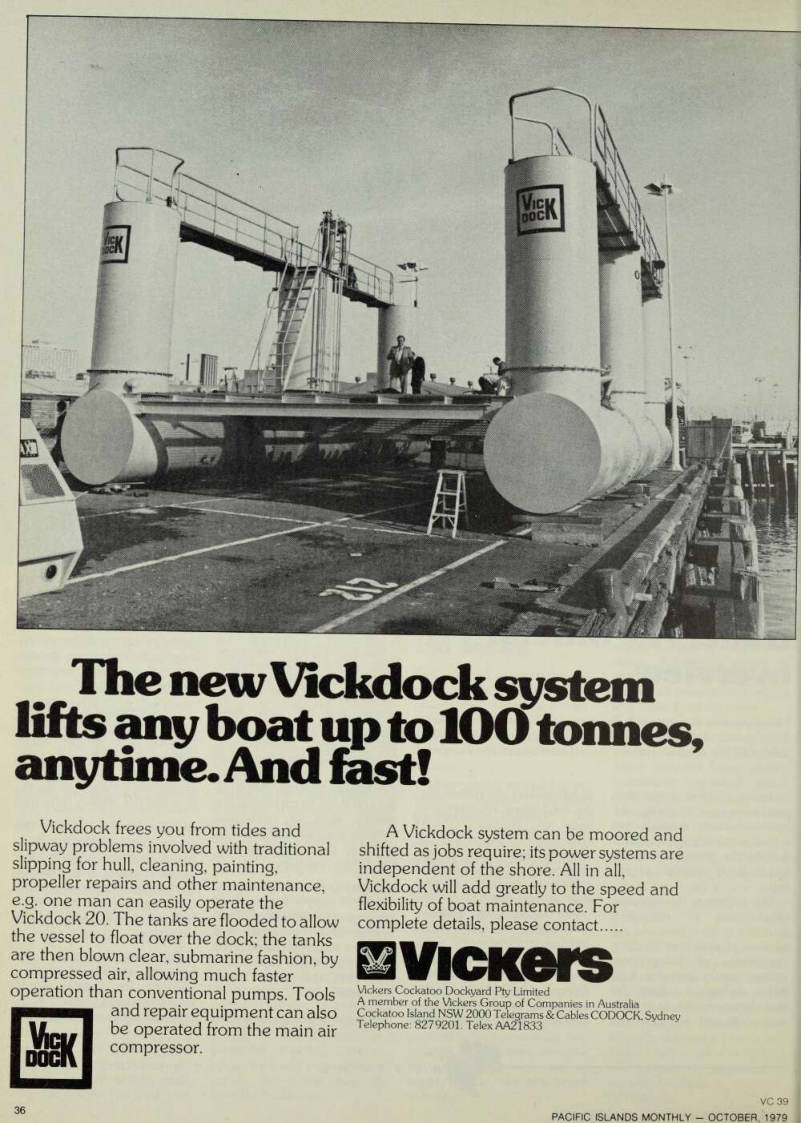

trade: An official overview
The Australian Government's Department of Trade and Resources has prepared the following overview of Australia/Pacific trade as Dart of PlM’s treatment of the theme Australia in the Pacific.
n terms of close geographic
proximity, good shipping and
communications, Australia has
i traditional relationship with
he Pacific Island countries vhich is of mutual advan age.
The advances in economic ievelopment of individual countries in the region, and the lumber of countries reaching he status of independent lations means that for Aus ralia, traditional outlets for nanufactured and food pro ducts will call for care and
understanding to ensure that the established relations con tinue to develop. Greater agricultural output, for example, may allow smaller developing nations to place less reliance on Australia as a sup plier of foodstuffs.
For Australia, the problem
of marketing in competition
with other suppliers is not a new experience and there is no doubt that if the nation’s tra ditional share of the Pacific market is to be maintained, then a continued strong servic
ing of the area by exporters will have to be maintained much as it is in other parts of the world.
Pacific Island countries, however, can find in Australian
industry, technology and capi
tal markets most of the re sources that can assist their economic development pro grammes, and Australia is committed in a variety of ways
to assisting this development
through investment, including
aid and trade. In particular, the smaller scale of Australian industry and technology is well suited to the requirements of the Island countries.
Australia is not only a logical source of supply for many of the import requirements of the Pacific Island countries but offers an expanding market for most of the major export pro ducts available from Island countries.
In the area of investment, the
Australian Government spon sored a mission to Papua New Guinea in February this year to
investigate specific business
opportunities and has been actively following up the re sults with potential Australian investors since then.
The question of access to the Australian market for Pacific products is at present being examined. Australia is sym pathetic to the needs of developing countries of the re gion and has already indicated that despite the fact that the great majority of products from Island countries already have duty-free access to its domestic market, it is prepared to enter into a regional trade agreement with the South Pacific Island countries.
This undertaking was an nounced by the Australian Minister for Special Trade Representations, Mr R. V.
Garland, at the conclusion of a
meeting of trade ministers from the countries of the South Pacific Forum in June this year. It followed a decision by ministers to enter into nego tiations to establish a
comprehensive, non-reciprocal
trade agreement in favour of Island member countries with the object of achieving, pro
gressively, duty-free and unre
stricted access to the markets of Australia and New Zealand over as wide a range of pro
ducts as possible.
That an answer to this ques tion, and the question of the
future shape of the region’s
trade relations, be found and found quickly is essential. The region is too vast and varied to be considered in single econ omic units, and it is to the advantage of all that greater nteraction between the ndividual economies of the re gion should become more than ust an aim or ideal it must oecome fact.
Generally, the area could be
xonsidered in three geographic
mtities Papua New Guinea,
he Pacific Islands (principally hose nations with membership )f the South Pacific Forum), md Hawaii. The well-being of :ach area is important to the
iiture prosperity and stability
)f the total region.
Papua New Guinea:
\ustralia and Papua New
Gruinea, formerly its trust tern ary, have a special relation ship. This has not changed in
essence since independence
vas granted in 1975. Australia’s jading interest with the new ration is more than just two vay in the usual sense. While \ustralia is concerned to make he most of the country’s export potential, it is also actively
nvolved in giving assistance
md investment funds to local ndustries in PNG, and offers m export market for the goods moduced.
PNG is Australia’s 13th lar gest market, and its fourth lar gest for manufactures, with a ;olal value in 1977/78 of $237
Trillion. Major exports in
1977/78 were rice (sl7m),
eanned meat (sl6m), prefabri
:ated buildings ($7.9m),
excavating and levelling equip
ment ($6.3m), iron and steel bars, pipes, sheets, etc. ($6.2m),
petroleum and petroleum pro
ducts (s7.lm) and sugar ($6.6m).
PNG and Australia signed a Trade and Commercial Re lations Agreement in 1976, and an important part of this agree ment is the wide duty-free access to the Australian market given to PNG exports and pro vision for encouraging direct Australian investment in the social and economic develop ment of PNG. (Since 1977, di rect Australian investment in PNG has totalled $279 million.) In welcoming the formal agreement, Sir Maori Kiki forecast a growing market for PNG’s goods in Australia, in addition to its traditional mar ket there for coffee, rubber, timber, plywood and peanuts.
In February this year, an Australian trade and develop ment mission visited PNG and looked specifically at the ques tion of promoting Australian
investment by private
companies. As a consequence, the Australian Government is
sponsoring an Australia/Papua
New Guinea Investment Pro motion Conference in Mel bourne this month. The object is to provide an opportunity for PNG to inform the Australian business community of the general economic and invest ment climate in PNG, and to bring PNG officials and businessmen together with their Australian counterparts to discuss specific investment and technology transfer oppor tunities.
Australia’s concern for its own position as an exporter to PNG, and its interest in help
ing its neighbour develop its
own industries and markets, are combined in its trade pro motion work in PNG. The Australian Trade Com missioner’s office in Port
Moresby provides assistance to
Australian exporters and holds regular trade displays at the showroom attached to the office, and, at the same time, gives assistance to PNG firms wishing to launch into the Aus tralian market.
As PNG develops, the mar-
ket for Australian exports and the nature of Australian
imports will necessarily
change. Increasing domestic
food production, greater indus trialisation and development of PNG’s natural resources are
already leading to a growing
percentage of raw and semi processed goods and capital
equipment being imported.
Population changes are also
affecting the market. Since 1971, the number of Aus tralians in the country has dropped by half (from 30 000 to 15 000), which inevitably affects the preference for Aus tralian goods. However,
increasing numbers of Papua
New Guineans are becoming part of the cash economy, with a resulting increase in the purchasing power of the popu lation. While this will provide a growing export market, it will not necessarily be for Aus tralian products. The major growth sector of the market for consumer goods will be the growing middle classes in the urban centres.
PNG will provide a growing export market in the future for exporters keen to understand and provide for its changing needs.
The Pacific Islands:
While the islands of the Pacific are usually grouped together for trade considerations, it is important to remember that the region is made up of very diverse nations. There are wide-ranging differences in size, population, affluence and natural resources. Australia’s main interest is in those islands which constitute the South Pa cific Forum: the Cook Islands, Fiji, Kiribati (formerly the Gil bert Islands), Nauru, Niue, Solomon Islands, Tonga, Tuvalu and Western Samoa.
New Caledonia is also an im portant trading partner.
Tourism, of course, plays a large part in the economies of many of the Island nations and because of the predominance of Australians visiting the area, it looms large as a major com ponent of the relationship be tween these countries and Australia.
Because of its importance,
the effects of tourism must be taken into account when look ing at the question of economic relations and the total balance of trade between Australia and other individual nations. In this regard, it is difficult to include the value of this industry with other cold financial facts nor mally included on a balance sheet. However, its effect is considerable and, in many cases, offsets what would nor mally be regarded as an imbalance in trade.
Fiji, for example, had in excess of 85 000 Australian tourists for the calendar year 1978. In that same year, 21 000 Australians visited New Caledonia, 10 000 went to the New Hebrides and 9000 arrived in Tahiti.
Australia’s principal market among the Island nations is Fiji, where its total exports were worth $77.7 million in 1977/78. The major export was petroleum (26.9 m), with ma chines and machinery (8.3), wheat (4.7), iron and steel (3.0) and rice (2.1) following behind.
Australia imported $ 10.4 m worth of goods from Fiji, prin cipally gold (5.5) and coconut oil (3.1). Fiji was the 13th lar gest market for Australian manufactures in 1977/78, valued at $50.7m.
New Caledonia is Australia’s second largest Island market, worth $23.6m in 1977/78.
Food, drink, tobacco, pet roleum, rice and sugar were the
principal goods exported.
Australia exports machinery and fresh meat to Nauru
(imports natural phosphate);
rice, beer, machinery, chemi cals and sugar to the New Hebrides (importing wood and coffee); rice, machinery, pet roleum and beer to Solomon Islands (importing timber and tuna); and flour, machinery, prefabricated buildings and rice to Western Samoa (importing timber and cocoa beans).
Smaller markets are Kiribati and Tuvalu, to which we export rice, flour, canned meats and
machinery, French Polynesia
(rice, dairy produce, meat), Tonga (flour, electric machin
Advertisements & other items, pp. 35-39 (4 items)
35
AUSTRALIA IN THE PACIFIC
'ACIFIC ISLANDS MONTHLY - OCTOBER, 1979
□viewers
K £ Wm d y I ■ i m I
The new Vickdock system
lifts any boat up to 100 tonnes,
anytime. And fast!
Vickdock frees you from tides and slipway problems involved with traditional slipping for hull, cleaning, painting, propeller repairs and other maintenance, e.g. one man can easily operate the Vickdock 20. The tanks are flooded to allov the vessel to float over the dock; the tanks are then blown clear, submarine fashion, h\ compressed air, allowing much faster operation than conventional pumps. Tools and repair equipment can alsc be operated from the main aii compressor.
Hcv
nodi
A Vickdock system can be moored and shifted as jobs require; its power systems are independent of the shore. All in all, Vickdock will add greatly to the speed and flexibility of boat maintenance. For complete details, please contact
□viewers
Vickers Cockatoo Dockyard Pty Limited A member of the Vickers Group of Companies in Australia Cockatoo Island NSW 2000 Telegrams & Cables CODOCK, Sydney Telephone: 8279201. Telex AA21833 VC 39
(3 SxpCr'
THE WATER WHEEL GROUP OF COMPANIES
Winners of Australia’s Top Export Award and Flour Millers for over 100 years,
OFFER THE PACIFIC ISLANDS
THE TOPS IN QUALITY
PRODUCTS & SERVICE
YY BEST AUSTRALIAN WHEATEN
FLOUR
(High Protein, Roller, Stone ground Wholemeal, Bakers, Cake etc)
COMPLETE RANGE OF FROZEN
AND GENERAL FOOD ITEMS
YY STOCK & POULTRY FEEDS
(Pellets or Mash form)
☆ YELLOW SPLIT PEAS & WHOLE
PEAS
(Machine-Dressed)
☆ REFRIGERATION EQUIPMENT
INCLUDING SALT WATER ICE
MAKERS
YY QUALITY AUSTRALIAN WINES
Papua New Guinea, Fiji, Tonga, Western Samoa, American Samoa, New Hebrides, New Caledonia, Solomon Islands and Micronesia.
All Enquiries Welcome To:
WATER WHEEL EXPORTS
i. Ltd.
Pty.
493 Bourke Street, Melbourne, 3000, Australia Cables: Watermill-Melbourne.
Telex: AA 32165 Telephone: 602 1433
Thinking about
furniture for your
hotel, restaurant, office,
school or hospital?
Choose from a wide range of modern contract furniture from Australia’s leading furniture manufacturer...
I |1 m 4 * : 8 j y HI • IS - ' l‘4 I i £1 *1 1 i' J » ¥U *4 V. «\f
sebel
manufacturers of contract furniture To: The Export Manager Sebel Operations Pty. Limited 96 Canterbury Rd, Bankstown, N.S.W. 2200 Telephone: 70 0771 Telex: AA23062 Name: Company: Address: lO/79
RETURN COUPON FOR FREE SEBEL CATALOGUE
MYLEX GARDENA
Watering System
as simple as
A total watering system featuring long-lasting
"click-on" fittings a full range of sprays, sprinklers and accessories everything you need for efficient watering. Basic connections are simple, no need for hot water or tools. Then all your fittings just "click" on and off!
The best fittings deserve the best hose. All Nylex Reinforced Garden Hoses are strong, kink resistant and flexible in all weather conditions. Nylex The
only way to grow!
Adaptor to connect other brands of sprinklers Jet gun 80S Impulse Sprinkler High performance sprinkler for the larger areas. Sturdy metal base. 962 Two Arm Sprinkler Waters an area up to 13m diameter.
Adjust orange tips for even or selective sprinkling.
Jet nozzle T? Screw tap nut Hose connector tails □ 961 Circle Sprinkler Waters an area up to 9m diameter Spray adjusts by turning orange control caps.
Hose joiner Water flow regulator repairer Three way hose union i How to connect Nylex Gardena fittings Jet Gun '■•Xajustable spray, pistol grip, on/off control. Water without waste. 984 Slimline Car Wash Brush Soft PVC bristles. Flexible slimline head to clean awkward places. Twist orange grip to adjust water flow. r 993 Super Polo Features built-in water filter and nozzle cleaning plug. Easily cleaned out. Maintenance-free. (Ci
* tNKJMCTD HO® •
r OMM/4NDO
MYLEX
Hose coupling Polo sprinkler m Garden Premier Australia's largest selling reinforced hose. Heavy duty, flexible, long life, kink resistant, easy to coil.
Commando Reinforced, economy priced, general purpose garden hose.
NYLEX
For further information and literature write to:
The Export Manager Nylex Corporation Limited
P.O. Box 68, Mentone, Victoria, Australia, 3194.
IMPORTANT: After
using your hose always turn the tap off and release pressure in the hose by connecting an accessory to open the valve. When changing accessories it is important that the second accessory is clicked into the Waterstop Valve as soon as the first is taken out. The longer the time taken the greater the pressure build up in the hose, and this can make the connection of the second accessory difficult. /* s & I
37
AUSTRALIA
IN THE PACIFIC
3 ACIFIC ISLANDS MONTHLY - OCTOBER, 1979
38
PACIFIC ISLANDS MONTHLY - OCTOBER. 1979
AUSTRALIA
IN THE PACIFIC
ery and meat) and American

Samoa (rice).
A new impetus to trade in the region may emerge following development of the proposed regional trade agreement between Australia and the countries of the South Pacific Forum. The agreement, which may be concluded later this year or early next year, may provide for improved trading arrangements in favour of the Island member countries on the basis of access to the Australian market for a wide range of products.
But such an agreement should be looked at in the light of the fact that already over 80% of Island products arriving in Australia enter on a dutyfree basis.
An agreement of this nature will complement Australia’s direct assistance to the Islands in their economic development.
Based on a $6O million rolling programme over three years, Australia has provided aid covering a wide variety of industries and projects ranging from a hydro-electric power generation plant in Solomon Islands to cocoa industry rehabilitation in Western
Samoa to fisheries develop ment in Tonga. The range of aid provided for includes train ing, provision of experts, joint venture schemes, feasibility studies and development bank grants.
Australia is also helping the Islands develop their export markets so essential for these developing industries. A Mar ket Advisory Service has been established to help with all as pects of marketing products in Australia. This assistance takes the form of trade fairs and exhibitions, Island selling missions and the facilitating of contact between exporters and
Australian importers.
Last year, Australia sent a trade and development mission to Tonga, Western Samoa, Nauru and Solomon Islands to identify the needs for invest ment and technology transfer [ n each country, and provide advice on the most effective means of promoting Australian participation in their export trade. The mission reported a ran ge of potential investments i n each country. Since April this year, an officer of the Aus tralian Trade Commissioner Service has been employed
full-time, drawing the atten tion of appropriate Australian firms to these investment opportunities, and some 32 companies have indicated posi tive interest.
Meanwhile, as with PNG, Australian exporters need to be aware of the growth of indus tries in the Islands, particularly the import substitution indus tries. Partly because of their growth, the Australian share of the South Pacific market has been declining in recent years.
There is also need for Aus tralia to look at the various Islands separately, some of which are very small markets but give wide scope for expan sion. French Polynesia par ticularly offers excellent potential, but is often overlooked by Australian businessmen. With growing economic development will come increased opportunities which Australia is in a prime
position to satisfy.
HAWAII: Hawaii cannot be regarded with other Pacific countries as a developing country. Indeed, as part of the USA, and with a standard of
living substantially higher than
elsewhere in the Pacific, it offers a good potential market for Australian goods. At pre sent, Australia has only a small role in the market, with $ 14.9 m worth of sales in a market valued at $1 061 million in 1978. A high percentage of Australia’s exports to Hawaii are manufactured goods, par
ticularly machinery, metal pro
ducts and textiles. This is a significant growth area, as Hawaii imports virtually all its
manufactured requirements.
Hawaii’s vast tourist industry also has potential for Australia, with its demand for sporting goods, apparel and food stuffs.
Australia is well placed geo graphically to compete with mainland United States sup pliers for the Hawaiian market, and Hawaii provides Aus tralian exporters with a testing ground for product acceptance before launching export drives in the United States main land.
But one fact remains con stant with a greater interflow between each nation, the greater will be the benefits to the total region.
Advertisements & other items, p. 40 (1 item)
Qbe Insurance Limited
offers expert insurance service
throughout the Islands.
Central Office: 82 Pitt Street, Sydney.
NEW CALEDONIA - T.A. Hagen, Sre. W.A. Johnston, S.A.R.L. ■ Noumea.
NEW HEBRIDES - Manager: G.F. Donnelly, Vila; Santo Santr: Burns Phi/p (New Hebrides) Ltd.
TAHITI - Arthur Chung: Immeub/e B.L, Front de Mer, Papeete.
NIUE, NORFOLK ISLAND, SAMOA, TONGA and other South Sea Islands Burns Ph/lp (South Sea) Company Ltd.
QUEENSLAND INSURANCE (FIJI) LIMITED
Head Office, 34 Usher St., SUVA. General Manager: L.G. Liddell. A.A.1.1.
Assistant Managers: Vljay Lai and J.T. Laidlaw. LAUTOKA Office, Burns Philp Bldg. District Manager: J. Dalton.
QUEENSLAND INSURANCE (P.N.C.) LIMITED
PAPUA NEW GUINEA -
Head Office, PORT MORESBY. General Manager; J.M, Dawe. Assistant Manager: R.V. Maskell.
District Managers at; LAE; I.R. Martin. MOUNT HAGEN D.F. Carroll, ARAWA: J Longbut. MADANG: R.W.V. Ceilings. RABAUL: W.F. Tinker.
Q BE
A close-up view of
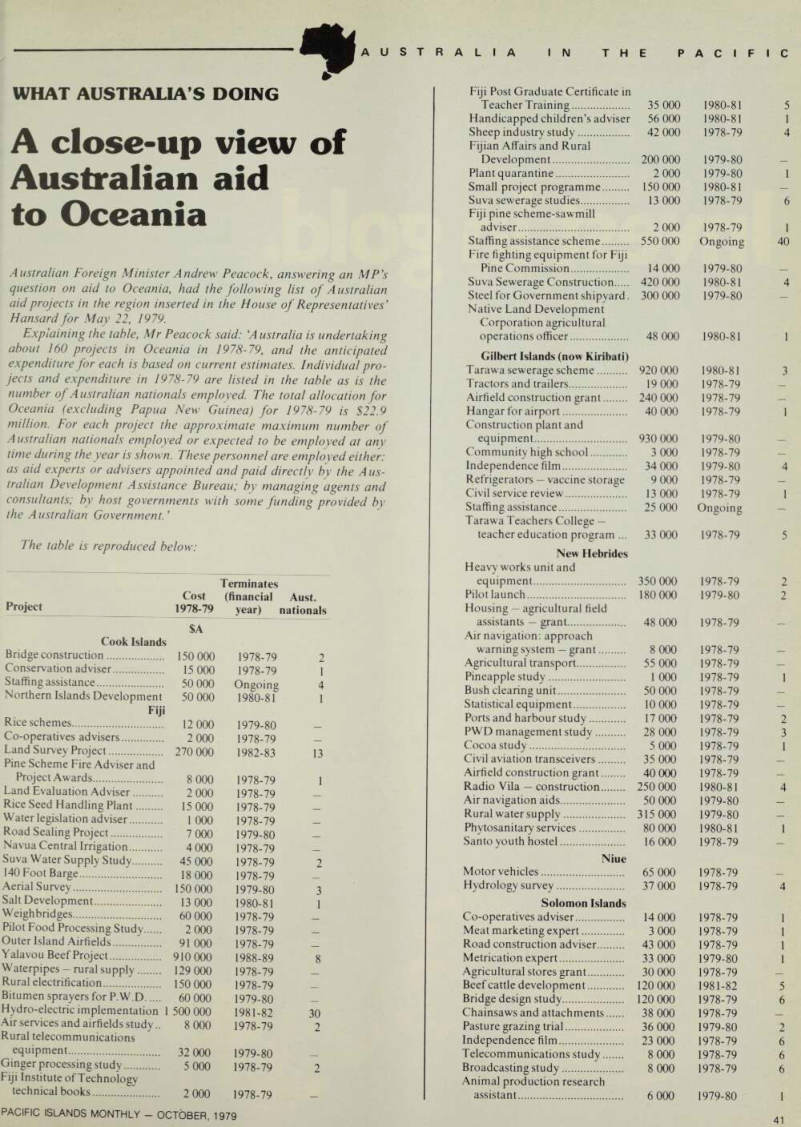
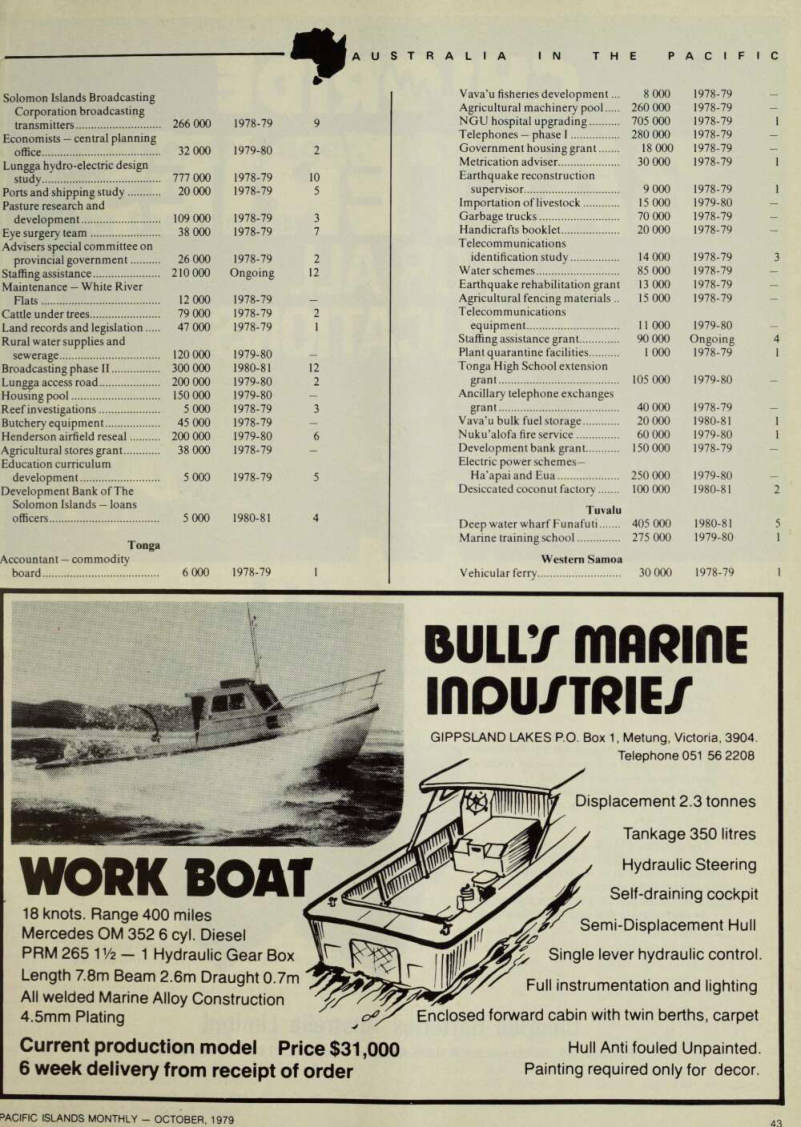
What Australia’S Doing
A close-up view of Australian aid to Oceania
Australian Foreign Minister Andrew Peacock, answering an MP’s question on aid to Oceania, had the following list of Australian aid projects in the region inserted in the House of Representatives’
Hansard for May 22, 1979.
Explaining the table, Mr Peacock said: ( A ustralia is undertaking about 160 projects in Oceania in 1978-79, and the anticipated expenditure for each is based on current estimates. Individual pro jects and expenditure in 1978-79 are listed in the table as is the number of Australian nationals employed. The total allocation for Oceania (excluding Papua New Guinea) for 1978-79 is $22.9 million. For each project the approximate maximum number of Australian nationals employed or expected to be employed at any time during the year is shown. These personnel are employed either: as aid experts or advisers appointed and paid directly by the Aus tralian Development Assistance Bureau; by managing agents and consultants; by host governments with some funding provided by the Australian Government.’
The table is reproduced below:
Fiji Post Graduate Certificate in
Teacher Training
35 000 1980-81 5 Handicapped children’s adviser 56 000 1980-81 1
Sheep industry study
42 000 1978-79 4 Fijian Affairs and Rural
Development
200 000 1979-80 —
Plant quarantine
2 000 1979-80 1 Small project programme 150 000 1980-81 — Suva sewerage studies 13 000 1978-79 6
Fiji pine scheme-sawmill
adviser 2 000 1978-79 1 Staffing assistance scheme 550 000
Ongoing
40
Fire fighting equipment for Fiji
Pine Commission 14 000 1979-80 — Suva Sewerage Construction 420 000 1980-81 4 Steel for Government shipyard. 300 000 1979-80 Native Land Development
Corporation agricultural
operations officer
48 000 1980-81 1 Gilbert Islands (now Kiribati) Tarawa sewerage scheme 920 000 1980-81 3 Tractors and trailers 19000 1978-79 Airfield construction grant 240 000 1978-79 —
Hangar for airport
40 000 1978-79 1 Construction plant and
equipment
930 000 1979-80 —
Community high school
3000 1978-79 —
Independence film
34 000 1979-80 4 Refrigerators — vaccine storage 9 000 1978-79 — Civil service review 13 000 1978-79 1
Staffing assistance
25 000
Ongoing
Tarawa Teachers College — teacher education program ... 33 000 1978-79 5 New Hebrides Heavy works unit and
equipment
350 000 1978-79 2 Pilot launch 180 000 1979-80 2
Housing — agricultural field
assistants — grant 48 000 1978-79 —
Air navigation: approach
warning system — grant 8 000 1978-79 —
Agricultural transport
55 000 1978-79 —
Pineapple study
1 000 1978-79 1 Bush clearing unit 50 000 1978-79 —
Statistical equipment
10 000 1978-79 — Ports and harbour study 17 000 1978-79 2 PWD management study 28 000 1978-79 3
Cocoa study
5000 1978-79 1 Civil aviation transceivers 35 000 1978-79 Airfield construction grant 40 000 1978-79 Radio Vila — construction 250 000 1980-81 4 Air navigation aids 50 000 1979-80 — Rural water supply 315000 1979-80
Phytosanitary services
80 000 1980-81 1 Santo youth hostel 16 000 1978-79 — Niue Motor vehicles 65 000 1978-79
Hydrology survey
37 000 1978-79 4 Solomon Islands
Co-operatives adviser
14 000 1978-79 1 Meat marketing expert 3 000 1978-79 1 Road construction adviser 43 000 1978-79 1 Metrication expert 33 000 1979-80 1 Agricultural stores grant 30 000 1978-79 — Beef cattle development 120 000 1981-82 5
Bridge design study
120 000 1978-79 6 Chainsaws and attachments 38 000 1978-79 Pasture grazing trial 36 000 1979-80 2
Independence film
23 000 1978-79 6
Telecommunications study
8 000 1978-79 6
Broadcasting study
8 000 1978-79 6 Animal production research assistant 6 000 1979-80 1
Project Cost 1978-79 Terminates (financial year) i Aust. nationals Cook Islands
Bridge construction
$A 150 000 1978-79 2 Conservation adviser 15 000 1978-79 1
Staffing assistance
50 000 Ongoing 4 Northern Islands Development 50 000 1980-81 1 Fiji Rice schemes 12 000 1979-80
Co-operatives advisers
2 000 1978-79
Land Survey Project
270 000 1982-83 13 Pine Scheme Fire Adviser and
Project Awards
8000 1978-79 1 Land Evaluation Adviser 2 000 1978-79 Rice Seed Handling Plant... 15 000 1978-79 Water legislation adviser 1 000 1978-79
Road Sealing Project
7000 1979-80 Navua Central Irrigation 4 000 1978-79
Suva Water Supply Study
45 000 1978-79 2 140 Foot Barge 18000 1978-79
Aerial Survey
150 000 1979-80 3
Salt Development
13 000 1980-81 1
Weighbridges
60 000 1978-79
Pilot Food Processing Study
2000 1978-79 Outer Island Airfields 91 000 1978-79 Yalavou Beef Project 910000 1988-89 8
Waterpipes - rural supply
129 000 1978-79 Rural electrification 150 000 1978-79 Bitumen sprayers for P.W.D. 60 000 1979-80
Hydro-electric implementation 1
500 000 1981-82 30 Air services and airfields study.. 8000 1978-79 2 Rural telecommunications
equipment
32 000 1979-80
Ginger processing study
5 000 1978-79 2
Fiji Institute of Technology
technical books 2000 1978-79
Solomon Islands Broadcasting
Corporation broadcasting
transmitters 266 000 1978-79 9 Economists - central planning office 32 000 1979-80 2
Lungga hydro-electric design
study
777 000 1978-79 10
Ports and shipping study
20 000 1978-79 5 Pasture research and
development
109 000 1978-79 3 Eye surgery team 38 000 1978-79 7 Advisers special committee on
provincial government
26 000 1978-79 2
Staffing assistance
210000
Ongoing
12 Maintenance - White River Flats 12 000 1978-79 Cattle under trees 79 000 1978-79 2 Land records and legislation 47 000 1978-79 I Rural water supplies and sewerage 120 000 1979-80
Broadcasting phase II
300 000 1980-81 12 Lungga access road 200 000 1979-80 2
Housing pool
150 000 1979-80 -
Reef investigations
5000 1978-79 3
Butchery equipment
45 000 1978-79 - Henderson airfield reseal 200 000 1979-80 6 Agricultural stores grant 38 000 1978-79 - Education curriculum
development
5000 1978-79 5 Development Bank of The Solomon Islands — loans officers 5000 1980-81 4 Tonga
Accountant — commodity
board 6000 1978-79 1
Vava’u fisheries development... 8000 1978-79 -
Agricultural machinery pool
260 000 1978-79 -
NGU hospital upgrading
705 000 1978-79 1
Telephones — phase I
280 000 1978-79 - Government housing grant 18000 1978-79 — Metrication adviser
Earthquake reconstruction
30 000 1978-79 1
supervisor
9000 1978-79 1 Importation of livestock 15000 1979-80 —
Garbage trucks
70 000 1978-79 — Handicrafts booklet Telecommunications 20 000 1978-79 —
identification study
14 000 1978-79 3 Water schemes 85 000 1978-79 — Earthquake rehabilitation grant 13 000 1978-79 —
Agricultural fencing materials..
Telecommunications 15000 1978-79 —
equipment
11 000 1979-80 - Staffing assistance grant 90 000
Ongoing
4 Plant quarantine facilities
Tonga High School extension
1 000 1978-79 1 grant
Ancillary telephone exchanges
105 000 1979-80 — grant 40 000 1978-79 — Vava’u bulk fuel storage 20 000 1980-81 1 Nukualofa fire service 60 000 1979-80 1 Development bank grant Electric power schemes— 150 000 1978-79 — Ha’apai and Eua 250 000 1979-80 — Desiccated coconut factory Tuvalu 100 000 1980-81 2 Deep water wharf Funafuti 405 000 1980-81 5 Marine training school Western Samoa 275 000 1979-80 1
Vehicular ferry
30 000 1978-79 1
Advertisements & other items, pp. 41-44 (3 items)
Australia In The Pacific
s*sr o y
v. o * x #* •my. ,• w *#*>» j < : r. kr®
SA Z'
v * *> * /T. m -r M t >r,v ass m
■SSK
: ? ✓ ✓ a fX •%» - ®Z€
S&XV * i|E-
■. ■ * ■-%* 'v % ISiSk I
WORK BOAT
18 knots. Range 400 miles Mercedes OM 352 6 cyl. Diesel PRM 265 1 V? 1 Hydraulic Gear Box Length 7.8 m Beam 2.6 m Draught 0.7 m All welded Marine Alloy Construction 4.5 mm Plating Current production model Price $31,000 6 week delivery from receipt of order
BULL 7 mflßinE
Inou/TPIE/
GIPPSLAND LAKES P.O. Box 1, Metung, Victoria. 3904.
Telephone 051 56 2208 Displacement 2.3 tonnes Tankage 350 litres Hydraulic Steering Self-draining cockpit Semi-Displacement Hull Single lever hydraulic control.
Full instrumentation and lighting Enclosed forward cabin with twin berths, carpet Hull Anti fouled Unpainted.
Painting required only for decor. 2? r r o*
CHLORIDE
•sl\ i i i u i =k»
FOR ALL
APPLICATIONS
immi
- r »-j » ▲•* v • vft ** *•. * • • • • * *»• v • . -•. 'k Chloride is the largest and only manufacturer of both lead acid and nickel cadmium alkaline batteries in Australia.
The Company is equipped and qualified to offer advice, guidance and service on any battery requirement no matter how large or small.
On the question of size, it could be as small as a battery for a hearing aid the dimensions of a coat button or a power station battery weighing as much as 40 tonnes.
Again it could be a no break D.C. Power System for a computer or emergency lighting for a hospital.
The Chloride Company operates in 40 countries throughout the world, and when you consider that in Australia alone its production is approaching 1% million batteries per year, it gives some idea of the far reaching role that batteries play in our lives.
A selection of Chloride Automotive and Industrial Batteries.
Chloride Batteries Australia Limited
P.O. Box 141, Bankstown. N.S.W. 2200. Australia. Telephone: 77 0177. Telex: 21262
43
PACIFIC ISLANDS MONTHLY - OCTOBER, 1979
AUSTRALIA IN THE PACIFIC
but they’re
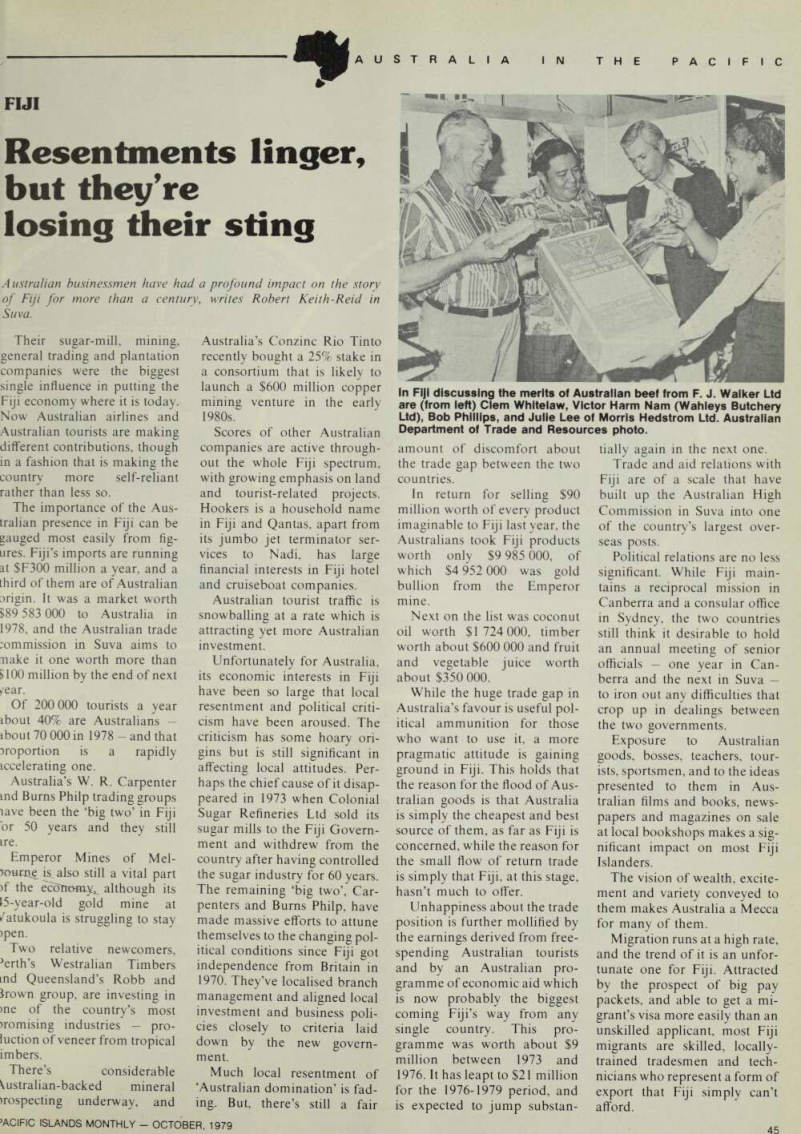
Fiji
Resentments linger, but they’re losing their sting
Australian businessmen have had a profound impact on the story of Fiji for more than a century, writes Robert Keith-Reid in Suva.
Their sugar-mill, mining, general trading and plantation companies were the biggest single influence in putting the Fiji economy where it is today.
Now Australian airlines and Australian tourists are making different contributions, though in a fashion that is making the country more self-reliant rather than less so.
The importance of the Aus tralian presence in Fiji can be gauged most easily from fig
ures. Fiji’s imports are running
at SF3OO million a year, and a third of them are of Australian arigin. It was a market worth 589 583 000 to Australia in 1978, and the Australian trade :ommission in Suva aims to make it one worth more than 5100 million by the end of next Of 200 000 tourists a year ibout 40% are Australians ibout 70 000 in 1978 - and that
proportion is a rapidly
iccelerating one.
Australia’s W. R. Carpenter md Burns Philp trading groups lave been the ‘big two’ in Fiji or 50 years and they still ire.
Emperor Mines of Mel bourne is also still a vital part )f the although its
15-year-old gold mine at
/atukoula is struggling to stay >pen.
Two relative newcomers, erth’s Westralian Timbers md Queensland’s Robb and irown group, are investing in me of the country’s most iromising industries pro luction of veneer from tropical imbers.
There’s considerable Australian-backed mineral
irospecting underway, and
Australia’s Conzinc Rio Tinto recently bought a 25% stake in a consortium that is likely to launch a $6OO million copper mining venture in the early 1980 s.
Scores of other Australian
companies are active through
out the whole Fiji spectrum, with growing emphasis on land and tourist-related projects.
Hookers is a household name in Fiji and Qantas, apart from its jumbo jet terminator ser vices to Nadi, has large financial interests in Fiji hotel and cruiseboat companies.
Australian tourist traffic is snowballing at a rate which is attracting yet more Australian investment.
Unfortunately for Australia, its economic interests in Fiji have been so large that local resentment and political criti cism have been aroused. The criticism has some hoary ori gins but is still significant in affecting local attitudes. Per haps the chief cause of it disap peared in 1973 when Colonial Sugar Refineries Ltd sold its sugar mills to the Fiji Govern ment and withdrew from the country after having controlled the sugar industry for 60 years.
The remaining ‘big two’, Car penters and Burns Philp, have made massive efforts to attune themselves to the changing pol itical conditions since Fiji got independence from Britain in 1970. They’ve localised branch management and aligned local investment and business poli cies closely to criteria laid down by the new govern ment.
Much local resentment of ‘Australian domination’ is fad ing. But, there’s still a fair
amount of discomfort about the trade gap between the two countries.
In return for selling $9O million worth of every product imaginable to Fiji last year, the
Australians took Fiji products
worth only $9 985 000, of which $4 952 000 was gold bullion from the Emperor mine.
Next on the list was coconut oil worth $1724 000, timber worth about $6OO 000 and fruit
and vegetable juice worth
about $350 000.
While the huge trade gap in Australia’s favour is useful pol itical ammunition for those who want to use it, a more
pragmatic attitude is gaining
ground in Fiji. This holds that the reason for the flood of Aus tralian goods is that Australia is simply the cheapest and best source of them, as far as Fiji is concerned, while the reason for the small flow of return trade is simply that Fiji, at this stage, hasn’t much to offer.
Unhappiness about the trade position is further mollified by the earnings derived from free spending Australian tourists and by an Australian pro gramme of economic aid which is now probably the biggest coming Fiji’s way from any single country. This pro gramme was worth about $9 million between 1973 and 1976. It has leapt to $2l million for the 1976-1979 period, and is expected to jump substan
tially again in the next one.
Trade and aid relations with Fiji are of a scale that have built up the Australian High Commission in Suva into one of the country’s largest over seas posts.
Political relations are no less
significant. While Fiji main
tains a reciprocal mission in Canberra and a consular office in Sydney, the two countries still think it desirable to hold an annual meeting of senior officials one year in Can berra and the next in Suva to iron out any difficulties that crop up in dealings between the two governments.
Exposure to Australian goods, bosses, teachers, tour ists, sportsmen, and to the ideas presented to them in Aus tralian films and books, news papers and magazines on sale at local bookshops makes a sig nificant impact on most Fiji Islanders.
The vision of wealth, excite ment and variety conveyed to them makes Australia a Mecca for many of them.
Migration runs at a high rate, and the trend of it is an unfor tunate one for Fiji. Attracted by the prospect of big pay packets, and able to get a mi grant’s visa more easily than an
unskilled applicant, most Fiji
migrants are skilled, locally
trained tradesmen and tech nicians who represent a form of export that Fiji simply can’t afford.
In FIJI discussing the merits of Australian beef from F. J. Walker Ltd are (from left) Clem Whitelaw, Victor Harm Nam (Wahleys Butchery Ltd), Bob Phillips, and Julie Lee of Morris Hedstrom Ltd. Australian Department of Trade and Resources photo.
Advertisements & other items, pp. 45-48 (3 items)
45
AUSTRALIA IN THE PACIFIC
’ACIFIC ISLANDS MONTHLY - OCTOBER, 1979
r hi-fi fortl
mm 1% :- ***►*.<* •?>*! «Jc 4 ' (fe «£'#* *T % c-Tr-.** , » £»~ - - MaattimimnnKiiu.
CD pioneer
’ ’ mm X***A9,+%m*4*rnm**S*' »-M>««t.»i MM WIHl , „««*«*»» #t ff f 111 ?t tf if
r i s
umi|iniu‘iit
PIOIMCEEJ?
Ml
STEREO
to
VOL -s>- BAL BASS
KP-77G
Supersystem is a super idea from Pioneer. The great sounds you enjoy while sitting at home can now be a truly moving experience.
The cassette decks feature auto-reverse, Dolby* separate bass/treble plus loudness contour controls and a new playback head that can handle any tape available, including the new “metal tapes.” And the separate power amp delivers a solid 20 watts per channel. More than some home stereo amps. Of course, the speakers are Pioneer designed for super performance. Three individual speakers ingeniously mounted in a single flush mount unit give you maximum sound in a minimum size.
So, if you’re travelin’ with Pioneer Supersystem Component Car Stereo, just slip into musical high gear and let the miles melt away while you boogie on down the diSCO highway. *Dolby is a registered trademark of Dolby Labs.
For further information, please contact: Australia: Pioneer Marketing Service Pty. Ltd., P.O. Box 317 Mordialloc Victoria, 3195 Tel: 90-9011 Fiji Islands: Brijlal & Company. G.P.O. Box No. 362, Suva. Fiji Islands Tel: 22268 New Zealand; Fountain Marketing Ltd., Maidstone Street, Auckland, New Zealand Tel: 763-064 Norfolk Island: Burns Philp (Norfolk Island) Ltd., Norfolk Island, South Pacific New Hebrides: Burns Philp (New Hebrides) Ltd., Vila. New Hebrides Nauru Island: Jacob Enterorises. P.O. Box No 4 Rennhlin nf Naum
super highway.
m Wan *~ . * >lse - * s*■&**s!* ' <r 'J&';'* a&» .-- ’* *. » *v *i^*«
ys|l
iW* . * life* ;*** .. .** 4^.- •A ' * *» *S ■ *! * ** wx \. & ■ * m $ m m m . \ Sn@ . i *L
JM -■ j
mu k t - ■
EER
AMPLIFIER
PIOMGGn
l( 111 imi|iniic CD zllHy „ ***?&■
VOL -§>- BAL BASS
j '•*" treble
LOUDNESS
1 1 1 m.n
DOLBY NR CrOa
ATT
J
KP-707G
GM-40 GM-40 Power Amplifier Power output (max.) 20 watts per channel Total harmonic distortion.. .0.06% (at 1.5 W) Signal-to-noise ratio More than 80dB TS-168 Speakers Speaker Permanent dynamic type 3-way; 158 mm (6%in.) cone woofer, 57mm (2Kin.)cone midrange, & 30mm (I%ein.) horn tweeter Input power (max.) 40 watts Frequency range 35-20,000 Hz
CiOpiomeer
KP-707G Cassette Deck Power source DC 13.8 V (11-16 V allowable) Wow & flutter No more than 0.13% (WRMS) Frequency response 30~15,000Hz (±3dß) Signal-to-noise ratio More than 60dB (Dolby on w/chrome tape) KP-77G Cassette Deck Power source DC 13.8 V (11-16 V allowable) Wow & flutter No more than 0.13% (WRMS) Frequency response 30~15,000Hz (±3dß) Signal-to-noise ratio More than 52d8 STp T H2C e T dex 2 °Noumea, New Caledonia ISSS ln,ema ‘ ional Ltd - PO B °* Cook Corporation. p ° Box 1477, Pago Pago. American TeTS BaM MerChan ' S R * Ud " P ° B ° X 6103 B ° r ° k °
Total service 0n ...
plumbing supplies
% You can get all your needs from one supply source: water taps, valves, copper tube, tools and a host of other fittings and related plumbing equipment for domestic, industrial and multi-storey buildings.
Watson & Crane Pty Ltd have over 20,000 plumbing items in stock at their central warehouse located at Waterloo, NSW, Australia.
Years of experience in handling and shipping right throughout the South Pacific add up to another big reason for you to deal with Watson & Crane Pty Ltd.
Representatives call regularly at Papua New Guinea, the Solomons, New Hebrides and Fiji Islands to personally discuss your requirements and appropriate credit arrangements.
Write, cable or telephone today for complete plumbers' supplies service. m Watson & Crane Pty. Ltd. 1037 Bourke Street, Waterloo,
NSW 2017.
Phone: Sydney 699-1333.
Telex: AA 25548.
Cables: "Watcrane" Sydney.
Pacific Island distributors of Crano Enfield copper tube for water, sanitation, engineering, refrigeration and air conditioning.
WATSON & CRANE
are organised to fulfil your needs
wherever you are in the South Pacific
48
ICI A MRC UAMTUI \/ AATADCD
nowhere dominant,
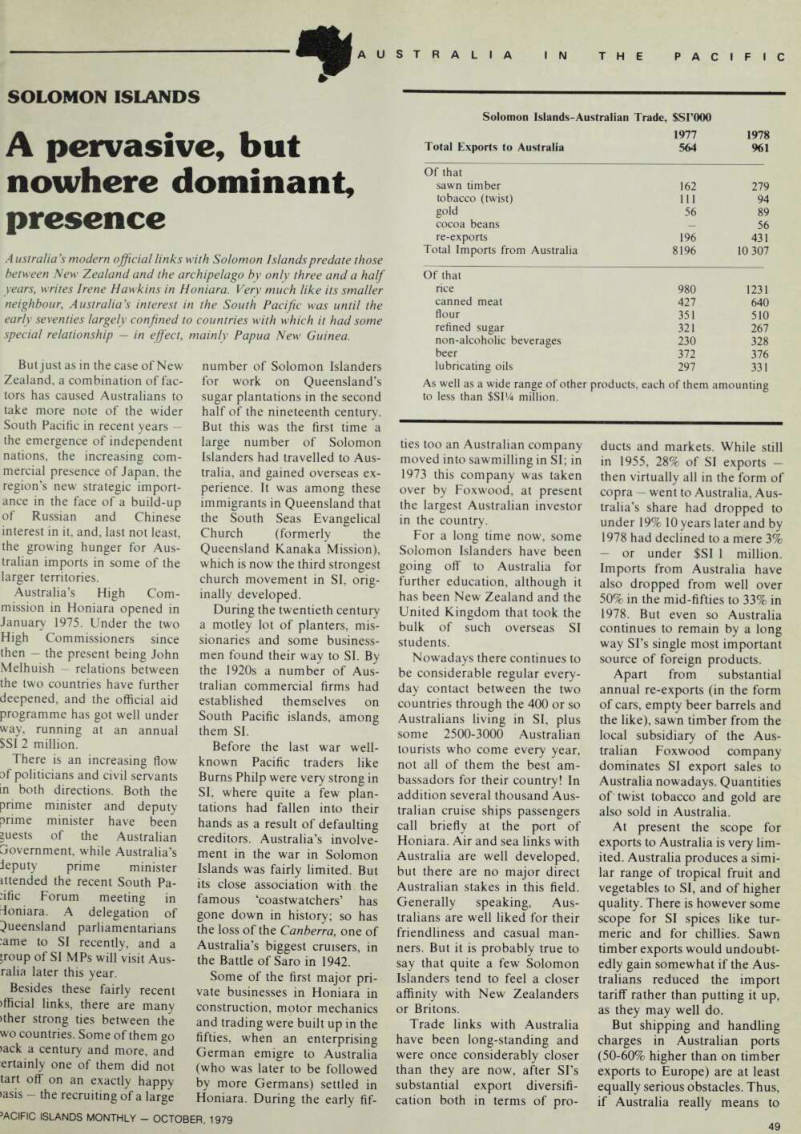
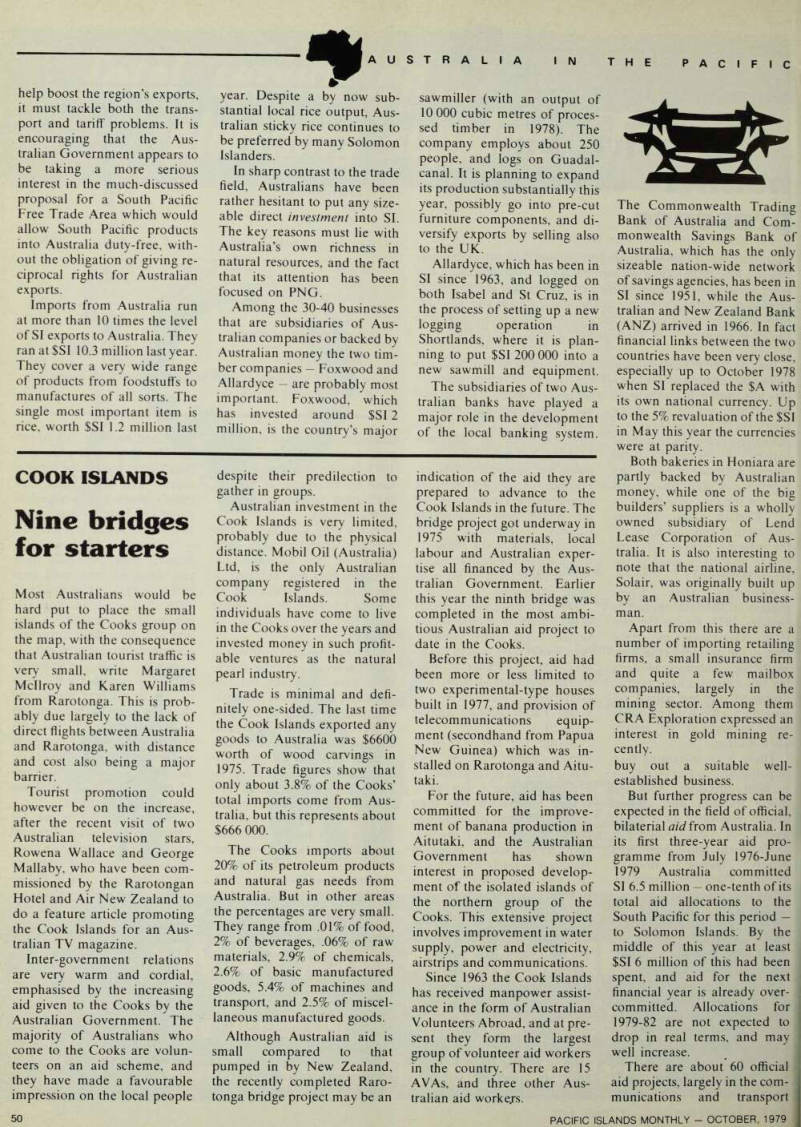

Solomon Islands
A pervasive, but nowhere dominant, presence
A ustralia's modern official links with Solomon Islands predate those between New Zealand and the archipelago by only three and a half years, writes Irene Hawkins in Honiara. Very much like its smaller neighbour, Australia's interest in the South Pacific was until the early seventies largely confined to countries with which it had some special relationship in effect, mainly Papua New Guinea.
But just as in the case of New Zealand, a combination of fac tors has caused Australians to take more note of the wider South Pacific in recent years the emergence of independent nations, the increasing com mercial presence of Japan, the region’s new strategic import ance in the face of a build-up of Russian and Chinese interest in it, and, last not least, the growing hunger for Aus tralian imports in some of the larger territories.
Australia’s High Com mission in Honiara opened in January 1975. Under the two High Commissioners since then the present being John Melhuish relations between the two countries have further deepened, and the official aid programme has got well under way, running at an annual SSI 2 million.
There is an increasing flow of politicians and civil servants in both directions. Both the
prime minister and deputy
prime minister have been quests of the Australian Government, while Australia’s leputy prime minister ittended the recent South Pa
cific Forum meeting in
Honiara. A delegation of
Queensland parliamentarians
:ame to SI recently, and a 'roup of SI MPs will visit Aus ralia later this year.
Besides these fairly recent )fficial links, there are many >ther strong ties between the wo countries. Some of them go >ack a century and more, and ertainly one of them did not tart off on an exactly happy
>asis the recruiting of a large
number of Solomon Islanders for work on Queensland’s sugar plantations in the second half of the nineteenth century.
But this was the first time a large number of Solomon Islanders had travelled to Aus tralia, and gained overseas ex perience. It was among these immigrants in Queensland that the South Seas Evangelical Church (formerly the Queensland Kanaka Mission), which is now the third strongest church movement in SI, orig
inally developed.
During the twentieth century a motley lot of planters, mis sionaries and some business men found their way to SI. By the 1920 s a number of Aus tralian commercial firms had established themselves on South Pacific islands, among them SI.
Before the last war well known Pacific traders like Burns Philp were very strong in SI, where quite a few plan tations had fallen into their hands as a result of defaulting creditors. Australia’s involve ment in the war in Solomon Islands was fairly limited. But its close association with the famous ‘coastwatchers’ has gone down in history; so has the loss of the Canberra, one of Australia’s biggest cruisers, in the Battle of Saro in 1942.
Some of the first major pri vate businesses in Honiara in construction, motor mechanics and trading were built up in the fifties, when an enterprising German emigre to Australia (who was later to be followed by more Germans) settled in Honiara. During the early fif-
Solomon Islands-Australian Trade, SSPOOO
ties too an Australian company moved into sawmilling in SI; in 1973 this company was taken over by Foxwood, at present the largest Australian investor in the country.
For a long time now, some Solomon Islanders have been going off to Australia for further education, although it has been New Zealand and the United Kingdom that took the bulk of such overseas SI students.
Nowadays there continues to be considerable regular every day contact between the two countries through the 400 or so Australians living in SI, plus some 2500-3000 Australian tourists who come every year, not all of them the best am bassadors for their country! In addition several thousand Aus tralian cruise ships passengers call briefly at the port of Honiara. Air and sea links with Australia are well developed, but there are no major direct Australian stakes in this field.
Generally speaking, Aus
tralians are well liked for their friendliness and casual man ners. But it is probably true to say that quite a few Solomon Islanders tend to feel a closer affinity with New Zealanders or Britons.
Trade links with Australia have been long-standing and were once considerably closer than they are now, after Si’s substantial export diversifi cation both in terms of pro
ducts and markets. While still in 1955, 28% of SI exports then virtually all in the form of copra went to Australia, Aus tralia’s share had dropped to under 19% 10 years later and by 1978 had declined to a mere 3% or under SSI 1 million.
Imports from Australia have also dropped from well over 50% in the mid-fifties to 33% in 1978. But even so Australia continues to remain by a long way Si’s single most important
source of foreign products.
Apart from substantial annual re-exports (in the form of cars, empty beer barrels and the like), sawn timber from the local subsidiary of the Aus tralian Foxwood company dominates SI export sales to Australia nowadays. Quantities of twist tobacco and gold are also sold in Australia.
At present the scope for exports to Australia is very lim ited. Australia produces a simi lar range of tropical fruit and vegetables to SI, and of higher quality. There is however some scope for SI spices like tur meric and for chillies. Sawn timber exports would undoubt edly gain somewhat if the Aus tralians reduced the import tariff rather than putting it up, as they may well do.
But shipping and handling
charges in Australian ports (50-60% higher than on timber exports to Europe) are at least equally serious obstacles. Thus, if Australia really means to
1977 1978 Total Exports to Australia 564 961 Of that sawn timber 162 279 tobacco (twist) 111 94
gold
56 89 cocoa beans — 56 re-exports 196 431 Total Imports from Australia 8196 10 307 Of that rice 980 1231 canned meat 427 640 flour 351 510 refined sugar 321 267
non-alcoholic beverages
230 328 beer 372 376
lubricating oils
297 331 As well as a wide range of other products, each of them
amounting
to less than SSI'A million.
help boost the region’s exports, it must tackle both the trans port and tariff problems. It is encouraging that the Aus tralian Government appears to be taking a more serious interest in the much-discussed proposal for a South Pacific Free Trade Area which would allow South Pacific products into Australia duty-free, with out the obligation of giving re
ciprocal rights for Australian
exports.
Imports from Australia run at more than 10 times the level of SI exports to Australia. They ran at SSI 10.3 million last year.
They cover a very wide range of products from foodstuff's to manufactures of all sorts. The single most important item is rice, worth SSI 1.2 million last
year. Despite a by now sub stantial local rice output, Aus tralian sticky rice continues to be preferred by many Solomon Islanders.
In sharp contrast to the trade field, Australians have been rather hesitant to put any size able direct investment into SI.
The key reasons must lie with Australia’s own richness in natural resources, and the fact that its attention has been focused on PNG.
Among the 30-40 businesses that are subsidiaries of Aus tralian companies or backed by Australian money the two tim ber companies Foxwood and
Allardyce are probably most
important. Foxwood, which has invested around SSI 2 million, is the country’s major
sawmiller (with an output of 10 000 cubic metres of proces sed timber in 1978). The company employs about 250 people, and logs on Guadal canal. It is planning to expand its production substantially this year, possibly go into pre-cut furniture components, and di
versify exports by selling also
to the UK.
Allardyce, which has been in SI since 1963, and logged on both Isabel and St Cruz, is in the process of setting up a new
logging operation in
Shortlands, where it is plan ning to put SSI 200 000 into a new sawmill and equipment.
The subsidiaries of two Aus tralian banks have played a major role in the development of the local banking system.
The Commonwealth Trading Bank of Australia and Com monwealth Savings Bank of Australia, which has the only sizeable nation-wide network of savings agencies, has been in SI since 1951, while the Aus tralian and New Zealand Bank (ANZ) arrived in 1966. In fact financial links between the two countries have been very close, especially up to October 1978 when SI replaced the $A with its own national currency. Up to the 5% revaluation of the SSI in May this year the currencies were at parity.
Both bakeries in Honiara are partly backed by Australian money, while one of the big builders’ suppliers is a wholly owned subsidiary of Lend Lease Corporation of Aus tralia. It is also interesting to note that the national airline, Solair, was originally built up by an Australian business man.
Apart from this there are a
number of importing retailing
firms, a small insurance firm and quite a few mailbox companies, largely in the mining sector. Among them CRA Exploration expressed an interest in gold mining re cently. buy out a suitable well established business.
But further progress can be expected in the field of official, bilaterial aid from Australia. In its first three-year aid pro gramme from July 1976-June 1979 Australia committed SI 6.5 million one-tenth of its total aid allocations to the South Pacific for this period to Solomon Islands. By the middle of this year at least SSI 6 million of this had been spent, and aid for the next financial year is already over committed. Allocations for : 1979-82 are not expected to j drop in real terms, and may well increase.
There are about 60 official j aid projects, largely in the com- j munications and transport j
fields, plus a small training programme and the provision of emergency relief. The single biggest chunk of Australia’s money SSI 1.6 million over three years - is going into the upgrading and expansion of the local radio station, mainly by building new studios, instal ling new equipment in both Honiara and some district centres, and training local per sonnel. Australia is also fin ancing the access road to the planned hydropower station on the Lungga River east of Honiara as well as the urgent repair of Henderson Airstrip outside Honiara.
Outside the communi cations/transport fields Aus tralian aid is going into three
projects to help cattle develop
ment, and the provision of
butchery equipment and
coolrooms.
Australia is also giving a cer tain amount of technical assist ance largely under its
Australian Staffing Assistance Scheme (ASAS).
In education, Australia is assisting the curriculum
development for secondary
schools through the University
of New England and is also funding three-month inter national training courses in anything from cattle manage ment to industrial relations, which are attended by a dozen or more Solomon Islanders on average per year. With the emergence of local secondary schools and regional universi ties Australia has preferred to concentrate on helping with higher level training and mas
ters’ degrees.
Australia’s procedures for administering its aid are often rather bureaucratic in the eyes of local civil servants, and its
policy of handling consultants
leaves much to be desired. Its degree of tying its aid is not more or less than that of most other donors. But Australia’s
aid programme deserves credit marks on several scores. Its ASAS scheme is much better than most other staffing assist ance schemes. The provisions on financing local costs are fairly generous. It is using a local lending institution the Development Bank of SI to channel some of its funds to the provinces. It is generally keen to push more money into the rural areas and is talking about a rural development fund.
Also, its system of cash grants is an effective, ‘short-cut’ way
of supporting smallish projects
with clearly defined costs.
Altogether SSI 750 000 has been given as accountable cash grants over the three-year period.
In addition to this official, bilateral support, there are all sorts of other, sometimes small ways, in which Australian money and expertise are sup porting SI. A periodic visit from a team of eye specialists
fills a vital gap in medical services.
Soon the independence film, made by Film Australia with $Bl 75 000 of aid funds, will be released in SI.
Australia’s defence forces have helped in such varied tasks as earthquake relief,
searching for a missing plane,
surveying an outlying atoll,
clearing away old unexploded
ammunition and coral-blasting to make room for a harbour.
Thus, generally speaking,
Australia’s influence in SI is pervasive, but nowhere domi nant, except in the import sec tor. This is in fact very much in accordance with the role that Australia wants to play in the region. It is keen not to be suspected of wanting to assume a neo-colonial role and lays great stress on assisting the South Pacific in maintaining or
achieving political stability,
national unity and regional co
operation.
Advertisements & other items, p. 49 (1 item)
49
AUSTRALIA IN THE PACIFIC
’ACIFIC ISLANDS MONTHLY OCTOBER. 1979
Nine bridges
Cook Islands
Nine bridges for starters
Most Australians would be hard put to place the small islands of the Cooks group on the map, with the consequence that Australian tourist traffic is very small, write Margaret Mcllroy and Karen Williams from Rarotonga. This is prob ably due largely to the lack of direct flights between Australia and Rarotonga, with distance and cost also being a major barrier.
Tourist promotion could however be on the increase, after the recent visit of two Australian television stars, Rowena Wallace and George Mallaby, who have been com
missioned by the Rarotongan
Hotel and Air New Zealand to do a feature article promoting the Cook Islands for an Aus tralian TV magazine.
Inter-government relations
are very warm and cordial,
emphasised by the increasing
aid given to the Cooks by the Australian Government. The majority of Australians who come to the Cooks are volun teers on an aid scheme, and they have made a favourable impression on the local people
despite their predilection to
gather in groups.
Australian investment in the Cook Islands is very limited, probably due to the physical distance. Mobil Oil (Australia) Ltd, is the only Australian company registered in the Cook Islands. Some individuals have come to live in the Cooks over the years and invested money in such profit able ventures as the natural
pearl industry.
Trade is minimal and defi nitely one-sided. The last time the Cook Islands exported any goods to Australia was $6600 worth of wood carvings in 1975. Trade figures show that only about 3.8% of the Cooks’ total imports come from Aus tralia, but this represents about $666 000.
The Cooks imports about 20% of its petroleum products and natural gas needs from Australia. But in other areas the percentages are very small.
They range from .01% of food, 2% of beverages, .06% of raw materials, 2.9% of chemicals, 2.6% of basic manufactured goods, 5.4% of machines and transport, and 2.5% of miscel laneous manufactured goods.
Although Australian aid is small compared to that pumped in by New Zealand,
the recently completed Raro
tonga bridge project may be an
indication of the aid they are prepared to advance to the Cook Islands in the future. The
bridge project got underway in
1975 with materials, local labour and Australian exper tise all financed by the Aus tralian Government. Earlier this year the ninth bridge was completed in the most ambi tious Australian aid project to date in the Cooks.
Before this project, aid had been more or less limited to two experimental-type houses built in 1977, and provision of
telecommunications equip
ment (secondhand from Papua New Guinea) which was in stalled on Rarotonga and Aitu taki.
For the future, aid has been committed for the improve ment of banana production in Aitutaki, and the Australian Government has shown
interest in proposed develop
ment of the isolated islands of the northern group of the Cooks. This extensive project involves improvement in water supply, power and electricity, airstrips and communications.
Since 1963 the Cook Islands has received manpower assist ance in the form of Australian Volunteers Abroad, and at pre sent they form the largest group of volunteer aid workers in the country. There are 15 AVAs, and three other Aus tralian aid workejs.
Advertisements & other items, pp. 50-52 (3 items)
50
PACIFIC ISLANDS MONTHLY - OCTOBER, 1979
AUSTRALIA IN THE PACIFIC
Tparker
Vk '• %
More of an asset
than just a pen.
Parker 75.
It takes four precious metals to make a Parker 75 pen like this. Sterling silver for the case, 14ct gold for the beautifully responsive nib, and a wear-resistant alloy \ of platinum and ruthenium for the tip.
It’s even more exceptional. The nib can turn 360° to write at the angle most natural to you.
A lifetime investment.
Also in 22ct gold and stainless steel.
Pencils, ball pens to match. wmmm
tPARKER
Worlds most wanted pens tVA • \ - V A- ■ftX V A % ' • s ' : , W !CA N ' V % .
V. •« ‘*v '*V % 1 ■ : >- / T, ■v • x * k,;: 066.P490R
If you have a problem with
COCKROACHES
the complete answer Is
KEEN COCKROACH KILLER
Extracts from tests carried out
at the Pest Control Research
Laboratory in June 1978
Tests were carried out using the Blatta Orientalis (oriental cockroach). This cockroach is probably the most common pest found in a wide range of premises including hospitals, schools, kitchens, factories, warehouses etc.
TEST 1 A five second spray with KEEN COCKROACH KILLER on to insects confined in a glass container of floor area 1000 cm 2 .
RESULT All insects were knocked down within one minute and all appeared dead within 30 minutes and there was no recovery within 24 hours.
TEST 2 A one second burst with KEEN COCKROACH KILLER under the same conditions as test 1.
RESULT 100% kill as in test 1.
TEST 3 The insects were exposed for one minute to a surface of corrugated cardboard that had received a five second burst with KEEN COCKROACH KILLER from 30cm then allowed to dry in air for 1 hour. The area of cardboard to which they were exposed was 200 cm 2 . This test was to simulate the use of the spray on absorptive surfaces such as wood plaster and cardboard as would be found under normal use of the spray.
RESULT Complete knockdown after 1 hour. Killed within 10 hours.
TEST 4 Repeat of the test 3 but using glass instead of cardboard in order to simulate the laminate and metallic, non absorptive surfaces that would be found in normal use.
RESULT Complete knockdown within 2 minutes. Killed within 1 hour.
Conclusions This KEEN COCKROACH KILLER killed with great efficiency under a variety of conditions. The speed of knockdown was remarkable, often taking less than one minute.
Throughout these tests the KEEN COCKROACH KILLER could scarcely have performed better.
Agents: PETER FISHER TRADING PTY. LTD.
321 Pitt Street, Sydney 2000, Australia
PTY. LTD.
EXPORTERS o GENERAL MERCHANTS
428 GEORGE ST., SYDNEY
CABLES: HENCO SYDNEY. G.P.O. Box 3949. PHONE; 232-5377 «-
For specialised and personalised buying service
throughout the Pacific Islands and the East.
LOCAL AGENTS AND REPRESENTATION:
PAPUA NEW GUINEA;
RABAUL: M. & C. Seeto, P.O. Box 131, Rabaul.
Telephone 92-2919.
MADANG: W. Double, P.O. Box 22, Madang, Telephone 82-2696.
K. Witherington Ltd., P.O. Box 293, Suva.
Telephone 22-356.
NEW HEBRIDES:
John Lum & Associates, P.O. Box 65, Santo.
Telephone 329..
SOLOMON ISLANDS:
Mr. Tom Lo, P.O. Box 327, Honiara.
Telephone 399.
Resident Agents in other Pacific Territories.
52
PACIFIC ISLANDS MONTHLY - OCTOBER, 1979
AUSTRALIA IN THE PACIFIC
and do’
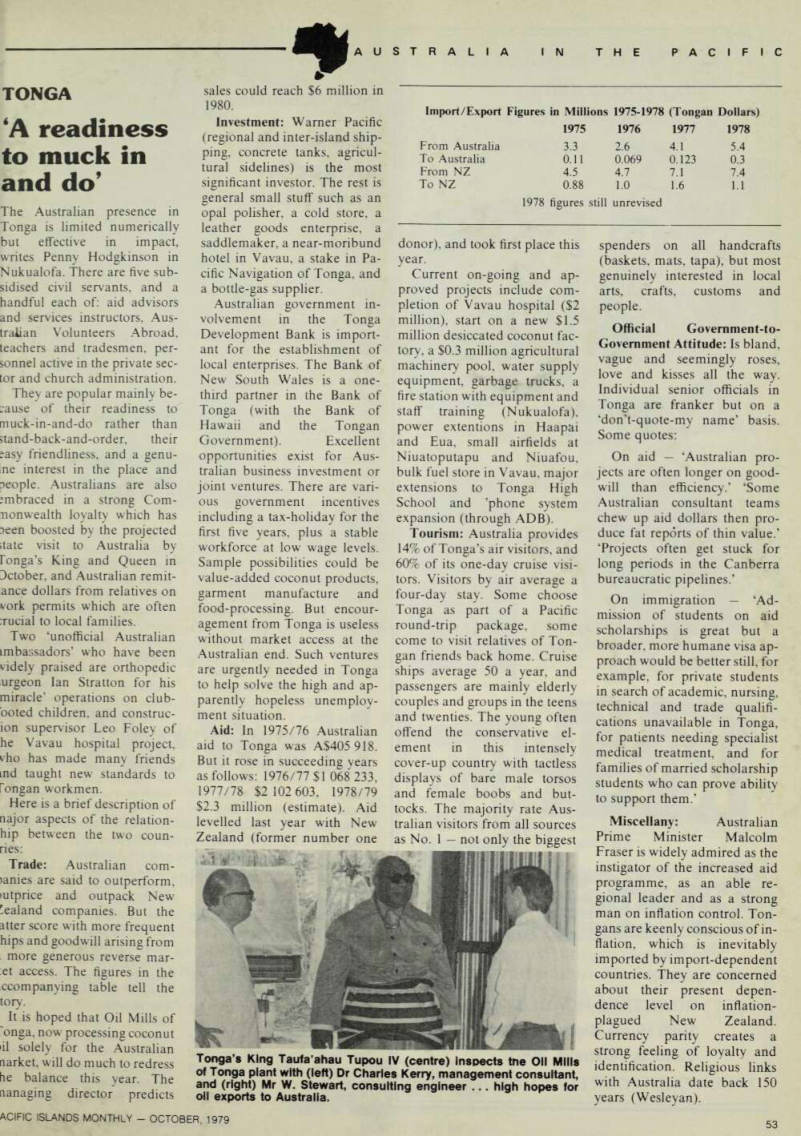
Tonga
‘A readiness to muck in and do’
The Australian presence in
Tonga is limited numerically
but effective in impact,
writes Penny Hodgkinson in
Nukualofa. There are five sub sidised civil servants, and a handful each of; aid advisors and services instructors, Aus tralian Volunteers Abroad, teachers and tradesmen, per sonnel active in the private sec tor and church administration.
They are popular mainly be
muse of their readiness to muck-in-and-do rather than stand-back-and-order, their ;asy friendliness, and a genu ine interest in the place and aeople. Australians are also embraced in a strong Com
nonwealth loyalty which has
aeen boosted by the projected
itate visit to Australia by fonga’s King and Queen in October, and Australian remit ance dollars from relatives on vork permits which are often :rucial to local families.
Two ‘unofficial Australian imbassadors’ who have been
videly praised are orthopedic
urgeon lan Stratton for his
miracle’ operations on club
boted children, and construc
ion supervisor Leo Foley of
he Vavau hospital project,
vho has made many friends md taught new standards to
fongan workmen.
Here is a brief description of najor aspects of the relation hip between the two coun ties; Trade: Australian com >anies are said to outperform, mtprice and outpack New
Zealand companies. But the
alter score with more frequent
hips and goodwill arising from
more generous reverse mar et access. The figures in the ccompanying table tell the tory.
It is hoped that Oil Mills of onga, now processing coconut •il solely for the Australian aarket, will do much to redress he balance this year. The managing director predicts
sales could reach $6 million in 1980.
Investment: Warner Pacific
(regional and inter-island ship
ping, concrete tanks, agricul
tural sidelines) is the most significant investor. The rest is general small stuff such as an opal polisher, a cold store, a
leather goods enterprise, a
saddlemaker, a near-moribund hotel in Vavau, a stake in Pa cific Navigation of Tonga, and
a bottle-gas supplier.
Australian government in volvement in the Tonga
Development Bank is import
ant for the establishment of local enterprises. The Bank of New South Wales is a one third partner in the Bank of Tonga (with the Bank of Hawaii and the Tongan Government). Excellent opportunities exist for Aus tralian business investment or joint ventures. There are vari ous government incentives including a tax-holiday for the first five years, plus a stable workforce at low wage levels.
Sample possibilities could be
value-added coconut products, garment manufacture and food-processing. But encour agement from Tonga is useless without market access at the Australian end. Such ventures are urgently needed in Tonga to help solve the high and ap
parently hopeless unemploy
ment situation.
Aid: In 1975/76 Australian aid to Tonga was As4os 918.
But it rose in succeeding years as follows: 1976/77 $1 068 233, 1977/78 $2 102 603, 1978/79 $2.3 million (estimate). Aid levelled last year with New Zealand (former number one
Import/Export Figures in Millions 1975-1978 (Tongan Dollars)
donor), and took first place this year.
Current on-going and ap proved projects include com pletion of Vavau hospital ($2 million), start on a new $1.5 million desiccated coconut fac tory, a $0.3 million agricultural
machinery pool, water supply
equipment, garbage trucks, a fire station with equipment and staff training (Nukualofa), power extentions in Haapai and Eua, small airfields at Niuatoputapu and Niuafou, bulk fuel store in Vavau, major
extensions to Tonga High
School and ’phone system expansion (through ADB).
Tourism: Australia provides 14% of Tonga’s air visitors, and 60% of its one-day cruise visi tors. Visitors by air average a four-day stay. Some choose Tonga as part of a Pacific
round-trip package, some
come to visit relatives of Ton gan friends back home. Cruise ships average 50 a year, and
passengers are mainly elderly
couples and groups in the teens and twenties. The young often offend the conservative el ement in this intensely cover-up country with tactless displays of bare male torsos and female boobs and but tocks. The majority rate Aus tralian visitors from all sources as No. 1 not only the biggest
spenders on all handcrafts (baskets, mats, tapa), but most genuinely interested in local arts, crafts, customs and people.
Official Government-to- Govemment Attitude: Is bland, vague and seemingly roses, love and kisses all the way.
Individual senior officials in Tonga are franker but on a ‘don’t-quote-my name’ basis.
Some quotes: On aid ‘Australian pro jects are often longer on good will than efficiency.’ ‘Some Australian consultant teams chew up aid dollars then pro duce fat reports of thin value.’ ‘Projects often get stuck for long periods in the Canberra
bureaucratic pipelines.’
On immigration ‘Ad mission of students on aid scholarships is great but a broader, more humane visa ap proach would be better still, for
example, for private students
in search of academic, nursing, technical and trade qualifi cations unavailable in Tonga,
for patients needing specialist
medical treatment, and for families of married scholarship students who can prove ability to support them.’
Miscellany: Australian Prime Minister Malcolm Fraser is widely admired as the instigator of the increased aid programme, as an able re gional leader and as a strong man on inflation control. Ton gans are keenly conscious of in flation, which is inevitably
imported by import-dependent
countries. They are concerned about their present depen dence level on inflation plagued New Zealand.
Currency parity creates a strong feeling of loyalty and identification. Religious links with Australia date back 150
years (Wesleyan).
Tonga’s King Taufa’ahau Tupou IV (centre) Inspects the Oil Mills of Tonga plant with (left) Dr Charles Kerry, management consultant, and (right) Mr W. Stewart, consulting engineer ... high hopes for oil exports to Australia.
1975 1976 1977 1978 From Australia 3.3 2.6 4.1 5.4 To Australia 0.11 0.069 0.123 0.3 From NZ 4.5 4.7 7.1 7.4
To Nz
0.88 1.0 1.6 1.1 1978 figures still unrevised
Advertisements & other items, p. 53 (1 item)
53
ACIFIC ISLANDS MONTHLY - OCTOBER, 1979
AUSTRALIA IN THE PACIFIC
finger in

New Hebrides
An Aussie finger in many a pie
Britain and France aside, Aus
tralia enjoys a physical,
business and diplomatic pres ence in the New Hebrides which is unequalled, writes
Greg Nosworthy, who recently
returned to Australia from a two-year stay there. According to the latest available figures, a total of 60 000 Australians arrived in 1977 on cruise ships or by air, compared with 2700 Japanese, their nearest rivals.
An Australian consular office was established in 1977, headed by Bill Fisher. It re
mains the only foreign diplo
matic establishment in the British/French condominium.
Since 1970 it has been largely Australian banks, trust companies, law and account ancy firms that have capitalised on the New Hebrides’ tax haven status. All Australian
private national trading banks
are or have been represented, along with French, British, Hong Kong and Swiss banks.
Cruise ships berth either in Vila or Santo on an average almost once a week. It is from these that most visitors arrive.
Carrying up to 2000 passen gers, they usually stay less than 24 hours. The balance of Aus tralians, who arrive by air, are generally on airfare and ac commodation package hol idays, with the heaviest numbers arriving at Australian
school holiday time, especially
August.
Accurate figures on the num ber of Australians resident in the New Hebrides are not available, although it is known that they are second in num bers to the French. It is possible that after independence, with the departure of many of the British and French public ser vants now working there, the numbers of Australians and New Zealanders will go up still further.
The attitude to Australians
of the average New Hebridean is friendly and co-operative.
The tourism and finance indus tries provide valuable jobs in Vila, where the unemployment rate is more than 80%. Some Islanders have come to regard Australia as some kind of para dise when they hear stories of high wages, 95% employment,
and people actually getting
paid by the government when they’re out of work.
It is to be hoped that in the coming years financial and physical assistance from Aus tralia will increase, in order to foster the development of this vital new nation.
Welcome ...

New Caledonia
Poken!
If Australia has not spoilt her image in New Caledonia, the reason is probably because the island is a French territory, writes Andre Chaville from Noumea. Absurd as this may seem, because the soil is French, Australians tread
lightly.
There is the occasional
exchange of lighthearted
abuse, the most popular topics
being nuclear explosions and
Aboriginal massacres. Both subjects only seem to interest the political extremists. And if
its current political problems
seem to create important issues within the territory, Australia is
keeping her nose exceptionally
clean.
For Australia, New Cale donia has many favourable as pects. Ranking very high as an Australian market in the Pa cific, it requires no aid and is in fact a base for a friendly Western power, even if the military forces present are
hardly significant. While ;
France and Australia accuse ; one another of trade protec tionism, Australia sells well to New Caledonia, and the j French seem to accept with calm this traditional invasion J of Australian products.
For the French, the Aus- I
tralians, or Tokens’ as they are familiarly called, are also use
ful neighbours. The weekly
Qantas flight brings its gener ous load of tourists and fresh fruit and vegetables, and takes back to Sydney New Cale donian flat-hunters, punters and those in need of urgent medical treatment.
Australians are still the big gest group of overseas visitors, close to 50% of the total num ber of tourists visiting New
Caledonia. They spend more
than New Zealanders, but much less than Japanese. The numbers of Australian visitors will increase still further when the new ‘Club Med ’ instal lations are opened. Promoters estimate that 85% of their cli ents will be from Sydney and Melbourne.
Like the other islands of the Pacific, New Caledonia also re
ceives regular shiploads of
cruise passengers. They are the
‘poor’ tourists, the ‘penniless
whingers’ who buy most of their duty-free goods on the
ship or in Fiji. They represent
the ugliest of the ‘ugly Aus tralians’, and, if a shipload should arrive on a public hol iday or a Sunday, most store keepers don’t even bother to raise their shutters.
New Caledonia also has its share of Australian expatriates.
They are generally well
accepted in the local com munity, speak French with that
‘delightful’ accent, and really
enjoy life in the French way.
New Caledonia and Aus tralia exchange hundreds of students every year. The chil dren of Noumea visit Australia during their holidays, the Aus tralian students return the visit during their own vacations.
Often long-standing ties of
friendship are created. Nearly
100 students visit Sydney every January to follow the six-week
English language course, and
students from Queensland University spend six or seven weeks every year in Noumea to soak up the atmosphere of French culture. The French cultural attache in Canberra is an enthusiastic promoter of the French Civilisation courses which attract dozens of teachers of French from Aus
tralian schools to Noumea dur
ing the summer holidays.
Although most New Cale donian students go to univer sity in France, there is still a small trickle who choose Aus tralia, if their English is good enough. Twenty years ago it was quite fashionable for the sons and daughters of wealthy families to go to a private
college or high school in Syd
ney, but this habit has now
disappeared.
The Sydney-Noumea yacht race, courtesy visits by the two navies, and numerous sports events all contribute to main tain a certain image of Aus tralia in the French territory.
Australians are always present in the annual round-the-island bicycle race, and generally per form well. Most New Caledonian sports clubs visit Australia regularly, or receive
visiting teams from Sydney,
Melbourne or Brisbane, the most popular events being car and motor bike rallies, soccer,
tennis, boxing and swimming.
Australian sportsmen and women are among their country’s best ambassadors,
and the ‘yachties’ participating
in the traditional Sydney- Noumea race have made close friends in the local sailing com
munity.
Perhaps the most curious as pect of the relationship is the role that Australia plays in the life of the Caldoches, descend ants of the original white set tlers. Australia is often their standard for commercial or
agricultural enterprise, and
Australian words such as
‘stockwhip’, ‘stockyard’, ‘pad
dock’ and ‘creek’ are part of the local vernacular. The first over seas holiday for families of modest means is inevitably in Sydney, where wealthier famil ies have their flats in Rand wick, Coogee, Kings Cross or Elizabeth Bay.
The impression of admir
ation and nostalgia, bordering
often on feelings of jealousy of Australia’s economic growth, is sometimes countered by sud den spurts of ‘French’ patriot ism. This is typical of the New Caledonian community, influ enced as it is by two civilis ations: where else would such a high proportion of French men drink tea or eat corn flakes? Instinctively, the diehard Caldoche plays the middle of the field, accepting and enjoying the favourable aspects of both civilisations.
And if the more recent immigrants from France resent the influence of the neighbour ing continent, after a few years
of residence they inevitably
make a short trip to Sydney.
Total annual imports into New Caledonia represent roughly SA2BO million, of which $l3O millions’ worth are from France and $33 million from Australia, these two coun
tries being the major suppliers.
Australia’s exports are mainly foodstuffs.
New Caledonia, like French Polynesia, imports large quanti ties of Australian foodstuffs.
This display of Australian foods was seen at an ‘amateurish’ Aus tralian trade fair staged in Papeete recently.
Advertisements & other items, pp. 54-57 (3 items)
54
PACIFIC ISLANDS MONTHLY - OCTOBER, 1979
AUSTRALIA
IN THE PACIFIC
smar
ROWNTREE HOADLEY LTD.
bring you quality
confectionery for all
seasons 120 g 'C' Pack m
ftuai
!1 y Str eei n Cartons & Tins 20g + 40g Bars ’AV Multipack 6 x 20g - 3 x 40g 120 g + 200 g Bags
0 g NET 0
m *
Milk
* biscuit
Shakes
V. a 20g + 40g i
smar
es 120 g 'C' Pack 25g + 50g
ENQUIRIES
ROWNTREE HOADLEY LTD,
1585 Hume Highway, Campbellfield, Victoria, Australia, 3061.
OR CONTACT YOUR LOCAL WHOLESALER
The World 'Dusts Mono
* 4 % i Ir s R •B
When it comes to providing water, the world trusts Mono Pumps. Mono make reliable bore hole pumps for almost every application, and any power source.
Mono Bore Hole Pumps raise clear, clean deep-well water and keep it flowing, year in and year out.
And with a minimum of maintenance.
That’s why, in so many remote areas all over the world, people trust Mono to provide water-and to keep on providing water.
Head Office & Works: “Mono House”, 338-348 Lower Dandenong Rd., Mordialloc, Vic. 3195. Australia.
Represented through Papua New Guinea by Steamships Machinery.
Agents in: Indonesia, Fiji, The Philippines and Singapore.
MONO
PUMPS
(AUSTRALIA) PTY. LTD.
MOVE IT WITH MONO
THE INDEPENDENT STATE OF
PAPUA NEW GUINEA
Utilising a World Bank Credit Agreement
is implementing the
“SOUTHERN HIGHLANDS
RURAL DEVELOPMENT PROJECT”
STAFF ARE REQUIRED
Specialist staff are required by the Government of Papua New Guinea for the above project to be carried out in the Southern Highlands Province. The Southern Highlands forms part of the central range of Papua New Guinea and the population of 240,000 is concentrated into valleys 1200-1800 metres above sea level. This population has had modern contact for twenty-five years, over 90% are involved wholly in the subsistence sector and the Province suffers few of the problems usually associated with prolonged “urbanization”.
Most specialist staff will be based in the Provincial Headquarters Mendi, a town of some 3,000 population, (300 non-nationals).
Mendi is connected by highway standard road to other highlands centres and the coastal port of Lae. It has a daily air service to Port Moresby and thence international routes and an international telephone system. Other facilities include a fully equipped four doctor hospital, pre-school, an international school to primary level (Australian curriculum), two banks, comlortable hotel and social clubs.
Recreation available includes golf, tennis, squash, a swimming pool, trout fishing, caving and bush walking.
The specialist team will be known as the Agricultural and Field Trials, Studies, Extension and Monitoring Unit, (AT .T.S.E.M.U.) and will:— * Study the subsistence farming systems of the Province and assemble basic knowledge to address the existing malnutrition problems so as to be able to make future decisions regarding the extent to which cash cropping can be introduced without degrading the subsistence reserves. * Study the health patterns of the Province, with particular regard to malmutrition. in order to design effective intervention programmes for health improvement. * Ensure that data collected during the project is processed, analysed and presented expeditiously in a form readily usable by provincial planners and policy makers. Design an on-going system of data collection for valid social monitoring indicators within the limitations of staff resources and available skills. * Strengthen the capacity of the Province to implement in-service training programmes to improve the effectiveness of field extension delivery services.
SPECIFICALLY, the people required for
A.F.T.S.E.M.U. are:
THE TEAM LEADER, would probably be an agriculturist but more importantly, someone with the depth of knowledge and experience to manage an interdisciplinary team, to understand the significance of research results in a variety of fields and to supervise field work and training activities. He would assist in the project establishment and organise work programmes for other technical personnel. He will remain through to the end of the project period in order to supervise preparation of the draft and final report by project end.
His specific tasks would be to review existing data and studies relevant to subsistence agriculture. At end of year 1 prepare a position paper summarising the state of agriculture in the Southern Highlands Province under specific headings which would indicate the most promising lines of approach to be included in the teams work programme for project years 2 to 5. To submit an annual report of activities to the Southern Highlands Research Committee including an agreed annual work programme for the following year.
FOOD CROPS AGRONOMISTS (2 Positions)
The Agronomists will have previous experience in developing countries, preferably in subsistence farming in humid highlands conditions.
They would examine the agronmic base of agricultural systems in selected ecological zones and assess their adequacy re: increasing population density, particularly with respect to nutrition. It would be desirable for each agronomist to concentrate on different aspects of existing studies in the area.
Examination of land use systems studies of soils and the effects on soils of various gardening practices, associated land tenure systems, interpretation of aerial photography to produce land-use maps.
Examination of the actual crops grown by the establishment of a representative network of field trials on sites available at existing institutions. Developing of higher yielding crops and the trial of new good crops would be undertaken.
HEALTH TRAINER
The Health Trainer would be a Physician with experience in training health workers of all levels in developing countries. A professional health educator with extensive experience in inservice training of health workers might be acceptable. Specific areas of responsibility would include responsibility for the administration of the health in-service training facilities to be provided as part of the Health Training Complex in the Province. Also to design and implement in-service training course for Aid Post Orderlies, Nurse Aids. Nurses and Health Extension Officers. On-the-job training at aid posts and health centres should form an important part of his work and he would be expected to train a counterpart in 3-4 years and develop techniques to evaluate the effectiveness of inservice training.
MONITORING AND EVALUATION OFFICER
(M.E.0.) The M.E.O. would be responsible for the operation and management of a Digital 11/34 computer which will be utilised in support of medical and agricultural research programmes.
He would initially assist in the establishment of base line date concerning the Province, its people and economy. He would be expected to develop appropriate software in support of the above research programmes, liaise with the manufacturer over hardware maintenance and repair and give statistical advice where and when required. He would need to combine a strong interest in the economics of broad based rural development with an interest and knowledge in the interpretation of numerical data concerning demographic, health and nutritilional aspect of the population. Qualifications and experience consistent with the above duties would be essential.
COFFEE EXTENSION SPECIALIST
The specialist will be a person with agricultural qualifications. Experience in extension work amongst smallholders in a developing country is essential. Some background in coffee would be desirable but not essential. The concept of the coffee component is that the 15 coffee blocks of 50 ha. each, dispersed through the Province and established by the Management Authority, will generate confidence in the crop and lead to individual smallholder interest and participation. It is anticipated that a further 530 ha. of smallholder coffee on up at 2500 holdings will be established during the life of the Project.
The Coffee Extension Specialist would work closely with Department of Primary Industry staff to develop extension programmes specifically aimed at coffee smallholder expansion. He would participate in integrated training programmes in liaison with the Extension Training Officer.
ADULT EDUCATION CO-ORDINATOR (A.E.0.)
An Adult Education Officer will be appointed to co-ordinate all adult and non-formal education activities in the Province. The person should have skill and knowledge related primarily to adult and non-formal education with an illiterate rural population of a developing country, but should also have experience with formal educational institutions. He would have the task of ensuring that non-formal education activities related closely to other extension and training activities taking place within the Province.
The A.E.O.'s duties will include co-ordination of the Adult Education work force and liaison with Missions and non-governmental agencies who participate in non-formal education.
Controlling and allocating expenditure under this component and the organisation of supplies, transport and other resources. Close liaison with Provincial level organisations involved in Research activities. Conducting on-the-job training of A.E.O. s and working with A.E.O. staff on practical field extension.
EXTENSION TRAINING OFFICER
The Extension Training Officer probably would be an agricultural graduate or diplomate with an additional qualification in rural extension/ communications; he should have a strong background in methods of training for extension work amongst a largely illiterate rural population. He would initially train and assist existing training staff who have had little experience in rural extension, both through training courses and attachment to the A.F.T.S.E.M.U. team. He would ensure that the Team's research results pass quickly to the field extension staff and that appropriate information is disseminated to the rural population in all fields (agric.. health, education), through an integrated extension approach.
CASH CROPS AGRONOMIST
The agronomist would establish suitable trials to identify improved husbandry methods for tea. cardamon and coffee crops under both block development and smallholder conditions.
Diversification of cash crops is desirable and the identification, introduction and testing of new cash crops would be given special attention.
The agronomist would need to be a self starter in this field.
Key staff are required for a term of four years but two year contracts would be considered in some cases and under
special circumstances.
Lradit lollB of employment would include the provision of leave fares, housing and generous education allowances for children (including overseas fares and boarding allowances for secondary students). Interested applicants should apply to the address given in writing giving full details, an indication of remuneration expected in American dollars, a telephone contact number, telex or telegraphic contact number or address and enclosing curriculum vitae. Closing date for applications is 13th October, 1979.
The project Co-ordinator. S.H.R.D.P., Department of Finance.
Post Office Wards Strip,
WAIGANI. Tplp*- FINANCE NF97119
PAPUA NEW GUINEA. TELEGRAMS: FINANCE. WAIGANI.
From pork to
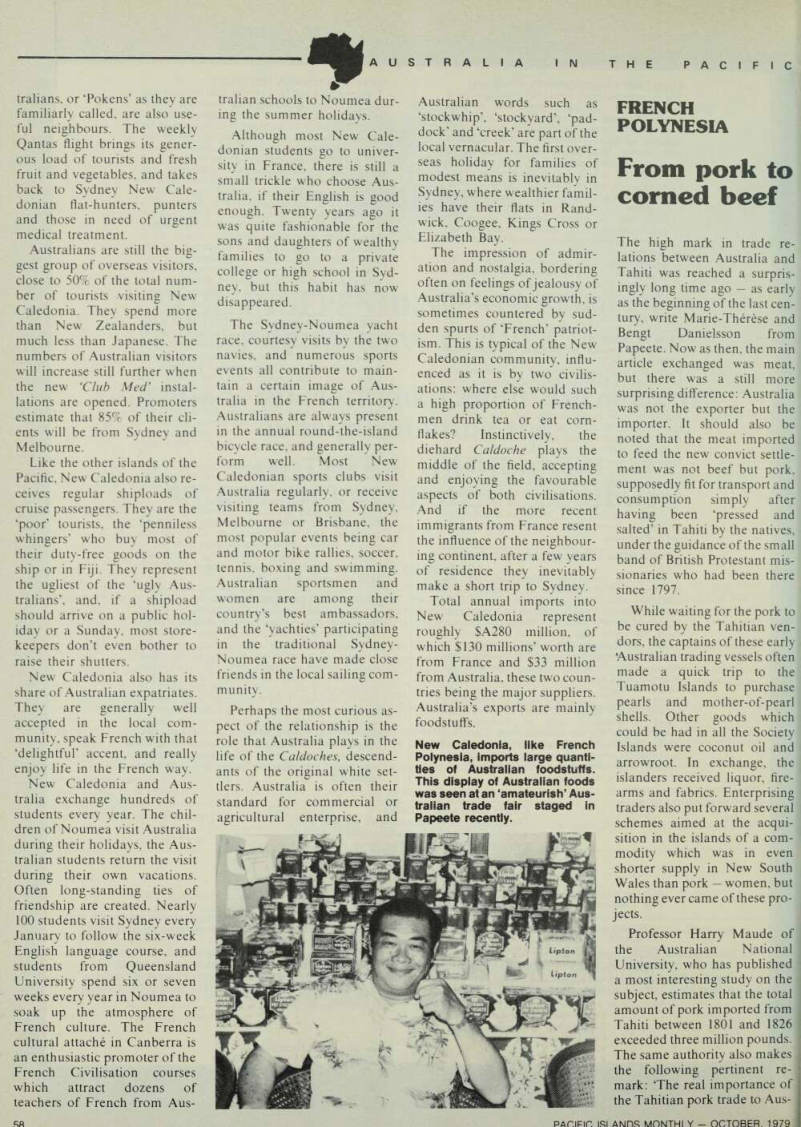
French
Polynesia
From pork to corned beef
The high mark in trade re lations between Australia and Tahiti was reached a surpris
ingly long time ago as early
as the beginning of the last cen tury, write Marie-Therese and Bengt Danielsson from Papeete. Now as then, the main article exchanged was meat, but there was a still more surprising difference: Australia was not the exporter but the importer. It should also be noted that the meat imported to feed the new convict settle ment was not beef but pork, supposedly fit for transport and
consumption simply after
having been ‘pressed and
salted’ in Tahiti by the natives, under the guidance of the small band of British Protestant mis sionaries who had been there since 1797.
While waiting for the pork to be cured by the Tahitian ven dors, the captains of these early ‘Australian trading vessels often made a quick trip to the Tuamotu Islands to purchase
pearls and mother-of-pearl
shells. Other goods which could be had in all the Society Islands were coconut oil and arrowroot. In exchange, the islanders received liquor, fire arms and fabrics. Enterprising traders also put forward several schemes aimed at the acqui sition in the islands of a com modity which was in even shorter supply in New South Wales than pork women, but nothing ever came of these pro
jects.
Professor Harry Maude of the Australian National
University, who has published
a most interesting study on the subject, estimates that the total amount of pork imported from Tahiti between 1801 and 1826 exceeded three million pounds.
The same authority also makes
the following pertinent re
mark: ‘The real importance of the Tahitian pork trade to Aus
Advertisements & other items, pp. 58-59 (2 items)
58
AUSTRALIA IN THE PACIFIC
PAP.inn IRI AMDS MONTHLY OCTOBER. 1979
CIG services
the Pacific
CIG provides an extensive range of gases, welding consumables, flame cutting and spray painting equipment, for industrial applications and the trade and service industries. CIG equipment is fully backed by a continuous research and testing programme, sales and technical services, spare parts and repair facilities, all designed to ensure that every item will provide optimum performance and service to industry.
See us at Suva.
Plumbers’ supplies display Australian Trade Commission Showrooms, Suva, October 2nd-4th, 1979.
On display • Transtig 180 AC/DC welding plant. • Airfuel gas package, including handpieces, necks, burners and attachments for welding and paint removal. • Comet sprint plant for fusion welding and cutting. • The CIG plastic welding blow-pipe. • CIG/Arnold Automatic V twin compressor for spray equipment etc.
See us at Port Moresby.
Industrial products display, Port Moresby Travelodge, October 16th-19th.
On display • CIG 1500 cross carriage profile cutter. • Pak 10 plasma arc welding plant. • Comet 3 and Comet Sprint portable welding plants. • Transpak and Transarc electric welding equipment. • The Roughneck 2E engine driven welder and auxiliary power service. • A full range of CIG consumables. • Spray equipment.
7ZZZI
Performance,Service,Satisfaction
tralian history lies in the fact
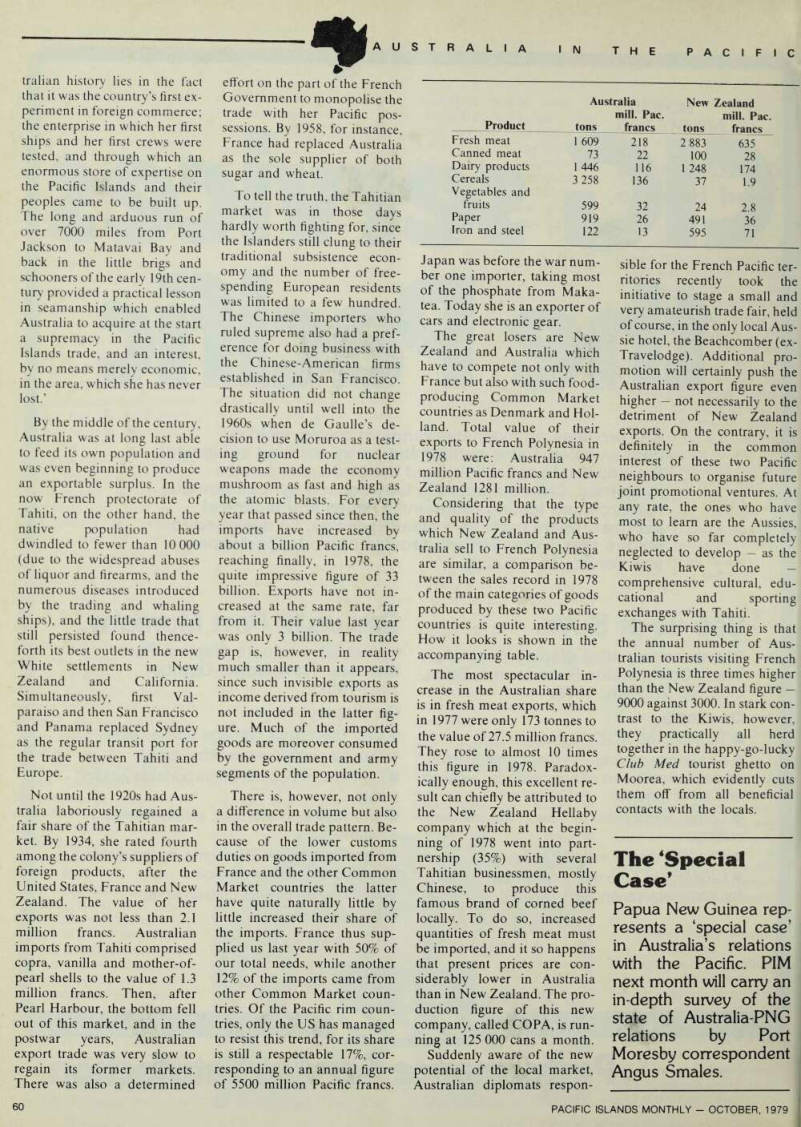
that it was the country’s first ex
periment in foreign commerce;
the enterprise in which her first ships and her first crews were tested, and through which an enormous store of expertise on the Pacific Islands and their peoples came to be built up.
The long and arduous run of over 7000 miles from Port Jackson to Matavai Bay and back in the little brigs and schooners of the early I9th cen tury provided a practical lesson in seamanship which enabled Australia to acquire at the start a supremacy in the Pacific Islands trade, and an interest, by no means merely economic, in the area, which she has never lost.’
By the middle of the century, Australia was at long last able to feed its own population and was even beginning to produce an exportable surplus. In the now French protectorate of Tahiti, on the other hand, the native population had dwindled to fewer than 10 000 (due to the widespread abuses of liquor and firearms, and the numerous diseases introduced
by the trading and whaling
ships), and the little trade that still persisted found thence forth its best outlets in the new White settlements in New Zealand and California.
Simultaneously, first Val paraiso and then San Francisco
and Panama replaced Sydney
as the regular transit port for the trade between Tahiti and
Europe.
Not until the 1920 s had Aus
tralia laboriously regained a
fair share of the Tahitian mar ket. By 1934, she rated fourth among the colony’s suppliers of
foreign products, after the
United States, France and New Zealand. The value of her exports was not less than 2.1 million francs. Australian
imports from Tahiti comprised
copra, vanilla and mother-of pearl shells to the value of 1.3 million francs. Then, after Pearl Harbour, the bottom fell out of this market, and in the postwar years, Australian export trade was very slow to regain its former markets.
There was also a determined
effort on the part of the French Government to monopolise the trade with her Pacific pos sessions. By 1958, for instance, France had replaced Australia as the sole supplier of both sugar and wheat.
To tell the truth, the Tahitian market was in those days hardly worth fighting for, since the Islanders still clung to their traditional subsistence econ omy and the number of free
spending European residents
was limited to a few hundred.
The Chinese importers who ruled supreme also had a pref erence for doing business with the Chinese-American firms established in San Francisco.
The situation did not change drastically until well into the 1960 s when de Gaulle’s de cision to use Moruroa as a test ing ground for nuclear weapons made the economy mushroom as fast and high as the atomic blasts. For every year that passed since then, the
imports have increased by
about a billion Pacific francs, reaching finally, in 1978, the
quite impressive figure of 33
billion. Exports have not in creased at the same rate, far from it. Their value last year was only 3 billion. The trade gap is, however, in reality much smaller than it appears, since such invisible exports as income derived from tourism is not included in the latter fig ure. Much of the imported goods are moreover consumed by the government and army segments of the population.
There is, however, not only a difference in volume but also in the overall trade pattern. Be cause of the lower customs duties on goods imported from France and the other Common Market countries the latter
have quite naturally little by
little increased their share of the imports. France thus sup plied us last year with 50% of our total needs, while another 12% of the imports came from other Common Market coun tries. Of the Pacific rim coun tries, only the US has managed to resist this trend, for its share is still a respectable 17%, cor responding to an annual figure of 5500 million Pacific francs.
Japan was before the war num ber one importer, taking most of the phosphate from Maka tea. Today she is an exporter of cars and electronic gear.
The great losers are New Zealand and Australia which have to compete not only with France but also with such food producing Common Market countries as Denmark and Hol land. Total value of their exports to French Polynesia in 1978 were; Australia 947 million Pacific francs and New Zealand 1281 million.
Considering that the type and quality of the products which New Zealand and Aus tralia sell to French Polynesia are similar, a comparison be tween the sales record in 1978 of the main categories of goods produced by these two Pacific
countries is quite interesting.
How it looks is shown in the
accompanying table.
The most spectacular in crease in the Australian share is in fresh meat exports, which in 1977 were only 173 tonnes to the value of 27.5 million francs.
They rose to almost 10 times this figure in 1978. Paradox ically enough, this excellent re sult can chiefly be attributed to the New Zealand Hellaby company which at the begin ning of 1978 went into part nership (35%) with several Tahitian businessmen, mostly Chinese, to produce this famous brand of corned beef locally. To do so, increased quantities of fresh meat must be imported, and it so happens that present prices are con siderably lower in Australia than in New Zealand. The pro duction figure of this new company, called COPA, is run ning at 125 000 cans a month.
Suddenly aware of the new potential of the local market, Australian diplomats respon
sible for the French Pacific ter ritories recently took the initiative to stage a small and very amateurish trade fair, held of course, in the only local Aus sie hotel, the Beachcomber (ex- Travelodge). Additional pro motion will certainly push the Australian export figure even higher not necessarily to the detriment of New Zealand exports. On the contrary, it is definitely in the common interest of these two Pacific
neighbours to organise future
joint promotional ventures. At
any rate, the ones who have most to leant are the Aussies, who have so far completely neglected to develop as the Kiwis have done I comprehensive cultural, edu cational and sporting exchanges with Tahiti.
The surprising thing is that the annual number of Aus tralian tourists visiting French Polynesia is three times higher than the New Zealand figure 9000 against 3000. In stark con trast to the Kiwis, however,
they practically all herd
together in the happy-go-lucky
Club Med tourist ghetto on Moorea, which evidently cuts them off from all beneficial contacts with the locals.
Product Australia mill. Pac. tons francs New Zealand mill. Pac. tons francs Fresh meat 1 609 218 2 883 635 Canned meat 73 22 100 28
Dairy products
1 446 116 1 248 174 Cereals 3 258 136 37 1.9
Vegetables and
fruits 599 32 24 2.8
Paper
919 26 491 36 Iron and steel 122 13 595 71
The ‘Special
Case’
Papua New Guinea rep resents a ‘special case’ in Australia’s relations with the Pacific. PIM next month will carry an in-depth survey of the state of Australia-PNG relations by Port Moresby correspondent Angus Smales.
Advertisements & other items, pp. 60-62 (3 items)
60
PACIFIC ISLANDS MONTHLY - OCTOBER, 1979
AUSTRALIA IN THE PACIFIC
61
\CIFIC ISLANDS MONTHLY OCTOBER IQ7Q
Beehive Building
94 Elizabeth Street Melbourne, Victoria Australia 3000 G.P.O. Box 8 Melbourne, Victoria Australia 301 Cables; Telex: AA34552 Phone: 63 5094
' : ;v.
AsSei
iters its sea
Seiko iv tens
slim, so
Nov#ou can own a quality Seik<
fashiJiable sophistication. Here if
:uracy and dependability) red with Seiko's uniquely styles to satisfy you'd expect from Seiko, and that never en< to techi
ion.
silSI? : • ■ , dress watch that represents a new :able styling combined with the unsi ieiko quartz. Crafted with trim good 100 l meed technology. In a variety of starkly of excellent taste everywhere, company that sold the world's first quai I quest for quality and dedication >gy. Seiko Quartz. dutiful watch \ / r \ \ V I V V
SEIKO
Someday all watches will be made this way.
of string figure
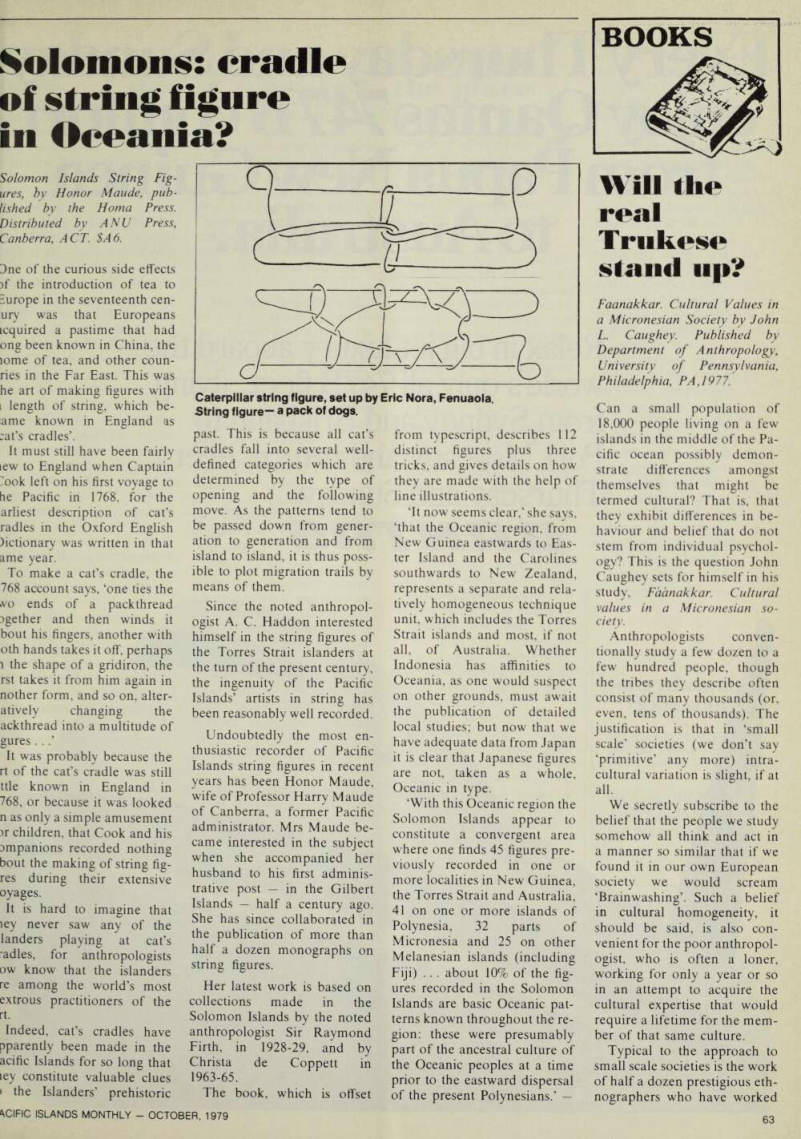
Books
Solomons: cradle of string figure In Oceania?
Solomon Islands String Fig
ures, by Honor Maude, pub
lished by the Homa Press.
Distributed by ANU Press,
Canberra, ACT. SA6. 3ne of the curious side effects )f the introduction of tea to Europe in the seventeenth cen ury was that Europeans icquired a pastime that had ong been known in China, the tome of tea, and other coun ries in the Far East. This was
he art of making figures with
i length of string, which be
ame known in England as :at’s cradles’.
It must still have been fairly
lew to England when Captain
rook left on his first voyage to he Pacific in 1768, for the arliest description of cat’s radles in the Oxford English )ictionary was written in that ame year.
To make a cat’s cradle, the 768 account says, ‘one ties the vo ends of a packthread 3gether and then winds it bout his fingers, another with oth hands takes it off, perhaps i the shape of a gridiron, the rst takes it from him again in nother form, and so on, alter
atively changing the
ackthread into a multitude of
gures ...’
It was probably because the rt of the cat’s cradle was still ttle known in England in 768, or because it was looked
n as only a simple amusement
)r children, that Cook and his
Dmpanions recorded nothing
bout the making of string fig
res during their extensive
oyages.
It is hard to imagine that ley never saw any of the landers playing at cat’s
•adles, for anthropologists
ow know that the islanders re among the world’s most
extrous practitioners of the
rt.
Indeed, cat’s cradles have pparently been made in the acific Islands for so long that ley constitute valuable clues
» the Islanders’ prehistoric
past. This is because all cat’s cradles fall into several well defined categories which are determined by the type of
opening and the following
move. As the patterns tend to be passed down from gener ation to generation and from island to island, it is thus poss
ible to plot migration trails by
means of them.
Since the noted anthropol ogist A. C. Haddon interested himself in the string figures of the Torres Strait islanders at the turn of the present century, the ingenuity of the Pacific Islands’ artists in string has been reasonably well recorded.
Undoubtedly the most en thusiastic recorder of Pacific Islands string figures in recent years has been Honor Maude, wife of Professor Harry Maude of Canberra, a former Pacific administrator. Mrs Maude be came interested in the subject when she accompanied her husband to his first adminis trative post in the Gilbert Islands half a century ago.
She has since collaborated in the publication of more than half a dozen monographs on
string figures.
Her latest work is based on collections made in the Solomon Islands by the noted
anthropologist Sir Raymond
Firth, in 1928-29, and by Christa de Coppett in 1963-65.
The book, which is offset
from typescript, describes 112
distinct figures plus three
tricks, and gives details on how they are made with the help of line illustrations. ‘lt now seems clear,’ she says, ‘that the Oceanic region, from New Guinea eastwards to Eas ter Island and the Carolines southwards to New Zealand, represents a separate and rela
tively homogeneous technique
unit, which includes the Torres Strait islands and most, if not all, of Australia. Whether Indonesia has affinities to Oceania, as one would suspect on other grounds, must await the publication of detailed local studies; but now that we have adequate data from Japan it is clear that Japanese figures are not, taken as a whole, Oceanic in type. ‘With this Oceanic region the Solomon Islands appear to constitute a convergent area where one finds 45 figures pre viously recorded in one or more localities in New Guinea, the Torres Strait and Australia, 41 on one or more islands of Polynesia, 32 parts of Micronesia and 25 on other Melanesian islands (including Fiji) ... about 10% of the fig ures recorded in the Solomon Islands are basic Oceanic pat terns known throughout the re
gion: these were presumably
part of the ancestral culture of the Oceanic peoples at a time prior to the eastward dispersal of the present Polynesians.’
Caterpillar string figure, set up by Eric Nora, Fenuaola.
String figure— a pack of dogs.
Trukese
Will the real Trukese stand up?
Faanakkar. Cultural Values in a Micronesian Society by John
L. Caughey. Published by
Department of Anthropology,
University of Pennsylvania,
Philadelphia, PA,1977.
Can a small population of 18,000 people living on a few islands in the middle of the Pa cific ocean possibly demon strate differences amongst themselves that might be termed cultural? That is, that they exhibit differences in be haviour and belief that do not stem from individual psychol ogy? This is the question John Caughey sets for himself in his study, Faanakkar. Cultural values in a Micronesian so ciety.
Anthropologists conven
tionally study a few dozen to a
few hundred people, though
the tribes they describe often consist of many thousands (or, even, tens of thousands). The justification is that in ‘small scale’ societies (we don’t say ‘primitive’ any more) intra cultural variation is slight, if at all.
We secretly subscribe to the belief that the people we study somehow all think and act in a manner so similar that if we found it in our own European society we would scream ‘Brainwashing’. Such a belief in cultural homogeneity, it should be said, is also con venient for the poor anthropol ogist, who is often a loner, working for only a year or so in an attempt to acquire the cultural expertise that would require a lifetime for the mem ber of that same culture.
Typical to the approach to small scale societies is the work of half a dozen prestigious eth nographers who have worked
Advertisements & other items, pp. 63-65 (2 items)
63
ISLANDS MONTHLY - OCTOBER, 1979
Every Thursday and Sunday
enjoy Qantas747B comfort
from Papua New Guinea
to Australia.
Relax in big jet luxury aboard the world’s only all 7478 fleet, flying from Sydney and Brisbane to Port Moresby and return, every Thursday and Sunday.
Polynesian
Bookshop...
THE PACIFIC ISLANDS
BOOK SPECIALISTS'
Write for our complimentary catalogue!
336 PONSONBY RD
(PO Box 47-267)
AUCKLAND, NEW ZEALAND.
Telephone 764-824.
knowledge?
on Truk since the first Yale
University Expedition in 1947.
The psychological dimension
has been an important one for studies of Truk since World War 11. Typically, these men lave concerned themselves vith how their informants and ither Trukese think, classify, or 'eel about their world and hemselves.
But, John Caughey tells us, hey have not really studied fruk at all only a small part >f it for they have all done heir real fieldwork only on
lononum. Dr Caughey sets
>ut to show us just how the >eople of Faanakkar (a >seudonym) differ from those »thers who for three decades lave been ‘the Trukese’ to the
/odd of anthropology.
Instead of mild, gentle, even lassive Trukese, we find the •eople of Faanakkar to be
•roud, assertive, aggressive
/ho at the smallest slight, will ike up a machete or cast a
evastating spell. If shamed
do greatly, they commit
Liicide.
Like some sort of oceanic
ekyll and Hyde, the people of
Lononum and Faanakkar, re
pectively, are personality
pposites.
Rononum co-operate, it ;ems, while, even in inter aurse, the Faanakkar com ete, man against woman to ot achieve the orgasm first, md, in this matrimonial so lety, women are kept in line y a strong belief in love magic hich can force them to pur ie, ‘like a man,’ a spiteful jitor.
The question I kept asking
lyself throughout this short
SO page monograph was why
te Faanakkar should be so
elligerent? One could equally
ask, I suppose, why the Rononum so fail to continue this characteristic attitude, Caughey tells us, of nineteenth century Truk society in gen eral?
The author does not provide us with an answer, but he does tell us a lot about how the people of Faanakkar believe their society operates. Most of Caughey’s evidence for his as sertions comes from the state ments of his informants, not from their observed behav iour.
Also, somewhat disturbing is the lack of consideration for the colonial context of the people of Faanakkar.
Throughout the monograph
there are accasional references to a Trukese reality that is not all thatched huts and canoes on the lagoon. The sky is com pared to blue plastic; a mal evolent spirit appears on the half-sunken hulk of a Japanese
warship; strength (and
endurance) is tested by sitting on a hot steam pipe; Japanese and German work gangs are mentioned.
Land can be sold, probably through the American admin istration of Truk, and there are high school dormitories. But, where do the modern people of Truk obtain their modern de sirable goods, such as the cor rugated iron houses, motor boats? Do they have cars, tran sistor radios, factory made clothing? In short, do they have access to those manufactured goods which feature in the ad vertisements?
And, if they do have these things, how do they relate to the apparently traditional sys tem of prestige so well
displayed by Caughey? Chiefs
Micronesian Senator Lazarus Salii has written about the vexatious American trusteeship over his islands, while Micronesian poet Moses
Ymal Uludong published a
poem called Milking the natives. Where do these
perspectives fit into Caughey’s
diagrammes of valuable
knowledge?
Will the real Trukese please stand up and tell us why they are as they are? Grant McCall.
Not quite
the place for it
Paradise Postoned: essays on re search and development in the South Pacific. Edited by A.
Mamak and G. McCall. Pub lished by Pergumon Press, Syd ney, 1978. $A 16.00 (hard), $9.95
(soft).
Paradise Postponed is a collec tion of essays presented at the Young Nations Conference in Sydney in August 1976 ‘to re examine the concept of development and research into development, with a view to
adopting a more responsible
approach to the communities
being researched’.
Chaired by Esiteri Kamikamica and Filimone Jitoko (Fiji), Ata Ma’ai’i (Western Samoa), Epeli Hau’ofa (Tonga) and Stuart Kingan (Cook Islands) and involving others from their nations as well as New Caledonians. New Hebrideans.
Papua New Guineans and rep resentatives of international agencies, universities and transnational corporations, the sessions had a go at questions of research into and/or for social planning, communi cation, village government, motivation, women’s role, and more. Even cargo cultism received attention.
The discussions and the essays in this book varied from academic jargon-laden arguments about ‘value-free’ anthropology and semantic acrobatics (‘What is meant by development?’) to down-to earth issues such as making it possible and easy for villagers to take part in planning.
Appropriate technology and
agricultural extension were among the issues that came to the fore during syndicate dis cussions which, in my opinion, were of greater value to most of the participants than the reading of esoteric essays by
European academics.
Two Tongans, Bishop
Patelisio P. Finau in his open ing address, and Professor Sione Latukefu in his conclud ing remarks, made some telling
points. The bishop asked
whether Sydney is'the most suitable venue for this kind of conference (and I don’t believe it is) and he claimed that any development programme must be judged by the extent to which it increases the islanders’ power of decision-making.
Professor Latukefu said that Islanders must have freedom ‘to choose whatever new ideas, technology or values they feel are relevant to their ever
changing needs and aspir
ations, irrespective of their source, whether from capitalist or socialist systems, and add to them what is good and relevant in their own cultures, in order to improve the lot of their
people, not only with pride and
confidence, but also with hu
mility and compassion’.
Home-grown politicans are
now the captains of the Pacific young nations’ destinies and depend upon advice from
home-grown planners. The
Young Nations Conference of 1976, reflected in the essays in this book, enabled some of the planners to meet their counter parts from elsewhere in the Pa
cific.
Harry Jackman
Advertisements & other items, p. 65 (2 items)
Books
65
4CIFIC ISLANDS MONTHLY - OCTOBER, 1979
Henry Lawson’s
Bookshop
127 York St., Sydney 2000 Just half a block from Town Hall. Phone 29 7799.
We stock ONLY
AUSTRALIAN BOOKS
and Books on the Pacific.
MAPS and PRINTS
of the OLD PACIFIC Regular catalogues issued listing a large stock of original antiquarian views and maps of Australia, New Zealand, Papua New Guinea and all the island groups of the Pacific. Write today for your free copy:
COLIN HINCHCLIFFE,
7 Royd Avenue, Heckmondwike, West Yorkshire, WFI6 9AL, UK.
lesson ro be learned
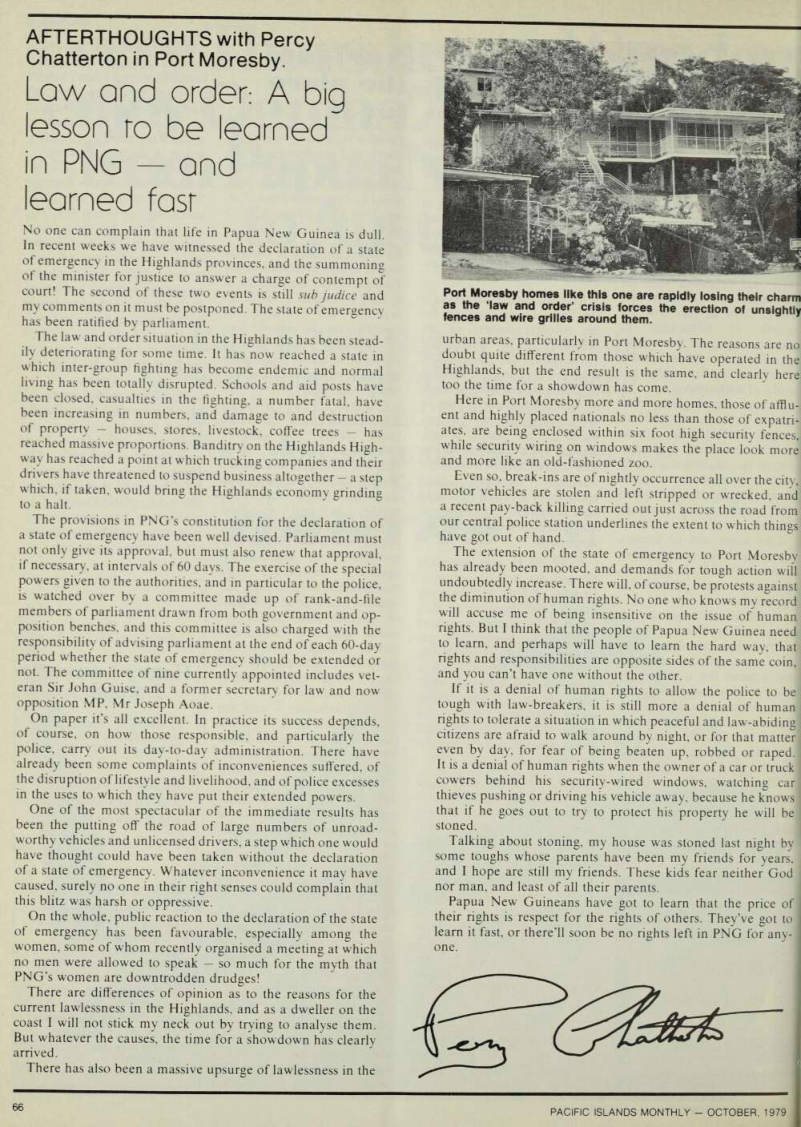
AFTERTHOUGHTS with Percy Chatterton in Port Moresby.
Low and order A big lesson ro be learned in PNG and learned fast
No one can complain that life in Papua New Guinea is dull.
In recent weeks we have witnessed the declaration of a stale of emergency in the Highlands provinces, and the summoning of the minister for justice to answer a charge of contempt of court! The second of these two events is still sub judice and my comments on it must be postponed. The state of emergency has been ratified by parliament.
The law and order situation in the Highlands has been stead ily deteriorating for some time. It has now reached a state in which inter-group fighting has become endemic and normal living has been totally disrupted. Schools and aid posts have been closed, casualties in the fighting, a number fatal, have been increasing in numbers, and damage to and destruction of property houses, stores, livestock, coffee trees has reached massive proportions. Banditry on the Highlands High way has reached a point at which trucking companies and their drivers have threatened to suspend business altogether a step which, if taken, would bring the Highlands economy grinding to a halt.
The provisions in PNG’s constitution for the declaration of a state of emergency have been well devised. Parliament must not only give its approval, but must also renew that approval, if necessary, at intervals of 60 days. The exercise of the special powers given to the authorities, and in particular to the police, is watched over by a committee made up of rank-and-file members of parliament drawn from both government and op position benches, and this committee is also charged with the responsibility of advising parliament at the end of each 60-day period whether the state of emergency should be extended or not. The committee of nine currently appointed includes vet eran Sir John Guise, and a former secretary for law and now opposition MP. Mr Joseph Aoae.
On paper it’s all excellent. In practice its success depends, of course, on how those responsible, and particularly the police, carry out its day-to-day administration. There have already been some complaints of inconveniences suffered, of the disruption of lifestyle and livelihood, and of police excesses in the uses to which they have put their extended powers.
One of the most spectacular of the immediate results has been the putting off the road of large numbers of unroad worthy vehicles and unlicensed drivers, a step which one would have thought could have been taken without the declaration of a state of emergency. Whatever inconvenience it may have caused, surely no one in their right senses could complain that this blitz was harsh or oppressive.
On the whole, public reaction to the declaration of the state of emergency has been favourable, especially among the women, some of whom recently organised a meeting at which no men were allowed to speak so much for the myth that PNG’s women are downtrodden drudges!
There are differences of opinion as to the reasons for the current lawlessness in the Highlands, and as a dweller on the coast I will not stick my neck out by trying to analyse them.
But whatever the causes, the time for a showdown has clearly arrived.
There has also been a massive upsurge of lawlessness in the
urban areas, particularly in Port Moresby. The reasons are no doubt quite different from those which have operated in the Highlands, but the end result is the same, and clearly here too the time for a showdown has come.
Here in Port Moresby more and more homes, those of afflu ent and highly placed nationals no less than those of expatri ates. are being enclosed within six foot high security fences, while security wiring on windows makes the place look more and more like an old-fashioned zoo.
Even so, break-ins are of nightly occurrence all over the city, motor vehicles are stolen and left stripped or wrecked, and a recent pay-back killing carried out just across the road from our central police station underlines the extent to which things have got out of hand.
The extension of the state of emergency to Port Moresby has already been mooted, and demands for tough action will undoubtedly increase. There will, of course, be protests against the diminution of human rights. No one who knows my record will accuse me of being insensitive on the issue of human rights. But I think that the people of Papua New Guinea need to learn, and perhaps will have to learn the hard way, that rights and responsibilities are opposite sides of the same coin, and you can’t have one without the other.
If it is a denial of human rights to allow the police to be tough with law-breakers, it is still more a denial of human rights to tolerate a situation in which peaceful and law-abiding : citizens are afraid to walk around by night, or for that matter ; even by day, for fear of being beaten up, robbed or raped. I It is a denial of human rights when the owner of a car or truck cowers behind his security-wired windows, watching carl thieves pushing or driving his vehicle away, because he knows that if he goes out to try to protect his property he will be stoned.
Talking about stoning, my house was stoned last night by some toughs whose parents have been my friends for years, i and I hope are still my friends. These kids fear neither God , nor man, and least of all their parents.
Papua New Guineans have got to learn that the price of their rights is respect for the rights of others. They’ve got to learn it fast, or there’ll soon be no rights left in PNG for any- j one.
Port Moresby homes like this one are rapidly losing their charm as the ‘law and order’ crisis forces the erection of unsightly fences and wire grilles around them.
People
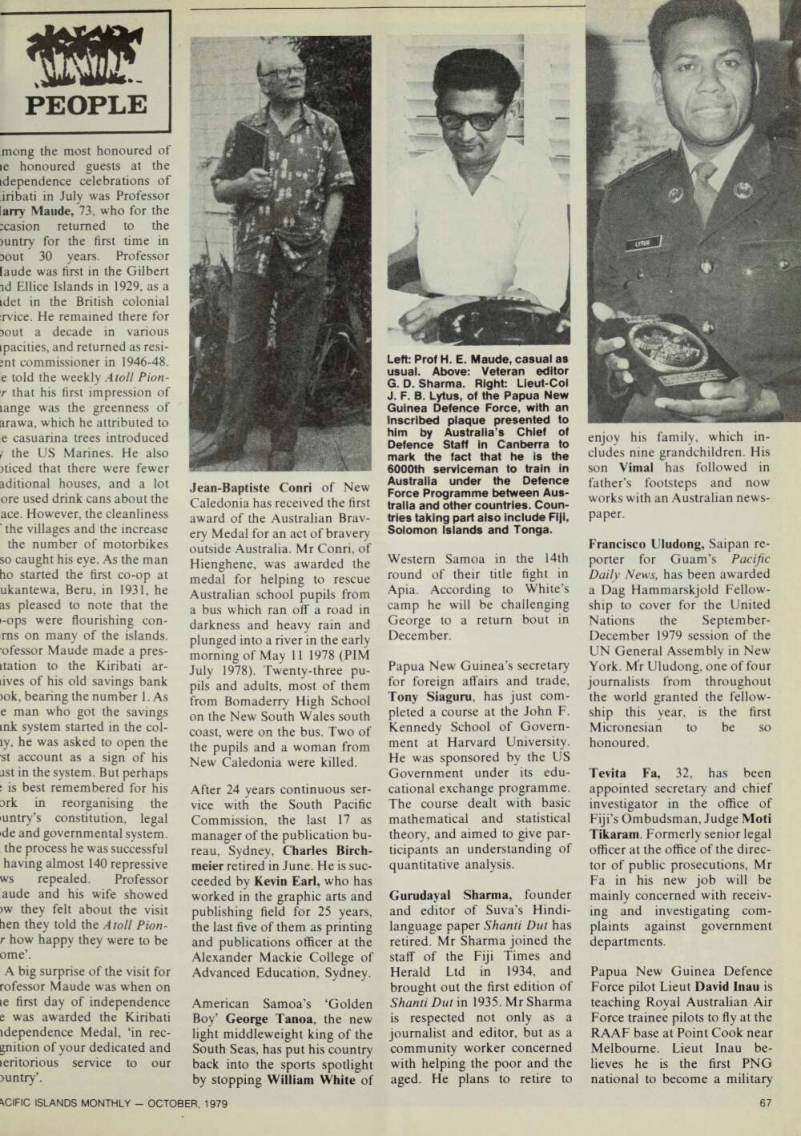
mong the most honoured of ic honoured guests at the idependence celebrations of riribati in July was Professor [airy Maude, 73, who for the :casion returned to the juntry for the first time in x>ut 30 years. Professor laude was first in the Gilbert id Ellice Islands in 1929, as a idet in the British colonial rvice. He remained there for lout a decade in various ipacities, and returned as resi ;nt commissioner in 1946-48. e told the weekly A toll Pion r that his first impression of lange was the greenness of arawa, which he attributed to e casuarina trees introduced / the US Marines. He also iticed that there were fewer aditional houses, and a lot ore used drink cans about the ace. However, the cleanliness * the villages and the increase the number of motorbikes so caught his eye. As the man ho started the first co-op at ukantewa, Beru, in 1931, he as pleased to note that the
i-ops were flourishing con
ms on many of the islands, ■ofessor Maude made a pres itation to the Kiribati ar rives of his old savings bank >ok, bearing the number 1. As e man who got the savings ink system started in the col ty, he was asked to open the st account as a sign of his ast in the system. But perhaps ; is best remembered for his
ark in reorganising the
entry’s constitution, legal
•de and governmental system, the process he was successful
having almost 140 repressive
ws repealed. Professor
aude and his wife showed >w they felt about the visit rien they told the Atoll Pion r how happy they were to be ome’.
A big surprise of the visit for rofessor Maude was when on
ic first day of independence
e was awarded the Kiribati idependence Medal, ‘in rec gnition of your dedicated and leritorious service to our
luntry’.
Jean-Baptiste Conri of New Caledonia has received the first award of the Australian Brav ery Medal for an act of bravery outside Australia. Mr Conri, of Hienghene, was awarded the medal for helping to rescue Australian school pupils from a bus which ran off a road in darkness and heavy rain and plunged into a river in the early morning of May 11 1978 (PIM
July 1978). Twenty-three pu
pils and adults, most of them
from Bomaderry High School
on the New South Wales south coast, were on the bus. Two of the pupils and a woman from New Caledonia were killed.
After 24 years continuous ser vice with the South Pacific Commission, the last 17 as manager of the publication bu reau, Sydney, Charles Birch meier retired in June. He is suc ceeded by Kevin Eari, who has worked in the graphic arts and publishing field for 25 years, the last five of them as printing and publications officer at the Alexander Mackie College of Advanced Education, Sydney.
American Samoa’s ‘Golden Boy’ George Tanoa, the new
light middleweight king of the
South Seas, has put his country back into the sports spotlight by stopping William White of
Western Samoa in the 14th round of their title fight in
Apia. According to White’s
camp he will be challenging George to a return bout in December.
Papua New Guinea’s secretary for foreign affairs and trade, Tony Siaguru, has just com pleted a course at the John F.
Kennedy School of Govern ment at Harvard University.
He was sponsored by the US Government under its edu cational exchange programme.
The course dealt with basic mathematical and statistical theory, and aimed to give par
ticipants an understanding of
quantitative analysis.
Gurudayal Sharma, founder and editor of Suva’s Hindi language paper Shanti Dut has retired. Mr Sharma joined the staff of the Fiji Times and Herald Ltd in 1934, and brought out the first edition of Shanti Dut in 1935. Mr Sharma is respected not only as a journalist and editor, but as a community worker concerned with helping the poor and the aged. He plans to retire to
enjoy his family, which in cludes nine grandchildren. His son Vimal has followed in father’s footsteps and now works with an Australian news paper.
Francisco Uludong, Saipan re porter for Guam’s Pacific Daily News, has been awarded
a Dag Hammarskjold Fellow
ship to cover for the United Nations the September- December 1979 session of the UN General Assembly in New York. Mr Uludong, one of four
journalists from throughout
the world granted the fellow ship this year, is the first Micronesian to be so honoured.
Tevita Fa, 32, has been appointed secretary and chief investigator in the office of
Fiji’s Ombudsman, Judge Moti
Tikaram. Formerly senior legal
officer at the office of the direc tor of public prosecutions, Mr Fa in his new job will be mainly concerned with receiv
ing and investigating com
plaints against government
departments.
Papua New Guinea Defence Force pilot Lieut David Inau is
teaching Royal Australian Air
Force trainee pilots to fly at the RAAF base at Point Cook near Melbourne. Lieut Inau be lieves he is the first PNG national to become a military
Left: Prof H. E. Maude, casual as usual. Above: Veteran editor G. D. Sharma. Right: Lieut-Col J. F. B. Lytus, of the Papua New Guinea Defence Force, with an inscribed plaque presented to him by Australia’s Chief of Defence Staff in Canberra to mark the fact that he is the 6000th serviceman to train in Australia under the Defence Force Programme between Aus tralia and other countries. Coun tries taking part also include Fiji, Solomon Islands and Tonga.
Advertisements & other items, p. 67 (1 item)
67
\CIFIC ISLANDS MONTHLY - OCTOBER, 1979
flying instructor. He was the first PNG national
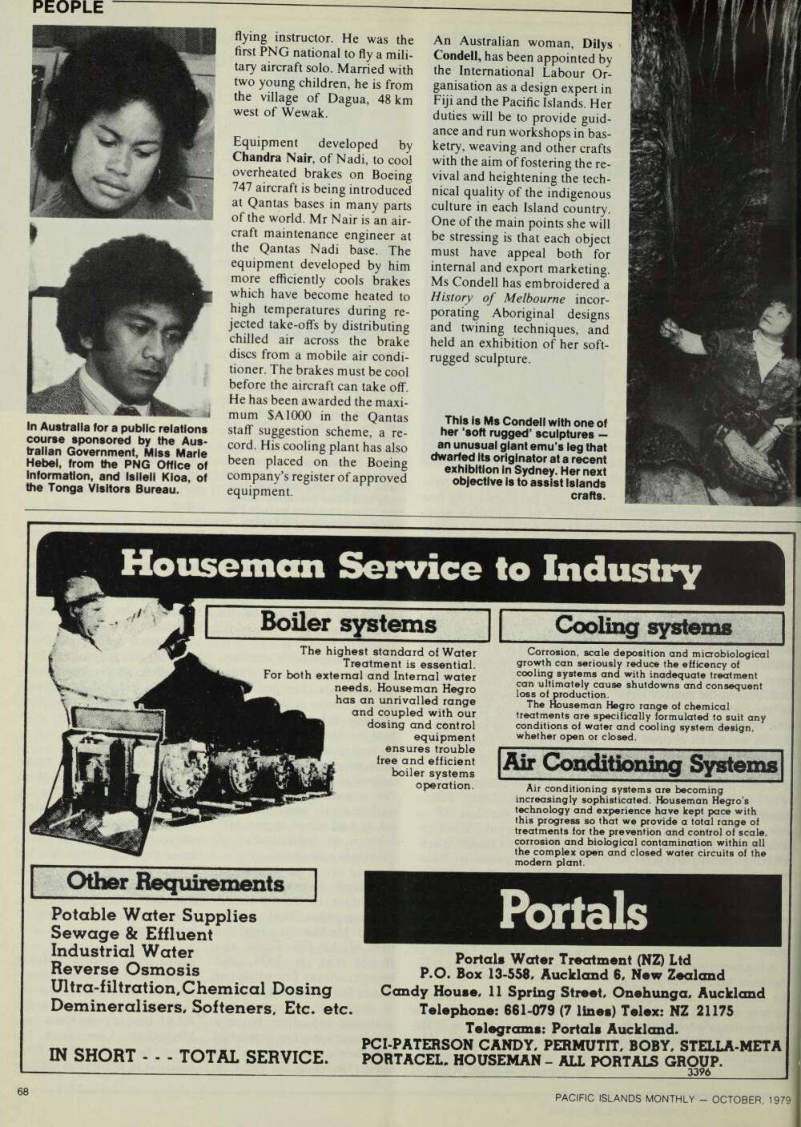
first PNG national to fly a mili tary aircraft solo. Married with two young children, he is from the village of Dagua, 48 km west of Wewak.
Equipment developed by
Chandra Nair, of Nadi, to cool overheated brakes on Boeing 747 aircraft is being introduced at Qantas bases in many parts of the world. Mr Nair is an air craft maintenance engineer at the Qantas Nadi base. The equipment developed by him more efficiently cools brakes which have become heated to
high temperatures during re
jected take-offs by distributing chilled air across the brake discs from a mobile air condi tioner. The brakes must be cool before the aircraft can take off.
He has been awarded the maxi mum SAIOOO in the Qantas staff suggestion scheme, a re cord. His cooling plant has also been placed on the Boeing company’s register of approved
equipment.
An Australian woman, Dilys Condell, has been appointed by the International Labour Or ganisation as a design expert in Fiji and the Pacific Islands. Her duties will be to provide guid ance and run workshops in bas ketry, weaving and other crafts with the aim of fostering the re vival and heightening the tech nical quality of the indigenous culture in each Island country.
One of the main points she will be stressing is that each object must have appeal both for internal and export marketing.
Ms Condell has embroidered a History of Melbourne incor
porating Aboriginal designs
and twining techniques, and
held an exhibition of her soft
rugged sculpture.
In Australia for a public relations course sponsored by the Aus tralian Government, Miss Marie Hebei, from the PNG Office of Information, and Isileli Kloa, of the Tonga Visitors Bureau.
This is Ms Condell with one of her ‘soft rugged’ sculptures an unusual giant emu’s leg that dwarfed its originator at a recent exhibition In Sydney. Her next objective is to assist Islands crafts.
Advertisements & other items, pp. 68-69 (1 item)
Portals
A
Houseman Service to Industry
mmd
Boiler systems
The highest standard of Water Treatment is essential.
For both external and Internal water needs, Houseman Hegro has an unrivalled range and coupled with our dosing and control equipment ensures trouble free and efficient boiler systems operation.
Cooling systems
Corrosion, scale deposition and microbiological growth can seriously reduce the efficency of cooling systems and with inadequate treatment can ultimately cause shutdowns and consequent loss of production.
The Houseman Hegro range of chemical treatments are specifically formulated to suit any conditions of water and cooling system design, whether open or closed.
Air Conditioning Systems
Air conditioning systems are becoming increasingly sophisticated. Houseman Hegro's technology and experience have kept pace with this progress so that we provide a total range of treatments for the prevention and control of scale, corrosion and biological contamination within all the complex open and closed water circuits of the modern plant.
Other Requirements
Potable Water Supplies
Sewage & Effluent
Industrial Water
Reverse Osmosis
Ultra-filtration,Chemical Dosing
Demineralisers. Softeners, Etc. etc,
IN SHORT - - - TOTAL SERVICE.
Portals
Portals Water Treatment (NZ) Ltd P.O. Box 13-558. Auckland 6, New Zealand Candy House. 11 Spring Street. Onehunga. Auckland Telephone: 661-079 (7 lines) Telex: NZ 21175 Telegrams: Portals Auckland.
PCI-PATERSON CANDY. PERMUTIT. BOBY. STELLA-META
PORTACEL.. HOUSEMAN - ALL PORTALS GROUP.
... 3396
JVC’s Metal-Tape-Compatible
Cassette Decks are pioi
in quality tape record!
li
BBS
- >1 r 4r v i &
KSt
ft a *r <7 Li W ¥ The biggest advance In cassette recording in years is the socalled “metal tape” now being introduced by tape manufacturers. - It stores four times as much magnetic energy as chrome tape. jX A It improves the overall recordsng/playback frequency response, gives a wider dynamic range at high frequencies, gives lower recording/playback distortion, and improves signal-tonoise ratio at high frequencies.
It is, in a word, the ultimate for cassette recording and playback, and the JVC KD-A8 is the ultimate cassette deck for metal tape recording and playback.
The KD-A8 has our exclusive SA (Sen Alloy) Heads, perfect for metal tape recording. A micro-computer-controlled system which we’ve named the B.E.S.T. Tuning System and which accurately and automatically adjusts for the bias, equalization and sensitivity of the tape you use. Plus many other advanced features.
The KD-A8 is at the very pinnacle of high fidelity excellence.
We know. We’re JVC, the innovative audio/video electronics company with 52 years of experience.
You can always count on us for true high fidelity sound reproduction.
Hear us, see us—in great detail—at your nearest au thorized JVC dealer today.
JVC
Australia: Hagemeyer(Australasia)B.V, 57/69 Anzac Parade, Kensington, N.5.W.2033 Australia Te 1.662-1222 Fiji Islands: D Gokal & Co., Ltd., G.P.O. Box 501, Corner of Pier Street & Renwick Road. Suva, Fiji Te 1.25259 Cook Islands: J. & P Ingram & Co.. Ltd., P.0.80x 55. Rarotonga, Cook Islands Te 1.378457 New Hebrides: Wu ke Luong, P.0.80x 113, Rue Higginson, Port-Vila, New Hebrides Tel. 2115 New Caledonia: Caldis, 2, Route du Velodrome, B.P. Ml, Noumea. Cedex.
New Caledonia Te 1.262350 Tahiti: Magasin Sincere, B.P. 215, Papeete, Tahiti Te 1.20060 Papua New Guinea: HagemeyerlP N.G.jPtu, Ltd., P.0.80x 90 Lae, Papua New Guinea Te 1.42-3200 New Zealand: Atlas Majestic Industries Ltd., 11. Albion Road. Otahuhu, Auckland, New Zealand Te 1.27-67-099
Softly, softly
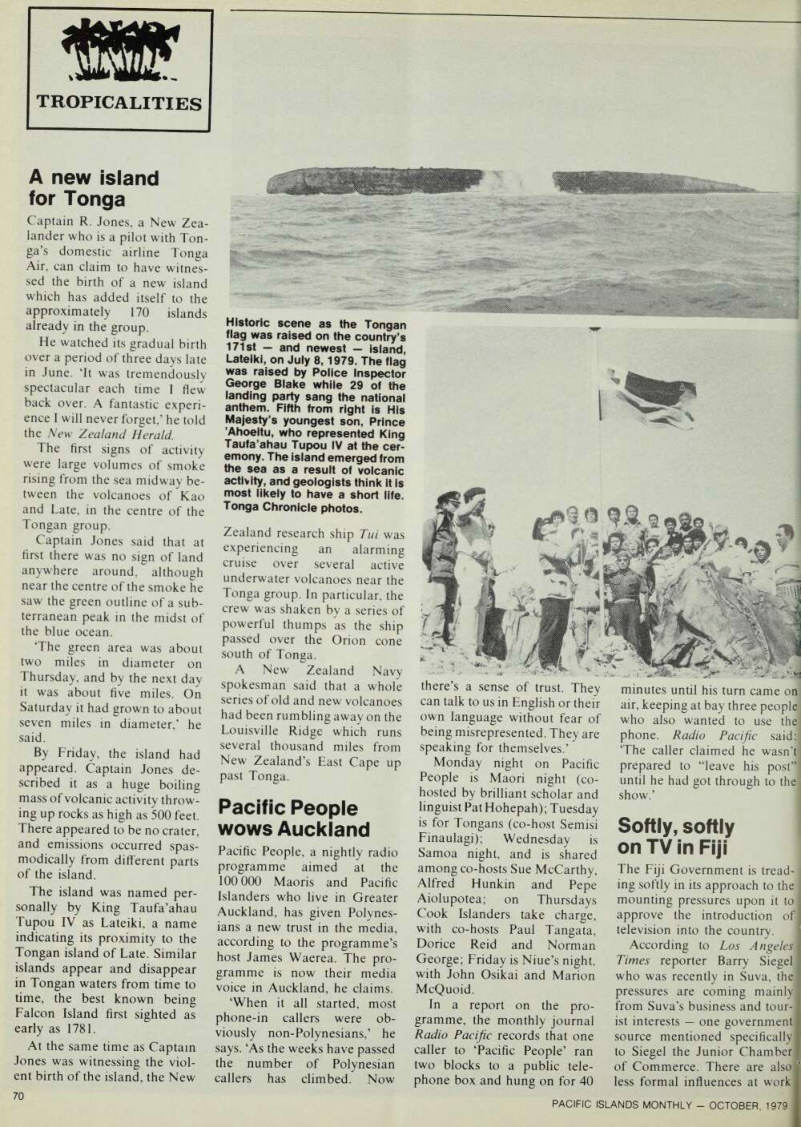
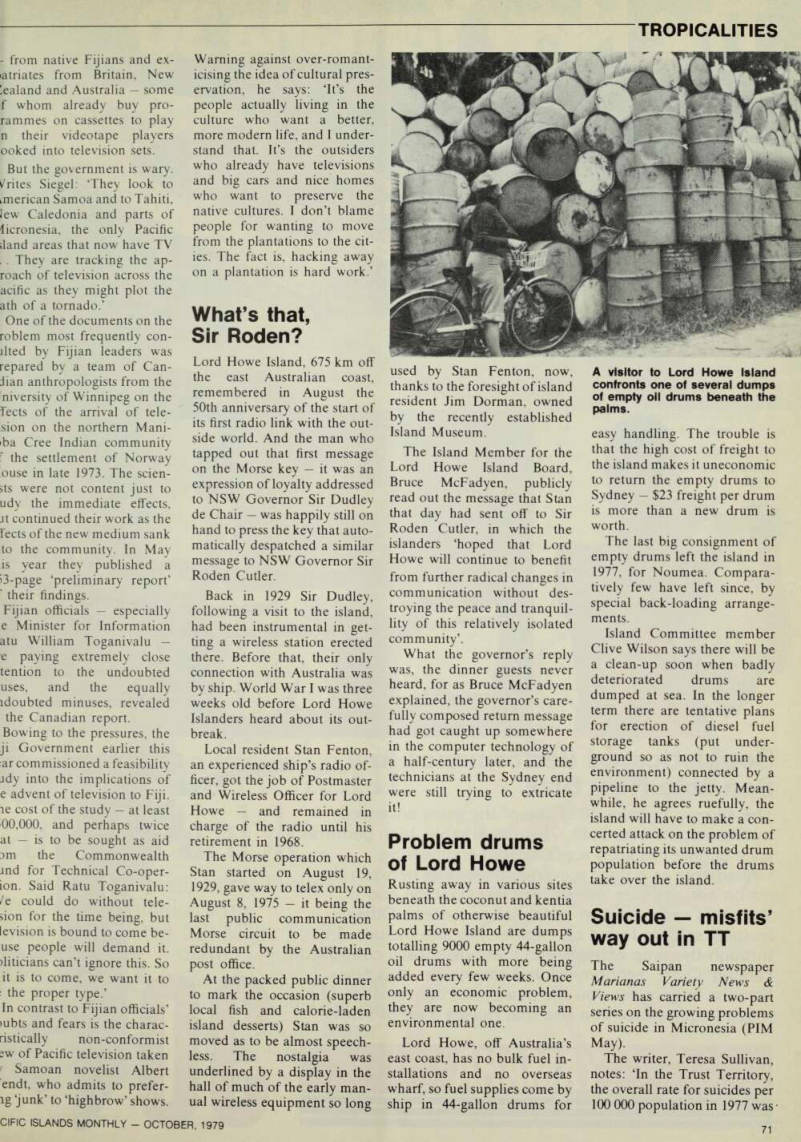
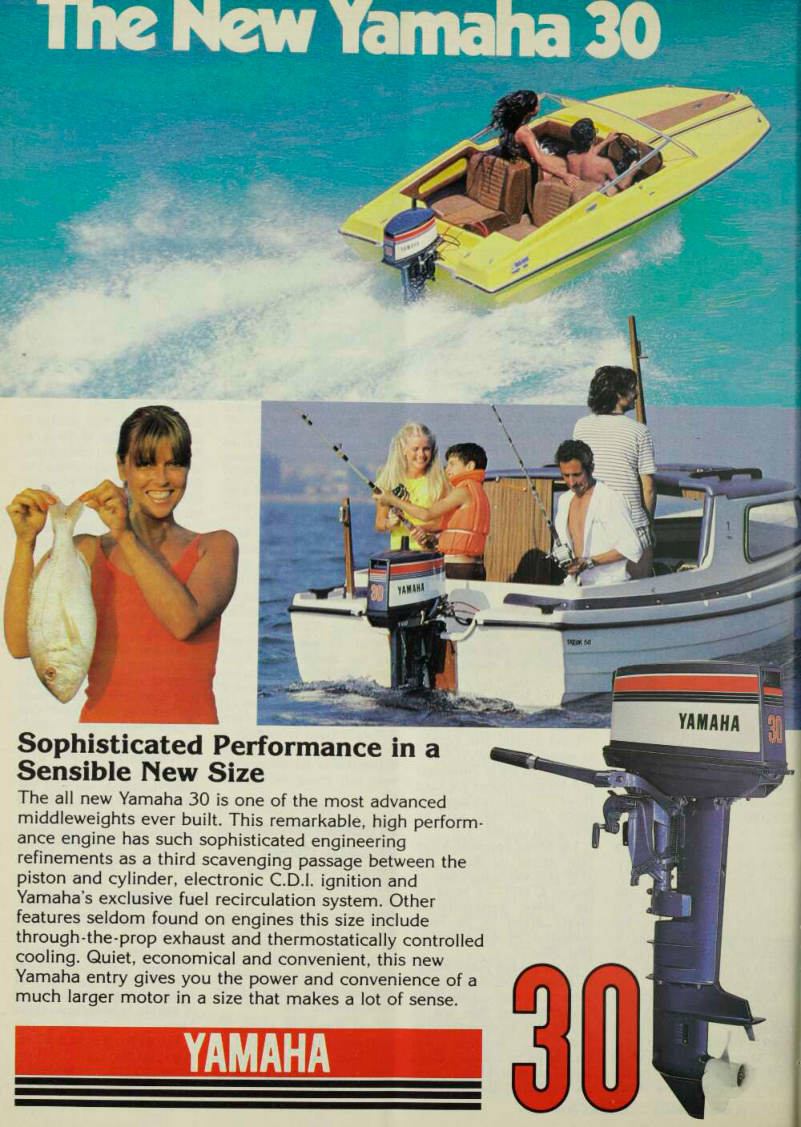
Tropicalities
A new island
for Tonga
Captain R. Jones, a New Zea lander who is a pilot with Ton ga’s domestic airline Tonga Air, can claim to have witnes sed the birth of a new island which has added itself to the approximately 170 islands already in the group.
He watched its gradual birth over a period of three days late in June. ‘It was tremendously spectacular each time I flew back over. A fantastic experi ence I will never forget,’ he told the New Zealand Herald.
The first signs of activity were large volumes of smoke rising from the sea midway be tween the volcanoes of Kao and Late, in the centre of the
Tongan group.
Captain Jones said that at first there was no sign of land anywhere around, although near the centre of the smoke he saw the green outline of a sub terranean peak in the midst of the blue ocean. ‘The green area was about two miles in diameter on
Thursday, and by the next day
it was about five miles. On Saturday it had grown to about seven miles in diameter,’ he said.
By Friday, the island had appeared. Captain Jones de scribed it as a huge boiling mass of volcanic activity throw ing up rocks as high as 500 feet.
There appeared to be no crater, and emissions occurred spas modically from different parts of the island.
The island was named per
sonally by King Taufa’ahau
Tupou IV as Lateiki, a name indicating its proximity to the Tongan island of Late. Similar islands appear and disappear in Tongan waters from time to time, the best known being Falcon Island first sighted as early as 1781.
At the same time as Captain Jones was witnessing the viol ent birth of the island, the New
Zealand research ship Tui was
experiencing an alarming
cruise over several active underwater volcanoes near the Tonga group. In particular, the crew was shaken by a series of powerful thumps as the ship passed over the Orion cone south of Tonga.
A New Zealand Navy spokesman said that a whole series of old and new volcanoes had been rumbling away on the Louisville Ridge which runs several thousand miles from New Zealand’s East Cape up
past Tonga.
Pacific People
wows Auckland
Pacific People, a nightly radio programme aimed at the 100 000 Maoris and Pacific Islanders who live in Greater
Auckland, has given Polynes
ians a new trust in the media, according to the programme’s host James Waerea. The pro gramme is now their media voice in Auckland, he claims. ‘When it all started, most phone-in callers were ob
viously non-Polynesians,’ he
says. ‘As the weeks have passed the number of Polynesian callers has climbed. Now
there s a sense of trust. They can talk to us in English or their own language without fear of
being misrepresented. They are
speaking for themselves.’
Monday night on Pacific People is Maori night (co hosted by brilliant scholar and
linguist PatHohepah); Tuesday
is for Tongans (co-host Semisi
Finaulagi); Wednesday is
Samoa night, and is shared among co-hosts Sue McCarthy, Alfred Hunkin and Pepe
Aiolupotea; on Thursdays
Cook Islanders take charge, with co-hosts Paul Tangata, Dorice Reid and Norman George; Friday is Niue’s night, with John Osikai and Marion McQuoid.
In a report on the pro gramme, the monthly journal Radio Pacific records that one caller to ‘Pacific People’ ran two blocks to a public tele phone box and hung on for 40
minutes until his turn came on air, keeping at bay three people who also wanted to use the
phone. Radio Pacific said:]
The caller claimed he wasn’t prepared to “leave his post” until he had got through to the show.’
Softly, softly
on TV in Fiji
The Fiji Government is tread ing softly in its approach to the mounting pressures upon it to approve the introduction of television into the country.
According to Los Angeles
Times reporter Barry Siegel
who was recently in Suva, the
pressures are coming mainly
from Suva’s business and tour ist interests one government source mentioned specifically to Siegel the Junior Chamber of Commerce. There are also! less formal influences at work!
Historic scene as the Tongan flag was raised on the country’s
171st - and newest - island,
Lateiki, on July 8, 1979. The flag was raised by Police Inspector George Blake while 29 of the landing parly sang the national anthem. Fifth from right is His Majesty’s youngest son, Prince ’Ahoeltu, who represented King Taufa’ahau Tupou IV at the cer emony. The island emerged from the sea as a result of volcanic activity, and geologists think it is most likely to have a short life.
Tonga Chronicle photos.
- from native Fijians and ex >atriates from Britain, New Zealand and Australia some f whom already buy pro rammes on cassettes to play
n their videotape players
ooked into television sets.
But the government is wary.
Writes Siegel: ‘They look to imerican Samoa and to Tahiti, lew Caledonia and parts of licronesia, the only Pacific ;land areas that now have TV . . They are tracking the ap roach of television across the acific as they might plot the ath of a tornado.’
One of the documents on the
roblem most frequently con
ilted by Fijian leaders was repared by a team of Can-
Jian anthropologists from the
niversity of Winnipeg on the fects of the arrival of tele sion on the northern Mani
la Cree Indian community
' the settlement of Norway ouse in late 1973. The scien >ts were not content just to udy the immediate effects, Jt continued their work as the fects of the new medium sank to the community. In May is year they published a
)3-page ‘preliminary report’
' their findings.
Fijian officials especially
e Minister for Information
atu William Toganivalu
e paying extremely close
tention to the undoubted uses, and the equally idoubted minuses, revealed the Canadian report.
Bowing to the pressures, the ji Government earlier this ar commissioned a feasibility ady into the implications of e advent of television to Fiji, le cost of the study at least 00,000, and perhaps twice at is to be sought as aid Dm the Commonwealth
and for Technical Co-oper
ion. Said Ratu Toganivalu:
ft could do without tele don for the time being, but ievision is bound to come be use people will demand it. )liticians can’t ignore this. So it is to come, we want it to
: the proper type.’
In contrast to Fijian officials’ >ubts and fears is the charac
ristically non-conformist
sw of Pacific television taken ' Samoan novelist Albert endt, who admits to prefer
ig ‘junk’ to ‘highbrow’ shows.
Warning against over-romant icising the idea of cultural pres ervation, he says: ‘lt’s the
people actually living in the
culture who want a better, more modern life, and I under stand that. It’s the outsiders who already have televisions and big cars and nice homes who want to preserve the native cultures. I don’t blame people for wanting to move from the plantations to the cit ies. The fact is, hacking away on a plantation is hard work.’
What’s that,
Sir Roden?
Lord Howe Island, 675 km off the east Australian coast, remembered in August the 50th anniversary of the start of its first radio link with the out side world. And the man who tapped out that first message on the Morse key it was an
expression of loyalty addressed
to NSW Governor Sir Dudley de Chair was happily still on hand to press the key that auto
matically despatched a similar
message to NSW Governor Sir Roden Cutler.
Back in 1929 Sir Dudley, following a visit to the island, had been instrumental in get ting a wireless station erected there. Before that, their only connection with Australia was by ship. World War I was three weeks old before Lord Howe Islanders heard about its out break.
Local resident Stan Fenton, an experienced ship’s radio of ficer, got the job of Postmaster and Wireless Officer for Lord Howe and remained in charge of the radio until his retirement in 1968.
The Morse operation which Stan started on August 19, 1929, gave way to telex only on August 8, 1975 - it being the last public communication Morse circuit to be made redundant by the Australian post office.
At the packed public dinner to mark the occasion (superb local fish and calorie-laden island desserts) Stan was so moved as to be almost speech less. The nostalgia was underlined by a display in the hall of much of the early man ual wireless equipment so long
used by Stan Fenton, now, thanks to the foresight of island resident Jim Dorman, owned
by the recently established
Island Museum.
The Island Member for the Lord Howe Island Board,
Bruce McFadyen, publicly
read out the message that Stan that day had sent off to Sir Roden Cutler, in which the islanders ‘hoped that Lord Howe will continue to benefit from further radical changes in communication without des troying the peace and tranquil lity of this relatively isolated
community’.
What the governor’s reply
was, the dinner guests never heard, for as Bruce McFadyen explained, the governor’s care
fully composed return message
had got caught up somewhere in the computer technology of a half-century later, and the technicians at the Sydney end were still trying to extricate it!
Problem drums
of Lord Howe
Rusting away in various sites beneath the coconut and kentia palms of otherwise beautiful Lord Howe Island are dumps
totalling 9000 empty 44-gallon
oil drums with more being added every few weeks. Once
only an economic problem,
they are now becoming an environmental one Lord Howe, off Australia’s east coast, has no bulk fuel in stallations and no overseas wharf, so fuel supplies come by ship in 44-gallon drums for
easy handling. The trouble is that the high cost of freight to the island makes it uneconomic to return the empty drums to Sydney $23 freight per drum is more than a new drum is worth.
The last big consignment of empty drums left the island in 1977, for Noumea. Compara tively few have left since, by
special back-loading arrange
ments.
Island Committee member Clive Wilson says there will be a clean-up soon when badly deteriorated drums are dumped at sea. In the longer term there are tentative plans for erection of diesel fuel storage tanks (put under ground so as not to ruin the environment) connected by a pipeline to the jetty. Mean while, he agrees ruefully, the island will have to make a con certed attack on the problem of repatriating its unwanted drum population before the drums take over the island.
Suicide misfits’
way out in TT
The Saipan newspaper Marianas Variety News & Views has carried a two-part series on the growing problems of suicide in Micronesia (PIM
May).
The writer, Teresa Sullivan, notes: Tn the Trust Territory, the overall rate for suicides per 100 000 population in 1977 was
A visitor to Lord Howe Island confronts one of several dumps of empty oil drums beneath the palms.
-3.6, only slightly higher than
he 12.6 US rate. However, /hen these suicides are con idered on an age and sex pecific rate, the figure soars to 11 suicides per 100 000 popu ition.’
She cites a study of suicides i the Marshall Islands which evealed: all suicides were male; all were between the ges of 16 and 25; all were
itoxicated usually with beer
-just before their suicide; all
having adjustment prob
;ms and were relatively unsuc essful in their Marshallese ommunity; all were unem
loyed school dropouts depen
ent on parents with no articular place in the com
munity; all experienced dis
ord with their families and ften the suicide occurred soon fter the parents refused the oy money with which to buy eer; most suicides occurred in me district centre (where the ash economy’ is at its stron est and the traditional ways
lost disrupted); most suicides
ere people whose education ad not gone very far and who
had never been outside the Islands.
Dr Paul Dale, chief of the mental health division in the
Trust Territory, disputes a
widely held view that the absence of job openings for
qualified youth returning
home from overseas training was a cause of the prevalence of suicide. He maintains the re verse, pointing out that the suicide candidates are over
whelmingly people who had
had limited educational suc cess. He adds: ‘The notion that having no job is such an over whelming defeat that death is preferred is strictly “an American work ethic” notion.
For Micronesians, work con tinues to be an intermittent phenomenon and not some thing they’re apt to kill them selves over.’
Dr Dale says: ‘The problem in self-destructive acts has its basis in difficulties within the family or clan.’
One senior public health
authority, after spending three
years in Truk, sees two types of suicide as occurring in that dis
trict. He explained that suicide was traditionally an honourable act, a ‘socially stabilising factor’, in Truk in years past, when there was nowhere else to go, it was the only alternative for those who were unable to con form to the norms of the clan.
He related the story of a young couple on the island of Tol in Truk who bound themselves together and jumped from a cliff to their deaths. It seemed that the two had become lovers, but being of the same clan they found themselves ostracised as a result. Suicide thus became their only way out.
According to Father Francis Hezel, director of Xavier High School in Truk, these ‘classic suicides are not what’s happen ing these days, at least in most cases’. To help curb the in crease in suicides, he rec ommends a ‘slowing up of social change’ in concrete terms, a reduction in the cash inflow into Micronesia.
Hezel also sees the need for a programme to educate
parents in more consistent forms of child-raising. Ado lescent males ‘are in a pigeon hole where they are not lis tened to’, he says. Responsi bility is not asked of them, but at the same time they are trying to find a place in society.
Hezel sees a third area of action in the efforts to meet the
problem ‘restoring the
integrity of the community’. He says: ‘lt’s difficult to see young
people growing up healthy in
a community that isn’t
healthy.’
‘My feeling,’ says Hezel, ‘is that a lot of communities are sitting down and playing dead,
abdicating responsibility to the
government.’ With the pro liferation of social services,
people are no longer challeng
ing their government, since so much is done for them.
While advocating an in
depth study for the problem
over the 10-year period
1968-78, Hezel is not wildly optimistic. ‘All we can do is present the problem and probe,’ he says.
Advertisements & other items, pp. 71-74 (3 items)
Tropicalities
71
CIFIC ISLANDS MONTHLY - OCTOBER, 1979
Sophisticated Performance in a
1 r * * Wm m t M A m yamah*
YAMAHA
Sensible New Size
The all new Yamaha 30 is one of the most advanced middleweights ever built. This remarkable, high performance engine has such sophisticated engineering refinements as a third scavenging passage between the piston and cylinder, electronic C.D.I. ignition and Yamaha’s exclusive fuel recirculation system. Other features seldom found on engines this size include through-the-prop exhaust and thermostatically controlled cooling. Quiet, economical and convenient, this new Yamaha entry gives you the power and convenience of a much larger motor in a size that makes a lot of sense.
In catering
SPEED-E-GAS
is fast, efficient
and reliable.
Terminals throughout the Pacific.
For more information write Boral Gas Limited, 221 Miller Street, DAD AI North Sydney 2060 *Speed-E-Gas is known in Papua New Guinea, as Guinea Gas. In Tonga as Tonga Speed-E-Gas, and in Fiji as Fiji Gas.
C\ ST*? w&~ ::s:w:=: ssSsssBBB See the world with Air New Zealand If your journey is to take you far or near, first see Air New Zealand or your travel agent to discuss the flights and fares that suit you best.
In the Pacific we fly to New Zealand, Australia, Fiji, Honolulu, Tahiti, Samoa, New Caledonia and Rarotonga. If you’re travelling farther, let us fly you to our Gateway cities to the world - Los Angeles, Hong Kong and Singapore, where you can connect with the airline of your choice.
And best of all, you’ll start by enjoying the special attentive service Air New Zealand is famous for.
Begin your trip with Air New Zealand
air new za lb no
We fly the Pacific.
ANZ 79/12 G
Tropicalities
73
kCIFIC ISLANDS MONTHLY OCTOBER, 1979
Islands
From the
Press
icronesian News Service ore than 2000 people from the Mortlock Islands in the Truk ter islands packed the Truk High School gymnasium on Sunday igust 19 to welcome the first president of the Federated States Micronesia, Tosiwo Nakayama . . . Misauo Petrus, Truk vernor’s representative to the Mortlocks, acted as master of remonies ... He presented three gifts to the president... a pair devil masks, a pair of lovesticks, and a turtle. The devil mask presents protection. It will protect the FSM from outside gression. ‘Our people are peaceful, and we want peace,’ Petrus ;d. The lovisticks represent love and affection. In the past, resticks were used between men and women for their love airs. The man used the stick to get a woman from her use ... ‘We want the FSM to remember the people of the Drtlocks,’ explained the Mortlockese spokesman. ‘The turtle gift nds for the courage and strength we have in leading the derated States of Micronesia,’ he said.
?ws Drum, Solomon Islands (reader’s letter)
m often sad to see letters in the Drum from people who think it anything ‘foreign’ must be no good. But now I see something eign that I too think is no good, an idea that I hope will not come popular in the Solomons. That is the idea (in the Drum May 18) that babies should be breast-fed for only a month, link your custom of feeding them for about a year is much tter. abanga, New Hebrides e fete run by the parish of Port-Vila at the scout grounds on igust 5 was a great success. From 9 am a large crowd gathered d proceedings were wound up at 6 pm with Tahitian dances d the drawing of the lottery ... icronesian News Service e people of Palau will be paid for giving birth to live children the Palau Hospital if a Palau legislature bi 11... becomes v ... Legislator Polycarp Basilius, author of the bill, says; ‘The ople are the roots, the source of energy and power from which ; nation will grow.’ Legislator Basilius says any children born e to parents both of whom are Palauans, or one of whom is *alauan citizen, shall receive $lOO provided that the child is m at the Palau Hospital. jview of the Local Press, French Polynesia wording to Les Nouvelles of July 25 Polynesia, which annually nsumes 300 000 tonnes of hydrocarbons, must cut back nsumption to 285 000 tonnes. Economies must be affected at ce, a ‘war on waste’ is an absolute necessity, and an increase the price of petrol is to be expected.
>nga Chronicle
ie brigantine, Eye of the Wind, which is retracing the 0-year-old path of Sir Francis Drake, was forced by adverse ;ather not to call at Tonga recently and continued on to ji. . . The brigantine’s two-year circumnavigation following •ake’s path is called ‘Operation Drake’. The operation is in nine ases, and 24 ‘young explorers,’ as they are called, participate each leg of the journey under the watchful eye of an
perienced crew.
*ws Drum, Solomon Islands ie Western Province Assembly has now agreed to accept a sum $9OOO as a fair and reasonable compromise for the poem West ind . . The West Wind poem, published in the News Drum last
year, had resulted in the author being imprisoned for six months, and the Western Province Assembly demanding compensation damage from the Central Government.
The Fiji Times The Colonial War Memorial Hospital’s blood donors are now properly screened and tested for syphilis and hepatitis, the Red Cross director, Mrs Susan Douglas, said yesterday. Many of the blood transfusion service faults found by the health inquiry 10 months ago had now been corrected, she said. The inquiry’s report said that about 10% of the CWM’s blood supplies were positive for syphilis or hepatitis, and that the hospital’s blood bank was in a ‘critical’ shape.
Marianas Variety News & Views (article by Erwin D.
Canham)
For us in the Northern Marianas last week’s anniversary of the Enola Gay’s mission from Tinian, carrying the atom bomb to Hiroshima, was particularly vivid. Most of us have visited our neighbouring island, driven down those disused and rather ghostly runways with the tangantangan pushing up through every crack in the paving. And we have come upon the old bomb pit where the Enola Gay was loaded with its lethal cargo which marked a turning point in the history of mankind. The fact that only a simple tablet marks the bomb pit and that it is far from human habitation, and not too frequently visited, certainly not celebrated, is somehow appropriate. The American view of the use of the atomic bomb remains at best ambivalent. It is therefore fitting that the Enola Gay itself should be gathering dust, dismantled, in a Smithsonian Museum warehouse in Maryland.
Cook Islands News (letter from E. Vuki, Fijian studying at the University of the South Pacific) Society is one big machine. Every day parts of the machine fall into depletion. Every day their places are filled in by new parts fresh from the innocent springs of youth . . . For society is gutless empty of personality and human feeling. It is only a machine.
A blatant conspiracy schemed by little goblins of men after their own exuberance. I choose to create my own niche and I promise myself that whenever this monster tries to waggle its tail into my affairs, if need be, with the entirety of my being, even if I demise in the process, I will give it a good painful kick in that vulnerable spot...
The Norfolk Islander (in article reproduced from the International Herald Tribune) For the millennium celebration (of the Isle of Man in July), perhaps the greatest day in the history of this fertile little island, which lies at a point approximately equidistant from Scotland, England and Ireland, visitors have come from all over the world representatives of other parliaments (than the Isle of Man’s Tynwald), as well as descendants of Manx emigrants. Among them was Charlotte Gertrude Christian from Norfolk Island in the South Pacific, a direct descendant of Fletcher Christian, the Manx sailor who led the mutiny on the Bounty. Descendants of the mutineers live on Norfolk and Pitcairn Islands.
The Fiji Times (editorial)
An Australian shopper’s accusation that a duty free dealer propositioned her has raised something of a storm in the trade.
Far more, in fact, than other recent complaints about over-charging and sales of broken equipment. . . Such proposals probably are irritating to visitors, particular coming from ‘pot-bellied’ men smelling srongly of after-shave. But most young women travellers of this day and age are self-possessed enough to be in control of such situations, particularly when they occur on public streets and in stores.
Cook Islands News (letter from ‘Round Ball’) So New Zealand’s minister of Maori affairs wants to build bridges with rugby (CIN, May 30). . . The trouble with rugby as a bridge-building material is that in the whole wide world only New Zealanders made it their national sport... The minister had better choose some truly international sport, such as football (soccer), basketball or volleyball.
Advertisements & other items, pp. 75-78 (2 items)
75
‘CIFIC ISLANDS MONTHLY - OCTOBER, 1979
Cupercomr)
THE AUDIBLE EDGE
the audible edge
dpg|
sH»i
* 3 r v =- 1 > a ST, • «*« k 1 ,! * iffl ra/ non^U!.^ Au ® t ) Pf y- Ltd - 162 ' A,b ® rt R oad, South Melbourne. Victoria 3205. Australia Phone: 699-5473/2 J™"* !n? c rabhu Bro,hers Lld - p O Box 183, Nadi Phone: 70183/4 • Papua New Guinea Ocea PortMoresby Phone: PM 256406 • New Zealand David Reid Electronics Ltd. C.P.O. Box 2630, Auckland 1 Phor Societv Reoublir nf niJL. I S Ph^ ne e 27 1 * Soo f| Pacific Ml,tona Department Stores Limited P 0 Box 1 46. Norfc Society Republic of Nauru ♦ New Hebrides The Sound Centre P.O. Box 434. Port Villa • Cook Island United Island Traders Ltd. P <
l ne secret oenina ourcn umru quamy »
“in-depth matching”!
With SUPER COMPO, Sansui the hi-fi specialist now makes its professional expertise available to all music lovers. All seven systems feature “in-depth matching” for exceptional purity of sound. Easy operation also received high priority. Equally nice, there’s just the right
quality system for every budget.
New SUPER COMPO offers the best values in stereo systems of outstanding musicality. Listen and believe! & The most practical receiver system with a low distortion of 0.09% (40W x 2, IHF Music Power).
The same cassette deck as used in the most expensive system is included.
L I mg This receiver system features higher power (70Wx 2, IHF Music Power), Peak Power Level Displays and precision auto-return direct drive turntable. 1 The top- of-the-line DC- Servo receiver system with reserves of clean power (100 W x 2, IHF Music Power), Peak Power Level Displays with 12x2 LED indicators, and the best fully automatic DD turntable incorporating D-O-B tonearm and computerized operation.
COMPO (JQQ yptRCOWPO yPtBCOWPO Q
A fine system which incorporates Sansui’s DC-Servo amplifier (70W x 2, IHF Music Power) with Peak Power level Displays and a matching FM/ AM tuner with LED signal/tune
displays.
- The most
powerful amplifier (100 W x 2,
IHF Music Power) and the Digitally Quartz-Locked tuner with a computerized directdrive turntable and D-O-B tonearm make this system highly desirable to both audiophiles and music lovers.
This is the top-of-the-line system even the internal illuminated cabinet has its own deluxe touches. DC-Servo amplifier (100 W x 2, IHF Music Power), Digitally Quartz-Locked tuner and Full-Auto Quartz- Servo DD turntable.
An excellent choice in a complete system with low distortion integrated amplifier (40W x 2, IHF Music Power), quality FM/AM stereo tuner, precision-made tape deck and precision auto-return turntable.
Matching speakers. Wide-
range quality speakers systems
are available to fully realize the fine features of SUPER COMPO systems.
Audio Cabinets. Each SUPER COMPO system comes with its own audio cabinet specially designed to accommodate the
system’s components.
Also available in silver finish.
Sajvsui.
Only hi-fi,every thing hi-fi.
wm m m HP *Pi| ».
A m » IS 9 0^ 0>' J ' se '^noe' N s^® #^ot/
*jb*K*s. w
,^«' 0 ' .c>^,^< e co^ 0 w®'" „d'" 0 l '“’< rn vrf^ U '' aoO^-r„oo^- S ''" -' „. V\V.e\M ._ n e<' s o^Qsy.^s®' 0 ,«mov> s 9 0 A" nN»' V\a° m# N,u^A'^ a ° 6 ’ '~^o\b- <'' <> e,a '- o0 ,\C^ <> 0 ' -O’S-^'
jjS^
Growing food at
Trade
Winds
Growing food at tome has its problems for PNG
ipua New Guinea’s Food and Nutrition Policy has as its aims *eduction in dependence on food imports and an improvement in ? nutritional status of the people. Geoff Harris of the Agricultural onomics Research Unit at Lincoln College, New Zealand, %gests that self-reliance is a laudable aim but has its costs.
iod imports make up about % of Papua New Guinea’s al imports and provide out the same proportion of al food supplies. The prob n is particularly marked in rt Moresby where about 70% food requirements are ported. The estimated pro rtion of children under five irs of age suffering from ilnutrition in early 1978 was 7c against 43% in 1975.
The government’s Food and
itrition Policy, adopted last
ir, has three specific tar ts: fo increase overall food ake from an estimated 80% recommended nutritional juirements to at least 90%.
Fo increase commercial food eduction so that there is no ther increase in the volume
food imports.
fo maintain subsistence pro ction at current levels per
ad of rural population,
fhese targets will require a issive 166% increase in
irketed domestic production
tween 1976 and 1986, prin •ally to feed a much larger aan population, and a 24% :rease in subsistence pro ction to feed an increased
lage population at the higher
ake level. Major emphasis is be given to Port Moresby, fhe policy assumes a 125% Tease in the urban Papua
:w Guinean population be
sen 1976 and 1986, a growth e of about 8.5% per annum, is appears to be a substantial 2r-estimate for two reasons. *st, the experience of the riod from the 1971 census til 1977, when further imates were made by the bu rn of statistics, indicates a >wth rate of 5.6%, ranging m 4.2% for Madang and haul to 8.2% a year for Port
Dresby.
Second, there is evidence which suggests that the rate of growth of urban populations is likely to slow down. This evi dence is based on work carried out by the Australian National University and the University of Papua New Guinea which showed that migration to urban areas (the major source of growth) is related to the
availability of employment
opportunities. Employment opportunities have been grow ing less rapidly since the mid-19705, principally because of the reduction in the rate of growth of government expen diture, and it is to be expected that the rate of migration into towns will be correspondingly reduced. Thus the target in crease of 166% in marketed domestic production is an over estimate and 100% would be a more realistic target. Con
versely, subsistence agriculture
will have to support more people (those who would otherwise have migrated from rural areas and probably some returnees from urban areas).
The second area for con sideration is exactly how a sub stantial increase in marketed domestic production is to be achieved. The policy does not go into this in any detail and suggests that government departments put forward schemes for funding under the
extra-budgetary national pub
lic expenditure plan. Clearly,
however, the policy envisages
large-scale commercial pro duction and, significantly, comments that this should not be achieved by encouraging a
surplus from village subsist
ence producers using tra ditional methods.
One obvious reason is that the present prices of village produced staples are consider ably higher than those of
imported alternatives, es
pecially in Port Moresby.
Another reason is the likeli hood of an imbalance being created between available land and the number of people being fed from it and, perhaps, lowering of village nutrition if priority is given to market food production. Any increase in food supplies from village pro ducers, states the policy, should utilise more appropriate farm ing systems. On this topic, Pro fessor Bill Clarke of Monash
University has recently written
a paper on ‘environmentally sustainable modifications’ to traditional agricultural sys tems.
Large-scale commercial pro duction then may be under
taken by village groups, using
mechanised cultivation or by non-Papua New Guineans with the aim of nationals being phased in as soon as possible. The investment guidelines of the National Investment and Development Authority (NIDA) have been adjusted to allow naturalised and non-citizens to participate in commercial growing of tra ditional staples near urban
centres. Commercial market
gardening of European vege
tables was carried out on a
large-scale near Port Moresby
by Australian and American army personnel during the Pa cific War. The experience of this activity and subsequent re search by the Department of
Primary Industry indicate sev
eral important points:
• Production of European
vegetables is possible but
financially marginal, given the
need for mechanised culti vation, irrigation, weed and disease control and fertiliser. • After several years culti vation, insect, weed and dis
ease problems require the
relocation of gardens.
Many of the required inputs
would have to be imported.
As a source of food to re
place imports, traditional
staples are more valuable than
Solomons Moves
On Forum Line
Solomon Islands will not give any more money to keep the ailing Pacific Forum Line afloat unless something is done to improve the running of the Line to member countries, according to Minister of Trans port and Communications John Tepaika. He made his threat in a statement to Solomon Islands Broadcasting
Corporation after attending
the August meeting of the South Pacific Regional Ship ping Council at Mount Hagen, Papua New Guinea.
He said New Zealand had promised to give up to SUSI.2S million, Australia $564 000 and Western Samoa $220 000.
Other member countries had pledged amounts up to about $llOOO.
Solomon Islands had indi cated it would give $lO 000 towards the line only if some thing was done to improve the services.
Points raised by Solomon Islands include: the Line to be come useful and meet the trading needs of the islands; re structuring of management; and the South Pacific Bureau for Economic Co-operation (SPEC) to subsidise unecon omic routes.
Mr Tepaika added that if the line’s headquarters were re moved from the Western Samoa capital of Apia, then it should be established in one of the island countries and not in any metropolitan country.
At the Mount Hagen meet ing, the 10 participating coun tries agreed to a total commitment of $2 254 000.
The conference decided on a number of steps designed to
improve the line’s efficiency,
although the question of
switching the headquarters
from Apia was deferred until the October meeting.
Advertisements & other items, p. 79 (1 item)
79
CIFIC ISLANDS MONTHLY - OCTOBER, 1979
production.
European vegetables. A num ber of village groups and insti tutions in the Port Moresby area are growing traditional staples commercially and the
Kapogere agricultural station
near Kwikila is promoting this activity. Ilimo Farm near Port Moresby, now government owned, may well be used for
large-scale staple production.
However, whilst present efforts are proving commer cially viable, there is a market problem. The production is sold to Port Moresby (edu cational institutions, hospitals, defence force) and the insti tutional population of Port Moresby is about 20% of the total population. Of these, per haps half are ‘captive con sumers’ in the sense that the institution provides their food.
The potential for import re
placement from this activity
may not therefore be great. The market sites set up by the city council throughout Port Moresby cater for individual village producers who sell to individual urban householders and supply about a quarter of the city’s food needs. Unless this system is changed, and there are good reasons for
retaining it, large-scale pro
ducers may not be able to mar ket their production.
A note on rice is relevant since it can be grown in Papua New Guinea and is the biggest
single food import (SA29
million in 1977-78). Rice has been grown in the Mekeo re gion since 1906 and despite compulsion in the inter-war years, and the introduction of
mechanised production during
the war, it has never really suc ceeded, partly because of the climatic requirements of rice but mainly because of the low returns to growers. A recent analysis by the national rice co ordinator, Peter Hale, indicates that mechanised production on five-hectare blocks in the Mekeo is a financially mar
ginal proposition.
A third area on which the policy is silent is exactly how food imports will be prevented from increasing above present levels. The production of more marketable food within the country will not be enough on its own since price differentials favour the consumption of
imported staples. This is par ticulai.'y true in Port Moresb) Common economic measure such as tariffs on food imports quantitative import restriction and devaluation are not likef to be used because of thi government’s determination t< limit price increases (and hena minimum wage increases) U urban wage earners. Alterna lively, it may be hoped to in crease local production to th< extent that prices of loca staples will fall so as to beconu
competitive with importer
staples. This would require i
very large increase in domestu
production.
Early in 1979, an annual rice import quota of 65 000 tonnes was introduced, compared with a level of 82 000 tonnes foi 1978. This quota is to be achieved by a series of quar terly reductions in imports ovei a year, in order to minimisd
shortages and disruptions in
supply. The cuts have been arranged so as to leave Port
Moresby’s supply untouched,
to reduce supplies to Rabaul, and most other island centres by 20%, and to cut supplies to the Highlands by 36%.
There are other ways of increasing local food supplies expanding road networks,
encouraging urban gardening
and encouraging village pro
duction by higher prices. Each of these has its problems.
Roads may allow village pro ducers to sell their output at Port Moresby markets, but the proceeds of these sales arej largely spent on food imports.
Urban blocks are of insuf ficient size to support more than a few thousand persons even if all of Port Moresby’s potential urban gardens were fully utilised. Price support for
growers implies a marketing
organisation of such a size and! complexity that it is most un-j likely to be established.
Self-reliance is a laudable! aim but it has its costs and these I should not be under-estimated. I An assessment of the import re-1 placement costs has not been] carried out. It may prove that rice from Australia and tinned mackerel from Japan are the
cheapest sources of food!
supplies for Papua New I Guinea’s towns.
Advertisements & other items, pp. 80-82 (3 items)
Tradewinds
Fasfair Spares
AND WE SEND ALL YOUR DOCUMENTS
P.O. Box 54, Lutwyche, Brisbane, Queensland, Australia, 4030.
Phone: 57 7600 (3 Lines) Telex; AA 41239
0 BIK
with
car
side
a IDEAL FOR: • Riding on rough terrain. • Safe to ride for inexperienced riders. • Low maintenance • Save fuel on 4-w.d. vehicles. • 10 mins, to attach or detatch. • Use on all 100 c.c. to 250 c.c. bikes. • Designed to take up to 200 lbs.
PRICE: $250 (EX. WORKS GUNNEDAH.)
EXTRAS: $l5 TOWING YOKE; $5O CANOPY.
SELLING AGENTS: THORNHILL PASTORAL CO.
GUNNEDAH, 2380.
PHONE: (067) 435215, SYDNEY (02) 991340.
TELEX: AA63870 GUNNIND.
DEWINDS INTELLIGENCE.•.TRADEWINDS INTELLIGENCE.•.TRADEWINDS INTELLIGEN
EBB Tonga Inc, the US company prospecting for oil in Tonga, spending SUS6OO 000 on a seismic survey in the area between mgatapu and Eua. The survey is expected to take about six ;eks. iE COOK Islands had both South Korea and the Soviet Union suitors in August-September, with the two countries seeking i right to fish the Cook Islands’ 200-mile economic zone. Cooks emier Dr Tom Davis said his country might have to consider ocating exclusive fishing rights to one country alone because the problems it would have in policing its zone.
IE MARSHALL Islands is considering adopting a Niuean techque of drying copra by installing racks at the back end of the :al power house so that copra is dried by expelled hot air which lierwise goes to waste. An article in the Micronesian Independent s praised Niue’s ‘imaginative’ Public Works Department for veloping the idea.
IE WESTERN Samoa government has decided to discourage ports of some goods that are manufactured in the country, not ly to promote local industry but most importantly to control ending in foreign exchange. The WS dollar (tala) was recently valued by 15% because of pressure from the International onetary Fund, and this has resulted in the sudden increase of ported goods in the country. The 18 items listed by government der the new regulations include such luxuries as vehicles, beer, ;arettes, fruit juices, etc.
JI’S Namosi copper project has about 5000 million tonnes of ; which could earn $l2 million a year about as much as all i’s other exports earn now. But its development depends on the world price of copper and the cost of power for the mining, according to Minister of Land and Minerals Bill Clark. He said the consortium of four companies Amax, Anglo-American, Conzinc Riotinto and West Germany’s Preussag involved in the project had estimated the mine would take about $5OO million to develop. The mine could be opened in three years with 5000 people employed. The Namosi deposits were about half the size of those in Papua New Guinea’s huge Bougainville mine and the grade of copper was not quite as good, Mr Clark said.
NEW ZEALAND’S Pacific Islands Industrial Development Scheme (PUDS) has so far created about 630 jobs: 118 in Fiji, 175 in Western Samoa, 160 in Tonga, 13 in the Cook Islands, 25 in Niue and many others on projects still to be set up. The figures were given by NZ Minister for Trade and Industry Lance Adams-Schneider in reply to a parliamentary question.
THE CHINESE Government is building a multi-million tala sports stadium for the Western Samoa Government. The project was agreed in a pact signed between the two countries last year.
THE AVIAN Mining Company’s minerals survey on Niue, begun last September, is expected to be completed by the end of this year. If the survey reveals mineralisation of any form on Niue, in particular whether there is uranium, it will be up to the government to decide whether to allow a further stage of exploration or abandon the project altogether.
THE COOK Islands’ fishing boat Ravakai is being fitted with radar, echo sonar, auto pilot, anchor winch and line hauler. It is also having a tonne of permanent internal ballast fitted for
greater stability.
TADEWINDS INTELLIGENCE...TRADEWINDS INTELLIGENCE...TRADEWINDS INTELLIG
nßEft^
s. o -0 02
FOR:
IN OUR 85th YEAR SELLING ‘SERVICE’
TO THE PACIFIC ISLANDS . . .
Nelson & Robertson
PTY. LTD. (Established 1895)
Plantation House, 197 Clarence Street, Sydney.
Cables: ‘IVANT, Sydney, Brisbane, Telex: AA22381, Sydney.
INDENTS - FROM AUSTRALIA, NEW ZEALAND and OVERSEAS.
FOODSTUFFS • HARDWARE • TRAVEL • CANNED FISH MACHINERY • INSURANCE • SOFTGOODS • JUTE GOODS
• REAL ESTATE •
BRANCH OFFICES: Nelson & Robertson Pty. Ltd., P.O. Box 575, Brisbane, Qld., Australia.
P.O. Box 2092, Govt. Bldg., Suva, Fiji. P.O. Box 258, Lautoka, Fiji.
P.O. Box 2420, CPO Auckland 1, New Zealand.
PAPUA NEW GUINEA Rabtrad Niugini Pty. Ltd., P.O. Box 219, Rabaul, P.N.G.
REPRESENTATIVES; P.0.80x 1406, Lae, P.N.G. P.O. Box 711, Madang, P.N.G.
P.O. Box 253, Kieta, P.N.G.
z/r
ALL-MECHANICAL
ICE POP MAKER
MODEL
PMT-180L
THREE-LANE:
25mm dia. tube for 50 mil. pack.
TWO-LANE :
38mm dia. tube for 200 mil. pack.
HIGHEST OUTPUT SPEED
UP TO 200 PER MINUTE.
ill
* USES PURE POLY FOR
NO LEAK SEALS.
* ACCURATE FILL.
INSTANTLY ADJUSTABLE
EVEN WHILE RUNNING.
* IMMEDIATE STOPPAGE OF
FILLER AT ANY TIME
DURING RUNNING.
* NO PNEUMATICS OR
HYDRAULICS -
THIS MACHINE
IS 100% MECHANICAL.
* REVOLUTIONARY
SEALING SYSTEM
BY DIRECT HEAT.
* WE EXPORT OUR
MACHINES AROUND
THREE-LANE FOR THREE
COLOURS OR, OF COURSE,
ONE COLOUR.
THE WORLD.
WORLD PATENTS
PENDING.
PACKAGING
SYSTEMS m
L.
N.S.W.: 22-24 WILLIAM STREET, BROOKVALE. 2100.
PH. 938-1433. CABLES: "ADMACH" TELEX: AA 22302 VIC.: 164 ST. GEORGES ROAD, NORTHCOTE, 3070.
PH. 489-7454.
RADEWINDS I INTELLIGENCE . . .TRADEWIND
C HIAO Yeng No 22, a 75-tonne wooden Taiwanese fishing boa (PIM September) finally left Funafuti on August 21, after payin a fine of $2O 000 for illegally fishing in Tuvalu’s economic zon The 14 days given by the magistrate in which to pay the fin were exceeded, but eventually they paid up.
WESTERN Samoa is asking the European Economic Communit for a long-term loan to finance the supply and installation of SWS2.S million earth satellite station and micro-wave systei linking it with the country’s new automatic telephon
exchange.
TUVALU’S one and only ship, Nivanga, the sole means of trans port to the outer islands, has departed Funafuti for Suva wher she will go on the slips for an annual overhaul. As a result, ther would be no internal shipping for six to eight weeks.
ABOUT SUS 224 million will be spent on the construction of air fields, docks, roads and utilities in Kosrae, Marshalls, Palau Ponape, Truk and Yap districts of the Trust Territory Micronesia. The projects, paid for by the US Department of th Interior through the office of the TT High Commissioner, wi be concerned primarily with the construction of airfields.
CORAL Surf Resort Ltd, developers of the 250-room Hyatt Re gency Hotel near Korolevu, Fiji, has granted land-owner Mr Kelera Tuinivanua a $7O 000 share holding in the company, ar annual income of $ll 200 a year in rent and a new three-bedroon concrete block house under a lease agreement on an 8 ha blocl of land near the hotel site. Mrs Tuinivanua’s husband, Ratu Josefa, and their eight children will receive first preference foi employment by the company.
POLYNESIAN Airlines, Western Samoa, has recently increased all fares except the meaalofa fare to New Zealand. Other fares to New Zealand have gone up 17%, and the airlines’ rates to othei countries have increased by 24%. In announcing the increase general manager Terence Betham said the company has faced increased operational costs since the devaluation of the Western Samoa currency.
AUSTRALIAN cinema advertising contractor, David Koffel Australia, has launched a monthly sports magazine in Fiji. Named Sports Digest, it is a ‘first’ for Fiji. With an initial print run oi 10 000, Sports Digest will be produced by Fijian staff and printed in Suva.
BURNS Philp (New Guinea), which is about 25% owned by the Investment Corporation of Papua New Guinea, has bought the PNG motor dealer Tutt Bryant Pacific for a sum of SA3 million.
Tutt Bryant is the franchise holder for General Motors-Holden, Suzuki and Subaru, and owner of a finance company. In Fiji, Bums Philp South Seas Ltd plans to expand its manufacturing capacity in the Pacific with the purchase for $1 800 000 of the assets of the Fiji subsidiary of a British company, Cope Allman (South Pacific) Ltd. The company processes copra into coconut oil, and makes soap, biscuits, plastic containers and packaging.
Its cracker biscuits are distributed widely in the South Pacific.
TONGA’S trade deficit for the first six months of 1979 rose to STIO 824 100, more than $2 200 000 up on last year’s figure for the same period.
GOLD price rises, soaring to over $305 an ounce, have brought bright new hopes to Fiji’s Emperor Gold Co Ltd. ‘We hope it will remain at this level or continue to rise,’ said Mr Phil Schmidt, assistant group general manager.
CONTINENTAL Airlines conceded in September that it had lost SUSIO million on its Australian run this year. But a company spokesman, Mr Jack Gregory, said: “We’re in the Australian market for keeps.’ The 40-day hiatus in the Australian service due to the grounding of Continental’s DC-10 aircraft in June-July accounted for only about half the total loss.
INTELLIGENCE...TRADEWINDS INTELLIGE
81
CIFIC ISLANDS MONTHLY - OCTOBER, 1979
Yachts
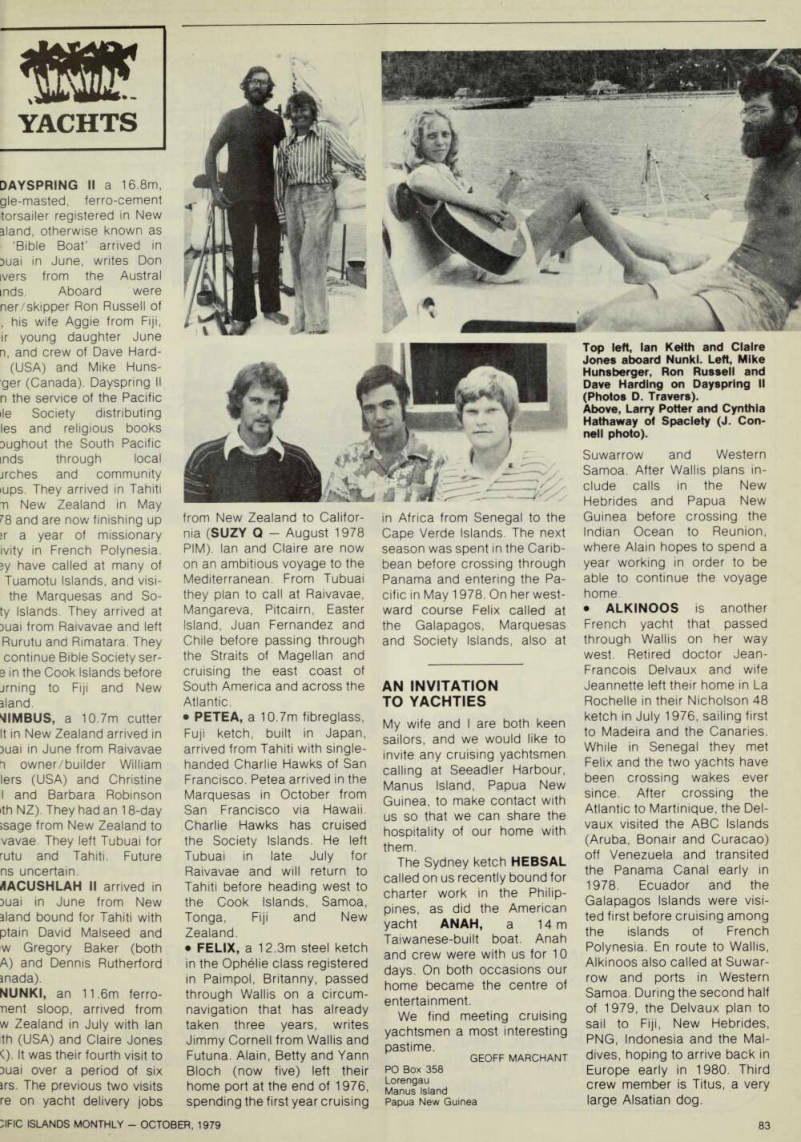
Dayspring Ii A 16.8 M,
gle-masted, ferro-cement torsailer registered in New aland, otherwise known as ‘Bible Boat’ arrived in auai in June, writes Don ivers from the Austral inds. Aboard were ner/skipper Ron Russell of , his wife Aggie from Fiji, ir young daughter June n, and crew of Dave Hard (USA) and Mike Huns ger (Canada). Dayspring II n the service of the Pacific ile Society distributing les and religious books aughout the South Pacific inds through local jrches and community iups. They arrived in Tahiti ti New Zealand in May 7Q and are now finishing up >r a year of missionary ivity in French Polynesia, ay have called at many of Tuamotu Islands, and visi the Marquesas and So ty Islands. They arrived at auai from Raivavae and left Rurutu and Rimatara. They continue Bible Society ser -3 in the Cook Islands before jrning to Fiji and New aland.
MIMBUS, a 10.7 m cutter It in New Zealand arrived in auai in June from Raivavae h owner/builder William lers (USA) and Christine I and Barbara Robinson ith NZ). They had an 18-day >sage from New Zealand to vavae. They left Tubuai for rutu and Tahiti. Future ns uncertain.
AACUSHLAH II arrived in Duai in June from New aland bound for Tahiti with ptain David Malseed and w Gregory Baker (both A) and Dennis Rutherford inada).
NUNKI, an 11.6 m ferro nent sloop, arrived from w Zealand in July with lan th (USA) and Claire Jones (). It was their fourth visit to auai over a period of six irs. The previous two visits re on yacht delivery jobs
from New Zealand to Califor nia (SUZY Q August 1978 PIM). lan and Claire are now on an ambitious voyage to the Mediterranean. From Tubuai they plan to call at Raivavae, Mangareva, Pitcairn, Easter Island, Juan Fernandez and Chile before passing through the Straits of Magellan and cruising the east coast of South America and across the Atlantic. • PETEA, a 10.7 m fibreglass, Fuji ketch, built in Japan, arrived from Tahiti with single handed Charlie Hawks of San Francisco. Petea arrived in the Marquesas in October from San Francisco via Hawaii.
Charlie Hawks has cruised the Society Islands. He left Tubuai in late July for Raivavae and will return to Tahiti before heading west to the Cook Islands, Samoa, Tonga, Fiji and New Zealand. • FELIX, a 12.3 m steel ketch in the Ophelie class registered in Paimpol, Britanny, passed through Wallis on a circum navigation that has already taken three years, writes Jimmy Cornell from Wallis and Futuna. Alain, Betty and Yann Bloch (now five) left their home port at the end of 1976, spending the first year cruising
in Africa from Senegal to the Cape Verde Islands. The next season was spent in the Carib bean before crossing through Panama and entering the Pa cific in May 1978. On her west ward course Felix called at the Galapagos, Marquesas and Society Islands, also at
An Invitation
To Yachties
My wife and I are both keen sailors, and we would like to invite any cruising yachtsmen calling at Seeadler Harbour, Manus Island, Papua New Guinea, to make contact with us so that we can share the hospitality of our home with them.
The Sydney ketch HEBSAL called on us recently bound for charter work in the Philip pines, as did the American yacht ANAH, a 14 m Taiwanese-built boat. Anah and crew were with us for 10 days. On both occasions our home became the centre of entertainment.
We find meeting cruising yachtsmen a most interesting pastime.
Geoff Marchant
PO Box 358 Lorengau Manus Island Papua New Guinea
Suwarrow and Western Samoa. After Wallis plans in clude calls in the New Hebrides and Papua New Guinea before crossing the Indian Ocean to Reunion, where Alain hopes to spend a year working in order to be able to continue the voyage home. • ALKINOOS is another French yacht that passed through Wallis on her way west. Retired doctor Jean- Francois Delvaux and wife Jeannette left their home in La Rochelle in their Nicholson 48 ketch in July 1976, sailing first to Madeira and the Canaries.
While in Senegal they met Felix and the two yachts have been crossing wakes ever since. After crossing the Atlantic to Martinique, the Del vaux visited the ABC Islands (Aruba, Bonair and Curacao) off Venezuela and transited the Panama Canal early in 1978. Ecuador and the Galapagos Islands were visi ted first before cruising among the islands of French Polynesia. En route to Wallis, Alkinoos also called at Suwar row and ports in Western Samoa. During the second half of 1979, the Delvaux plan to sail to Fiji, New Hebrides, PNG, Indonesia and the Mal dives, hoping to arrive back in Europe early in 1980. Third crew member is Titus, a very large Alsatian dog.
Top left, lan Keith and Claire Jones aboard Nunki. Left, Mike Hunsberger. Ron Russell and Dave Harding on Dayspring II (Photos D. Travers).
Above, Larry Potter and Cynthia Hathaway of Spaciety (J. Con nell photo).
SPACIETY, Kantola 32 naran from San Diego, lifornia, with Larry Potter j Cynthia Hathaway on ard. This is Larry’s second Dific voyage on Spaciety. a previous one also started m California, but included y Hawaii and French ynesia. On the present voy 5, Spaciety left San Diego in le 1977 bound for the rquesas and Tuamotus. ring the passage to the rquesas the yacht was sur mded one day by a group 30-50 false killer whales, ssibly by accident, one of whales rammed the hull J put a 35cm hole through plywood skin. The yacht s going fast at that time, ng 8-10 knots, but being jported by the side floats i didn’t sink, and Larry naged to patch up the naged area. The whales ig around the yacht for two jrs after the collision, visibly icerned, every now and lin one of them coming up A/ly to the hole and looking ) the hull at Larry working the other side. The trimaran 3 properly repaired later i spent nine months cruis in French Polynesia before rying on to Suwarrow, the • Samoas and Tonga. Plans 1979 include cruising the an islands with nothing firm )x that.
ARA 11, a Vancouver 27 ed by George and Susan lley, called at Funafuti from awa in Kiribati on passage Suva, Fiji, writes Peter Ouarrie from Funafuti, r alu. George is a pro sional boatbuilder from icouver, and Tara II is his n work.
JONATHAN, sailed by i)le-handed ‘Yanick’, a mg Frenchwoman, arrived : unafuti after a 10-day trip n Suwarrow Atoll. Is ided for Kiribati, Micronesia 1 Japan. Yacht: Nicholson AD ASTRA, 14m Piver laran, sailed into Jayapura, st Irian, Indonesia, with /id and Connie Wells, ether with their small jghter, Tami Sam, reports jerica Laymon from 'apura, West Irian. The Its started their voyage
from Sydney in 1964, with the intention of circumnavigating Australia aboard their first trimaran, SCHEHEREZADE, a 10m River. They sailed instead through the Great Bar rier Reef, spent some time in Papua New Guinea. Ad Astra was purchased in Port Moresby. • OCARINA, Westsail 42, arrived in Jayapura, West Irian with Ken and Rica Laymon, and Bob Blaesi. Ocarina, homeported in Pago Pago, American Samoa, spent some time recently visiting Rabaul, PNG, and is presently en route to Bali and Singapore.
August was a busy month for yachts in Tuvalu. The island usually has only four or five yachts call in a year. But in August there were five yachts in port together. Sev eral called on their way south after attending the indepen dence celebrations in Kiribati.
At one point there were in port a steel yacht, a concrete yacht, a wooden yacht and two fibreglass. • JELLICLE, an 8 m conven tionally built wooden boat, probably the smallest cruising boat ever to visit Tuvalu, called during August. Skipper, retired Commander Mike Bailes, and Tongan crewman, Peter, sailed to Funafuti from Wallis Island and departed for Vila in the New Hebrides. Mike Bailes has been cruising the Pacific in Jellicle for 23 years. • OYSTER COVE. Peter and Chris Cole from Sydney arrived at Funafuti in their 10 m ferro-cement yacht from Suva and departed for Vila. • TARA 11. George and Susan Hartley from Vancouver arrived in their Vancouver 25 and departed for Suva. After bad weather they returned to Funafuti and, after resting up, departed once again for Suva. • TARAWARA, a 12 m steel boat arrived from the Kiribati independence celebrations and departed for Lautoka. • AVENTURA, with roving PIM correspondent Jimmy Cornell and family on board, called at Funafuti on their way from the Kiribati indepen dence events to Suva.
Advertisements & other items, pp. 83-86 (3 items)
83
:iFIC ISLANDS MONTHLY - OCTOBER, 1979
The Bank Line
Papua New Guinea & Solomon Islands
UK/Continent Service
Regular direct monthly sailings
PAPUA NEW GUINEA and SOLOMON ISLANDS
to:
UNITED KINGDOM and CONTINENT
For particulars apply:
THE BANK LINE (AUSTRALASIA) PTY LTD.
18th Floor 1 York Street Sydney N.S.W. 2000 Australia Telephone; 272041 Telex: 24063
PACIFIC
ISLANDS
TRANSPORT
LINE
MS AFRICANSTARS
Express Freight Service between Pacific Coast Ports of U.S.A. and...
Tahiti 6 Samoa
PAPEETE - APIA - PAGO PAGO
Full container service including reefers.
GENERAL STEAMSHIP CORPORATION LTD.
General Agents 400 California Street, San Francisco, California, U.S.A.
APIA: Bums Philp (South Set) Company Ltd.
PAPEETE: Agence Maritime Internationale, Tahiti.
PAGO PAGO: Polynesia Shipping Services Inc.
J Since 1947 .
V . . . sth year in Australia
GOLD
DETECTORS
AUSTRALIAN GOLD NUGGET FINDS
Professionals unoice ...
GET YOUR
FREE INFORMATION PACKAGE - NOW!
Write or phone the Australian importers:
HENDON DETECTOR COMPANY
TEL: 24 hours - 7 DAYS A WEEK - (02)918-6667 Box 155. V. (121 Plateau Rd.), Avalon Beach,
\ N.S.W. 2107.
\ DEALER INQUIRIES WELCOMED
with enviable history of The
The
"South Seas Express
Your Pipeline to
the Pacific
T 4 Day Frequency
To UK USA
S.E. Asia Hong Kong Apia k C 3 Pago Pago Nukualofa New Zealand Every 14 days Union Company’s roU-on roll-off vessel “Marama” leaves Auckland for five key Pacific Island ports; Lautoka, Suva, Apia, Pago Pago and Nukualofa, and return to Auckland.
We cal) her The South Seas Express.
New Zealand exporters outside Auckland can take advantage of Union Company s internal ‘Relay’ system to connect up with the “Marama” service.
The Marama” provides a safe, fast, reliable service to the advantage of New Zealand and Pacific Island traders, as well as providing the essential link for trade between the Pacific Islands nations.
Island traders can take advantage of “Marama” service to link through ew Zealand to other world markets, using Union Company’s international relay service.
Talk Pacific Island trading with Union Company at any New Zealand or Pacific Island office.
union com
i
tJfV —*
-r r * every day one of our ships is in one of your markets
HEAD OFFICE
Wellington 729-699
NEW ZEALAND
BRANCHES
Auckland 774-730 Bluff 8174 Nelson 81-459 Dunedin 777-201 New Plymouth 75-459 Lyttleton 7149 Timaru 86-099 Mount Maunganui 53-199 Wellington 850-799 Napier 58-788 Westport 7279 Whangarei 88-759
PACIFIC ISLAND
BRANCHES
Suva, Fiji 23861 Lautoka, Fiji 60577 Apia, Western Samoa 21781 Pago Pago, American Samoa C/o B. F. Kneubuhl Inc. (Agent) Nukualofa, Tonga 118 or 160 13495
fgffğfgƒgfgfgfgfgfg
85
:IFIC ISLANDS MONTHLY - OCTOBER, 1979
Deaths
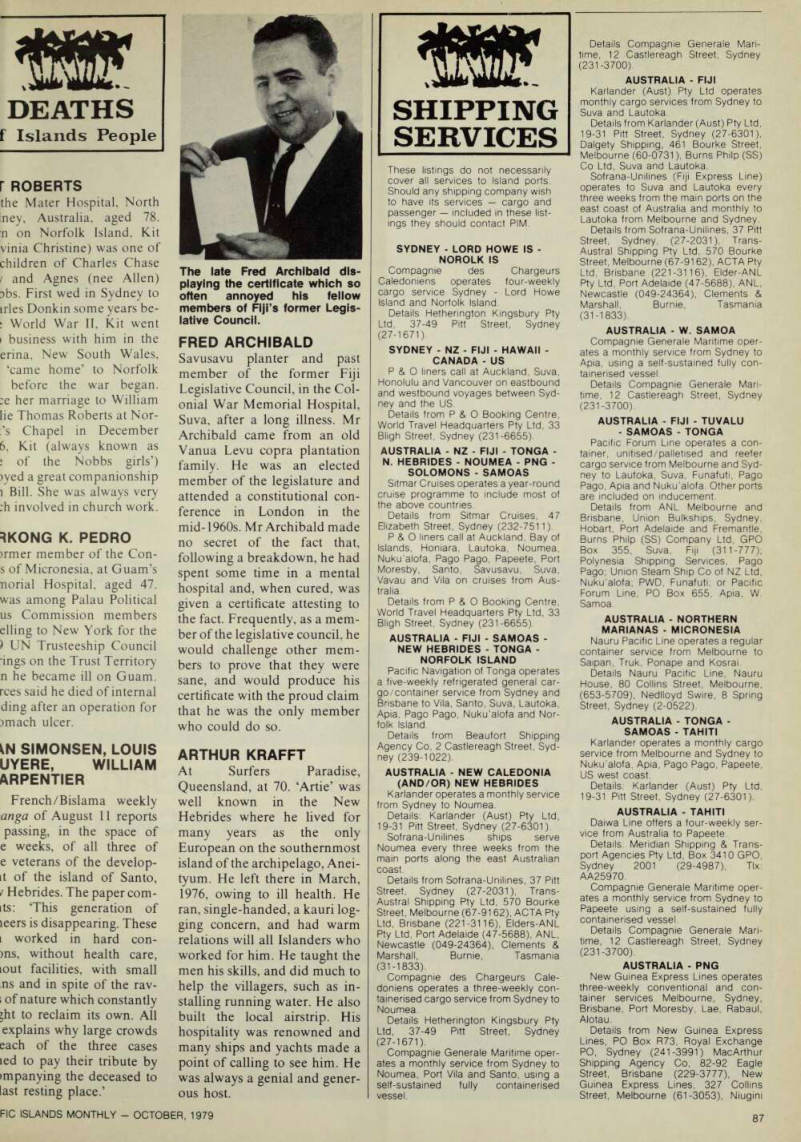
Islands People
R Roberts
the Mater Hospital, North ney, Australia, aged 78. n on Norfolk Island, Kit vinia Christine) was one of children of Charles Chase i and Agnes (nee Allen) 3bs. First wed in Sydney to irles Donkin some years be : World War 11, Kit went • business with him in the erina. New South Wales, ‘came home’ to Norfolk before the war began. :e her marriage to William lie Thomas Roberts at Nor
;’s Chapel in December
6, Kit (always known as ; of the Nobbs girls’)
>yed a great companionship
i Bill. She was always very :h involved in church work.
3Kong K. Pedro
irmer member of the Con s of Micronesia, at Guam’s
norial Hospital, aged 47.
was among Palau Political us Commission members elling to New York for the
) UN Trusteeship Council
•ings on the Trust Territory n he became ill on Guam, rces said he died of internal ding after an operation for imach ulcer.
Tn Simonsen, Louis
Uyere, William
Arpentier
French/Bislama weekly
anga of August 11 reports passing, in the space of e weeks, of all three of e veterans of the develop it of the island of Santo, / Hebrides. The paper com its: ‘This generation of
leers is disappearing. These
l worked in hard con ins, without health care, lout facilities, with small ns and in spite of the rav i of nature which constantly ;ht to reclaim its own. All
explains why large crowds
each of the three cases led to pay their tribute by unpanying the deceased to
last resting place.’
Fred Archibald
Savusavu planter and past member of the former Fiji Legislative Council, in the Col onial War Memorial Hospital, Suva, after a long illness. Mr Archibald came from an old Vanua Levu copra plantation family. He was an elected member of the legislature and attended a constitutional con ference in London in the mid-19605. Mr Archibald made no secret of the fact that, following a breakdown, he had spent some time in a mental hospital and, when cured, was given a certificate attesting to the fact. Frequently, as a mem ber of the legislative council, he would challenge other mem bers to prove that they were sane, and would produce his certificate with the proud claim that he was the only member who could do so.
Arthur Krafft
At Surfers Paradise, Queensland, at 70. ‘Artie’ was well known in the New Hebrides where he lived for many years as the only European on the southernmost island of the archipelago, Anei tyum. He left there in March, 1976, owing to ill health. He ran, single-handed, a kauri log ging concern, and had warm relations will all Islanders who worked for him. He taught the men his skills, and did much to help the villagers, such as in stalling running water. He also built the local airstrip. His hospitality was renowned and many ships and yachts made a point of calling to see him. He was always a genial and gener ous host.
The late Fred Archibald dis playing the certificate which so often annoyed his fellow members of Fiji’s former Legis lative Council.
Services
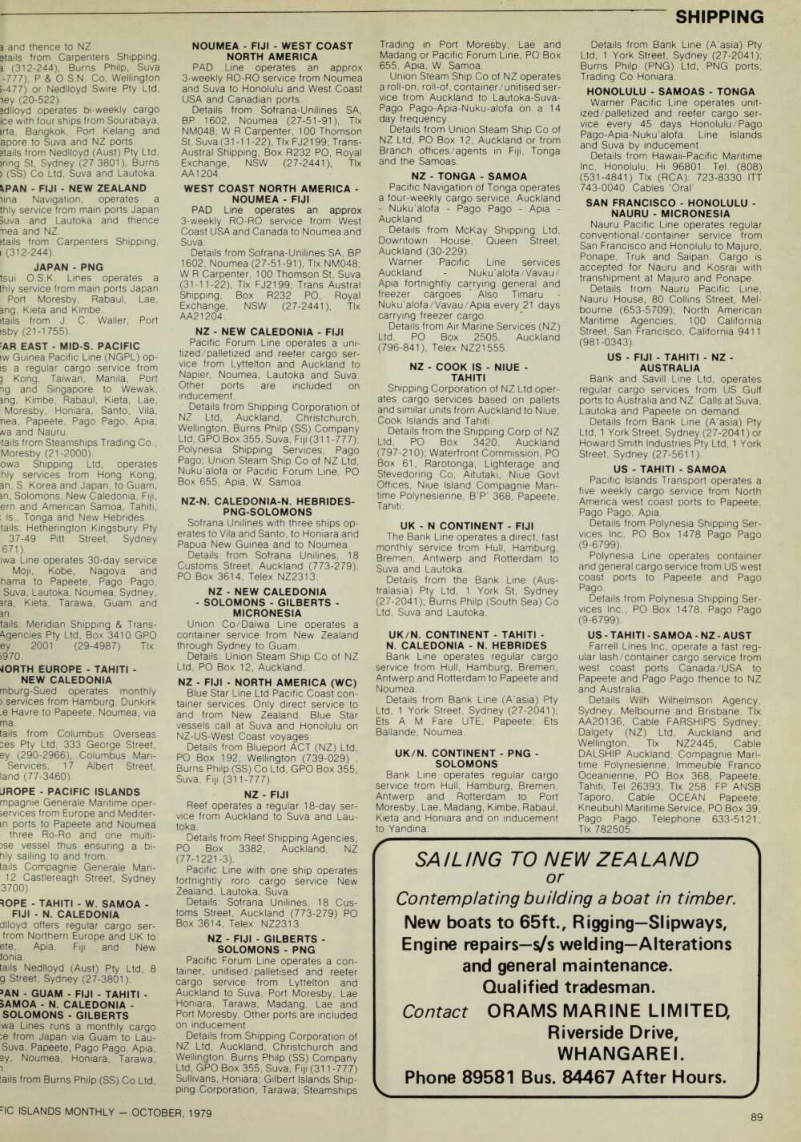
Shipping
These listings do not necessarily cover all services to Island ports.
Should any shipping company wish to have its services cargo and passenger included in these list ings they should contact PIM.
Sydney - Lord Howe Is -
Norolk Is
Compagnie des Chargeurs Caledoniens operates four-weekly cargo service Sydney - Lord Howe Island and Norfolk Island.
Details Hetherington Kingsbury Pty Ltd, 37-49 Pitt Street, Sydney (27-1671), SYDNEY - NZ - FIJI - HAWAII -
Canada - Us
P & O liners call at Auckland, Suva, Honolulu and Vancouver on eastbound and westbound voyages between Syd ney and the US.
Details from P & O Booking Centre, World Travel Headquarters Pty Ltd, 33 Bligh Street, Sydney (231-6655).
AUSTRALIA - NZ - FIJI - TONGA - N. HEBRIDES - NOUMEA - PNG -
Solomons - Samoas
Sitmar Cruises operates a year-round cruise programme to include most of the above countries.
Details from Sitmar Cruises, 47 Elizabeth Street, Sydney (232-7511).
P & O liners call at Auckland, Bay of Islands, Honiara, Lautoka, Noumea, Nukualofa, Pago Pago, Papeete, Port Moresby, Santo, Savusavu, Suva, Vavau and Vila on cruises from Aus tralia.
Details from P & O Booking Centre, World Travel Headquarters Pty Ltd. 33 Bligh Street, Sydney (231-6655)
Australia - Fiji - Samoas -
New Hebrides - Tonga -
Norfolk Island
Pacific Navigation of Tonga operates a five-weekly refrigerated general car go/container service from Sydney and Brisbane to Vila, Santo, Suva, Lautoka, Apia, Pago Pago, Nuku’alofa and Nor folk Island.
Details from Beaufort Shipping Agency Co, 2 Castlereagh Street, Syd ney (239-1022).
Australia - New Caledonia
(And/Or) New Hebrides
Karlander operates a monthly service from Sydney to Noumea.
Details: Karlander (Aust) Pty Ltd, 19-31 Pitt Street, Sydney (27-6301).
Sofrana-Unilines ships serve Noumea every three weeks from the main ports along the east Australian coast.
Details from Sofrana-Unilines, 37 Pitt Street, Sydney (27-2031), Trans- Austral Shipping Pty Ltd, 570 Bourke Street, Melbourne (67-9162), ACTA Pty Ltd, Brisbane (221-3116), Elders-ANL Pty Ltd, Port Adelaide (47-5688), ANL, Newcastle (049-24364), Clements & Marshall, Burnie, Tasmania (31-1833).
Compagnie des Chargeurs Cale
doniens operates a three-weekly con tainerised cargo service from Sydney to Noumea.
Details Hetherington Kingsbury Pty Ltd, 37-49 Pitt Street, Sydney (27-1671).
Compagnie Generate Maritime oper ates a monthly service from Sydney to Noumea, Port Vila and Santo, using a self-sustained fully containerised vessel.
Details Compagnie Generate Mari time, 12 Castlereagh Street, Sydney (231-3700).
Australia - Fiji
Karlander (Aust) Pty Ltd operates monthly cargo services from Sydney to Suva and Lautoka.
Details from Karlander (Aust) Pty Ltd, 19-31 Pitt Street, Sydney (27-6301), Dalgety Shipping, 461 Bourke Street, Melbourne (60-0731), Burns Philp (SS) Co Ltd, Suva and Lautoka.
Sofrana-Unilines (Fiji Express Line) operates to Suva and Lautoka every three weeks from the main ports on the east coast of Australia and monthly to Lautoka from Melbourne and Sydney.
Details from Sofrana-Unilines, 37 Pitt Street, Sydney, (27-2031), Trans- Austral Shipping Pty Ltd, 570 Bourke Street, Melbourne (67-9162). ACTA Pty Ltd, Brisbane (221-3116), Elder-ANL Pty Ltd, Port Adelaide (47-5688), ANL, Newcastle (049-24364), Clements & Marshall, Burnie, Tasmania (31-1833),
Australia - W. Samoa
Compagnie Generate Maritime oper ates a monthly service from Sydney to Apia, using a self-sustained fully con tainerised vessel.
Details Compagnie Generate Mari time, 12 Castlereagh Street, Sydney (231-3700).
Australia - Fiji - Tuvalu
- Samoas - Tonga
Pacific Forum Line operates a con tainer, unitised/palletised and reefer cargo service from Melbourne and Syd ney to Lautoka, Suva, Funafuti, Pago Pago, Apia and Nukualofa. Other ports are included on inducement.
Details from ANL Melbourne and Brisbane, Union Bulkships, Sydney, Hobart, Port Adelaide and Fremantle, Burns Philp (SS) Company Ltd, GPO Box 355, Suva, Fiji (311-777); Polynesia Shipping Services, Pago Pago; Union Steam Ship Co of NZ Ltd, Nukualofa; PWD, Funafuti, or Pacific Forum Line, PO Box 655, Apia, W.
Samoa.
Australia - Northern
Marianas - Micronesia
Nauru Pacific Line operates a regular container service from Melbourne to Saipan, Truk, Ponape and Kosrai.
Details Nauru Pacific Line, Nauru House, 80 Collins Street, Melbourne, (653-5709), Nedlloyd Swire, 8 Spring Street, Sydney (2-0522),
Australia - Tonga -
Samoas - Tahiti
Karlander operates a monthly cargo service from Melbourne and Sydney to Nuku’alofa, Apia, Pago Pago, Papeete, US west coast.
Details: Karlander (Aust) Pty Ltd, 19-31 Pitt Street, Sydney (27-6301).
Australia - Tahiti
Daiwa Line offers a four-weekly ser vice from Australia to Papeete.
Details: Meridian Shipping & Trans port Agencies Pty Ltd, Box 3410 GPO, Sydney 2001 (29-4987), Tlx: AA25970.
Compagnie Generate Maritime oper ates a monthly service from Sydney to Papeete using a self-sustained fully containerised vessel.
Details Compagnie Generate Mari time, 12 Castlereagh Street, Sydney (231-3700).
Australia - Png
New Guinea Express Lines operates three-weekly conventional and con tainer services Melbourne, Sydney, Brisbane, Port Moresby, Lae, Rabaul, Alotau.
Details from New Guinea Express Lines, PO Box R 73, Royal Exchange PO, Sydney (241-3991) MacArthur Shipping Agency Co, 82-92 Eagle Street, Brisbane (229-3777), New Guinea Express Lines, 327 Collins Street, Melbourne (61-3053), Niugini
Express Lines in Port Moresby (21-2466), Lae (42-1536), Rabtrad Niugmi Pty Ltd, Rabaul (92-2911) Alotau Stevedoring & T'soort (61-1318). M Karlander New Guinea Line’s cargo vessels call at Melbourne, Sydney, Port Moresby, Lae, Madang, Wewak Manus, Kimbe, Rabaul, Popondetta.
Details from Karlander (Aust) Pty Ltd 19-31 Pitt Street, Sydney (27-6301)’
Dalgetty Shipping, 461 Bourke Street’
Melbourne (60-0731)
Austral) A-Png-Solomons
A consortium of Conpac, NGAL/PNGL have three container vessels operating on a 28 day turn around from Melbourne, Sydney and Brisbane to Port Moresby, Lae, Rabaul, Kavieng, Wewak Madang, Kieta and Honiara supplemented by Daiwa vessels, Pacific Princess and Fiji Maru extending from Sydney to Lae on a monthly basis.
Details from Burns, Philp & Co. Ltd 51 Pitt Street, Sydney (2-0547) and Interocean Swire, 8 Spring Street Svd ney. (2-0522).
Australia-Solomons
Northern Marianas-Taiwan
Japan
Daiwa Line offers a four-weekly ser vice Sydney-Honiara-Guam-Taiwan- Japan with transhipment at Guam for Saipan.
Details Meridian Shipping & Trans port Agencies Pty Ltd, Box 3410 GPO Sydney 2001 (29-4987). Tlx’
AA25970.
Australia - Solomons -
Gilbert Is - Micronesia
Daiwa Line operates a container ser vice every 30 days from Sydney to Honiara, Kieta, Tarawa and Guam. Gizo cargoes transhipped at Honiara, Saipan, cargoes transhipped at Guam.
Details Meridian Shipping & Trai port Agancies Pty Ltd, Box 3410 Gl Sydney 2001 (29-4987) 1 AA25970.
Australia - Nauru -
Majuro
Nauru Pacific Line operates regu cargo/passenger service from M bourne to Nauru and Majuro.
Details: Nauru Pacific Line, Nai House, 80 Collins Street, Melbour (653-5709), Nedlloyd Swire, 8 Spri Street, Sydney (2-0522).
Png - Uk/Continent
Bank Line operates regular car service from Kieta, Rabaul, Kiml Madang and Lae to Cardiff, Hambu Rotterdam and Antwerp, Details from Bank Line (A’asia) F Ltd. 1 York Street, Sydney (27-204 Burns Philp (PNG) Ltd, ports.
Png - Us
Bank Line operates regular can service from Kieta, Rabaul, Kimt Madang and Lae direct to New Orlear calls at other US and Gulf and Ee Coast ports on inducement.
Details from Bank Line (A’asia) F Ltd, 1 York Street, Sydney (27-204 1 Burns Philp (PNG) Ltd, PNG ports.
Solomons - Usa -
Uk/Continent
Bank Line operates regular carj service from Honiara to New Orlean Cardiff, Hamburg, Rotterdam and Ar werp.
Details from Bank Line (A’asia) £ Ltd, 1 York Street, Sydney (27-2041 Trading Co, Honiara (389).
Far East - Fiji - New
Zealand
New Zealand Unit Express (NZUI operates a fortnightly palletised care service from Manila, Keelurii Kaoshiung and Hong Kong to Lautoki
a and thence to NZ.
“tails from Carpenters Shipping, i (312-244), Burns Philp, Suva -777), P & O S.N. Co, Wellington !-477) or Nedlloyd Swire Pty Ltd, ney (20-522). adlloyd operates bi-weekly cargo ice with four ships from Sourabaya, irta, Bangkok, Port Kelang and apore to Suva and NZ ports.
“tails from Nedlloyd (Aust) Pty Ltd, >ring St, Sydney (27 3801), Burns > (SS) Co Ltd. Suva and Lautoka.
\Pan - Fiji - New Zealand
lina Navigation, operates a thly service from main ports Japan Suva and Lautoka and thence mea and NZ.
“tails from Carpenters Shipping, l (312-244).
Japan - Png
tsui O.S.K. Lines operates a thly service from main ports Japan Port Moresby, Rabaul, Lae, ang, Kieta and Kimbe. (tails from J. C. Waller, Port (Sby (21-1755).
Ar East - Mid-S. Pacific
(w Guinea Pacific Line (NGPL) op (S a regular cargo service from 3 Kong, Taiwan, Manila, Port ng and Singapore to Wewak, ang, Kimbe, Rabaul, Kieta, Lae, Moresby, Honiara, Santo, Vila, nea, Papeete, Pago Pago, Apia, A/a and Nauru. tails from Steamships Trading Co., Moresby (21-2000) owa Shipping Ltd, operates hly services from Hong Kong, an, S. Korea and Japan, to Guam, in, Solomons, New Caledonia, Fiji, ern and American Samoa, Tahiti, ; Is., Tonga and New Hebrides, tails: Hetherington Kingsbury Pty 37-49 Pitt Street, Sydney 671). iwa Line operates 30-day service Moji, Kobe, Nagoya and hama to Papeete, Pago Pago, Suva, Lautoka, Noumea, Sydney, ara, Kieta, Tarawa, Guam and an. tails: Meridian Shipping & Trans agencies Pty Ltd, Box 3410 GPO ey 2001 (29-4987) Tlx: >970.
Jorth Europe - Tahiti -
New Caledonia
mburg-Sued operates monthly ) services from Hamburg, Dunkirk .e Havre to Papeete, Noumea, via ma. tails from Columbus Overseas ties Pty Ltd, 333 George Street, ey (290-2966), Columbus Man- Services. 17 Albert Street, land (77-3460).
Jrope - Pacific Islands
mpagnie Generate Maritime oper >ervices from Europe and Mediter m ports to Papeete and Noumea three Ro-Ro and one multi ase vessel thus ensuring a bi hly sailing to and from, tails Compagnie Generate Mari -12 Castlereagh Street, Sydney 3700).
- Tahiti - W. Samoa -
Fiji - N. Caledonia
dlloyd offers regular cargo ser from Northern Europe and UK to ete, Apia, Fiji and New lonia. tails Nedlloyd (Aust) Pty Ltd, 8 g Street, Sydney (27-3801). >AN - GUAM - FIJI - TAHITI -
Samoa - N. Caledonia -
Solomons - Gilberts
wa Lines runs a monthly cargo ie from Japan via Guam to Lau- Suva, Papeete, Pago Pago, Apia, sy, Noumea, Honiara, Tarawa, i. tails from Burns Philp (SS) Co Ltd,
Noumea - Fiji - West Coast
North America
PAD Line operates an approx 3-weekly RO-RO service from Noumea and Suva to Honolulu and West Coast USA and Canadian ports.
Details from Sofrana-Unilines SA, BP 1602, Noumea (27-51-91), Tlx NMO4B; W R Carpenter, 100 Thomson St, Suva (31-11 -22), Tlx FJ2199; Trans- Austral Shipping, Box R 232 PO, Royal Exchange, NSW (27-2441), Tlx AA1204.
West Coast North America -
Noumea - Fiji
PAD Line operates an approx 3-weekly RO-RO service from West Coast USA and Canada to Noumea and Suva, Details from Sofrana-Unilines SA, BP 1602, Noumea (27-51-91). Tlx NMO4B; W R Carpenter, 100 Thomson St, Suva (31-11-22), Tlx FJ2199; Trans Austral Shipping, Box R 232 PO, Royal Exchange, NSW (27-2441), Tlx AA21204.
Nz - New Caledonia - Fiji
Pacific Forum Line operates a uni tized/palletized and reefer cargo ser vice from Lyttelton and Auckland to Napier, Noumea, Lautoka and Suva.
Other ports are included on inducement.
Details from Shipping Corporation of NZ Ltd, Auckland, Christchurch, Wellington, Burns Philp (SS) Company Ltd, GPO Box 355, Suva, Fiji (31 1 -777); Polynesia Shipping Services, Pago Pago; Union Steam Ship Co of NZ Ltd, Nukualofa or Pacific Forum Line, PO Box 655, Apia, W. Samoa.
Nz-N. Caledonia-N. Hebrides
Png-Solomons
Sofrana Unilines with three ships op erates to Vila and Santo, to Honiara and Papua New Guinea and to Noumea.
Details from Sofrana Unilines, 18 Customs Street, Auckland (773-279), PO Box 3614, Telex NZ2313.
Nz - New Caledonia
- Solomons - Gilberts -
Micronesia
Union Co/Daiwa Line operates a container service from New Zealand through Sydney to Guam.
Details: Union Steam Ship Co of NZ Ltd, PO Box 12, Auckland.
NZ - FIJI - NORTH AMERICA (WC) Blue Star Line Ltd Pacific Coast con tainer services. Only direct service to and from New Zealand Blue Star vessels call at Suva and Honolulu on NZ-US-West Coast voyages Details from Blueporf ACT (NZ) Ltd, PO Box 192, Wellington (739-029) , Burns Philp (SS) Co Ltd, GPO Box 355, Suva, Fiji (311-777),
Nz - Fiji
Reef operates a regular 18-day ser vice from Auckland to Suva and Lau toka.
Details from Reef Shipping Agencies, PO Box 3382, Auckland, NZ (77-1221-3).
Pacific Line with one ship operates fortnightly roro cargo service New Zealand, Lautoka, Suva.
Details: Sofrana Unilines, 18 Cus toms Street, Auckland (773-279) PO Box 3614, Telex: NZ2313.
Nz - Fiji - Gilberts -
Solomons - Png
Pacific Forum Line operates a con tainer, unitised/palletised and reefer cargo service from Lyttelton and Auckland to Suva, Port Moresby, Lae Honiara, Tarawa, Madang, Lae and Port Moresby. Other ports are included on inducement.
Details from Shipping Corporation of NZ Ltd, Auckland, Christchurch and Wellington. Burns Philp (SS) Company Ltd, GPO Box 355, Suva, Fiji (31 1 -777) Sullivans, Honiara; Gilbert Islands Ship ping Corporation, Tarawa; Steamships
Trading in Port Moresby, Lae and Madang or Pacific Forum Line, PO Box 655, Apia, W. Samoa.
Union Steam Ship Co of NZ operates a roll-on, roll-of, container/unitised ser vice from Auckland to Lautoka-Suva- Pago Pago-Apia-Nuku-alofa on a 14 day frequency.
Details from Union Steam Ship Co of NZ Ltd, PO Box 12, Auckland or from Branch offices/agents in Fiji, Tonga and the Samoas.
Nz- Tonga - Samoa
Pacific Navigation of Tonga operates a four-weekly cargo service, Auckland - Nuku’alofa - Pago Pago - Apia - Auckland.
Details from McKay Shipping Ltd, Downtown House, Queen Street, Auckland (30-229).
Warner Pacific Line services Auckland - Nuku’alofa/Vavau/ Apia fortnightly carrying general and freezer cargoes ’ Also Timaru Nuku'alofa/Vavau/Apia every 21 days carrying freezer cargo.
Details from Air Marine Services (NZ) Ltd, PO Box 2505, Auckland (796-841). Telex NZ21555.
NZ - COOK IS - NIUE -
Tahiti
Shipping Corporation of NZ Ltd oper ates cargo services based on pallets and similar units from Auckland to Niue, Cook Islands and Tahiti.
Details from the Shipping Corp of NZ Ltd, PO Box 3420, Auckland (797-210); Waterfront Commission, PO Box 61, Rarotonga, Lighterage and Stevedoring Co, Aitutaki, Niue Govt Offices, Niue Island Compagnie Mari time Polynesienne, B'P’ 368, Papeete, Tahiti
Uk - N Continent - Fiji
The Bank Line operates a direct, fast monthly service from Hull, Hamburg, Bremen, Antwerp and Rotterdam to Suva and Lautoka.
Details from the Bank Line (Aus tralasia) Pty Ltd, 1 York St, Sydney (27-2041); Burns Philp (South Sea) Co Ltd, Suva and Lautoka.
Uk/N. Continent - Tahiti -
N. Caledonia - N. Hebrides
Bank Line operates regular cargo service from Hull, Hamburg, Bremen, Antwerp and Rotterdam to Papeete and Noumea.
Details from Bank Line (A’asia) Ply Ltd, 1 York Street, Sydney (27-2041); Ets A M Fare UTE, Papeete; Ets Ballande, Noumea.
Uk/N. Continent - Png -
Solomons
Bank Line operates regular cargo service from Hull, Hamburg, Bremen, Antwerp and Rotterdam to Port Moresby, Lae, Madang, Kimbe, Rabaul, Kieta and Honiara and on inducement to Yandina.
Details from Bank Line (A'asia) Pty Ltd, 1 York Street, Sydney (27-2041); Burns Philp (PNG) Ltd, PNG ports; Trading Co Honiara.
Honolulu - Samoas - Tonga
Warner Pacific Line operates unit ized/palletized and reefer cargo ser vice every 45 days Honolulu/Pago Pago-Apia-Nuku’alofa. Line Islands and Suva by inducement.
Details from Hawaii-Pacific Maritime Inc, Honolulu, Hi 96801, Tel. (808)
(531-4841) Tlx (Rca): 723-8330 Itt
743-0040. Cables ‘Oral’
San Francisco - Honolulu -
Nauru - Micronesia
Nauru Pacific Line operates regular conventional/container service from San Francisco and Honolulu to Majuro, Ponape, Truk and Saipan. Cargo is accepted for Nauru and Kosrai with transhipment at Majuro and Ponape.
Details from Nauru Pacific Line, Nauru House, 80 Collins Street, Mel bourne (653-5709); North American Maritime Agencies, 100 California Street, San Francisco, California 9411 (981-0343) US - FIJI - TAHITI - NZ -
Australia
Bank and Savill Line Ltd, operates regular cargo services from US Gulf ports to Australia and NZ. Calls at Suva, Lautoka and Papeete on demand.
Details from Bank Line (A'asia) Pty Ltd, 1 York Street, Sydney (27-2041) or Howard Smith Industries Pty Ltd, 1 York Street, Sydney (27-5611).
Us - Tahiti - Samoa
Pacific Islands Transport operates a five weekly cargo service from North America west coast ports to Papeete, Pago Pago, Apia.
Details from Polynesia Shipping Ser vices Inc, PC Box 1478 Pago Pago (9-6799).
Polynesia Line operates container and general cargo service from US west coast ports to Papeete and Pago
Pago.
Details from Polynesia Shipping Ser vices Inc., PO Box 1478, Pago Pago (9-6799).
US - TAHITI - SAMOA - NZ - AUST Farrell Lines Inc, operate a fast reg ular lash/container cargo service from west coast ports Canada/USA to Papeete and Pago Pago thence to NZ and Australia.
Details Wilh Wilhelmson Agency, Sydney, Melbourne and Brisbane, Tlx AA20136, Cable FARSHIPS Sydney; Dalgety (NZ) Ltd, Auckland and Wellington, Tlx NZ2445, Cable DALSHIP Auckland; Compagnie Mari time Polynesienne, Immeuble Franco Oceanienne, PO Box 368, Papeete, Tahiti, Tel 26393, Tlx 258. FP ANSB Taporo, Cable OCEAN Papeete; Kneubuhl Maritime Service, PO Box 39, Pago Pago, Telephone 633-5121; Tlx 782505.
Advertisements & other items, pp. 87-90 (3 items)
87
FIG ISLANDS MONTHLY - OCTOBER, 1979
Daiwa Line
JB PRCIFIC
ip FORUm
OWNED BY THE PEOPLE
OF THE PACIFIC ISLANDS
0. Regular Mon th/y L iner Services
from Australia and New Zealand
to the South and Central Pacific
FOR INFORMATION CONTACT AGENTS:
AMERICAN SAMOA:
Polynesian Shipping Services Inc. P.O. Box 1478, Pago Pago.
AUSTRALIA:
The Australian National Line, 50 Queen Street, Melbourne.
Union Bulkships Pty.Ltd., 333-339 George Street Sydney
GILBERT ISLANDS:
Gilbert Islands Shipping Corp. P.O. Box 495 Tarawa.
FIJI:
Burns Philp South Sea Co. Ltd. GPO Box 355 Suva.
NEW CALEDONIA:
ETS Ballande, BP. C 4, Noumea.
NEW HEBRIDES:
Burns Philp New Hebrides Limited, Vila.
NEW ZEALAND:
The Shipping Corp. of N.Z. Ltd. P.O. Box 3344, Wellington.
PAPUA NEW GUINEA:
Steamships Trading Co. Ltd. P.O. Box 1, Port Moresby.
SOLOMON ISLANDS;
Sullivans S.l. Ltd. GPO Box 3, Honiara.
TONGA:
Union Steam Ship Co. P.O. Box 4, Nuku'alofa.
DAIWA LINE
JAPAN-SOUTH PACIFIC REGULAR SERVICE
AUSTRALIA-SOUTH PACIFIC CONTAINER SERVICE
JAPAN-TAIWAN-GUAM-SAIPAN REGULAR SERVICE
DAIWA LINE BRIDGES SOUTH PACIFIC
WITH RO/RO CAR & CONTAINER CARRIER
JAPAN GUAM LAUTOKA—SUVA—PAPEETE—PAGO PAGO—APIA—NOUMEA
SYDNEY HONIARA—KIETA—TARAWA—GUAM—TAIWAN—JAPAN
JAPAN —MAJURO—RAROTONGA—VILA—SANTO—NAURU—JAPAN
JAPAN—TAIWAN—GUAM—SAIPAN—JAPAN
THE DAIWA NAYIGATION CO., LTD.
OSAKA; "DAILINE"
HEAD OFFICE
DAHCHI KYOGYO BLDG
45. 2-CHOME. AWAZAMINAMi-OORI
NISH-KU, OSAKA, JAPAN
TELEPHONE 06 531-0471 -9
TELEX: 525-6324 & 525-6325
TOKYO: “FUNEDAILINE”
TOKYO OFFICE
SHIN-DAIICHI'BI DG
4-13, NIHONBASHI 3 CHOME. CHUO-KU,
TOKYO. JAPAN
TELEPHONE: ‘ 03274-3251
TELEX: 222-3343, J 23559
SA /LING TO NEW ZEA LA ND or Contemplating building a boat in timber.
New boats to 65ft., Rigging—Slipways, Engine repairs—s/s welding—Alterations and general maintenance.
Qualified tradesman.
Contact GRAMS MARINE LIMITED,
Riverside Drive,
WHANGAREI.
Phone 89581 Bus. 84467 After Hours.
CLASSIFIED
FOR SALE
FLEETS 49 ft 6 inch x 17 ft x 6 ft
PARTLY PLANKED HULL, Timbers
frames, stringers fitted "AS IS", including balance planking timber, timber for decks, 3" Stainless Steel prop shaft, stern tube, $42,000 FLEETS 221 Esplanade, Wynnum Central, Brisbane. Cable ‘‘FLEETS
BRISBANE'.
FOR SALE
36' Cruising Ketch. $A23,000 P.O. Box 447, Vila
NEW HEBRIDES
CC i s High reliability, totally marinised SOMA Windmills charge batteries to run lights, tools, water pumps, etc. 200 watt 12 volt unit SNZBSO.
FOB Auckland. 500 watt 24 volt unit SNZIOOO.
FOB Auckland.
Send for free brochure and c.i.f. quotes or send SNZ3.SO for post-paid Installation Manual.
SOMA
WINDMILLS LTD.
P.O. Box 94, Russell, New Zealand.
Shipping
89
-1C ISLANDS MONTHLY - OCTOBER, 1979
Advertisers' Index
Akai Electric 21 Air New Guinea 24, 26, 27 Aggie Grey Hotel 29 Amatil 42 Advam 82 Air New Zealand 74 Abbey Bookshop 65 Bull's Marine 43 Boral Gas 73 Bankline 84 Caterpillar 12 Chloride Batteries 44 Cumines 52
Cig 59
Clarion 91 Dept. Finance 56-57
Dept. Overseas Trade 78 Daiwa Line 88 Fastair 80 Fleets 90 Fisher Trading 52,90 Goodyear 32 General Steam 85 Hendon 85 Hinchcliffe 65 Kelvinator 34-35 Mono Pumps 55 Marine Pacific 90 Nylex 39 Nelson & Robertson 81 Nissan Motor Co. 92
Grams Marine 89 Pacific Forum 88 Polynesian Air 6 Polynesian Bookshop 65 Papua Hotel 29 Pioneer 46-47 Parker 51 Portals 68 QBE Insurance 40 Qantas 64 Queensland Marine 90 Rowntree 54 Sony 28 Sebel 38 Seiko 62 Sansui 76-77
Somar g( Toyota 2 Travelodge Tatham 6' Thornhill Pastoral 8( Union Steamship 8( University of Sydney 9( Victa 3( Vickers Cockatoo 3( Victor 6!
Yamaha 7; Watson & Crane 4J Waterwheel 3i Whangarei 9C Yachting Ptnrs 2£
Advertisements & other items, pp. 90-92 (1 item)
Pty Ltd
Ph0ne(070)514039 A/Hrs 93 7268 . . . u Telex QUMAR AA 48475 C^pta,n Donald A Ho f Mail PO. Box 1871, Cairns 4870 T Eng 1
oueensiflnp mpßing brokerrge
COMMERCIAL SHIPPING SALES & CHARTER
80ft. Motor Yacht Twin G.M $70,000 118 ft. Hydraulic Cutter Suction Dredge .. $200,00' 90ft. Wooden Cargo Vessel $155,001 69ft. Wooden Cargo/Passenger $35,000 Office Suite 2 Mac Donnell Lane 26 Abbott St Cairns Servicing Australia and the South West Pacific.
RINE PACIFIC LTD
SALVAGE TOWAGE
TUGS
500 - 2700 b.h.p.
RAMPED - BARGES
250 500 d.w.t.
For charter throughout the South Pacific cable: TUGBOAT, SUVA, telex: FJ2202
THE
UNIVERSITY
OF SYDNEY
Walter Mersh Strong
Scholarships
Applications are invited from Papua New Guineans for the above scholarships, which are available either as (a) undergraduate scholarships open to Papua New Guineans who are qualified to matriculate in the University of Sydney or (b) postgraduate scholarships open to Papua New Guinean graduates for postgraduate research or course work at the University of Sydney.
Further information and applications are available from the Registrar, University of Sydney, NSW 2006 Applications close on 2 October 1979. (Or as soon as possible thereafter.) Students applying for undergraduate scholarships must also apply for admission to the University through the Metropolitan Universities Admission Centre by 3 October. (Late applications are accepted up to January on payment of a late fee).
/i VI D/ w
WHANGAREI ENGINEERING & CONSTRUCTION
LTD.
A. Dillingham Affiliate
SHIPBUILDERS & GENERAL ENGINEERS
Port Road, Whangarei, New Zealand - P.O. BOX 24
TELEPHONE 82-219-TELEX NZ. 21578.
NEW
ZEALAND'S
LEADING
SHIPYARD
SHIP DESIGN AND BUILD:
Complete Facility.
SHIP REPAIR:
Quick Turn-around. AH trades integrated. 1,700 t Slipway A vail able.
PETER FISHER
TRADING
Pty Ltd
321 PITT St., SYDNEY, AUSTRALIA 2000
Telephone: 212 1475 Cables: "FISHERION" Sydney
EXPORTERS TO THE
PACIFIC ISLANDS
Clarion
The One For The Road
II ■ 7 > —: DM <*»?„■• ‘ » ’ 9 gg OClaiion 0 Clarion Co., Ltd. Tokyo, Japan PE-758 'larion reliability, proven on the toughest oads and in the hottest weather. Easy-opertion design, for your convenience and added Iriving safety. A wide selection of easy-tonstall car stereos, backed by Clarion’s
enowned quality and high performance.
Clarion—the best way to listening and
Iriving pleasure.
Australia: Amalgamated Wireless (Australasia) Ltd. 554 Parramatta Road, Ashfield N.S.W., 2131/New Zealand: AWA New ealand Limited P.O. Box 50-248 Porirua/Fiji Islands: Brijlal & Co., Ltd. G.P.O. Box 362 Suva/Tahiti: HI-FI Shangrila >.P. 200 Papeete/New Caledonia: Caldis B.P. Ml Noumea Cedex/ Guam: Guam Radio &TV Shop P.O. Box 1939 Agana, juam 96910/New Hebrides: The Sound Centre P.O. Box 434 Vila/ Cook Islands: South Seas International Ltd. P.O. Box 9 Rarotonga/Papua New Guinea: Hagemeyer (P.N.G.) Pty. Ltd. P.O. Box 1428, Boroko, Port Moresby.
Datsun’s “pass/no pass sample’:
■ ■I
so you pass with dying colors
The “pass/no pass sample”... an example of Datsun's extra effort that makes sure your car gets the best in paint quality. And, that way, captures the admiration of your friends with flying colors.
Here’s how it works.
Serving as an authoritative guide—rather like a dictionary to a writer—the “pass/no pass sample” illustrates the various key points for painting a car, against which our workers can critically compare a car as it emerges from the paint line. Following Datsun’s philosophy that every worker should be a ‘specialist” at his job, all our / , workers <1 longthie paint line know the “pass/no pass sample" by heart.
So that they can tell, virtually at a glance, whether a car's paint has the right sort of finish, luster and depth. Otherwise, it’s “no pass...
And there are no shortcuts either.
So we do the "extra.” Like plating the panel stamping dies to facilitate rinsing and elimination of particles that could undermine the stamping process. Before painting, the panels are carefully examined for any hint of imperfection... if found, the panel is x B & O mm Datsun’s “pass/no pass sample.’ 1 smoothened with a whetstone to a satin finish Finally, the panel is rotated through various angles to receive the light reflections that allow the discovery of any imperfection, no matter how small. Then, and only then, is a panel sent for painting.
Checking.,. checking... and more checking. That’s simply because Datsun thinks you deserve only the best very
THt NAM( Of QUAUT
Datsun’s “extra”effort for total quality. DATSUN ♦ Datcim DictriKi • DAmL/s i * wa,u Bay. Suva, Fiji .slands Private Mai, Bag/ Morris prises PO. Box 4, Republic 0 f Nauru7cook S Sf Ce^eT Ud^O ‘ Box WfiSSon.nfrn '| !^ds/ Sirius Motors PO. Box 34, Norfolk Island, South Pacific/ Jacob Enter- Agence Alma S.A. B.P. A 3, Noumea Cedex, New Caledon a/ Tahi Suli S AR L B P 3595 S / JEiL 01 ? ? c,f,c/ PaCi,iC SA PO Box 1 19 ’ R)rt Vi,a ' New Hebrides/ d/ anmouii 0.a.h.1. b.k 359, Papeete. Tahiti /Gilbert Islands Government, Supply Division PO. Box 71. Bairiki, Tarawa, Gilbert Islands